


Community hub
Recent from talks
Contribute something
Nothing was collected or created yet.
Functionalism (architecture)
View on Wikipedia
In architecture, functionalism is the principle that buildings should be designed based solely on their purpose and function. An international functionalist architecture movement emerged in the wake of World War I, as part of the wave of Modernism. Its ideas were largely inspired by a desire to build a new and better world for the people, as broadly and strongly expressed by the social and political movements of Europe after the extremely devastating world war. In this respect, functionalist architecture is often linked with the ideas of socialism and modern humanism.
A new slight addition to this new wave of architecture was that not only should buildings and houses be designed around the purpose of functionality, architecture should also be used as a means to physically create a better world and a better life for people in the broadest sense. This new functionalist architecture had the strongest impact in Czechoslovakia, Germany, Poland,[1] the USSR and the Netherlands, and from the 1930s also in Scandinavia and Finland.
This principle is a matter of confusion and controversy within the profession, particularly in regard to modern architecture, as it is less self-evident than it first appears.
History
[edit]The theoretical articulation of functionalism in buildings can be traced back to the Vitruvian triad, where utilitas (variously translated as 'commodity', 'convenience', 'utility') stands alongside firmitas (firmness) and venustas (beauty) as one of three classic goals of architecture. Functionalist views were typical of some Gothic Revival architects. In particular, Augustus Welby Pugin wrote that "there should be no features about a building which are not necessary for convenience, construction, or propriety" and "all ornament should consist of enrichment of the essential construction of the building".[2]
In 1896, Chicago architect Louis Sullivan coined the phrase Form follows function. However, this aphorism does not relate to a contemporary understanding of the term 'function' as utility or the satisfaction of user needs; it was instead based in metaphysics, as the expression of organic essence and could be paraphrased as meaning 'destiny'.[3]
In the mid-1930s, functionalism began to be discussed as an aesthetic approach rather than a matter of design integrity (use). The idea of functionalism was conflated with a lack of ornamentation, which is a different matter. It became a pejorative term associated with the baldest and most brutal ways to cover space, like cheap commercial buildings and sheds, then finally used, for example in academic criticism of Buckminster Fuller's geodesic domes, simply as a synonym for 'gauche'.
For 70 years the influential American architect Philip Johnson held that the profession has no functional responsibility whatsoever, and this is one of the many views today. The position of postmodern architect Peter Eisenman is based on a user-hostile theoretical basis and even more extreme: "I don't do function."[4]
Modernism
[edit]Popular notions of modern architecture are heavily influenced by the work of the Franco-Swiss architect Le Corbusier and the German architect Mies van der Rohe. Both were functionalists at least to the extent that their buildings were radical simplifications of previous styles. In 1923, Mies van der Rohe was working in Weimar Germany, and had begun his career of producing radically simplified, lovingly detailed structures that achieved Sullivan's goal of inherent architectural beauty. Le Corbusier famously said "a house is a machine for living in"; his 1923 book Vers une architecture was, and still is, very influential, and his early built work such as the Villa Savoye in Poissy, France, is thought of as prototypically function.
In Europe
[edit]Czechoslovakia
[edit]The former Czechoslovakia was an early adopter of the functionalist style, with notable examples such as Villa Tugendhat in Brno, designed by Mies van der Rohe in 1928, Villa Müller in Prague, designed by Adolf Loos in 1930, and the majority of the city of Zlín, developed by the Bata shoe company as a factory town in the 1920s[5] and designed by Le Corbusier's student František Lydie Gahura.
Numerous villas, apartment buildings and interiors, factories, office blocks and department stores can be found in the functionalist style throughout the country, which industrialised rapidly in the early 20th century while embracing the Bauhaus-style architecture that was emerging concurrently in Germany.[6] Large urban extensions to Brno in particular contain numerous apartment buildings in the functionalist style, while the domestic interiors of Adolf Loos in Plzeň[7] are also notable for their application of functionalist principles.
-
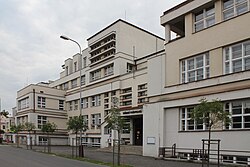 Secondary Industrial School (Mladá Boleslav), 1927, Jiří Kroha
 -
 Villa Tugendhat (Brno), 1928, Ludwig Mies van der Rohe
 -
 Villa Müller (Prague), 1930, Adolf Loos
 -
 Brno Crematorium (Brno), 1930, Ernst Wiesner
 -
 Hotel Avion (Brno), 1928, Bohuslav Fuchs
 -
 Zlín, factory city built by the Bata Company
 -
 Tomas Bata Memorial (Zlín), 1933, František Lydie Gahura


.JPG)


Germany
[edit]German modern architects had been working in a style using principles associated with Functionalism from the 1910s onward; using angular geometric designs, glass, and unadorned facades. By the 1920s, this style came to prominence over competing styles such as Expressionism. The movement was known by several terms including Neue Sachlichkeit (New Sobriety, or New Objectivity) and Neues Bauen (New Building).
Nordic "funkis"
[edit]
In Scandinavia and Finland, the international movement and ideas of modernist architecture became widely known among architects at the 1930 Stockholm Exhibition, under the guidance of director and Swedish architect Gunnar Asplund. Enthusiastic architects collected their ideas and inspirations in the manifesto acceptera and in the years thereafter, a functionalist architecture emerged throughout Scandinavia. The genre involves some peculiar features unique to Scandinavia and it is often referred to as "funkis", to distinguish it from functionalism in general. Some of the common features are flat roofing, stuccoed walls, architectural glazing and well-lit rooms, an industrial expression and nautical-inspired details, including round windows.[8] The global stock market crisis and economic meltdown in 1929, instigated the needs to use affordable materials, such as brick and concrete, and to build quickly and efficiently. These needs became another signature of the Nordic version of functionalist architecture, in particular in buildings from the 1930s, and carried over into modernist architecture when industrial serial production became much more prevalent after World War II.[9]
As most architectural styles, Nordic funkis was international in its scope and several architects designed Nordic funkis buildings throughout the region. Some of the most active architects working internationally with this style, includes Edvard Heiberg, Arne Jacobsen and Alvar Aalto. Nordic funkis features prominently in Scandinavian urban architecture, as the need for urban housing and new institutions for the growing welfare states exploded after World War II. Funkis had its heyday in the 1930s and 1940s, but functionalist architecture continued to be built long into the 1960s. These later structures, however, tend to be categorized as modernism in a Nordic context.
Denmark
[edit]Vilhelm Lauritzen, Arne Jacobsen and C.F. Møller were among the most active and influential Danish architects of the new functionalist ideas and Arne Jacobsen, Poul Kjærholm, Kaare Klint, and others, extended the new approach to design in general, most notably furniture which evolved to become Danish modern.[10] Some Danish designers and artists who did not work as architects are sometimes also included in the Danish functionalist movement, such as Finn Juhl, Louis Poulsen and Poul Henningsen. In Denmark, bricks were largely preferred over reinforced concrete as construction material, and this included funkis buildings. Apart from institutions and apartment blocks, more than 100,000 single-family funkis houses were built in the years 1925–1945. However, the truly dedicated funkis design was often approached with caution. Many residential buildings only included some signature funkis elements such as round windows, corner windows or architectural glazing to signal modernity while not provoking conservative traditionalists too much. This branch of restrained approach to the funkis design created the Danish version of the bungalow building.[11][12]
Fine examples of Danish functionalist architecture are the now listed Kastrup Airport's Vilhelm Lauritzen's Terminal ( 1939), Aarhus University (by C. F. Møller et al.) and Aarhus City Hall (by Arne Jacobsen et al.), all including furniture and lamps specially designed for these buildings in the functionalist spirit. The largest functionalist complex in the Nordic countries is the 30,000-sq. m. residential compound of Hostrups Have in Copenhagen.[13]
-
 Vodroffsvej 2, Copenhagen (1929–30)
 -
 Det Grønne Funkishus (1932), Frederiksberg. Early funkis, facade detail.
 -
 Bellavista (1934), Klampenborg
 -
 Hotel Astoria, Copenhagen (1935)
 -
 Bakkegården (1935–38), Aarhus
 -
 Champagnehuset (1936), Copenhagen
 -
 Skovvangsskolen (1937), Aarhus
 -
 Vilhelm Lauritzen's Terminal, Copenhagen ( 1939),
 -
 Frederiksgade no. 1 (1939), Aarhus
 -
 Strandparken (1938), Aarhus. Typical pastel colour for stuccoed funkis.
 -
 The Standard (1937), Copenhagen. Former custom house.
 -
 Knippelsbro bridge (1935), Copenhagen
 -
 Aarhus City Hall (1941), Aarhus. Marble facade.
 -
 Lyngby City Hall (1941), Lyngby
 -
 Dronningegården (1958), Copenhagen. Late funkis.
 -
 Aarhus University (1933 onwards)
 -
 Aarhus University. This building is from 1974.

.jpg)


.jpg)


.jpg)
.jpg)


Finland
[edit]Some of the most prolific and notable architects in Finland, working in the funkis style, includes Alvar Aalto and Erik Bryggman who were both engaged from the very start in the 1930s. The Turku region pioneered this new style and the journal Arkkitehti mediated and discussed functionalism in a Finnish context. Many of the first buildings in the funkis style were industrial structures, institutions and offices but spread to other kinds of structures such as residential buildings, individual housing and churches. The functionalist design also spread to interior designs and furniture as exemplified by the iconic Paimio Sanatorium, designed in 1929 and built in 1933.[14][9][15]
Aalto introduced standardised, precast concrete elements as early as the late 1920s, when he designed residential buildings in Turku. This technique became a cornerstone of later developments in modernist architecture after World War II, especially in the 1950s and 1960s. He also introduced serial produced wooden housing.[14]
-
 Tennispalatsi (1937) in Helsinki
 -
 Helsinki-Malmi Airport Terminal (1938)
 -
 Stora Enso head office (1962) in Helsinki
 -
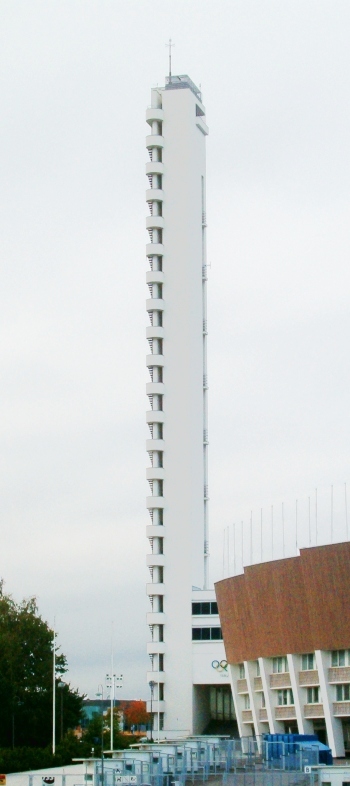
 Helsinki Olympic Stadium (1938)
 -
 Lasipalatsi (1936) in Helsinki
 -
 Hotel Vaakuna (1940) in Helsinki
 -
 Paimio Sanatorium (1931) in Paimio
 -
 Viipuri Library (1927) in Vyborg


Poland
[edit]Interbellum avant-garde Polish architects in the years 1918–1939 made a notable impact in the legacy of European modern architecture and functionalism. A lot of Polish architects were fascinated by Le Corbusier like his Polish students and coworkers Jerzy Sołtan, Aleksander Kujawski (both co-authors of Unité d'habitation in Marseille[16]) and his coworkers Helena Syrkus (Le Corbusier's companion on board of the S.S. Patris, an ocean liner journeying from Marseille to Athens in 1933 during the CIAM IV[17]), Roman Piotrowski and Maciej Nowicki. Le Corbusier said about Poles (When the Cathedrals Were White, Paris 1937) "Academism has sent down roots everywhere. Nevertheless, the Dutch are relatively free of bias. The Czechs believe in 'modern' and the Polish also." Other Polish architects like Stanisław Brukalski was meeting with Gerrit Rietveld and inspired by him and his neoplasticism. Only a few years after the construction of Rietveld Schröder House, Polish architect Stanisław Brukalski built his own house[18] in Warsaw in 1929 supposedly inspired by Schröder House he had visited. His Polish example of the modern house was awarded bronze medal in Paris world expo in 1937. Just before the Second World War, it was fashionable to build in Poland a lot of large districts of luxury houses in neighbourhoods full of greenery for wealthy Poles like, for example, district Saska Kępa in Warsaw or district Kamienna Góra in seaport Gdynia. The most characteristic features in Polish functionalist architecture 1918–1939 were portholes, roof terraces and marble interiors.
Probably the most outstanding work of Polish functionalist architecture is the entire city of Gdynia, modern Polish seaport established 1926.
-
![Bohdan Lachert villa with roof garden (1929) in Warsaw. The house was considered as the best implementation of so-called villa architecture at the time in Warsaw (opinion by professor Lech Niemojewski in 1929). It's the house inspired by the form of ocean liner.[19]](//upload.wikimedia.org/wikipedia/commons/thumb/2/22/11_kat9_archpol35_70_a.jpg/250px-11_kat9_archpol35_70_a.jpg) Bohdan Lachert villa with roof garden (1929) in Warsaw. The house was considered as the best implementation of so-called villa architecture at the time in Warsaw (opinion by professor Lech Niemojewski in 1929). It's the house inspired by the form of ocean liner.[19]
Bohdan Lachert villa with roof garden (1929) in Warsaw. The house was considered as the best implementation of so-called villa architecture at the time in Warsaw (opinion by professor Lech Niemojewski in 1929). It's the house inspired by the form of ocean liner.[19] -
 Stanisław Brukalski villa with roof terrace (1929) in Warsaw
 -
 Polish eagle basalt relief on the building of the Ministry of Infrastructure (by Rudolf Świerczyński, 1931) in Warsaw
 -
 Small station Michalin near Warsaw (1936) by Kazimierz Centnerszwer. Typical modern railway station built in series near Warsaw.
 -

-
 Bohdan Damięcki Gdynia Maritime University (1937)
 -
 Narcyz Obrycki villa (1937) in Gdynia
 -
 Tadeusz Kossak villa (1938) in seaport Gdynia. Three large porthole windows in the back.
 -
 Juliusz Żórawski Housing Unit "Glass House" (1938-1941) in Warsaw with luxury apartments 177m2 each and large roof terrace
![Bohdan Lachert villa with roof garden (1929) in Warsaw. The house was considered as the best implementation of so-called villa architecture at the time in Warsaw (opinion by professor Lech Niemojewski in 1929). It's the house inspired by the form of ocean liner.[19]](https://en.wikipedia.org/wiki/File:11_kat9_archpol35_70_a.jpg)


.JPG)
_cz.jpg)


Russia
[edit]In Russia and the former Soviet Union, functionalism was known as Constructivist architecture, and was the dominant style for major building projects between 1918 and 1932. The 1932 competition for the Palace of the Soviets and the winning entry by Boris Iofan marked the start of eclectic historicism of Stalinist Architecture and the end of constructivist domination in Soviet Union.
-
 Mosselprom building (David Kogan, 1923–4)
 -
 Melnikov House in Moscow. It is at the top of UNESCO's list of "Endangered Buildings". There is an international campaign to save it.
 -
 Narkomfin Building, apartment house (Moisei Ginzburg, 1930)
 -
 Red Carnation Factory, St Petersburg (Yakov Chernikhov)

.jpg)


Södra Ängby, Sweden
[edit]
The residential area of Södra Ängby in western Stockholm, Sweden, blended a functionalist or international style with garden city ideals. Encompassing more than 500 buildings, it remains the largest coherent functionalistic villa area in Sweden and possibly the world, still well-preserved more than a half-century after its construction 1933–40 and protected as a national cultural heritage.[20]
Zlín, Czech Republic
[edit]
Zlín is a city in the Czech Republic which was in the 1930s completely reconstructed on principles of functionalism. In that time the city was a headquarters of Bata Shoes company and Tomáš Baťa initiated a complex reconstruction of the city which was inspired by functionalism and the Garden city movement.
Zlín's distinctive architecture was guided by principles that were strictly observed during its whole inter-war development. Its central theme was the derivation of all architectural elements from the factory buildings. The central position of the industrial production in the life of all Zlín inhabitants was to be highlighted. Hence the same building materials (red bricks, glass, reinforced concrete) were used for the construction of all public (and most private) edifices. The common structural element of Zlín architecture is a square bay of 20x20 feet (6.15x6.15 m). Although modified by several variations, this high modernist style leads to a high degree of uniformity of all buildings. It highlights the central and unique idea of an industrial garden city at the same time. Architectural and urban functionalism was to serve the demands of a modern city. The simplicity of its buildings which also translated into its functional adaptability was to prescribe (and also react to) the needs of everyday life.
The urban plan of Zlín was the creation of František Lydie Gahura, a student at Le Corbusier's atelier in Paris. Architectural highlights of the city are e.g. the Villa of Tomáš Baťa, Baťa's Hospital, Tomas Bata Memorial, The Grand Cinema or Baťa's Skyscraper.
Khrushchyovka
[edit]
Khrushchyovka (Russian: хрущёвка, IPA: [xrʊˈɕːɵfkə]) is an unofficial name of type of low-cost, concrete-paneled or brick three- to five-storied apartment building which was developed in the Soviet Union during the early 1960s, during the time its namesake Nikita Khrushchev directed the Soviet government. The apartment buildings also went by the name of "Khruschoba" (Хрущёв+трущоба, Khrushchev-slum).
Functionalism in landscape architecture
[edit]The development of functionalism in landscape architecture paralleled its development in building architecture. At the residential scale, designers like Christopher Tunnard, James Rose, and Garrett Eckbo advocated a design philosophy based on the creation of spaces for outdoor living and the integration of house and garden.[21] At a larger scale, the German landscape architect and planner Leberecht Migge advocated the use of edible gardens in social housing projects as a way to counteract hunger and increase self-sufficiency of families. At a still larger scale, the Congrès International d'Architecture Moderne advocated for urban design strategies based on human proportions and in support of four functions of human settlement: housing, work, play, and transport.
Examples
[edit]Notable representations of functionalist architecture include:

- Aarhus University, Denmark
- ADGB Trade Union School, Germany
- Administratívna budova spojov, Bratislava, Slovakia
- Obchodný a obytný dom Luxor, Bratislava, Slovakia
- Villa Tugendhat, Brno, Czech Republic
- Kavárna Era, Brno, Czech Republic
- Kolonie Nový dům, Brno, Czech Republic
- Veletržní palác, Prague, Czech Republic
- Villa Müller, Prague, Czech Republic
- Zlín city, Czech Republic
- Tomas Bata Memorial, Zlín, Czech Republic
- Booth House, Bridge Street, Sydney, Australia
- Bullfighting Arena, Póvoa de Varzim, Portugal
- Glass Palace, Helsinki, Finland
- Hotel Hollywood, Sydney, Australia
- Knarraros lighthouse, Stokkseyri, Iceland
- Pärnu Rannahotell, Pärnu, Estonia
- Pärnu Rannakohvik, Estonia
- Södra Ängby, Stockholm, Sweden
- Stanislas Brukalski's villa, Warsaw, Poland
- Modernist Center of Gdynia, Poland
- Villa Savoye, Poissy, France
See also
[edit]Literature
[edit]- Vers une Architecture and Villa Savoye: A Comparison of Treatise and Building – A multipart essay explaining the basics of Le Corbusier's theory and contrasting them with his built work.
- Behne, Adolf (1923). The Modern Functional Building. Michael Robinson, trans. Santa Monica: Getty Research Institute, 1996.
- Forty, Adrian (2000). "Function". Words and Buildings, A Vocabulary of Modern Architecture. Thames & Hudson, p. 174–195.
- Michl, Jan (1995). Form follows WHAT? The modernist notion of function as a carte blanche 1995.
References
[edit]- ^ "Adrian Yekkes: Gdynia – Poland's modernist masterpiece". June 29, 2018.
- ^ A.W.N.Pugin, The true principles of pointed or Christian architecture: set forth in two lectures delivered at St. Marie's, Oscott.
- ^ Forty, A. ‘Words & Buildings: Function’, pp 174.
- ^ Branko Mitrovic, Philosophy for Architects, New York: Chronicle Books, 2012. p.153.
- ^ Rail, Evan (2012-06-15). "Exploring Czech Functionalism in Brno". The New York Times. ISSN 0362-4331. Retrieved 2019-05-28.
- ^ "Discovering Brno's Architecture". Travel + Leisure. Retrieved 2019-05-28.
- ^ "Adolf Loos in Plzeň". adolfloosplzen.cz. Retrieved 2019-05-28.
- ^ William C Miller (2016): Nordic Modernism: Scandinavian Architecture 1890–2017, The Crowood Press Ltd., ISBN 978 1 78500 237 3
- ^ a b Roger Connah (2006). Finland: Modern Architectures in History. Reaktion Books.
- ^ Andrew Hollingsworth, Danish Modern, 2008, Gibbs Smith, p. 31.
- ^ Jeanne Brüel (2014): "Funkishuset – en bevaringsguide", (in Danish) Bygningskultur Danmark
- ^ Johan Hage: Funkishuset (in Danish)
- ^ Niels-Ole Lund (2008): Nordic Architecture, Arkitektens Forlag, ISBN 9788774072584
- ^ a b YIT: Functionalism is a Finnish thing
- ^ Malcolm Quantrill (2012). Finnish Architecture and the Modernist Tradition. Taylor & Francis.
- ^ Le Corbusier l'unité d'habitation de Marseille Jacques Sbriglio 2013
- ^ Józef Piłatowicz POGLĄDY HELENY I SZYMONA SYRKUSÓW NA ARCHITEKTURĘ W LATACH 1925–1956 Warszawa 2009
- ^ "Willa Barbary i Stanisława Brukalskich, Warszawa – Zabytek.pl". zabytek.pl.
- ^ Architektura w Warszawie. Lata 1918–1939. Marta Leśniakowska Warszawa 2006
- ^ Detailed references listed in the article on Södra Ängby.
- ^ Rogers, Elizabeth Barlow. Landscape Design: A Cultural and Architectural History. New York: Abrams, 2001. pp. 23, 454–455
External links
[edit]


Functionalism (architecture)
View on GrokipediaDefinition and Principles
Core Tenets
Functionalism in architecture asserts that a building's form must be determined by its practical function, with structural and spatial elements derived strictly from the demands of use rather than imposed aesthetic ideals. This doctrine, rooted in the principle that utility dictates design, emphasizes empirical correspondence between a structure's purpose—such as accommodating specific activities, circulation, or environmental conditions—and its resulting configuration, thereby ensuring efficiency in material deployment and operational performance.[8][9] Central to this approach is the rejection of superfluous ornamentation, which functionalists viewed as a distraction from the building's core purpose and an inefficient use of resources, contrasting sharply with 19th-century eclecticism's reliance on historical motifs and decorative excess unrelated to contemporary needs. Instead, designs incorporate minimalism to facilitate standardization and adaptability, aligning with industrial processes that prioritize mass-producible components and rational construction methods for scalability and cost-effectiveness.[1][10] This purpose-driven paradigm underscores a commitment to serving human requirements through unadorned, adaptable forms that optimize functionality, such as open plans for flexibility or exposed materials for structural honesty, without deference to symbolic or stylistic precedents. By grounding architecture in observable causal relationships—where form emerges as a direct consequence of functional imperatives—functionalism promotes buildings as tools for practical ends, free from the subjective impositions that could compromise their efficacy.[2][11]Philosophical Foundations
Functionalism's philosophical underpinnings rest on empiricist principles inherited from the Enlightenment, which elevated rational inquiry and direct observation of materials and uses over dogmatic adherence to tradition, framing architecture as an applied science continuous with engineering logic. Proponents argued that effective design derives from analyzing functional requirements—such as structural stability, circulation, and utility—much like mechanical systems, where empirical testing yields forms optimized for purpose without superfluous elements. This rationalist-materialist approach posits architecture not as abstract art but as a pragmatic extension of physics and biology, with 18th- and 19th-century engineers demonstrating that iron frameworks and bridges achieve aesthetic harmony through sheer efficiency, as efficiency aligns means precisely with ends.[12][13][14] Central to this worldview is the assertion that beauty inheres in functional fitness, emerging causally from designs that resolve practical demands without imposed ornamentation, echoing Hume's observation that utility renders objects pleasing by evidencing adaptation to human needs. In contrast to Kantian dependent beauty, which subordinates aesthetics to purpose, functionalists contended that true formal perfection arises automatically from mechanical optimization, as imperfect execution betrays the underlying logic of use and material limits. This first-principles reasoning rejects subjective taste as a primary driver, insisting instead on verifiable causal chains: form as the inevitable output of function, tested against real-world performance rather than stylistic precedent.[12][13][14] The doctrine sharply critiques historicism as inefficient and deceptive, charging that revivalist styles—by grafting antique motifs onto modern contexts—misrepresent contemporary functions like industrialized labor or mass shelter, breeding waste and structural dishonesty. Historicism's eclectic borrowing from past eras ignores engineering advances and societal shifts, imposing arbitrary forms that hinder rather than facilitate circulation, durability, and economy, thereby violating the realist imperative to mirror actual causal realities of human activity. Functionalists advocated unadorned expressionism, where visible materials and layouts truthfully convey purpose, deeming ornament a criminal distraction from this integrity.[15][13][14] Analogies to Darwinian adaptation further bolster this materialist realism, conceptualizing architectural evolution as a process where forms refine through selection for functional efficacy in specific environments, eschewing imposed aesthetics for traits proven viable by practical necessity. Just as biological structures adapt via environmental pressures without teleological styling, buildings should evolve incrementally from use-driven imperatives, ensuring resilience and honesty over decorative artifice. This evolutionary lens underscores functionalism's causal optimism: optimized designs, like adapted organisms, inherently satisfy both utility and perceptual appeal through their fidelity to underlying demands.[12][13]Historical Development
19th-Century Precursors
The Industrial Revolution, accelerating from the mid-18th century but profoundly impacting architecture by the 1850s, introduced mass-produced iron, glass, and later steel, enabling structures that prioritized utility, prefabrication, and structural efficiency over traditional ornamentation. These materials facilitated expansive, light-filled enclosures for factories, greenhouses, and public spaces, responding to urbanization's demands for rapid, cost-effective construction amid population booms in cities like London and Manchester. Engineers, rather than conventional architects, drove innovations, as seen in early conservatories where iron frames supported vast glass roofs, minimizing material waste and maximizing functionality.[16][17] A pivotal example was the Crystal Palace, designed by Joseph Paxton and erected in London's Hyde Park for the Great Exhibition of 1851. Spanning 564 meters in length with a modular system of prefabricated cast-iron columns and glass panels—totaling over 900,000 square meters of floor space—this temporary structure exemplified structural honesty by exposing its skeletal frame without superfluous decoration, achieving erection in just nine months at a cost of £150,000. Paxton, originally a gardener who pioneered greenhouse designs at Chatsworth House using similar ridge-and-furrow glazing for optimal light and ventilation, adapted these techniques to create a building that served its exhibition function efficiently while demonstrating the scalability of industrial methods.[18][19] Intellectual groundwork complemented these technical advances, with figures like Eugène Viollet-le-Duc advocating rationalism in his 1854–1868 Dictionnaire raisonné de l'architecture, arguing for architecture where form derived logically from function and materials, as in Gothic structures' integrated load-bearing systems. Similarly, John Ruskin, in his 1849 The Seven Lamps of Architecture, critiqued Victorian excesses under the "Lamp of Truth," decrying painted imitations of stone or wood as dishonest and insisting on materials' authentic expression to align building with purpose. These ideas, though rooted in medieval revivalism, prefigured functionalism's rejection of arbitrary ornament in favor of purposeful design amid industrial proliferation.[20][21]Early 20th-Century Emergence
The rapid urbanization of the early 20th century, fueled by industrialization and population surges in cities like Chicago and Vienna, demanded efficient building solutions to accommodate growing commercial and residential needs. Technological innovations, including steel-frame construction refined after the 1850s Bessemer process and hydraulic elevators commercialized by Elisha Otis in the 1880s, enabled the rise of tall, skeletal skyscrapers that prioritized structural logic over decorative excess.[22][23] These advances shifted architectural thinking toward utility, as architects sought forms that directly served programmatic requirements rather than historical ornamentation, laying groundwork for functionalist principles amid economic pressures for cost-effective designs.[24] In the United States, Louis Sullivan advanced these ideas through the Chicago School's innovations, articulating the maxim "form ever follows function" in his 1896 essay "The Tall Office Building Artistically Considered," which argued that a building's exterior should express its internal purpose and skeletal structure.[24] Sullivan's designs, such as the 1890-1891 Wainwright Building in St. Louis with its tripartite vertical composition mirroring office functions (base for entry, shaft for work floors, cornice for mechanical systems), exemplified this by stripping away superfluous decoration to highlight engineering efficiency.[25] This approach evolved into explicit manifestos by the 1910s, influencing a generation to view architecture as a rational response to modern demands rather than stylistic revivalism.[26] Across the Atlantic, Adolf Loos's 1908 lecture and essay "Ornament and Crime" marked a theoretical pivot, condemning decorative elements as economically wasteful and culturally regressive, akin to primitive tattoos unfit for civilized society.[27] Loos contended that true progress lay in smooth, unadorned surfaces that conserved labor and materials, directly challenging the ornate Secessionist styles prevalent in Vienna and promoting spatial functionality over aesthetic indulgence.[26] The devastation of World War I (1914-1918), with its material shortages and urgent reconstruction needs in Europe, amplified these rationalist calls, favoring reproducible, utilitarian forms using concrete and steel to rebuild infrastructure efficiently without ornamental frills.[28] This period's emphasis on pragmatic design amid scarcity solidified functionalism's emergence as a response to both pre-war technological optimism and wartime austerity.[29]Interwar Period and Modernist Integration
During the interwar period, functionalism in architecture increasingly aligned with the broader modernist movement, emphasizing rational design driven by technological advancements and social needs following World War I. Architects sought to reject ornamental historicism in favor of forms derived from purpose, materials, and construction methods suited to the machine age, promoting efficiency and hygiene in response to urbanization and housing shortages. This integration manifested in shared principles like the prioritization of use over aesthetics and the adoption of standardized, prefabricated elements to enable mass production.[30][31] The founding of the Congrès Internationaux d'Architecture Moderne (CIAM) in 1928 in La Sarraz, Switzerland, by architects including Le Corbusier, Sigfried Giedion, and Hélène de Mandrot, formalized functionalism's role within modernism through international collaboration. CIAM's early congresses advocated for urban planning based on functional zoning, separating dwelling, work, recreation, and transportation to optimize efficiency and reduce congestion in industrial cities. These principles drew from empirical analysis of social and economic factors, promoting machine-inspired aesthetics such as flat roofs, white stucco surfaces, and open interiors to reflect the era's technological optimism.[31][32] Le Corbusier contributed significantly to this synthesis in 1926 with his "Five Points of Architecture," which codified functional layouts through innovative structural elements: pilotis to elevate buildings and free ground-level circulation; free plans enabled by reinforced concrete frames; roof gardens for recreational utility; horizontal ribbon windows for even interior lighting; and free facades independent of load-bearing constraints. These points, detailed in his writings, integrated functional requirements with modernist expression, arguing that buildings as "machines for living" demanded forms generated by utility rather than tradition.[33][34] Exhibitions like the Weissenhof Siedlung in Stuttgart, organized by Ludwig Mies van der Rohe in 1927 for the Deutscher Werkbund's "Die Wohnung" exposition, demonstrated these ideas through prototypical housing. Featuring 21 buildings by 17 architects, including contributions from Le Corbusier and Walter Gropius, the settlement tested functional layouts for affordable, hygienic worker dwellings using modern materials like steel and glass. It emphasized empirical validation of designs, showcasing standardized units that prioritized spatial efficiency and natural light over decorative excess, thus propagating functionalist-modernist principles across Europe.[35]Key Figures and Movements
American Origins
Louis Sullivan, often regarded as the progenitor of functionalist principles in American architecture, articulated the core idea in his 1896 essay "The Tall Office Building Artistically Considered," where he posited that "form ever follows function" as a guiding maxim for designing skyscrapers responsive to their utilitarian demands.[1] This principle emphasized deriving building forms from the practical needs of occupancy, such as efficient vertical circulation and natural light penetration in high-rises, rather than ornamental precedents from historical styles. Sullivan's approach manifested in projects like the Guaranty Building (1894–1896) in Buffalo, New York, co-designed with Dankmar Adler, which featured a steel frame clad in terra cotta piers and spandrels that articulated structural logic while incorporating organic motifs at the cornice to resolve the building's vertical thrust with the ground.[36] The structure's thirteen stories exemplified market-driven innovation, prioritizing commercial efficiency over aesthetic imitation, and influenced subsequent tall building designs by demonstrating how function could yield both economical and expressive outcomes.[37] Frank Lloyd Wright, Sullivan's apprentice from 1887 to 1893, extended these ideas into the Prairie School style around 1900, adapting functionalism to residential and low-rise forms through site-specific integration and open interior planning.[38] Wright's designs, such as the Robie House (1909), employed horizontal lines echoing the Midwest landscape, cantilevered roofs for shelter, and fluid room arrangements that prioritized occupant movement and natural illumination over rigid compartmentalization.[39] He refined Sullivan's dictum into a holistic view, stating that "form and function should be one, joined in a spiritual union," thereby embedding functional efficiency within an organic response to environment and human use.[40] This evolution reflected American individualism, where architects tailored solutions to private clients' needs via entrepreneurial commissions, diverging later toward broader organic architecture but retaining functionalist roots in pragmatic problem-solving. Unlike later European variants often tied to state-sponsored social programs and theoretical manifestos, American functionalism under Sullivan and Wright arose from commercial imperatives and personal ingenuity, fostering innovations like skeletal framing for urban density without reliance on public funding or ideological collectives.[41] This market-oriented ethos prioritized verifiable utility—measured in load-bearing capacities, rentable square footage, and adaptive usability—over abstract utopianism, grounding the movement in empirical responses to industrial America's expansion.[42]European Innovators
Adolf Loos pioneered minimalist approaches that influenced functionalism by rejecting superfluous ornamentation, arguing in his 1908 essay "Ornament and Crime" that decoration represented cultural primitivism and inefficiency.[43] His Steiner House, completed in 1910 in Vienna, demonstrated these principles through a stark, cubic form with smooth white plaster walls, horizontal fenestration for natural light, and an interior Raumplan organizing spaces by function rather than symmetry, prioritizing utility over aesthetic excess.[44] This work critiqued Viennese Secessionist decadence, advocating architecture as a rational response to modern needs.[43] Le Corbusier, born Charles-Édouard Jeanneret in Switzerland, radicalized functionalism in France by integrating anthropometric data into modular design systems, exemplified by the Modulor scale introduced in the 1940s but rooted in his earlier interwar theories.[45] Drawing from Leonardo da Vinci's Vitruvian proportions and the golden section, the Modulor used human body measurements—such as a 1.83-meter-tall man's arm reach—to establish universal dimensions for efficient spatial organization, enabling mass-produced housing and urban planning aligned with industrial efficiency.[46] His visions, like the 1920s-1930s proposals for high-rise cities, applied these metrics to "machines for living," emphasizing ventilation, sunlight, and pilotis for elevated structures to optimize functionality in dense populations.[47] Walter Gropius, a German architect, contributed to functionalism's emphasis on collective utility through pre-World War I industrial designs that subordinated form to purpose, as seen in the Fagus Factory shoe-last works in Alfeld (1911), featuring a glass curtain wall that maximized interior daylight for production efficiency while minimizing structural ornament.[48] Gropius advocated standardization and prefabrication to serve societal needs, viewing architecture as a tool for harmonizing technology with human activity in democratic, utilitarian environments, distinct from stylistic revivalism.[49]