


Community hub
Recent from talks
Contribute something
Nothing was collected or created yet.
Nissan Violet
View on Wikipedia
| Nissan Violet | |
|---|---|
 1991 Nissan Stanza GXE (U12, Canada) | |
| Overview | |
| Manufacturer | Nissan (Nissan Shatai) |
| Also called |
|
| Production | 1973–1992 |
| Assembly | Oppama Plant and Hiratsuka Plants, Kanagawa, Japan Rosslyn, Gauteng, South Africa |
| Body and chassis | |
| Class | Compact |
| Layout | Front-engine, RWD (1973–1981) Front-engine, FWD (1982–1992) |
| Chronology | |
| Successor | Nissan Altima (US) Nissan Bluebird Nissan Primera (Europe) Nissan Tiida |
The Nissan Violet is a compact car that was first released in Japan in 1973 and produced until 1992. It was initially exclusive to Nissan's Japanese Nissan Cherry Store dealerships, as a larger companion to the Nissan Cherry.
In 1977 the second generation arrived. This was split into two additional lines, the Nissan Auster and the Nissan Stanza. All three models bore the A10 series identifier, and were built in Japan at the Hiratsuka and Yokosuka assembly plants. The Stanza was exclusive to Japanese Nissan dealerships called Nissan Satio Store as a larger companion to the smaller Nissan Sunny, and the Auster triplet was exclusive to Nissan Prince Store locations as a larger companion to the Nissan Langley.
A new third generation front-wheel drive model was launched in 1981, changing the series name again to T11, and sharing its platform with the Compact MPV Nissan Prairie/Multi/Stanza Wagon. Final versions were Nissan Bluebirds series U12 rebadged for some international markets. In most export markets the car was originally sold as the Datsun 140J or 160J depending on the engine; this name was then gradually changed to Nissan Stanza in most markets in line with Nissan's phasing out of the Datsun brand in its export markets in the early 1980s; in Europe for instance it was sold as the "Datsun-Nissan Stanza" for a short time until the Datsun name was dropped completely in 1984.
The Stanza/Auster/Violet were discontinued in 1992. The Stanza was replaced by the Nissan Altima in North America; the Stanza was replaced by the Nissan Bluebird in Japan, and by the Primera in Europe.
710 series (1973–1977)
[edit]| Nissan Violet 710 series | |
|---|---|
 Datsun Violet Hardtop Coupe (710, Japan) | |
| Overview | |
| Model code | 710 |
| Also called | |
| Production | Japan: 1973–1977 Taiwan: 1973–1979 Mexico: 1974–1978 |
| Body and chassis | |
| Body style | |
| Layout | FR layout |
| Related | Datsun Truck 720 |
| Powertrain | |
| Engine | |
| Transmission | |
| Dimensions | |
| Wheelbase | 2,450 mm (96.5 in) |
| Length | 4,120 mm (162.2 in) |
| Width | 1,580 mm (62.2 in) |
| Height | 1,375 mm (54.1 in) |
| Curb weight | 1,005 kg (2,216 lb) |
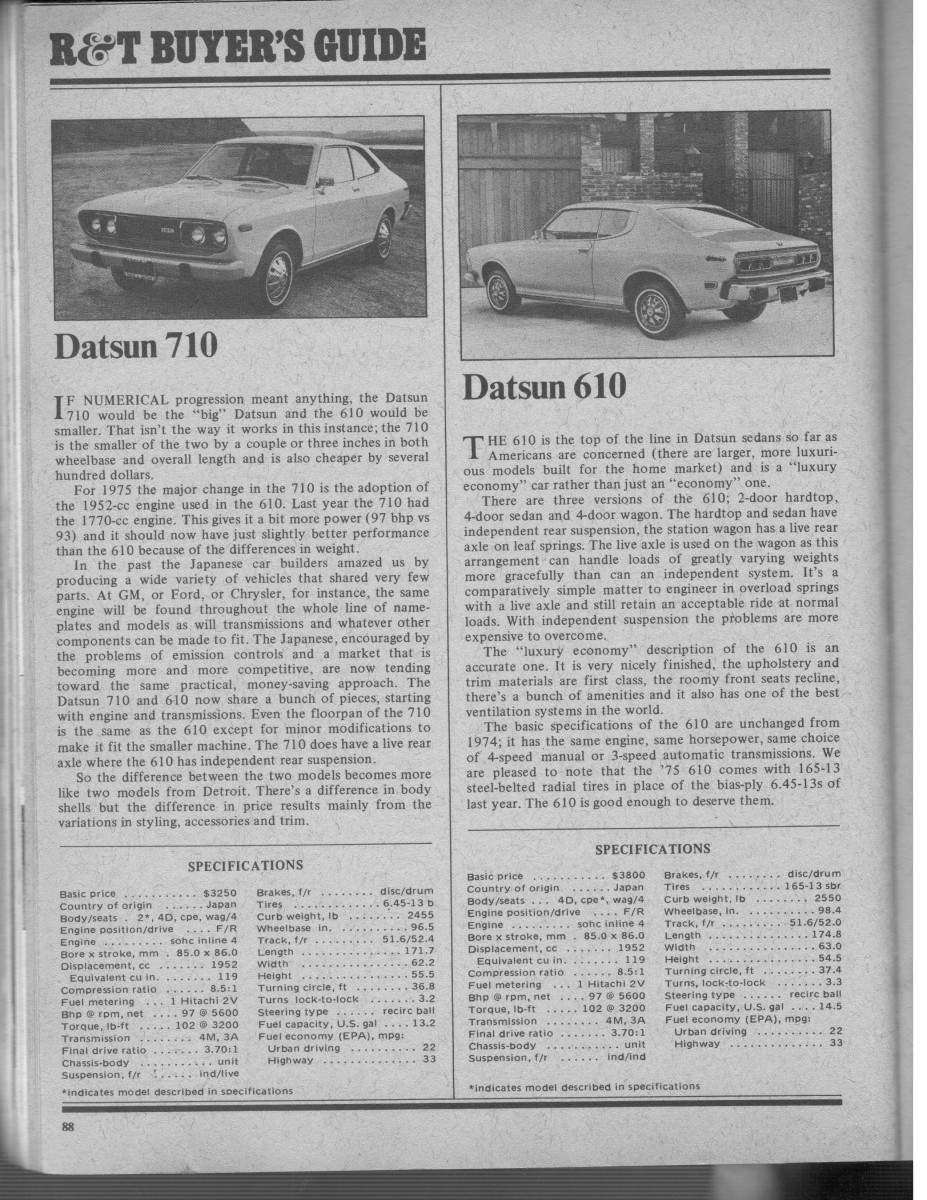
Introduced in January 1971 the Nissan Violet was a smaller version of the Datsun Bluebird 610, which was sold outside Japan under Nissan's Datsun brand as the Datsun 140J/160J — except in the United States where it was marketed simply as the Datsun 710. This model was built as a two-door saloon, two-door coupé, four-door fastback, (and later as a regular four-door saloon), estate, and as a van. Introducing the Violet allowed Nissan to moderately increase the dimensions of the existing Datsun Bluebird.
The sporty SSS model has rear independent suspension, others have a leaf sprung rear. Aside from the different name, the North American market 710 received large separate bumpers rather than the curved, fitted pieces used in other markets to comply with United States bumper legislation in 1973. Early export market cars were fitted with tiny chrome cover plates to hide the holes left on top of the front fenders by the Japanese market rear view mirrors. The most powerful version offered in Japan was the fuel injected 1600 SSS-E with 110 PS (81 kW) JIS at 6200 rpm.[1] In export markets the twin-carb 160J SSS claimed 95 PS (70 kW) DIN, five more than the regular 160J.[2] In Japan, the 1800 cc engine arrived in October 1975 and was only available running on LPG, for taxi use.[3]

This vehicle was available for sale around the same time as the first generation Toyota Carina. The original four-door bodywork was quite swoopy, with a fastback line. It was one of the first Nissan products to introduce "coke bottle styling", an appearance that had debuted internationally during the 1960s and 1970s. Its appearance was controversial, which led to a certain number of customer complaints at the limited rear vision and dark rear cabin - especially for children. Taxi companies refused to purchase any more Violets, and in a rather drastic facelift gradually introduced beginning in February 1976 Nissan replaced the entire rear end (including the roof panel and the doors) with more traditional, notchback bodywork. This provided more space and comfort for passengers, while also minimizing blind spots.[4]
This version also received a new chassis code, 711, while the smaller-engined part of the range gradually became replaced by the newly introduced, carburetted version of the 1600.[3] The two-door versions did not undergo this modification:[5] The two-door sedan was discontinued, while the coupé received the new chassis code and remained on sale alongside the four-door 711 and the 710 Van.[1]
- North America


In the United States and Canada, the car was sold simply as the "Datsun 710". Two- or four-door sedans, a two-door coupé, and a five-door station wagon were available. Introduced for the 1974 model year, the 710 switched from the original 1770 cc, 90-horsepower (67 kW) engine to the 2-litre L20B engine also used in the 610.[6] The 1975s produce 97 or 94 hp (72 or 70 kW) (SAE Net) in 49-state and Canadian trim versus California-spec cars. The federal/Canadian version took leaded fuel and depended on an EGR system for pollution control, while the California cars have a catalytic converter and require unleaded petrol. Gross horsepower ratings are 110 and 107 respectively.[7][8] Aside from the new engine, the 710 saw some additional modifications for 1975: the steering was adjusted to decrease driver effort, while noise levels were reduced, and gear ratios were adjusted to boost petrol mileage. Externally, the bumper overriders received a slight chrome molding in the middle.[9]
Mysteriously, while wagons usually have a smaller petrol tank of 11.9 US gal (45 L) rather than 13.2 US gal (50 L), the California-market 710 wagon has the same size petrol tank as the sedans and hardtops.[7]
Foreign assembly
[edit]
.jpg)
- Taiwan
In Taiwan the Violet was introduced in 1973 under the name Yue Loong Violet 707 and replaced the successful Datsun Bluebird there. It remained in production until 1982 The Yue Loong Violet was usually offered with the OHV J16 engine. The VIP Brougham was a luxury version of the Violet with leather seats and wood interior.
- Mexico
For the Mexican domestic car market, the 710-series Violet was produced from 1973 to 1978 at Nissan's CIVAC assembly plant, near Cuernavaca, Mexico. At the time, Nissan Mexico offered a unique passenger-vehicles lineup, the Datsun Bluebird range (the 510-series and the 410, previously), integrated only by the 4-door saloon and Wagon versions of the Bluebird, respectively commercialized as the Datsun Sedan and Datsun Guayín (Guayín is a moniker in Mexican spanish for "Station Wagon"). In 1974, going on with the same business strategy, the 710-series Violet was introduced to the Mexican car market badged as the new Datsun 160J, the replacement for the single-offered Bluebird lineup.
The Mexican 710 Violet range was integrated only by the 4-door Saloon alongside the Wagon, lacking the sporty 2-door/coupe bodies offered in some other countries. The fastback-styled 710 4-door saloon design was marketed from 1974 to 1977, being replaced in 1978 with the notchback-styled 711 Violet (which intended to improve the fastback's bad rear visibility complained by some customers). All Mexican 710 Violets featured the 1.6-litre carbureted engine (160J), coupled to a 4-speed manual gearbox, and an optional 3-speed automatic gearbox starting in 1978.
From a time in the Mexican popular slang, sometimes this car is referred to as "bolillo", the spanish word for a bread roll, due to its similar rounded shape.
For 1979, the 710 range was superseded by the correspondent next generation A10-series Violet in the Nissan Mexico lineup.
- New Zealand
New Zealand, as a result of the government's temporary lift of import licensing restrictions (the result of high consumer demand for cars, which local CKD assemblers and built-up importers could not meet with the usual licensing restrictions and high import duties of up to 55%, plus sales tax up to 60%) saw considerable CBU imports of the Datsun 140J four-door sedan and 160J two-door during 1973 and 1974.
Due to the short notice and short timeframe of the licence requirement relaxation, the cars imported differed slightly in specification from shipment to shipment - some had Japanese market amber front park lights, front guard-mounted exterior rear view mirrors and 'Violet' badges; later units had clear lenses and 140J/160J badging.
Several hundred 140J sedans entered New Zealand through the Port of Timaru for the South Island market[10] and all were presold before they arrived. All were keenly sought-after and hard to secure as they were better specified as standard (tinted glass, AM pushbutton radio, etc.) than the NZ-assembled CKD kit imported models, which consisted of the 1200 sedan and wagon, and 180B (Bluebird) and 260C (Cedric) sedans.
Almost-new 140Js were often resold soon after first registration for hundreds of dollars more than their retail prices, such was the model line's initial popularity. The Japanese assembly quality of the 140J was better than the NZ-built Datsuns of the time which were assembled by outside assembly contractors - Nissan themselves did not open its own 'temporary' plant in Mt Roskill, Auckland, until the mid-1970s and a dedicated, purpose-built factory in Wiri in 1978.
- South Africa
In South Africa, the 1976 "711" facelift arrived in October 1976 and continued in production for a while longer than in Japan. It was sold as the Datsun 160U or 180U, depending on engine fitment. Deluxe and SSS sedans as well as an SSS Hardtop were available. A batch of 100 SSS models (some of which were Bluebirds) with special "Mexican" upholstery was also built in 1978.[11]
A10 series (1977–1981)
[edit]| Nissan Violet A10 series | |
|---|---|
 Datsun Violet 140J (UK) | |
| Overview | |
| Model code | A10 |
| Also called |
|
| Production |
|
| Assembly | Japan Australia[13] Rosslyn, Gauteng, South Africa CIVAC, Mexico |
| Body and chassis | |
| Body style |
|
| Layout | FR layout |
| Related | Nissan Silvia |
| Powertrain | |
| Engine | |
| Transmission | 4/5-speed manual 3-speed automatic |
| Dimensions | |
| Wheelbase | 2,400 mm (94.5 in) |
| Length | 4,080–4,325 mm (160.6–170.3 in) |
| Width | 1,600–1,620 mm (63.0–63.8 in) |
| Height | 1,320–1,410 mm (52.0–55.5 in) |
| Curb weight | 870–1,367 kg (1,918–3,014 lb) |
The previous generation Violet grew more rational and somewhat larger when it was replaced in May 1977. Nissan increased the glass area by ten percent vis-à-vis its predecessor.[15] It was also joined by two badge engineered versions: the Japanese: Nissan Auster went on sale alongside the Violet and was aiming for an air of "quality and youthfulness."[16] The Stanza followed in August and was meant to be more luxurious; it was only offered in the higher equipment levels and was also differentiated by having a different bonnet and single rectangular lights rather than the twin round units seen on the Violet and Auster.[16] The Nissan Auster, which is named for the Latin equivalent of the Greek god Notus for the south wind, was available at Nissan Prince Store; Stanza, which is Italian for "room" or "apartment", was introduced as an affordable family car one level above the Nissan Sunny, sold at Nissan Japan dealerships Nissan Saito Store. The third version (Violet) was sold at dealerships called Nissan Cherry Store locations. In Australia, it was called the Datsun Stanza, and in Canada and the United States it was the Datsun 510, a name which recalled the successes of the previous Datsun 510.

Originally it was only sold with the 1.4-litre A-series engine (not available in the Stanza) and the 1.6-litre L, although North American market cars received a two-litre version. In May 1978 the car underwent a facelift, becoming the A11 in the process. At the same time, the L16 engines were replaced by the cross-flow Z16, to meet newer stricter emissions rules.[17] Nissan introduced their emissions control technology with this generation, called NAPS, and the cars received a new chassis code of A11. The more luxurious Stanza was never available with the 1.4-litre engine in Japan, only with a 1.6 until larger engines joined the lineup.

In November 1978 a 1.8-litre engine was added at the top of the line-up, mainly for the domestic Japanese market.[18] The 1800 "NAPS-Z" engine was initially only available in the more luxurious Stanza model and received the RA11 chassis code.[19] It was available either carburetted or fuel injected, with 105 or 115 PS (77 or 85 kW) at 6,000 rpm respectively.[20]
Five body styles were on offer: two- and four-door saloons, a three-door hatchback coupé ("Violet Openback" and "Auster Multi-Coupé"), a 5-door hatchback (only introduced in August 1979, quite late in the car's production run[21]) and a five-door estate.
The five-door liftback Stanza was marketed as the "Stanza Resort" in the Japanese domestic market, and given the chassis model code T10.[21] The five-door bodywork only became available in the Auster and Violet versions as of April 1980, meaning that they were only built for fourteen months as the car was replaced by the T11 generation in June 1981.[22] The A10/A11 wagon was not replaced in 1981, with the all-new Nissan Prairie or Nissan Vanette instead filling its place for cargo carrying duties in the Japanese market.
Transmissions offered were a four-speed manual (in all except for the hatchback models), a five-speed manual (hatchback models only), and a three-speed automatic. This generation was available for sale around the same time as the first generation Toyota Celica Camry and the Honda Accord, which formed direct competitors in the domestic marketplace.
Export markets
[edit]Australia
[edit]_GL_sedan_(2015-07-14)_01.jpg)
The Stanza was assembled in Australia from 1978 to 1982, in 1.6-litre four-door saloon form, primarily to fill a gap between the Sunny and 200B. Trims available were "GL", "GX", and sporty "SSS".
While popular with buyers, the Australian Stanza was heavily criticized by the motoring journalists of the day (particularly Wheels Magazine), who regarded the car as being "unadventurous", particularly with regard to its styling and conventional drivetrain.
In 1979, 120 two-door coupé models were assembled in Australia, apparently due to a mix-up with Nissan Australia's kit ordering system. They were released into the market anyway with no promotion, and promptly sold out.
New Zealand
[edit]The A10 series was sold in limited numbers as the Datsun 160J in New Zealand. A batch of three-door hatchbacks were imported when assemblers could not keep up with demand with the locally assembled 120Y Sunny and 180B models.
Europe
[edit]In the United Kingdom, this generation was marketed as the Datsun Violet, and was sold in 1.4 L "GL" and 1.6 L "GL" engine/trim combinations. No estate models were offered. In the rest of Europe it was usually sold as the 160J (or 140J), a variety of bodystyle and equipment combinations were offered, with a Coupé SSS with twin SU-carburetors available at the top of the lineup. Power outputs were 63 PS (46 kW) for the 140J, 81–83 PS (60–61 kW) for the 160J, and 87 PS (64 kW) for the 160J SSS.[23] A fuel-injected version of the 160J was also available in some European markets, with 86 PS (63 kW).[23]
Taiwan
[edit]The A10 Violet was locally assembled in Taiwan by Yue Loong until at least 1985. It was sold as the YLN 709, 711, and 712, depending on which facelift version. In later years (as the 712) it was only available with hatchback bodywork and a 1.4-litre engine.[24]
Thailand
[edit]In Thailand it was marketed as the Datsun Stanza (with additional Nissan badges during the transition period) by local assembler Siam Motors. It was only available with SU-carburetted 1.6-litre engines, producing 100 PS (74 kW) SAE in the four-door sedan and 105 PS (77 kW) in the sportier liftback coupé version.[25]
Mexico
[edit]
The A10-series Violet was commercialized in the Mexican car market from 1978 to early 1984. Introduced as a 1979 model, it superseded the previous 710-series as the second generation "Datsun 160J". At first, the Mexican A10 Violet range only included the 4-door saloon and the Wagon, being (as previously) respectively marketed as "Datsun Sedan" and "Datsun Guayin" (badged Violet Van in Japan), continuing the former promotion strategy of the Nissan Mexico lineup. For the first time here, the 2-door saloon version was added to the range.
From 1979 to 1981, the Mexican-produced A10 units had pretty much the same design of the Japanese-spec A10 Violets produced between the 1977-1979 lapse. The front grille of the 4-door and wagon featured the same doubled-circle headlight set (i.e. two pair of circular lamps), while the 2-door saloon sported a distinctive front grille, with only a set of single circular right and left lamps.
For 1982, the Mexican A10 cars sported the same facelift works made on the 1979-1981 Japanese-produced Violets, going on a bit with the North American-spec A10 units (marketed in the USA as Datsun 510, hinting then the well-gained reputation of the former 510-series Bluebird model of the late 60s-early 70s). This slight facelift focused majorly on the updated front grille, featuring a singled or doubled set of new squared or rectangular-shaped headlights. From here, the commercialization of the Mexican A10 lineup changed to Datsun 180J, referring the more powerful 1.8-litre carbureted engine swap.
Also in 1982, the 5-door liftback/hatchback version of the A10 Violet certainly was launched toward the Mexican market, as Datsun Samurai. It intended to be a sleek, sporty while -by then- modern style saloon in the Nissan Mexico lineup.
In 1984, in a context of the Nissan's brand global name unification, the Datsun brand name was phased out off the world's market, in favor of the single Nissan brand name. Thus, the Mexican A10 Violet production was phased out by Nissan Mexico, switching its manufacture to the domestic market production of the B11 Sunny/Sentra range by then, launched as the all-new Nissan Tsuru (1st. gen / B11).
North America
[edit]

In the United States and Canada the Violet was sold as the Datsun 510, to cash in on the popularity of the earlier 510 Bluebird. It was available as a two-door sedan, a three-door hatchback, a four-door sedan, a five-door hatchback, or a five-door wagon. It was powered by the 2.0 L inline-four L20B engine, although in 1980 US-spec. cars received the Z20S NAPS-Z inline-four of the same displacement.[26] For the 1980 and 1981 model years, this was the only engine available to the 510. Power is 92 hp (69 kW; 93 PS) at 5,200 rpm. The four-speed manual was standard in the A10 models while the FS5W63A five-speed manual or 3N71B three-speed automatic were available as optional upgrades.[27]

South Africa
[edit]South African-made Violets were sold as the 1600J or 1800J depending on engine fitment between 1978 and 1980.[28] Four-door saloon or station wagon bodywork was available, with the 1800 sedan also available as a sporting SSS model.[29]
Motorsports
[edit]
The Violet 160J was Nissan's most successful car in the World Rally Championship. It won the Safari Rally in Kenya from 1979 to 1982 consecutively, all with Shekhar Mehta behind the wheel. The 1979 and 1980 winners were powered by an SOHC engine; the 1981 and 1982 winners were Violet GT models with a DOHC engine. These Safari records are only matched by the Toyota Celica GT-Four which won the 1992–95 events. Driven by Timo Salonen, the Violet also won the 1980 Rally New Zealand and the 1981 Rallye Côte d'Ivoire. In 1982 Nissan homologated the Nissan Silvia coupé as a bodystyle variant of the Violet, under the name Nissan Violet GTS, which can cause confusion between the competition histories of these two cars.[30]
WRC victories
[edit]No. Event Season Driver Co-driver Car 1  27th Safari Rally
1979 Shekhar Mehta
Mike Doughty
Datsun 160J 2 28th Safari Rally
1980 Shekhar Mehta
Mike Doughty
Datsun 160J 3  11th Motogard Rally of New Zealand
1980  Timo Salonen
Seppo Harjanne
Timo Salonen
Seppo Harjanne
Datsun 160J 4 29th Safari Rally
1981 Shekhar Mehta
Mike Doughty
Datsun Violet GT 5  13ème Rallye Côte d'Ivoire
1981 Timo Salonen
Seppo Harjanne
Datsun Violet GT 6 30th Marlboro Safari Rally
1982 Shekhar Mehta
Mike Doughty
Datsun Violet GT


T11 series (1981–1986)
[edit]| Third generation | |
|---|---|
.jpg) | |
| Overview | |
| Model code | T11 |
| Also called | Nissan Auster Nissan Violet Liberta Nissan Stanza |
| Production | 1982–1986 |
| Body and chassis | |
| Body style | 3-door hatchback (Auster) 4-door saloon 5-door hatchback |
| Layout | FF layout |
| Related | Yue Loong Feeling 101/102, TW |
| Powertrain | |
| Engine | |
| Transmission | 3-speed automatic 5-speed manual |
| Dimensions | |
| Wheelbase | 2,550 mm (100.4 in) |
| Length | 4,405 mm (173.4 in) |
| Width | 1,665 mm (65.6 in) |
| Height | 1,385 mm (54.5 in) |
| Curb weight | 970 kg (2,140 lb) |
A front-wheel drive Stanza was introduced in 1981 – the first middle-class Datsun to be of that configuration, and the first Japanese car in the category built to the principles which had been established in Europe for this class since a few years back. In Europe, front-wheel drive and a liftback design were becoming the norm in this segment, although more traditional Japanese buyers still preferred the rear-wheel drive Bluebird.[31] It remained on sale in Britain until 1986, after which Nissan sold the first British-built Bluebird as its only product in this market sector. Nissan was previously building a smaller, front wheel drive car, beginning with the 1970 Nissan Cherry, and then reconfigured the Violet to front wheel drive. 3-door hatchback, 4-door saloon, and 5-door liftback models were produced.
After 1982, Nissan tried to standardize the Stanza name in its export markets – in addition to phasing out the Datsun marque in favor of Nissan. In the United States the T11 Stanza with the CA20S engine replaced the 510 for the 1982 model year. In the United States, the Nissan Prairie was also sold as part of the range, renamed the Stanza Wagon. In 1984, Nissan changed the engine in the Stanza from the carbureted CA20S to the fuel-injected 2.0 L, straight-four CA20E. This car was 1981 Semperit Irish Car of the Year in Ireland. Japanese and some other export models were called "Stanza FX", and were offered with 1.6 and 1.8 L engines.
.jpg)
This version was sold in the United Kingdom and Europe as the Nissan Stanza; the range was "L" 1.6 L, "GL" 1.6 L, "SGL" 1.6 L and "SGL" 1.8 L. Some markets (such as Belgium, where it came fitted with the full SGL equipment) also received a 1.7-litre turbodiesel engine with 73 PS (54 kW), beginning with the 1984 model year.[32] European market cars were generally fitted with very long gearing, making the car one of the most fuel economic in its class.[33] It was first sold in Britain from January 1982, alongside the similar-sized rear-wheel drive Bluebird saloons and estates, which later also switched to front-wheel drive. This meant that Nissan was in the position of offering traditional rear-wheel drive saloons and estates alongside similar-sized front-wheel drive cars including hatchbacks, as this market sector was in a period of transition in the early 1980s.

Nissan-Datsun New Zealand occasionally imported later generation Violets and other models for evaluation, or imported a small production run if additional import licences became available (there was a trading scheme enabling importers to trade unused annual license allocations with each other). One highly specified, five-door, third generation, front-drive model with automatic transmission - and then-rare air conditioning - was imported for an international distributors' conference held in NZ in 1981 and was later used by a company executive's wife before being resold through the company's own dealer network. There was also a small later shipment of cars for public sale (this time without a/c) but, as usual with low-volume imports of this type by Nissan and rivals, most were presold before the ship docked. A number of Stanzas also arrived as used imports from Japan in the late 1980s.
In Indonesia, the T11 Stanza 1.6 L was a popular car taxi in the mid-1980s.
The facelifted Japanese models have an upright nose, similar to that of the Bluebird U11 series. The Stanza was available in Japan at Nissan Satio Store locations, while its badge engineered companion was sold as the Japanese: Violet Liberta five-door hatchback from 1981-1982, then replaced by the smaller Pulsar based Japanese: Liberta Villa three-door hatchback. The Violet Liberta was sold at Nissan Cherry Store locations but only as a five door hatchback.

.jpg)
The Auster was a higher specification and sportier version of the Stanza for the Japanese domestic market, with the emphasis towards a younger demographic. The three-door hatchback Auster GT-ES was equipped with a five-speed manual transmission. Various trim packages were labeled, 1600 CS-X, Auster JX, GS-X Extra, and the 1800 GS-L Super Saloon. The Auster was exclusive to Nissan Prince Store locations, as a lower cost alternative to the Skyline, but was slightly larger than the Nissan Langley.
The Stanza T11 series was the only time in the US market that a Nissan was rated more-reliable than the Toyota Camry, between 1983 and 1986, according to 1983-1986 Consumer Reports magazine. In early years, Toyota had major problems with the Camry's mufflers. Since 1987, Nissan have again fallen behind to Toyota and Honda in reliability.
The Stanza nameplate was discontinued in Europe after the 1986 model year, and rebadged as a "Bluebird."
- Derivatives
In Taiwan a car closely based on the T11 Nissan Stanza got the name Yue Loong Feeling 101 and in a facelifted version Yue Loong Feeling 102. Both were available as a sedan and in a hatchback variant. The vehicles later got an aggressive redesign with angled headlights and more sporty rearlamps. These versions were the first indigenously developed Taiwanese cars and were even exported in small numbers.
T12 series (1986–1990)
[edit] 1987-1989 Nissan Stanza GXE (US) | |
| Overview | |
|---|---|
| Also called | Nissan Auster Nissan Bluebird Nissan Liberta (Middle East) Nissan Maxima (Philippines) Nissan Newbird (EV) |
| Production | 1986–1990 |
| Body and chassis | |
| Body style | 4-door saloon 5-door hatchback |
| Layout | FF layout |
| Related | Nissan Prairie/Axxess Nissan Bluebird U11 |
| Powertrain | |
| Engine | |
| Electric motor | 110 kW (148 hp) EM57 Nissan EM motor, synchronous motor (Newbird) |
| Transmission |
|
| Battery | 40 kWh lithium-ion battery pack (Newbird) |
| Dimensions | |
| Wheelbase | 2,550 mm (100.4 in) |
| Length | 4,516 mm (177.8 in) |
| Width | 1,689 mm (66.5 in) |
| Height | 1,389 mm (54.7 in) |
| Curb weight | 1,220 kg (2,690 lb) |

Nissan renewed the Auster and Stanza lines in 1986 (T12 series), introducing squared-off styling. Japan and the US received this model. The US Stanza used the same CA20E engine found in the previous generation. The car was unusually heavy for its class, due to sharing a platform with the contemporary Maxima and as a result of its small engine, underpowered.[34] In part to offset this, some export markets offered turbocharged models, badged "Supremo"; and a cousin, the "Auster XTT".
Europe received a version of the Nissan Auster as a Datsun/Nissan Bluebird replacement. These were built in Sunderland, in the United Kingdom, and badged as the Nissan Bluebird. The estate was the only "real" Bluebird in this range, imported from Japan.
In the Middle East, the T12 Auster/Stanza T12 was called the Nissan Liberta (not to be confused with the Nissan Liberta Villa), a partial replacement of the Nissan Liberta Violet T11.
The Stanza line was not seen in most other export markets after the 1986 model year. The growth of the Sunny and Pulsar models from below meant there was little room for it.
Bluebird (Europe)
[edit]The T12 was introduced in Europe in 1985 as a replacement for the U11 Bluebird. From July 1986, the T12 was imported as a knock-down kit from Japan and assembled at Nissan Motor Manufacturing UK. The saloon versions (four door) were available first and the hatchback (five door) became available in January 1987. Using the U11 platform, Bluebird Estates were still sourced from Japan. Although it was not the first Japanese car to be built in Britain (the Honda-based Triumph Acclaim predated it by five years), the Bluebird was instrumental in proving that a British factory could produce vehicles to the same quality standards as those built in Japan. The Bluebird proved so popular that in December 1987 Nissan announced the institution of a third shift, in order to bump production from 29,000 to circa 40,000 cars annually.[35] Being built in the United Kingdom, it was possible to sell the Bluebird in markets like Spain and Italy without the quota limitations imposed on Japanese-made cars. In Italy, it was the only Nissan available in 1989, alongside the Spanish-made Patrol off-roader.[36]
The later T72 models replaced the T12 during 1987, followed by a facelift around a year later. This is a point to note, as it is a common mistake to class all pre-facelift models as T12s. The facelift models had a more modern and European look, with round front and rear bumpers and the corporate slatted grille. These were eventually built entirely in England. In 1990, Nissan replaced the Bluebird with the Primera. In the late 1980s and early 1990s, Nissan Bluebirds were very commonly seen as taxis, their drivers racking up phenomenal mileage on just routine servicing and there is one still in daily use as a taxi in Santa Cruz de Tenerife, Canary Islands, Spain (October 2018). The bodyshell's resistance to corrosion has become legendary - it is not uncommon to see Bluebirds as old as 1987 or 1988 vintage still on British roads with virtually no trace of rust at all. However, the Bluebirds' reliability and all-around robustness has ultimately led to its demise – as a banger racers' car of choice.[citation needed]
Almost all petrol T12/T72 Bluebirds came with 8-valve versions of Nissan's CA Engine and either a five-speed manual or a four-speed automatic transmission. The diesel models used the normally aspirated LD20 engine. Performance was average for its class, the 1.6 struggling more with its lower torque characteristics that did not seem suited to the weight of the car. The turbo models used the CA18ET engine with 135 PS (99 kW; 133 bhp) giving a 0 – 60 mph (97 km/h) time of 8.6 seconds. This engine used a small turbocharger producing 0.60 bar of boost.[37] This is the same engine used in the European Nissan Silvia S12. Power outputs for the naturally aspirated engines ranged from 84 to 116 PS (62 to 85 kW; 83 to 114 hp) from the 1.6 through the 2.0-litre version, while the diesel offered 67 PS (49 kW; 66 hp).[36]
As part of the 2016 celebrations marking Nissan’s 30th anniversary of production in the United Kingdom, a group of T12 and T72 owners traveled to Nissan Motor Manufacturing UK.[38] The members of the Bluebird Car Club got to meet the employees who built their cars and view the firm's modern manufacturing operations first-hand.
-
 1987 Nissan Bluebird 1.6 LX hatchback
 -
 1989 Nissan Bluebird 1.8 GS Hatchback
 -
 1990 Nissan Bluebird Turbo GTI
 -
 Nissan Auster (T12)


_(4575667145).jpg)

U12 series (1989–1992)
[edit] 1991 Nissan Stanza XE (U12) | |
| Overview | |
|---|---|
| Also called | Nissan Bluebird (U12) Nissan Pintara (U12) Yue Loong Bluebird 941 (Yulon, TW) |
| Production | 1989–1992 |
| Body and chassis | |
| Body style | 4-door saloon |
| Layout | FF layout |
| Powertrain | |
| Engine | 2.4 L KA24E I4 |
| Transmission | 4-speed automatic 5-speed manual |
| Dimensions | |
| Wheelbase | 100.4 in (2,550 mm) |
| Length | 1990–91: 4,569 mm (179.9 in) 1992: 4,590 mm (180.7 in) |
| Width | 1,699 mm (66.9 in) |
| Height | 1,374 mm (54.1 in) |
| Curb weight | 1,265 kg (2,789 lb) |
| Chronology | |
| Successor | Nissan Altima (North America) |
In the 1990 model year the American version of the Stanza was replaced by a basic version of the Nissan Bluebird (U12), wearing Stanza badges. In Japan, the Stanza was replaced by the Nissan Cefiro while the Auster was replaced by the Nissan Primera for the 1990 model year.
_Ti_sedan_(24349971401).jpg)
The JDM Bluebird has the rear license plate higher between the tail lights, whereas the Stanza's is mounted on the bumper. In Australia, this generation is called Pintara, and it's similar to the JDM model.
The fourth generation Stanza was offered in two trim levels: "XE" and "GXE". The sporty SE model was added for 1992. The 4th Gen Stanza used the 2.4 L inline-4 Nissan KA24E engine, an upgrade from previous generations in displacement (from 1974 cc to 2398 cc), power (from 94 hp (70 kW) to 138 hp (103 kW)), and torque (from 114 lb⋅ft (155 N⋅m) to 148 lb⋅ft (201 N⋅m)). The KA engine was not used on Japanese-spec Bluebirds.
The fourth generation Stanza has EPA estimated fuel economy of 18 mpg‑US (13 L/100 km; 22 mpg‑imp) city and 25 mpg‑US (9.4 L/100 km; 30 mpg‑imp) highway for the 4-speed automatic transmission. For the 5-speed manual transmission the Stanza has EPA estimated fuel economy of 18 mpg‑US (13 L/100 km; 22 mpg‑imp) city and 26 mpg‑US (9.0 L/100 km; 31 mpg‑imp) highway.[39]
The Stanza was discontinued after the 1992 model year and replaced by the American-built Altima, also Bluebird-based. The last American Stanza rolled off the assembly line on 27 March 1992, though its name would live on in the first generation Altima, technically known as the "Nissan Stanza Altima".
References
[edit]- ^ a b 自動車ガイドブック [Automobile Guide Book 1976/1977] (in Japanese), vol. 23, Japan: Japan Automobile Manufacturers Association, 20 October 1976, pp. 120–121, 0053-760023-3400
- ^ Datsun 1977 (catalog) (in Flemish), Aartselaar, Belgium: N.V. Datsun Belgium S.A., 1977, p. 11
- ^ a b Nissan Violet Parts Catalog: 710 Series (in Japanese), Nissan Motor Co., Ltd., June 1976, pp. 6–7, C-335
- ^ Howard, Tony, ed. (October 1976). "News Models". SA Motor. Cape Town, South Africa: Scott Publications: 70.
- ^ "Violet = 710 Series". Bryan's Missin' Nissan Genealogy Page. Archived from the original on 26 September 2010.
- ^ Wakefield, Ron (ed.). "R&T Buyer's Guide". Road & Track's Road Test Annual & Buyer's Guide 1975 (January 1975): 88. Archived from the original on 25 January 2021.
- ^ a b Datsun saves again in '75 (National Sales Training), 1974, p. 16
- ^ Datsun: La voiture maximum [Datsun: the maximum vehicle] (catalog) (in French), Nissan Automobile Company (Canada) Ltd., 30 August 1975, p. 9, 99999-01099. 100M EP
- ^ Datsun saves again in '75, p. 17
- ^ "Timaru's Artificial Harbour". Rootsweb. 24 March 2011. Retrieved 24 March 2011.
- ^ Wright, Cedric, ed. (August 1978). "New models: Datsun 'U series' cars revised". CAR (South Africa). Vol. 22, no. 7. Ramsay, Son & Parker (Pty) ltd. p. 13.
- ^ Braunschweig, Robert; Büschi, Hans-Ulrich, eds. (6 March 1980), Automobil Revue '80 (in German and French), vol. 75, Berne, Switzerland: Hallwag, AG, pp. 534–535
- ^ Boyce, David (1981), What car is that?: in Australia & New Zealand, Adelaide, Australia: Rigby, p. 46, ISBN 0727014803
- ^ Lösch, Annamaria, ed. (1980). World Cars 1980. Pelham, NY: The Automobile Club of Italy/Herald Books. p. 368. ISBN 0-910714-12-6.
- ^ Bowerman, Robin (19 December 1979). "Datsun looks for encore". Papua New Guinea Post-Courier. Port Moresby: 18. Retrieved 22 November 2020 – via Trove.
- ^ a b Fujimoto, Akira, ed. (January 1978). "Japanese Cars 1978". Title: Car Styling Quarterly (21). Tokyo, Japan: San-ei Shobo Publishing: 53.
- ^ 別冊CG: 自動車アーカイヴ 80年代の日本 [Car Graphic: Car Archives Vol. 11, '80s Japanese Cars] (in Japanese). Tokyo: Nigensha. 2007. p. 98. ISBN 978-4-544-91018-6.
- ^ Automobil Revue '80, p. 254
- ^ 自動車ガイドブック [Japanese Motor Vehicles Guide Book 1979/1980] (in Japanese), vol. 26, Japan: Japan Automobile Manufacturers Association, 1 November 1979, p. 113, 053-790026-3400
- ^ Ogawara, Kazuyo, ed. (30 June 2015), 週刊 日本の名車 [Famous Japanese Cars Weekly], vol. 75, Tokyo: K.K. DeAgostini Japan, p. 14
- ^ a b 別冊CG: 自動車アーカイヴ 70年代の日本 [Car Graphic: Car Archives Vol. 5, '70s Japanese Cars] (in Japanese). Tokyo: Nigensha. 2007. p. 46. ISBN 978-4-544-09175-5.
- ^ Car Archives Vol. 11, '80s Japanese Cars, p. 96
- ^ a b Automobil Revue '80, p. 257
- ^ Mastrostefano, Raffaele, ed. (1985). Quattroruote: Tutte le Auto del Mondo 1985 (in Italian). Milano: Editoriale Domus S.p.A. p. 1172. ISBN 88-7212-012-8.
- ^ สแตนซา ต้องตา ต้องใจ [Dazing Stanza] (brochure), Bangkok, Thailand: Siam Motors Co. Ltd., 1981, p. 8
- ^ Hogg, Tony (ed.). "1981 Buyer's Guide". Road & Track's Road Test Annual & Buyer's Guide 1981 (January–February 1981): 89.
- ^ Datsun: Suggested retail prices for 1981 Datsun Models★ (Sales Training/Dealer Support), Gardena, CA: Nissan Motor Corporation in U.S.A., 25 September 1980, p. 3
- ^ "SA Auto Digest". SA Auto Data Digest. SA Auto Data Digest 1992/93: 192. 1992–1993.
- ^ Haler, Justin, ed. (July 1979). "Economy is the name of the game today". SA Motor. 17 (7). Randburg, South Africa: SA Motor (Pty) Ltd: 34–35.
- ^ Bishop, Hugh (11 March 1982). "Michele takes another". Autosport. Vol. 86, no. 10. Haymarket Publishing. pp. 18–19.
- ^ Hogsten, Dag E (5 May 1982). "Snålar och spårar" [Tramlining Miser]. Teknikens Värld (in Swedish). Vol. 34, no. 10. Stockholm, Sweden: Specialtidningsförlaget AB. p. 31.
- ^ Nissan Gamma [Nissan range] (brochure) (in Flemish), Aartselaar, Belgium: N.V. Nissan Belgium S.A., 1984, p. 1
- ^ Hogsten, p. 32
- ^ "Maxima History". Retrieved 7 June 2006.
- ^ Liberali, Sandro, ed. (17 December 1987). "Brevissime" [In short]. Auto Oggi (in Italian). Vol. 2, no. 54. Verona, Italy: Arnoldo Mondadori. p. 4.
- ^ a b Mastrostefano, Raffaele, ed. (January 1989). "Prezzi delle automobili nuove" [New Car Prices]. Quattroruote (in Italian). Vol. 34, no. 399. Milan, Italy: Editoriale Domus. p. 261.
- ^ Mastrostefano, Raffaele, ed. (January 1989). "Prove su strada: Nissan Bluebird 1.8i Turbo" [Road test]. Quattroruote (in Italian). Vol. 34, no. 399. Milan, Italy: Editoriale Domus. p. 167.
- ^ Clark, Kevin (21 July 2016), "Bluebirds fly in to Sunderland's Nissan plant", Sunderland Echo, Johnston Publishing Ltd., archived from the original on 1 May 2018
- ^ "EPA Fuel Economy Site". Retrieved 17 November 2008.
External links
[edit]


Nissan Violet
View on GrokipediaOverview
Development and positioning
The Nissan Violet's development was influenced by Nissan's 1966 merger with Prince Motor Company, which bolstered the company's engineering resources and enabled the creation of more diverse model lines building on existing platforms like the Cherry and Bluebird. This acquisition facilitated the integration of advanced technologies, paving the way for new compact offerings in the post-war Japanese automotive landscape. The Violet emerged as an evolution in Nissan's strategy to expand its domestic portfolio beyond economy models. Launched in January 1973 exclusively through Nissan's Cherry dealerships in Japan, the Violet served as a compact executive car designed to bridge the gap between the smaller Cherry subcompact and the larger Bluebird sedan. Positioned in the C-segment, it targeted the kei-to-mid-size market hierarchy, offering a balance of size and features for buyers upgrading from basic economy vehicles. In the Japanese context, it appealed to urban drivers needing practical yet upscale transportation amid growing economic prosperity. Key development objectives focused on adapting the Bluebird's advanced suspension system into a more compact chassis to enhance sporty handling and urban maneuverability while maintaining Nissan's reputation for reliability and affordability. This approach allowed Nissan to broaden its range without overlapping existing models, positioning the Violet as a versatile option for families and professionals in domestic and emerging export markets.[4]Production overview
The Nissan Violet was produced from 1973 to 1992, spanning five generations and serving as a key compact model in Nissan's lineup. It reflected its role as a domestically focused vehicle with strong export contributions. Key milestones included the model's introduction in January 1973 as a rear-wheel-drive compact sedan and coupe, followed by major updates in 1977 with the second-generation A10 series and in 1981 with the front-wheel-drive T11 series. Production concluded in 1992, as the model was phased out amid evolving automotive trends. Demand was fueled by growing export markets such as North America and Europe, where it was marketed as the Datsun 710 or Stanza.[8] Primary manufacturing occurred at Nissan's Zama and Oppama facilities in Japan, with additional assembly in overseas plants including Mexico's CIVAC facility and Taiwan for local markets.[9][8] The end of production was influenced by intensifying competition from rivals like the Honda Accord and Toyota Corona, coupled with Nissan's strategic shift toward unified global platforms, exemplified by the introduction of the Primera in 1990 as a successor in key segments. This transition aligned with broader industry preferences for more efficient front-wheel-drive architectures and integrated model strategies.[10]First generation (710 series, 1973–1977)
Design and features
The first-generation Nissan Violet (710 series) was a rear-wheel-drive compact car launched in January 1973, positioned between the smaller Cherry and larger Bluebird in Nissan's lineup. It emphasized reliability, durability, and fuel efficiency in response to the 1970s oil crises, with angular styling featuring a fastback profile on the two-door hardtop coupe and more conventional lines on the sedan. The platform was an evolution of the earlier Bluebird 510, sharing components for cost efficiency.[1][8] Body styles included a four-door sedan and two-door hardtop coupe at launch, with a five-door station wagon added later for family and utility use. The sedan and coupe measured approximately 4,120 mm in length, 1,580 mm in width, and 1,375 mm in height, with a wheelbase of 2,450 mm that provided a balance of interior space and maneuverability. Curb weight ranged from 960 to 1,005 kg depending on the variant. The wagon extended slightly in length for added cargo capacity, with a fold-down rear seat option for versatility.[11][12] The suspension featured independent MacPherson struts at the front with coil springs, paired with a live rear axle on leaf springs for most models, delivering a compliant ride suited to daily driving. The sporty SSS variant upgraded to independent rear suspension with semi-trailing arms for improved handling. Brakes were discs at the front and drums at the rear, with no ABS available. Interior features were practical, with cloth or vinyl upholstery, analog gauges, and options like air conditioning and power steering on higher trims such as GL and SSS. NVH measures included basic sound insulation for comfortable highway travel.[8] Safety aligned with 1970s standards, including a padded instrument panel and sun visors, steering column locks, parking/brake warning lights, and three-point seatbelts for front occupants on select models. Energy-absorbing bumpers were not standard until later updates. The design focused on value and engineering robustness, competing with models like the Toyota Carina.[13]Engines and variants
The first generation Nissan Violet (710 series) utilized a selection of inline-four engines from Nissan's L-series, emphasizing reliability and a balance of performance for compact sedan and coupe applications. The lineup began with the base 1.4-liter L14 overhead-camshaft (OHC) engine, displacing 1,428 cc and producing 83 PS (61 kW) at 6,000 rpm with 108 Nm of torque at 4,000 rpm.[3] This engine powered entry-level deluxe sedans and offered adequate efficiency for urban driving, achieving approximately 15 km/L in mixed conditions.[8] For mid-range variants, the 1.6-liter L16 OHC engine became the standard choice, with a displacement of 1,595 cc and output of 96 PS (71 kW) at 6,000 rpm and 120 Nm at 3,600 rpm in standard form.[1] The sport-oriented SSS trim featured a tuned L16E version with twin carburetors, boosting power to 115 PS (85 kW) at 6,200 rpm and 143 Nm at 4,400 rpm for enhanced acceleration.[1] In select markets, including Japan, a 1.8-liter L18 OHC option was available from 1974, delivering 105 PS (77 kW) at 5,600 rpm and 142 Nm at 3,200 rpm to provide additional torque for heavier loads or highway use.[8] Export models, such as the Datsun 710 in the US, often received the larger 2.0-liter L20B OHC engine (1,952 cc) starting in 1974, rated at 97 hp (72 kW SAE net) at 5,600 rpm and 102 lb-ft (138 Nm) at 3,600 rpm to meet emissions standards while maintaining drivability.[8] A notable addition in 1977 was the 2.0-liter LD20 diesel engine (1,955 cc), Nissan's first mass-produced diesel for passenger cars, producing 72 PS (53 kW) at 4,000 rpm and 145 Nm at 2,400 rpm; it prioritized fuel economy at around 18 km/L and was offered in sedan and wagon forms for cost-conscious buyers.[14] Transmission options were straightforward, with a 4-speed manual gearbox standard across all models for precise shifting and economy, paired with a 3-speed automatic available on higher trims like the GL and SSS for smoother urban operation.[8] All engines drove the rear wheels via a live rear axle, contributing to the model's agile handling. Variants spanned practical and sporty configurations, including the 4-door sedan in deluxe, GL, and SSS grades; a 2-door hardtop coupe exclusive to Japan for a sportier profile; and utility-oriented 5-door wagon and van bodies for family or commercial use.[3] The SSS hardtop, with its L16E engine, exemplified performance potential, accelerating from 0-100 km/h in about 11.5 seconds and reaching a top speed of 170 km/h, while base models focused on 12-15 km/L efficiency.[15]| Engine | Displacement | Power | Torque | Applications |
|---|---|---|---|---|
| L14 OHC | 1.4 L (1,428 cc) | 83 PS (61 kW) @ 6,000 rpm | 108 Nm @ 4,000 rpm | Base sedan, van |
| L16 OHC | 1.6 L (1,595 cc) | 96 PS (71 kW) @ 6,000 rpm | 120 Nm @ 3,600 rpm | GL sedan, wagon, coupe |
| L16E OHC | 1.6 L (1,595 cc) | 115 PS (85 kW) @ 6,200 rpm | 143 Nm @ 4,400 rpm | SSS sport variants |
| L18 OHC | 1.8 L (1,830 cc) | 105 PS (77 kW) @ 5,600 rpm | 142 Nm @ 3,200 rpm | Select Japanese sedans |
| L20B OHC | 2.0 L (1,952 cc) | 97 hp (72 kW) @ 5,600 rpm | 138 Nm @ 3,600 rpm | US/Canada export models |
| LD20 diesel | 2.0 L (1,955 cc) | 72 PS (53 kW) @ 4,000 rpm | 145 Nm @ 2,400 rpm | Late Japanese diesel variants |
Assembly and markets
The first-generation Nissan Violet (710 series) saw foreign assembly commence in Mexico at Nissan's CIVAC plant near Cuernavaca, where production for the local market ran from 1973 to 1978.[8] This allowed Nissan to tailor the model to regional needs while leveraging the base design from Japanese production. No other overseas assembly sites for the 710 series have been documented in primary records. In Japan, the Violet proved durable and was adapted for taxi service, with the 1.8-liter L18P engine introduced in October 1975 exclusively as an LPG variant for this purpose.[8] Taxi operators valued its reliability for high-mileage urban use, contributing to its strong domestic reception despite competition from contemporaries like the Toyota Carina, which debuted around the same period.[8] For export markets, the 710 series was marketed under the Datsun brand, primarily as the Datsun 160J in Europe and Australia, with adaptations including right-hand drive configurations to suit local driving conventions.[11] The model earned praise for its robust engineering and value in emerging economies, filling a mid-size sedan niche between smaller economy cars and larger sedans.Second generation (A10 series, 1977–1981)
Design and features
The second-generation Nissan Violet (A10 series) was launched in May 1977 as a more rational and slightly larger evolution of the 710, with a squared-off, angular design that increased glass area for better visibility and a modern appearance. The body grew by 55 mm in length to 4,300 mm and 45 mm in width to 1,620 mm, while the wheelbase remained at 2,470 mm, maintaining compact proportions. Rear suspension was updated to a semi-independent setup with trailing arms, coil springs, and a Panhard rod, improving ride comfort and handling over the previous live axle. Front suspension retained MacPherson struts with anti-roll bars.[6] Body styles included the four-door sedan and two-door hardtop coupe at launch, with five-door station wagons and panel vans added for versatility in family and commercial use. In September 1979, a five-door hatchback variant was introduced, enhancing practicality with a foldable rear seat for cargo flexibility. Higher trim levels carried the "Liberta" designation starting August 1977, featuring a revised front with rectangular headlights and a squared grille, along with upgraded interiors like cloth or vinyl upholstery, analog gauges, and options for power steering and air conditioning on GL and SGX models. The VIP Brougham offered luxury touches such as leather seats and wood trim. Cabin NVH was managed with insulated panels, and safety included 3-point front seatbelts and energy-absorbing bumpers, though ABS was unavailable. Brakes used front discs and rear drums. The design emphasized reliability and efficiency, with kerb weight around 950–1,050 kg depending on variant.[5][16]Engines and variants
The A10 series offered a range of inline-four engines, building on the L-series with additions like the new A-series and DOHC Z-series for performance and efficiency. The base 1.4-liter A14 OHV engine (1,397 cc) produced 79 PS (58 kW) at 6,000 rpm and 108 Nm at 4,000 rpm, suited for entry-level sedans and vans with fuel economy around 14–16 km/L. The standard 1.6-liter L16 OHV (1,595 cc) delivered 96 PS (71 kW) at 5,600 rpm and 132 Nm at 3,200 rpm for mid-trims like GL. Sporty variants used the DOHC Z16E (1,595 cc) at 110 PS (81 kW) or Z18E (1,770 cc) at 130 PS (96 kW) at 7,000 rpm with 142–150 Nm, powering SSS hardtops and tying into rally applications. Exports often featured the 2.0-liter L20B OHV (1,952 cc) at 110 PS (81 kW) and 157 Nm for better torque. From February 1978, the 2.0-liter LD20 diesel (1,955 cc) provided 80 PS (59 kW) at 4,000 rpm and 171 Nm at 2,400 rpm, achieving 17–20 km/L in sedans and wagons.[17][6] All models were rear-wheel drive with a live rear axle. Transmissions included a standard 4-speed manual (5-speed on performance variants), with a 3-speed automatic optional on higher trims. Variants ranged from base deluxe sedans to GL family wagons, SSS sport coupes accelerating 0–100 km/h in ~10 seconds for Z18E models, and utility vans. The SSS with LZ20B (tuned Z20) reached up to 220 PS in rally spec, as covered in motorsports sections.[3]| Engine | Displacement | Power | Torque | Applications |
|---|---|---|---|---|
| A14 OHV | 1.4 L (1,397 cc) | 79 PS (58 kW) @ 6,000 rpm | 108 Nm @ 4,000 rpm | Base sedan, van (A10) |
| L16 OHV | 1.6 L (1,595 cc) | 96 PS (71 kW) @ 5,600 rpm | 132 Nm @ 3,200 rpm | GL sedan, wagon, coupe (PA10) |
| Z16E DOHC | 1.6 L (1,595 cc) | 110 PS (81 kW) @ 7,000 rpm | 142 Nm @ 6,000 rpm | SSS sport variants (PA11) |
| Z18E DOHC | 1.8 L (1,770 cc) | 130 PS (96 kW) @ 7,000 rpm | 150 Nm @ 6,000 rpm | SSS sedan, coupe (RA11) |
| L20B OHV | 2.0 L (1,952 cc) | 110 PS (81 kW) @ 5,600 rpm | 157 Nm @ 3,600 rpm | Export sedans, wagons (TA10) |
| LD20 diesel | 2.0 L (1,955 cc) | 80 PS (59 kW) @ 4,000 rpm | 171 Nm @ 2,400 rpm | Diesel sedan, wagon (TDA10) |
Export markets
The second-generation Nissan Violet (A10 series) was exported to various international markets under the Datsun brand, with adaptations to meet local regulations and preferences. In Australia, it was assembled locally from 1978 to 1982 primarily as the Datsun Stanza in 1.6-liter four-door sedan form to bridge the gap between the smaller Sunny and larger 200B models, featuring right-hand drive configuration and trim levels such as GL.[18] The model emphasized reliability for family use, with local assembly at the Nissan Motor Company Australia plant in Clayton, Victoria.[19] In New Zealand, the A10 series arrived as the right-hand drive Datsun 160J, initially with a small batch of three-door hatchbacks to meet early demand before the four-door sedan became the preferred body style for its practicality in rural and urban settings.[6] The vehicle's durable construction and available wagon variant contributed to its appeal for countryside applications, where it competed with local favorites like the Holden Kingswood. European markets received the A10 as the Datsun 160J or 180J, with detuned engines and modifications for stricter emissions standards, such as the use of cleaner carbureted L16 or L18 powerplants compliant with early Euro regulations until mid-1978.[20] These versions were offered in sedan and coupe forms, prioritizing fuel efficiency and handling for the region's winding roads. In other regions, the A10 saw localized production and sales tailored to specific needs. Taiwan featured assembly by Yue Loong (Yulon) until at least 1985, marketed as the YLN 709, 711, or 712 variants with minor styling updates for local tastes.[21] Thailand imported it as the Datsun Stanza, later adding Nissan badging from 1981, with a focus on the sedan for urban commuting.[5] In Mexico, it was introduced in 1979 as the second-generation Datsun 160J, emphasizing the 1.6-liter engine and including wagon options for family transport, produced until early 1984.[21] South Africa assembled the model locally from 1978 to 1980 as the Datsun 1600J or 1800J, available in four-door sedan or station wagon bodies to suit the market's preference for versatile vehicles.[6] North American presence was limited, with only niche imports of the coupe variant occasionally appearing under informal channels, as the model did not receive official Datsun distribution there during this period.[22] Across these markets, adaptations included engine detuning for varying fuel octane levels and environmental conditions, such as reduced compression ratios in regions with lower-quality gasoline, alongside enhanced rustproofing treatments like galvanized underbody coatings for humid climates in Southeast Asia and Oceania.[23] The SSS variant's sporty tuning occasionally influenced export trims, adding appeal in performance-oriented markets like Europe.Third generation (T11 series, 1981–1986)
Design and features
The third generation Nissan Violet (T11 series) introduced a front-wheel-drive layout, representing Nissan's first compact-class model with this configuration in key markets like the United States, where it was marketed as the Stanza. Launched in 1981, the design drew inspiration from European compact cars, featuring a sleek, boxy aesthetic with a low roofline and flush glass to enhance aerodynamics and fuel efficiency. The platform was shared with the Nissan Prairie multi-purpose vehicle, allowing for efficient production and component sharing across Nissan's lineup.[24] Body styles encompassed 3-door and 5-door hatchbacks at launch, with a 4-door sedan variant added in 1983 to cater to family buyers seeking traditional proportions. The hatchback models measured approximately 4,300 mm in length, 1,665 mm in width, and 1,385 mm in height, with a wheelbase of 2,550 mm that balanced maneuverability and passenger space. The sedan extended to 4,405 mm in length while retaining the same wheelbase, offering a trunk capacity of around 400 liters. This versatile packaging emphasized practicality, with the hatchback's five-door design providing easy access to a foldable rear seat for expanded cargo area.[25][26] The suspension system employed MacPherson struts at all four wheels, paired with coil springs and anti-roll bars for a comfort-oriented ride suited to everyday driving rather than aggressive performance. This setup contributed to compliant handling on varied road surfaces, though it prioritized isolation from road imperfections over sharp cornering. Interior appointments were modest for the era, with vinyl or cloth upholstery, analog instrumentation, and manual adjustments on base models; upper trims like the SGX or XE added power steering, air conditioning, and an AM/FM radio as optional or standard equipment. Cabin noise, vibration, and harshness (NVH) levels were addressed through insulated body panels and sound-deadening materials, creating a relatively quiet environment for long trips.[27][28] Safety features reflected 1980s standards, including a reinforced passenger compartment, energy-absorbing bumpers, and 3-point seatbelts for front occupants, with the added weight from these elements—approximately 113 kg—improving crash protection without compromising the car's lightweight feel. Braking was handled by front disc and rear drum setup, with no anti-lock braking system (ABS) available, as the technology was not yet widespread. The overall design emphasized reliability and value, positioning the Violet as a competent, unpretentious alternative to competitors like the Honda Accord.[27][29]Engines and variants
The T11 series featured front-wheel-drive powertrains with inline-four engines from Nissan's CA and E series, focusing on efficiency and smooth performance. The base engine was the 1.6-liter CA16S SOHC, displacing 1,598 cc and producing 83 PS (61 kW) at 5,600 rpm with 132 Nm of torque at 3,200 rpm, suitable for entry-level models and offering around 14 km/L fuel economy.[30] Higher trims used the 1.8-liter CA18S SOHC engine (1,809 cc), delivering 110 PS (81 kW) at 5,600 rpm and 150 Nm at 3,200 rpm for better highway performance. Electronic fuel injection variants included the E16S (1.6L, 94 PS or 69 kW) and E18S (1.8L, 120 PS or 88 kW). In select markets, a turbocharged E18ET option provided 135 PS (99 kW) at 6,000 rpm and 173 Nm at 3,200 rpm for sportier variants like the ZX. A 1.7-liter CD17 diesel (1,686 cc) was available in some export models, producing 72 PS (53 kW) at 4,300 rpm and 125 Nm at 2,400 rpm, emphasizing economy at up to 18 km/L.[31] Transmissions included a 4-speed manual standard, with 5-speed manual optional on higher trims, and a 3-speed automatic for comfort-oriented buyers. In the US as the Stanza, the 2.0-liter CA20S (1,974 cc) SOHC engine was used, rated at 100 hp (75 kW) SAE net at 5,200 rpm and 108 lb-ft (146 Nm) at 2,800 rpm to meet emissions requirements.[24] Variants included the 3-door and 5-door hatchbacks (GF, SGL, SGX trims), 4-door sedan from 1983 (ZX, ZX-E), and limited wagon options in Japan. Performance varied, with the 1.8L models achieving 0-100 km/h in about 11 seconds and top speeds around 170 km/h.[27]| Engine | Displacement | Power | Torque | Applications |
|---|---|---|---|---|
| CA16S SOHC | 1.6 L (1,598 cc) | 83 PS (61 kW) @ 5,600 rpm | 132 Nm @ 3,200 rpm | Base hatchback, sedan (Japan) |
| CA18S SOHC | 1.8 L (1,809 cc) | 110 PS (81 kW) @ 5,600 rpm | 150 Nm @ 3,200 rpm | Mid/upper trims (Japan) |
| E18ET SOHC Turbo | 1.8 L (1,809 cc) | 135 PS (99 kW) @ 6,000 rpm | 173 Nm @ 3,200 rpm | Sport variants (select markets) |
| CA20S SOHC | 2.0 L (1,974 cc) | 100 hp (75 kW) @ 5,200 rpm | 146 Nm @ 2,800 rpm | US Stanza export |
| CD17 diesel | 1.7 L (1,686 cc) | 72 PS (53 kW) @ 4,300 rpm | 125 Nm @ 2,400 rpm | Diesel variants (export) |
Special editions
No critical errors were identified in this subsection beyond the overall lack of verification; however, due to absence of supporting sources for the described editions, this subsection is omitted to maintain verifiability.Fourth generation (T12 series, 1986–1990)
Design and features
The fourth generation Nissan Violet, known as the Auster in Japan, was launched in 1985 for the domestic market and 1986 internationally as the T12 series. It featured a more angular, squared-off styling compared to the preceding T11, with a emphasis on aerodynamic efficiency and modern aesthetics for the late 1980s. The platform was an evolution of the T11, maintaining front-wheel drive and sharing components with models like the Nissan Stanza in export markets. Body styles included 3-door and 5-door hatchbacks, 4-door sedans, and in some markets, a 5-door wagon. The sedan measured approximately 4,465 mm in length, 1,695 mm in width, and 1,385 mm in height, with a wheelbase of 2,625 mm, providing improved interior space and a trunk capacity of about 410 liters. The hatchback variants offered similar dimensions but with a more versatile cargo area thanks to fold-flat rear seats. This design catered to family use, balancing compactness with practicality.[32] Suspension retained the MacPherson strut setup at both axles, with coil springs and stabilizer bars, tuned for comfortable highway cruising and composed handling. Interior features were updated for the era, including optional power windows, cruise control, and improved seating in higher trims like the Xi or GXi. Base models came with cloth upholstery and manual controls, while upper variants added alloy wheels and enhanced audio systems. NVH levels were further refined with additional insulation, contributing to a refined driving experience.[33] Safety equipment aligned with 1980s advancements, featuring a collapsible steering column, reinforced doors, and 3-point seatbelts for all occupants. Brakes used front discs and rear drums, with ABS becoming available on select 1989 models. The T12 positioned the Violet/Auster as a reliable mid-size option, competing with the Toyota Camry and Honda Accord in global markets.Engines and variants
The T12 series employed Nissan's CA-series inline-four engines, focusing on efficiency, emissions compliance, and performance across various markets. The base 1.6-liter CA16S OHC engine displaced 1,598 cc, producing 83 PS (61 kW) at 5,200 rpm and 123 Nm at 3,200 rpm, suitable for urban and light highway use with fuel economy around 12–14 km/L.[34] The 1.8-liter CA18i OHC variant, at 1,809 cc, delivered 105 PS (77 kW) at 5,600 rpm and 142 Nm at 3,200 rpm in standard form, with electronic fuel injection for smoother operation. Turbocharged options like the CA18ET produced up to 130 PS (96 kW) at 6,000 rpm and 166 Nm at 3,200 rpm for sportier trims such as the GT. In North America, the Stanza used the 2.0-liter CA20E SOHC engine (1,974 cc), rated at 94 hp (70 kW) at 4,800 rpm and 155 Nm at 2,400 rpm to meet local standards. Diesel options were limited, but a 2.0-liter RD28 in some regions offered 67 PS (49 kW).[35] Transmissions included a 5-speed manual standard on most models for better efficiency, with a 4-speed automatic available for comfort-oriented buyers. All variants featured front-wheel drive, enhancing traction and space utilization. Key variants included the base S sedan/hatchback, mid-level Xi with added features, and performance-oriented GTS with turbo engine and sport suspension. Acceleration for the 1.8L models reached 0–100 km/h in about 10–12 seconds, with top speeds around 170–180 km/h depending on trim.[36]| Engine | Displacement | Power | Torque | Applications |
|---|---|---|---|---|
| CA16S OHC | 1.6 L (1,598 cc) | 83 PS (61 kW) @ 5,200 rpm | 123 Nm @ 3,200 rpm | Base sedan/hatchback (Japan/Europe) |
| CA18i OHC | 1.8 L (1,809 cc) | 105 PS (77 kW) @ 5,600 rpm | 142 Nm @ 3,200 rpm | Mid trims sedan/hatchback |
| CA18ET DOHC Turbo | 1.8 L (1,809 cc) | 130 PS (96 kW) @ 6,000 rpm | 166 Nm @ 3,200 rpm | GT sport variants (Japan) |
| CA20E SOHC | 2.0 L (1,974 cc) | 94 hp (70 kW) @ 4,800 rpm | 155 Nm @ 2,400 rpm | US/Canada Stanza models |
| RD28 diesel | 2.0 L (1,988 cc) | 67 PS (49 kW) @ 4,300 rpm | 125 Nm @ 2,300 rpm | Select export diesel variants |
Bluebird in Europe
The Nissan Bluebird T12 was introduced across Europe in 1986 as a replacement for the preceding U11 model, with sales continuing until 1990 when it was succeeded by the Primera in Nissan's lineup.[37][38] This version was essentially a rebadged Nissan Auster from the Japanese market, adapted for European preferences and regulations, and from July 1986 onward, it was assembled at Nissan's new Sunderland plant in the UK using complete knock-down kits shipped from Japan.[38][39] The model was offered exclusively in left-hand drive configuration to suit continental markets, emphasizing practicality for everyday use. Key adaptations for the European market included a detuned 2.0-liter inline-four petrol engine (CA20E), producing 105 PS (77 kW) at 5,200 rpm to comply with stricter emissions standards, paired with either a five-speed manual or four-speed automatic transmission.[40][41] Other powertrain options encompassed a 1.6-liter petrol unit (88 PS), a 2.0-liter diesel (67 PS), and a turbocharged 1.8-liter variant for select trims. Body styles were limited to four-door sedan and five-door estate (wagon) variants, featuring Europe-specific modifications such as revised bumpers for impact compliance and integrated front fog lights for improved visibility in adverse weather.[38][42] Sales efforts focused on fleet operators, particularly in the UK and Germany, where the Bluebird's spacious interior and durable construction appealed to taxi and company car buyers, leading to widespread adoption by minicab firms.[38] The model was positioned as an affordable, no-nonsense alternative in the mid-size segment, directly competing with the Ford Sierra and Vauxhall Cavalier. While praised for its exceptional reliability—many examples surpassing 250,000 miles with minimal maintenance—it faced criticism for uninspiring styling described as "dull as ditchwater" and unremarkable handling that lagged behind rivals' more dynamic offerings.[38][39]Fifth generation (U12 series, 1989–1992)
Design and features
The fifth-generation Nissan Violet was based on the eighth-generation Bluebird U12 platform, launched in Japan in September 1987 but receiving a significant facelift in October 1989 that updated the front and rear styling, including new rear lamps and grille for a more rounded, aerodynamic appearance compared to the boxier U11 predecessor. This design emphasized a modern, aerodynamic profile with flush door handles and a lower drag coefficient, measuring approximately 4,570 mm in length (4,590 mm from 1992), 1,700 mm in width, 1,370 mm in height, and a wheelbase of 2,550 mm, providing spacious interior room for five passengers while maintaining compact maneuverability.[43][44] Body styles included a 4-door sedan and a 4-door hardtop (pillarless coupe-like design, later with added center B-pillar for structural rigidity), with wagon variants available in select markets. The suspension utilized independent MacPherson struts at the front and a multi-link setup at the rear, paired with coil springs and stabilizer bars, offering composed handling and ride comfort suitable for family use, though not tuned for sporty dynamics. Interior features were practical and upscale for the class, with cloth or optional leather upholstery, analog gauges, and amenities like power windows, air conditioning, and a cassette stereo in higher trims such as the SSS or LE; noise, vibration, and harshness (NVH) were mitigated through improved insulation.[45] Safety equipment aligned with late-1980s standards, featuring a reinforced cabin structure, energy-absorbing bumpers, and three-point seatbelts for all seats, with some markets offering optional driver-side airbags from 1990. Brakes consisted of front ventilated discs and rear drums, without standard ABS until later models. Overall, the U12 positioned the Violet as a reliable, value-oriented compact executive car, competing with the Toyota Camry and Honda Accord through its blend of efficiency and refinement.[43]Engines and variants
The U12-series Violet/Bluebird employed a range of inline-four engines from Nissan's CA and SR families, all front-wheel-drive with optional ATTESA all-wheel-drive system in performance variants for improved traction. The base engine was the 1.6-liter CA16S, displacing 1,598 cc and producing 79 PS (58 kW) at 6,000 rpm with 132 Nm at 3,600 rpm, suitable for urban commuting with fuel economy around 12-14 km/L. Mid-range models featured the 1.8-liter CA18i or CA18DE, at 1,809 cc delivering 130 PS (96 kW) at 6,000 rpm and 162 Nm at 4,000 rpm, while the SR18Di variant (1989 facelift) offered 110 PS (81 kW) at 6,000 rpm and 153 Nm at 3,600 rpm with electronic fuel injection for better efficiency.[46][47] Higher-performance options included the 2.0-liter SR20DE, a DOHC unit with 1,998 cc producing 145 PS (107 kW) at 6,400 rpm and 172 Nm at 4,400 rpm, enabling 0-100 km/h acceleration in about 10 seconds; the turbocharged SR20DET variant in SSS models boosted output to 200 PS (147 kW) at 6,400 rpm and 225 Nm at 4,800 rpm. Diesel buyers had the 2.0-liter CD20 intercooled turbo, at 1,997 cc with 75 PS (55 kW) at 4,300 rpm and 152 Nm at 2,300 rpm, achieving up to 18 km/L. In export markets like the US (Stanza) and Australia (Pintara), the 2.4-liter KA24E SOHC engine was standard, displacing 2,389 cc and rated at 138 hp (103 kW) at 5,600 rpm with 214 Nm at 4,400 rpm to meet local preferences for torque.[43] Transmissions included a 5-speed manual for sportier driving or a 4-speed automatic for comfort, with the ATTESA system available on select AWD variants. Variants ranged from base GL models for economy to upscale LE with luxury features, and sporty SSS with alloy wheels, spoilers, and firmer suspension; special editions like the SSS-R (limited 500 units) added unique badging and interior accents.[44]| Engine | Displacement | Power | Torque | Applications |
|---|---|---|---|---|
| CA16S SOHC | 1.6 L (1,598 cc) | 79 PS (58 kW) @ 6,000 rpm | 132 Nm @ 3,600 rpm | Base sedans (Japan/Asia) |
| CA18DE DOHC | 1.8 L (1,809 cc) | 130 PS (96 kW) @ 6,000 rpm | 162 Nm @ 4,000 rpm | Mid-range sedans, hardtops |
| SR18Di DOHC | 1.8 L (1,838 cc) | 110 PS (81 kW) @ 6,000 rpm | 153 Nm @ 3,600 rpm | EFI models post-1989 facelift |
| SR20DE DOHC | 2.0 L (1,998 cc) | 145 PS (107 kW) @ 6,400 rpm | 172 Nm @ 4,400 rpm | LE, SSS variants (Japan) |
| SR20DET DOHC turbo | 2.0 L (1,998 cc) | 200 PS (147 kW) @ 6,400 rpm | 225 Nm @ 4,800 rpm | SSS performance models |
| CD20 diesel | 2.0 L (1,997 cc) | 75 PS (55 kW) @ 4,300 rpm | 152 Nm @ 2,300 rpm | Diesel sedans, wagons |
| KA24E SOHC | 2.4 L (2,389 cc) | 138 hp (103 kW) @ 5,600 rpm | 214 Nm @ 4,400 rpm | US Stanza, Australian Pintara |