Hubbry Logo
search
logo
2202636

Deep Space 2

logo
Community Hub0 Subscribers
Read side by side
from Wikipedia
Deep Space 2
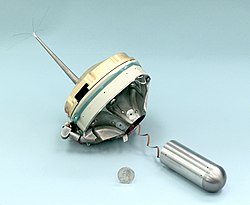
A Deep Space 2 probe with heatshield and mounting attached to the Mars Polar Lander
Mission typeMars impactor
OperatorNASA / JPL
Websitejpl.nasa.gov
Mission duration334 days
Mission failure
Spacecraft properties
ManufacturerJet Propulsion Laboratory
Launch mass2.4 kg (5.3 lb) each
Power300mW Li-SOCl2 batteries
Start of mission
Launch date20:21:10, January 3, 1999 (UTC) (1999-01-03T20:21:10Z)
RocketDelta II 7425-9.5
D-265
Launch siteCape Canaveral SLC-17
ContractorBoeing
Deployed fromMars Polar Lander (precluded)
End of mission
DisposalFailure in transit
Last contact20:00, December 3, 1999 (UTC) (1999-12-03T20:00:00Z)[1]
Mars impactor
Spacecraft componentAmundsen and Scott
Impact date~20:15 UTC ERT, December 3, 1999
Impact site73°S 210°W / 73°S 210°W / -73; -210 (Deep Space 2) (projected)

Mars Surveyor 98 mission logo

Deep Space 2 was a NASA space probe, part of the New Millennium Program. It included two highly advanced miniature space probes that were sent to Mars aboard the Mars Polar Lander in January 1999.[1] The probes were named "Scott" and "Amundsen", in honor of Robert Falcon Scott and Roald Amundsen, the first explorers to reach the Earth's South Pole. Intended to be the first spacecraft to penetrate below the surface of another planet, after entering the Mars atmosphere DS2 was to detach from the Mars Polar Lander mother ship and plummet to the surface using only an aeroshell impactor, with no parachute. The mission was declared a failure on March 13, 2000, after all attempts to reestablish communications following the descent went unanswered.[2]

The Deep Space 2 development costs were US$28 million.[3]

Overview

[edit]
Deep Space 2 project manager Sarah Gavit with the engineering hardware of the probe

Deep Space 2, also known as "Mars Microprobe,"[2] was the second spacecraft developed under the NASA New Millennium Program to flight-test advanced technologies concepts for space missions. The purpose of the program was to do high-risk technology demonstration, with a motto "Taking risks to reduce future danger."[4] The project was led and operated by the Jet Propulsion Laboratory in Pasadena, with contributions from The University of Arizona, New Mexico State, Northern Arizona University, the Air Force Research Laboratory, and others.[5]

The Deep Space 2 mission was intended to do an engineering validation of the concept of a penetrator probe, impacting the planet at high velocity, instead of slowing down for a soft landing as done by the probes conventionally used for planetary exploration. The penetrator concept is potentially a lower-cost approach, and has a proposed advantage of giving access to the subsurface of the planet being studied (in this case, Mars.)

Though the primary objective was to validate the technology, the probes also had goals for science analysis at Mars. These goals were “1) to derive the atmospheric density, pressure, and temperature throughout the entire atmospheric column, 2) to characterize the hardness of the soil and possibly the presence of layers at a scale of tens of centimeters, 3) to determine if ice is present in the subsurface soil, and, 4) to estimate the thermal conductivity of the soil at depth.”[6] The eventual goal for such probes was to deploy networks “around a planet using no more resources than a single landing under conventional assumptions.”[7]

The probes were launched with the Mars Polar Lander on January 3, 1999, on a Delta II 7425 Launch Vehicle.

Spacecraft

[edit]

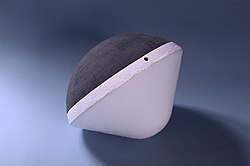
Each probe[8][6] weighed 2.4 kg (5.3 lb) and was encased in a protective aeroshell. They rode to Mars aboard another spacecraft, the Mars Polar Lander.

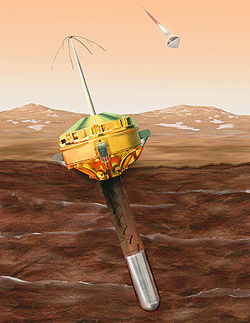
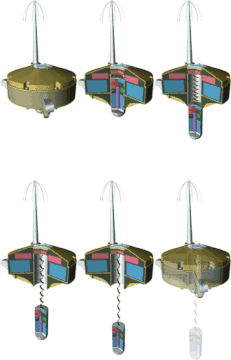
Upon arrival near the south polar region of Mars on December 3, 1999,[1] the basketball-sized shells were released from the main spacecraft, plummeting through the atmosphere and hitting the planet's surface at over 179 m/s (590 ft/s). On impact, each shell was designed to shatter, and its grapefruit-sized probe was to punch through the soil and separate into two parts. The lower part, called the forebody, was designed to penetrate as far as 0.6 meters (2 ft 0 in) into the soil. It contained the primary science instrument on board, the Evolved Water Experiment.[6] The upper part of the probe, or aftbody, was designed to remain on the surface in order to transmit data through its UHF antenna to the Mars Global Surveyor spacecraft in orbit around Mars. The Mars Global Surveyor would act as a relay in order to send the data collected back to Earth. The two sections of the probe were designed to remain connected via a data cable.[2]

Science Instruments

[edit]

The probes are each equipped with five instruments to enable analysis of the atmosphere, surface, and subsurface.

Descent accelerometer: The descent accelerometer was a commercially available sensor meant to measure accelerations from drag during descent. Its readings could “be used to derive a density profile of the Martian atmosphere” based on the acceleration data combined with knowledge of the probe's speed and ballistic coefficient.[9]

Impact accelerometer: The impact accelerometer was built with a range of ±120,000 g for the large expected acceleration on impact with Mar's surface.[9]

Meteorological sensor: provides atmospheric pressure and temperature data at the landing site. This sensor was located on the back of the probe so that it would stay above the surface after impact. It was sampled and recorded by the telecommunications “which enables the acquisition of meteorological data in the event that the microcontroller failed during the impact.”[9]

Soil Thermal Conductivity Temperature Sensors: Twin platinum resistor temperature sensors would determine rates of cooling in the forebody once submerged in the surface.[9]

Evolved Water Experiment: A small sample collection system in the forebody would bring Martian regolith into a heating chamber. The sample would then be heated to allow spectroscopy measurements on the resulting vapor using a miniaturized tunable diode laser. The Evolved Water Experiment was the primary instrument on board the probe.[6]

New Technologies: High Impact and Low Temperature Electronics

[edit]

Custom electronics and batteries were designed for the Deep Space 2 probes to survive extremely high accelerations on impact with the surface of Mars and the cold temperatures that it would experience once in operation. Both the electronics and the custom cells were required to survive an impact on the order of 80,000 g and operational temperatures as low at -80 °C.[10] Additionally, as much as a 30,000 g difference in acceleration was possible between the forebody and aftbody.[11]

Batteries

Together with Yardney Technical Products, JPL designed a battery with two non-rechargeable 6-14V cells using lithium-thionyl chloride (LI-SOCl2) chemistry to survive the expected conditions. The batteries were impact tested and also thermally cycled during development.[11]

Electronics Packaging

Due to the probe's form factor and the harsh survivability conditions, JPL used novel techniques to secure the onboard electronics. The techniques included chip-on-board (COB) technology to improve packing density.[12] It also used a 1-meter flexible umbilical cable to connect the forebody penetrator that would be displaced upon impact. Mechanical (non-functioning) models were impact tested before launch to determine if the structures would survive.[12]

Mission failure

[edit]

The probes reached Mars along with the Mars Polar Lander mission, apparently without incident, but communication was never established after impact. It is not known what the cause of failure was.

A failure review board was commissioned to report on the failures of the Mars Polar Lander and Deep Space 2 probes.[13] The review board was unable to identify a probable cause of failure,[14] but suggested several possible causes:

  • The probe radio equipment had a low chance of surviving the impact.
  • The batteries may have failed on impact.
  • The probes may have bounced on impact.
  • The probes may have landed on their sides, resulting in bad antenna performance or radio link geometry.
  • The probes may simply have hit ground that was too rocky for survival.

The board concluded that the probes and their components were not tested adequately before launch.[13][14]

Aftermath

[edit]

Despite the failures of Mars Polar Lander and the two Deep Space 2 probes, Planum Australe, which served as their exploration target,[15] would in later years be explored by European Space Agency's MARSIS radar, which examined and analyzed the site from Mars's orbit and even determined that the area had water beneath its vast area of ice.[16][17][18][19] Images which were obtained from MARSIS also determined that the water discovered beneath Planum Australe was in fact saltwater.[20][21]

See also

[edit]

References

[edit]

Bibliography

[edit]
[edit]
Revisions and contributorsEdit on WikipediaRead on Wikipedia
from Grokipedia
Deep Space 2 (DS2) was a NASA technology demonstration mission within the New Millennium Program, featuring two experimental microprobes intended to impact and penetrate the Martian subsurface to validate innovative systems for future deep-space exploration.[1][2] Launched on January 3, 1999, aboard a Delta II rocket as a piggyback payload with the Mars Polar Lander, the probes were released from the lander's cruise stage approximately 10 minutes before its scheduled touchdown near the Martian south polar region on December 3, 1999.[3][2] Each probe, weighing about 2.4 kilograms and encased in a protective aeroshell, was designed to split upon impact at around 644 kilometers per hour, with the forebody burrowing up to 1 meter into the soil and the aftbody remaining on the surface to relay data via the Mars Global Surveyor orbiter.[2] The mission's primary objectives included testing miniature electronics, low-power communication systems, and hard-landing penetrator technology, while secondarily aiming to measure subsurface temperature, pressure, acceleration, and potential water content using integrated sensors like a vibro-piezoelectric prototype detector.[1][2] However, no signals were received from the probes after their scheduled impacts, with no data returned; the exact cause remains unknown, with possible modes including battery failure or impact issues identified in post-mission analysis.[4] The mission was officially declared a failure on March 13, 2000.[3]

Background and Objectives

Mission Goals

The primary goal of the Deep Space 2 mission was to validate penetrator technology for future planetary missions by deploying two small probes designed to impact the Martian surface at high velocity and burrow into the subsurface, thereby demonstrating a novel method for accessing planetary interiors without traditional landing systems.[5] This technological demonstration emphasized low-cost, low-mass entry systems capable of passive atmospheric descent and autonomous operations, independent of real-time ground control, to enable scalable network science missions involving multiple probes.[6] Secondary goals focused on collecting basic scientific data from the Martian subsurface, including assessments of water presence, soil properties, and local weather conditions at the polar landing site, to contribute to broader understandings of Mars' climate history and resource potential.[7] Specific objectives included measuring subsurface temperature profiles and cooling rates to infer thermal conductivity, as well as detecting potential water vapor through soil sample analysis, all while testing the survival of electronics under extreme impact forces and cryogenic temperatures down to -120°C.[7] These efforts aimed to characterize soil hardness, layering, and ice content on scales from inches to feet, providing initial data on the physical state of the regolith.[5] The target site was selected in the southern polar region near 76°S, 195°W, adjacent to the Mars Polar Lander's landing ellipse, due to its layered deposits rich in dust and water ice, which offered high potential for detecting subsurface volatiles.[8] As a piggyback payload on the Mars Polar Lander, Deep Space 2 leveraged the carrier spacecraft for delivery while pursuing its independent objectives.[5]

Development History

Deep Space 2 was initiated on January 1, 1996, as part of NASA's New Millennium Program, which sought to flight-test high-risk, high-reward technologies essential for future deep space missions.[1] The project was formally selected in February 1997 to serve as a piggyback payload on the Mars Polar Lander, with a total development cost capped at $28 million to align with the program's emphasis on cost-effective innovation.[9][10] Managed by NASA's Jet Propulsion Laboratory (JPL) in Pasadena, California, the mission involved collaboration with the Goddard Space Flight Center for penetrator development and Lockheed Martin Astronautics for integration and testing.[9] This effort was embedded within the broader Mars Surveyor Program, which aimed to reduce expenses for subsequent Mars explorations by validating advanced systems like miniature penetrators for subsurface access.[11] Key milestones advanced rapidly following selection. The preliminary design review occurred in 1998, confirming the feasibility of the compact probe design despite the mission's focus on technology demonstration rather than extensive science.[4] Integration with the Mars Polar Lander took place in late 1998 at Lockheed Martin's facilities in Denver, Colorado, after which the combined payload was shipped to Cape Canaveral Air Force Station in Florida for launch preparations on a Delta II 7425 rocket.[9] The probes were officially named in November 1999 after polar explorers Robert Falcon Scott and Roald Amundsen, symbolizing their intended plunge into Mars' south polar region.[12] Development faced significant challenges due to an aggressive timeline of under three years from selection to launch, driven by strict cost constraints that limited full-scale testing opportunities.[9] Over 70 airgun impact tests were conducted between 1995 and September 1998 at facilities including Sandia National Laboratories to simulate the probes' high-deceleration entry, but the compressed schedule prioritized rapid prototyping over exhaustive environmental simulations.[9] These constraints reflected the New Millennium Program's philosophy of accepting risks to accelerate technology maturation for subsurface exploration goals.[11]

Spacecraft Design

Physical Configuration

The Deep Space 2 mission consisted of two identical microprobes, named Scott and Amundsen after the Antarctic explorers Robert Falcon Scott and Roald Amundsen, designed to demonstrate penetrator technology on Mars.[12] Each probe had a total mass of 2.4 kg and was configured as a forebody penetrator and an aftbody communications module connected by a 1 m flexible tether for power and data relay.[13] The forebody, which housed the scientific instruments, measured 105.6 mm in length and 39 mm in diameter, while the aftbody, containing the batteries and electronics, was 105 mm high and 136 mm in diameter, with an additional 127 mm antenna.[13] The probes lacked propulsion or attitude control systems, relying instead on the carrier spacecraft for orientation during cruise.[9] The probes were encased in a protective aeroshell for atmospheric entry, consisting of a forebody heat shield and aftbody structure with a total height of 27.5 cm and diameter of 35 cm, contributing to an entry mass of 3.6 kg per unit.[13] The aeroshell featured a brittle silicon carbide structure designed to shatter upon surface impact, eliminating the need for parachutes or retrorockets, and an advanced ablative heat shield material capable of withstanding entry temperatures.[14] This single-stage entry system oriented the probe for a near-vertical impact trajectory.[13] The design emphasized survival during hypervelocity impact at approximately 180 m/s (about 650 km/h), producing decelerations of up to 30,000 g for the forebody and 60,000 g for the aftbody.[13] The forebody's missile-like shape, with a sharpened tungsten nose tip, enabled it to burrow up to 1 meter into the Martian soil (with modeled depths of 0.2 to 0.6 m depending on ice content and hardness), while the aftbody remained on the surface to relay data.[13][9] Internal components were potted in rigid structures to withstand these forces, with the forebody prioritizing instrument protection and the aftbody focusing on robust power and telecom elements.[9] The two probes were functionally identical, with Scott designated as the primary and Amundsen as the backup.[12]

Power and Communication Systems

The Deep Space 2 probes relied on two non-rechargeable lithium-thionyl chloride (Li-SOCl₂) batteries connected in parallel for power, each delivering a capacity of 600 milliamp-hours while operating at temperatures as low as -80°C (-112°F).[15] These custom batteries, consisting of four D-sized cells per unit with an operating voltage range of 6 to 14 volts, were designed specifically for the mission's extreme cold environment on Mars and provided the sole energy source without solar panels or recharging capabilities.[15] The total energy budget was thus constrained to support instrument activation, data collection, and transmission for an estimated 1 to 3 days post-impact.[9] Communication was handled by a miniaturized UHF transmitter and receiver system, weighing less than 50 grams and consuming under 500 milliwatts in receive mode or 2 watts during transmission.[9] The system operated at data rates of up to 7 kilobits per second, exclusively for relaying scientific and engineering data to the Mars Global Surveyor orbiter acting as an intermediary, with no provision for direct-to-Earth links due to power and antenna limitations.[9] Transmission opportunities were scheduled for passes every 2 hours in the initial post-impact period, prioritizing buffered data packets.[9] To enable independent function after separation from the cruise stage and during surface operations, the probes incorporated pre-programmed sequences executed by an 80C51 microcontroller with 128 kilobytes of RAM and permanent memory, managing impact detection via accelerometers, sequential instrument activation, and data buffering for uplink.[9] Fault protection software monitored subsystem health in real time, entering a low-power listening mode (under 6 milliwatts active, 0.5 milliwatts sleep) upon detecting anomalies to conserve battery life and handle single-point failures without ground commands.[9] All systems were qualified through thermal cycling, vibration, and environmental testing for vacuum conditions, radiation exposure during the interplanetary cruise, and thermal extremes from -120°C in the forebody to impact-induced heating, relying on passive insulation and materials rather than active heaters to maintain operability.[9] This integration contributed to the overall probe mass of approximately 2.4 kilograms, excluding the aeroshell.[9]

Scientific Payload

Instruments

The Deep Space 2 probes featured a lightweight scientific payload totaling approximately 0.5 kg, consisting of sensors and experiments optimized for brief operation following high-speed impact and subsurface penetration into the Martian soil. Powered by non-rechargeable batteries, the instruments were engineered for one-time activation, with data collection limited to hours after deployment to capture environmental and geological data from depths up to 1 m.[9] The descent and impact accelerometers formed a core component of the payload, providing measurements of deceleration forces to analyze entry dynamics and penetration performance. The single-axis descent accelerometer, mounted in the aftbody, recorded forces ranging from 1 to 40 g at a 20 Hz sampling rate during atmospheric entry, enabling derivation of atmospheric density, pressure, and temperature profiles from an altitude of about 75 km to the surface. Complementing this, the single-axis impact accelerometer in the forebody captured extreme deceleration up to 30,000 g at 25 kHz over 30 ms, facilitating assessment of soil hardness, layering, and burrowing efficiency upon ground contact.[9] The meteorological sensor package encompassed temperature sensors, a pressure sensor, and mechanisms to infer wind speed, aimed at characterizing near-surface atmospheric conditions post-penetration. Integrated thermistors monitored local temperatures, while the pressure sensor operated over 0–25 mbar with 0.01 mbar precision and 0.03 mbar accuracy, contributing to post-burrowing environmental profiling approximately 10–15 cm above or within the soil. Wind speed and direction were estimated indirectly from accelerometer data and sensor orientations during the brief operational window.[16] Soil thermal conductivity probes utilized two platinum resistor elements functioning as both heaters and thermistors, spaced about 6 cm apart on the forebody's inner surface, to evaluate subsurface thermal properties. By applying heat and tracking the subsequent cooling rate, the probes measured heat flow and inferred soil composition, porosity, and water content to depths of up to 1 m, providing insights into regolith structure without mechanical excavation beyond the initial penetration.[9] The Evolved Water Experiment (EWX) employed a tunable diode laser coupled with a sample acquisition system to detect water vapor evolved from heated soil via absorption spectroscopy, specifically targeting subsurface ice in the polar regions. A micromotor-driven drill collected small samples (approximately 0.1 g) from up to 1 cm depth within the penetrated forebody, heating them to release volatiles for analysis; the compact tunable diode laser spectrometer, with a volume under 11 cm³ and mass below 50 g, operated at peak power of 1.5 W for detection within 10 hours post-impact.[9]

Expected Measurements

The Deep Space 2 penetrators were designed to collect accelerometer data during entry and impact, providing profiles of deceleration forces to validate models of atmospheric aerocapture and subsurface burrowing. The descent accelerometer would sample g-forces at 20 Hz from approximately 75 km altitude to the surface, yielding atmospheric density, pressure, and temperature profiles that would offer the first in-situ measurements in Mars' polar region at 75°S during late southern spring (Ls=259°).[13] The impact accelerometer, operating at 25 kHz for 30 ms, was anticipated to record peak decelerations up to 30,000 g, enabling estimates of penetration depth (0.2–0.6 m) and regolith hardness, which would inform the presence of 10 cm-scale layers and volatile content in the soil.[13][16] Post-impact meteorological readings from the probes would focus on subsurface conditions to study polar weather dynamics, with temperature sensors expected to measure values ranging from -50°C to -120°C and pressure around 6 mbar, sampled hourly over the nominal two-day mission.[17] These data, combined with derived wind profiles from entry deceleration, would reveal small-scale atmospheric processes such as gravity waves and convection, contributing to understanding volatile and dust cycles in the polar environment.[13] Thermal conductivity measurements would derive from cooling rates recorded by two temperature sensors, initially sampled every 30 seconds and then every 30 minutes, to assess soil properties like particle size and ice content. Expected values for dry dust were around 0.02 W/m·K, increasing to >0.05 W/m·K in the presence of ice, providing insights into regolith composition and heat transfer in the subsurface.[13] These results would help evaluate thermal diffusivity, anticipated in the range of 0.001 to 0.01 cm²/s, to quantify ice distribution and its role in polar geology. The Evolved Water Experiment (EWX) would detect subsurface water vapor by heating a soil sample to 10°C and analyzing absorption spectra via tunable diode laser spectroscopy, quantifying H₂O abundance to confirm whether polar ice caps extend underground.[13] This data would constrain models of Mars' water inventory and climate history, with implications for past habitability.[9] Overall data volume per probe was limited to up to 100 kbits, stored in 128 Kbytes of memory and prioritized for transmission at 7 kbits/second during Mars Global Surveyor orbiter passes, focusing on high-value measurements like impact profiles and water detection to maximize scientific return within power and contact constraints.[9][16]

Technologies Demonstrated

Penetrator Technology

The Deep Space 2 (DS2) penetrators represented a core innovation in planetary exploration by employing a hardened forebody with a conical nose to harness the kinetic energy from high-speed impact for subsurface penetration, eliminating the need for rockets, parachutes, or mechanical drills. This design allowed the 2.4 kg probe—comprising a bullet-shaped forebody and a surface-mounted aftbody connected by a tether—to bury itself up to 0.6 meters into the Martian soil upon impact at approximately 190 m/s. The forebody's rigid structure, optimized for extreme decelerations of up to 30,000 g, converted horizontal and vertical impact forces into downward penetration without active propulsion, enabling direct access to subsurface layers for in-situ measurements.[9] Impact modeling for the penetrators relied on simulations using the penetrability index (S-value) to predict performance in varied soil types, with designs tolerating a vertical velocity component of around 100-190 m/s and forecasting depths of 0.6 m in icy regolith analogous to Mars' south polar regions. These models, informed by the IMPACT code for six-degree-of-freedom trajectories and empirical SAMPLL equations, accounted for soil hardness ranging from soft (S > 15) to icy-hard (S ≈ 1-5), emphasizing penetration in frozen, low-density materials expected at the target site. Qualification testing validated these predictions through over 70 airgun experiments at the Energetic Materials Research and Test Center, where prototypes impacted simulated Mars regolith—such as native clay (S ≈ 10-15) and hard-packed sand (S ≈ 5)—at speeds up to 200 m/s, achieving measured depths of 0.38-0.85 m with accelerometer data confirming burial within ±10 cm accuracy. Additional drop tests from altitudes equivalent to several kilometers simulated entry dynamics, while aeroshell shatter tests at Eglin Air Force Base ensured clean separation and penetration. Survival criteria focused on structural integrity, requiring no deformation exceeding minimal thresholds to protect internal components during impacts.[18][9] Compared to traditional Mars landers like the 290 kg Mars Polar Lander, the DS2 penetrators offered significant advantages in mass reduction (2.4 kg total), cost efficiency through a single-stage entry system, and the ability to probe subsurface environments without post-landing excavation or complex deployment mechanisms. This approach facilitated networked science by deploying multiple low-mass units for broader coverage, potentially revealing soil composition and ice layers inaccessible to surface-only platforms. However, pre-launch assessments identified limitations, including high sensitivity to surface rocks or hard ice layers, which could arrest penetration at shallow depths (as low as 0.2 m in S ≈ 1-5 materials) and compromise data relay if the forebody failed to bury adequately. These challenges highlighted the trade-offs in relying on passive kinetic burrowing for unproven extraterrestrial terrains.[9][18]

Low-Temperature Electronics

The low-temperature electronics developed for Deep Space 2 represented a critical technology demonstration under NASA's New Millennium Program, aimed at enabling compact, robust systems for future planetary missions in extreme environments. These electronics were engineered to function autonomously after high-speed impact into Mars' surface, operating at temperatures as low as -120°C in the forebody and -80°C in the aftbody, while surviving deceleration forces exceeding 30,000 g in the forebody and up to 60,000 g in the aftbody.[19][16] A core innovation was the use of chip-on-board (COB) packaging combined with application-specific integrated circuits (ASICs) to achieve minimal size, mass, and power consumption. The power microelectronics unit employed mixed digital and analog ASICs fabricated in CMOS technology, housed in a compact module measuring 5.6 cm³ and weighing just 5 g, with a quiescent power draw of only 0.05 mW. This three-dimensional high-density interconnect approach provided structural rigidity essential for high-shock survival, embedding circuits in plastic to protect against deceleration loads during penetration. Qualification testing confirmed operation down to -120°C and shock resistance up to 30,000 g, making it suitable for deep-space harsh conditions.[19][9] Power for the electronics was supplied by custom lithium-thionyl chloride (Li-SOCl₂) primary batteries, optimized with a non-freezing electrolyte containing lithium tetrachlorogallate salt to maintain performance in extreme cold. Each probe featured two such batteries in parallel, each comprising four D-sized cells with a capacity of 600 mAh at -80°C, delivering 6–14 V and weighing less than 40 g per cell, with a 3-year shelf life. These batteries were designed to support post-impact operations for 1–3 days, including powering the electronics and instruments in the subsurface environment, and were qualified to withstand shocks up to 60,000 g. Thermal vacuum testing verified their functionality at -80°C, ensuring reliable energy delivery without freezing or degradation.[15][9][16] Development of these electronics was funded through the New Millennium Program, with prototypes rigorously tested at Sandia National Laboratories using air-gun facilities to simulate Mars entry and impact conditions. Over 70 tests were conducted at velocities up to 200 m/s (400 mph) in simulants like clay, sand, and ice, demonstrating survival of impact accelerations approaching 100,000 g for qualification margins beyond flight requirements. The electronics also incorporated radiation-tolerant design elements, such as shielding against solar proton events and error-correcting codes to maintain data integrity during the cruise phase and potential surface operations.[9][13][16] The success of this low-temperature electronics suite in ground testing validated its scalability for micro-spacecraft applications, achieving approximately 50% reduction in power requirements compared to conventional components through integrated ASICs and efficient packaging. This technology paved the way for more autonomous, low-mass probes in subsequent missions, emphasizing reliability in uncrewed deep-space exploration.[19][9]

Mission Profile

Launch and Cruise

The Deep Space 2 (DS2) mission launched on January 3, 1999, at 3:21 p.m. EST (20:21 UTC), aboard a Delta II 7425 rocket from Space Launch Complex 17B at Cape Canaveral Air Force Station, Florida. The two DS2 penetrator probes served as a piggyback payload on the Mars Polar Lander (MPL), attached to its cruise stage beneath the lander's legs to facilitate integration, testing, and thermal management during transit. No issues arose during ascent or initial orbit insertion, with the combined spacecraft stack achieving a Type 2 Hohmann transfer trajectory toward Mars.[9] The 11-month cruise phase spanned approximately 757 million kilometers (470 million miles), during which the DS2 probes remained in a powered-off, dormant mode to conserve battery life and simplify operations, exposing them to space radiation and thermal cycling while relying on the MPL for protection from the space environment. Trajectory corrections were performed using the MPL's thrusters, with maneuvers executed on January 21 (about 3 minutes duration), March 15, September 1 (30 seconds), October 30, and November 30, ensuring precise alignment for Mars arrival without independent navigation or propulsion for the probes. Health and status monitoring occurred via NASA's Deep Space Network throughout the cruise, focusing on the MPL as the primary spacecraft, with no direct telemetry from the dormant DS2 units.[9][13] Pre-entry preparations included final tracking passes via the Deep Space Network about 14 hours before atmospheric interface, with probe systems slated for activation upon jettison from the cruise stage roughly 5 to 10 minutes prior to MPL entry, allowing brief system checkouts before separation and descent. The probes' dormant configuration during cruise minimized power draw and operational risks, though they endured the full interplanetary environment without active mitigation beyond the MPL's shielding.[9][20]

Entry, Descent, and Impact

The Deep Space 2 (DS2) probes were planned to encounter Mars' atmospheric entry interface on December 3, 1999, targeting a location at 75.3°S, 195.9°W within the south polar layered terrain.[13] The aeroshell for each probe was oriented to achieve a nominal entry flight path angle of approximately -13°, enabling a controlled hypersonic entry at a velocity of 6.9 km/s relative to the Martian atmosphere.[9][21] This configuration ensured the probes followed a ballistic trajectory designed for impact roughly 60 km from the Mars Polar Lander touchdown site, allowing independent operation while leveraging the shared cruise phase.[9] During descent, the probes underwent hypersonic deceleration primarily through aerodynamic drag and ablation of the non-erosive aeroshell, which protected the internal components from peak heating rates exceeding 100 W/cm².[13] The probes separated from the Mars Polar Lander cruise stage at an altitude of approximately 960 km, initiating a free-fall phase with passive reorientation to maintain attitude stability and prevent tumbling.[9][20] This passive alignment ensured stability through the transonic regime where dynamic pressures reached up to 10 kPa.[13] As altitude decreased, the impact sequence relied on the aeroshell's design to protect until surface contact. Upon impact at approximately 200 m/s, the aeroshell was designed to shatter, enabling the forebody to burrow up to 1 meter into the subsurface while the aftbody remained exposed for communications.[9] Instruments, including the accelerometer and temperature sensors, were programmed to activate post-impact, recording deceleration forces up to 30,000 g for the forebody and transmitting initial data packets immediately.[9] Data relay was planned through the Mars Global Surveyor orbiter, utilizing UHF transmissions at rates up to 7,000 bits/s during two daily overflights, each providing an 8-10 minute communication window.[13] The first relay pass was scheduled approximately 8 hours after impact, with subsequent opportunities enabling cumulative data return of subsurface and descent profiles over the first week.[9] This relay dependence highlighted key risk factors, including the probes' reliance on the Mars Polar Lander's precise descent timing for synchronized trajectory delivery and the absence of redundancy for critical separation mechanisms, which could result in off-nominal entry angles or failed stabilization.[4]

Mission Failure and Investigation

Loss of Contact

The Deep Space 2 probes entered the Martian atmosphere on December 3, 1999, at approximately 20:00 UTC, with the first expected signal from the penetrators planned to be relayed via the Mars Global Surveyor orbiter around 20:30 UTC.[4] No communication was received during the initial relay window or subsequent opportunities on December 4 and 5, as the probes failed to transmit any telemetry or status data back to Earth.[4] Mission controllers at NASA's Jet Propulsion Laboratory immediately initiated contingency procedures, including attempts to activate backup communication modes through direct commands sent to the probes, but these efforts yielded no response.[4] Search operations expanded to include prolonged monitoring sessions using the Deep Space Network's large antennas across multiple sites, listening for any faint or delayed signals over extended periods.[4] Additionally, the Mars Global Surveyor conducted high-resolution orbital imaging of the targeted landing sites starting December 16, 1999, but the Mars Orbiter Camera detected no visible evidence of the probes or impact disturbances on the surface.[4] After exhaustive recovery attempts lasting into mid-January 2000, including analysis of potential signal interference and further command uplinks, the Deep Space 2 mission was officially declared a failure on January 17, 2000.[4] This loss occurred simultaneously with the failure of the co-manifested Mars Polar Lander, compounding the setbacks for NASA's Mars exploration efforts following the earlier Mars Climate Orbiter mishap and prompting a broad reevaluation of the agency's planetary program.[22]

Root Cause Analysis

Following the loss of contact with the Mars Polar Lander (MPL) and Deep Space 2 (DS2) on December 3, 1999, NASA formed a JPL Special Review Board on December 16, 1999, chaired by John Casani, to investigate the failures of both missions.[4] The board, comprising experts from JPL, industry, and academia, conducted multidisciplinary reviews of design, testing, and operations, culminating in a report released on March 22, 2000.[4] For the MPL, the board identified premature shutdown of the descent engines as the primary probable cause, triggered by a false signal from the touchdown sensors at approximately 40 meters altitude during leg deployment, resulting in an uncontrolled impact at about 22 m/s instead of the nominal 2.4 m/s.[4] For DS2 specifically, the investigation could not determine a definitive root cause due to the complete absence of post-entry telemetry or signals from the probes.[4] The board assessed multiple plausible failure modes, with one leading scenario being a failure in the separation of the cruise stage from the aeroshell and lander, which would have prevented the probes from deploying and instead caused them to reenter and burn up with the stage.[4] An alternative plausible mode involved the probes impacting rocky or uneven terrain, leading to bouncing, side-landing, or burial failure that blocked antenna deployment and communication; remote sensing data suggested rocks larger than 30 cm were unlikely, but small-scale slopes exceeding 10 degrees covered about 12% of potential sites.[4] Simulations and analyses indicated low probabilities for many entry and descent anomalies, such as backshell draping (<1%) or heatshield micrometeoroid penetration (~1% upper bound), but could not exclude the separation or terrain issues without direct evidence.[4] Secondary contributing factors included inadequate software testing on the MPL, where transient signals from the touchdown sensors (lasting 5-33 ms) were not fully simulated, potentially causing the erroneous engine cutoff—a flaw verified in post-failure ground tests.[4] For DS2, limited environmental testing exacerbated risks, with no system-level impact tests of flight-like radio frequency subsystems in Mars-like conditions (e.g., 6-torr CO2 atmosphere) and no full-scale qualification of batteries under impact loads, relying instead on similarity to prior designs.[4] Systemic issues identified by the board stemmed from program pressures, including a compressed schedule that deleted key tests like system-level heatshield separation and supersonic parachute deployment to meet cost and timeline constraints.[4] Cost-cutting measures led to understaffing and siloed development between the MPL and DS2 projects, managed as separate efforts under the Mars Surveyor Program, which hindered integrated risk assessment and peer reviews.[4] These factors, combined with immature thermal and propellant management designs, increased overall mission vulnerability without robust end-to-end verification.[4]

Legacy and Aftermath

Lessons Learned

The failure of the Deep Space 2 (DS2) mission, as detailed in the official investigation, underscored critical deficiencies in testing protocols, particularly the absence of comprehensive end-to-end simulations that integrated software and hardware components under flight-like conditions. While partial impact tests were conducted using an air gun, the project deleted a full system-level qualification test mid-development due to cost and schedule pressures, leaving key interactions between the aeroshell and probe unverified.[4] This highlighted the necessity for rigorous, powered-on system-level testing to validate technology demonstrations before launch.[4] Risk management practices were also exposed as inadequate, with schedule compression and budget reductions—hallmarks of NASA's "faster, better, cheaper" paradigm—resulting in overlooked failure modes, such as uncharacterized structural risks from aeroshell-probe separation and insufficient mitigation of potential RF subsystem breakdowns during impact.[4] The investigation revealed that these constraints led to acceptance of high-risk elements without adequate characterization, emphasizing the need for proactive risk assessment that prioritizes modeling validation and contingency planning over expedited timelines.[4] For piggyback missions like DS2, which relied on the Mars Polar Lander for deployment and communication, the lack of independent oversight allowed issues from the primary mission to cascade, prompting recommendations for separate review processes to ensure isolated evaluation of secondary payloads.[4] The DS2 mishap catalyzed broader cultural shifts within NASA, prompting a reevaluation of the "faster, better, cheaper" approach to balance innovation with disciplined engineering. This included mandates for more rigorous peer reviews, enhanced modeling accuracy, and stricter adherence to "test as you fly" principles to prevent deviations that compromise mission reliability.[23] In response, NASA implemented specific reforms such as increased funding allocations for environmental qualification testing and the adoption of dual-redundancy measures for critical systems like separations in subsequent Mars missions post-2000, aiming to build greater margins against single-point failures.[23]

Influence on Future Missions

The failures of Deep Space 2, occurring alongside the Mars Polar Lander loss in late 1999, played a significant role in NASA's reevaluation of its Mars exploration strategy, contributing to a temporary hiatus in new Mars lander missions that lasted until the Mars Exploration Rovers Spirit and Opportunity launched in 2003.[24] This period of reflection led to the abandonment of the high-risk "faster, better, cheaper" paradigm, which had prioritized cost savings over rigorous testing, and instead emphasized more robust engineering and redundancy in subsequent missions.[25] The resulting designs were evident in the Mars Exploration Rovers Spirit and Opportunity, launched in 2003 and landing in 2004, which incorporated enhanced reliability features to mitigate software and hardware vulnerabilities exposed by Deep Space 2.[26] Lessons from the mission, as part of broader post-1999 reforms, informed the development of later Mars landers including the Mars Science Laboratory (Curiosity rover, launched 2011) and the Perseverance rover (launched 2020), where balanced budgets supported comprehensive pre-flight validation to avoid the under-testing issues that doomed Deep Space 2.[23] Deep Space 2's targeted impact sites in the Martian south polar layered deposits underscored the scientific value of probing polar subsurface environments for volatiles like water ice, even though the mission failed to transmit data.[6] This focus gained validation years later through the Mars Advanced Radar for Subsurface and Ionosphere Sounding (MARSIS) instrument on ESA's Mars Express orbiter, launched in 2003, which detected radar reflections initially interpreted as indicative of liquid water beneath the south polar ice cap in 2018— in regions akin to Deep Space 2's intended landing area.[27] [28] However, subsequent studies as of 2021 have cast doubt on this interpretation, suggesting alternatives such as clay deposits or variations in ice composition could explain the signals without liquid water.[29] These findings, whether confirming liquid water or highlighting other subsurface features, underscored the potential habitability and resource significance of polar terrains that Deep Space 2 aimed to explore directly. The penetrator design of Deep Space 2 advanced concepts for low-mass, high-velocity subsurface probes, influencing proposals for future NASA missions involving networks of micro-penetrators to enable distributed science on Mars and other bodies. Its pioneering low-temperature electronics, capable of operating at -120°C after extreme impact forces, contributed to the technological foundation for instruments in later polar missions, such as the Phoenix lander (2008) and InSight (2018), which required reliable performance in frigid conditions.[30] More recently, InSight's Heat Flow and Physical Properties Package (HP³) mole probe encountered penetration difficulties due to unexpectedly cohesive Martian soil, echoing the subsurface access challenges Deep Space 2 faced in achieving viable burial depths for its sensors.[31] These experiences have reinforced the need for adaptive penetration strategies in ongoing efforts to study volatiles, as seen in hybrid drilling and sampling systems proposed for resource prospecting.[32]

References

User Avatar
No comments yet.