Hubbry Logo
Dharmarajika StupaDharmarajika StupaMain
Open search
Dharmarajika Stupa
Community hub
Dharmarajika Stupa
logo
8 pages, 0 posts
0 subscribers
Be the first to start a discussion here.
Dharmarajika Stupa
Dharmarajika Stupa
from Wikipedia

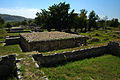
The Dharmarajika Stupa (Punjabi, Urdu: دھرم راجک اسٹوپا), also referred to as the Great Stupa of Taxila, is a Buddhist stupa near Taxila, Pakistan. It was built over the relics of the Buddha by Ashoka, the Emperor of Magadha, in the 3rd century BCE.[1][2][3][4][5] The stupa, along with the large monastic complex that later developed around it, forms part of the Ruins of Taxila - which were inscribed as a UNESCO World Heritage Site in 1980.[6]

Key Information

History

[edit]

It is believed that the Dharmarajika Stupa was built over the remains of an even older stupa that had been built by the Mauryan emperor King Ashoka in the 3rd century BCE[7][8][3][4][5] The stupa was believed to have been reestablished in the 2nd century CE during the Kushan era in order to house relics of the Buddha, which may have been sourced from earlier monuments.[1] Buddhist texts mention that frankincense was used during religious services at Dharmarajika, while the complex was paved with colourful glass tiles.[9] Indo-Greek coins found at the site date from the 2nd century BCE, suggesting earliest possible establishment of a religious monument at the site.[8]

Small stupas that predate the main stupa are found throughout the Dharmarajika site, and surrounded an earlier core stupa in an irregular layout.[8] It is known that the earlier core stupa contained a pathway for circumambulation that was made of plaster, and decorated with shell bangles in geometric patterns.[8] The earlier stupa likely had four gates in axial directions.[8]

The site came under control of Persian Sassanid rule, and suffered a period of stagnation.[8] Large-scale developments took place during the late Kushan and Kidarite era which added numerous monasteries and stupas to the site.

Destruction

[edit]
Plan of the Dharmarajika Stupa.

The site was devastated by the White Huns in the 5th century CE, and then abandoned.[2] Subsequent rulers, such as the Hun king Mihirakula, persecuted the region's Buddhists.[8] Under his reign, over a thousand Buddhist monasteries throughout Gandhara are said to have been destroyed.[8] The White Huns destroyed not only Taxilan sites, but also devastated nearby Peshawar.

Excavation

[edit]

The stupa was excavated by Sir John Marshall in 1913. The stupa had been looted several times prior to Marshall's discovery, and was badly damaged.[10] Marshall noted that a large trench, requiring tremendous effort, was built at some point in the past in order to loot the stupa's precious relics.[1] By 1934, enough of the site had been uncovered that the site's scale could be appreciated.[2] Human skeletons were discovered in the open area immediately south of the stupa, and may be the remains of monks who were killed during the invasion of the White Huns.

Layout

[edit]

The location of the stupa and its monastic community about one kilometre outside of Sirkap is in conformity with the Buddha's recommendation that monasteries should be neither "too far" nor "too close" to adjacent towns.[10] Three distinctive types of masonry in the buildings around the main stupa suggest the contributions of different periods to the building activity.

Core stupa

[edit]
The passageway between the main stupa and several smaller stupas was used for the practice of pradakshina.

Dharmarajika Stupa is the largest of all stupas in the Taxila region,[2] Surrounding the main mound is a passageway for pradakshina — the ancient practice of walking around a holy site.

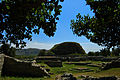
The stupa's large anda, or hemispherical mound, is damaged − though the plinth of the mound, known as the medhi, is still largely intact.[10] The anda mound was made of ashlar stone.[10] The stupa's harmika, or fence like structure built atop the anda mound, has been lost.[10]

The stupa's southern gateway was initially considered the most important, though the construction of four smaller stupas (termed G7, G8, S7, Q1) to the west of the stupa indicate that this then likely became the preferred entrance for those performing circumambulation.[8] Later constructions around the "Eastern Avenue" then shifted the preferred route for circumambulation to the eastern side of the stupa.[8]

Before entering the main sacred areas, visitors to the shrine from Sirkap would pass through a large building, now termed building H, that would openly display relics.[8] Visitors likely venerated the relics at building H before entering the main stupa area.[8]

Peripheral stupas

[edit]
Chambers containing religious imagery were built along the "Northern Avenue".

The stupa was surrounded by a circle of smaller stupas which were built approximately 200 years after the main stupa's construction,[2] and were likely constructed together as part of a project funded by a single patron.[8]

Additional stupas were built further along the northern portion of the site by various patrons, and date from the Indo-Scythian period.[2] These stupas form a "Northern Avenue," that had several small shrines with devotional images, rendering the Northern Avenue a processional corridor.[8] Devotional images were likely relegated to the periphery of the complex due to religious conservatives, who were hesitant to fully embrace the new practice of using imagery in religious practice.[8]

Unlike constructions at Sanchi, stupas around the Dharmarajika Stupa were built by individual donors, rather than as part of a communal effort.[11]

Monasteries

[edit]
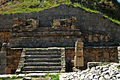
Ruins of several monasteries are located around the main stupa.

Early monastic cells near the stupa were built as a row of rooms, with a verandah,[11] The verandah style was later dropped in favour of monastic living quarters surrounding quadrangles that were built immediately north, northeast, and east of the stupa approximately 300 years after the stupa's construction.[2]

The northern monastery consisted of two courtyards that were each built around a large stupa.[8] The smaller eastern courtyard is believed to have housed 13 monks.[2]

Monastery G, located immediately west of the stupa has at least 50 monastic cells, a stupa, and was likely multistoried.[8] Monastery M in the extreme northwest section of the site, and contained its own stupa in a small courtyard.[8] Monastery M is connected to a long residential monastery,[8] oriented in a roughly north-south direction. At the southern edge of this monastery are the remains of two stupas, now termed E1 and E2.[8] E1 was built in a pre-existing cell, while E2 was a more elaborated stupa that contained a small passageway for circumambulation.[8] Neither stupa was likely open to the public.[8]

Relics

[edit]

Bone fragments of the Buddha

[edit]
Statuette from the Dharmarajika site, now displayed at the Taxila Museum in Taxila.

The site is famous for its bone relics – thought to be those of the Buddha,[12] Much of the stupa's precious relics had been looted by the time it was discovered by Sir John Marshall.[1] A silver casket containing a silver inscription was recovered from the stupa's chapel after discovery,[1] The inscription is written in the ancient Kharosthi script that was once common throughout Gandhara,[2] The inscription states that Urusaka of Noacha placed bone relics of the Buddha in his chapel at Dharmarajika in 78 CE.[2]

In 2016, 2 bone relics from the Dharmarajika Stupa were sent to Sri Lanka for one month. The relics were displayed at important shrines in Polonnaruwa, Colombo, Kandy, and Anuradhapura, and attracted 9.3 million visitors.[13]

Reliquary vessels

[edit]

18 reliquary vessels were also recovered from smaller stupas surrounding the Dharmarajika Stupa that yielded a wide array of relics, including one that encased a cylindrical piece of gold.[2] Other reliquaries yielded gold jewelry and precious jewels,[2] while others contained items from distant locations such as lapis lazuli from Afghanistan, pearls, and shells − reflecting the large trade networks operating from Taxila.[2] Several coins of the Indo-Greek king Zoilos II were found under the foundation of such a 1st-century BCE stupa.[14]

Etymology

[edit]

The name Dharmarajika comes from Dharmaraja, a name given to Buddha who was the true Dharma Raja (Lord of Law), according to Marshall. It is also believed that ‘Dharmarajika’ is derived from the word ‘Dharmaraja’, a title used by Mauryan emperor Ashoka. The stupa is also popularly known as Chir Tope, or "Scarred hill".

Access

[edit]

The Dharmarajika Stupa lies about 3 kilometers east of the Taxila Museum, along the PMO Colony Road, northeast of Taxila Cantonment. The stupa was located near the ancient city of Sirkap, which also forms part of the Ruins of Taxila.

[edit]

See also

[edit]

Notes

[edit]

References

[edit]
Revisions and contributorsEdit on WikipediaRead on Wikipedia
from Grokipedia
The Dharmarajika Stupa, also known as the Great Stupa or Chir Tope, is an ancient Buddhist monument located in the Taxila Valley of , approximately 1 kilometer west of the Taxila Museum. Constructed in the 3rd century BCE during the reign of Emperor Ashoka, it is one of the earliest surviving in the region and enshrines bone relics attributed to , making it a key site for Buddhist pilgrimage and veneration. As part of the World Heritage-listed archaeological ensemble of , the stupa complex spans from the Mauryan period through later Kushan and post-Kushan expansions, reflecting Taxila's continuous religious importance from the 5th century BCE to the 5th century CE. The stupa's origins trace to Ashoka's efforts to propagate Buddhism following his conversion, with the main structure surrounded by subsidiary stupas containing relic deposits of ashes, bone fragments, and jewelry, discovered during excavations led by British archaeologist Sir John Marshall from 1913 to 1916. The main stupa had been looted in antiquity and contained no relics. Later additions in the 1st to 2nd centuries CE under Kushan patronage included encircling walls, four apsidal chapels at the cardinal points, and numerous subsidiary stupas, some of which yielded coins, beads, and further relics dating to the 2nd century BCE. The complex also encompasses an adjacent monastery with monks' cells, courtyards, and assembly halls, illustrating the integrated monastic life centered around the stupa. Architecturally, the Dharmarajika exemplifies early Mauryan design with a hemispherical dome (anda) rising to about 15 meters in height, a square base, and a harmika (square platform) topped originally by a chattra (umbrella-like ), though much of the upper structure has eroded. The surrounding path features ornate reliefs in the Gandharan style, depicting , 's life events, and Greco-Buddhist motifs such as fluted pilasters and pseudo-Corinthian capitals, with over 140 sculptures recovered, including rare early images of the standing . Masonry evolved from wedge-shaped bricks in the core to and semi-ashlar techniques in later phases, highlighting technological advancements and multicultural influences from Persian, Hellenistic, and Central Asian traditions. The Dharmarajika Stupa holds profound historical and cultural significance as a testament to 's role as a major crossroads of ancient trade routes and a hub of Buddhist scholarship, attracting pilgrims from across and contributing to the spread of Mahayana Buddhism. Its relics and artifacts, now largely housed in the Taxila Museum, provide crucial evidence for dating early Buddhist and worship practices, while the site's ongoing conservation underscores its vulnerability to environmental degradation and urban encroachment. Recognized under Criteria (iii) for bearing exceptional testimony to urban evolution and (vi) for associations with pivotal historical figures, the stupa remains a cornerstone of Gandharan heritage, illuminating the interplay of religion, art, and empire in ancient .

Overview

Location and Context

The Dharmarajika Stupa is situated within the ancient city of in the of , modern-day , at coordinates approximately 33°44′41″N 72°50′34″E. As a prominent feature of 's archaeological landscape, it lies in the fertile valley of the , historically part of the strategic crossroads connecting with . The site is located about 3 kilometers east of the Museum, along the PMO Colony Road, northeast of Cantonment, and in close proximity to other key ruins such as the Greco-Indo-Scythian city of Sirkap, roughly 3 kilometers to the northwest. It is also near the modern village of Dharmarajika, which shares its name and underscores the site's enduring local significance. This positioning places the within a dense cluster of ancient settlements and religious complexes that facilitated trade, learning, and pilgrimage along historic routes. Within the broader region, encompassing parts of present-day and , the Dharmarajika Stupa served as a vital Buddhist center from the 3rd century BCE through the 5th century CE, reflecting the area's role as a hub for and early Buddhist practices amid cultural exchanges between Indian, Persian, and Hellenistic influences. The stupa emerged as a patronage site during the Mauryan Empire under Emperor , who supported its establishment to promote Buddhist teachings across his domains. Recognized for its outstanding as part of an exceptional archaeological , the Dharmarajika Stupa was inscribed on the World Heritage List in 1980 as a component of the Ruins, highlighting its contribution to understanding ancient and urban development in .

Etymology

The name Dharmarajika derives from the compound Dharmarāja, literally meaning " of the " (where dharma denotes the Buddhist doctrine or righteousness, and rāja signifies ), a title bestowed upon as the ultimate promulgator of the or upon Emperor for his role in propagating . This designation reflects the stupa's association with Ashoka's distribution of the Buddha's relics across eight major sites in the BCE. In local Punjabi usage, the stupa is known as Chir Tope, translating to "Scarred Hill," an appellation arising from its post-destruction appearance as a scarred, mound-like structure resembling a hilltop with visible fissures. The is rooted in classical , with no attested variants in or inscriptions from the Ashokan period beyond the standard Dharmarāja form adapted to Buddhist .

History

Construction and Expansion

The Dharmarajika Stupa, located in , was initially constructed in the 3rd century BCE, attributed to Emperor as part of his extensive campaign to redistribute relics of following the opening of earlier containing the original remains. This effort aimed to propagate across his empire, with the stupa serving primarily as a depository for portions of the Buddha's relics to facilitate worship and merit accumulation. The attribution is based on the site's name ("Dharmarajika," referring to Ashoka as Dharmaraja), Mauryan masonry style, and donative inscriptions; earliest coin evidence dates to the 2nd century BCE. The original core measured approximately 131 feet (40 m) in diameter at the base, consisting of a simple structure designed for basic , with a drum height of about 45 feet (14 m). Subsequent expansions occurred during the Kushan period in the 2nd century CE, under rulers who patronized to assert their imperial and religious authority. These modifications enlarged the central core by encasing it in finer stone facing and added peripheral chapels and radiating walls to enhance ritual pathways for pilgrims. Evidence from stratigraphic layers reveals three distinct styles marking these phases: an early core from the Mauryan era, intermediate refinements with slabs in the post-Mauryan period, and Kushan-era diaper-patterned work that provided greater durability and aesthetic elaboration. This evolution transformed the from a compact into a more elaborate monumental complex, underscoring its growing role in regional Buddhist devotion. Relics discovered during 20th-century excavations, including bone fragments of , confirmed the site's ancient significance, with portions gifted to in 1937.

Destruction and Abandonment

The Dharmarajika Stupa, originally constructed during the reign of Emperor Ashoka in the 3rd century BCE, experienced partial damages possibly linked to conflicts involving Indo-Greek rulers in the 2nd century BCE, as indicated by numismatic evidence from the site. However, the primary phase of destruction occurred in the 5th century CE amid invasions by the White Huns (Hephthalites), who devastated Buddhist monuments across , including those at . These invasions, beginning after 455 CE, involved ruthless campaigns that carried "sword and fire wherever they went," leading to the wanton devastation of sites like Dharmarajika. Under , who ruled from around 515 CE, the persecution intensified; the 7th-century Chinese pilgrim recorded that he demolished 1,600 stupas and monasteries in alone, targeting Buddhist institutions amid his broader anti-Buddhist policies. Archaeological findings at confirm this, with evidence of fire damage—such as charred debris and burnt structural elements—and widespread collapses that buried the under rubble. The site's main abandonment followed these events in the late 5th century CE, as the Hunnic incursions disrupted economic and monastic life, contributing to Buddhism's sharp decline in . This neglect persisted through the revival of in the and later Islamic expansions from the 8th century onward, leaving the monument interred for over 1,300 years.

Excavation and Rediscovery

The excavations at the Dharmarajika Stupa in were initiated under the direction of Sir John Marshall, Director-General of the , beginning in 1913 and continuing through 1916. These efforts, supervised on-site by local archaeologist Ghulam Qadir, focused on systematically uncovering the buried remains of the main stupa and its surrounding complex, which had been largely obscured by debris from later historical disturbances, including the Hunnic invasions of the 5th century CE. Marshall's team documented the site's layout through detailed surveys, photographs, and maps, revealing a multi-phase construction history with successive layers of styles ranging from early and kañjūr to later diaper and semi- techniques. Key findings during this period included the exposure of the stupa's core structure and peripheral elements, such as the pradakshina path—a circumambulatory encircling the monument—and adjacent remains located to the northwest and west. Artifacts unearthed provided chronological insights, notably Indo-Greek coins dating to the early BCE, which indicated the site's religious significance predated later Buddhist expansions. These discoveries were meticulously recorded in Marshall's field notes and illustrated in his comprehensive reports, highlighting the stupa's evolution from an initial foundation possibly in the BCE to subsequent enlargements. Further work under the extended the excavations from 1934 to 1936, led by A.D. Siddiqui, achieving the full uncovering of the complex and consolidating earlier findings. Initial scholarly interpretations by Marshall linked the stupa's origins to Emperor Ashoka's era, based on the types, evidence, and donative inscriptions discovered at the site, positioning it as one of 's earliest Buddhist monuments. These assessments, published in the Annual Reports (1916, 1918, 1920) and Marshall's seminal three-volume work (1951), established the foundational framework for understanding the site's historical and cultural role.

Architecture

Core Stupa

The core of the Dharmarajika consists of a circular structure with a base of approximately 35 (115 feet), elevating a hemispherical dome referred to as the anda. This dome supports a harmika, a square platform symbolizing the square of the earth, which was originally surmounted by a chatra—a multi-tiered umbrella representing the axis mundi and enlightenment. In its reconstructed form, the stupa reaches a height of approximately 15 meters, embodying the classic hemispherical profile typical of early Buddhist architecture.[](Marshall, J. (1951). Taxila: An Illustrated Account of Archaeological Excavations, Vol. 1. Cambridge University Press, pp. 230-274.) The internal design includes a passageway encircling the base to facilitate pradakshina, the devotional practice of , constructed with a rubble core faced by stone for durability and aesthetic appeal. This core-relic enclosure served as the primary repository for sacred remains, with the passageway allowing pilgrims to engage in ritual movement without entering the sacred interior.[](Marshall, J. (1951). Taxila: An Illustrated Account of Archaeological Excavations, Vol. 1. , pp. 240-241.) During the Kushan period, expansions introduced ornate decorative features to the core structure, such as vibrant glass tiles inlaid for visual splendor, shell bangles arranged in geometric motifs on the facing, and images portraying in meditative poses. These elements enhanced the stupa's symbolic role as a site of veneration and artistic expression.[](Marshall, J. (1951). Taxila: An Illustrated Account of Archaeological Excavations, Vol. 1. , pp. 691-727; Errington, E. (1999/2000). "The Western Satraps and ," Silk Road Art and Archaeology, 6, pp. 191-216.) The stupa originated as a modest earthen mound enclosing relics, evolving into a more elaborate monument through phased additions that refined its form and scale.[](Forte, A., & Kuwayama, S. (2018). "Dharmarajika, Taxila." Oxford Centre for Architectural Conservation, pp. 1-5. https://www.carc.ox.ac.uk/XDB/DMS/%7B762B3E5F-1EBB-4EF9-AC5D-7AC5E6890FE7%7D.pdf)

Peripheral Structures

The peripheral structures of the Dharmarajika Stupa complex feature numerous smaller votive stupas encircling the main stupa, with at least 11 identified in a ring formation dating to the Saka period around the 1st century BCE, and additional ones constructed from the 2nd to 5th centuries CE as devotional offerings by pilgrims and benefactors. These votive stupas, often built with rubble cores and kanjur stone facings, vary in size and decoration, with some containing personal relics such as steatite caskets holding bones, beads, and miniature stupas deposited by devotees. Over time, more than 30 such structures accumulated, illustrating the site's ongoing role as a center for individual piety and commemorative acts. Northern and southern avenues, serving as processional routes, are lined with devotional images in niches and small chapels designed for rituals, including and offerings. These avenues, flanked by shrines featuring and stone figures of , facilitated ritual movement toward the core , the focal point of worship. The peripheral elements integrate seamlessly with adjacent monasteries, particularly a large northern monastic complex with multiple courts, cells, and assembly halls, forming a cohesive that supported monastic communities in their daily practices and supported pilgrimage activities. This arrangement created a bounded where and visitors could engage in communal worship and . The overall layout demonstrates symmetry along an east-west axis, with the circular main stupa centered on a raised terrace accessible via aligned staircases, while the encircling stupas and chapels radiate outward in patterned rows. The total site spans several acres on a lofty plateau above the Tamra Nala, encompassing the stupa courts, avenues, and monastic quarters within a unified archaeological enclosure.

Construction Techniques

The Dharmarajika Stupa was constructed primarily using local materials such as and kanjur stone, with rubble cores for stability. Early Mauryan phases ( BCE) employed rough bonded with mud or , faced with slabs for the core structure and . These techniques provided durability on the site's plateau , with walls 3 to 5 feet thick radiating from the center. Subsequent expansions from the Saka to Kushan periods (1st century BCE to 3rd century CE) introduced more refined methods, including small masonry (interlocking wedge-shaped stones) in the 1st-2nd centuries CE and larger or semi-ashlar techniques thereafter, reflecting advancements in stone dressing and jointing for added precision and load distribution. Foundations were dug to where possible, especially on sloping ground, and surfaces were often plastered with lime for protection and decoration, sometimes inlaid with or shell elements.[](Marshall, J. (1951). Taxila: An Illustrated Account of Archaeological Excavations, Vol. 1. , pp. 230-274.) The multi-phase construction began with a simple hemispherical dome over relics, evolving through additions like encircling walls and chapels, with no evidence of advanced tools like saws; instead, fissures were exploited for quarrying, and stones were shaped using hammers and chisels. Later repairs used baked bricks and for aesthetic enhancements, adapting to regional Gandharan influences.

Relics and Artifacts

Discovery Process

The discovery of relics at the Dharmarajika Stupa took place during excavations carried out between 1913 and 1916 under the direction of Sir John Marshall as part of the Archaeological Survey of India's work at Taxila. These digs targeted the core stupa and surrounding peripheral chapels, where teams employed careful stratigraphic removal to excavate layer by layer, using tools such as picks, spades, and brushes to clear accumulated debris while preserving contextual integrity. This methodical approach allowed archaeologists to identify construction phases and locate relic deposits at varying depths, often 4 to 13 feet below the surface in subsidiary structures. Excavation of the stupa's core involved sinking a vertical shaft, but no intact reliquaries were found due to prior disturbance; relic deposits were located in peripheral structures. This technique minimized disturbance to surrounding materials and enabled the controlled extraction of intact containers from those areas. Overall, 18 vessels were recovered from diverse stratigraphic layers in the peripheral sites and smaller stupas, encompassing materials like grey schist, gold, silver, copper, and crystal, many of which had been placed as votive offerings. Some deposits showed evidence of prior tampering by treasure-seekers, complicating recovery but not preventing the salvage of significant items. Marshall's team documented each find extensively through on-site measurements, photographic records, and field notes, contributing to detailed catalogs in the Archaeological Survey of India's annual reports from the period. Following initial assessment, the relics were carefully transported to the Museum for safekeeping, study, and long-term curation, ensuring their availability for scholarly analysis. A major challenge was the fragility of bone fragments and other organic elements within the caskets, which risked disintegration upon exposure to air and handling. On-site preservation efforts involved immediate application of consolidants like , gentle cleaning with acids for metal components, and protective wrapping to mitigate damage during transport, particularly for delicate items such as and .

Types of Relics

The relics at the Dharmarajika Stupa encompass fragments venerated as those of , including calcined pieces distributed after his , underscoring their profound sacred status in Buddhist tradition. These remains, often minute in size, were carefully enshrined to commemorate the Buddha's physical legacy and inspire devotion among pilgrims. In 2016, two relics from the site were gifted to for public veneration and exhibition. Reliquary vessels formed the primary containers for these relics, featuring intricate nested designs made from diverse materials such as silver caskets, small caskets, steatite or stone boxes, and elements. A prominent example from a deposit, dated to 78 CE, included a steatite casket enclosing a silver vase that held a casket with bone fragments, accompanied by fragments of and small pearls. Other vessels incorporated semi-precious stones like , , and , enhancing the sanctity and aesthetic reverence of the enclosures; for instance, jars or beads were paired with reliquaries in subsidiary stupas to house similar bone pieces. In addition to the sacred bone relics, deposits contained non-human items interpreted as donor offerings, such as trade goods including carnelian beads, agate, rock crystal, and coins from Indo-Greek and Indo-Scythian periods (e.g., issues of Apollodotus II and Maues). These artifacts, totaling dozens across sites like Stupas B3, B6, and U1, reflected the economic and cultural exchanges of the era while supporting the ritual deposition. Overall, excavations revealed over 18 reliquary vessels from the smaller stupas surrounding the main structure, along with more than 100 associated fragments, beads, and minor artifacts primarily from layers linked to the 78 CE period. Such relics were typically placed within the core of the stupa or its chapels to align with cosmological symbolism, ensuring their protective enclosure and accessibility for worship.

Inscriptions and Cultural Items

The Dharmarajika Stupa features several inscriptions in script discovered on silver caskets within its relic chambers, providing key evidence of royal patronage during the Kushan period. One prominent example is the inscription on a lenticular silver casket unearthed from chapel G, dated to 78 CE (year 136 of the Azes era), which records the enshrinement of relics attributed to by Urasaka, son of Athadapha from and resident of Noacha. This dedication was made for the welfare of the Kushan ruler, invoking the title "Maharaja Rajatiraja Devaputra Kushanasa," highlighting the involvement of Central Asian donors under Kushan oversight in supporting Buddhist institutions. Other inscriptions from the site, documented in early 20th-century epigraphic studies, similarly reflect donations by local elites and reflect the script's prevalence in the region from the Indo-Scythian to Kushan eras. Earlier inscriptions linked to the Ashokan era, though less directly associated with the stupa's core, appear in the broader complex and underscore the site's foundational ties to Mauryan patronage. These include fragmentary Brahmi dedications from the 3rd century BCE, consistent with Ashoka's edicts promoting across his empire, which facilitated the stupa's initial construction to house redistributed relics. Cultural items recovered from the stupa's relic deposits and surrounding structures illustrate extensive trade networks along the , blending local, Greco-Roman, and Central Asian influences. Indo-Greek coins, such as those of kings like from the 2nd century BCE, were found in fills, indicating ongoing cultural exchange and use as votive offerings by pilgrims during the site's early phases. artifacts, including square tiles used to pave the path around the stupa, point to imports around the 1st-2nd centuries CE, likely via overland routes. Central Asian jewels, such as , , and etched stone beads from relic chambers in stupas B and S, reflect artisanal traditions from regions like , deposited as part of devotional hoards. Devotional artifacts further emphasize the site's role as a pilgrimage center, with images of and attendant figures adorning chapel niches, such as a 9-inch-high head from chapel B. These lime-based sculptures, typical of Gandharan art, were likely commissioned by visiting devotees. Jewelry deposits, including gold earrings with pearls and small gold coins interspersed in relic spaces between peripheral stupas P and P, represent personal offerings from pilgrims seeking merit through dedication. Interpretations of the stupa's relics connect them to the traditional post-parinirvana distribution of the Buddha's remains, where is said to have opened seven of the original eight stupas to reallocate portions into 84,000 new structures, including this one at . Bone fragments served as the primary relic contents, symbolizing the Buddha's physical presence and drawing pilgrims for .

Significance and Preservation

Religious and Historical Importance

The Dharmarajika Stupa holds profound religious significance in Buddhist tradition as an early constructed during the reign of Emperor Ashoka to enshrine relics attributed to following his , serving as a key site for commemorating 's final passing and the distribution of his ashes among the faithful. These relics, attributed to and accompanied by inscriptions recording their deposition by donors, underscore the stupa's role in preserving tangible links to 's life and teachings. As a focal point within ancient pilgrimage circuits in , the stupa attracted devotees seeking spiritual merit through and veneration, reinforcing its centrality in and practices across South and . Historically, the Dharmarajika Stupa exemplifies Emperor Ashoka's efforts to propagate beyond the Mauryan heartland, with its construction in the BCE marking a pivotal expansion of the faith into the northwestern frontier of the . Located in the region, it illustrates the syncretic Greco-Buddhist culture that emerged from interactions between Mauryan Indian traditions and Hellenistic influences following Alexander the Great's campaigns, blending indigenous architecture with Western artistic motifs in surrounding reliefs and sculptures. In 2016, relics from the Dharmarajika Stupa were loaned to for a month-long exhibition during celebrations, displayed across major shrines in , , , and , drawing millions of visitors and reigniting global interest in Gandhara's Buddhist heritage. This event highlighted the stupa's enduring interfaith and international relevance, fostering diplomatic ties between and while emphasizing the relics' role in contemporary . As the largest in , the Dharmarajika uniquely bridges the Mauryan and Kushan empires, originally erected under in modest form before significant expansions under Kushan patronage from the 1st to 3rd centuries CE, reflecting evolving imperial support for and cultural continuity in the region.

Modern Conservation and Access

Following the major excavations led by Sir from 1913 to 1916, the Department of Archaeology and Museums has overseen the conservation of the Dharmarajika Stupa, focusing on site stabilization through measures such as fencing, vegetation control, and structural reinforcements to prevent further deterioration. Since 's inscription as a in 1980, international monitoring has intensified, with joint /ICOMOS missions in 1995 and 2000 assessing progress and recommending actions like closing nearby stone quarries to mitigate damage from quarrying activities near the Dharmarajika site. A comprehensive Master Plan for , approved in the early 2000s with an allocation of 200 million Pakistani Rupees, outlined restoration efforts across sites including Dharmarajika, though implementation has been partial, emphasizing documentation and controlled interventions to preserve authenticity. In June 2025, an updated Taxila Master Plan was released, outlining enhanced restoration and sustainable management strategies for sites including Dharmarajika. Conservation faces significant challenges, including natural from tropical rains, , earthquakes, and flooding, which have accelerated the degradation of exposed structures at Dharmarajika. Urban encroachment poses another threat, with historical instances of industrial development, military installations, and a proposed sports on nearby mounds encroaching on buffer zones, though some projects like the stadium on Bhir Mound were halted in 2000. Additional pressures include illegal excavations, unchecked vegetation growth, , and infestations, compounded by limited funding and staffing within the Department of Archaeology, leading to outdated conservation practices and a lack of major restorations in recent decades. exacerbates these issues through intensified temperature fluctuations and precipitation, while tourism management remains inadequate, with overcrowding straining the site's fragile remains despite its status requiring sustainable visitor controls. The Dharmarajika Stupa is accessible as part of the archaeological complex, located approximately 4 km from the Taxila Museum, and is open to visitors from Saturday to Thursday, 9:00 AM to 4:00 PM, with closures on Fridays and public holidays. Entry requires a ticket covering multiple sites, priced at 20 Pakistani Rupees for locals and 500 Pakistani Rupees for foreigners, with children under 12 entering free; these fees support basic maintenance. Guided tours, often starting from the Taxila Museum, provide essential archaeological context for understanding the stupa's layout and history, and are recommended for a comprehensive visit, especially during the optimal cooler months from to March when road access via the Grand Trunk Road or Haripur Road is more reliable despite occasional repairs. Facilities at the site include basic signage, restrooms, and a small shop, though a proposed Visitor Management Plan aims to enhance pathways, information centers, and capacity limits to balance accessibility with preservation.

References

Add your contribution
Related Hubs
User Avatar
No comments yet.