Hubbry Logo
Lahore FortLahore FortMain
Open search
Lahore Fort
Community hub
Lahore Fort
logo
8 pages, 0 posts
0 subscribers
Be the first to start a discussion here.
Contribute something
Lahore Fort
Lahore Fort
from Wikipedia

The Lahore Fort (Punjabi: شاہی قلعہ, romanized: Śā'ī Qilā; Urdu: شاہی قلعہ, romanizedŚāhī Qil'ā; lit.'Royal Fort') is a citadel in the walled interior of Lahore in Punjab, Pakistan.[1] The fortress is located at the northern end of the Walled City and is spread over an area greater than 20 hectares (49 acres).[2] It contains 21 notable monuments, some of which date to the era of Emperor Akbar. The Lahore Fort is notable for having been almost entirely rebuilt in the 17th century,[3] when the Mughal Empire was at the height of its splendor and opulence.[4]

Key Information

Though the site of the present fort has been inhabited for millennia,[2] the first record of a fortified structure at the site was that of an 11th-century mudbrick fort.[2] The foundations of the modern fort was laid in 1566 ,during the reign of Emperor Akbar, in a syncretic architectural style that featured both Islamic and Hindu motifs.[2] Additions from the Shah Jahan period are characterized by marble with inlaid Persian floral designs,[2] while the fort's grand Alamgiri Gate was constructed by the last of the great Mughal emperors, Aurangzeb, and faces the Badshahi Mosque.

After the fall of the Mughal Empire, Lahore Fort was used as the residence of Maharaja Ranjit Singh, founder of the Sikh Empire. The Sikhs made several additions to the fort. It then passed to the control of the East India Company after they annexed Punjab following their victory over the Sikhs at the Battle of Gujrat in February 1849. In 1981, the fort was inscribed as a UNESCO World Heritage Site for its "outstanding repertoire" of Mughal monuments dating from the era when the empire was at its artistic and aesthetic zenith.[2]

Location

[edit]

The fort is located in the northern part of Lahore's old walled city. The fort's Alamgiri gate is part of an ensemble of buildings, which along with the Badshahi Mosque, Roshnai Gate, and Samadhi of Ranjit Singh, form a quadrangle around the Hazuri Bagh. The Minar-e-Pakistan and Iqbal Park are adjacent to the northern boundary of the fort.

History

[edit]
A picture showing the Lahore Fort (Alamgiri Gate in background) and Hazuri Bagh Pavilion (foreground) in 1870.

Early history

[edit]

Though the site is known to have been inhabited for millennia,[2] the origins of Lahore Fort are obscure and traditionally based on various myths.[5]

Delhi Sultanate

[edit]

The first historical reference to a fort at the site is from the 11th century during the rule of Mahmud of Ghazni.[6] It was made of mud and was destroyed in 1241 by the Mongol Empire during the Siege of Lahore in 1241.[7] A new fort was constructed in 1267 at the site by Sultan Balban of the Mamluk dynasty of the Delhi Sultanate.[8] The rebuilt fort was destroyed in 1398 by the invading forces of Timur, only to be rebuilt by Mubarak Shah Sayyid in 1421.[9] In the 1430s, the fort was occupied by Shaikh Ali of Kabul.[10] It later remained under the control of the Lodi dynasty until Lahore was captured by the Mughal Emperor Babur in 1526.

Mughal era

[edit]

Akbar period

[edit]
The use of elephant-shaped column brackets in buildings of the Lahore Fort reflects the influence of Hindu motifs on Mughal architecture during the reign of Akbar.

The present design and structure of the fort trace its origins to 1566 when the Mughal Emperor Akbar occupied the site as a post to guard the northwest frontier of the empire.[11] The strategic location of Lahore, between the Mughal territories and the strongholds of Kabul, Multan, and Kashmir necessitated the dismantling of the old mud-fort and fortification with solid brick masonry.[12] Lofty palaces were built over time, along with lush gardens.[13] Notable Akbar period structures included the Doulat Khana-e-Khas-o-Am, Jharoka-e-Darshan, and Akbari Gate. Many Akbari structures were modified or replaced by subsequent rulers.[14]

Jahangir period

[edit]
The fort's massive Picture Wall dates from the Jahangir period.

Emperor Jahangir first mentions his alterations to the fort in 1612 when describing the Maktab Khana. Jahangir also added the Kala Burj pavilion, which features European-inspired angels on its vaulted ceiling.[15] British visitors to the fort noted Christian iconography during the Jahangir period, with paintings of the Madonna and Jesus found in the fort complex.[16] In 1606, Guru Arjan of the Sikh faith was imprisoned at the fort before his death.[17][18]

Jahangir bestowed the massive Picture Wall, a 1,450 feet (440 m) by 50 feet (15 m) wall[19] which is decorated with a vibrant array of glazed tile, faience mosaics, and frescoes.[19] On the spandrels of the large arched panels below Jahangir's Khwabgah (the Imperial Bedchamber) are azdahas or winged dragons from ancient Persian mythology, cup-bearing angel figures herons, cranes and other flying birds. Many of the scenes displayed on this 'Picture Wall' illustrate the court life of the Mughal sovereigns, their sports and their pastimes. One of the panels shows four horsemen playing the noble game of Vaughan, nowadays known as polo. Most prominent are those relating to elephant fights, which were one of the favourite recreations of the Mughal court.[20][21]

The Mosque of Mariyam Zamani Begum was built adjacent to the forts of the eastern walls during the reign of Jahangir. While the mosque likely served as a Friday congregational mosque for members of the Royal Court, it was not financed by Jahangir, although it likely required his approval.[15] The foundation of this mosque was laid by the Empress Mariam-uz-Zamani in the year 1611.

Shah Jahan period

[edit]

Shah Jahan's first contribution to the fort commenced in the year of his coronation, 1628, and continued until 1645.[15] Shah Jahan first ordered the construction of the Diwan-i-Aam in the style of a Chehel Sotoun - a Persian style 40-pillar public audience hall.[15] Though construction of the Shah Burj commenced under Jahangir, Shah Jahan was displeased with its design and appointed Asif Khan to oversee reconstruction.[15] Shah Jahan's Shah Burj forms a quadrangle with the famous Sheesh Mahal, and Naulakha Pavilion. Both are attributed to Shah Jahan, although the Naulakha Pavilion may be a later addition possibly from the Sikh era.[15] The white marble Moti Masjid, or Pearl Mosque, also dates from the Shah Jahan period.

Aurangzeb period

[edit]
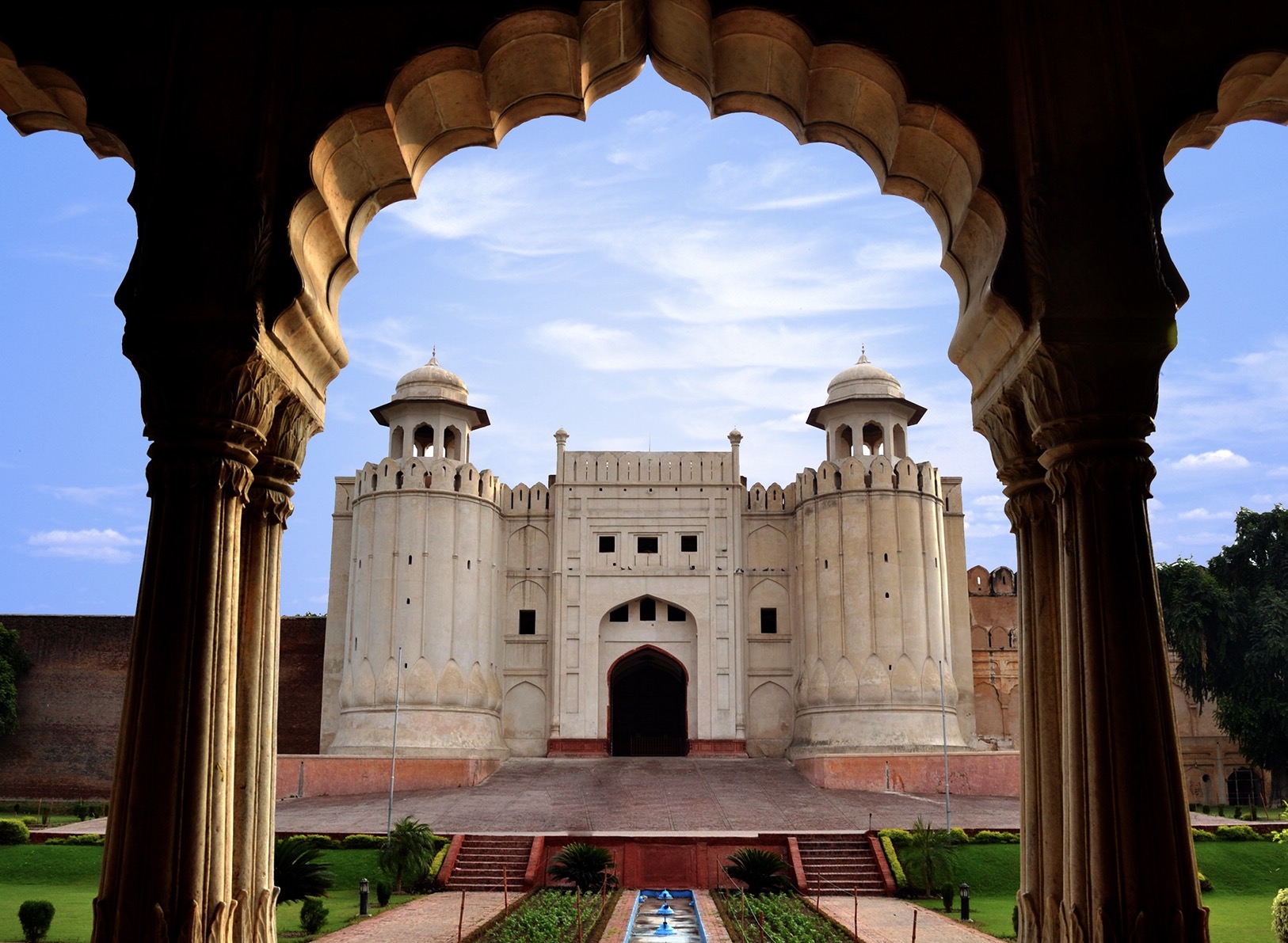
The fort's Alamgiri Gate was built during the reign of Emperor Aurangzeb.

Emperor Aurangzeb, built the Alamgiri Gate,[22] whose semi-circular bastions and domed cupolas are a widely recognised symbol of Lahore that was once featured on Pakistani currency.

Sikh era

[edit]

The Mughals lost the fort to the Afghan Durranis, who in turn briefly lost the fort to Maratha forces before being recaptured by the Durranis.[23] The fort was then captured by the Bhangi Misl, one of the 12 Sikh Misls of Punjab that ruled Lahore from 1765 until 1799.

Ranjit Singh period

[edit]
Ath Dara, built during the reign of Maharaja Ranjit Singh and used as his court.

The fort fell to the army of Ranjit Singh, who took Lahore from the Bhangi Misl in 1799.[24] During their occupation of the fort, the Sikhs made many additions to the fort and repurposed portions of it for their own use. Te Hazuri Bagh garden and its central baradari were constructed during Sikh rule to celebrate the Maharaja's capture of the Koh-i-Noor diamond. Ranjit Singh used the fort's Summer Palace as his own residence,[25] while the Moti masjid was repurposed as a Gurdwara called Moti mandir, and later used as royal treasury. The Sehdari pavilion, or "Three-doored" pavilion, was added to the fort during this period, as was the Ath dara or "Eight-doored" pavilion. The fort's Naag Temple and Loh temple were also constructed during Sikh rule, while the Mai Jindan Haveli was extensively modified. Kharak Singh Haveli was also added. The fort's northern outer wall, parallel to the picture wall, was constructed during this period.

The fort's Diwan-i-Aam was destroyed in 1841 when the son of Ranjit Singh, Sher Singh bombarded the fort in his fight against Chand Kaur.[26] Maharaja Ranjit Singh's elder son and successor, Kharak Singh was born in the fort to his wife, Maharani Datar Kaur. The youngest son of Ranjit Singh, Maharaja Duleep Singh was born at the fort's Mai Jindan Haveli in 1838.[27] Duleep Singh had signed the Treaty of Bhyroval in 1847 that brought the Sikh empire to an effective end.[27] The fort and the city had remained under the control of Ranjit Singh's family until the fall of the Sikh Empire in 1849.[28]

Modern era

[edit]
Layout of the Lahore Fort in 1911

The British occupied the fort after their conquest of Lahore, and made several modifications to it, primarily involving conversion of existing buildings for colonial use including hospitals and barracks for the British military. Excavations in 1959 in front of Diwan-i-Am led to the discovery of a gold coin dated 1025 CE belonging to Mahmud Ghaznavi. The coin was unearthed at the depth of 25 feet (7.6 m) from the lawn. The cultural layers were continuous to the depth of 15 feet (4.6 m) indicating that the fort was inhabited by people even before his conquest. Other pre-Mughal objects unearthed in the excavation included terracotta depicting mother goddess, horses, bulls and other figures of Hindu origin.[29] The fort, along with the Mughal garden at Shalimar was designated as a World Heritage site by UNESCO in 1981.

While relaying the deteriorated floor of Akbari Gate in April 2007, three floors in the fort were unearthed belonging to the British, Sikh and Mughal periods, constructed with bricks, burnt bricks and pebbles respectively. The latter either built during Jahangir's or Shah Jahan's era was the hallmark of Mughals.[30]

Layout

[edit]
Lahore Fort is located across the Hazuri Bagh from the Badshahi Mosque (foreground).

The fort is surrounded by a high bastioned defensive wall which forms a rough parallelogram measuring 365x320 metres.[31] The fort is itself longitudinally divided into two approximate equal halves: first, the administrative section reserved in the south, which is well connected with main entrances, and includes gardens and Diwan-e-Khas for royal audiences. The second, a private and concealed residential section is divided into courts in the north and accessible through elephant gate. It also contains Sheesh Mahal, spacious bedrooms and small gardens.[32] In all there are five main quadrangles in Lahore Fort, namely Diwan-e-Aam, Moti Masjid Quadrangle, Jahangir’s Quadrangle, Shah Jahan’s Quadrangle, and Paien Bagh Quadrangle. Interior walls are decorated with blue Persian tiles, in a style called kashi kari. The original entrance faces the Maryam Zamani Mosque and the larger Alamgiri gate opens towards Hazuri Bagh through the majestic Badshahi mosque.[33] Influence of Hindu architecture is seen in the zoomorphic corbels.[2]

Major structures

[edit]

Shah Burj Quadrangle

[edit]

Naulakha Pavilion

[edit]
The marble Naulakha Pavilion is one of the most iconic sights at the fort.

The Naulakha Pavilion is an iconic sight of the Lahore Fort built in 1633 during the Shah Jahan period that is made of prominent white marble, and known for its distinctive curvilinear roof. It cost around 900,000 rupees,[34] an exorbitant amount at the time.[35] The structure derives its name from the Urdu word for 900,000, Naulakha.

The Naulakha Pavilion served as a personal chamber and was located to the west of the Sheesh Mahal, in the northern section of the fort. The pavilion served as inspiration for Rudyard Kipling, who named his Vermont home Naulakha in honour of the pavilion.[36]

The structure was originally inlaid with precious and semi-precious stones. It reflects a mixture of contemporary traditions at the time of its construction, with a sloping-roof based on a Bengali style, and a baldachin from Europe, which makes evident the imperial as well as the religious function of the pavilion.[37] The marble shades of the pavilion are capped with merlons to hide the view from the grounds.[38]

Picture Wall

[edit]
The Picture Wall features mosaics depicting a myriad of scenes.

Emperor Jahangir ordered the construction of the massive "Picture Wall", which is considered to be the greatest artistic triumph of the Lahore Fort.[39] Unlike the Red Fort and Agra Fort, Lahore Fort's ramparts were made of brick rather than red stone. The monumental Picture Wall is a large section of the outer wall which is exquisitely decorated with a vibrant array of glazed tile, faience mosaics, and frescoes.[19]

The embellished wall stretches over much of the fort's northern and western walls and measures approximately 1,450 feet (440 m) by 50 feet (15 m).[19] The wall contains 116 panels,[40] which depict a myriad of subjects, including elephant fights, angels, and polo games that do not form a cohesive narrative; each can be viewed in isolation. Though begun under Jahangir, the Picture Wall was decorated throughout the 1620s, and may have been completed under the reign of his son, Shah Jahan.[41]

The Picture Wall was badly neglected and suffered from disrepair and damage. Conservation works at the site began in 2015 by the Aga Khan Trust for Culture and Walled City of Lahore Authority, which together have also restored other Lahore landmarks such as the Wazir Khan Mosque and Shahi Hammam. Detailed documentation of the wall using 3D scanner was completed in July 2016,[42] after which conservation work would start.[40]

Sheesh Mahal

[edit]
The Sheesh Mahal is elaborately decorated with a myriad of reflective glass tiles.

The Sheesh Mahal ("The Palace of Mirrors"; Urdu: شیش محل) is located within Jahangir's Shah Burj block in the northern-western corner of the Lahore Fort. It was constructed under the reign of Mughal Emperor Shah Jahan in 1631-32 by Mirza Ghiyas Begh, the grandfather of Mumtaz Mahal, and father of Nur Jahan. The ornate white marble pavilion's walls are decorated with frescoes and are inlaid with pietra dura and complex mirror-work known as Āina-kāri. It is among the best-known monuments of Lahore Fort and forms the jewel in the fort's crown.[43] The distinctive Shah Jahani style is reflected in the extensive use of white marble, and hierarchical accents of the construction.[44]

Sheesh Mahal was reserved for personal use by the imperial family and close aides. During the Sikh Empire, Shah Burj became Ranjit Singh's favourite place, who built a harem on top of the Sheesh Mahal.[45] This was also the place where he would display his prized possession, the Koh-i-Noor.[46][47][circular reference]

Summer Palace

[edit]
The Summer Palace is a labyrinth of chambers that was used as a residence during the hot summer months.

Located directly beneath the Sheesh Mahal and Shah Burj quadrangle is the Summer Palace, also known as the Pari Mahal, or "Fairy Palace." The palace is a labyrinth of chambers that date from the Shah Jahan period.[48] They were used as a residence during hot weather months, as they were cooled by effective ventilation systems that channelled cool breezes into the palace.[25] The palace's flooring system also helped cool the space - its floors were made of two layers that were separated by a layer of water pumped in from the Ravi River.[25] Cool water perfumed by roses flowed through an elaborate system of 42 waterfalls and cascades throughout the palace.[25]

The palace was historically only accessible from the overlying Sheesh Mahal,[25] though a new entrance was built by the British near Hathi Pul, or "Elephant Stairs."[49] Its walls were decorated with intricate frescoes and marble inlay that have been severely deteriorate by layers of subsequent white-washing and centuries of dampness.[25] Passage tunnels also exist that lead from the palace to the fort's exterior where the River Ravi once flowed, suggesting that it may have been part of an escape tunnel designed to allow occupants to flee in case of attack.[25]

The Summer Palace remained in use during the Sikh period under the reign of Ranjit Singh.[50][51] After the defeat of the Sikh empire in the Second Anglo-Sikh War, it went into the hands of the East India Company and in 1858, into the hands of the British Raj, and its appointed agents and executors.[52]

Beginning in World War 2, the Summer Palace was used as a storehouse for the British Civil Defence Department, and remained in use by Pakistan until 1973.[49] The building's structural integrity was affected by its use as a storehouse. As of 2014, the Walled City of Lahore Authority has assumed control of the space in order to undertake restoration works with the Aga Khan Trust for Culture[25][49] Following its restoration, the space will house the Lahore Fort's museum.[25]

Athdara

[edit]

Āth darā, an elevated pavilion with eight openings, was built by Maharaja Ranjit Singh for use as his court. It is located near the gate of the Shah Burj quadrangle and shares a wall with it. The structure is made of marble and red sandstone. The ceiling is decorated with colourful mirror-work, and Kangra style frescoes depicting Krishna are present on the interior walls.[53][54]

Khilwat Khana

[edit]

Khilwat Khana was built by Shah Jahan in 1633 to the east of the Shah Burj Pavilion, and west of the Shah Jahan Quadrangle. It was the residence of the royal ladies of the court.[55] The plinth and door frames are made of marble with a curvilinear roof.[26]

Kala Burj

[edit]
The Kala Burj.

In the northwest corner of the Khilawat Khana stands the Kala Burj ("Black Pavilion"). The pavilion is the most significant of the Jahangir-era additions to the Lahore Fort.[15] The vaulted ceilings in the pavilion feature paintings in a European-influenced style of angels which symbolize the virtuosity of King Solomon,[15] who is regarded as the ideal ruler in the Quran, and a ruler with whom Jahangir identified.[15] Angels directing djinns are also painted on tiles in the ceiling, which also reference King Solomon.[15] Kala Burj was used as a summer pavilion.[26]

Lal Burj

[edit]

In the northeast corner of the Khilawat Khana stands the Lal Burj ("Red Pavilion"). Like the nearby Kala Burj, the Lal Burj was built during the reign of Jahangir, though finished during the reign of Shah Jahan. Octagonal in shape, the Lal Burj was used as a summer pavilion. It features primary windows that opened to the north to catch cool breezes. The interior frescoes date mostly from the Sikh era, along with the entire upper level that was also added during the Sikh era.[15]

Shah Jahan's Quadrangle

[edit]

The collection of buildings surrounding the quadrangle situated between Jahangir's Quadrangle and Khilawat Khana is referred to as Shah Jahan's Quadrangle.

Diwan-i-Khas

[edit]
The Diwan-i-Khas is where the Emperor would attend to state affairs.

In contrast to the Diwan-i-Aam, the Diwan-i-Khas served as a hall where the Emperor would attend to matters of the state, and where courtiers and state guests were received.[56] The hall was site of elaborate pageantry, with processions of up to one hour long occurring before each audience session.[57]

The Khwabgah of Shah Jahan

[edit]

Khwabgah was the bedroom of Shah Jahan. It was built by Shah Jahan under the supervision of Wazir Khan in 1634 during his first visit to the city.[26] Five sleeping chambers are aligned in a single row. The chambers feature carved marble screens and are decorated with inlaid white marble and frescoes, It is the first building built by Shah Jahan in the fort. At present, its decorations have vanished except for a trace of the marble which once might have beautified the façade.[58]

Jahangir's Quadrangle

[edit]

Jahangir's Quadrangle occupies the northeastern corner of the fort. Though named for Jahangir, construction on the site began during the reign of Akbar but was completed in 1620 under Jahangir.[3] Akbar's syncretic style is noted in the quadrangle, as it employs column brackets carved in the form of animals. The quadrangle's layout differs from other Mughal quadrangles which are based upon the layout of a Persian paradise garden and instead is formed by concentric rectangles with a fountain in its centre.[3]

Diwan-i-Aam

[edit]
The current Diwan-i-Aam is a reconstruction undertaken during the British era.

The Diwan-i-Aam was built by Shah Jahan in 1628 in a prominent part of the fort immediately south of Jahangir's Quadrangle. It was built style of a Chehel Sotoun - a Persian style 40-pillar public audience hall,[15] in a style similar to the Diwan-i-Aam at the Agra Fort. The Diwan-i-Aam was used as a hall for the emperors to hold an audience with commoners.

Shah Jahan's Diwan-i-Aam was destroyed in 1841 when the son of Maharaja Ranjit Singh, Sher Singh bombarded the fort in his fight against Maharani Chand Kaur, the wife of Maharaja Kharak Singh. The current structure was built by the British in 1849 after their victory against the Sikhs.[26]

Kharak Singh Haveli

[edit]

Kharak Singh Haveli was the haveli of Kharak Singh, the heir to Ranjit Singh. It lies in the southeast of the Jahangir's Quadrangle. It was later occupied by the British where the first and the ground floor were used as a Commandant's Quarters and godown and servants house respectively. Currently, it houses the archaeological survey office.[58]

The Khwabgah of Jahangir

[edit]

The Jahangir Quadrangle is bordered on its northern edge by Jahangir's sleeping chambers, the Bari Khwabgah, which was largely reconstructed during the British era.

Sehdari pavilion

[edit]
The Sikh-era Sehdari, or "Three-doored pavilion" served as an office for Faqir Syed Noor-ud-din, a trusted Governor of Ranjit Singh.

The Sikh-era Sehdari pavilion, or "Three-doored" pavilion, is located to the east of the Bari Khwabgah. A second Sehdari pavilion was located to the west of the Bari Khwabgah, but was subsequently destroyed during the British period.[59] The surviving pavilion was used as an office for Faqir Syed Noor-ud-din, a trusted Governor of Ranjit Singh. The architectural style of the Sehdari pavilion is typical of the Sikh period. Frescoes decorating the pavilion portray floral designs, birds, and Hindu religious themes.[60]

Maktab Khana

[edit]

The Maktab Khana ("Clerk's Quarters") originally known as Dawlat Khana-e-Jahangir, was constructed in 1617 under the supervision of Mamur Khan during the reign of Jahangir as a set of cloisters near the Moti Masjid.[15] Designed by Khawaja Jahan Muhammad Dost, it was used as a passage to the Audience Hall from the palace buildings to the north.[15][26] Clerks in the Maktab Khana would also record the entry of guests into the fort. It features iwans in the Persian-Timurid style on each of its four sides. Each iwan is flanked by arches.

Moti Masjid

[edit]
Lahore's Moti Masjid is the earliest of three Mughal "Pearl Mosques." The two others are the one in Agra and the other in Delhi.

The Moti Masjid (Urdu: موتی مسجد), one of the "Pearl Mosques", is a mosque dating from the Shah Jahan Period that is located on the western side of Lahore Fort, closer to Alamgiri Gate. It is situated in the northwestern corner of Dewan-e-Aam. The white marble structure is among its prominent extensions (such as Sheesh Mahal and Naulakha pavilion) to the Lahore Fort Complex.[61] Moti in Urdu language means pearl, which designates a perceived preciousness to the religious structure. It was an established practice among Mughal emperors to name the mosques after generic names for gemstones.[62] The mosque, built between 1630–35,[63] has three superimposed domes, two aisles of five bays, and a slightly raised central pishtaq, or portal with a rectangular frame.[64] This five-arched facade distinguishes it from other mosques of a similar class with three-arched facades. The interior is simple and plain with the exception of ceilings that are decorated and designed in four different orders, two arcuate, and two trabeated.[65]

After the demise of the Mughal Empire, the mosque was converted into a Sikh temple and renamed Moti Mandir during the period of the Sikh rule under Ranjit Singh's Sikh Confederacy.[66] He later used the building for the state treasury. When the East India Company took over Punjab in 1849, they discovered precious stones wrapped in bits of rags and placed in velvet purses scattered inside the mosque, along with other inventory.[67]

Gates

[edit]
Akbari Gate as seen from within the fort complex.
Alamgiri Gate

Akbari Gate

[edit]

Mughal Emperor Akbar built two gates. Akbari Gate was built in 1566 and is now called Maseeti Gate.

Alamgiri Gate

[edit]

Located at the western end of the fort, the Alamgiri Gate is the entrance of the Lahore Fort. It was built by the Mughal emperor Aurangzeb in 1674.[68] It has two semi-circular bastions where lotus petal design adorns its base.[69] It opens to the Hazuri Bagh and faces the Badshahi Mosque. The gate is one of Lahore's most iconic monuments, and once featured on Pakistani currency.

Shah Burj Gate

[edit]

Restoration work was completed in March 2020 by Aga Khan Cultural Service Pakistan with funding from the Royal Norwegian Embassy, the Walled City of Lahore Authority, and the Aga Khan Trust for Culture.[70]

Naag Temple

[edit]

The Naag temple is a Sikh temple built by Chand Kaur, the wife of Kharak Singh, daughter in law of the then ruling Maharaja Ranjit Singh. The temple is square in plan and built on a raised platform. Its exterior walls are covered with fresco paintings. The temple also has a water-melon shaped dome. The site is currently closed to the public in order to prevent further deterioration.[71]

Mai Jindan Haveli

[edit]

Mai Jindan Haveli is of unknown origins and believed to be a Mughal structure but attributed to the Mai Jindan, Chand Kaur because of the extensive additions by the Sikhs. It is a two-storied building and is presently the site of the Sikh Gallery Museum.[58]

Conservation

[edit]

In 1980, Government of Pakistan nominated the fort for inclusion in UNESCO World Heritage Site based on the criteria i, ii, and iii together with the Shalimar Gardens.[2] In the fifth meeting session held in Sydney in October 1981, the World Heritage Site committee added both the monuments to the list.[72]

In 2000, Pakistan sent a letter to the organization to include both the sites in List of World Heritage in Danger and sought help to restore the damaged part of the outer walls and hydraulic works of Shalamar Gardens.[73][74] In April 2006, it was reported that officials had urged UNESCO to remove the name of the fort from the list of endangered World Heritage Sites because of extensive restoration work funded by Norway, Hong Kong, the United Kingdom and France.[75] Restoration projects included works at the Sheesh Mahal, Alamgiri Gate, and Hazuri Bagh.[76] After years of extensive renovation and restoration work, the fort and Shalimar Gardens were removed from the endangered list in June 2012.[77][78]

Though in 1990, UNESCO had ordered the Punjab Archaeological Department to bar the use of the Fort for state or private functions on account of historical significance, a wedding reception was held in violation on 23 December 2010. The Antiquities Act of 1975, which prohibits the use of historical places to protect them from damage, was violated in the following month by hosting a dinner in the Diwan-i-Khas.[79]

Conservation works at the Picture Wall began in 2015 by the Aga Khan Trust for Culture and Walled City of Lahore Authority.[80] Documentation of the wall using 3D scanner was completed in July 2016,[42] after which conservation work would start.[40]

Governance

[edit]

Under the 2017 Local Government Act of Punjab, Shahi Qila also serves as a union council located in the Ravi Zone.[81]

See also

[edit]

Footnotes

[edit]

References

[edit]

Sources

[edit]
  • Hamadani, Agha Hussain (1986). The Frontier Policy of the Delhi Sultans. Atlantic Publishers. ISBN 9694150035.
  • Khan, Muhammad Ishtiaq. Lahore Fort. Department of Archaeology & Museums, Government of Pakistan, 1974.
  • Blanshard Asher, Catherine. Architecture of Mughal India. Cambridge University Press. ISBN 9780521267281.
  • Chaudhry, Nazir Ahmad (1999). Lahore Fort: A Witness to History. Sang-e-Meel Publications. ISBN 9789693510409.
  • Bhalla, A. S. (18 February 2015). Monuments, Power and Poverty in India: From Ashoka to the Raj. I.B.Tauris. ISBN 9781784530877.
  • Koch, Ebba (1991). Mughal Architecture: An Outline of Its History and Development, 1526-1858. Prestel. ISBN 3-7913-1070-4.
  • Nabi Khan, Ahmed (1997). Studies in Islamic Archaeology of Pakistan. Sang-e-Meel Publications. ISBN 969-35-0717-7.
  • Neville, Pran (2006). Lahore : A Sentimental Journey. Penguin Books. ISBN 9780143061977.
[edit]
Revisions and contributorsEdit on WikipediaRead on Wikipedia
from Grokipedia
The Lahore Fort, also known as Shahi Qila, is a historic citadel in , , renowned as a masterpiece of that encapsulates the empire's architectural evolution from the 16th to 17th centuries. Spanning approximately 36 acres (14.5 hectares) in an irregular trapezoidal layout measuring about 1,400 feet east-west by 1,115 feet north-south, it features a high featuring several historic gates, enclosing palaces, mosques, and gardens built primarily with red , , and intricate tile mosaics. Originally fortified in the and rebuilt by Mughal Emperor in 1566 CE using burnt brick and red to replace earlier mud structures, the fort was extensively expanded and embellished by subsequent rulers like and , incorporating Persian motifs, pietradura inlays, and decorative elements such as animal figures and sculptured gargoyles. As the only monument in representing a complete of , the fort served as a royal residence and administrative center during the empire's zenith, reflecting influences from Hindu, Islamic, and Persian traditions in its design. Key structures include the Shish Mahal (Mirror Palace) with its mirrored walls and marble pavilions, the Alamgiri Gate as the main entrance, and the Picture Wall adorned with over 1,000 glazed-tile panels depicting floral, faunal, and courtly scenes. Together with the adjacent Shalimar Gardens—laid out in 1642 CE as a symmetrical paradise with fountains and pools—the fort was inscribed on the World Heritage List in 1981 for its outstanding as a testimony to Mughal civilization's artistic and cultural peak under . Today, it remains a vital cultural , drawing visitors to explore its preserved quadrangles and ongoing conservation efforts to protect against urban encroachment and environmental threats.

Location

Geographical Position

The Lahore Fort, also known as Shahi Qila, is situated in the northwestern corner of the , province, , at coordinates 31°35′15″N 74°18′55″E. This positioning places it within the historic urban core of , at an elevation of approximately 217 meters above . The fort's strategic placement on a prehistoric provided natural elevation for defensive purposes, enhancing its role as a overlooking key approaches to the city. The complex covers an irregular area of approximately 14.5 hectares (36 acres), with approximate dimensions of 427 meters east-west by 335 meters north-south, encompassing a trapezoidal layout bounded by high defensive walls. These walls, constructed primarily of baked brick and red sandstone, reach heights of up to 18 meters in places and form a perimeter extending roughly 2 kilometers, enclosing the inner enclosures and monumental structures. Historically, the fort was built directly adjacent to the , which once flowed immediately to its north and west, offering both a natural and a vital water source; however, natural and 19th-century diversions shifted the river's course approximately 2 kilometers westward, altering the site's hydrological context while preserving its elevated mound foundation. The fort's boundaries integrate seamlessly with the remnants of Lahore's 16th-century city walls, which encircled the urban area and reinforced the overall defensive perimeter of the Mughal capital.

Surrounding Environment

The Lahore Fort occupies a prominent position in the northwestern corner of Lahore's Walled City, forming an integral part of the historic urban core that includes densely packed neighborhoods and markets dating back to Mughal times. Immediately to its west lies the , separated by the open expanse of , creating a cohesive ensemble of Mughal imperial architecture that enhances the fort's ceremonial and visual prominence. Approximately 7 kilometers to the east, the Shalimar Gardens complement the fort as a co-listed , representing the pinnacle of design and royal leisure spaces. To the north, the fort borders and Iqbal Park, a modern erected in on the site of the , which juxtaposes colonial and postcolonial landmarks against the Mughal heritage. This adjacency integrates the fort into a broader continuum of Pakistan's historical narrative, while the surrounding Mughal landscape axis—extending along the historic —links it to sites like the Shalimar Gardens, embodying the empire's strategic and aesthetic symmetry. Historically, the fort's environment was defined by its riverine setting, with the flowing directly along its northern fortifications, effectively serving as a natural extension of the defensive and facilitating water access for the citadel. During the Mughal era, this proximity influenced architectural features like river-facing pavilions and gates, such as the Roshnai Gate, designed for direct views and access to the waterway. However, by the mid-19th century, at the end of Sikh rule and into the British colonial period, the river's course shifted westward due to natural and human interventions, including irrigation diversions like the Upper Bari Canal system initiated in the 1860s, which diminished the 's hydrological function and altered the fort's defensive landscape. In contemporary times, rapid urban encroachment has transformed the fort's surroundings, with Lahore's population growth leading to high-density development, traffic congestion, and commercial intrusions into the adjacent Walled City, straining the site's buffer zones and environmental integrity. As of 2025, occasional flooding events, such as the August-September surge of the Ravi River, have temporarily brought waters closer to the fort, highlighting ongoing hydrological changes. These pressures, compounded by pollution and loss of green spaces, have prompted conservation efforts by authorities like the Walled City of Lahore Authority to mitigate impacts on the fort's historical topography. Despite these challenges, the fort remains embedded in a dynamic urban fabric that underscores its enduring role within Lahore's evolving landscape.

History

Pre-Mughal Foundations

The origins of Lahore Fort are rooted in ancient traditions and archaeological evidence suggesting a long history of at the site. Traditional accounts attribute the foundation of Lahore and its fort to Loh, son of from the epic, in ancient times, though these are largely mythological. Archaeological excavations in the and uncovered pre-Mughal remains, including terracotta artifacts depicting Hindu motifs such as mother goddesses, horses, and bulls, indicating early habitation and possibly defensive structures made of mud bricks as far back as the 11th century CE. A from of Ghazna, dated 1025 CE, further confirms the site's use during this period. During the Ghaznavid and Ghorid periods in the 11th and 12th centuries, Lahore emerged as a strategic stronghold, with the fort serving as a defensive outpost amid invasions. of Ghazna (r. 998-1030 CE) is credited with early constructions using mud bricks, transforming the site into a key military base in his campaigns across the region. The fort gained prominence under the Ghorids when invaded Lahore in 1186 CE, capturing it from the and establishing it as an administrative hub for their expanding influence in northern . The Delhi Sultanate era (13th-16th centuries) marked significant developments, with the fort evolving from a primarily defensive structure to a central administrative center. In 1241 CE, Mongol invasions destroyed the existing fortifications, prompting Sultan Balban of the Mamluk dynasty to rebuild it in 1267 CE using brick and mud materials to reinforce Lahore's role as a provincial capital. Subsequent rulers, including those of the , undertook repairs; for instance, Sultan Mubarak Shah Sayyid reconstructed parts in mud in 1421 CE, while Sheikh Ali of repaired it in 1432 CE following further damages. Under the (1451-1526 CE), the fort continued to function as an important and governance site, though specific extensions are less documented, reflecting its enduring strategic value until the Mughal conquest.

Mughal Expansions Under Akbar and Jahangir

During the reign of Mughal Emperor (r. 1556–1605), the Lahore Fort underwent a significant reconstruction starting in 1566, transforming it from a mud-brick structure into a robust red-brick that emphasized defense and administrative functions. replaced the earlier clay walls with solid burnt-brick masonry, enlarging the fort's perimeter to approximately 427 by 335 meters to serve as a strategic stronghold between key Mughal territories including , , and . This rebuild focused on military resilience, with high outer walls designed for protection, while also accommodating imperial administration as Lahore became a from 1585 to 1598. A notable addition was the Akbari Gate on the eastern side, a two-story entrance with guard chambers and wide doors capable of admitting elephants, symbolizing the fort's role as a gateway to Mughal power. Under Emperor (r. 1605–1627), the fort shifted toward aesthetic embellishments, reflecting his patronage of art and nature-inspired designs influenced by European motifs. introduced inlay techniques—semi-precious stones embedded in marble—for decorative elements, marking an early adoption of this opulent style in at the site. He commissioned the Picture Wall in along the western and northern facades of the private palaces, a massive glazed-tile spanning 450 meters in length and 15 meters in height, featuring intricate floral patterns, geometric designs, and figurative scenes of court life, animals, and combatants drawn from Persian and European inspirations. These motifs, including botanically accurate flowers derived from Netherlandish engravings, highlighted 's emphasis on visual splendor over mere utility. Jahangir also oversaw the construction of the within the Sheesh Mahal quadrangle, a white marble chamber with a curving Bengali-style roof and extensive work depicting floral and mythical elements, completed around at a reputed cost of nine lakhs of rupees. By , following the completion of his personal quadrangle—a complex of residences, gardens, and artist studios— established the fort as his primary residence, infusing it with tolerant, syncretic elements like Hindu architectural motifs and paintings that blended Islamic and European styles. This period elevated the fort from a defensive outpost to a canvas of imperial grandeur, setting the stage for further Mughal refinements.

Developments Under Shah Jahan and Aurangzeb

During the reign of Shah Jahan (1628–1658), the Lahore Fort reached its architectural zenith through extensive renovations and new constructions that emphasized opulence and refinement. Between 1628 and 1634, Shah Jahan transformed the fort into his primary residence, overseeing the replacement of earlier red sandstone structures with luxurious white marble cladding, often sourced from the Makrana quarries in Rajasthan, to create a more elegant and imperial aesthetic. Key additions included the Diwan-i-Aam (Hall of Public Audience), Diwan-i-Khas (Hall of Private Audience), Sheesh Mahal (Mirror Palace), and Moti Masjid (Pearl Mosque), which integrated Persian architectural motifs such as intricate pietra dura inlays and tile mosaics with indigenous Indian elements like chhatris and jali screens. These works, completed by 1645 for the major quadrangles, symbolized the emperor's vision of a paradisiacal Mughal court, blending symmetry, water features, and floral designs to evoke grandeur. Under (1658–1707), developments in the Lahore Fort shifted toward practicality and defense, reflecting the empire's gradual decline and the emperor's austere policies, with fewer lavish expansions compared to his predecessors. The most notable addition was the Alamgiri Gate, constructed between 1671 and 1674 as the fort's main western entrance, featuring robust semi-circular bastions and minimal ornamentation to prioritize functionality over decoration. This gate, named after Aurangzeb's title Alamgir, served as a strategic access point opposite the newly built , underscoring a continued, albeit restrained, emphasis on Mughal defensive architecture integrated with Islamic functionalism. Overall, 's contributions maintained the fort's role as an administrative hub but marked a departure from Shah Jahan's ornamental excess toward simpler, more utilitarian designs amid political and economic challenges.

Sikh and Colonial Periods

Following the decline of Mughal authority, the Lahore Fort served as the primary residence for , founder of the , from his conquest of in 1799 until his death in 1839. revitalized the fort's interiors, incorporating opulent Sikh-era embellishments such as extensive mirror work and frescoes in structures like the Sheesh Mahal, alongside gilded ceilings and European-style furniture to reflect his cosmopolitan court. Notable additions during this period included the Mai Jindan Haveli, named after 's wife, Rani Jind Kaur, which functioned as a and later became a Sikh heritage gallery, and the Naag Temple, a small Hindu dedicated to the serpent deity, highlighting the syncretic religious influences in the Sikh court. The fort remained the seat of the Sikh rulers until the empire's fall, with utilizing spaces like the Musamman Burj for both private quarters and official audiences. After the British annexation of in 1849 following the Second Anglo-Sikh War, the Lahore Fort was repurposed as a and administrative , marking a shift from royal palace to colonial stronghold. The British demolished numerous Mughal-era buildings within the fort to construct and other utilitarian structures, significantly altering the site's original layout and contributing to the loss of several historical pavilions. It also served as a residence for British viceroys and governors, with additions like a (later removed) and modifications such as an upper level to the Diwan-i-Khas and a liquor bar in repurposed chambers. By the early , amid growing heritage awareness, partial restorations began in the under British oversight, focusing on repairing damages from use and stabilizing key structures like the Shish Mahal, which had developed cracks due to these alterations.

Post-Independence Era

Following the in 1947, the Lahore Fort came under the control of the newly formed , marking a significant shift in its administration from British colonial oversight to Pakistani governance. Initially, the site experienced periods of neglect and abandonment, particularly in the royal palaces, due to the chaos of mass migrations and the prioritization of national reconstruction efforts. Restoration initiatives gained momentum in the 1960s, with major conservation works resuming and completing projects initiated under British rule, including structural repairs and archaeological excavations funded by the Pakistani government and international collaborators like the Museum. These efforts, culminating around 1960, cost approximately 4.8 million rupees and focused on preserving Mughal-era monuments amid growing public interest. By the 1980s, the fort's international recognition was solidified when it was inscribed as a in 1981, alongside the Shalimar Gardens, highlighting its outstanding universal value as a Mughal architectural ensemble. The fort's function as a , established during the British period in the 1920s through the , continued uninterrupted under Pakistani management, with the site housing displays of Mughal artifacts and serving as an educational hub operated by the Department of and Museums. In the , the Cultural Service-Pakistan (AKCSP), established in 1991, began preliminary interventions in Lahore's historic core, laying the groundwork for later targeted restorations at the fort through technical assistance and planning. The site also hosted annual cultural events, such as the Basant , which drew crowds to its walls until a nationwide ban in due to safety concerns over deadly kite strings. Pre-2020s, the fort faced mounting modern challenges, including urban pollution from Lahore's rapid industrialization and encroaching on its , as well as pressures from surging that strained without adequate . UNESCO monitoring reports from the 2000s repeatedly noted these threats, urging enhanced protective measures to safeguard the site's integrity. In 2024, preservation of the Sikh-era Naag Temple was completed through collaboration between the Walled City of Lahore Authority and the Cultural Service-Pakistan, enhancing access to lesser-known heritage elements.

Layout and Design

Overall Site Plan

The Lahore Fort exhibits an asymmetrical layout spanning approximately 1,400 feet east to west and 1,100 feet north to south, enclosed by high fortification walls that originally bordered the to the east. The site is functionally divided into an eastern half dedicated to private royal quarters and a western half for public and administrative functions, creating a clear spatial hierarchy that progresses from accessible outer areas to secluded inner palaces. This organization centers around four main quadrangles, which serve as the primary courts linking key buildings and gardens, reflecting a structured for , residence, and . Key circulation elements include wide elephant paths designed for processions leading to the private sector via the Hathi Pol (Elephant Gate), a moat surrounding the western Alamgiri Gate for defense, and elevated platforms that raise private structures above flood-prone levels while providing panoramic views. The overall plan originally featured multiple gates, with access controlled hierarchically from the public Diwan-i-Aam (Hall of Public Audience) in the southwest—serving ceremonial and administrative roles—to the intimate Khwabgah (sleeping chambers) in the northeast, ensuring restricted progression through successive courts. This evolution adapts Mughal grid-based planning from Persian charbagh principles, where symmetrical quadrants with water channels and axial paths symbolize cosmic order, integrated into the fort's defensive enclosure during expansions under Akbar and his successors.

Architectural Styles and Influences

The Lahore Fort represents a prime example of , characterized by a synthesis of Persian, Timurid, Central Asian, and indigenous Punjabi influences that evolved through the Mughal era. This fusion is evident in the fort's design principles, which blend the grandeur of Persian symmetry and Timurid decorative motifs with local Punjabi craftsmanship, creating a distinctive regional style that emphasized both aesthetic elegance and functional . Primary building materials include a robust base of red sandstone, often sourced locally, overlaid with white veneers for ornamental sections and inlaid with semi-precious stones such as , , and to enhance decorative surfaces. These materials transitioned from the heavier, more utilitarian red sandstone dominant in earlier Mughal constructions to the refined marble accents in later phases, reflecting advancements in quarrying and transport techniques. Architectural techniques showcase a progression from the sturdy, robust forms of the era—featuring cusped arches and sloping buttresses for structural support—to the more delicate and ornate styles under , incorporating screens for ventilation and light diffusion, chattris as elevated pavilions crowning key elements, and intricate work. Defensive features further integrate these influences, with semi-circular bastions at intervals along the walls for placement, machicolations for dropping projectiles on attackers, and massive buttresses to reinforce against sieges, combining Central Asian with Persian aesthetic proportions.

Major Structures

Shah Burj Quadrangle

The Shah Burj Quadrangle, situated in the northwestern corner of Lahore Fort, represents the epitome of Mughal private royal quarters, designed for intimacy and opulent seclusion away from public view. This enclosed area served as a luxurious enclave for the imperial family, featuring chambers and pavilions that functioned as bedrooms and private audience halls, particularly utilized by emperors such as and for personal repose and intimate gatherings. Its layout emphasizes seclusion, with high walls and strategic placement providing privacy while overlooking the fort's defenses. Central to the quadrangle is the , a small summerhouse renowned for its exquisite craftsmanship and symbolic naming. Constructed entirely of white with a deeply curving roof inspired by Bengali architectural traditions and European forms, the pavilion features intricate inlays and glazed tile mosaics depicting angels, , and Solomonic motifs, originally including gilded elements on the roof for added splendor. Named "Naulakha" meaning "worth nine s," it reflects the substantial cost of nine rupees at the time, underscoring its status as a jewel of luxury within the private quarters. Positioned beside the Sheesh Mahal, it offered a serene retreat for royal relaxation during warmer months. Adjoining the Naulakha is the Sheesh Mahal, or Palace of Mirrors, an ornate chamber that exemplifies Mughal decorative artistry through its ayina kari technique of glass mosaics embedded in the walls and ceilings. The structure boasts a façade with five cusped arches supported by paired columns featuring inlaid precious stone bases, creating a shimmering interior that amplified light and created an ethereal ambiance suited for private imperial audiences and nocturnal leisure. This highly embellished space was intended for the empress's personal use, enhancing the quadrangle's role as a haven of refined intimacy. The quadrangle's visual grandeur is further elevated by the Picture Wall, a monumental facade dating to , adorning the northern and western boundaries with 116 pictorial panels executed in tiles on a terracotta base. These panels showcase over diverse motifs including scenes of deer pursued by hounds, floral arabesques, dancers and musicians, mythical creatures like dragons and demons, and zodiacal symbols, blending narrative artistry with symbolic elements to celebrate imperial life. As a backdrop to the private enclave, it provided an artistic enclosure that reinforced the luxurious, contemplative atmosphere for the royals. Beneath the Sheesh Mahal and main forecourt lies the , a labyrinthine complex of cooled chambers designed for respite during the scorching summers. Comprising interconnected rooms with innovative ventilation systems and water features, it functioned as a seasonal residence for the family, offering shaded, airy spaces that complemented the quadrangle's emphasis on comfort and exclusivity. This underground extension heightened the area's intimacy, allowing emperors like to escape the heat in palatial elegance.

Jahangir's and Shah Jahan's Quadrangles

Jahangir's Quadrangle, located in the northeastern section of the Lahore Fort, represents a key expansion during the early under Emperor , serving as a central administrative and residential space. This large courtyard, measuring approximately 730 feet by 460 feet, features structures primarily in red sandstone with later marble inlays, reflecting the transitional Mughal style blending Akbari robustness with Jahangir's ornamental preferences. The quadrangle's design emphasized semi-public functions, with pavilions arranged around a central garden for imperial oversight of court proceedings. The Diwan-i-Aam, or Hall of Public Audiences, forms the northern boundary of Jahangir's Quadrangle and was constructed by in the 1630s as a pillared assembly space for addressing petitioners and officials. This expansive hall, supported by 40 slender columns of red sandstone and white marble, spans about 100 feet by 60 feet and opens on three sides to the , allowing visibility from the emperor's elevated platform. Its decorative motifs include intricate carvings of angels, foliage, and geometric patterns, showcasing the era's fusion of Persian and Indian aesthetics. Adjacent to the Diwan-i-Aam lies the Barri Khwabgah, Jahangir's primary sleeping chamber, a multi-roomed rebuilt in the British era but originally dating to the early 1600s. This structure, positioned at the quadrangle's north end, consists of aligned chambers with arched doorways and remnants of original frescoes depicting floral and avian themes, designed for the emperor's private repose amid administrative duties. The Sehdari Pavilion, or "Three-Doored" structure, flanks the eastern side of the Khwabgah and features a central rectangular hall with a bangla roof bookended by two domed chambers, incorporating Sikh-era additions like painted motifs while retaining Mughal proportions for transitional use between public and private areas. Shah Jahan's Quadrangle, situated adjacent to Jahangir's to the west, exemplifies the emperor's predilection for white marble and symmetrical gardens, developed in the 1630s as a more refined administrative zone. This smaller courtyard, enclosed by ornate pavilions, prioritizes private imperial interactions and residential comfort, with water channels enhancing the paradisiacal layout inspired by Timurid traditions. The Diwan-i-Khas, or Hall of Private Audiences, anchors the northern edge of Shah Jahan's Quadrangle, built in 1645 as an intimate venue for consultations with nobles and advisors. This square marble pavilion, measuring 53 feet by 51 feet, employs five lobed arches on three sides and delicate screens on the north facade, originally overlooking the for scenic views during deliberations. Its interior boasts frescoed ceilings with floral and calligraphic designs, underscoring Shah Jahan's emphasis on opulent yet functional spaces. The Khwabgah of , known as the Chhoti Khwabgah or smaller sleeping chambers, occupies the eastern side and was completed in 1633 as the emperor's personal bedchamber suite. Comprising five aligned rooms with carved marble screens and inlaid work, the structure features vibrant frescoes of mythical scenes and vegetation on walls and ceilings, providing a serene retreat integrated with the quadrangle's administrative flow.

Gates and Defensive Elements

The Lahore Fort's primary entry points and fortification systems were designed to balance security, symbolism, and ceremonial access during the Mughal era. The main gates served as grand portals reflecting imperial power, while the surrounding defenses emphasized impregnability against invasions. These elements evolved from Akbar's foundational reconstructions in the through later Mughal additions. The Alamgiri Gate, constructed by Emperor between 1673 and 1674, stands as the fort's principal western entrance, facing the adjacent . This monumental gateway features a distinctive incline facilitating the passage of war elephants, flanked by two semi-circular bastions adorned with lotus petal motifs at their bases. It incorporates three cusped arches and marble inlay work, marking a shift toward more austere yet imposing Mughal aesthetics in Aurangzeb's reign. The gate leads into a sharply angled passage that enhances defensive capabilities by disorienting potential attackers. The Akbari Gate, built by Emperor in 1566 as part of his overhaul of the fort's mud structures into brick , originally functioned as the main eastern entrance and is now known as the Masti or Masjidi Gate. It showcases an ornate —a vaulted hall with intricate geometric and floral motifs—flanked by two robust bastions that underscore its role in the fort's early defensive layout. This gate exemplifies Akbar's syncretic , blending Persian and local influences for both functionality and grandeur. The Shah Burj Gate, erected by Emperor in 1631–1632, provided exclusive access to the royal Shah Burj Quadrangle and was reserved for imperial use. Positioned along the northern facade, it integrates with the elaborate Picture Wall and features glazed-tile mosaics depicting hunting scenes and floral patterns, symbolizing the opulence of 's era. Its restoration in 2020 by the preserved these decorative elements while reinforcing its structural integrity. The fort's defensive perimeter consists of a continuous fortification of burnt bricks and red sandstone, averaging 16 meters in height along key sections like the Picture Wall, with crenellations for archers and ports. This is reinforced by semi-circular bastions at regular intervals, providing vantage points for surveillance and artillery. A dried runs along the northern outer , adding an additional barrier that was particularly vital during historical assaults, such as the 1761 Afghan invasion led by , which tested the fort's resilience amid regional conflicts. Watchtowers integrated into the bastions further enhanced vigilance over the surrounding .

Religious and Miscellaneous Buildings

The Moti Masjid, constructed by Mughal Emperor in the 1630s, exemplifies the pinnacle of within the Lahore Fort. Crafted entirely from white that imparts a pearl-like sheen, the structure features three bulbous domes and flanking minarets, designed for the private use of royal women. Its compact layout includes a prayer hall with intricate inlays and cusped arches, reflecting Shah Jahan's emphasis on opulent, symmetrical Islamic design. The Naag Temple, erected during the Sikh era in the , represents a rare Hindu religious site within the fort's predominantly Mughal framework. Dedicated to the serpent deity Naag Devta, it incorporates Sikh architectural elements such as a domed and frescoed interiors, blending with regional motifs. Though modest in scale, the temple's construction and symbolic carvings highlight the multicultural under Maharaja Ranjit Singh. Among the miscellaneous structures, the Khilwat Khana stands as a secluded prayer and residential complex built by Shah Jahan in 1633, adjacent to the Kala Burj and Lal Burj pavilions. Intended for imperial solitude and devotional activities, it comprises underground chambers with vaulted ceilings and marble accents, offering respite from the fort's public areas. The Mai Jindan Haveli, attributed to the Sikh period as the residence of Maharani Jindan (Ranjit Singh's consort), is a two-story edifice that later housed significant events, including the birth of Maharaja Duleep Singh in 1838. Now repurposed as the Sikh Gallery museum, it preserves artifacts from the Sikh era, underscoring its role in royal domestic life. The Maktab Khana, constructed in 1617-18 under Emperor , served as an administrative school and clerk's quarters near the Moti Masjid. This cloistered courtyard, where scribes recorded imperial decrees, features arcaded verandas and simple geometric tilework, embodying the Mughal bureaucratic ethos. Complementing these is the Athdara, a Sikh-era pavilion with eight cusped arches, constructed on a raised red sandstone platform using white marble. Primarily functioning as a judicial hall under , its open design facilitated oversight of court proceedings while evoking earlier hunting lodge aesthetics through its elevated vantage.

Conservation and Management

Preservation History

The preservation efforts for Lahore Fort began in earnest during the early 20th century under British colonial administration, which conducted surveys and initiated restorations to address decay and prior modifications. Following the fort's occupation by British forces after 1849, extensive repairs were undertaken starting in 1939, including the reversal of 19th-century demolitions that had de-fortified the site by removing gates and outer walls to suppress potential uprisings after the 1857 revolt. These works, documented in archaeological reports, focused on stabilizing structures like the Diwan-e-Aam and Picture Wall, with efforts continuing post-1947 partition under Pakistani oversight and completing major phases by 1960 at a cost of approximately 4.8 million rupees. In the 1960s, the newly formed Pakistani Department of Archaeology took over systematic conservation, building on British foundations through excavations and targeted restorations. A notable 1959 excavation in front of the Diwan-i-Am, reaching depths of 16 meters, uncovered multiple occupation layers and informed subsequent repairs, while works on structures like the Seh Dari Pavilion addressed fresco deterioration and structural instability. These efforts emphasized reversing earlier damages, such as British-era alterations for military use, and laid the groundwork for international recognition. By the late 1970s, growing awareness of the fort's Mughal heritage prompted nominations to , culminating in its inscription as a in 1981 alongside Shalamar Gardens, highlighting its architectural significance and the need for ongoing protection. Subsequent decades saw intensified interventions, particularly through partnerships addressing environmental and seismic threats. The Cultural Service (AKCSP) began comprehensive restorations in the mid-2000s, with key projects from 2007 focusing on the fort's monuments; this included detailed documentation of the Picture Wall starting in 2015, a 400-year-old mural spanning 156 meters, using to assess tile damage from weathering and prior neglect. In 2017, the Government of Punjab approved a US$9 million allocation over five years for holistic conservation, leading to the development of a Masterplan for the Lahore Fort Precinct and , which integrated , seismic pilots, and reversal of 19th-century losses through reconstruction of defensive elements like gates. This plan emphasized earthquake-proofing, incorporating base isolation and material reinforcements to mitigate cracks from historical seismic events, as seen in structures like Shish Mahal. Post-2021, preservation has increasingly incorporated digital technologies for documentation and risk assessment, reflecting global trends in heritage management. Initiatives like 3D modeling of the Barood Khana (magazine house) and Sheesh Mahal, using terrestrial laser scanning and Historic Building Information Modeling (HBIM), have enabled precise virtual reconstructions and monitoring of vulnerabilities, including seismic impacts. These efforts, part of broader AKCSP and UNESCO-supported programs, have reversed further decay from urban pressures while ensuring long-term resilience against natural disasters. In 2025, significant advancements included the completion of a major phase in the conservation of the Khilwat Khana chambers in September, revealing undocumented Mughal-era subterranean structures beneath the Shah Burj quadrangle. The full restoration of the Picture Wall, ongoing since 2018, was finalized in 2025, bringing back its intricate glazed-tile artwork. The World Heritage Committee approved the state of conservation report for Lahore Fort and Shalimar Gardens during its 47th session in 2025. Additionally, in November 2025, hidden Mughal chambers were rediscovered during restoration work, once used for storage and now secured for public access.

Current Governance and Challenges

The administrative control of the Lahore Fort resides with the Department of Archaeology and Museums (DoAM) as of April 2025, following a directive that revoked prior transfers to the Authority (WCLA) due to the latter's organization of unauthorized private events at protected heritage sites, violating judicial orders from 2014 and 2023. The WCLA, formed in 2012 under the government to oversee conservation within Lahore's historic core, retains a collaborative role in site management and restoration activities, including joint inspections and project implementation with DoAM. In March 2025, the government additionally established the Lahore Authority for Heritage Revival (LAHR), chaired by , to coordinate broader preservation efforts across the city's monuments, with an allocated budget of Rs 635 million for 2025-26 to support integrated heritage initiatives. Maintenance funding for the Lahore Fort, often bundled with Shalimar Gardens, stands at approximately Rs 135 million annually under DoAM, supplemented by the WCLA's overall operational budget of Rs 481 million for 2024-25, which funds repairs, staffing, and infrastructure upkeep. Tourism revenue generation is embedded in through entry fees and promotional programs managed by WCLA and DoAM, with the fort drawing around 5 million visitors per year and contributing to local economic revitalization via guided tours and cultural events. Contemporary challenges to the fort's preservation include rapid urban encroachment from Lahore's unchecked sprawl, which has intensified since the 2020s and threatens buffer zones with informal settlements and infrastructure pressures. Severe , exacerbated by industrial emissions and seasonal , has positioned Lahore as the world's most polluted major city multiple times in 2025, accelerating the degradation of the fort's marble facades, frescoes, and open-air structures through and particulate deposition. , fueled by the site's status and post-pandemic recovery, poses risks of physical wear from high footfall—visitor numbers surged from 1.6 million pre-2020 to 5 million annually—leading to , accumulation, and strain on systems without adequate measures. The disrupted operations with enforced closures in 2020-2021, but the rebound has highlighted ongoing visitor management gaps, including insufficient digital ticketing and protocols to handle fluctuating crowds amid global resurgence. To address these issues, governance frameworks emphasize public-private partnerships, notably with the (AKDN), which has spearheaded initiatives since the early 2010s, including skills training for local artisans and revenue-sharing models that reinvest visitor income into conservation. In 2025, AKDN-led projects advanced climate adaptation efforts, such as enhanced drainage systems in the Shah Burj quadrangle and waterproofing of key pavilions like the Sheesh Mahal, designed to mitigate flood risks from Lahore's increasing extreme weather events, including the October 2025 deluges that tested the fort's Mughal-era resilience. These collaborations, supported by international donors like the U.S. government, also promote eco-friendly visitor guidelines to curb impacts, ensuring long-term site integrity while boosting economic benefits through controlled access and educational programming.

Cultural Significance

Architectural and Artistic Value

The Lahore Fort stands as an exemplar of 17th-century at its zenith, recognized by as a in under criteria (i), (ii), and (iii) for its outstanding repertoire of monumental structures that encapsulate the pinnacle of imperial design during the reigns of , , and [Shah Jahan](/page/Shah Jahan). Criterion (i) highlights the 21 preserved monuments within the fort's boundaries, which form a comprehensive showcase of Mughal architectural forms, including red sandstone bastions, pavilions, and intricate garden layouts that blend functionality with opulence. Under criterion (ii), the fort exemplifies the exchange of cultural influences, fusing Persian and Central Asian motifs with indigenous Hindu elements, such as zoomorphic corbels and chhatris, while later additions incorporated European-inspired details like Renaissance-style frescoes depicting angels in the Kala Burj pavilion. This syncretic approach not only reflects the Mughal emperors' patronage of diverse artistic traditions but also demonstrates the fort's role in disseminating these hybrid styles across . Artistically, the fort is renowned for its masterful employment of techniques that elevate Mughal aesthetics, including vibrant frescoes illustrating courtly scenes and floral patterns, multicolored tilework known as kashi kari that adorns walls with geometric and vegetal designs, mirror work or aina kari that creates shimmering illusions in interiors like the Sheesh Mahal, and inlays of semi-precious stones in marble surfaces for luminous effects. These elements, particularly evident in Shah Jahan's marble additions, combine Islamic geometric precision with Hindu narrative motifs and European perspectival techniques, influencing the decorative vocabulary of subsequent South Asian forts and palaces. The fort's artistic innovations underscore its status as a cultural crossroads, where artisans from across the empire crafted enduring symbols of imperial grandeur. Ongoing conservation efforts, including the restoration of the Picture Wall initiated in 2018, are nearing completion as of 2025, aiming to preserve its intricate mosaics against deterioration. Among its standout features, the Picture Wall— a 442-meter-long facade in Jahangir's Quadrangle—represents the world's largest surviving pictorial mosaic, executed in kashi kari with 116 glazed tile panels depicting hunting scenes, floral arabesques, and mythical creatures, serving as a testament to the era's narrative artistry. With over 20 surviving pavilions, including the Naulakha and Moti Masjid, the complex preserves a dynamic ensemble that captures the evolution of Mughal spatial organization and ornamentation. The fort's legacy endures as a model for later Mughal commissions, such as the Red Fort in Delhi, where Shah Jahan replicated elements like marble inlays and pavilion layouts, ensuring the propagation of Lahore's architectural and artistic paradigms throughout the empire.

Tourism and Modern Role

The Lahore Fort attracts significant tourism, drawing over one million visitors annually prior to the , including 1,023,023 domestic tourists and 10,828 international visitors in 2019. As of 2024, visitor numbers have surged to 5,325,847 domestic and 80,070 international tourists, reflecting a strong post-pandemic recovery. Entry to the site costs PKR 50 for Pakistani citizens and PKR 500 for foreign visitors, while guided tours organized by local operators typically range from $120 to $140 for full-day explorations covering the fort and surrounding heritage areas. These tours emphasize interactive experiences, such as walkthroughs of key pavilions and defensive structures, enhancing visitor engagement with the site's historical layers. In its modern role, the fort functions as a vibrant cultural hub, hosting festivals and immersive events like sound and light shows that narrate its Mughal legacy through performances and illuminations, as seen in the ongoing History by Night tour launched in 2017. The site's museums, particularly the Mughal Art Gallery, feature exhibits of period artifacts, including miniature paintings and architectural relics, drawing enthusiasts to explore tangible connections to imperial artistry. These activities position the fort as a dynamic space for public cultural immersion beyond static preservation. The fort integrates seamlessly with Lahore's broader heritage trail via the Shahi Guzargah, or Royal Trail, which links Delhi Gate to and traces historic processional routes used by Mughal emperors. Under the Authority (WCLA), it supports educational programs such as youth internships in heritage conservation and training workshops on traditional skills, fostering involvement in site . Post-2020, WCLA has expanded access through digital virtual tours, allowing global audiences to navigate the fort's interiors remotely via online platforms. Economically, the fort drives local development by sustaining crafts like , , and textile weaving through WCLA-led revival initiatives that train artisans and promote their work to tourists. This tourism activity generates employment in preservation efforts and related services, contributing to the Walled City's overall economic vitality as a heritage destination.

References

Add your contribution
Related Hubs
Contribute something
User Avatar
No comments yet.