Hubbry Logo
Exothermic weldingExothermic weldingMain
Open search
Exothermic welding
Community hub
Exothermic welding
logo
8 pages, 0 posts
0 subscribers
Be the first to start a discussion here.
Exothermic welding
Exothermic welding
from Wikipedia
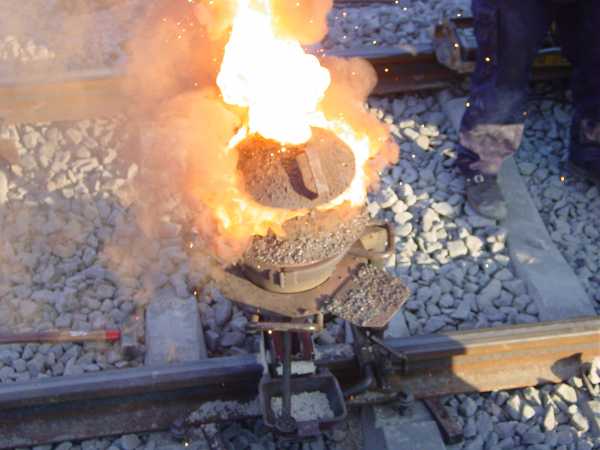
A thermite weld in progress

Exothermic welding, also known as exothermic bonding, thermite welding (TW),[1] and thermit welding,[1] is a welding process that employs molten metal to permanently join the conductors. The process employs an exothermic reaction of a thermite composition to heat the metal, and requires no external source of heat or current. The chemical reaction that produces the heat is an aluminothermic reaction between aluminium powder and a metal oxide.

Overview

[edit]

In exothermic welding, aluminium dust reduces the oxide of another metal, most commonly iron oxide, because aluminium is highly reactive. Iron(III) oxide is commonly used:

The products are aluminium oxide, free elemental iron,[2] and a large amount of heat. The reactants are commonly powdered and mixed with a binder to keep the material solid and prevent separation.

Commonly the reacting composition is five parts iron oxide red (rust) powder and three parts aluminium powder by weight, ignited at high temperatures. A strongly exothermic (heat-generating) reaction occurs that via reduction and oxidation produces a white hot mass of molten iron and a slag of refractory aluminium oxide. The molten iron is the actual welding material; the aluminium oxide is much less dense than the liquid iron and so floats to the top of the reaction, so the set-up for welding must take into account that the actual molten metal is at the bottom of the crucible and covered by floating slag.

Other metal oxides can be used, such as chromium oxide, to generate the given metal in its elemental form. Copper thermite, using copper oxide, is used for creating electric joints:

Thermite welding was a step forward for joining rails.

Thermite welding is widely used to weld railway rails. One of the first railroads to evaluate the use of thermite welding was the Delaware and Hudson Railroad in the United States in 1935[3] The weld quality of chemically pure thermite is low due to the low heat penetration into the joining metals and the very low carbon and alloy content in the nearly pure molten iron. To obtain sound railroad welds, the ends of the rails being thermite welded are preheated with a torch to an orange heat, to ensure the molten steel is not chilled during the pour.

Because the thermite reaction yields relatively pure iron, not the much stronger steel, some small pellets or rods of high-carbon alloying metal are included in the thermite mix; these alloying materials melt from the heat of the thermite reaction and mix into the weld metal. The alloying beads composition will vary, according to the rail alloy being welded.

The reaction reaches very high temperatures, depending on the metal oxide used. The reactants are usually supplied in the form of powders, with the reaction triggered using a spark from a flint lighter. The activation energy for this reaction is very high however, and initiation requires either the use of a "booster" material such as powdered magnesium metal or a very hot flame source. The aluminium oxide slag that it produces is discarded.[4][5]

When welding copper conductors, the process employs a semi-permanent graphite crucible mould, in which the molten copper, produced by the reaction, flows through the mould and over and around the conductors to be welded, forming an electrically conductive weld between them.[6] When the copper cools, the mould is either broken off or left in place.[4] Alternatively, hand-held graphite crucibles can be used. The advantages of these crucibles include portability, lower cost (because they can be reused), and flexibility, especially in field applications.

Properties

[edit]

An exothermic weld has higher mechanical strength than other forms of weld, and excellent corrosion resistance[7] It is also highly stable when subject to repeated short-circuit pulses, and does not suffer from increased electrical resistance over the lifetime of the installation. However, the process is costly relative to other welding processes, requires a supply of replaceable moulds, suffers from a lack of repeatability, and can be impeded by wet conditions or bad weather (when performed outdoors).[4][6]

Applications

[edit]

Exothermic welding is usually used for welding copper conductors but is suitable for welding a wide range of metals, including stainless steel, cast iron, common steel, brass, bronze, and Monel.[4] It is especially useful for joining dissimilar metals.[5] The process is marketed under a variety of names such as AIWeld, American Rail Weld, AmiableWeld, Ardo Weld, ERICO Cadweld, FurseWeld, Harger Ultrashot, Quikweld, StaticWeld, Techweld, Tectoweld, TerraWeld, Thermoweld and Ultraweld.[4]

Because of the good electrical conductivity and high stability in the face of short-circuit pulses, exothermic welds are one of the options specified by §250.7 of the United States National Electrical Code for grounding conductors and bonding jumpers.[8] It is the preferred method of bonding, and indeed it is the only acceptable means of bonding copper to galvanized cable.[5] The NEC does not require such exothermically welded connections to be listed or labelled, but some engineering specifications require that completed exothermic welds be examined using X-ray equipment.[8]

Rail welding

[edit]
Tram tracks being joined
Tram tracks recently joined

History

[edit]

Modern thermite rail welding was first developed by Hans Goldschmidt in the mid-1890s as another application for the thermite reaction which he was initially exploring for the use of producing high-purity chromium and manganese. The first rail line was welded using the process in Essen, Germany in 1899, and thermite welded rails gained popularity as they had the advantage of greater reliability with the additional wear placed on rails by new electric and high speed rail systems.[9] Some of the earliest adopters of the process were the cities of Dresden, Leeds, and Singapore.[10] In 1904 Goldschmidt established his eponymous Goldschmidt Thermit Company (known by that name today) in New York City to bring the practice to railways in North America.[9]

In 1904, George E. Pellissier, an engineering student at Worcester Polytechnic Institute who had been following Goldschmidt's work, reached out to the new company as well as the Holyoke Street Railway in Massachusetts. Pellissier oversaw the first installation of track in the United States using this process on August 8, 1904,[11] and went on to improve upon it further for both the railway and Goldschmidt's company as an engineer and superintendent, including early developments in continuous welded rail processes that allowed the entirety of each rail to be joined rather than the foot and web alone.[12] Although not all rail welds are completed using the thermite process, it still remains a standard operating procedure throughout the world.[9]

Process

[edit]

Typically, the ends of the rails are cleaned, aligned flat and true, and spaced apart 25 mm (1 in).[9] This gap between rail ends for welding is to ensure consistent results in the pouring of the molten steel into the weld mold. In the event of a welding failure, the rail ends can be cropped to a 75 mm (3 in) gap, removing the melted and damaged rail ends, and a new weld attempted with a special mould and larger thermite charge. A two or three piece hardened sand mould is clamped around the rail ends, and a torch of suitable heat capacity is used to preheat the ends of the rail and the interior of the mould.

The proper amount of thermite with alloying metal is placed in a refractory crucible, and when the rails have reached a sufficient temperature, the thermite is ignited and allowed to react to completion (allowing time for any alloying metal to fully melt and mix, yielding the desired molten steel or alloy). The reaction crucible is then tapped at the bottom. Modern crucibles have a self-tapping thimble in the pouring nozzle. The molten steel flows into the mould, fusing with the rail ends and forming the weld.

The slag, being lighter than the steel, flows last from the crucible and overflows the mould into a steel catch basin, to be disposed of after cooling. The entire setup is allowed to cool. The mould is removed and the weld is cleaned by hot chiselling and grinding to produce a smooth joint. Typical time from start of the work until a train can run over the rail is approximately 45 minutes to more than an hour, depending on the rail size and ambient temperature. In any case, the rail steel must be cooled to less than 370 °C (700 °F) before it can sustain the weight of rail locomotives.

When a thermite process is used for track circuits – the bonding of wires to the rails with a copper alloy, a graphite mould is used. The graphite mould is reusable many times, because the copper alloy is not as hot as the steel alloys used in rail welding. In signal bonding, the volume of molten copper is quite small, approximately 2 cm3 (0.1 cu in) and the mould is lightly clamped to the side of the rail, also holding a signal wire in place. In rail welding, the weld charge can weigh up to 13 kg (29 lb).

The hardened sand mould is heavy and bulky, must be securely clamped in a very specific position and then subjected to intense heat for several minutes before firing the charge. When rail is welded into long strings, the longitudinal expansion and contraction of steel must be taken into account. British practice sometimes uses a sliding joint of some sort at the end of long runs of continuously welded rail, to allow some movement, although by using a heavy concrete sleeper and an extra amount of ballast at the sleeper ends, the track, which will be prestressed according to the ambient temperature at the time of its installation, will develop compressive stress in hot ambient temperature, or tensile stress in cold ambient temperature, its strong attachment to the heavy sleepers preventing sun kink (buckling) or other deformation.

Current practice is to use welded rails throughout on high speed lines, and expansion joints are kept to a minimum, often only to protect junctions and crossings from excessive stress. American practice appears to be very similar, a straightforward physical restraint of the rail. The rail is prestressed, or considered "stress neutral" at some particular ambient temperature. This "neutral" temperature will vary according to local climate conditions, taking into account lowest winter and warmest summer temperatures.

The rail is physically secured to the ties or sleepers with rail anchors, or anti-creepers. If the track ballast is good and clean and the ties are in good condition, and the track geometry is good, then the welded rail will withstand ambient temperature swings normal to the region.

Remote welding

[edit]

Remote exothermic welding is a type of exothermic welding process for joining two electrical conductors from a distance. The process reduces the inherent risks associated with exothermic welding and is used in installations that require a welding operator to permanently join conductors a safe distance from the superheated copper alloy.

The process incorporates either an igniter for use with standard graphite molds or a consumable sealed drop-in weld metal cartridge, semi-permanent graphite crucible mold, and an ignition source that tethers to the cartridge with a cable that provides the safe remote ignition.

See also

[edit]

References

[edit]
[edit]
Revisions and contributorsEdit on WikipediaRead on Wikipedia
from Grokipedia
Exothermic welding is a metallurgical process that creates permanent, molecular bonds between metal conductors—typically copper to copper or copper to steel—through a self-sustaining exothermic chemical reaction, without requiring external heat, power, or filler materials. The reaction, often involving a thermite mixture of aluminum powder and copper(II) oxide (Cu₂O), generates temperatures around 2,000–2,500°C, producing molten metal that fuses the conductors in a graphite mold to form a low-resistance joint exceeding the strength of the base materials. Originating from the thermite reaction discovered by German chemist Hans Goldschmidt in 1893 for initial rail applications, the modern process was patented and commercialized in 1938 by Charles Cadwell, enabling widespread use in electrical and structural connections. Key applications include electrical grounding systems, railroad rail bonding, for pipelines and structures, lightning protection, and high-voltage transmission, where it provides corrosion-resistant, maintenance-free bonds compliant with standards like IEEE 837 and UL 467. Advantages over mechanical or brazed connections include superior conductivity (typically around 10 microohms resistance for standard joints), longevity matching the conductors' lifespan, and resistance to , thermal cycling, and , though it requires trained operators and proper safety measures due to the intense heat involved.

Fundamentals

Definition and Principles

Exothermic welding is a metallurgical process for permanently joining similar or dissimilar metals, such as to or to , by utilizing the intense produced from a highly exothermic between a metal and a , which generates molten to fuse the components at the atomic level. At its core, the process operates on the principle of a self-sustaining reaction initiated by a simple ignition source, such as a spark or flint , which rapidly elevates temperatures to approximately 2500°C without requiring external , gas, or other power inputs. This chemical energy-driven mechanism contrasts with conventional techniques that rely on arc discharge or heating to achieve , enabling exothermic welding to be performed in remote or hazardous environments where power sources are unavailable. The high temperatures melt the parent metals and filler material, allowing them to intermix and solidify into a homogeneous, molecular bond that exhibits electrical conductivity and tensile strength equivalent to or exceeding that of the original conductors, outperforming mechanical joints like crimps or bolts by eliminating and vulnerability to or loosening over time.

Chemical Reaction

The core chemical reaction in exothermic welding is a highly exothermic redox process known as the thermite reaction, where powdered aluminum acts as the reducing agent and iron(III) oxide (Fe₂O₃) serves as the oxidizing agent. In this reaction, aluminum reduces the iron oxide, displacing the iron and forming aluminum oxide while liberating a significant amount of heat that melts the iron. The balanced equation for the standard thermite reaction used in ferrous exothermic welding is: 2Al+Fe2O3Al2O3+2Fe+heat2 \text{Al} + \text{Fe}_2\text{O}_3 \rightarrow \text{Al}_2\text{O}_3 + 2 \text{Fe} + \text{heat} This reaction releases approximately 4 MJ/kg of energy, providing the intense heat necessary to achieve temperatures around 2,200°C, which fuses the metals without external power sources. Variations of the thermite reaction employ different metal oxides for non-ferrous applications, such as copper(I) oxide (Cu₂O) with aluminum for welding copper conductors, following the equation: 3Cu2O+2AlAl2O3+6Cu+heat3 \text{Cu}_2\text{O} + 2 \text{Al} \rightarrow \text{Al}_2\text{O}_3 + 6 \text{Cu} + \text{heat} These adaptations maintain the redox mechanism but produce molten copper instead of iron, ensuring compatibility with the base materials while generating comparable exothermic energy. The primary byproduct of the reaction is aluminum oxide (Al₂O₃), which forms a that is less dense than the molten metal and floats to the surface, separating naturally to yield clean, impurity-free welds. The reaction requires a high and is initiated by an external ignition source, such as a magnesium strip or ribbon, which provides the initial heat to start the self-sustaining process.

History and Development

Invention and Early Use

The exothermic welding process, also known as welding, originated from the discovered by German chemist Hans Goldschmidt in 1893. Goldschmidt patented the method for reducing metal oxides using aluminum powder under Imperial Patent No. 96317 in 1895, with a U.S. (No. 578,868) granted in 1897 for producing metals and alloys via this reaction. The process was initially developed for metallurgical applications but was soon adapted for welding, with a specific (DRP 116,400) issued in 1899 for aluminothermic of railway tracks. Early commercial applications emerged shortly after, marking the transition from laboratory innovation to practical use. The first known thermite welds for track joining occurred in 1899 on the Essen tramways in , demonstrating the process's potential for creating strong, seamless connections without external heat sources. By 1904, the technique saw its inaugural railway track welds on the Hungarian state railway in , and , engineer George E. Pellissier oversaw the first installation on August 8 of that year for the Holyoke Street Railway in , where it was used to weld approximately one mile of streetcar track over 18 days. These efforts were supported by the establishment of the Goldschmidt Thermit Company in New York in 1904, which facilitated the process's spread to North American infrastructure projects, including initial trials for joining pipes alongside rails. In the , railroads increasingly adopted exothermic welding to replace brittle mechanical joints, such as fishplates, which were prone to failure under heavy loads and . This shift was driven by the process's ability to produce homogeneous, high-strength welds that enhanced track durability and reduced maintenance needs, with notable implementations on European and American lines by 1911, including a 1,000-meter section on the Seetalbahn tramway in that endured until 1924. However, primitive early setups presented challenges, including precise control of the reaction speed to prevent uneven heating or incomplete fusion, and effective management of the aluminothermic slag to minimize inclusions that could weaken the joint. These issues required ongoing refinements by pioneers like Pellissier, who improved mold designs and reaction timing for reliable field applications.

Evolution and Modern Adaptations

The modern exothermic process for electrical applications was invented in 1938 and patented in 1939 by Charles Cadwell of the Electric Railway Improvement Company, introducing a -based system (Cadweld) that expanded use beyond rail welding to non-ferrous conductors like . In the mid-20th century, the process underwent significant standardization efforts led by companies such as ERICO (now part of nVent), which refined it for broader industrial applications. By 1949, the technique was adapted for systems, minimizing heat effects on sensitive structures like thin-walled under high stress. In 1951, it was further standardized for grounding connections, facilitating more efficient commercial electrical installations. A key innovation during this period came in 1959 with the introduction of disposable graphite molds under the Cadweld One Shot system, enabling precise control over the process for connecting conductors to ground rods and improving reproducibility in field operations. The marked a shift toward enhanced and usability in exothermic welding, with the development of low-emission systems to address concerns in indoor and sensitive environments. In 1988, nVent ERICO introduced the Cadweld Exolon system, featuring electronic ignition and ceramic filters to reduce smoke and fumes, allowing safer application in confined spaces without compromising weld integrity. This adaptation emphasized pre-measured, contained reaction mixtures to minimize handling risks associated with raw components. Entering the 2000s, exothermic welding integrated technological advancements for greater precision and convenience, including the 2003 launch of the Cadweld Plus system by nVent ERICO, which incorporated self-contained, pre-packaged welding materials and electronic ignition for consistent, user-friendly performance. Custom mold design benefited from digital tools, such as online selection systems, enabling tailored connections for diverse conductor sizes and configurations. Post-2020 developments have focused on and ; for instance, the next-generation Cadweld Plus lineup introduced the Impulse Exothermic Welding for improved and monitoring. By 2025, manufacturers have advanced automated exothermic welding systems to boost efficiency and accuracy in high-volume applications, alongside eco-friendly materials that incorporate recycled components to lower environmental impact.

Process and Materials

Preparation and Setup

Exothermic welding requires careful selection of materials to ensure compatibility and optimal fusion between the conductors being joined. Base metals such as and are commonly used, with copper-to- or copper-to- connections being standard for electrical grounding applications. The powder, which serves as the primary welding material, typically consists of around 20% aluminum powder and 80% (CuO) for copper welds, producing a molten upon reaction. Molds are generally made from due to its high resistance and reusability, lasting up to 50 connections before requiring or replacement; sand molds may be used in specialized cases but are less common in modern setups. The composition varies by application; for example, is used for welds in rail applications, while is for copper-based electrical connections. Essential equipment includes molds with integrated crucibles to contain the mixture, handle clamps to secure the mold around the conductors, and ignition devices such as flint igniters or torches for preheating. Wire brushes (e.g., natural bristle or ) are necessary for surface preparation, while protective tools like gloves and glasses are standard. Only manufacturer-approved materials, such as those from nVent ERICO, should be used to maintain connection integrity and . Site preparation begins with selecting a level, dry work area to prevent or uneven of the molten metal, ensuring adequate ventilation to disperse fumes. Conductors must be thoroughly cleaned to remove oxides, , and coatings using a . The mold itself is preheated to approximately 250°F (120°C) and inspected for cracks or wear in the cavity, tap hole, and cable openings to avoid leaks during the process and eliminate moisture that could cause in the weld. Charge size is determined by the joint dimensions and specified on the mold's ID tag, typically ranging from 15 grams to several hundred grams of mixture per connection, ensuring the volume matches the required molten metal output without excess.

Execution and Joining Mechanism

The execution of exothermic welding begins once the conductors are positioned within the graphite mold, with the mold securely clamped around the joint area. The exothermic mixture, typically contained in a cartridge or disk, is ignited using a flint igniter, electronic control unit, or starting powder, initiating a self-sustaining chemical reaction that generates temperatures around 2500°C (4500°F). The reaction sustains for approximately 20-30 seconds, during which the powdered metal and oxidizer combust to produce molten filler metal—such as copper or iron—that flows through a tap hole into the mold cavity surrounding the conductors. This molten material fills the gap between the base metals without requiring external pressure or power sources, completing the active welding phase. Following the reaction, the mold is opened, and any is removed from the surface of the . The connection then undergoes natural cooling in air, typically taking 1-5 minutes to solidify fully and reach a handleable , during which a crystalline structure forms as the molten filler transitions from liquid to solid. For certain applications like welds, the mold may be removed within about 30 seconds post-reaction to facilitate controlled cooling. The joining mechanism relies on the high-temperature molten filler metal intermixing with the base metals through atomic diffusion at the interface, creating a metallurgical bond rather than a mechanical one. This diffusion process allows elements from the filler (e.g., copper in copper-based welds) to migrate into the parent metals, forming a homogeneous microstructure upon solidification that is resistant to corrosion and capable of withstanding environmental stresses. The resulting bond exhibits high tensile strength, often equal to or exceeding 100% of the parent metal's strength in electrical grounding applications, ensuring the joint does not become the weak point. Quality assurance for the weld primarily involves to confirm complete filling of the cavity, absence of voids or cracks, and a smooth, slag-free surface with the riser protruding above the conductors. A simple hammer tap test—striking the joint with a 12-16 oz hammer—can detect internal defects, as a flawed weld may dislodge or produce a hollow sound. For critical applications, such as rail joints, non-destructive testing methods like ultrasonic examination are employed to identify subsurface voids or inclusions, ensuring structural .

Properties and Performance

Physical and Chemical Properties

Exothermic welds form a molecular bond between metals, resulting in physical properties that closely match or exceed those of the base materials. The tensile strength of the bond typically exceeds that of the base metal for hard-drawn copper conductors (ultimate tensile strength around 50 ksi), ensuring the weld does not become the weak point in the joint. Thermal conductivity of the weld metal aligns with that of pure copper at approximately 400 W/m·K, facilitating efficient heat dissipation without significant loss relative to the parent conductor. The coefficient of thermal expansion for the weld is similar to copper's value of 17 × 10^{-6}/K, minimizing differential expansion stresses that could lead to cracking during thermal cycling. Chemically, exothermic welds exhibit high corrosion resistance due to the use of pure metal fillers, such as alloys with over 97% content, which resist oxidation and in grounding environments. The resulting , primarily composed of aluminum (Al₂O₃), is and pH-neutral (approximately 7), preventing acidic or alkaline interactions with the after removal. The achieves near 100% conversion efficiency, ensuring complete reduction and minimal unreacted material. Testing under standards like IEEE 837-2024 demonstrates superior fatigue resistance compared to bolted joints, with connections enduring 2.4 times higher mechanical forces and 15 heat cycles at 47 kA rms (127 kA peak) without failure, simulating decades of fault conditions and outperforming mechanical connections in cyclic loading. ASTM-based evaluations, such as those aligned with F855 for fault current withstand, confirm the welds' robustness, with no degradation in bond integrity after exposure to 100% relative and salt fog for .

Advantages and Limitations

Exothermic welding offers significant advantages in scenarios requiring reliable electrical connections without reliance on external . The process eliminates the need for an external power source or heat, making it particularly suitable for remote or field applications where access to is limited. This portability enhances its utility in diverse settings, such as grounding systems in isolated locations. Additionally, the resulting molecular bond creates permanent joints that require minimal maintenance over time, as they do not loosen, corrode, or degrade under normal conditions, often outlasting the connected conductors themselves. The technique demonstrates high reliability in challenging environments, including those exposed to , repeated currents, or mechanical stresses. These joints maintain consistent performance without deterioration, providing a stable electrical path even under harsh conditions like seismic activity or environmental exposure. Compared to alternative methods, exothermic welding provides superior electrical conductivity to due to its fused, impurity-free bond that minimizes resistance at the joint interface. It also outperforms mechanical fasteners in long-term conductivity and , though it is generally slower to execute than the quicker installation of mechanical connections. Despite these benefits, exothermic welding has notable limitations that can impact its practicality. The process produces irreversible, one-time joints that cannot be easily undone or adjusted once formed, necessitating precise initial setup. It requires skilled operators to ensure proper execution, as errors in handling can compromise joint integrity. Furthermore, inadequate ventilation during the reaction can lead to defects in the weld or risks from emitted gases, underscoring the need for controlled conditions.

Applications

Rail Track Connections

Exothermic welding, commonly referred to as thermite welding in rail applications, is widely used to create permanent butt s between rail ends, ensuring structural integrity and electrical continuity in track infrastructure. The process involves clamping specialized molds around the abutting rail ends to contain the molten metal produced by the , resulting in a fused that encompasses the full rail cross-section, including the head, web, and foot. This full-profile bonding eliminates weak points and provides a seamless connection capable of withstanding the dynamic stresses of rail . In executing rail track connections, precise alignment is critical to achieve straight and prevent misalignment-induced failures. Alignment jigs, such as rail alignment plates or A-frames, are employed to position the rail ends accurately before mold installation, often adjusting for gaps of 20-25 mm and ensuring levelness within tolerances of 0.5 mm. For standard rails (e.g., 60 kg/m profiles), portions typically weigh 10-15 kg, though larger charges up to 20 kg are used for heavier sections to generate sufficient molten for complete fusion. The reaction is initiated in a , and the superheated metal (at approximately 2,500°C) is poured into the mold, where it solidifies to form the in about 3-5 minutes. The benefits of exothermic welding in rail tracks are particularly pronounced for both mechanical durability and electrical performance. These welds provide low electrical resistance comparable to the parent rail material, enabling reliable rail signaling systems that depend on low-impedance paths for track circuits and train detection. Structurally, the joints can withstand loads exceeding 100 tons in heavy-haul applications, with tests demonstrating under cyclic loading equivalent to millions of passes. Global adoption accelerated in the 1920s following early 20th-century innovations, with widespread use in major networks; for instance, produced over 700,000 such welds annually as of 2013 to maintain its extensive continuous welded rail infrastructure. Maintenance of exothermic rail welds focuses on post-installation finishing and periodic to ensure longevity. Immediately after solidification, excess metal is removed using portable grinders to restore the to standard tolerances (e.g., 0.2-0.5 mm deviation), preventing uneven wear and facilitating smooth passage. These welds exhibit exceptional , often lasting 50 years or more without under normal operating conditions, as evidenced by field studies showing minimal degradation in heat-affected zones over decades of service. Regular ultrasonic complement grinding to detect any subsurface defects early.

Electrical and Grounding Systems

Exothermic welding is extensively employed in electrical and grounding systems to create permanent, molecular bonds between conductors, ensuring reliable pathways for fault currents and strikes. This method is particularly valued in utility infrastructure where connections must withstand environmental stresses and maintain electrical integrity over extended periods. In grounding applications, it joins materials like conductors to structures, forming joints that mimic the conductivity of the base metals themselves. A key technique involves using copper-aluminum mixtures to join copper conductors to structures, where the between aluminum powder and generates intense —reaching up to 2,200°C—to fuse the metals without external power sources. This process occurs within a mold, producing a homogeneous bond that resists and mechanical failure. For elevated or hard-to-reach installations, such as pole-mounted grounding in transmission lines, remote ignition kits enable safe operation from a distance, utilizing electronic impulse controls to initiate the reaction while minimizing operator exposure to . Specialized mold designs facilitate exothermic bonds in pipelines and associated electrical grounding, incorporating variants that use alloys to limit heat impact on pipes while ensuring low-impedance connections for cathodic systems. These molds are engineered for various configurations, such as cable-to-pipe taps, to support in buried or exposed lines. The resulting joints exhibit very low resistance, typically equivalent to or better than the conductors, facilitating efficient dissipation of fault currents. The benefits of these connections include sustained low resistance—typically around 10 microohms—over decades, as the molecular fusion prevents loosening, oxidation, or degradation that plagues mechanical alternatives. This longevity is critical for lightning protection, where the bonds provide a direct, high-capacity path to ground, reducing risks in high-voltage environments. Exothermic welding is the preferred method in the majority of utility substations worldwide, qualifying under rigorous standards like IEEE 837 for permanent grounding in such facilities. In modern applications, exothermic welding has integrated into grids, particularly for grounding in solar farms since the 2010s, where low-resistance joints ensure safe and efficient flow from panels to amid harsh outdoor conditions. These connections enhance system reliability by minimizing losses and supporting fault in expanding photovoltaic installations. As of 2025, similar applications are expanding in charging infrastructure for robust grounding.

Safety and Standards

Safety Protocols

Exothermic welding involves significant hazards due to the high-temperature , which can reach approximately 2500°C, posing risks of severe burns from direct contact with hot surfaces or molten metal. The process also generates molten metal splatter, particularly if the graphite mold leaks or if contaminates the materials, leading to explosive ejection of hot particles that can cause penetrating injuries to or eyes. Additionally, the reaction produces toxic fumes from the oxidation of aluminum to aluminum oxide, along with metallic vapors such as oxides, which can irritate the and induce —characterized by symptoms like fever, chills, and muscle aches upon . To mitigate these risks, operators must wear comprehensive (PPE), including heat-insulated gloves to against thermal burns, safety glasses or face shields to shield eyes from splatter and intense light, and fire-resistant clothing that covers the body, arms, and legs to prevent ignition or burn-through from sparks and hot debris. Respiratory , such as masks or supplied-air systems, is required in poorly ventilated areas to avoid fume , while aprons or sleeves provide extra safeguarding for the hands and during mold handling. Adequate ventilation must be ensured through natural airflow or local exhaust systems to disperse and gases from the reaction site, reducing exposure to airborne particulates. Establishing an around the welding area is essential to protect nearby workers; this involves clearing flammable materials within a safe radius, advising personnel of the operation, and restricting access to authorized individuals only to prevent unintended exposure to heat, splatter, or fumes. Operators should conduct a pre-weld to remove potential ignition sources and ensure the site is dry, as can exacerbate splatter hazards. For emergency response, fire suppression should employ dry chemical agents like sand to smother any ignited materials, avoiding direct water application on molten metal to prevent steam explosions; large volumes of water may be used from a safe distance if necessary. In case of exposure, affected individuals should be moved to immediately, with burns flushed under cool and medical attention sought promptly for or severe injuries. All personnel performing exothermic welding require formal training and certification from manufacturers, such as nVent ERICO's CADWELD program or Harger's Ultraweld courses, which cover safe handling, equipment setup, and recognition to ensure competent execution and minimize risks.

Regulatory Standards and Best Practices

Exothermic welding connections, particularly those used in electrical grounding and bonding applications, must comply with established standards to ensure reliability, safety, and performance under fault conditions. The IEEE Std 837-2024 (as of April 2025) provides comprehensive qualification criteria for permanent connections in substation grounding systems, applicable to materials such as , , and . This standard mandates rigorous testing protocols, including mechanical evaluations to assess , sequential aging simulations via current-temperature cycling (up to 25 cycles between ambient and 350°C), freeze-thaw cycles (10 iterations from -10°C to 20°C), resistance through salt spray exposure (over 500 hours per ASTM B117) and acid immersion (10% achieving 20% conductor reduction), and electromagnetic force (EMF) tests simulating fault currents up to 126 kA peak for 0.25 seconds at 90% of the fusing current. Connections pass if post-test resistance remains at or below 1.5 times the initial value (normalized to 20°C), with no excessive movement exceeding 10 mm or the conductor diameter. In , UL 467, 11th Edition (2022), governs grounding and bonding equipment, with Annex D specifically addressing exothermic welding systems. This standard requires evaluation of construction integrity, markings for identification and installation guidance, and performance under mechanical and electrical stresses to prevent failures in grounding applications. Systems must demonstrate compliance through third-party testing, ensuring they meet pull-strength and conductivity requirements without degradation from environmental factors. Internationally, IEC 62561-1:2023 outlines requirements for connection components in lightning protection systems, including exothermic welds, emphasizing their ability to withstand lightning currents without excessive heating or mechanical failure. Tests focus on current-carrying capacity, typically up to 200 kA for 10/350 μs impulses, with joints evaluated for resistance stability and structural integrity post-exposure. This standard complements regional codes by prioritizing surge protection in external installations. For rail applications, AWS D15.2/D15.2M:2022 establishes recommended practices for (exothermic) welding of rails and components, covering processes for joining, repair, and maintenance to ensure track integrity under vehicular loads. It specifies pre-weld preparation, such as alignment and gap control (typically 13-25 mm for standard rails), post-weld cooling protocols to avoid cracks, and non-destructive inspection methods like for internal defects. Welds must achieve full penetration and meet tensile strength comparable to parent rail material. Best practices emphasize operator training and adherence to manufacturer guidelines to mitigate risks like incomplete fusion or contamination. Conductors and molds must be thoroughly cleaned to bare metal and preheated (above 100°C) to eliminate , which can cause ; improper preparation can lead to high failure rates in field welds. Molds should be clamped securely in a vertical orientation, with starting material ignited remotely using electronic systems to reduce hazards. Post-weld involves visual checks for a solid, slag-free body exceeding conductor cross-section, supplemented by hammer tap tests on joints or pull tests verifying bond strength above 50% of conductor tensile capacity. , including gloves, , and respirators, is mandatory, as reaction temperatures exceed 2500°C and produce hazardous fumes. Regular mold maintenance—limited to 50 uses per set—and certification of weld powders to standards like UL 467 ensure consistent quality.

References

Add your contribution
Related Hubs
User Avatar
No comments yet.