


Community hub
Recent from talks
Contribute something
Nothing was collected or created yet.
Friedmann–Lemaître–Robertson–Walker metric
View on Wikipedia| Part of a series on |
| Physical cosmology |
|---|
 |


The Friedmann–Lemaître–Robertson–Walker metric (FLRW; /ˈfriːdmən ləˈmɛtrə ... /) is a metric that describes a homogeneous, isotropic, expanding (or otherwise, contracting) universe that is path-connected, but not necessarily simply connected.[1][2][3] The general form of the metric follows from the geometric properties of homogeneity and isotropy. Depending on geographical or historical preferences, the set of the four scientists – Alexander Friedmann, Georges Lemaître, Howard P. Robertson, and Arthur Geoffrey Walker – is variously grouped as Friedmann, Friedmann–Robertson–Walker (FRW), Robertson–Walker (RW), or Friedmann–Lemaître (FL). When combined with Einstein's field equations, the metric gives the Friedmann equation, which has been developed into the Standard Model of modern cosmology[4] and further developed into the Lambda-CDM model.
Concept
[edit]The metric is a consequence of assuming that the mass in the universe has constant density – homogeneity – and is the same in all directions – isotropy. Assuming isotropy alone is sufficient to reduce the possible motions of mass in the universe to radial velocity variations. The Copernican principle, that our observation point in the universe is equivalent to every other point, combined with isotropy, ensures homogeneity. Without the principle, a metric would need to be extracted from astronomical data, which may not be possible.[5]: 408 Direct observation of stars has shown their velocities to be dominated by radial recession, validating these assumptions for cosmological models.[6]: 65
To measure distances in this space, that is to define a metric, we can compare the positions of two points in space, moving along with their local radial velocity of mass. Such points can be thought of as ideal galaxies. Each galaxy can be given a clock to track local time, with the clocks synchronized by imagining the radial velocities run backwards until the clocks coincide in space. The equivalence principle applied to each galaxy means distance measurements can be made using special relativity locally. So a distance can be related to the local time t and the coordinates:


An isotropic, homogeneous mass distribution is highly symmetric. Rewriting the metric in spherical coordinates reduces four coordinates to three coordinates. The radial coordinate is written as a product of a comoving coordinate, r, and a time-dependent scale factor R(t). The resulting metric can be written in several forms. Two common ones are:

or

where is the angle between the two locations and


(The meaning of r in these equations is not the same). Other common variations use a dimensionless scale factor

where time zero is now.[6]: 70
2-dimensional analogy
[edit]The time-dependent scale factor , which plays a critical role in cosmology, has an analog in the radius of a sphere. A sphere is a 2-dimensional surface embedded in a 3-dimensional space. The radius of a sphere lives in the third dimension: it is not part of the 2-dimensional surface. However, the value of this radius affects distances measured on the two-dimensional surface. Similarly, the cosmological scale factor is not a distance in our 3-dimensional space, but its value affects the measurement of distances.[7]: 147

FLRW models
[edit]Applying the metric to cosmology and predicting its time evolution requires Einstein's field equations and a way of calculating the density, such as a cosmological equation of state. This process allows an approximate analytic solution of Einstein's field equations giving the Friedmann equations when the energy–momentum tensor is similarly assumed to be isotropic and homogeneous. Models based on the FLRW metric and obeying the Friedmann equations are called FRW models.[6]: 73 Direct observation of stars has shown their velocities to be dominated by radial recession, validating these assumptions for cosmological models.[6]: 65 These models are the basis of the standard Big Bang cosmological model, including the current ΛCDM model.[8]: 25.1.3


General metric
[edit]The FLRW metric assumes homogeneity and isotropy of space.[9]: 404 It also assumes that the spatial component of the metric can be time-dependent. The generic metric that meets these conditions is

where ranges over a 3-dimensional space of uniform curvature, that is, elliptical space, Euclidean space, or hyperbolic space. It is normally written as a function of three spatial coordinates, but there are several conventions for doing so, detailed below. does not depend on – all of the time dependence is in the function , known as the "scale factor".


Reduced-circumference polar coordinates
[edit]In reduced-circumference polar coordinates, the spatial metric has the form[10][11]

is a constant representing the curvature of the space. There are two common unit conventions:

- may be taken to have units of length−2, in which case has units of length and is unitless. is then the Gaussian curvature of the space at the time when . is sometimes called the reduced circumference because it is equal to the measured circumference of a circle (at that value of ), centered at the origin, divided by (like the of Schwarzschild coordinates). Where appropriate, is often chosen to equal 1 in the present cosmological era, so that measures comoving distance.
- Alternatively, may be taken to belong to the set {−1, 0, +1} (for negative, zero, and positive curvature, respectively). Then is unitless and has units of length. When , is the radius of curvature of the space and may also be written .


A disadvantage of reduced circumference coordinates is that they cover only half of the 3-sphere in the case of positive curvature—circumferences beyond that point begin to decrease, leading to degeneracy. (This is not a problem if space is elliptical, i.e., a 3-sphere with opposite points identified.)
Hyperspherical coordinates
[edit]In hyperspherical or curvature-normalized coordinates, the coordinate is proportional to radial distance; this gives

where is as before and

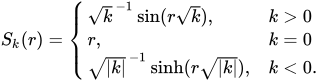
As before, there are two common unit conventions:
- may be taken to have units of length−2, in which case has units of length and is unitless. is then the Gaussian curvature of the space at the time when . Where appropriate, is often chosen to equal 1 in the present cosmological era, so that measures comoving distance.
- Alternatively, as before, may be taken to belong to the set {−1 ,0, +1} (for negative, zero, and positive curvature respectively). Then is unitless and has units of length. When , is the radius of curvature of the space and may also be written . Note that when , is essentially a third angle along with and . The letter may be used instead of .


Though it is usually defined piecewise as above, is an analytic function of both and . It can also be written as a power series


or as

where is the unnormalized sinc function and is one of the imaginary, zero, or real square roots of . These definitions are valid for all .


Cartesian coordinates
[edit]When one may write simply


This can be extended to by defining


where is one of the radial coordinates defined above, but this is rare.
Curvature
[edit]Cartesian coordinates
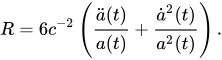
[edit]In flat FLRW space using Cartesian coordinates, the surviving components of the Ricci tensor are[12]


and the Ricci scalar is
Spherical coordinates
[edit]In more general FLRW space using spherical coordinates (called "reduced-circumference polar coordinates" above), the surviving components of the Ricci tensor are[13][failed verification]
![{\displaystyle {\begin{aligned}R_{tt}&=-3{\frac {\ddot {a}}{a}},\\[1ex]R_{rr}&={\frac {c^{-2}\left(a{\ddot {a}}+2{\dot {a}}^{2}\right)+2k}{1-kr^{2}}}\\[1ex]R_{\theta \theta }&=r^{2}\left[c^{-2}\left(a{\ddot {a}}+2{\dot {a}}^{2}\right)+2k\right]\\[1ex]R_{\phi \phi }&=r^{2}\sin ^{2}(\theta )\left[c^{-2}\left(a{\ddot {a}}+2{\dot {a}}^{2}\right)+2k\right]\end{aligned}}}](https://wikimedia.org/api/rest_v1/media/math/render/svg/b3f5ba570b1355c2cb8323534144382caf225eb7)
and the Ricci scalar is

Name and history
[edit] |
In 1922 and 1924, the Soviet mathematician Alexander Friedmann[14][15] and in 1927, Georges Lemaître, a Belgian priest, astronomer, and periodic professor of physics at the Catholic University of Leuven, arrived independently at results[16][17] that relied on the metric. Howard P. Robertson from the US and Arthur Geoffrey Walker from the UK explored the problem further during the 1930s.[18][19][20][21] In 1935, Robertson and Walker rigorously proved that the FLRW metric is the only one on a spacetime that is spatially homogeneous and isotropic (as noted above, this is a geometric result and is not tied specifically to the equations of general relativity, which Friedmann and Lemaître always assumed).
This solution, often called the Robertson–Walker metric since they proved its generic properties, is different from the dynamical "Friedmann–Lemaître" models. These models are specific solutions for a(t) that assume that the only contributions to stress-energy are cold matter ("dust"), radiation, and a cosmological constant.
Current status
[edit]The current standard model of cosmology, the Lambda-CDM model, uses the FLRW metric. By combining the observation data from some experiments, such as WMAP and Planck, with theoretical results of the Ehlers–Geren–Sachs theorem and its generalization,[26] astrophysicists now agree that the early universe is almost homogeneous and isotropic (when averaged over a very large scale) and thus nearly a FLRW spacetime. That being said, attempts to confirm the purely kinematic interpretation of the Cosmic Microwave Background (CMB) dipole through studies of radio galaxies [27] and quasars [28] show disagreement in the magnitude. Taken at face value, these observations are at odds with the Universe being described by the FLRW metric. Moreover, one can argue that there is a maximum value to the Hubble constant within an FLRW cosmology tolerated by current observations, = 71±1 km/s/Mpc, and depending on how local determinations converge, this may point to a breakdown of the FLRW metric in the late universe, necessitating an explanation beyond the FLRW metric.[29][22]

References
[edit]- ^ For an early reference, see Robertson (1935); Robertson assumes multiple connectedness in the positive curvature case and says that "we are still free to restore" simple connectedness.
- ^ Lachieze-Rey, M.; Luminet, J.-P. (1995). "Cosmic Topology". Physics Reports. 254 (3): 135–214. arXiv:gr-qc/9605010. Bibcode:1995PhR...254..135L. doi:10.1016/0370-1573(94)00085-H. S2CID 119500217.
- ^ Ellis, G. F. R.; van Elst, H. (1999). "Cosmological models (Cargèse lectures 1998)". In Marc Lachièze-Rey (ed.). Theoretical and Observational Cosmology. NATO Science Series C. Vol. 541. pp. 1–116. arXiv:gr-qc/9812046. Bibcode:1999ASIC..541....1E. ISBN 978-0-7923-5946-3.
- ^ Bergström, Lars; Goobar, Ariel (2008). Cosmology and particle astrophysics. Springer Praxis books in astronomy and planetary science (2. ed., reprinted ed.). Chichester, UK: Praxis Publ. p. 61. ISBN 978-3-540-32924-4.
- ^ Steven Weinberg (1972). Gravitation and Cosmology: Principles and Applications of the General Theory of Relativity. John Wiley & Sons, Inc. ISBN 978-0-471-92567-5.
- ^ a b c d Peacock, J. A. (1998-12-28). Cosmological Physics (1 ed.). Cambridge University Press. doi:10.1017/cbo9780511804533. ISBN 978-0-521-41072-4.
- ^ Tropp, Eduard A.; Frenkel, Viktor Ya.; Chernin, Artur D. (1993-06-03). Alexander A Friedmann: The Man who Made the Universe Expand. Translated by Dron, Alexander; Burov, Michael (1 ed.). Cambridge University Press. doi:10.1017/cbo9780511608131. ISBN 978-0-521-38470-4.
- ^ Navas, S.; Amsler, C.; Gutsche, T.; Hanhart, C.; Hernández-Rey, J. J.; Lourenço, C.; Masoni, A.; Mikhasenko, M.; Mitchell, R. E.; Patrignani, C.; Schwanda, C.; Spanier, S.; Venanzoni, G.; Yuan, C. Z.; Agashe, K. (2024-08-01). "Review of Particle Physics". Physical Review D. 110 (3) 030001. doi:10.1103/PhysRevD.110.030001. hdl:20.500.11850/695340. ISSN 2470-0010.
- ^ Weinberg, Steven (1972). Gravitation and cosmology: principles and applications of the general theory of relativity. New York: Wiley. ISBN 978-0-471-92567-5.
- ^ Wald, Robert M. (1984). General relativity. Chicago: University of Chicago Press. p. 116. ISBN 978-0-226-87032-8.
- ^ Carroll, Sean M. (2019). Spacetime and geometry: an introduction to general relativity. New York: Cambridge University Press. pp. 329–333. ISBN 978-1-108-48839-6.
- ^ Wald, Robert M. (1984). General relativity. Chicago: University of Chicago Press. p. 97. ISBN 978-0-226-87032-8.
- ^ "Cosmology" (PDF). p. 23. Archived from the original (PDF) on Jan 11, 2020.
- ^ Friedmann, Alexander (1922). "Über die Krümmung des Raumes". Zeitschrift für Physik A. 10 (1): 377–386. Bibcode:1922ZPhy...10..377F. doi:10.1007/BF01332580. S2CID 125190902.
- ^ Friedmann, Alexander (1924). "Über die Möglichkeit einer Welt mit konstanter negativer Krümmung des Raumes". Zeitschrift für Physik A (in German). 21 (1): 326–332. Bibcode:1924ZPhy...21..326F. doi:10.1007/BF01328280. S2CID 120551579. English trans. in 'General Relativity and Gravitation' 1999 vol.31, 31–
- ^ Lemaître, Georges (1931), "Expansion of the universe, A homogeneous universe of constant mass and increasing radius accounting for the radial velocity of extra-galactic nebulæ", Monthly Notices of the Royal Astronomical Society, 91 (5): 483–490, Bibcode:1931MNRAS..91..483L, doi:10.1093/mnras/91.5.483 translated from Lemaître, Georges (1927), "Un univers homogène de masse constante et de rayon croissant rendant compte de la vitesse radiale des nébuleuses extra-galactiques", Annales de la Société Scientifique de Bruxelles, A47: 49–56, Bibcode:1927ASSB...47...49L
- ^ Lemaître, Georges (1933), "l'Univers en expansion", Annales de la Société Scientifique de Bruxelles, A53: 51–85, Bibcode:1933ASSB...53...51L
- ^ Robertson, H. P. (1935), "Kinematics and world structure", Astrophysical Journal, 82: 284–301, Bibcode:1935ApJ....82..284R, doi:10.1086/143681
- ^ Robertson, H. P. (1936), "Kinematics and world structure II", Astrophysical Journal, 83: 187–201, Bibcode:1936ApJ....83..187R, doi:10.1086/143716
- ^ Robertson, H. P. (1936), "Kinematics and world structure III", Astrophysical Journal, 83: 257–271, Bibcode:1936ApJ....83..257R, doi:10.1086/143726
- ^ Walker, A. G. (1937), "On Milne's theory of world-structure", Proceedings of the London Mathematical Society, Series 2, 42 (1): 90–127, Bibcode:1937PLMS...42...90W, doi:10.1112/plms/s2-42.1.90
- ^ a b c d Abdalla, Elcio; et al. (June 2022). "Cosmology intertwined: A review of the particle physics, astrophysics, and cosmology associated with the cosmological tensions and anomalies". Journal of High Energy Astrophysics. 34: 49–211. arXiv:2203.06142v1. Bibcode:2022JHEAp..34...49A. doi:10.1016/j.jheap.2022.04.002. S2CID 247411131.
- ^ Billings, Lee (April 15, 2020). "Do We Live in a Lopsided Universe?". Scientific American. Retrieved March 24, 2022.
- ^ Migkas, K.; Schellenberger, G.; Reiprich, T. H.; Pacaud, F.; Ramos-Ceja, M. E.; Lovisari, L. (April 2020). "Probing cosmic isotropy with a new X-ray galaxy cluster sample through the L X – T scaling relation". Astronomy & Astrophysics. 636 (April 2020): A15. arXiv:2004.03305. Bibcode:2020A&A...636A..15M. doi:10.1051/0004-6361/201936602. ISSN 0004-6361. S2CID 215238834. Retrieved 24 March 2022.
- ^ Krishnan, Chethan; Mohayaee, Roya; Colgáin, Eoin Ó; Sheikh-Jabbari, M. M.; Yin, Lu (16 September 2021). "Does Hubble Tension Signal a Breakdown in FLRW Cosmology?". Classical and Quantum Gravity. 38 (18): 184001. arXiv:2105.09790. Bibcode:2021CQGra..38r4001K. doi:10.1088/1361-6382/ac1a81. ISSN 0264-9381. S2CID 234790314.
- ^ See pp. 351ff. in Hawking, Stephen W.; Ellis, George F. R. (1973), The large scale structure of space-time, Cambridge University Press, ISBN 978-0-521-09906-6. The original work is Ehlers, J., Geren, P., Sachs, R.K.: Isotropic solutions of Einstein-Liouville equations. J. Math. Phys. 9, 1344 (1968). For the generalization, see Stoeger, W. R.; Maartens, R; Ellis, George (2007), "Proving Almost-Homogeneity of the Universe: An Almost Ehlers-Geren-Sachs Theorem", Astrophys. J., 39: 1–5, Bibcode:1995ApJ...443....1S, doi:10.1086/175496.
- ^ See Siewert et al. for a recent summary of results Siewert, Thilo M.; Schmidt-Rubart, Matthias; Schwarz, Dominik J. (2021). "Cosmic radio dipole: Estimators and frequency dependence". Astronomy & Astrophysics. 653: A9. arXiv:2010.08366. Bibcode:2021A&A...653A...9S. doi:10.1051/0004-6361/202039840. S2CID 223953708.
- ^ Secrest, Nathan J.; Hausegger, Sebastian von; Rameez, Mohamed; Mohayaee, Roya; Sarkar, Subir; Colin, Jacques (2021-02-25). "A Test of the Cosmological Principle with Quasars". The Astrophysical Journal. 908 (2): L51. arXiv:2009.14826. Bibcode:2021ApJ...908L..51S. doi:10.3847/2041-8213/abdd40. S2CID 222066749.
- ^ Krishnan, Chethan; Mohayaee, Roya; Ó Colgáin, Eoin; Sheikh-Jabbari, M. M.; Yin, Lu (2021-05-25). "Does Hubble tension signal a breakdown in FLRW cosmology?". Classical and Quantum Gravity. 38 (18): 184001. arXiv:2105.09790. Bibcode:2021CQGra..38r4001K. doi:10.1088/1361-6382/ac1a81. S2CID 234790314.
Further reading
[edit]- North, John David (1990). The measure of the universe: a history of modern cosmology. New York: Dover Publications. ISBN 978-0-486-66517-7.
- Harrison, E. R. (1967). "Classification of Uniform Cosmological Models". Monthly Notices of the Royal Astronomical Society. 137 (1): 69–79. Bibcode:1967MNRAS.137...69H. doi:10.1093/mnras/137.1.69. ISSN 0035-8711.
- D'Inverno, Ray (1992). Introducing Einstein's relativity (Repr ed.). Oxford [England] : New York: Clarendon Press ; Oxford University Press. ISBN 978-0-19-859686-8.. (See Chapter 23 for a particularly clear and concise introduction to the FLRW models.)
| Special relativity |
| ||||||||||||
|---|---|---|---|---|---|---|---|---|---|---|---|---|---|
| General relativity |
| ||||||||||||
| Scientists | |||||||||||||


Friedmann–Lemaître–Robertson–Walker metric
View on Grokipediawhere is the speed of light, are comoving spatial coordinates, and is the curvature parameter ( for a closed universe, for flat, and for open).[2] This metric forms the foundation of modern cosmology, enabling the derivation of the Friedmann equations that relate the universe's expansion rate to its energy content, including matter, radiation, and dark energy.[1] The metric's development began with Alexander Friedmann's 1922 paper, where he solved Einstein's field equations to show that a dynamic, expanding universe is possible, challenging the prevailing static model by introducing a time-varying radius of curvature. Independently, Georges Lemaître in 1927 proposed a similar expanding model, linking it to observations of galactic redshifts and estimating the expansion rate, which prefigured Hubble's law. In the 1930s, Howard P. Robertson and Arthur G. Walker rigorously proved that the FLRW form is the unique metric satisfying the cosmological principle of homogeneity and isotropy on large scales, solidifying its status as the standard geometric description of spacetime in an evolving universe.[3] In contemporary cosmology, the FLRW metric underpins the CDM model, which successfully accounts for observations such as the cosmic microwave background, supernova distances, and large-scale structure, with current data indicating a nearly flat universe () dominated by dark energy.[2] The scale factor encodes the universe's history, from the Big Bang singularity where approximately 13.8 billion years ago to its current accelerated expansion driven by a cosmological constant .[1] While idealized, the metric's assumptions hold well on scales larger than galaxy clusters, serving as the basis for testing theories of gravity, inflation, and the universe's ultimate fate.[2]