

Force concentration
View on WikipediaForce concentration is the practice of concentrating a military force so as to bring to bear such overwhelming force against a portion of an enemy force that the disparity between the two forces alone acts as a force multiplier in favour of the concentrated forces.
| Part of a series on |
| War (outline) |
|---|
 |
Mass of decision
[edit]Force concentration became integral to the Prussian military operational doctrine of the mass of decision, which aimed to cause disproportionate losses on the enemy and therefore destroy the enemy's ability to fight.
From an empirical examination of past battles, the Prussian military theorist Carl von Clausewitz (1780–1831) concluded:
[...] we may infer, that it is very difficult in the present state of Europe, for the most talented General to gain a victory over an enemy double his strength. Now if we see double numbers prove such a weight in the scale against the greatest Generals, we may be sure, that in ordinary cases, in small as well as great combats, an important superiority of numbers, but which need not be over two to one, will be sufficient to ensure the victory, however disadvantageous other circumstances may be.[1]
Lanchester's laws
[edit]During the First World War Frederick W. Lanchester formulated Lanchester's laws that calculated that the combat power of a military force is the square of the number of members of that unit so that the advantage a larger force has is the difference of the squares of the two forces,[2][3] i.e.
- If force A has say 2 units and force B has 3 units, then the advantage force B has is 3²−2² or 5.
- If force A still has 2 units and force B has 4 units then the advantage force B has is 4²−2² or 12.
- If force A still has 2 units and force B has 5 units then the advantage force B has is 5²−2² or 21.
So a two to one advantage in units will quadruple the firepower and inflict four times the punishment, three times as many units will have nine times the combat ability and so on. Basically the greater the numerical superiority that one side has, the greater the damage he can inflict on the other side and the smaller the cost to himself.
Mathematical model
[edit]
There is no battlefield where battle tactics can be reduced to a pure race of delivering damage while ignoring all other circumstances. However, in some types of warfare, such as a battle for air superiority, confrontation of armoured forces in World War II or battleship-based naval battles, the ratio of armed forces could become the dominant factor. In that case, equations stated in Lanchester's laws model the potential outcome of the conflict fairly well. Balance between the two opponent forces incline to the side of superior force by the factor of . For example, two tanks against one tank are superior by a factor of four.
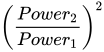
This result could be understood if the rate of damage (considered as the only relevant factor in the model) is solved as a system of differential equations. The rate in which each army delivers damage to the opponent is proportional to the number of units – in the model each unit shoots at a given rate – and to the ability or effectiveness of each surviving unit to kill the enemy. The sizes of both armies decrease at different rates depending on the size of the other, and casualties of the superior army approach zero as the size of the inferior army approaches zero. This can be written in equations:
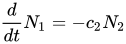
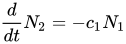
- is the number of units in the first army
- is the rate in which army 1 damages army 2 (affected by unit quality or other advantage)
- is a coefficient which describes army 1's ability to inflict damage per unit per time.


The above equations result in the following homogeneous second-order linear ordinary differential equations:
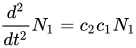
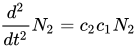
To determine the time evolution of and , these equations need to be solved using the known initial conditions (the initial size of the two armies prior to combat).

This model clearly demonstrates (see picture) that an inferior force can suffer devastating losses even when the superior force is only slightly larger, in case of equal per-unit qualitative capabilities: in the first example (see picture, top plot) the superior force starts only 40% larger, yet it brings about the total annihilation of the inferior force while suffering only 40% losses. Quality of the force may outweigh the quantitative inferiority of the force (middle plot) when it comes to battle outcomes.
Business strategy
[edit]In the 1960s, Lanchester's laws were popularised by the business consultant Nobuo Taoka and found favour with a segment of the Japanese business community.[4] The laws were used to formulate plans and strategies to attack market share. The "Canon–Xerox copier battle" in the UK, for example, reads like a classic people's war campaign. In this case, the laws supported Canon's establishment of a "revolutionary base area" by concentrating resources on a single geographical area until dominance could be achieved, in this case in Scotland. After this, they carefully defined regions to be individually attacked again with a more focused allocation of resources. The sales and distribution forces built up to support these regions in turn were used in the final "determined push in London with a numerically larger salesforce".
History
[edit]Force concentration has been a part of the military commander's repertoire since the dawn of warfare, though maybe not by that name. Commanders have always tried to have the advantage of numbers. The declined flank for example, was one way of achieving a force concentration during a battle.
Disposition of Roman Legions
[edit]At the beginning of the Roman Empire, in the first years of the first millennium, Rome's Legions were grouped into battle groups of three or four Legions, on the Rhine, on the Danube and in the Levant. By the third century A.D. these Legions had been dispersed along the frontiers in frontier fortifications, and within the Empire as internal security troops. In the first case Rome's military might was disposed in a manner in which it had a concentration of force capable of offensive action; in the second case it could defend effectively but could only attack and counterattack with difficulty.
Guerrilla warfare
[edit]As they are usually the smaller in number an appreciation of force concentration is especially important to guerrilla forces, who find it prudent initially to avoid confrontations with any large concentrations of government/occupying forces. However, through the use of small attacks, shows of strength, atrocities etc. in out of the way areas, they may be able to lure their opponents into spreading themselves out into isolated outposts, linked by convoys and patrols, in order to control territory. The guerrilla forces may then attempt to use force concentrations of their own; using unpredictable and unexpected concentrations of their forces, to destroy individual patrols, convoys and outposts. In this way they can hope to defeat their enemy in detail.
Regular forces, in turn, may act in order to invite such attacks by concentrations of enemy guerrillas, in order to bring an otherwise elusive enemy to battle, relying on its own superior training and firepower to win such battles. This was successfully practiced by the French during the First Indochina War at the Battle of Nà Sản, but a subsequent attempt to replicate this at Dien Bien Phu led to decisive defeat.
Aerial warfare
[edit]During World War I the Central Powers became increasingly unable to meet the Allied Powers in terms of outright number of fighter aircraft. To overcome this shortcoming rather than deploying their fighters uniformly along the fronts, the Germans concentrated their fighters into large mobile Jagdgeschwader formations, the most famous of which was Manfred von Richthofen's Flying Circus, that could be moved rapidly and unexpectedly to different points along the front. This allowed them to create a local superiority in numbers, that could achieve air supremacy in a local area in support of ground operations or just to destroy Allied fighters in the overall strategy of attrition.
Similarly the Second World War Big Wing was one tactic that was evolved to cause maximum damage to the enemy with the minimum of casualties.
Blitzkrieg
[edit]Modern armour warfare doctrine was developed and established during the run up to World War II. A fundamental key to conventional Warfare is the concentration of force at a particular point (the [der] Schwerpunkt). Concentration of force increases the chance of victory in a particular engagement. Correctly chosen and exploited, victory in a given engagement or a chain of small engagements is often sufficient to win the battle.
Defence of France 1944
[edit]The Nazi defence of France in 1944 could have followed one of the two models offered in the hypothetical example. The first was to distribute the available forces along the Atlantic Wall and throw the invading Allies back into the sea where and when they landed. The second was to keep the German Panzers concentrated and well away from the beaches. Territory could then be conceded to draw the invasion force away from their lodgement areas from which it would be nipped off by the cutting of their supply lines and then defeated in detail. The superiority of concentrated forces using maneuver warfare in the hypothetical example carried the proviso of "all other things being equal"; by 1944 things were far from being equal.
With Allied air superiority not only were major force concentrations vulnerable to tactical and heavy bombers themselves, but so were the vital assets—bridges, marshalling yards, fuel depots, etc.—needed to give them mobility. As it was in this case, the blitzkrieg solution was the worst of both worlds, neither being far enough forward to maximise the use of their defensive fortifications, nor far enough away and concentrated to give it room to manoeuvre.
Similarly, for the Japanese in the final stages of the Island hopping campaign of the Pacific War, with Allied naval and air superiority and non-existent room to manoeuvre, neither a water's edge defensive strategy nor a holding back and counterattacking strategy could succeed.
Cold War and beyond
[edit]
For much of the Cold War, to combat the overwhelming Soviet supremacy in armour and men, NATO planned to use much of West German territory as a flood plain in a defence in depth to absorb and disperse the momentum of a massed Soviet attack. Mobile anti-tank teams and counterattacking NATO armies would seek to cut off the leading Soviet echelons from their supporting echelons and then reduce the isolated elements with superior air power and conventional munitions, and if this failed, with nuclear munitions.
In an effort to avoid the use of nuclear munitions in an otherwise conventional war, the US invested heavily in a family of technologies it called "Assault Breaker", the two parts of these programmes were an enhanced realtime intelligence, surveillance, target acquisition, and reconnaissance capability, and the second part a series of stand off precision guided air-launched and artillery weapon systems, such as the MLRS, ICMs, M712 Copperhead, and the BLU-108 submunition. Against such weapons massed concentrations of armour and troops would no longer be a virtue but a liability. From the mid eighties and onward a much greater level of force dispersal became desirable rather than concentration.
See also
[edit]References
[edit]- ^
von Clausewitz, Karl (1909). "Book 3 (Of strategy in general): Superiority_of_numbers". Vom Kriege [On War]. London. Retrieved 2016-04-27.
{{cite book}}: CS1 maint: location missing publisher (link) - ^ "Article at Lanchester Press". Archived from the original on 2007-06-29. Retrieved 2007-05-06.
- ^ Lanchester, F.W., "Mathematics in Warfare" in The World of Mathematics, Vol. 4 (1956) Ed. Newman, J.R., Simon and Schuster, 2138–2157
- ^ "A British Military Theory Finds Favour Among Japan's Businesses". Archived from the original on 2007-04-18. Retrieved 2007-05-11.
Sources
[edit]- Carl von Clausewitz, On War, online version available, especially Book 3, Chapter VIII ("Superiority of Numbers"), and Chapter XI ("Assembly of Forces in Space").
- Dunnigan, James F. How To Make War, 2003, HarperCollins Publishers, New York.
Force concentration
View on GrokipediaConceptual Foundations
Core Definition
Force concentration is a fundamental strategic principle in military doctrine, involving the assembly of superior combat power—whether troops, firepower, or other resources—at a decisive point on the battlefield to achieve local superiority and overwhelm the enemy. This approach aims to exploit vulnerabilities by creating a temporary imbalance in forces, enabling decisive results that would be unattainable through dispersed efforts.[1][4] The concept originates from 19th-century Prussian military theory, notably articulated by Carl von Clausewitz in his seminal work On War (1832), where he emphasized directing operations against the enemy's "center of gravity"—the hub of their strength, such as concentrated forces or critical capabilities—to deliver the most effective blow.[5] Clausewitz described this as gaining a preponderance of physical and moral forces at the pivotal location, underscoring that keeping the forces concentrated is the most imperative and simpler law of strategy.[6] This principle evolved within the Prussian General Staff's reforms following the Napoleonic Wars, prioritizing operational focus over linear deployments to counter mass armies.[7] Key attributes of force concentration include its temporary nature, often achieved through rapid maneuver or deception, and its dual emphasis on numerical superiority (massing more units) or qualitative edges (superior technology or training) to disrupt enemy cohesion at critical moments.[5] It requires meticulous planning to synchronize elements like logistics and intelligence, ensuring the amassed power strikes with shock and momentum before the enemy can react.[1] A prerequisite for effective force concentration is the principle of economy of force, which dictates allocating the minimum essential combat power to secondary efforts or fronts, thereby freeing resources for the main thrust and avoiding dilution of overall strength.[8] This complementary dynamic ensures that while risks are accepted elsewhere, the decisive point receives overwhelming support. The effects of such concentration can be modeled quantitatively through frameworks like Lanchester's laws, which illustrate how local superiority yields disproportionate attrition advantages.[9]Principle of Mass
The principle of mass is one of the nine principles of war outlined in U.S. Army doctrine, defined as concentrating the effects of combat power at the most advantageous place and time to produce decisive results.[10] In the U.S. Army Field Manual FM 3-0 Operations (2025 edition), it emphasizes synchronizing elements of combat power—such as lethal and nonlethal fires, maneuver units, and information capabilities—to overwhelm adversaries at critical points, thereby achieving superiority and mission success.[10] This doctrinal foundation, rooted in over a century of U.S. military thought, underscores mass as essential for translating relative advantages into operational outcomes.[3] Operationally, the principle of mass requires synchronizing the effects of fires, maneuver, and logistics at the point of decision to maximize combat power.[10] Commanders achieve this by positioning forces and capabilities to exploit terrain features, such as chokepoints or covered approaches, while timing actions to align with enemy vulnerabilities, ensuring rapid concentration without exposing units to unnecessary risks.[10] For instance, in close operations, mass involves integrating joint fires with ground maneuver to destroy or dislocate enemy formations, often through convergence at decisive points like key terrain or high-value targets.[10] Logistics play a pivotal role by enabling sustained effects, such as prepositioning supplies to support prolonged engagements.[10] The principle of mass interacts with other principles like offensive and surprise but remains distinct in its emphasis on accumulation rather than initiative or timing alone.[11] While the offensive principle drives seizing and exploiting initiative through aggressive action, and surprise amplifies effects via unexpected strikes, mass specifically focuses on building overwhelming superiority through concentrated resources, often complementing these by providing the raw power needed for breakthroughs.[11] In joint doctrine, as per Joint Publication JP 3-0 Joint Campaigns and Operations (2022), mass achieves this by massing effects of combat power for synergistic impacts, rather than merely concentrating physical forces, allowing integration with offensive maneuvers and surprise elements without redundancy.[11] Modern doctrinal updates in JP 3-0 (2022) and FM 3-0 (2025) highlight mass's integration with multi-domain operations, where effects are synchronized across land, air, maritime, space, and cyberspace domains to counter peer threats.[11][10] This evolution emphasizes convergence of joint capabilities, such as long-range precision fires and cyber effects, to mass overwhelming power against anti-access/area denial systems, enabling distributed forces to achieve decisive effects in contested environments.[10] Such updates adapt mass to contemporary warfare, focusing on information-enabled synchronization to tip the balance at the mass of decision.[10]Mass of Decision
The Prussian military doctrine concept of the mass of decision, inspired by Carl von Clausewitz's seminal work On War, describes how the strategic concentration of forces at a decisive point generates an overwhelming momentum that can precipitate the enemy's moral and physical collapse, rendering further resistance untenable.[12] Clausewitz emphasizes that keeping the forces concentrated is the most imperative law of strategy.[12] The operational execution of force concentration to achieve a mass of decision unfolds in three distinct phases. The build-up phase involves the accumulation and maneuver of forces to a selected point of vulnerability, ensuring numerical and logistical superiority without premature exposure. This is followed by the application phase, where the concentrated force engages the enemy at the identified weak point, leveraging surprise and mass to shatter defenses and create disarray. Finally, the exploitation phase entails relentless pursuit of the defeated enemy to prevent reorganization, capitalizing on the initial victory to deepen the collapse and secure lasting gains. Despite its potential, pursuing a mass of decision carries significant risks, including overextension of supply lines and flanks, which can expose the attacking force to isolation and attrition. Concentrated forces also remain vulnerable to enemy counter-concentration, where the defender redirects reserves to blunt the assault and restore balance. Effective unity of command is essential to mitigate these dangers, as fragmented decision-making can erode cohesion and allow the enemy to exploit internal discord. Tactical indicators of achieving a viable mass of decision include local force ratios favoring the attacker, with the longstanding 3:1 superiority rule of thumb serving as a benchmark for overcoming prepared defenses.[13] This guideline, derived from empirical analysis of historical engagements, underscores the need for concentrated numerical advantage to ensure breakthrough without excessive casualties.[14] Lanchester's laws further support this by modeling how superior concentration amplifies combat effectiveness in modern warfare scenarios.[15]Mathematical Frameworks
Lanchester's Laws
Lanchester's laws, developed by British engineer Frederick William Lanchester in 1916 during World War I, provide a mathematical framework for modeling combat dynamics, originally focused on aerial warfare but applicable to broader force interactions. These models distinguish between ancient melee combat and modern ranged engagements, emphasizing how force concentration influences outcomes by amplifying effective firepower.[16] Lanchester derived the laws from observations of early aerial tactics, where numerical superiority in coordinated formations could decisively overwhelm opponents, as detailed in his treatise Aircraft in Warfare: The Dawn of the Fourth Arm. The linear law applies to ancient or hand-to-hand combat, where fighters engage in pairwise duels without significant ranged fire or coordination. In this scenario, the overall combat power of a force is directly proportional to its numerical strength and the average fighting effectiveness of its units. The equilibrium condition for victory is given by the equation $ N_1 F_1 = N_2 F_2 $, where $ N_1 $ and $ N_2 $ represent the initial numbers of combatants in the two opposing forces, and $ F_1 $ and $ F_2 $ denote their respective fighting effectiveness per individual. This implies that to achieve superiority, one side must outnumber the other linearly, as losses occur at rates tied to direct confrontations rather than collective fire. However, concentration of forces in such melee settings can yield quadratic advantages by creating local numerical superiorities, allowing a commander to isolate and overwhelm subsets of the enemy, effectively multiplying the impact of total numbers beyond simple linearity.[17] For instance, dividing a force reduces its ability to concentrate, increasing vulnerability without proportional gains in coverage. In contrast, the square law governs modern ranged combat, where weapons allow forces to engage simultaneously across distances, making attrition dependent on the size of the opposing force rather than pairwise matches. The foundational differential equations are:General Mathematical Models
Stochastic models extend deterministic frameworks like Lanchester's laws by incorporating randomness in combat outcomes to better predict the probabilities of successful force concentration. These models treat force levels as random variables, using continuous-time Markov chains to represent attrition processes where transitions occur via probabilistic casualty events. For instance, the forward Kolmogorov equations describe the probability distribution P(t, m, n) of forces at levels m and n over time:where G and H denote transition rates for opposing forces, enabling simulation of concentration advantages under uncertain engagements.[18] Monte Carlo simulations further apply this by generating multiple realizations of exponential inter-kill times with mean 1/λ, where λ scales with opposing force size (e.g., λ_x = β y), to estimate outcomes like survivor counts and battle duration when forces concentrate at breakpoints. In one simulation with initial forces of 15 versus 20 units, the mean duration was 49.76 time units, with 5 and 3 survivors respectively, highlighting how randomness affects concentration efficacy.[19] Network and graph theory models represent force distribution as graphs, with nodes as units or positions and edges weighted by connectivity or supply flows, allowing concentration to be optimized via path selections that maximize local density. Centrality measures quantify this: betweenness centrality for an edge or node v is $ b_v = \sum_{s \neq t} \frac{\sigma_{st}(v)}{\sigma_{st}} $, where σ_st is the number of shortest paths from s to t, and σ_st(v) passes through v, identifying critical chokepoints for concentrating forces in supply networks.[20] Closeness centrality, $ c(u) = \left( \sum_v \frac{1}{d(u,v)} \right)^{-1} $, measures a node's average distance to others, aiding in positioning forces for rapid concentration in network-centric operations. In analyses of joint exercises like JEFX 2006, removing high-betweenness edges reduced mission effectiveness by up to 10%, underscoring graph-based vulnerabilities in force distribution.[20] Optimization frameworks employ linear programming to allocate resources for force concentration, maximizing local density subject to constraints like total force limits and logistics. A multi-objective linear goal programming approach formulates this as minimizing deviations from goals, such as achieving a target concentration ratio r at key points while balancing budget and readiness: minimize ∑ p_i d_i^+ + q_i d_i^-, subject to A x + d^+ - d^- = b, where x is the allocation vector, d deviations, and A the coefficient matrix for constraints including ∑ x_j ≤ F_total.[21] This has been applied in military planning to prioritize weapon systems and unit deployments, yielding annual budget savings through iterative post-optimal adjustments under uncertainty.[21] Computational extensions utilize agent-based models to simulate dynamic force concentration under uncertainty, where individual agents (e.g., units) interact via rules incorporating communication and terrain. In network-centric warfare, agents compute success probabilities using path loss models, such as PL = 40.0 log_{10}(d) + 11.65 for line-of-sight links, affecting concentration by reducing blue survival ratios in non-line-of-sight scenarios by 7.7%–12.2% on varied terrains.[22] Tools like AnyLogic integrate these with discrete-event elements to model adaptive behaviors, such as repositioning for massing, validated against exchange ratios in comparative analyses.[23] Validation of these models involves empirical fits to historical data, revealing discrepancies from human factors like command delays. Markov chain models, for example, were tested on U.S. Civil War battles, approximating victory probabilities with exponential breakpoints and aligning within 5–10% of observed outcomes when adjusted for terrain-induced randomness.[18] Broader combat simulations using historical casualty records from World War II engagements validate stochastic extensions relative to deterministic baselines.[24]
Extensions to Non-Military Domains
In business strategy, Lanchester models, originally developed for military combat, have been adapted to analyze market share dynamics as analogous to battles between competitors. These models treat advertising expenditures or sales efforts as "forces" that firms deploy to capture market share, predicting outcomes based on the relative concentration of resources in competitive arenas. For instance, firms can achieve dominance by concentrating marketing budgets on high-potential customer segments rather than spreading efforts evenly, leading to nonlinear gains in market position similar to the square law in concentrated engagements. This application has been explored in empirical studies of advertising competition, where duopoly models show that targeted spending yields superior returns compared to diffuse strategies.[25][26] In economic contexts, force concentration principles extend to resource allocation within supply chains, where focusing investments on critical nodes helps mitigate bottlenecks and enhance efficiency. Lanchester-inspired differential equation models have been applied to duopoly supply chains, such as beverage distribution, to simulate how concentrated promotional efforts or inventory placement between competitors affect overall market penetration and logistical flows. By prioritizing resources at key chokepoints—like major distribution hubs—firms reduce delays and costs, as demonstrated in analyses of real-world cases where uneven resource deployment leads to suboptimal outcomes. Conversely, just-in-time (JIT) inventory systems embody an inverse approach by dispersing stock across the chain to minimize holding costs and vulnerability to disruptions, relying on precise timing rather than centralized stockpiles.[27][28] Game theory provides parallels to force concentration through Nash equilibria in oligopolistic markets, where firms strategically focus efforts on niche segments to avoid destructive head-on competition. In models of product differentiation, competitors reach stable equilibria by concentrating production and marketing on underserved submarkets, such as specialized consumer demographics, thereby securing profits without mutual erosion of margins. This mirrors military massing by allowing each player to optimize payoffs given rivals' choices, as seen in Cournot and Bertrand extensions where niche focus prevents price wars and sustains higher equilibrium prices.[29][30] Critiques of these extensions highlight key differences from military applications: business "battles" lack irreversible attrition, as market share losses can often be recovered through pivots, and decisions remain reversible without existential costs like human lives. Michael Porter's 1980 framework of competitive strategies, particularly the "focus" approach, illustrates this by advocating concentration on narrow market segments for cost or differentiation advantages, but emphasizes adaptability over permanent commitment, contrasting with rigid military deployments. These distinctions underscore that while analogies aid insight, economic models must account for fluid, non-zero-sum interactions absent in warfare.[31] Recent developments in the 2020s integrate AI to enable dynamic force concentration in e-commerce logistics, optimizing resource deployment for peak efficiency. AI algorithms forecast demand and route shipments to concentrate delivery fleets and warehouse capacity on high-volume zones, reducing idle resources by up to 30% in major platforms. For example, predictive analytics in platforms like Amazon allow real-time reallocation to bottleneck-prone areas during surges, enhancing resilience without over-dispersion. This AI-driven approach builds on Lanchester-like models by simulating competitive logistics scenarios to prioritize impactful concentrations.[32][33]Strategic Applications
Hypothetical Scenarios
In a hypothetical battlefield scenario, an attacking force of 10,000 troops faces an equally sized defender spread across a broad front. If the attacker divides its units evenly to cover multiple avenues, each engagement results in near parity, leading to prolonged stalemate and high casualties without decisive gains, as dispersed forces fail to overwhelm any single point.[10] Conversely, by concentrating 7,000 troops at a critical river crossing while using the remaining 3,000 to feint elsewhere, the attacker achieves a local 2:1 superiority, enabling a breakthrough that collapses the defender's line and secures victory through overwhelming combat power at the decisive point.[10] This illustrates how concentrating effects produces decisive results by synchronizing combat power against a vulnerable objective.[10] Variations in terrain and timing can amplify the benefits of force concentration. In chokepoint scenarios, such as a narrow mountain pass, an attacker might mass artillery and infantry to exploit the confined space, turning a potential defensive advantage into a trap where the defender's numbers become irrelevant due to limited maneuver room.[10] Similarly, a night attack allows surprise massing of forces under cover of darkness, enabling an otherwise outnumbered unit to assemble undetected at a flank before striking, thereby achieving shock and momentum without alerting the enemy to reposition.[10] These elements highlight how environmental factors and operational timing enhance the principle's effectiveness in creating local superiority. Counterexamples demonstrate the risks of inadequate concentration, particularly when poor intelligence leads to dispersed deployments. Consider a defending force that, based on faulty reconnaissance, scatters its units across assumed enemy approach routes; an alert attacker then exploits the gaps by concentrating on one isolated sector, defeating segments piecemeal and rendering the dispersion fatal.[34] Such vulnerabilities underscore how dispersed forces invite defeat in detail, as they lack the mass to counter focused assaults effectively.[10] To explore these dynamics interactively, military planners often employ step-by-step wargaming walkthroughs during decision-making:- Assess the situation: Evaluate enemy dispositions, friendly capabilities, and terrain to identify potential decisive points, weighing risks like overextension against the benefits of mass.[34]
- Develop courses of action (COAs): Outline options, such as dividing forces for broad coverage versus concentrating at a chokepoint, incorporating timing elements like a surprise assault.[34]
- Wargame each COA: Simulate enemy responses, testing how concentration achieves superiority (e.g., a 3:1 ratio at the objective) while dispersed alternatives lead to vulnerabilities, adjusting for intelligence gaps.[34]
- Evaluate and select: Compare outcomes, prioritizing the COA that maximizes mass for decisive effects, such as rapid breakthrough, while mitigating risks through reserves.[34]