Hubbry Logo
EMD GP40-based passenger locomotivesEMD GP40-based passenger locomotivesMain
Open search
EMD GP40-based passenger locomotives
Community hub
EMD GP40-based passenger locomotives
logo
8 pages, 0 posts
0 subscribers
Be the first to start a discussion here.
EMD GP40-based passenger locomotives
from Wikipedia

EMD GP40-based passenger locomotives
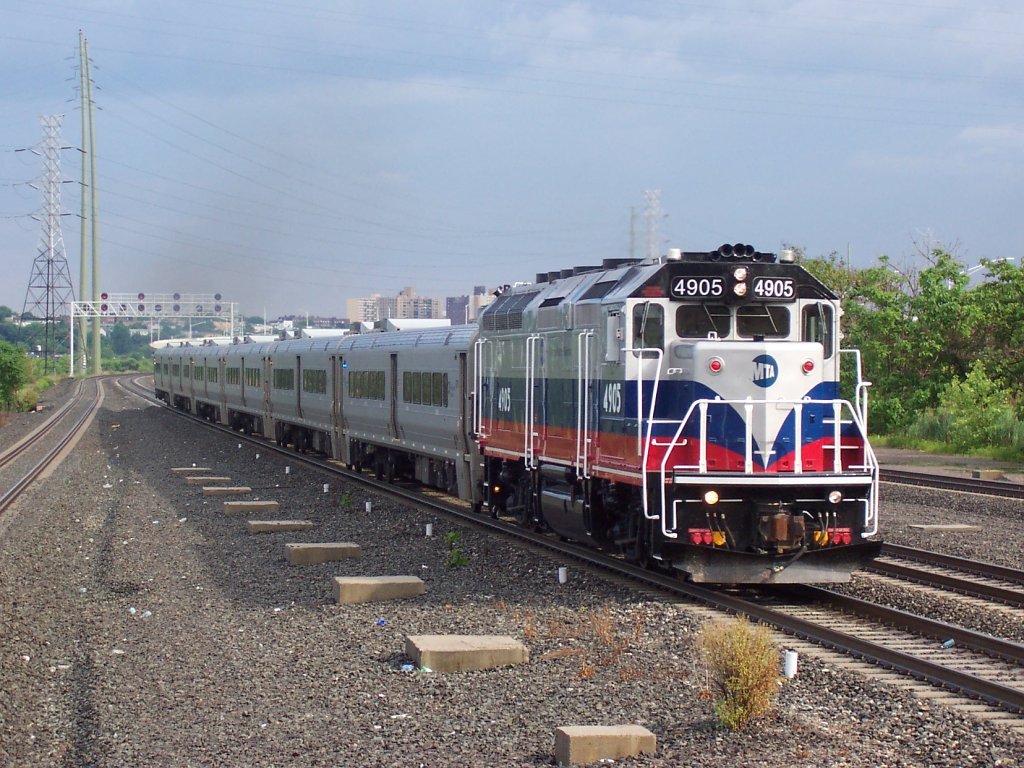
A Metro-North Railroad GP40FH locomotive entering Secaucus Junction
Type and origin
Power typeDiesel-electric
BuilderElectro-Motive Diesel (EMD)
Specifications
Configuration:
 • AARB-B
 • UICBo'Bo'
 • CommonwealthBo-Bo
Gauge4 ft 8+12 in (1,435 mm) standard gauge
Performance figures
Maximum speed77–105 mph (124–169 km/h)
Power output2,000–3,000 hp (1,491–2,237 kW)
Career
LocaleNorth America

The passenger locomotives derivatives of the General Motors EMD GP40 diesel-electric locomotive have been, and continue to be, used by multiple passenger railroads in North America. For passenger service, the locomotives required extra components for providing steam or head-end power (HEP) for heating, lighting and electricity in passenger cars. Most of these passenger locomotives were rebuilt from older freight locomotives, while some were built as brand new models.

GP40TC

[edit]
GO Transit GP40TC No. 501 with Bombardier Bi-Level Coaches in October 1980
Amtrak GP40TC No.525 at Boston South Station in March 2002

The GMD GP40TC was built by General Motors Diesel (GMD), for GO Transit in Toronto. Eight units were manufactured between 1966 and 1968. They were built on an extended frame to accommodate a head-end power generator.[1]: 55  GO Transit sold the fleet to Amtrak in 1988,[2]: 106  where they were based in Chicago and used on short-haul trains.

In 2005, the Norfolk Southern Railway rebuilt all eight GP40TC locomotives at its Juniata Shops in Altoona, Pennsylvania.[3][better source needed] These are now classed as GP38H-3, and work as maintenance-of-way trains or standby power for Downeaster trains.

GP40P

[edit]
GP40P 3676 operating on the Central Railroad of New Jersey.

Thirteen GP40Ps were built in October 1968 for the Central Railroad of New Jersey (CNJ) and paid for by the New Jersey Department of Transportation (NJDOT). The CNJ put the units in service on the Raritan Valley Line and the North Jersey Coast Line.

The CNJ's passenger operations were transferred to NJDOT in 1976 (with Conrail operating them under contract), and in 1983 New Jersey Transit assumed operating passenger rail service in the state. Shortly after, the steam generator, which had occupied the flat end of the locomotive's long hood, was replaced with a diesel HEP generator, and the units were reclassified as GP40PH. They were later rebuilt as GP40PH-2 units in 1991–92.

GP40P-2

[edit]
SP GP40P-2 #3197

Southern Pacific ordered a Dash-2 variant of the GP40P; only three of these were ever built. After the conclusion of passenger service, they were repurposed for freight use. All three units are still in service, with two being retained by the Union Pacific Railroad and the remaining one sold to the Indiana Harbor Belt Railroad.

GP40FH-2

[edit]
Metro-North Railroad GP40FH-2 No. 4905 at Suffern Yard

In 1987, New Jersey Transit and Metro-North ordered a set of GP40 locomotives called GP40FH-2s, which were completed by Morrison Knudsen between 1987 and 1990. These locomotives combine the standard cab and frame of a GP40 with the cowl from an ex-Burlington Northern F45 locomotive. A total of 21 units of this type were built; 15 were delivered to New Jersey Transit, and the remaining six were for Metro-North.

As of late 2016, only the Metro-North units remain in service, rebuilt as GP40FH-2Ms. All NJT GP40FH-2 locomotives have been retired following the delivery of the ALP-45DP. Five units were rebuilt into MPI MP20B switchers in 2008. Seven NJT units were purchased by Iowa Pacific Holdings and three of those were designated for use on the Hoosier State between Chicago and Indianapolis before Amtrak took over operations again on January 30, 2017. The rest of the units have been sold to various other operators.

GP40PH-2

[edit]
NJ Transit GP40PH-2B No. 4217 heads west out of Maplewood

In 1991–92, NJ Transit sent its ex-CNJ GP40PH units out for rebuilding. The units were rebuilt as GP40PH-2 locomotives.

New Jersey Transit later ordered two more sets of GP40PH-2 units; these units were rebuilt from former freight GP40 units. The first order in 1993 consisted of six units rebuilt by Morrison-Knudsen which are designated GP40PH-2A. The second order in 1993–94 was for 19 former Penn Central units rebuilt by Conrail, which are classified as GP40PH-2B.

Metro-North ordered a single GP40PH-2 unit, numbered 4906. It was rebuilt by Conrail in 1992 and is classified as a GP40PH-2M.

Starting in 2014, all but three of NJ Transit's original GP40PH-2s have entered an in-house rebuild program by NJ Transit for a mechanical conversion into a standard GP40-2 for non-revenue service. The HEP motor was removed, unlit number boards were drilled in, the rear ladders were removed and replaced with steps, and LED markers were applied to the rear end of the locomotive, replacing their original tri-color class lights. As of 2020, locomotives 4100, 4101 and 4109 are the only ex-CNJ locomotives that remain in service. NJ Transit's GP40PH-2B units and Metro-North's GP40PH-2M unit also remain active. All GP40PH-2A units were retired and placed into storage, except for one unit, which was sold to MARC in 2019.

In December 2017, New Jersey Transit purchased 17 additional ALP-45DPs to replace the remaining GP40PH-2B locomotives that are still in service.[4] However, in July 2020, NJ Transit decided to use the ALP-45As to replace older locomotives of the PL42AC fleet instead of the GP40PH-2Bs, due to the PL42AC's unreliability and inability to be upgraded to meet new Environmental Protection Agency standards.[5]

In 2019, NJ Transit unveiled locomotive 4109 painted in a heritage scheme based on that of the CNJ GP40P.[6] In October 2022, NJ Transit unveiled locomotive 4101 painted in a heritage NJDOT scheme.[7] In October 2023, GP40PH-2B 4210 was repainted into the Erie Railroad black-and-yellow scheme. In October 2024, locomotive 4208 was unveiled in Conrail's "can opener" scheme.[8]

GP39H-2

[edit]
MARC GP39H-2 No. 70 at Odenton

In the late 1980s, Morrison-Knudsen rebuilt six GP40s into 12-cylinder GP39s for MARC. They were downgraded from 3,000 horsepower (2,200 kW) to 2,300 horsepower (1,700 kW), and re-equipped with 4-stroke Cummins HEP generators. As of 2023, all were rebuilt as GP39PH-3Cs, and they continue to be used by MARC for smaller train sets and work train duty.

GP40WH-2

[edit]
MARC GP40WH-2 No. 52 at Camden Station, Baltimore, Maryland

In 1993, Morrison-Knudsen was contacted by the Maryland Transit Administration to assemble a fleet of GP40s for use on MARC. They entered service in 1994. GP40WH-2s are equipped with a Cummins head-end power generator. The Federal Railroad Administration exempted these units from the "triangular light pattern" rule because the engines were ordered with Gyralites before the mandatory use of ditch lights.

Between 2009 and 2011, MARC retired all of their GP40WH-2 locomotives in favor of new MP36PH-3C locomotives,[9] except for unit 68, which remains for non-revenue work duty and rescue use. Five units were leased to the MBTA in 2011 until 2012,[10] and one unit was sent to CSX Transportation for use on their track geometry train.[11] The remaining units have been rebuilt by MotivePower into MP32PH-Q locomotives for use on SunRail[12] or sold to various leasing firms.[13]

GP40-2H

[edit]
CTrail GP40-3H No. 6695 at New Haven Union Station

In 1996, AMF Technotransport rebuilt six freight locomotives into passenger locomotives for the Connecticut Department of Transportation for use on Shore Line East service. The locomotives, designated GP40-2H, were rebuilt from ex-CSX Transportation EMD GP38s and EMD GP40s. The rebuild included an EMD 645 prime mover, producing 3,000 hp (2,200 kW), and a separate head-end power (HEP) generator.[14]

Between 2017 and 2018, the GP40-2H locomotives received an overhaul performed by National Railway Equipment and were reclassified as GP40-3H.[15][16] They were subsequently transferred to the newly established Hartford Line service, where they remain in service as of June 2018. In 2022, the remaining Shore Line East equipment was moved into service on the Hartford Line after CTDOT introduced M8 electric multiple units to operate on Shore Line East service.[17][failed verification]

GP40MC

[edit]
MBTA GP40MC No. 1126 leading a Fitchburg Line train through Waltham in 2025

The Massachusetts Bay Transportation Authority currently owns and operates a set of 25 GP40 passenger diesels known as GP40MCs, used on the MBTA Commuter Rail system. They were originally built by General Motors Diesel as GP40-2LWs for Canadian National in 1973–75. In 1997–98, these units were extensively rebuilt by AMF. Although they have been principally used on the lines from North Station, these locomotives can also be seen commonly on the South Station lines.

Other locomotives

[edit]

Other passenger locomotives based on the GP40 locomotive include the following:

  • EMD/M-K RP39-2C, operated by the Virginia Railway Express. 10 units, now retired since 2010. All sold to other operators.[18]
  • EMD/M-K RP40-2C, operated by Virginia Railway Express. Two units, now retired since 2010 and sold to other operators.[18]
  • EMD/AMF GP40H-2, operated by Virginia Railway Express. Three units, now retired since 2010 and since sold to other operators.[18]
  • EMD/AMF GP40PH-2 (not to be confused with the NJT-operated units), operated by the North Carolina Department of Transportation for the Piedmont service. Two units, now retired. One was sold to Virginia Railway Express (since retired), other retired after a wreck.
  • EMD/MAC GP49H-3, operated by Tri-Rail. 6 units were rebuilt by Mid American Car in 2006 after being purchased from Norfolk Southern Railway in 2001. Three units have been retired, remaining units are expected to be retired in 2025.

See also

[edit]

References

[edit]

Further reading

[edit]
[edit]
Revisions and contributorsEdit on WikipediaRead on Wikipedia
from Grokipedia
EMD GP40-based passenger locomotives are a of four-axle, diesel-electric locomotives derived from the (EMD) GP40 freight model, adapted primarily for commuter and regional passenger service in through the incorporation of (HEP) generation, steam generators, and extended frames to support passenger car heating and needs. Featuring a 3,000 horsepower, 16-cylinder 645-series turbocharged prime mover, these variants were produced or rebuilt starting in the mid-1960s and served major operators such as the (CNJ), , New Jersey Transit (NJT), and the (ConnDOT). The earliest dedicated passenger adaptation was the GP40TC, with eight units constructed in 1966 for in using an elongated SD40 frame (65 feet 8 inches long) and a wide cab to house a 500 kW driven by a separate 12V-149 auxiliary for HEP, enabling efficient powering of commuter consists without the need for separate generator cars. These locomotives remained in service with until the early 1990s, after which some were acquired by for temporary use. In 1968, EMD delivered 13 GP40P units to the for operation by the CNJ on suburban services out of Newark and Jersey City, measuring 62 feet 8 inches in length with a weight of 281,000 pounds, a flared section, and equipment for passenger car heating. Acquired by NJT in 1976 following the CNJ's , these locomotives formed the core of NJT's early diesel fleet and were later overhauled between 1991 and 1994 into the GP40PH-2 configuration, featuring updated 3,000–3,200 horsepower ratings, 425 kW HEP capability, a length of 62 feet 8 inches, and weights ranging from 284,200 to 300,000 pounds depending on the sub-variant (PH-2A or PH-2B). By 2010, NJT operated 42 such units; as of 2025, approximately 22 remain in revenue and heritage service, with others repurposed as work locomotives or retired. In 1974, EMD produced three GP40P-2 units directly for the Southern Pacific Railroad equipped with flared radiators, extended-range , and air conditioning in the cab for commuter routes. Later rebuilds expanded the , including the GP40-2H series, where six former freight GP38 and GP40 locomotives were modified by AMF Technotransport in the late for ConnDOT using blended components for and other state services; these 3,000 horsepower units underwent further overhauls under a 2017 NRE contract to extend their service life into the . These locomotives represented a cost-effective transition from steam-heated to electrically powered passenger cars during the decline of private railroads, providing reliable push-pull operation on electrified and non-electrified lines while leveraging the robust GP40 platform's proven reliability and parts commonality with freight rosters. Many remain in heritage or secondary service as of 2025, underscoring their enduring role in North American evolution.

Background and Design

The EMD GP40 Locomotive

The EMD GP40 is a four-axle diesel-electric produced by the Electro-Motive Division (EMD) of as a high-power freight hauler. Introduced in November 1965, it represented an evolution from the GP35, incorporating EMD's new 645-series prime mover to boost performance for longer and heavier trains on mainline routes. The design emphasized reliability and versatility in freight operations, with production spanning from November 1965 to December 1971, during which 1,187 units were built for U.S. railroads. At its core, the GP40 utilized a turbocharged 16-645E3 V16 , delivering 3,000 horsepower for traction, paired with a standard freight cab and system for efficient control on varied terrains. The locomotive's four-axle configuration provided a balance of power and maneuverability, with a top speed of around 65 mph suited to general freight duties. These specifications made it a staple for mid-20th-century railroading, powering operations across diverse freight networks. Key original operators of the GP40 included major freight railroads such as Southern Pacific, Penn Central, and Norfolk & Western, which deployed the units extensively in hump yard service, drag freights, and intermodal trains. In , the model was succeeded by the Dash 2 variant, the GP40-2, which introduced refinements like an improved AR10 alternator and solid-state electrical components to enhance efficiency and reduce maintenance. Later adaptations of GP40s for passenger service incorporated for train heating and lighting.

Passenger Adaptations and Modifications

The primary adaptation for converting EMD GP40 locomotives to passenger service involved the addition of (HEP) generators, which supply electrical power to passenger cars for , heating, ventilation, (HVAC), and other onboard amenities. These HEP systems typically generate 480 volts AC at 60 Hz in a three-phase configuration, providing a standardized electrical output that supports modern requirements across North American railroads. This marked a significant shift from earlier systems, which relied on boiler-produced steam for car heating and were less efficient and more maintenance-intensive for electrical needs. Common structural and operational modifications to accommodate HEP and enhance utility included extending the to house the additional generator equipment, often increasing overall length by several feet to integrate the diesel-driven without compromising traction performance. Many adapted units also featured dual control stands within , allowing operation from either end to facilitate push-pull service common in commuter operations, while high short hoods were raised to improve visibility over the front of the during forward-facing runs. In some cases, the short hood was lowered or customized with wider windshields to further optimize sightlines, balancing safety and in environments. Rebuild processes for these passenger adaptations were typically handled by specialized firms such as Morrison-Knudsen (M-K), which focused on comprehensive overhauls to extend the life of aging GP40s starting from their original 3,000 horsepower 16-645 prime mover. M-K's methods often entailed frame stretching to fit HEP components, followed by prime mover overhauls that included replacing worn pistons, liners, and turbochargers to restore reliability and efficiency under the added electrical load. These rebuilds emphasized modular upgrades, such as integrating new electrical controls and cooling systems, to ensure the locomotive could sustain both propulsion and HEP demands without excessive downtime. Safety and regulatory modifications addressed (FRA) standards for visibility and signaling, including the incorporation of ditch lights—pairs of white auxiliary lights mounted low on the front pilot that flash in unison with the headlight to alert motorists at grade crossings. Earlier passenger units sometimes retained or added Gyralites, rotating beacon-style warning lights, as transitional features before full compliance with modern auxiliary lighting rules. Passenger-specific designs often qualified for exemptions from certain FRA visibility requirements, such as the strict triangular marker light pattern mandated for freight locomotives, allowing flexibility in headlight and auxiliary arrangements to suit cab-forward operations.

Original Passenger Builds

GP40TC

The GP40TC was the first dedicated passenger variant of the EMD GP40 locomotive, built by (GMD) in , between 1966 and 1968 specifically for GO Transit's inaugural service in the area. Eight units were produced, numbered 600–607 initially, and designed to haul push-pull trains on routes such as the Lakeshore line between Pickering and Oakville. These locomotives featured an extended frame—measuring 62 feet 8 inches in length, borrowed from the SD40 model—to accommodate a dedicated (HEP) system, marking the earliest such adaptation on a GP40 derivative. Unlike later U.S.-built passenger versions, the GP40TC was engineered from the outset for and without a steam generator, providing 500 kW of auxiliary power via a separate GM 12V-71 diesel-driven . The prime mover remained the standard unmodified EMD 16-645E3 V16 turbocharged diesel engine rated at 3,000 horsepower, paired with a GM AR10-D14 main generator and HT-B high-adhesion trucks geared for a top speed of 79 mph. This configuration prioritized reliable traction for frequent-stop commuter operations, with a starting tractive effort of 61,000 pounds and no dynamic braking to simplify the design for short-haul service. The locomotives entered revenue service in May 1967 after initial freight testing by Canadian National Railway, and were renumbered twice by GO Transit—to 9800–9807 in 1970 and finally to 500–507 in 1975—while receiving soundproofing upgrades in 1974–1975 to reduce the distinctive whine from the auxiliary generator. GO Transit operated the fleet until 1988, when all eight units were sold to Amtrak for temporary use on short-haul routes and work trains, primarily in the Chicago area; they were renumbered 192–199 and later to 520–527 between 2000 and 2004. In 2004–2005, Norfolk Southern rebuilt the locomotives at its Juniata Locomotive Shops in Altoona, Pennsylvania, downgrading the prime movers to 2,000 hp 12-645F3C engines while retaining the HEP capability for hybrid freight and passenger equipment movements, reclassifying them as GP38H-3s still under Amtrak ownership. Amtrak continued deploying them for maintenance-of-way duties and occasional passenger train support into the 2020s. As of November 2025, all eight GP38H-3 units remain active in Amtrak's roster, primarily for work train service with their HEP systems enabling the handling of passenger cars during non-revenue moves, though no preservation efforts or recent scrappings have been reported.

GP40P

The EMD GP40P was an early passenger adaptation of the standard GP40 freight , featuring modifications for service on the U.S. East Coast. In October 1968, Electro-Motive Division (EMD) built 13 units, numbered 3671–3683, for the (CNJ). These locomotives were funded by the (NJDOT) to bolster emergency passenger power amid deteriorating service on legacy railroads, including challenges leading up to the Penn Central bankruptcy. The GP40Ps entered service on the and , providing reliable motive power for push-pull commuter trains until the CNJ's absorption into in 1976. Technically, the GP40P retained the base GP40's 3,000-horsepower EMD 645E3 16-cylinder prime mover and four-axle configuration but incorporated a longer 62-foot frame to house a Vapor Clarkson steam generator rated at 800 pounds per hour for passenger car heating. Additional features included dual control stands for bidirectional operation, cab signals, radios, dynamic brakes, and a 3,600-gallon combined fuel-and-water tank (1,600 gallons fuel, 2,000 gallons water). This setup addressed the needs of steam-dependent commuter operations while maintaining the GP40's robust freight-derived chassis. Following Conrail's operation of the former CNJ lines, New Jersey Transit (NJT) acquired the fleet in the early . Between 1983 and 1984, NJT rebuilt all 13 units to GP40PH configuration at its own facilities, removing the steam generators and adding a 480-volt (HEP) generator for modern passenger car requirements. A subsequent major overhaul from 1991 to 1992 at Conrail's Juniata Locomotive Shop transformed them into GP40PH-2 models, incorporating Dash 2-era upgrades such as improved electrical systems, air conditioning, snowplows, and a dedicated , while renumbering them 4100–4112. These enhancements extended their service life significantly. The rebuilt GP40PH-2s became a cornerstone of NJT's diesel fleet, operating on lines including the Morristown, Montclair-Boonton, Main, , and Pascack routes. As of November 2025, the units remain in active , with several preserved in heritage paint schemes—such as No. 4109 in CNJ colors (applied 2019) and No. 4101 in NJDOT "" (applied 2022)—to commemorate their origins and NJT's rail history. No full retirements of this subclass have occurred by late 2025, though fleet reductions are anticipated with the introduction of newer dual-mode locomotives.

GP40P-2

The EMD GP40P-2 was a rare passenger variant of the GP40-2 , featuring modifications for commuter service including a for heating passenger cars. Only three units were constructed by the Electro-Motive Division (EMD) in November 1974 specifically for the Southern Pacific Railroad (SP), numbered 3197–3199, making it one of the least-produced models in the GP40 series. These locomotives incorporated Dash-2 line enhancements over the original GP40P, such as improved cooling systems and electrical components, while retaining a 3,000 horsepower rating from the 16-645E3C prime mover. Unlike later (HEP) designs, the GP40P-2 relied on steam generation, similar to the earlier GP40P but without capabilities. The GP40P-2 units were ordered for SP's Peninsula Commute Service, operating push-pull trains between and San Jose on the Peninsula Corridor. Delivered with extensive options including full front lighting packages and , they entered service in late 1974 and handled commuter duties through the and early , including unit 3197 in Bicentennial red-white-and-blue paint from 1976 to 1983. By the mid-, as the State of assumed control of the service via Caltrans and introduced new F40PH locomotives under the banner in 1985, SP withdrew the GP40P-2 from passenger operations. The units were then renumbered to 7600–7602 and repurposed for general freight service, with steam generators removed or disconnected to accommodate larger fuel tanks and freight configurations. Technically, the GP40P-2 benefited from the Dash-2 platform's advancements, including a modular cooling system for enhanced radiator efficiency and an AR10D alternator for improved electrical reliability over the generator-equipped GP40. Each unit weighed approximately 277,000 pounds, featured B-B trucks with 40-inch wheels, and had a top speed of around 65 mph, optimized for the frequent stops of commuter runs. The prime mover, an EMD 16-645E3C V16 turbocharged diesel, delivered 3,000 hp at 62,000 lbs starting , with standard. Following their freight conversion on SP, the locomotives transitioned to subsequent owners after the 1996 Union Pacific (UP)–Southern Pacific merger. Units 7601 and 7602 became UP 1373 and 1375, respectively, and remain in active freight service on UP's roster as of 2025, primarily in yard and local assignments. The third unit, ex-SP 7600 (original 3197), was sold to the (IHB) in the late 1990s, rebuilt with the generator compartment plated over, and renumbered 4010; it continues in freight operations, including transfer trains, as of 2025. The GP40P-2's extremely limited production run of three units underscores its status as a transitional design, built for intent but quickly shifted to freight due to changing commuter operations. None were rebuilt back to configuration, and no preservation efforts have been reported for these locomotives as of 2025, leaving them as active freight relics of a brief era.

Rebuilt H-Series Variants

GP40FH-2

The GP40FH-2 is a locomotive variant rebuilt by Morrison-Knudsen from former EMD GP40 and F45 units between 1987 and 1990, totaling 21 locomotives specifically for commuter service. Of these, New Jersey Transit ordered 15 units (numbered 4130–4144), while acquired the remaining six (numbered 4184–4189). These rebuilds utilized the standard GP40 frame and cab but incorporated a wide F45-style to enhance and crew comfort, marking the first in the H-2 series to adopt F-unit styling. Technically, the GP40FH-2 retained the EMD 645E3 V16 turbocharged rated at 3,000 horsepower, paired with an AR10 main generator and a 61:16 gear ratio for a top speed of approximately 77 mph. It featured a head-end power (HEP) generator providing 600 horsepower for onboard passenger amenities, along with ditch lights for improved forward visibility and compliance with safety regulations, and an updated cab design offering better sightlines for operators in dense commuter environments. The B-B truck configuration supported a total weight of 270,000 pounds, with Westinghouse 26L air brakes and for reliable push-pull operations. Primarily operated by New Jersey Transit on lines such as the North Jersey Coast and Raritan Valley, the GP40FH-2 fleet provided traction for electrified and non-electrified segments until the late 2010s, when retirements began following the introduction of dual-mode ALP-45DP locomotives. Metro-North deployed its units on the non-electrified West of Hudson lines, including the Pascack Valley and Port Jervis routes, where they hauled push-pull trains from Hoboken Terminal to destinations up to 95 miles away. A few ex-New Jersey Transit units saw brief heritage service with Iowa Pacific Holdings from 2015 to 2017, powering the Chicago–Indianapolis Hoosier State train before the operator's contract ended. The hybrid cowl design combined the narrow GP40 cab with the broader F45 body to reduce drag and provide additional interior space for crew amenities, improving overall comfort during extended shifts in high-density service. As of November 2025, all New Jersey Transit GP40FH-2 units have been retired, with many scrapped or donated to museums, while Metro-North's fleet remains active on legacy diesel routes despite ongoing plans for replacement by more modern locomotives.

GP40PH-2

The GP40PH-2 is a narrow-cowl locomotive variant rebuilt from EMD GP40 and GP40P donor units, primarily for service in the . Between 1991 and 1994, a total of 27 units were rebuilt by Morrison-Knudsen, with the initial six derived from former (CNJ) GP40P locomotives and classified as GP40PH-2A; the remaining units, known as GP40PH-2B, originated from various standard GP40 freight locomotives from railroads such as Penn Central and . These rebuilds incorporated a standard GP40 carbody without the wide-nose aerodynamic features of the contemporary GP40FH-2, focusing instead on cost-effective adaptations for high-volume fleet expansion. One additional unit for Metro-North was rebuilt from a GP40FH-2 donor, highlighting minor cross-variant conversions in the series. Technically, the GP40PH-2 retained the EMD 16-645 turbocharged diesel engine rated at 3,000 horsepower for traction, paired with (HEP) generation ranging from 500 to 750 kW to supply onboard amenities like lighting, heating, and for passenger cars. Braking systems were upgraded with enhanced dynamic and air brake components to handle the increased loads and stopping demands of commuter trains, including provisions for extended blends and improved control. The locomotives featured a conventional GP40 frame length of approximately 59 feet 2 inches and a top speed governed to 105 mph, optimized for electrified and non-electrified territory operations. New Jersey Transit acquired the bulk of the GP40PH-2 fleet, deploying 26 units across its commuter network including the , , and Morris & Essex lines, where they served as a backbone until the 2020s. operated a single GP40PH-2 (No. 4906), primarily on West of Hudson services such as the Pascack Valley and Port Jervis lines, often in pooled operations with NJ Transit equipment. Notable features include sub-variants differentiated by donor origins—the A-series from passenger-specific GP40Ps with pre-existing HEP setups, and the B-series from freight GP40s requiring more extensive passenger conversions—as well as heritage liveries honoring predecessor railroads, such as the scheme on No. 4109 and the "Bluebird" (Arrow III-era) paint on No. 4101. As of November 2025, the GP40PH-2 fleet has largely been phased out in favor of modern dual-mode locomotives like the ALP-45DP, with retiring most units between 2019 and 2024 while retaining a handful for heritage and backup roles; Metro-North's sole example remains in limited service on non-electrified branches, with retirement anticipated by late 2025.

GP39H-2

The GP39H-2 locomotives were rebuilt in the late 1980s by Morrison-Knudsen from six former GP40 freight units for the Area Rail Commuter (MARC) service, entering operation in 1989. These units, numbered 70 through 75, originated from various railroads including (ex-3062, 3066, 3243) and Baltimore & Ohio (ex-3703, 3710), with one from the (ex-2050); the rebuilds followed GP39-2 standards but incorporated passenger-specific modifications for commuter duties. This represented a cost-saving approach tailored to MARC's shorter routes, where full power was unnecessary, allowing for improved over the standard 3,000 hp H-2 baseline designs. Technically, the GP39H-2 featured a downgraded prime mover consisting of a 12-cylinder EMD 645E3 rated at 2,300 horsepower, a reduction from the original 3,000 hp 16-cylinder configuration to better suit lighter passenger loads. (HEP) was provided by a separate 4-stroke diesel auxiliary generator, which supplied electrical needs for train cars without drawing from the main , enhancing reliability and reducing overall fuel consumption. At 134 tons (268,000 pounds), these locomotives were lighter than contemporary full-power passenger variants like the GP40PH-2 at 142 tons, contributing to their efficiency on regional services. The GP39H-2s served exclusively with MARC from their introduction in 1989 through the 2010s, primarily on the Camden, Brunswick, and Penn Lines for push-pull commuter operations. Their design emphasized practicality for mid-distance runs, with the Cummins HEP system marking an early adoption of dedicated in GP-series rebuilds to minimize main engine wear during idle periods at stations. As of 2025, the six units, rebuilt to GP39PH-3C configuration in 2023, remain in MARC service for smaller train sets and work train duty following these overhauls, with no reported preservation efforts for retired examples.

GP40WH-2

The GP40WH-2 locomotives were rebuilt by Morrison-Knudsen from former GP40 freight units for the Maryland Area Regional Commuter (MARC) service, with 19 units assembled between 1993 and 1996 using components from ex-CSX, Kansas City Southern, and other GP40s combined with SD45-style radiator sections and F45-inspired wide cabs. These rebuilds maintained the full 3,000 horsepower output of the original EMD 16-645E3 prime mover while incorporating a stretched frame for improved stability and a wide hood design, denoted by the "WH" suffix, to accommodate the head-end power (HEP) equipment. Equipped with a diesel generator for HEP—rated at 600 horsepower—to supply passenger cars, the GP40WH-2 also featured Gyralite rotating beacons, modern safety appliances including ditch lights, and for enhanced commuter operations. The design received a (FRA) exemption for certain lighting configurations, allowing streamlined integration of the beacons without full compliance to freight standards. These units demonstrated improved reliability compared to earlier H-series variants through upgraded electrical systems and cooling, reducing downtime in high-density service. Initially operated exclusively by MARC on Baltimore-Washington and Brunswick lines, the fleet began retirements between 2009 and 2011 as newer MP36PH-3C locomotives entered service, with most units stored or transferred thereafter; one unit (MARC 68) was retained for non-revenue work. Several were leased to the () from 2011 to 2014 for on lines like Lowell and Worcester, providing interim power amid F40PH shortages. Unit 69 was sold to and converted to freight service as number 9969, primarily hauling geometry trains on the former Baltimore & Ohio mainline. By 2017, multiple ex-MARC units (including former MBTA 66) were acquired by Motive Power Industries and rebuilt for continued commuter service, with some leased to operators including Precision Locomotive Leasing as of October 2025. As of November 2025, the original GP40WH-2 fleet is largely retired, with remaining MARC units scrapped or stored, MBTA-leased examples returned to lessors and subsequently rebuilt or idled, the CSX unit still active in maintenance roles, and other conversions operational but facing phase-out plans amid electrification studies. This multi-operator legacy underscores the GP40WH-2's adaptability, building on HEP precedents from the related GP39H-2 rebuilds.

Later Rebuilds and Other Variants

GP40-2H

The GP40-2H locomotives consist of six units rebuilt in 1996 by AMF Technotransport in , , specifically for the (CDOT) to support expanding services. These units, numbered 6694 through 6699, originated from a mix of surplus freight locomotives, including former CSX GP40s and GP38s with pedigrees tracing back to railroads such as the & Ohio, Chesapeake & Ohio, and Clinchfield. The rebuilds utilized a Dash-2 platform base, benefiting from EMD's second-generation improvements like enhanced electrical systems and improved for better performance in applications. Tailored for the demands of Northeast commuter routes, the GP40-2Hs entered service on , providing reliable traction for push-pull operations along Connecticut's coastal corridor from New Haven to New London. Technically, each GP40-2H is powered by a 16-cylinder EMD 645E3 turbocharged rated at 3,000 horsepower for traction, paired with a separate (HEP) generator delivering 500 kW to supply electricity, heating, and lighting for passenger cars. The design retained the standard four-axle configuration with high-adhesion trucks suitable for the electrified and mixed-traffic lines in the region, while incorporating passenger-specific modifications such as updated control systems for compatibility with Bombardier single-level coaches. In 2017–2018, CDOT contracted (NRE) for a comprehensive overhaul program, upgrading the fleet to GP40-3H standards with modern electronics, emissions controls, and refurbished components to ensure continued reliability amid increasing service demands. These enhancements extended the units' operational life, focusing on the unique operational profile of the New Haven–Hartford–Springfield corridor, where they handle frequent stops and bi-level electrification transitions. Initially deployed on for daily commuter runs, the GP40-2Hs were reassigned in the 2010s to bolster the newly launched service, operating between New Haven, Hartford, and , in partnership with and state agencies. This shift supported expanded regional connectivity along the former New Haven Railroad mainline, with the locomotives often paired in multiple for heavier consists during peak hours. As of 2024, all six units remain in active service under CDOT management, painted in the agency's "coke zero" , though their age—approaching 60 years since original construction—prompts discussions of future replacements amid ongoing investments. Post-2023 operations have included routine and integration with leased P40DC units to maintain schedule reliability on both and routes.

GP40MC

The GP40MC is a rebuild of 25 EMD GP40-2LW locomotives originally constructed by (GMD) in , between 1973 and 1975 for (CN), numbered 9474–9499. These units were designed as wide-nose variants of the GP40-2 for improved visibility on freight services across Canada's varied terrain. In 1997–1998, all 25 were acquired by the (MBTA) and extensively rebuilt by AMF Technotransport in , , transforming them into passenger locomotives designated GP40MC, with "MC" denoting the modified cab. The rebuild incorporated a wide safety cab with a Canadian-style wide-nose design, featuring a lowered nose profile and desktop control stand to enhance crew visibility and , particularly on snow-prone routes in the . Technical upgrades included retention of the original EMD 16-645E3 prime mover rated at 3,000 horsepower for traction, addition of dynamic brakes, and extension of the frame by approximately 5 feet 8 inches to accommodate a separate 500 kW (HEP) generator using a KTA-19 for passenger car heating, lighting, and electrical needs. The locomotives also received flared radiator grilles, American-style two-pane cab windows, and microprocessor-based controls, while retaining the original GP40-2 trucks. These modifications enabled reliable push-pull commuter operations, primarily on MBTA lines out of and in . Following their introduction in 1998, the GP40MCs served as the backbone of , hauling trains on routes like the Fitchburg, Lowell, and Haverhill lines from , as well as occasional services. operated the originals until divestiture, after which MBTA became the sole operator into the 2020s. The wide-nose cab addressed operational challenges in ' harsh winters by improving forward visibility through accumulated snow. As of November 2025, the fleet remains active despite its age, with 19 units reported in service earlier in the year and ongoing overhauls by Southern to extend life through the decade. A new rebuild program initiated in 2024 designates upgraded units as GP40MC-3, incorporating modern computer controls and LED lighting, while recent heritage repaints—such as No. 1130 in the original MBTA purple-and-silver scheme—highlight preservation efforts amid gradual phase-out plans for older locomotives.

Additional GP40-Based Rebuilds

The EMD/M-K RP39-2C locomotives were a series of ten units rebuilt by Morrison-Knudsen in 1991 specifically for the (VRE) commuter service, utilizing frames and components from former GP40 freight locomotives such as those from Seaboard Coast Line and CSX. These rebuilds featured a deturbocharged 12-cylinder EMD 645E3 prime mover rated at 2,300 horsepower, paired with a head-end power (HEP) generator for passenger car heating and lighting, and a 57:20 gear ratio optimized for commuter speeds up to 85 mph. Weighing approximately 268,000 pounds, they were designed for push-pull operations with VRE's cab cars and served reliably on the Fredericksburg and Manassas lines until their retirement in 2010, after which all units were sold to secondary operators including the and Quincy Railroad. Complementing the RP39-2C fleet, VRE acquired two RP40-2C units, also rebuilt by Morrison-Knudsen in 1991 from ex-Atlantic & Western Pacific and Penn Central GP40s, providing higher power output for heavier consists. These locomotives retained the full 3,000-horsepower EMD 645E3 turbocharged engine, along with a HEP generator, enabling efficient operation in VRE's regional push-pull service. Like their RP39-2C counterparts, the RP40-2Cs were retired in 2010 and subsequently transferred to short-line operators such as the Central Railroad of . VRE further expanded its motive power with three GP40H-2 units rebuilt by American Mechanical Facilities (AMF) between 1992 and 1994, derived from early GP40s originally built in the mid-1960s. These 3,000-horsepower locomotives, equipped with standard EMD 645-series engines and HEP capabilities, were customized for VRE's commuter demands, including compatibility with push-pull controls. All three were retired in 2010 and sold for further service elsewhere. For the North Carolina Department of Transportation's (NCDOT) service, two GP40PH-2 locomotives were rebuilt by AMF in the early 1990s from former & Ohio and Seaboard System GP40s, entering service in 1995 to haul regional trains between Raleigh and Charlotte. Numbered 1768 ("City of Charlotte") and 1792 ("City of Raleigh"), these units delivered 3,000 horsepower with integrated HEP systems, supporting the state's nascent operations. Unit 1768 saw limited use before being sold to VRE in 1999, while 1792 operated until a 2010 led to its retirement and scrapping. The GP49H-3 variant represented a specialized rebuild for in , where six units (812–817) were converted by Mid America Car Inc. in 2006–2007 from former Norfolk Southern GP49 locomotives, incorporating elements adaptable from GP40 designs for passenger conversion. Featuring a 12-cylinder EMD 645F3B engine rated at 2,800 horsepower and dedicated HEP generation, these locomotives were tailored for Tri-Rail's routes, emphasizing reliability in humid coastal conditions. By 2023, three units had been retired amid fleet modernization, with the remaining three scheduled for phase-out in 2025 as locomotives take over. These additional GP40-based rebuilds, primarily from the 1990s, shared common traits such as 2,300–3,000 horsepower outputs and HEP integration, allowing regional operators like VRE, NCDOT, and Tri-Rail to bridge service gaps cost-effectively before the widespread adoption of newer Siemens and GE passenger units. Their customizations, including push-pull adaptations for VRE and durability enhancements for Tri-Rail, underscored the versatility of GP40 platforms in extending the life of aging freight locomotives for commuter roles.

References

Add your contribution
Related Hubs
User Avatar
No comments yet.