Hubbry Logo
Gable hoodGable hoodMain
Open search
Gable hood
Community hub
Gable hood
logo
8 pages, 0 posts
0 subscribers
Be the first to start a discussion here.
Gable hood
Gable hood
from Wikipedia
Gable hood with pinned-up lappets and a hanging veil. Mary, Lady Guildford, by Hans Holbein the Younger, 1527.

A gable hood, English hood or gable headdress is an English woman's headdress of c. 1500–1550, so called because its pointed shape resembles the architectural feature of the same name. The contemporary French hood was rounded in outline and unlike the gable hood, less conservative, displaying the frontal part of the wearer's hair.

Description

[edit]

The gable hood was originally a simple pointed hood with decorated side panels called lappets and a veil at the back. Over time, it became a complex construction stiffened with buckram, having a box-shaped back and two tube-shaped hanging veils at 90-degree angles. The hanging veils and lappets could be pinned up in a variety of ways to make complex headdresses.

Generally, the gable hood consisted of four parts: the paste, lappets, veil, and decorative jewels (for the most aristocratic only). The paste was a white, stiffened version of the coif, with drawstrings at the back to adjust to the wearer's head. The lappets were then pinned to the paste, and either left to hang or pinned to the side of the head; the veil was then attached. The jewels were mounted on a stiff foundation that could be sewn to the paste, acting not only as decoration but as something to create a more rigid structure. A striped silk undercap could also be worn to fully cover the hair.

Tudor court

[edit]

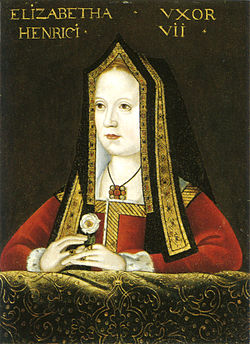
The privy purse accounts of Elizabeth of York include payments to Mistress Lokke, a silkwoman, who supplied her with frontlets and bonnets, and for the purchase of a gold frontlet.[1] In 1517, Lady Catherine Gordon, the widow of Perkin Warbeck, owned a gold "flat chain for paste" for wearing on her hood.[2]

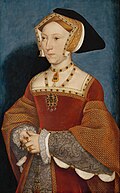
In 1537, Queen Jane Seymour forbade her gentlewomen from wearing the newly fashionable French hood, apparently preferring the gable style.[3] John Husee informed Lady Lisle that her daughter, as an attendant to the Queen, was required to instead wear a "bonnet and frontlet of velvet", lamenting that it "became her nothing so well as the French hood".[4]

[edit]

See also

[edit]

References

[edit]
[edit]
Revisions and contributorsEdit on WikipediaRead on Wikipedia
from Grokipedia
The gable hood, also known as the English hood or gable headdress, is a structured women's headdress originating in early 16th-century , characterized by a wired frame forming a pointed, angular shape over the , with fabric draping from the back and long lappets (strips of fabric) framing the face and . Primarily worn by aristocratic and royal women from approximately 1500 to 1550, the gable hood evolved from earlier draped hoods and reflected English fashion's emphasis on geometric and modesty, often concealing the entirely under a linen and a rear "curtain" of fabric. In its early form (ca. 1500–1525), it featured thick folds of fabric draping to the shoulders at the back, visible parted beneath the front , and extended lappets that hung freely or were pinned with jewels; materials typically included black or over a light wire frame, sometimes edged with embroidered ribbons or set with pearls and gems. By the 1520s, the design shifted to a more streamlined version, replacing the draped back with two long pendant flaps and shortening the front lappets, which were often pinned upward; hair was now fully hidden in sheaths, enhancing the hood's rigid and aligning with sumptuary trends that reserved such elaborate headwear for the elite. Notable wearers included , whose portraits from the 1510s–1520s depict her in crimson velvet gable hoods bordered in gold and adorned with rubies, diamonds, and pearls, symbolizing her royal status and Spanish-influenced English style. The gable hood held cultural and political significance in the Tudor court, distinguishing English fashion from continental styles like the softer introduced by figures such as around the 1530s; it became a marker of to traditional Catholic influences and Catherine's faction amid religious upheavals. Though it declined in favor by the mid-16th century as French-inspired designs gained prominence, surviving examples in museum collections, such as wire frames from the London Museum, illustrate its craftsmanship and in European fashion history.

Overview

Definition

The gable hood is a structured headdress worn by women in during the early 16th to mid-16th century, primarily associated with the , and characterized by its distinctive angular shape resembling the of a house roof. This headdress served as a formal head covering that framed the face while concealing the hair, reflecting the standards of the era. Key visual features of the gable hood include a rigid frame that creates a triangular with a prominent central peak above the , often stiffened with wire to maintain its peaked form. The structure typically extends to cover the head and drape over the shoulders, with fabric panels or veils hanging loosely at the back in folds or flaps, and side lappets—narrow strips of fabric or ribbon—framing the cheeks and neck. An underlying or cap was commonly worn beneath to secure the hair completely from view. In basic terminology, the gable hood is distinguished from related headdresses such as the by its sharper, more angular profile, which contrasts with the latter's softer, rounded crescent shape. This geometric design emphasized a structured, architectural aesthetic unique to English styles of the time.

Historical Context

The gable hood emerged in during the early , evolving from earlier medieval veiled headdresses that featured structured and pointed forms. By the early 1500s, it had developed into a distinct style, as evidenced by portraits such as that of around 1500, where long lappets extended past the shoulders. This headdress reflected the transition from Gothic to fashion influences in , incorporating elements of continental styles from and possibly Burgundian territories, known for their elaborate, wired headwear. During the early Tudor era under (1509–1547), the gable hood reached its peak popularity, becoming a staple among aristocratic women from the 1510s to the 1540s. Portraits of figures like in the 1520s showcase its extravagant form, with thick folds draping to the shoulders and visible parted hair beneath until around 1525, after which pendant flaps concealed the front hair. This period marked its widespread adoption in English courtly circles, aligning with the era's emphasis on formal, structured attire. The gable hood's decline began in the 1530s and accelerated by the 1550s, supplanted by the lighter, rounded introduced through French influences at court. Its association with conservative dress codes during the Henrician further shaped its trajectory; for instance, Jane Seymour adopted the style in the late 1530s to signal modesty and distance herself from the more "wanton" French hoods linked to , aligning with the era's push for restrained fashions amid religious upheaval. It continued to be worn into the 1550s, including by Mary I, but had largely faded by the late 16th century, giving way to evolving styles.

Design and Construction

Components and Materials

The gable hood's primary structure relied on a stiffened frame that created its signature angular shape, typically fashioned from —a coarse, stiffened fabric—or lightweight wire bent into a peaked form to ensure rigidity and maintain the hood's architectural silhouette over the forehead. This frame included a central bill or peak, a forward-projecting element that extended above the brow, providing essential support for the overall headdress while framing the face with geometric precision. Side lappets, elongated flaps attached to the frame's sides, draped over the ears and along the neck to offer lateral coverage and aesthetic balance, often secured by pins for adjustability. An undercap, known as a , formed the foundational base layer, fitting closely to the head to anchor the frame, conceal hair, and distribute weight for comfortable wear. Outer coverings for these components utilized rich, durable fabrics such as , , or , selected for their ability to drape elegantly while withstanding the hood's structured form; these were frequently layered or sheathed in contrasting patterns like stripes for visual interest. Inner linings employed softer materials like or to prevent and enhance against the skin. Elite iterations incorporated embellishments including gold embroidery along the edges, pearls strung as borders, or inset jewels on the bill and lappets, adding weight and luster without compromising the frame's integrity. Functionally, the buckram or wire frame supported the hood's weight and preserved its shape during extended wear, while the lappets and veil extension ensured comprehensive head and neck coverage. The coif's snug fit further stabilized the assembly, allowing the components to interlock seamlessly for both protection from the elements and a polished appearance.

Assembly and Variations

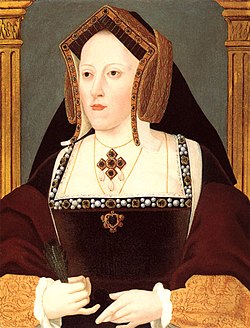
As no complete gable hoods survive and only wire frames remain, such as those in the Museum of London, assembly details are conjectural and based on modern reconstructions informed by portraits and contemporary depictions. The assembly of a gable hood began with constructing a rigid frame to achieve its distinctive angular, gable-like shape. Typically, this involved forming a base from buckram or wire, cut into a square or rectangular panel of appropriate size, such as around 24 inches on each side, with corners trimmed to create the peaked front. Hoop boning was inserted into channels sewn along the edges of a folded buckram strip to form the rear support and gable peak, which was then whipstitched at the ends for stability. The frame was covered first with a layer of white linen for lining, followed by an outer fabric such as black velvet or patterned silk, hand-stitched using backstitches and slip stitches to secure the coverings without visible seams. Lappets—rectangular extensions of fabric, often in contrasting silk or geometric patterns—were attached to the sides of the frame, measuring from the shoulders to about three-quarters down the elbow, and a semi-circular veil or curtain of fine silk was draped and hemmed at the rear to cover the hair. Finally, the hood was secured to the head over a linen coif or undercap by pinning the lappets and front edge with decorative jeweled or silver pins, or occasionally by ties at the nape, ensuring it remained fixed during wear. Variations in gable hood design emerged primarily in the , reflecting evolving aesthetics and practical adaptations. Early versions from before the 1520s featured longer lappets that extended nearly to the elbows and fuller veils that completely concealed the hair, creating a bulkier as seen in portraits of noblewomen like Katherine of Aragon. By the 1530s, styles shifted to shorter lappets pinned upward or folded for a more compact form, with sharper angular peaks, while hair remained fully concealed, marking a transition toward the softer . Regional influences, particularly Flemish, introduced wider frames for added volume at the sides, while English designs remained narrower and more structured overall. Adaptations for different social classes emphasized material choices over structural changes. Courtly gable hoods for noblewomen incorporated luxurious or outer layers with elaborate borders of , pearls, or jewels, as evidenced by surviving brass wire frames from the Museum of London. In contrast, middle-class versions used simpler, cheaper fabrics like or without embellishments, maintaining the core frame to comply with sumptuary laws restricting opulent displays.

Usage in Society

Tudor Court Fashion

The gable hood was prominently adopted in the Tudor court during the early 16th century, particularly by Henry VIII's queens such as and in the 1520s and 1530s. , as from 1509 to 1533, frequently wore the gable hood in its classic form, as evidenced by her portrait painted around 1518, which depicts the structured, angular headdress framing her face with jeweled lappets. , who became queen in 1533, initially adopted the gable hood before popularizing the ; notably, she chose to wear a gable hood during her execution in 1536, signaling a return to traditional English styles amid her downfall. This courtly preference reflected the hood's status as a staple of elite fashion before the mid-1530s shift toward softer continental influences. Sumptuary laws, such as the 1510 Act under , reinforced the gable hood's exclusivity by restricting lavish materials like , gold , and imported silks—common in high-end hoods—to the and royalty, thereby limiting ornate versions to circles and prohibiting their use by lower classes to maintain social hierarchies. These regulations targeted in apparel, including headwear, ensuring that the gable hood's embellishments, such as pearl billiments and fur trims, remained markers of aristocratic privilege. Court inventories and accounts from the era highlight the gable hood's prominence among royal women; for instance, Elizabeth of York's wardrobe, as until her death in 1503, included richly decorated headpieces, with her portrait showing a gable hood adorned with jewels and gold , underscoring its role in royal attire. Such examples influenced court masques and official portraits, where the hood appeared in ceremonial contexts, like those surrounding Henry VIII's court events in the 1520s. The gable hood's integration into Tudor emphasized geometric silhouettes, often paired with square-necked gowns and fitted kirtles that exposed the shoulders and chest, creating a balanced, angular profile suited to the era's structured aesthetic.

Social and Symbolic Role

The gable hood served as a prominent indicator of in Tudor , where its materials and embellishments directly reflected the wearer's economic standing and adherence to sumptuary laws. Among elite women, such as and royalty, the hood was often crafted from luxurious fabrics like or , adorned with jewels, , pearls, or rubies to ostentatiously display wealth and high status, thereby reinforcing hierarchical distinctions in a society governed by strict apparel regulations that limited such opulence to the upper echelons. In contrast, middle-class women adapted simpler versions using affordable , which signaled respectability and modesty while still aligning with prevailing fashion norms without violating the 1510 and subsequent Acts of Apparel that prohibited lower ranks from using costly imports or furs. Symbolically, the gable hood embodied marital fidelity and gender norms by fully covering a woman's , a practice rooted in English custom that marked married women as obedient and virtuous, distinct from the uncovered or loosely styled of unmarried girls symbolizing purity and availability. This veiling tradition, described in contemporary legal terms as rendering a "covert" or veiled upon , underscored women's subservient roles within the patriarchal structure and suppressed displays of sexuality, as was culturally viewed as an inherently sensual attribute. The hood also carried connotations of and moral uprightness, particularly in the post-Reformation era, where its structured, concealing design aligned with emerging Protestant ideals of and devotion over ostentatious Catholic rituals, as exemplified by figures like who favored it to project virtue amid religious upheaval. This conservative English style contrasted sharply with perceived "immodest" foreign influences, such as the more revealing that exposed curls and was associated with continental frivolity, thereby positioning the gable hood as a badge of national modesty and reformed sensibilities.

Representations and Legacy

Artistic Depictions

The gable hood is prominently featured in Tudor-era portraits, serving as a key element in conveying status and style. Hans Holbein the Younger's portrait of (c. 1536–1537), housed in the , depicts the queen wearing an English gable hood with intricate gold embroidery along the edges, folded in the fashionable 1530s style that emphasized structured angularity over the forehead. This detailed rendering highlights the hood's white linen base edged with jeweled bands and a draped at the back, illustrating its role in formal royal imagery. Similarly, Holbein's works, such as those in the Royal Collection, consistently portray the gable hood as a symbol of English , contrasting with continental fashions. Tomb effigies provide another avenue for examining the gable hood in sculptural art, often in simplified forms suited to monumental commemoration. The gilt bronze effigy of Margaret Beaufort on her tomb in Westminster Abbey's (c. 1512), sculpted by , shows her in a widow's attire including a structured gable hood with lappets framing the face, resting on pillows emblazoned with Tudor motifs. This depiction, while less ornate than painted portraits, captures the hood's essential gable shape and its association with and lineage, with traces of original polychromy suggesting once-vibrant detailing on the wimple and mantle. In illuminations from the early 1500s, the gable hood appears in scenes of daily life and devotion, often with artistic conventions that exaggerate its geometric form for visual impact. These stylized representations, common in English prayer books, employ heightened angles to denote elegance and moral uprightness, differing from more fluid continental styles. Artistic depictions also reveal evolving trends through subtle variations in the gable hood's proportions. This evolution, evident in works from the National Portrait Gallery, underscores how artists like Holbein adapted the hood's form to reflect contemporary preferences without altering its core structure.

Surviving Examples and Modern Recreations

Surviving examples of the gable hood are exceedingly rare, primarily limited to structural components rather than complete garments, owing to the organic materials' susceptibility to decay over centuries. The Museum of London preserves several 16th-century copper alloy wire frames that supported gable hoods, illustrating the headdress's characteristic angular, house-gable shape and rigid form. These artifacts, dating to the , reveal how the frames were twisted and capped to maintain the hood's distinctive silhouette. No intact fabric examples of gable hoods survive, though related Tudor-era textile fragments, such as pieces of stamped velvet from the early 16th century, exist in collections like those of the London Museum, offering clues to the luxurious materials originally employed. Modern recreations of the gable hood thrive in historical reenactment communities and educational contexts, drawing on archaeological evidence and contemporary pattern reconstructions to replicate the headdress faithfully. The Tudor Group, founded in 1968 as one of the earliest dedicated Tudor reenactment societies, produces gable hoods using authentic techniques and materials like velvet, linen, and wire supports to perform living history demonstrations. Similarly, publications such as "The Tudor Tailor: Reconstructing 16th-Century Dressmaking Techniques" provide step-by-step guidance for assembling gable hoods based on surviving frames and period portraits, enabling hobbyists and professionals to create wearable versions. In the 2020s, digital innovations have enhanced access to these recreations, with institutions like the Victoria & Albert Museum incorporating virtual models of Tudor attire, including gable hoods, into online exhibits to explore historical fashion without physical wear. Recreating gable hoods presents challenges related to fabric preservation, as original textiles degrade rapidly due to environmental factors, prompting modern costume designers to incorporate synthetic fabrics for enhanced durability while approximating the appearance of and .
Add your contribution
Related Hubs
User Avatar
No comments yet.