



Community hub
Recent from talks
Contribute something
Nothing was collected or created yet.
Kausia
View on Wikipedia


The kausia or causia (Ancient Greek: καυσία[1]) was an ancient Macedonian flat hat. A purple kausia with a diadem was worn by the Macedonian kings as part of the royal costume.[2]
Name
[edit]The name is derived from its keeping off the heat (καῦσις, kaûsis).[2]
Background
[edit]It was worn during the Hellenistic period but perhaps even before the time of Alexander the Great[3] and was later used as a protection against the sun by the poorer classes in Rome.[4]
Depictions of the kausia can be found on a variety of coins and statues found from the Mediterranean to the Greco-Bactrian kingdom and the Indo-Greeks in northwestern India. The Persians referred to both the Macedonians and the rest of the Greeks as "Yauna" (Ionians), but made a distinction between "Yauna by the sea" and those "with hats that look like shields" (Yauna Takabara), probably referring to the Macedonian kausia hat.[5] According to Bonnie Kingsley the kausia may have came to the Mediterranean as a campaign hat worn by Alexander and veterans of his campaigns in the Indus[6] but according to Ernst Fredricksmeyer the kausia was too established a staple of the Macedonian wardrobe for it to have been imported from Asia to Macedonia.[7]
A modern descendant of the hat may be the Pakol: the familiar and remarkably similar men's hat from Pakistan, Afghanistan and Jammu and Kashmir.[8]
Gallery
[edit]-
 Ancient Macedonian soldiers, from the tomb of Agios Athanasios (Greece) wearing the kausia, grave of Agios Athanasios, 4th century BC
 -
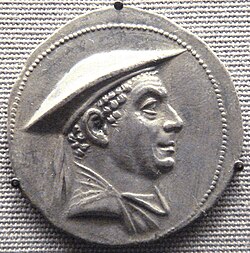 Coin of Greco-Bactrian king Antimachus I Theos wearing the Macedonian kausia, c.185–170 BC
 -
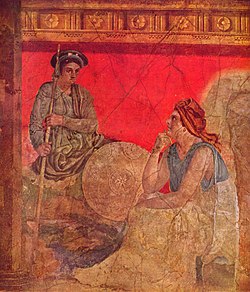 Antigonus II Gonatas wearing the kausia and holding a spear, detail of a fresco in Villa Fannius, c. 40 BC, Archaeological Museum of Naples


See also
[edit]References
[edit]- ^ Henry George Liddell; Robert Scott. "καυσία". A Greek-English Lexicon – via Perseus.
- ^ a b Harry Thurston Peck, Harpers Dictionary of Classical Antiquities (1898), Causia
 This article incorporates text from this source, which is in the public domain.
- ^ Kingsley, Bonnie M. (1984). "The Kausia Diadematophoros". American Journal of Archaeology. 88 (1): 66–68. doi:10.2307/504602. JSTOR 504602. S2CID 193037990.
- ^ Miles gloriosus. Harvard University Press. 1997. ISBN 9780674574373.
- ^ Roisman, Joseph; Worthington, Ian (2010). A Companion to Ancient Macedonia. John Wiley and Sons. p. 87. ISBN 978-1-4051-7936-2.
- ^ Kingsley, Bonnie M. (1981). The Cap That Survived Alexander. Vol. 85. p. 39.
{{cite book}}:|work=ignored (help) - ^ Fredricksmeyer, Ernst (1986). Alexander the Great and the Macedonian kausia. Vol. 116. pp. 215–227.
{{cite book}}:|work=ignored (help) - ^ Worthington, Ian; Geoffrey, Nicholas; Hammond, Lemprière (1994). Ventures into Greek history. Clarendon Press. p. 135. ISBN 978-0198149286.

External links
[edit] Media related to Kausia at Wikimedia Commons


Kausia
View on GrokipediaEtymology and Terminology
Origin of the Name
The term kausia (Ancient Greek: καυσία) has been suggested by some scholars to derive from the Greek noun καῦσις (kaûsis), meaning "burning" or "heat," a connection that underscores the hat's practical role in shielding wearers from intense sunlight in the Macedonian climate. Alternative theories suggest connections to terms for woolen materials, such as γαύσαπος (gaúsapos, “woolen cloth”), or influences from Proto-Scythian *xauδiya through Thracian intermediaries.[3] This etymological link was first proposed by 19th-century scholars Louis Heuzey and Henri Daumet in their archaeological report on Macedonian attire, and later elaborated by Emilio Wuescher-Becchi, who tied it to related terms like καῦσος (kaûsos, "fever" or "searing heat"), suggesting the name evoked protection against thermal discomfort.[4][5][6] The word's earliest attestations appear in 4th-century BCE Greek literature, coinciding with the height of Macedonian influence under Philip II and Alexander the Great. It features in comedic and historical fragments, such as those by Menander (c. 342–290 BCE) and Nearchus (c. 360–312 BCE), the latter describing naval aspects of Alexander's expedition where the kausia served as standard headgear for Macedonian troops.[7] These references firmly associate the term with Macedonian cultural identity, distinguishing it from other Greek headwear like the petasos or pilos. Historians have retroactively connected the kausia to earlier Macedonian contexts through indirect evidence in 5th-century BCE accounts. Herodotus (c. 484–425 BCE), in describing Persian perceptions of northern Greeks, implies a distinctive hat worn by Macedonians via the Old Persian label Yauna Takabara ("Greeks with shield-like hats"), interpreted by modern scholars as referring to the flat, protective kausia.[8] Later, Arrian (c. 86–160 CE) explicitly links the kausia to Macedonian royal and military traditions in his Anabasis of Alexander, noting its use by Alexander himself during campaigns in Asia (An. 7.22.2).[9]Linguistic Variations
The term for the Macedonian hat appears in ancient Greek as καυσία, and is attested in classical texts such as Athenaeus' Deipnosophistae, where it describes a felt head covering worn by Macedonians.[10] In Greek inscriptions from the Hellenistic period, the word καυσία is used consistently to denote this item of attire, reflecting its cultural specificity to Macedonian contexts.[11] Latin authors adapted the term as causia, a close phonetic rendering that appears in Roman descriptions of Eastern and Macedonian customs, such as in Plautus' comedies where it evokes foreign headgear similar to the Greek petasos but distinct in its broad, upturned brim. This Latin variant, documented in classical antiquities references, highlights the term's transmission through Roman ethnography and adoption into broader Mediterranean nomenclature for felt hats.[12] During the medieval and Byzantine periods, the term evolved in Greek-speaking contexts as a symbol of Macedonian heritage, notably in the 10th-century Suda lexicon, which defines καυσία as a "barbarian" head covering adaptable for Macedonian use in snow and rain, thereby preserving its association with ethnic identity amid Byzantine cultural shifts.[13] In modern scholarly literature, the preferred transliteration is "kausia" in English and Greek studies, reflecting standardized philological conventions, while "causia" persists in Latin-influenced works to maintain fidelity to Roman sources; rarer variants like "kausie" appear occasionally in older 19th-century philology but are not widely adopted. The ancient term has indirectly influenced regional nomenclature, with the kausia's style linked to the Pashto/Afghan "pakol" hat, where some local traditions evoke phonetic resemblances in terms for woolen headgear, though direct etymological descent remains unproven.[14]Physical Description
Materials and Construction
The kausia was typically made from felt, leather, or wool, with sources varying on the primary material; leather is favored in some scholarly analyses for its durability in the region's mountainous terrain.[15][1] This provided a dense, water-repellent fabric suitable for everyday and military use, with felting achieved through traditional processes of compressing and matting fibers by hand.[16] Elite versions of the kausia featured vibrant crimson or purple dyes, the former derived from madder root extracts and the latter from the costly Tyrian purple obtained from murex snails; these dyes signified status, with purple reserved for royalty, as noted in ancient accounts of gifts to Hellenistic rulers.[17] Common variants often retained natural tones or simpler plant-based colorings for practicality. Literary sources, such as Plutarch, mention purple kausia, though archaeological textile evidence is limited.[18] Construction involved forming a circular base, which could be supplemented with a woven wool or leather underlayer for added structure; optional chin ties or edge reinforcements were attached through basic sewing techniques using bone or bronze needles common in ancient Macedonian textile production.[18][19] This method allowed for adjustable fit via folding or rolling the edges, ensuring versatility across social classes. Elite examples occasionally incorporated finer materials and more intricate dyeing, differing subtly in density from coarser common versions.Shape and Distinctive Features
The kausia is characterized by its distinctive flat-topped, mushroom-like profile, featuring a low crown that flares out into a wide, floppy brim designed primarily for providing shade in the Mediterranean climate without obstructing the wearer's field of vision.[1] This shape, often described as imitating a soft leather cap with sharp edges, includes a slightly pointed top and terminates in a sweatband around the scalp for added comfort during extended wear.[1] The overall form resembles a broad-brimmed beret or disk, distinguishing it from more rigid headgear like the Attic petasos, which has a wider, more flexible brim suited for travelers.[20] Variations in the kausia's design reflect its adaptation to different users and contexts, with stiffer brims appearing in military depictions to offer enhanced protection while maintaining the hat's compact silhouette.[15] For civilian wear, softer versions were common, sometimes folded or rolled at the edges for a more casual fit, as seen in representations of non-elite Macedonians.[19] Typically constructed from wool felt or leather, the kausia's breathable material helped prevent overheating, making it practical for both active and sedentary pursuits in ancient Macedonia.[15]Historical Development
Origins in Ancient Macedonia
The earliest evidence for the kausia emerges in the 5th century BCE from Achaemenid Persian reliefs at Persepolis and Naqsh-e Rustam, where Macedonian delegates are depicted wearing a distinctive flat-brimmed hat termed "Yauna takabara" (Ionians with the shield-like hat), distinguishing them from other Greek groups and highlighting its role in marking Macedonian identity amid interactions with the Persian Empire.[21] Archaeological confirmation appears in the 4th century BCE royal tombs at Vergina (ancient Aegae), particularly Tomb II, associated with Philip II of Macedon (r. 359–336 BCE), where frescoes in the hunting frieze portray figures in kausia headgear, evidencing its use among the Macedonian elite during this period.[1] These artifacts, dated to around 350 BCE, illustrate the hat's integration into royal and martial iconography before the reign of Alexander the Great.[15] The kausia's cultural roots trace to the pastoral traditions of ancient Macedonia, shaped by influences from neighboring Thracian and Illyrian peoples, whose similar felt or leather headwear suited the herding lifestyle in the Balkan highlands.[21] Macedonian tribes adapted this practical form for protection against sun and weather during herding and early warfare, reflecting the region's semi-nomadic agrarian economy in the 6th–5th centuries BCE, as broader cultural exchanges with Thracian and Persian elements are attested in early Macedonian material culture.[21] Literary sources, including Philo of Byzantium, further support its likely leather construction, aligning with the durable needs of such activities.[15] In the pre-Alexander era, the kausia served as attire for Macedonian nobility, particularly in border regions influenced by Achaemenid Persia, where the kingdom's vassal status and diplomatic ties exposed elites to eastern styles while retaining local distinctions.[21] Accounts of Macedonian customs under Alexander I (r. ca. 498–454 BCE), including royal lineage and interactions with Persian envoys, reflect a dress code that blended indigenous elements with external pressures, symbolizing status amid the kingdom's volatile frontiers. This usage persisted into the Hellenistic era, facilitating its wider adoption during conquests.Adoption in the Hellenistic Era
Following Alexander the Great's conquests in the Persian Empire during the late 4th century BCE, the kausia—a traditional Macedonian headdress—gained prominence as a practical item for military campaigns, valued for its broad brim that offered protection against the sun and elements in arid regions. Ancient historians Arrian and Plutarch reference its use in this context; Arrian describes an incident during Alexander's return voyage where the king's kausia, adorned with the diadem, was swept overboard by a storm, underscoring its routine wear on expeditions (Anabasis Alexandri 7.22.2). Plutarch similarly notes the kausia's association with Alexander's inner circle, such as his companion Krateros, highlighting its functionality as a field hat amid the rigors of extended marches. Originating from Macedonian traditions, this adoption marked a shift toward integrating the hat into the broader cultural fabric of the expanding empire. The kausia's dissemination accelerated after Alexander's death in 323 BCE, as his successors, the Diadochi, carried it eastward through their armies into Egypt, Persia, and regions of India. In the successor kingdoms, it transitioned from battlefield utility to a staple of elite attire, symbolizing Hellenistic continuity with Macedonian heritage. By the 3rd century BCE, it had been incorporated into the courts of the Seleucid Empire in Persia and Syria, where kings like Seleucus II (r. 246–225 BCE) depicted themselves wearing it on coins, blending it with royal diadems to assert legitimacy over diverse territories. Similarly, in Ptolemaic Egypt, the kausia appeared in royal iconography, as evidenced by terracotta depictions from the Hadra necropolis. The kausia reached its peak popularity between 323 and 146 BCE, flourishing across the Hellenistic world from the Mediterranean to Bactria and the Indo-Greek realms, where rulers such as Antimachos I (early 2nd century BCE) wore it as a marker of Greco-Macedonian identity. Its decline coincided with expanding Roman influence, particularly after the Battle of Corinth in 146 BCE, which curtailed Greek autonomy and introduced alternative headgear preferences in the core Hellenistic territories. However, the kausia persisted on the Balkan fringes, influencing local variants among Thracian and Illyrian groups into the early Roman era.Usage and Symbolism
Royal and Elite Attire
The kausia served as a prominent status symbol among Macedonian royalty and nobility, particularly when enhanced with regal markers such as a gold diadem or purple cloth band. In portraits and artifacts associated with Philip II, underscoring its role in royal attire during the Argead dynasty. Alexander III further elevated the kausia by tying a Persian-style diadem around it, creating the kausia diadematophoros, a headdress that became an exclusive royal prerogative post-330 BCE and was depicted in elite contexts like the Boscoreale wall-painting. These enhancements, often in purple fabric symbolizing imperial authority, distinguished kings from lesser nobility, as seen in Alexander's gifting of purple kausias to his companions while reserving the diademed version for himself.[1][15] In ceremonial contexts, the kausia signified the legitimacy of Argead rule, worn by kings during processions, diplomatic events, and battles to evoke Macedonian heritage. Alexander maintained his royal kausia through his campaigns and until his death in Babylon in 323 BCE, using it to project dynastic continuity amid conquests. Evidence from Hellenistic coinage reinforces this, with tied versions of the diademed kausia appearing on issues of Seleukos II (c. 228 BCE). Such depictions on numismatic portraits highlighted the headdress's role in royal iconography, linking wearers directly to Argead precedents.[1][22] The kausia's use was largely restricted to highborn elites in early Macedonian society, implying sumptuary regulations through historical accounts that associate it with royal officers, bodyguards, and nobility rather than commoners. Texts describe it as attire for special envoys and high-ranking generals under Alexander, such as Krateros, while plain versions without diadems marked lesser elites. This exclusivity preserved hierarchical distinctions, with the enhanced royal form enforcing dynastic privilege, as no pre-Alexander evidence shows diademed kausias outside the Argead court.[15]Common and Military Wear
In ancient Macedonia, the kausia served as a practical headdress for soldiers, particularly as a lightweight alternative to heavier bronze helmets during extended marches and non-combat activities. Phalangites in the rear ranks of the Macedonian infantry often wore the kausia instead of full helmets, providing essential sun protection and ventilation in the region's hot climate while allowing for mobility on long campaigns.[23] This utility is evidenced in accounts of non-Macedonian troops under Memnon wearing the kausia to impersonate Macedonian allies for deception in battle preparations, as described by Polyaenus (336/5 BCE).[24] Felt or wool construction made it ideal for shielding against solar exposure without the encumbrance of metal armor, contributing to the army's endurance during expeditions like those under Alexander the Great.[25] Among civilians, the kausia was a standard garment for everyday laborers such as farmers and shepherds, adapted to Macedonia's variable weather with its broad brim offering defense against sun and light rain. Tied or secured at the chin to resist strong winds common in the mountainous terrain, it became an essential item for those working outdoors, reflecting its origins in pastoral traditions.[26] Archaeological depictions from Macedonian tombs, such as those at Agios Athanasios, show ordinary figures in similar attire, underscoring its role in daily rural life rather than solely elite contexts.[16] By the 3rd century BCE, the kausia had diffused widely among lower social classes across the Hellenistic world, symbolizing the cultural blending fostered by Alexander's conquests. This mass adoption marked its transition from a regional staple to a ubiquitous marker of Hellenistic identity among commoners, evident in terracotta figurines and coinage portraying everyday wearers.[27] Elite variants occasionally incorporated diadems for distinction, but the plain form remained predominant in popular use.[19]Evidence and Representations
Artistic Depictions
The kausia appears prominently in ancient Macedonian and Hellenistic art, serving as a marker of elite identity in various media from the 4th century BCE onward. In the hunting frieze on the facade of Tomb II at Vergina, dated to the late 4th century BCE, several figures of hunters are depicted wearing the kausia, emphasizing its association with royal and aristocratic pursuits such as lion hunts.[28] One notable hunter in this scene, possibly representing Ptolemy son of Lagos, is shown with a kausia paired with a crimson chlamys, highlighting the hat's role in conveying nobility and martial prowess.[29] Similarly, the Alexander Mosaic from the House of the Faun in Pompeii, a 2nd-century BCE Roman copy of a Hellenistic painting depicting the Battle of Issus, features a companion of Alexander the Great wearing a deep red, brimmed kausia, underscoring its practical yet symbolic form in battle contexts.[1][30] In Hellenistic reliefs, the kausia often appears alongside the chlamys cloak, reinforcing its iconographic ties to Macedonian heritage and equestrian or hunting attire. This pairing with the chlamys, a short cloak typically draped over one shoulder, is evident in these reliefs, where it complements the kausia to evoke the mobile, elite warrior archetype of the Hellenistic world.[30] The stylistic representation of the kausia evolved from the realistic portraits of 4th-century BCE Macedonian art to more stylized forms in peripheral Hellenistic regions. Early depictions, such as those in the Vergina frieze, prioritize naturalistic details to convey status and action, while later Greco-Bactrian coins from the 3rd–2nd centuries BCE, like those of Demetrius I and Antimachus I, show the king in a flat kausia with idealized, profile-view portraits that blend Macedonian realism with local artistic influences, adapting the hat into a symbol of royal continuity amid cultural fusion.[31][32] This progression illustrates the kausia's enduring visual role in propagating Macedonian iconography across expanding Hellenistic territories.Archaeological Discoveries
The archaeological record for the kausia is limited by the perishable nature of its primary materials, such as wool or felt, which rarely survive in ancient Macedonian contexts. Direct physical evidence consists mainly of degraded organic fragments and associated artifacts, with most insights derived from high-status burials and maritime discoveries. These finds confirm the kausia's construction as a soft, brimless cap, often folded or rolled at the edges, and its widespread use from the late Classical to Hellenistic periods. Preservation of kausia remains poses significant challenges across Macedonian sites, primarily due to organic decay from exposure to oxygen, moisture, and acidic soils. In most excavations, such as those at Pella and Vergina, textiles disintegrate rapidly post-exhumation, leaving only indirect traces. A key discovery comes from the royal tombs at Aegae (modern Vergina), where excavations in the 1970s and subsequent analyses uncovered degraded wool and felt fragments in Tomb II, dated to around 336 BCE and associated with the burial of Philip II. These remnants, preserved in the anaerobic conditions of the tomb, exhibit the dense, matted texture characteristic of felted wool. Complementary evidence includes impressions of folded fabric on gold wreaths and diadems from the same tomb, suggesting the hat's integration into elite attire.[33] Further confirmation of the kausia's design appears in terracotta figurines excavated from Pella, the ancient Macedonian capital, dating to the late 4th century BCE. These small-scale figures of standing Macedonian boys, found in a pit grave in the western cemetery, depict wearers with the distinctive flat-topped, softly draped cap, often paired with military elements like spears. The figurines, molded in detail, highlight variations in the hat's folding, from loose draping to a more structured roll, and underscore its role in both civilian and ceremonial contexts.[34] A significant archaeological find is an over-life-size bronze portrait head of a bearded man wearing a kausia, recovered from the sea near Kalymnos and dated to ca. 200–150 BCE, highlighting its use in elite portraiture.[1]Cultural Legacy
Influence on Later Headgear
The kausia's distinctive flat, beret-like design left a lasting imprint on headgear across post-Hellenistic cultures, adapting to local materials and contexts while retaining core elements of its protective, sun-shading form. In Eastern traditions, the kausia spread through Alexander the Great's campaigns and subsequent Greco-Bactrian trade networks beginning in the 2nd century BCE, and bears a resemblance to the pakol (or chitrali cap), a woolen beret prominent in Afghan and Pashtun regions. This possible connection is suggested by Hellenistic-era coins depicting Greco-Bactrian and Indo-Greek rulers wearing the kausia, as well as terracotta fragments from sites like Kampyrtepa (3rd–2nd century BCE) and later Kushan figurines (2nd–3rd century CE) showing similar flat-crowned headwear. The pakol differs in construction—using rolled wool rather than felt or leather—and shifted from a primarily military accessory to everyday rural attire, yet its rounded, forward-folding shape recalls the Macedonian original, facilitating cultural transmission along Silk Road routes.[35]Modern Reconstructions
In recent years, efforts to reconstruct the kausia have focused on historical reenactment groups and specialized workshops, drawing from archaeological evidence such as the royal tombs at Vergina. A notable project is the 2017 creation of felt kausia replicas by the Rowan Tree Workshop, which produced large, mushroom-shaped hats using 3mm industrial felt dyed to approximate the ancient crimson or purple hues achieved with murex dye, often paired with a silk diadem for elite representations. These replicas were based on descriptions from ancient sources and artistic depictions, incorporating padding with wool and linen for the brim to mimic the hat's protective form against sun and weather; they were worn in reenactments, such as at the Canterbury Faire, portraying high-ranking Hellenistic figures including those inspired by Alexander the Great.[19] Museums have incorporated modern reconstructions into their exhibits to enhance public understanding of Macedonian material culture. The British Museum, which holds artifacts like a terracotta figurine depicting a figure in a kausia (dating to the 4th-3rd century BCE), has artifacts that inform such reconstructions. Academic discussions on the accuracy of such reconstructions, as explored in scholarly analyses of ancient costume, emphasize challenges in replicating the kausia's material—likely felted wool or leather—and its variations between elite purple versions with diadems and plainer military forms, urging reliance on iconographic evidence from tombs and coins to avoid anachronistic interpretations.[36][33] Contemporary applications of kausia reconstructions extend to cultural festivals and commercial markets, promoting awareness of Macedonian heritage. In events like those celebrating Hellenistic traditions in northern Greece, participants don replicas to evoke ancient attire. Commercially, artisans use natural dyes and wool felting to create functional pieces for educational and performative purposes.[19]References
- https://en.wiktionary.org/wiki/%CE%BA%CE%B1%CF%85%CF%83%CE%AF%CE%B1