


Geostationary orbit
View on Wikipedia


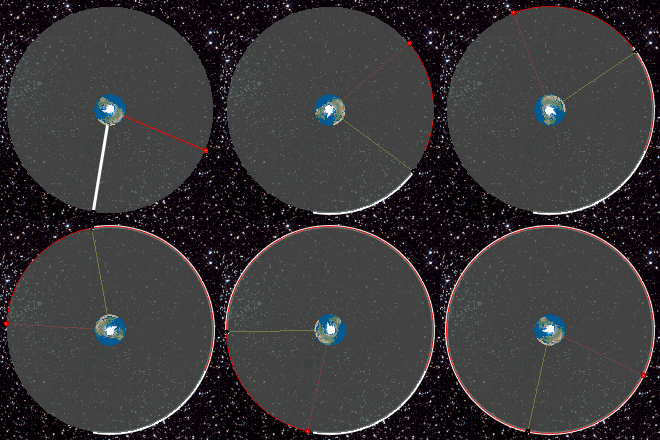
A geostationary orbit, also referred to as a geosynchronous equatorial orbit[a] (GEO), is a circular geosynchronous orbit 35,786 km (22,236 mi) in altitude above Earth's equator, 42,164 km (26,199 mi) in radius from Earth's center, and following the direction of Earth's rotation.
An object in such an orbit has an orbital period equal to Earth's rotational period, one sidereal day, and so to ground observers it appears motionless, in a fixed position in the sky. The concept of a geostationary orbit was popularised by the science fiction writer Arthur C. Clarke in the 1940s as a way to revolutionise telecommunications, and the first satellite to be placed in this kind of orbit was launched in 1963.
Communications satellites are often placed in a geostationary orbit so that Earth-based satellite antennas do not have to rotate to track them but can be pointed permanently at the position in the sky where the satellites are located. Weather satellites are also placed in this orbit for real-time monitoring and data collection, as are navigation satellites in order to provide a known calibration point and enhance GPS accuracy.
Geostationary satellites are launched via a temporary orbit, and then placed in a "slot" above a particular point on the Earth's surface. The satellite requires periodic station-keeping to maintain its position. Modern retired geostationary satellites are placed in a higher graveyard orbit to avoid collisions.
History
[edit]
In 1929, Herman Potočnik described both geosynchronous orbits in general and the special case of the geostationary Earth orbit in particular as useful orbits for space stations.[1] The first appearance of a geostationary orbit in popular literature was in October 1942, in the first Venus Equilateral story by George O. Smith,[2] but Smith did not go into details. British science fiction author Arthur C. Clarke popularised and expanded the concept in a 1945 paper entitled Extra-Terrestrial Relays – Can Rocket Stations Give Worldwide Radio Coverage?, published in Wireless World magazine. Clarke acknowledged the connection in his introduction to The Complete Venus Equilateral.[3][4] The orbit, which Clarke first described as useful for broadcast and relay communications satellites,[4] is sometimes called the Clarke orbit.[5] Similarly, the collection of artificial satellites in this orbit is known as the Clarke Belt.[6]
In technical terminology the orbit is referred to as either a geostationary or geosynchronous equatorial orbit, with the terms used somewhat interchangeably.[7]
The first geostationary satellite was designed by Harold Rosen while he was working at Hughes Aircraft in 1959. Inspired by Sputnik 1, he wanted to use a geostationary satellite to globalise communications. Telecommunications between the US and Europe was then possible between just 136 people at a time, and reliant on high frequency radios and an undersea cable.[8]
Conventional wisdom at the time was that it would require too much rocket power to place a satellite in a geostationary orbit and it would not survive long enough to justify the expense,[9] so early efforts were put towards constellations of satellites in low or medium Earth orbit.[10] The first of these were the passive Echo balloon satellites in 1960, followed by Telstar 1 in 1962.[11] Although these projects had difficulties with signal strength and tracking, issues that could be solved using geostationary orbits, the concept was seen as impractical, so Hughes often withheld funds and support.[10][8]
By 1961, Rosen and his team had produced a cylindrical prototype with a diameter of 76 centimetres (30 in), height of 38 centimetres (15 in), weighing 11.3 kilograms (25 lb), light and small enough to be placed into orbit. It was spin stabilised with a dipole antenna producing a pancake shaped beam.[12] In August 1961, they were contracted to begin building the real satellite.[8] They lost Syncom 1 to electronics failure, but Syncom 2 was successfully placed into a geosynchronous orbit in 1963. Although its inclined orbit still required moving antennas, it was able to relay TV transmissions, and allowed for US President John F. Kennedy in Washington D.C., to phone Nigerian prime minister Abubakar Tafawa Balewa aboard the USNS Kingsport docked in Lagos on August 23, 1963.[10][13]
The first satellite placed in a geostationary orbit was Syncom 3, which was launched by a Delta D rocket in 1964.[14] With its increased bandwidth, this satellite was able to transmit live coverage of the Summer Olympics from Japan to America. Geostationary orbits have been in common use ever since, in particular for satellite television.[10]
Today there are hundreds of geostationary satellites providing remote sensing and communications.[8][15]
Although most populated land locations on the planet now have terrestrial communications facilities (microwave, fiber-optic), with telephone access covering 96% of the population and internet access 90%,[16] some rural and remote areas in developed countries are still reliant on satellite communications.[17][18]
Uses
[edit]Most commercial communications satellites, broadcast satellites and SBAS satellites operate in geostationary orbits.[19][20][21]
Communications
[edit]Geostationary communication satellites are useful because they are visible from a large area of the earth's surface, extending 81° away in latitude and 77° in longitude.[22] They appear stationary in the sky, which eliminates the need for ground stations to have movable antennas. This means that Earth-based observers can erect small, cheap and stationary antennas that are always directed at the desired satellite.[23]: 537 However, latency becomes significant as it takes about 240 ms for a signal to pass from a ground based transmitter on the equator to the satellite and back again.[23]: 538 This delay presents problems for latency-sensitive applications such as voice communication,[24] so geostationary communication satellites are primarily used for unidirectional entertainment and applications where low latency alternatives are not available.[25]
Geostationary satellites are directly overhead at the equator and appear lower in the sky to an observer nearer the poles. As the observer's latitude increases, communication becomes more difficult due to factors such as atmospheric refraction, Earth's thermal emission, line-of-sight obstructions, and signal reflections from the ground or nearby structures. At latitudes above about 81°, geostationary satellites are below the horizon and cannot be seen at all.[22] Because of this, some Russian communication satellites have used elliptical Molniya and Tundra orbits, which have excellent visibility at high latitudes.[26]
Meteorology
[edit]A worldwide network of operational geostationary meteorological satellites is used to provide visible and infrared images of Earth's surface and atmosphere for weather observation, oceanography, and atmospheric tracking. As of 2019 there are 19 satellites in either operation or stand-by.[27] These satellite systems include:
- the United States' GOES series, operated by NOAA[28]
- the Meteosat series, launched by the European Space Agency and operated by the European Weather Satellite Organization, EUMETSAT[29]
- the Republic of Korea COMS-1 and[30] GK-2A multi mission satellites.[31]
- the Russian Elektro-L satellites
- the Japanese Himawari series[32]
- Chinese Fengyun series[33]
- India's INSAT series[34]
These satellites typically capture images in the visual and infrared spectrum with a spatial resolution between 0.5 and 4 square kilometres.[35] The coverage is typically 70°,[35] and in some cases less.[36]
Geostationary satellite imagery has been used for tracking volcanic ash,[37] measuring cloud top temperatures and water vapour, oceanography,[38] measuring land temperature and vegetation coverage,[39][40] facilitating cyclone path prediction,[34] and providing real time cloud coverage and other tracking data.[41] Some information has been incorporated into meteorological prediction models, but due to their wide field of view, full-time monitoring and lower resolution, geostationary weather satellite images are primarily used for short-term and real-time forecasting.[42][40]
Navigation
[edit]
Geostationary satellites can be used to augment GNSS systems by relaying clock, ephemeris and ionospheric error corrections (calculated from ground stations of a known position) and providing an additional reference signal.[43] This improves position accuracy from approximately 5m to 1m or less.[44]
Past and current navigation systems that use geostationary satellites include:
- The Wide Area Augmentation System (WAAS), operated by the United States Federal Aviation Administration (FAA);
- The European Geostationary Navigation Overlay Service (EGNOS), operated by the ESSP (on behalf of EU's GSA);
- The Multi-functional Satellite Augmentation System (MSAS), operated by Japan's Ministry of Land, Infrastructure and Transport Japan Civil Aviation Bureau (JCAB);
- The GPS Aided Geo Augmented Navigation (GAGAN) system being operated by India.[45][46]
- The commercial StarFire navigation system, operated by John Deere and C-Nav Positioning Solutions (Oceaneering);
- The commercial Starfix DGPS System and OmniSTAR system, operated by Fugro.[47]
Implementation
[edit]Launch
[edit]

Geostationary satellites are launched to the east into a prograde orbit that matches the rotation rate of the equator. The smallest inclination that a satellite can be launched into is that of the launch site's latitude, so launching the satellite from close to the equator limits the amount of inclination change needed later.[48] Additionally, launching from close to the equator allows the speed of the Earth's rotation to give the satellite a boost. A launch site should have water or deserts to the east, so any failed rockets do not fall on a populated area.[49]
Most launch vehicles place geostationary satellites directly into a geostationary transfer orbit (GTO), an elliptical orbit with an apogee at GEO height and a low perigee. On-board satellite propulsion is then used to raise the perigee, circularise and reach GEO.[48][50]
Orbit allocation
[edit]Satellites in geostationary orbit must all occupy a single ring above the equator. The requirement to space these satellites apart, to avoid harmful radio-frequency interference during operations, means that there are a limited number of orbital slots available, and thus only a limited number of satellites can be operated in geostationary orbit. This has led to conflict between different countries wishing access to the same orbital slots (countries near the same longitude but differing latitudes) and radio frequencies. These disputes are addressed through the International Telecommunication Union's allocation mechanism under the Radio Regulations.[51][52] In the 1976 Bogota Declaration, eight countries located on the Earth's equator claimed sovereignty over the geostationary orbits above their territory, but the claims gained no international recognition.[53]
Statite proposal
[edit]A statite is a hypothetical satellite that uses radiation pressure from the sun against a solar sail to modify its orbit.
It would hold its location over the dark side of the Earth at a latitude of approximately 30 degrees. A statite is stationary relative to the Earth and Sun system rather than compared to surface of the Earth, and could ease congestion in the geostationary ring.[54][55]
Retired satellites
[edit]Geostationary satellites require some station keeping to keep their position, and once they run out of thruster fuel they are generally retired. The transponders and other onboard systems often outlive the thruster fuel and by allowing the satellite to move naturally into an inclined geosynchronous orbit some satellites can remain in use,[56] or else be elevated to a graveyard orbit. This process is becoming increasingly regulated and satellites must have a 90% chance of moving over 200 km above the geostationary belt at end of life.[57]
Space debris
[edit]
Space debris at geostationary orbits typically has a lower collision speed than at low Earth orbit (LEO) since all GEO satellites orbit in the same plane, altitude and speed; however, the presence of satellites in eccentric orbits allows for collisions at up to 4 km/s (14,400 km/h; 8,900 mph). Although a collision is comparatively unlikely, GEO satellites have a limited ability to avoid any debris.[58]
At geosynchronous altitude, objects less than 10 cm in diameter cannot be seen from the Earth, making it difficult to assess their prevalence.[59]
Despite efforts to reduce risk, spacecraft collisions have occurred. The European Space Agency telecom satellite Olympus-1 was struck by a meteoroid on August 11, 1993, and eventually moved to a graveyard orbit,[60] and in 2006 the Russian Express-AM11 communications satellite was struck by an unknown object and rendered inoperable,[61] although its engineers had enough contact time with the satellite to send it into a graveyard orbit. In 2017, both AMC-9 and Telkom-1 broke apart from an unknown cause.[62][59][63]
Properties
[edit]A typical geostationary orbit has the following properties:
- Inclination: 0°
- Period: 1436 minutes (one sidereal day)[23]: 121
- Eccentricity: 0
- Argument of perigee: undefined
- Semi-major axis: 42,164 km
Inclination
[edit]An inclination of zero ensures that the orbit remains over the equator at all times, making it stationary with respect to latitude from the point of view of a ground observer (and in the Earth-centered Earth-fixed reference frame).[23]: 122
Period
[edit]The orbital period is equal to exactly one sidereal day. This means that the satellite will return to the same point above the Earth's surface every (sidereal) day, regardless of other orbital properties. For a geostationary orbit in particular, it ensures that it holds the same longitude over time.[23]: 121 This orbital period, T, is directly related to the semi-major axis of the orbit through Kepler's Third Law:
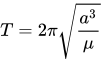
where:
- a is the length of the orbit's semi-major axis
- μ is the standard gravitational parameter of the central body[23]: 137
Eccentricity
[edit]The eccentricity is zero, which produces a circular orbit. This ensures that the satellite does not move closer or further away from the Earth, which would cause it to track backwards and forwards across the sky.[23]: 122
Stability
[edit]A geostationary orbit can be achieved only at an altitude very close to 35,786 kilometres (22,236 miles) and directly above the equator. This equates to an orbital speed of 3.07 kilometres per second (1.91 miles per second) and an orbital period of 1,436 minutes, one sidereal day. This ensures that the satellite will match the Earth's rotational period and has a stationary footprint on the ground. All geostationary satellites have to be located on this ring.
A combination of lunar gravity, solar gravity, and the flattening of the Earth at its poles causes a precession motion of the orbital plane of any geostationary object, with an orbital period of about 53 years and an initial inclination gradient of about 0.85° per year, achieving a maximal inclination of 15° after 26.5 years.[64][23]: 156 To correct for this perturbation, regular orbital stationkeeping maneuvers are necessary, amounting to a delta-v of approximately 50 m/s per year.[65]
A second effect to be taken into account is the longitudinal drift, caused by the asymmetry of the Earth – the equator is slightly elliptical (equatorial eccentricity).[23]: 156 There are two stable equilibrium points sometimes called "gravitational wells"[66] (at 75.3°E and 108°W) and two corresponding unstable points (at 165.3°E and 14.7°W). Any geostationary object placed between the equilibrium points would (without any action) be slowly accelerated towards the stable equilibrium position, causing a periodic longitude variation.[64] The correction of this effect requires station-keeping maneuvers with a maximal delta-v of about 2 m/s per year, depending on the desired longitude.[65]
Solar wind and radiation pressure also exert small forces on satellites: over time, these cause them to slowly drift away from their prescribed orbits.[67]
In the absence of servicing missions from the Earth or a renewable propulsion method, the consumption of thruster propellant for station-keeping places a limitation on the lifetime of the satellite. Hall-effect thrusters, which are currently in use, have the potential to prolong the service life of a satellite by providing high-efficiency electric propulsion.[65]
Derivation
[edit]
For circular orbits around a body, the centripetal force required to maintain the orbit (Fc) is equal to the gravitational force acting on the satellite (Fg):[68]

From Isaac Newton's universal law of gravitation,
- ,
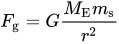
where Fg is the gravitational force acting between two objects, ME is the mass of the Earth, 5.9736×1024 kg, ms is the mass of the satellite, r is the distance between the centers of their masses, and G is the gravitational constant, (6.67428±0.00067)×10−11 m3 kg−1 s−2.[68]
The magnitude of the acceleration, a, of a body moving in a circle is given by:

where v is the magnitude of the velocity (i.e. the speed) of the satellite. From Newton's second law of motion, the centripetal force Fc is given by:
- .[68]

As Fc = Fg,
- ,
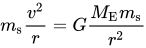
so that

Replacing v with the equation for the speed of an object moving around a circle produces:
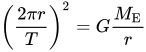
where T is the orbital period (i.e. one sidereal day), and is equal to 86164.09054 s.[69] This gives an equation for r:[70]
![{\displaystyle r={\sqrt[{3}]{\frac {GM_{\text{E}}T^{2}}{4\pi ^{2}}}}}](https://wikimedia.org/api/rest_v1/media/math/render/svg/f82a14e92ba3a8e9c78590fd4acbb436884d19a3)
The product GME is known with much greater precision than either factor alone; it is known as the geocentric gravitational constant μ = 398600.4418±0.0008 km3 s−2. Hence
![{\displaystyle r={\sqrt[{3}]{\frac {\mu T^{2}}{4\pi ^{2}}}}}](https://wikimedia.org/api/rest_v1/media/math/render/svg/43ba4d2a4b1f1550a6c499c350f76d0911ae4384)
The resulting orbital radius is 42,164 kilometres (26,199 miles). Subtracting the Earth's equatorial radius, 6,378 kilometres (3,963 miles), gives the altitude of 35,786 kilometres (22,236 miles).[71]
The orbital speed is calculated by multiplying the angular speed by the orbital radius:

In other planets
[edit]By the same method, we can determine the orbital altitude for any similar pair of bodies, including the areostationary orbit of an object in relation to Mars, if it is assumed that it is spherical (which it is not entirely).[72] The gravitational constant GM (μ) for Mars has the value of 42830 km3 s−2, its equatorial radius is 3389.50 km and the known rotational period (T) of the planet is 1.02595676 Earth days (88642.66 s). Using these values, Mars' orbital altitude is equal to 17039 km.[73]
See also
[edit]
- List of orbits
- List of satellites in geosynchronous orbit
- Orbital station-keeping
- Space elevator, which ultimately reaches to and beyond a geostationary orbit
Explanatory notes
[edit]- ^ Geostationary orbit and Geosynchronous (equatorial) orbit are used somewhat interchangeably in sources.
- ^ Orbital periods and speeds are calculated using the relations 4π2R3 = T2GM and V2R = GM, where R is the radius of orbit in metres; T, the orbital period in seconds; V, the orbital speed in m/s; G, the gravitational constant ≈ 6.673×10⁻¹¹ Nm2/kg2; M, the mass of Earth ≈ 5.98×1024 kg.
- ^ The Moon's orbit is not perfectly circular, and is approximately 8.6 times further away from the Earth than the geostationary ring when the Moon is at perigee (363 104 km ÷ 42 164 km) and 9.6 times further away when the Moon is at apogee (405,696 km ÷ 42,164 km).
References
[edit]- ^ Noordung, Hermann (1929). Das Problem der Befahrung des Weltraums: Der Raketen-Motor (PDF). Berlin: Richard Carl Schmidt & Co. pp. 98–100.
- ^ "(Korvus's message is sent) to a small, squat building at the outskirts of Northern Landing. It was hurled at the sky. ... It ... arrived at the relay station tired and worn, ... when it reached a space station only five hundred miles above the city of North Landing." Smith, George O. (1976). The Complete Venus Equilateral. New York: Ballantine Books. pp. 3–4. ISBN 978-0-345-28953-7.
- ^ "It is therefore quite possible that these stories influenced me subconsciously when ... I worked out the principles of synchronous communications satellites ...", McAleer, Neil (1992). Arthur C. Clarke. Contemporary Books. p. 54. ISBN 978-0-809-24324-2.
- ^ a b Arthur C. Clarke (October 1945). "Extraterrestrial Relays: Can Rocket Stations Give World-wide Radio Coverage?" (PDF). Arthur C. Clarke Institute for Space Education. Archived (PDF) from the original on October 9, 2022. Retrieved January 1, 2021.
- ^ Phillips Davis (ed.). "Basics of Space Flight Section 1 Part 5, Geostationary Orbits". NASA. Archived from the original on December 12, 2012. Retrieved August 25, 2019.
- ^ Mills, Mike (August 3, 1997). "Orbit Wars: Arthur C. Clarke and the Global Communications Satellite". The Washington Post Magazine. pp. 12–13. Retrieved August 25, 2019.
- ^ Kidder, S.Q. (2015). "Satellites and satellite remote senssing: Orbits". In North, Gerald; Pyla, John; Zhang, Fuqing (eds.). Encyclopedia of Atmospheric Sciences (2 ed.). Elsiver. pp. 95–106. doi:10.1016/B978-0-12-382225-3.00362-5. ISBN 9780123822253.
- ^ a b c d McClintock, Jack (November 9, 2003). "Communications: Harold Rosen – The Seer of Geostationary Satellites". Discover Magazine. Retrieved August 25, 2019.
- ^ Perkins, Robert (January 31, 2017). Harold Rosen, 1926–2017. Caltech. Retrieved August 25, 2019.
- ^ a b c d Vartabedian, Ralph (July 26, 2013). "How a satellite called Syncom changed the world". Los Angeles Times. Retrieved August 25, 2019.
- ^ Daniel R. Glover (1997). "Chapter 6: NASA Experimental Communications Satellites, 1958-1995". In Andrew J Butrica (ed.). Beyond The Ionosphere: Fifty Years of Satellite Communication. NASA. Bibcode:1997bify.book.....B.
- ^ David R. Williams (ed.). "Syncom 2". NASA. Archived from the original on July 14, 2019. Retrieved September 29, 2019.
- ^ "World's First Geosynchronous Satellite Launched". History Channel. Foxtel. June 19, 2016. Archived from the original on December 7, 2019. Retrieved August 25, 2019.
- ^ David R. Williams (ed.). "Syncom 3". NASA. Archived from the original on February 14, 2020. Retrieved September 29, 2019.
- ^ Howell, Elizabeth (April 24, 2015). "What Is a Geosynchronous Orbit?". Space.com. Retrieved August 25, 2019.
- ^ "ITU releases 2018 global and regional ICT estimates". International Telecommunication Union. December 7, 2018. Retrieved August 25, 2019.
- ^ Thompson, Geoff (April 24, 2019). "Australia was promised superfast broadband with the NBN. This is what we got". ABC. Retrieved August 25, 2019.
- ^ Tibken, Shara (October 22, 2018). "In farm country, forget broadband. You might not have internet at all. 5G is around the corner, yet pockets of America still can't get basic internet access". CNET. Retrieved August 25, 2019.
- ^ "Orbits". ESA. October 4, 2018. Retrieved October 1, 2019.
- ^ a b "Deployment of an SBAS system demonstration in Southern Africa". GMV. August 6, 2016. Retrieved October 1, 2019.
- ^ Richard Thompson. "Satellites, Geo-stationary orbits and Solar Eclipses". BOM. Retrieved October 1, 2019.
- ^ a b Soler, Tomás; Eisemann, David W. (August 1994). "Determination of Look Angles To Geostationary Communication Satellites" (PDF). Journal of Surveying Engineering. 120 (3): 123. doi:10.1061/(ASCE)0733-9453(1994)120:3(115). ISSN 0733-9453. Archived (PDF) from the original on October 9, 2022. Retrieved April 16, 2019.
- ^ a b c d e f g h i Wertz, James Richard; Larson, Wiley J. (1999). Larson, Wiley J.; Wertz, James R. (eds.). Space Mission Analysis and Design. Microcosm Press and Kluwer Academic Publishers. Bibcode:1999smad.book.....W. ISBN 1-881883-10-8.
- ^ Kohn, Daniel (March 6, 2016). "The Teledesic Network: Using Low-Earth-Orbit Satellites to Provide Broadband, Wireless, Real-Time Internet Access Worldwide". Teledesic Corporation, USA.
- ^ Freeman, Roger L. (July 22, 2002). "Satellite Communications". Reference Manual for Telecommunications Engineering. American Cancer Society. doi:10.1002/0471208051.fre018. ISBN 0471208051.
- ^ History Committee of the American Astronautical Society (August 23, 2010). Johnson, Stephen B. (ed.). Space Exploration and Humanity: A Historical Encyclopedia. Vol. 1. Greenwood Publishing Group. p. 416. ISBN 978-1-85109-514-8. Retrieved April 17, 2019.
- ^ "Satellite Status". World Meteorological Organization. Retrieved July 6, 2019.
- ^ "Our Satellites". NOAA National Environmental Satellite, Data, and Information Service (NESDIS).
- ^ "Meteosat". EUMETSAT.int. Archived from the original on January 14, 2020. Retrieved July 1, 2019.
- ^ "Satellite Launches for the Middle East and South Korea" (PDF). Arianespace. Archived from the original (PDF) on July 4, 2010. Retrieved June 26, 2010.
- ^ Heinrich, Ralph (September 9, 2014). "Airbus Defence and Space supports South Korean weather satellite programme". Airbus. Archived from the original on December 26, 2019. Retrieved July 2, 2019.
- ^ Graham, William (October 6, 2014). "Japan lofts Himawari 8 weather satellite via H-IIA rocket". NASASpaceFlight.com.
- ^ "China plans to launch additional nine Fengyun meteorological satellites by 2025". GBTimes. November 15, 2018. Archived from the original on July 2, 2019. Retrieved July 2, 2019.
- ^ a b "RAPID: Gateway to Indian Weather Satellite Data". Indian Space Research Organisation. July 2, 2019. Archived from the original on December 25, 2019. Retrieved July 2, 2019.
- ^ a b "About environmental satellites". BOM. Retrieved July 6, 2019.
- ^ "Coverage of a geostationary satellite at Earth". The Planetary Society.
- ^ "NOAA Satellites, Scientists Monitor Mt. St. Helens for Possible Eruption". SpaceRef. October 6, 2004. Archived from the original on September 10, 2012. Retrieved July 1, 2019.
- ^ "GOCI". NASA. Archived from the original on June 24, 2021. Retrieved August 25, 2019.
- ^ Miura, Tomoaki; Nagai, Shin; Takeuchi, Mika; Ichii, Kazuhito; Yoshioka, Hiroki (October 30, 2019). "Improved Characterisation of Vegetation and Land Surface Seasonal Dynamics in Central Japan with Himawari-8 Hypertemporal Data". Scientific Reports. 9 (1): 15692. Bibcode:2019NatSR...915692M. doi:10.1038/s41598-019-52076-x. ISSN 2045-2322. PMC 6821777. PMID 31666582.
- ^ a b Hanson, Derek; Peronto, James; Hilderbrand, Douglas (November 12, 2015). "NOAA's Eyes in the Sky – After Five Decades of Weather Forecasting with Environmental Satellites, What Do Future Satellites Promise for Meteorologists and Society?". World Meteorological Organization. Archived from the original on December 18, 2023. Retrieved July 2, 2019.
- ^ "GOES-R: Today's Satellite for Tomorrow's Forecast Dataset". Science On a Sphere. NOAA. November 14, 2016.
- ^ Tollefson, Jeff (March 2, 2018). "Latest US weather satellite highlights forecasting challenges". Nature. 555 (7695): 154. Bibcode:2018Natur.555..154T. doi:10.1038/d41586-018-02630-w. PMID 29517031.
- ^ "Satellite Navigation – WAAS – How It Works". FAA. June 12, 2019.
- ^ "Satellite Based Augmentation System test-bed project". Geoscience Australia. Archived from the original on July 7, 2019.
- ^ "GAGAN System Certified for RNP0.1 Operations" (Press release). Indian Space Research Organisation. January 3, 2014. Archived from the original on January 3, 2014.
- ^ Radhakrishnan, S. Anil (January 11, 2014). "GAGAN system ready for operations". The Hindu.
- ^ Ott, L. E. Mattok, C. (ed.). Ten Years of Experience with A Commercial Satellite Navigation System. International Cooperation in Satellite Communications, Proceedings of the AIAA/ESA Workshop. ESTEC, Noordwijk, the Netherlands. p. 101. Bibcode:1995ESASP.372..101O.
- ^ a b Farber, Nicholas; Aresini, Andrea; Wauthier, Pascal; Francken, Philippe (September 2007). A general approach to the geostationary transfer orbit mission recovery. 20th International Symposium on Space Flight Dynamics. p. 2.
- ^ "Launching Satellites". Eumetsat. Archived from the original on December 21, 2019. Retrieved July 22, 2019.
- ^ Jason Davis (January 17, 2014). "How to get a satellite to geostationary orbit". The Planetary Society. Retrieved October 2, 2019.
- ^ Henri, Yvon. "Orbit/Spectrum Allocation Procedures Registration Mechanism under the Radio Regulations". Space Services Department. Archived from the original on March 27, 2009.
- ^ "Space Services Division". ITU. Retrieved July 26, 2019.
- ^ Oduntan, Gbenga. "The Never Ending Dispute: Legal Theories on the Spatial Demarcation Boundary Plane between Airspace and Outer Space". Hertfordshire Law Journal. 1 (2): 75. S2CID 10047170.
- ^ US patent 5183225, Forward, Robert, "STATITE: SPACECRAFT THAT UTILIZES SIGHT PRESSURE AND METHOD OF USE", published February 2, 1993
- ^ "Science: Polar 'satellite' could revolutionise communications". New Scientist. No. 1759. March 9, 1991. Retrieved October 2, 2019.
- ^ "Inclined orbit operation". SatSig.net.
- ^ EUMETSAT (April 3, 2017). "Where old satellites go to die". phys.org.
- ^ Marric Stephens (December 12, 2017). "Space debris threat to geosynchronous satellites has been drastically underestimated". Physics World.
- ^ a b Caleb Henry (August 30, 2017). "ExoAnalytic video shows Telkom-1 satellite erupting debris". SpaceNews.com.
- ^ "The Olympus failure" ESA press release, August 26, 1993. Archived September 11, 2007, at the Wayback Machine
- ^ "Notification for Express-AM11 satellite users in connection with the spacecraft failure" Russian Satellite Communications Company, April 19, 2006.
- ^ Dunstan, James E. (January 30, 2018). "Do we care about orbital debris at all?". SpaceNews.com.
- ^ "AMC 9 Satellite Anomaly associated with Energetic Event & sudden Orbit Change – Spaceflight101". spaceflight101.com. June 20, 2017. Archived from the original on December 26, 2019. Retrieved July 8, 2019.
- ^ a b Anderson, Paul; et al. (2015). Operational Considerations of GEO Debris Synchronization Dynamics (PDF). 66th International Astronautical Congress. Jerusalem, Israel. IAC-15,A6,7,3,x27478. Archived (PDF) from the original on October 9, 2022.
- ^ a b c Dundeck, M; Doveil, F; Arcis, N; Zurbach, S (2012). Plasma propulsion for geostationary satellites fortelecommunication and interplanetary missions. IOP Conference Series: Materials Science and Engineering. doi:10.1088/1757-899X/29/1/012010.
- ^ Jefferson Barker (March 2006). U.S. Military Space Reference Text (PDF). National Security Space Institute. p. 56.
- ^ Kelly, Patrick; Erwin, Richard S.; Bevilacqua, Riccardo; Mazal, Leonel (2016). Solar radiation pressure applications on geostationary satellites (PDF). Proceedings of the 2016 AAS GP & C Conference. American Astronautical Society. Archived (PDF) from the original on October 9, 2022.
- ^ a b c Pople, Stephen (2001). Advanced Physics Through Diagrams. Oxford University Press. p. 72. ISBN 0-19-914199-1.
- ^ Edited by P. Kenneth Seidelmann, "Explanatory Supplement to the Astronomical Almanac", University Science Books,1992, p. 700.
- ^ Mohindroo, K. K. (1997). Basic Principles of Physics. Vol. 1. New Delhi: Pitambar Publishing Company. pp. 6–8.19. ISBN 81-209-0199-1.
- ^ Elert, Glenn (2019). "Orbital Mechanics I". The Physics Hypertextbook. Retrieved September 30, 2019.
- ^ Lakdawalla, Emily (2013). "Stationkeeping in Mars orbit". The Planetary Society. Retrieved September 30, 2019.
- ^ "Solar System Dynamics". NASA. 2017. Retrieved September 30, 2019.
 This article incorporates public domain material from Federal Standard 1037C. General Services Administration. Archived from the original on January 22, 2022. (in support of MIL-STD-188).
External links
[edit]- How to get a satellite to geostationary orbit
- Orbital Mechanics (Rocket and Space Technology)
- List of satellites in geostationary orbit
- Clarke Belt Snapshot Calculator
- 3D Real Time Satellite Tracking
- Geostationary satellite orbit overview
- Daily animation of the Earth, made by geostationary satellite 'Electro L' photos Satellite shoots 48 images of the planet every day.
- Orbital Mechanics for Engineering Students
Gravitational orbits | |||||||||
|---|---|---|---|---|---|---|---|---|---|
| Types |
| ||||||||
| Parameters |
| ||||||||
| Maneuvers | |||||||||
| Orbital mechanics |
| ||||||||

Geostationary orbit
View on GrokipediaDefinition and Properties
Core Characteristics
A geostationary orbit is a circular orbit in Earth's equatorial plane where a satellite's angular velocity matches Earth's rotation, resulting in the satellite appearing motionless relative to a fixed point on the equatorial surface.[2] The orbit requires zero orbital inclination and negligible eccentricity to maintain longitudinal station-keeping over the equator.[7] The nominal altitude above Earth's surface is 35,786 kilometers, corresponding to an orbital radius of 42,164 kilometers from Earth's center.[8][9] This altitude ensures the satellite completes one revolution in precisely one sidereal day, equivalent to 23 hours, 56 minutes, and 4 seconds.[3] The orbital velocity at this radius is approximately 3,075 meters per second eastward.[10] These parameters arise from balancing gravitational force with centripetal acceleration, governed by Kepler's third law adapted for Earth's gravitational parameter (μ ≈ 3.986 × 10¹⁴ m³/s²).[3] Satellites deviate slightly due to perturbations like lunar-solar gravity and Earth's oblateness, necessitating periodic station-keeping maneuvers using onboard propulsion to correct drift, typically consuming 20-50 meters per second of delta-v annually.[7] The geostationary belt thus forms an annular ring of slots, with international regulations via the International Telecommunication Union allocating positions to avoid interference.[8] Geostationary satellites provide optimal coverage centered on the equator, with poor coverage beyond approximately 70-80° latitudes due to low elevation angles that increase susceptibility to obstructions such as terrain and buildings.[11]Distinction from Related Orbits
A geostationary orbit (GEO) is distinguished from a broader geosynchronous orbit (GSO) primarily by its zero orbital inclination relative to Earth's equator and circular path, ensuring the satellite remains fixed over a single point on the equatorial surface. In contrast, a GSO has an orbital period matching Earth's sidereal rotation of approximately 23 hours, 56 minutes, and 4 seconds but may possess non-zero inclination, causing the satellite to trace an analemma or figure-8 pattern in the sky as viewed from the ground, rather than appearing motionless. [3] [2] This distinction arises because GEO requires precise equatorial alignment to counteract Earth's oblateness and maintain longitudinal stability without north-south oscillation. Inclined geosynchronous orbits, a subset of GSOs, further deviate from GEO by operating at inclinations typically between 0° and 90°, which can provide coverage to higher latitudes at the cost of reduced station-keeping demands compared to GEO but with periodic visibility changes. For instance, satellites in inclined GSOs, such as certain navigation augmentation systems, exploit this to balance fuel efficiency and coverage without equatorial confinement. [12] [3] GEO also differs from the Clarke Belt, the theoretical equatorial ring at 35,786 km altitude encompassing all possible GEO positions, named after Arthur C. Clarke's 1945 proposal for synchronous communication satellites; while GEO satellites occupy slots within this belt, the belt itself includes potential non-operational or transitional paths. Unlike highly elliptical geosynchronous orbits, which might synchronize periods but vary in altitude and thus ground track, GEO enforces circularity (eccentricity near zero) to prevent east-west drift beyond station-keeping corrections. [7] [3] These parameters ensure GEO's utility for continuous, fixed-point observation, setting it apart from more flexible but less stationary synchronous variants.Historical Development
Conceptual Origins
The concept of a geostationary orbit, where an object remains fixed relative to a point on Earth's equator, traces its earliest detailed formulation to Slovenian engineer Herman Potočnik (also known as Hermann Noordung) in his 1929 book Das Problem der Befahrung des Weltraums. Potočnik proposed a crewed space station in a circular orbit at approximately 36,000 kilometers altitude, synchronized with Earth's rotation to appear stationary for continuous observation of planetary surfaces and celestial bodies, as well as for harnessing solar energy.[13] He derived the orbital parameters using Newtonian mechanics, calculating the required altitude to match Earth's sidereal day of about 23 hours 56 minutes, emphasizing the station's utility for astronomical research over a fixed ground point.[14] Potočnik's vision built on foundational orbital theories from Isaac Newton and Johannes Kepler but applied them practically to human spaceflight, predating broader rocketry advancements. However, his ideas received limited attention due to the era's technological constraints and his death in 1929 at age 36.[15] Subsequent early 20th-century theorists, such as Konstantin Tsiolkovsky and Hermann Oberth, discussed orbital mechanics for space travel but did not specify geostationary configurations for stationary platforms.[16] The application of geostationary orbits to global telecommunications was first articulated by British science fiction writer and engineer Arthur C. Clarke in his October 1945 article "Extra-Terrestrial Relays: Can Rocket Stations Give World-wide Radio Coverage?" published in Wireless World. Clarke envisioned three manned or unmanned satellites spaced 120 degrees apart in equatorial geostationary orbit at 35,786 kilometers altitude, enabling continuous radio signal relay to cover the entire Earth except polar regions, with each satellite handling one-third of the globe via microwave beams.[17] He calculated the orbital radius using the balance of gravitational and centrifugal forces, predicting low-power transmission feasibility and estimating launch requirements based on contemporary rocketry like the V-2 missile, though he acknowledged initial reliance on manned stations transitioning to automation.[18] Clarke's proposal, derived from first-principles analysis of Kepler's third law adapted for synchronous periods, popularized the concept amid post-World War II interest in rocketry and communications, influencing later engineers despite initial skepticism over propulsion feasibility.[19] While Potočnik focused on scientific observation, Clarke emphasized practical relay functions, bridging theoretical orbits to engineered systems without claiming novelty over prior orbital math but innovating in application.[20]Pioneering Launches
The Syncom program, a collaboration between NASA and Hughes Aircraft Company, marked the initial efforts to place communications satellites into geosynchronous orbit for stationary positioning relative to Earth. Syncom 1 launched on February 14, 1963, aboard a Thor-Delta rocket from Cape Canaveral but failed due to a malfunction in its apogee injection system shortly after reaching orbit.[21] Syncom 2, launched successfully on July 26, 1963, at 14:33 UTC from Cape Canaveral using a Delta B rocket, became the first operational geosynchronous communications satellite. Positioned over the Atlantic Ocean at approximately 35° W longitude, it achieved a 24-hour orbital period matching Earth's rotation, enabling continuous line-of-sight communication tests between ground stations. This launch validated the concept of synchronous satellites for relaying signals across continents, with President John F. Kennedy utilizing it for a phone call to Nigeria in August 1963.[5][22][23] Syncom 3 followed on August 19, 1964, launched via a Thrust Augmented Delta rocket from Cape Canaveral, and was maneuvered into the first true geostationary position over the Pacific Ocean at about 180° longitude after correcting for initial inclination. It relayed live television broadcasts of the 1964 Summer Olympics from Tokyo to the United States, demonstrating practical trans-Pacific communication capabilities.[24][25] These experimental successes paved the way for commercial applications, culminating in the launch of Intelsat I, known as Early Bird, on April 6, 1965, aboard a Delta D rocket. The first commercial geosynchronous satellite, it provided transatlantic telephone, telegraph, and television services from a position over the Atlantic at 28° W longitude, handling up to 240 voice circuits simultaneously.[26][27]Commercial and Global Expansion
The commercialization of geostationary orbit began with the launch of Intelsat I, known as Early Bird, on April 6, 1965, marking the first operational commercial communications satellite in geosynchronous orbit.[26] This satellite, developed under the International Telecommunications Satellite Organization (Intelsat), established by intergovernmental agreements signed on August 20, 1964, enabled the first live transatlantic television broadcasts and international telephone services, demonstrating the viability of GEO for revenue-generating applications.[28] With a capacity for 240 voice circuits or one TV channel, Early Bird's success validated the economic model of fixed satellite services, prompting rapid investment in subsequent generations.[26] Following Early Bird, Intelsat expanded its fleet, launching Intelsat II series satellites starting in 1966, which introduced frequency reuse techniques to increase capacity over the Atlantic and Pacific regions.[29] By 1969, the Intelsat III satellites achieved initial global coverage across the Atlantic, Pacific, and Indian Ocean regions, supporting over 1,000 voice circuits and facilitating international data transmission for 80 member countries.[28] This phase saw GEO transponders grow from single-channel to multi-beam configurations, driven by demand for telephony and broadcasting, with Intelsat's revenue model distributing profits among participating nations based on usage.[29] Global expansion accelerated in the 1970s and 1980s as regional operators emerged, complementing Intelsat's intercontinental focus. Europe's European Space Agency launched the Orbital Test Satellites in 1977, paving the way for Eutelsat's GEO fleet in the early 1980s, which provided dedicated services for direct broadcasting and maritime communications across the continent.[30] Similarly, Asia saw the deployment of Japan's Sakura satellites in 1977 and India's INSAT system in 1983, enabling domestic and regional connectivity in underserved areas.[30] By the mid-1980s, over 20 GEO satellites operated commercially, with private ventures like PanAmSat's PAS-1 in 1988 introducing competition to Intelsat's near-monopoly, fostering innovation in high-throughput transponders and spot beams.[28] The 1990s marked further commercialization through privatization and capacity surges, as Intelsat transitioned to a private entity in 2001, and direct-to-home broadcasting proliferated with satellites like SES Astra's launches from 1988 onward, serving millions of households in Europe.[29] This era saw GEO slot utilization intensify, with orbital positions allocated under ITU regulations to prevent interference, enabling a diverse ecosystem of operators handling billions in annual revenues from video distribution, internet backhaul, and mobile services.[30] By 2000, more than 100 active GEO communications satellites orbited, reflecting the orbit's transformation into a cornerstone of global infrastructure, reliant on precise station-keeping to maintain fixed positions amid growing congestion.[28]Orbital Mechanics
Derivation of Parameters
The radius $ r $ of a geostationary orbit is derived by equating the orbital period $ T $ to Earth's sidereal rotation period of 86,164 seconds, ensuring the satellite completes one revolution relative to the fixed stars in the same time Earth rotates once on its axis.[31] For a circular orbit, Kepler's third law relates the period to the semi-major axis $ a $ (equal to $ r $ for circular orbits) via $ T = 2\pi \sqrt{r^3 / \mu} $, where $ \mu = GM $ is Earth's standard gravitational parameter, $ G $ is the gravitational constant, and $ M $ is Earth's mass.[32] Rearranging yields $ r^3 = \mu T^2 / (4\pi^2) $, so $ r = \left[ \mu T^2 / (4\pi^2) \right]^{1/3} $.[33] Using $ \mu = 3.986004418 \times 10^{14} $ m³ s⁻², the value of $ r $ computes to approximately 42,164 km above Earth's center.[34] Subtracting Earth's equatorial radius of 6,378 km gives an altitude $ h = r - R_E \approx 35,786 $ km.[34] The orbital speed $ v = 2\pi r / T $ follows as about 3,075 m/s eastward in the equatorial plane to match Earth's rotation.[32] This derivation stems from balancing gravitational and centripetal forces for circular motion: $ GMm / r^2 = m v^2 / r $, simplifying to $ v^2 = GM / r $. Substituting $ v = 2\pi r / T $ recovers the same cubic relation for $ r $.[33] The orbit must lie in the equatorial plane with zero inclination for the satellite to remain fixed over a longitude, as any inclination would cause latitudinal oscillation.[32] These parameters assume a point-mass Earth and neglect perturbations, which require station-keeping for practical implementation.[34]Effects of Perturbations
The primary gravitational perturbations on geostationary satellites arise from asymmetries in Earth's gravitational field, particularly the triaxiality represented by the tesseral harmonic C_{2,2}, which induces a secular drift in longitude. Satellites positioned away from equilibrium longitudes—stable points near 75°E and 255°E or unstable points near 105°W and 11.5°E—experience drift rates that can exceed 1° per year, directing them toward geopotential minima or accelerating departure from maxima.[35][36] Earth's oblateness (J_2 term) primarily influences inclination and precession but is mitigated by precise tuning of the semi-major axis to maintain the 24-hour period; higher-order geopotential terms contribute smaller coupled effects on eccentricity and argument of perigee.[37] Lunisolar third-body perturbations, dominated by the Moon's gravity followed by the Sun's, exert the strongest long-term influence on inclination and eccentricity. These out-of-plane forces cause the orbital inclination to increase at an initial rate of approximately 0.8° to 1° per year, accompanied by regression of the ascending node and excitation of eccentricity vectors with periods of 18.6 years (lunar nodal) and shorter solar cycles.[38][39] Over decades without correction, inclination can reach 15° or more, degrading coverage for equatorial pointing antennas and increasing collision risks with the GEO ring.[40] Solar radiation pressure (SRP), a non-gravitational force scaling with the satellite's area-to-mass ratio (typically 10^{-3} to 10^{-2} m²/kg for GEO craft), accelerates the spacecraft radially away from the Sun, primarily perturbing eccentricity and inducing small along-track drifts that couple to longitude via Keplerian dynamics. Unmitigated, SRP generates eccentricity excursions of up to 0.001–0.003 per year, manifesting as figure-8 ground tracks and requiring compensatory torques on solar arrays.[41] Atmospheric drag is insignificant at GEO altitudes above 35,000 km, contributing less than 10^{-6} of gravitational accelerations.[42] Collectively, these perturbations necessitate station-keeping maneuvers: east-west corrections for longitude and eccentricity (Δv ≈ 0.5–2 m/s annually, leveraging SRP for efficiency in some designs) and north-south adjustments for inclination (Δv ≈ 2–3 m/s annually). For a 15-year mission, total Δv budgets reach 50–80 m/s, consuming 50–150 kg of propellant depending on propulsion type—chemical systems for rapid response or electric for mass savings—while failure to maintain within ±0.05°–0.1° boxes risks interference, signal loss, or slot violations under ITU regulations.[43][44][45]Applications
Telecommunications and Broadcasting
Geostationary satellites dominate telecommunications and broadcasting applications due to their stationary apparent position, which permits ground antennas to remain fixed without mechanical tracking for signal reception and transmission. This configuration supports continuous, wide-area coverage, with a single satellite typically illuminating about one-third of Earth's surface from its equatorial vantage at 35,786 km altitude. While ideal for fixed ground stations, geostationary satellites pose challenges for aeronautical mobile satellite services, including high round-trip latency of approximately 600 ms, absence of coverage at high latitudes where aircraft routes often pass, and the requirement for large, mechanically tracked antennas that are difficult to implement on moving aircraft. These limitations make GEO less suitable for real-time voice and data communications in aviation compared to low-Earth orbit systems.[46][47] Primary uses include direct-to-home (DTH) television broadcasting, transoceanic telephony, and broadband internet backhaul, leveraging bent-pipe transponder architectures to relay signals between uplink and downlink stations.[48][49][50] Communications occur across allocated microwave bands optimized for propagation and capacity: C-band (downlink 3.7–4.2 GHz) for robust, wide-beam services resistant to atmospheric attenuation; Ku-band (downlink 11.7–12.75 GHz) for higher-resolution direct broadcasting; and Ka-band (downlink 17.3–20.2 GHz) for high-throughput data links enabling multi-gigabit per second capacities per transponder. These bands, regulated by the International Telecommunication Union, facilitate frequency reuse via spot beams and polarization to maximize spectrum efficiency, supporting thousands of television channels and data streams globally. Modern high-throughput satellites (HTS) in GEO incorporate phased-array antennas for dynamic beamforming, increasing effective capacity to hundreds of gigabits per second per satellite.[51] The foundational milestone was Syncom 3, launched August 19, 1964, which relayed the first live trans-Pacific television signals, including coverage of the Tokyo Olympics. This was followed by Intelsat I (Early Bird), launched April 6, 1965, the inaugural commercial geosynchronous communications satellite, providing 240 voice circuits or one TV channel across the Atlantic. By 1968, Intelsat satellites enabled live global broadcast of the Mexico City Olympics, marking the onset of international television networking. Subsequent series like Intelsat II and III expanded to near-global coverage by 1969, interconnecting continents via standardized ground stations. As of 2024, commercial operators maintain fleets exceeding 500 operational GEO satellites dedicated to fixed and broadcast services, though new launches have declined to fewer than ten annually amid competition from low-Earth orbit constellations.[52][26][29][53]Meteorological and Environmental Monitoring
Geostationary satellites enable persistent meteorological observation by maintaining a fixed position relative to the Earth's surface, allowing full-disk imaging of hemispheric regions every 10 to 15 minutes. This rapid revisit capability surpasses polar-orbiting satellites, which provide coverage only during periodic passes, facilitating real-time tracking of dynamic phenomena like tropical cyclones, severe thunderstorms, and frontal systems. Instruments typically include visible and infrared imagers for detecting cloud patterns, sea surface temperatures, and atmospheric moisture, with resolutions down to 0.5 km in advanced systems.[54][55][56] The United States' Geostationary Operational Environmental Satellites (GOES), managed by NOAA since the SMS-1 launch on October 17, 1974, form a cornerstone of North American weather monitoring. The current GOES-R series, beginning with GOES-16's operational deployment in December 2017, features the Advanced Baseline Imager (ABI) with 16 spectral channels for enhanced detection of fog, fires, and aerosol layers, alongside the Geostationary Lightning Mapper (GLM) that observes total lightning activity across over 3 million square kilometers continuously. These improvements have increased storm nowcasting accuracy, with ABI scanning mesoscale sectors in under 60 seconds.[57][58][59] Global counterparts include Europe's Meteosat Second Generation satellites, operational since 2002 and providing imagery over Africa, Europe, and the Indian Ocean with 12-channel imagers updated every 15 minutes, and Japan's Himawari-8/9 series, launched in 2014 and 2016, which deliver 10-minute full-disk scans with 16 bands for Asia-Pacific monitoring. These systems support international data sharing via the World Meteorological Organization, enhancing global forecast models.[60] In environmental monitoring, geostationary platforms address air quality and atmospheric composition with high temporal frequency unattainable from low-Earth orbit. South Korea's Geostationary Environment Monitoring Spectrometer (GEMS), launched February 5, 2020, aboard the GEO-KOMPSAT-2B satellite, retrieves hourly vertical profiles of trace gases including ozone, NO₂, SO₂, HCHO, and aerosols over East Asia, revealing diurnal pollution cycles and emission hotspots. Similarly, NASA's Tropospheric Emissions: Monitoring of Pollution (TEMPO), hosted on a geostationary platform since April 2023, maps pollutants like NO₂ and ozone across North America hourly during daylight, aiding regulatory enforcement and health impact assessments. GOES satellites further detect environmental hazards such as biomass burning and volcanic ash dispersion through multispectral analysis.[61][62][63]Navigation, Military, and Scientific Uses
Geostationary satellites support navigation through Satellite-Based Augmentation Systems (SBAS), which broadcast differential corrections and integrity data to enhance Global Navigation Satellite System (GNSS) signals like GPS. These systems improve positional accuracy from meters to sub-meter levels and provide real-time alerts on signal errors, critical for aviation safety. In the United States, the Wide Area Augmentation System (WAAS) employs geostationary satellites to relay corrections from ground reference stations, enabling precision approaches such as Localizer Performance with Vertical Guidance (LPV) down to 200 feet above runways across the National Airspace System.[64][65] Similar systems, including Europe's EGNOS and Japan's MSAS, utilize GEO satellites for regional coverage, collectively serving aviation, maritime, and other precision applications.[66] Military applications leverage GEO for persistent, global coverage in communications and surveillance. The U.S. Wideband Global SATCOM (WGS) constellation consists of geosynchronous satellites providing high-capacity, secure broadband communications for tactical and strategic forces, with 10 operational satellites as of 2023 supporting operations worldwide.[67] These platforms enable jam-resistant, high-throughput data links for command and control, though vulnerabilities to anti-satellite threats have prompted diversification to lower orbits. For missile warning, the Space-Based Infrared System (SBIRS) deploys GEO sensors to detect heat signatures from ballistic missile launches, offering early detection and tracking; the program includes six GEO satellites launched between 2011 and 2022, transitioning from legacy Defense Support Program assets.[68][69] Scientific uses of GEO have focused on magnetospheric and atmospheric studies, capitalizing on the orbit's fixed vantage for continuous observations. The European Space Agency's GEOS-1 (launched 1977) and GEOS-2 (1978) were dedicated to measuring particles, electric fields, and plasmas in Earth's magnetosphere, providing data on wave-particle interactions and substorms.[70] More recently, NASA's GOLD mission, hosted on the SES-14 satellite since 2018, employs an ultraviolet spectrograph in GEO to image the thermosphere and ionosphere over the Western Hemisphere, achieving 30-minute cadence observations of densities, temperatures, and composition to investigate space weather dynamics and solar influences.[71] Such missions demonstrate GEO's utility for time-resolved monitoring of dynamic plasma environments, though limited primarily to equatorial longitudes.Implementation
Launch Vehicles and Trajectories
Satellites destined for geostationary orbit (GEO) are injected into a geostationary transfer orbit (GTO), an elliptical trajectory with perigee altitudes typically around 250 km and apogee near the GEO radius of approximately 42,164 km above Earth's center.[72] From GTO, the satellite performs an apogee burn using its onboard propulsion system to raise perigee, circularize the orbit at GEO altitude, and correct any inclination imparted by the launch site's latitude.[73] This indirect path exploits the Oberth effect, allowing launch vehicles to achieve higher energy orbits with less delta-v than direct GEO insertion, which demands significantly more propellant and is rarely used except for supersynchronous transfers or specific mission profiles.[74] The GTO inclination matches the launch site's latitude for due-east launches, necessitating equatorial or near-equatorial sites like the Guiana Space Centre (5° N) to minimize post-injection plane-change maneuvers, which are propellant-intensive due to the high orbital velocity at GEO.[2] Launches from higher-latitude sites, such as Cape Canaveral (28.5° N), result in inclined GTOs requiring additional delta-v for equatorial alignment, often reducing effective payload mass by 20-50% depending on the vehicle.[75] Heavy-lift launch vehicles with GTO payload capacities exceeding 4,000 kg dominate GEO missions, as communication satellites typically mass 3,000-7,000 kg dry. Reusability in vehicles like Falcon 9 trades some capacity for cost reduction, with expendable configurations offering higher performance.| Launch Vehicle | Operator | GTO Capacity (kg) | Notes |
|---|---|---|---|
| Falcon 9 Block 5 | SpaceX | 8,300 | Reusable configuration; has launched over 100 GEO-class satellites since 2010.[76] |
| Falcon Heavy | SpaceX | 26,700 | Expendable; used for heaviest payloads, e.g., ViaSat-3 class.[77] |
| Ariane 5 ECA | Arianespace | 10,500 | Retired in 2023; record dual launches exceeded 10 t to GTO.[78] |
| Proton-M / Briz-M | Khrunichev | 6,920 | Upper stage enables precise GTO insertion; usage declined post-2010s due to reliability issues.[79] |
| Long March 5 | China Academy of Launch Vehicle Technology | 14,000 | Enables direct GEO for some missions; key for China's APSTAR and AsiaSat fleets.[80] |
| LVM3 | ISRO | 4,000 | Supports India's GSAT series; cryogenic upper stage critical for GTO performance.[81] |
| Vulcan Centaur | United Launch Alliance | 15,300 | Operational since 2024; replaces Atlas V for U.S. GEO missions.[82] |