Hubbry Logo
VathekVathekMain
Open search
Vathek
Community hub
Vathek
logo
8 pages, 0 posts
0 subscribers
Be the first to start a discussion here.
Vathek
Vathek
from Wikipedia

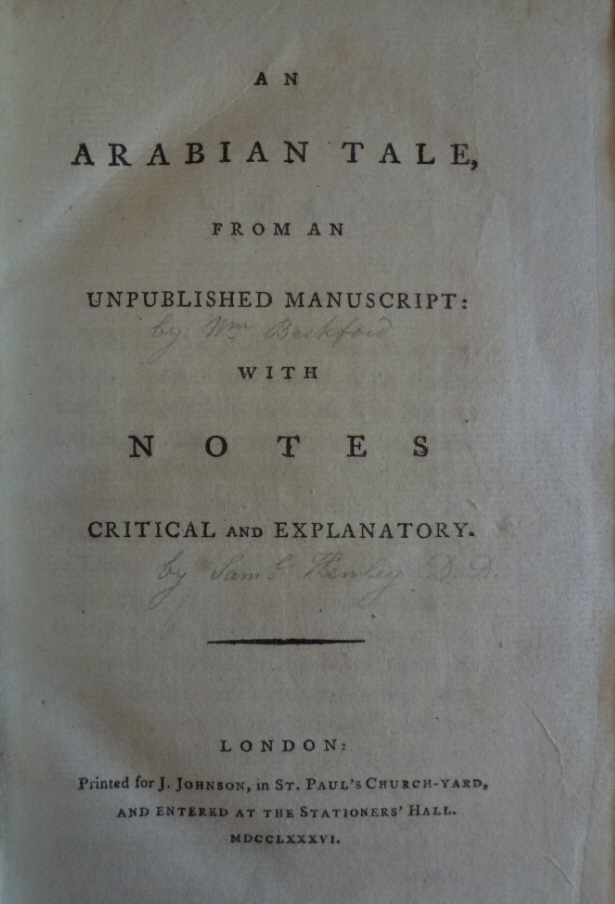
Vathek (alternatively titled Vathek, an Arabian Tale or The History of the Caliph Vathek) is a Gothic novel written by William Beckford. It was composed in French beginning in 1782, and then translated into English by Reverend Samuel Henley[1] in which form it was first published in 1786 without Beckford's name as An Arabian Tale, From an Unpublished Manuscript, claiming to be translated directly from Arabic. The first French edition, titled simply as Vathek, was published in December 1786 (postdated 1787).[2] During the twentieth century some editions include The Episodes of Vathek (Vathek et ses épisodes), three related tales intended by Beckford to be so incorporated, but omitted from the original edition and published separately long after his death.[3]

Key Information

Plot summary

[edit]
Vathek and Giaour, an illustration to William Beckford's Vathek in a late-18th to early–19th century illustration. Giaour is withstanding the angry and perilous glances of Vathek without the slightest emotion, while the courtiers fall prostrate with their faces on the ground.

Vathek[a], the ninth caliph of the Abassides, ascended to the throne at an early age. He is a fickle and depraved tyrant, known for his unquenchable thirst for knowledge, and often invites scholars to converse with him. If he fails to convince the scholar of his points of view, he attempts a bribe; if this does not work, he sends the scholar to prison. To better study astronomy, he builds an observation tower with 11,000 steps. Prophet Muhammad observes Vathek from the seventh heaven, but decides not to punish him, believing that the decadent caliph will bring about his destruction.

A hideous stranger whom Vathek calls "Giaour"[b] arrives in Samarra, claiming to be a merchant from India selling Vathek magical treasures, but refuses to reveal their origin, causing Vathek to throw him in prison. The next day, he discovers that the merchant has escaped and his prison guards are dead. Depressed, Vathek loses his appetite and falls into a drunken stupor. His Greek mother Carathis, a practitioner of Zarathustrianism, arrives to comfort him.

Vathek develops an insatiable thirst, which the giaour later cures and the two men return to Samarra. At court, Vathek makes a fool of himself trying to out-drink the Giaour, and to out-eat him; when he sits upon the throne to administer justice, he does so haphazardly. His prime vizier rescues him from disgrace by whispering that Carathis had read a message in the stars foretelling a great evil to befall him. When Vathek confronts the giaour, he is met with laughter, enraging Vathek who kicks him. The giaour is transformed into a ball and Vathek compels everyone in the palace to kick it. Then Vathek has the whole town kick the giaour into a remote valley. Vathek stays in the area and eventually hears Giaour's voice telling him that if he worships the Giaour and the jinns of the earth, and renounces the teachings of Islam, he will bring Vathek great knowledge and the keys to the "Palace of Underground Fire" where Soliman Ben Daoud controls the talismans that rule over the world.

Vathek agrees and proceeds with the ritual that the giaour demands: to sacrifice fifty of the city's children. In return, Vathek will receive a key of great power. Vathek holds a "competition" among the children of the nobles, declaring that the winners will receive precious gifts. As the children approach Vathek for the competition, he throws them inside an ebony portal where the giaour feasts upon their blood. This enrages the residents of Samarra, who accuse him of murdering their children. Carathis pleads with Morakanabad to help save Vathek's life; the vizier complies and calms the crowd.

Vathek grows impatient with the giaour, and Carathis advises him to fulfill the pact and sacrifice to the jinn of the earth. Carathis helps him prepare the sacrifice: she and her son climb to the top of the tower and mix oils to create an explosion of light. The people of Samarra mistake the smoke rising from the tower for fire and rush to help the caliph, only to be burned alive as Carathis sacrifices them to the jinn. Carathis performs another ritual and learns that for Vathek to claim his reward, he must go to Istakhr.

Vathek sets off with his wives and servants, placing the city in the care of Morakanabad and Carathis. Eventually, they reach the mountains where Islamic dwarves reside. He stays with them and meets their Emir named Fakreddin, and the Emir's beautiful daughter Nouronihar. Vathek wants to marry her, but she is already in love with and promised to her effeminate cousin Gulchenrouz. The Emir and his servants plan to safeguard Nouronihar and Gulchenrouz by drugging them and hiding them in a valley by a lake. The plan succeeds temporarily, but when they awake in the valley, they believe they have died and are in purgatory. Nouronihar grows curious and wants to explore the area. Beyond the valley, she encounters Vathek, who seduces her.

In Samarra, Carathis can discover no news of her son from reading the stars. Vathek's favorite wife, the sultana Dilara, writes to Carathis, informing her that her son has broken the condition of the giaour's contract, by accepting Fakreddin's hospitality on the way to Istakhr. She asks him to drown Nouronihar, but Vathek refuses. Carathis then decides to sacrifice Gulchenrouz, but before she can catch him, Gulchenrouz jumps into the arms of a jinn who protects him. That night, Carathis hears that Motavakel, Vathek's brother, is planning to lead a revolt against Morakanabad. Vathek continues on his journey, reaches Roknabad, and degrades and humiliates its citizens for his pleasure.

A jinn asks Mohammed for permission to try to save Vathek from his eternal damnation, to which he agrees. He takes the form of a saintly shepherd who plays the flute to make men realize their sins. The shepherd asks Vathek if he is done sinning, warns Vathek about the fallen angel Iblis. The shepherd begs Vathek to renounce his wickedness and return to Islam, lest he be eternally damned. In his pride, Vathek rejects the offer and declares that he renounces Islam.

Vathek reaches Istakhr, where the giaour opens the gates, and Vathek and Nouronihar step through into a place of gold. The Giaour leads them to Iblis, who tells them that they may enjoy whatever his empire holds. Vathek asks to be taken to the talismans that govern the world. There, Soliman tells Vathek that he had once been a great king, but was seduced by a Jinn and received the power to make everyone in the world do his bidding. But because of this, Soliman is destined to suffer in hell for a finite but vast period. The other inmates must suffer the fire in their hearts for all eternity. Vathek requests the giaour to release him, saying he will relinquish all he was offered, but the giaour refuses. He tells Vathek to enjoy his omnipotence while it lasts, for in a few days he will be tormented.

Vathek and Nouronihar become increasingly discontented with the palace of flames. Vathek orders an ifrit to fetch Carathis from the castle. While the ifrit is bringing Carathis, Vathek meets some people who are, like him, awaiting the execution of their sentences of eternal suffering. Three relate to Vathek how they got to Iblis' domain.[c] When Carathis arrives, he warns her of what happens to those who enter Iblis' domain, but Carathis takes the talismans of earthly power from Soliman regardless. She gathers the Jinns and tries to overthrow one of the Solimans, but Iblis decrees "It is time." Carathis, Vathek, Nouronihar, and the other denizens of hell lose "the most precious gift granted by heaven – HOPE". They all sink into a state of complete apathy, and an eternal fire begins to burn within them.

Characters

[edit]
Vathek
Ninth Caliph of the Abassides, who ascended to the throne at an early age. His figure was pleasing and majestic, but when angry, his eyes became so terrible that "the wretch on whom it was fixed instantly fell backwards and sometimes expired" (1). He was addicted to women and pleasures of the flesh, so he ordered five palaces to be built: the five palaces of the senses. Although he was an eccentric man, he was learned in the ways of science, physics, and astrology. His chief sin, gluttony, paved the path of his damnation.
Giaour
His name means blasphemer and infidel.[4] He claims to be an Indian merchant, but in actuality he is a Jinn who works for the arch-demon Eblis. He guides Vathek and gives him instructions on how to reach the palace of fire.
Carathis
Vathek's mother. She is a Greek woman who is well versed in science, astrology, and occult magic. She teaches all of her skills to Vathek, and convinces him to embark on his quest for power which eventually leads to his damnation. When arriving in hell, Carathis runs amok, exploring the palace, discovering its hidden secrets, and even tries to stage a rebellion. However, once her own punishment is enacted, she too loses all hope and is consumed by her guilt.
Emir Fakreddin
Vathek's host during his travels. He offers Vathek a place to stay and rest. He is deeply religious. Vathek betrays his hospitality by seducing his daughter.
Nouronihar
The Emir's daughter, a beautiful girl who is promised to Gulchenrouz, but is seduced by Vathek and joins him in his road to damnation.
Gulchenrouz
A beautiful young man with feminine features. He is the Emir's nephew. Due to his innocence, he is rescued from Carathis's hands and is allowed to live in eternal youth in a palace above the clouds.
Bababalouk
Head of Vathek's eunuchs. He is cunning and acts as a steward on Vathek's journey.
Morakanabad
Vathek's loyal and unsuspecting vizier.
Sutlememe
The Emir's head eunuch who serves as a caretaker for Nouronihar and Gulchenrouz.
Dilara
Vathek's favourite wife.

Terms used from history and mythology, as named in the work

[edit]
  • Afrit – described as a creature comparable to the Lamia and Medusa, depicted as the cruelest type of demon (div) in Vathek.[5]
  • Balkis (Balkis in Vathek) (Hebrew: מלכת שבא, Malkat Shva; Ge'ez: ንግሥተ ሳባ, Nigist Saba; (ማክዳ mākidā); Arabic: ملكة سبأ, Malikat Sabaʾ – the woman ruler of the ancient kingdom of Sheba referred to in Habeshan history, the Hebrew Bible, the New Testament, and the Qur'an. She is mentioned (unnamed) in the Bible in the Books of Kings and Book of Chronicles as a great queen who seeks out Solomon to learn if the tales of his wisdom are true. She is also mentioned in Jewish legends as a queen with a great love for learning, in African tales as "the queen of Egypt and Ethiopia", and in Muslim tradition as Balkis, a great queen of a nation that worshiped the sun who later converted to Solomon's god. The Roman historian Josephus calls her Nicaule. She is thought to have been born on 5 January, sometime in the 10th century BC. The character was modelled on Iblis or Azazil and from Satan in John Milton's Paradise Lost's Satan (1667 and 1674; see Fallen angel).
  • Dive – an evil creature, a demon.
  • Eunuch – an emasculated man; the term usually refers to those emasculated to perform a specific social function.
  • Khalif (Caliph in Vathek) (from Arabic خلافة khilāfa) – the head of state in a caliphate, and the title for the leader of the Islamic Ummah, or global Islamic nation. It is a transliterated version of the Arabic word خليفة Khalīfah which means "successor" or "representative". The early leaders of the Muslim nation following Muhammad's (570–632) death were called "Khalifat ar-rasul Allah," meaning political successor.
  • Fortress of Aherman – a reference to the religious figure.[5](p116)
  • Jinn – according to Middle Eastern mythology, they governed the Earth before humans. They are formed of subtler matter than humans and likewise capable of salvation.[5](p101)
  • Layla and Majnun – famous lovers in Middle Eastern legends.
  • Eblis (Arabic إبليس) – lord of the apostate angels, who were cast into the underworld after refusing to bow before Adam.[5](p113)
  • Mount Qaf – a legendary mountain surrounding the Earth.[5](p116)
  • Simurgh – a wise and miraculous bird, friendly towards "the sons of Adam" and an enemy to the divs.

Setting

[edit]

Architecture is used to illustrate certain elements of Vathek's character and to warn of the dangers of over-reaching. Vathek's hedonism and devotion to pleasure are reflected in the pleasure wings he adds on to his castle, each with the express purpose of satisfying a different sense. He builds a tall tower in order to further his quest for knowledge. This tower stands for Vathek's pride and desire for a power beyond the reach of humans. He is later warned that he must destroy the tower and return to Islam, or risk dire consequences. Vathek's pride wins out, and in the end his quest for power and knowledge ends with him confined to hell.[6]

Literary significance and criticism

[edit]

Lord Byron cited Vathek as a source for his poem The Giaour. In Childe Harold's Pilgrimage, Byron also calls Vathek "England's wealthiest son". Other Romantic poets wrote works with a Middle Eastern setting inspired by Vathek, including Robert Southey's Thalaba the Destroyer (1801) and Thomas Moore's Lalla-Rookh (1817).[7] John Keats's vision of the Underworld in Endymion (1818) is indebted to the novel.[8]

Edgar Allan Poe mentions the infernal terrace seen by Vathek in "Landor's Cottage". Stéphane Mallarmé, who translated Poe's poems into French, inspired by this reference in "Landor's Cottage," had Vathek reprinted in its original French, for which edition he also supplied a preface.[9] In his book English Prose Style, Herbert Read cited Vathek as "one of the best fantasies in the language".[10]

H. P. Lovecraft also cited Vathek as the inspiration for his unfinished novel Azathoth.[11] Vathek is also believed to have been a model for Lovecraft's completed novel The Dream-Quest of Unknown Kadath.[12]

American fantasy author Clark Ashton Smith greatly admired Vathek. Smith later wrote "The Third Episode of Vathek", the completion of a fragment by Beckford that was entitled "The Story of the Princess Zulkaïs and the Prince Kalilah". "The Third Episode of Vathek" was published in R. H. Barlow's fanzine Leaves in 1937, and later in Smith's 1960 collection The Abominations of Yondo.[13]

Vathek has been well received by historians of the fantasy genre; Les Daniels stated Vathek was "a unique and delightful book". Daniels argued Vathek had little in common with the other "Gothic" novels; "Beckford's luxuriant imagery and sly humour create a mood totally antithetical to that suggested by the grey castles and black deeds of medieval Europe".[14] Franz Rottensteiner calls the novel "a marvellous story, the creation of an erratic but powerful imagination, which brilliantly evokes the mystery and wonder associated with the Orient"[15] and Brian Stableford has praised the work as the "classic novel Vathek—a feverish and gleefully perverse decadent/Arabian fantasy".[16]

Adaptations

[edit]

George Yeilding MacMahon published his dramatic adaptation of Vathek in 1859.[17]

Major allusions to Vathek

[edit]

Notes

[edit]

References

[edit]

Sources

[edit]
  • Beckford, William, Vathek: The English Translation by Samuel Henley (1786) and the French Editions of Lausanne and Paris (1787, postdated), 1972, Facsimile ed., 3 vols. in 1, Scholars' Facsimiles & Reprints, ISBN 978-0-8201-1102-5.
  • Salah S. Ali: Vathek as a Translation of a Lost Tale from the Arabian Nights.
  • Laurent Châtel, Utopies paysagères: vues et visions dans les écrits et dans les jardins de William Beckford (1760–1844), Université Paris III–Sorbonne Nouvelle (2000), 769 p. 2 vols.
  • Laurent Châtel, "Les sources des contes orientaux de William Beckford" ("Vathek et la 'Suite des contes arabes' "), Epistémé (2005): article online: [1] Archived 23 July 2011 at the Wayback Machine
  • Laurent Châtel, William Beckford – The Elusive Orientalist (Oxford: The Oxford University Studies in the Enlightenment, 2016). ISSN 0435-2866 : William Beckford
  • William Thomas Beckford (1887). Vathek  – via Wikisource.
  • Beckford, William, Vathek et ses épisodes, Préface et édition critique – Didier Girard, Paris, J. Corti, 2003 ISBN 978-2714308078

Further reading

[edit]
[edit]
Revisions and contributorsEdit on WikipediaRead on Wikipedia
from Grokipedia
Vathek is a Gothic written by the English author William Beckford, originally composed in French during a single summer in 1782 and first published in English translation in 1786. The work is presented as an Arabian tale, featuring the caliph Vathek, a tyrannical ruler of whose relentless pursuit of and powers—urged on by his sorceress mother, Carathis—drives him to commit increasingly depraved acts, culminating in his eternal damnation in the subterranean halls of Eblis. Beckford, born into immense wealth in 1760 as the son of a prominent and slave trader, drew upon his fascination with Eastern cultures, gleaned from extensive reading and travels, to craft the novel's exotic settings and motifs inspired by The Arabian Nights. The English edition, translated by Reverend Samuel Henley without Beckford's initial involvement or consent, was issued anonymously in as a supposed rendering from an ancient , a pretense that concealed the author's identity amid his personal scandals, including a high-profile accusation in 1784 that prompted his temporary . Renowned for its blend of Orientalist fantasy, horror, and satirical excess, Vathek explores themes of , corruption, and the perils of unchecked ambition, marking it as a seminal work in the Gothic tradition and a subversive commentary on Enlightenment desires. Beckford later expressed pride in the as "the only production of mine which I am not ashamed of," distinguishing it from his other suppressed or unfinished writings. Its vivid depictions of opulent palaces, demonic pacts, and infernal punishments have influenced subsequent , including works by and , cementing its status as a cornerstone of fantastical fiction.

Background and Publication

Authorship and Composition

William Beckford (1760–1844) was an English writer, traveler, and art collector born into immense wealth as the only legitimate son of William Beckford, a prominent Jamaican plantation owner, , and . Educated privately at the family estate in Fonthill, , he mastered multiple languages, including Persian and , studied music under as a child, and undertook an extensive Grand Tour of from 1777 to 1780, visiting , , , , and . These experiences deepened his fascination with exotic cultures, particularly Oriental tales like those in the Arabian Nights and the intricate details of , which he encountered through travel, readings, and his burgeoning collection of Eastern artifacts. Beckford began composing Vathek in French during the summer of 1782 at Fonthill Splendens, his family's Gothic in , originally titling the work "Vathek, histoire orientale." In his own recollection, he completed the core narrative in a feverish burst of inspiration over three days and two nights, a claim echoed in contemporary accounts, though modern analysis suggests the full draft spanned several months from January to May 1782, with possible final revisions in early 1783. The novel's creation reflected Beckford's personal motivations, blending his enthusiasm for Gothic excess and supernatural motifs with Orientalist fantasies drawn from his scholarly interests and imaginative escapism amid growing social scrutiny. These pressures intensified shortly after, culminating in the 1784 Powderham Castle scandal involving rumored improprieties with a young nobleman, which prompted his self-imposed exile to continental Europe and Portugal for much of the following decade. The initial handwritten manuscript, preserved in Beckford's own script, consisted solely of the main tale without the supplementary Episodes of Vathek, which he conceived and drafted later in the 1780s but did not publish during his lifetime.

Publication History

Vathek first appeared in print through an unauthorized English translation by Reverend Samuel Henley, published in in June 1786 under the title An Arabian Tale, From an Unpublished Manuscript, with a false claim that it was translated from an ancient original to heighten its exotic appeal. Beckford had shared the French manuscript with Henley for translation but explicitly instructed him not to publish it, a directive Henley ignored, leading to a complete break in their correspondence. This edition concealed Beckford's authorship entirely, attributing the work instead to an anonymous Oriental source, which fueled initial perceptions of it as an authentic Eastern tale amid the era's Orientalist fascination. In response to Henley's betrayal, Beckford rushed the publication of his original French manuscript, titled simply Vathek, which appeared in and in late 1786 (postdated 1787), marking the first revelation of his authorship. However, Beckford initially distanced himself from the work publicly due to the personal scandals surrounding him, including a accusation that had forced him into exile in , prompting him to avoid further notoriety. The French editions were actually back-translations from Henley's English version rather than the pure original manuscript, introducing textual discrepancies that sparked ongoing scholarly debates. Henley's translation included notable additions and alterations, such as expanded footnotes and moralistic interpolations not present in Beckford's text, which some critics viewed as diluting the original's fantastical intensity and imposing Victorian-era sensibilities. These variants, along with the unauthorized release, created controversies over textual authenticity, with Beckford later decrying the edition as a of his vision. The 1815 London edition by William Clarke finally printed Beckford's unaltered French original verbatim, accompanied by his own acknowledging authorship and providing for the work's composition. In the twentieth century, editions began incorporating The Episodes of Vathek, the supplemental tales Beckford wrote later but left unpublished during his lifetime, often integrating them as intended appendices to the main narrative. Modern scholarly editions, such as the 2001 Broadview Press version edited by Kenneth W. Graham, feature revised translations of the Episodes alongside the 1823 English text—the last edition Beckford personally oversaw—along with addressing textual history and variants. These developments reflect a broader effort to restore Beckford's complete vision, resolving earlier controversies through comparative analysis of manuscripts. The publication of Vathek occurred against the backdrop of late eighteenth-century England's Gothic novel surge and rising interest in Oriental tales, genres that blended horror with exotic settings to captivate readers seeking escapist thrills. Henley's sensational framing capitalized on this trend, positioning the work as a mysterious import that aligned with the period's cultural appetite for the "Arabian" fantastic, even as it obscured its true European origins.

The Episodes of Vathek

In the years immediately following the composition of Vathek in 1782, William Beckford drafted a series of supplemental tales known as the Episodes of Vathek, intended as infernal sequels to be interpolated into the novel's climactic scenes in the palaces of Eblis. These episodes feature damned souls recounting their lives of excess and moral transgression, emphasizing themes of decadence, perversion, and inevitable eternal punishment as a cautionary extension of the caliph's downfall. Beckford envisioned them as interwoven narratives in the style of The Arabian Nights, serving to expand the hellish realm's depiction through standalone Eastern tales that illustrate the consequences of unchecked ambition and passion. The episodes consist of three principal stories, each framed as confessions from Vathek's fellow sufferers in perdition. In "The Story of Prince Alasi and the Princess Firouzkah," the titular prince of Kharezme forms a passionate bond with the disguised princess, leading them through trials of jealousy, war, and Zoroastrian rituals guided by a mage; their pursuit of eternal love culminates in betrayal and descent into a fiery underworld of mutual hatred and despair. "The Story of Prince Barkiarokh" follows the rise and fall of a greedy protagonist—depicted variably as a fisherman's son or Daghestani prince—who amasses power through supernatural aids like a magical ring or a peri named Homaiouna, only to commit murders within his family and suffer torment after losing his daughter Leilah to the abyss. The third, "The Story of the Princess Zulkais and the Prince Kalilah," explores an incestuous sibling attachment fostered by magical rites, severed by their father's ambitions; Zulkais's quest through a perilous labyrinth to reunite with Kalilah invokes jinn and spirits like Omoultakos, ending in tragic separation and supernatural retribution. These narratives highlight perversion through motifs of forbidden desire, deceit, and invocation of otherworldly forces, mirroring yet amplifying the novel's critique of hubris. Unlike the main novel's continuous picaresque structure centered on Vathek's journey, the episodes adopt a shorter, fragmented format suited for insertion as anecdotal vignettes within the hellish tableau, lacking a unified or overarching quest. Beckford abandoned their integration during his lifetime, possibly due to the unauthorized English publication of Vathek, and they remained unpublished until their discovery among the manuscripts. The tales first appeared in a bilingual French-English edition in , translated by Sir Frank T. Marzials with an introduction by Lewis Melville, over sixty years after Beckford's death in 1844. The episodes were absent from early editions of Vathek, which focused solely on the core , but gained prominence in twentieth-century scholarly to provide a more complete vision of Beckford's original design. Notable inclusions appear in the 1929 Constable edition edited by Guy Chapman, the 1995 Dedalus European Classics reprint, and the 2001 Broadview Press edition, which restores them in Beckford's planned sequence following the 1823 French text of the novel. These modern compilations underscore the episodes' role in enhancing the work's infernal scope, offering readers insight into Beckford's sustained Oriental-Gothic sensibilities amid his reclusive later years at .

World and Setting

Geographical and Architectural Elements

The primary setting of Vathek is the 8th-century city of Samarah (modern-day Sāmarrā), located upriver from along the River in present-day , where the opulent Palace of Alkoremmi serves as the central hub of Caliph Vathek's tyrannical rule. This sprawling complex, originally constructed by Vathek's father, Motassem, dominates a hill overlooking the city; Vathek expanded it by adding five distinct wings, each dedicated to one of the human senses, exemplifying the caliph's indulgence in sensory excess. The Hall of the Eternal or Unsatiating Banquet caters to taste with endless feasts; the Temple of Melody, or Nectar of the Soul, to hearing through perpetual music; the Delight of the Eyes, or Support of Memory, to sight with dazzling visual spectacles; the Palace of Perfumes, or Incentive to Pleasure, to smell via aromatic gardens; and the Retreat of Joy, or the Dangerous, to touch with thrilling yet perilous entertainments. At the heart of the palace rises an iconic observation tower with 11,000 steps, which Vathek built to facilitate his stargazing pursuits and quest for forbidden astronomical knowledge, its spiraling height evoking both architectural grandeur and the caliph's overreaching ambition. This structure, inspired by the minaret of the , underscores the novel's blend of historical Islamic architectural motifs with exaggerated fantasy. As the narrative progresses, the settings shift to the vast deserts surrounding Samarah, where Vathek embarks on arduous travels, culminating at the mythical Mount Caf—a towering, remote peak symbolizing the boundary between the earthly and realms. The journey leads to the ancient ruins of (or Istakar), an underground palace in Persia characterized by roofless watchtowers, colossal leopard-griffin statues guarding its entrance, and halls illuminated by eternal flames, representing a descent into infernal isolation. The architectural elements draw from William Beckford's deep engagement with Orientalist sources, incorporating Persian and Indian motifs such as intricate colonnades, domed structures, and sensory pavilions, though fantastical elements like the endless subterranean arcades amplify their scale beyond reality. These designs reflect Beckford's scholarly immersion in Arabian tales and European interpretations of Eastern , rather than direct . Throughout the novel, the geographical and architectural features mirror Vathek's moral decay, with the initial opulence of Samarah's palaces contrasting the barren isolation of the deserts and the fiery torment of , symbolizing the consequences of unchecked tyranny and . This interplay between lavish exteriors and underlying desolation heightens the thematic tension between excess and downfall.

Mythological and Historical Influences

Vathek draws heavily from Islamic and pre-Islamic Arabian mythology, incorporating supernatural entities such as , which are invisible spirits created from smokeless fire according to Quranic tradition, often depicted as capable of both benevolence and malevolence. In the novel, embodies this archetype as a tempter jinn dispatched by Eblis, the Islamic counterpart to and who refused to bow to , serving as the chief of rebellious jinn and ruler of the infernal realms. Afrits, powerful and rebellious jinn subtypes known for their strength and hostility in Persian and Arabian , appear as terrifying demons under Eblis's command, evoking dread through their association with fire and chaos. Historical elements are rooted in the Abbasid Caliphate of the 8th and 9th centuries, with Vathek portrayed as the ninth caliph in the lineage of Haroun al-Rashid, the renowned Abbasid ruler whose courtly splendor and patronage of arts and sciences inspired tales of opulence and intrigue. The narrative nods to the 8th-century Abbasid era through depictions of grand palaces, eunuch-led harems, and theological debates, reflecting the historical caliph al-Wathiq (r. 842–847 CE), grandson of Haroun al-Rashid, whose reign involved cultural flourishing amid political tensions. Figures like Balkis, the Arabian name for the Queen of Sheba from Quranic and biblical lore, symbolize ancient wisdom and exotic allure, while Soliman—representing King Solomon—possesses magical rings and talismans that command jinn and control natural forces, drawn from Islamic traditions of his dominion over pre-Adamite spirits. Mythological sources include Antoine Galland's French translation of the Arabian Nights (1704–1717), which popularized tales of , afrits, and enchanted treasures, blending them with Persian folklore elements like demonic hierarchies and quests from texts such as the . The Quran provides foundational motifs, such as Eblis's rebellion ( 7:11–18) and Solomon's command over ( 27:17), adapted into the novel's infernal palaces and pacts. Beckford employs these in an Orientalist framework, merging authentic terms with imaginative inventions to heighten Gothic horror, such as the Giaour's role as a seductive spirit leading Vathek to . Specific examples illustrate this fusion: the of fifty children at a chasm, demanded by to unlock subterranean treasures, echoes ancient Near Eastern rituals of blood offerings to underworld deities while amplifying the caliph's moral descent. Talismans and inscribed sabres attributed to Soliman, which shift inscriptions to reveal hidden powers, derive from Solomonic lore in Islamic , where such artifacts subjugate , but Beckford twists them into instruments of temptation and terror. Through these, Beckford evokes a sense of exotic wonder laced with dread, portraying an where historical grandeur intersects with peril.

Narrative and Characters

Plot Summary

Vathek, the ninth Caliph of the race of the Abassides, rules tyrannically over Samarah, indulging his whims through five opulent palaces dedicated to each of the senses, while his mother Carathis schemes from her nearby tower. Dissatisfied with earthly power, Vathek orders the construction of a massive tower in Samarah to ascend into the heavens and unlock cosmic secrets, employing genii and slaves in the laborious project despite warnings of divine displeasure. A mysterious Indian stranger, later revealed as , arrives bearing ten swords inscribed with shifting talismanic characters that promise access to treasures, captivating Vathek's ambition. Imprisoned for refusing to explain the inscriptions, escapes through means, prompting Vathek, with Carathis's aid, to offer vast rewards for their decryption; an elderly man partially succeeds but warns of peril, only to be executed in Vathek's rage. reappears, offering a to cure Vathek's ensuing illness in exchange for a pact, and demands the of fifty young boys to open a portal to the subterranean realms, which Vathek enacts by deceiving his subjects into surrendering their children. When the portal fails to open fully, public outrage erupts into , forcing Vathek and Carathis to retreat to her tower, where she performs necromantic rituals involving , serpents, and infernal invocations to summon guidance. A materializes, directing Vathek to renounce , obey unquestioningly, and journey to the ruins of to claim the treasures of the kings, with eternal torment as the penalty for disobedience. Amid this, Vathek encounters Nouronihar, the beautiful and ambitious daughter of the Fakreddin, during a visit to his valley; smitten, he disrupts her betrothal to the gentle Gulchenrouz and elopes with her, pursued by Carathis's further machinations. The narrative unfolds across nine principal chapters, interspersed with episodic tales of encountered along the way, such as the who aids Vathek but faces his own , mirroring the structure of a into infernal realms. Vathek, Nouronihar, and their retinue endure a grueling journey through deserts and mountains to , ignoring prophetic warnings from benevolent genii and a shepherd's counsel, as 's invisible presence urges them onward. Upon reaching the ancient ruins, they confront omens and enter a hidden chasm leading to vast subterranean halls adorned with jewels and automata, where reveals himself as a fallen spirit. In the palace of Eblis, the prince of darkness, Vathek and Nouronihar are admitted as devotees of the eternal fire, only to learn from tormented rulers like Soliman Ben Daoud that all aspirants to suffer ironic punishments: Vathek's feet are consumed by flames for his restless wandering, Nouronihar's eyes burn for her covetous gaze, and Carathis, arriving later, is eternally pursued by vengeful mummies. Their hearts ignite in perpetual agony, dooming them to wander the fiery halls forever, regretting their pact as seal behind them.

Major Characters

Vathek, the ninth Caliph of the Abassides, is depicted as a figure of majestic stature and pleasing appearance, yet marked by a volatile temper and insatiable curiosity for . Ascending the throne at a young age, he rules from Samarah with a blend of and , indulging in extravagant pleasures while constructing opulent palaces to satisfy his sensual appetites. His pride and impiety drive him to pursue supernatural powers, often manifesting in rage that renders one of his eyes unbearable to behold, underscoring his tyrannical disposition. Carathis, Vathek's mother, embodies ruthless ambition and intellectual superiority, wielding her skills in , , and persuasion to manipulate those around her. A sorceress of Greek descent who isolates herself in a tower filled with poisons and artifacts, she lacks any moral scruples and actively encourages her son's descent into wickedness, viewing infernal alliances as a path to dominance. Her dauntless and unrepentant nature positions her as a corrupting familial influence, prioritizing power over . The Giaour serves as an enigmatic tempter, a hideous jinn-like figure with ebony skin, glowing eyes, and a ghastly laugh that instills terror. As a blasphemous outsider—his name signifying "infidel"—he arrives bearing magical curiosities to lure Vathek toward damnation, demanding child sacrifices in exchange for promises of esoteric secrets. His role as a satanic deceiver highlights themes of infernal deception, remaining aloof and manipulative throughout his interactions. Nouronihar, the beautiful and intelligent daughter of Fakreddin, possesses a spirited and ambitious personality, often described as sprightly as an with radiant eyes that convey both allure and conflict. Seduced by Vathek's grandeur, she becomes his romantic companion, her own desires for power mirroring his and leading her to forsake prior attachments. Her development reveals a vengeful and resilient streak, entangled in the caliph's fateful pursuits. Among supporting figures, Fakreddin stands as a pious and hospitable , punctiliously religious and protective of his family, offering a to Vathek's excesses through his devout lifestyle in a secluded . Gulchenrouz, Nouronihar's delicate and innocent young , embodies poetic purity and , his gentle nature and deep affection contrasting sharply with the caliph's brutality. Bababalouk, the chief , functions as a loyal yet pragmatic overseer of the , blending vigilance with humor in managing palace intrigues and enduring his master's whims. These dynamics underscore familial manipulations between Vathek and Carathis, romantic tensions involving Nouronihar, and stark oppositions between the pious supporters and the ambitious protagonists.

Themes and Literary Analysis

Key Themes and Motifs

One of the central themes in Vathek is and the pursuit of , portrayed through the caliph's construction of a towering edifice to rival the heavens and his subsequent pacts with demonic entities, which echo Faustian bargains and inevitably lead to spiritual ruin. Vathek's insatiable ambition drives him to sacrifice fifty children to in exchange for esoteric secrets, underscoring the destructive consequences of overreaching human limits. This motif is reinforced by the novel's depiction of the tower as a to pride, symbolizing the caliph's defiance of divine order and culminating in his eternal damnation. Orientalist permeates the narrative, presenting the sensual and opulent East as a of excess where for its grandeur intertwines with of its perceived laxity, particularly in relation to Islamic cultural elements reimagined through a Western lens. Beckford blends lavish descriptions of palaces dedicated to the five senses with undercurrents of degeneracy, subverting simplistic stereotypes by incorporating pious figures like Emir Fakreddin while highlighting Vathek's tyrannical deviations from Islamic norms. This dual portrayal serves as a site for exploring cultural "otherness," where the becomes a for Gothic and cautionary excess. Moral ambiguity and perversion are evident in the characters' embrace of , , and hedonistic pursuits, which are ultimately punished through ironic reversals in the infernal halls of Eblis. Vathek and his mother Carathis exemplify this through their necromantic and unrestrained desires, blending horror with comedic undertones that blur clear ethical boundaries and reflect a perversion of into power-seeking. The episodes extending into amplify these reckonings, where the caliph's victims confront him with their sufferings, enforcing a twisted that underscores the novel's exploration of ethical complexity. Recurring motifs further illuminate these themes, with fire symbolizing both desirous passion and punitive torment, as seen in Vathek's eternally burning heart in damnation. Architecture functions as a emblem of hubristic pride, from the sensory palaces evoking fleeting luxury to the labyrinthine infernal realms that trap the ambitious. Gender roles are subverted through Carathis's commanding occult influence, challenging passive stereotypes of Eastern women and highlighting female agency in moral transgression. The narrative also incorporates satire on tyranny, critiquing absolute rule via Vathek's capricious governance and extravagant indulgences, which parody the excesses of despotic power and invite reflection on the fragility of unchecked authority. Through these elements, Vathek weaves a tapestry of cautionary motifs, integrating the episodic structure to extend moral ironies into the afterlife.

Style and Genre Influences

Vathek represents a genre hybrid, blending elements of the Gothic novel with an Oriental framework, which predates the full emergence of the Gothic boom in English literature during the 1790s. Written originally in French by William Beckford in 1782 and first published in English translation in 1786, the novel draws heavily from the exotic storytelling traditions of The Arabian Nights, incorporating tales of caliphs, jinn, and supernatural quests, while infusing them with Gothic motifs of horror, moral decay, and infernal punishment. This fusion is evident in its depiction of despotic ambition leading to damnation in underground realms, marking it as an early example of Oriental Gothic. Additionally, satirical influences from Voltaire's works are apparent in the novel's mockery of religious piety and authoritarian excess, using hyperbolic exaggeration to critique both Eastern despotism and Western indulgences. The style of Vathek features lavish, hyperbolic in its French original, characterized by dazzling descriptions of opulent palaces, gardens, and infernal landscapes that evoke sensory excess and visual splendor. Beckford's , rich in exotic detail, employs an episodic structure interspersed with digressions, such as the appended "Episodes of Vathek," which expand on peripheral characters and subplots, creating a fragmented yet immersive reminiscent of frame tales in The Arabian Nights. The English translation by Samuel Henley adopts an archaic , with pseudo-Elizabethan phrasing like "" and inverted , to enhance the tale's Oriental mystique and antiquity, though this sometimes borders on parody. The narrative voice in Vathek is ironic and omniscient in the third person, masterfully blending horror with humor and lavish exotic descriptions to underscore the of unchecked desire. This voice often ridicules its characters' pretensions through cruel , as seen in portrayals of the caliph's vain pursuits and the Giaour's demonic temptations, veering between terrifying encounters and satirical jabs at . Such techniques innovate early fantasy elements, including jinn-like spirits and vast underground domains of torment, while the visual opulence reflects Beckford's personal as an art collector and builder of extravagant estates like . As a precursor to Romantic , Vathek influenced later writers like and by popularizing exotic, despotic settings and themes of forbidden knowledge, evident in Byron's Turkish Tales such as (1813), which echo Vathek's ironic use of the "evil gaze" and supernatural otherness. Shelley's works, too, draw on its blend of Gothic terror and allure, contributing to the Romantic fascination with the as a realm of sublime excess and moral ambiguity.

Critical Reception and Significance

Upon its publication, Vathek garnered significant admiration from prominent 19th-century literary figures for its exotic fantasy elements and atmospheric intensity. , a key Romantic poet, explicitly praised the novel and drew inspiration from it for his own work (1813), incorporating similar Oriental motifs of vengeance and the supernatural. was similarly influenced, as evidenced by echoes of Vathek's themes of and ruin in his poem (1818), reflecting the novel's impact on Romantic explorations of power and decay. also expressed admiration for its blend of horror and opulence, viewing it as a model for his own tales of the . Later in the century, hailed Vathek as "a classic of the demoniac" in his essay (1927), commending its "haughty luxury, sly disillusion, bland cruelty, urbane treachery, and shadowy spectral horror" as evocative of otherworldliness. In the 20th century, scholars positioned Vathek as a pioneering work in Gothic literature, emphasizing its innovative fusion of supernatural dread with lavish Oriental settings, which distinguished it from earlier Gothic novels like The Castle of Otranto. Marxist and postcolonial readings, particularly after Edward Said's Orientalism (1978), reframed the novel through the lens of Western , critiquing its portrayal of the East as a site of sensual excess and moral corruption that justified imperial domination. These interpretations highlighted how Beckford's text perpetuated stereotypes of while subtly exposing the hypocrisies of European . Recent scholarship since 2020 has deepened analyses of Vathek's moral ambiguity, portraying the caliph's downfall not as straightforward but as a complex interrogation of ambition and , blending Faustian with Gothic consequences. Studies from emphasize the novel's Gothic-Oriental fusion, where infernal landscapes and temptations reinforce ideological divides between a "degenerate" East and "civilized" West, often through stereotyped female figures like Nouronihar. Emerging readings also explore undertones linked to Beckford's own marginalized sexuality, interpreting the text's homoerotic tensions and non-normative desires as veiled critiques of 18th-century heteronormativity. The novel's enduring significance lies in its role as a bridge between Enlightenment satire—mocking rational and sensual indulgence—and Romanticism's fascination with the sublime and the irrational. By exoticizing the as a realm of unchecked desire, Vathek critiques imperialism's cultural underpinnings, denouncing commercial exploitation and colonial fantasies through ironic depictions of Eastern opulence that mirror European excesses. This dual-layered approach has sustained scholarly interest, though gaps persist in examining the Episodes alongside modern debates.

Legacy and Adaptations

Influences on Later Works

Vathek's portrayal of and entities exerted a notable influence on Romantic literature, particularly in Lord Byron's 1813 poem , where the jinn motif is borrowed to evoke themes of vengeance and otherworldly intervention. Byron's admiration for Beckford's work is evident in his references to Vathek as a pinnacle of imaginative excess, shaping the Orientalist elements in his own Oriental tales. In the realm of modern horror, drew directly from Vathek for his unfinished novel , citing its demonic quests and infernal palaces as inspirations for cosmic horror narratives that emphasize humanity's insignificance against vast, malevolent forces. This influence extends to Lovecraft's broader mythos, including elements in "," where the novel's blend of exoticism and existential dread informs the portrayal of ancient, indifferent entities beyond human comprehension. Vathek's hyperbolic style and decadent fantasy elements resonated in the weird fiction of , whose Zothique cycle echoes the novel's ornate, doom-laden atmospheres and supernatural opulence, adapting its Oriental Gothic motifs into a framework of cosmic decay and exaggerated splendor. , in his 1943 essay on Vathek, highlighted its labyrinthine structures and sensory palaces as precursors to his own explorations of infinite, maze-like realities, influencing the metaphysical puzzles and cultural allusions in works like . Twentieth- and twenty-first-century postcolonial scholarship frequently cites Vathek as a seminal text for critiquing , analyzing its exoticized portrayal of the East as a site of demonic sensuality and excess that reinforces Western stereotypes of Eastern barbarism and allure. Scholars examine how the novel's blend of Gothic horror and Eastern motifs perpetuates a binary of civilized West versus decadent , influencing discussions of imperial gaze in Romantic literature.

Adaptations and Allusions

One of the earliest adaptations of Vathek was a theatrical rendition in the form of a dramatic poem titled Vathek, a Dramatic Poem (Founded on the 'Vathek' of Beckford), published by George Yeilding MacMahon in 1859. This work reimagines the novel's Orientalist fantasy and moral downfall in verse, emphasizing the caliph's into infernal temptation through poetic and scenes of revelry turning to despair. In visual media, Vathek received a modern adaptation by Swiss artist and writer Patrick Mallet, published in French by Glénat in 2006 as part of the Carrément BD collection. The 56-page comic faithfully captures the novel's gothic-Oriental atmosphere, depicting Vathek's palace intrigues and journey to the underworld with intricate illustrations of opulent settings and supernatural horrors. Illustrated editions of the text have also appeared, such as the version featuring artwork by Mahlon Blaine, which highlights the story's exotic and elements through detailed engravings. Audio adaptations include full audiobook narrations, such as the 2023 YouTube release of The History of the Caliph Vathek as a complete reading, providing accessible entry into Beckford's tale for contemporary listeners. Additionally, radio dramatizations exist in , notably a 1957 Third Programme adaptation scripted and produced by Rayner Heppenstall, which condenses the narrative into a broadcast format emphasizing its dramatic tension and supernatural motifs. No major feature films or television series directly adapt Vathek, though its gothic themes of ambition and damnation appear in allusions within horror anthologies, evoking similar tales of and infernal realms. The novel's influence extends indirectly to gothic aesthetics in cinema, such as the stylized underworlds and moral critiques in Tim Burton's films like Beetlejuice (1988) and (2005), which echo Vathek's blend of whimsy and horror without explicit reference. Cultural allusions to Vathek appear in video games, where the name "Vathek" often denotes malevolent entities or accursed domains, drawing from the caliph's tyrannical and demonic associations. For instance, in Skylanders: Spyro's Adventure (2011), Vathek is portrayed as an undead dragon antagonist guarding a perilous realm, mirroring the novel's infernal palace motifs in RPG-style gameplay. Similarly, Zin Vathek in the Trails series (beginning 2004) serves as a formidable senior bracer and martial artist in expansive fantasy narratives. In media studies, Vathek features prominently in critiques of Orientalism, analyzing its portrayal of Eastern excess as a lens for Western anxieties about desire and empire, as explored in scholarly works on gothic literature's imperial undertones. Adaptations of the novel's supplementary Episodes of Vathek—additional hellish tales written by Beckford—are rare and typically integrated into broader editions rather than standalone works. These episodes appear in combined audiobooks and , such as the Broadview Press edition () that pairs them with the main text for contextual depth, occasionally featured in extended audio releases to illustrate the damned souls' eternal torments.

References

Add your contribution
Related Hubs
User Avatar
No comments yet.