Hubbry Logo
Ginetta CarsGinetta CarsMain
Open search
Ginetta Cars
Community hub
Ginetta Cars
logo
8 pages, 0 posts
0 subscribers
Be the first to start a discussion here.
Ginetta Cars
Ginetta Cars
from Wikipedia

Ginetta Cars Limited is a British specialist builder of racing and sports cars based in Garforth, Leeds, West Yorkshire.

Key Information

History

[edit]

20th century

[edit]

Ginetta was founded in 1958 by four Walklett brothers (Bob, Ivor, Trevers and Douglas) in Woodbridge, Suffolk.[1] The first car was built in 1957 and subsequently became known as the Ginetta G1; it was based on a pre-war Wolseley Hornet six.[2] The first car built was the 1958 Ginetta G2, a cycle-fendered "special" using Ford 10 HP mechanicals. The Walklett Brothers briefly also offered a kit car body called the Fairlite, a glass-fibre body shell priced at £49 for fitting to a Ford 8 or 10 HP chassis.[3]

The four Walklett brothers each had their areas of expertise: Bob was the managing director, Douglas was the mechanical engineer and also handled the electrical work, Ivor was the designer and Trevers was the stylist, working closely with Ivor.

From their original base, the company moved to Witham, Essex, in 1962, and between 1972 and 1974 operated from larger premises in Ballingdon Street adjacent to the railway bridge Sudbury, Suffolk, before returning to Witham. In 1988, the Walklett brothers needed bigger premises and so moved the company to Scunthorpe where they could expand. On 7 November 1989, the Walkletts sold Ginetta to an international group of enthusiasts, based in Sheffield and run by managing director Martin Phaff. Ginetta was in a strong financial position at the time of its sale and the Walkletts went on to retire.

Under Phaff, the company went on to produce the Ginetta G20 and the Ginetta G33. It was during this period that the company hit troubled times. After selling Ginetta, brothers Trevor and Ivor Walklett went on to form a new company called Design And Research Engineering (DARE) with the intent of manufacturing new copies of some of Ginetta's old designs, like the G4 and G12 – for which there were considerable demand, particularly in Japan.[4] In 1994, Ginetta's Swedish importer Ingemar Engström formed a company for manufacturing a Volvo-engined version of the G34 there, called Gin1Car AB (pronounced "ginett car" in Swedish). Production did start in 1997, but ended the following year.

21st century

[edit]

In late 2005, Ginetta was acquired by LNT Automotive, a company run by racing car driver, engineer and businessman Lawrence Tomlinson.[5]

In mid-2007, Ginetta moved to a factory near Leeds, with a target to sell 200 cars per year. Tomlinson himself penned the base specification for the Ginetta G50, which marked 50 years of Ginetta production and became a successful GT4 car.

In March 2010, Ginetta acquired the Somerset-based sports car manufacturer Farbio, and re-badged their car as the Ginetta F400. In March 2011, Ginetta launched the G55, which competed in the Michelin Ginetta GT Supercup and was built to comply to the GT3 class regulations. In October 2011, Ginetta launched the G60, a two-door mid-engine sports car developed from the F400 and powered by a Ford-sourced 3.7-litre V6 engine.[6]

In 2017, Ginetta acquired Blyton Park test circuit near Gainsborough, Lincolnshire, as a proving track to help develop road and race models.[7]

In 2021 the Ginetta G56 was launched.

Models

[edit]

Models produced by Ginetta include the following:

G2

[edit]
1958 Ginetta G2 at NEC 2018

Ginetta's first car, the G2, was produced as a kit car for enthusiasts and consisted of a tubular frame chassis to take Ford components and aluminium body. About 100 were produced.

G3 and G4

[edit]

The glass fibre-bodied G3 arrived in 1959 and was succeeded by the G4 in 1961.[8] Unlike Ginetta's earlier efforts, the G4 could also be used as an everyday car while remaining competitive in motorsports. Production stopped in 1968 after about 500 had been built, but was revived in 1981 with the Series IV which was 2 in (51 mm) wider and 3 in (76 mm) longer than the III; production of this version ended in 1984.[9]

G10 and G11

[edit]
Ginetta G10 with James Guess at the wheel, Goodwood Members Meeting 2017

Launched at the 1965 Racing car show, the Ginetta G10 was meant to be a more powerful racing car than its predecessors. Weighing around 2,000 lb (900 kg) and fitted with a 289 cu in (4.7 L) V8 engine from the Ford Mustang, it was well received by the enthusiasts. Ginetta works driver Chris Meek secured a win with a prototype at the car's debut at Brands Hatch, beating a Jaguar E-Type which was considered to be the most successful GT racing car. However Ginetta failed to make a homologated version of the G10 in order for it to keep competing and as a result, it was forced out of the competition with a total production of only three cars. Following the reception the G10 had generated, Ginetta produced the G11, a street legal version of the G10 with the same body but with the Ford V8 replaced by the MGB 1800 engine. However, slow deliveries of the engine curbed production of the car and therefore only a handful were made.[10]

G12

[edit]
Ginetta G12

Unveiled in 1966, the G12 was an evolution of the G4 but had many new features that made it stand apart from its predecessors. The car had a new tubular steel space frame chassis, with the cockpit section mounted to it for extra strength, while removable body work allowed for easy repair. The front suspension consisted of Triumph-derived uprights and double wishbones (with camber adjustment courtesy of rose-joints on the upper items) and coil springs. While, at the rear, the usual arrangement of single upper transverse links with lower reversed wishbones (with rose-joints) and radius arms was present, along with coil springs. The car was fitted with anti-roll bars for increased safety, and the Triumph-sourced Girling disc brakes at the front and rear ensured increased stopping power. Power came from a 1.0-litre Cosworth SCA inline-four engine, though larger engines were fitted later such as an Aston Martin V8, but were less successful. The G12 dominated the competition in its class, outclassing Lotus Elan 26Rs and Coventry Climaxes, winning the 1,150 cc MN series. Outside track racing, the G12 also found success at hill climb events, before it was replaced by the G16. Approximately 28 were built, though at least 1 was converted into the Jerboa SP.[11]

G15

[edit]
1969 Ginetta G15

In 1967 the G15, utilizing a rear-mounted 875 cc Sunbeam Imp engine, was launched.[12] This two-seat coupé had a glass fibre body bolted to a tube chassis and used Imp rear and Triumph front suspension. Approximately 800 were produced from 1967 to 1974[12] and the car was fully type approved allowing for complete Ginetta cars to be sold for the first time. Eight G15s were produced with Volkswagen engines and called "Super S".

G16

[edit]
Ginetta G16

The G16 was produced as a Group 6 sports-racer in 1968-1969.[13] Buyers installed engines of choice; known fitments include BRM, Coventry Climax, Cosworth FVA and BMW units of 2 litres capacity.[13] Ten examples were built, but it did not prove particularly successful in competition.[13]

G19

[edit]

The G19 was a single seater Formula 3 racing car of which only one was produced.

G20

[edit]
2005 Ginetta G20

Appearing in 2001 the G20 was a light racing car, similar to the earlier G27 which it gradually replaced.[14] It competed in the Ginetta Championship single-make racing series; about 200 examples were built. The G20 was cheapier and easier to build than the G27, lacking doors and various other items required in a street-legal car.[14] "G20" was also the name for a projected single-seat Formula 1 racer with a BRM V12 engine; the name was also considered for a V6-engined road car discussed in the 1970s.[15]

G21

[edit]
1974 Ginetta G21

In 1970, the G15 was joined by the larger G21, which was initially available with either a four-cylinder, 1.7-litre sourced from the Rootes Group (Sunbeam) or a 3.0-litre Ford Essex V6 engine. The car largely used Rootes components.[16] The 1.7-litre Sunbeam Rapier engine subsequently became the standard four-cylinder engine for the car. 80 cars in total were produced before production ceased in 1974 due to the oil crisis. The car was later morphed into an open top G23 and G24 coupé version but none of those variants went to production.

GRS Tora

[edit]

Trevor Walklett owned a 1968 Hillman Hunter which had been put up due to rust.[17] Inspired by the success of the Dutton Sierra estate kit car, Ginetta developed a Range Rover-inspired fibreglass station wagon body for installation onto the Hunter's underpinnings. Called the GRS Tora Mark I it was first shown in October 1982, going on sale the next year. Although it was a two-door estate, it used the front doors of a four-door Hunter. These are shorter than a normal two-door design, leading to limited rear seat access and somewhat awkward proportions. More troubling was that the Hunter's fuel tank and filler location meant that the rear gate opening was very high, limiting the cars utility. In October 1983, a GRS Tora Pickup was shown.[18] In August 1984, the GRS Tora Mark II started deliveries.[18] This version rectified the concerns with the rear opening, with a relocated fuel tank (and filler now mounted on the flank of the car) allowing for a full-height rear gate. Being more expensive than the simpler Mark I model the two were offered side by side. Sales of the GRS Tora helped Ginetta stay afloat in the 1980s, but by 1988 Tora production gradually came to a halt as the market was changing and donor cars were becoming rarer.

At the July 1989 Newark Kit Car Show, Ginetta showed a GRS Tora Mark III. Unlike previous models, this was a four-door estate (of a rather beefy appearance) on Ford Cortina saloon underpinnings. It used the doors as well as the taillights of a Mark IV Cortina four-door saloon, and had Cortina engines or the option of a Perkins diesel. Only two were built, and Ginetta went back to its main business of making sports cars. All in all, about 320 Toras of all variants were built.[17]

G26, G28, G30 and G31

[edit]

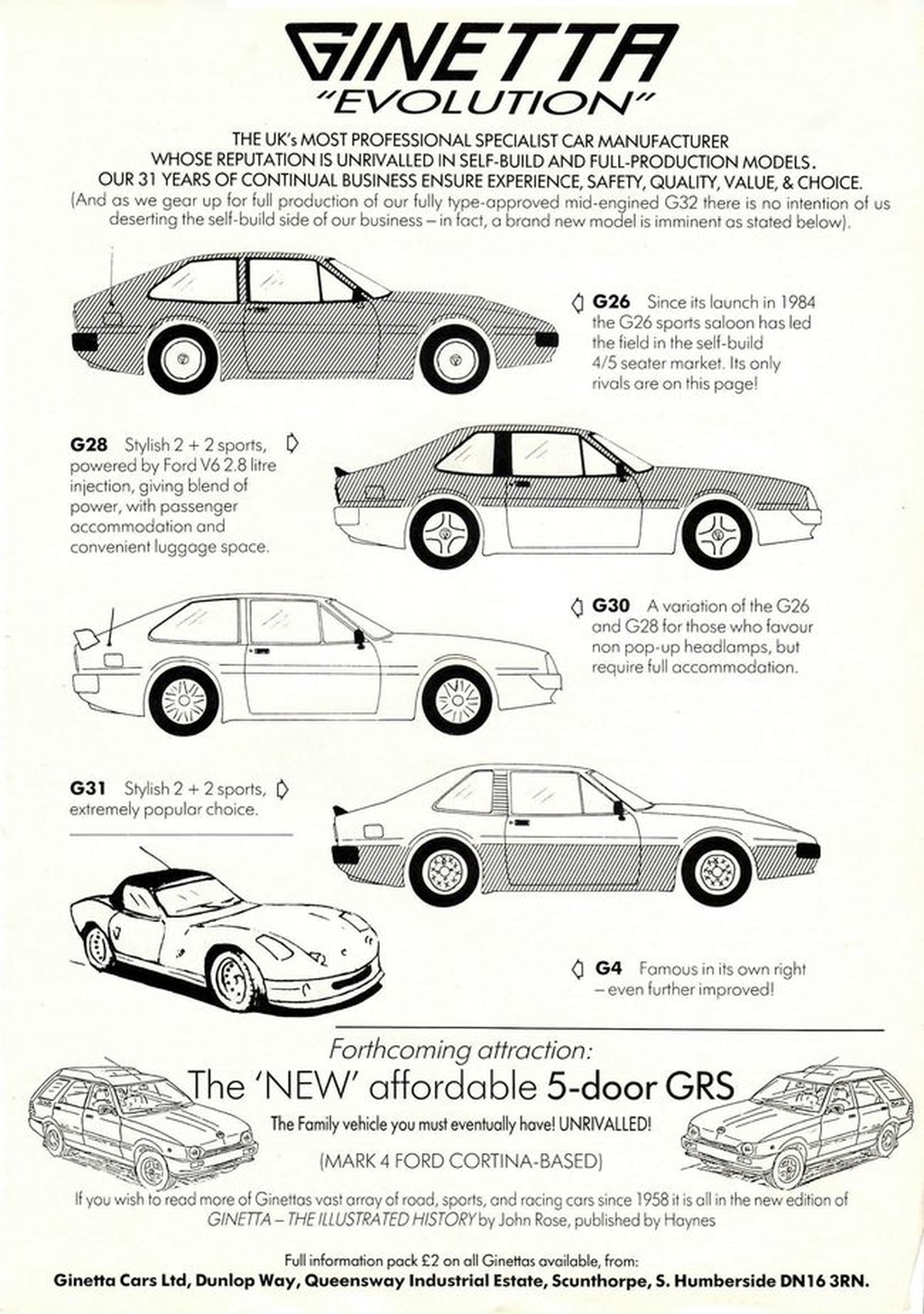
Following reorganization, the company moved to Scunthorpe and began making cars in kit form again in the 1980s starting with the G27 and followed by the G26, G28, G30 and G31, with all cars using Ford parts. The G26 was the first model to arrive, in 1984.[19] The G26 and G31 both used flip-up headlamps; the G26 and G30 were fastback coupés while the G28 and G31 had a notchback profile.[20]

The design used the Ford Cortina Mk3/Mk4 drivetrain and parts installed in a galvanized steel chassis of Ginetta's own construction. Originally, only four-cylinder engines could be fitted, but the G28's taller bonnetline made room for Ford's Cologne V6 engine. The bodywork was fibreglass, although the doors were the Ford Fiesta's steel units. The rear window on the fastback designs was also from the Fiesta, while the sportier notchbacks used the small window from the Sierra XR4i.[21] 280 G26 were built.[19] While the G31 was the last addition to the G26 line, it sold pretty well, with around 70 cars finished.[21] Six G28 and fourteen G30 were finished, although since these cars were only available as kits it is unknown how many kits were actually sold. The total production of the G26 and its derivatives is about 370 cars.

The G29 code was assigned to a one-off competition car for the Thundersports racing series.[22]

G27, G33, and G34

[edit]

Introduced in 1985, the G27 was a two-seater sports car derived from the G4.[23] Designed by Mark Walklett, it uses the front suspension from the Triumph Vitesse, a modified Jaguar independent rear suspension, and could be fitted with a wide range of engines up to the Rover V8.[22] The G33 speedster was introduced in 1990; derived from the G27 it was typically equipped with a Rover V8 engine and was accordingly faster. In terms of appearance, the windshield, with its body-coloured frame, was the main difference compared to the G27, while the overall appearance was smoothed off, with various creases and folds removed. The G33 was soon offered as a kit as well, which left room for the G34, a version with a turbocharged Volvo four-cylinder engine and only offered as a fully built and type approved car.[24] After considerable delays, 21 examples were built by Ginetta's Swedish importer in 1997 and 1998 after.[25]

G32

[edit]
Ginetta G32

It was decided to re-enter the complete car business with the mid-engined G32 with a choice of 1.6- or 1.9-litre four-cylinder engine, available as a coupé or convertible. In 1990, the G32 coupé cost £13,700 (equivalent to £39,331 in 2023), the convertible £14,600 (equivalent to £41,914 in 2023), and the G33 £17,800 (equivalent to £51,101 in 2023). The G32 used a significant amount of parts from the contemporary Ford Fiesta.

G50

[edit]
Ginetta G50 GT4

After Ginetta was acquired by Lawrence Tomlinson in 2005, the company began work on the design of the Ginetta G50 - utilizing a 3.5-litre V6 engine, generating a power output of 224 kW (300 hp; 305 PS) - to celebrate the company's 50th anniversary. In 2007, the car competed in its first race in the European GT4 Cup, in Nogaro France, finishing second.

Soon after this success, the car was officially launched at Autosport International in early 2008 alongside its sister car, the Ginetta G50 GT4. Together, they have become Ginetta's best selling cars.

G60

[edit]
Ginetta G60

In March 2010, Lawrence acquired the Somerset-based sports car manufacturer Farbio Sports Cars, and in doing so inherited the F400, which was subsequently redesigned, redeveloped and rebranded into the Ginetta G60. This is a two-door mid-engined sports car which shares the same 3.7-litre V6 engine as its G55 GT3 stablemate and is capable of 0–97 km/h (0–60 mph) in 4.9 seconds, with a top speed of 266 km/h (165 mph).[citation needed]

G40

[edit]
Ginetta G40

In 2010, Lawrence implemented a newer, safer car into the existing Ginetta Junior series and in doing so, replaced the old Ginetta G20 race car with a G40J.

Following the success of the G40J, Ginetta decided to introduce a Ginetta G40 Challenge car for the adult racers in its Challenge series. With the same engine as its sister car, the G40 Challenge car is capable of 123 kW (165 hp) and competes against existing G20 models. Today, the car features heavily in the Total Quartz Ginetta GT5 Challenge.

Ginetta unveiled its second road car, the Ginetta G40R, in 2011. It was designed to mimic the Walklett brothers' original vision of 'a race car for the road'. Capable of 0–97 km/h (0–60 mph) in 5.8 seconds, the G40R shares a number of characteristics with its racing siblings.

G55

[edit]
Ginetta G55

2011 saw the introduction of the G55 Cup car to the Ginetta GT Supercup, which, until that point, had only featured the G50 Cup car. Offering a 3.7-litre V6 engine generating a maximum power output of 380 hp (283 kW; 385 PS), the car provided Ginetta with the basis for their Ginetta G55 GT3 car; a larger spec car which gives GT teams a 4.35 L V8 powerplant.

Akula

[edit]
Ginetta Akula

On 5 March 2019, at the Geneva International Motor Show, Ginetta announced a new 6.0-litre Ginetta/Chevrolet LS2 OHV V8 600 hp (447 kW; 608 PS) supercar called the Akula (Акула), Russian for "shark".

Motorsport

[edit]

Michelin Ginetta GT4 SuperCup

[edit]

The Michelin Ginetta GT4 SuperCup is a single-class race series which features the Ginetta G50 and G55 sports cars; running in support of the British Touring Car Championship.

The championship began as the Ginetta G50 Cup in 2008, supporting the British Formula Three Championship and British GT Championship. In 2009, it moved to support the BTCC. In 2011, with the introduction of the Ginetta G55, the championship became the Michelin Ginetta GT4 SuperCup.

The 2014 season will be the fourth running of the Michelin Ginetta GT4 Supercup, but it will be the first year in which the G50 GT4 and G55 GT4 cars are consolidated into one single class. In order to maintain fair competition, the two models will be equalized through a balance of performance test.

Protyre Motorsport Ginetta GT5 Challenge

[edit]

The Protyre Motorsport Ginetta GT5 Challenge offers a unique, low-cost opportunity to race in a single-make racing championship, over seven race weekends supporting the British GT package. For 2014, the series will once again return to Spa for an international round alongside the Swedish Ginetta Challenge series.

A popular entry-level championship for many GT racers, the series boasts packed grids with close racing. All weekends are triple headers, providing 21 races throughout the season, with all races counting towards the final championship positions.

Prototype

[edit]
Ginetta G60-LT-P1

Ginetta supplies customer LMP3 cars for the European Le Mans Series and Asian Le Mans Series as well as the IMSA Prototype Challenge.

In 2017, Ginetta developed a LMP1 class car the Ginetta G60-LT-P1.[26] For the 2018–19 FIA World Endurance Championship season Ginetta entered 2 G60-LT-P1 in the WEC series in conjunction with TRSM Racing Manor. At the 2018 24 Hours of Le Mans, the #5 car finished 5th in class, while the #6 car retired after 10 hours due to persistent electrical issues.[27]

Racecars

[edit]

See also

[edit]

References

[edit]

Bibliography

[edit]
[edit]
Revisions and contributorsEdit on WikipediaRead on Wikipedia
from Grokipedia
Ginetta Cars Limited is a British manufacturer of hand-built sports and racing cars, founded in by brothers Bob, , Trevers, and Douglas Walklett in , . The company specializes in high-performance vehicles designed for both road use and competitive , with a legacy rooted in innovative engineering and a commitment to driver development programs. Headquartered in Garforth, Leeds, West Yorkshire, Ginetta operates from a 75,000 square foot factory where each car is meticulously crafted, emphasizing precision and quality control. Since its acquisition by entrepreneur Lawrence Tomlinson in 2005, the firm has solidified its position as a leader in British motorsport, producing iconic models such as the G4 (a 1960s classic), G15, G56 roadster, and modern vehicles like the Ginetta GTR, Akula supercar, and LMP3 prototypes. These vehicles have competed successfully in series worldwide, contributing to Ginetta's reputation for reliability and performance. Beyond manufacturing, Ginetta runs an integrated ecosystem, including the Ginetta Challenge Championship, junior racing academies, track days at its Blyton Park circuit, and simulator training through SimTrack, providing a structured pathway from novice to professional racer. This focus on accessibility and progression has expanded globally, with operations in since 2019.

History

Founding and Early Development

Ginetta Cars was founded in 1958 by four brothers—Bob, Ivor, Trevor, and Douglas Walklett—in , , driven by their passion for and a desire to create affordable performance vehicles. The brothers, who worked full-time jobs elsewhere, named the company after a contraction of their surname and began operations from a small workshop, focusing initially on kit cars that enthusiasts could assemble themselves using readily available components. Their first effort, retrospectively known as the G1, was a one-off prototype built in 1957 as a simple roadster based on the chassis and mechanicals of a pre-war six-cylinder engine, serving more as a design exercise than a production model. This laid the groundwork for Ginetta's emphasis on lightweight, customizable specials inspired by contemporary club racing cars like the Lotus 7. The company's first production model, the G2, debuted in 1959 as a Ford-powered kit car featuring a multi-tubular spaceframe chassis designed for easy DIY assembly with components from pre- and post-war Ford 8 and 10 hp models, including a sidevalve engine. Weighing 112 pounds for the chassis and 44 pounds for the body, totaling 156 pounds for the basic kit, the G2 was tailored for club racing and sprints, quickly earning praise for its agile handling and affordability, with approximately 30 kits sold to enthusiasts who prized its simplicity and performance in amateur events. Building on this, the G3 arrived in 1960 with a fully fendered fiberglass body over a similar tube-frame chassis, marking Ginetta's shift toward more refined aesthetics while maintaining the kit format for cost-conscious builders; about 60 G3 bodyshells were produced. The iconic G4 followed in 1961, evolving the G3 with a stiffer square-tube spaceframe, bonded fiberglass monocoque center section, and options for the more potent Ford 105E engine, blending sports car style with everyday usability and becoming a bestseller that solidified Ginetta's reputation in enthusiast circles. Ginetta's early models emphasized accessible, enthusiast-driven construction, with kits providing chassis, body panels, and basic fittings for buyers to install donor parts, fostering a community of home builders who valued the hands-on experience and low entry cost compared to factory-built rivals. These cars achieved notable early racing successes, particularly the G2 and G4, which dominated club events, sprints, and hillclimbs throughout the early 1960s, with drivers like Johnny Blades securing class wins and championships that boosted the marque's visibility in British motorsport. To support expanding demand, the company relocated in 1962 to larger facilities in Witham, Essex, enabling increased production and the introduction of fully assembled complete cars alongside kits, allowing buyers to opt for turnkey vehicles without assembly. This period through the 1970s marked Ginetta's growth from a backyard operation to a respected specialist in affordable, track-capable sports cars.

Ownership Transitions and Challenges

In the 1970s, Ginetta Cars encountered significant financial strain stemming from an ambitious expansion to a larger factory in , which overextended the company's resources amid the global oil crisis and economic downturn. Sales of models like the G21 suffered due to rising fuel prices, the introduction of on , and intensified competition from mass-produced alternatives such as the GT, prompting a return to the more modest Witham facilities in 1974 to cut costs. Production continued on a limited basis, focusing on occasional builds and spare parts sales, while the market began to contract under broader economic pressures. The 1980s brought further challenges as Ginetta navigated a shifting automotive landscape dominated by larger manufacturers offering affordable, high-volume sports cars, which eroded demand for niche kit vehicles. Efforts to revive production included the reintroduction of the iconic G4 in its Series 4 form (1981–1984, approximately 35 units built) and the development of the mid-engined G32, launched in 1986 after re-engineering an earlier prototype, though high type-approval costs and lukewarm market reception limited its success to 97 coupés and 16 convertibles by 1991. A planned distribution deal through Ford dealerships in the late 1980s failed to materialize, exacerbating internal management strains as the company relocated to a modern facility in Scunthorpe, Lincolnshire, in 1988. In November 1989, the Walklett brothers sold Ginetta to a consortium of international enthusiasts led by managing director Martin Phaff, with co-founder Ivor Walklett retained as technical director; this transition aimed to inject fresh capital but highlighted ongoing instability. The 1990s marked a period of dormancy for Ginetta, driven by recessionary economic pressures, cash flow shortages, and rising interest rates that hampered production scaling. Under Phaff's leadership, the company launched the G33 in 1990, which initially sold well as a lightweight, V8-powered model, but the entered in September 1992 amid persistent financial woes; a dealer-led rescue allowed limited production to continue until 1993, with approximately 90 units built overall due to insufficient funds for complete engine procurement (costing £5,000 each) and broader market decline. The G33 SC variant debuted in October 1992, yet model discontinuations like the G32 and G27 kits followed. Brief revival attempts followed, including the sale of G33 molds to Swedish firm 1 for the short-lived G34 (16 built), but internal management issues and competition from established brands prolonged the instability until the early 2000s.

Modern Expansion and Innovations

In 2005, Ginetta was acquired by businessman and racing driver Lawrence Tomlinson through his LNT Group, marking a pivotal revival for the company after years of financial instability. Under Tomlinson's leadership, the firm relocated its operations to a new purpose-built 75,000 square foot facility in Garforth, near Leeds, West Yorkshire, which enabled expanded production capacity and modern manufacturing processes. This investment facilitated the revival of classic models like the G33 and G4, reintroducing them as heritage roadsters while emphasizing hand-built quality and British engineering heritage. The 2010s saw Ginetta's strategic expansion into GT racing, with the launch of the G40 in 2010 as a versatile, cost-effective racer suitable for junior series, and the G55 in 2011, designed to FIA GT3 specifications and initially powered by a Ford through a partnership with Ford. This collaboration enhanced performance and accessibility, positioning the G55 as a staple in championships like the British GT. Later in the decade, Ginetta diversified powertrains by partnering with , incorporating engines like the VR38DETT in variants of the G55 to boost output and appeal to international markets. These developments solidified Ginetta's role in affordable, high-performance GT racing, with over 200 G55 units produced by the mid-2010s. Entering the 2020s, Ginetta continued its innovation trajectory with updates focused on affordability and global reach, including the 2025 introduction of the G56 GTP8, a V8-powered GT racer derived from the successful G56 GT4 platform, offering 400 bhp and an for endurance series. Complementing this, the G40 Junior Evo was unveiled for the same year, featuring aerodynamic refinements and reduced costs to lower barriers for young drivers in entry-level racing. Corporate milestones included the 2019 establishment of Ginetta North America, with a 60,000 square foot facility in to support U.S. exports and service, driving growth in n sales. In Europe, expansions like the 2023 launch of the in further boosted international presence, while series integration with Motorsport Vision-owned circuits such as and Oulton Park enhanced event logistics and driver development pathways.

Company Profile

Ownership and Leadership

Ginetta Cars has been under the primary ownership of Lawrence Tomlinson since 2005, when he acquired the company through his LNT Group, a diversified holding entity encompassing automotive and other sectors. As chairman, Tomlinson has steered the company's evolution from a niche sports car manufacturer toward a broader motorsport ecosystem, including the development and promotion of single-make racing series to sustain growth. The leadership team is headed by CEO , who assumed the role in February 2025, bringing expertise in operations to oversee , production, and divisions. Supporting roles emphasize and , with key executives focusing on vehicle development and championship management to align with Tomlinson's vision of accessible performance motoring. Under Tomlinson's direction, Ginetta's strategy prioritizes affordability in to attract a wider participant base, exemplified by initiatives like the Ginetta Junior Championship—now in its 20th year—and the , which provide entry-level pathways for young drivers through structured academies and scholarships. The company has diversified revenue streams, drawing from road and sales alongside event hosting and series management, contributing to group-wide growth in new vehicle sales despite fluctuations in parts and income. Global expansion efforts include multinational grids and North American schedules, enhancing international accessibility. In 2025, Tomlinson has influenced cost-cutting measures such as reduced engine build expenses and more affordable bodywork components for race cars, aiming to lower and foster long-term participation in series like the Ginetta Challenge. These updates have supported record-equaling grid sizes and positioned Ginetta as a leader in cost-effective, youth-oriented development.

Facilities and Operations

Ginetta's primary manufacturing facility is located at Helios 47, Isabella Road, in , , , encompassing a 75,000 state-of-the-art site dedicated to , assembly, and testing. This central hub supports the company's focus on high-performance engineering, where skilled teams craft each to exacting standards. Lawrence Tomlinson's investments have facilitated key upgrades to these facilities, enhancing production efficiency and innovation capacity. In 2019, Ginetta established a North American facility in , USA, spanning 60,000 square feet for engineering, assembly, and service to support regional operations and expansion. The production process relies on hand-built construction, featuring lightweight composite bodies—often carbon fiber—affixed to robust tubular steel chassis for superior strength-to-weight ratios and handling dynamics. Ginetta maintains low-volume production, with a historical target of up to 200 vehicles annually, primarily racing models and a smaller portion to road-legal variants like the . This approach ensures meticulous quality while catering to demands and niche enthusiasts. Ginetta's supply chain integrates partnerships with established suppliers, including Ford for V6 engines in models like the G55 and G56 GTA, and Ford 1.8 L Zetec I4 for the G40 series; V8 engines in GT variants such as the G55 GT3 and G56 GT4 are Ginetta-built based on and GM LS units respectively, and for Pilot Sport tires across the lineup. In parallel, the company invests in in-house R&D for advanced prototypes, such as the Akula, which undergoes aerodynamic refinement through collaborations like testing at Williams Advanced Engineering. As of 2025, operations emphasize enhanced measures for Evo iterations, including the G40 Evo and G61-LT-P3 Evo, to optimize and in applications. Sustainability efforts are also advancing, with initiatives incorporating recycled materials—such as carbon fiber—in components for prototypes and race cars, exemplified by the Waste2Race project's use of bio-based and recycled elements in steering wheels for LMP3 vehicles.

Road and Kit Cars

Early Sports and Kit Models

Ginetta's earliest vehicles, produced from the late 1950s through the 1960s, established the company's reputation for affordable, enthusiast-oriented kit cars that emphasized simplicity, lightweight construction, and adaptability for both road use and club racing. The G1, a one-off prototype based on a pre-war Wolseley Hornet six-cylinder chassis, served as an internal design exercise in 1958 but never entered production. This led directly to the G2, announced in February 1958 as the first production model under Walklett Bros., featuring a multi-tubular spaceframe chassis constructed from 1-inch steel tubing, aluminum body panels with a fiberglass nosecone, and Ford 8-inch axle assemblies with transverse springs. Powered by a 1172cc Ford sidevalve engine producing approximately 40 bhp, the open-top G2 was offered as a bare chassis kit for home assembly, weighing under 1,500 pounds and capable of basic road and track duties, with around 100 units claimed sold by the factory though historians estimate closer to 25 completed. The G3, introduced in March 1960, refined the formula with a full fiberglass body replacing the aluminum panels, bolted to an upgraded square-tube chassis for improved rigidity and ease of assembly, while retaining the Ford 1172cc engine option for around 40 bhp. Available as a bare shell or more complete kit, it addressed the G2's rudimentary aesthetics and sold approximately 60 bodyshells, appealing to builders seeking a more enclosed sports car design suitable for club events. By late 1960, the G4 series debuted as Ginetta's breakthrough model, utilizing a multi-tubular spaceframe with double-wishbone front suspension and a live rear axle, clad in lightweight fiberglass bodywork inspired by contemporary racers like the Jaguar D-type. The G4 accommodated engines up to 2.0 liters, such as the Ford 1600cc inline-four delivering up to 75 bhp, achieving top speeds around 110 mph and a curb weight below 1,500 pounds, with modular components allowing home mechanics to install donor parts from Ford or Triumph. Over 500 G4 units were produced across its Series 1 (1960-1963), Series 2 (1963-1967), and Series 3 (1967-1974) variants, many adapted for club racing through reinforced chassis and aerodynamic tweaks, though production waned by the late 1960s due to shifting market preferences toward more refined production cars. Entering the and , Ginetta expanded its lineup with more versatile s and roadsters under the G10 to G21 designations, maintaining the core hallmarks of bodies and tubular frames for low-volume, customizable kits. The G10, launched in January 1965, introduced V8 power via a Ford 289ci producing over 200 bhp in a front-engined format, with only approximately 3-6 units built due to its specialized nature. This was followed by the MGB-powered G11 in 1966 with a 1.8L inline-four yielding around 95 bhp, both emphasizing for spirited road driving and amateur . The G15, a rear-engined roadster introduced at the 1967 London Motor Show, utilized components including a 875cc inline-four at 51 bhp (upgradable to 998cc for 65 bhp), with a body over a tubular frame and Imp-derived suspension, achieving lightweight agility under 1,500 pounds; approximately 800 units were built from 1968 to 1974, popular for its compact design and club-level competitiveness before discontinuation amid declining interest in small-displacement kits. The G21, unveiled in October 1970, marked a shift toward luxury-oriented coupes with a square-tube featuring a reinforced sheet-steel transmission tunnel for greater refinement, offered in 1.6L inline-four (79 ) or 3.0L Ford V6 (128 ) variants, and optional overdrive for smoother highway cruising. Its body provided a more enclosed, GT-like cabin while keeping assembly modular, with production totaling approximately 150 units through 1978, many fitted with engines for balanced road performance; like predecessors, variants saw club racing use via engine swaps, but the model faded as economic pressures and emissions regulations reduced demand for hand-built kits. These early designs' emphasis on modularity and tubular simplicity influenced Ginetta's later GT models by prioritizing lightweight, adaptable platforms.

Contemporary Road Models

Ginetta's contemporary road models emphasize track-capable performance while maintaining full road legality, drawing on the company's heritage to offer lightweight, high-revving sports cars for enthusiasts. These vehicles, produced in limited numbers since the , blend modern engineering with classic British principles, prioritizing agility and driver engagement over mass-market appeal. The G33 and G34, introduced in the as revivals of earlier designs, represent Ginetta's transition to more refined roadsters inspired by the . The G33 featured a 3.9-liter producing approximately 200 horsepower, paired with a five-speed and bodywork on a tubular steel chassis, achieving a top speed over 130 mph in limited production runs of around 100 units. The G34 variant, offered as a fully built rather than a kit, utilized a turbocharged 2.0-liter Volvo inline-four engine delivering up to 190 horsepower and 207 lb-ft of torque, with production limited to fewer than 50 examples, emphasizing everyday usability with features like progressive clutch and all-disc brakes. Both models weighed under 1,000 kg, enabling responsive handling suitable for spirited road driving. In the , Ginetta expanded its road lineup with the G56 GTR, a street-legal of the successful G56 racing platform. This employs a 6.2-liter naturally aspirated producing over 400 horsepower, mounted in a tubular steel chassis with composite body panels, resulting in a kerb weight of just 1,150 kg and a 0-60 mph time of around 3.5 seconds. Equipped with a six-speed H-pattern manual gearbox, adjustable suspension, and large ventilated brakes, the G56 GTR achieves road compliance through features like soundproofing, , and GPS integration, while retaining track-day prowess with a top speed of 160 mph. Annual production remains low, with estimates of 20 or fewer units to maintain exclusivity. The 2025 Akula marks Ginetta's latest entry into the segment, a road-legal model limited to 20 units worldwide, derived from LMP1 racing technology. Powered by a 6.4-liter naturally aspirated generating 600 horsepower and 494 lb-ft of , it accelerates from 0-62 mph in 2.9 seconds and reaches a top speed of 180 mph, all within a carbon-fiber weighing approximately 1,300 kg. Standard features include carbon-ceramic brakes, a six-speed manual or paddle-shift transmission, and advanced safety systems for emissions compliance, with pricing starting at £275,000 plus taxes. This model incorporates 2025 updates for stricter environmental standards while preserving its track-focused dynamics. Heritage revivals like the G10 RM further exemplify Ginetta's approach to contemporary road cars, reissuing the G10 racer as a modern restomod with updated safety features. The G10 RM uses a 6.2-liter V8 engine in a chassis weighing 950 kg, paired with a five-speed and road-legal modifications such as ABS and emissions controls, enabling compliant street use. While specific G4 restomods are not officially produced, Ginetta supports heritage restorations with modern upgrades like four-wheel disc brakes and for enhanced safety and performance. These models appeal to collectors seeking track-day legality without compromising heritage authenticity.

Racing Cars

GT and Touring Car Lineup

Ginetta's GT and touring car lineup emerged in the 2000s as a cornerstone of the company's portfolio, emphasizing affordable, competitive vehicles for GT4-class championships. The series began with the G50, a purpose-built racer introduced in 2006 and homologated for FIA GT4 in 2008, designed to deliver high performance at a lower cost than established GT manufacturers. This model paved the way for subsequent developments, including the G55 and G40, which refined the formula for broader accessibility in series like British GT and international GT4 events. By focusing on tubular chassis construction and naturally aspirated engines, these cars balanced driver engagement with reliability, influencing Ginetta's reputation for customer racing support. The G50 GT4, powered by a front-mid-mounted Ford 3.5-liter producing approximately 300 horsepower, featured a Quaife six-speed sequential gearbox and layout, with a curb weight around 1,100 kilograms. It excelled in endurance and sprint races, securing multiple class victories in British GT from 2008 onward, thanks to its lightweight T45 tubular and adjustable suspension setup. The model's drew brief influences from Ginetta's road car heritage, incorporating spaceframe elements for rigidity without excessive complexity. Over its production run through the early , the G50 established Ginetta's foothold in GT4 racing, with variants tuned for specific regulations to maintain competitiveness. Succeeding the G50 in 2011, the G55 GT4 became Ginetta's flagship GT racer, utilizing a Ford 3.7-liter detuned to around 355-385 horsepower for GT4 , paired with a six-speed sequential transmission and weighing approximately 1,085-1,200 kilograms depending on the variant. Homologated under FIA GT4 standards, it incorporated advanced , carbon fiber body panels, and pushrod-activated double-wishbone suspension with adjustable dampers for optimized handling on diverse circuits. More than 200 units of the G55 and its /SuperCup variants were produced by the mid-2010s, enabling widespread adoption in championships across and , supported by partnerships such as the tire supply agreement with extending through 2025. Engineering evolutions emphasized , including shared components with entry-level models to lower expenses while preserving . Introduced in the as an entry-level GT and touring option, the G40 targets junior and club-level drivers, featuring a sealed Ford 1.8-liter Zetec inline-four engine restricted to 100 horsepower for age-specific series (14-17 years old), though higher-output GT4 variants reach 165 horsepower with a Quaife six-speed sequential gearbox and a lightweight 800-kilogram . Its T45 tubular frame and integral ensure FIA compliance, with pushrod suspension and adjustable dampers providing a forgiving yet responsive platform for skill development. The 2025 G40 Evo update introduces aerodynamic refinements, including a redesigned front end inspired by the G56 series, updated doors, and rear panels to enhance airflow and reduce operational costs, making it more affordable for aspiring racers without compromising safety or speed. This evolution underscores Ginetta's commitment to modular engineering, allowing shared parts across the lineup to support progression from junior touring cars to full GT competition.

Prototype and Supercar Variants

Ginetta's involvement in prototype racing began in earnest with the development of Le Mans-compliant vehicles in the , focusing on lightweight carbon-fiber monocoques and efficient to compete in endurance series. The company's emphasized modular design elements for rapid research and development, allowing adaptations across powertrains and chassis configurations while maintaining low-volume production for testing and customer teams. These efforts built on Ginetta's GT heritage but shifted toward bespoke, high-performance platforms optimized for top-tier circuits like . The G60-LT-P1 represented Ginetta's ambitious entry into the LMP1 class, unveiled in 2018 to mark the marque's 60th anniversary and designed for the . Featuring a carbon and an AER P60B/C 2.4-liter turbocharged producing approximately 650 horsepower, the car debuted at the 2018 but faced reliability challenges, leading to limited outings including a strong showing at in 2019 where it set record lap times. Transitioning to the more accessible LMP3 category, Ginetta's first dedicated prototype was the Juno P3-15, introduced in 2015 as the inaugural LMP3 car under ACO regulations, equipped with a VK50VE 5.0-liter delivering 420 horsepower and a carbon-fiber for enhanced safety and weight savings at 950 kilograms. This model paved the way for entries in the (ELMS), where Ginetta teams secured multiple class victories, including a clean sweep of the 2017 season by three cars. Evolving from the Juno, the G61-LT-P3 arrived in 2017 with refinements to inspired by the LMP1 program, retaining the V8 powertrain initially at around 460 horsepower, and achieving podiums in ELMS and Le Mans Cup events through 2024. For 2025, Ginetta relaunched its LMP3 program with the G61-LT-P3 Evo, incorporating a new V35A-FTS 3.5-liter twin-turbo producing 470 horsepower in endurance trim, paired with updated cooling, air intake, and designs for improved efficiency and compliance with ACO's next-generation specifications. This platform, limited to small-batch production for customer teams like DKR , targets ELMS and competition, with initial testing at Spa-Francorchamps demonstrating enhanced reliability over the V8 era. In 2025, the G61-LT-P3 Evo secured its first victory at the Road to in June, driven by DKR , and has continued to compete in ELMS and the Michelin Le Mans Cup, attracting additional customer interest. Complementing these racers, the Akula emerged as Ginetta's high-end variant in 2024, a road-legal evolved from LMP-inspired concepts first shown in , featuring a full carbon-fiber and a naturally aspirated 6.4-liter generating 600 horsepower with . Limited to just 20 units for exclusive clientele, the Akula incorporates modular suspension and aerodynamic elements derived from R&D, enabling track-capable performance with a top speed exceeding 180 mph, though it remains oriented toward grand touring rather than outright endurance racing.

Motorsport Involvement

Supported Racing Series

Ginetta supports several dedicated racing series in the , emphasizing accessibility, affordability, and driver development as core principles of its involvement. These single-make championships utilize Ginetta's purpose-built race cars and are organized in with (MSV) and other bodies, forming a structured pathway from youth programs to professional GT racing. The Protyre Motorsport Ginetta GT Championship (formerly known as the Ginetta GT4 Supercup, launched in 2010) is an FIA-approved single-make series featuring the G56 GTP8 and G56 GT4 Evo cars in professional competition. For 2025, it follows a six-round calendar at circuits including (5-6 April), Silverstone (26-27 April), Oulton Park (24-26 May), Snetterton (12-13 July), (23-24 August), and (4-5 October), with each event comprising a 20-minute sprint race and a 40-minute feature race that includes mandatory pitstops for driver changes or adjustments. The series prioritizes close racing through spec setups and no (BoP) adjustments, supporting Ginetta's role in elevating GT talent. The (also referred to as the Protyre Ginetta GT5 Challenge) serves as an entry-level GT racing category, utilizing the G56 GTA car to promote affordability and broad participation for amateur and aspiring professional drivers. In 2025, updates to the G56 GTA include fixed setups for dampers and suspension, a new Quaife QBE69G gearbox, and enhanced components for reduced maintenance costs, such as improved durability in high-wear areas, aligning with Ginetta's commitment to lowering while maintaining competitive integrity through sealed engines and fixed specifications. The series shares the GT Championship's six-round domestic , focused on sprint formats that emphasize driver skill over budget. Ginetta's youth development initiatives include the , starting at age 14 to nurture emerging talent in a safe, structured environment, complemented by the for drivers of all ages including progressing juniors. The employs the G40 Junior Evo car and runs an eight-round schedule: (5-6 April), (26-27 April), Oulton Park (24-26 May), Snetterton (12-13 July), (23-24 August), Croft (6-7 September), (4-5 October), and an international venue at (26-27 July). 2025 enhancements feature visual updates to the bodywork—including a modernized front end, side doors, and rear panels—for improved and , alongside an adjustable pedal box to accommodate younger drivers. The complements this by providing training and racing in the G56 GTA car across six rounds aligned with the , incorporating fixed setups for dampers and suspension to ensure parity and focus on skill-building, with free technical upgrades included in entries to enhance affordability. Beyond its core championships, Ginetta maintains involvement in broader series such as British GT and , supplying GT4 and prototype cars for multi-class events and hosting support races that integrate with these grids. Collectively, these efforts result in over 20 races annually across Ginetta-supported platforms, fostering a comprehensive for motorsport progression.

Achievements and Developments

Ginetta has achieved notable success in various racing series, particularly through its GT platforms. In the Protyre Motorsport Ginetta GT , young driver Archie Clark secured the 2025 title with a dominant performance, including multiple victories such as a double win at early in the season. The Ginetta GT4 Supercup (now the GT ), a key one-make series, has crowned multiple champions over its history, including Adam Morgan in its inaugural year and Tom Ingram in subsequent seasons, highlighting the reliability and competitiveness of Ginetta's G55 and G56 models in balanced GT4 racing. Additionally, Ginetta marked a milestone in endurance racing with a class victory in the LMP3 category at the 2025 Road to event, where the G61-LT-P3 Evo claimed its first win in competition for the manufacturer. In the 2025 Ginetta Junior , [Champion Name] was crowned winner, while [Champion Name] took the GT title, further demonstrating the effectiveness of Ginetta's development pathway. The company's driver development programs have established significant records in talent nurturing. Through partnerships like the one with PalmerSport, over 10,000 drivers experience cars annually, providing accessible training that has propelled many into professional racing pathways. In 2025, Ginetta implemented cost-saving measures across its championships, including extended component lifespans, reduced spare parts pricing, and free upgrades for committed entrants, aimed at lowering overall season expenses and broadening participation without compromising performance. Innovations in vehicle design continue to drive Ginetta's advancements. The introduction of the G56 GTP8 for the 2025 North American series features a V8 with up to 390 horsepower, built on a proven for enhanced reliability and ease of conversion to GT4 specification. Safety features, such as FIA-standard integral roll cages with carbon side-impact panels and aluminum honeycomb reinforcements, are standard in models like the G56 GT4 Evo, ensuring compliance with global regulations while maintaining lightweight construction. On the global stage, Ginetta expanded into the U.S. market by announcing entry into the SRO GT America series for 2026, running a spec class for GTP8 cars alongside its established North American Challenge, to foster growth in American GT racing.

References

Add your contribution
Related Hubs
User Avatar
No comments yet.