Hubbry Logo
Sunbeam-TalbotSunbeam-TalbotMain
Open search
Sunbeam-Talbot
Community hub
Sunbeam-Talbot
logo
8 pages, 0 posts
0 subscribers
Be the first to start a discussion here.
Sunbeam-Talbot
Sunbeam-Talbot
from Wikipedia

Sunbeam-Talbot Limited was a British motor manufacturing business. It built upmarket sports-saloon versions under the parenthood of Rootes Group cars from 1938 to 1954. Its predecessor Clément-Talbot Limited had made Talbot automobiles from 1902 to 1935.

Key Information

Clément-Talbot was bought by Rootes brothers in January 1935 and re-organised to make Rootes Group cars also branded Talbot.[1]

In 1938 after some years of consideration the Rootes brothers dropped plans to make large luxury cars branded Sunbeam, added the name Sunbeam to Talbot and put the extra name on both the cars built in Kensal Green and the company building them.

After the Second World War Sunbeam-Talbot production was resumed in London then in Spring 1946 it was moved to Rootes' new factory at Ryton-on-Dunsmore, Warwickshire and Clément-Talbot's North Kensington works became a Rootes administration and service centre.

Background history: predecessors

[edit]

Clément-Talbot

[edit]

Until acquired by Rootes in 1935 this North Kensington business had manufactured "thoroughbred" high quality Talbot cars and limousines. When it began in 1902 the company's name was Clément-Talbot Limited and it kept that name until 1938 when it was changed to Sunbeam-Talbot. Initially an independent public listed company on the London Stock Exchange Clément-Talbot was bought in 1919 by A Darracq and Co.[2] Later, in 1920, Darracq bought control of Wolverhampton's Sunbeam Motor Car Company Limited[3] but kept all identities quite separate. In August 1920 Darracq was renamed S T D Motors Limited to recognise the gathering together of Sunbeam Talbot and Darracq under one ownership.[4]

Badges used by Clément-Talbot

in late 1934 S T D Motors was obliged to sell Wolverhampton's loss-making Sunbeam and North Kensington's then profit-making Talbot and they were bought by the Rootes brothers. A provisional agreement with Rootes Securities was reached in January 1935 and from that point Rootes controlled Clément-Talbot.[5] In the summer of 1935 Rootes Securities announced they had bought Sunbeam Motor Cars.[6] Sunbeam designs had not been brought up to date and Wolverhampton's production ended. During 1937 Humber Limited, controlled by Rootes, bought Clément-Talbot Limited and Sunbeam Motors Limited, which continued to build buses, from Rootes Securities Limited.[7]

Automobiles Talbot

[edit]

S T D Motors in 1922 had finally dropped Darracq from the name of its French subsidiary replacing it with Talbot. But they continued to import the French cars and when they were sold in Britain those cars were badged Darracq-Talbot or Talbot-Darracq or just Darracq. By the time this former Clément-Talbot London business was bought by Rootes the two manufacturers of Talbots no longer had any connection at all and in any case continued to manufacture wholly unrelated vehicles.

Talbot London

[edit]

Although Talbots had been selling well the expensive London Talbot designs were dropped from production during 1936, since the new ownership had taken effect they had been steadily incorporating more and more Humber parts, and replaced with much cheaper simpler Rootes Group designs intended for a quite different much larger market. From late 1935, capitalising on the high reputation of the brand name Talbot, the Clément-Talbot North Kensington plant made mid-range upgraded versions of their Hillman and Humber cars for Rootes and branded them Talbot. To begin Talbot's well-known chief engineer and designer Georges Roesch came up with a modified Hillman Aero Minx for the October 1935 Motor Show and it was branded Talbot Ten.

History: Sunbeam-Talbot company

[edit]
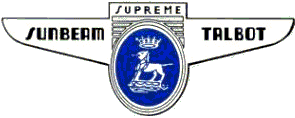
Sunbeam-Talbot radiator badge.

Although the intention had been to continue the Sunbeam name on a large and expensive car almost four years after Rootes bought Sunbeam it was announced Sunbeam Motors and Clément-Talbot were now combined under Clément-Talbot Limited, since renamed Sunbeam-Talbot Limited, and would continue to produce good quality cars at reasonable prices.[8]

Until the Second World War Sunbeam-Talbot cars were made in the Clément-Talbot premises in North Kensington, London with its aging machinery. Those works repaired aero engines during the war and, though production of the prewar models resumed in London, in Spring 1946 Sunbeam-Talbot production was shifted to Rootes' new factory at Ryton-on-Dunsmore, Warwickshire and the North Kensington buildings became a Rootes administration and service centre.

The first two models were the handsome Sunbeam–Talbot 10 previously the Talbot Ten and the 3 Litre. They were modified Hillman-Talbots or Humber-Talbots radiatored and badged as Sunbeam-Talbots for the October 1938 Motor Show. The new 3 Litre car was a combination of then current 3 Litre Hillman Hawk later re-badged Humber Snipe in a better finished Hillman/Humber body with distinctive rear side-windows.

The Ten was launched in August 1938, and was an upgrade from the previous Talbot Ten, itself an upgrade of the Hillman Aero-Minx. Purists described the new car as "a Hillman Minx in a party frock". It had a 1185 cc sidevalve Minx unit engine with an alloy head, and a chassis that had its origins in that used in the Hillman Aero Minx. The Ten was available with four-door saloon, sports tourer bodywork and drophead coupe.

The Sunbeam-Talbot 2 Litre was introduced in 1939 and was based on the Ten, though it used the 1944 cc sidevalve engine from the Hillman 14 later Humber Hawk. Due to the advent of World War II, these models were rare. They were available in the same bodywork as the Ten. The Sunbeam-Talbot 3 Litre was available as a saloon, sports saloon, sports tourer and drophead coupé. Another new model for 1939 was the 4 Litre, a 3 Litre car with a 4086 cc sidevalve six and alloy head engine of the Humber Super Snipe. It was also supplied as a touring limousine.[9]

These models continued to be listed after the war [citation needed]until 1948. However, materials were short at that time and it has been reported that "all the [3 and 4 Litre] engines were needed for the big Humbers", so that Sunbeam Talbot production was in reality virtually or entirely restricted, post-1945, to the Minx based 10 and the 2 Litre.[10]

Ten 4-light 4-door sports saloon 1946 "a Hillman Minx in a party frock"[11]
3-litre 6-light 4-door sports saloon 1939 re-badged Hillman Hawk
4-litre 6-light 4-door sports saloon 1939 rebadged Humber Super Snipe

Second World War

[edit]

During the war Barlby Road repaired aero engines and built Karrier's Bantam lorries. All Sunbeam-Talbot production was suspended though Rootes continued to build the Hillman Minx and Humber Super Snipe for military use. When production resumed in 1945 only the 10 and 2-litre were continued. The 3 and 4 litre models were never revived. The following year production moved in Spring 1946 from the ex-Talbot Barlby Road London plant to the new Ryton plant opened in 1940 for the production of bombers and military vehicles under the UK government's shadow factory scheme.

Postwar

[edit]
2-litre 1947 with Hillman 14 engine

Rootes were relatively quick to reintroduce the 1,944 cc and 1,185 cc Sunbeam-Talbots after the war, though the cars delivered during the first couple of years followed the designs first seen in 1939, readily identifyable by their separate headlamps.[10] The ex-Talbot London plant became a Rootes service centre. (In 1987 the outside of the old London administration block in Barlby Road, W10, was transformed into the set for the Thames Television programme, The Bill, which was filmed there between 1987 and 1990.)

Sunbeam-Talbot's distinctive reverse-slope rear side-window

New Sunbeam-Talbot 80 and 90 designs were introduced during the summer of 1948 and built at the new Ryton plant. Both had the same new streamlined design with flowing front wings into which were integrated headlamps in a manner reminiscent of the front of a fighter plane,[10] a shape that would have been all too familiar to potential buyers at the time. The designer, Ted White, acknowledged a prewar Packard had been his inspiration.[12] The 80 was again fitted with an overhead valve version of the old 10 and Minx engine. The 90 had a modified version of the Humber Hawk ohv 4-cylinder 2-litre engine.[10] Both were available with saloon bodywork from British Light Steel Pressings or drophead coupe bodywork by Thrupp & Maberly. The small-engined postwar austerity model Sunbeam-Talbot 80 was discontinued in 1950.

The 90 continued in production renamed 90 MK II with a new chassis and independent front suspension. The headlamps were raised by three inches to meet American regulations and the front driving lamps were replaced with a pair of small air intake grilles. The 90 MK II also had an enlarged OHV engine with 2267 cc. The MK IIA arrived in 1952, the main update on this model was the removal of the rear wheel spats.

Sunbeam-Talbot models sold
80 Mark I saloon c. 1950
80 Mk I saloon showing spats
90 Mk IIA drophead coupé 1954

Sunbeam

[edit]

Sunbeam-Talbot facelift

[edit]

After twenty years of potential confusion with the French Talbot that name was dropped in 1954 and the final revision was badged Sunbeam instead. It was given much larger front air intake grilles and three air outlet portholes just below each side at the back of the bonnet. The engine now developed 80 bhp (60 kW; 81 PS), amazing compared to the 64 bhp (48 kW; 65 PS) that the, admittedly smaller swept volume, very first 90 achieved. In the 1952 Alpine Rally cars won three Coupes des Alpes, Manufacturers Team Prize, 1st 2nd and third places in the 2 to 3-litre class and a special cup for an outstanding performance.[13] A name had been found for a new model.

Production of the first postwar style finally ended in 1957.

Alpine 2.25 Litre open two-seater by Mulliners of Birmingham

[edit]
1954 Alpine in Morges canton of Vaud, Switzerland.
This car displays a Vaud registration

The first Alpine is a two-seater sports-variant its body specially made by Mulliners of Birmingham from the standard 2¼-litre 4-seater drophead coupé. Very successful in motor rallying in Europe —rallying was then a greater spectator sport than GP racing— its production was from 1953 to 1955. The day before its announcement it was awarded the RAC Dewar Trophy for setting new speed and endurance records on the Jabbeke autoroute and the Montlhéry circuit.[14]

On its first competitive outing, the 1953 Coupe des Alpes, the new car won the Coupe des Dames (Sheila Van Damm) and, without loss of any marks, four Coupes des Alpes driven by Stirling Moss, John Fitch, G Murray-Frame and Sheila Van Damm.[15]

Under Rootes Sunbeams and Talbots with the unified name continued competition in some motorsports. The two seater Alpine variants proved to be very effective rally vehicles with notable International successes by drivers Sheila van Damm and Stirling Moss. Cars competed in and won numerous international rallies, most notably the 1955 Monte Carlo Rally. They concentrated mainly on the more popular rallying rather than other competition.

Sunbeam Rapier and the Sunbeam-Talbot reverse angle side-window

Sunbeam Rapier 1.5 Litre

[edit]

Sunbeam Rapier is a Raymond Loewy designed two-door hardtop variant of the Hillman Minx available from October 1955.[16] Later sold as a convertible it displayed the Sunbeam-Talbot signature rear side-window on its first hardtop version.

In 1967 it was replaced by a two-door fastback version of the Hillman Hunter which stayed in production until 1976.

Sunbeam Alpine 1.5 Litre

Sunbeam Alpine 1.5 Litre

[edit]

Series I. From 1959 to 1968 a quite different 1½-litre car with the same name and an up-to-date prominently finned Transatlantic shape for its body was made on a modified Hillman Husky chassis. A 4¼ Litre (later 4¾ Litre) Ford V8 powered variant was sold under the name Tiger. The Tiger showed little change in external appearance.

Hunter variant

[edit]

Low spec Rapier. Under Chrysler ownership and continuing the old Sunbeam-Talbot Ten and Sunbeam Rapier formula a two-door fastback variant of the Hillman Hunter Minx replacement was sold under the Alpine name from 1969 to 1975. Unusually this Sunbeam was a simplified downmarket version of the main Sunbeam Rapier car.

Sunbeam Tiger 4.75 Litre

[edit]

The Q-car, Sunbeam Tiger, is a Sunbeam Alpine with a 4¼-litre, later 4¾-litre, Ford V8 engine transplant.

References

[edit]
[edit]
Revisions and contributorsEdit on WikipediaRead on Wikipedia
from Grokipedia
Sunbeam-Talbot Limited was a British automobile manufacturer established in 1938 by the , which acquired the struggling and brands in 1935 and combined them to produce upmarket sports saloons and coupés based on and chassis. Pre-war models included the Sunbeam-Talbot Ten (introduced in 1938) with its 1,185 cc sidevalve four-cylinder engine, the 2-Litre (1,944 cc sidevalve, introduced in 1939), and larger six-cylinder variants like the 3-Litre (3,181 cc) and 4-Litre (4,086 cc, both introduced in 1939), limited by the outbreak of . Production resumed post-war at the Rootes Group's Ryton plant, with the Sunbeam-Talbot 80 (1,185 cc overhead-valve inline-four engine producing ~47 bhp) and 90 (2,267 cc overhead-valve inline-four engine producing 64-80 bhp) launched in 1948, available as saloons or drophead coupés, and noted for their refined handling and styling. The marque achieved significant motorsport success, particularly in rallies; the 90 series secured class wins in the from 1948 to 1952, an outright overall victory in the 1955 , and overall victories in the Alpine Rally, often driven by figures like , enhancing its reputation for sporting prowess. Subsequent developments included the Mk II (1950) with independent front suspension, the Mk IIA (1952) with engine and brake improvements reaching 81 mph top speed, and the introduction of the Alpine sports model in 1953, before the Sunbeam-Talbot name was phased out by the late 1950s following Chrysler's increasing control over Rootes in the 1960s.

Predecessors

Clément-Talbot

Clément-Talbot Limited was founded in 1903 in by French industrialist Adolphe Clément, who provided engineering expertise, and Charles Chetwynd-Talbot, 20th , who offered financial backing and the name derived from his family . The company initially operated as a British assembler of French Clément-Bayard vehicles, importing components and completing assembly at a new factory on Barlby Road in , with the first cars rolling out in 1903. From 1906, Clément-Talbot shifted to producing its own high-quality luxury cars entirely in Britain, emphasizing engineering excellence through robust construction and performance-oriented designs suitable for both touring and . The 20/28 hp model, introduced that year with a 3.8-litre four-cylinder , marked the first fully British and gained acclaim for its reliability, earning the marque a reputation for "invincible" durability in early motoring events. By 1912, the company offered models such as the 25/35 hp with a 4.3-litre side-valve powerplant for upscale buyers seeking power and refinement. These vehicles highlighted Clément-Talbot's focus on advanced shaft-drive systems and T-head engines, with entries achieving milestones such as the 25/50 hp model's 102.83 mph average over 100 miles at in 1913. The North Kensington facility grew into a self-contained operation with its own testing track and body assembly lines, producing around 800 cars annually by 1914 before wartime demands redirected efforts to lorries and armored vehicles. Postwar, however, financial struggles emerged in the amid declining demand for luxury models and intense , leaving nearly idle by 1925 with reduced staff and unprofitable production. In 1921, the company introduced the compact 8/18 hp model with a 1,074 cc overhead-valve engine in a lightweight chassis. In 1919, the company was sold to the Darracq syndicate, forming the STD Motors combine (Sunbeam, Talbot, Darracq) in 1920, which attempted to revive output but faced ongoing losses from racing expenditures and debt. STD's collapse in 1934 prompted the full acquisition of Clément-Talbot by the in 1935, after which the independent Talbot branding under the company ceased, paving the way for its integration into Sunbeam-Talbot operations.

Automobiles Talbot

Automobiles Talbot originated from the Clément factory established in 1896 by Adolphe Clément in , , initially focused on production before expanding into motor vehicles as Clément-Gladiator by 1901. Following a corporate split in , the French operations continued under Clément-Bayard, producing automobiles with mechanical components that paralleled British efforts. In the post-World War I era, the Suresnes-based Automobiles Darracq, founded by Alexandre Darracq in 1897, merged with the British Clément-Talbot around 1919, evolving into Talbot-Darracq and marking a key consolidation of French manufacturing expertise. By 1920, the entity was formally renamed Automobiles Talbot France, with production centered at the facility outside , emphasizing reliable side-valve engines in its lineup. Notable models included the Type V14, a 2,940 cc four-cylinder model resumed , and the Type A, a 4,584 cc V8 introduced in 1919. These vehicles showcased the company's early focus on durability and potential, with side-valve configurations providing cost-effective power delivery suitable for both and track applications. In 1920, Automobiles Talbot was integrated into S.T.D. Motors Ltd. following the merger of , Clément-Talbot, and the remaining Darracq interests, centralizing design and production across French and British sites. Under S.T.D., the French division drove key innovations, including V8 engines like the 4,584 cc Type A producing around 90 horsepower, paired with advanced features like pre-selector gearboxes for enhanced luxury touring. These developments positioned Talbot models as sophisticated grand tourers, influencing broader automotive trends in engine refinement. S.T.D. Motors faced mounting financial pressures, exacerbated by heavy investments in racing, leading to its collapse in 1934. In 1935, the acquired the British Talbot and Sunbeam assets from , effectively ending independent Automobiles Talbot operations in under the S.T.D. umbrella. The French Suresnes factory was subsequently sold to Major Antony Lago in 1936, transitioning to production while severing direct ties to British Talbot branding. During the S.T.D. period, shared engineering resources between French and British operations facilitated the cross-pollination of designs and architectures, with elements like the robust six-cylinder blocks and independent front suspensions from French Talbot prototypes informing the postwar Sunbeam-Talbot models under Rootes ownership. This technological overlap ensured continuity in performance-oriented features, such as improved handling and powertrain efficiency, in the British lineup through the .

Sunbeam Motor Car Company

The Sunbeam Motor Car Company traces its origins to 1901, when John Marston, a Wolverhampton-based industrialist who had established a bicycle manufacturing business under the Sunbeam marque in 1888, expanded into motorized vehicles including motorcycles. Marston's enterprise, initially focused on high-quality japanned metalwork and cycles, quickly grew into a significant employer in the Black Country, leveraging the region's engineering expertise. By 1905, the Sunbeam Motor Car Company Ltd was formally incorporated to concentrate on automotive production, distinct from the bicycle and motorcycle divisions of John Marston Ltd. Sunbeam's entry into automobile manufacturing began with experimental prototypes in the early 1900s, but the company's first production model, the Sunbeam 12/16, debuted in , featuring a reliable 2.0-liter four-cylinder and marking a shift toward quality touring cars. During from 1914 to 1920, Sunbeam redirected efforts to military production, including aircraft like the Cossack V-12, which powered early British fighters, and ambulances such as the Rover-Sunbeam models used on the front lines. These contributions solidified Sunbeam's reputation for prowess, with the aero being among the most powerful British designs until Rolls-Royce scaled up production. The represented Sunbeam's peak, with annual production exceeding 3,000 vehicles at its works, dominated by robust models like the 16/40 (a 2.8-liter four-cylinder tourer) and the 24/60 (a 4.0-liter six-cylinder capable of 70 mph). These vehicles emphasized durability and refinement, appealing to the growing . Sunbeam's racing legacy shone during this era, highlighted by Henry Segrave's victory at the 1923 at Tours, where his 2.0-liter straight-eight Grand Prix racer outpaced and entries, securing Sunbeam's first major international win and boosting export sales. For certain overseas markets, models were badged as Talbot-Sunbeam under the 1920 STD Motors alliance (Sunbeam, Talbot, Darracq), facilitating distribution in and beyond. Amid pre-acquisition plans to relocate for cost efficiencies amid rising competition, Sunbeam grappled with financial strains in the early 1930s, exacerbated by the and outdated designs. In 1934, the acquired the company for £25,000, initiating integration with Talbot operations and paving the way for the Sunbeam-Talbot marque.

Company History

Formation under Rootes Group

In 1935, the Rootes brothers, William and Reginald, acquired the British assets of the failing Sunbeam-Talbot-Darracq (STD) group, including the and Clément-Talbot Limited, to consolidate these historic marques under the expanding and revive their prestige in the market. These acquisitions followed the STD conglomerate's collapse, allowing Rootes to integrate Sunbeam's engineering heritage from and Talbot's London-based operations, while phasing out unprofitable models to focus on more viable production. Sunbeam-Talbot Limited was officially formed in as a dedicated Rootes , headquartered at the former Clément-Talbot factory on Barlby Road in , , with the primary aim of producing upmarket, badge-engineered variants of and chassis to target the sports-saloon segment. Under the leadership of Reginald Rootes as group chairman, the new entity emphasized quality coachwork and performance enhancements, positioning Sunbeam-Talbot to compete against established luxury brands like and by leveraging Talbot's remaining assets, including design expertise from chief engineer Georges Roesch. The company's inaugural models, including the Sunbeam-Talbot Ten sports saloon, were launched in August 1938, marking the debut of this revived branding with a focus on refined, lower-volume production of premium vehicles. This formation capitalized on the predecessors' contributions to design, such as Talbot's aerodynamic styling influences, to establish Sunbeam-Talbot as a distinct luxury arm within the Rootes portfolio.

Pre-World War II Operations

Following the formation of under the in 1938, the company launched its initial lineup comprising the Sunbeam-Talbot Ten and 3 Litre models, available as saloons and tourers. The Ten featured a 1,185 cc four-cylinder side-valve engine, derived from the platform with styling elements such as rounded wings and integrated headlamps. The 3 Litre utilized a 3,181 cc six-cylinder side-valve engine with an cylinder head, mounted on a with independent front suspension and a 9 ft 10 in . These vehicles emphasized quality coachwork and were positioned as upmarket sports saloons to revive the prestige of the and names. In 1939, the range expanded with the addition of the 2 Litre and 4 Litre models, all sharing modified chassis from the Hillman 14 and Humber lines. The 2 Litre, introduced in September, employed a 1,944 cc four-cylinder side-valve engine producing 52 bhp, paired with hydraulic brakes and available in saloon, drophead coupé, and tourer variants. The 4 Litre, launched at the 1938 Olympia Motor Show but entering production in 1939, featured a larger 4,086 cc six-cylinder side-valve engine on an 8 ft 0.5 in wheelbase chassis with wishbone front suspension. Coachbuilt bodies, including drophead coupés by firms like Carbodies, were emphasized for their custom appeal, with options for sports tourers and limousines on the larger models. Production remained limited during this period, with approximately 500 units assembled in 1939 across the lineup, reflecting the brand's focus on exclusivity rather than volume. The 3 Litre saw a total of 1,266 units built before cessation in November 1939, while the 4 Litre totaled 229 and the 2 Litre fewer than 100 pre-war examples due to its late introduction. Overall pre-war output reached around 1,200 cars, with the Ten contributing the majority through its saloon and tourer forms. Priced between £300 and £600, these models targeted export markets in the and the , where they were marketed for their refined handling derived from Rootes engineering. Early reviews commended the responsive manners and smooth power delivery but critiqued the conservative styling, which closely mirrored and designs without bold innovation. As the looming war disrupted supply chains for materials and components by late , operations faced increasing challenges, curtailing expansion and shifting focus toward wartime preparations.

World War II Activities

With the outbreak of in September 1939, Sunbeam-Talbot halted all civilian automobile production at its factory, fully converting operations to support the British war effort under the oversight of the and the Ministry of Aircraft Production. The facility was repurposed for aeronautical work, contributing to the repair and maintenance of aero engines used in British aircraft such as the and . In addition to engine repairs, the works built Bantam utility lorries, while the 's shadow factories at and Ryton handled larger-scale aircraft assembly, including the bomber, contributing to approximately one in seven of Britain's bombers produced during the war. The company also supported ground vehicle production, including Tilly utility vehicles adapted from pre-war designs for military use, as well as parts for tanks and armoured cars, including models of the Humber Armoured Car, with the manufacturing 60% of the UK's armoured cars during the war. The workforce at Sunbeam-Talbot expanded to around 1,500 employees to meet these demands, focusing on tasks from 1940 to 1945. Despite bombing campaigns, the site sustained minimal damage compared to Rootes' facilities, which were heavily hit on 14 November 1940, allowing continued operations and the preservation of pre-war tooling for eventual resumption of car production.

Postwar Developments and Rebranding

Following the end of , Sunbeam-Talbot production resumed in 1946, leveraging the preservation of pre-war tooling and designs that facilitated a swift return to civilian manufacturing. That spring, operations relocated from to the Rootes Group's newly expanded plant near , which centralized final assembly and boosted capacity for the group's light vehicle lineup. Initial postwar output continued with the pre-war 10 and 2-Litre models, which were produced without major changes until 1948 to meet pent-up demand amid material shortages. In 1948, Sunbeam-Talbot introduced entirely new streamlined designs for its 80 and 90 series, featuring flowing front fenders and integrated headlights that marked a departure from austerity-era . These updates contributed to a recovery, with exports comprising up to 70% of production by the early 1950s, including shipments to markets like and the . The models shared mechanical components with Rootes' and lines, reflecting deeper integration within the conglomerate for and parts commonality. By 1954, persistent brand confusion—stemming from the merger of historic and identities under Rootes—prompted the decision to drop "Talbot" entirely, rebranding the lineup simply as to streamline marketing and avoid dilution. The updated 90 Mk III continued production under this new banner until , achieving a postwar peak output of around 3,000 units annually across the range. The rebranding marked the effective end of the Sunbeam-Talbot entity as a distinct marque, with subsequent Sunbeam models like the Rapier, Alpine Series I, and Tiger serving as spiritual successors within the Rootes portfolio.

Models (1938–1954)

Pre-War Saloons

The pre-war Sunbeam-Talbot saloons, introduced in 1938 following the marque's formation under the Rootes Group, represented upscale adaptations of Hillman and Humber platforms, emphasizing refined coachwork and mechanical reliability for the executive market. These models featured conservative styling with flowing lines, chrome accents, and pillarless designs in some variants, built at the Clément-Talbot works in North Kensington. Production was limited due to the onset of World War II in 1939, focusing on four-cylinder and six-cylinder side-valve engines tuned for smooth performance rather than outright speed. The entry-level Sunbeam-Talbot 10, launched in , utilized a 1,185 cc side-valve four-cylinder engine derived from the , producing 41 bhp for adequate urban motoring. Available as a four-door saloon or drophead coupé, it employed a short 7 ft 9 in underslung with semi-elliptic spring suspension fore and aft, duo-servo cable brakes, and a four-speed synchromesh gearbox. Top speed reached approximately 68 mph, with the model prioritizing economy and ease of handling on British roads. Around 7,250 units were produced from to , though pre-war output was a fraction of this total before wartime production halted. Introduced in September 1939, the Sunbeam-Talbot 2-Litre offered a step up in refinement, sharing its extended 8 ft 0½ in architecture with the 10 but fitted with a 1,944 cc side-valve four-cylinder engine from the pre-war Twelve, augmented by an for 52 output. Body styles included pillarless four-door saloons and drophead coupés, distinguished by hydraulic Lockheed brakes, a front , and semi-elliptic spring suspension. The four-speed gearbox provided ratios suited to touring, with the model achieving comfortable cruising speeds while maintaining modest . Total production reached 1,304 units through 1948, with pre-war examples numbering in the low hundreds. The Sunbeam-Talbot 3-Litre, debuted in 1938, catered to larger families and executives with its 3,181 cc side-valve six-cylinder engine—Humber-derived with an head—delivering 80 for stronger acceleration. Offered as a sports saloon or tourer on a 9 ft 10 in featuring cruciform bracing (from 1939), it incorporated independent front suspension via wishbones and a transverse , paired with semi-elliptic rears and four-wheel hydraulic brakes. This setup provided superior ride quality for the era, with a four-speed synchromesh transmission enabling top speeds over 75 mph. Approximately 1,266 units were built before production ceased in November 1939. Capping the range, the 1939 Sunbeam-Talbot 4-Litre was a luxury variant on an 8 ft 0½ in , powered by a 4,086 cc side-valve six-cylinder engine from the , yielding 100 with full-pressure lubrication and an alloy head. Standard hydraulic brakes and independent front suspension mirrored the 3-Litre, while body options included extended saloons for chauffeured use, emphasizing quiet operation and durability. Only 229 examples were produced before wartime interruption, making it the rarest of the pre-war saloons.

Post-War Saloons

Following , Sunbeam-Talbot briefly continued production of its pre-war 10 and 2-Litre saloon models from 1946 to 1948 as transitional offerings, retaining the 1,185 cc side-valve inline-four engine producing 40 hp in the 10 and the 1,944 cc side-valve inline-four delivering 56 hp in the 2-Litre, both with four-door saloon bodies on updated pre-war chassis to meet immediate demand. These bridge models featured beam-axle suspension with semi-elliptic springs and Lockheed hydraulic drum brakes, achieving top speeds around 70 mph while providing economical motoring at approximately 25 . The all-new Sunbeam-Talbot 80, introduced in June 1948 as Rootes Group's first postwar design, employed a 1,185 cc overhead-valve (OHV) inline-four derived from the , generating 47 bhp at 4,800 rpm for refined performance. Available as a four-door saloon or drophead coupé, it utilized a four-speed and beam-axle suspension with semi-elliptic springs front and rear, complemented by Lockheed hydraulic nine-inch drum brakes. With a top speed of 73 mph and fuel economy of about 25 mpg, the 80 offered comfortable highway cruising suited to family use, though production totaled only around 3,500 units through 1950. Launched alongside the 80 in 1948, the Sunbeam-Talbot 90 served as the range's upscale pillarless four-door saloon, powered initially by a 1,944 cc OHV inline-four from the Humber Hawk producing 64 bhp at 4,100 rpm, paired with a column-shift four-speed manual gearbox. It featured beam-axle suspension with semi-elliptic springs and 10-inch Lockheed hydraulic drum brakes, attaining a top speed of 75 mph and 22 mpg economy, with approximately 4,000 units built through 1950. The 1950 Mk II variant enlarged the engine to 2,267 cc for 70 bhp output, introduced optional overdrive, and adopted independent front suspension using torsion bars with a Panhard rod at the rear on coil springs, enhancing ride quality and handling; production reached 5,493 units by 1952. In 1952, the Mk IIA refinement added column gearchange as standard, larger 2¼-inch-wide drum brakes for improved stopping power, and a facelifted exterior with a revised grille and updated instruments, while a higher-compression head from late boosted power to 77 bhp and top speed to 85 mph. Retaining the torsion bar independent front suspension and achieving 22 mpg, the Mk IIA emphasized durability and refinement for executive buyers, with total 90 series production approximating 20,000 units through 1954.

Sports Variants

The Sunbeam-Talbot 90 drophead coupés and tourers, produced from 1950 to 1954, were open-top variants built on the established 80 and 90 saloon chassis, offering a more sporting alternative with enhanced open-air appeal. These models featured a 2,267 cc inline-four engine, initially delivering 70 bhp in the Mk II (1950–1952) and upgraded to 77 bhp in the Mk IIA (1952–1954) following revisions including a higher compression ratio. Approximately 500 units were produced across both marks, with bodies coachbuilt by Thrupp & Maberly, incorporating refinements such as wind-up windows for improved weather protection and optional dual carburettors for better performance. These variants maintained the independent front suspension and larger brakes of the saloon platform while emphasizing convertible versatility, positioning them as accessible sports cars for enthusiasts seeking a blend of touring comfort and style. The Sunbeam-Talbot Alpine, introduced in and continuing until , represented a dedicated two-seater sports roadster derived from the 90 drophead coupé but extensively modified for enhanced performance and lightness. Powered by a tuned version of the 2,267 cc engine producing 80 at 4,200 rpm with a 7.42:1 and twin carburettors, it achieved a top speed of 100 mph and accelerated from 0 to 60 mph in 16 seconds. Handbuilt by Mulliners of Birmingham as an open-top model with detachable side screens and a retractable hood, the Alpine included premium features such as leather-trimmed interiors, wool carpets, and standard wire wheels, making it a refined yet agile option. Total production reached 1,582 units, with 961 exported primarily to the and , establishing it as an affordable rival to contemporaries like the MG TD and 100. Overall, Sunbeam-Talbot's sports variants from this era totaled fewer than 2,200 units, reflecting their handcrafted nature and focus on quality over while providing spirited alternatives to more mainstream British sports .

Motorsport Achievements

Rally Successes

The saloon marked its first major rally success in the 1948 Alpine Rally, where entries secured class victories following preparation by the Rootes Group's competition department under manager Norman Garrad. In the 1952 Alpine Rally, Sunbeam-Talbot 90 Mk II works entries dominated the 2-3 litre class, achieving first, second, and third places, while securing three Coupes des Alpes and the Manufacturers' Team Prize. Drivers including with co-driver John Cutts, with W.R. Chipperton, and others piloted the six factory-prepared cars, all of which completed the event without penalty to earn the awards. Sunbeam-Talbot 90 Mk II variants continued their strong performance in the 1955 , achieving an overall victory after modifications including stiffer suspension and auxiliary spotlights for improved visibility on night stages. The 90 series contributed to numerous international rally successes under the , enhancing the marque's prestige.

Other Competitions

Sunbeam-Talbot's involvement in non-rally motorsport extended to hill climbs, speed trials, and occasional circuit racing, leveraging the racing heritage of its predecessor brand, which had a strong tradition in speed events and hill climbs during the and . In the pre-war period from 1938 to 1939, the 3-Litre model was tuned to 110 hp and secured wins in British hill climb events, including at Shelsley Walsh. Postwar, Sunbeam-Talbot 90 variants competed in speed trials, such as the 1949 Brighton Speed Trials, where entries achieved competitive standing start times in the unlimited racing cars class. The company also made occasional entries in circuit racing during the 1950s, using modified 80 models in the , where their reliability was highlighted despite no major victories. In the United States, imported 4-Litre models participated in SCCA events during the , earning praise for their durability in competition. Key works drivers included Tommy Wisdom, who drove Sunbeam-Talbot cars in various events. Overall, the company prepared approximately 20 competition cars for these activities.

References

Add your contribution
Related Hubs
User Avatar
No comments yet.