Hubbry Logo
KisaengKisaengMain
Open search
Kisaeng
Community hub
Kisaeng
logo
8 pages, 0 posts
0 subscribers
Be the first to start a discussion here.
Kisaeng
Kisaeng
from Wikipedia

Kisaeng
Korean name
Hangul
기생
Hanja
妓生
RRgisaeng
MRkisaeng

Kisaeng (Korean기생; Hanja妓生; RRGisaeng), also called ginyeo (기녀; 妓女), were enslaved women from outcast or enslaved families who were trained to be courtesans, providing artistic entertainment and conversation to men of upper class.[1][2][3] First emerging in Goryeo dynasty. kisaeng were officially sanctioned by the state and employed in various public functions. While many worked in royal courts, others were stationed throughout the provinces.

Trained in music, dance, poetry, and prose, kisaeng were often highly educated and skilled in the fine arts. Despite their low social status, they were respected as cultured artists. In addition to entertainment, some were assigned duties in medicine and needlework.

Kisaeng hold an important place in the traditional cultural memory of the Joseon dynasty. Although most individual kisaeng have faded from history, a few are remembered for their talents, intelligence, or loyalty. The most renowned among them is Hwang Jini, a celebrated 16th-century kisaeng known for her poetry and wit.

Social position

[edit]

Throughout the Goryeo and Joseon periods, kisaeng held the status of cheonmin, the lowest in society. They shared this status with other entertainers, as well as butchers and slaves. Status was hereditary, so the children of a kisaeng were also of cheonmin status, and daughters automatically became kisaeng as well.[4] Beginning in the Goryeo period, the governing offices in each district kept a registry of kisaeng, to ensure thorough oversight.[5] The same practice was followed for conscripted slaves. Kisaeng could only be released from their position if a hefty price was paid to the government; this could only be done by a wealthy patron, typically a high government official.[6]

Many kisaeng were skilled in poetry, and numerous sijo composed by kisaeng have survived. These often reflect themes of heartache and parting, similar to poems composed by scholars in exile.[7] In addition, some of the most famous kisaeng poems were composed to persuade prominent scholars to spend the night.[8] The sijo style later came to be associated with kisaeng women, while women of yangban status focused on the gasa form.[9]

Kisaeng attached to a local government office were known as gwan-gi, and their status was differentiated from that of the common slaves also attached to the office. They were separately entered on the census rolls. The kisaeng were regarded as of significantly higher status than the slaves, although technically they were all of cheonmin rank.[10]

Though they were of low social class, the kisaeng held a unique role in ancient Korea's society, and were respected for their career as educated artists and writers. For this reason, they were sometimes spoken of as "possessing the body of the lower class but the mind of the aristocrat"[11] and as having a "paradoxical identity as a socially despised yet popularly (unofficially) acclaimed artist".[12] Not all kisaeng engaged in prostitution as different groups or tiers of kisaeng had different educations and roles.[3] Numerous accounts report individual kisaeng as specializing specifically in arts, music, poetry, and conversation skills.

Career

[edit]
A kisaeng girl of Joseon, in 1910

The career of most kisaeng was very short, generally peaking at age 16 or 17, and over by age 22.[13] Only a few kisaeng were able to maintain their business for very long beyond this time. It may be for this reason that the kisaeng training institutes accepted entrants as young as eight.[14] All kisaeng were obliged by law to retire at age 50. The best prospect most kisaeng had for long-term support was through becoming the concubine of a patron. However, even this was not an option unless their patron first purchased them from the state, which few men of the Joseon period could afford. Thus, most former kisaeng went on to work in or manage a local tavern.[15]

In the later period of Joseon, a three-tiered system developed.[16] The highest tier was occupied by ilp'ae (일패; 一牌) who sang and danced at upper-class feasts.[3][17] Ilp'ae kisaeng were not permitted to entertain after they turned 30.[18] However, they could continue working in other duties, such as dressmaking and medicine, until the age of 50.[19] They received guests only by choice. The haengsu (행수; 行首) of each district, who was the leader of the kisaeng, took charge of discipline and training new kisaeng.

Kisaeng of the lowest tier were called samp'ae (삼패; 三牌).[3] The samp'ae were forbidden to perform the songs and dances of the ilp'ae.[20] The three-tiered system, like other aspects of Joseon class division, broke down in the late 19th century.[21]

In the course of their careers, some kisaeng were able to amass considerable personal wealth. However, these were the exception. Kisaeng were required to meet their expenses, including food, clothes, and makeup, out of their own personal funds.[22]

Becoming a kisaeng

[edit]
Young kisaeng receiving musical instruction, c. 1910

Women entered the kisaeng class through various paths. Some were the daughters of kisaeng, who inherited their mother's status. Others were sold into the class by families who could not afford to support them.[23] Most such families were of cheonmin rank, but sometimes poor families of higher status sold their children in this fashion. On occasion, even women from the yangban aristocracy were made kisaeng, usually because they had violated the strict sexual mores of the Joseon period.[23]

As kisaeng were skilled workers from the beginning, the government took an early interest in ensuring correct education. This first emerged with the establishment of gyobang, training institutes for palace kisaeng during the Goryeo period. During the Joseon period, this became further codified, with instruction focusing on music and dance.[citation needed]

In the three-tiered system of later Joseon, more specialized training schools were established for kisaeng of the first tier. The course of study lasted three years and covered poetry, dance, music, and art.[24] The most advanced such school was located in Pyongyang. This system continued well into the Japanese colonial period, during which time the schools training kisaeng were known as gwonbeon (권번).

Daily life

[edit]

As slaves of the government, the lives of kisaeng were closely regulated. They were overseen by the officer in charge of kisaeng, known as the hojang.[25] The hojang was also in charge of maintaining the kisaeng register, and ensuring that none of the district's kisaeng had fled. Kisaeng were required to answer the requests of patrons, unless they had previously notified the hojang.[25] The kisaeng of the district were expected to appear for inspection twice a month and also when a new official arrived in the area.[25] In addition, they were required to report for continuing education, usually focused on music and dance. The frequency and content of this training varied from region to region.[26]

However, the detailed affairs of the kisaeng were not directly overseen by the state. Order was kept within each gyobang, which might include some tens of kisaeng, by the haengsu kisaeng, those of the highest tier.[27] When problems arose between a kisaeng and a client, or when charges of criminal conduct were made against a kisaeng, the haengsu kisaeng usually took the leading role in resolving the situation.[28]

In addition, most kisaeng had a gibu, or "kisaeng husband", who provided protection and economic support, such as buying them valuable things or granting them social status in return for entertainment.[29] Most gibu were former soldiers, government enforcers, or servants of the royal household.[30] At times, there was friction between would-be customers and possessive gibu, although the gibu was not the kisaeng's husband and had no legal claim to her.[20] The role of the gibu changed over time; at first, many kisaeng in government service had no such patron.[31] However, by the late Joseon dynasty, the gibu system was more or less universal.[32]

In the Joseon dynasty, kisaeng houses were typically located near the center of a town, often close to the marketplace.[33] They were laid out to create a welcoming effect; in many cases, a location was chosen with a fine view,[34] and the area around the house would be landscaped with ornamental pools and plantings.[33]

Politics and diplomacy

[edit]

Kisaeng played a number of important political roles, as servants of the state and in their own right.

Thanks to their frequenting the taverns and guest-houses of the town, kisaeng were often among the most knowledgeable on local affairs. For this reason, they were at times a key source of intelligence. It was through information supplied by kisaeng that the rebel army of Hong Gyeong-nae was able to easily take the fortress of Jongju in the early 19th century.[citation needed]

When cities fell, as many of Korea's cities did during the 1592–1598 Japanese invasions of Korea, kisaeng were often made to entertain the generals of the victorious army. Some of Korea's most famous kisaeng, including Nongae of Jinju, are remembered today for their bravery in killing or attempting to kill leaders of the imperial Japanese army.[citation needed]

Some kisaeng were also active in the Korean independence movements of the early 20th century. In this they resembled other women of Joseon, who often took a leading role in the independence struggle. Aengmu, a kisaeng of Daegu, was a major donor to the National Debt Repayment Movement in the early 20th century.[35] Some fifty kisaeng of Jinju took part in a demonstration as part of the March 1st Movement in 1919.[36]

Regional differences

[edit]
Jinju kisaeng specialized in the sword dance.

Kisaeng seem to have been relatively few in number, at the most a few thousand. They were spread throughout the country, with a few hundred in the larger centers and smaller numbers in the hyeon villages.[37] They were also found in the "stations" and inns which provided food and shelter to travelers along the country's arterial roads, such as the Great Yeongnam Road.[citation needed]

The number and characteristics of the kisaeng varied greatly from region to region. During the Joseon period, the city with the most kisaeng by far was Seoul, then called Hanseong, with perhaps 1000.[38] Many of these worked for the court, and helped to fill the vast number of trained entertainers needed for grand festivals.[39] Beautiful or talented kisaeng were often taken from the provinces to Seoul.[citation needed] The required training for kisaeng in Seoul was regular and very strict, with inattentive kisaeng sent home.[40]

There were also large numbers of kisaeng in the old capitals of Kaesong and Pyongyang. The kisaeng of Pyongyang were noted for their high level of skill and beauty.[41] The kisaeng school of Pyongyang was one of the country's most advanced, and continued operating until late in the colonial period.[14] The kisaeng of Pyongyang were also known for their ability to recite the kwan san yung ma, a song by the 18th-century composer Sin Kwangsu.[40]

Other large concentrations existed around military camps, particularly along the northern border. For instance, in the time of Sejong the Great in the 15th century, there were some sixty kisaeng attached to the army base at Yongbyon.[42] In these areas, kisaeng essentially filled the role of wives for the army and their role was commensurately more focused on domestic tasks than entertainment.[citation needed]

The kisaeng of other regions also maintained distinctive local identities. The kisaeng of Jinju were particularly adept at the Geommu, a traditional sword dance.[40] Those of Jeju were known for their equestrian prowess.[43] In many cases, the noted skills of a region's kisaeng corresponded with some other local claim to fame. The kisaeng of the Gwandong region on the east coast, home to many famous sights including Mount Kumgang, memorized the gwan dong byeol gok (관동별곡; 關東別曲), a poem recounting their region's scenery.[43] Those of the Honam region in the southwest were trained in pansori,[40] while those of the seonbi city Andong could recite the Great Learning (Daxue; Daehak) by heart.[44]

History

[edit]

Official histories of Korea do not mention kisaeng often.[45] They enter only occasionally into official records such as the Goryeosa or Veritable Records of the Joseon Dynasty. For example, the Royal Protocols, or Ŭigwe (의궤; 儀軌), records names of those who worked to prepare for important court rituals, and some kisaeng are listed as needleworkers.[46] Yet references to kisaeng are quite widespread in the yadam or "anecdotal histories" of later Joseon and Silhak thinkers such as Yi Ik and Chŏng Yagyong, known as Tasan, who gave some thought to their role and station in society. A few records of kisaeng that exist are used in the study of their history, such as Joseon Haeeohwhasa (조선해어화사; 朝鮮解語花史), Nogpajapgi (녹파잡기; 綠派雜記), and Joseon miinbogam (조선미인보감; 朝鮮美人寶鑑), the last one being written in the Japanese colonial period. Even today, many formal histories of Korea pay little or no heed to the story of the kisaeng. For example, Lee Ki-baik's New History of Korea does not contain a single reference to the kisaeng.[citation needed]

Origins

[edit]

There are various theories concerning the origin of the kisaeng. The first such theory was formulated by the scholar Tasan, and theories have multiplied as the kisaeng themselves have receded further into the past.[citation needed]

One theory actually places their origins in the Silla, among the wonhwa, female predecessors of the hwarang.[47] However, there is little to suggest a concrete link between Silla's wonhwa and the later kisaeng. Also, the wonhwa seem to have been chosen from among the aristocracy, whereas kisaeng were always members of the lower classes.[48] For these reasons, few contemporary scholars support this theory.[citation needed]

Many others trace their origins to the early years of Goryeo, when many people were displaced following the end of the Later Three Kingdoms period in 936.[49][citation needed] At this time, a large number of Baekje people wandered the country. It is not clear whether this nomadic lifestyle was already established, or a consequence of the recent turmoil. In fact, a connection between these wanderers and the nomadic tribes of Manchuria has been conjectured. The first king of Goryeo, Taejo, considered these wanderers to be a threat to the stability of the state. He ordered that they be made into slaves of the government. Although no certain records exist, it is likely that the first kisaeng were drawn from these former wanderers.[citation needed]

Goryeo

[edit]

Regardless of their origins, kisaeng first emerged as a class and rose to prominence during the Goryeo dynasty, 935–1394. They are first mentioned in the early 11th century.[50] At this time, they were primarily engaged in skilled trades such as needlework, music, and medicine. The female entertainers of the court during this period filled a role similar to that later filled by almost all kisaeng.[51]

Due to the growth of the kisaeng class, during the reign of Myeongjong the state began to keep records (called gijeok) of the kisaeng living in each jurisdiction. Around this time, the state also made its first efforts to set up educational institutions to train kisaeng entertainers. These academies were known as gyobang, and first appear in history with their abolition by King Hyeonjong in 1010. However, they were re-established in the reign of Chungnyeol. The gyobang provided training in the dangak and sogak musical styles.[14]

The women trained in the gyobang were exclusively court entertainers. Their role in the affairs of the court became increasingly important as the dynasty progressed. They entertained both the king and visiting dignitaries, a role which continued into the Joseon period. In addition, beginning in the reign of Munjong, they performed at official ceremonies of the state.[52]

Just as the origin of the kisaeng is unclear, so is their precise relation to other strata of society. The female entertainers who appear in records are exclusively kisaeng of the court, and are recorded as slaves of the government.[53]

Joseon dynasty

[edit]
Kisaeng, 1890
A Kisaeng girl c. 1910

Goryeo was succeeded by the Joseon dynasty, which lasted from 1394 to 1897. During the Joseon dynasty, the kisaeng system continued to flourish and develop, despite the government's deeply ambivalent attitude toward it.[citation needed]

Joseon was founded on Korean Confucianism, and these scholars of the time took a very dim view of professional women and of the kisaeng class in particular. There were many calls for the abolition of the kisaeng, or for their exclusion from court, but these were not successful—perhaps because of the influence of the women themselves, or perhaps because of fear that officials would take to stealing the wives of other men.[31] One such proposal was made during the reign of Sejong the Great, but when an advisor of the court suggested that the abolition of the class would lead to government officials committing grave crimes, the king chose to preserve the kisaeng.[54]

During the brief and violent reign of Yeonsangun between 1494 and 1506, kisaeng became symbolic of royal excess. Yeonsan-gun treated women as primarily objects of pleasure, and made even the medicinal kisaeng (yakbang gisaeng) into entertainers.[55] Yeonsan-gun brought 1,000 women and girls from the provinces to serve as palace kisaeng; many of them were paid from the public treasury.[31] He may have been the first to institute a formal hierarchy among them, dividing the kisaeng of the palace into "Heaven", those with whom he slept, and "Earth", those who served other functions.[13]

In 1650, all kisaeng were made slaves of the government.[56] The kisaeng attached to a government office were known as gwan-gi, or "kisaeng of the office". Their role did not, by law, include sexual service to the officeholder; in fact, government officials could be punished severely for consorting with a kisaeng. However, in practice kisaeng were often forced to serve the officeholder.[57] A distinction was sometimes made between those gwan-gi who were obliged to sleep with the officeholder, and those who were not.[58] This distinction was featured in the popular play Chunhyangga.[59]

The Gabo Reform of 1895 officially abolished the class system of Joseon dynasty, and slavery as well. From that year forward, all kisaeng became nominally free, and the gwan-gi no longer belonged to the government. In practice, many kisaeng, like many other slaves, continued in servitude for many years. In addition, many of those who were freed had no alternative career; they continued as entertainers, now without the protections afforded by kisaeng status. During the subsequent decade, many of these kisaeng went elsewhere to work.[citation needed]

Japanese colonial period

[edit]

The kisaeng were considered to be the lowest of the caste system in the Neo-Confucian way of living that had developed in Korea. Kisaeng often composed and sang their own sijo which allowed them to incorporate their emotions and themes into their work. This continued to be a prevalent practice during the Japanese occupation, even as the face of the kisaeng profession underwent drastic changes.[60] One of the prominent sijo poets of the era was Hwang Jin-I, who was considered to be one of the most irresistible kisaeng of her time. A famous sijo poem that is attributed to Jin-I is entitled (정산리 벽계수야), which is rumored to be a humorous comeback to a yangban official who boasted that he could pass through Jin-I’s territory without stopping or being tempted by her. Such elements were not as prevalent in the work of their male counterparts from the same era.[61] The economic depression that Korea faced at the time of the Japanese occupation led to an impoverished female population being exposed to the labor market. The transition from the Sino-Japanese War to colonial Korea helped expand the sex market. Such expansion came in the form of new laws such as the Kisaeng Regulation Order or Kisaeng Tansongnyŏng (기생 단속령; 妓生團束令) enacted in 1908 which forced the kisaeng out of the palace and replaced their pimps with the Japanese police. This led to the kisaeng being grouped with licensed prostitutes, called ch’anggi. As the overtaking of Korea by Japan continued, the kisaeng profession responded to social and economic shifts in fashion, schools, and brothel management.[62] Guilds or groups of kisaeng were changed to gwonbeon, which not only was a group of kisaeng under registration but was also a school to teach young kisaeng mainly traditional art, such as calligraphy, dance, and songs. During the colonial period, the preexisting tiers or structures of kisaeng disappeared, and they were more viewed as relevant to prostitution than before.[63][64][65]

Most of the kisaeng of this time performed in restaurants or entertainment houses to earn a living, and they were often seen as a tourist attraction for the Japanese in Korea, especially Seoul.[3] Even though there is information on prostitution within Korean history regarding the kisaeng over the centuries from pre-modern to contemporary times, there is little information on prostitution and the climate that the kisaeng were exposed to during the colonial period. Prior to the Japanese occupation, kisaeng were courtesans, artists, and poets. However, during the 1920s, while Korea remained under Japanese occupation, the role of kisaeng shifted from entertainers to sex workers. This transition allowed the Japanese police to have control over female bodies through the prostitution licensing system that Japan employed. Chang Han, a magazine run largely by kisaeng, discussed the personal lives of a kisaeng in conjunction with their professional ones, stating that before the Japanese occupation, the kisaeng were of lower caste and able to interact with those of a higher caste. However, after the start of the Japanese occupation, the kisaeng had to actively navigate a restructured sex market in colonial Korea. Chang Han also discussed how the kisaeng of the time were able to interweave femininity with the arts, to create a more cultured approach that allowed them to compete with the licensed prostitutes. The publication also spoke of how their clientele were seen as friends, rather than as oppressors, and they often had a working relationship with Japanese law enforcement.

Modern Kisaeng

[edit]

South Korea

[edit]

The 1970s onward saw kisaeng dances and vocabulary partially preserved in the contemporary Korean dance and theatre scene observed in the gwonbeon, kisaeng schools, that predominated during the Japanese colonial period, between 1910 and 1945. Although true gwŏnbŏn no longer existed, an academic convention developed where students would study privately with former kisaeng or gwŏnbŏn entertainers.[66]

Very few traditional kisaeng houses continue to operate in South Korea, and many traditions and dances are considered to be lost forever. Some South Korean businesses continue to escort visiting foreign business people to a kisaeng house, but these locations are mostly modern interpretations of old kisaeng houses. The oldest traditional kisaeng house in Korea, Ohjinam (오진암), was closed in 2010. Today, the kisaeng's evolution and impact on Korean society is receiving new attention as Koreans increase efforts to rediscover and revitalize their cultural and historical heritage. However, this interest is focused almost entirely on the historical kisaeng of the Joseon period, and not on the traces of the kisaeng which endure today.[citation needed]

Prostitution is illegal in South Korea.[67]

North Korea

[edit]

In North Korea, according to journalist Barbara Demick, all kisaeng descendants were labelled as members of a "hostile class" and considered to have "bad songbun", i.e. "tainted blood".[68] By contrast, historian Suzy Kim has documented how former kisaeng were an important subgroup of the women organized in the Korean Democratic Women's Union in the decades following the country's foundation and how they openly shared experiences of exploitation under Japanese colonial rule. This was particularly remarkable because "these women were situated at the bottom of the social hierarchy, rarely treated as part of the working class, even by labor organizers".[69] Prostitution is illegal in North Korea.[70]

Literary and artistic depictions

[edit]
Chunhyang before the magistrate, from an anonymous Joseon dynasty painting

Kisaeng have played important roles in Korean popular literature since the mid-Joseon dynasty. As popular literature such as novels and pansori emerged, kisaeng often took a leading role. This was in part due to their unique role as women who could move freely in society. Kisaeng appear as heroines in stories such as Chunhyangga, and as important figures in many other Joseon-era narratives.[citation needed]

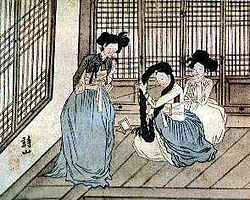
Kisaeng also began to appear in the vernacular art of later Joseon. They are particularly common in the work of the famed early 19th-century painter Hyewon, whose work focused on both the life of the cheonmin, including kisaeng, and erotic themes.[citation needed] During the colonial period, kisaeng were a popular object to Japanese and Korean painters, and postcards with the picture of Korean kisaeng were circulated in Japan.[71][72]

Kisaeng continue to be central to the understanding and imagining of Joseon culture in contemporary South and North Korea. For example, the female lead in the film Chi-hwa-seon was a kisaeng, the companion of painter Owon. Fresh treatments of popular kisaeng stories, including the fictional Chunhyang and the historical Hwang Jin-Yi, continue to emerge in popular novels and cinema. There was a modern re-telling of Kisaeng in the TV series New Tales of Gisaeng.[citation needed]

Literary and artistic works by kisaeng

[edit]

Not very many works by kisaeng are extant to this day. While many were accomplished artists in their time, it is likely that their work was not deemed valuable enough to keep or store. A large amount of their poetry survive, Hwang Jin-I being one of the most famous kisaeng poets (Book: Songs of the Kisaeng: courtesan poetry of the last Korean dynasty). While very little of their painting survive, the National Museum of Korea has thirteen of Juk-hyang's paintings of plants and flowers.[73] In the Japanese colonial period, though the education of gwonbeon still focused on traditional music and performance, the scope of their art expanded along with the cultural changes of society to include both folk genres and Japanese music.[3] The transmission of many songs and dances, albeit some with modification, were through the kisaeng of this period.

Famous kisaeng

[edit]

Notable kisaeng include:

See also

[edit]

Notes

[edit]

Further reading

[edit]
Revisions and contributorsEdit on WikipediaRead on Wikipedia
from Grokipedia
Kisaeng, also known as gisaeng, were a hereditary class of professional female entertainers in Korea from the Dynasty (918–1392) through the Dynasty (1392–1910), trained in the arts of music, , , , and conversation to serve the and officials. Officially registered as government-owned slaves within the cheonmin (lowborn) social stratum, they performed both artistic displays and sexual services, occupying a paradoxical position of cultural significance amid legal and social marginalization. Despite their low status, kisaeng received formal education in Confucian classics, etiquette, and performance skills—privileges rare for women outside the elite—enabling them to compose and influence literary traditions, as exemplified by figures like Hwang Jini. Their role persisted into the early until colonial reforms and modernization curtailed the system, though romanticized depictions in folklore often obscure the coercive realities of their hereditary servitude and exploitation.

Definition and Primary Functions

Etymology and Institutional Origins

The term kisaeng (also romanized as gisaeng) derives from the Sino-Korean compound gi-saeng (妓生), in which gi (妓) denotes a or female entertainer associated with , and saeng (生) signifies a person or living being. This etymology reflects the dual role of kisaeng as skilled performers and sexual companions, a rooted in historical records from the medieval period. The institutional origins of kisaeng trace to the dynasty (918–1392), where they first emerged as a distinct class of government-regulated entertainers serving the royal court, , and Buddhist monasteries. By the , the state formalized their training through gyobang (teaching houses or academies) dedicated to palace kisaeng, emphasizing instruction in music, , , and etiquette to support official banquets and diplomatic functions. This system persisted and expanded under the subsequent Joseon dynasty (1392–1910), with kisaeng integrated into a hereditary structure overseen by the , though their foundational establishment predates Joseon by centuries.

Core Roles in Entertainment and Sexual Commerce

Kisaeng fulfilled dual primary functions in society (1392–1910), acting as professional entertainers proficient in traditional arts and as providers of sexual services to elite male patrons. Their artistic roles centered on performances at official banquets, private gatherings, and court events, where they demonstrated mastery of , dance, poetry, and conversation to cultivate an atmosphere of refined leisure. Instruments such as the (a twelve-stringed zither) and daegeum (flute) featured prominently in their repertoires, alongside improvised poetry and elegant etiquette that appealed to scholars and officials. These skills elevated kisaeng above common laborers, positioning them as cultural intermediaries who preserved and disseminated artistic traditions amid strict Confucian hierarchies. Sexual commerce constituted the other foundational role, with many kisaeng operating as courtesans in gibang (private houses) registered under oversight. Clients, typically from the upper classes, compensated kisaeng not only for performances but for extended companionship that frequently included sexual relations, reflecting the intertwined nature of entertainment and intimacy in their profession. Historical accounts from records describe post-performance retreats where such services occurred, underscoring how economic dependency on male patronage reinforced this aspect, though not uniformly across all kisaeng tiers. Official gugwan kisaeng, employed by the state for public duties like diplomatic receptions, engaged less overtly in compared to private practitioners, yet the boundary remained fluid. This duality arose from their status as hereditary slaves trained specifically for elite service, where artistic prowess served as a prerequisite to access sexual labor markets without descending into unregulated . The integration of these roles stemmed from Joseon's social structure, where kisaeng filled a niche unmet by proper yangban women confined to domesticity. While some contemporary and later interpretations romanticize kisaeng solely as artists to mitigate stigma, primary Joseon-era evidence, including administrative registries and literary depictions, confirms sexual services as a routine economic driver, often enabling skilled kisaeng to amass wealth or purchase . Exaggerations of prostitution in colonial-era narratives under Japanese rule (1910–1945) further blurred distinctions, but pre-colonial functions balanced artistry with commerce as complementary survival mechanisms in a caste-bound system.

Hereditary Enslavement and Class Position

Kisaeng were classified within the cheonmin (천민), the lowest stratum of Joseon dynasty society, alongside slaves, butchers, and other entertainers deemed ritually impure or socially marginal. This positioning excluded them from the aristocracy and jungin middle class, rendering them ineligible for examinations or land ownership privileges reserved for higher ranks. Despite their artistic roles, kisaeng lacked over their labor, as they were registered in state offices akin to other enslaved populations, with the government exerting control over their assignments and earnings. The enslavement of kisaeng was hereditary, with female offspring inheriting the status and training as successors, while sons typically entered general . This perpetuated the class through familial lines, as escape required rare via payment or royal decree, often unattainable due to prohibitive costs and legal barriers. By 1650, all kisaeng were designated as state-owned slaves, formalizing their bondage under the and intensifying oversight of their hereditary obligations. Unlike chattel slavery in other contexts, Korean (slaves) including kisaeng could marry, own limited property, and receive compensation, though these rights did not mitigate their fixed subservience. The Gabo Reforms of 1894–1895 abolished and the caste system, nominally freeing kisaeng from hereditary bonds and integrating them into a modern legal framework. However, socioeconomic dependencies lingered, as former kisaeng often continued in entertainment due to limited alternatives and entrenched stigma. This transition marked the end of institutionalized hereditary enslavement but highlighted the persistence of class-derived vulnerabilities in early modern Korea. Kisaeng were classified under the cheonmin stratum, the lowest rung of society's hereditary class system, and functioned as state-owned slaves bound to government service. Their status was hereditary, compelling daughters of kisaeng to inherit the profession without choice, while sons often entered auxiliary roles like musicians or laborers. Official registries maintained by provincial offices tracked kisaeng as property of the state, subjecting them to administrative oversight akin to other enslaved groups such as . Legal rights were severely curtailed; kisaeng could not legally marry elites, as such unions threatened Confucian class purity and were voided under dynastic law. They faced mobility restrictions, including bans on independent residence or travel without official permission, and were prohibited from refusing assigned duties, which encompassed both artistic performances and sexual obligations deemed integral to their . Government regulations enforced from active service, typically after age 30 for lower ranks or 50 for elites, after which many sought for protection. Violations, such as unauthorized relationships or evasion of duties, invited or reassignment, though state ownership afforded nominal safeguards against private abuse by clients. Economically, kisaeng depended on a mix of state stipends—modest rice allotments and housing from gyubang training houses—and client fees for banquets, , , and companionship, which formed the bulk of their income but fluctuated with networks. High-ranking kisaeng cultivated long-term benefactors among officials or merchants, trading exclusivity for gifts, allowances, or posthumous support, while lower-tier ones endured precarious gig labor vulnerable to exploitation. This dependency reinforced their subordination, as independence was infeasible without state emancipation; the Gabo Reforms of 1894–1895 dismantled hereditary , nominally liberating kisaeng by abolishing class bindings, though many persisted in the trade due to ingrained economic ties.

Training and Professional Development

Recruitment from Marginalized Groups

Kisaeng were predominantly recruited from the cheonmin class, encompassing slaves and other disenfranchised individuals within Korea's rigid social hierarchy. In the dynasty (918–1392), early kisaeng likely originated from enslaved populations, including displaced Baekje people captured and integrated into the system following unification efforts around 936 CE. This pattern persisted into the dynasty (1392–1910), where the government registered kisaeng as state-owned slaves through gijeok registries, similar to other forms of conscripted labor. A primary recruitment avenue involved impoverished families, particularly from the lowest strata, who sold young daughters into gisaeng schools due to economic desperation; this included some fallen households unable to sustain their status. Hereditary transmission reinforced this marginalization, as daughters of existing kisaeng were automatically inducted into the profession, perpetuating enslavement across generations via matrilineal lines. Forced conscription from marginalized groups occurred as punishment for familial crimes, with female relatives of convicted —often for offenses like —condemned to kisaeng status, effectively enslaving them as state property. Notable examples include the reign of King Yeonsan (r. 1494–1506), during which approximately 1,000 women and girls were conscripted from provincial areas to serve as palace entertainers, drawn from vulnerable rural populations. Orphans and abandoned children from destitute backgrounds were also absorbed into the system, funneled into government-supervised gyobang training institutes established as early as the 11th century in and formalized in for skills in music, dance, and etiquette. These methods ensured a steady supply from society's periphery, with recruits typically entering young—often between ages 8 and 16—to undergo rigorous, multi-year preparation.

Education in Arts, Etiquette, and Other Skills

Kisaeng underwent rigorous formal training in gyobang (teaching houses or academies), state-regulated institutions established during the dynasty to prepare women from hereditary entertainer classes for their professional roles. These schools, often government-appointed and supervised, emphasized a that mirrored aspects of while adapting it to the kisaeng's functions in and companionship. Training commenced as early as ages 8 to 12 for selected girls, typically lasting three years or more, with advanced programs concentrated in centers like . The core of the education centered on performing arts, including mastery of traditional Korean instruments such as the geomungo (six-string zither), gayageum, daegeum (flute), and piri (oboe), alongside vocal techniques for genres like pansori (epic storytelling songs), sijo (three-line poems set to music), and japga (short songs). Dance training encompassed expressive forms such as salpuri (shamanistic ritual dance), seungmu (monk's dance), gibangmu (courtesan dance), fan dances, and sword dances, requiring precise control of breath, posture, and emotional conveyance through movements that embodied concepts like meot (elegance) and heung (excitement). Proficiency in composing and reciting poetry, particularly sijo, was essential, enabling kisaeng to improvise verses during gatherings. Etiquette and formed a parallel pillar, instructing kisaeng in refined conversation, deportment, and interpersonal dynamics to appeal to (elite) clients, including the ability to engage in witty discourse on , , and current events. Visual arts like and were taught to enhance cultural versatility, with some kisaeng also learning and basic crafts. Literacy in and limited was standard, distinguishing kisaeng from most women and allowing access to classical texts. In select cases, talented individuals received supplementary instruction in rudimentary , qualifying them as uinyeo ( physicians) for minor treatments. This multifaceted curriculum, delivered by experienced instructors within the gyobang framework, produced kisaeng who functioned as cultivated performers rather than mere servants, though the training reinforced their subservient class position by prioritizing skills aligned with elite male leisure. Government oversight ensured standardization, with kwŏnbeom (official entertainers) receiving the most intensive preparation, while private or lower-tier kisaeng might undergo abbreviated or less formal instruction.

Daily Life and Operational Realities

Typical Routines and Performance Venues

Kisaeng in the Joseon dynasty generally followed structured routines centered on artistic preparation and evening performances, residing in state-regulated gyobang (teaching houses) or affiliated quarters. Mornings and afternoons were devoted to rigorous practice of skills such as playing instruments like the and , composing and reciting poetry, rehearsing dances, and refining etiquette and conversational arts, often under the supervision of senior kisaeng or instructors. This daily regimen ensured proficiency, as elite ilp'ae (first-grade) kisaeng trained intensively to maintain their status, with careers peaking between ages 16 and 22 before declining due to age-related preferences among clients. Performance venues varied by occasion and client status, primarily occurring in the evenings or nights to accommodate elite male schedules. Official duties included entertaining at gwon-u-hwe banquets in government offices or royal palaces such as and in Hanyang (modern ), where kisaeng provided music, , recitation, and accompaniment for scholarly or diplomatic gatherings, such as celebrations for successful examinees. Private venues encompassed residences, particularly the sarangbang (men's quarters) or gardens, for intimate parties hosted by aristocrats, involving flirtation, singing, and extended conversations often laced with alcohol. Urban kisaeng houses (yugak or kisaeng chip), typically located near town centers and marketplaces for accessibility, served as hubs for both training and commercial performances, blending artistic displays with sexual services for paying patrons including officials and merchants. These routines reflected kisaeng's dual role as state-servants and commodified entertainers, with performances fluidly incorporating elements like and soothing to sustain client engagement, though records indicate variability by region and era, with emerging as a notable center for such houses by the late period. Historical accounts, such as those of famed kisaeng like Hwang Jini, highlight travel between cities like and Hanyang for high-profile events, underscoring the peripatetic nature of their professional lives.

Client Interactions and Personal Risks

Kisaeng engaged with clients primarily from the aristocracy, government officials, and scholars during banquets, private gatherings, and official events in the Dynasty (1392–1910). Interactions centered on artistic performances, including music on instruments like the and , dance, singing, poetry recitation (such as ), and yadam (witty or erotic conversation), often escalating to sexual services as part of their role as courtesans. These encounters could extend into longer-term arrangements, as seen with renowned kisaeng Hwang Jini (1506–1560), who formed month-long or multi-year relationships with clients like So Seyang and Yi Sajong through her poetic and performative skills, sometimes using to influence or rebuke patrons. Clients typically summoned kisaeng via a hojang (overseer) who managed fees and , with payments in rice, cloth, or silver depending on the kisaeng's grade and the event's scale; higher-ranked ilp'ae kisaeng served elite , while lower samp'ae worked taverns with broader clientele. Despite their cultural prestige, these interactions reinforced kisaeng's subservient position, blending —flirting, soothing, and intellectual companionship—with obligatory physical intimacy, as kisaeng were hereditary slaves () expected to provide concubine-like services to privileged males. Personal risks were inherent to kisaeng's enslaved status and occupational demands. Exploitation through bonded labor contracts, formalized after the 1894 Kabo Reforms but rooted in caste systems, trapped many in perpetual servitude, with limited avenues for beyond rare or purchase. Health hazards included sexually transmitted diseases like , prevalent among courtesans due to frequent unprotected encounters; colonial-era mandates for venereal checks in 1909 highlight the longstanding issue, though records imply similar vulnerabilities without systematic screening. Unwanted pregnancies posed further dangers, as female children typically inherited kisaeng status, perpetuating the cycle, while male offspring faced cheonmin (lowborn) stigma; abortions or occurred but lacked formal documentation. Physical and social perils compounded these, including violence from drunken clients or abusive overseers, as kisaeng's low offered scant against patrons. Hwang Jini navigated risks like potential execution or banishment for offending elites through bold poetry, and interpersonal jealousy from patrons' wives or concubines, underscoring the precariousness of defying Confucian norms despite artistic . Broader stigma as "public women" exposed kisaeng to societal disdain, isolating them from respectable and amplifying mental strains, though some leveraged fame for relative agency.

Specialized Societal Roles

Involvement in Politics and Diplomacy

Kisaeng served as state-regulated entertainers in court politics, performing , , and poetry at official banquets for kings, elites, and government officials, which helped maintain social hierarchies and facilitate administrative gatherings. These performances occurred regularly in palaces and government offices, where kisaeng, classified as government slaves after 1650, were summoned to uphold Confucian rituals and leisure without personal agency in selection. In diplomacy, kisaeng played ceremonial roles by greeting foreign envoys upon arrival and providing artistic entertainment during tributary missions and state receptions, particularly for Chinese and Japanese dignitaries, to demonstrate Korean cultural sophistication and hospitality. This practice, rooted in Goryeo dynasty precedents, extended into Joseon, where top-tier kisaeng—often unrestricted in palace access—accompanied envoys on excursions and performed at diplomatic events, such as those tied to Ming and Qing investitures, blending protocol with subtle soft power projection. Their involvement underscored the government's use of kisaeng as instruments of state prestige rather than independent actors.

Use in Espionage and Intelligence Gathering

During periods of foreign occupation, such as the Japanese colonial era (1910–1945), kisaeng's established networks among elites and their growing disaffection with colonial policies positioned them as suspected participants in anti-colonial intelligence activities. Japanese authorities, wary of this vulnerability, implemented targeted anti-espionage and anti-communist lectures and exhibitions to monitor and deter kisaeng from relaying information or aiding independence movements. In earlier contexts like the dynasty, kisaeng's routine presence at official banquets, diplomatic receptions, and private elite gatherings—where they provided entertainment including music, , and —afforded incidental access to political discourse among officials and envoys. While this proximity theoretically enabled informal intelligence gathering or the relay of overheard details amid factional rivalries or foreign visits, verifiable instances of deliberate deployment remain undocumented in surviving such as the Veritable Records of the Dynasty.

Historical Development

Goryeo Dynasty Foundations

The kisaeng class first emerged during the Goryeo Dynasty (918–1392), with historical records indicating their origins in the early period around 935, potentially linked to displaced populations from Baekje following the end of in 936. They are first explicitly mentioned in sources from the early , during the reign of King Hyeonjong (r. 1010–1036). As hereditary members of the cheonmin (lowest ), kisaeng functioned as state-sanctioned government servants, often in bondage, tasked with providing artistic performances, including music and dance, alongside sexual services to officials and dignitaries. The institutional foundations of the system were solidified through the establishment of gyobang, specialized training institutes for palace kisaeng, which focused on skills in dangak (court music) and sogak () styles. These academies first appeared in records during King Hyeonjong's reign but were temporarily abolished by royal decree in 1010 amid efforts to curb excesses; they were re-established under King Chungnyeol (r. 1274–1308). From King Munjong's reign (1046–1083), kisaeng were required to perform at official ceremonies and banquets, extending their roles beyond entertainment to include practical arts such as and rudimentary . State oversight included the maintenance of gijeok registries to track kisaeng, a practice formalized during King Myeongjong's reign (1170–1194). This bureaucratic framework underscored their role in cultural transmission, preserving and disseminating Korean musical, dance, and literary traditions amid the dynasty's aristocratic and Buddhist-influenced society. Unlike the more rigid hierarchies of later eras, kisaeng occasionally achieved elevated status, such as becoming royal concubines, reflecting relatively greater social fluidity.

Joseon Dynasty Expansion and Regulation

During the Dynasty (1392–1910), the kisaeng system expanded beyond its foundations, becoming more deeply embedded in state administration and official ceremonies despite the regime's Neo-Confucian ideology, which often expressed ambivalence toward professional female entertainers. Kisaeng served increasingly in formalized roles at royal courts, gatherings, and diplomatic receptions, reflecting a broader institutionalization to meet the needs of a stratified . This growth aligned with the dynasty's centralization of power, where entertainers facilitated social lubrication among elites while adhering to hereditary cheonmin status as government-owned slaves. Government regulation intensified to maintain order and prevent perceived moral excesses, with kisaeng registered in official ledgers under local magistrates or court offices responsible for music and rites. The Gyeongguk Daejeon, Joseon's comprehensive legal code compiled in 1485 and revised periodically, included specific statutes governing kisaeng activities, such as prohibitions on unauthorized entry into residences and mandates for supervised conduct during performances. Training was centralized in gyobang academies, state-supervised institutions that instructed recruits—often daughters of existing kisaeng or marginalized families—in music, , , , and from ages 8 to 16, ensuring standardized skills for . To enforce hierarchy and functionality, kisaeng were categorized into types like gunggi (palace-based for royal exclusive use), haengju (mobile entertainers for officials), and hyanggi (local for provincial duties), with further internal ranks determining access to clients. Regulations stipulated from active —typically by age 30 for haengju to curb long-term social disruptions—and occasional privileges for performers, such as elevated treatment comparable to women in restricted contexts. These measures balanced utility against Confucian concerns over licentiousness, though enforcement varied by region and era, with urban centers like Hanseong hosting the largest concentrations for demands.

Japanese Colonial Period Transformations

Following Japan's annexation of Korea in 1910, the kisaeng system faced regulatory overhaul, with the 1908 Kisaeng Regulation Order—issued under early colonial administration—placing kisaeng under police supervision and detaching them from traditional managers known as kibu, thereby embedding the profession within a controlled sex labor framework. This formalized shift diminished the guild-like autonomy inherited from the Joseon era, aligning kisaeng operations with Japanese bureaucratic priorities that emphasized licensing and oversight. Training evolved to accommodate colonial patrons, as Japanese authorities supported or established schools teaching proficiency alongside adapted forms of , , and to suit Japanese tastes. Privately funded elite kisaeng academies emerged around 1910, including the prestigious kisaeng school, which upheld rigorous standards in and performance until the late occupation period. These institutions perpetuated kisaeng skills but increasingly prioritized commercial viability over cultural refinement, amplifying the sexual service component historically associated with the role. By the 1920s, modernization of kisaeng houses intensified competition with nascent urban entertainments such as bar girls and actresses, while integration into Japan's licensing regime eroded distinctions from unregulated sex work, prompting prestige decline and some kisaeng to exit via labor movements. Demonstrations of agency surfaced, notably through the 1927 launch of Chang Han magazine by kisaeng collectives, which articulated political awareness against colonial and . These transformations—marked by , regulatory subjugation, and selective —foreshadowed the institution's post-1945 liberation, as modern societal shifts supplanted traditional patronage structures.

Post-1945 Decline and Absorption into Modern Entertainment

Following the end of Japanese colonial rule in August 1945, kisaeng houses in and quickly resumed operations, entertaining Allied delegations and local elites amid the power vacuum south of the . However, the traditional kisaeng institution faced immediate pressures from Korea's division, rapid , and shifting social norms that eroded hereditary class structures and state-regulated training. By the late , kisaeng as a distinct professional category began dissolving into a modernizing sex labor market, where their specialized artistic skills—such as singing and playing—became less competitive against emerging commercial entertainment forms. The (1950–1953) accelerated the decline, displacing traditional venues and integrating kisaeng into broader, unregulated networks catering to U.S. military personnel, with surveys from the indicating that around 60% of sex workers operated near American bases. In , remnants persisted in kisaeng houses through the and , offering music, , and companionship to businessmen and officials, but these faced crackdowns under President Park Chung-hee's regime (1961–1979), which expanded entertainment districts while enforcing anti-vice laws to promote industrialization and moral reform. By the 1970s, overt kisaeng operations had largely vanished, surviving only in nostalgic "kisaeng tours" for Japanese tourists and elite private banquets, though these blurred into general hospitality rather than formalized training lineages. In , post-1945 socialist reforms under Kim Il-sung abolished feudal entertainers outright, redirecting any surviving practitioners into state arts ensembles stripped of private patronage. Kisaeng artistry absorbed into modern Korean entertainment through the professionalization of traditional , with skills in recitation, instrumental music, and influencing South Korea's National Gugak Center troupes and commercial trot singers, who adapted kisaeng-era repertoires like verses for mass audiences. This transition decoupled performance from sexual labor, as colonial-era bifurcations between "pure" entertainers and sex workers evolved into regulated theater and industries , preserving elements like solos in contemporary cultural festivals. In both Koreas, state-sponsored ensembles formalized kisaeng-derived techniques into national heritage, evident in North Korea's incorporating stylized routines and South Korea's preservation of gugak (traditional music) , though commercialized for and media.

Regional and Temporal Variations

Differences Across Korean Regions

During the Joseon Dynasty (1392–1910), kisaeng numbers, training intensity, and artistic specializations varied significantly across regions, influenced by local administrative centers, cultural traditions, and proximity to power structures like the royal court. Urban hubs such as and concentrated larger populations of kisaeng, who underwent formalized education in music, , , and etiquette, while rural provinces and military outposts featured smaller groups often oriented toward practical support roles alongside basic performances. These disparities arose from the government's gyobang (kisaeng offices) system, which allocated resources unevenly, with capital and northern cities receiving priority for elite recruitment and instruction. Pyongyang, a key northern administrative center, stood out for its renowned kisaeng, who were celebrated for superior proficiency in and performance; the city's gyobang was among the most prestigious, annually selecting and training approximately 200 adolescent girls over three years in advanced arts. In contrast, Seoul's roughly 1,000 kisaeng—many directly serving court officials—faced mandatory, rigorous daily drills, with expulsion for lapses in attentiveness, emphasizing courtly refinement over regional folk elements. Rural areas, including hyeon-level villages and garrisons like 15th-century Yeongbyeon (with about 60 kisaeng), prioritized domestic duties such as and companionship, with limited emphasis on elaborate . Regional artistic foci further highlighted these differences: kisaeng in Honam (Jeolla Province) specialized in pansori narrative singing, a southwestern oral tradition; those in Jinju (Gyeongsang Province) excelled in geommu sword dance; Jeju Island kisaeng incorporated equestrian displays reflective of island horsemanship; Gwandong (Gangwon Province) emphasized memorization of local scenic poems like "Gwandong Byeolgok"; and Andong-area kisaeng recited Confucian classics such as the Great Learning. These localized repertoires allowed kisaeng to cater to provincial yangban preferences, though elite talents from peripheries often migrated to urban centers for higher status.

Adaptations in North vs. South Korea Post-Division

In the Democratic People's Republic of Korea (DPRK), the kisaeng system was formally prohibited during the revolutionary period from 1945 to 1950 as part of broader efforts to eradicate feudal institutions, licensed , and private , including the closure of kisaeng schools and revocation of licenses. This abolition aligned with the regime's emphasis on through workforce integration and elimination of class-based entertainments, resulting in the complete suppression of kisaeng training and performance by the early . Descendants of kisaeng were often classified within the "hostile class" framework, subjecting them to ongoing social and economic discrimination under the system, which prioritized class background in and opportunities. In contrast, the Republic of Korea (ROK) saw a temporary resurgence of kisaeng activities immediately after liberation in 1945, with salons reopening south of the 38th parallel to entertain American military delegations and officials amid the power vacuum. The (1950–1953) accelerated the profession's transformation, as traditional kisaeng skills became less viable in a modernizing economy, leading to absorption into broader sex labor markets near U.S. bases, where surveys from the and indicated widespread but diminished emphasis on artistic training. By the , remnants persisted in "kisaeng tourism" targeted at Japanese visitors, featuring nostalgic performances that blended historical reenactments with commercial entertainment, though formal guilds and state regulation had eroded. Some former kisaeng transitioned to roles in women's organizations or modern arts, reflecting partial adaptation rather than outright eradication. These divergences stemmed from ideological priorities: the DPRK's Marxist-Leninist framework viewed kisaeng as emblematic of pre-modern exploitation, necessitating total elimination to foster proletarian culture, whereas the ROK's capitalist development and U.S. influence allowed selective preservation for economic and cultural purposes until urbanization and legal reforms further marginalized the tradition by the late .

Cultural Representations and Legacy

Depictions in Traditional Korean Art and Literature

In traditional Korean genre paintings of the late Dynasty, kisaeng were frequently depicted as active participants in social and everyday scenes, often engaging in music, dance, and conversation with elites. Painters such as Kim Hong-do (1745–c. 1818), known as Danwon, illustrated kisaeng houses where noblemen relaxed, emphasizing the entertainers' roles in activities amid Confucian . Similarly, Sin Yun-bok (c. 1758–after 1821), or Hyewon, portrayed kisaeng in satirical or humorous contexts within urban life, such as walking along walls or , using symbols like the lotus to contrast their profane status with sacred ideals. These works, part of the tradition, highlighted kisaeng's visibility in public spaces despite their low social position, reflecting a nativist focus on experiences during the 18th and 19th centuries. Literary depictions of kisaeng in Joseon-era and folk tales often romanticized their virtues and talents, portraying them or their daughters as embodiments of fidelity and artistry against class barriers. The , a prominent narrative from the 18th century, centers on Chunhyang, the daughter of a kisaeng named Wolmae, who defies social norms through her loyalty to her lover Mongryong, ultimately affirming Confucian ideals of chastity even for those of entertainer descent. This story, performed by singers and drummers, elevated kisaeng-associated figures as moral exemplars, influencing cultural perceptions of their agency within rigid hierarchies. Such representations, while rooted in oral traditions predating written records, underwent embellishments in later adaptations, blending historical realism with idealized narratives of beauty and resilience. These artistic and literary portrayals underscore kisaeng's dual role as skilled performers and social outliers, with paintings capturing candid interactions and literature weaving tales of transcendence, though both mediums occasionally glossed over the coercive elements of their training and servitude under state regulation. Primary sources from the period, including royal records, confirm kisaeng's mandatory in arts from age eight or nine, which informed these creative depictions of their cultural contributions.

Modern Media Portrayals and Historical Romanticization

In South Korean historical dramas () and films, kisaeng are commonly portrayed as elegant, multifaceted entertainers whose artistic prowess in music, dance, and poetry often intersects with tales of forbidden romance and personal defiance against social constraints. For instance, the 2006 MBC drama Hwang Jini, based loosely on the life of the 16th-century kisaeng Hwang Jini, depicts her as a determined navigating Joseon-era hardships while pursuing excellence in her craft, highlighting themes of autonomy and cultural contribution over institutional subjugation. Similarly, the 2007 film Hwang Jin Yi, starring , fictionalizes the protagonist's journey as a blend of relentless artistic ambition and romantic intrigue, drawing from historical accounts but amplifying her agency in a male-dominated society. The 2011 tvN drama New Tales of Gisaeng centers on the interpersonal dynamics within a gisaeng house, emphasizing emotional depth, loyalty, and tragedy among the women, who serve elite clientele in a modernized retelling set partially in contemporary times but rooted in traditions. These narratives frequently feature kisaeng as "ride-or-die" figures—fiercely devoted lovers willing to challenge authority for personal bonds—echoing adaptations of classical tales like The Song of Chunhyang, where the kisaeng heroine embodies unwavering fidelity and moral virtue amid class barriers. Such depictions contribute to a broader historical romanticization that idealizes kisaeng as proto-feminist icons of talent and resilience, often glossing over empirical realities of their coerced from lowborn or enslaved families, rigorous state-regulated starting in childhood, and primary in providing sexual companionship to elites. This selective emphasis aligns with conventions prioritizing dramatic allure and national cultural pride, as seen in recurring motifs of kisaeng outwitting corrupt officials or inspiring reform, which diverge from primary sources documenting their as hereditary entertainers bound by government oversight until the early . Critics note that this romantic lens, prevalent since early cinematic efforts like the 1957 Hwang Jin-i, serves value but risks distorting causal factors like economic dependency and limited that defined their lives.

Original Contributions

Literary and Artistic Works Produced by Kisaeng

Kisaeng produced a body of primarily in the form, a Korean genre consisting of three lines with a rhythmic structure that allowed for concise expression of , , and observation, often drawing from themes of transient , romantic longing, and the constraints of their social position. These works emerged mainly during the Joseon Dynasty (1392–1910), reflecting the kisaeng's training in literati arts despite their low status as government slaves. by kisaeng contributed to the genre's development, blending accessibility with sophisticated , and were occasionally exchanged in elite social gatherings as intellectual diversions. Hwang Jini (1506–1560), the most renowned kisaeng poet, authored at least six surviving , noted for their restrained passion and ironic twists that challenged Confucian norms indirectly through natural imagery. One example, "Expectation," evokes unfulfilled desire: "Did you come to see me / or did you come to see the plum blossoms? / I came to see you, / but the plum blossoms are in bloom." Her poems, preserved in Joseon-era anthologies, demonstrate technical mastery and personal agency, earning her posthumous fame among scholars. Other kisaeng poets included Yi Maechang (fl. 17th century), who composed —Sino-Korean regulated verse typically reserved for male elites—infusing them with worldly embrace and subtle defiance, as in her reflections on nature's impermanence amid human folly. Collections of kisaeng , such as those compiled in the 20th century from earlier manuscripts, highlight around 200 attributed poems across figures like these, underscoring their role in vernacular literary innovation despite limited formal access. In artistic domains beyond , kisaeng contributed to and , particularly in gagok (lyric songs) and instrumental styles; for instance, Kim Juk-pa (fl. 19th century) developed freer interpretations of zither pieces, adapting traditional modes for expressive solos that influenced court ensembles. Their works in and , often integrated with poetry recitations, preserved aesthetic forms, though surviving notations and scores are rarer than texts due to oral transmission traditions.

Notable Historical Figures and Their Achievements

Hwang Jini (1506–1567), also known as Hwang Chin-i, was a prominent kisaeng from Gaeseong during the early dynasty, celebrated for her mastery of poetry, music, and dance. She composed poems noted for their wit and emotional depth, with works like "To a Man Watching a Sunset" reflecting themes of transience and longing, preserved in collections such as the Akchang gweon. Historical accounts describe her rejecting suitors based on intellectual merit, including a challenge to a Buddhist monk that led to her composing a poem on the spot, demonstrating her improvisational skill. Her talents extended to calligraphy and performance, earning her patronage among elites while maintaining selective independence. Non-gae (fl. 1592), a kisaeng from Jinju, gained renown for her act of defiance during the Imjin War against Japanese invaders. Forced to entertain Keyamura Rokusuke, a high-ranking Japanese officer, she lured him to the rocky banks of the Nam River during a banquet and leapt into the water with him bound to her, resulting in both deaths and symbolizing resistance to occupation. This event, dated to 1592 amid the Japanese invasions led by Toyotomi Hideyoshi, was commemorated in local lore and later memorials, highlighting kisaeng involvement in wartime espionage and sabotage. Non-gae's story underscores the dual roles of kisaeng as entertainers and occasional agents in national defense, though primary records are sparse and reliant on oral traditions recorded post-event. Maechang (fl. early 17th century), a Pyongyang-based kisaeng, distinguished herself through that critiqued social norms and embraced natural imagery. She corresponded with the scholar-official Heo Gyun (1569–1618), author of the novel , who praised her verses for their philosophical depth and incorporated influences from her work into his writings. Surviving poems, such as those evoking seasonal changes to metaphorize human impermanence, were circulated among literati, evidencing kisaeng contributions to literary culture beyond performance. Her association with Heo Gyun elevated her status, as he reportedly valued her intellect over conventional roles.

Debates on Nature and Interpretations

Artist vs. Prostitute Classification Disputes

Kisaeng in the Joseon dynasty (1392–1910) were officially designated as a hereditary class of female entertainers trained by the state in music, dance, poetry, and etiquette to serve government officials and elites at banquets and official events. While their primary documented role emphasized artistic performance—such as accompanying yangban scholars with gagok songs or sijo poetry—historical records indicate that sexual services were frequently expected or provided, particularly in private patronage arrangements, leading to disputes over whether this constituted integral prostitution or incidental exploitation. Higher-ranked kisaeng, like gapja, focused more on public performances and instruction, whereas lower tiers (samp'ae) often combined arts with direct sexual labor, blurring lines but not eliminating the entertainer distinction. Under Japanese colonial rule (1910–1945), the 1908 Kisaeng Regulation Order and mandatory health examinations formally incorporated kisaeng into the licensed system, shifting many from hereditary state-managed entertainers to bonded sex workers amid a commercializing industry. This policy, building on the Kabo Reforms that ended , bifurcated kisaeng into licensed musical performers and explicit prostitutes, with colonial authorities emphasizing the sexual over artistic heritage to regulate and labor. Critics argue this era cemented a prostitute label that retroactively overshadowed pre-colonial artistic contributions, as evidenced by Japanese portrayals equating kisaeng with common courtesans, though some kisaeng resisted by reclaiming traditional skills in periodicals like Chang Han (1927). Modern scholarly debates reflect nationalist efforts to reframe kisaeng as empowered artists—highlighting figures like Hwang Jini (1506–1560), renowned for poetry and independence—against evidence of systemic coercion in a Confucian hierarchy where refusal of elite demands risked punishment or enslavement. Pro-prostitute classifications draw on empirical accounts of economic dependency and bodily regulation, viewing artistic training as a veneer for sex labor in a slave-like institution, while artist advocates cite surviving collections and paintings as proof of cultural agency, though these often ignore the causal link between entertainment access and sexual availability in patriarchal structures. The tension persists, with postcolonial historiography cautioning against romanticization that downplays exploitation realities over verifiable elite-client dynamics.

Exploitation Realities vs. Claims of Agency and Empowerment

The kisaeng system in Korea (1392–1897) was characterized by hereditary servitude, with many girls born into the profession as daughters of prior kisaeng or sold into it from impoverished or slave backgrounds, often beginning rigorous in arts and etiquette as early as age 8 or 9 under state oversight. This , while emphasizing skills in poetry, music, dance, and conversation, served to prepare them for mandatory service to elites and officials, where sexual availability was an implicit expectation despite formal prohibitions against outright ; refusal could result in , and many endured coerced relations, leading to widespread venereal diseases like and short life expectancies. Structural exploitation was reinforced by the cheonmin caste system, denying kisaeng marriage rights to commoners, property ownership, and exit from the role, with government registries enforcing their bonded status akin to other forms of unfree labor prevalent in society. Empirical accounts from Joseon records and later analyses reveal pervasive hardships, including physical abuse by patrons, economic dependency on unstable patronage, and social stigmatization that isolated kisaeng from mainstream ; for instance, unregistered or "wild" kisaeng faced even greater vulnerability to trafficking and without institutional protections. Korean scholars have noted a historical reluctance to fully confront this trafficking dimension, often downplaying it in favor of cultural , which aligns with broader patterns of selective narration in postcolonial influenced by nationalist sentiments. In contrast, some contemporary interpretations, particularly in Western-influenced academic discourse, claim kisaeng exercised significant agency and through their , artistic output, and occasional influence over patrons, portraying them as proto-feminists who subverted Confucian patriarchy via intellectual prowess and selective relationships. Proponents cite exceptional figures like the 16th-century kisaeng Hwang Jini, who composed poetry and allegedly chose lovers, as evidence of autonomy, extending this to argue the system offered rare avenues for and in a rigidly hierarchical era. However, such claims overgeneralize from outliers, ignoring causal realities: any perceived agency stemmed from survival strategies within , not genuine , as systemic bondage precluded opting out, and "" metrics like rates (estimated at a minority among kisaeng) did not mitigate exploitation for the majority, who comprised unregistered practitioners or those in rural gisaeng houses facing graver abuses. This tension reflects interpretive biases, where narratives—often amplified in modern media and —prioritize aesthetic legacies over verifiable suffering, akin to apologetics for other historical sex labor systems; primary evidence from Joseon annals and survivor testimonies prioritizes exploitation as the norm, with agency as a precarious exception dependent on elite favor rather than inherent system design. Under Japanese colonial rule (1910–1945), these dynamics intensified with state bifurcations licensing kisaeng explicitly as workers or entertainers, further entrenching without alleviating underlying unfreedom.

References

Add your contribution
Related Hubs
User Avatar
No comments yet.