


Community hub
Recent from talks
Contribute something
Nothing was collected or created yet.
Guantánamo Bay
View on Wikipedia | This article needs additional citations for verification. (February 2021) |

Guantánamo Bay (Spanish: Bahía de Guantánamo, [baˈia ðe ɣwãnˈtanamo]) is a bay in Guantánamo Province at the southeastern end of Cuba. It is the largest harbor on the south side of the island and it is surrounded by steep hills which create an enclave that is cut off from its immediate hinterland.
The United States assumed territorial control over the southern portion of Guantánamo Bay under the 1903 Lease.[1] The United States exercises jurisdiction and control over this territory as the home of the Guantanamo Bay Naval Base, while recognizing that Cuba retains ultimate sovereignty.[2][3]
Climate
[edit]Guantánamo Bay has a hot semi-arid climate according to the Köppen climate classification, with high temperatures throughout the year. Rainfall is rather low, and it is one of the driest regions in Cuba.
| Climate data for Guantánamo Bay | |||||||||||||
|---|---|---|---|---|---|---|---|---|---|---|---|---|---|
| Month | Jan | Feb | Mar | Apr | May | Jun | Jul | Aug | Sep | Oct | Nov | Dec | Year |
| Record high °C (°F) | 35 (95) |
35 (95) |
33 (91) |
35 (95) |
37 (99) |
37 (99) |
39 (102) |
37 (99) |
37 (99) |
38 (100) |
39 (102) |
35 (95) |
39 (102) |
| Mean daily maximum °C (°F) | 29 (85) |
29 (85) |
30 (86) |
31 (87) |
31 (88) |
32 (90) |
33 (91) |
33 (92) |
33 (91) |
32 (89) |
31 (88) |
30 (86) |
31 (88) |
| Mean daily minimum °C (°F) | 20 (68) |
20 (68) |
21 (70) |
22 (72) |
23 (74) |
24 (76) |
24 (76) |
24 (76) |
24 (76) |
24 (75) |
23 (73) |
21 (70) |
23 (73) |
| Record low °C (°F) | 13 (55) |
13 (55) |
16 (61) |
17 (63) |
18 (64) |
20 (68) |
21 (70) |
20 (68) |
19 (66) |
18 (64) |
16 (61) |
13 (55) |
13 (55) |
| Average precipitation mm (inches) | 25 (1.0) |
23 (0.9) |
30 (1.2) |
33 (1.3) |
91 (3.6) |
53 (2.1) |
28 (1.1) |
48 (1.9) |
76 (3.0) |
130 (5.1) |
46 (1.8) |
28 (1.1) |
610 (24.0) |
| Source: Weatherbase[4] | |||||||||||||
U.S. control of Guantánamo Bay
[edit]
The United States first seized Guantánamo Bay and established a naval base there in 1898 during the Spanish–American War in the Battle of Guantánamo Bay.[5]: 160–163 In 1903, the United States and Cuba signed a lease granting the United States permission to use the land as a coaling and naval station. The lease satisfied the Platt Amendment, passed by the United States Congress, which stated that a naval base at "certain specific points agreed upon by the President of the United States" was needed to "enable the United States to maintain the independence of Cuba."[citation needed]
History
[edit]
The original inhabitants of the bay, the Taínos, called it Guantánamo. Christopher Columbus landed in 1494, naming it Puerto Grande.[6][page needed] On landing, Columbus' crew found Taíno fishermen preparing a feast for the local chieftain. When Spanish settlers took control of Cuba, the bay became a vital harbor on the island's south side.[citation needed]
The bay was briefly renamed as "Cumberland Bay" when a British expeditionary force captured it in 1741 during the War of Jenkins' Ear. British Admiral, Edward Vernon, arrived with a force of eight warships and 4,000 soldiers with plans to march on Santiago de Cuba. However, local Spanish colonial troops defeated him and forced him to withdraw or face becoming a prisoner.[6][page needed] In late 1760, two Royal Navy frigates, HMS Trent and HMS Boreas cut out the French privateers Vainquer and Mackau, which were hiding in the bay. The French were also forced to burn the Guespe, another privateer, to prevent her capture.[citation needed]
During the Spanish–American War of 1898, the U.S. Navy fleet attacking Santiago needed shelter from the summer hurricane season. They chose Guantánamo because of its excellent harbor. U.S. Marines landed with naval support in the invasion of Guantánamo Bay in June 1898. As they moved inland, however, Spanish resistance increased, and the Marines required support from Cuban scouts.[citation needed]
Guantanamo Bay is of interest to U.S. military planners due to its geographical location in the Caribbean. It became a strategic location in defending the Panama Canal and the southern US coast. It was also a natural haven for naval vessels in the region. Due to other factors, it pushed the US to consider the area as a suitable location for a Naval Base.[7]
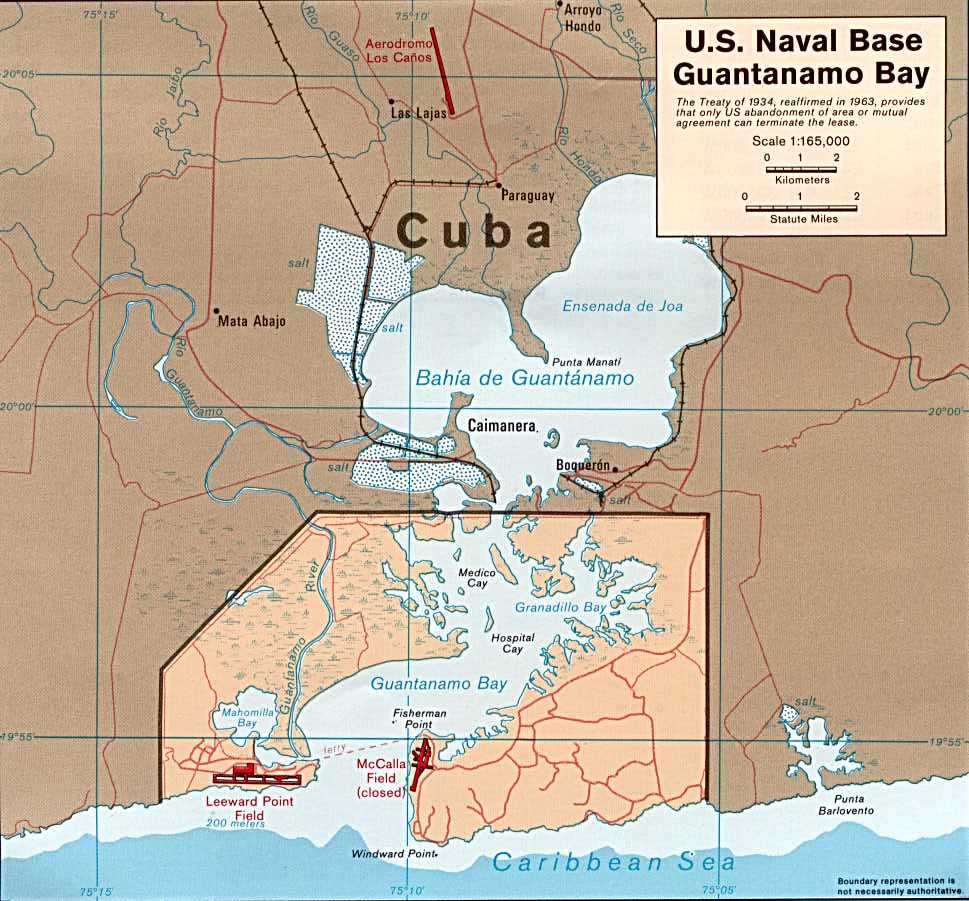
The Guantanamo Bay Naval Base surrounds the southern portion of the bay.

The naval base, nicknamed "GTMO" or "Gitmo", covers 116 square kilometres (45 sq mi) on the western and eastern banks of the bay. It was established in 1898, when the United States took control of Cuba from Spain following the Spanish–American War. The newly-formed American protectorate incorporated the Platt Amendment in the 1901 Cuban Constitution. Tomás Estrada Palma, the first President of Cuba, offered a perpetual lease for the area around Guantánamo Bay on February 23, 1903. The 1903 Cuban–American Treaty of Relations held, among other things, that the United States, to operate coaling and naval stations, has "complete jurisdiction and control" of the Guantánamo Bay, while recognizing that the Republic of Cuba retains ultimate sovereignty.[8][page needed]
In 1934, a new Cuban-American Treaty of Relations, reaffirming the lease, granted Cuba and its trading partners free access through the bay, modified the lease payment from $2,000 in U.S. gold coins per year to the 1934 equivalent value of $4,085 in U.S. dollars,[citation needed] and made the lease permanent unless both governments agreed to break it, or until the U.S. abandoned the base property.[9]
After the Cuban Revolution of 1953–1959, United States President Dwight D. Eisenhower insisted that the status of the base remain unchanged, despite the objections of Fidel Castro. Since then, the Cuban government has cashed only one of the rent cheques from the U.S. government, and even then, according to Castro, only because of "confusion" in the early days of the Cuban revolution. The remaining uncashed cheques, made out to "Treasurer General of the Republic" (a title that ceased to exist after the revolution), were kept in Castro's office, stuffed into a desk drawer.[10]
In the 1990s, the United States used Guantanamo Bay as a processing center for asylum-seekers and as a camp for HIV-positive refugees.[citation needed][11] Over a period of six months, the US interned over 30,000 Haitian refugees in Guantanamo, while another 30,000 fled to the Dominican Republic. Eventually, the US admitted 10,747 of the Haitians to refugee status in the United States. Most of the refugees were housed in a tent city on the re-purposed airstrip that would later be used to house the complex used for the Guantanamo military commissions. The refugees who represented discipline or security problems were held on the site that later became Camp XRay, the initial site of the Guantanamo Bay detention camp.[citation needed] In August 1994, rioting broke out in the detention camps and 20 U.S. military police and 45 Haitians were injured.[12]
Since 2002, the base has included detention of individuals deemed of risk to United States national security. In 2009, the U.S. President, Barack Obama, gave orders for the detention camp to close by January 22, 2010. As of 2021[update], it remains open due to a congressional refusal of funds for its closure.[13]
Alfred-Maurice de Zayas has argued that the 1903 lease agreement was imposed on Cuba under duress and was a treaty between unequals, no longer compatible with modern international law, and voidable ex nunc. He makes six suggestions for a peaceful settlement, including following the procedure outlined in the Vienna Convention on the Law of Treaties.[14] However, Article 4 of the Vienna Convention states that its provisions do not apply to past treaties retroactively.
In January 2025, U.S. President Donald Trump, said the US would send to and detain migrants in the base, resuming a practice that the US had employed at Guantanamo Bay previously over decades for migrants intercepted at sea.[15]
See also
[edit]- Cuba–United States relations
- Guantanamo Bay detention camp
- Platt Amendment: Document to guarantee U.S. Navy lease in Cuba
References
[edit]- ^ "Avalon Project – Agreement Between the United States and Cuba for the Lease of Lands for Coaling and Naval stations; February 23, 1903". Avalon.law.yale.edu. Retrieved March 26, 2013.
- ^ Vaughne Miller; Alison Pickard; Ben Smith. "Cuba and the United States - how close can they get?" (PDF). House of Commons Library. p. 18. Retrieved November 12, 2022.
The Cuban government regards the US presence in Guantánamo Bay as illegal and insists the 1903 Treaty was obtained by threat of force and is in violation of international law.
- ^ Boadle, Anthony (August 17, 2007). "Castro: Cuba not cashing US Guantanamo rent checks". Reuters.com. Retrieved October 8, 2017.
- ^ "Weatherbase: Historical Weather for Guantanamo Bay, Cuba". Weatherbase.
- ^ Nofi, A.A., 1995, The Spanish–American War, 1898, Pennsylvania: Combined Books, ISBN 0938289578
- ^ a b Gott, Richard Cuba: A new history, Yale University Press: 2004
- ^ Carrington, J. (2022). Guantanamo Bay. A Historical Mystery. Independently published ISBN 979-8838304131
- ^ Olga Miranda Bravo, Vecinos Indeseables: La Base Yanqui en Guantánamo (La Habana: Editorial Ciencias Sociales, 1998)
- ^ Destination Guantanamo Bay Avalon Law Yale, Retrieved on July 16, 2015
- ^ Boadle, Anthony (August 17, 2007). "Castro: Cuba not cashing U.S. Guantanamo rent cheques". Reuters. Retrieved December 7, 2007.
- ^ Amnesty International. "LETTER WRITING ACTION Haitian Asylum Seekers USA (Guantánamo)" (PDF).
- ^ "Gis, Haitians Hurt In Guantanamo Riot". chicagotribune.com. Chicago Tribune. August 16, 1994. Retrieved August 16, 2015.
- ^ "Guantanamo Docket". The New York Times. Retrieved October 1, 2011.
- ^ Compare a Word document titled "The Status of Guantánamo Bay and the Status of the Detainees" A presentation to the University of British Columbia – Law. Retrieved July 2014
- ^ "Trump Administration Considers Detaining Migrants At Guantanamo". Barron's. Retrieved January 30, 2025.
External links
[edit]

- Read Congressional Research Service (CRS) Reports regarding Guantánamo Detainees
- U.S. Naval Station Guantanamo Bay — The United States' oldest overseas Naval Base
- Guantánamo: U.S. Black Hole
- All-Party Parliamentary Group on Guantanamo Bay (APPG-GB)
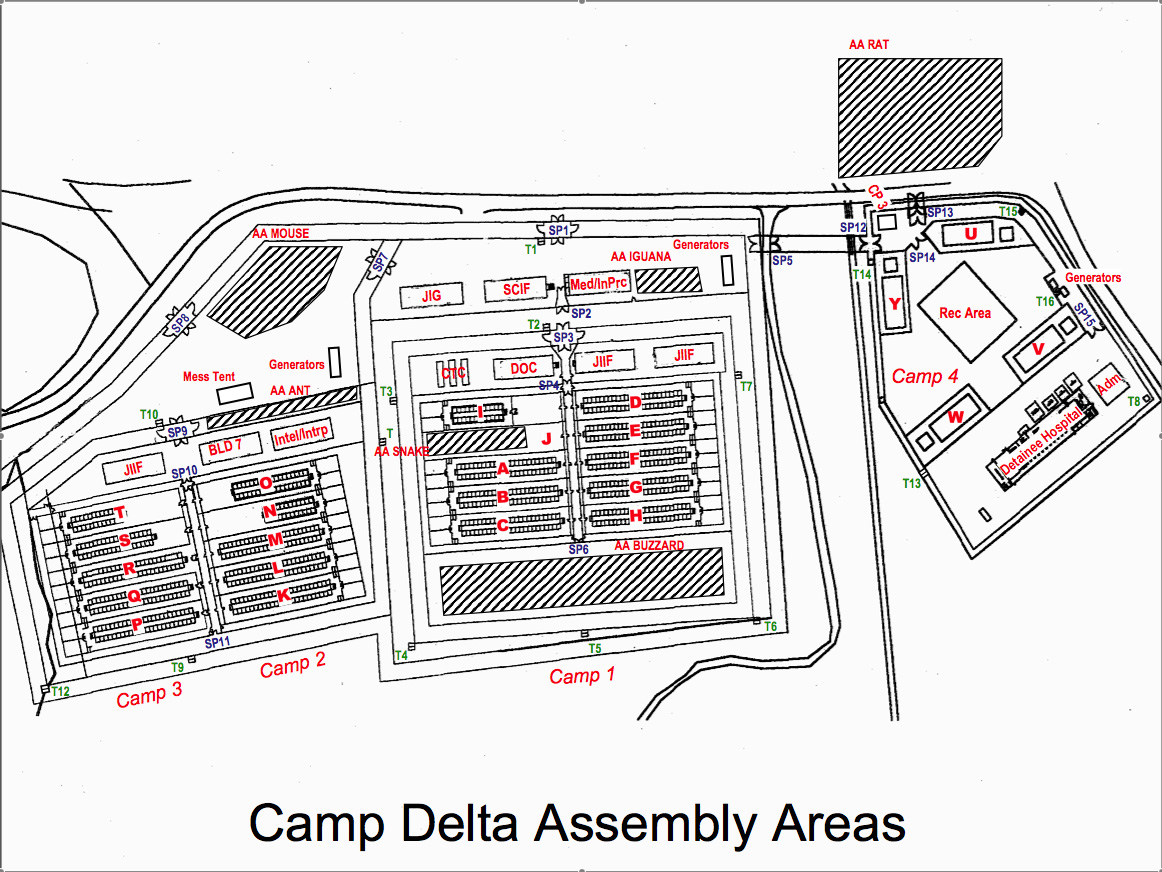
- Camp Delta (detainee) Map
- U.S. Naval Base Guantanamo Bay Map
- Guantanamo Docket
- Human Rights First; In Pursuit of Justice: Prosecuting Terrorism Cases in the Federal Courts (2009)
19°59′51″N 75°08′31″W / 19.997520°N 75.142021°W
| International | |
|---|---|
| National | |
| Other | |


Guantánamo Bay
View on GrokipediaGeography and Environment
Location and Physical Features
Guantánamo Bay is an inlet of the Caribbean Sea located on the southeastern coast of Cuba, approximately 430 miles (700 kilometers) southeast of Miami, Florida.[9] The bay lies at the boundary between Guantánamo Province and Santiago de Cuba Province, serving as a natural harbor with strategic maritime access.[10] The bay features a pouch-shaped indentation extending about 12 miles (19 kilometers) in a northeast-southwest direction, with a maximum width of approximately 6 miles (10 kilometers) at its entrance, narrowing inland to form a sheltered harbor capable of accommodating large vessels.[10] Its narrow entrance provides natural protection from open ocean swells, contributing to its utility as a deep-water anchorage.[10] Surrounding the bay are steep, dry hills rising sharply from the shoreline, characterized by rocky outcroppings, scrub vegetation, and cactus, which create a rugged, arid terrain that isolates the area from the broader Cuban landscape.[10] The coastline includes chalky cliffs and ridges, enhancing the bay's defensible geography while limiting overland connectivity to the interior.[11]Climate and Ecology
Guantánamo Bay experiences a tropical climate characterized by high temperatures year-round and distinct wet and dry seasons. Average annual temperatures hover around 26.8°C (80.2°F), with daily highs typically reaching 33°C (91°F) in summer and lows dipping to 20°C (68°F) in winter, rarely falling below 17°C (63°F) or exceeding 34°C (94°F). Precipitation totals approximately 924 mm (36.4 inches) annually, concentrated in the rainy season from May to October, rendering the area one of Cuba's drier regions despite its tropical latitude.[12] The bay's ecology encompasses coastal mangroves, dry limestone forests, wetlands, and marine habitats supporting significant biodiversity. Terrestrial fauna includes over 31 species of amphibians and reptiles, such as Cuban tree frogs and rock iguanas, alongside endemic birds like the Cuban trogon and bee hummingbird, with eight Cuban endemics noted as abundant in rapid assessments. Mammals such as banana rats and West Indian manatees, and reptiles including Cuban boas and American crocodiles, thrive due to limited human disturbance. Marine environments feature coral reefs, seagrass beds, and migratory species including sea turtles (e.g., hawksbill and green), sharks, dolphins, and whales, contributing to Caribbean-wide ecological connectivity.[13][14][15] The U.S. Naval Station's isolation—enforced by fencing and restricted access—has inadvertently preserved habitats from poaching, logging, and development prevalent elsewhere in Cuba, fostering a de facto wildlife refuge and enabling ecological research on rare species. Environmental monitoring by base authorities includes water quality assessments compliant with U.S. standards, though isolated reports of potential contaminants, such as in a 2016 cancer cluster among staff, highlight ongoing scrutiny of industrial activities' impacts. This preservation contrasts with broader Cuban coastal degradation, positioning the bay as a comparative baseline for regional biodiversity studies.[16][17][18][19]Historical Background
Indigenous and Colonial Eras
The region surrounding Guantánamo Bay was originally inhabited by the Taíno people, an Arawakan group that migrated to Cuba from South America via the Caribbean islands around 700 CE, establishing villages and utilizing the bay's resources for fishing, hunting, and agriculture including cassava cultivation.[20][21] Archaeological evidence from the Guantánamo River basin indicates human habitation dating back approximately 5,000 years, with Taíno presence marked by ceramic artifacts, shell middens, and petroglyphs reflecting their animistic beliefs and hierarchical society led by caciques.[20] The Taíno population in eastern Cuba, including the Guantánamo area, numbered in the tens of thousands at contact, sustaining themselves through a mix of foraging, small-scale farming, and maritime activities in the sheltered bay, which they named Guantánamo, meaning "a place of rivers" or "land between rivers."[22][23] Christopher Columbus sighted the bay during his second voyage on November 29, 1494, renaming it Puerto Grande due to its expansive natural harbor suitable for large fleets.[22] Spanish colonization of Cuba began in earnest with Diego Velázquez de Cuéllar's establishment of Baracoa, the island's first permanent settlement, in 1511 near the eastern tip, approximately 30 miles northwest of Guantánamo Bay; this followed violent conquests that decimated Taíno populations through enslavement, forced labor in gold mines, European diseases like smallpox, and direct violence, reducing their numbers from an estimated 100,000–200,000 across Cuba to near extinction by the mid-16th century.[24][21] During the early colonial period (16th–18th centuries), Guantánamo Bay remained sparsely populated, serving primarily as a strategic naval anchorage for Spanish defenses against French, English, and Dutch pirates and privateers, with intermittent fortifications and small fishing outposts rather than large-scale settlement due to the region's rugged terrain and distance from Havana.[20] Settlement intensified in the late 18th century amid Cuba's shift toward plantation agriculture; following the Haitian Revolution (1791–1804), thousands of French planters and their enslaved Africans fled Saint-Domingue (Haiti) to eastern Cuba, including Guantánamo, where they established haciendas producing sugar, coffee, cotton, indigo, and cacao using coerced labor from an estimated 10,000–20,000 imported African slaves by 1800.[20] By 1820, a market town had formed along the Guantánamo River, founded by French and Catalan immigrants, evolving into a hub for smuggling, salt extraction from coastal flats, and the transshipment of enslaved people until abolition in 1886.[20] The mid-19th century saw further development with the construction of a narrow-gauge railroad from the bay's port at Caimanera to inland sugar mills around 1860–1870, facilitating export growth amid Cuba's economic boom, which positioned the island as Spain's most valuable colony by producing over 25% of global sugar by 1860, though the Guantánamo area remained peripheral compared to central and western provinces.[20][25] This era also featured cimarron (runaway slave) communities in the Sierra Maestra mountains and sporadic uprisings, precursors to broader independence movements, underscoring the bay's role in Spain's extractive colonial system reliant on unfree labor and naval control.[20]Spanish-American War and U.S. Acquisition
In the Spanish-American War, declared by the United States against Spain on April 25, 1898, Guantánamo Bay's strategic value as a sheltered deep-water harbor prompted U.S. naval planners to prioritize its seizure for coaling, repairs, and as a staging point for operations against Santiago de Cuba, approximately 40 miles northwest.[26] Rear Admiral William T. Sampson, commanding the North Atlantic Fleet, directed initial naval actions to clear the bay: on June 6–7, U.S. warships including the Marblehead, Dolphin, and Yankee destroyed Spanish gunboats, schooners, and lighters used to block the channel with scuttled vessels and mines, while landing parties under Commander Bowman H. McCalla dismantled onshore obstructions and Spanish batteries at Punta del Este and other positions.[27] To secure a defensible shore base amid threats from Spanish forces estimated at up to 14,000 troops in the region, a provisional battalion of about 650 U.S. Marines under Lieutenant Colonel Robert W. Huntington disembarked from transports on June 10, 1898, at Playa del Este (Fisherman's Point), supported by Cuban insurgent allies numbering around 800–1,000.[28] The Marines established a fortified camp at Camp McCalla, repelling nocturnal Spanish attacks on June 11–13 involving infantry fire and guerrilla raids from hilltop positions, which inflicted 16 Marine deaths and 33 wounded from rifle and artillery fire, alongside challenges from heat, dysentery, and contaminated water.[29] A critical engagement occurred on June 14 at Cuzco Well, where a Marine water detail of 41 men under Captain William L. Swan was ambushed by approximately 200 Spanish troops, resulting in three Marines killed and three wounded before a relief force of 235 Marines counterattacked, killing or dispersing the attackers and securing the well despite six additional Marine casualties.[30] By June 15, the Marines had consolidated control over key ridges and the coastal sector, marking the first U.S. amphibious landing and land combat in Cuba during the war, with total Marine casualties at 6 killed and 42 wounded, compared to Spanish losses exceeding 100 dead and wounded.[31] The position facilitated naval resupply and reconnaissance until the Spanish surrender at Santiago on July 17 and the armistice of August 12, after which Marine forces withdrew in mid-September, leaving the bay under nominal Spanish administration pending peace terms.[1] The Treaty of Paris, signed December 10, 1898, ended the war by recognizing Cuban independence from Spain while placing the island under temporary U.S. military occupation, without specifying Guantánamo Bay's disposition beyond general U.S. rights to establish coaling stations.[26] U.S. occupation of Cuba lasted until 1902, during which the Platt Amendment—enacted March 2, 1901, as a rider to the Army Appropriations Act—codified conditions for Cuban independence, including Article VII authorizing perpetual U.S. leases of lands for naval or coaling stations at mutually agreed sites with specified rent.[32] Pursuant to this, the U.S. and provisional Cuban government executed a lease agreement on February 23, 1903, granting the United States exclusive jurisdiction over approximately 45 square miles (including expansions) at Guantánamo Bay for a naval station, at an annual rent of $2,000 in gold coin, terminable only by mutual consent or abandonment with compensation.[8] This arrangement formalized U.S. acquisition and control, distinct from outright cession, enabling construction of a permanent base amid Cuba's unstable post-war transition.[1]Lease Agreements and Perpetual U.S. Control
The Platt Amendment, appended to the U.S. Army appropriations bill of March 2, 1901, and incorporated into the Cuban Constitution of 1901, conditioned Cuban independence on the island's agreement to lease lands to the United States for coaling or naval stations at specified points, including Guantánamo Bay.[33] This provision facilitated U.S. strategic interests in the Caribbean following the Spanish-American War, granting the U.S. the right to intervene in Cuban affairs if necessary to maintain stability.[34] On February 16, 1903, the United States and Cuba signed a general agreement for the lease of lands for naval or coaling stations, followed by a specific lease for Guantánamo Bay on February 23, 1903, covering approximately 45 square miles of land and water.[8][2] Under the terms, the U.S. obtained "complete jurisdiction and control" over the leased territory for naval purposes, while Cuba retained "ultimate sovereignty," with the lease to remain in effect "so long as the United States of America shall not abandon the same."[2] The initial annual rent was set at $2,000 in U.S. gold coin, payable to Cuba.[2] A 1934 treaty between the U.S. and Cuba reaffirmed the Guantánamo lease amid rising tensions, adjusting the rent to $4,085 annually and stipulating that no changes to the arrangement could occur without mutual consent, effectively codifying U.S. control unless abrogated by free agreement between the parties.[35] The U.S. government interprets this as conferring perpetual rights, contingent on continued rent payments and non-abandonment, a position reinforced by consistent annual remittances even after the 1959 Cuban Revolution. Cuba's revolutionary government has refused to negotiate or accept the payments since 1959, viewing the lease as imposed under duress via the Platt Amendment and thus invalid under international law, while demanding the base's unconditional return as a precondition for normalization.[36] The U.S. maintains the checks are tendered yearly—totaling over $200,000 uncashed by 2007—to uphold treaty obligations, rejecting Cuban claims of coercion as inconsistent with the voluntary ratification by pre-revolutionary Cuban authorities.[37]U.S. Naval Station Operations
Establishment and Early Military Use
United States forces first seized Guantánamo Bay on June 10, 1898, when elements of the First Marine Battalion landed on the eastern shore to establish an advanced naval base during the Spanish-American War, securing the area against Spanish resistance through engagements including the Battle of Cuzco Well on June 14. [27] This occupation provided a strategic anchorage for the U.S. Atlantic Fleet, facilitating operations against Spanish holdings in Cuba.[1] Following Cuban independence in 1902, the U.S. formalized its presence through the Cuban-American Treaty of Relations signed on February 23, 1903, which leased 45 square miles of land and water at the bay to the United States in perpetuity for coaling and naval stations, in exchange for an annual rent of $2,000 (adjusted to $4,085 after 1934), with provisions acknowledging Cuban sovereignty but granting the U.S. complete jurisdiction and control.[8] Construction of initial facilities, including barracks on South Toro Cay and basic coaling infrastructure, commenced shortly thereafter to support fleet refueling and minor repairs.[1] In its early years, the Naval Station primarily functioned as a coaling station and winter anchorage for the U.S. fleet, enabling rapid deployment in the Caribbean amid regional instabilities, such as during the 1906-1909 U.S. occupation of Cuba and the 1912 intervention against Cuban rebels.[1] By the 1910s, expansions included submarine bases and training ranges, with the station hosting annual fleet exercises and serving as a repair depot for vessels operating in the region.[38] These operations underscored its role in projecting U.S. naval power while maintaining a self-sustaining outpost independent of Cuban utilities or supplies.[1]Cold War and Post-Cold War Roles
Following Fidel Castro's 1959 revolution, Guantánamo Bay Naval Station assumed heightened strategic importance as the United States' only military installation in a communist-led nation without diplomatic relations, serving as a base for naval refueling, aviation training, and surveillance operations overlooking Cuban territory.[39] The facility's perimeter, fortified with minefields, barbed wire, and cacti—dubbed the "Cactus Curtain"—symbolized the frontline tensions of the era.[40] During the October 1962 Cuban Missile Crisis, the base went to Defense Condition 3 alert status; on October 22, U.S. authorities evacuated 2,810 dependents (women and children), while reinforcements brought Marine strength to approximately 5,000 personnel in anticipation of potential invasion support or defense against Cuban or Soviet attack.[41] Unbeknownst to U.S. intelligence at the time, Soviet FKR cruise missiles with 14-kiloton nuclear warheads had been positioned about 15 miles away, targeted to destroy the base if President Kennedy ordered an invasion of Cuba.[41] Tensions persisted into 1964, when Cuba halted fresh water deliveries—agreed upon in a 1938 arrangement—to the base on February 6, in retaliation for U.S. Coast Guard seizures of Cuban fishing vessels in Guantánamo's territorial waters; the U.S. responded with emergency airlifts of over 1.5 million gallons via C-130 aircraft and accelerated construction of desalination plants to achieve water independence.[42][43] After the Soviet Union's 1991 collapse, the station's military role diminished in direct confrontation but expanded into humanitarian migrant processing amid Caribbean instability. In response to the September 1991 Haitian coup ousting President Jean-Bertrand Aristide, U.S. interdictions led to Operation GTMO, where over 30,000 Haitians were screened; peak populations exceeded 11,000 in January 1992, with Joint Task Force medical teams treating approximately 18,000 migrants from November 1991 to April 1992 before most were repatriated.[44] The August 1994 Cuban balsero crisis prompted Operation Sea Signal, as U.S. forces intercepted over 30,000 rafters fleeing economic hardship; combined with lingering Haitian cases, migrant numbers at the base swelled to nearly 45,000 by late 1994, necessitating rapid expansion of tent camps, security perimeters, and support infrastructure under Marine-led Joint Task Force Guantánamo.[45][4] By mid-1996, processing concluded with many Cubans paroled into the U.S. under adjusted migration accords, restoring the station's focus to routine naval logistics and training while underscoring its utility for large-scale, temporary operations beyond combat.Infrastructure and Daily Base Functions
The U.S. Naval Station Guantanamo Bay (NSGB) maintains extensive infrastructure to support its role as a strategic logistics and operational hub in the Caribbean. Established in 1903, the base encompasses facilities for maritime operations, including an inner harbor for commercial ports and an outer harbor serving as the primary anchorage for naval vessels.[46] Regular dredging operations, such as those conducted by the U.S. Army Corps of Engineers in 2025, ensure navigable depths exceeding one square kilometer to facilitate daily ship movements and port functions.[47] Leeward Point Field remains the active airfield, supporting aviation logistics, while McCalla Airfield was deactivated in 1976.[46] Utilities and energy systems form a cornerstone of base self-sufficiency. In September 2023, NSGB commissioned a $368.8 million liquefied natural gas (LNG) power plant, enhancing energy independence and efficiency for all base operations.[48] Base operating support (BOS) contracts, including a $41.3 million award in April 2023, cover utility system operations, wastewater management via sanitary lift stations, and facilities maintenance.[49] [50] Housing for military personnel and families is provided at no cost, including utilities and major appliances, with dedicated support for assignment and maintenance.[51] Recent infrastructure upgrades include a $227.6 million contract awarded in June 2025 for a new medical facility and a $249 million multiple award construction contract in January 2025 for ongoing repairs and expansions.[52] [53] Daily base functions emphasize logistics sustainment and mission enablement for U.S. and coalition forces. NSGB operates as a sea power platform, hosting joint military activities, maritime security patrols, and humanitarian assistance missions.[9] Core activities include transportation services, facilities repairs managed by units like Naval Mobile Construction Battalion 133, and comprehensive support for personnel, such as galleys, medical care, and recreational amenities.[54] [55] These functions ensure continuous operational readiness, with Seabees and support battalions maintaining infrastructure amid the base's isolated location.[54]Detention Facilities
Pre-9/11 Temporary Detentions
Prior to the September 11, 2001, terrorist attacks, the U.S. Naval Station Guantánamo Bay served primarily as a temporary processing and detention site for migrants intercepted at sea during humanitarian crises involving Haiti and Cuba, rather than for suspected terrorists or combatants.[56][4] This usage began in the early 1990s, leveraging the base's extraterritorial status to conduct asylum screenings outside U.S. sovereign territory, thereby avoiding immediate entry and full domestic legal protections for claimants deemed economic migrants rather than refugees.[57][58] The first major deployment occurred amid Haiti's 1991 military coup against President Jean-Bertrand Aristide, prompting mass flight by boat. U.S. policy under Presidents George H.W. Bush and Bill Clinton authorized Coast Guard interdictions in international waters, with over 32,000 Haitians detained at Guantánamo by mid-1992, peaking at approximately 12,500 in tent camps such as Camp McCalla.[58][57] Initial screenings classified most as economic migrants ineligible for asylum, leading to repatriations, though a federal court ruling in Haitian Refugee Center v. Baker (1992) mandated individualized interviews.[57] Around 300 HIV-positive detainees faced prolonged quarantine in Camp Bulkeley until 1993, when policy shifts allowed some entry to the U.S. after legal challenges.[59] Riots erupted in December 1991 over conditions and repatriation fears, quelled by military forces.[60] By 1994, following U.S. intervention in Haiti, remaining detainees—numbering in the hundreds, including unaccompanied minors—were largely repatriated or resettled.[61] In August 1994, Cuba's balsero (rafter) crisis escalated when Fidel Castro lifted emigration restrictions amid economic collapse, spurring over 30,000 Cubans to flee by makeshift vessels. Under Operation Sea Signal, the U.S. suspended its wet-foot, dry-foot policy temporarily, directing interdicted migrants to Guantánamo for "safe haven" processing in expanded camps accommodating up to 20,000 by September.[62][63] Detentions lasted 17 months for many, with initial repatriations of volunteers starting October 1994, while others received conditional parole to the U.S. by 1996 after diplomatic agreements.[64][65] This combined Haitian-Cuban influx in 1994 peaked at around 50,000 total detainees across both nationalities. These operations emphasized rapid tent-based facilities for short-term holding and adjudication, distinct from post-9/11 permanent military detention structures, and were justified as deterrence against unsafe sea voyages while balancing domestic immigration pressures.[56][4]Post-9/11 Establishment and Expansion
In the aftermath of the September 11, 2001, terrorist attacks, the United States designated Naval Station Guantánamo Bay as a site for detaining captured al-Qaeda operatives and Taliban fighters from Afghanistan, classifying them as unlawful enemy combatants ineligible for prisoner-of-war status under the Geneva Conventions.[66] The base's extraterritorial location was intended to facilitate indefinite detention without immediate access to U.S. civilian courts.[4] The first 20 detainees arrived on January 11, 2002, via military transport from Kandahar, Afghanistan, and were housed in Camp X-Ray, a rudimentary temporary facility built in late 2001 with open-air chain-link enclosures, concrete floors, and no roofs, designed for rapid intake.[67] [68] Camp X-Ray, previously used for migrant interdictions, held up to 300 detainees by early 2002 but faced criticism for its austere conditions, prompting quick replacement.[69] Construction of Camp Delta, a permanent detention complex, commenced on February 27, 2002, under U.S. Navy Seabees and contractors, yielding 408 initial units by mid-April.[70] Detainees began transferring from Camp X-Ray to Camp Delta on April 28, 2002, with the new site incorporating medium-security blocks (Camps 1 through 4) for general population and Camp Echo, an isolation unit for high-value interrogations.[67] [71] Detainee numbers surged amid ongoing captures in Afghanistan and elsewhere, totaling 536 by June 26, 2002, and peaking at 680 by May 2003, necessitating further infrastructure.[67] [70] Expansions included Camp 5, completed in 2005 as a supermaximum-security facility for compliant long-term detainees, and Camp 6, opened in November 2006 with 160 cells modeled on U.S. county jails for maximum-security housing.[72] [73] These additions supported a cumulative total of approximately 780 detainees processed through the facility by 2012.[74]Detainee Intake, Classification, and Releases
The first detainees arrived at Guantánamo Bay on January 11, 2002, consisting of 20 individuals captured primarily in Afghanistan during U.S. military operations against al-Qaida and the Taliban following the September 11 attacks.[75] Over the subsequent years, approximately 780 individuals from over 40 countries were transferred to the facility, with the majority apprehended in Afghanistan, Pakistan, and other regions associated with al-Qaida networks.[75] Detainees were typically screened at forward operating bases or by allied forces before transport via military aircraft to Guantánamo, where initial processing included medical evaluations, biometric identification, and assignment to temporary camps like Camp X-Ray before relocation to permanent facilities such as Camps Delta and Echo.[76] Classification of detainees as unlawful enemy combatants—distinct from prisoners of war under the Geneva Conventions—stemmed from their involvement in non-state armed groups that did not adhere to laws of war, such as wearing identifiable uniforms or maintaining command structures.[77] This designation, formalized by executive order in early 2002, allowed indefinite detention without criminal charges for those deemed to pose a continuing threat based on intelligence assessments of battlefield conduct or affiliations.[78] Combatant Status Review Tribunals (CSRTs), established in 2004, reviewed the status of 558 detainees, confirming enemy combatant classification for 520 through non-adversarial hearings relying on classified evidence and detainee statements.[79] Subsequent processes, including Administrative Review Boards (ARBs) and Periodic Review Boards (PRBs) initiated in 2011, reassessed threat levels using multi-agency evaluations focused on recidivism risk, behavioral intelligence yields, and post-release monitoring feasibility.[77] Releases and transfers occurred progressively after threat reassessments, with over 765 of the original detainees repatriated or resettled by 2025, often conditioned on host-nation security guarantees to mitigate reengagement risks.[75] Early releases under the Bush administration exceeded 500, primarily low-level fighters cleared via ARBs, while later efforts involved diplomatic negotiations for third-country resettlement to avoid returns to unstable home nations like Yemen.[74] As of January 6, 2025, transfers of 11 Yemeni detainees to Oman reduced the population to 15, comprising high-value figures pending trial or continued detention based on PRB determinations of persistent threats.[80] Nine detainees have died in custody, including suicides and natural causes, without impacting the overall release framework.[81] Recidivism among released detainees has been documented at rates of 17-30% in U.S. assessments, influencing stricter criteria for ongoing holds.[77]Legal and Operational Framework
Status as Enemy Combatants vs. POWs
Following the September 11, 2001 attacks, the U.S. government under President George W. Bush classified captured members of al-Qaeda and the Taliban as "unlawful enemy combatants" rather than prisoners of war (POWs), a determination formalized in a February 7, 2002 memorandum from President Bush stating that the Geneva Conventions' protections for POWs did not fully apply to such individuals due to their failure to adhere to the laws of war. This status derived from the Authorization for Use of Military Force (AUMF) passed by Congress on September 18, 2001, which permitted detention of those who planned, authorized, committed, or aided the attacks, or harbored such actors, without specifying POW treatment. Al-Qaeda operatives were deemed non-state actors engaging in irregular warfare, while Taliban fighters were viewed as not qualifying under Article 4 of the Third Geneva Convention, which requires combatants to operate under responsible command, wear distinctive insignia, carry arms openly, and conduct operations in accordance with the laws and customs of war—criteria unmet by fighters who often blended with civilians and targeted non-combatants.[82][83] The distinction carried significant legal and operational implications: POWs under the Third Geneva Convention enjoy protections including immunity from criminal prosecution for lawful acts of war, repatriation upon conflict's end, and restrictions on interrogation limited to name, rank, serial number, and date of birth.[84] Unlawful enemy combatants, by contrast, could be detained indefinitely without trial as a preventive measure during hostilities, subjected to trial by military commission for violations of the laws of war, and interrogated more aggressively, as they forfeited POW privileges by not complying with international humanitarian law requirements.[85][86] This approach was defended by the Bush administration as necessary to address asymmetric threats from non-uniformed irregulars, arguing that granting POW status would incentivize terrorism by shielding violators from accountability, though critics, including some international law scholars, contended it undermined U.S. adherence to treaty obligations and risked reciprocal treatment of American captives.[87][88] U.S. Supreme Court rulings partially affirmed but constrained the classification. In Hamdi v. Rumsfeld (2004), the Court upheld the president's authority under the AUMF to detain enemy combatants, including U.S. citizens, but required notice and a meaningful opportunity to contest the status through due process, rejecting unchecked executive discretion. Hamdan v. Rumsfeld (2006) ruled that Common Article 3 of the Geneva Conventions applied to al-Qaeda detainees as a baseline for humane treatment, invalidating certain military commission procedures for failing to provide equivalent protections, though it did not elevate them to full POW status.[89] Boumediene v. Bush (2008) extended habeas corpus rights to non-citizen detainees at Guantánamo, deeming the Military Commissions Act's suspension unconstitutional and affirming judicial review of detention lawfulness, but preserved the underlying enemy combatant framework for ongoing hostilities.[90] Subsequent legislation, including the Military Commissions Act of 2009, redefined the category as "unprivileged enemy belligerents," maintaining denial of POW privileges while incorporating Court-mandated safeguards. As of 2025, the approximately 30 remaining detainees continue to be held under this non-POW enemy combatant paradigm, justified by persistent threats from groups like al-Qaeda, with no formal repatriation as the "war on terror" lacks a defined endpoint akin to traditional state-on-state conflicts. This status has enabled long-term detention without POW repatriation timelines but faced ongoing challenges, including periodic reviews under the 2012 National Defense Authorization Act, which assess threat levels without granting Convention-based releases. The policy reflects a causal prioritization of security over symmetrical reciprocity, as irregular combatants' non-compliance with Geneva criteria precludes equivalent protections, though it has drawn international scrutiny for potentially eroding norms that protect lawful U.S. forces in future conflicts.[91][92]Interrogation Methods and Intelligence Yields
The U.S. Department of Defense (DoD) established a framework for detainee interrogations at Guantánamo Bay in early 2002, drawing from Army Field Manual 34-52 while incorporating counter-resistance strategies to elicit information from high-value al-Qaeda and Taliban suspects. Approved techniques, formalized in a April 16, 2003, memorandum from Secretary of Defense Donald Rumsfeld, included Category I methods such as yelling, deception, and repeating questions; Category II approaches like isolation, sleep management (up to four hours per session), nutritional manipulation, and environmental adjustments (e.g., light and sound deprivation); and limited use of Category III tactics such as stress positions and significant sensory alterations, though more extreme measures like waterboarding were reserved for CIA operations and not formally authorized for DoD personnel at the facility.[93][94] Implementation involved multidisciplinary teams, including the Behavioral Science Consultation Team (BSCT) formed in late 2002, which used psychological profiles derived from medical records to tailor stressors exploiting detainees' fears, cultural sensitivities, and phobias—such as prolonged isolation, feigned suffocation, painful body positions, sexual humiliation tactics, and exposure to phobias like dogs or insects. Interrogators accessed clinical data as early as 2002 per U.S. Southern Command policy, enabling personalized pressure while a tiered reward system (e.g., Camp Delta privilege levels granting amenities for cooperation) incentivized disclosures. FBI observers in 2002–2004 noted deviations, including impersonation of agents and aggressive handling, prompting internal concerns over adherence to non-coercive rapport-building preferred by law enforcement.[95][95][96] DoD officials consistently asserted that these interrogations yielded intelligence of "enormous value" on al-Qaeda and Taliban networks, including operational planning, funding mechanisms, recruitment pipelines, training methodologies, command hierarchies, and terrain knowledge supporting global counterterrorism efforts. By March 2005, Joint Task Force Guantánamo commander Brig. Gen. Jay Hood reported daily intelligence gains ranging from incremental details to actionable insights aiding ongoing operations, with detainees continuing to provide relevant data even years into detention. A 2005 DoD assessment highlighted safe, humane procedures producing timely support for missions, such as disrupting plots through derived leads, though classified specifics limited public verification.[97][98][97] Critics, including FBI behavioral analysts, contended that coercive elements eroded trust and elicited unreliable information, potentially contaminating leads with fabricated confessions—exemplified by cases where detainees provided false details under duress that initially misled investigations but required cross-verification. Declassified reviews, such as the 2009 Senate Armed Services Committee inquiry, documented how survival, evasion, resistance, and escape (SERE) training reversals influenced technique adoption, raising questions about long-term efficacy versus rapport-based alternatives that yielded higher-quality intelligence in parallel FBI efforts. Nonetheless, DoD maintained that the combined approach at Guantánamo extracted critical data unavailable through non-coercive means alone, contributing to over 500 terrorist disruptions by 2006 per task force estimates.[96][99][100]Habeas Corpus and Judicial Oversight
In the aftermath of the September 11, 2001 attacks, the U.S. executive branch maintained that detainees at Guantánamo Bay, classified as alien unlawful enemy combatants, possessed no statutory or constitutional right to habeas corpus review in federal courts, arguing the naval base's extraterritorial status precluded such jurisdiction.[101] This position relied on precedents limiting habeas to sovereign U.S. territory and the practical challenges of reviewing wartime detentions abroad.[102] The Supreme Court addressed this in Rasul v. Bush (2004), ruling 5-3 that the federal habeas statute (28 U.S.C. § 2241) permitted non-citizen detainees to challenge their detention's legality in U.S. district courts, as Guantánamo fell within the statute's "jurisdiction" despite its leased status from Cuba.[101] The decision emphasized statutory text over executive assertions of inherent wartime authority, opening the door to over 200 habeas petitions on behalf of detainees.[103] Congress and the administration responded by enacting the Detainee Treatment Act of 2005, limiting review to the D.C. Circuit for Combatant Status Review Tribunal (CSRT) decisions, but the Court in Hamdan v. Rumsfeld (2006) struck down related military commission structures for lacking congressional authorization, reinforcing judicial checks.[102] The Military Commissions Act of 2006 explicitly stripped federal courts of habeas jurisdiction for alien unlawful enemy combatants, aiming to channel oversight through administrative processes like CSRTs.[103] In Boumediene v. Bush (2008), the Supreme Court held 5-4 that this suspension violated the Constitution's Suspension Clause (Art. I, § 9, cl. 2), extending its protections to Guantánamo detainees based on a "functional" test weighing the site's practical U.S. control, the detainees' indefinite custody without trial, and minimal obstacles to judicial review.[90] The ruling rejected formalistic extraterritorial limits on constitutional rights, mandating adequate substitutes for habeas—such as prompt factual review of detention lawfulness under the 2001 Authorization for Use of Military Force (AUMF)—but invalidated the MCA's blanket bar absent rebellion or invasion.[102] Post-Boumediene, the U.S. District Court for the District of Columbia handled habeas petitions, placing the burden on the government to prove detention lawful by a preponderance of evidence, often drawing on classified intelligence, CSRT findings, and administrative reviews while excluding coerced statements.[104] By late 2009, of roughly 63 decided petitions, district judges granted 38 (later adjusted to 32 after appeals), citing insufficient reliable evidence linking detainees to al-Qaeda or Taliban forces, which prompted releases or transfers for about 31 winners.[105][106] Subsequent cases saw higher denial rates as the government refined evidentiary presentations, though critics from detainee advocacy groups argued reliance on hearsay and untested intelligence undermined due process.[107] Congress supplemented habeas with the Periodic Review Board (PRB) process via the National Defense Authorization Act for Fiscal Year 2012, enabling detainees to contest ongoing threat status every three to six years using unclassified summaries, but PRBs do not supplant habeas and have approved continued detention for high-value cases based on national security assessments.[108] Judicial oversight persists for the remaining detainees as of 2025, with the D.C. Circuit reviewing district rulings and the Supreme Court occasionally intervening on procedural issues, such as evidentiary standards, amid fewer active petitions due to transfers and deaths.[109] This framework has facilitated releases absent diplomatic hurdles but sustained detentions where courts credit government evidence of combatant ties, balancing security imperatives against erroneous indefinite confinement risks.[110]Controversies and Perspectives
Allegations of Abuse and International Criticism
Allegations of detainee mistreatment at Guantánamo Bay surfaced in early 2003 through confidential reports by the International Committee of the Red Cross, which documented interrogations involving prolonged stress positions, hooding, and sensory deprivation on multiple detainees, describing these as amounting to torture or cruel treatment in violation of the Geneva Conventions.[111] These observations, shared privately with U.S. authorities, were leaked to the New York Times in November 2004, prompting public scrutiny.[112] Federal Bureau of Investigation agents, embedded for joint interrogations from 2002 to 2004, raised internal concerns via e-mails and memos about military techniques including extreme sleep deprivation (up to 24 hours), blasting of loud music, short-shackling in uncomfortable positions, and threats with military dogs, which FBI personnel deemed aggressive and inconsistent with bureau guidelines or legal standards.[113][114] One memo from August 2002 detailed an interrogator grabbing a detainee's genitals during questioning, while others noted forced nudity and light deprivation as common.[115] The FBI declined participation in such methods, citing risks of false confessions and inadmissibility in court. U.S. Department of Defense investigations followed, including the 2005 Schmidt-Furlow Report, which probed FBI claims and substantiated isolated abuses—such as unauthorized short-shackling of one detainee for 16 hours in December 2002, resulting in injury, and coerced nudity on another—but attributed these to individual interrogators deviating from approved behavioral techniques like incentives and isolation, rather than systemic policy or command encouragement.[116] The report cleared Joint Task Force-Guantánamo leadership of wrongdoing and noted that techniques like yelling or light manipulation aligned with then-approved guidelines modified from standard Army field manuals. No deaths or severe injuries were linked to interrogations in the findings.[116] The 2005 Church Report, a comprehensive review of detainee operations across U.S. facilities including Guantánamo, identified policy evolution from initial permissive techniques in 2002 (e.g., 20-hour interrogations) to stricter controls by 2003, with some deviations like unauthorized stress positions but no evidence of intentional torture programs; it recommended centralized oversight to prevent ad hoc practices. Across theaters, the report documented 71 substantiated abuse cases involving 121 victims, though Guantánamo-specific incidents were fewer and less severe than those in Iraq or Afghanistan.[117] International bodies have issued sustained condemnations, with Amnesty International labeling Guantánamo a "gulag" in 2005 and, as of 2023, decrying 21 years of alleged torture, indefinite detention without charge for most of the 35 remaining detainees, and lack of fair trials, often framing the facility as emblematic of U.S. exceptionalism overriding human rights norms.[118][119] United Nations experts, including special rapporteurs on torture, in 2022 characterized the site as an "ugly chapter" of arbitrary detention, ill-treatment, and psychological harm persisting two decades after the first arrivals on January 11, 2002, calling for immediate closure and accountability despite limited access to detainees for verification.[120] These critiques, while highlighting verified isolation and restraint practices, frequently apply civilian due process standards to non-POW enemy combatants captured in asymmetric warfare, overlooking declassified intelligence yields from interrogations and the absence of equivalent facilities in peer adversaries.[120][66]Defenses Based on National Security Imperatives
Proponents of the Guantánamo Bay detention facility maintain that it fulfills a critical national security function by securely holding enemy combatants affiliated with al Qaeda and associated forces, whose release poses a demonstrable risk of renewed terrorist activity. Of the approximately 730 detainees transferred or released since 2002, U.S. intelligence assessments indicate significant recidivism, with confirmed reengagement in terrorism or insurgency activities affecting at least 18.5% of pre-2009 releases (137 out of 739) and higher proportions among later cohorts, alongside suspected cases pushing totals above 30% in some analyses.[121][122] These figures, drawn from declassified Director of National Intelligence summaries tracking open-source and classified indicators such as leadership roles in attacks or propaganda endorsements, underscore the causal link between release and operational threats, including high-profile cases like former detainee Ibrahim al Qosi, who rejoined al Qaeda post-transfer.[123] The facility's value extends to preventive detention of high-value individuals whose battlefield capture yielded evidence of involvement in plots like the September 11 attacks, but whose prosecution in U.S. federal courts is impeded by classified intelligence inadmissible in civilian proceedings or risks of acquittal due to chain-of-custody issues from irregular wartime captures. Military commissions at Guantánamo enable handling of such evidence under specialized rules, as defended by Department of Defense officials who argue that domestic trials would necessitate revealing sources and methods, compromising ongoing operations. For instance, Khalid Sheikh Mohammed, architect of the 9/11 attacks, remains detained there pending trial, averting his potential leadership of reconstituted networks observed in recidivist patterns.[124] Interrogations at the site have produced actionable intelligence contributing to counterterrorism successes, according to Joint Task Force Guantánamo commanders, who in 2005 reports emphasized ongoing yields from disciplined sessions in disrupting plots without reliance on unauthorized methods. While contested by some congressional reviews, empirical outcomes include detainee-derived leads on al Qaeda structures that informed raids and captures, aligning with first-principles needs for isolating threats in a non-state actor conflict unbound by traditional prisoner-of-war timelines.[97][100] Retaining the facility avoids repatriation to unstable nations, where monitoring lapses have enabled reengagement, as evidenced by transfers to countries like Yemen yielding subsequent attacks traceable to ex-detainees.[123]Impact on Counterterrorism Effectiveness
Interrogations at Guantánamo Bay have yielded actionable intelligence on al Qaeda and Taliban operations, including funding mechanisms, recruitment processes, organizational structures, and operational planning, supporting global counterterrorism efforts as recently as 2025.[97] Military personnel reported obtaining such insights "practically every day" through tailored, rapport-based methods, contributing to real-time disruptions of terrorist activities.[97] High-value detainees, transferred to the facility for long-term exploitation, provided details unattainable through short-term custody elsewhere, aiding in the mapping of networks post-9/11.[125] The facility's role in indefinite detention of approximately 780 individuals captured in counterterrorism operations prevented their immediate return to the battlefield, with Director of National Intelligence reports assessing recidivism risks among released detainees to inform retention decisions.[121] Confirmed or suspected reengagement rates for former detainees have hovered around 17-29% in periodic assessments, lower than estimates for active jihadist fighters, suggesting that prolonged holding neutralized high-threat actors who might otherwise have resumed plotting.[126] This containment complemented broader efforts that reduced major al Qaeda attacks on U.S. soil after 2001, though isolating Gitmo's causal contribution remains challenging amid multifaceted strategies like drone strikes and financial tracking.[127] Critics, including human rights organizations and some academic analyses, argue that Guantánamo's existence served as propaganda for terrorist groups, potentially aiding recruitment by portraying U.S. hypocrisy on detainee treatment.[128] However, empirical studies linking the facility directly to spikes in jihadist enlistment are scarce, with broader recruitment surges tied more to ideological appeals, regional conflicts like Iraq, and socioeconomic factors than isolated detention symbols.[129] Al Qaeda leaders referenced perceived abuses in motivational materials, but no quantified evidence demonstrates net recruitment gains outweighing the intelligence and preventive benefits, particularly given the facility's evolution toward non-coercive methods yielding sustained cooperation.[97] Mainstream critiques often amplify these claims without rigorous causation analysis, reflecting institutional preferences for moral framing over operational outcomes.[66]Recent Developments
Detainee Status as of 2025
As of October 2025, 15 individuals captured in connection with al-Qaeda and associated forces remain detained at the Guantánamo Bay detention facility under law-of-war authority.[75] These detainees represent the lowest number held since the facility's establishment in 2002, following transfers including 11 Yemenis resettled in Oman in January 2025.[80] No further releases or transfers of these specific detainees have occurred through October.[75] The detainees fall into distinct categories based on U.S. government reviews: three are eligible for immediate transfer to foreign custody if security arrangements permit; three await Periodic Review Board (PRB) processes to assess continued law-of-war detention; seven face charges or proceedings before military commissions; and two have been convicted by military commissions and are serving sentences.[130] Of the total, nine have been cleared for transfer by interagency reviews but remain due to the lack of accepting countries willing to monitor them post-release, citing risks of recidivism or regional instability.[75]| Category | Number | Description |
|---|---|---|
| Eligible for transfer | 3 | Approved for repatriation or resettlement abroad, pending diplomatic agreements.[130] |
| Pending PRB | 3 | Under review for potential continued indefinite detention without trial, based on assessed threat levels.[130] |
| Military commission cases | 7 | Facing trial or pretrial proceedings for war crimes, including high-value figures like Khalid Sheikh Mohammed.[130] |
| Convicted and sentenced | 2 | Serving terms imposed by military commissions, with no executions carried out to date.[130] |