


Community hub
Recent from talks
Contribute something
Nothing was collected or created yet.
Harthacnut
View on Wikipedia
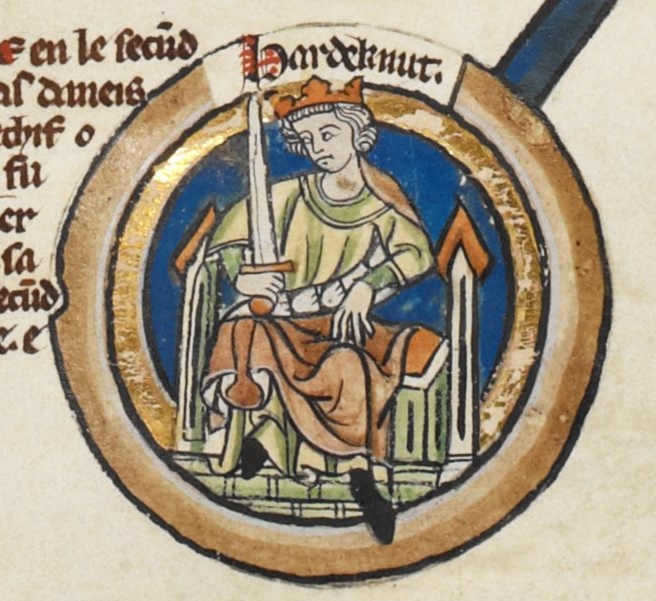
Harthacnut[a] (c. 1018 – 8 June 1042) was King of Denmark from 1035, and King of England from 1040 until his death in 1042. He was the last monarch of the North Sea Empire, an empire consisting of England and Denmark, and was also the last monarch of the House of Knýtlinga.
Key Information


Harthacnut was the son of King Cnut the Great, who ruled Denmark, Norway, and England, and Emma of Normandy. After Cnut's death in 1035, Harthacnut faced challenges in retaining his father's territories. Magnus I seized control of Norway, while Harthacnut succeeded as King of Denmark. In 1040, following the death of his half-brother Harold Harefoot, he became King of England. Harthacnut died suddenly in 1042 and was succeeded by Magnus in Denmark and Edward the Confessor in England. He was the last Dane to rule England.
Early life
[edit]Harthacnut was born shortly after the marriage of his parents in July or August 1017.[1] Cnut had set aside his first wife, Ælfgifu of Northampton, to marry Emma, and according to the Encomium Emmae Reginae, a book she commissioned many years later, Cnut agreed that any sons from this marriage would take precedence over the sons of his first marriage. In 1023, Emma and Harthacnut played a leading role in the translation of the body of the martyr St Ælfheah from London to Canterbury. Harthacnut's biographer, Ian Howard, sees this event as recognition of his position as Cnut's heir in England.[2]
In the 1020s, Denmark faced threats from Norway and Sweden. In 1026, Cnut decided to strengthen its defences by sending his eight-year-old son to Denmark as the future king under a council headed by his brother-in-law, Earl Ulf. Ulf alienated Cnut by persuading the Danish provinces to acknowledge Harthacnut as king without reference to Cnut's overall authority and by failing to take vigorous measures against Norwegian and Swedish invasions, instead waiting for Cnut's assistance. In 1027, Cnut arrived with a fleet, forgave Harthacnut his insubordination in view of his youth, but had Ulf murdered. He drove the invaders out of Denmark and established his authority over Norway, returning to England in 1028 and leaving Denmark under Harthacnut's rule.[3]

Cnut had left Norway under the rule of Håkon Eiriksson, who drowned in a shipwreck in 1029 or 1030. Cnut then appointed his son Svein to rule Norway with the assistance of Ælfgifu, Cnut's first wife and Svein's mother. They made themselves unpopular through heavy taxation and by favouring Danish advisers over the Norwegian nobility. When King Magnus I of Norway, the son of former King Olaf, invaded in 1035, Svein and Ælfgifu were forced to flee to Harthacnut's court. Harthacnut was a close ally of Svein, but he did not consider his resources sufficient to launch an invasion of Norway. The half-brothers sought help from their father, only to learn of his death in November 1035.[4]
Reign
[edit]Harold and Denmark
[edit]In 1035, Harthacnut succeeded his father on the throne of Denmark as Cnut III.[5] He was unable to travel to England due to the situation in Denmark, and it was agreed that Svein's full brother, Harold Harefoot, should act as regent, with Emma holding Wessex on Harthacnut's behalf. By 1037, Harold was generally accepted as king, Harthacnut being, in the words of the Anglo-Saxon Chronicle, "forsaken because he was too long in Denmark",[6] while Emma fled to Bruges, in Flanders. In 1039, Harthacnut sailed with ten ships to meet his mother in Bruges but delayed an invasion, as it was clear Harold was sick and would soon die, which he did in March 1040. Envoys soon crossed the Channel to offer Harthacnut the throne.
While the general outline of events following Cnut's death is clear, the details are obscure, and historians offer differing interpretations. The historian M. K. Lawson states that it is unclear whether Harthacnut was intended to have England as well as Denmark, but the situation was probably reflected in a formal arrangement: mints south of the Thames produced silver pennies in his name, while those to the north were almost all Harold's. There might have been a division of the kingdom if Harthacnut had appeared immediately. He probably remained in Denmark because of the threat from Magnus of Norway, but the two eventually made a treaty by which, if either died without an heir, his kingdom would pass to the other. This may have freed Harthacnut to pursue his claim to England.[1]
According to Ian Howard, Harthacnut agreed to help Svein recover Norway and planned an invasion in 1036. Svein died shortly before the expedition was to set out, but Harthacnut proceeded nonetheless. War was avoided by the treaty between Harthacnut and Magnus, which Harthacnut accepted because he had no plausible candidate to rule Norway after Svein's death and was temperamentally inclined to avoid campaigns and wars. Howard dates the treaty to 1036,[7] whereas other historians date it to 1039 and believe it freed Harthacnut to launch an invasion of England.[8][9]
Exiled in Bruges, Emma plotted to secure the English throne for her son. She sponsored the Encomium Emmae Reginae, which eulogised her and criticised Harold, particularly for arranging the murder of Alfred Atheling (the younger of Emma's two sons by Æthelred) in 1036. The work describes Harthacnut's horror at hearing of his half-brother's murder and, in Howard's view, was probably influential in persuading the cautious Harthacnut to finally invade England. According to a later edition of the Encomium, the English took the initiative in communicating with Harthacnut in 1039, possibly upon learning that Harold had little time to live.[10]
Return to England
[edit]_obverse.jpg)
Harold died on 17 March 1040 and soon afterwards Harthacnut travelled to England with his mother, landing at Sandwich on 17 June, "seven days before Midsummer",[11] in a peaceful arrival despite commanding a fleet of 62 warships. Although invited to take the throne, he came prepared as a conqueror.[12] To reward the crews for their service, he levied a geld of over 21,000 pounds, a considerable sum that made him unpopular, although it was only a quarter of the amount his father had raised under similar circumstances in 1017–1018.[13]
Harthacnut had been horrified by Harold's murder of Alfred, and his mother demanded vengeance. With the approval of Harold's former councillors, Harold's body was disinterred from its place of honour at Westminster and publicly beheaded. It was disposed of in a sewer, but later retrieved and thrown into the Thames, from which London shipmen rescued it and had it buried in a churchyard.[14] Godwin, the powerful earl of Wessex, had been complicit in the crime, having handed over Alfred to Harold. Queen Emma charged him in a trial before Harthacnut and his council. The king allowed Godwin to escape punishment after witnesses testified he had acted on Harold's orders, but Godwin later gave Harthacnut a richly decorated ship as wergild.[15] Bishop Lyfing of Worcester was also charged with complicity and deprived of his see, but in 1041 he reconciled with Harthacnut and was restored.[1]
The English were accustomed to a king ruling in council with the advice of his chief men, but Harthacnut had ruled autocratically in Denmark and was unwilling to change, particularly as he did not fully trust the leading earls. Initially, he successfully intimidated his subjects, though his influence waned later in his short reign. He doubled the size of the English fleet from sixteen to thirty-two ships, partly to secure forces capable of handling troubles elsewhere in his empire,[16] and to fund it he sharply increased taxation.[9] The increase coincided with a poor harvest, causing severe hardship. In 1041, two tax collectors in and around Worcester were killed by rioting townspeople. Harthacnut responded by ordering a then-legal but highly unpopular "harrying": he instructed his earls to burn the town and kill the population. Few were killed, as most had fled in advance.[1][17] Citizens who had taken refuge on an island in the River Severn successfully resisted Harthacnut's troops and were allowed to return to their homes without further punishment.[18][19]
The earl of Northumbria was Siward, but Earl Eadwulf of Bamburgh ruled the northern part semi-independently, a situation displeasing to the autocratic Harthacnut. In 1041, Eadwulf offended the king for an unknown reason but sought reconciliation. Harthacnut promised safe conduct but colluded in Eadwulf's murder by Siward, who then became earl of the whole of Northumbria. The crime was widely condemned; the Anglo-Saxon Chronicle described it as "a betrayal" and the king as an "oath-breaker".[1][20]
Harthacnut was generous to the church. Very few contemporary documents survive, but a royal charter transferred land to Bishop Ælfwine of Winchester, and he made several grants to Ramsey Abbey. The 12th-century Ramsey Chronicle praises his generosity and character.[1]
Death
[edit]Harthacnut had suffered from bouts of illness even before becoming King of England. He may have suffered from tuberculosis and was likely aware that his life expectancy was limited.[21] In 1041, he invited his half-brother Edward the Confessor—his mother Emma's son by Æthelred the Unready—back from exile in Normandy. The Anglo-Saxon Chronicle reports that Edward was sworn in as king. Historian M. K. Lawson notes: "This may mean that Edward was recognized as heir of Harthacnut, who had neither wife nor children, and who is said by the slightly later Norman historian William of Poitiers to have suffered from frequent illness. The likely truth of this is suggested not only by his sudden death the following year, but also because it is otherwise difficult to see why a man in his early twenties with a normal life expectancy should have acted so." Harthacnut may also have been influenced by Emma, who sought to preserve her power by ensuring that one of her sons was succeeded by the other.[1] Historian John Maddicott comments that Harthacnut must have sanctioned Edward's return and may even have promoted it,[22] but Tom Licence disputes this, suggesting that Edward was summoned by leading magnates who had lost confidence in Harthacnut and effectively forced Edward upon him. Licence adds that no contemporary source indicates that Harthacnut was dying.[23]
On 8 June 1042, Harthacnut attended a wedding in Lambeth. The groom was Tovi the Proud, and the bride was Gytha, daughter of Osgod Clapa; both men had been close to Cnut.[24] According to the Anglo-Saxon Chronicle, "Harthacnut died as he stood at his drink, and he suddenly fell to the earth with an awful convulsion; and those who were close by took hold of him, and he spoke no word afterwards".[25] Licence suggests that the death does not appear to have been that of a chronically ill man.[26]
Succession
[edit]
The political agreement between Harthacnut and Magnus the Good included the appointment of Magnus as Harthacnut's heir. At the time, this arrangement applied only to the throne of Denmark. According to the Heimskringla, when Harthacnut died, Magnus extended his claim to England. He reportedly sent a letter to Edward the Confessor, asserting his claim to the English throne and threatening invasion. Magnus’s own heir, Harald Hardrada, would later pursue this claim as well. Both considered themselves legal successors to Harthacnut.[27] The Fagrskinna records Magnus proclaiming: "I will take possession of all the Danish empire or else die in the attempt."[28]
According to the Encomium Emmae Reginae, Edward had already served as co-ruler of England since 1041. The work emphasizes Harthacnut, Edward, and Emma acting as a trinity of rulers, in emulation of the Holy Trinity. Edward, by surviving Harthacnut, would automatically inherit the kingship. The Heimskringla depicts Edward presenting himself as brother and legal heir to both Harold Harefoot and Harthacnut, noting that he had already secured "the support of all the people of the country". Unstated in these accounts is that Edward’s eventual marriage to Edith of Wessex strengthened his claim by gaining the political backing of her father, Godwin, Earl of Wessex, and an additional connection to Cnut, as she was a niece of the king.[27]
The Fagrskinna emphasizes Edward’s strong familial claim: as the son of Æthelred the Unready and Emma of Normandy, half-brother of Harthacnut, stepbrother of Harold Harefoot, and stepson of Cnut, he was closely tied to multiple royal lines. England’s leading nobles had already acknowledged him as king, and he was consecrated by an archbishop. He was thus widely regarded as the legitimate ruler. According to the saga, Magnus was warned: "You can never be called king in England, and you will never be granted any allegiance there before you put an end to my life." This reportedly caused Magnus to doubt the strength of his claim.[29]
The planned marriage between Gunhilda of Denmark, Harthacnut’s sister, and Henry III, Holy Roman Emperor was intended to allow their descendants to claim the Danish throne, and potentially the English throne. From Henry’s perspective, it was likely designed to give the Holy Roman Empire influence over Denmark and the western Baltic region. Gunhilda died in 1038 with no known sons.[27] Her only daughter, Beatrice I, Abbess of Quedlinburg, never married.
Reputation
[edit].jpg)
Apart from the Ramsey Chronicle, medieval sources are generally hostile to Harthacnut. According to the Anglo-Saxon Chronicle, he "did nothing worthy of a king as long as he ruled".[30] Modern historians, however, are less dismissive. M. K. Lawson notes that Harthacnut possessed at least two key attributes of a successful medieval king: he was "both ruthless and feared"; had he lived longer, the Norman Conquest might not have occurred. Ian Howard praises him for maintaining peace throughout his empire, benefiting trade and merchants, and ensuring a smooth succession by inviting Edward to his court as heir. Howard suggests that, had he lived longer, Harthacnut might have become a successful king comparable to his father.[31]
Henry of Huntingdon (12th century) claimed that Harthacnut ordered his court's dining tables to be "laid four times a day with royal sumptuousness", which O'Brien considers likely a popular myth.[32] Henry framed this in the context of sharing meals with his household, suggesting that Harthacnut was more generous than contemporaries, who "through avarice, or as they pretend through disgust, ... set but one meal a day before their dependents".[33] This account contributed to Harthacnut’s image as a "very generous bon viveur".[32] In contrast, Ranulf Higden (14th century) viewed the practice negatively, claiming Harthacnut insisted on two dinners and two suppers daily, influencing the English to be gluttonous and extravagant.[34] Harthacnut’s association with gluttony was well known enough to appear in Walter Scott’s 1819 novel Ivanhoe, where Cedric remarks about Athelstane: "The soul of Hardicanute hath taken possession of him, and he hath no pleasure save to fill, to swill, and to call for more."[35][36]
The Knýtlinga saga treats Harthacnut’s death as the end of an ancient line of kings and notes that he was the last Danish king to rule England. Otherwise, he is treated as a minor figure, with far more attention given to Cnut. The Morkinskinna covers Harthacnut’s death in some detail but provides almost no information about his life, suggesting a lack of memorable achievements due to his short reign.[37]
The Brut Chronicle is an Anglo-Norman work covering British and English monarchs from Brut (Brutus of Troy) to the death of Henry III in 1272. It was probably composed during the reign of Edward I (reigned 1272–1307), although the oldest surviving manuscript dates to 1338. The text contains numerous errors, and the original author remains unknown, though several continuations extend the narrative to the Battle of Halidon Hill (1333).[38] The material on Harthacnut is largely positive. The author portrays Harold Harefoot as lacking chivalry, courtesy, and honour, while Harthacnut is depicted as "a noble knight and stalwart of body, and he greatly loved knighthood and all virtues". He praises Harthacnut’s generosity with food and drink, noting that his table was open "for all who wished to come to his court to be richly served with royal dishes". The chronicle also commends Harthacnut for accepting his mother, Emma, back to court, highlighting his loyalty as a son.[39]
Notes
[edit]References
[edit]- ^ a b c d e f g h Lawson 2004.
- ^ Howard 2008, pp. 15, 27.
- ^ Howard 2008, pp. 29–38.
- ^ Howard 2008, pp. 42–51.
- ^ Monarkiet i Danmark – Kongerækken Archived 18 November 2009 at the Wayback Machine at The Danish Monarchy
- ^ Swanton 2000, p. 160.
- ^ Howard 2008, pp. 58–61.
- ^ Bricka 1893, pp. 91–92.
- ^ a b Lund 2017.
- ^ Howard 2008, pp. 105–107.
- ^ Swanton 2000, p. 161; Howard 2008, p. 109.
- ^ Howard 2008, p. 109.
- ^ Howard 2008, p. 117.
- ^ Howard 2008, pp. 111–112.
- ^ Howard 2008, pp. 112–117.
- ^ Howard 2008, pp. 118–119.
- ^ Howard 2008, pp. 119–120.
- ^ Fleming, Robin (2011). Britain after Rome : the fall and rise, 400–1070. London: Penguin. pp. 251–252. ISBN 978-0-140-14823-7.
- ^ John of Worcester. Chronicon ex chronicis. Archived from the original on 18 January 2022. Retrieved 17 January 2022.
- ^ Howard 2008, pp. 120–121.
- ^ Howard 2008, pp. 106, 124, 149.
- ^ Maddicott 2004, p. 654.
- ^ Licence 2020, pp. 75–79.
- ^ Darlington & McGurk 1995, pp. 532–535; Lawson 2004.
- ^ Swanton 2000, p. 162.
- ^ Licence 2020, p. 79.
- ^ a b c Howard 2008, pp. 40–44.
- ^ Finlay 2004, p. 173.
- ^ Finlay 2004, pp. 174–175.
- ^ Howard 2008, p. 119.
- ^ Howard 2008, p. 136.
- ^ a b O'Brien 2006, pp. 202–203.
- ^ Kerr 2007, p. 77, Note 25.
- ^ Given-Wilson 2004, pp. 133–134.
- ^ Scott 1998, p. 177, Ch. 21.
- ^ "Study Guide: Athelstane in Ivanhoe". shmoop.com. Archived from the original on 25 September 2020. Retrieved 16 March 2020.
- ^ Fjalldal 2005, pp. 51–53.
- ^ Marvin 2006, pp. 40–42, 47–49, 75.
- ^ Marvin 2006, pp. 223–225.
Sources
[edit]- Bricka, Carl Frederik (1893). Dansk Biografisk Lexikon. Vol. VII. Holmsted: I. Hansen. Archived from the original on 19 January 2020. Retrieved 15 March 2010.
- Darlington, Reginald; McGurk, Patrick, eds. (1995). The Chronicle of John of Worcester (in Latin and English). Vol. 2. Oxford, UK: Clarendon Press. ISBN 978-0-19-822261-3.
- Finlay, Alison (2004). Fagrskinna: A Catalogue of the Kings of Norway. BRILL. ISBN 90-04-13172-8. Archived from the original on 11 September 2023. Retrieved 16 March 2020. Based primarily on Einarsson's 1984 edition.
- Fjalldal, Magnús (2005). Anglo-Saxon England in Icelandic Medieval Texts. University of Toronto Press. ISBN 978-0-8020-3837-1. Archived from the original on 11 September 2023. Retrieved 16 March 2020.
- Given-Wilson, Chris (2004). Chronicles: The Writing of History in Medieval England. A&C Black. ISBN 978-1-85285-358-7. Archived from the original on 11 September 2023. Retrieved 25 October 2015.
- Howard, Ian (2008). Harthacnut: The Last Danish King of England. The History Press.
- John, Eric (1996). Reassessing Anglo-Saxon England. Manchester University Press. ISBN 978-0-7190-5053-4. Archived from the original on 11 September 2023. Retrieved 25 October 2015.
- Kerr, Julie (2007). Stephen Morillo Diane Korngiebel (ed.). "Food, Drink, and Lodging:Hospitality in Twelfth-Century England". The Haskins Society Journal: Studies in Medieval History. 18. Boydell Press: 72–92. ISBN 978-1-84383-336-9. Archived from the original on 11 September 2023. Retrieved 25 October 2015.
- Lawson, M. K. (23 September 2004). "Harthacnut (Hardecanute) (c.1018–1042)". Oxford Dictionary of National Biography (online ed.). Oxford University Press. doi:10.1093/ref:odnb/12252. (Subscription, Wikipedia Library access or UK public library membership required.)
- Maddicott, John (June 2004). "Edward the Confessor's Return to England in 1041". Anglo-Saxon England. CXIX (482): 650–666. ISSN 0263-6751.
- Licence, Tom (2020). Edward the Confessor: Last of the Royal Blood. New Haven, Connecticut: Yale University Press. ISBN 978-0-300-21154-2.
- Lund, Niels (24 August 2017), "Knud 3. Hardeknud", Den Store Danske, Gyldendal, archived from the original on 11 September 2023, retrieved 16 March 2020
- Marvin, Julia (2006). Brut. Boydell Press. ISBN 978-1-84383-274-4. Archived from the original on 11 September 2023. Retrieved 16 March 2020.
- O'Brien, Harriet (2006). Queen Emma and the Vikings: The Woman Who Shaped the Events of 1066. Bloomsbury. ISBN 978-0-7475-7968-7. Archived from the original on 11 September 2023. Retrieved 16 March 2020.
- Scott, Walter (1998). Ivanhoe. Edinburgh University Press. ISBN 978-0-7486-0573-6. Archived from the original on 11 September 2023. Retrieved 25 October 2015.
- Swanton, Michael, ed. (2000). The Anglo-Saxon Chronicles (revised paperback ed.). London, UK: Phoenix. ISBN 978-1-84212-003-3.
Further reading
[edit]- DeVries, Kelly, The Norwegian Invasion of England in 1066 (2003), Boydell & Brewer Ltd, ISBN 1843830272
- Douglas, David Charles, William The Conqueror: The Norman Impact Upon England (1964), University of California Press.
- Gillingham, John, The introduction of chivalry into England, Essay included in Law and Government in Medieval England and Normandy: Essays in Honour of Sir James Holt (1994), pages 31–56, Cambridge University Press, ISBN 0521430763
- Howard, Ian, Harold II: a Throne-Worthy King, Essay included in King Harold II and the Bayeux Tapestry (2005), pages 35–52. Boydell Press, ISBN 1843831244
External links
[edit]
| Knýtlinga |
| .svg) | |||
|---|---|---|---|---|---|
| Fairhair |
| ||||
| Estridsen | |||||
| Bjälbo |
| ||||
| Estridsen |
| ||||
| Pomerania |
| ||||
| Palatinate-Neumarkt |
| ||||
| Oldenburg |
| ||||
| |||||
| International | |
|---|---|
| National | |
| People | |

Harthacnut
View on GrokipediaOrigins and Early Life
Birth and Parentage
Harthacnut was the son of Cnut, king of England from 1016, Denmark from 1018, and Norway from 1028, and his second wife Emma, a Norman noblewoman who had previously been married to the English king Æthelred II (known as the Unready) from 1002 until Æthelred's death in 1016.[3][1] Cnut set aside his first consort, Ælfgifu of Northampton, with whom he had two sons—Sweyn (d. 1035) and Harold Harefoot (d. 1040)—to marry Emma on 2 July 1017 at Canterbury Cathedral, in a union intended to legitimize his rule over England by linking him to the previous Anglo-Saxon dynasty.[4][5] Harthacnut, the only son born to Cnut and Emma, entered the world circa 1018, shortly following the marriage, though no contemporary records provide an exact date or location.[1][3][2] Emma's union with Cnut also produced a daughter, Gunhilda, born around 1020, who later married the German emperor Henry III in 1036.[5] The Encomium Emmae Reginae, a Latin panegyric commissioned by Emma herself circa 1041–1042 and authored by a monk of Saint-Bertin's Abbey, portrays Harthacnut as a favored heir but offers no precise details on his infancy, reflecting the work's propagandistic emphasis on Emma's lineage over chronological precision.[6]Upbringing in Denmark and England
Harthacnut was born circa 1018 in England as the son of King Cnut the Great and Emma of Normandy, following their marriage in 1017.[7][1] His early childhood coincided with Cnut's expansion of authority across England, Denmark, and Norway, during which Harthacnut resided primarily in England alongside his parents and half-siblings from Emma's prior marriage to Æthelred the Unready.[1] Around 1026, at approximately eight years old, Cnut dispatched Harthacnut to Denmark with a contingent of troops to bolster defenses against incursions from Norway and Sweden, entrusting him to a council led by his brother-in-law, Ulf Jarl (Estrid's husband and Cnut's sister's spouse).[8] This move, documented in the Encomium Emmae Reginae—a contemporary Latin panegyric commissioned by Emma—aimed to secure Danish loyalty and groom the young prince for succession amid regional instability. The Encomium, while partisan in promoting Emma's lineage, aligns with broader accounts of Cnut's strategic delegation of northern realms to kin. In Denmark, Harthacnut's upbringing focused on princely preparation under regency oversight, including military and administrative training suited to Viking-age Scandinavian rulership.[9] By 1028, at about ten years old, Cnut formally proclaimed him king of the Danes during an assembly at Trondheim (in Norway), though effective power remained with advisors until Cnut's death; Cnut then returned to England, leaving Harthacnut as nominal deputy in Denmark.[9][7] This period marked Harthacnut's immersion in Danish court life, contrasting with his half-brother Harold Harefoot's development in England under their mother Ælfgifu of Northampton's influence.[10] Harthacnut remained in Denmark through his father's death in 1035, having thus spent roughly half his brief life there by adolescence.[9]Rule in Denmark
Ascension After Cnut's Death
Cnut died on 12 November 1035 at Shaftesbury, leaving his North Sea empire divided among his sons.[9] Harthacnut, his son by Emma of Normandy and already established as deputy ruler in Denmark, succeeded immediately to the Danish throne as Cnut III, without recorded opposition from local magnates.[7] [4] At approximately 17 years old, Harthacnut inherited a realm that Cnut had secured through conquest and alliances, but one now vulnerable to external pressures.[11] The succession in Denmark proceeded smoothly compared to England, where Harthacnut's half-brother Harold Harefoot, son of Cnut and Ælfgifu of Northampton, asserted control amid uncertainty.[1] Harthacnut's position derived from Cnut's prior arrangements, including his designation as heir during Cnut's campaigns, which had positioned him to govern Danish affairs independently by the early 1030s.[2] This continuity allowed Harthacnut to consolidate power quickly, focusing on defense against Norwegian incursions led by Magnus I, who had seized Norway following the death of Olaf II in 1030 and posed a direct threat to Danish borders.[1] Harthacnut's early reign in Denmark emphasized military preparedness, as Magnus's forces raided Danish territories, compelling Harthacnut to prioritize naval defenses and alliances rather than immediate intervention in English affairs.[12] This strategic necessity delayed any unified claim over Cnut's full domains, marking the fragmentation of the short-lived North Sea empire.[13]Conflicts and Defense of the Realm
Upon Cnut's death in November 1035, Harthacnut inherited Denmark but faced immediate challenges to the realm's security, primarily from Magnus I of Norway, who had seized control of Norway earlier that year following the death of Harthacnut's half-brother Svein Knutsson in 1033. Magnus, previously a client of Cnut, exploited the power vacuum to reclaim Norwegian independence, launching raids and posing a direct threat to Danish dominance in Scandinavia. Harthacnut responded by prioritizing military readiness, assembling and maintaining a substantial fleet to deter Norwegian aggression and protect Danish coasts and trade routes.[14][1] This defensive posture consumed significant resources and delayed Harthacnut's assertion of authority over England, as he could not risk leaving Denmark vulnerable to invasion. Historical accounts indicate Harthacnut considered offensive actions, including a planned expedition in 1036 to support Svein's former regime in Norway, though Svein's prior death rendered it moot. Ongoing tensions persisted, with Magnus reportedly preparing incursions into Denmark by 1040, compelling Harthacnut to fortify his position and negotiate to avoid open warfare.[4][15] To resolve the standoff, Harthacnut and Magnus concluded a treaty, dated by some historians to 1039, stipulating mutual succession: should either king die without a male heir, his kingdom would pass to the other. This pact effectively neutralized the immediate Norwegian threat, securing Denmark's borders without major bloodshed and allowing Harthacnut to dispatch a fleet of 62 warships to England in 1040. The agreement reflected pragmatic realism amid the fragility of Cnut's North Sea empire, though it ultimately facilitated Magnus's uncontested claim to Denmark after Harthacnut's death in 1042.[7][16][8]Struggle for England
Rivalry with Harold Harefoot
Following Cnut's death on 12 November 1035, succession to the English throne was contested between his sons: Harthacnut, the legitimate son from his marriage to Emma of Normandy, who was ruling in Denmark, and Harold Harefoot, the illegitimate son from his earlier union with Ælfgyfu of Northampton, who held influence in England.[13][17] Cnut had reportedly intended Harthacnut to inherit England, with Harold possibly designated for a subordinate role in northern England, but no formal will was enacted, leading to de facto power struggles.[18] Initially, Harold assumed regency-like control north of the Thames, while Emma secured Wessex for Harthacnut, retaining his housecarls in Winchester and relying on the loyalty of Earl Godwin of Wessex.[19] By 1036, tensions escalated as Harold consolidated support among northern earls and the Danish faction weakened in the south; Emma, acting as Harthacnut's advocate, invited her son Alfred Ætheling from Normandy to bolster claims, but Alfred was captured en route, imprisoned, and subjected to blinding on Harold's orders—though Godwin later claimed responsibility during Harthacnut's subsequent trial to avert reprisals.[13] In 1037, with backing from Earl Leofric of Mercia and other nobles wary of Norman influence, Harold was proclaimed king at a witan in Oxford, effectively sidelining Harthacnut's nominal rights and prompting Emma's banishment to Flanders.[17][20] Harthacnut, preoccupied by threats from Magnus I of Norway who had seized parts of Denmark, could not dispatch forces to England despite Emma's appeals.[1] The rivalry persisted through Harold's reign, marked by mutual delegitimization: Harold's supporters portrayed Harthacnut as absent and foreign-tied, while Emma's circle, including exiled English envoys to Denmark, emphasized Harthacnut's legitimacy as Cnut's favored heir and Harold's bastardy.[21] No direct military clash occurred, as Harthacnut prioritized reclaiming Denmark—defeating Magnus in a 1040 pact that ceded Norway to the Norwegian but secured his Danish throne.[12] Harold's sudden death on 17 March 1040 in Oxford, possibly from illness or injury during a hunt, ended the standoff without resolution, allowing Harthacnut to cross to England later that year with 10,000 troops amid widespread acquiescence.[13][12]Invitation and Arrival in 1040
Harthacnut's half-brother Harold Harefoot died on 17 March 1040 at Oxford, after a contested rule marked by division among the English nobility. The Anglo-Saxon Chronicle records that the councillors (witan) promptly turned to Harthacnut as the rightful heir, son of Cnut, and invited him to assume the throne, reflecting recognition of his dynastic claim despite his prolonged absence and focus on Denmark.[22] [19] This invitation came amid Harthacnut's own preparations for a potential invasion, as he had levied heavy ship-tribute in Denmark to fund an English campaign delayed by Scandinavian threats.[1] Residing in Bruges, Flanders, with his mother Emma of Normandy—who had fled England during Harold's ascendancy—Harthacnut mobilized a fleet of 60 to 62 warships, signaling both enforcement of his claim and continuity of Cnut's naval tradition. He landed unopposed at Sandwich, Kent, on 17 June 1040, seven days before Midsummer, accompanied by Emma and his forces.[1] [8] [17] The Chronicle notes his immediate coronation at Canterbury Cathedral the next day, 18 June, by Archbishop Eadsige, where he pledged to the councillors to rectify Harold's misdeeds, including excessive taxation and favoritism.[22] [7] This swift acceptance underscored the witan's preference for Cnut's designated successor over prolonged instability, though Harthacnut's armed arrival underscored the fragility of consent under Danish hegemony.[15]Reign in England
Administrative Policies
Harthacnut delegated much of the day-to-day governance of England to the three most powerful earls: Godwin of Wessex, who controlled the south; Leofric of Mercia, overseeing the midlands; and Siward of Northumbria, a Dane managing the north.[18] This tripartite earldom structure, inherited from his father Cnut, allowed Harthacnut to focus on military and fiscal priorities amid his divided realms, with the earls handling local justice, military levies, and shire administration.[15] A core administrative policy involved aggressive fiscal extraction to sustain a standing fleet of approximately 60-80 ships, essential for defending Denmark against Norwegian threats under Magnus I. Harthacnut levied a burdensome heregeld (army tax) of around two marks of silver per 300 hides of land, compounded by poor harvests that intensified economic hardship.[7] Tax collection was enforced through royal agents, reflecting centralized oversight, though it provoked widespread resentment among thegns and freemen.[23] Enforcement mechanisms emphasized deterrence via military reprisals; in May 1041, following the murder of two tax collectors in Worcester, Harthacnut dispatched a detachment of ships to ravage the town, destroying homes and killing residents in retaliation.[7] [23] No new law codes or structural reforms were issued, preserving Cnut-era practices like uniform coinage standards, with Harthacnut's silver pennies minted across numerous English towns to facilitate trade and taxation.[14]Taxation, Unrest, and Punitive Actions
Harthacnut imposed a heavy tax levy in 1041 to fund and maintain his naval fleet, estimated at more than 21,000 pounds of silver to pay the crews of approximately 60 ships.[8][24] This burden, levied amid a poor harvest that caused widespread famine, intensified public discontent across England.[7] The tax sparked violent resistance in Worcester, where on 4 May 1041, local citizens killed two of Harthacnut's housecarls who had sought refuge in the minster while enforcing the collection.[25] According to the Anglo-Saxon Chronicle, the housecarls "demanded the heavy tax," prompting the slayings, which the chronicler framed as a local backlash against oppressive enforcement.[26] In retaliation, Harthacnut ordered earls Leofric, Godwin, and Siward to ravage Worcestershire, leading to the sacking and burning of Worcester in late 1041.[27][7] The Anglo-Saxon Chronicle records that the king "caused all Worcestershire to be ravaged... to revenge their death," resulting in the plundering of the entire shire, though some residents fled to Bevere Island in the River Severn and repelled attackers.[26][14] This punitive expedition, while restoring royal authority locally, further eroded Harthacnut's reputation for fiscal severity.[28]Military and Diplomatic Efforts
Harthacnut's primary diplomatic achievement was a treaty concluded with Magnus I of Norway in 1039, stipulating mutual succession to each other's kingdoms in the event of death without heirs.[29] This agreement averted potential conflict over Scandinavian territories, particularly after the death of Svein Knutsson, allowing Harthacnut to redirect attention to securing England without northern threats.[29] In 1040, Harthacnut arrived in England with a fleet of Danish ships, asserting military dominance and facilitating his reclamation of the throne following Harold Harefoot's death.[30] During his reign, he imposed a naval tax to sustain this fleet and military readiness, though this policy fueled domestic unrest.[10] Harthacnut's most notable military action was a punitive expedition against Worcester in 1041. On May 4, 1041, local inhabitants killed two royal tax collectors, prompting the king to mobilize leading earls including Leofric, Godwin, and Siward, along with their forces.[27] In November 1041, the army pillaged and burned the city for four days, devastating the area and quarantining refugees on an island in the River Severn before withdrawing.[27] This campaign, recorded in the Chronicle of Florence of Worcester, underscored Harthacnut's harsh enforcement of royal authority but highlighted the fragility of his rule amid resistance to taxation.[27][10] Diplomatically, in 1041, Harthacnut summoned his half-brother Edward from Normandy and groomed him as heir apparent, signaling a shift toward Anglo-Saxon continuity and alliances beyond Scandinavia.[10] Overall, Harthacnut's efforts prioritized internal consolidation over expansive campaigns, with no major external wars during his brief English reign.[10]Death and Immediate Aftermath
Circumstances and Possible Causes
Harthacnut died suddenly on 8 June 1042, at the age of approximately 24, while attending a wedding feast in Lambeth for Tovi the Proud, one of his former housecarls.[31] [32] The Anglo-Saxon Chronicle records that "Harthacnut died as he stood at his drink, and he suddenly fell to the earth with an awful convulsion; and those who were with him took him up and carried him to his bed, and he died soon after."[4] [33] This primary account, compiled by monastic chroniclers close to the events, describes an abrupt collapse amid revelry, with no mention of violence or external intervention.[31] The most widely accepted explanation among historians is a stroke precipitated by acute alcohol intoxication, consistent with reports of Harthacnut's habitual heavy drinking during his brief English reign.[1] [7] Excessive consumption at the feast likely exacerbated underlying vulnerabilities, such as those inferred from his youth and the sudden convulsive nature of the seizure, which aligns with cerebrovascular events rather than chronic illness.[31] A 2015 genetic study of Danish royal remains proposed that porphyria, a hereditary metabolic disorder linked to convulsions and neurological symptoms, may have affected up to fourteen early Danish kings, including potentially Harthacnut, though direct evidence from his unexamined body remains absent.[7] Alternative theories of poisoning have circulated in later interpretations, positing political motives amid Harthacnut's unpopularity from heavy taxation and punitive campaigns, but these lack substantiation in contemporary records and rely on speculation without forensic or testimonial support.[32] [31] The Chronicle's emphasis on the drinking context and immediate aftermath points instead to a natural, if self-induced, demise, underscoring the risks of royal excess in a era without medical diagnostics.[1]Succession Arrangements
Harthacnut, who remained unmarried and childless throughout his reign, established succession provisions through diplomatic agreements to ensure continuity in both Denmark and England.[7] In approximately 1039, he concluded a treaty with Magnus I, King of Norway, stipulating that should either ruler die without male heirs, the surviving king would inherit the deceased's realm, thereby averting open conflict over Scandinavian territories.[34] [15] This pact reflected Harthacnut's strategic prioritization of stability amid threats from rivals like Sweyn Estridsson, who held claims to Denmark but was sidelined by the arrangement.[34] Upon Harthacnut's sudden death on June 8, 1042, the Danish throne passed to Magnus I as per the treaty, marking the integration of Denmark into Magnus's Norwegian domain despite initial resistance from local nobles.[12] Magnus's succession was contested by Sweyn Estridsson, but the agreement's terms prevailed, allowing Magnus to consolidate control over Denmark by 1043.[34] In England, Harthacnut had proactively designated his half-brother Edward—son of Emma of Normandy and Æthelred the Unready—as heir in 1041, summoning him from exile in Normandy and integrating him into the royal court to facilitate a smooth transition.[7] [35] Edward's coronation on June 8, 1042, the same day as Harthacnut's death, underscored the premeditated nature of this arrangement, ending Danish rule in England without immediate upheaval.[36]Legacy and Historical Assessment
End of Danish Rule in England
Harthacnut's death on 8 June 1042, occurring suddenly during a wedding feast in Lambeth where he reportedly collapsed while standing to drink a toast, left no direct heir as he was unmarried and childless.[1][2] The Anglo-Saxon Chronicle records that he "died as he stood at his drink, and he suddenly fell to the earth with great weakness," attributing the event to possible overindulgence or natural causes without evidence of foul play.[37] In the preceding year, Harthacnut had invited his half-brother Edward—son of Emma of Normandy and the previous English king Æthelred the Unready—to England, signaling an intent to involve him in governance amid Harthacnut's divided attention between England and Denmark.[15] The transition to Edward proved seamless, with English nobles and the populace acclaiming him king without recorded opposition, as noted in the Anglo-Saxon Chronicle: "all the people then received Edward for king, as was his natural right."[37][38] Earl Godwin of Wessex, a key power broker who had navigated the Danish interregnum, endorsed Edward's claim, facilitating stability after the fiscal burdens and punitive measures of Harthacnut's rule.[15] This accession restored the House of Wessex to the throne, effectively concluding the Danish phase of English monarchy initiated by Cnut's conquest in 1016. Harthacnut's demise thus terminated Cnut's imperial dynasty in England after less than two decades, reverting rule to an Anglo-Saxon lineage despite ongoing Scandinavian ties through trade and migration.[23] While Magnus I of Norway inherited Denmark per a prior agreement with Harthacnut and later asserted a claim to England based on an alleged pact, Edward's uncontested hold precluded any Danish resurgence south of the North Sea.[1] The event underscored the fragility of Cnut's North Sea empire, fragmented by succession disputes and the preference for native rule amid recent grievances over taxation and governance.[15]Reputation Among Contemporaries and Historians
Harthacnut's reputation among English contemporaries was predominantly negative, as reflected in the Anglo-Saxon Chronicle, which records that he "did nothing worthy of a king as long as he ruled" and condemns his order to exhume and desecrate the body of his half-brother Harold Harefoot, describing the act as a "betrayal" by an "oath-breaker."[23] This source, maintained by monastic scribes with evident preference for native Anglo-Saxon rule, highlights resentment over his heavy taxation—imposed to fund a fleet of 60 ships and Danish defenses—which doubled the heregeld rate and provoked unrest, including the 1041 killing of tax collectors in Worcester, met by Harthacnut's retaliatory ravaging of the shire.[1][39] In Danish and courtly circles, views differed; the Encomium Emmae Reginae, a Latin panegyric commissioned by his mother Emma around 1041–1042 for presentation at Harthacnut's court, portrays him as a legitimate and vigorous ruler upholding Cnut's North Sea empire, though its flattery serves Emma's factional interests amid rivalry with Edward the Confessor.[6] Scandinavian sagas, such as those later compiled by Snorri Sturluson, treat his succession pact with Magnus of Norway neutrally as a pragmatic alliance, without dwelling on English grievances.[38] Historians assess Harthacnut as an able but unpopular administrator whose fiscal severity—necessitated by dual-realm demands and poor harvests—accelerated the collapse of Danish hegemony in England after just two years, though he secured initial elite support from figures like Earl Godwine and showed church patronage via charters granting land to Winchester.[39] While some modern analyses credit him with stabilizing Cnut's inheritance through naval reforms and designating Edward as heir, his legacy is overshadowed by perceptions of tyranny, with contemporaries' animus amplified by the Chronicle's monastic bias against foreign kings; Danish chroniclers, by contrast, recall him more as a fleeting bridge to native restoration.[1][23]References
- https://en.wikisource.org/wiki/Dictionary_of_National_Biography%2C_1885-1900/Hardecanute