


Community hub
Recent from talks
Contribute something
Nothing was collected or created yet.
Highest averages method
View on Wikipedia
| A joint Politics and Economics series |
| Social choice and electoral systems |
|---|
 |
 Mathematics portal Mathematics portal |


The highest averages, divisor, or divide-and-round methods[1] are a family of apportionment rules, i.e. algorithms for fair division of seats in a legislature between several groups (like political parties or states).[1][2] More generally, divisor methods are used to round shares of a total to a fraction with a fixed denominator (e.g. percentage points, which must add up to 100).[2]
The methods aim to treat voters equally by ensuring legislators represent an equal number of voters by ensuring every party has the same seats-to-votes ratio (or divisor).[3]: 30 Such methods divide the number of votes by the number of votes per seat to get the final apportionment. By doing so, the method maintains proportional representation, as a party with e.g. twice as many votes will win about twice as many seats.[3]: 30
The divisor methods are generally preferred by social choice theorists and mathematicians to the largest remainder methods, as they produce more-proportional results by most metrics and are less susceptible to apportionment paradoxes.[3][4][5][6] In particular, divisor methods avoid the population paradox and spoiler effects, unlike the largest remainder methods.[5]
History
[edit]Divisor methods were first invented by Thomas Jefferson to comply with a constitutional requirement that states have at most one representative per 30,000 people. His solution was to divide each state's population by 30,000 before rounding down.[3]: 20
Apportionment would become a major topic of debate in Congress, especially after the discovery of pathologies in many superficially-reasonable rounding rules.[3]: 20 Similar debates would appear in Europe after the adoption of proportional representation, typically as a result of large parties attempting to introduce thresholds and other barriers to entry for small parties.[7] Such apportionments often have substantial consequences, as in the 1870 reapportionment, when Congress used an ad-hoc apportionment to favor Republican states.[8] Had each state's electoral vote total been exactly equal to its entitlement, or had Congress used Webster's method or a largest remainders method (as it had since 1840), the 1876 election would have gone to Tilden instead of Hayes.[8][9][3]: 3, 37
Definitions
[edit]The two names for these methods—highest averages and divisors—reflect two different ways of thinking about them, and their two independent inventions. However, both procedures are equivalent and give the same answer.[1]
Divisor methods are based on rounding rules, defined using a signpost sequence post(k), where k ≤ post(k) ≤ k+1. Each signpost marks the boundary between natural numbers, with numbers being rounded down if and only if they are less than the signpost.[2]
Divisor procedure
[edit]The divisor procedure apportions seats by searching for a divisor or electoral quota. This divisor can be thought of as the number of votes a party needs to earn one additional seat in the legislature, the ideal population of a congressional district, or the number of voters represented by each legislator.[1]
If each legislator represented an equal number of voters, the number of seats for each state could be found by dividing the population by the divisor.[1] However, seat allocations must be whole numbers, so to find the apportionment for a given state we must round (using the signpost sequence) after dividing. Thus, each party's apportionment is given by:[1]
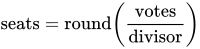
Usually, the divisor is initially set to equal the Hare quota. However, this procedure may assign too many or too few seats. In this case the apportionments for each state will not add up to the total legislature size. A feasible divisor can be found by trial and error.[10]
Highest averages procedure
[edit]With the highest averages algorithm, every party begins with 0 seats. Then, at each iteration, we allocate a seat to the party with the highest vote average, i.e. the party with the most votes per seat. This method proceeds until all seats are allocated.[1]
However, it is unclear whether it is better to look at the vote average before assigning the seat, what the average will be after assigning the seat, or if we should compromise with a continuity correction. These approaches each give slightly different apportionments.[1] In general, we can define the averages using the signpost sequence:
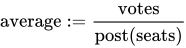
With the highest averages procedure, every party begins with 0 seats. Then, at each iteration, we allocate a seat to the party with the highest vote average, i.e. the party with the most votes per seat. This method proceeds until all seats are allocated.[1]
Specific methods
[edit]While all divisor methods share the same general procedure, they differ in the choice of signpost sequence and therefore rounding rule. Note that for methods where the first signpost is zero, every party with at least one vote will receive a seat before any party receives a second seat; in practice, this typically means that every party must receive at least one seat, unless disqualified by some electoral threshold.[2]
| Method | Signposts | Rounding of Seats |
Approx. first values |
|---|---|---|---|
| Adams | k | Up | 0.00 1.00 2.00 3.00 |
| Dean | 2÷(1⁄k + 1⁄k+1) | Harmonic | 0.00 1.33 2.40 3.43 |
| Huntington–Hill | Geometric | 0.00 1.41 2.45 3.46 | |
| Stationary (e.g. r = 1⁄3) |
k + r | Weighted | 0.33 1.33 2.33 3.33 |
| Webster/Sainte-Laguë | k + 1⁄2 | Arithmetic | 0.50 1.50 2.50 3.50 |
| Power mean (e.g. p = 2) |
Power mean | 0.71 1.58 2.55 3.54 | |
| Jefferson/D'Hondt | k + 1 | Down | 1.00 2.00 3.00 4.00 |

![{\textstyle {\sqrt[{p}]{(k^{p}+(k+1)^{p})/2}}}](https://wikimedia.org/api/rest_v1/media/math/render/svg/1ce4ec0114c24cbde0d4b556a3c3f114d437f929)
Jefferson (D'Hondt) method
[edit]Thomas Jefferson was the first to propose a divisor method, in 1792;[1] it was later independently developed by Belgian political scientist Victor d'Hondt in 1878. It assigns the representative to the list that would be most underrepresented at the end of the round.[1] It remains the most-common method for proportional representation to this day.[1]
Jefferson's method uses the sequence , i.e. (1, 2, 3, ...),[11] which means it will always round a party's apportionment down.[1]

Jefferson's apportionment never falls below the lower end of the ideal frame, and it minimizes the worst-case overrepresentation in the legislature.[1] However, it performs poorly when judged by most other metrics of proportionality.[12] The rule typically gives large parties an excessive number of seats, with their seat share often exceeding their entitlement rounded up.[3]: 81
This pathology led to widespread mockery of Jefferson's method when it was learned Jefferson's method could "round" New York's apportionment of 40.5 up to 42, with Senator Mahlon Dickerson saying the extra seat must come from the "ghosts of departed representatives".[3]: 34
Adams' method
[edit]Adams' method was conceived of by John Quincy Adams after noticing Jefferson's method allocated too few seats to smaller states.[13] It can be described as the inverse of Jefferson's method; it awards a seat to the party that has the most votes per seat before the new seat is added. The divisor function is post(k) = k, which is equivalent to always rounding up.[12]
Adams' apportionment never exceeds the upper end of the ideal frame, and minimizes the worst-case underrepresentation.[1] However, like Jefferson's method, Adams' method performs poorly according to most metrics of proportionality.[12] It also often violates the lower seat quota.[14]
Adams' method was suggested as part of the Cambridge compromise for apportionment of European parliament seats to member states, with the aim of satisfying degressive proportionality.[15]
Webster (Sainte-Laguë) method
[edit]The Sainte-Laguë or Webster method, first described in 1832 by American statesman and senator Daniel Webster and later independently in 1910 by the French mathematician André Sainte-Lague, uses the fencepost sequence post(k) = k+.5 (i.e. 0.5, 1.5, 2.5); this corresponds to the standard rounding rule. Equivalently, the odd integers (1, 3, 5...) can be used to calculate the averages instead.[1][16]
The Webster method produces more proportional apportionments than Jefferson's by almost every metric of misrepresentation.[17] As such, it is typically preferred to D'Hondt by political scientists and mathematicians, at least in situations where manipulation is difficult or unlikely (as in large parliaments).[18] It is also notable for minimizing seat bias even when dealing with parties that win very small numbers of seats.[19] The Webster method can theoretically violate the ideal frame, although this is extremely rare for even moderately-large parliaments; it has never been observed to violate quota in any United States congressional apportionment.[18]
In small districts with no threshold, parties can manipulate Webster by splitting into many lists, each of which wins a full seat with less than a Hare quota's worth of votes. This is often addressed by modifying the first divisor to be slightly larger (often a value of 0.7 or 1), which creates an implicit threshold.[20]
Huntington–Hill method
[edit]In the Huntington–Hill method, the signpost sequence is post(k) = √k (k+1), the geometric mean of the neighboring numbers. Conceptually, this method rounds to the integer that has the smallest relative (percent) difference. For example, the difference between 2.47 and 3 is about 19%, while the difference from 2 is about 21%, so 2.47 is rounded up. This method is used for allotting seats in the US House of Representatives among the states.[1]
The Huntington-Hill method tends to produce very similar results to the Webster method, except that it guarantees every state or party at least one seat (see Highest averages method § Zero-seat apportionments). When first used to assign seats in the House, the two methods produced identical results; in their second use, they differed only in assigning a single seat to Michigan or Arkansas.[3]: 58
Comparison of properties
[edit]Zero-seat apportionments
[edit]Huntington-Hill, Dean, and Adams' method all have a value of 0 for the first fencepost, giving an average of ∞. Thus, without a threshold, all parties that have received at least one vote will also receive at least one seat.[1] This property can be desirable (as when apportioning seats to states) or undesirable (as when apportioning seats to party lists in an election), in which case the first divisor may be adjusted to create a natural threshold.[21]
Bias
[edit]There are many metrics of seat bias. While the Webster method is sometimes described as "uniquely" unbiased,[18] this uniqueness property relies on a technical definition of bias, which is defined as the average difference between a state's number of seats and its seat entitlement. In other words, a method is called unbiased if the number of seats a state receives is, on average across many elections, equal to its seat entitlement.[18]
By this definition, the Webster method is the least-biased apportionment method,[19] while Huntington-Hill exhibits a mild bias towards smaller parties.[18] However, other researchers have noted that slightly different definitions of bias, generally based on percent errors, find the opposite result (The Huntington-Hill method is unbiased, while the Webster method is slightly biased towards large parties).[19][22]
In practice, the difference between these definitions is small when handling parties or states with more than one seat.[19] Thus, both the Huntington-Hill and Webster methods can be considered unbiased or low-bias methods (unlike the Jefferson or Adams methods).[19][22] A 1929 report to Congress by the National Academy of Sciences recommended the Huntington-Hill method,[23] while the Supreme Court has ruled the choice to be a matter of opinion.[22]
Comparison and examples
[edit]Example: Jefferson
[edit]The following example shows how Jefferson's method can differ substantially from less-biased methods such as Webster. In this election, the largest party wins 46% of the vote, but takes 52.5% of the seats, enough to win a majority outright against a coalition of all other parties (which together reach 54% of the vote). Moreover, it does this in violation of quota: the largest party is entitled only to 9.7 seats, but it wins 11 regardless. The largest congressional district is nearly twice the size of the smallest district. The Webster method shows none of these properties, with a maximum error of 22.6%.
| Jefferson | Webster | |||||||||||||
|---|---|---|---|---|---|---|---|---|---|---|---|---|---|---|
| Party | Yellow | White | Red | Green | Purple | Total | Party | Yellow | White | Red | Green | Purple | Total | |
| Votes | 46,000 | 25,100 | 12,210 | 8,350 | 8,340 | 100,000 | Votes | 46,000 | 25,100 | 12,210 | 8,350 | 8,340 | 100,000 | |
| Seats | 11 | 6 | 2 | 1 | 1 | 21 | Seats | 9 | 5 | 3 | 2 | 2 | 21 | |
| Ideal | 9.660 | 5.271 | 2.564 | 1.754 | 1.751 | 21 | Ideal | 9.660 | 5.271 | 2.564 | 1.754 | 1.751 | 21 | |
| Votes/Seat | 4182 | 4183 | 6105 | 8350 | 8340 | 4762 | Votes/Seat | 5111 | 5020 | 4070 | 4175 | 4170 | 4762 | |
| % Error | 13.0% | 13.0% | -24.8% | -56.2% | -56.0% | (100.%) | (% Range) | -7.1% | -5.3% | 15.7% | 13.2% | 13.3% | (22.6%) | |
| Seats | Averages | Signposts | Seats | Averages | Signposts | |||||||||
| 1 | 46,000 | 25,100 | 12,210 | 8,350 | 8,340 | 1.00 | 1 | 92,001 | 50,201 | 24,420 | 16,700 | 16,680 | 0.50 | |
| 2 | 23,000 | 12,550 | 6,105 | 4,175 | 4,170 | 2.00 | 2 | 30,667 | 16,734 | 8,140 | 5,567 | 5,560 | 1.50 | |
| 3 | 15,333 | 8,367 | 4,070 | 2,783 | 2,780 | 3.00 | 3 | 18,400 | 10,040 | 4,884 | 3,340 | 3,336 | 2.50 | |
| 4 | 11,500 | 6,275 | 3,053 | 2,088 | 2,085 | 4.00 | 4 | 13,143 | 7,172 | 3,489 | 2,386 | 2,383 | 3.50 | |
| 5 | 9,200 | 5,020 | 2,442 | 1,670 | 1,668 | 5.00 | 5 | 10,222 | 5,578 | 2,713 | 1,856 | 1,853 | 4.50 | |
| 6 | 7,667 | 4,183 | 2,035 | 1,392 | 1,390 | 6.00 | 6 | 8,364 | 4,564 | 2,220 | 1,518 | 1,516 | 5.50 | |
| 7 | 6,571 | 3,586 | 1,744 | 1,193 | 1,191 | 7.00 | 7 | 7,077 | 3,862 | 1,878 | 1,285 | 1,283 | 6.50 | |
| 8 | 5,750 | 3,138 | 1,526 | 1,044 | 1,043 | 8.00 | 8 | 6,133 | 3,347 | 1,628 | 1,113 | 1,112 | 7.50 | |
| 9 | 5,111 | 2,789 | 1,357 | 928 | 927 | 9.00 | 9 | 5,412 | 2,953 | 1,436 | 982 | 981 | 8.50 | |
| 10 | 4,600 | 2,510 | 1,221 | 835 | 834 | 10.00 | 10 | 4,842 | 2,642 | 1,285 | 879 | 878 | 9.50 | |
| 11 | 4,182 | 2,282 | 1,110 | 759 | 758 | 11.00 | 11 | 4,381 | 2,391 | 1,163 | 795 | 794 | 10.50 | |
Example: Adams
[edit]The following example shows a case where Adams' method fails to give a majority to a party winning 55% of the vote, again in violation of their quota entitlement.
| Adams' Method | Webster Method | |||||||||||||
|---|---|---|---|---|---|---|---|---|---|---|---|---|---|---|
| Party | Yellow | White | Red | Green | Purple | Total | Party | Yellow | White | Red | Green | Purple | Total | |
| Votes | 55,000 | 17,290 | 16,600 | 5,560 | 5,550 | 100,000 | Votes | 55,000 | 17,290 | 16,600 | 5,560 | 5,550 | 100,000 | |
| Seats | 10 | 4 | 3 | 2 | 2 | 21 | Seats | 11 | 4 | 4 | 1 | 1 | 21 | |
| Ideal | 11.550 | 3.631 | 3.486 | 1.168 | 1.166 | 21 | Ideal | 11.550 | 3.631 | 3.486 | 1.168 | 1.166 | 21 | |
| Votes/Seat | 5500 | 4323 | 5533 | 2780 | 2775 | 4762 | Votes/Seat | 4583 | 4323 | 5533 | 5560 | 5550 | 4762 | |
| % Error | -14.4% | 9.7% | -15.0% | 53.8% | 54.0% | (99.4%) | (% Range) | 3.8% | 9.7% | -15.0% | -15.5% | -15.3% | (28.6%) | |
| Seats | Averages | Signposts | Seats | Averages | Signposts | |||||||||
| 1 | ∞ | ∞ | ∞ | ∞ | ∞ | 0.00 | 1 | 110,001 | 34,580 | 33,200 | 11,120 | 11,100 | 0.50 | |
| 2 | 55,001 | 17,290 | 16,600 | 5,560 | 5,550 | 1.00 | 2 | 36,667 | 11,527 | 11,067 | 3,707 | 3,700 | 1.50 | |
| 3 | 27,500 | 8,645 | 8,300 | 2,780 | 2,775 | 2.00 | 3 | 22,000 | 6,916 | 6,640 | 2,224 | 2,220 | 2.50 | |
| 4 | 18,334 | 5,763 | 5,533 | 1,853 | 1,850 | 3.00 | 4 | 15,714 | 4,940 | 4,743 | 1,589 | 1,586 | 3.50 | |
| 5 | 13,750 | 4,323 | 4,150 | 1,390 | 1,388 | 4.00 | 5 | 12,222 | 3,842 | 3,689 | 1,236 | 1,233 | 4.50 | |
| 6 | 11,000 | 3,458 | 3,320 | 1,112 | 1,110 | 5.00 | 6 | 10,000 | 3,144 | 3,018 | 1,011 | 1,009 | 5.50 | |
| 7 | 9,167 | 2,882 | 2,767 | 927 | 925 | 6.00 | 7 | 8,462 | 2,660 | 2,554 | 855 | 854 | 6.50 | |
| 8 | 7,857 | 2,470 | 2,371 | 794 | 793 | 7.00 | 8 | 7,333 | 2,305 | 2,213 | 741 | 740 | 7.50 | |
| 9 | 6,875 | 2,161 | 2,075 | 695 | 694 | 8.00 | 9 | 6,471 | 2,034 | 1,953 | 654 | 653 | 8.50 | |
| 10 | 6,111 | 1,921 | 1,844 | 618 | 617 | 9.00 | 10 | 5,790 | 1,820 | 1,747 | 585 | 584 | 9.50 | |
| 11 | 5,500 | 1,729 | 1,660 | 556 | 555 | 10.00 | 11 | 5,238 | 1,647 | 1,581 | 530 | 529 | 10.50 | |
| Seats | 10 | 4 | 3 | 2 | 2 | Seats | 11 | 4 | 4 | 1 | 1 | |||
Example: All systems
[edit]The following shows a worked-out example for all voting systems. Notice how Huntington-Hill and Adams' methods give every party one seat before assigning any more, unlike Webster or Jefferson.
| Jefferson method | Webster method | Huntington–Hill method | Adams method | ||||||||||||||||||||||||
|---|---|---|---|---|---|---|---|---|---|---|---|---|---|---|---|---|---|---|---|---|---|---|---|---|---|---|---|
| party | Yellow | White | Red | Green | Blue | Pink | Yellow | White | Red | Green | Blue | Pink | Yellow | White | Red | Green | Blue | Pink | Yellow | White | Red | Green | Blue | Pink | |||
| votes | 47,000 | 16,000 | 15,900 | 12,000 | 6,000 | 3,100 | 47,000 | 16,000 | 15,900 | 12,000 | 6,000 | 3,100 | 47,000 | 16,000 | 15,900 | 12,000 | 6,000 | 3,100 | 47,000 | 16,000 | 15,900 | 12,000 | 6,000 | 3,100 | |||
| seats | 5 | 2 | 2 | 1 | 0 | 0 | 4 | 2 | 2 | 1 | 1 | 0 | 4 | 2 | 1 | 1 | 1 | 1 | 3 | 2 | 2 | 1 | 1 | 1 | |||
| votes/seat | 9,400 | 8,000 | 7,950 | 12,000 | ∞ | ∞ | 11,750 | 8,000 | 7,950 | 12,000 | 6,000 | ∞ | 11,750 | 8,000 | 15,900 | 12,000 | 6,000 | 3,100 | 15,667 | 8,000 | 7,950 | 12,000 | 6,000 | 3,100 | |||
| seat | seat allocation | seat allocation | seat allocation | seat allocation | |||||||||||||||||||||||
| 1 | 47,000 | 47,000 | ∞ | ∞ | |||||||||||||||||||||||
| 2 | 23,500 | 16,000 | ∞ | ∞ | |||||||||||||||||||||||
| 3 | 16,000 | 15,900 | ∞ | ∞ | |||||||||||||||||||||||
| 4 | 15,900 | 15,667 | ∞ | ∞ | |||||||||||||||||||||||
| 5 | 15,667 | 12,000 | ∞ | ∞ | |||||||||||||||||||||||
| 6 | 12,000 | 9,400 | ∞ | ∞ | |||||||||||||||||||||||
| 7 | 11,750 | 6,714 | 33,234 | 47,000 | |||||||||||||||||||||||
| 8 | 9,400 | 6,000 | 19,187 | 23,500 | |||||||||||||||||||||||
| 9 | 8,000 | 5,333 | 13,567 | 16,000 | |||||||||||||||||||||||
| 10 | 7,950 | 5,300 | 11,314 | 15,900 | |||||||||||||||||||||||
Stationary calculator
[edit]The following table calculates the apportionment for any stationary signpost function. In other words, it rounds an apportionment if the vote average is above the selected bar.
Properties
[edit]Monotonicity
[edit]Divisor methods are generally preferred by mathematicians to largest remainder methods[24] because they are less susceptible to apportionment paradoxes.[5] In particular, divisor methods satisfy population monotonicity, i.e. voting for a party can never cause it to lose seats.[5] Such population paradoxes occur by increasing the electoral quota, which can cause different states' remainders to respond erratically.[3]: Tbl.A7.2 Divisor methods also satisfy resource or house monotonicity, which says that increasing the number of seats in a legislature should not cause a state to lose a seat.[5][3]: Cor.4.3.1
Min-Max inequality
[edit]Every divisor method can be defined using the min-max inequality. Letting brackets denote array indexing, an allocation is valid if-and-only-if:[1]: 78–81
max votes[party]/ post(seats[party]) ≤ min votes[party]/ post(seats[party]+1)
In other words, it is impossible to lower the highest vote average by reassigning a seat from one party to another. Every number in this range is a possible divisor. If the inequality is strict, the solution is unique; otherwise, there is an exactly tied vote in the final apportionment stage.[1]: 83
Quota rule violation
[edit]On the negative side, divisor methods might violate the quota rule: they might give some agents less than their lower quota (quota rounded down) or more than their upper quota (quota rounded up). This can be fixed by using quota-capped divisor methods, at the cost of losing population monotonicity.
Simulation experiments show that different divisor methods have greatly different probabilities of violating quota (when the number of votes is selected by an exponential distribution):
- The probability for Adams and D'Hondt is 98%;
- The probability for D'Hondt with a minimum requirement of 1 is 78%;
- The probability for Dean is about 9%, and for Huntington-Hill about 4%;
- The probability for Webster/Sainte-Laguë is the smallest - only 0.16%.
A divisor method is called stationary if its divisor is of the form for some real number . The methods of Adams, Webster and DHondt are stationary, while those of Dean and Huntington-Hill are not.
Method families
[edit]The divisor methods described above can be generalized into families.
Generalized average
[edit]In general, it is possible to construct an apportionment method from any generalized average function, by defining the signpost function as post(k) = avg(k, k+1).[1]
Stationary family
[edit]A divisor method is called stationary[25]: 68 if for some real number , its signposts are of the form . The Adams, Webster, and d'Hondt methods are stationary, while Dean and Huntington-Hill are not. A stationary method corresponds to rounding numbers up if they exceed the weighted arithmetic mean of k and k+1.[1] Smaller values of r are friendlier to smaller parties.[19]
![{\displaystyle r\in [0,1]}](https://wikimedia.org/api/rest_v1/media/math/render/svg/6d4a8acea9f5c4e59d8f5fd0ea3c695efa7252fe)

Danish elections allocate leveling seats at the province level using-member constituencies. It divides the number of votes received by a party in a multi-member constituency by 0.33, 1.33, 2.33, 3.33 etc. The fencepost sequence is given by post(k) = k+1⁄3; this aims to allocate seats closer to equally, rather than exactly proportionally.[26]
Power mean family
[edit]The power mean family of divisor methods includes the Adams, Huntington-Hill, Webster, Dean, and Jefferson methods (either directly or as limits). For a given constant p, the power mean method has signpost function post(k) = p√kp + (k+1)p. The Huntington-Hill method corresponds to the limit as p tends to 0, while Adams and Jefferson represent the limits as p tends to negative or positive infinity.[1]
The family also includes the less-common Dean's method for p=-1, which corresponds to the harmonic mean. Dean's method is equivalent to rounding to the nearest average—every state has its seat count rounded in a way that minimizes the difference between the average district size and the ideal district size. For example:[3]: 29
The 1830 representative population of Massachusetts was 610,408: if it received 12 seats its average constituency size would be 50,867; if it received 13 it would be 46,954. So, if the divisor were 47,700 as Polk proposed, Massachusetts should receive 13 seats because 46,954 is closer to 47,700 than is 50,867.
Rounding to the vote average with the smallest relative error once again yields the Huntington-Hill method because |log(x⁄y)| = |log(y⁄x)|, i.e. relative differences are reversible. This fact was central to Edward V. Huntington's use of relative (instead of absolute) errors in measuring misrepresentation, and to his advocacy for Hill's rule:[27] Huntington argued the choice of apportionment method should not depend on how the equation for equal representation is rearranged, and only the relative error (minimized by Hill's rule) satisfies this property.[3]: 53
Stolarsky mean family
[edit]Similarly, the Stolarsky mean can be used to define a family of divisor methods that minimizes the generalized entropy index of misrepresentation.[28] This family includes the logarithmic mean, the geometric mean, the identric mean and the arithmetic mean. The Stolarsky means can be justified as minimizing these misrepresentation metrics, which are of major importance in the study of information theory.[29]
Modifications
[edit]Thresholds
[edit]Many countries have electoral thresholds for representation, where parties must win a specified fraction of the vote in order to be represented; parties with fewer votes than the threshold requires for representation are eliminated.[20] Other countries modify the first divisor to introduce a natural threshold; when using the Webster method, the first divisor is often set to 0.7 or 1.0 (the latter being called the full-seat modification).[20]
Majority-preservation clause
[edit]A majority-preservation clause guarantees any party winning a majority of the vote will receive at least half the seats in a legislature.[20] Without such a clause, it is possible for a party with slightly more than half the vote to receive just barely less than half the seats (if using a method other than D'Hondt).[20] This is typically accomplished by adding seats to the legislature until an apportionment that preserves the majority for a parliament is found.[20]
Surplus vote agreement
[edit]Some electoral systems, such as Switzerland, Israel, and European Parliament elections in Denmark, permit surplus vote agreements, whereby two or more parties are regarded as a single bloc for the purposes of seat allocation; within this bloc, a second seat allocation takes place between the parties to the agreement.
Quota-capped divisor method
[edit]A quota-capped divisor method is an apportionment method where we begin by assigning every state its lower quota of seats. Then, we add seats one-by-one to the state with the highest votes-per-seat average, so long as adding an additional seat does not result in the state exceeding its upper quota.[30] However, quota-capped divisor methods violate the participation criterion (also called population monotonicity)—it is possible for a party to lose a seat as a result of winning more votes.[3]: Tbl.A7.2
References
[edit]- ^ a b c d e f g h i j k l m n o p q r s t u v w Pukelsheim, Friedrich (2017). "Divisor Methods of Apportionment: Divide and Round". Proportional Representation: Apportionment Methods and Their Applications. Cham: Springer International Publishing. pp. 71–93. doi:10.1007/978-3-319-64707-4_4. ISBN 978-3-319-64707-4. Retrieved 2021-09-01.
- ^ a b c d Pukelsheim, Friedrich (2017). "From Reals to Integers: Rounding Functions, Rounding Rules". Proportional Representation: Apportionment Methods and Their Applications. Springer International Publishing. pp. 59–70. doi:10.1007/978-3-319-64707-4_3. ISBN 978-3-319-64707-4. Retrieved 2021-09-01.
- ^ a b c d e f g h i j k l m n Balinski, Michel L.; Young, H. Peyton (1982). Fair Representation: Meeting the Ideal of One Man, One Vote. New Haven: Yale University Press. ISBN 0-300-02724-9.
- ^ Ricca, Federica; Scozzari, Andrea; Serafini, Paola (2017). "A Guided Tour of the Mathematics of Seat Allocation and Political Districting". In Endriss, Ulle (ed.). Trends in Computational Social Choice. Lulu.com. pp. 49–68. ISBN 978-1-326-91209-3. Archived from the original on 2024-10-08. Retrieved 2024-10-08.
- ^ a b c d e Pukelsheim, Friedrich (2017). "Securing System Consistency: Coherence and Paradoxes". Proportional Representation: Apportionment Methods and Their Applications. Cham: Springer International Publishing. pp. 159–183. doi:10.1007/978-3-319-64707-4_9. ISBN 978-3-319-64707-4. Retrieved 2024-05-10.
- ^ Dančišin, Vladimír (2017-01-01). "No-show paradox in Slovak party-list proportional system". Human Affairs. 27 (1): 15–21. doi:10.1515/humaff-2017-0002. ISSN 1337-401X.
- ^ Pukelsheim, Friedrich (2017). "Exposing Methods: The 2014 European Parliament Elections". Proportional Representation: Apportionment Methods and Their Applications. Cham: Springer International Publishing. pp. 1–40. doi:10.1007/978-3-319-64707-4_1. ISBN 978-3-319-64707-4. Retrieved 2024-07-03.
- ^ a b Argersinger, Peter H., ed. (2012), ""Injustices and Inequalities": The Politics of Apportionment, 1870–1888", Representation and Inequality in Late Nineteenth-Century America: The Politics of Apportionment, Cambridge: Cambridge University Press, pp. 8–41, doi:10.1017/cbo9781139149402.002, ISBN 978-1-139-14940-2, archived from the original on 2018-06-07, retrieved 2024-08-04,
Apportionment not only determined the power of different states in Congress but, because it allocated electors as well, directly affected the election of the president. Indeed, the peculiar apportionment of 1872, adopted in violation of the prevailing law mandating the method of allocating seats, was directly responsible for the 1876 election of Rutherford B. Hayes with a popular vote minority. Had the previous method been followed, even the Electoral Commission would have been unable to place Hayes in the White House.
- ^ Caulfield, Michael J. (2012). "What If? How Apportionment Methods Choose Our Presidents". The Mathematics Teacher. 106 (3): 178–183. doi:10.5951/mathteacher.106.3.0178. ISSN 0025-5769. JSTOR 10.5951/mathteacher.106.3.0178.
- ^ Pukelsheim, Friedrich (2017). "Targeting the House Size: Discrepancy Distribution". Proportional Representation: Apportionment Methods and Their Applications. Cham: Springer International Publishing. pp. 107–125. doi:10.1007/978-3-319-64707-4_6. ISBN 978-3-319-64707-4. Retrieved 2024-05-10.
- ^ Gallagher, Michael (1991). "Proportionality, disproportionality and electoral systems" (PDF). Electoral Studies. 10 (1): 33–51. doi:10.1016/0261-3794(91)90004-C. Archived from the original (PDF) on 2016-03-04.
- ^ a b c Gallagher, Michael (1992). "Comparing Proportional Representation Electoral Systems: Quotas, Thresholds, Paradoxes and Majorities" (PDF). British Journal of Political Science. 22 (4): 469–496. doi:10.1017/S0007123400006499. ISSN 0007-1234. S2CID 153414497.
- ^ "Apportioning Representatives in the United States Congress - Adams' Method of Apportionment | Mathematical Association of America". www.maa.org. Archived from the original on 9 June 2024.
- ^ Ichimori, Tetsuo (2010). "New apportionment methods and their quota property". JSIAM Letters. 2: 33–36. doi:10.14495/jsiaml.2.33. ISSN 1883-0617.
- ^ The allocation between the EU Member States of the seats in the European Parliament (PDF) (Report). European Parliament. 2011. Archived (PDF) from the original on 2024-05-12. Retrieved 2024-01-26.
- ^ Webster, André. "La représentation proportionnelle et la méthode des moindres carrés." Archived 2024-05-15 at the Wayback Machine Annales scientifiques de l'école Normale Supérieure. Vol. 27. 1910.
- ^ Pennisi, Aline (March 1998). "Disproportionality indexes and robustness of proportional allocation methods". Electoral Studies. 17 (1): 3–19. doi:10.1016/S0261-3794(97)00052-8. Archived from the original on 2024-04-24. Retrieved 2024-05-10.
- ^ a b c d e Balinski, M. L.; Young, H. P. (January 1980). "The Sainte-Laguë method of apportionment". Proceedings of the National Academy of Sciences. 77 (1): 1–4. Bibcode:1980PNAS...77....1B. doi:10.1073/pnas.77.1.1. ISSN 0027-8424. PMC 348194. PMID 16592744.
- ^ a b c d e f Pukelsheim, Friedrich (2017). "Favoring Some at the Expense of Others: Seat Biases". Proportional Representation: Apportionment Methods and Their Applications. Cham: Springer International Publishing. pp. 127–147. doi:10.1007/978-3-319-64707-4_7. ISBN 978-3-319-64707-4. Retrieved 2024-05-10.
- ^ a b c d e f Pukelsheim, Friedrich (2017). "Tracing Peculiarities: Vote Thresholds and Majority Clauses". Proportional Representation: Apportionment Methods and Their Applications. Cham: Springer International Publishing. pp. 207–223. doi:10.1007/978-3-319-64707-4_11. ISBN 978-3-319-64707-4. Retrieved 2024-05-10.
- ^ Pukelsheim, Friedrich (2017). "Truncating Seat Ranges: Minimum-Maximum Restrictions". Proportional Representation: Apportionment Methods and Their Applications. Cham: Springer International Publishing. pp. 225–245. doi:10.1007/978-3-319-64707-4_12. ISBN 978-3-319-64707-4. Retrieved 2024-05-10.
- ^ a b c Ernst, Lawrence R. (1994). "Apportionment Methods for the House of Representatives and the Court Challenges". Management Science. 40 (10): 1207–1227. doi:10.1287/mnsc.40.10.1207. ISSN 0025-1909. JSTOR 2661618. Archived from the original on 2024-05-10. Retrieved 2024-02-10.
- ^ Huntington, Edward V. (1929). "The Report of the National Academy of Sciences on Reapportionment". Science. 69 (1792): 471–473. Bibcode:1929Sci....69..471H. doi:10.1126/science.69.1792.471. ISSN 0036-8075. JSTOR 1653304. PMID 17750282.
- ^ Pukelsheim, Friedrich (2017). "Quota Methods of Apportionment: Divide and Rank". Proportional Representation: Apportionment Methods and Their Applications. Cham: Springer International Publishing. pp. 95–105. doi:10.1007/978-3-319-64707-4_5. ISBN 978-3-319-64707-4. Retrieved 2024-05-10.
- ^ Pukelsheim, Friedrich (2017). "From Reals to Integers: Rounding Functions and Rounding Rules". Proportional Representation: Apportionment Methods and Their Applications. Cham: Springer International Publishing. pp. 59–70. doi:10.1007/978-3-319-64707-4_3. ISBN 978-3-319-64707-4. Retrieved 2021-09-01.
- ^ "The Parliamentary Electoral System in Denmark". Archived from the original on 2016-08-28.
- ^ Lauwers, Luc; Van Puyenbroeck, Tom (2008). "Minimally Disproportional Representation: Generalized Entropy and Stolarsky Mean-Divisor Methods of Apportionment". SSRN Electronic Journal. doi:10.2139/ssrn.1304628. ISSN 1556-5068. S2CID 124797897.
- ^ Wada, Junichiro (2012-05-01). "A divisor apportionment method based on the Kolm–Atkinson social welfare function and generalized entropy". Mathematical Social Sciences. 63 (3): 243–247. doi:10.1016/j.mathsocsci.2012.02.002. ISSN 0165-4896.
- ^ Agnew, Robert A. (April 2008). "Optimal Congressional Apportionment". The American Mathematical Monthly. 115 (4): 297–303. doi:10.1080/00029890.2008.11920530. ISSN 0002-9890. S2CID 14596741.
- ^ Balinski, M. L.; Young, H. P. (1975-08-01). "The Quota Method of Apportionment". The American Mathematical Monthly. 82 (7): 701–730. doi:10.1080/00029890.1975.11993911. ISSN 0002-9890.
Highest averages method
View on GrokipediaHistorical Development
Origins in Early Apportionment Challenges
The apportionment of seats in the United States House of Representatives presented one of the earliest systematic challenges in fairly distributing indivisible legislative positions based on population data, as mandated by Article I, Section 2 of the U.S. Constitution, which requires representatives and direct taxes to be apportioned among the states according to their respective numbers, determined by an actual enumeration conducted every ten years.[3] Following the first census in 1790, which counted a total population of 3,929,214, Congress faced the task of allocating 105 seats—a number derived from aiming for one representative per approximately 30,000 inhabitants—while grappling with fractional quotas that arose when dividing state populations by this standard divisor.[4] This process highlighted the core tension in apportionment: ensuring integer seat assignments that approximated proportional representation without systematic bias toward small or large states, a problem compounded by the constitutional prohibition on fractional representatives.[5] Initial efforts relied on Alexander Hamilton's proposal, which calculated each state's quota as population divided by the national divisor and assigned seats via the integer part plus largest remainders to reach the total, a method akin to the later Hamilton or largest remainder approach.[6] However, the bill embodying this method, passed by Congress in early 1792, was vetoed by President George Washington on April 5, 1792, primarily because it fixed the total seats at a level that deviated from strict constitutional ratios for taxation and representation, potentially allowing future inconsistencies.[7] This veto, the first in U.S. presidential history, underscored the need for a method that adhered more closely to proportional principles while avoiding paradoxes like assigning more seats to states with proportionally smaller growth.[8] In response, Thomas Jefferson, serving as Secretary of State and responsible for census implementation, advanced an alternative divisor-based approach in 1792, which allocated seats by generating successive quotients for each state—dividing its population by 1, 2, 3, and so on—and selecting the largest such quotients across all states until the total seats were filled.[6] This highest averages method, enacted via the Apportionment Act of April 14, 1792, which set the House at 105 members, prioritized larger quotients to favor states with higher populations, ensuring no state received fewer seats than its integer quota but often granting extra seats to larger entities to fill the total.[5] Adopted out of necessity to resolve the impasse, Jefferson's method addressed the indivisibility issue through iterative division and ranking, marking the inaugural application of a highest averages procedure in legislative apportionment and setting a precedent for handling quota fractions via divisor sequences rather than remainders.[8] It remained in use for apportionments from 1792 until 1832, despite later criticisms for biasing toward larger states, as evidenced by its tendency to allocate additional seats beyond strict quotas to meet fixed totals.[5]Independent Inventions and Key Contributors
The highest averages method, encompassing various divisor-based apportionment techniques, emerged through independent inventions across different national contexts, primarily in the late 18th and 19th centuries, as solutions to the challenge of allocating indivisible seats proportionally to vote shares or population figures. Thomas Jefferson first formalized a version of the method—now known as the Jefferson or D'Hondt procedure—in his 1791 report to Congress on apportioning U.S. House seats following the 1790 census, advocating division of state populations by successive integers starting from 1 and assigning seats based on the largest quotients to favor larger states and ensure a constitutional minimum representation.[9] This approach was adopted for U.S. apportionments from 1792 through 1842, despite later criticisms of its bias toward populous states.[10] Nearly a century later, Belgian mathematician and lawyer Victor D'Hondt independently reinvented an identical procedure in 1882 for allocating parliamentary seats in proportional representation systems, publishing it as a mathematical formula to distribute seats by repeatedly dividing party vote totals by 1, 2, 3, and so on, then selecting the highest resulting averages until all seats are filled.[11] D'Hondt's formulation, unaware of Jefferson's prior work, gained traction in European electoral practice, notably in Belgium's adoption of proportional representation in 1899, where it addressed fragmentation in multi-party legislatures without reference to American precedents.[12] A parallel independent development occurred with the Webster/Sainte-Laguë variant, which modifies divisors to odd numbers (1, 3, 5, etc.) for greater neutrality toward smaller parties. American statesman Daniel Webster proposed this in 1832 during debates over equitable House apportionment, emphasizing rounded quotients to balance representation without inherent bias to large or small entities; it was implemented in the U.S. from 1842 to 1852 and again from 1901 onward in modified forms.[13] French mathematician André Sainte-Laguë separately derived the same method in 1910, applying it to graph theory-inspired models of seat allocation and advocating its use in French elections for its mathematical fairness in minimizing vote-seat disproportionality.[14] These reinventions highlight the method's appeal as a first-principles solution to indivisibility in fair division, converging on similar algorithms despite isolated origins in U.S. constitutional mechanics and European parliamentary reforms.Initial Adoption and Evolution in Electoral Practice
Belgium adopted the highest averages method, specifically the D'Hondt variant, as part of its pioneering implementation of proportional representation in national elections through the electoral reform of 1899, marking the first such nationwide use globally.[12] This reform addressed the disproportionate outcomes of the prior majoritarian system, which had favored larger parties amid rising demands for fairer representation from emerging socialist and liberal factions. The method was applied in the 1900 Belgian general election, dividing votes by successive divisors (1, 2, 3, etc.) to allocate seats to parties with the highest resulting quotients, thereby promoting greater proportionality while retaining a slight bias toward larger lists to maintain governmental stability.[15] Following its Belgian origins, the highest averages method proliferated across Europe in the early 20th century, becoming a cornerstone of party-list proportional representation systems. Countries such as the Netherlands, Austria, and Finland incorporated D'Hondt or similar divisor approaches by the 1910s and 1920s to facilitate multi-party parliaments post-World War I, often as a response to fragmented electorates and demands for minority inclusion.[16] The Sainte-Laguë variant, proposed by French mathematician André Sainte-Laguë in 1910 with odd-numbered divisors (1, 3, 5, etc.) to reduce bias against smaller parties, saw initial adoption in Norway in 1921 and subsequently in Sweden and New Zealand, reflecting a shift toward enhanced neutrality in seat allocation.[17] Evolution continued through mid-century adaptations, with southern European democracies like Spain and Portugal embedding D'Hondt in their post-1970s constitutions to balance proportionality and effective governance amid transitions from authoritarianism.[18] Germany, which employed D'Hondt until the 1983 Bundestag election, transitioned to a modified Sainte-Laguë system thereafter to mitigate advantages for major parties, incorporating a 5% threshold for additional fragmentation control.[19] By the late 20th century, highest averages methods underpinned over half of European PR systems, with refinements like initial divisor adjustments (e.g., Denmark's 1.4 factor) addressing critiques of large-party bias while preserving mathematical simplicity and resistance to strategic voting manipulation.[20]Mathematical Foundations
Core Principles of Divisor Methods
Divisor methods, collectively known as highest averages methods, allocate seats in multi-member constituencies by computing a series of quotients for each party, derived from dividing the party's total votes by an increasing sequence of positive divisors, and then awarding seats to the parties corresponding to the highest such quotients until the total number of seats is exhausted. This process ensures that each selected quotient represents a marginal claim for an additional seat, where the quotient value approximates the average votes per seat for that allocation.[21] The divisors are chosen as a non-decreasing sequence , often starting with , such that the -th quotient for a party with votes is , reflecting the incremental average if the party receives its -th seat.[22] [float-right] The core principle underlying this approach is to prioritize allocations that maximize the "highest averages," meaning seats are granted iteratively to the party for which adding the next seat yields the highest possible vote-to-seat average at that step, equivalent to selecting the global highest quotients in batch form. This iterative equivalence holds because the quotients decrease monotonically for each party as increases, allowing the method to simulate a greedy assignment without recomputing averages sequentially.[23] For instance, in the standard d'Hondt variant, divisors are the integers 1, 2, 3, ..., producing quotients that favor parties with larger vote shares by making their higher-order quotients competitive longer than for smaller parties.[1] These methods inherently satisfy house monotonicity, as increasing a party's votes cannot decrease its seat allocation, due to the non-decreasing nature of divisors ensuring that all its quotients rise uniformly. However, the choice of divisor sequence determines bias: linear divisors (e.g., ) advantage larger parties by compressing small-party quotients faster, while adjusted sequences like (Sainte-Laguë) mitigate this by slowing the decline for initial seats.[24] Empirical analysis of European Parliament elections from 1979 to 2014 shows divisor methods like d'Hondt yielding effective thresholds around 5-10% in larger districts, balancing proportionality with stability by under-representing fringe parties.762352_EN.pdf) The mathematical rigor of divisor methods stems from their axiomatic foundations, including anonymity (permutation invariance) and neutrality (vote scaling), though they may violate quota conditions where a party's seats deviate from its ideal vote proportion by more than one.[25]The Highest Averages Allocation Procedure
The highest averages allocation procedure is an iterative algorithm within the family of divisor methods used for proportional seat apportionment in multi-party elections. It assigns seats one at a time to the party whose prospective average—defined as the ratio of votes received to the number of seats it would hold after allocation—is the highest among all parties at each step. This approach, equivalent to selecting the largest quotients from the set of all possible vote divisions by positive integers, ensures that seats are distributed to minimize disparities in average representation while favoring parties with stronger vote shares for marginal allocations.[26][23] The procedure begins with zero seats assigned to each party. For the first seat, each party's quotient is its total votes divided by 1, and the seat goes to the party with the maximum quotient. Subsequent seats follow the same principle: for a party with seats already allocated and votes, the quotient for the next potential seat is . The party maximizing this value receives the seat, and its seat count increments. This continues until all seats are distributed. Mathematically, the average for the prospective allocation is given bywhere the post-allocation divisor function is typically , yielding
for the standard arithmetic progression of divisors starting at 1.[27][28] This iterative process is computationally equivalent to generating the sequence of quotients for each party and integer , then selecting the largest values (where is the total seats), with the number of selected quotients per party determining its allocation. The method's efficiency allows linear-time implementations for large-scale applications, as optimized algorithms avoid exhaustive quotient generation by maintaining priority queues of current maxima.[26][29] It inherently satisfies lower quota bounds but may violate upper quotas, prioritizing higher averages over strict proportionality in edge cases.[27]
Role of Divisors and Rounding Rules
In highest averages methods, also known as divisor methods, the divisor sequence , a strictly increasing and unbounded sequence of positive real numbers, plays a central role in determining seat allocations by computing successive averages for each party or state as , where is the vote count or population for entity and is the seat number. Seats are assigned to the highest such quotients across all entities, ensuring the total equals the house size . The specific form of the sequence controls the relative thresholds for awarding additional seats, thereby influencing the method's bias toward larger or smaller entities; for instance, sequences with lower initial divisors, such as , yield higher initial quotients for large-vote entities, favoring them in competitive allocations.[27] The shape of the divisor sequence, often characterized by its asymptotic growth and initial values, dictates the method's proportionality properties and potential violations of criteria like the quota condition, where allocations may deviate from the exact proportional share by more than one seat. Sequences growing linearly like for some offset adjust the bias: (Jefferson method) biases toward larger parties, while (Webster method) aims for neutrality by aligning rounding points closer to standard arithmetic means. Empirical analysis shows that slower-growing sequences initially amplify advantages for vote-rich parties, as the first few quotients remain disproportionately high compared to smaller competitors.[27][5] Rounding rules in these methods arise equivalently from selecting a global divisor and applying a sequence-dependent rounding function to , ensuring the sum of rounded quotas equals ; this is chosen iteratively such that , where extends the divisor sequence. Common rounding variants include the floor function for pro-large bias (Jefferson, using divisors around 1 to ), ceiling for pro-small (Adams), and nearest integer for balance (Webster), with the effective rounding boundaries set by midpoints derived from the sequence, such as geometric means in Huntington-Hill where . This equivalence highlights how divisors encode the rounding logic: for example, Jefferson's floor rounding after scaling by total population / seats systematically under-rounds small entities, leading to quota violations exceeding one seat in cases like a state with quota 40.705 receiving 42 seats under certain divisors around 44,600.[27][5]Specific Methods
Jefferson (D'Hondt) Method
![{\displaystyle {\text{average}}:={\frac {\text{votes}}{\operatorname {post} ({\text{seats}})}}}] (./assets/e7307f9790652446d36257e42e77791abd986bd5.svg)[float-right] The Jefferson method, also called the D'Hondt method, is a highest averages divisor method for apportioning seats in legislative bodies proportionally to votes received by parties or, historically, populations of states. It operates by computing quotients of each party's vote total divided by successive integers (1, 2, 3, and so on) and allocating seats to the highest such quotients until all seats are assigned.[1][30] This approach ensures that larger parties receive a disproportionate share of seats relative to smaller ones, as their quotients remain competitive longer in the sequence.[1] Thomas Jefferson proposed the method in 1792 as a solution to apportion U.S. House of Representatives seats among states following the 1790 census, after President Washington vetoed Alexander Hamilton's largest remainder method for exceeding the constitutional maximum of one representative per 30,000 persons in some states.[8] Congress adopted Jefferson's approach, which used a common divisor applied to state populations to yield integer quotients, with the divisor adjusted to fit the exact number of seats.[8] It remained in use for apportionments based on the 1790, 1800, and 1810 censuses, until replaced in the 1840s due to its bias toward larger states, which could result in allocations exceeding the quota principle.[8] Independently, Belgian lawyer and mathematician Victor d'Hondt formulated an equivalent procedure in 1882 for distributing seats in multi-member districts under proportional representation, aiming to balance linguistic and political groups in Belgium.[11][1] The method spread across Europe, adopted in countries including Belgium, Denmark, and Finland by the early 20th century, and is currently employed for national parliamentary elections in at least 16 European Union member states, such as Austria, France, and Spain, as well as for allocating European Parliament seats in those jurisdictions.[1] The allocation proceeds iteratively: for each party with vote total , initially compute ; assign the first seat to the party with the highest quotient. For subsequent seats, divide the vote total of each party by one plus its seats already allocated (i.e., , where is current seats for party ), and award to the highest resulting value, repeating until all seats are distributed.[1][30]| Step | Party A (10,000 votes) | Party B (6,000 votes) | Party C (1,500 votes) | Seat Awarded To |
|---|---|---|---|---|
| 1 | 10,000 / 1 = 10,000 | 6,000 / 1 = 6,000 | 1,500 / 1 = 1,500 | A |
| 2 | 10,000 / 2 = 5,000 | 6,000 / 1 = 6,000 | 1,500 / 1 = 1,500 | B |
| 3 | 10,000 / 2 = 5,000 | 6,000 / 2 = 3,000 | 1,500 / 1 = 1,500 | A |
| 4 | 10,000 / 3 ≈ 3,333 | 6,000 / 2 = 3,000 | 1,500 / 1 = 1,500 | A |
| 5 | 10,000 / 4 = 2,500 | 6,000 / 2 = 3,000 | 1,500 / 1 = 1,500 | B |
| 6 | 10,000 / 4 = 2,500 | 6,000 / 3 = 2,000 | 1,500 / 1 = 1,500 | A |
| 7 | 10,000 / 5 = 2,000 | 6,000 / 3 = 2,000 | 1,500 / 1 = 1,500 | B |
| 8 | 10,000 / 5 = 2,000 | 6,000 / 4 = 1,500 | 1,500 / 1 = 1,500 | A or B (tie possible, but example yields A:5, B:3) |
Adams Method
The Adams method utilizes the highest averages procedure with the post function defined as for a party's -th seat, resulting in quotients of votes divided by successively smaller initial values compared to other divisor methods. For , the divisor is 0, yielding an infinite quotient that prioritizes allocating at least one seat to every party with positive votes before competing for additional seats via quotients votes/1, votes/2, and so forth. Seats are assigned by selecting the largest total quotients across all parties until the house size is reached. This formulation, equivalent to ceiling rounding with a modified divisor below the standard in the divisor method framework, was proposed by John Quincy Adams in 1832 during debates on U.S. congressional apportionment to address perceived unfairness in prior systems.[31]/09%3A__Apportionment/9.02%3A_Apportionment_-_Jeffersons_Adamss_and_Websters_Methods) In practice, the method begins by computing infinite quotients for each party's first seat, filling initial allocations accordingly if seats suffice, then proceeds with finite quotients ordered by magnitude. For example, with parties A (100 votes) and B (10 votes) apportioning 3 seats, A's quotients are ∞, 100/1=100, 100/2=50; B's are ∞, 10/1=10, 10/2=5. The top three (two ∞ and 100) yield 2 seats to A and 1 to B. This contrasts with d'Hondt's post(h)=h, which would give all 3 to A. The approach guarantees satisfaction of upper quotas—no party exceeds votes / (total seats / total votes) —but risks lower quota violations and over-representation of small parties.[32][33] The method's bias stems from minimizing early divisors, amplifying small parties' competitive quotients for additional seats relative to large parties' higher denominators. Empirical analyses show it allocates more seats to minor parties than Jefferson or Webster methods, potentially fragmenting legislatures but enhancing minority representation. Despite theoretical appeal for equity in sparse vote distributions, it has seen no widespread electoral adoption, as its pro-small bias can undermine proportionality for majorities and complicate governability.[34][24]Webster (Sainte-Laguë) Method
The Webster (Sainte-Laguë) method is a highest averages divisor method for allocating seats in proportional representation systems or apportioning representatives among entities such as states, using successive odd integers as divisors: 1, 3, 5, 7, and so forth.[35][36] To apply it, each party's (or state's) vote total or population figure is divided by these divisors to generate a series of quotients, and seats are assigned iteratively to the highest quotients until the total number of seats is reached, equivalent to rounding each initial quota to the nearest integer after selecting an appropriate common divisor such that the sum matches the house size.[35][14] This rounding incorporates geometric means implicitly, with decision points at half-integers (e.g., a quotient above 0.5 earns the first seat, above 1.5 the second), distinguishing it from methods like D'Hondt that favor larger parties through even-integer divisors starting at 1, 2, 3.[36] Proposed by U.S. Senator Daniel Webster in 1832 as a refinement to earlier divisor methods, it addressed biases in quota rounding by advocating nearest-integer allocation via a modified divisor adjusted iteratively until the total seats apportion correctly.[35] Congress adopted it for House of Representatives apportionment following the 1840 census, fixing the House at 223 members with a ratio of one per 70,680 residents, though it was repealed in 1852 amid disputes over representation and reinstated briefly in 1901 before further shifts.[35] Independently, French mathematician André Sainte-Laguë described the identical procedure in 1910, framing it as an arithmetic progression to minimize least-squares deviations in seat-vote proportionality and counteract the large-party bias of prevailing methods like D'Hondt.[14] Sainte-Laguë's formulation emphasized its application to party-list systems, influencing its adoption in parliamentary elections. The method exhibits house-monotonicity and satisfies the quota condition more reliably than alternatives for certain house sizes, as it is the unique divisor method meeting the quota criterion for three seats.[37] It is pairwise unbiased, meaning for any pair of parties or states, the probability of favoring the larger over the smaller equals that of the reverse under uniform random vote distributions, avoiding systematic bias toward either large or small entities.[38][36] In practice, this neutrality supports broader representation without excessive fragmentation, though variants like Schepers (starting divisors at 0.5 or adjusted values such as 1.4) have been implemented to further deter dominance by the largest party, as in Germany's federal elections.[36] Countries including Sweden, Norway, and formerly New Zealand have employed it or close variants for multi-member district allocations, valuing its balance over D'Hondt's stability-favoring bias.[14]| Party | Votes | Quotient for 1st Seat (÷1) | Quotient for 2nd Seat (÷3) | Quotient for 3rd Seat (÷5) |
|---|---|---|---|---|
| A | 10000 | 10000 | 3333.33 | 2000 |
| B | 6000 | 6000 | 2000 | 1200 |
| C | 4000 | 4000 | 1333.33 | 800 |
Huntington-Hill Method
The Huntington-Hill method, also termed the method of equal proportions, is a divisor-based highest averages procedure for apportioning legislative seats proportionally to population shares, currently applied to allocate the 435 seats in the United States House of Representatives following each decennial census.[39] Developed independently by mathematician Edward V. Huntington and statistician Joseph A. Hill in the early 20th century, it gained prominence after Congress, stalled on apportionment post-1920 census due to methodological disputes, consulted a National Academy of Sciences committee of experts including Huntington, who endorsed it in 1929 as superior for balancing proportionality and avoiding paradoxes like the Alabama paradox seen in earlier Hamilton and Jefferson approaches.[40] Congress enacted it via the Reapportionment Act of 1929, with refinements confirmed in 1941 legislation that fixed the House size at 435 and made the method permanent, resolving a 1930s impasse where it diverged from Webster's method in seat allocations for states like Arkansas and Minnesota.[39][41] The procedure begins by assigning one seat to each state, reflecting constitutional minimum representation. For remaining seats, it iteratively grants the next seat to the state maximizing the priority value , where is the state's population and its current seats; this divisor represents the geometric mean constituency size at which indifference occurs between awarding the -th seat or not.[40] Equivalently, it modifies Webster's arithmetic-mean rounding (at ) by shifting thresholds downward via the geometric mean, which lies between arithmetic and harmonic means, yielding initial quotas floored then adjusted upward for states whose fractional part exceeds the geometric threshold.[39] This produces allocations minimizing the maximum relative difference in constituency sizes across states, with the effective quota bounded between 1 and 2 for the marginal seat, though overall quotas may slightly violate exact equality condition.[41] The method exhibits house monotonicity, ensuring that increasing total seats does not reduce any state's allocation, and avoids the population paradox where a state's seat gain causes another's loss despite national growth.[42] It introduces a mild bias toward smaller states relative to pure proportional methods, as the geometric rounding favors rounding up lower quotas more readily than arithmetic means, evident in post-1941 apportionments where states like Montana retained seats longer than under Webster's despite population shifts.[41] Computationally self-executing once census figures are certified—using standard divisor total population divided by seats, then priorities—it has yielded consistent results without legal challenges since adoption, though critics note its equal-proportions criterion prioritizes relative equity over absolute quota adherence.[43] For the 2020 census, it allocated seats effective January 3, 2023, shifting one from California, New York, Illinois, Ohio, Michigan, and Pennsylvania to Texas, Florida, Colorado, Montana, North Carolina, and Oregon.[39]Theoretical Properties
Monotonicity and Related Criteria
Highest averages methods satisfy party monotonicity, ensuring that if a single party's vote total increases while others remain constant, that party's seat allocation does not decrease. This follows from the iterative selection process, where seats are awarded to the highest current average (votes divided by a divisor sequence); an increase in votes raises all relevant averages for that party proportionally, allowing it to retain prior selections and potentially claim additional ones without displacing its own prior awards.[44][45] These methods also fulfill house monotonicity, meaning that expanding the total number of seats in the assembly cannot reduce any party's allocation. Proofs rely on the monotonicity of the divisor function and rounding rule: additional seats are assigned to the next-highest averages across parties, preserving existing allocations due to the non-decreasing nature of the averages as seats increase.[46] This contrasts with quota-based methods like Hamilton's, which can exhibit the Alabama paradox where enlargement deprives a party of a seat.[47] Related criteria include population monotonicity (analogous to party monotonicity in multi-state or federal apportionment), where an increase in one entity's population share does not cause it to lose seats while another gains. Divisor methods satisfy this via similar average-comparison logic, avoiding paradoxes observed in non-divisor approaches.[22] However, the specific divisor sequence influences bias toward larger parties, potentially amplifying small violations in strict proportionality under extreme vote shifts, though core monotonicity holds universally across the family.[48]Quota Compliance and Inequalities
Highest averages methods, also known as divisor methods, do not satisfy the quota condition, which requires that each party's allocated seats satisfy , where is the party's standard quota defined as votes for the party divided by the Hare quota (total votes divided by total seats).[49] Instead, these methods adjust a common divisor to ensure the sum of rounded modified quotas equals the total seats, which can result in modified quotas that push allocations outside the standard quota bounds.[49] This violation arises because smaller divisors inflate modified quotas (favoring larger parties and risking upper quota breaches), while larger divisors deflate them (favoring smaller parties and risking lower quota breaches).[49] The propensity for quota violations varies by the specific rounding rule in the highest averages procedure. Methods employing downward-biased rounding, such as the Jefferson (D'Hondt) method with divisors and rounding down, tend to produce lower quota violations, under-allocating seats to smaller parties whose quotas fall just below integers.[50] Conversely, upward-biased methods like Adams, using divisors and rounding up, more often cause upper quota violations, over-allocating to larger parties.[49] Neutral methods, including Webster (Sainte-Laguë) with arithmetic mean rounding or Huntington-Hill with geometric mean, exhibit violations in both directions but at lower frequencies; for instance, simulations for Huntington-Hill in U.S. House apportionment indicate lower quota violations occur in approximately 1-2% of cases under historical population distributions, with upper violations rarer. Empirical analyses confirm these patterns persist in multi-party electoral contexts, though exact frequencies depend on vote distributions and house size.[51] Despite quota non-compliance, highest averages methods constrain relative inequalities in representation, measured as disparities in parties' effective votes-per-seat ratios (). The procedure ensures that the final set of averages (votes divided by the divisor corresponding to allocated seats) forms a threshold where no unallocated next average exceeds the lowest allocated one, bounding the maximum ratio of any party's votes-per-seat to another's at most for a party receiving seats, typically yielding ratios under 2 for common implementations like D'Hondt.[22] This property minimizes pairwise relative deviations compared to quota methods, which prioritize absolute quota adherence but can amplify inequalities via remainders.[5] In practice, such bounds promote consistent proportionality, with deviations rarely exceeding 10-20% in seat-vote ratios across European parliamentary elections using variants like D'Hondt.[21]House Monotonicity and Population Constraints
Highest averages methods, also known as divisor methods, satisfy house monotonicity, a criterion requiring that an increase in the total number of seats allocated in the legislature does not result in any party receiving fewer seats than it would have under the previous house size, assuming unchanged vote shares.[26] This property follows from the methods' reliance on iterative division and rounding of vote quotients, ensuring that additional seats are assigned to parties with the highest resulting averages without displacing prior allocations.[22] In contrast to largest remainder methods, which can exhibit the Alabama paradox—where a state or party loses a seat upon house expansion—highest averages methods avoid such violations systematically.[26] These methods also fulfill population monotonicity, stipulating that if the population (or vote total) of one state or party increases while others remain fixed and the house size is constant, that entity receives at least as many seats as before, with no other entity gaining more than one additional seat.[22] Theorem 8.4 in apportionment theory establishes that population monotonicity holds uniquely for divisor methods among common classes, as their uniform divisor sequences preserve relative priorities in seat assignments despite proportional shifts.[22] For instance, under the Jefferson (D'Hondt) or Webster (Sainte-Laguë) variants, an incremental vote gain for a party adjusts its quotients upward without retroactively reducing its rounded allocations below the prior level.[26] Population monotonicity implies house monotonicity, reinforcing the robustness of highest averages methods to expansions in representational capacity.[22] These properties contribute to their adoption in systems prioritizing stability, such as certain European parliaments and the U.S. House of Representatives (via Huntington-Hill), where avoiding paradoxes from demographic or legislative changes is paramount. However, while monotonicity is guaranteed, trade-offs arise with other criteria like strict quota compliance, which divisor methods may violate.[26] Empirical applications, including post-census reapportionments, demonstrate rare boundary cases but no systematic failures of these monotonicity axioms.[22]Biases, Criticisms, and Advantages
Empirical Biases Toward Larger Parties
Empirical analyses of highest averages methods in proportional representation systems reveal systematic seat biases favoring larger parties, particularly under the Jefferson (D'Hondt) variant with its standard divisor sequence of 1, 2, 3, and downward rounding. In the German state of Bavaria, which employs list proportional representation, examination of 49 apportionments across seven districts from 1966 to 1998 (with district magnitudes ranging from 19 to 65 seats) showed the largest parties receiving consistent excess seats, while smaller parties experienced deficits relative to their vote shares.[52] Similarly, in the Swiss Canton of Solothurn, data from 143 apportionments in 10 districts between 1896 and 1997 (district magnitudes 7 to 29 seats) confirmed this pattern, with larger parties benefiting from the method's mechanics in multi-party contests.[52] Quantitative assessments quantify the magnitude of this bias. For instance, the largest party typically gains about 5 extra seats over the course of 12 elections under D'Hondt, accumulating from district-level rounding effects that disproportionately disadvantage smaller competitors by elevating the effective threshold for additional seat allocations.[52] These findings from historical election data underscore how the method's highest averages priority amplifies advantages for parties with higher initial vote concentrations, as smaller parties must surpass steeper quotient hurdles to compete for seats. In broader empirical contexts, such as European parliamentary allocations using D'Hondt, observed seat-vote disproportionality indices (e.g., Gallagher index) are higher for larger parties' overrepresentation compared to more neutral methods like Sainte-Laguë, with real-world applications in countries like Spain and Belgium reinforcing the pattern through post-election seat distributions that exceed strict proportionality by 2-5% for dominant parties in multi-district systems.[21] This bias persists despite varying district magnitudes, as confirmed by apportionment datasets analyzed for mechanical effects independent of strategic voting.[52]Criticisms Regarding Small Party Representation
The highest averages method, encompassing divisor-based apportionment rules such as the D'Hondt (Jefferson) variant, systematically disadvantages smaller parties by favoring those with higher initial vote concentrations, as seats are iteratively assigned to the highest vote-per-seat quotients. This dynamic enables larger parties to accumulate seats more rapidly after securing initial representation, while small parties often fail to surpass the de facto threshold for even one seat, particularly in multi-member districts with limited seats. Empirical studies confirm this bias, showing that D'Hondt implementations result in small parties absorbing disproportionate residual votes—unrepresented portions of the electorate—thus underrepresenting their support relative to larger competitors.[18][54] Critics argue this structure elevates the effective electoral threshold, excluding minor parties and minority viewpoints from legislatures, which can entrench two-party dominance or coalitions among major actors at the expense of broader pluralism. For instance, in systems employing D'Hondt, parties garnering 5–10% of votes in districts may receive zero seats, amplifying disproportionality compared to largest remainder methods that guarantee quota-based allocations.[55][56] Academic analyses quantify this favoritism, noting that divisor sequences starting at 1 (as in standard D'Hondt) inherently prioritize larger lists, with seat shares deviating more from vote proportions for smaller entities than in Sainte-Laguë variants, which use odd-numbered divisors to mitigate but not eliminate the effect.[57][58] Proponents of alternative systems highlight that this bias persists across highest averages implementations unless modified with higher initial divisors, but such adjustments risk other distortions; unchanged, the method correlates with reduced legislative diversity, as observed in national parliaments where small-party seat bonuses are minimal or negative.[59][60] Consequently, it has drawn scrutiny for potentially undermining the core aim of proportional representation by marginalizing emerging or niche political forces, though defenders counter that the stability gained outweighs representational losses for fringe groups.[18]Advantages for Stability and Governability
The highest averages method, especially the D'Hondt variant, inherently favors larger parties through its increasing divisor sequence, which disadvantages smaller parties relative to more neutral methods like Sainte-Laguë. This bias reduces the effective number of parties in legislatures, mitigating parliamentary fragmentation and thereby promoting government stability. Empirical analyses of electoral systems indicate that lower fragmentation correlates with decreased instability, as fewer parties simplify coalition negotiations and reduce the likelihood of no-confidence votes or governmental collapses. For instance, in Spanish municipalities using D'Hondt allocation, crossing entry thresholds to admit additional small parties increases the probability of destabilizing no-confidence motions by approximately 4 percentage points, particularly in non-majority settings.[61] By allocating disproportionate seats to major parties, the method encourages voter consolidation around larger blocs rather than splintering into ideologically similar small groups, fostering decisive outcomes that enhance governability. This dynamic supports the formation of stable single-party governments or minimal coalitions capable of enacting policy without constant renegotiation. In Turkey, the adoption of D'Hondt with a 10% national threshold since 1995 shifted from fragmented coalitions in the 1990s to single-party rule by the AKP in the 2002, 2007, and 2011 elections, where the party secured 66% of seats in 2002 despite 34.3% of votes, enabling prolonged governance stability.[62] Such advantages are particularly pronounced in multi-party systems prone to instability, where the method's mechanics act as a de facto threshold mechanism, prioritizing effective governance over maximal proportionality. While critics argue this comes at the expense of minority representation, proponents highlight its role in avoiding the gridlock observed in highly fragmented assemblies under purer proportional systems.[63]Comparative Analyses
Versus Largest Remainder Methods
The highest averages methods, also known as divisor methods, allocate seats by repeatedly dividing each party's vote total by a sequence of divisors (such as 1, 2, 3, ... in the d'Hondt variant) and awarding seats to the highest resulting quotients until all seats are filled.[64] In contrast, largest remainder methods first compute a quota (e.g., Hare quota as total votes divided by seats) to assign initial whole seats via integer division of votes by the quota, then distribute remaining seats to parties with the largest fractional remainders.[33] This procedural divergence leads to distinct outcomes in seat proportionality, particularly under varying party fragmentation and district magnitudes. Highest averages methods exhibit a systematic bias favoring larger parties, as the divisor sequence effectively raises an implicit threshold for smaller parties to compete for seats; for instance, in d'Hondt, small parties require disproportionately higher vote shares to secure their first seat compared to larger ones.[65] Largest remainder methods, by prioritizing quota-based initial allocations followed by remainder rankings, produce less bias toward large parties and can yield more seats to smaller ones when remainders favor them, though this may result in greater volatility if vote distributions yield high remainders for minor parties.[33] Empirical analyses, such as those using the Gallagher index of disproportionality, show divisor methods consistently yielding higher disproportionality scores (worse proportionality) than largest remainder under equivalent conditions, with d'Hondt's bias amplifying as district size decreases below 10-15 seats.[33][65] Monotonicity—a criterion requiring that increasing a party's votes does not decrease its seats—is satisfied by most highest averages variants like d'Hondt and Sainte-Laguë, but largest remainder methods (especially with Hare quota) can violate it in multi-party settings where a vote shift alters remainder rankings unfavorably.[33] Conversely, largest remainder avoids the "no-show paradox" more reliably in some quota implementations (e.g., Droop), where abstaining or strategic voting harms the intended beneficiary, though both families are susceptible to other paradoxes like the Alabama paradox in fixed-seat expansions.[33] In practice, highest averages promote coalition stability by concentrating seats among larger parties, as observed in systems like Spain's Congress (d'Hondt since 1986), while largest remainder, used in countries like South Africa (with Droop quota), better accommodates diverse small-party representation but risks fragmented parliaments requiring broader coalitions.[64][33]| Aspect | Highest Averages (e.g., d'Hondt) | Largest Remainder (e.g., Hare) |
|---|---|---|
| Large-Party Bias | High; divisors penalize small parties progressively | Low; quota floors initial seats equally, remainders favor residuals |
| Proportionality (Gallagher Index) | Higher disproportionality, especially in small districts | Lower disproportionality overall |
| Monotonicity | Generally preserved | Can fail due to remainder flips |
| Small-Party Threshold | Implicit (e.g., ~3-5% effective in mid-sized districts) | Explicit only if added; otherwise minimal |
Illustrative Examples Across Methods
The highest averages methods, such as D'Hondt and Sainte-Laguë, allocate seats by repeatedly awarding them to the party with the highest average vote per seat obtained so far, using successive divisors; this contrasts with largest remainder methods, which first assign seats based on a quota (e.g., Hare quota of total votes divided by seats) and then distribute remaining seats to parties with the largest fractional remainders.[66] These approaches can yield divergent outcomes for the same vote distribution, with highest averages generally exhibiting a greater bias toward larger parties than largest remainder variants using the Hare quota.[66][20] Consider an illustrative election with 100,000 total votes and 6 seats to allocate among four parties: A with 42,000 votes (42%), B with 31,000 (31%), C with 15,000 (15%), and D with 12,000 (12%).[66]| Method | Party A | Party B | Party C | Party D |
|---|---|---|---|---|
| D'Hondt (highest averages) | 3 | 2 | 1 | 0 |
| Modified Sainte-Laguë (highest averages) | 2 | 2 | 1 | 1 |
| Hare largest remainder | 2 | 2 | 1 | 1 |
Quantitative Bias Metrics and Simulations
Seat bias in highest averages methods is quantified as the expected deviation between allocated seats and ideal proportional seats , where denotes a party's vote share and is the total seats or district magnitude, formally .[65] For the Jefferson-D'Hondt variant, which employs downward rounding of quotients, the bias for the largest party approximates B_J_1(M) \approx 5/12 \approx 0.4167 seats per election, persisting asymptotically even as increases, unlike quota methods.[65] This metric arises from the method's tendency to allocate fractional remainders downward, systematically advantaging parties with higher vote shares by reducing the effective threshold for additional seats.[67] In contrast, the Sainte-Laguë (Webster) method, using standard rounding, exhibits negligible bias B_W_1(M) \approx 37/(144M), converging to zero with larger , making it less favorable to large parties.[65] A generalized bias formula for Jefferson-D'Hondt across multi-district systems estimates a party's seat share as , where is the vote share, the number of effective parties, and the mean district magnitude ( total seats, districts); positive bias occurs when , quantifying favoritism toward larger parties proportional to their size relative to the field.[67] Simulations assuming uniform district-level vote distributions validate this, showing overrepresentation for parties exceeding average share, with bias scaling inversely with but positively with . Empirical validations through computer simulations for 2 to 9 parties confirm these theoretical biases, with Jefferson-D'Hondt yielding persistent gains for leading parties (e.g., ~0.42 seats on average) across varying , while Sainte-Laguë deviations diminish rapidly.[65] For instance, in simulated national elections mirroring Poland's 2015 results (largest party at 43% votes, , ), the formula predicts ~1-2 extra seats for the frontrunner versus proportional ideal, aligning closely with actual outcomes under Jefferson-D'Hondt.[68] Such approximations simplify broader simulations by relying on aggregate vote shares, avoiding district-specific computations, and highlight how lower amplifies bias, as seen in systems with many small districts.[68] Overall, these metrics underscore highest averages methods' inherent tilt toward stability via large-party overrepresentation, with divisor choice (e.g., 1,2,3,... versus 1,3,5,...) determining bias magnitude.[65][67]Practical Applications
Usage in Proportional Representation Systems
The highest averages method serves as a core mechanism for seat allocation in many party-list proportional representation systems, particularly in multi-member constituencies. Under this approach, each party's total votes are successively divided by a sequence of divisors (e.g., 1, 2, 3, ... in the D'Hondt variant) to generate quotients, with seats awarded one by one to the party holding the highest quotient at each step until the constituency's seats are exhausted.[69][1] This iterative process ensures a degree of proportionality while inherently providing a modest advantage to parties with broader voter support, as smaller parties require disproportionately higher vote shares to secure additional seats.[70] In practice, the D'Hondt method—a prominent highest averages variant—underpins proportional seat distribution in numerous national legislatures. Spain employs it for allocating seats in the Congress of Deputies, where it has shaped outcomes since the post-Franco democratic transition, often consolidating representation among major parties in provinces with varying seat numbers.[71] Belgium applies the same method across its federal and regional assemblies, adapting divisors to accommodate linguistic and ideological divides while maintaining proportionality within districts.[63] Brazil utilizes D'Hondt for initial party-level allocation in its open-list PR system before intra-party vote sorting, influencing the 513-seat Chamber of Deputies elections as of 2022.[63] According to assessments by electoral bodies, the D'Hondt formula is adopted for proportional seat allocation in 23 countries as of recent comparative surveys, predominantly in Europe but extending to Latin America and beyond.[72] Other highest averages variants, such as those with adjusted divisors (e.g., 1, 3, 5, ... in Sainte-Laguë-inspired systems), appear less frequently but are used in select contexts like Norway's Storting allocations, where they aim for stricter proportionality at the cost of larger-party bonuses.[70] These implementations often incorporate legal thresholds (e.g., 3-5% vote minimums) to exclude fringe parties, enhancing governability in fragmented electorates.762352_EN.pdf)Application to U.S. Congressional Apportionment
The highest averages method is employed in U.S. congressional apportionment to distribute the 435 seats in the House of Representatives among the states based on resident population figures from the decennial census, as required by Article I, Section 2 of the U.S. Constitution.[73] Since the Reapportionment Act of 1929, which fixed the House size at 435 members, the Huntington-Hill method—also termed the method of equal proportions—has served as the standard highest averages procedure for this allocation.[74] This approach aims to equalize the average population per representative across states by prioritizing increments that minimize proportional disparities.[39] In the Huntington-Hill process, each state receives one seat initially, guaranteeing minimum representation. The remaining 385 seats are assigned iteratively: for each additional seat, states are ranked by priority quotients, computed as a state's population divided by , where is the state's current seat count.[75] The state with the highest quotient receives the next seat, and priorities are recalculated until all seats are distributed. This divisor-based mechanism, using the geometric mean, functions as a highest averages method by favoring assignments that keep average constituency sizes as equal as possible.[76] Historically, other highest averages variants preceded Huntington-Hill. Jefferson's method, a divisor approach with , apportioned seats following the 1790, 1800, 1810, and 1820 censuses, tending to advantage larger states.[77] Webster's method, employing to approximate arithmetic averages, was used for apportionments after the 1840, 1860, 1880, and 1900 censuses, offering a balance between small and large states.[77] These methods reflect ongoing refinements to address paradoxes and inequities observed in prior allocations, culminating in the current system's adoption to resolve disputes following the 1920 census.[39] The Huntington-Hill method was first applied to the 1930 census data for the 1931 apportionment and has governed every subsequent redistribution, including the most recent based on the 2020 census effective for the 118th Congress in 2023.[76]Observed Outcomes in Recent Elections
In the Netherlands' general election held on November 22, 2023, the Sainte-Laguë method—a highest averages variant designed for greater proportionality—was applied to allocate 150 seats in the House of Representatives. The Party for Freedom (PVV) received 24.7% of the valid votes and obtained 37 seats, aligning closely with its vote share and positioning it as the largest party. This outcome facilitated the eventual formation of a four-party right-leaning coalition government on July 2, 2024, comprising PVV, the People's Party for Freedom and Democracy (24 seats), New Social Contract (20 seats), and the Farmer-Citizen Movement, which addressed post-election negotiations amid high fragmentation.[78] The method's neutral divisor progression minimized extreme biases, though smaller parties like the combined Labour/GreenLeft list (25 seats) experienced minor underrepresentation relative to their 20.7% vote share, contributing to a stable legislative environment despite diverse ideological representation.[78] Israel's November 1, 2022, election for the 120-seat Knesset utilized the Bader-Ofer method, a modified highest averages approach with adjusted initial divisors to balance larger and religious party advantages. Likud secured 32 seats as the leading list, enabling a right-wing bloc to claim 64 seats total and form a government under Benjamin Netanyahu, resolving four years of instability from prior inconclusive results.[79] Yesh Atid followed with 24 seats, while smaller lists like Shas (11 seats) and United Torah Judaism (7 seats) gained representation beyond strict quota thresholds, reflecting the method's favoritism toward established groups; however, Arab lists such as United Arab List (5 seats) and Hadash-Ta'al (5 seats) saw diluted influence despite combined vote totals, underscoring empirical tendencies toward larger bloc consolidation.[79] In Spain's July 23, 2023, general election, the D'Hondt method apportioned 350 seats in the Congress of Deputies, awarding the People's Party (PP) 136 seats on 33.05% of the vote—exceeding proportional expectation by approximately 20 seats—and the Spanish Socialist Workers' Party (PSOE) a comparable over-allocation relative to its near-32% share.[80] This distortion amplified major-party dominance, with PP and PSOE together holding over 73% of seats despite garnering about 65% of votes, while fringe parties like Vox (33 seats on 12.4%) faced underrepresentation; the resulting hung parliament prompted PSOE to govern as a minority with external support, illustrating how the method's progressive divisors enhance governability but at the cost of smaller-party viability.[81] Similar patterns emerged in Portugal's March 10, 2024, snap election under D'Hondt, where the Democratic Alliance coalition won 80 of 230 seats without a majority, prompting coalition efforts amid center-right gains.[82]Extensions and Modifications
Generalized Average Families
![{\displaystyle d(k)=k+r}][float-right] Generalized average families extend the highest averages method by parameterizing the divisor sequence to produce a continuum of apportionment rules, allowing for tunable proportionality properties. A key such family utilizes Stolarsky means, defined as for , to set . This construction ranks quotients for each party's votes and potential seat , assigning seats iteratively to the highest averages until the total seats are allocated.[83] Specific parameter choices in the Stolarsky family recover classical divisor methods: Jefferson (D'Hondt) corresponds to ; Webster to ; Hill (equal proportions) to ; Dean to ; and Adams to . These mappings unify disparate methods under a single parametric framework linked to generalized entropy measures , where the apportionment minimizes voter-oriented inequality as quantified by . Simpler parametric families include linear divisors for parameter , which adjust bias toward larger or smaller parties depending on ; for instance, yields the D'Hondt method, while positive favors proportionality akin to Sainte-Laguë variants. Such families maintain house-monotonicity and avoid paradoxes like the new states paradox under certain conditions, but may exhibit varying degrees of bias in small assemblies. More advanced generalizations optimize over discrepancy functions, defining procedures that solve apportionment via integer programming while preserving core divisor properties.[85][29] These extensions enable context-specific adaptations, such as incorporating relative equality axioms in generalized problems, where divisor methods satisfy subproportionality and individual fairness criteria. Empirical studies confirm their efficacy in reducing disproportionality across parameter sweeps, though selection depends on desired trade-offs between majoritarian stability and strict proportionality.[86][83]Incorporation of Thresholds and Clauses
Electoral thresholds are integrated into the highest averages method as a preliminary filter, requiring parties to achieve a specified minimum share of valid votes—often 3% to 5% nationally—before eligibility for seat allocation. Qualifying parties proceed to the divisor-based computation using their raw vote totals, while non-qualifying parties' votes are excluded from the process, effectively redistributing all seats among the remaining competitors. This step-by-step exclusion preserves the core averaging mechanism but amplifies bias toward larger parties, as smaller parties' votes do not contribute to the total denominator or initial averages, potentially increasing the effective quota beyond the mathematical one derived from seats and votes.[87][88] In practice, thresholds interact with district magnitude and the choice of divisor function; for instance, in multi-member districts using the D'Hondt variant (divisors starting at 1, 2, 3, ...), a national threshold ensures only viable lists enter the highest averages calculation, mitigating the method's inherent small-party disadvantage while introducing a sharp cutoff that can waste significant vote shares. Empirical analyses show this incorporation raises the overall effective threshold of representation—the vote share needed for the last seat—to levels higher than in threshold-free systems, with simulations indicating up to 10-15% effective barriers in low-magnitude settings combined with 5% legal thresholds.[33][89] Additional clauses, often enshrined in electoral laws, modify threshold application to address specific contingencies, such as allowing vote pooling among alliances or exemptions for ethnic minority parties. For example, alliances may aggregate votes to clear the threshold collectively, after which seats are apportioned internally via highest averages on sub-vote shares, preserving proportionality within the group but favoring coordinated small parties. Exemptions, as in systems with minority protections, bypass the threshold for designated lists if they secure a lower fixed vote minimum (e.g., 1%), ensuring token representation without altering the main averaging process for majority parties. These clauses introduce targeted deviations, justified by goals of inclusivity, but can undermine uniformity, as evidenced by varying implementation across jurisdictions using highest averages variants.[90]Surplus Agreements and Quota Adjustments
In Israel's implementation of the highest averages method, known as the Bader-Ofer method, surplus agreements enable electoral lists to pair prior to elections and pool their surplus votes for the allocation of residual seats. The process begins by calculating the electoral quota as total valid votes divided by 120 seats; each list passing the 3.25% threshold receives an initial allocation equal to the floor of its votes divided by this quota. Remaining seats, typically few, are then assigned based on surplus votes (the fractional remainders), but pairs under surplus agreements receive priority: their combined surpluses determine eligibility, with the seat awarded to the partner list holding the larger individual surplus.[91] This pairwise mechanism, legalized in 1988, mitigates wasted votes for smaller lists without requiring electoral mergers, though it requires pre-election registration with the Central Elections Committee and applies only to pairs.[92] In the 2022 Knesset election, agreements between parties like Labor and Meretz helped optimize residual allocations amid tight margins.[93] Such agreements introduce a strategic layer to highest averages allocation, as unpaired lists compete solely on individual surpluses after paired ones are resolved, potentially shifting 1-2 seats in fragmented fields.[94] Critics argue this favors pre-coordinated alliances, distorting pure proportionality, while proponents note it encourages cooperation without altering vote shares. Empirical outcomes show agreements benefiting smaller Zionist and religious lists, with data from 1992-2022 elections indicating paired lists securing additional mandates in over 70% of cycles where residuals exceeded one seat.[95] Quota adjustments in highest averages methods involve modifying the divisor sequence to alter the effective electoral quota and bias toward larger or smaller parties. Standard D'Hondt uses divisors for the -th seat, yielding an implicit Hare-like quota bias favoring established parties; Sainte-Laguë employs odd numbers , effectively raising the initial threshold and reducing small-party disadvantage.[96] Further refinements, such as adding a constant where , fine-tune proportionality: positive lowers the effective quota to aid minors, while Huntington-Hill's geometric sequence minimizes relative representation errors, approximating equal proportions over fixed quotas. These adjustments ensure house monotonicity and avoid paradoxes like Alabama, with simulations showing variance reductions up to 15% in seat-vote proportionality compared to unadjusted divisors.[97] In practice, Denmark's use of modified Sainte-Laguë with has stabilized allocations since 1982, preventing quota-induced overrepresentation.[98]References
- https://arxiv.org/pdf/1805.08291
- https://feb.kuleuven.be/research/[economics](/page/Economics)/ces/documents/DPS/2008/DPS0819.pdf