


Community hub
Recent from talks
Contribute something
Nothing was collected or created yet.
Hiwi (volunteer)
View on Wikipedia| Auxiliary volunteer | |
|---|---|
| Hilfswilliger, Hiwi | |
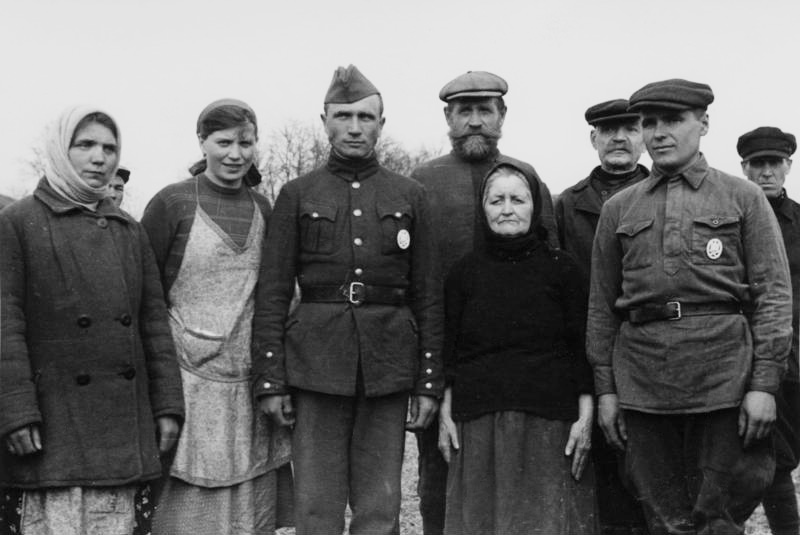
 Russia, January 1942, two former Soviet soldiers in the German Wehrmacht army, decorated with the General Assault Badge | |
| Active | 1941–1944 |
| Country | Occupied Soviet Union, Eastern Front (World War II), occupied Poland |
| Allegiance | Nazi Germany |
| Branch | .svg) Wehrmacht Wehrmacht  Schutzstaffel Schutzstaffel |
| Type | Auxiliary forces |
| Size | 600,000 (in 1944) |
| Nicknames | Hiwi, Askari |
Hiwi ([ˈhiːviː]), the German abbreviation of the word Hilfswilliger or, in English, auxiliary volunteer, designated, during World War II, a member of different kinds of voluntary auxiliary forces made up of recruits indigenous to the territories of Eastern Europe occupied by Nazi Germany.[1] Adolf Hitler reluctantly agreed to allow recruitment of Soviet citizens in the Rear Areas during Operation Barbarossa.[2] In a short period of time, many of them were moved to combat units.
Roles and numbers
[edit]A captured Hiwi told his NKVD interrogators:
Russians in the German Army can be divided into three categories. Firstly, soldiers mobilized by German troops, so-called Cossack sections, which are attached to German divisions. Secondly, Hilfswillige [Voluntary Assistants] made up of local people or Russian prisoners who volunteer, or those Red Army soldiers who desert to join the Germans. This category wears full German uniform, with their own ranks and badges. They eat like German soldiers and they are attached to German regiments. Thirdly, there are Russian prisoners who do the dirty jobs, kitchens, stables and so on. These three categories are treated in different ways, with the best treatment naturally reserved for the volunteers.[3]
Fighting
[edit]Hiwis comprised 50% of the 2nd Panzer Army's 134th Infantry Division in late 1942, while the 6th Army at the Battle of Stalingrad was composed of 25% Hiwis.[2] By 1944, their numbers had grown to 600,000. Both men and women were recruited. Veteran Hiwis were practically indistinguishable from regular German troops, and often served in entire company strengths.[2][4]
The Hiwis may have constituted one quarter of 6th Army's front-line strength, amounting to over 50,000 Slavic auxiliaries serving with the German troops.[5]
Policing
[edit]Between September 1941 and July 1944 the SS employed thousands of collaborationist auxiliary police recruited as Hiwis directly from the Soviet POW camps. After training, they were deployed for service with Nazi Germany, in the General Government, and the occupied East.[6]
In one instance, the German SS and police inducted, processed, and trained 5,082 Hiwi guards before the end of 1944 at the SS training camp division of the Trawniki concentration camp set up in the village of Trawniki southeast of Lublin. They were known as the "Trawniki men" (German: Trawnikimänner) and were former Soviet citizens, mostly Ukrainians. Trawnikis were sent to all major killing sites of the "Final Solution", which was their training's primary purpose. They took an active role in the executions of Jews at Bełżec, Sobibor, Treblinka II, Warsaw (three times), Częstochowa, Lublin, Lvov, Radom, Kraków, Białystok (twice), Majdanek as well as Auschwitz, and Trawniki itself.[7][8][9]
Motivation
[edit]German historian Werner Röhr wrote that there were many different reasons why Soviet citizens volunteered.[10] He argues that the issue has to be seen first and foremost with the German Vernichtungskrieg (war of annihilation) policy in mind. For example, volunteering allowed Soviet POWs to get out of the barbaric German POW camp system, giving them a much higher chance of survival. During World War II, Nazi Germany engaged in a policy of deliberate maltreatment of Soviet POWs, in contrast to their treatment of British and American POWs. This resulted in some 3.3 to 3.5 million deaths, or 57% of all Soviet POWs.[11][12][13][14] Therefore it becomes very difficult to differentiate between a genuine desire to volunteer, and seeming to volunteer in the hope of a better chance of surviving the war.
Perceptions
[edit]By the Allies
[edit]
The term 'Hiwis' acquired a thoroughly negative meaning during World War II when it entered into several other languages in reference to Ostlegionen as well as volunteers enlisted from occupied territories for service in a number of roles including hands-on shooting actions and guard duties at extermination camps on top of regular military service, drivers, cooks, hospital attendants, ammunition carriers, messengers, sappers, etc.[2][4]
In the context of World War II the term has clear connotations of collaborationism, and in the case of the occupied Soviet territories also of anti-Bolshevism (widely presented as such by the Germans).
Soviet authorities referred to the Hiwis as "former Russians" regardless of the circumstances of their joining or their fate at the hands of the NKVD secret police.[15] After the war, thousands attempted to return to their homes in the USSR. Hundreds were captured and prosecuted, charged with treason and therefore guilty of enlistment from the start of judicial proceedings.[7] Most were sentenced to the Gulag labor camps, and released under the Khrushchev amnesty of 1955.[16]
By the German authorities
[edit]The reliance upon Hiwis exposed a gap between Nazi ideologues and pragmatic German Army commanders. Nazi leaders including Adolf Hitler regarded all Slavs as Untermenschen and therefore of limited value as volunteers also. On the other hand, the manpower was needed,[17] and German Intelligence had recognised the need to divide the Soviet nationals. The contradiction was sometimes disguised by reclassification of Slavs as Cossacks.[18] Colonel Helmuth Groscurth (XI Corps' Chief of Staff) wrote to General Beck:
"It is disturbing that we are forced to strengthen our fighting troops with Russian prisoners of war, who are already being turned into gunners. It's an odd state of affairs that the "Beasts" we have been fighting against are now living with us in closest harmony."[5]
Contemporary use
[edit]The term "Hiwi" is still found in academic vernacular in German-speaking countries, in the meanings of "volunteer", "research/student assistant" (in a university), or Hilfswissenschaftler (auxiliary scientist(s)).[19]
See also
[edit]References
[edit]- ^ Grasmeder, Elizabeth M.F. "Leaning on Legionnaires: Why Modern States Recruit Foreign Soldiers". International Security. Retrieved 30 July 2021.
- ^ a b c d Thomas, Nigel (2015). "Eastern Troops. Hilfswillige". Hitler's Russian & Cossack Allies 1941–45. Bloomsbury Publishing. pp. 13–15, 57. ISBN 978-1472806895.
- ^ Beevor, Antony (1999). Stalingrad. London: Penguin. pp. 184–185. ISBN 0-14-024985-0.
Hiwi.
- ^ a b Lee Ready, J. (1987). The Forgotten Axis: Germany's Partners and Foreign Volunteers in World War II. McFarland. pp. 194, 211, 510. ISBN 089950275X.
- ^ a b Beevor, Antony (1999). Stalingrad. London: Penguin. pp. 161, 184. ISBN 0-14-024985-0.
Hiwi.
- ^ Browning, Christopher R. (1998) [1992]. "Arrival in Poland" (PDF). Ordinary Men: Reserve Police Battalion 101 and the Final Solution in Poland. Penguin Books. pp. 52, 77, 79, 80. direct download 7.91 MB complete. Also available via PDF cache archived by WebCite.
- ^ a b "Trawniki". Holocaust Encyclopedia. United States Holocaust Memorial Museum. Retrieved July 21, 2011.
- ^ Mgr Stanisław Jabłoński. "Hitlerowski obóz w Trawnikach". The camp history (in Polish). Trawniki official website. Retrieved 2013-04-30.
- ^ Tadeusz Piotrowski (2006). "Ukrainian Collaboration". Poland's Holocaust. McFarland. p. 217. ISBN 0786429135. Retrieved 2013-04-30.
- ^ Röhr, Werner (1994). Okkupation und Kollaboration. (1938–1945). Beiträge zu Konzepten und Praxis der Kollaboration in der deutschen Okkupationspolitik (Europa unterm Hakenkreuz. Erg.-Bd. 1). Bundesarchiv. Hüthig, Berlin u.a. ISBN 3-8226-2492-6.
- ^ Peter Calvocoressi, Guy Wint, Total War – "The total number of prisoners taken by the German armies in the USSR was in the region of 5.5 million. Of these, the astounding number of 3.5 million or more had been lost by the middle of 1944 and the assumption must be that they were either deliberately killed or done to death by criminal negligence. Nearly two million of them died in camps and close on another million disappeared while in military custody either in the USSR or in rear areas; a further quarter of a million disappeared or died in transit between the front and destinations in the rear; another 473,000 died or were killed in military custody in Germany or Poland." They add, "This slaughter of prisoners cannot be accounted for by the peculiar chaos of the war in the east. ... The true cause was the inhuman policy of the Nazis towards the Russians as a people and the acquiescence of army commanders in attitudes and conditions which amounted to a sentence of death on their prisoners."
- ^ Christian Streit: Keine Kameraden: Die Wehrmacht und die Sowjetischen Kriegsgefangenen, 1941–1945, Bonn: Dietz (3. Aufl., 1. Aufl. 1978), ISBN 3-8012-5016-4 – "Between 22 June 1941 and the end of the war, roughly 5.7 million members of the Red Army fell into German hands. In January 1945, 930,000 were still in German camps. A million at most had been released, most of whom were so-called ‘volunteers’ (Hilfswillige) for (often compulsory) auxiliary service in the Wehrmacht. Another 500,000, as estimated by the Army High Command, had either fled or been liberated. The remaining 3,300,000 (57.5 percent of the total) had perished."
- ^ Nazi persecution of Soviet Prisoners of War United States Holocaust Memorial Museum – "Existing sources suggest that some 5.7 million Soviet army personnel fell into German hands during World War II. As of January 1945, the German army reported that only about 930,000 Soviet POWs remained in German custody. The German army released about one million Soviet POWs as auxiliaries of the German army and the SS. About half a million Soviet POWs had escaped German custody or had been liberated by the Soviet army as it advanced westward through eastern Europe into Germany. The remaining 3.3 million, or about 57 percent of those taken prisoner, were dead by the end of the war."
- ^ Jonathan North, Soviet Prisoners of War: Forgotten Nazi Victims of World War II – "Statistics show that out of 5.7 million Soviet soldiers captured between 1941 and 1945, more than 3.5 million died in captivity."
- ^ Beevor, Antony (1999). Stalingrad. London: Penguin. p. 186. ISBN 0-14-024985-0.
Hiwi.
- ^ Holocaust Encyclopedia. "Trawniki" (GFDL). United States Holocaust Memorial Museum. Retrieved July 12, 2014.
- ^ Davies, Norman (2007). Europe at War 1939–1945: No Simple Victory. London: Pan Books. p. 169. ISBN 978-0-330-35212-3.
- ^ Beevor, Antony (1999). Stalingrad. London: Penguin. p. 185. ISBN 0-14-024985-0.
Hiwi.
- ^ "Hiwi ▶ Rechtschreibung, Bedeutung, Definition, Herkunft | Duden". www.duden.de (in German). Retrieved 2025-04-24.
Further reading
[edit]- Elizabeth M.F. Grasmeder, "Leaning on Legionnaires: Why Modern States Recruit Foreign Soldiers," International Security (July 2021), Vol 46 (No. 1), pp. 147–195.
- Browning, Christopher R. (1992). Ordinary Men: Reserve Police Battalion 101 and the Final Solution in Poland. New York: Aaron Asher Books. ISBN 9780060190132. OCLC 905564331.
Hiwi (volunteer)
View on GrokipediaEtymology and Definition
Linguistic Origins
The term Hiwi originated as a German abbreviation for Hilfswilliger, a noun denoting a male individual inclined to offer help or assistance.[8] The full form Hilfswilliger is a compound derived from the adjective hilfswillig (helpful or willing to aid), combining Hilfs-—the genitive stem of Hilfe (help or aid)—with -willig, an adjectival suffix from the verb wollen (to want or will), implying voluntary disposition.[9] This linguistic structure reflects standard German word formation for agents of action, where -er denotes the performer, yielding a literal translation of "one willing to help" or "auxiliary helper."[5] Prior to its specialized military application, Hiwi served as shorthand for Hilfswissenschaftler (assistant researcher or student aide) in academic contexts, illustrating the term's broader utility for supportive roles.[9] In both usages, the abbreviation retained a phonetic simplicity ([ˈhiːviː]), facilitating informal spoken and written reference. During World War II, Hilfswilliger emerged in official Wehrmacht documentation to classify non-combatant or auxiliary personnel, though its neutral connotation masked varying degrees of compulsion in recruitment.[7] The term's euphemistic undertone, portraying service as voluntary aid, aligned with Nazi propaganda framing collaboration as mutual benefit rather than subjugation.Primary Historical Meaning
The primary historical meaning of "Hiwi" denotes Hilfswillige ("auxiliary volunteers" or "those willing to help"), a category of non-German personnel who volunteered or were attached to serve the Wehrmacht as support staff during World War II, predominantly on the Eastern Front following the 1941 invasion of the Soviet Union.[5] These auxiliaries, drawn largely from Soviet prisoners of war and local populations in occupied territories such as Ukraine, Belarus, and Russia, filled critical logistical roles to compensate for German manpower deficits, including tasks like ammunition handling, fortification construction, and rear-area security.[10] Unlike formally incorporated foreign legions or Waffen-SS units, Hiwis operated in an unofficial capacity initially, lacking full combatant status under international law and receiving minimal equipment, such as captured Soviet uniforms supplemented by German insignia.[5] Their designation emerged from ad hoc recruitment practices amid the high mortality rates in German POW camps, where volunteering offered survival prospects through food and shelter.[10] By mid-1942, official guidelines formalized their employment, permitting frontline integration while prohibiting independent units to maintain racial and command hierarchies. This usage of "Hiwi" as a military term gained prominence in German army records and correspondence from 1941 onward, reflecting pragmatic exploitation of anti-Bolshevik sentiments among recruits, though ideological vetting remained inconsistent.[5] The role expanded beyond support to include armed participation in anti-partisan operations and defensive battles, with estimates indicating their indispensability in sustaining Army Group South and Center's operations against Soviet advances.[10] Postwar accounts, drawing from declassified Wehrmacht documents, underscore that Hiwis numbered in the tens of thousands by 1943, embodying a blend of coerced pragmatism and voluntary collaboration amid total war exigencies.World War II Context
Initial Recruitment (1941–1942)
The initial recruitment of Hilfswillige (Hiwis), or auxiliary volunteers, occurred amid the chaos of Operation Barbarossa, launched on June 22, 1941, as German forces advanced deep into Soviet territory and captured millions of prisoners of war. Facing acute manpower shortages for logistical support amid rising casualties and vast supply lines, German field commanders began employing Soviet POWs and local civilians in non-combat roles such as laborers, cooks, drivers, and stable hands, often on an ad hoc basis without central approval.[3] [11] This pragmatic approach disregarded Nazi racial ideology, which viewed Slavs as inferior and initially prohibited their formal integration into Wehrmacht units.[10] Soviet POWs, subjected to deliberate maltreatment with over 2.8 million dying from starvation, disease, and exposure by February 1942, provided the primary recruitment pool, as volunteering offered survival amid camp conditions where rations were minimal and mortality rates exceeded 50% in some facilities.[12] Local inhabitants in occupied areas, motivated by anti-Bolshevik sentiments or economic incentives, also joined for rear-area tasks, though numbers remained limited in 1941 due to ideological restrictions and fears of unreliability.[13] By late 1941, approximately 46,000 auxiliary police volunteers had been recruited in key occupied regions, including 31,652 in Reichskommissariat Ostland and 14,452 in Reichskommissariat Ukraine, primarily for security duties that freed German personnel.[13] In 1942, as the Eastern Front stalled and partisan activity intensified, recruitment expanded with reluctant high-level acquiescence, including Hitler's authorization for limited use in rear areas, though frontline combat roles were still frowned upon.[11] Wehrmacht Hiwi numbers grew modestly, with estimates suggesting tens of thousands serving in support capacities by mid-1942, constituting up to 25% of some units like the 6th Army during the Stalingrad campaign, where they handled logistics under dire conditions.[2] These early volunteers were typically unarmed or lightly equipped, focused on sustaining German operations rather than direct fighting, reflecting a shift from ideological purity to wartime necessity driven by empirical pressures of attrition and overextension.[10]Expansion and Peak Utilization (1943–1944)
![Local Soviet volunteers serving with the Wehrmacht in Russia][float-right] In 1943, following severe losses at Stalingrad and Kursk, the Wehrmacht expanded its use of Hilfswillige (Hiwi) to address critical manpower deficits on the Eastern Front. German commanders, operating with de facto autonomy from ideological directives in Berlin that initially discouraged reliance on Soviet auxiliaries, incorporated larger numbers of volunteers into units for logistical support, freeing regular troops for combat duties. This shift marked a pragmatic departure from early policies, as Hiwi numbers surged from tens of thousands in 1942 to an estimated 250,000 by late 1943, primarily handling supply, maintenance, and construction tasks. By 1944, Hiwi utilization peaked amid escalating Soviet offensives, with total enlistments reaching approximately 600,000, including both men and women from Soviet territories. These auxiliaries were increasingly formed into organized formations such as Ost-Bataillone, performing combat support roles alongside non-combat functions, though they remained under-equipped and subordinate to German officers. In Army Group Center, for example, Hiwi comprised significant portions of divisional strength, contributing to defensive efforts but suffering disproportionate casualties—averaging nearly 4,000 losses per month during the summer 1944 collapse.[7][2] This period of peak integration highlighted the Wehrmacht's dependence on local volunteers, driven by survival needs rather than ideological alignment, as German personnel shortages intensified. While effective in sustaining operations short-term, the reliance exposed vulnerabilities, with many Hiwi deserting or surrendering en masse during retreats, reflecting limited loyalty amid harsh treatment and battlefield realities.[4]Roles in Specific Campaigns
![Indigenous volunteers in Wehrmacht service, Russia]float-right During Operation Barbarossa in 1941, Hiwi volunteers provided essential logistical support to advancing German units on the Eastern Front, including transporting supplies, constructing fortifications, and performing rear-area tasks to sustain the rapid offensive pace.[7] Their early recruitment helped alleviate manpower strains in non-combat roles amid the invasion's vast scale. In the Battle of Stalingrad from August 1942 to February 1943, Hiwi constituted approximately 25% of the German 6th Army's personnel, totaling around 50,000 individuals who handled ammunition distribution, cooking, cart driving, and maintenance duties.[5] Due to escalating casualties, some Hiwi were armed and deployed in front-line combat functions, though their reliability waned during the Soviet encirclement, with many deserting or surrendering.[14] Hiwi involvement in the Battle of Kursk in July 1943 remained primarily supportive, focusing on logistics and auxiliary policing in rear areas, as German forces prioritized regular troops for the offensive's armored spearheads. Their numbers had grown by this phase, but specific combat contributions were limited compared to earlier campaigns.[2]Scale and Composition
Numerical Estimates
By mid-1943, the peak strength of Hiwi auxiliaries integrated into Wehrmacht units on the Eastern Front reached approximately 600,000 individuals, primarily former Soviet prisoners of war performing non-combat support duties such as logistics, construction, and maintenance. [4] [15] Broader estimates encompassing Hiwis in police formations, labor battalions, and other auxiliary roles extend the total to nearly 1 million Soviet citizens actively supporting German operations by late 1943, with an additional 900,000 employed in rear-area labor within Germany itself. [4] Overall figures for Soviet auxiliaries, including those eventually armed or transferred to combat units like Ostlegionen, vary between 600,000 and 1.4 million across the war, reflecting recruitment driven by POW releases and local conscription amid harsh occupation policies. [16] [4]Demographic Breakdown
The Hilfswillige, or Hiwi, auxiliaries in the German Wehrmacht during World War II were drawn predominantly from Soviet prisoners of war (POWs) and civilians in occupied Eastern territories, with estimates of their total numbers ranging from 600,000 to 1.4 million by 1944.[14] These volunteers encompassed a diverse array of ethnic groups from the Soviet Union, reflecting the multi-national composition of the Red Army and occupied populations; non-Russian ethnicities likely constituted at least 50% and possibly a majority of Hiwi, as Germans prioritized recruitment from anti-Bolshevik or non-Slavic minorities to exploit Soviet nationality divisions.[14] Slavic groups, however, formed the numerical core, primarily through releases from POW camps where survival rates incentivized volunteering for labor and support roles.[14] Among Slavic volunteers, Ukrainians and Belarusians predominated in early recruitment from POWs, comprising a majority of those processed for auxiliary service due to their prevalence in captured Red Army units and local populations in Ukraine and Belarus.[14] Approximately 250,000 individuals identifying as Ukrainian served in the Wehrmacht overall, including Hiwi capacities, often in logistical and security roles before some transitioned to combat units like the Ukrainian Liberation Army.[17] Russians, while numerous—potentially hundreds of thousands given their dominance in the Soviet military—were ideologically suspect to German command and thus underrepresented relative to their POW numbers, with many assigned to menial tasks amid Nazi racial hierarchies.[14] Cossacks, as a distinct Slavic subgroup with historical autonomy aspirations, also contributed significantly, forming dedicated cavalry and auxiliary formations.[1] Non-Slavic groups from the Soviet periphery provided substantial contingents, organized into ethnic legions or battalions for security and eventual frontline duties. Central Asians, particularly Turkestanis (Uzbeks, Kazakhs, and others), numbered 110,000 to 180,000 in the Turkestan Legion and related Hiwi units.[14] Caucasians, including Georgians, Armenians, and North Caucasian peoples like Chechens and Azerbaijanis, totaled around 110,000, with units such as the Georgian Legion proving reliable in antipartisan operations.[14] Turkic minorities added further diversity: Volga Tatars contributed 35,000 to 40,000, Crimean Tatars around 20,000 across at least eight battalions, and smaller groups like Kalmyks formed a 5,000-strong cavalry corps.[14] Baltic nationalities—Estonians, Latvians, and Lithuanians—participated as Hiwi in auxiliary police (Schutzmannschaft) battalions and Wehrmacht support roles, leveraging their pre-1941 independence and anti-Soviet sentiments, though exact figures merge into broader foreign volunteer estimates exceeding 100,000 from the region.[18] Both men and women served, with females often in administrative or medical capacities, though males overwhelmingly filled combat-adjacent positions; age demographics skewed toward military-age adults (18–40), mirroring Red Army conscripts who became POWs.[5]| Ethnic Group | Estimated Numbers | Primary Roles |
|---|---|---|
| Ukrainians | ~250,000 (in Wehrmacht broadly) | Logistics, security, some combat |
| Russians | Hundreds of thousands (exact unspecified) | Menial labor, support |
| Belarusians | Significant portion of Slavic POW recruits | Auxiliary police, rear services |
| Central Asians (e.g., Turkestanis) | 110,000–180,000 | Legions for security/frontline |
| Caucasians (e.g., Georgians, Armenians) | ~110,000 | Antipartisan, combat units |
| Volga Tatars | 35,000–40,000 | Ethnic battalions |
| Crimean Tatars | ~20,000 | Security battalions |
| Baltic (Estonians, Latvians, Lithuanians) | >100,000 regionally | Schutzmannschaft, support |