Hubbry Logo
Hook LighthouseHook LighthouseMain
Open search
Hook Lighthouse
Community hub
Hook Lighthouse
logo
8 pages, 0 posts
0 subscribers
Be the first to start a discussion here.
Hook Lighthouse
Hook Lighthouse
from Wikipedia

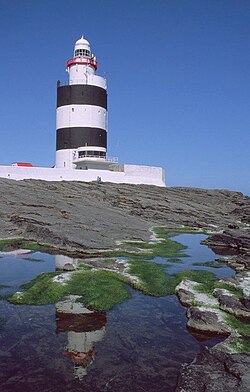
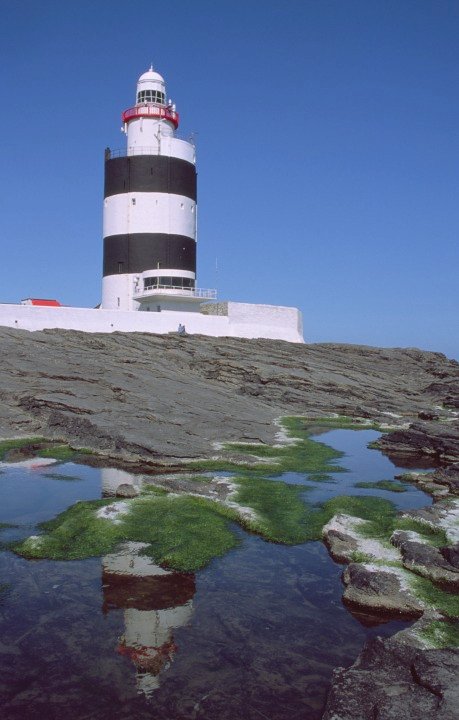
The Hook Lighthouse (Irish: Teach Solais Rinn Duáin;[1] also known as Hook Head Lighthouse) is a building situated on Hook Head at the tip of the Hook Peninsula in County Wexford, in Ireland. It is one of the oldest lighthouses in the world[2] and the second oldest operating lighthouse in the world, after the Tower of Hercules in Spain. It is operated by the Commissioners of Irish Lights, the Irish lighthouse authority, and marks the eastern entrance to Waterford Harbour. The current structure has stood for over 800 years.

Key Information

History

[edit]
The Hook Lighthouse appears on the coat of arms of County Wexford.

The existing tower dates from the 12th century, though tradition states that Dubhán, a missionary to the Wexford area, established a form of beacon as early as the 5th century. The headland is known in Irish as Rinn Dubháin, St. Dubhán's Head. However, the similar-sounding Irish word 'duán' means a fish hook, hence the English name. It is known locally as "the Hook."

The tower was built by Strongbow's son-in-law William Marshall, Earl of Pembroke, who succeeded Strongbow as Lord of Leinster. Pembroke had established a port in the town of New Ross, approx. 30 km up river. In order for his new port to be successful and for ships to safely reach their destination, Pembroke had a 36m high tower built at the mouth of Waterford Harbour. The exact year of construction is not known, but Pembroke first came to the region in 1201 and the first map that shows the lighthouse serving its function is dated 1240, so construction must have taken place between these dates.

The first custodians of the light were a small group of monks whose small monastery was situated on the peninsula. The monks who lived at this monastery would have lit warning fires and beacons all through the years to warn sailors of the dangerous rocks on the peninsula. It was the monks who lived at this monastery in the 13th century who became the first light-keepers. They are also thought to have helped in the construction of the tower.

Hook Lighthouse is one of the most fascinating examples of medieval architecture in Ireland. The tower stands four stories high with walls up to 4m thick. The tower itself consists of three rib-vaulted chambers in the lower tier, while the upper, narrower section would have carried the warning beacon. These two tiers are connected by a mural (within the wall) stairway of 115 steps. The tower was constructed of local limestone and the original building survives intact. The first tier is 13m in diameter at the base and has three storeys, each with its original 13th-century stone fireplace. In the thickness of the wall, there are a number of mural chambers, including two garderobes (toilets). The upper tier is 6m in diameter: originally it supported the beacon fire, which was later replaced by the lantern.

Fog signals were operated at the lighthouse as a warning to seafarers during dense fog which can suddenly descend on the peninsula. The fog signal was essential in days before radar and radio. Fog guns situated at the cliff edge were fired every 10 minutes. These were replaced by explosive charges set from the top of the tower on an extending arm. Finally, a compressed air horn (hooter) blasted every 45 seconds during fog.

The monks left the tower and were replaced by the first lighthouse keepers in the mid-17th century. In 1671, a new, but still coal-burning lantern was installed on top of the tower to replace the old beacon light. The coal fire was finally abandoned in 1791 when a whale oil-lantern 12 ft. in diameter with 12 lamps was installed. This continued until new gas lights were installed in 1871, lit by gas manufactured in the enclosure known as 'the gas yard'. In the 1860s, three dwellings were built for the lighthouse keepers. Paraffin oil became the source of power in 1911, and a clockwork mechanism changed the light from fixed to flashing. This mechanism had to be wound up every 25 minutes by the keeper on duty. Finally, in 1972 electricity became the power source, and light-sensitive switches were installed to control the lantern. In March 1996, The Hook Lighthouse was converted to automatic operation, and the last light-keepers who had climbed the stairs and tended the light were permanently withdrawn from the station. The lighthouse is now remotely controlled from Dún Laoghaire by the Commissioners of Irish Lights.

In 2001 the light was opened to the public as a tourist attraction after the old keepers' houses were turned into a visitor centre. In January 2011 The Hook's fog horn was heard for the last time as all the fog horns were turned off. It was felt that the technology on modern ships was so advanced that the fog horn was no longer required. In June 2011 the structure was placed first in a Lonely Planet piece listing the "Top 10 Flashiest Lighthouses"; the author described Hook as "The great granddaddy of lighthouses".[3][4]

See also

[edit]

References

[edit]

Bibliography

[edit]
[edit]
Revisions and contributorsEdit on WikipediaRead on Wikipedia
from Grokipedia
The Hook Lighthouse is a medieval tower located at Hook Head on the southeastern tip of Ireland's , serving as the eastern sentinel for Waterford Harbour and often regarded as the world's oldest intact and continuously operational lighthouse. Constructed in the early 13th century by William Marshal, 1st Earl of Pembroke, the 35-metre-high structure features walls up to 4 metres thick, designed to withstand the treacherous seas and rocky coastline that have long endangered ships navigating the confluence of the rivers Suir, , and Barrow. Its origins trace to a 5th-century beacon lit by the monk Dubhán from a nearby monastery, evolving over centuries into a critical aid for maritime safety with its current electric light, flashing white every 3 seconds and visible for 23 nautical miles. Automated and unmanned since 1996, the lighthouse remains under the management of the Commissioners of Irish Lights, blending historical preservation with modern navigation. As a cornerstone of Ireland's maritime heritage, Hook Lighthouse exemplifies Norman engineering from the Anglo-Norman era, rebuilt or enlarged around 1240 to support expanding trade routes while guarding against Viking-era threats that once plagued the region. Its lantern, added in 1864, elevated the focal plane to 46 metres above mean high water springs, enhancing its role in coordinating with nearby lights at Tuskar Rock and Mine Head to cover the southeast coast. Today, beyond its operational duties—including an AIS and transmitting 'K'—it attracts visitors through guided tours that explore its , fossil-rich geology of and , and panoramic views of the , earning acclaim as part of the Great Lighthouses of initiative.

Location and Setting

Geographical Position

The Hook Lighthouse stands at the precise coordinates 52°07′25″N 6°55′46″W, positioned at the easternmost tip of the Hook Head peninsula in , . This low-lying headland extends into the , forming a natural promontory that marks the southeastern boundary of the region. The surrounding landscape features rugged rocky cliffs and wave-cut platforms, shaped by the erosive forces of the sea over millennia. Geologically, the peninsula features sedimentary rock formations spanning the Devonian Old Red Sandstone to Lower Carboniferous limestone, approximately 400 to 345 million years old, with the lighthouse situated on fossil-rich limestone deposited in a shallow marine environment. These strata, including crinoid and bryozoan fossils, are prominently exposed along the foreshore, contributing to the area's dramatic coastal topography. In 2022, an exceptional cluster of well-preserved Carboniferous echinoids was discovered near Hook Head, highlighting the site's ongoing palaeontological significance. The lighthouse overlooks the eastern entrance to Waterford Harbour, situated roughly 35 km southeast of New Ross and providing distant views of the Saltee Islands to the south across the open sea. The environmental conditions at Hook Head are notoriously severe, with the exposed position subjecting the site to frequent Atlantic storms, gale-force winds, and powerful tidal currents that surge through the narrow harbour entrance. These factors have long rendered the waters hazardous for maritime traffic, contributing to a of shipwrecks during inclement weather. High wave action and shifting sands further amplify the risks, particularly during winter months when storm surges can batter the cliffs.

Maritime Significance

The waters surrounding Hook Head are among the most perilous in Ireland, characterized by powerful currents from the and the broader , compounded by the influx of the "three sisters" rivers—the , Suir, and Barrow—along with frequent fog, strong winds, and shifting sandbanks and reefs. This hazardous environment has earned the region the grim moniker "Graveyard of ," with over 1,000 recorded shipwrecks occurring between Hook Lighthouse and the nearby Kilmore Quay and since ancient times, many attributable to these natural dangers before reliable navigational beacons were established. As the primary beacon marking the eastern entrance to Waterford Harbour, Hook Lighthouse has served as an essential for vessels since its construction in the early 13th century by William Marshal, Lord of , who built it specifically to guide ships safely into the estuary and protect maritime routes to ports like and Waterford. This role traces back even further to 5th-century monastic beacons lit by monks at nearby Churchtown to warn seafarers of the offshore rocks, evolving into a formalized light that supported medieval trade by directing ships carrying exports such as , hides, , oats, and , as well as imports including salt, wine, and silk. The lighthouse's enduring function has significantly bolstered the economy of southeast by facilitating secure shipping channels vital to regional commerce; historically, it enabled the of agricultural goods like , , and , while today it continues to guide modern traffic, including bulk carriers, tankers transporting fuels and raw materials, and fishing vessels operating in the . By minimizing wreck risks in this key trade corridor—the closest Irish bulk port to mainland —Hook Lighthouse contributes to the sustained economic vitality of Waterford Harbour, which handles diverse cargo and supports local industries. In the broader network of Irish navigational aids, Hook Lighthouse complements offshore beacons such as Tuskar Rock Lighthouse, located 11 kilometers southeast, which warns of treacherous reefs along the southeast coast; together, they provide sequential guidance, with Tuskar serving as an initial alert for transatlantic vessels approaching from the west, and Hook acting as the critical light directing ships into Waterford Harbour.

History

Origins and Construction

The tradition of maintaining a beacon at Hook Head originated in the 5th century with Saint Dubhán, a Welsh monk who founded a monastic settlement at the site known in Irish as Rinn Dubháin, or Dubhán's Point. Seeking solitude, Dubhán and his monks lit warning fires using timber or local fuels in a chauffer atop a mound or simple stone structure to alert seafarers to the hazardous rocks and currents off the peninsula, establishing the area's early significance for maritime navigation into Waterford Harbour. The extant tower was built in the early , circa 1210–1230, by William Marshal, 1st , after he inherited extensive lands in through his marriage to Isabel de Clare, daughter of the Anglo-Norman conqueror Richard de Clare (Strongbow). Recognizing the need to safeguard shipping routes to his vital port at , approximately 30 km upstream, Marshal commissioned the structure using locally quarried limestone to form a robust circular tower that served as both a for visual and a night with an open coal or wood fire lit on the summit. The construction process involved of the nearby Rinn Dubháin , who were granted an annual allowance to tend the light and likely assisted in the labor, reflecting the integration of and secular efforts during the Anglo-Norman era. Designed with thick walls up to 4 meters and a spiral stairway of 115 steps, the tower fulfilled a dual purpose as a and a defensive stronghold amid the ongoing conflicts between Anglo-Norman settlers and Irish forces in medieval .

Ownership and Alterations

Following its initial construction in the early under the commission of William Marshal, the lighthouse remained under monastic oversight by the monks affiliated with the Priory of Saint Augustine at Ross (later Saint Saviour's of Rendevan), who continued tending the until the in 1641 disrupted operations. In 1665, Sir Robert Reading received a royal patent from King Charles II to re-establish the light, rebuilding the and encasing the in a while still using coal. By 1667, the lighthouse was operational again. Ownership transferred to the in 1704 under Queen Anne, with the light leased to Henry Loftus from 1706 for £120 annually after disputes. The coal fire was replaced by an oil-burning lamp in 1791 following complaints about visibility, managed by the Revenue Board. Key technological updates in the early featured the installation of a fixed catoptric apparatus in , utilizing reflectors to amplify the beam, alongside reinforcements to the tower walls to mitigate erosion from the harsh coastal environment. These developments coincided with the formal establishment of the Commissioners of Irish Lights in 1786, initiating centralized state oversight of Irish lighthouses and ensuring more consistent management.

20th Century to Present

During the early 20th century, Hook Lighthouse continued its vital role in maritime navigation with minor updates to its signaling system. In June 1937, the fog signal was modified to one shot every five minutes, accompanied by a brilliant flash at night. The lighthouse's distinctive flash was discontinued during as part of Ireland's neutrality measures, with the structure serving as one of 83 coastal lookout posts manned by the Local Defence Force to monitor ships and aircraft from 1939 to 1945; operations faced minimal disruptions overall due to the country's neutral status. The flash was re-introduced in 1949 following the war's end. Significant modernization occurred in the mid-20th century, including the conversion to electric operation in , which replaced vaporized paraffin and increased the light's intensity to 480,000 candelas with a flash duration of 0.11 seconds, extending its range to 23 nautical miles. The original medieval tower, constructed in the 13th century, has remained the core structure throughout these changes. In 1977, lightkeepers' families were withdrawn, transitioning the station to a relieving basis. Full automation followed on 29 1996, when the last lightkeepers were permanently withdrawn, and became remotely monitored via telemetry from by the Commissioners of Irish Lights. An (AIS) base station was added in January 2009, and the fog signal was discontinued on 11 January 2011. In 2001, ownership and management of the site for tourism purposes were transferred to the Hook Heritage Community enterprise, enabling public access and the establishment of a visitor centre; this coincided with celebrations of the 's 800th anniversary. Recognized as a medieval architectural monument and the world's oldest intact operational , it continues to function as an active aid to while preserving its historical integrity. The structure has demonstrated resilience against modern environmental challenges, such as Storm Ophelia in October 2017, which brought gusts up to 90 mph (145 km/h) to the area, yet the sustained no significant damage and resumed operations promptly. As of 2025, plans are underway for a new multi-million euro visitor centre, with preliminary designs expected by mid-year.

Architecture and Engineering

Tower Structure

The tower of Hook Lighthouse is a robust circular structure measuring 35 meters in height, with a base diameter of 13 meters that narrows to 6 meters at the top. Its walls, reaching up to 4 meters in thickness at the base, taper gradually upward, providing structural stability against coastal winds and . Constructed primarily from local sourced from nearby quarries, the tower exemplifies medieval techniques employed during its building in the early . Internally, access to the upper levels is via a stairway comprising 115 spiral stone steps, winding anti-clockwise through the four storeys to facilitate easier ascent for keepers carrying supplies. The lower tier houses three rib-vaulted chambers, originally serving as living quarters and storage spaces, each featuring a 13th-century for heating and cooking. Additional small chambers and two garderobes (medieval latrines) are integrated into the walls, while the upper tier culminates in a cap that forms an integral part of the tower's roof structure. This layout allowed self-sufficiency within the confined space, with all essential functions contained in the single tower. Although primarily designed as a , the tower incorporates defensive characteristics inspired by contemporary , including its massive wall thickness and cylindrical form, which offered protection against potential raids in this exposed maritime location. There is no separate keep; instead, the entire fortress-like complex is unified within the tower itself, blending utilitarian functions with basic elements. From an perspective, the tower's relied on precisely cut local blocks fitted together to form enduring vaults and passages, enabling it to endure centuries of harsh environmental forces including Atlantic storms and saltwater . Its massive foundations and have ensured remarkable without major structural failure, highlighting the advanced stoneworking skills of the era's builders from the Pembroke estate.

Lighting and Auxiliary Features

The original beacon at Hook Lighthouse consisted of an open fire maintained on the tower top by monastic keepers, a practice dating back to the 5th or as established by Saint Dubhán to warn seafarers of nearby rocks. In 1791, lighthouse engineer Thomas Rogers constructed the first enclosed atop the medieval tower, a structure approximately 3.65 meters in diameter that housed 12 Argand oil lamps with silvered parabolic reflectors to amplify the light. This cylindrical iron , elevated about 35 meters above sea level, marked a significant upgrade from the exposed fire, providing a more reliable and weather-resistant light source until further modifications in the . The optics system evolved through several advancements to enhance visibility and efficiency. In 1810, the installation of 13 oil lamps with a combination of bottle glass lenses and plate glass sheets improved the catoptric apparatus, followed by a complete replacement in 1864 with a fixed first-order dioptric Fresnel lens. By 1911, a revolving third-order 500 mm Fresnel optic powered by vaporized paraffin and a clockwork mechanism was introduced, producing a characteristic flashing white light. In November 2015, the system transitioned to a modern LED array (Grad RLS 36-6) within the retained third-order Fresnel lens; as of 2025, the light has a range of 23 nautical miles with a flash pattern of white light every 3 seconds (0.1 second flash + 2.9 seconds eclipse) for energy efficiency and remote monitoring. Auxiliary buildings and features supported the lighthouse's operations over centuries. Three keepers' dwellings, constructed in the , provided housing for the staff maintaining the light and signals; these structures have since been repurposed as visitor facilities, including a cafe, craft shop, and reception area. An oil store was integral for storing during the paraffin era, while a dedicated fog signal station housed evolving equipment: starting with a bell in 1838, progressing to fog guns by 1905 (one shot every 5 minutes), and culminating in an electric horn (two blasts every 45 seconds) until its discontinuation in 2011. The tower's base includes a store from the 13th-century construction, reflecting early provisions for in this remote location.

Operations and Management

Historical Operations

From its medieval origins, the Hook Lighthouse was operated by monks associated with Saint Dubhán's 5th-century monastery, who maintained a warning fire on a or rudimentary tower at Hook Point. These early custodians used timber or other local fuels to keep the burning continuously, organizing shifts to ensure round-the-clock operation despite the 's limited visibility in fog or storms. This manual vigilance helped avert shipwrecks amid the treacherous rocks and currents of the area, with the tradition of monastic oversight continuing under Norman rule after 1172, when the light was vested to the monks of Saint Augustine’s Priory. By the , operations had evolved under professional keepers appointed by the Commissioners of Irish Lights, typically three in number—a principal keeper and two assistants—who rotated duties for uninterrupted 24-hour service. Their routines involved trimming and refilling the Argand oil lamps installed in 1791, winding the clockwork apparatus to rotate the for sweeping visibility, cleaning lenses and reflectors, and manually operating fog signals, such as the bell introduced in and later upgraded to a in 1872. Keepers also monitored , scanned for vessels in distress, and maintained the station's structures, with shifts structured as four hours on and eight hours off to sustain vigilance through long nights. Fuel transitions, from to in 1871 and vaporized paraffin in 1911, required meticulous handling to prevent outages. Throughout its history, keepers confronted significant challenges, including profound isolation at the remote , which complicated resupplies and family life, as well as relentless exposure to gales and threatening the surrounding cliffs. Fuel shortages arose during wartime disruptions, such as dimming protocols in conflicts to avoid aiding enemies, while events tested the station's durability—records note gales extinguishing lights and damaging equipment, underscoring the physical and mental toll of the role. In the transition period, staffing gradually declined from three resident keepers to a single on-site attendant by the 1960s amid technological improvements like electric conversion in 1972, with comprehensive logbooks meticulously documenting over 800 years of these routines, incidents, and adaptations.

Current Management and Automation

The Hook Lighthouse has been fully automated and unwatched since March 29, 1996, with operations monitored remotely via from the headquarters of the Commissioners of Irish Lights (CIL) in , . This transition eliminated the need for on-site keepers, allowing the lighthouse to function as a vital aid to without resident staff. The CIL, as the statutory authority for lighthouses in Irish waters, retains full responsibility for its navigational operations, ensuring continuous reliability for maritime safety. The lighthouse's lighting system was converted to electric operation in and now utilizes an LED lantern producing a white flashing light every 3 seconds with an intensity of 480,000 candelas and a range of 23 nautical miles. Bulbs are replaced as required during routine servicing to maintain optimal performance. In , an (AIS) base station was integrated into the lighthouse, enabling real-time vessel tracking and enhanced collision avoidance in the approaches to Waterford Harbour. The system is designed for resilience, with automatic mechanisms to ensure uninterrupted service during power disruptions, supported by the CIL's grid-connected electric supply. Maintenance is conducted under the CIL's statutory program, which includes regular inspections of aids to (AtoN) and infrastructure, often utilizing access for efficient evaluation of the remote coastal site. Structural assessments and valuations occur every five years to monitor the medieval tower's integrity against environmental factors, with intervening annual checks to address any discrepancies. For public access and heritage purposes, the site has been leased to Hook Heritage CLG since its opening as a visitor attraction in 2001, allowing tours while preserving the CIL's navigational oversight.

Cultural and Heritage Value

Legends and Folklore

Local folklore attributes the origins of the beacon at Hook Head to Saint Dubhán, a 5th-century Welsh who, according to , arrived at the site seeking solitude and established a there after receiving divine instruction to light a warning fire for sailors navigating the treacherous waters. The ruins of Dubhán's , known as Churchtown, remain nearby, and tales persist of the saint's miraculous interventions, such as divine protections that shielded the and their from storms and invasions throughout the early Christian period. The phrase "by hook or by crook," meaning to achieve a goal , is popularly linked in Irish lore to Oliver Cromwell's 1649 campaign during the siege of Waterford, where he reportedly vowed to conquer by landing forces at either Hook Head or the village of Crooke near Passage East, two strategic points guarding the harbor entrance. stories surrounding Hook Lighthouse include reports of a hooded , possibly one of Dubhán's followers, said to haunt the tower's spiral staircase, with some accounts claiming he is entombed within its walls after a tragic accident during construction or maintenance. Spectral apparitions of former keepers and victims of shipwrecks off the rocky coast are also recounted in local tales, often appearing on foggy nights as ethereal figures near the base of the tower, while unusual are interpreted in as omens warning of approaching storms. In Irish cultural narratives, Hook Lighthouse symbolizes enduring vigilance against the perils of the , appearing in as a motif of resilience amid isolation and danger, with broader connections to Celtic myths of lost ships lured by and shape-shifting like selkies that embody the unpredictable allure of coastal waters.

Tourism and Preservation Efforts

The Hook Lighthouse Visitor Centre, housed in the former keepers' houses adjacent to the tower, was officially opened in 2000 by President , transforming the site into a major heritage tourism destination. The centre features interactive exhibits on the lighthouse's and maritime heritage, a , and a café sourcing local ingredients to support regional producers. Guided tours, available daily, lead visitors through the medieval structure, including a climb of 115 steps to the balcony for panoramic views of the , often incorporating elements of local such as tales of monastic origins. With over 200,000 annual visitors, the site attracts families, enthusiasts, and international tourists, emphasizing educational programs on maritime safety, environmental sustainability, and the lighthouse's role in Irish coastal . Preservation efforts at Hook Lighthouse focus on combating and maintaining the site's ecological integrity, as the surrounding Hook Head is designated a under the EU Habitats Directive, protecting reefs, dunes, estuaries, and species like otters and dolphins. Managed by Hook Heritage CLG in partnership with the Commissioners of Irish Lights and Fáilte Ireland, initiatives include monitoring vegetated sea cliffs prone to slumping and promoting geodiversity to sustain against . Recent conservation actions encompass waste reduction through comprehensive programs for , , and glass, alongside minimized energy and water usage, ensuring the 800-year-old structure endures while minimizing visitor impact on the fragile landscape. As part of the Great Lighthouses of Ireland network, Hook Lighthouse contributes significantly to , generating economic benefits through direct visitor spending and supporting over 30 local jobs during peak seasons via employment and supplier networks. The site's integration into Ireland's Ancient East tourism itinerary enhances its role in , with educational outreach fostering awareness of sustainable practices and maritime heritage. Recognized as one of Ireland's top attractions, these efforts underscore a commitment to eco-friendly operations, including avoiding single-use plastics and prioritizing low-impact site management.

References

Add your contribution
Related Hubs
User Avatar
No comments yet.