Hubbry Logo
Dermatobia hominisDermatobia hominisMain
Open search
Dermatobia hominis
Community hub
Dermatobia hominis
logo
8 pages, 0 posts
0 subscribers
Be the first to start a discussion here.
Dermatobia hominis
Dermatobia hominis
from Wikipedia

Dermatobia hominis
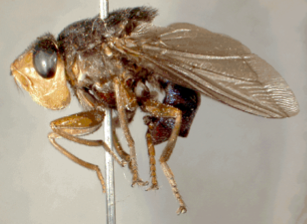
Adult female human botfly
Scientific classification Edit this classification
Kingdom: Animalia
Phylum: Arthropoda
Class: Insecta
Order: Diptera
Family: Oestridae
Subfamily: Cuterebrinae
Genus: Dermatobia
Species:
D. hominis
Binomial name
Dermatobia hominis
(Linnaeus Jr. in Pallas, 1781)
Synonyms

Oestrus hominis (Linnaeus Jr. in Pallas, 1781)

The human botfly, Dermatobia hominis (Greek δέρμα, skin + βίος, life, and Latin hominis, of a human), is a species of botfly whose larvae parasitise humans (in addition to a wide range of other animals, including other primates[1]). It is also known as the torsalo or American warble fly,[1] though the warble fly is in the genus Hypoderma and not Dermatobia, and is a parasite on cattle and deer instead of humans.

Dermatobia fly eggs have been shown to be vectored by over 40 species of mosquitoes and muscoid flies, as well as one species of tick[2] (however, the source for this is somewhat old — 2007 — and slightly more recent literature seems to indicate they don't need a particular species of tick, or at least makes no mention of them only being able to use one as a vector[3]). The female captures the mosquito and attaches its eggs to its body, then releases it. Either the eggs hatch while the mosquito is feeding and the larvae use the mosquito bite area as the entry point, or the eggs simply drop off the muscoid fly when it lands on the skin. The larvae develop inside the subcutaneous layers, and after about eight weeks, they drop out to pupate for at least a week, typically in the soil. The adults are large flies lacking mouthparts (as is true of other oestrid flies).

This species is native to the Americas from southeastern Mexico (beginning in central Veracruz) to northern Argentina, and Uruguay,[1] though it is not abundant enough (nor harmful enough) to ever attain true pest status. Normally the greatest risk they pose to humans is increasing the chances of infection. Since the fly larvae can survive the entire eight-week development only if the wound does not become infected, patients rarely experience infections unless they kill the larva without removing it completely.

Extracted human botfly larva: The arrow points to the larva's mouthparts.

Remedies

[edit]

The easiest and most effective way to remove botfly larvae is to apply petroleum jelly over the location, which prevents air from reaching the larva, suffocating it. It can then be removed with tweezers safely after a day. White glue mixed with pyrethrin or other safe insecticides and applied to the spot of swelling on the scalp will kill the larvae within hours, as they must keep an air hole open, so will chew through the dried glue to do this, consuming the insecticide in the process.[citation needed]

Venom extractor syringes can remove larvae with ease at any stage of growth.[4] A larva has also been successfully removed by first applying several coats of nail polish to the area of the larva's entrance, weakening it by partial asphyxiation.[5] Covering the location with adhesive tape would also result in partial asphyxiation and weakening of the larva, but is not recommended because the larva's breathing tube is fragile and would be broken during the removal of the tape, leaving most of the larva behind.[5]

Oral use of ivermectin, an antiparasitic avermectin medicine, has proven to be an effective and noninvasive treatment that leads to the spontaneous emigration of the larva.[6] This is especially important for cases where the larva is located in inaccessible places such as inside the inner canthus of the eye.

Map of human botfly region

See also

[edit]

References

[edit]
[edit]
Revisions and contributorsEdit on WikipediaRead on Wikipedia
from Grokipedia
Dermatobia hominis, commonly known as the human bot fly, torsalo, or , is a parasitic species of belonging to the family Oestridae (bot flies) within the order Diptera. Native to the Neotropical region, it ranges from southern through and into much of , inhabiting tropical and subtropical forests and rural areas. Adult flies are robust and bee-like in appearance, measuring 12–15 mm in length, with dense golden-yellow hair covering a black body, and they possess strong legs adapted for capturing vectors. The species is notorious for inducing furuncular , a type of subcutaneous infestation where its larvae develop within the skin of mammalian hosts, including humans, , dogs, and wildlife, leading to painful, boil-like lesions. The life cycle of D. hominis is obligatorily parasitic and involves an unusual phoretic strategy for egg deposition. Gravid females, which live only 1–9 days and do not feed, ambush and capture blood-sucking arthropods such as mosquitoes, ticks, or flies in mid-air, gluing clusters of eggs to the vector's using a cement-like . When the vector subsequently bites a host, the warmth and trigger the eggs to hatch within minutes, releasing first-instar larvae that penetrate the skin through the . These larvae migrate subdermally, creating a furuncular nodule with a central pore, and feed on host tissue and fluids for 5–10 weeks across three instars, molting twice. Mature third-instar larvae then exit the host, drop to the ground, and pupate in the soil for 2–6 weeks before emerging as adults to mate and continue the cycle, which spans about 3–4 months overall. Infestations by D. hominis pose veterinary and medical challenges in endemic regions, causing economic losses to through reduced hide quality, , and production, while in humans presenting as pruritic, inflamed swellings on exposed (often the head, neck, or limbs) that may discharge serosanguinous fluid and mimic bacterial abscesses, furuncles, or even tumors. Larvae can reach 2 cm in length, and complications include secondary bacterial infections or, rarely, deeper migrations leading to cerebral . Diagnosis typically involves visualizing the larva's posterior spiracles at the lesion's apex or detecting its wriggling movements, confirmed by extraction. Treatment consists of occluding the pore with or to suffocate the larva, followed by safe removal with to avoid from crushed tissues; surgical excision or may be used in refractory cases. Prevention relies on repellents, protective clothing, and avoiding bites in endemic areas.

Taxonomy and nomenclature

Classification

Dermatobia hominis is classified in the kingdom Animalia, phylum Arthropoda, class Insecta, order Diptera, family Oestridae, subfamily Cuterebrinae, genus Dermatobia, and species hominis. This species belongs to the botfly family Oestridae, a group of obligate parasitic flies within the order Diptera, and is placed in the subfamily Cuterebrinae alongside genera such as Cuterebra, which also cause myiasis in mammals. Phylogenetic analyses position Oestridae as a derived clade within the muscoid complex of Diptera, diverging from non-parasitic lineages through adaptations for endoparasitism in vertebrate hosts. Dermatobia hominis serves as the for the Dermatobia, originally described as Oestrus hominis by Linnaeus Jr. in Pallas in 1781. The Dermatobia is monotypic, encompassing only this single , and no are currently recognized.

and synonyms

The name Dermatobia derives from roots derma (δέρμα), meaning "," and bios (βίος), meaning "" or "way of living," alluding to the fly's parasitic habit of infesting the of mammalian hosts. The hominis originates from the Latin genitive form of , meaning "of man" or "," emphasizing its well-documented parasitism on humans alongside other mammals. Dermatobia hominis was first described scientifically as Oestrus hominis by in 1781, placing it initially within the broad genus Oestrus for botflies. In 1844, Jean Macquart reclassified it as Cuterebra cyaniventris, a name that persisted briefly but was later recognized as a junior synonym of D. hominis due to overlapping morphological and biological characteristics. The modern genus Dermatobia was established by Friedrich Brauer in 1861 through a systematic revision of oestrid flies, separating it from related genera based on distinct larval and adult features; this classification has remained stable through subsequent 19th- and 20th-century entomological works, with no alterations mandated by rulings. In addition to its scientific nomenclature, D. hominis is known by several common names reflecting its regional impact and appearance, including "" in English for its primary association, "" due to the subcutaneous larval warbles it produces (though distinct from true warble flies in genus Hypoderma), and "torsalo" in Spanish-speaking Central and South American countries where infestations are prevalent. Other local terms include "moyocuil" in and "berne" in , underscoring its cultural significance in endemic areas.

Physical description

Adult morphology

Adult Dermatobia hominis flies are robust, densely haired insects measuring 12 to 18 mm in length, resembling bumblebees due to their hairy covering and coloration. The body features a yellow face, a blue-gray thorax densely covered in yellow hairs, and a metallic blue abdomen also bearing hairs. The legs are orange, equipped with strong claws adapted for perching on hosts or vectors. The head is characterized by a pair of large compound eyes, three ocelli, and prominent aristate antennae that exhibit , with males having longer antennae than females. Mouthparts consist of a short of the type, vestigial and non-functional, as adults do not feed, along with vestigial elements typical of Oestridae. Sexual dimorphism is evident in body size, with females generally larger than males to accommodate egg production, and in eye placement, where males possess holoptic eyes that are closer together, aiding in mate location. Females also feature a more robust abdominal structure for egg attachment during oviposition. The wings are clear with dark veins and span approximately 12 mm, while , though present as in all Diptera, are not prominently visible externally due to the dense pilosity.

Larval morphology

The larvae of Dermatobia hominis are obligate characterized by a cylindrical to barrel-shaped body, typically white to cream or yellowish-white in coloration, attaining lengths of up to 23 mm and widths of approximately 7 mm in the mature third instar. They possess no true legs, relying instead on peristaltic contractions of their segmented body for locomotion and burrowing within the host's . A key adaptation is the pair of black, sclerotized posterior spiracles located at the caudal end, which protrude through a respiratory aperture in the host's to facilitate while the larva remains embedded. The body surface features transverse rows of small spines that aid in anchoring and preventing expulsion from the host's . Development occurs across three distinct s, each with specialized morphological traits suited to progressive . The first instar measures 1–2 mm in length, presenting a slender, worm-like form with a bulbous posterior end that enhances initial mobility for penetrating the host's after . In the second , the larva adopts a flask- or bottle-neck-shaped profile, developing paired curved oral hooks on the anterior pseudocephalon for anchoring into host tissues as it feeds on serous fluids and liquefied cells. The third instar exhibits a robust barrel shape, growing to 15–23 mm, with prominent dark transverse bands, rows of backward-pointing spines along the body segments, and reinforced caudal spines that secure its position within the enlarging pocket. Following completion of the third , the mature exits the host and forms a puparium on the ground, typically in shaded . This puparium is a hardened, reddish-brown to dark brown barrel-shaped case, 15–18 in length, within which the larva pupates and the eventually emerges after 2–6 weeks.

Life cycle

Egg deposition and hatching

The eggs of Dermatobia hominis are small, measuring approximately 1 in length, and are white in color. Females deposit them in clusters, typically consisting of 19 to 23 eggs arranged in overlapping rows and adhered firmly to the body of a phoretic vector, such as a or other blood-feeding . The deposition process involves the adult female capturing a suitable vector, often in mid-air, and gluing the eggs to its abdomen using a specialized adhesive secretion. This strategy targets day-active vectors, including species from the families Simuliidae and Muscidae, which facilitate transport to a mammalian host without the female making direct contact. A single female can produce up to 1,000 eggs over her lifetime, laid in multiple batches across several vectors to maximize dispersal. Once attached to the vector, the eggs remain dormant for 4 to 9 days until the vector contacts a host during feeding. The sudden increase in temperature and then triggers , with first-instar larvae emerging head-first through an operculum (a lid-like structure) on the egg shell within minutes. The larvae promptly penetrate the host's , initiating .

Larval development and maturation

Upon , the first-instar of Dermatobia hominis rapidly penetrates the host's , typically within minutes to hours, using its hooked mouthparts to burrow into the . This initial stage lasts approximately 4–12 days, during which the feeds on serous fluids and tissue exudates from the host, forming a small boil-like known as a furuncle. The begins as a raised, painful nodule, and the establishes a respiratory opening through the host's , allowing air to reach its posterior spiracles for breathing. As the progresses to the second and third , it molts twice, enlarging the to 2–3 cm in diameter while continuing to feed voraciously on host tissues and fluids. The second instar typically spans 10–18 days, followed by the third instar, which can last 4–10 weeks and involves significant growth, with the reaching up to 18–22 mm in length. Throughout these stages, the remains stationary in the subdermal cavity, relying on the persistent puncture for respiration and periodically enlarging its cavity to accommodate growth. The total larval period inside the host varies from 5–12 weeks, influenced by factors such as host species, ambient , and . Upon reaching full maturity in the third , the larva voluntarily backs out of the , often at night or early morning, and drops to the ground to avoid predation. It then burrows into the to pupate, a process that does not occur within the host. The pupal stage lasts 27–78 days, typically 2–3 months under optimal conditions of 25–30°C and suitable humidity, after which the adult fly emerges.

Habitat and distribution

Geographic range

Dermatobia hominis is native to the Neotropical region, with its range extending from southern southward to northern . This distribution encompasses much of Central and , including countries such as , , , , , , , , , , , , , , , , and , totaling approximately 18 to 21 nations depending on territorial delineations. The species is absent from and is generally not found in higher elevations above about 1,500 meters, limiting its presence to lowland and mid-altitude zones. The fly is most prevalent in rural areas of , such as and , where it commonly infests humans and livestock in tropical settings. In , highest incidence rates are reported in and , where it poses a significant veterinary and concern in agricultural regions. Sporadic cases occur in the , but these are exclusively imported through travel and do not indicate established populations. The species has not become established outside the , with all documented occurrences confined to its native continental range. Historically, no major range expansions have been observed for D. hominis prior to the 2020s, maintaining its distribution within the described Neotropical boundaries. Projections suggest potential northward shifts due to effects on temperature and humidity, but as of 2025, these remain unconfirmed without evidence of new endemic areas.

Environmental preferences

Dermatobia hominis is adapted to tropical and subtropical climates, where it requires warm temperatures typically ranging from 20 to 35°C and high relative levels above 70% for optimal development and activity. These conditions support hatching, larval growth, and adult reproduction, with the fly becoming inactive at temperatures below 15°C, limiting its persistence in cooler environments. Such climatic preferences align with the species' reliance on consistent warmth and moisture to facilitate the phoretic dispersal of s via blood-feeding vectors like mosquitoes. The species inhabits a variety of ecosystem types, including rainforests, savannas, and edges of agricultural lands, where vegetation cover and proximity to host populations are key. Adults are frequently observed near water sources, as these areas attract phoretic vectors essential for egg deposition, while larvae develop parasitically within warm-blooded mammalian hosts across these habitats. Pupae form in the soil after larvae exit the host, with soil type generally irrelevant to successful pupation. The altitudinal range is limited to approximately 1,500 m above sea level, beyond which cooler temperatures and reduced humidity inhibit survival. Seasonal patterns of activity are closely tied to , with peak populations and incidence occurring during the , generally from May to across much of its range, when increased and vector abundance promote . During dry periods, activity declines due to risks and reduced vector availability, though the persists year-round in consistently humid tropical zones.

Behavior and ecology

Host selection and parasitism

Dermatobia hominis primarily infests a wide range of mammals, including such as , dogs, and various like sloths, monkeys, , and armadillos, with over 40 host recorded across vertebrates. Humans serve as incidental hosts, as the fly does not preferentially target them but opportunistically infects individuals in endemic regions through vector-mediated transmission. by D. hominis accounts for 7–11% of travel-related dermatologic conditions among visitors to endemic areas, particularly in where prevalence in untreated herds often exceeds 90% on affected farms. The parasitism strategy of D. hominis relies heavily on phoretic vectors, with females capturing day-biting arthropods such as mosquitoes, muscoid flies, and ticks in mid-flight to deposit eggs. Over 30 species of these vectors have been documented, including common ones like Stomoxys calcitrans (stable fly) and various Aedes mosquitoes, which inadvertently transport the eggs to hosts during blood-feeding. The female glues clusters of up to 30 eggs to the vector's abdomen using a cement-like secretion, ensuring the eggs remain attached until the vector contacts a suitable host. Host selection appears opportunistic, with gravid females targeting active vectors in humid, tropical environments near potential hosts without strong preferences beyond availability; no specific chemical or visual cues for particular host species have been identified beyond the vector's proximity to mammals. Upon the vector landing on a host to feed, the warmth of the skin triggers of the first-instar larvae within minutes, which then burrow into the skin through hair follicles or minor abrasions to form a single subcutaneous . Typically, only one develops per , as multiple eggs from a cluster rarely result in superinfestation due to spacing and host immune responses.

Adult and larval behaviors

Adult Dermatobia hominis flies exhibit a short lifespan, typically ranging from 1 to 9 days in the wild, during which they do not feed and focus primarily on reproduction. Mating behavior involves males performing "pouncing" displays in response to females signaling sexual readiness by protracting their genitalia, with courtship further mediated by female-produced sex pheromones that act as sexual stimulants to elicit copulatory responses in males. These flies display diurnal activity patterns, remaining inactive and avoiding light during nighttime hours, and show no evidence of social interactions, behaving as solitary individuals throughout their adult phase. Larvae of D. hominis demonstrate limited mobility once embedded in the host's , where they remain anchored using body spines and sclerotized mouthparts to feed on host fluids without actively manipulating the host beyond this parasitic attachment. For respiration, the larvae periodically expose their posterior spiracles through a small opening in the host's skin, forming a central punctum that allows oxygen intake while minimizing exposure to the external environment. This ventilation strategy supports their development over 5 to 10 weeks inside the host, after which mature larvae exit to pupate, synchronized with internal cues for maturation rather than host-specific behaviors. dispersal is constrained by weak flight capabilities, with no recorded long-distance migration, contributing to the species' localized distribution in tropical regions.

Human interactions

Medical significance

Dermatobia hominis, commonly known as the human botfly, is the primary cause of furuncular in humans within its endemic range, resulting in a distinctive parasitic of the skin. The manifests as a painful, pruritic boil-like measuring 1-3 cm in diameter, often accompanied by and swelling. A central pore, through which the breathing spiracles of the are visible, develops as the evolves, and patients frequently report a sensation of movement beneath the skin due to larval activity. Secondary bacterial infections occur commonly, exacerbating inflammation and discomfort. Epidemiologically, D. hominis infestations affect thousands of individuals annually worldwide, with the majority of reported cases occurring among international travelers returning from tropical regions of Central and . The parasite is endemic from southern to northern , with the highest risk in rural areas during the rainy season from to , when vectors are most active. Incidence rates vary by region; for example, in , annual rates range from 4.7 to 23 cases per 100,000 population, predominantly in the . represents 6-11% of travel-related dermatologic conditions in visitors to neotropical areas. As of 2024, cases continue to be reported among travelers, reflecting increased global travel. If left untreated, complications can include formation and from secondary bacterial invasion, though the is generally self-limiting as the eventually exits after 4-12 weeks. In rare instances, particularly among immunocompromised individuals, larvae may migrate to deeper tissues, leading to systemic spread, but D. hominis does not transmit other diseases to humans. Symptoms typically appear 1-2 days after larval penetration, rendering the condition highly distressing despite its benign in most cases.

Historical and cultural references

Historical accounts of Dermatobia hominis trace back to European explorations in the during the , contributing to early recognition of the parasite's impact on in colonial . The was formally described by Jr. in 1781 as Oestrus hominis, drawing on reports of skin-infesting larvae from tropical regions of the . In indigenous cultures, particularly among the Q'eqchi' Maya of and , infestations by D. hominis larvae are addressed in traditional healing practices through self-treatment with to manage the physical symptoms. This cultural significance persists alongside modern perceptions, where the symbolizes tropical perils in travel medicine literature and warnings issued by health organizations for visitors to endemic areas. Notable events include 19th-century outbreaks in expanding cattle ranching operations across , prompting early economic studies on the parasite's role in reducing hide quality and animal productivity as beef production became a key economic driver. In the , cases continue to be reported among eco-tourists and adventure travelers, with examples of furuncular following trips to regions like and , highlighting the botfly's ongoing relevance in narratives without causing widespread pandemics. The parasite has appeared in medical texts since the late , often emblematic of in tropical parasite discussions rather than isolated epidemics.

Prevention and management

Preventive strategies

Preventing infestations by Dermatobia hominis, the human , relies on integrated personal and environmental measures, particularly for travelers and residents in endemic regions of Central and . Key strategies focus on interrupting the fly's life cycle, which involves mosquitoes or other as vectors for attachment to hosts. Personal protection is the cornerstone of prevention. Applying EPA-registered insect repellents containing 30% N,N-diethyl-meta-toluamide () to exposed and effectively deters mosquitoes, thereby reducing the risk of transfer from the botfly. Wearing loose-fitting, long-sleeved shirts, long pants tucked into socks, and hats is advised, especially in rural or forested areas during daylight hours when adult botflies are most active. These measures align with guidelines from health authorities emphasizing physical barriers alongside repellents to minimize exposure. treatment of and gear provides prolonged protection against arthropod vectors. Additionally, avoiding direct contact with mosquitoes through prompt slapping or brushing them away can further thwart attachment. Vector control complements individual efforts. Using bed nets impregnated with while sleeping in unscreened areas safeguards against nocturnal activity. Environmental management, such as clearing dense brush and leaf litter near dwellings to reduce fly habitats and eliminating standing water in containers or natural depressions to curb breeding, limits populations in endemic zones. Insecticides may be applied to outdoor resting sites of flies, though their use should follow local regulations to avoid ecological disruption. Education and vigilance play vital roles in community-level prevention. Awareness campaigns in high-risk areas inform residents and visitors about risks, promoting habits like daily self-examinations for unusual lesions following outdoor exposure. No vaccine exists for D. hominis , underscoring the importance of these proactive strategies. organizations recommend combining these approaches for optimal efficacy, with field observations indicating substantial reductions in infestation rates when consistently applied.

Treatment and removal methods

Diagnosis of Dermatobia hominis is primarily clinical, relying on the identification of a furuncular resembling a , characterized by a central punctum through which the posterior end of the may be visible and exhibit periodic movement. In cases where the is uncertain, imaging can confirm the presence of a viable, motile within the , displaying characteristic hypoechoic structures with internal motion. Routine laboratory tests are not typically required, as the depends on visual and imaging confirmation rather than serological or microbiological analysis. Removal techniques focus on extracting the intact larva to minimize complications. A common noninvasive method involves occluding the larval breathing hole (spiracle) with substances such as , , or bacon fat to suffocate the , prompting it to emerge from the within several hours to 24 hours; this approach is highly effective when applied correctly. Surgical excision remains the definitive treatment, performed under by making a small incision over the to gently extract the without fragmentation. Squeezing or forceful manipulation of the is strongly discouraged, as it risks rupturing the and releasing allergenic contents that can trigger severe local , secondary bacterial , or anaphylactic reactions. Occlusion methods are contraindicated in ocular or periorbital infestations due to the risk of spreading the or causing corneal damage; in such cases, alternative approaches are necessary. Following larval removal, post-treatment care includes thorough cleansing and to prevent , with topical or oral antibiotics prescribed if signs of secondary bacterial are present. Patients should receive standard care instructions, including keeping the site clean and dry, and monitoring for healing; prophylaxis is updated if status is inadequate. Follow-up is recommended, particularly in cases of multiple lesions, to ensure complete extraction and address any residual symptoms. Recent studies, including case reports from 2023, have explored oral or topical as an adjunctive to facilitate larval immobilization prior to removal, though it is not considered a primary standalone treatment due to variable efficacy in expelling the larva intact.

References

Add your contribution
Related Hubs
User Avatar
No comments yet.