Hubbry Logo
Hyperexponential distributionHyperexponential distributionMain
Open search
Hyperexponential distribution
Community hub
Hyperexponential distribution
logo
8 pages, 0 posts
0 subscribers
Be the first to start a discussion here.
Hyperexponential distribution
from Wikipedia
Diagram showing queueing system equivalent of a hyperexponential distribution

In probability theory, a hyperexponential distribution is a continuous probability distribution whose probability density function of the random variable X is given by
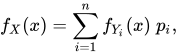
where each Yi is an exponentially distributed random variable with rate parameter λi, and pi is the probability that X will take on the form of the exponential distribution with rate λi.[1] It is named the hyperexponential distribution since its coefficient of variation is greater than that of the exponential distribution, whose coefficient of variation is 1, and the hypoexponential distribution, which has a coefficient of variation smaller than one. While the exponential distribution is the continuous analogue of the geometric distribution, the hyperexponential distribution is not analogous to the hypergeometric distribution. The hyperexponential distribution is an example of a mixture density.

An example of a hyperexponential random variable can be seen in the context of telephony, where, if someone has a modem and a phone, their phone line usage could be modeled as a hyperexponential distribution where there is probability p of them talking on the phone with rate λ1 and probability q of them using their internet connection with rate λ2.

Properties

[edit]

Since the expected value of a sum is the sum of the expected values, the expected value of a hyperexponential random variable can be shown as

and

from which we can derive the variance:[2]

The standard deviation exceeds the mean in general (except for the degenerate case of all the λs being equal), so the coefficient of variation is greater than 1.

The moment-generating function is given by

Fitting

[edit]

A given probability distribution, including a heavy-tailed distribution, can be approximated by a hyperexponential distribution by fitting recursively to different time scales using Prony's method.[3]

See also

[edit]

References

[edit]
Revisions and contributorsEdit on WikipediaRead on Wikipedia
from Grokipedia
The hyperexponential distribution, also known as the H_k distribution, is a continuous on the non-negative real line that models a as a of k independent exponential distributions, where each component is selected with probability p_i (summing to 1) and has rate parameter μ_i. Its is given by
f(t)=i=1kpiμieμit,t>0,f(t) = \sum_{i=1}^k p_i \mu_i e^{-\mu_i t}, \quad t > 0,
and the by
F(t)=1i=1kpieμit,t0.F(t) = 1 - \sum_{i=1}^k p_i e^{-\mu_i t}, \quad t \geq 0. This structure allows it to approximate distributions with high variability, as its squared satisfies c21c^2 \geq 1, contrasting with the exponential distribution's c2=1c^2 = 1.
Key moments include the E[X]=i=1kpi/μiE[X] = \sum_{i=1}^k p_i / \mu_i and variance Var(X)=i=1kpi/μi2(i=1kpi/μi)2\mathrm{Var}(X) = \sum_{i=1}^k p_i / \mu_i^2 - \left( \sum_{i=1}^k p_i / \mu_i \right)^2, which can be matched to empirical data using just the first two moments for fitting purposes, particularly for the two-phase case (H_2) where parameters are solved to balance across phases. The distribution is a special case of phase-type distributions, specifically an acyclic phase-type with parallel phases, and it exhibits a decreasing , with a monotonically decreasing hazard function. In applications, the hyperexponential distribution is widely used in to model service times or interarrival processes with heavy tails and high variability, such as in M/H_k/1 queues where explicit solutions for measures like waiting times are available. It also appears in , software modeling, and call center analysis for customer patience times, providing robust fits to empirical traces when exponential assumptions fail due to . For instance, in storage systems and network simulations, H_2 fits outperform other long-tail models like log-normal in capturing response time distributions.

Definition

Probability Density Function

The hyperexponential distribution is defined as a finite , or , of kk independent exponential distributions, where a XX is selected to follow the ii-th with probability pi>0p_i > 0 for i=1,,ki = 1, \dots, k, and i=1kpi=1\sum_{i=1}^k p_i = 1. This structure captures heterogeneity in processes by weighting multiple exponential components, each characterized by its own rate λi>0\lambda_i > 0. The of the hyperexponential distribution is given by f(x)=i=1kpiλieλix,x0,f(x) = \sum_{i=1}^k p_i \lambda_i e^{-\lambda_i x}, \quad x \geq 0, and f(x)=0f(x) = 0 otherwise. The support of the distribution is the non-negative real line, reflecting the nature of the underlying exponential components. This distribution arises in the context of phase-type distributions as the absorption time in a with kk parallel phases, where the process begins in phase ii with probability pip_i and is absorbed upon exiting that single phase at rate λi\lambda_i, without transitioning between phases. A practical interpretation occurs in queueing models, where service times follow a hyperexponential distribution due to different types, such as voice calls (with one exponential rate) versus data sessions (with another), each selected probabilistically based on arrival proportions.

Cumulative Distribution Function

The cumulative distribution function of the hyperexponential distribution is given by F(x)={1i=1kpieλixx0,0x<0,F(x) = \begin{cases} 1 - \sum_{i=1}^k p_i e^{-\lambda_i x} & x \geq 0, \\ 0 & x < 0, \end{cases} where pi>0p_i > 0 are the mixture weights with i=1kpi=1\sum_{i=1}^k p_i = 1 and λi>0\lambda_i > 0 are the rate parameters of the underlying exponential components. This form arises from integrating the probability density function over the interval [0,x][0, x]. Specifically, F(x)=0xf(t)dt=i=1kpi0xλieλitdt=i=1kpi(1eλix)F(x) = \int_0^x f(t) \, dt = \sum_{i=1}^k p_i \int_0^x \lambda_i e^{-\lambda_i t} \, dt = \sum_{i=1}^k p_i \left(1 - e^{-\lambda_i x}\right) for x0x \geq 0, which simplifies to the expression above since i=1kpi=1\sum_{i=1}^k p_i = 1. The is the derivative of F(x)F(x). The , defined as S(x)=1F(x)S(x) = 1 - F(x), takes the form S(x)=i=1kpieλix,x0,S(x) = \sum_{i=1}^k p_i e^{-\lambda_i x}, \quad x \geq 0, which directly provides the probability that a exceeds xx and is particularly useful for evaluating tail probabilities in applications such as and reliability analysis. The hyperexponential distribution is absolutely continuous with respect to , possessing a density that is positive on (0,)(0, \infty) and an unbounded support on [0,)[0, \infty).

Characteristic Functions

Characteristic Function

The characteristic function of a random variable XX with a hyperexponential distribution is ϕ(t)=E[eitX]\phi(t) = \mathbb{E}[e^{itX}] for real tt, given by ϕ(t)=i=1kpiμiμiit.\phi(t) = \sum_{i=1}^k \frac{p_i \mu_i}{\mu_i - i t}. This follows from the mixture structure, as the characteristic function of an with rate μi\mu_i is μi/(μiit)\mu_i / (\mu_i - i t), and the overall function is the weighted sum. Unlike the , it is defined for all real tt since the poles are off the real axis. The characteristic function encodes all moments via derivatives at t=0t=0 and is useful for proving limit theorems and central limit results for sums of hyperexponential variables. It relates to the via ϕ(t)=M(it)\phi(t) = M(it), where MM is the MGF.

Moment-Generating Function

The moment-generating function (MGF) of a random variable XX with a hyperexponential distribution provides a compact representation that encodes all moments of the distribution and is particularly useful for analyzing sums of independent hyperexponential random variables. For a hyperexponential distribution defined as a mixture of kk exponential distributions with rates μ1,,μk>0\mu_1, \dots, \mu_k > 0 and mixing probabilities p1,,pk>0p_1, \dots, p_k > 0 satisfying i=1kpi=1\sum_{i=1}^k p_i = 1, the MGF is given by M(t)=i=1kpiμiμit,M(t) = \sum_{i=1}^k \frac{p_i \mu_i}{\mu_i - t}, valid for t<mini{μi}t < \min_i \{\mu_i\}. This formula arises directly from the definition of the MGF and the probability density function (PDF) of the hyperexponential distribution, f(x)=i=1kpiμieμixf(x) = \sum_{i=1}^k p_i \mu_i e^{-\mu_i x} for x0x \geq 0. Substituting into the MGF integral yields M(t)=0etxf(x)dx=i=1kpi0μie(μit)xdx.M(t) = \int_0^\infty e^{tx} f(x) \, dx = \sum_{i=1}^k p_i \int_0^\infty \mu_i e^{-(\mu_i - t)x} \, dx. The inner integral is the MGF of an exponential random variable with rate μi\mu_i, which evaluates to μi/(μit)\mu_i / (\mu_i - t) for t<μit < \mu_i, leading to the overall expression upon summation. The domain of convergence for the MGF is t<mini{μi}t < \min_i \{\mu_i\}, as the integral diverges beyond the smallest rate parameter, ensuring the expectation exists. Within this interval, the MGF is analytic, meaning it is infinitely differentiable and can be expanded in a Taylor series around t=0t = 0, with coefficients corresponding to the moments of XX. This analyticity guarantees the uniqueness of the hyperexponential distribution among all distributions on [0,)[0, \infty) sharing the same MGF, by the standard uniqueness theorem for moment-generating functions. The rational form of the MGF—a ratio of polynomials where the denominator is of degree kk and the numerator of degree at most k1k-1—uniquely characterizes hyperexponential mixtures relative to other infinite-support distributions, facilitating identification in applications like fitting empirical data to phase-type models.

Laplace Transform

The Laplace-Stieltjes transform (LST) of a hyperexponential random variable XX with parameters pi>0p_i > 0 (i=1kpi=1\sum_{i=1}^k p_i = 1) and distinct rates μi>0\mu_i > 0 (i=1,,ki = 1, \dots, k) is defined as f~(s)=E[esX]\tilde{f}(s) = \mathbb{E}[e^{-sX}] for Re(s)0\operatorname{Re}(s) \geq 0. This transform evaluates to f~(s)=i=1kpiμiμi+s,\tilde{f}(s) = \sum_{i=1}^k \frac{p_i \mu_i}{\mu_i + s}, which follows directly from the mixture structure, as the LST of an with rate μi\mu_i is μi/(μi+s)\mu_i / (\mu_i + s), and the overall transform is the corresponding weighted sum. The LST relates to the (MGF) M(t)=E[etX]M(t) = \mathbb{E}[e^{tX}] via f~(s)=M(s)\tilde{f}(s) = M(-s), where the domain restriction Re(s)0\operatorname{Re}(s) \geq 0 ensures convergence for nonnegative XX, mirroring the MGF derivation but emphasizing for stability analysis in systems. At s=0s = 0, f~(0)=1\tilde{f}(0) = 1, confirming normalization as a proper distribution transform, while the satisfies f~(0)=E[X]\tilde{f}'(0) = -\mathbb{E}[X], providing a direct link to the mean without full inversion. Inversion of the LST for hyperexponential distributions typically employs partial fraction decomposition, exploiting the rational form with distinct poles at s=μis = -\mu_i, to recover the mixture density f(x)=i=1kpiμieμixf(x) = \sum_{i=1}^k p_i \mu_i e^{-\mu_i x} for x>0x > 0. This method is particularly valuable in renewal theory, where the LST facilitates solving integral equations for quantities like the renewal function, whose transform is 1/(s(1f~(s)))1 / (s (1 - \tilde{f}(s))), enabling efficient computation of transient behaviors in phase-type renewal processes modeled by hyperexponential interarrival times.

Moments and Properties

Mean and Variance

The mean of a hyperexponential XX, which is a of kk independent exponential distributions with rates μi>0\mu_i > 0 and mixing probabilities pi>0p_i > 0 where i=1kpi=1\sum_{i=1}^k p_i = 1, is given by E[X]=i=1kpiμi.E[X] = \sum_{i=1}^k \frac{p_i}{\mu_i}. This formula arises from the , conditioning on the component: E[X]=i=1kpiE[Xcomponent i]=i=1kpi1μiE[X] = \sum_{i=1}^k p_i E[X \mid \text{component } i] = \sum_{i=1}^k p_i \cdot \frac{1}{\mu_i}, since each component follows an with 1/μi1/\mu_i. Alternatively, the mean can be derived from the (MGF) of the hyperexponential distribution, M(t)=i=1kpiμiμit,t<miniμi.M(t) = \sum_{i=1}^k \frac{p_i \mu_i}{\mu_i - t}, \quad t < \min_i \mu_i. Differentiating yields M(t)=i=1kpiμi(μit)2M'(t) = \sum_{i=1}^k \frac{p_i \mu_i}{(\mu_i - t)^2}, and evaluating at t=0t=0 gives M(0)=i=1kpiμiM'(0) = \sum_{i=1}^k \frac{p_i}{\mu_i}, confirming the mean. The variance is Var(X)=i=1k2piμi2(i=1kpiμi)2.\text{Var}(X) = \sum_{i=1}^k \frac{2 p_i}{\mu_i^2} - \left( \sum_{i=1}^k \frac{p_i}{\mu_i} \right)^2. This follows from the law of total variance: Var(X)=E[Var(Xcomponent i)]+Var(E[Xcomponent i])\text{Var}(X) = E[\text{Var}(X \mid \text{component } i)] + \text{Var}(E[X \mid \text{component } i]). The first term is E[Var(Xi)]=i=1kpi1μi2E[\text{Var}(X \mid i)] = \sum_{i=1}^k p_i \cdot \frac{1}{\mu_i^2}, and the second is Var(1/μi)=i=1kpi(1/μi)2(E[X])2=i=1kpiμi2(E[X])2\text{Var}(1/\mu_i) = \sum_{i=1}^k p_i (1/\mu_i)^2 - (E[X])^2 = \sum_{i=1}^k \frac{p_i}{\mu_i^2} - (E[X])^2, yielding the total. Equivalently, from the MGF, M(t)=i=1k2piμi(μit)3M''(t) = \sum_{i=1}^k \frac{2 p_i \mu_i}{(\mu_i - t)^3}, so E[X2]=M(0)=i=1k2piμi2E[X^2] = M''(0) = \sum_{i=1}^k \frac{2 p_i}{\mu_i^2}, and Var(X)=E[X2](E[X])2\text{Var}(X) = E[X^2] - (E[X])^2. The coefficient of variation, defined as CV=Var(X)/E[X]CV = \sqrt{\text{Var}(X)} / E[X]
Add your contribution
Related Hubs
User Avatar
No comments yet.