


Community hub
Recent from talks
Contribute something
Nothing was collected or created yet.
Personal defense weapon
View on Wikipedia
Personal defense weapons (PDWs) are compact magazine-fed automatic firearms, typically performing as a submachine gun designed for secondary defensive use rather than as a primary service weapon. Some PDWs fire a small-caliber (generally less than 8 mm or 0.31 in in bullet diameter), high-velocity centerfire bottleneck cartridge resembling a scaled-down intermediate cartridge, essentially making them an "in-between" hybrid between a submachine gun and a conventional carbine assault rifle.
The name describes the weapon's original conceptual role: as a compact but powerful small arm that can be conveniently carried for personal defense, usually by support personnel behind the front line such as military engineers, logistic drivers, medical specialists, artillery crews, or signallers. These "second-line" personnel are not strictly combat troops expected to directly engage the enemy, but may still be at risk of encountering decently equipped (and often well-armored) hostile skirmishers and infiltrators, therefore having to defend themselves in close quarters. Such encounters were thought to warrant an effective weapon that would have sufficient range for engagements that exceed handgun capabilities, but without the unnecessary bulk of a full-sized service rifle causing a burden during their normal duties. However, the concept has generally proven unsuccessful for this application, with carbines still being widely preferred for these roles.
History
[edit]
In the late 19th and early 20th centuries, shortened versions of the infantry rifle were issued as "carbines" for cavalry troops and gun crews. This designation was dropped as infantry rifle designs became shortened overall, such as in the Short Magazine Lee–Enfield rifle. Thereafter, handguns were typically issued as self-defense weapons. However, they were not effective in most close combat situations.[citation needed] As a result, during the First World War, the Mauser C96 and artillery versions of the Luger pistol were issued with attachable shoulder stock holsters, which allowed for greater control and accuracy.

During World War I, the United States secretly developed the Pedersen device attachment for the M1903 Springfield rifle that allowed it to fire the .30-18 Auto (7.65×20mm Longue) pistol cartridge in semi-automatic mode.[1][2] This attachment was developed to allow an infantryman to convert "his rifle to a form of submachine gun or automatic rifle" in approximately 15 seconds.[2][1]
Production of the device and modified M1903 rifles started in 1918.[2] However, the war ended before they were sent to Europe.[1][2] The contract was cancelled on March 1, 1919, after production of 65,000 devices, 1.6 million magazines, 65 million cartridges and 101,775 modified Springfield rifles.[1][2][3] The Pedersen device was declared surplus in 1931.[3] To prevent them from falling into the hands of the lawless, nearly all of the stored devices were destroyed by the Army except for a few examples kept by Ordnance Department.[4][3]

In 1918, Ribeyrolles, Sutter and Chauchat designed the Chauchat-Ribeyrolles 1918 submachine gun. This weapon was meant to be used for close-range protection for the French tank crews. The weapon is based on the RSC Mle. 1917 semi-automatic rifle mechanism. The first trials used a Mannlicher–Berthier clip holding eight cartridges. The trials continued until 1919 with a weapon using the same magazine as the Chauchat. The results were satisfactory but the weapon was too powerful for the intended self-protection use. A mix of standard and tracer bullets was planned to be used to assist in aiming.

In 1938, the U.S. Army Ordnance Department received a request for a light rifle to be issued to mortarmen, radiomen, drivers, clerks, cooks, and similar grades.[5] During field exercises, these troops found that the M1 Garand rifle was too heavy and too cumbersome for general issue.[citation needed] And, while handguns are undeniably convenient, they had limited range, accuracy and power.[citation needed] This request was refused by authorities.[5]
In 1940, after Germany's use of glider-borne and paratroop forces to infiltrate and attack strategic points behind the front lines,[6][7] the request for a light rifle was resubmitted and subsequently approved.[5] U.S. Army Ordnance issued a requirement for a "light rifle" with greater range, firepower, and accuracy than the M1911 pistol while weighing half as much as the M1 Garand.[8] As a result, the U.S. developed the semi-automatic M1 Carbine and shortly thereafter the select-fire M2 Carbine.

In 1969, AO-46 was an unsolicited design by Peter Andreevich Tkachev working at TsNIITochMash. Although not accepted for service, this design, in combination with report of the US use of the XM-177 in Vietnam led the GRAU to start the competition known as Project Modern, which led to the adoption of AKS-74U for service.[9][10]

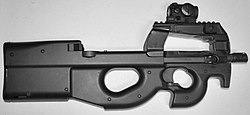
Introduced in 1991, the FN P90 features a bullpup design with a futuristic appearance. It has a 50-round magazine housed horizontally above the barrel, an integrated reflex sight and fully ambidextrous controls.[11] A simple blow-back automatic weapon, it was designed to fire the FN 5.7×28mm cartridge which can penetrate soft body armor.[12][13] The P90 was designed to have a length no greater than a man's shoulder width, to allow it to be easily carried and maneuvered in tight spaces, such as the inside of an armored vehicle.[11]
Introduced in 2001, the Heckler & Koch MP7 is a direct rival to the FN P90. Featuring a more conventional-looking design, the MP7 uses a short-stroke piston gas system as used on H&K's G36 and HK416 assault rifles, in place of a blowback system traditionally seen on submachine guns.[14] The MP7 is able to use 20-, 30- and 40-round magazines and fires 4.6×30mm ammunition which can penetrate soft body armor. Due to the heavy use of polymers in its construction, the MP7 is much lighter than older SMG designs, weighing only 1.9 kg (4.19 lb) with an empty 20-round magazine.
Applications
[edit]
The PDW concept has not been widely successful, partly because existing PDWs are not significantly cheaper to manufacture than carbines or full-size military rifles. Most PDWs also use a proprietary cartridge, such as the 5.7×28mm cartridge for the FN P90 or the 4.6×30mm for the H&K MP7, neither of which were originally compatible with any existing pistols or rifles/carbines. Although both manufacturers planned handguns that used the same proprietary rounds, only FN went forward with production of the Five-SeveN pistol, which was the only handgun option available for the 5.7×28mm cartridge for over two decades until the introduction of Ruger-57 in 2019. In turn, this made the PDW cartridges expensive to consumers due to the lack of mass production.[15]
Though personal defense weapons have not been very popular for their intended application, they have been acquired by various military special forces units and law enforcement groups, as an upgrade for their older submachine guns[citation needed]. The FN P90 and Five-seven pistol are used by military and police forces in over 40 countries, including Canada, Cyprus, France, Greece, India, Peru, Poland, Spain, and the United States.[16] The Heckler & Koch MP7 is also used in a number of countries, including Austria, France, Germany, Ireland, Norway, Malaysia, and the United Kingdom.[17][18]
PDW cartridges
[edit]Traditional personal defense weapons
[edit]| Name | Cartridge | Country | Serial production |
|---|---|---|---|
| Brügger & Thomet APC9 RWS ACTION SE Gen. II SXF variant | 9×19mm, regular loads and armor piercing RWS ACTION SE Gen. II SXF loads | Switzerland | |
| Brügger & Thomet MP9 | 6.5×25mm CBJ, 9×19mm | Switzerland | yes |
| Colt SCAMP | .22 SCAMP | United States | no |
| ČZW-438 | 4.38×30mm Libra | Czech Republic | no |
| FN P90 | 5.7×28mm | Belgium | yes |
| Heckler & Koch MP7 | 4.6×30mm | Germany | yes |
| Saab Bofors Dynamics CBJ-MS | 6.5×25mm CBJ | Sweden | no |
| SR-2 Veresk | 9×21mm Gyurza | Russia | yes |
| ST Kinetics CPW | 4.6×30mm, 5.7×28mm, 9×19mm[22] | Singapore | yes |
| Tuma MTE 224 VA | .224 Voboril | Switzerland | no |
| VBR-Belgium PDW[15] | 7.92×24mm | Belgium |
Other
[edit]| Name | Cartridge | Country | Serial production | Note |
|---|---|---|---|---|
| AAC Honey Badger | .300 AAC Blackout (7.62×35mm) | United States | yes | |
| AKS-74U | 5.45×39mm | Soviet Union | yes | |
| AO-46 | 5.45×39mm | Soviet Union | no | |
| AR-57 | 5.7×28mm | United States | yes | M16 lower receiver with a redesigned upper receiver fed by FN P90 magazines |
| Barrett REC7 PDW | 6.8mm Remington SPC (6.8×43mm) | United States | ||
| Floro PDW | 5.56×45mm | Philippines | ||
| FN SCAR PDW | 5.56×45mm | Belgium | yes | |
| GA Personal Defense Weapon | 7.62×37mm Musang | Philippines | ||
| GAU-5A Aircrew Self Defense Weapon | 5.56×45mm | United States | yes | Takedown gun |
| Globserver PDW[23] | 9×19mm Parabellum | Hungary | yes | |
| Heckler & Koch MP5K-PDW | 9×19mm Parabellum | Germany | yes | |
| Knight's Armament Company PDW | 6×35mm KAC,.300 Blackout | United States | yes | |
| Magpul PDR | 5.56×45mm | United States | no | |
| SAI SMG Tiger Cub[24] | 9×19mm Parabellum | Denmark | yes | |
| SIG MCX Rattler | 5.56×45mm, .300 Blackout | United States | yes |
See also
[edit]References
[edit]- ^ a b c d https://www.guns.com/news/2013/06/22/perishings-super-weapon-the-pedersen-device/ "The Pedersen Device: The World War I superweapon that (almost) won the war". 6/22/13. by Chris Eger
- ^ a b c d e Military Small Arms of the 20th Century. 7th Edition. by Ian V. Hogg & John S. Weeks. Krause Publications. 2000. pages 284 & 285
- ^ a b c Julian S. Hatcher, Hatcher's Notebook, Military Service Publishing Co., 1947, Ch. 15 The Pedersen Device, pp. 361-372.
- ^ Canfield, Bruce N. (2003). "Never in Anger: the Pedersen Device". American Rifleman. 151 (June). National Rifle Association of America: 58–61&71.
- ^ a b c Military Small Arms of the 20th Century. 7th Edition. by Ian V. Hogg & John S. Weeks. Krause Publications. 2000. pages 289-290
- ^ George, John, Shots Fired In Anger, NRA Press (1981), p. 394
- ^ Weeks, John, World War II Small Arms, London: Orbis Publishing Ltd. and New York: Galahad Books, ISBN 0-88365-403-2, ISBN 978-0-88365-403-3 (1979), p. 130
- ^ Larry Ruth, M1 Carbine: Design, Development & Production, (The Gun Room Press, 1979, ISBN 0-88227-020-6) contains many Ordnance documents related to the "Light Rifle" specification that led to the M1 carbine
- ^ Monetchikov, Sergei (2005). История русского автомата [The History of Russian Assault Rifle] (in Russian). St. Petersburg: Military Historical Museum of Artillery, Engineers and Signal Corps. p. 165. ISBN 5-98655-006-4.
- ^ "Солдат удачи" номер 9 (72) 2000 Д.Ширяев "Кто изобрел автомат Калашникова?"
- ^ a b Kevin, Dockery (2007). Future Weapons. New York: Berkley Trade. ISBN 9780425217504.
- ^ Miller, David (2001). The Illustrated Directory of 20th Century Guns. London: Salamander Books Ltd. ISBN 9781840652451.
- ^ Oliver, David (2007). "In the Line of Fire". Global Defence Review. Archived from the original on October 16, 2006. Retrieved October 19, 2009.
- ^ Cutshaw, Charles Q. (2003). "Heckler & Koch's cutting-edge compacts G36C and MP7 PDW: when less really is more". Guns Magazine.
- ^ a b "New VBR-B Multi-Caliber (9mm NATO/7.92×24mm) Compact PDW Pistol: Most Intelligently-Developed Personal Defense Weapon Yet?". 2009-11-28. Archived from the original on 2009-11-28. Retrieved 2023-08-22.
- ^ Francotte, Auguste; Claude, Gaier; Robert, Karlshausen, eds. (January 2008). Ars Mechanica – The Ultimate FN Book. Vottem: Herstal Group. ISBN 978-2-87415-877-3.
- ^ "BMI" (PDF). www.bmi.gv.at. Retrieved 23 March 2018.
- ^ Gourley, S.; Kemp, I (November 26, 2003). "The Duellists". Jane's Defence Weekly (ISSN 0265-3818), Volume 40 Issue 21, pp 26–28.
- ^ "Cal. 7.92×24 FMJ-OGI-71-P". 2010-11-23. Archived from the original on 2010-11-23. Retrieved 2023-06-19.
- ^ "7.92 Ammo selector". 2010-12-17. Archived from the original on 2010-12-17. Retrieved 2023-06-19.
- ^ "Cal. 7.92×24 AE-FMJ-RN". 2011-09-22. Archived from the original on 2011-09-22. Retrieved 2023-06-19.
- ^ "STKinetics CPW submachine gun – Compact Personal Weapon". Singapore. 27 October 2010. Retrieved 22 May 2015.
- ^ "Hungarian Globserver's Pistol-to-SMG Conversion Machine Pistol Chassis". 27 February 2025.
- ^ "SAI SMG-Tiger Cub". 19 July 2025.


Personal defense weapon
View on GrokipediaDefinition and Characteristics
Definition
A personal defense weapon (PDW) is a compact, selective-fire firearm designed for close-quarters self-defense, primarily intended for non-frontline military personnel such as vehicle crews, artillery operators, and support staff who require a lightweight option for personal protection without compromising mobility.[4] These weapons feature high-capacity magazines, typically holding 20 to 50 rounds, and use specialized intermediate cartridges engineered to penetrate soft body armor at short ranges, addressing vulnerabilities in traditional sidearms during modern conflicts.[7] In contemporary military doctrine, PDWs function as a supplementary armament alongside standard-issue rifles, pistols, and machine guns, providing rear-echelon troops with enhanced defensive capability in confined or vehicular environments.[3] PDWs are distinguished from assault rifles by their smaller size and reduced effective range, as assault rifles are full-sized, high-velocity platforms optimized for sustained fire and engagements beyond 300 meters.[6] Unlike submachine guns, which rely on pistol-caliber ammunition lacking significant armor-piercing performance, PDWs employ proprietary high-velocity rounds that balance controllability, penetration, and low recoil for rapid, accurate fire in defensive scenarios.[7] Typical specifications for PDWs include an overall length under 60 cm (often achieved with folding stocks for concealment), a weight of 2 to 3 kg when unloaded, and an effective range of 50 to 200 meters, making them suitable for urban or interior operations without the encumbrance of larger service weapons.[8] The concept originated in the early 1990s from NATO initiatives to equip support personnel against increasingly armored threats.[4]Key Design Features
Personal defense weapons (PDWs) prioritize compactness as a core design principle, frequently utilizing bullpup layouts—where the action and magazine are positioned behind the trigger—or folding stocks to achieve overall lengths under 24 inches while maintaining barrel lengths of 8 to 12 inches for optimal muzzle velocity.[4] This configuration enables effective handling in vehicle interiors, urban environments, or close-quarters scenarios without sacrificing ballistic performance.[6] To support extended engagement, PDWs incorporate high-capacity magazines, commonly ranging from 20 to 50 rounds, often integrated directly into the pistol grip or bullpup stock for streamlined ergonomics and reduced profile.[3] Construction emphasizes lightweight polymer frames and components, typically resulting in unloaded weights of approximately 4 to 6 pounds (1.8 to 2.7 kg), which enhances portability and reduces user fatigue while providing inherent corrosion resistance for adverse conditions.[9][10] Fire control systems in PDWs include selective modes such as semi-automatic and full-automatic, with cyclic rates of fire standardized around 800 to 900 rounds per minute to deliver controllable bursts for suppressive fire.[11] Modular rail interfaces, such as MIL-STD-1913 Picatinny systems, are standard for mounting optics, aiming lasers, and suppressors, facilitating adaptability for low-light targeting and noise reduction in tactical operations.[6] These weapons are optimized for specialized cartridges offering enhanced penetration against body armor, distinguishing them from conventional submachine guns.[4]Historical Development
Origins and Early Concepts
The origins of personal defense weapons trace back to World War II, when military forces sought compact firearms for vehicle crews, pilots, and rear-echelon troops who needed lightweight options for self-defense in confined spaces or during emergencies, without the encumbrance of full-sized rifles. In the U.S. Army, the M1 Carbine, adopted in 1941, addressed this by providing support personnel with a semi-automatic weapon chambered in .30 Carbine, offering greater range and power than pistols while maintaining portability for tank crews and noncombat roles.[6] Similarly, submachine guns like the German MP40, chambered in 9mm Parabellum, were widely issued to paratroopers and vehicle operators for their compact design and high-volume close-range fire, influencing postwar concepts for defensive arms.[12] During the Cold War, these needs evolved with the proliferation of pistol-caliber submachine guns, such as the Israeli Uzi and German MP5, which became staples for rear-area security and special operations due to their controllability and ease of use in urban or vehicular environments.[1] However, by the 1980s, NATO militaries identified limitations in these 9mm weapons, particularly their inability to penetrate emerging Soviet body armor like the 6B2 vest, which could stop standard pistol rounds and posed risks to support troops in potential high-intensity conflicts.[3] This vulnerability spurred requirements for a new category of compact, armor-defeating firearms tailored for non-infantry personnel. Early experiments with enhanced pistol-caliber designs, such as the Italian Beretta 93R machine pistol introduced in the late 1970s, demonstrated selective-fire capabilities in a handgun format but underscored deficiencies in effective range and ballistic penetration against protected adversaries.[13] In response, late-1980s studies by U.S. and European forces, including analyses at the U.S. Army Infantry Center, formalized the "personal defense weapon" concept as a bridge between submachine guns and carbines, emphasizing concealability, controllability, and lethality for rear-echelon defense.[1] These foundational ideas laid the groundwork for subsequent cartridge innovations in the 1990s.Modern Evolution (1990s–Present)
In the 1990s, the personal defense weapon transitioned from conceptual designs to practical implementations, driven by NATO's solicitation for a new compact firearm and specialized ammunition to equip non-frontline troops against armored threats. FN Herstal led this effort, developing the 5.7×28mm cartridge in collaboration with NATO partners to achieve high muzzle velocity exceeding 2,300 feet per second while minimizing recoil and weight. This initiative resulted in the debut of the FN P90 in 1990, a bullpup-configured submachine gun with a 50-round top-mounted magazine, marking the first mass-produced PDW optimized for personal protection in close-quarters scenarios.[14][15] Parallel to FN's project, Heckler & Koch pursued an independent response to the same NATO requirements, creating the 4.6×30mm cartridge for superior penetration against body armor at short ranges. The resulting MP7 personal defense weapon entered full production in 2001, featuring a polymer frame, ambidextrous controls, and a high cyclic rate of up to 950 rounds per minute, which facilitated its adoption by elite units worldwide. By the 2000s, PDWs like the P90 saw procurement by special operations and protective services, including integration into U.S. federal agency arsenals for high-threat environments.[16] NATO ultimately abandoned the PDW standardization program in the early 2000s due to ongoing debates over cartridge efficacy and challenges integrating with existing 5.56mm systems.[4] The 2010s and 2020s witnessed broader global proliferation, particularly among non-Western militaries seeking affordable, concealable options. China followed with the QCW-05 in the mid-2000s, a suppressed bullpup design chambered in 5.8×21mm DCV05, produced by the PLA's 208 Research Institute to support covert operations and vehicle crews. India's Defence Research and Development Organisation advanced the Modern Sub Machine Carbine (MSMC) project in the 2010s, selecting the 5.56×30mm-chambered design by the early decade to replace outdated submachine guns, with final army trials completed in 2020.[17][18] Recent advancements post-2020 have emphasized enhanced versatility through multi-caliber platforms and smart technologies, such as quick-change barrels for switching between pistol and intermediate cartridges, alongside electronic sighting systems for improved target acquisition. PDWs have integrated with modular rifle ecosystems, enabling seamless accessory mounting like suppressors and optics on systems akin to the AR-15 platform, as seen in compact rifle-caliber variants. This evolution supports asymmetric warfare. Concurrently, the civilian market for PDW-inspired firearms has expanded in the 2020s, fueled by rising demand for lightweight defensive arms amid global small arms sales growth at a CAGR of 3.7% from 2024 to 2034.[19][20]Ammunition
PDW-Specific Cartridges
Personal defense weapon-specific cartridges were developed primarily in the late 1980s and 1990s to address the limitations of standard 9×19mm Parabellum ammunition against emerging body armor, emphasizing high velocity and armor-penetrating designs from compact platforms. These rounds emerged from NATO's solicitation for a new personal defense weapon (PDW) caliber to equip non-frontline personnel, with trials conducted in the late 1990s and culminating in 2003, though no single cartridge was adopted due to political and standardization issues among member nations. However, both cartridges were later standardized by NATO—the 5.7×28mm via STANAG 4509 in 2021 and the 4.6×30mm via STANAG 4820—facilitating limited adoption.[21][4][22][23] The 5.7×28mm cartridge, introduced by FN Herstal in 1990, features a bottle-necked, rebated-rim brass case measuring 28.9 mm in length, designed to achieve high muzzle velocities of approximately 715 m/s from PDW platforms while maintaining low recoil and high magazine capacity. It incorporates a 31-grain projectile with a steel penetrator core for defeating NIJ Level IIIA soft body armor at typical engagement ranges. Manufacturing emphasizes lightweight construction, with the cartridge's small caliber allowing for steel-tipped penetrators that balance penetration and reduced weight, enabling effective performance from short barrels under 300 mm.[24][25][26] Heckler & Koch developed the 4.6×30mm cartridge in the early 1990s as a direct competitor in NATO's PDW program, utilizing a bottlenecked case with a 4.65 mm diameter bullet optimized for velocities around 725 m/s and penetration of soft armor up to 50 meters. The round employs a 31-grain projectile with a hardened steel core, providing barrier-defeating capability while weighing less than standard pistol cartridges to support high-capacity magazines in compact weapons. Production details include the use of lightweight brass cases and steel penetrators to maximize velocity from short barrels, ensuring reliability in PDW applications without excessive recoil.[27][16][22] Other specialized calibers include the Swedish 6.5×25mm CBJ, developed by CBJ Tech AB in the late 1990s during the NATO trials era, which uses a case dimensionally similar to 9×19mm but fires a 6.5 mm projectile with steel penetrator for rifle-like penetration against body armor. In Russian and Chinese PDWs, enhanced 9×19mm +P variants such as the 7N21 armor-piercing load feature lightweight bullets with steel cores, achieving higher velocities around 450 m/s to improve soft armor defeat while leveraging existing manufacturing infrastructure. These cartridges generally prioritize steel penetrators encased in lightweight materials to enable high muzzle energies from submachine gun-length barrels, reflecting a common design philosophy for PDW ammunition.[28][29][3]Ballistic and Penetration Characteristics
Personal defense weapon (PDW) ammunition is engineered to penetrate soft body armor while maintaining controlled terminal performance in close-quarters engagements. A key penetration standard for PDW rounds is the NATO CRISAT target, consisting of 1.6 mm titanium backed by 20 layers of Kevlar, which simulates lightweight protective vests common among vehicle crews and support personnel. PDW cartridges like the 5.7×28mm and 4.6×30mm are designed to defeat this target at ranges up to 200 meters, ensuring effectiveness against armored threats in defensive scenarios without the bulk of full rifle ammunition.[30][3] In terminal ballistics, PDW projectiles achieve wounding through high muzzle velocities—typically exceeding 600 m/s—that induce yawing and tumbling upon impact with soft tissue, creating larger temporary and permanent wound cavities compared to traditional pistol rounds. This instability, driven by the lightweight, high-speed design, promotes rapid energy transfer and reduces overpenetration relative to intermediate rifle cartridges like the 5.56×45mm, minimizing risks in confined spaces. For instance, the 5.7×28mm SS190 round tumbles after 8–9 inches of penetration in ballistic gelatin, deviating from its path to enhance tissue disruption while limiting exit wounds.[31][32][33] Compared to the 9×19mm Parabellum, PDW ammunition offers superior armor defeat but trades some immediate stopping power for flatter trajectories and higher capacity in submachine gun platforms. The 5.7×28mm, for example, penetrates Level IIIA soft armor—equivalent to about 48 layers of Kevlar—while standard 9mm FMJ rounds are stopped by far fewer layers, though 9mm hollow points provide better expansion in unarmored targets. Versus the 5.56×45mm NATO, PDW rounds exhibit shorter effective ranges (under 200 meters) but excel in close-quarters battle (CQB) due to lighter recoil and superior maneuverability in tight environments like vehicles or buildings.[34][35][4] Under NATO testing protocols, the 5.7×28mm SS190 penetrates 48 layers of Kevlar at 100 meters when fired from a PDW like the FN P90, far surpassing the 9mm's capabilities against similar soft barriers. However, PDW rounds have notable limitations against hard armor, failing to defeat NIJ Level IV ceramic plates designed to stop .30-caliber armor-piercing rifle ammunition, as their lightweight construction prioritizes soft-target penetration over rigid barrier defeat.[36][37][31] Post-2010 advancements in PDW ammunition include polymer-tipped designs for civilian applications, enhancing ballistic coefficients for improved accuracy and stability at extended ranges. These developments address earlier criticisms of trajectory drop-off beyond 50 meters while focusing on expansion for unarmored targets in non-military loads.[37]Design and Technology
Operating Mechanisms
Personal defense weapons (PDWs) commonly utilize blowback or gas-operated systems to balance compactness with reliable cycling under high-pressure ammunition. Straight blowback mechanisms, as seen in the FN P90, rely on the recoil of the fired cartridge case to drive the bolt rearward against spring tension, with the bolt mass providing inherent delay to contain chamber pressure. This closed-bolt design fires only when a round is fully chambered, enhancing accuracy and control in automatic fire. Alternatively, gas-operated short-stroke piston systems, employed in the Heckler & Koch MP7, tap propellant gases to drive a piston that unlocks a rotating bolt head, allowing secure operation with potent cartridges while minimizing bolt velocity for reduced felt recoil.[10] Straight blowback offers key advantages in simplicity, with fewer moving parts than locked systems, promoting reliability and ease of field stripping in constrained environments. The design's low recoil impulse, achieved through optimized bolt weight, supports rapid follow-up shots without excessive muzzle rise, ideal for close-range engagements. These attributes make blowback suitable for PDWs, where mechanical complexity must be minimized to maintain performance in dynamic scenarios. Safety features integral to PDW mechanisms include drop-safety designs that block firing pin movement to prevent inadvertent discharges during falls or holstered carry. Closed-bolt operation in blowback variants further mitigates risks by avoiding an out-of-battery condition until triggered. Ambidextrous selector switches and decockers ensure intuitive handling across user profiles, contributing to overall operational security. Many PDWs incorporate threaded barrels for seamless suppressor attachment, optimizing noise reduction in tactical settings. Suppressors reduce mechanical noise from standard supersonic ammunition but do not eliminate the sonic crack. Operating PDWs face challenges in heat dissipation during high cyclic rates, as short barrels concentrate thermal buildup, risking ammunition cook-off or component warping after extended bursts. The selection of blowback versus gas systems is influenced by PDW cartridge pressures, often exceeding 50,000 psi, which demand delayed or locked actions to safely manage unlocking timing.[38]Ergonomics and Accessories
Personal defense weapons (PDWs) prioritize ergonomic designs that facilitate rapid handling in confined spaces, often incorporating ambidextrous controls and intuitive grip configurations to accommodate diverse users. For instance, the FN P90 features a bullpup layout with a thumbhole polymer stock that integrates the pistol grip, promoting a natural shooting stance while maintaining compactness for one-handed or braced firing.[39] Similarly, the HK MP7 employs a handgun-style pistol grip on the underside of the receiver, paired with an integrated foldable vertical foregrip, enabling stable two-handed control without increasing overall length.[40] These elements address human factors by reducing hand strain and improving accuracy under stress, as poor grip fit can lead to control loss in high-pressure scenarios.[41] Adjustable stocks further enhance usability, allowing users to customize length for vehicle operations or urban environments where space is limited. The MP7's telescoping stock extends or retracts to suit body armor or varying user sizes, minimizing fatigue during prolonged carry.[40] Vertical foregrips, such as those on the P90's optional under-barrel mounts, provide additional leverage for one-handed aiming, particularly beneficial for support personnel.[42] Human factors engineering emphasizes reduced weight—typically under 3 kg unloaded for PDWs—to support extended missions without compromising mobility, as lighter systems lower the physical burden on operators.[41] A low bore axis is a critical design feature in many PDWs, positioning the barrel close to the shooter's hand to mitigate muzzle rise and enhance follow-up shot speed. This configuration, evident in the MP7's inline design, reduces torque during recoil, allowing for flatter trajectories and better control with subsonic ammunition.[40] Sighting systems on PDWs focus on quick target acquisition, often integrating reflex or red dot optics directly onto the receiver. The P90 includes factory-mounted options for compact red dots, while Picatinny (MIL-STD-1913) rails enable attachment of holographic sights for both eyes-open shooting.[39][44] These rails, standard across PDW platforms, support modular additions like weapon lights, lasers, and thermal optics, enhancing low-light performance without altering the weapon's profile.[45] Holster and sling compatibility ensures seamless integration into personal loadouts, with PDWs designed for cross-body or single-point slings to facilitate vehicle egress or close-quarters retention. The P90's integrated sling mounts pair with quick-adjust slings for urban carry, while compact holsters or chest rigs accommodate the MP7's form factor.[42][46] This modularity aligns with MIL-STD-1913 standards, allowing lights and lasers to mount forward for illumination in defensive postures.[44]Applications
Military and Support Roles
Personal defense weapons (PDWs) are primarily issued to non-frontline military personnel, including tank crews, aircraft pilots, medics, and artillery operators, who benefit from their compact size and light weight as alternatives to full-sized rifles that would impede vehicle operation or medical duties.[47][48] Doctrinal adoption of PDWs began gaining traction in the 2000s through U.S. Special Operations Command (SOCOM) trials, which evaluated compact firearms for close-quarters needs among special forces support elements, leading to later procurements like the Sig Sauer MCX Rattler in 2022 for enhanced maneuverability in confined spaces.[49][50] The Ministry of Defence acquired substantial numbers of the Heckler & Koch MP7 for vehicle crews and protective details.[3][4] In combat scenarios during the Iraq and Afghanistan wars of the 2000s, PDWs supported VIP protection missions by special operations units, providing defensive firepower in urban and convoy environments where larger rifles were impractical.[51] More recently, in the Ukraine conflict, PDWs such as the MP7 have been observed in urban fighting roles among support troops as of 2025, leveraging their portability for rapid engagement in built-up areas.[52][53] PDWs excel in close-quarters battle (CQB) due to their superior maneuverability within vehicles, aircraft, or tight enclosures, enabling quick transitions from primary tasks to self-defense without encumbering movement or egress.[54][55] Despite these strengths, PDWs are not designed as primary infantry weapons and function mainly as supplements to standard-issue rifles, constrained by reduced effective range beyond 200 meters and limited penetration against modern body armor compared to assault rifles.[6][4] In 2023–2025, the Lithuanian Armed Forces acquired MP7 A2 submachine guns for tactical roles.[56]Law Enforcement and Civilian Contexts
In law enforcement contexts, personal defense weapons (PDWs) are valued for their compact size and ability to penetrate soft body armor, making them suitable for close-quarters operations by special units. The French Gendarmerie's Groupe d'Intervention de la Gendarmerie Nationale (GIGN), an elite counterterrorism and hostage rescue unit, has adopted the Heckler & Koch MP7 PDW for such missions, appreciating its lightweight design and 4.6×30mm cartridge that offers superior penetration compared to standard 9mm submachine guns.[57] Similarly, in the United States, SWAT teams and tactical units in over 200 agencies employ the FN P90 PDW for entry operations, where its bullpup configuration allows for maneuverability in confined spaces without sacrificing firepower.[15] For VIP protection and security details, PDWs provide discreet yet effective armament for bodyguards and protective services. The U.S. Secret Service has integrated the FN P90 into its arsenal since the early 2000s, selecting it for its ergonomic top-mounted magazine that enables low-profile carry under clothing and rapid deployment during threat responses.[15] This adoption reflects a broader trend among federal protective services, where the P90's 5.7×28mm round balances concealability with the ability to defeat Level IIIA body armor at close range.[4] Civilian availability of PDWs has been shaped by regulatory frameworks, with semi-automatic variants emerging as viable options for personal defense. Following the expiration of the 1994 Federal Assault Weapons Ban in 2004, which temporarily restricted certain semi-automatic rifles with military-style features but did not target PDW designs like the FN PS90, manufacturers expanded civilian-legal models.[58] The PS90, a semi-automatic version of the P90 with a 16-inch barrel to comply with federal rifle definitions, became widely available for purchase through licensed dealers, appealing to users seeking a compact home defense option that bridges the gap between pistols and rifles.[59] Legal considerations for PDWs in the U.S. hinge on Bureau of Alcohol, Tobacco, Firearms and Explosives (ATF) classifications and import rules. Full-automatic PDWs are regulated as machine guns under the National Firearms Act of 1934, requiring a $200 transfer tax, background check, and registration; however, new machine guns manufactured after May 19, 1986, cannot be registered for civilian ownership due to the Firearm Owners' Protection Act.[60] Semi-automatic variants are typically classified as rifles or pistols depending on barrel length and stock configuration, avoiding NFA restrictions unless modified. Importation of full-automatic models requires ATF Form 6 approval, but such permits are generally limited to government or licensed manufacturers, effectively barring direct civilian imports of post-1986 full-auto PDWs.[61] In the 2020s, civilian interest in PDW-style firearms has surged, driven by heightened demand for home defense tools amid rising personal safety concerns and market growth in self-defense products. Adaptations like the B&T APC9 semi-automatic pistol, a 9mm platform with modular accessories for brace or stock attachment, have gained popularity for their reliability and low recoil, positioning them as modern alternatives to traditional carbines in urban environments. Recent recommendations as of 2026 highlight additional popular PDW-style platforms and pistol-caliber carbines (PCCs) suited for personal and home defense, including the CZ Scorpion EVO series, valued for its low recoil, high capacity, and ease of use; the SIG Sauer MPX and MPX K, praised for smooth operation and accessory integration; the Springfield Armory Kuna, featuring roller-delayed blowback for reduced recoil and compact design ideal for home or vehicle defense; and others such as the Maxim Defense PDX in 300 Blackout, optimized for short barrels and suppression. These platforms appeal in urban and close-quarters scenarios due to their maneuverability, modularity, and effectiveness, with preferences varying by caliber—9mm for affordability and minimal recoil versus 300 Blackout for superior barrier penetration—and local laws. This trend aligns with broader increases in the self-defense market, projected to grow at a 5.7% compound annual rate through 2034, fueled by civilian firearm ownership expansions.[62][63][64][65]Notable Examples
Traditional PDWs
The FN P90, introduced in 1990, represents one of the earliest and most influential personal defense weapons, featuring a bullpup configuration that houses the action behind the trigger for a compact overall length of approximately 50 cm while maintaining a 26.4 cm barrel.[39] Chambered in the PDW-specific 5.7×28mm cartridge, it employs a closed-bolt blowback operating system and includes a distinctive 50-round translucent polymer magazine mounted horizontally atop the receiver to minimize the weapon's height and enhance its low-profile silhouette during concealed carry or vehicle operations.[39] The design incorporates bottom ejection through a port behind the pistol grip, promoting ambidextrous use by directing spent casings downward away from the shooter's face.[39] Weighing 2.8 kg when loaded, the P90 prioritizes portability for support personnel while delivering high-capacity fire in close-quarters scenarios.[66] The P90's innovative horizontal magazine feeds rounds parallel to the bore axis via a rotating disk mechanism, reducing snag hazards and allowing the integrated reflex sight to remain unobstructed for rapid target acquisition.[67] This configuration, combined with the bullpup layout, enables effective maneuverability in confined spaces without sacrificing magazine capacity or ballistic performance. The weapon has been adopted by military forces in over 30 countries, including special operations units in Belgium, Canada, France, and Greece, reflecting its role in defining PDW standards for non-frontline troops.[15] Developed by Heckler & Koch and entering service in 2001, the HK MP7 builds on PDW concepts with a lightweight polymer frame that reduces weight to under 2 kg empty, emphasizing concealability and ease of handling comparable to a large pistol. Chambered in the 4.6×30mm cartridge, it uses an indirect gas-operated short-stroke piston with a rotating bolt for reliable cycling and accuracy, feeding from detachable box magazines of 20-, 30-, or 40-round capacities integrated into the pistol grip for a streamlined profile. Fully ambidextrous controls, including a folding stock and interchangeable charging handle, enhance usability across operators, while the 18 cm barrel supports effective ranges up to 200 meters against soft targets.[68] The MP7's polymer construction and modular rail system for optics and accessories underscore its focus on modern ergonomics within the traditional PDW framework, allowing adaptation for suppressed or suppressed fire without excessive bulk. It has seen adoption by elite units such as Germany's GSG 9 counterterrorism group and various U.S. agencies, including the Secret Service and Naval Special Warfare Development Group (SEAL Team 6), where its armor-penetrating capabilities prove valuable in high-threat environments.[69]Contemporary and Variant Designs
The B&T MP9, introduced in the early 2000s by the Swiss firm Brügger & Thomet, represents a compact 9×19mm Parabellum weapon serving similar roles to PDWs, optimized for law enforcement and special operations. Weighing approximately 1.4 kg unloaded, it features a closed-bolt blowback operation for improved accuracy and is designed for rapid deployment in close-quarters scenarios. The MP9's threaded barrel allows for quick attachment of suppressors, such as the proprietary Print-X TP9/MP9 Ti model, enhancing its suitability for discreet tactical use.[70][71][72] In Russia, the PP-2000 submachine gun, developed by the KBP Instrument Design Bureau in 2004, serves as a lightweight 9×19mm option for elite units like Spetsnaz. This polymer-framed weapon, with a folding stock that reduces its length to 340 mm, emphasizes concealability and controllability during urban operations, firing at a rate of 700 rounds per minute. It feeds from proprietary 20- or 44-round double-stack magazines.[73][74][75] China's CS/LS06, entering service in the 2010s through Chongqing Changfeng, exemplifies Asian advancements in suppressed submachine guns chambered in 9×19mm Parabellum, serving PDW-like roles. Featuring a distinctive 50-round helical magazine and a layout with rear-feed mechanism, it integrates a detachable suppressor directly into the design for reduced signature in paramilitary and law enforcement roles. Early prototypes were chambered in 5.8×21mm. The weapon's polymer construction and optional Picatinny rail for optics underscore its focus on modernized close-protection duties.[76][77][78] Modular designs have proliferated in the 2010s, enabling caliber conversions and customization for diverse users. The Sig Sauer MPX, launched around 2013, employs a short-stroke gas piston system in 9×19mm as standard, but supports quick changes to .40 S&W or .357 SIG via barrel and bolt swaps, with interchangeable handguards for accessory mounting. This adaptability makes it ideal for both military and civilian configurations similar to PDWs. Similarly, AR-15 PDW uppers—such as 7.5-inch barrels in 5.56×45mm or .300 AAC Blackout—allow existing lower receivers to be transformed into compact, suppressed defense platforms, often with folding braces for enhanced portability.[79][80][81] Post-2020 developments, particularly amid the Ukraine conflict, have driven adaptations of compact weapons for frontline needs through rapid prototyping and integration of rails for night vision and suppressors, reflecting broader trends in low-signature armaments.[82][83] As of February 2026, following SHOT Show 2026 reviews and announcements, several compact platforms and PDW-style rifles have been highlighted for close-quarters personal defense, particularly in home defense, vehicle defense, and law enforcement contexts. These modern examples expand on modular and pistol-caliber trends, though they generally do not feature the armor-piercing cartridges central to traditional PDW definitions. Notable recommendations include the Springfield Armory Saint Edge PDW and EVAC PDW in 5.56×45mm or .300 AAC Blackout, praised for maneuverability, low over-penetration risks, and home defense suitability; the CZ Scorpion EVO series in 9×19mm, valued as a reliable "goldilocks" choice with low recoil, high capacity, and ease of use; the Maxim Defense PDX in .300 AAC Blackout, compact and optimized for short barrels with strong suppression potential; Daniel Defense .300 AAC Blackout PDW configurations for consistent performance and excellent ballistics from 0-100 yards; the SIG Sauer MPX and MPX K in 9×19mm, premium options with smooth operation and extensive accessory support; and the Springfield Armory Kuna utilizing roller-delayed blowback for reduced recoil in a compact design ideal for home or vehicle defense. Other notable mentions include the PSA JAKL in .300 AAC Blackout, B&T APC9, and Flux Raider configurations. Recommendations vary by use case (such as discreet carry versus home defense), caliber preference (9mm for affordability and low recoil versus .300 AAC Blackout for better barrier penetration), and local laws.[84][64][85]References
- https://www.[researchgate](/page/ResearchGate).net/publication/254091033_Human_Factors_Issues_in_Firearms_Design_and_Training