


Community hub
Recent from talks
Contribute something
Nothing was collected or created yet.
International airport
View on Wikipedia

An international airport is an airport with customs and border control facilities, enabling passengers to travel between countries around the world. International airports are usually larger than domestic airports, and feature longer runways and have facilities to accommodate heavier aircraft such as the Boeing 747 and the Airbus A380 commonly used for international and intercontinental travel. International airports often host domestic flights, which helps feed both passengers and cargo into international ones (and vice versa).

Buildings, operations, and management have become increasingly sophisticated since the mid-20th century, when international airports began to provide infrastructure for international civilian flights. Detailed technical standards have been developed to ensure safety and common coding systems implemented to provide global consistency. The physical structures that serve millions of individual passengers and flights are among the most complex and interconnected in the world. By the second decade of the 21st century, over 1,200 international[citation needed] airports existed with around 3.8 billion[1] international passengers as of January 2023 along with 50 million[citation needed] metric tonnes of cargo passing through them annually.
History
[edit]
In August 1919, Hounslow Heath Aerodrome, in London, England, was the first airport to operate scheduled international commercial services. It was closed and supplanted by Croydon Airport in March 1920.[2][3] In the United States, Douglas Municipal Airport in Arizona became the first international airport of the Americas in 1928.[4]
The precursors to international airports were airfields or aerodromes. In the early days of international flights, infrastructure was limited, "although if engine problems arose there were plenty of places where aircraft could land".[5] Since four-engined land planes were unavailable for over-water operations to international destinations, flying boats became part of the solution. At the far end of the longest international route (which became the Kangaroo Route), on-water landing areas were found in places such as Surabaya and in the open sea off Kupang. In Sydney, Rose Bay, New South Wales, was chosen as the flying-boat landing area.[5]
International airports sometimes serve military as well as commercial purposes and their viability is also affected by technological developments. Canton Island Airport, for example, in the Phoenix Islands (Kiribati), after serving as a military airport during World War II, was used as a refuelling stop by commercial aircraft such as Qantas which stationed ground crew there in the late 1950s.[6] The advent in the early 1960s of jet aircraft such as the Boeing 707 with the range to fly non-stop between Australia or New Zealand and Hawaii, meant that a mid-Pacific stop was no longer needed and the airport was closed to regular commercial use. Other international airports, such as Kai Tak Airport in Hong Kong, have been decommissioned and replaced when they reached capacity or technological advances rendered them inadequate.[7][8]
Design and construction
[edit].jpg)
The construction and operation of an international airport depends on a complicated set of decisions that are affected by technology, politics, economics and geography as well as both local and international law.[9][10][11][12] Designing an airport even for domestic traffic or as "non-hub" has, from the beginning, required extensive co-ordination between users and interested parties – architects, engineers, managers and staff all need to be involved.[13][14] Airports may also be regarded as emblematic of national pride and so the design may be architecturally ambitious. An example was the planned New Mexico City international airport, intended to replace an airport that has reached capacity.[15]
Airports can be towered or non-towered, depending on air traffic density and available funds. Because of high capacity and busy airspace, many international airports have air traffic control located on site.
Some international airports require construction of additional infrastructure outside of the airport, such as at the Hong Kong International Airport, which included the construction of a high-speed railway and automobile expressway to connect the airport to the urban areas of Hong Kong. Construction of the expressway included the construction of two bridges (the Tsing Ma suspension bridge and Kap Shui Mun cable bridge) and the Ma Wan viaduct on Ma Wan island to connect the bridges. Each bridge carries rail and automobile traffic.[16]
Operations and management
[edit]
International airports have commercial relationships with and provide services to airlines and passengers from around the world. Many also serve as hubs, or places where non-direct flights may land and passengers may switch planes, while others serve primarily direct point-to-point flights. This affects airport design factors, including the number and placement of terminals as well as the flow of passengers and baggage between different areas of the airport. An airport specializing in point-to-point transit can have international and domestic terminals, each in their separate building equipped with separate baggage handling facilities. In a hub airport, however, spaces and services are shared.[17]
Airport management have to take into account a wide range of factors, among which are the performance of airlines, the technical requirements of aircraft, airport-airline relationships, services for travelling customers, security and environmental impacts.[18]
Standards
[edit]Technical standards for safety and operating procedures at international airports are set by international agreements. The International Air Transport Association (IATA), formed in 1945, is the association of the airline companies. The International Civil Aviation Organization (ICAO) is a body of the United Nations succeeding earlier international committees going back to 1903. These two organizations served to create regulations over airports which the airports themselves had no authority to debate. This eventually sparked an entire subject of air travel politics. In January 1948, 19 representatives from various US commercial airports met for the first time in New York City to seek resolution to common problems they each faced, which initiated the formation of the Airport Operators Council, which later became Airports Council International – North America (ACI-NA). This group included representatives from Baltimore, Boston, Chicago, Cleveland, Dallas, Denver, Detroit, Jacksonville, Kansas City, Los Angeles, Memphis, Miami, Minneapolis-Saint Paul, New York, Philadelphia, Pittsburgh, St. Louis, San Francisco and Washington.[19]
Flight logistics
[edit]International airports have extensive operations in managing flight logistics, such as air traffic control. The latter service is provided by ground-based controllers who coordinate and direct aircraft on the ground and through controlled airspace. Air traffic control also provides advisory services to aircraft in non-controlled airspace.[20]
Customs and immigration
[edit]
.jpg)
Airports with international flights have customs and immigration facilities, which allow right of entry. These change over time but are generally designated by law.[21] However, as some countries have agreements that allow connecting flights without customs and immigrations, such facilities do not define an international airport.
Security and safety
[edit]
The current trend of enhancing security at the cost of passenger and baggage handling efficiency at international airports is expected to continue in the future.[22][23] This places financial burden on airports, risks the flow of servicing processes, and has implications for the privacy of passengers.[17] International flights often require a higher level of physical security than domestic airports do, although in recent years, many countries have adopted the same level of security for both.
Most international airports feature a "sterile lounge", an area after security checkpoints within which passengers are free to move without further security checks. This area can have services such as duty-free shops that sell goods that have been selected and screened with safety in mind, so that purchasing and bringing them on board flights poses no security risks. In addition to employees, only processed passengers with a valid ticket are allowed inside the sterile lounge. Admittance into the sterile area is done in centralized security checkpoints in contrast to e.g. individual checkpoints at each gate. This allows for more efficient processing of passengers with fewer staff, as well as makes it possible to detect both delays and security threats well ahead of boarding.[24]
To ensure the viability of airport operations, new and innovative security systems are being developed. For instance, the old security checkpoints can be replaced by a "total security area" encompassing an entire airport, coupled with automatic surveillance of passengers from the moment they enter the airport until they embark on a plane.[17]
Passengers connecting to domestic flights from an international flight generally must take their checked luggage through customs and re-check their luggage at the domestic airline counter, requiring extra time in the process. In some cases in Europe, luggage can be transferred to the final destination even if it is a domestic connection.
In some cases, travelers and the aircraft can clear customs and immigration at the departure airport. An example of this would be that some airports in Canada and Ireland, along with several other countries, have United States border preclearance facilities. This allows flights from those airports to fly into US airports that do not have customs and immigration facilities. Luggage from such flights can also be transferred to a final destination in the U.S. through the airport of entry.
A crucial safety aspect of international airports is medical facilities and practices. In particular, controlling transmissible disease, such as SARS, is deemed important at international airports.[25] While these standards are regulated by ICAO Standards And Recommended Practices (SARPs) and WHO's International Health Regulations (IHR), local authorities have considerable say in how they are implemented.[26]
Transportation
[edit]Among the most important airport services are further transportation connections, including rail networks, taxi and shuttle services at curbside pick-up areas, and public buses.[27] Large areas for automobile parking, often in co-located multi-storey car parks, are also typical to find at airports. Some airports provide shuttle services to parking garages for passengers and airport employees.[27] Due to the very large scale of international airports, some have constructed shuttle services to transport passengers between terminals.[28] Such systems operate for example, in Singapore Changi Airport and Zurich Airport.
At some U.S. international airports, such as O'Hare International Airport in Chicago, some seating and waiting areas are located away from the terminal building, with passengers being shuttled to terminals.[27] These areas may be referred to as ground transportation centers or intermodal centers.[27] Amenities at ground transportation centers typically include restrooms and seating, and may also provide ticket counters, food and beverage sales and retail goods such as magazines.[27] Some ground transportation centers have heating and air conditioning and covered boarding areas[27] (to protect passengers from the elements).
-
 An internal motorized moving footway to transport passengers within Adolfo Suárez Madrid–Barajas Airport, Spain
 -
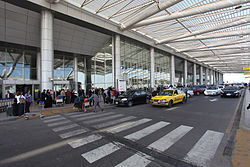 Curbside passenger pick up area at Terminal 3 Cairo International Airport, Egypt
 -
 Rail service at Terminal 2 of Charles de Gaulle Airport in France


Services and amenities
[edit]Standard amenities include public restrooms, passenger waiting areas and retail stores for dining and shopping,[28] including duty-free shops. Dining establishments may be consolidated in food courts. Some international airports may offer retail sales of luxury goods at duty-free stores. Wi-Fi service and access, offices for bureau de change (currency exchange) and tourism advice are common, although the availability of service varies across airports. Some international airports provide secure areas for stranded passengers to rest and sleep. The more usual service is hotels that are available on the premises.
-
 Duty-free shops at Ben Gurion International Airport in Tel Aviv, Israel (2012)
 -
![For passengers stranded overnight, secure area at O'Hare International Airport with dimmed lights, cots, pillows, blankets, and toiletries (2008)[29]](//upload.wikimedia.org/wikipedia/commons/thumb/7/7e/Cots_for_stranded_passengers_-_O%27Hare_International_Airport.jpg/250px-Cots_for_stranded_passengers_-_O%27Hare_International_Airport.jpg) For passengers stranded overnight, secure area at O'Hare International Airport with dimmed lights, cots, pillows, blankets, and toiletries (2008)[29]
For passengers stranded overnight, secure area at O'Hare International Airport with dimmed lights, cots, pillows, blankets, and toiletries (2008)[29] -
 The food court in the restricted area of Terminal 1 at Hong Kong International Airport (2013)

![For passengers stranded overnight, secure area at O'Hare International Airport with dimmed lights, cots, pillows, blankets, and toiletries (2008)[29]](https://en.wikipedia.org/wiki/File:Cots_for_stranded_passengers_-_O%27Hare_International_Airport.jpg)
.jpg)
Customer satisfaction awards
[edit]The World Airport Awards are voted by consumers in an independent global customer satisfaction survey. Singapore Changi Airport was the first-place winner in 2020.[30] Other winners include Incheon International Airport (South Korea) and Amsterdam Airport Schiphol (The Netherlands).[31]
Airport names
[edit]

.jpg)
Toponymy is one of the most common sources for the naming of airports. A number of areas close to them have lent their names, including villages, estates, city districts, historical areas and regions, islands and even a waterfall. Sometimes the toponym is combined with or renamed to incorporate another name from another source such as from one of the following:
- Athletes such as George Best Belfast City Airport in Belfast, Northern Ireland.
- Aviators such as pilots (civil and military) and others who played a role in the development of aviation- like Jorge Chavez International Airport in Lima, Peru, named after Peruvian-French pilot Jorge Chavez, Sydney Kingsford Smith Airport, named after Australian aviator Charles Kingsford Smith, or Sabiha Gökçen International Airport named after Turkish Female Pilot Sabiha Gökçen
- Cultural leaders (poets, artists, writers, musicians) - like the John Lennon Airport in the English city of Liverpool, where John Lennon and The Beatles came from, Rafael Hernandez Airport in Aguadilla, Puerto Rico, named for Puerto Rican singer and actor Rafael Hernandez, and Louis Armstrong New Orleans International Airport in New Orleans, Louisiana, named for jazz artist Louis Armstrong.
- Ethnic groups, such as Minangkabau International Airport in Padang, Indonesia, named after the local Minangkabau people.
- Ideals in combination with toponyms, such as Newark Liberty International Airport.
- Mythology and religion, such as heroes of epics and myths, church hierarchs and saints and similar names. A notable example of this is El Dorado International Airport.
- Politicians and statesmen such as the O. R. Tambo International Airport in Johannesburg, South Africa which was named after O.R. Tambo who was a South African anti-apartheid politician and Ninoy Aquino International Airport in Manila, Philippines to honour the former Senator of the Philippines, Benigno Aquino Jr. who was assassinated at the exact airport in 1983. Some airports have been named after dictators during their dictatorship; such is the case of the Robert Mugabe International Airport in Harare, Zimbabwe, named after Robert Mugabe, and, in the past Saddam International Airport in Baghdad, Iraq, so named after Saddam Hussein. Some airports were formerly International, for example Atatürk International Airport, named from founding father of the Republic of Türkiye's Mustafa Kemal Atatürk. More notable examples are two of the three New York City airports: LaGuardia Airport (named after Mayor Fiorello LaGuardia) and John F. Kennedy International Airport (named after the 35th President of the United States). In addition, the world’s busiest airport, Hartsfield-Jackson Atlanta International Airport, was named after two former mayors: William B. Hartsfield and Maynard Jackson.
- Public figures (advocates, engineers, doctors, teachers, journalists or sportspeople), such as John Wayne Airport, named after an actor.
- Royalty (kings, queens) such as King Shaka International Airport in Durban, South Africa which was named after King Shaka who was one of the most influential monarchs of the Zulu Kingdom.
- Scientists such as Galileo Galilei Airport in Pisa which was named after Galileo Galilei.
A study found that 44 percent of the world's international airports are named by toponyms: named for politicians (thirty percent), aviators (seven percent), mythology and religion (three percent), public figures (two percent), people of science (two percent) and other (one percent).[32]
Airports also use an IATA-3 letter code for identification. Some airports are nicknamed after these codes, such as JFK, BWI, DFW, LAX, YYZ, FCO, and CDG.
An "international airport" can be named as such by providing customs and border control facilities to enable international flights, regardless of whether international flights currently operate to or from the airport. For example, a U.S. Customs and Border Protection facility has been in place at Bozeman Yellowstone International Airport since July 1, 2012, but no scheduled international flights have been inaugurated to or from Bozeman since.
Notable airports
[edit]By historical event
[edit]- 1919 (August) Hounslow Heath Aerodrome begins operating scheduled international commercial services from England to France.
- 1933 Douglas International Airport in Arizona is honored by Eleanor Roosevelt as "the first international airport of the Americas", having reached this capacity in 1928.[4]
By passenger numbers
[edit]- As of 2018[update], Hartsfield–Jackson Atlanta International Airport had the greatest number of travelers of all international airports with 107 million passengers, more than Beijing Capital International with 100 million passengers.[33]
- Los Angeles International Airport is considered to have the greatest number of passengers who start or end their travel there as opposed to continuing on to a connecting flight. Overall, LAX is considered to be the 7th busiest airport in the world.[34]
- Dubai International Airport is the busiest airport in the world by international passenger traffic, with 83,105,798 international passengers. Dubai is the third busiest airport worldwide.
Other
[edit]- Svalbard Airport in Svalbard, Norway is the northernmost airport to which tourists can book tickets. It is primarily used for transporting miners to and from a cluster of islands with a heavy mining industry.[35]
- King Fahd International Airport in Dammam, Saudi Arabia is the largest airport in the world, encompassing over 300 square miles (780 km2).[36]
- The world's longest active scheduled passenger flight by great-circle distance operates between Changi Airport (in Singapore) and John F. Kennedy International Airport (in New York City, United States); the great-circle distance between the two airports is 15,349 kilometres (9,537 mi; 8,288 nmi).[37][38]
See also
[edit]

References
[edit]- ^ "The world's airports – the state of the industry in Jan-2023 in 11 numbers". CAPA - Centre for Aviation. Retrieved 11 January 2024.
- ^ Bluffield, Robert (2009). Imperial Airways: the birth of the British airline industry 1914–1940. Hersham [England]: Ian Allan. ISBN 978-1-906537-07-4.
- ^ Learmonth, Bob; Cluett, Douglas; Nash, Joanna (1977), A history of Croydon Airport, Sutton Libraries and Arts Services
- ^ a b Blaskey, Larry (6 June 2008). "Eleanor Roosevelt's trip to Douglas remembered". Douglas Dispatch. Archived from the original on 14 October 2019. Retrieved 6 October 2014.
- ^ a b Stackhouse, John (1995). --from the dawn of aviation : The Qantas Story, 1920-1995. Double Bay, NSW: Focus Pub. pp. 57, 66–71. ISBN 1-875359-23-0.
- ^ Walker, Howell. "Air Age Brings Life to Canton Island". The National Geographic Magazine: January 1955, pp. 117-132.
- ^ Hafer, JR. "Kai Tak Airport Hong Kong". 20th Century Aviation Magazine. Archived from the original on 23 July 2014. Retrieved 20 October 2014.
- ^ Farewell speech for Kai Tak (6 July 1998)
- ^ Feldman, Elliot J. and Jerome Milch (1982). Technology versus democracy: the comparative politics of international airports. Boston, Massachusetts: Auburn House Pub. Co. ISBN 0-86569-063-4.
- ^ Regulatory implications of the allocation of flight departure and arrival slots at international airports. Montreal, Canada: International Civil Aviation Organization. 2001.
- ^ Salter, Mark B. (2008). Politics at the airport ([Online-Ausg.] ed.). Minneapolis: University of Minnesota Press. ISBN 978-0-8166-5014-9.
- ^ Williams, Alan, 1934-, Developing strategies for the modern international airport : East Asia and beyond / by Alan Williams, Ashgate Pub. Co
{{citation}}: CS1 maint: multiple names: authors list (link) CS1 maint: numeric names: authors list (link) - ^ "Planning and design of airport terminal building facilities at nonhub locations". United States Federal Aviation Administration. 1980. Retrieved 30 September 2014.
- ^ "Quality control of construction for airport grant projects". U.S. Dept. of Transportation, Federal Aviation Administration. 2007. Retrieved 1 October 2014.
- ^ Luhnow, David (2 September 2014). "Mexico Plans New $9.2 Billion Airport". The Wall Street Journal. Retrieved 6 December 2014.
- ^ Telford, Thomas (1 November 1998). "transport links". Hong Kong International Airport (Technical report). Vol. Supplement of Volume 126 (Special Issue 2 ed.). Journals Leon Heward-Mills for Institution of Civil Engineers.
- ^ a b c Janić, Milan (February 2010). Airport Analysis, Planning and Design: Demand, Capacity, and Congestion. New York: Nova Science Publishers. pp. 51–52, 248. ISBN 978-1-61761-560-3.
- ^ Graham, Anne (2003). Managing airports – an international perspective (2 ed.). Oxford, UK and Burlington, US: Butterworth-Heinemann. ISBN 0-7506-5917-3.
- ^ "History of Airports Council International-North America". Airports Council International – North America. Archived from the original on 7 December 2017. Retrieved 2 October 2014.
- ^ Reddy, Arun (3 March 2010). "The Science and Technology of Air Traffic Control". Ars Technica. Conde Nast. Retrieved 3 October 2014.
- ^ Bennett, David L. (1996). "Designated US International airports". U.S. Department of Transportation Federal Aviation Administration. Retrieved 1 October 2014.
- ^ St. John, Peter (1991). Air piracy, airport security, and international terrorism: winning the war against hijackers. New York: Quorum Books. ISBN 0-89930-413-3.
- ^ Moore, Kenneth C. (1991). Airport, aircraft, and airline security (2nd ed.). Boston: Butterworth-Heinemann. ISBN 0-7506-9019-4.
- ^ Rodney Wallis (2003). How Safe are Our Skies?: Assessing the Airlines' Response to Terrorism. Greenwood Publishing Group. pp. 90–91. ISBN 978-0-275-97847-1.
- ^ IHR implementation at ports, airports and groundcrossings – video. multimedia.who.int (Video). WHO. Archived from the original (WEBM) on 6 October 2014. Retrieved 1 October 2014.
- ^ "FAQ: What are the ICAO Standards and Recommended Practices ... at international airports?". ICAO. Retrieved 1 October 2014.
- ^ a b c d e f Strategies for Improving Public Transportation Access to Large Airports. Transportation Research Board. 2002. pp. 81–84. ISBN 0-309-06764-2.
- ^ a b Johnson, Josie J. International Air Flights. Clinton Gilkie.
- ^ "Traveler Services". Chicago Department of Aviation. Archived from the original on 3 June 2014. Retrieved 29 September 2014.
- ^ Karla Cripps. "The world's best airports for 2020, according to Skytrax". CNN. Retrieved 1 January 2021.
- ^ "World Airport Awards". Archived from the original on 21 September 2014. Retrieved 29 September 2014.
- ^ Peskov, Denis. "Naming of International Airports". Retrieved 2 October 2014.
{{cite journal}}: Cite journal requires|journal=(help) - ^ "Preliminary World Airport Rankings". Airports Council International. 13 March 2019. Archived from the original on 17 May 2020. Retrieved 23 May 2019.
- ^ "(LAX) Los Angeles International Airport Overview". Flight Stats. FlightStats, Inc. Archived from the original on 7 December 2017. Retrieved 2 October 2014.
- ^ Sweeney, Chris (17 February 2010). "The World's 18 Strangest Airports": Svalbard, Norway". Popular Mechanics.
- ^ Sweeney, Chris (17 February 2010). "The World's 18 Strangest Airports: Dammam, Saudi Arabia". Popular Mechanics.
- ^ Pallini, Thomas. "Inside the new world's longest flight: What it's like to fly on Singapore Airlines' new route between Singapore and New York". Business Insider. Archived from the original on 25 November 2021. Retrieved 1 January 2021.
- ^ "Great Circle Map Distance SIN-JFK". www.gcmap.com. Archived from the original on 8 October 2021. Retrieved 1 January 2021.
External links
[edit]
- Airport World – published by Airports Council International
- World Airport in the map - provided by chaoo13


International airport
View on GrokipediaAn international airport is any airport designated by an ICAO Contracting State in whose territory it is situated as an airport of entry and departure for international air traffic, where the formalities incident to immigration, customs, public health, animal and plant quarantine may be performed.[1] These facilities are essential gateways for global connectivity, accommodating scheduled commercial flights across borders and requiring specialized infrastructure including separate terminals, enhanced security screening, and border agency operations to process arriving and departing passengers and cargo.[2] International airports often feature duty-free retail, lounges, and multilingual services to support diverse travelers, while their scale enables handling of wide-body aircraft and high traffic volumes that drive economic exchange through tourism, business, and freight logistics.[3]
Definition and Classification
Criteria for International Status
An international airport is officially designated by national authorities to accommodate scheduled passenger and cargo flights crossing international borders, necessitating dedicated infrastructure for regulatory compliance. This designation typically follows an evaluation of operational capacity, including the presence of on-site customs offices to enforce import/export duties and inspections, immigration services to verify travel documents and visas, and border control measures to screen for security threats. In the United States, such airports are classified as ports of entry by U.S. Customs and Border Protection after assessing local demand and facility readiness, enabling legal clearance of international traffic without diversion.[4][5] Without these, an airport cannot process arriving or departing international flights routinely, as passengers and goods require formal entry protocols absent in domestic facilities. These airports must also maintain capabilities for health and quarantine procedures aligned with the World Health Organization's International Health Regulations (2005), which mandate designated points of entry equipped for routine surveillance, inspection of travelers for infectious diseases, and isolation measures during outbreaks. Cargo handling involves specialized zones for phytosanitary checks, biosecurity scans, and compliance with trade agreements like those under the World Trade Organization, distinguishing international operations from domestic ones limited to national logistics.[6][7] Such infrastructure supports global connectivity by allowing airlines to operate nonstop international routes, as certification assures compliance with bilateral air service agreements and facilitates passenger throughput without interline disruptions to secondary airports lacking border services. Domestic airports, by contrast, operate without integrated customs or immigration, restricting them to intra-country flights and requiring any rare international arrivals—such as general aviation—to reroute passengers to a designated international facility for processing. This operational divide ensures efficient border management while preventing unauthorized cross-border movement, with international status conferring economic advantages like duty-free retail eligibility and access to foreign airline slots.[4][5]ICAO and Regulatory Standards
The International Civil Aviation Organization (ICAO), a specialized agency of the United Nations, establishes Standards and Recommended Practices (SARPs) to promote uniform safety and operational standards across international aviation, including aerodrome certification and design requirements outlined in Annex 14.[8][9] These SARPs mandate specific criteria for airport infrastructure, such as runway specifications and obstacle limitation surfaces, while assigning four-letter location indicators to aerodromes worldwide for precise identification in air traffic management and flight planning.[10] Compliance with these standards ensures interoperability and risk mitigation, with empirical data from ICAO's annual safety reports linking high adherence levels to sustained reductions in global accident rates, such as the drop from 2.05 to 1.87 accidents per million departures between 2022 and 2023.[11] Airports serving international traffic in ICAO's 193 member states are required to obtain certification demonstrating conformity to SARPs, with states obligated to implement these provisions or file notifications of differences under Article 38 of the Chicago Convention when national regulations deviate due to practical constraints.[12][2] This mechanism allows for tailored adaptations—such as variations in rescue and fire-fighting services—while maintaining core safety thresholds, as evidenced by periodic audits that track implementation effectiveness rather than imposing uniform mandates irrespective of local conditions.[13] Non-compliance notifications are publicly registered, enabling data-driven oversight that has contributed to aviation's empirical safety record, with fatal accident rates remaining below historical averages through targeted SARPs enforcement.[14] Complementing ICAO's framework, the International Air Transport Association (IATA) develops operational guidelines, such as those in the Airport Handling Manual and ISAGO audits for ground services, which build on SARPs to enhance efficiency without regulatory authority.[15][16] These voluntary standards facilitate airline-specific compliance checks, correlating with lower incident rates in audited operations; for instance, IATA data shows integrated safety programs reducing all-accident rates to 0.80 per million sectors in 2023, underscoring the value of empirical audits over prescriptive overreach.[17]Historical Development
Pre-1940s Origins
![Flying boats at Rose Bay, an early seaplane base supporting international routes][float-right] The Wright brothers' powered flight on December 17, 1903, initiated aviation's growth, initially relying on improvised grass fields for operations due to aircraft's light weight and short takeoff requirements.[18] These rudimentary sites, often on farms or open land, accommodated early propeller planes' limitations, including low speeds under 100 mph and payloads of one or two persons, resulting in negligible traffic volumes that delayed infrastructure investment.[18] By 1909, operational airfields appeared, with Germany's 1910 commissioning of dedicated spaces for Zeppelin airships representing early purposeful development amid aviation's experimental phase.[19] Events like the January 10–20, 1910, Los Angeles International Air Meet at Dominguez Field advanced public interest and basic practices, featuring over 30 aircraft demonstrations that exposed operational challenges, including crashes from inadequate facilities, prompting informal safety considerations in subsequent U.S. exhibitions.[20] International efforts, such as the June 14–15, 1919, nonstop transatlantic flight by John Alcock and Arthur Whitten Brown from St. John's, Newfoundland—a converted meadow—to a bog near Clifden, Ireland, highlighted infrastructure's primitiveness, as formal airports were absent for such long-range attempts covering 1,890 miles in 16 hours.[21] Commercial international service began August 25, 1919, with Aircraft Transport and Travel's London-to-Paris route using converted bombers to carry one passenger, underscoring aviation's marginal viability and reliance on basic aerodromes.[22] Croydon Aerodrome in the UK, repurposed from World War I use and opening for civil flights in 1920, emerged as a pioneering hub; its 1928 purpose-built terminal and progressive paving of runways addressed heavier aircraft like the de Havilland DH.34, handling Europe's initial scheduled traffic of dozens of passengers weekly.[23] [24] Propeller aircraft's constraints—ranges below 500 miles and vulnerability to weather—kept development modest, with grass strips persisting until the late 1920s when wheel brakes and multi-engine designs necessitated hard surfaces; by 1930, select fields like Dearborn's Ford Airport featured concrete runways to support 5,000-foot takeoffs for emerging airliners.[25] This evolution reflected causal demands: empirical needs for reliability in mail and passenger carriage drove incremental hardening, though pre-1940 volumes remained low, averaging under 1,000 annual movements at major sites.[18]Post-WWII Expansion and Jet Age
The Convention on International Civil Aviation, signed on December 7, 1944, by 52 states in Chicago, established the International Civil Aviation Organization (ICAO) to standardize rules for airspace sovereignty, aircraft registration, safety, and international flight rights, facilitating post-war global aviation coordination.[26][27] Many wartime military airfields were repurposed for civilian use, while new facilities emerged to handle surging demand; for instance, New York International Airport (later Idlewild, now JFK) opened on July 1, 1948, on former marshland to serve transatlantic routes previously constrained by older fields like LaGuardia.[28] This expansion drew on surplus military infrastructure and engineering, enabling rapid conversion from propeller-era operations to accommodate economic recovery-driven travel in Europe and North America.[29] The advent of commercial jet aircraft in 1958 marked a pivotal shift, as the Boeing 707's inaugural transatlantic flight by Pan American World Airways on October 26 from New York Idlewild to Paris Le Bourget halved previous flight times to about 8 hours and 41 minutes, spurring demand through faster, more reliable service.[30] Jets' higher speeds and fuel efficiency, derived from wartime turbojet advancements like those in the German Messerschmitt Me 262, necessitated infrastructure overhauls: runways extended beyond 8,000 feet to support heavier takeoffs (versus 5,000-6,000 feet for propellers), and terminals redesigned for higher throughput, as seen in Idlewild's phased expansions starting in the late 1950s.[31] This military-to-civilian technology transfer causally linked to post-war booms, where falling real costs—driven by economies of scale in jet production—made air travel accessible beyond elites, correlating with GDP growth in industrialized nations.[32] Passenger traffic exploded amid these changes, with global revenue passenger miles rising from 17.4 billion in 1950 to 237.4 billion by 1970 at an average annual rate of 14%, reflecting compounded effects of jet economics and deregulatory precursors like the U.S. Federal Aviation Act of 1958, which formed the Federal Aviation Agency (later FAA) on August 23 to centralize air traffic control and reduce bureaucratic monopolies inherited from the pre-war Civil Aeronautics Board.[33][34] The Act addressed jet-era safety gaps exposed by mid-1950s accidents, enhancing efficiency through unified regulation that countered fragmented oversight, though critics noted persistent government interventions stifled competition until later reforms.[35] By the early 1970s, annual growth exceeded 10% in the jet age's core markets, tying airport expansions directly to causal drivers like technological diffusion and prosperity-fueled mobility rather than mere policy alone.[36]Late 20th Century to Present Globalization
The U.S. Airline Deregulation Act of 1978 dismantled federal controls on fares, routes, and entry, igniting competition that lowered costs and expanded international services from U.S. hubs, contributing to a surge in transatlantic and transpacific traffic. This policy shift, echoed in Europe's 1997 package liberalizing intra-EU skies, accelerated airline alliances and code-sharing, transforming international airports into interconnected nodes of a global network. By enabling hub-and-spoke operations—where carriers concentrate flights at key airports for efficient connections—deregulation amplified connectivity; for instance, Delta Air Lines consolidated at Atlanta's Hartsfield-Jackson, handling over 100 million passengers annually by the 2000s. Wide-body jets, starting with the Boeing 747's commercial debut on January 22, 1970, halved per-seat-mile costs for long-haul routes, facilitating mass tourism and business travel that swelled international airport throughput from 300 million passengers in 1970 to 2.2 billion by 2000. The 1990s saw low-cost carriers like Ryanair and easyJet pioneer no-frills trans-European flights, eroding state monopolies and boosting secondary international airports, with EU point-to-point traffic rising 150% between 1992 and 2002. These dynamics, rooted in falling fuel prices and trade pacts like NAFTA (1994), causally linked aviation liberalization to globalization, as evidenced by synchronized growth in air cargo—doubling to 30 million tons by 2000—supporting just-in-time supply chains. The September 11, 2001 attacks prompted universal security overhauls, including the Aviation and Transportation Security Act establishing TSA protocols extended internationally via ICAO standards, which imposed liquid restrictions and reinforced cockpit doors but initially cut traffic 30% before rebounding. The COVID-19 crisis slashed global passengers 60% in 2020 to 2.2 billion, yet Airports Council International reported a 37% rebound to 8.5 billion in 2023, surpassing 2019 levels in regions like Asia-Pacific by mid-2024 amid pent-up demand and eased visa regimes. Megahubs like Istanbul Airport, operational since October 29, 2018, with phased capacity to 200 million passengers yearly, underscore state-driven investments in gateway dominance, handling 76 million in 2023 via Turkish Airlines' expansive routes. Biometric implementations, trialed at hubs like London's Heathrow since 2018 and scaled post-2020 for touchless verification, have reduced processing times 30-50% at adopting facilities, per IATA benchmarks. As of 2025, AI-driven analytics for crowd forecasting and anomaly detection proliferate, with trials at Singapore Changi optimizing flows amid Boeing's forecast of a 48,000-aircraft fleet by 2042, necessitating airport expansions to sustain 16 billion annual passengers. These adaptations reflect causal pressures from demographic shifts and e-commerce, prioritizing throughput over legacy constraints.Infrastructure and Design
Airfield Components
Runways form the core of an airport airfield, providing paved surfaces for aircraft takeoff and landing, with designs governed by ICAO Annex 14 standards to ensure compatibility with intended aircraft types.[37] The ICAO Aerodrome Reference Code classifies runways by a numeric element based on reference field length—the balanced field length required for a piston-engined aeroplane at maximum takeoff mass under standard conditions of 1,500 m altitude, 25°C temperature, and sea level pressure: Code 1 for less than 800 m, Code 2 for 800–1,200 m, Code 3 for 1,200–1,800 m, and Code 4 for 1,800 m or more.[37] A parallel code letter (A–F) reflects aircraft wingspan and outer main gear wheel span; international airports handling wide-body jets typically feature Code 4E facilities (wingspan 52–65 m, gear span 9–14 m) or 4F (over 65 m wingspan, over 14 m gear span), with runway widths of 45 m for Code E/F and longitudinal slopes limited to 1% for safe operations.[37] Taxiways enable efficient ground movement of aircraft between runways and aprons, with ICAO specifying minimum widths of 23 m for Code 4 taxiways serving Code E/F aircraft and separation distances from runway centerlines of at least 107.5 m to prevent blast hazards and allow simultaneous operations. Aprons provide areas for aircraft parking, loading, and servicing, designed with stand lead-in lines, nose gear stops, and spacing based on aircraft codes—typically 120–150 m between stands for Code E jets—to optimize capacity while minimizing collision risks from wingtip clearances. Navigation aids and lighting systems support all-weather operations on international airfields. The Instrument Landing System (ILS) delivers precision guidance, categorized by ICAO as: Category I (decision height ≥60 m, runway visual range ≥550 m); Category II (DH ≥30 m, RVR ≥300 m); Category IIIA (DH <30 m or none, RVR <300 m but ≥200 m); Category IIIB (RVR <200 m but ≥50 m); and Category IIIC (no RVR limitation, no DH).[38] Runway lighting includes edge lights spaced 60 m apart for Code 3/4 runways, centerline lights every 15 m in the touchdown zone, and high-intensity approach lighting systems extending 900 m to enhance visibility in low conditions. Airfield designs incorporate safety features like runway end safety areas (RESA) of at least 90 m by strip width for Code 1–3 or 240 m for Code 4 to accommodate overruns or excursions, reducing accident severity as evidenced by probabilistic models showing RESA extensions lower overrun risk probabilities from historical data on veer-offs and undershoots.[39] Runway strips extend 60–150 m beyond edges depending on code, with clearways and stopways balancing takeoff performance against land use costs, while taxiway shoulders and blast pads mitigate erosion and foreign object debris, contributing to a reported decline in surface incidents through standardized separations that prevent incursions without excessive infrastructure expense.[40][39]Terminal and Facility Design
International airport terminals prioritize layouts that facilitate high-volume passenger flows, with common configurations including linear, pier, and satellite designs tailored to operational demands. Linear terminals arrange facilities in a straight line parallel to the runway, minimizing walking distances for low-to-medium traffic volumes but limiting gate expansion without extensive land use. Pier terminals extend from a central building like spokes, optimizing gate density for hub airports, while satellite terminals, connected via automated people movers, allow decentralized concourses to maximize apron space and reduce congestion in mega-hubs handling over 50 million passengers annually. These choices stem from empirical traffic projections, where satellite systems prove efficient for transfers in networks like those at Hartsfield-Jackson Atlanta, supporting up to 1,000 daily flights through segregated arrival and departure streams.[41][42] Facility design emphasizes capacity metrics derived from passenger throughput data, such as peak-hour processing rates and gate utilization ratios, often targeting 300,000 to 500,000 annual passengers per gate in efficient systems to avoid bottlenecks. For instance, modern terminals integrate modular expansions based on IATA standards for space allocation, ensuring security checkpoints and baggage systems scale with forecasted demand rather than fixed aesthetic visions. Underground or elevated linkages in satellite setups further enhance flow, reducing average passenger walking times to under 10 minutes in optimized hubs, as evidenced by simulations prioritizing causal flow models over ornamental features. Overemphasis on expansive, non-functional "signature" architecture, however, has led to inefficiencies, with some projects incurring 20-30% higher operational costs due to underutilized spaces and maintenance burdens not justified by traffic data.[43][44][45] Cargo operations necessitate dedicated facilities separate from passenger terminals to handle specialized freight flows, comprising a minor but high-value segment of total logistics. In the United States, air cargo accounts for approximately 1% of domestic freight by weight but up to 40% by value for time-sensitive goods, prompting isolated warehouses and aprons at major gateways. John F. Kennedy International Airport, for example, processed 1.67 million metric tonnes of cargo in 2024 through dedicated centers equipped with cold storage and automated sorting, isolated from passenger zones to prevent delays in either stream. Such separations align with first-principles efficiency, allocating resources based on distinct volume profiles—cargo peaks at night—avoiding cross-contamination in shared infrastructures.[46][47]Modern Technological Integrations
Modern international airports increasingly integrate biometric systems and artificial intelligence to streamline passenger processing and reduce queue times. Facial recognition technology at check-in and security checkpoints has been shown to decrease bag drop times from over a minute to approximately 30 seconds and security interactions from 25 seconds to under 10 seconds.[48] In the United States, airlines deploying facial recognition have achieved up to 90% reductions in processing durations.[49] AI-driven systems, such as automated immigration corridors, further minimize wait times by enabling seamless verification without physical documents.[50] Automated baggage handling relies on radio-frequency identification (RFID) tags for real-time tracking, achieving read accuracies exceeding 99% even without line-of-sight.[51] Systems like those at Hong Kong International Airport process over 15,000 bags per hour with high reliability, minimizing mishandling rates.[52] These integrations enhance throughput by allowing simultaneous scanning of hundreds of items, directly improving operational efficiency over manual methods. Post-COVID recovery efforts from 2023 to 2025 have emphasized automation for resilience, including AI for crowd flow management and staggered boarding to prevent bottlenecks.[53] Airports like San Francisco International have advanced modernization projects incorporating automated systems for resource tracking and passenger amenities, supporting higher volumes amid surging demand. Sustainability integrations include electric ground support equipment (GSE), with adoption accelerating due to battery advancements enabling heavy-duty reliability.[54] Facilities such as John F. Kennedy International Airport introduced pooled electric GSE fleets in 2025, targeting emission reductions in ramp operations.[55] However, aviation contributes only 2.5% to global energy-related CO2 emissions, underscoring that such measures support localized improvements without overshadowing the sector's net economic value in connectivity.[56]Operations and Management
Air Traffic and Flight Logistics
Air traffic control (ATC) at international airports coordinates aircraft movements through a combination of control towers, radar surveillance, and automated systems to ensure safe separation and efficient sequencing of takeoffs, landings, and taxiing. These systems manage ground operations via surface movement radar and progressive taxi instructions, while en route and terminal radar handles airborne traffic, preventing collisions and minimizing delays. Globally, ATC networks oversee more than 100,000 scheduled commercial flights per day, with figures reaching up to 137,000 on peak days in 2025.[57][58] Airport slots, critical for capacity-constrained facilities, are allocated according to the International Air Transport Association's (IATA) Worldwide Airport Slot Guidelines (WASG), which establish neutral, transparent rules for prioritizing historic usage, new entrants, and schedule coordination at over 200 coordinated airports worldwide. These guidelines facilitate equitable access, with slots defined as permissions for arrivals or departures within a specific time window, typically 60 minutes, and enforced by independent coordinators to balance airline demands against infrastructure limits.[59][60] Hub airports exemplify optimized flight logistics by concentrating connecting traffic into synchronized banks, reducing idle times and enhancing throughput. Hartsfield-Jackson Atlanta International Airport (ATL), ranked the world's busiest by aircraft movements in 2024 per Airports Council International (ACI) data, handled over 900,000 movements annually, leveraging wave-based scheduling to align inbound and outbound flights for seamless transfers.[61][62] Aircraft turnaround times, averaging 45-70 minutes for narrow-body jets at major hubs, are streamlined through data-driven processes like real-time monitoring and AI-assisted ground handling, as demonstrated at Dubai International Airport (DXB), where such technologies have cut averages by up to five minutes per flight, supporting over 400,000 annual movements.[63][64] Empirical metrics from ACI highlight that efficient hubs maintain on-time performance above 80% during peak hours by integrating predictive analytics for delay mitigation, though congestion at public-managed facilities often exceeds 15% delay rates compared to commercially oriented models emphasizing rapid gate utilization.[61]Passenger and Border Processing
Passenger processing at international airports involves sequential immigration and customs inspections for arriving travelers, aimed at verifying identity, admissibility, and compliance with entry regulations. Immigration officers assess passports, visas, and entry purposes, while customs agents inspect declarations for prohibited items or duties. These workflows rely on Advance Passenger Information Systems (APIS), which transmit biometric and travel data from airlines to border authorities prior to arrival, enabling pre-screening for risks and facilitating smoother processing.[65] Automated electronic gates (e-gates) equipped with facial recognition or fingerprint biometrics have been implemented to expedite verification for pre-approved passengers, such as nationals or registered travelers, reducing manual officer interactions. Evidence from deployments indicates that biometric systems significantly shorten border control times by automating identity matching against travel documents, with studies showing processing efficiencies that mitigate congestion during peak hours.[66][67] Average wait times for immigration and customs at major hubs range from 18 to 25 minutes overall, though they can extend to 60 minutes or more during high-volume periods, influenced by flight schedules and passenger volumes.[68][69] Preclearance arrangements, where destination-country officers conduct inspections at the origin airport, further streamline arrivals by completing formalities before departure. The United States operates such facilities at 15 foreign airports, including those in Canada and Ireland, allowing passengers to arrive domestically upon landing and reducing origin-destination bottlenecks.[70] Health screening aligns with International Civil Aviation Organization (ICAO) and World Health Organization (WHO) standards, incorporating thermal scans, symptom declarations, or quarantine referrals for communicable disease risks, though routine measures emphasize contactless verification over broad isolation.[71][72] Parallel mechanisms for air cargo, such as pre-manifested secure supply chains, mirror passenger APIS protocols to enable rapid clearance of time-sensitive goods like perishables, ensuring trade continuity without compromising border integrity.[73]Security and Emergency Protocols
International airports implement layered security protocols to mitigate threats of unlawful interference, primarily guided by ICAO Annex 17, which establishes Standards and Recommended Practices (SARPs) for threat assessment, prevention, and response to acts such as hijackings or sabotage.[74] These include mandatory passenger and baggage screening, access control to restricted areas, and intelligence-sharing mechanisms among states, with national implementations like the U.S. Transportation Security Administration (TSA) employing advanced imaging technology, trace explosives detection, and explosive detection systems (EDS) for checked luggage to identify concealed threats.[74] Post-9/11 expansions, enacted via the Aviation and Transportation Security Act of 2001, federalized screening and introduced measures like liquid restrictions and no-fly lists, aiming to address vulnerabilities exposed by the 2001 attacks where hijackers bypassed rudimentary checks. Emergency protocols emphasize rapid response to incidents like aircraft fires or crashes, with Aircraft Rescue and Firefighting (ARFF) services required to meet ICAO guidelines for the first ARFF vehicle to reach the scene within three minutes of alarm—ideally two minutes—from any point on the airport, supplemented by NFPA standards for equipment and training to handle aviation fuel fires.[75] U.S. Federal Aviation Administration (FAA) regulations under 14 CFR Part 139 mandate similar indices based on passenger volume, ensuring ARFF coverage during operations, with vehicles capable of high-speed response and foam discharge rates calibrated for large aircraft.[76] These protocols have contributed to high survivability rates in post-crash fires, as evidenced by incidents like the 1989 Sioux City DC-10 crash where ARFF intervention limited fatalities despite structural failure. Empirical data indicate a sharp decline in successful hijackings post-9/11, with global incidents dropping from an average of over 20 annually in the 1970s to fewer than one per year since 2001, correlating with reinforced cockpit doors and behavioral profiling alongside screening.[77] However, critiques, including those from risk analysts, argue many measures constitute "security theater" with marginal threat reduction relative to costs exceeding $10 billion annually in the U.S. alone, as TSA red-team tests have repeatedly shown failure rates above 90% in detecting simulated explosives or weapons.[78] [79] Cost-benefit studies suggest alternatives like targeted screening or intelligence prioritization could achieve comparable deterrence at lower expense and with reduced privacy intrusions from full-body scans and pat-downs, though proponents cite deterrence value in zero successful U.S. hijackings since 2001.[80][81]Ground Transportation and Services
International airports integrate diverse ground transportation modes to enhance accessibility and reduce congestion, including dedicated rail links, highway interchanges, and extensive parking infrastructure. The Heathrow Express, operational since 1998, provides non-stop high-speed rail service from London Heathrow Airport's Terminals 2 & 3 to Paddington Station in 15 minutes, with extensions to Terminal 5 adding six minutes, serving as a model for efficient city-center connectivity.[82] Similar direct rail integrations exist at airports like Paris Charles de Gaulle, where TGV high-speed trains connect terminals to national networks, minimizing transfer times for intercity passengers.[83] Highway access via multi-lane roads and dedicated ramps supports bus, taxi, and private vehicle entry, with curbside zones at terminals facilitating pick-up and drop-off, as seen at Cairo International Airport's Terminal 3.[84] Parking facilities represent a major non-aeronautical revenue stream, with North American airports experiencing notable growth in this sector post-2020, contributing to financial sustainability amid fluctuating airline fees.[85] Retail concessions and food services further bolster revenues, often comprising the dominant non-aero share globally; studies indicate these sources exceed 60% of total airport income at major hubs.[86] Public-private partnerships have addressed ground access bottlenecks, such as delays from inadequate rail or road capacity, through collaborative infrastructure upgrades, as documented in U.S. airport case studies emphasizing multimodal planning.[87] Passenger amenities, including lounges, enhance service quality and generate ancillary income via access fees. In the 2025 Skytrax World Airline Awards, Plaza Premium Group secured the title of World's Best Independent Airport Lounge operator, based on passenger surveys evaluating comfort, amenities, and staff service across global locations.[88] These facilities typically offer seating, Wi-Fi, dining, and quiet zones, with awards reflecting empirical feedback from millions of travelers rather than institutional assessments.[89]Economic and Strategic Role
Direct Economic Contributions
International airports generate direct economic value through on-site employment in operations, ground handling, maintenance, security, retail, and concessions, as well as revenue from landing fees, passenger charges, terminal leases, and non-aeronautical activities like parking and advertising. These activities create immediate local output via wages, procurement of goods and services, and capital investments in infrastructure. Globally, air transport—anchored by airport operations—provides 11.6 million direct jobs, focusing on personnel employed by airports, airlines, and on-site suppliers.[90] [91] In specific cases, such as San Francisco International Airport (SFO), direct contributions include support for over 46,000 on-site jobs across aviation-related businesses and more than $10.6 billion in annual business revenues from airport-facilitated activities.[92] These revenues, derived primarily from aeronautical fees and commercial leases, often enable airports to fund operations and expansions without relying on government subsidies, as demonstrated by self-sustaining models at major hubs. The Airports Council International notes that such direct inputs underpin aviation's overall 3.9% share of global GDP, equivalent to $4.1 trillion, through verifiable on-site multipliers in employment and output.[93]Broader Impacts on Trade and Development
International airports exert macro-level influences on trade and development by amplifying connectivity, which empirical research links to heightened foreign direct investment (FDI) and tourism inflows. A 10% enhancement in air connectivity has been shown to yield a 0.5% increase in GDP, as evidenced in analyses of European airports where international links foster trade, innovation spillovers, and FDI.[94] Globally, these facilities underpin $4.1 trillion in economic activity, equivalent to 3.9% of world GDP, through facilitation of passenger and cargo movements that integrate regions into supply chains and markets.[93] Major hubs illustrate these dynamics, with Dubai International Airport—the busiest for international passengers in 2025—propelling aviation's role in generating 18.2% of the UAE's GDP via sustained passenger volumes exceeding 80 million annually and cargo throughput.[95] [96] Likewise, Hartsfield-Jackson Atlanta International Airport, handling over 100 million passengers in peak years as the world's busiest overall, demonstrates how concentrated infrastructure investments catalyze export-oriented growth and logistics efficiency in developing regions.[97] In causal terms, air transport infrastructure precedes economic expansion, with unidirectional relationships confirmed in panel data studies across countries, where connectivity enhancements precede FDI and trade volume increases.[98] The U.S. experience post-1978 Airline Deregulation Act exemplifies this, as route expansions and cost reductions boosted accessible markets, correlating with subsequent rises in inter-city trade and business interactions that supported broader GDP gains.[99] Such patterns underscore airports' role in enabling market-driven development over redistributive policies.Controversies and Criticisms
Environmental and Sustainability Claims
International airports contribute to environmental concerns primarily through aircraft emissions and operational noise, though these impacts represent a modest fraction of global totals. Commercial aviation accounts for approximately 2.5% of anthropogenic CO₂ emissions worldwide, totaling around 882 million metric tons in 2023, with international flights comprising about 60% of that figure.[100][101] Airport noise pollution is typically measured using the equivalent continuous sound level (LAeq), which averages noise exposure over time and has been validated in large-scale studies against real-world measurements, showing average discrepancies of about 1.5 dBA between models and observations.[102] While localized effects near airports can affect communities, such pollution is confined compared to broader urban or industrial sources, and mitigation through flight path optimizations and quieter engine technologies has reduced exposure levels over decades. Critiques often exaggerate aviation's role in climate change relative to its economic contributions, which include supporting 3.9% of global GDP—valued at $4.1 trillion—and enabling $967.8 billion in tourism-related activity, where air connectivity facilitates over half of international tourist arrivals.[90][103] These benefits, including enhanced trade and job creation (88 million direct and indirect roles pre-pandemic), empirically outweigh aviation's localized environmental costs when assessed via causal trade-offs, as unrestricted growth in demand sustains prosperity without proportional emission spikes due to efficiency gains. Market-driven innovations, such as high-bypass turbofan engines introduced since the 1970s, have improved fuel efficiency by roughly 70% through better thrust-to-fuel ratios and 25% via aerodynamics, contributing to overall aircraft performance gains of up to 400% from 1960 to 2020.[104][105] In contrast, policy-mandated alternatives like sustainable aviation fuels (SAF), derived from biofuels, promise up to 80% lifecycle CO₂ reductions but face scalability hurdles including high production costs, feedstock limitations, and infrastructure needs, limiting their penetration to fractions of demand without subsidies.[106][107] Projections indicate continued fleet expansion to over 36,000 aircraft by 2033, driven by rising passenger demand rather than environmental alarmism, underscoring aviation's resilience through technological adaptation over regulatory overreach.[108] This growth trajectory aligns with historical patterns where efficiency improvements have decoupled emission intensity from volume increases, prioritizing empirical outcomes over speculative decarbonization mandates that may hinder net societal welfare.Security Measures and Efficiency Debates
Following the September 11, 2001, attacks, international airports adopted layered security protocols, including reinforced cockpit doors, federalized passenger screening via agencies like the U.S. Transportation Security Administration (TSA), and behavioral detection programs, which correlated with zero successful hijackings of U.S. commercial flights thereafter.[77] Empirical data indicate that global airline hijackings, once averaging dozens annually pre-2001, declined sharply post-implementation, attributable in part to these visible deterrents and shifts in passenger resistance norms.[109] However, causal attribution remains debated, as parallel enhancements like arming pilots and intelligence sharing may contribute disproportionately to risk reduction compared to screening alone.[110] These measures, while effective against hijackings, impose substantial operational costs, including average screening wait times of 7.11 minutes in standard lanes during peak 2024 periods, exacerbating delays amid record passenger volumes.[111] TSA received over 11,600 complaints in January 2024 alone, many citing excessive lines and procedural inefficiencies, with airports like Chicago Midway logging 2.8 complaints per 100,000 passengers.[112][113] Privacy erosions from full-body scanners and pat-downs have fueled litigation and public backlash, yet empirical validation of their marginal threat detection value lags, with critics arguing they prioritize compliance over targeted risk assessment.[114] The TSA's FY 2024 budget exceeded $11 billion, reflecting sustained funding for workforce expansion and technology amid critiques of "security theater"—measures designed for public reassurance rather than optimal risk mitigation.[115] Security expert Bruce Schneier has described elements like routine shoe removal and liquid bans as reactive theater, inflating costs without commensurate reductions in low-probability threats, as post-9/11 incident data show persistent insider risks and alternative attack vectors unaddressed by blanket screening.[116] Economic analyses highlight overregulation's drag on aviation demand, with early post-9/11 screening mandates reducing passenger throughput by diverting resources from efficiency.[117] High-profile 2025 incidents, including ransomware disruptions at European airports like Heathrow that bypassed physical screening to halt check-ins, underscore vulnerabilities in uniform protocols versus intelligence-driven targeting.[118] Such events, affecting thousands via systemic failures rather than individual breaches, advocate for causal realism in resource allocation—prioritizing data analytics and preclearance over universal invasiveness to balance efficacy against economic and liberty costs.[119] Proponents of reform cite GAO validations showing inconsistent passenger behavior detection, urging empirical recalibration to avoid diminishing returns on layered systems.[120]Labor, Privatization, and Operational Challenges
Labor disputes and staffing shortages at publicly managed international airports have frequently led to operational disruptions. In the United States, Federal Aviation Administration (FAA) air traffic controller shortages exacerbated by the 2025 government shutdown resulted in up to 53% of flight delays attributed to staffing issues, with ground stops at major hubs like Reagan National, Newark, and others.[121][122] These shortages stem from chronic understaffing in government-controlled systems, where union protections and federal hiring constraints limit flexibility, contrasting with private sector adaptability.[123] Widespread airport worker strikes in 2025 further caused cancellations across multiple facilities, highlighting vulnerabilities in labor-intensive public operations reliant on collective bargaining.[124] Privatization and public-private partnerships (PPPs) have demonstrated empirical advantages in addressing such inefficiencies. When private equity funds acquire government-owned airports, operating income rises, the number of airlines and routes increases, and passengers per flight grow by an average of 20%, driven by incentives for capacity optimization and service expansion.[125] Publicly listed airports post-privatization exhibit higher efficiency, with commercial revenues increasing and costs decreasing due to market-driven management.[126] In Europe, where 39% of airports feature full private ownership and 61% operate as PPPs, technical efficiency outperforms fully public models, as private operators prioritize innovation and responsiveness over bureaucratic subsidies.[127][128] Operational challenges like overcrowding and delays persist more acutely in state-owned facilities, where government oversight often delays expansions amid fiscal constraints. For instance, U.S. airports, predominantly publicly owned, face recurring capacity bottlenecks resolved slowly through taxpayer funding rather than revenue-based investments.[129] In contrast, privatized or corporatized Asian hubs like Singapore's Changi Airport leverage private efficiencies for seamless scaling, avoiding the delays seen in underinvested public systems.[130] PPPs enhance lifecycle maintenance and accelerate project completion, yielding broader cost efficiencies without the rigidities of full public control.[131] These mechanisms align incentives with performance, mitigating union-driven disruptions through competitive labor markets and investment in automation.[132]Notable Examples
By Passenger and Cargo Volume
Hartsfield-Jackson Atlanta International Airport (ATL) led global passenger traffic in 2024 with 108.1 million passengers, according to Airports Council International (ACI) data released in July 2025, surpassing 100 million for the first time since the pandemic and reinforcing its status as a primary hub for Delta Air Lines.[97] Dubai International Airport (DXB) ranked second with 92.3 million passengers, driven by Emirates' expansive network and Middle Eastern connectivity.[97] These volumes illustrate the scale of major hubs, where high throughput supports economies of scale in operations, fosters airline alliances, and generates substantial revenue from non-aeronautical sources like retail and concessions, with top airports often handling over 80 million passengers annually despite geopolitical and economic uncertainties.[61] The following table summarizes the top five airports by passenger traffic in 2024:| Rank | Airport | Passengers (millions) | Country |
|---|---|---|---|
| 1 | Hartsfield-Jackson Atlanta (ATL) | 108.1 | United States |
| 2 | Dubai International (DXB) | 92.3 | United Arab Emirates |
| 3 | Dallas/Fort Worth International (DFW) | ~81.8 (preliminary full-year estimate based on trends) | United States |
| 4 | London Heathrow (LHR) | ~79.0 | United Kingdom |
| 5 | Tokyo Haneda (HND) | ~78.0 | Japan |
| Rank | Airport | Cargo (million metric tonnes) | Country |
|---|---|---|---|
| 1 | Hong Kong International (HKG) | 4.94 | Hong Kong |
| 2 | Shanghai Pudong (PVG) | 3.78 | China |
| 3 | Memphis International (MEM) | ~3.5 | United States |
| 4 | Anchorage Ted Stevens (ANC) | ~3.2 | United States |
| 5 | Incheon International (ICN) | ~3.0 | South Korea |