Hubbry Logo
Iowa Falls, IowaIowa Falls, IowaMain
Open search
Iowa Falls, Iowa
Community hub
Iowa Falls, Iowa
logo
8 pages, 0 posts
0 subscribers
Be the first to start a discussion here.
Iowa Falls, Iowa
Iowa Falls, Iowa
from Wikipedia

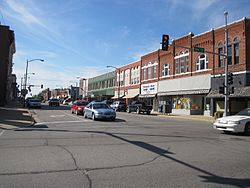
Main Street, Iowa Falls, Iowa, 1915

Key Information

Iowa Falls is a city in Hardin County, Iowa, United States. Iowa Falls is the home of Ellsworth Community College. It is also a regional transportation center, located along U.S. Routes 20 and 65 and the Canadian National and Union Pacific Railroads. The population was 5,106 at the time of the 2020 census.[3]

History

[edit]

Iowa Falls was laid out and platted in 1856.[4] Prior to being named Iowa Falls, the area had been known as Rocksylvania. However, due to the difficulty of pronunciation and spelling, it was then changed to Iowa Falls.[5] It was named from the falls on the Iowa River.[6]

The Illinois Central Railroad was built through Iowa Falls in 1866.[7]

The Metropolitan Opera House was built in 1899, it presented plays, operas, and vaudeville in the town during the first half of the twentieth century, and is listed on the National Register of Historic Places.

The Iowa Falls Popcorn Stand, located in Estes Park, is the oldest popcorn stand in Iowa that is still running.[8] It was first opened on May 29, 1948, as "Louie's Korn Krib."[9]

Geography

[edit]

According to the United States Census Bureau, the city has a total area of 5.44 square miles (14.09 km2), of which 5.36 square miles (13.88 km2) is land and 0.08 square miles (0.21 km2) is water.[10]

Iowa Falls is located at the point where the Iowa River flows through a limestone gorge 70 feet (21.34 m) deep between bluffs that rise another 50 feet (15.24 m). The falls themselves were also known as the "rapids of the Iowa."[11] The falls are now submerged by a dam built in 1926 that is 26 feet (7.92 m) feet high and 200 feet long and serves a hydroelectric power station that currently generates 1.5MW.[12][13]

Climate

[edit]

According to the Köppen Climate Classification system, Iowa Falls has a hot-summer humid continental climate, abbreviated "Dfa" on climate maps.

Climate data for Iowa Falls, Iowa, 1991–2020 normals, extremes 1893–present
Month Jan Feb Mar Apr May Jun Jul Aug Sep Oct Nov Dec Year
Record high °F (°C) 68
(20)
68
(20)
87
(31)
97
(36)
107
(42)
107
(42)
111
(44)
108
(42)
101
(38)
95
(35)
79
(26)
70
(21)
111
(44)
Mean maximum °F (°C) 46.6
(8.1)
51.7
(10.9)
67.5
(19.7)
81.4
(27.4)
87.4
(30.8)
91.8
(33.2)
92.6
(33.7)
90.6
(32.6)
89.0
(31.7)
82.5
(28.1)
67.2
(19.6)
51.1
(10.6)
94.1
(34.5)
Mean daily maximum °F (°C) 25.7
(−3.5)
30.6
(−0.8)
43.5
(6.4)
58.3
(14.6)
69.9
(21.1)
79.9
(26.6)
82.9
(28.3)
80.8
(27.1)
74.8
(23.8)
61.7
(16.5)
45.0
(7.2)
31.5
(−0.3)
57.1
(13.9)
Daily mean °F (°C) 16.9
(−8.4)
21.3
(−5.9)
33.9
(1.1)
46.8
(8.2)
58.8
(14.9)
69.1
(20.6)
72.6
(22.6)
70.2
(21.2)
62.7
(17.1)
50.0
(10.0)
35.3
(1.8)
23.2
(−4.9)
46.7
(8.2)
Mean daily minimum °F (°C) 8.1
(−13.3)
12.1
(−11.1)
24.4
(−4.2)
35.3
(1.8)
47.7
(8.7)
58.4
(14.7)
62.2
(16.8)
59.7
(15.4)
50.6
(10.3)
38.3
(3.5)
25.6
(−3.6)
14.9
(−9.5)
36.4
(2.5)
Mean minimum °F (°C) −14.2
(−25.7)
−8.7
(−22.6)
3.1
(−16.1)
21.5
(−5.8)
33.5
(0.8)
46.7
(8.2)
51.9
(11.1)
49.9
(9.9)
36.0
(2.2)
23.2
(−4.9)
8.9
(−12.8)
−6.0
(−21.1)
−17.2
(−27.3)
Record low °F (°C) −34
(−37)
−32
(−36)
−31
(−35)
3
(−16)
18
(−8)
34
(1)
36
(2)
31
(−1)
19
(−7)
−5
(−21)
−13
(−25)
−31
(−35)
−34
(−37)
Average precipitation inches (mm) 0.92
(23)
1.16
(29)
2.08
(53)
3.80
(97)
5.57
(141)
6.13
(156)
4.54
(115)
4.37
(111)
3.49
(89)
2.56
(65)
1.97
(50)
1.54
(39)
38.13
(968)
Average snowfall inches (cm) 7.1
(18)
7.1
(18)
4.5
(11)
1.3
(3.3)
0.0
(0.0)
0.0
(0.0)
0.0
(0.0)
0.0
(0.0)
0.0
(0.0)
0.0
(0.0)
1.6
(4.1)
6.1
(15)
27.7
(69.4)
Average precipitation days (≥ 0.01 in) 6.7 6.2 7.5 10.6 12.8 11.5 8.8 9.4 8.3 8.5 6.6 7.1 104
Average snowy days (≥ 0.1 in) 5.0 4.4 2.2 0.7 0.0 0.0 0.0 0.0 0.0 0.0 1.3 4.6 18.2
Source 1: NOAA[14]
Source 2: National Weather Service[15]

Demographics

[edit]
Historical populations
YearPop.±%
1880955—    
18901,796+88.1%
19002,840+58.1%
19102,797−1.5%
19203,954+41.4%
19304,112+4.0%
19404,425+7.6%
19504,900+10.7%
19605,565+13.6%
19706,454+16.0%
19806,174−4.3%
19905,435−12.0%
20005,193−4.5%
20105,238+0.9%
20205,106−2.5%
Source:"U.S. Census website". United States Census Bureau. Retrieved March 29, 2020. and Iowa Data Center
Source:
U.S. Decennial Census[16][3]

2020 census

[edit]

As of the census of 2020,[17] there were 5,106 people, 2,146 households, and 1,235 families residing in the city. The population density was 948.1 inhabitants per square mile (366.1/km2). There were 2,422 housing units at an average density of 449.7 per square mile (173.6/km2). The racial makeup of the city was 89.1% White, 1.1% Black or African American, 0.4% Native American, 0.9% Asian, 0.0% Pacific Islander, 3.4% from other races and 5.1% from two or more races. Hispanic or Latino persons of any race comprised 6.6% of the population.

Of the 2,146 households, 26.1% of which had children under the age of 18 living with them, 42.3% were married couples living together, 6.3% were cohabitating couples, 30.6% had a female householder with no spouse or partner present and 20.8% had a male householder with no spouse or partner present. 42.5% of all households were non-families. 37.3% of all households were made up of individuals, 19.8% had someone living alone who was 65 years old or older.

The median age in the city was 40.7 years. 24.1% of the residents were under the age of 20; 8.4% were between the ages of 20 and 24; 21.8% were from 25 and 44; 21.9% were from 45 and 64; and 23.7% were 65 years of age or older. The gender makeup of the city was 48.6% male and 51.4% female.

2010 census

[edit]

At the 2010 census there were 5,238 people, 2,207 households, and 1,295 families living in the city. The population density was 977.2 inhabitants per square mile (377.3/km2). There were 2,462 housing units at an average density of 459.3 per square mile (177.3/km2). The racial makup of the city was 94.0% White, 2.7% African American, 0.4% Native American, 0.7% Asian, 1.0% from other races, and 1.1% from two or more races. Hispanic or Latino of any race were 3.9%.[18]

Of the 2,207 households 26.8% had children under the age of 18 living with them, 44.0% were married couples living together, 10.6% had a female householder with no husband present, 4.1% had a male householder with no wife present, and 41.3% were non-families. 37.1% of households were one person and 18.9% were one person aged 65 or older. The average household size was 2.17 and the average family size was 2.81.

The median age was 40.9 years. 21.2% of residents were under the age of 18; 12.6% were between the ages of 18 and 24; 20.2% were from 25 to 44; 23.6% were from 45 to 64; and 22.4% were 65 or older. The gender makeup of the city was 48.2% male and 51.8% female.

2000 census

[edit]

At the 2000 census there were 5,193 people, 2,215 households, and 1,331 families living in the city. The population density was 1,043.1 inhabitants per square mile (402.7/km2). There were 2,412 housing units at an average density of 484.5 per square mile (187.1/km2). The racial makup of the city was 97.34% White, 1.21% African American, 0.15% Native American, 0.33% Asian, 0.42% from other races, and 0.54% from two or more races. Hispanic or Latino of any race were 1.04%.[19]

Of the 2,215 households 25.4% had children under the age of 18 living with them, 48.9% were married couples living together, 8.3% had a female householder with no husband present, and 39.9% were non-families. 34.6% of households were one person and 18.5% were one person aged 65 or older. The average household size was 2.19 and the average family size was 2.81.

The age distribution was20.3% under the age of 18, 13.0% from 18 to 24, 22.2% from 25 to 44, 21.5% from 45 to 64, and 23.1% that were 65 or older. The median age was 41 years. For every 100 females, there were 89.5 males. For every 100 females age 18 and over, there were 85.0 males.

The median household income was $32,141 and the median family income was $42,279. Males had a median income of $31,216 versus $21,004 for females. The per capita income for the city was $18,330. About 7.1% of families and 10.0% of the population were below the poverty line, including 12.5% of those under age 18 and 8.3% of those age 65 or over.

Economy

[edit]

Iowa Select Farms, Iowa's largest hog producer, is headquartered in Iowa Falls.[20]

Education

[edit]

Iowa Falls Community School District operates public schools.

Radio and Cable broadcasting

[edit]

KIFG (Iowa River Radio) 95.3 FM, 1510 AM. An over-the-air cable system existed in Iowa Falls, similar to one in Iron Mountain, Michigan. A list of channels and what they rebroadcast:

Notable people

[edit]

See also

[edit]

References

[edit]
[edit]
Revisions and contributorsEdit on WikipediaRead on Wikipedia
from Grokipedia
Iowa Falls is a in Hardin County, central , , situated along the and known for its scenic bluffs and historic limestone arch bridges. With a population of 4,993 as of 2024, it functions as a regional transportation hub at the intersection of U.S. Routes 20 and 65 and along the Canadian National Railway line. The , nicknamed the "Scenic City," is home to Ellsworth Community College, a public institution founded in 1890 that enrolls around 685 students as of 2023 and emphasizes liberal arts and career programs. Settled in 1851 by Benjamin I. Talbott, who constructed a mill near the river's small falls—inspiring the city's name—Iowa Falls experienced early growth with additional settlers arriving by 1852 and the town plat recorded in 1856, including community buildings like Sayer’s Hall in 1857. The arrival of the Illinois Central Railroad in 1866 spurred further development, including the establishment of banks and stores. Officially incorporated on May 4, 1869, the city preserved its heritage through sites like the Iowa Falls Historical Museum, which features replicas of early downtown structures, and the Union Depot, now part of the local historical society's collections. The local economy centers on processing and , with major employers including Cargill's , oil, and facility and Iowa Select Farms, one of 's largest producers. household income stood at approximately $53,051 as of 2023, with a median age of 39 and key community assets like Calkins Area for and the Scenic City Empress for river cruises highlighting the area's natural beauty.

Geography

Physical Features

Iowa Falls is situated in Hardin County in north-central , United States, at the geographic coordinates 42°31′N 93°16′W. This positioning places the city within the broader watershed, contributing to its distinctive landscape amid the state's rolling plains and agricultural terrain. According to the , the city encompasses a total area of 5.46 square miles (14.15 km²), of which 5.39 square miles (13.95 km²) is land and 0.077 square miles (0.20 km²) is water. The elevation of Iowa Falls averages 1,106 feet (337 meters) above sea level, reflecting the gentle undulations typical of the region's glacial deposits and loess-covered hills. A prominent natural feature is the gorge, which carves through bedrock, flanked by bluffs, creating a dramatic incision in the otherwise flat surroundings. This gorge defines the city's scenic identity and supports local along the riverbanks. Spanning the gorge is a concrete gravity hydroelectric , constructed in 1926, measuring 26 feet (7.9 m) high and 200 feet (61 m) long. The and also play a supporting role in the local economy through water management and limited energy production.

Climate

Iowa Falls features a hot-summer classified as Köppen Dfa, characterized by four distinct seasons with warm to hot summers and cold, snowy winters. Based on 1991–2020 normals from the National Centers for Environmental Information, the city's annual average is approximately 46.5°F, with mean daily highs of 57°F and lows of 36°F. The warm season spans late May to mid-September, peaking in with average highs of 83.4°F and lows of 62.7°F. In contrast, the cold season extends from late November to early March, with January featuring the lowest averages at 25.9°F highs and 9.0°F lows. Record extremes include a high of 111°F on July 14, 1936, and a low of -34°F on , 1912, reflecting the region's potential for severe swings. Precipitation averages 38.13 inches annually, distributed unevenly with a peak during the from thunderstorms; June records the highest monthly total at 6.0 inches, while winter months see less than 2 inches on average. Snowfall totals average 28 inches per year, concentrated in the snowy period from to March, where the average 31-day accumulation reaches up to 3.9 inches in mid-winter. Notable weather events include heavy flash flooding from the Beaver Creek basin in historical instances, such as a 6-to-8-inch rainfall event leading to near-record floods.

History

Settlement and Early Development

The settlement of Iowa Falls began in the early 1850s, drawn by the natural falls and rapids of the , which provided opportunities for milling and water power. In , Benjamin I. Talbott established the area's first permanent settlement by constructing a and near the river's rock ripple, marking the initial European American presence in what was then a region of Hardin County. Additional pioneers, including Nathan Townsend and John Caldwell, arrived in 1852, staking claims and beginning small-scale farming operations that laid the groundwork for agricultural development. By 1855, the nascent community consisted of approximately 10 to 12 residents, focused on subsistence farming and basic milling activities tied to the river's resources. The town was formally platted in October 1855 and recorded in June 1856 by surveyors J. L. Estes, Hosmer Stevens, and J. R. Larkin, with boundaries encompassing the , Union Street, and the eastern section line near Oak Street. Its name, "Iowa Falls," originated in 1853 from a proposal by Dr. J. F. Simonds, referencing the river's distinctive falls; this prevailed over Talbott's preference for "Rocksylvania" when the post office was established that year. Early economic activity centered on the river-powered mills—Talbott's initial operation expanded with a three-story stone mill built in 1856—alongside , including corn and cultivation on surrounding fertile prairies, and limited quarrying for local . A opened in 1865, supporting further building efforts in the growing settlement. The arrival of the railroad on April 15, 1866, via the Dubuque and Sioux City (later part of the Illinois Central), transformed Iowa Falls from a remote outpost into a burgeoning hub. The event was celebrated with a three-day , including an from Dubuque, signaling the town's integration into regional trade networks. This connectivity spurred rapid , from about 1,000 residents in to 1,200 by 1869, when Iowa Falls was officially incorporated as a on May 4. The railroad facilitated the shipment of agricultural products and , with records showing 280 cars of and 130 cars of exported in 1873–1874 alone, while enabling imports of goods that diversified local commerce. By the 1880 U.S. Census, the population had reached 1,012, reflecting sustained expansion driven by these transportation and river-based economic foundations.

20th and 21st Century Milestones

The Metropolitan Opera House, a cornerstone of cultural life in Iowa Falls, was constructed in 1899 and opened its doors just after Christmas that year, designed in the Italian Renaissance style to evoke the grandeur of New York City's Metropolitan Opera. Commissioned by local businessman Eugene S. Ellsworth and built by architects O'Meyer & Thori, the three-story structure initially hosted operas, vaudeville performances, and plays, serving as the most impressive theater in the region at the time. It was added to the National Register of Historic Places in 1975, recognizing its architectural and historical significance, and later became a contributing property to the Washington Avenue Historic District in 2012. In 1925, the city completed construction of a hydroelectric across the , submerging the natural falls that had given the town its name and creating a 26-foot-high, 200-foot-long structure that powered a local electric plant. Built by the Welden Brothers following groundwork started in 1925, the generated hydroelectric power for the community through much of the , with full operations achieved by 1930 under various owners including Central States Power and Light Company. By the early , however, the facility had ceased producing power due to aging , though the remains a key landmark for recreation and local identity. The mid-20th century brought notable growth to Iowa Falls, fueled by post-World War II economic expansion and rural migration patterns. The population rose from 5,193 in to a peak of 6,454 in 1970, reflecting broader trends in agricultural prosperity and industrial development that attracted families and workers to small towns like Iowa Falls. This era saw infrastructure improvements and community expansion, solidifying the city's role as a regional hub amid the state's overall population stabilization. Recent developments from 2021 to 2025 highlight Iowa Falls' focus on sustainable growth and stability. In 2022, the city partnered with an group to address housing shortages, purchasing three lots along Georgetown Road for $14,000 each to facilitate the construction of new single-family homes east of Pheasant Run Apartments. This initiative aimed to stimulate residential and support retention in the community. In April 2025, city officials reported a surplus for the 2025-26 during review, enabling potential investments in infrastructure and services amid steady economic conditions.

Government and Demographics

Local Government

Iowa Falls operates under a mayor-council form of government with an appointed city manager, as established in the city's charter. The city manager serves as the chief executive officer, responsible for supervising the implementation of council policies, managing daily operations, and overseeing appointed department heads. As of November 2025, Kaci Elkin holds the position of city manager and finance director, having been appointed in August 2024 to an initial term extending through July 2025, with continued service confirmed in subsequent council meetings. The city council comprises a mayor and five at-large council members, who set policy, approve budgets, and provide legislative oversight. Elections occur in odd-numbered years during the general election in November, with council terms lasting four years and staggered to ensure continuity. In the November 4, 2025, election, incumbent Mayor Michael R. Emerson was reelected with 518 votes against challenger Gene Newgaard's 499 votes. For the two open council seats, Steven L. Klein secured reelection with 552 votes, joined by newcomer Gumaro Valencia with 528 votes; incumbents or candidates Jody Lewis Anderson (443 votes) and Tamra Kjormo (333 votes) were not elected. The current council, including holdover members Roger Nissly, Micah Cutler, Bruce Thies, and Dave Henry, meets regularly to address municipal matters. Recent decisions include the April 2025 review of the 2025-26 fiscal year budget, where City Manager Elkin reported a surplus, enabling allocations such as $5,000 in tourism funds to the Iowa Falls Chamber/Main Street for Project Facelift and $15,000 to Iowa Falls High School initiatives. The council plays a key role in economic development by partnering with the Iowa Falls Area Development Corporation (IFADC), a nonprofit established in 1956 to promote business expansion, , and community growth in north-central . IFADC provides services like business planning assistance, , and access to a revolving fund, often collaborating with the city on initiatives to attract investment. Complementing this, the Community Investment Corporation (IFCIC), a subgroup of IFADC investors, supports targeted projects such as development, working closely with city-provided lots to address local shortages. Public services, including police, fire protection, and planning, fall under the council's policy oversight and the city manager's administrative supervision. The Iowa Falls Police Department, led by Chief Josh Nelson, handles and community safety from its headquarters at 321 Stevens Street. The provides protection for the city and surrounding areas, responding to emergencies and conducting prevention efforts. The Planning and Zoning Commission advises the council on , development regulations, and zoning ordinances to guide sustainable growth.

Demographic Profile

As of the , Iowa Falls had a of 5,106, reflecting a slight decline from 5,238 in 2010. The was estimated at 4,993 as of July 1, 2024. The city's has grown significantly since its early years, rising from 955 in 1880 and 1,796 in 1890 to a peak of 6,454 in 1970, before stabilizing and modestly decreasing in recent decades due to broader rural demographic shifts in . With a land area of 5.39 square miles, the was 946 persons per square mile in 2020. According to the 2020 Census and the American Community Survey (ACS) 2018–2022, Iowa Falls features 2,146 households and a median age of 39.3 years, with a gender distribution of 48.4% male and 51.6% female. Racially and ethnically, the population was 87.7% non-Hispanic White, 7.3% Hispanic or Latino, 2.8% two or more races, 1.0% Black or African American, 0.8% Asian, and 0.2% American Indian and Alaska Native; foreign-born residents comprised 3.3% of the total. Family structures included 52.3% married-couple households and 27.7% non-family households, with an average household size of 2.29 persons. Economic indicators from the ACS 2018–2022 show a household income of $53,051 and of $30,215, with a rate of 7.6%. Housing consisted of 2,422 total units, 88.6% occupied, value $137,300, 70.2% owner-occupied, and monthly housing cost of $1,029 for owners with a . These figures indicate a stable, middle-income community with relatively compared to state averages.

Economy

Key Industries

The economy of Iowa Falls is fundamentally anchored in agriculture, which serves as the primary sector and leverages the surrounding fertile farmland of Hardin County for crop and livestock production. Hog farming stands out as a cornerstone, with Iowa Select Farms, headquartered in the city, operating as the largest family-owned pork producer in the United States and the fourth-largest overall pork producer nationally. This enterprise processes millions of hogs annually, contributing significantly to Iowa's position as the top swine-producing state in the country. Complementing agriculture are manufacturing and processing industries closely integrated with farming operations, particularly in meat processing and value-added agricultural products. The city also hosts Cargill's major facility for soybean meal, oil, and biodiesel production, which processes agricultural outputs and supports biofuel initiatives central to the regional economy. For instance, Nimrod Meats, a local full-service meat processor established in 2022, has been recognized for its quality and community impact, earning the U.S. Small Business Administration's Impact Award in 2024 during National Veterans Small Business Week and being named Small Business of the Week by U.S. Senator in 2025. These activities transform raw agricultural outputs into processed goods, enhancing economic resilience by linking production directly to regional supply chains. The Iowa Falls Hydroelectric Dam, constructed in 1925 on the , plays a vital role in supporting local energy needs through renewable generation. Owned by Zero6 Energy, the facility harnesses the river's flow to produce , providing a sustainable energy source that bolsters the community's amid its agriculture-dependent . Historically, the city's economic foundation evolved from early 20th-century milling operations powered by the 's , which processed local grains into flour and feed, to a modern model post-2000. This transition reflects broader regional trends toward large-scale integration and processing, with expansions in companies like Iowa Select Farms driving growth in hog production and related sectors since the late 1990s.

Major Employers

Iowa Falls' economy is anchored by several major employers that provide stable job opportunities, particularly in , , education, and healthcare, reflecting the community's agricultural focus. Among these, Iowa Select Farms stands out as the largest, serving as the for the fourth-largest pork producer in the United States, where it oversees hog production and operations employing a significant portion of local workers in administrative and support roles. The company, founded by Iowa Falls natives, contributes to the area's economic stability through its statewide network but maintains a key presence in the city with contributions to job growth in the sector. Ellsworth Community College, a public two-year institution located in Iowa Falls, is another vital employer, supporting around 80 staff members, including approximately 27 instructors, who deliver and community services to over 700 students annually. As part of the Valley Community College District, it fosters local employment in academic and administrative positions while promoting workforce development through programs that align with regional industries. Local businesses bolster employment diversity, with Nimrod Meats exemplifying smaller-scale operations as a custom and retail facility that opened in , hiring for roles in slaughter, packaging, and sales to serve farmers and consumers. The Iowa Falls Area Development Corporation (IFADC) supports additional firms through site selection and expansion assistance, including manufacturers like Cam Spray and Agri-Pro Enterprises, which provide jobs in production and distribution, enhancing overall economic vitality. Recent labor market data for Hardin County, where Iowa Falls is situated, indicates strong participation and low unemployment, with a labor force of approximately 7,784 in August 2024 and an rate of 2.9%, below the state average of 3.3% in 2025. Labor force participation in the county hovers around 79.6%, supporting sustained job opportunities amid post-2020 recovery trends. From 2021 to 2025, economic initiatives led by IFADC have focused on job growth, including career tours to attract to local industries and developments to support retention, alongside securing grants like a $5,000 award from the Shiller Fund in 2023 for community projects that indirectly aid employment expansion. These efforts, combined with collaborations for business tours and infrastructure improvements, have aimed to create and sustain jobs in key sectors, contributing to the area's resilience.

Education

Primary and Secondary Education

The Iowa Falls and Alden Community School District (IFACSD) serves K-12 students in Iowa Falls and surrounding rural areas of Hardin and Franklin counties, , emphasizing academic achievement, athletics, fine arts, and extracurricular involvement to foster well-rounded development. The district operates four main schools: Pineview Elementary School (pre-K through 1st grade), Rock Run Elementary School (2nd through 5th grade), Riverbend Middle School (6th through 8th grade), and Iowa Falls-Alden High School (9th through 12th grade), along with the Green Belt Alternative School for specialized needs. Total enrollment stands at 1,254 students as of the 2025-26 school year, with 20% from minority backgrounds and 28.9% economically disadvantaged, reflecting the area's . Academic performance in the district exceeds state averages in several areas, with elementary students achieving 77% proficiency in reading and 88% in math, middle school students at 75% reading and 73% math proficiency, and high school students at 71% reading proficiency. The high school graduation rate is 91.2%, and individual schools rank competitively statewide: Rock Run Elementary at 83rd out of 576 elementary schools, Riverbend Middle at 103rd out of 344 s, and Iowa Falls-Alden High at 218th to 322nd out of Iowa high schools. Extracurricular offerings include robust athletics programs such as wrestling, , soccer, dance, and , alongside fine arts in music and theater, and clubs focused on and community service, which engage over half of eligible students annually. Recent developments include Phase 1 of a high school renovation project, which began in 2025 and features a new secure entrance, updated administrative offices, a dedicated wrestling room, and renovated visitor locker rooms to enhance safety and facilities, with substantial completion expected by August 2025. The district also launched an after-school program in 2024 for pre-K through 5th graders, offering enrichment activities like art and puzzles until 6 p.m. for a nominal fee, supporting working families. These initiatives integrate with community events through school-sponsored athletics competitions and fine arts performances at local venues, promoting broader and student pride in Iowa Falls.

Higher Education

Ellsworth , located in Falls, serves as the primary institution of higher education in the area. Founded in as a private business academy by Eugene S. Ellsworth and Professor John Tobin, it evolved into Iowa's oldest community college and is now part of the Iowa Valley Community College District. The college offers associate degrees and vocational training to approximately 730 students annually, fostering a close-knit environment that supports both transfer to four-year institutions and direct entry into the workforce. The institution provides a range of programs, including Associate of Arts (AA) and Associate of Applied Science (AAS) degrees, with a strong emphasis on vocational training in fields relevant to the region. In agriculture, offerings include , , Farm Management, and Animal Science, which equip students with practical skills in crop production, management, and sustainable farming practices. Business programs, such as Transfer, Computer Applications in Business, and Merchandising and Retail Management, cover topics like , , and , preparing graduates for roles in local commerce and management. Campus facilities enhance hands-on learning, featuring the state-of-the-art Agriculture & Renewable Energy Center for advanced training and the Ellsworth Equestrian Center on the south Robert & Arlene Hamilton campus for equine-related programs. These and courses directly tie into Iowa Falls' economy, supporting the area's farming and rural sectors by developing skilled workers. The college collaborates with the Iowa Falls Area Development Corporation (IFADC) on workforce development initiatives, such as and program promotion to align with local industry needs.

Infrastructure

Transportation

Iowa Falls serves as a regional transportation hub in north-central Iowa, facilitated by the intersection of major highways and rail lines that connect it to broader state and national networks. , a primary east-west corridor across Iowa, passes through the city as a four-lane divided highway, providing efficient access to Fort Dodge to the west and Waterloo to the east. U.S. Route 65 runs north-south through Iowa Falls, intersecting US 20 at the city's core and linking it to Des Moines about 82 miles south and Mason City about 47 miles north. lies about 20 miles west, offering proximity to the state's main north-south interstate system. Rail transportation in Iowa Falls is supported by lines from the Canadian National Railway () and (UP), which run parallel through the area and enable freight movement for agricultural and industrial goods; rail service first arrived in 1866 with the completion of the Dubuque and Sioux City Railroad to the city. These lines position Iowa Falls as a key junction for traffic, with a certified 295-acre industrial rail site located between the CN and UP tracks, featuring approved designs for a manifest yard and additional sidings to enhance capacity. Air travel options center on the Iowa Falls Municipal Airport (KIFA/IFA), a general aviation facility located three miles south of the city on 214 acres, with a 4,602-foot paved suitable for small aircraft and offering fuel services during business hours. For commercial flights, the nearest major are Des Moines International Airport (about 89 miles south) and The Eastern Iowa Airport in Cedar Rapids (about 105 miles east). Public transit within Iowa Falls is provided by Region 6 Resource Partners, operating fixed-route and demand-response services for in-town travel and connections to nearby communities like Alden and Hampton, with fares starting at $3 for local trips. Recent updates under the –2025 Iowa Transportation Program have focused on enhancing highway and in the Iowa Falls area. In Hardin County, a project to pave shoulders along 7.5 miles of US 20 east of its intersection with US 65 to 2.0 miles east of County Road S56 was allocated $2,215,000 to improve road conditions and reduce hazards. Additionally, a $450,000 bridge deck overlay on US 65 over the UP Railroad, located 2.1 miles west of Iowa Highway 57, addresses structural maintenance needs. Rail safety improvements included $180,000 in federal funding for installing signals with gate arms at Hardin County railroad crossings in fiscal year 2021.

Utilities and Public Works

The Iowa Falls Hydroelectric Dam, constructed between 1925 and 1926 by the Welden Brothers, stands as a historical landmark on the , originally designed to generate power for the local area. Owned by North American Hydro, the measures 26 feet in height and 200 feet in length, with a foundation of rock and soil. While it once supported hydroelectric operations, the facility ceased power generation by the early due to aging infrastructure, though it continues to serve recreational and purposes. Maintenance efforts have included periodic repairs, such as lowering the river in 2018 for nearby sewer line work, ensuring structural integrity amid its centennial in 2025. The city's water supply is sourced from groundwater in the Mississippian , consisting of and dolomite formations, treated by the Iowa Falls Water Department located at 1500 River Road. This department, staffed by five full-time employees operating from 7:00 a.m. to 3:30 p.m. weekdays, ensures compliance with quality standards through regular testing and 24/7 on-call support. Wastewater treatment occurs at a dedicated facility that processes from residential and industrial sources collected via the system, preventing environmental discharge into the . Waste management is handled by the Solid Waste Department, which manages collection and disposal services from 5:00 a.m. to 1:00 p.m. daily. Public works responsibilities fall under the Streets & Sanitation Department, which oversees street maintenance, , and upkeep from its base at 215 South River Street, with operations running 6:30 a.m. to 3:00 p.m. weekdays. Recent initiatives include the 2024 street reconstruction projects, awarded to Heartland Asphalt for $794,409 to resurface key local roads. The 2025-26 budget, reviewed by the city council in April 2025, maintains a surplus to support ongoing maintenance and potential upgrades in public infrastructure. Electricity services in Iowa Falls are primarily provided by , delivering reliable power to residential and commercial users, while natural gas is supplied by MidAmerican Energy. The Midland Power Cooperative maintains a local service center for cooperative members, supporting rural distribution needs. Sustainability efforts align with broader initiatives, including the city's comprehensive plan that integrates and hazard mitigation, though specific local programs emphasize efficient resource use in and operations to minimize environmental impact.

Media

Radio Broadcasting

KIFG operates as the primary radio station in Iowa Falls, broadcasting on 95.3 FM and simulcasting on 1510 AM under the branding Iowa River Radio. Owned by Times-Citizen Communications, Inc., the station delivers a format featuring music from the , 1970s, and 1980s. The FM signal transmits at 6,000 watts from a tower located approximately 2 miles east of Iowa Falls, providing coverage across central , while the AM signal is limited to daytime operation at 1,000 watts to protect other stations on the frequency. Programming on KIFG emphasizes community-oriented content alongside its music rotation, including syndicated shows like "Floydian Slip," a weekly exploration of Pink Floyd's history. The station has long served as a hub for local information, with dedicated segments on , business, education, and updates. KIFG plays a significant role in Iowa Falls' communication landscape by broadcasting local news, high school sports, and public affairs programming, such as moderated forums for city council and mayoral candidates. It covers community events like observances and school achievements, fostering in the area. As a local broadcaster, KIFG contributes to emergency communications by relaying alerts and safety information during severe conditions, aligning with its commitment to small-town .

Other Media

In addition to radio, Iowa Falls residents access news and entertainment through print, cable television, and digital platforms that have evolved significantly since the late 19th century. The primary local newspaper, the Iowa Falls Times-Citizen, traces its roots to the Iowa Falls Citizen, established in the late 1800s as one of at least 16 publications in Hardin County during that era. Publisher Ira Nichols led the Citizen for nearly 40 years until 1933, after which Carl Hamilton acquired it in 1948 and merged it with the Alden Times to create the Times-Citizen; Hamilton owned it until 1962. His son, Mark Hamilton, purchased the paper in 1983 and continues as owner, expanding it under Times-Citizen Communications, Inc., which also publishes the Ackley World Journal and operates a printing division. The Times-Citizen provides comprehensive coverage of local news, sports, business, politics, obituaries, and community events in Iowa Falls and nearby Ackley, earning numerous state and national awards for its journalism. It maintains a strong digital presence through its website (timescitizen.com), which offers online editions, photo galleries, video content, and an e-edition, alongside a mobile app available on Google Play for broader accessibility. Cable television services in Iowa Falls are primarily provided by , the dominant local provider offering packages with over 170 channels, including national networks such as , AMC, , and local affiliates for ABC, , , and . Additional options include satellite services like and DISH, which deliver 155+ channels but are not traditional cable. Cable infrastructure arrived in Iowa Falls during the 1980s, enabling access to expanded programming like and premium channels, marking a shift from over-the-air broadcasts to wired delivery systems that improved signal quality in rural areas. Digital media has grown rapidly in Iowa Falls, with local organizations leveraging online platforms for news dissemination and engagement. The Iowa Falls Area Development Corporation (IFADC) uses its website (iowafallsdevelopment.com) and page to share updates, resources, and business news, fostering growth in the region. Similarly, the Iowa Falls Chamber of Commerce and Main Street maintains a website (iowafallschamber.com) featuring a event calendar, monthly digital newsletters promoting local happenings like holiday events, and social media accounts on and for business spotlights and visitor promotions. These outlets complement traditional media by providing real-time updates and interactive content, reflecting the broader transition from print and broadcast to digital ecosystems since the 1990s.

Culture and Attractions

Historic Landmarks

The Metropolitan Opera House, constructed in 1899, stands as a prominent example of Italian Renaissance Revival architecture in Iowa Falls, featuring a three-story facade with quoined walls, a garlanded frieze, and a bracket-supported cornice. Commissioned by local businessman Eugene S. Ellsworth, the building originally seated 831 patrons across an orchestra level and balcony, with a spacious stage measuring 66 feet wide and 30 feet deep, complete with 50 feet of fly space for elaborate productions. It hosted a variety of performances, including operas like Faust, dramatic plays such as Uncle Tom’s Cabin, and vaudeville shows, with notable visits from John Philip Sousa's band in the early 1900s. By the late 1920s, the venue transitioned to silent films and later installed a sound system in 1930, serving as a community hub for Ellsworth College dramas, high school plays, and concerts until 1952; it was restored in 1993 and now operates as a dual-screen movie theater. The Iowa Falls Popcorn Stand, established in its current location in 1948 as Louie's Korn Krib, represents the state's oldest continuously operating vendor, with roots tracing back to the 1870s when such stands first appeared in the community. Situated at the southeast corner of Estes Park in Iowa Falls, the stand has become a , offering a range of flavors like and cheese and drawing visitors for its nostalgic appeal; it underwent a full renovation in to preserve its historic charm while maintaining limited operations. Originally operated by Louie Knudson for nearly three decades before being sold in , the business was acquired by and Lisa Senne in , ensuring its ongoing role as a beloved local landmark. The Mills Tower Historic District, listed on the in 1990, preserves key elements of Iowa Falls' railroad heritage on the eastern edge of the Illinois Central yard. Encompassing six structures from the late 19th and early 20th centuries, the district highlights utilitarian railroad architecture, including the Mills Tower—built around 1909 as Iowa's only surviving tower out of nearly 70 once in operation—equipped with an original electric control board and train order signal. It reflects the integration of the Chicago, Rock Island and Pacific Railroad (arriving in 1880) and the Illinois Central, with passenger service ending in 1969; a restored adds to the site's interpretive value for visitors exploring the area's rail history. River-related historic structures include the Swinging Bridge, a suspension bridge originally built in 1897 across the in Assembly Park, with subsequent reconstructions in 1909, 1925, 1956, and 1989 to maintain its function as a scenic walkway. This swaying , perched above the water, exemplifies early 20th-century engineering adapted to the local terrain and continues to offer public access while symbolizing the city's connection to its riverfront. Nearby, remnants of early milling activity persist in the form of submerged foundations from the Iowa Flouring Mill, constructed in 1851 from native as a four-and-a-half-story operation powered by the , though the structure was later lost to flooding and river alterations. The Dow House, built in the 1870s and acquired by the Iowa Falls Historical Society in 1999, serves as a preserved Victorian residence that housed the Dow family for 75 years, showcasing original interior features like intricate woodwork, pocket doors, a , and a turn-of-the-century kitchen with period cabinets. Located at 519 Stevens Street, the home displays artifacts including photographs of local landmarks, period furniture, agricultural tools in the basement, and rotating exhibits on the second floor, such as a collection of petit point embroidery, providing insight into 19th-century domestic life in Iowa Falls.

Recreation and Community Events

Iowa Falls offers a variety of recreational opportunities centered around its parks and the scenic , which features a dramatic gorge that enhances outdoor pursuits. The city's parks encompass over 100 acres, many situated along the riverbanks, providing access to natural cliffs and wooded areas ideal for and . The Greenbelt, a 30-mile corridor passing through Iowa Falls, supports activities such as , , and seasonal , with the river's gentle currents suitable for paddling and occasional mild sections in the gorge. Key access points include the 4-acre Iowa Falls River Access, a primitive site offering shore for species like and , as well as launch facilities for canoes, kayaks, and jon boats. The Water Trail in Hardin County, spanning 55 miles with frequent entry points in Iowa Falls—known as the "Scenic City"—facilitates short paddling trips and excursions, often combined with nearby camping at Pineridge Recreation Area or Pine Lake State Park. trails within the Greenbelt, such as the 76-acre Calkins Nature Area with its and paths, the paved Trail, and the Trail, attract visitors year-round, though the allows for extended outdoor enjoyment from spring through fall. Community facilities contribute to social gatherings and leisure in Iowa Falls. The Popcorn Stand, located at the corner of Estes and Stevens Streets, stands as Iowa's oldest continuously operating popcorn vendor, dating back to the 1870s with its current iteration serving as a beloved local hub for snacks and casual interactions since its establishment in the mid-20th century. This seasonal stand offers a range of flavored popcorn varieties, drawing residents and visitors for quick treats that foster community connections during events and daily strolls. Annual events in Iowa Falls emphasize holiday celebrations and community engagement, often promoted through the Iowa Falls Chamber of Commerce newsletters and calendar. The Scenic City Holiday Hop on December 6, 2025, features festive activities, holiday treats, and visits from Santa and Mrs. Claus across participating locations, encouraging local shopping and cheer. The Festival of Lights, running Fridays through Sundays from November 28 to December 21, 2025, illuminates the community with displays and draws families for evening outings. Other seasonal highlights include PINK Friday on November 21, 2025, promoting early holiday sales, and Shop Small Business Saturday on November 29, 2025, supporting local merchants. Broader annual traditions encompass the Riverbend Rally in early July, a multi-day festival with a 5K run, kayak races, parade, live entertainment, and fireworks; the Scenic City Car Show over Labor Day weekend, awarding trophies in 34 categories; the October Wine and Art Walk for adults 21 and older, sampling local wineries amid downtown shops; the May All Iowa Rugby Tournament; June's Lawn Chair Nite concert series in Estes Park; and the September Free Christian Concert. The Chamber of Commerce highlights these in its November 2025 newsletter, focusing on upcoming festive events to boost participation. Business honors, such as the 2025 Small Business of the Week recognition for Nimrod Meats by U.S. Senator Joni Ernst during National Small Business Week and the SBA Impact Award to owner Rocky Damiano in November 2024 for community economic contributions, are celebrated at chamber gatherings, underscoring local entrepreneurial spirit. Recent recreational developments from 2021 to 2025 have enhanced accessibility and programming through the City of Iowa Falls Department, which expanded summer activities for , including , crafts, outdoor games, and in two-week sessions during June and July. Ongoing maintenance of the Greenbelt trails and access points has improved safety and appeal for and paddling, aligning with state initiatives for enhancements.

Notable People

Entertainers

Iowa Falls has produced several individuals who have made significant contributions to the entertainment industry, spanning acting, television production, and live performance. , born Marjorie May Massow on July 15, 1921, in Iowa Falls, was an actress who pursued a Hollywood career after overcoming a childhood stammer through dedicated speech therapy and earning a scholarship to the Rice School of Theatre in . She appeared in minor roles in films such as Falstaff on the (1951) and (1954), and worked as a model and bit player in the 1940s and 1950s, often leveraging her striking looks to secure auditions in New York and . Her career was overshadowed by a 1962 scandal in , where she was convicted of attempted kidnapping after staging an elaborate scheme to extort money from a producer she believed owed her opportunities; Meredith maintained her innocence, claiming it was a gone wrong, and served time in prison before being paroled in 1965. She later lived quietly in until her death on September 16, 2017, at age 96. Sean Whitesell, born on March 11, 1963, in Iowa Falls, was a prominent television writer and producer whose work shaped acclaimed drama series. After graduating from the University of Northern Iowa and earning an MFA from the University of California, San Diego, he began his career writing for Homicide: Life on the Street (1993–1999), contributing episodes that explored urban crime and social issues. Whitesell later co-created and produced The Killing (2011–2014), an AMC adaptation of the Danish series Forbrydelsen, which earned praise for its atmospheric storytelling and psychological depth over four seasons. He also served as an executive producer on Oz (1997–2003) and House M.D. (2004–2012), influencing narratives in gritty prison dramas and medical procedurals, respectively. Whitesell, the fifth of six brothers, died of cancer on December 28, 2015, in Los Angeles at age 52. Bill Riley Sr., born William J. Riley on October 7, 1920, in Iowa Falls, earned the nickname "Mr. State Fair" for his decades-long career as an entertainer and emcee at the . Starting in local journalism at age 16 by reporting sports for the Iowa Falls Citizen, he transitioned to radio in the 1940s, hosting variety shows for KRNT in Des Moines and captivating audiences with his charismatic storytelling and promotion of young talent. In 1959, Riley founded the Bill Riley Talent Search, an annual competition that has launched the careers of thousands of performers, including musicians, dancers, and comedians, by providing a platform for amateurs at county fairs across before culminating at the state level. His efforts helped preserve and promote Iowa's cultural traditions through live entertainment, and the program continues in his name, drawing over 5,000 participants yearly. Riley died on December 15, 2006, at age 86, leaving a lasting legacy in community-based performance arts. Patrick Whitesell, born on February 4, 1965, in Iowa Falls, is a key figure in the entertainment business as the executive chairman of Endeavor, a global media and talent agency. One of six brothers, he built a career representing high-profile actors, directors, and musicians, co-founding WME (now part of Endeavor) and facilitating major deals in , , and sports entertainment. While not a performer, his influence on the industry includes shaping strategies that have supported blockbuster productions and award-winning artists.

Scientists and Innovators

Carl L. Gade (1869–1959) was a pioneering inventor and industrialist closely associated with Iowa Falls, where he established a enterprise that advanced in the early . Born in , Gade relocated to Iowa Falls and co-founded the Gade Brothers Company in 1903, serving as its president and driving innovations in design and farm equipment. His most notable contribution was the development of the first successful air-cooled , which powered various applications including stationary engines for rural use, offering reliability and ease of in farming operations. This , produced and sold worldwide from Iowa Falls, marked a significant step in reducing dependence on water-cooled systems and supported the mechanization of Midwestern agriculture. Gade's inventive work extended to practical farm tools, such as the all-steel hog rack introduced in 1910, an adjustable device that fit any standard wagon box to streamline transport, and the adjustable steel farm gate, praised for its lightweight yet durable construction. These innovations addressed everyday challenges faced by farmers, enhancing efficiency in handling and amid the state's booming corn and sectors. By employing around 60 skilled machinists at its peak, the Gade company not only bolstered local employment but also contributed to 's agricultural economy by exporting equipment that improved productivity on family farms across the region. Gade's broader ventures, including the Gade Excavating Company focused on dredging for land improvement, further tied his efforts to and vital to 's fertile prairies. Through such figures as Gade, Iowa Falls exemplified small-town innovation in , fostering tools that sustained 's position as a leading producer of corn, soybeans, and hogs into the modern era.

Athletes

, born on July 26, 1980, in , grew up in Iowa Falls and attended Iowa Falls High School, where he led the team to two state championships in 1997 and 1998 and was named a All-American in 1999. After a standout college career at the , Collison was drafted 12th overall by the (now ) in the and played 15 seasons in the NBA, retiring in 2018 as the franchise's all-time leader in games played. As of 2025, he serves as an assistant general manager for the Thunder and won an NBA championship as part of the front office in the 2024–25 season. Kurt Ploeger, born on December 1, 1962, in Iowa Falls, was a professional defensive end and tackle who played in the for the and from 1985 to 1987 after being drafted in the sixth round out of . Standing at 6 ft 5 in (1.96 m) and weighing 259 lb (117 kg), Ploeger was recognized for his college achievements, including honors in 1984. Randy Schultz, born on November 17, 1943, in Iowa Falls, was a who played professionally in the for the from 1966 to 1968 after a college career at the (then State College of Iowa), where he set rushing records. He also appeared in the film Number One (1969) and was inducted into the UNI Athletics Hall of Fame in 1987. Schultz died on October 4, 1996, in , at age 52.

Military

Joseph Gomer (1920–2013), born on June 20, 1920, in Iowa Falls, was a Tuskegee Airman and one of the first African American military aviators in the United States Armed Forces. After graduating from Iowa Falls High School in 1938 and attending Ellsworth Community College, Gomer enlisted in 1942 and trained at Tuskegee Army Airfield, , earning his wings as a in the 302nd Fighter Squadron. He flew combat missions in and later served in the and , retiring as a major in 1969. Gomer, the last surviving Tuskegee Airman from at the time of his death on October 10, 2013, was honored with a in Iowa Falls in 2013.

References

Add your contribution
Related Hubs
User Avatar
No comments yet.