Hubbry Logo
Catholic Apostolic ChurchCatholic Apostolic ChurchMain
Open search
Catholic Apostolic Church
Community hub
Catholic Apostolic Church
logo
8 pages, 0 posts
0 subscribers
Be the first to start a discussion here.
Catholic Apostolic Church
from Wikipedia

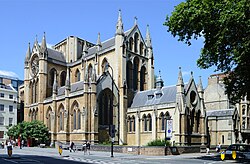
Church of Christ the King, Bloomsbury, which belongs to the trustees of the Catholic Apostolic Church

The Catholic Apostolic Church (CAC), also known as the Irvingian Church or Irvingite Church, is a denomination in the Restorationist branch of Christianity.[1][2] It originated in London around 1831 and later spread to Germany and the United States.[3] The traditional groups of the Catholic Apostolic Church with the revisionist movement, the character of which include elements of historic liturgies and charismatic gifts are sometimes referred to as Irvingism or the Irvingian movement after Edward Irving (1792–1834), a clergyman of the Church of Scotland sometimes credited as organising the movement.[1]

The church was organised in 1835 with the fourfold ministry of "apostles, prophets, evangelists, and pastors".[4] The denominations in the tradition of the Catholic Apostolic Church teach "the restoration to the universal church of prophetic gifts by the direct inspiration of the Holy Ghost."[5]

As a result of schism within the Catholic Apostolic Church, other Irvingian Christian denominations emerged, including the Old Apostolic Church, New Apostolic Church, Reformed Old Apostolic Church and United Apostolic Church; of these, the New Apostolic Church is the largest Irvingian Christian denomination today, with 16 million members.[6][7]

Irvingism has elaborate liturgies; it teaches three sacraments: Baptism, Holy Communion and Holy Sealing.[1][8][9]

History

[edit]

Edward Irving

[edit]

Edward Irving, also a minister in the Church of Scotland, preached in his church at Regent Square in London on the speedy return of Jesus Christ and the real substance of his human nature.[citation needed]

Irving's relationship to this community was, according to its members, somewhat similar to that of John the Baptist to the early Christian Church. He was the forerunner and prophet of the coming dispensation, not the founder of a new sect; and indeed the only connection which Irving seems to have had with the Catholic Apostolic Church was in fostering spiritual persons who had been driven out of other congregations for the exercise of their spiritual gifts.[10]

Around him, as well as around other congregations of different origins, coalesced persons who had been driven out of other churches, wanting to "exercise their spiritual gifts". Shortly after Irving's trial and deposition (1831), he restarted meetings in a hired hall in London, and much of his original congregation followed him. Having been expelled from the Church of Scotland, Irving took to preaching in the open air in Islington, until a new church was built for him and his followers in Duncan Street, Islington, funded by Duncan Mackenzie of Barnsbury, a former elder of Irving's London church.[11]

Shortly after Irving's trial and deposition (1831), certain persons were, at some meetings held for prayer, designated as "called to be apostles of the Lord" by certain others claiming prophetic gifts.[10]

Naming of the apostles

[edit]

In the year 1835, six months after Irving's death, six other people were similarly designated as called to complete the number of the twelve, who were then formally separated, by the pastors of the local congregations to which they belonged, to their higher office in the universal church on 14 July 1835. This separation is understood by the community not as "in any sense being a schism or separation from the one Catholic Church, but a separation to a special work of blessing and intercession on behalf of it." The twelve were afterwards guided to ordain others—twelve prophets, twelve evangelists, and twelve pastors, "sharing equally with them the one Catholic Episcopate," and also seven deacons for administering the temporal affairs of the church catholic.[10]

The names of those twelve apostles included John Bate Cardale, Henry Drummond, Spencer Perceval, Thomas Carlyle, and Duncan Mackenzie.

Structure and ministries

[edit]

Each congregation was presided over by its "angel" or bishop (who ranks as angel-pastor in the Universal Church); under him are four-and-twenty priests, divided into the four ministries of "elders, prophets, evangelists and pastors," and with these are the deacons, seven of whom regulate the temporal affairs of the church—besides whom there are also "sub-deacons, acolytes, singers, and door-keepers." The understanding is that each elder, with his co-presbyters and deacons, shall have charge of 500 adult communicants in his district; but this has been but partially carried into practice. This is the full constitution of each particular church or congregation as founded by the "restored apostles," each local church thus "reflecting in its government the government of the church catholic by the angel or high priest Jesus Christ, and His forty-eight presbyters in their fourfold ministry (in which apostles and elders always rank first), and under these the deacons of the church catholic."[10]

The priesthood is supported by tithes; it being deemed a duty on the part of all members of the church who receive yearly incomes to offer a tithe of their increase every week, besides the free-will offering for the support of the place of worship, and for the relief of distress. Each local church sends "a tithe of its tithes" to the Temple, by which the ministers of the Universal Church are supported and its administrative expenses defrayed; by these offerings, too, the needs of poorer churches are supplied.[10]

Liturgy and forms of worship

[edit]

Sources of forms of worship

[edit]

For the service of the church a comprehensive book of liturgies and offices was provided by the apostles. It dates from 1842 and is based on the Anglican, Roman and Greek liturgies. Lights, incense, vestments, holy water, chrism, and other adjuncts of worship are in constant use. In 1911, the ceremonial in its completeness could be seen in the church in Gordon Square, London and elsewhere.[10]

The daily worship consists of matins with proposition (or exposition) of the sacrament at 6 a.m., prayers at 9 a.m. and 3 p.m., and vespers with proposition at 5 p.m. On all Sundays and holy days there is a "solemn celebration of the eucharist" at the high altar; on Sundays this is at 10 a.m. On other days low celebrations are held in the side-chapels, which with the chancel in all churches correctly built after apostolic directions are separated or marked off from the nave by open screens with gates. The community has always laid great stress on symbolism, and in the eucharist, while rejecting both transubstantiation and consubstantiation, holds strongly to a real (mystical) presence. It emphasizes also the phenomena of Christian experience and deems miracle and mystery to be of the essence of a spirit-filled church.[10]

The services were published as The Liturgy and other Divine Offices of the Church. Apostle Cardale put together two large volumes of writings about the liturgy, with references to its history and the reasons for operating in the ways defined, which was published under the title Readings on the Liturgy.

The Eucharist, being the memorial sacrifice of Christ, is the central service. The Irvingian Churches teach the real presence of Christ in the Eucharist, though they rejected what they saw as the philosophical explanations of the Roman Catholic doctrine of transubstantiation as well as Lollardist doctrine of consubstantiation.[12]

Some of the music in the Catholic Apostolic Church is composed by Edmund Hart Turpin, former secretary of the Royal College of Organists.

Sacraments

[edit]

Irvingism teaches three sacraments: Baptism, Holy Communion and Holy Sealing.[8][9]

Number of congregations and members

[edit]

In 1911, the CAC claimed to have among its clergy many of the Roman, Anglican and other churches, the orders of those ordained by Greek, Roman and Anglican bishops being recognized by it with the simple confirmation of an "apostolic act." The community had not changed in 1911 in general constitution or doctrine. At the time, it did not publish statistics, and its growth during late years before 1911 is said to have been more marked in the United States and in certain European countries, such as Germany, than in Great Britain. There are nine congregations enumerated in The Religious Life of London (1904).[10]

The former Catholic Apostolic church in Stockholm, Sweden, built in 1889–90. Since the 1970s, it has served as a Greek Orthodox church.[13]

In the 21st century, of the principal CAC buildings in London, the Catholic Apostolic Central Church, in Gordon Square, survives and has been let for other religious purposes.

Notable members

[edit]

Aside from Irving, notable members include Thomas Carlyle; Edward Wilton Eddis, who contributed to the Catholic Apostolic hymnal; and Edmund Hart Turpin, who contributed much to CAC music.

New Apostolic Church

[edit]
Scheme of several Apostolic churches inside and outside the Netherlands from 1830 until 2005. Click on the image to enlarge.

In the 19th century, the Dutch branch of the Restored Apostolic Mission Church (at first known as Apostolische Zending, since 1893 officially registered as Hersteld Apostolische Zendingkerk (HAZK)) was created. This later became the New Apostolic Church.

Notable buildings

[edit]
Former Catholic Apostolic Church, Albury Park, Surrey

Shortage of holy order

[edit]

All ministers in the church were ordained by an apostle, or under delegated authority of an apostle. Thus, following the death of the last of the apostles, Francis Valentine Woodhouse, in 1901, the consensus of trustees, who administer the remaining assets, has been that no further ordinations are possible.[14]

Archives

[edit]

A collection of papers related to the Catholic Apostolic Church, compiled by the Cousland family of Glasgow, is held at the Cadbury Research Library, University of Birmingham.[15]

See also

[edit]

References

[edit]

Further reading

[edit]
Revisions and contributorsEdit on WikipediaRead on Wikipedia
from Grokipedia
The Catholic Apostolic Church was a millenarian that emerged in in the early , emphasizing the restoration of the twelve apostles and the imminent of Christ, while incorporating elaborate liturgical practices and a belief in ongoing spiritual gifts such as and tongues. Although often associated with the charismatic preacher (1792–1834), who was expelled from the in 1833 for his views on Christ's humanity, the church was not founded by him; instead, it arose from a revivalist prayer movement led by figures like Henry Drummond at Albury Park conferences starting in 1826, with initial manifestations of spiritual gifts reported in 1830 among participants such as Mary Campbell. The first , John Bate Cardale, was appointed in 1832 through prophetic selection, followed by eleven others by 1835, including Drummond himself, forming a central council that governed the church universally. Doctrinally, the church adhered to orthodox Trinitarian beliefs, accepting the Apostles', Nicene, and Athanasian Creeds, while interpreting the literally and rejecting in favor of viewing the as a mystical memorial and intercessory sacrifice. It promoted universal salvation, personal holiness, and the active operation of spiritual gifts to prepare for the end times, influencing its emphasis on as a means of divine guidance and ministry appointment. Organizationally, it featured a strict hierarchy drawn from Ephesians 4:11, with apostles holding supreme authority over prophets, evangelists, and pastors; local congregations were led by "angels" (chief pastors equivalent to bishops), supported by priests (elders), deacons, and lesser orders like seraphim and coadjutors, all ordained through apostolic laying on of hands following prophetic calls. Worship was highly ritualistic, blending Anglican, Roman Catholic, and Eastern Orthodox elements with original hymns and symbols, including daily services at 6 a.m. and 5 p.m., weekly Eucharists, vestments, incense, and anointing of the sick; by the mid-19th century, it had established seven major churches in London, such as the Gordon Square edifice built in 1853. The church expanded through missionary efforts to (e.g., in 1848), the , presenting formal testimonies to the bishops of Britain in 1836 and to the rulers of in 1838, but it declined sharply after the death of the last , Francis Valentine Woodhouse, in 1901, which prevented further ordinations and led to the cessation of priestly functions by 1971 and deaconate by 1972. Today, no active congregations remain, though its liturgical and apocalyptic influences persisted in later movements like the .

History

Origins and Edward Irving

The origins of the Catholic Apostolic Church trace back to a revivalist movement in , where the first manifestations of spiritual gifts occurred in 1830. In March of that year, Mary Campbell (later Mrs. Caird) of Fernicarry, near , began and prophesying during private prayer meetings, an event interpreted as the restoration of gifts in preparation for Christ's return. These phenomena spread to other participants, including the Macdonald family in , and gained attention through reports to figures like . Edward Irving, born on August 4, 1792, in Annan, , was a Presbyterian minister educated at the , where he received his M.A. in 1809. After serving as a and assistant minister in Annan, he moved to in 1822 to lead the Caledonian Chapel in , attracting a large following among the city's elite through his charismatic and dramatic preaching style. By the mid-1820s, his congregation had outgrown the chapel, prompting a relocation in 1827 to a larger building in Regent Square, where he continued to emphasize premillennial . Throughout the 1820s, Irving's sermons in focused intensely on the imminent of Christ and the restoration of apostolic spiritual gifts, such as and , as precursors to the end times. Influenced by figures like Henry Drummond and the prophetic conferences at Albury Park starting in 1826, Irving co-edited Dialogues on Prophecy in 1827, which popularized these views among evangelicals. His teachings on Christ's assumption of a fallen human nature—positing that took on sinful flesh yet remained sinless—drew early controversy, leading to formal charges from the Presbytery in 1830, though initial proceedings stalled due to jurisdictional issues. The movement's pivotal shift occurred in 1831–1832 amid gatherings in and around Irving's Regent Square congregation, building on the Scottish events, where further manifestations of spiritual gifts emerged in . Beginning in April 1831 with private prayer meetings, participants, including members of the Cardale family, reported , prophesying, and healings, which Irving and his followers interpreted as divine signs heralding the apostolic restoration and end times. These events, initially met with and suppression by church authorities, intensified through 1832, fostering a sense of urgency for renewed ecclesiastical order. Irving's support for these phenomena, despite his own lack of direct experience, alienated traditional Presbyterians. Irving's escalating unorthodoxy culminated in his trial and deposition on March 13, 1833, by the Presbytery of Annan in , on charges of related to his Christological views and tolerance of disruptive spiritual expressions in worship. Expelled from the , he relocated his followers to a rented hall on Newman Street, continuing services until his health declined. Irving died of on December 7, 1834, in , without formally establishing a new denomination, but his catalytic influence inspired the of the Catholic Apostolic Church in 1835.

Appointment of the Apostles

The process of appointing apostles in the Catholic Apostolic Church unfolded through a series of prophetic utterances delivered in meetings between 1832 and 1835, reflecting the group's belief in the restoration of spiritual gifts in anticipation of Christ's imminent return. These prophecies, often spoken in unknown tongues and subsequently interpreted, identified specific individuals as divinely called to the apostolic office, beginning with the lawyer John Bate Cardale, who was named the first on Christmas Day 1832 during a gathering in . Cardale, initially skeptical but convinced after witnessing glossolalia, became the sole for nearly a year, overseeing the emerging church structure until further calls expanded the number. Subsequent prophecies named additional men from varied professional backgrounds, emphasizing the church's conviction that apostleship transcended and was bestowed by divine rather than human . Henry Drummond, a prominent banker and , was appointed second in 1833, bringing financial and political influence to the movement. Other notable appointees included Henry King-Church, a clergyman; Spencer Perceval, a and son of the assassinated ; and Thomas Carlyle, a civil servant—representing professions ranging from law and finance to and work. By mid-1835, prophecies had identified twelve apostles in total: John Bate Cardale, Henry Drummond, Henry King-Church, Spencer Perceval, Nicholas Armstrong, Francis Valentine Woodhouse, Henry Dalton, John Oliver Tudor, Thomas Carlyle, Francis Sitwell, William Dowson, and Duncan Mackenzie. The formal recognition of the twelve occurred on July 14, 1835, when the apostles and seven prophets convened at Park, Drummond's estate in , for a prophetic council to confirm their commissions and outline the church's global mission. During this gathering, prophecies divided the world into twelve sections corresponding to the tribes of , assigning each oversight of a region to propagate the faith. This event marked the completion of the apostolic foundation, with the group meeting periodically at Albury for two and a half years to develop and organization. Following their appointment, the apostles asserted centralized , directing the church's ministries and ordinations, which initially met resistance from some local congregations accustomed to independent prophetic guidance. To consolidate leadership, they relocated the central administration from to in , establishing the primary congregation in Newman Street, , as the hub for worship and governance. This move facilitated coordination amid growing numbers but underscored early tensions over apostolic primacy in a movement rooted in Edward Irving's earlier emphasis on spiritual spontaneity.

Expansion and Decline

The Catholic Apostolic Church experienced significant expansion beyond its British origins during the 1840s and 1860s, as missionaries and converts established congregations across . Beginning with a foothold in , , in 1835–1836, the movement extended to in 1841 through evangelistic efforts led by figures such as Robert Thiersch and John Caird. By 1848, it had reached northern Germany, including , while further missions took root in , with a notable congregation forming in , , by the late 19th century. These efforts resulted in the formation of active communities in , , and Scandinavian countries, drawing on the church's emphasis on spiritual gifts and apocalyptic expectations to attract adherents from Protestant backgrounds. In , splits among congregations in the 1860s led to the formation of independent groups that continued apostolic appointments, while the original church maintained its structure. At its peak around , the church claimed widespread influence, particularly in , where it developed a robust presence with multiple congregations. However, verifiable membership figures indicate a more modest scale; by 1851, it reported approximately 4,018 members across 32 churches, primarily in Britain but with growing European outposts. This growth reflected the church's and liturgical appeal, yet exaggerated claims of up to 500,000 adherents circulated among supporters, though actual numbers remained far lower due to localized recruitment. The church's decline began in earnest with the deaths of its apostles starting in , as doctrinal convictions prohibited replacements, leading to a halt in ordinations and a cessation of evangelistic activities. Without apostolic to appoint new ministers, the structure stagnated, and by 1900, many congregations faced leadership shortages. The death of the last apostle, Francis Valentine Woodhouse, on February 3, 1901, marked a pivotal , after which services were abbreviated and the church entered a phase of gradual dissolution. In the , the church's remnants dwindled to small, isolated congregations, primarily in and Britain, where no new ordinations have occurred since 1901. The last "" (local leader) died in , , in 1960, the final priest in , , in 1971, and the last in , , in 1972, signaling the end of active ministry. As of 2025, the church is effectively defunct, with surviving groups maintaining archives, trustees, and historic buildings but no ongoing sacramental life or expansion.

Doctrine and Beliefs

Core Theological Tenets

The Catholic Apostolic Church espoused a restorationist centered on the recovery of the primitive Christian church's and practices, particularly the reinstatement of apostles, prophets, and the spiritual gifts outlined in 1 Corinthians 12. This belief stemmed from the conviction that these elements, essential to the early church, had been lost during centuries of and needed revival in the to fulfill God's purposes. Proponents viewed the appointment of twelve apostles starting in as a divine act restoring this biblical order, enabling the church to function as it did in apostolic times with , tongues, and other charismata active among believers. The church adhered to orthodox Trinitarian beliefs, accepting the Apostles', Nicene, and Athanasian Creeds, while interpreting the literally. It rejected , viewing the instead as a mystical and intercessory sacrifice. Doctrinally, it promoted universal salvation, personal holiness, and the active operation of spiritual gifts. Central to the church's , heavily influenced by Edward Irving's teachings, was the doctrine that Jesus Christ assumed a fallen identical to that of sinful humanity, yet remained entirely sinless through the indwelling power of the from conception. This view emphasized Christ's full humanity and solidarity with humankind while upholding his divine sinlessness, carefully distinguishing it from by affirming the eternal divinity of the Son who voluntarily took on this condition without personal sin. Irving articulated this in his 1828 sermons on the , arguing that the Spirit's empowerment enabled Christ to overcome and redeem fallen flesh, a position that contributed to his presbytery in 1830 and deposition in 1833. In ecclesiology, the church was understood as the visible body of Christ on earth, requiring a strict hierarchical order of ministries—including apostles as the chief authority, followed by prophets, evangelists, and pastors—for its proper functioning and the salvation of members amid end-time tribulations. This structure was deemed indispensable, with apostles holding supreme oversight to guide the church toward unity and spiritual maturity. The emphasis on visible hierarchy underscored the belief that only through this restored order could the church effectively prepare for Christ's return, as hinted in eschatological prophecies. The church's use of "Catholic" denoted the universal body of all true believers across denominations, transcending sectarian divisions and encompassing a global fellowship united in apostolic faith, rather than alignment with Roman Catholicism. This inclusive vision positioned the Catholic Apostolic Church as a pivotal part of the broader, invisible , calling all Christians to recognize its restored ministries as essential to the one holy catholic and apostolic church.

Eschatology and Spiritual Gifts

The Catholic Apostolic Church embraced a premillennial , centered on the belief in the imminent return of Jesus Christ to establish a literal thousand-year reign on earth. This view positioned the church as a pivotal instrument in the final age, tasked with gathering the elect and preparing believers for the end times through renewed apostolic ministry. Central to this expectation was the interpretation of biblical prophecies, such as those in Daniel and , as foretelling the collapse of worldly powers and the triumph of God's kingdom. A key aspect of the church's eschatological framework was the restoration of spiritual gifts, which were seen as normative for the church in anticipation of Christ's return. Gifts such as , , and were actively manifested during the movement's formative years, particularly in meetings at Edward Irving's congregation starting around , where participants experienced ecstatic utterances and visions interpreted as divine revelations. The apostles, appointed beginning in 1832, held authority to discern and interpret these gifts, ensuring they aligned with scriptural and served the church's evangelistic mission. This emphasis on charismatic renewal distinguished the Catholic Apostolic Church from contemporary Protestant denominations and underscored its conviction that the Holy Spirit's power must be revived for the last days. The apostles produced numerous prophetic tracts to elucidate these beliefs, drawing on Old and imagery to describe the church's role in the end times. For instance, they interpreted the "little stone" cut out without hands in :34-35 as representing the restored apostolic church, destined to shatter the dominant worldly empires and grow into an eternal mountain filling the earth. These writings, circulated among members, reinforced the urgency of the imminent parousia and the need for spiritual vigilance. Following the death of the last apostle, Francis Valentine Woodhouse, in 1901, the church faced a theological , as prohibited appointing successors without prophetic confirmation. This led to the cessation of new ordinations and a gradual decline in active congregations, with many buildings sold by the mid-20th century. Nonetheless, the core eschatological expectations of Christ's premillennial return and the enduring value of spiritual gifts remained embedded in the of surviving remnant groups, though charismatic manifestations became less prominent without apostolic oversight.

Church Structure and Ministries

Apostolic Authority

In the Catholic Apostolic Church, the apostles were regarded as the direct successors to the twelve apostles of the , uniquely commissioned by Christ through the to restore the primitive church order in preparation for the Second Advent. They held supreme authority to appoint all other ministers, including prophets, evangelists, pastors, and subordinate roles such as angels (bishops), , and deacons, ensuring the church's fourfold ministry aligned with their divine mandate. This authority extended to defining , interpreting prophecies, and overseeing the global structure of the church, positioning the apostles as the foundational dispensers of spiritual gifts and the itself to believers. The central council of apostles convened primarily in , where they met regularly—often monthly through the Council of the Seven Churches—to interpret prophetic utterances, resolve doctrinal matters, and provide oversight for congregations worldwide. These gatherings, beginning formally after the church's organization in 1835, emphasized the apostles' role in uniting the "tribes" of under their divided jurisdictions, with serving as the symbolic heart of the universal church. For instance, in 1840, all apostles assembled at to reaffirm their amid internal challenges, issuing directives to local leaders that underscored their irreplaceable . Apostles served for life, with no provision for replacement or successors, a tenure rooted in 1835 prophecies that designated their restoration as a singular end-times event without ongoing succession. This rule, fulfilled on July 14, , during the "separation of the apostles" rite at , led to a profound as deaths mounted from 1855 onward; by 1901, with the passing of the last , Francis Valentine Woodhouse, the church suspended ordinations and entered decline, as their absence rendered full ministerial authority impossible. Unlike democratic or episcopal structures in other denominations, the Catholic Apostolic Church vested absolute, non-consultative power in the living apostles alone, rejecting both and congregational voting in favor of direct divine appointment.

Ordained and Lay Roles

The Catholic Apostolic Church established a distinctive multi-tiered ministry system, drawing from :11 to form a fourfold structure of apostles, prophets, evangelists, and pastors, supplemented by local congregational roles including , deacons, and an "angel" as the chief overseer for each church. Apostles held universal authority over the church, prophets served as channels for divine revelation to guide leadership decisions, evangelists focused on missionary outreach and proclamation, and pastors provided and to congregations. In addition to this foundational layer, each local congregation was led by an angel—functioning as a bishop-like figure responsible for spiritual oversight—along with a body of elders () who assisted in and , and deacons who managed practical needs such as distribution and service support. Initially, seven angels were appointed to lead the seven original congregations, marking a key organizational milestone in 1835 when they participated in the consecration of the apostles by laying on hands. Appointments to these ordained roles emphasized spiritual calling through rather than formal or theological training, reflecting the church's belief in direct divine selection for ministry. Ministers, excluding deacons, were identified via prophetic utterance and then ordained by the apostles through the , a process seen as conferring apostolic authority and spiritual gifts. Deacons, by contrast, were selected by congregational vote to represent lay needs and ordained locally by the , underscoring a blend of divine and communal discernment in leadership formation. Lay members played an active role in the church's spiritual life, particularly through the exercise of prophetic gifts, where any believer—including women and children—could contribute revelations or speak under the influence of the during gatherings. This involvement extended to practical service, as laypeople supported the ordained ministries in community care and worship preparation. Regarding gender roles, women served as deaconesses, assisting deacons in poverty relief, pastoral visitation to female members, and educational efforts like Sunday schools, but these positions were lay installations by the local without apostolic or liturgical privileges. Women were not appointed to higher ordained roles such as or angels, limiting their formal to supportive functions amid the church's emphasis on distinct male-led hierarchies.

Worship and Liturgy

Liturgical Forms

The liturgical forms of the Catholic Apostolic Church emphasized a restoration of primitive through elaborate, ritualistic services that blended Anglican, Eastern Orthodox, and patristic influences. Sunday liturgies, held weekly from 1836, centered on the and typically unfolded in two main parts: the Preparation (from to ) and the proper (from Introit to Final ), incorporating an introit or psalm, scripture readings, a by an ordained minister, extensive intercessions known as the Great , and the distribution of communion. These services lasted approximately two hours and featured processions of ministers—such as angels in purple stoles and pastors in white—along with the use of as a "sweet-smelling savour" symbolizing Christ's , though not for censing people or objects. Vestments included black cassocks, white albs, purple copes, and white chasubles for the , with stoles color-coded by ministry role to denote hierarchical order during ritual movements. Daily offices, comprising morning and evening prayers, were adapted from the Anglican with added typological elements linking them to Mosaic sacrifices—the morning office to the Brazen and the evening to the Golden . Introduced experimentally in 1842 and formalized for congregational use by 1843, these offices included confessions, scripture readings, litanies, and intercessions led by elders, prophets, evangelists, and pastors, often culminating in a proposition of the to prepare for the . Performed in the upper with solemn ceremonial, they ceased full ritual observance, including , after the apostolic ministry ended in 1901, though simplified forms persisted in some congregations. Music formed an integral part of the church's worship, with a pronounced choral emphasis featuring anthems like the Benedictus and Magnificat, slow-paced hymns drawn from Eastern translations, Isaiah, and the Apocalypse, and organ accompaniment to guide devotion. Initially, congregational singing was absent, as the choir alone rendered the music to foster a meditative, heavenly atmosphere; this practice evolved slightly over time but retained its non-participatory character for the laity. Altars, constructed of stone with central tabernacles and resurrection crosses (avoiding crucifixes), anchored the high church ritualism, evoking early Christian and Eastern rites through ornate symbolism and structured processions that mirrored ancient liturgical entrances. Service books detailing these forms, including rubrics, were produced in up to twelve languages by the 1880s to support international expansion.

Influences on Worship Practices

The liturgical practices of the Catholic Apostolic Church were profoundly shaped by the Anglican , which provided the foundational structure for early services, including elements like the , , and forms of morning and evening . Congregations initially adhered closely to these Anglican patterns, adapting prayers such as the for the Fourth Sunday in Advent and incorporating confirmation rites that emphasized apostolic . Eastern Orthodox traditions influenced ceremonial aspects, including the use of vestments, , epiclesis in the , and processional entrances, drawing from Eastern Orthodox traditions. Roman Catholic sources contributed to the sacramental framework, particularly in emphasizing the Real Presence and sacrificial nature of the , as well as incorporating patristic prayers like those attributed to St. . Apostolic innovations, emerging from revelations in the , introduced distinctive elements such as prophetic insertions during services and extended Eucharistic prayers featuring a double and unique intercessions, which reflected the church's eschatological focus and restored ministerial roles. These developments, guided by the apostles, integrated typology and symbolism into the rites, distinguishing them from borrowed traditions while preparing for the anticipated parousia. The church's worship evolved from relative simplicity in the 1830s—marked by weekly Eucharists and basic structures—to greater elaboration by the 1850s, incorporating ornate ceremonies, detailed symbolism, and the full sealing rite by 1847. In German-speaking regions, adaptations incorporated Lutheran elements, such as influences from figures like Heinrich Thiersch and liturgical translations that aligned with local Protestant sensibilities, evident in the Hamburg congregation's practices before its 1863 schism. By the 20th century, following the suspension of ordinations in 1901 and the death of the last apostle in 1901, remnant groups simplified their liturgies, reducing ceremonial features like incense and extended intercessions, curtailing service frequency, and focusing on key feasts while redirecting resources to Anglican churches.

Sacraments and Ordinances

Seven Sacraments

The Catholic Apostolic Church recognized three primary sacraments: , Holy Sealing (equivalent to ), and the . These were understood as outward and visible signs of inward and spiritual grace instituted by Christ, emphasizing the church's restorationist and liturgical heritage drawn from early Christian and Catholic traditions. While the church incorporated other rites such as , (Extreme Unction), , and matrimony in its elaborate —introduced or formalized around —these were not formally designated as sacraments but served important ceremonial and pastoral roles within the apostolic structure. All three sacraments were administered exclusively by ordained ministers, with Holy Sealing reserved for apostles to underscore their unique authority. Baptism is the sacrament of initiation into the Christian life, available to both infants and adults, symbolizing cleansing from and incorporation into the . It is typically performed by pouring water () on the while invoking the , reflecting the church's high liturgical emphasis on sacramental efficacy. This rite is essential for entry into the church community and precedes Holy Sealing. Holy Sealing, or , imparts the gifts of the , equipping believers for ministry and in anticipation of Christ's return. Administered by apostles through anointing with and , it is reserved for baptized members who have reached an age of understanding (typically 20 or 21), marking them as part of the sealed referenced in . This uniquely stresses the bestowal of charismatic gifts such as and , and was introduced in 1847. , the central , celebrates the real mystical presence of Christ in the bread and wine, rejecting but affirming a profound spiritual union with the divine. It is reserved for sealed members and celebrated weekly during the principal at 10 a.m., with elaborate ceremonial elements including vestments, , and choral accompaniment to foster communal . Additional celebrations occur on other days. The church's liturgy also included absolution through private confession to a , followed by pronouncement of , to restore fellowship, though not classified as a . Similarly, Extreme Unction, or the , offered comfort and healing by priests using blessed oil, reflecting early Christian practices. Holy Orders consecrated individuals to ministries via by apostles, essential for but viewed as an ordinance rather than a . Matrimony sanctified marital unions in a liturgical setting by a , emphasizing , though again not a formal . These sacraments and rites collectively formed the means of grace indispensable for full church membership, integrating personal faith with communal worship and underscoring the church's eschatological orientation.

Their Theological Role

In the theology of the Catholic Apostolic Church, the sacraments serve as essential channels of , conveying spiritual life and blessings through visible signs infused by the , grounded in Christ's and , and oriented toward preparing believers for the Second Advent. These rites are viewed as vital for within the restored apostolic church, imparting initial divine life through , sustaining the new life in Christ via the , perfecting holiness through sealing, and equipping the elect for the Parousia. Without active participation in the sacraments under apostolic ministry, spiritual vitality is believed to diminish, underscoring their soteriological necessity in maintaining the church's eschatological mission. The occupies a central place among the sacraments, affirming the real presence of Christ in the elements through the operation of the , effecting a spiritual rather than carnal union. This presence aligns with a mystical substantial reality, wherein the bread and wine retain their sensible qualities while spiritually containing Christ's Body and Blood, rejecting the Catholic doctrine of in favor of perspectives akin to Eastern Orthodox views. The rite commemorates Christ's sacrificial death and while anticipating the millennial kingdom, functioning as both a memorial and an eschatological foretaste that unites the church in preparation for His return. Holy Orders form the foundational ordinance linking sacramental efficacy to , requiring the restoration of living apostles—ordained through divine —to ensure the full validity and grace of the sacraments. While episcopal ordinations from other traditions are acknowledged as valid, they are deemed incomplete without apostolic oversight, as the laying on of hands by apostles imparts the authority necessary for the church's sacramental life and the validity of rites like and sealing. This emphasis on apostolic ministry underscores the belief that sacraments administered outside the restored church lack the plenitude of divine power essential for eschatological readiness. The sacramental theology of the Catholic Apostolic Church profoundly influenced successor movements, particularly the , which adopted its three sacraments, stress on , the efficacy of sacraments as , and their eschatological orientation toward the Parousia.

Membership and Organization

Historical Congregation Numbers

The Catholic Apostolic Church originated in the early amid revivalist movements in and , beginning with small groups numbering in the dozens, drawn by prophecies of spiritual gifts and the anticipated return of Christ. By , the appointment of the first apostles formalized its structure, and initial growth occurred primarily through charismatic experiences in urban centers like and . The movement quickly spread to via missionary outreach, establishing its early base in Protestant regions of the and . By the mid-19th century, the church had expanded to dozens of congregations. In 1851, it had 4,018 members organized in 32 congregations, mostly in , reflecting rapid but localized growth from its founding enthusiasm. Continued expansion through the 1860s and 1870s led to hundreds of congregations by 1870, concentrated in the UK and , with additional outposts forming in and due to patterns of European immigration during industrialization and gold rushes. At its peak in the and early , the church estimated 100,000 to 200,000 members worldwide across nearly 1,000 congregations, with significant presence in Britain (around 100 congregations), Germany (around 70,000 members in 350 congregations), and scattered communities in the United States, , , and . This growth was bolstered by liturgical appeal and eschatological fervor but was geographically limited to immigrant networks and urban Protestant circles. The death of the last apostle in 1901 triggered an apostolic succession crisis, halting ordinations and initiating a sharp decline, as the church's theology required apostolic authority for leadership continuity. Schisms, notably the 1863 Hamburg split that birthed the New Apostolic Church, diverted thousands of members and fragmented unity. By the 1920s, overall membership had fallen below 10,000, with widespread closures of congregations in response to theological rigidity, shifting immigration flows, and competition from evangelical movements. As of 2025, no active congregations remain; vestigial lay-led groups persist in a few historic buildings in , without ordained ministry or official structure, emphasizing the church's transition from expansion to preservation amid modern .

Prominent Adherents

The Catholic Apostolic Church's leadership was centered on its twelve apostles, appointed through between 1832 and 1835, who played pivotal roles in shaping its , , and organization. John Bate Cardale (1802–1877), a solicitor, was the first , appointed in 1832 following prophetic utterances in 1831 that identified him as such; he became the church's principal liturgist, compiling key texts like Readings on the Liturgy (1856) that guided worship practices. Henry Drummond (1786–1860), a wealthy banker, , and evangelical organizer, was appointed the second in 1833; he hosted prophetic conferences at his estate from 1826 onward and authored over 140 publications, including Dialogues on Prophecy (1827–1829) and Tracts for the Last Days (1844), which disseminated premillennialist ideas central to the church's . Other apostles included Spencer Perceval (son of the assassinated British prime minister), Thomas Carlyle (not the famous writer, but a relative), and Francis Valentine Woodhouse (1823–1901), who served as the last surviving apostle from 1880 until his death, overseeing the church during its final active phase. Beyond the apostles, notable contributors included architect William White (1825–1900), a Gothic Revival specialist who designed the Catholic Apostolic Church in , (1871), incorporating the church's emphasis on elaborate liturgical spaces. Edward William Eddis (1820–1902), a church elder and , compiled and edited the Hymns for the Use of the Churches (1860s editions), contributing original hymns such as "Thou standest at " that enriched the church's sacramental worship. Composer Edmund Hart Turpin (1835–1907) provided musical settings, including versicles and responses for the service, enhancing the church's choral traditions. In the , following Woodhouse's death in 1901—which halted ordinations and initiated a "period of silence" as prophesied—the church persisted through remnant congregations led by existing clergy without new appointments. The last (senior pastor) died in 1960 in , ; the last priest in 1971 in ; and the last deacon in 1972 in , , after which services ceased in most locations. These remnant groups maintained secrecy and stewardship of assets, including church buildings, but dwindled amid broader membership decline. A notable figure from this era was Kenneth Stevenson (1949–2011), who grew up in a remnant community and later became an Anglican bishop; he donated significant archival materials to Lambeth Palace Library in 2009, preserving the church's historical legacy.

Legacy and Successor Movements

Apostolic Succession Crisis

The Apostolic Succession Crisis in the arose from a core doctrinal tenet, established through prophetic utterances in the early , that the twelve apostles were divinely appointed by Christ alone via direct revelation from the , and no human mechanism existed for their replacement. This belief, articulated in foundational documents like the "Great Testimony" of 1837, held that the apostles' ministry would suffice until the imminent return of Christ, rendering further appointments unnecessary. The first apostle, John Bate Cardale, was called in 1832, followed by the others by 1835, all through prophecies delivered in gatherings at Albury Park. The crisis intensified following the death of the last apostle, Francis Valentine Woodhouse, on February 23, 1901, which paralyzed the church's sacramental and organizational functions since only apostles could ordain new ministers, including priests, deacons, and evangelists. Without successors, no ordinations occurred after 1901, resulting in a severe shortage of as existing ministers aged and died; by the , many congregations faced critical understaffing, with some reports indicating that services became unsustainable due to the lack of authorized officiants. This doctrinal rigidity, rooted in the expectation of the parousia, prevented adaptive measures like lay-led services or alternative paths, exacerbating the church's operational challenges across its global network of congregations. In response to the shortages, some congregations simply ceased operations due to the lack of . Others attempted informal adaptations, such as relying on surviving elders for basic functions or merging with sympathetic groups, though these lacked official sanction and often led to internal tensions. The long-term impact of this crisis was profound doctrinal inflexibility, which not only hastened the original church's fade into inactivity by the mid-20th century but also contributed to earlier schisms, including the emergence of successor movements like the that rejected the no-replacement rule.

Emergence of the New Apostolic Church

The emergence of the (NAC) stemmed from growing dissatisfaction within the Catholic Apostolic Church (CAC) during the 1860s in , particularly over the refusal of the remaining British apostles to appoint successors after several had died, creating a perceived monopoly on apostolic . This tension culminated in the congregation's push for the "re-sealing" of believers—referring to the spiritual preparation of the elect for Christ's imminent return—and the necessity of restoring a full complement of twelve apostles to maintain the church's divine mandate. Heinrich Geyer played a pivotal role, advocating that God had turned away from the British apostles due to their intransigence, and he began secretly calling new apostles to address the vacancies. By 1862, Geyer had called Rudolf Rosochacky as an apostle on October 10, marking the first such appointment outside the CAC's control, though it was initially kept private to avoid immediate conflict. The Hamburg congregation, led by Friedrich Wilhelm Schwartz, formally acknowledged Rosochacky's calling on January 4, 1863, escalating the rift. On January 27, 1863, Apostle John Thomas Woodhouse excommunicated Schwartz, prompting the entire Hamburg group to separate and form the Allgemeine christliche apostolische Mission, which later evolved into the NAC. Key figures in this schism included Geyer, who continued to influence apostolic calls, and Schwartz, who became the first recognized apostle in the new body; Friedrich Krebs, initially an evangelist, was later sealed as an apostle in 1881 and emerged as a unifying leader after Schwartz's death in 1895. A core doctrinal divergence was the NAC's affirmation of ongoing apostolic appointments, contrasting with the CAC's belief that the original twelve apostles were irreplaceable and that no further calls were needed. This shift emphasized the continuous renewal of ministry through divine , enabling the church to adapt and expand without the constraints that paralyzed the CAC. The NAC formalized this structure in 1897 with the introduction of the Chief Apostle office, held first by Krebs, who coordinated the apostles' work and solidified the church's independence. The NAC experienced steady growth, reaching over nine million members worldwide by 2025 across nearly 200 countries, with significant international expansion post-2000 driven by efforts in and , where membership now constitutes the majority of adherents. This development reflects the doctrinal emphasis on active apostolic , which facilitated and adaptation to diverse cultural contexts, transforming the NAC from a German splinter group into a global denomination. Other successor movements arose from similar schisms in and other regions, including groups that eventually formed the United Apostolic Church and related bodies, though the NAC remains the largest.

Physical and Archival Heritage

Notable Church Buildings

The Catholic Apostolic Church commissioned several architecturally distinctive buildings in the , often incorporating Byzantine and Romanesque elements alongside symbols representing the twelve s, such as carved figures or dedicated chapels. These structures emphasized grandeur and liturgical symbolism, reflecting the church's restorationist theology. However, following the church's decline after the death of its last apostle in 1901, many buildings were sold, repurposed, or demolished. A key early example is the Chapel in , established in the 1830s as one of the church's initial worship sites and serving as its central "cathedral" from 1853. Designed by John Raphael Brandon in the Early English Gothic style and constructed from , the building spans 20,000 square feet with an internal length of 212 feet and features a adorned with angels, a Pugin-designed , and a large by . It remains Grade I listed for its architectural significance. In , the Apostolic Church on Stretford New Road in exemplified mid-19th-century Gothic Revival design when rebuilt and enlarged in 1867 by architect O. Ayliffe. The structure, in Early Gothic style with a continuous and roof supported by red stone columns, included a five-light east window with and seated 380 worshippers; it was later demolished. German congregations also produced notable examples, such as the Catholic Apostolic Church in Leipzig's Körnerstraße, built in the late to a neo-Gothic building design by Julius Zeißig for a prominent street presence. Many such structures were sold or lost post-decline, preserving the church's physical heritage primarily through archival documentation.

Archives and Historical Records

The primary archives of the Catholic Apostolic Church are preserved in major institutional collections in the and , encompassing a range of materials from the church's formative years through its decline. In the UK, the Library holds one of the most comprehensive collections, donated in 2009 by Rt Rev Dr Kenneth Stevenson, which includes manuscripts, sermons, liturgical texts, and administrative records dating from the 1830s onward. Similarly, Yale University's Divinity School Library maintains a significant archive of pamphlets, tracts, and correspondence related to the church's early , including materials on its prophetic origins. In , state-supported and private scholarly initiatives, such as the Apostolic History Network, house extensive holdings in regional archives, reflecting the church's strong continental presence. These collections feature key documents central to understanding the church's theology and organization, such as apostolic tracts outlining doctrinal positions, recorded prophecies from the movement's charismatic beginnings, and minute books from congregational councils and conferences. Notable among them are reprints in The Orthodox Churchman's Magazine (1801–1808), which disseminated early prophetic interpretations influencing Edward Irving and the Albury gatherings, including analyses of biblical eschatology that shaped the church's restorationist views. The records of the 1835 Albury Conference, a pivotal meeting where the first apostles were appointed, are preserved in fragments across these archives, documenting discussions on church governance and the role of prophecy. In the , efforts enhanced accessibility to these materials, with the Apostolic History Network scanning over 2,200 documents comprising approximately 50,000 pages, making them available online for researchers studying apostolic communities. Lambeth Palace Library also integrated its Catholic Apostolic holdings into digital catalogs during this period, allowing remote searches via platforms like COPAC. However, access to certain records remains restricted, particularly those held by remnant congregations, such as the archive at the Apostles' Chapel in , where physical consultation requires special permission due to the site's ongoing private use. Historical gaps exist in the archival record, particularly for European branches affected by disruptions, where some congregational minute books and local tracts were lost or scattered amid the conflict's upheavals, though no comprehensive inventory of such losses has been compiled.

References

Add your contribution
Related Hubs
User Avatar
No comments yet.