Hubbry Logo
Israeli settlement timelineIsraeli settlement timelineMain
Open search
Israeli settlement timeline
Community hub
Israeli settlement timeline
logo
8 pages, 0 posts
0 subscribers
Be the first to start a discussion here.
Israeli settlement timeline
from Wikipedia

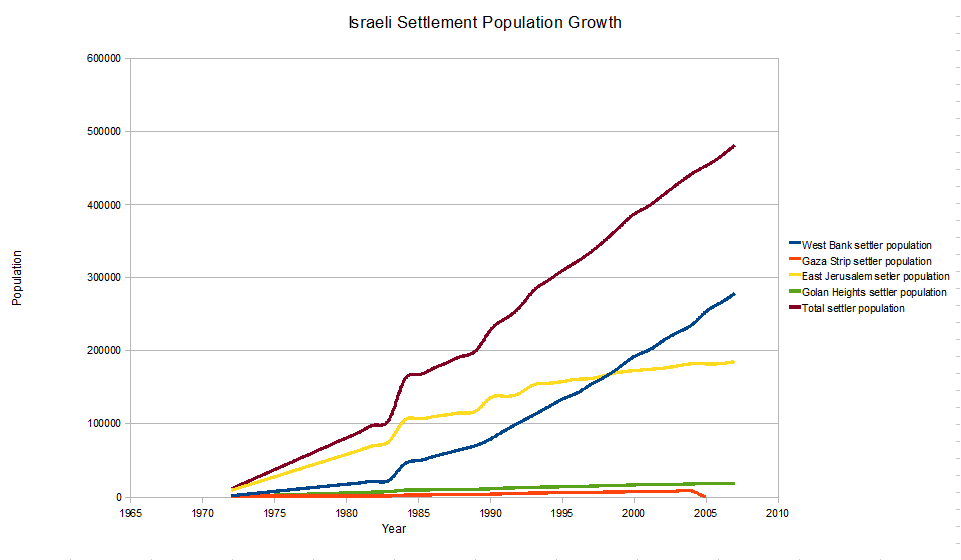
Settler population by year in the West Bank, Gaza Strip, East Jerusalem and Golan Heights 1972-2007 [1][dead link][2][dead link]

This is a timeline of the development of and controversy over Israeli settlements. As of January 30, 2022 the West Bank settlement population was 490,493 and the settler population in the Golan Heights was almost 27,000 and in East Jerusalem the settler population was around 220,000.[3][4][5]

1967

[edit]
  • The cease-fire agreement following the 1967 Six-Day War leaves Israel in control of a number of areas captured during hostilities.
  • From Jordan, Israel gains control of the West Bank, including East Jerusalem.
  • From Egypt, Israel gains control of the Sinai Peninsula up to the Suez Canal, and the Gaza Strip.
  • From Syria, Israel gains control of most of the Golan Heights, which since 1981 has been administered under the Golan Heights Law.
  • The municipal borders of Jerusalem are extended to include all of the Old City as well as other areas. Residents within the new municipal borders are offered the choice between citizenship (subject to a few restrictions) and permanent residency (if they wished to retain their Jordanian passports).
  • The Sinai, Gaza Strip, and West Bank are put under Israeli military occupation. Residents are not offered citizenship or residency, though they typically have de facto work permits within Israel and freedom of travel there.

1972

[edit]

1975

[edit]

1977

[edit]

1978

[edit]
  • Israel forcibly evacuates its citizens from the Sinai and demolishes their homes as the area is returned to Egypt pursuant to the Camp David Accords. The last Israeli community in the area, Yamit, is evacuated by early 1982.

August

[edit]

1979

[edit]

March

[edit]
  • United Nations Security Council Resolution 446 is passed. The resolution states that it "Determines that the policy and practices of Israel in establishing settlements in the Palestinian and other Arab territories occupied since 1967 have no legal validity and constitute a serious obstruction to achieving a comprehensive, just and lasting peace in the Middle East". The resolution is passed 12 votes to 0 with 3 abstentions. This is the first of many such UN resolutions against the Israeli settlements.[6]

1980

[edit]
  • The Knesset asserts Jerusalem's status as the nation's "eternal and indivisible capital" by passing the Jerusalem Law.
  • The UN declares the Jerusalem Law "null and void", and the Security Council in resolution 465 ordered Israel to dismantle the settlements.

1981

[edit]

December

[edit]
  • Israel extends its law to the Golan Heights, passing the Golan Heights Law, which grants permanent residency, ID cards, and Israeli citizenship to the residents, but does not formally annex the territory.

1983

[edit]

1985

[edit]

1989

[edit]

1990

[edit]

1991

[edit]

1992

[edit]

1993

[edit]

1994

[edit]

1995

[edit]

1996

[edit]

1997

[edit]

1998

[edit]

1999

[edit]

2000

[edit]

September

[edit]

2001

[edit]

2002

[edit]

2003

[edit]

April

[edit]
  • Israel and the Palestinians agree to the Road map for peace plan, in which Israel undertakes to freeze settlement building in all the occupied territories to accompany unconditional cessation of violence by the Palestinians.[8][9]

2004

[edit]
  • Settler population. West Bank: 234,487[1]-235,263.[2] Gaza Strip:7,826. East Jerusalem: 181,587[1]-176,566.[2] Golan Heights: 17,265. Total: 441,828.[1]
  • The Israeli Government and Parliament approve the evacuation of the Israeli settlements from the Gaza Strip and four settlements from northern Samaria." Nurit Kliot, "Resettlement of Refugees in Finland and Cyprus: A Comparative Analysis and Possible Lessons for Israel", in Arie Marcelo Kacowicz, Pawel Lutomski. Population Resettlement in International Conflicts: A Comparative Study, Lexington Books, 2007, p. 57.

2005

[edit]

March

[edit]
  • The Sasson report finds that Israeli state bodies have been discreetly diverting millions of shekels to build West Bank settlements and outposts that were illegal under Israeli law. The report exposes the existence of at least 150 such illegal outposts that lack proper government authorization.
  • The Israeli government confirms plans to increase the size of the Maale Adumim settlement, in the West Bank near Jerusalem, by 3,500 homes. Chief Palestinian negotiator Saeb Erekat criticizes the move, saying "[This] sabotages all efforts seeking to get the peace process back on track," and "The Israeli government wants to determine Jerusalem's fate by presenting the settlements and wall as a fait accompli.".[10]

August

[edit]

2006

[edit]

2007

[edit]

November

[edit]
  • Annapolis Conference is held. Palestinians demand settlement freeze as precondition for talks however Israel stands by plan to build new settlements in East Jerusalem.[13]

December

[edit]
  • Israel decides to build 300 more Israeli homes in the Har Homa neighborhood of East Jerusalem, near Bethlehem. The move is condemned by the United States and the European Union.[14]

2008

[edit]

March

[edit]
  • The Jerusalem municipality announces plans to build 600 new housing units in East Jerusalem. US Secretary of State Condoleezza Rice states in response that settlement expansion should stop and was inconsistent with 'road map' obligations.[15]

November

[edit]

December

[edit]

2009

[edit]

January

[edit]

June

[edit]
  • US President Barack Obama makes his famous Cairo speech in which he says "The United States does not accept the legitimacy of continued Israeli settlements".[17]
  • Israeli Defense Minister Ehud Barak authorizes the construction of 300 new homes in West Bank settlements.[18]

August

[edit]
  • US President Barack Obama demands a complete freeze on settlement construction in the West Bank, including East Jerusalem. The Israeli government agrees to a freeze in the West Bank. Peace Now argues that Israel is attempting to fool the United States.[19] On 25 August 2009 Netanyahu says that he will attempt to gain an agreement with the U.S. to continue building settlements before attempting to talk with the Palestinians.[20] On 28 August 2009 US officials said they would not impose conditions on the parties, but that it would be up to the parties themselves to determine if the threshold for talks had been met.[21] Education Minister Gideon Sa'ar defended the freeze as an attempt to "protect the vital interests - Jerusalem and the relationship with the United States - and to avoid national isolation, because we won't be able to do the things close to our hearts while under international isolation."[22]

September

[edit]
  • Hamas leader Khaled Meshaal called Israel's proposal to temporarily halt settlement construction in exchange for improved relations with Arab countries "Dangerous", as he viewed it as an attempt to avoid US demands. The Hamas leader's opposition to the Israeli proposal was supported by Arab League Secretary General Amr Moussa.[23]

November

[edit]
  • The United States government voices their dismay at the approved by the Israel's interior ministry of 900 additional housing units at a Jewish settlement in East Jerusalem. A White House spokesman says the move makes it "more difficult" to revive Israeli-Palestinian peace talks. Settlements on occupied territory are considered illegal under international law, though Israel disputes this and consider Gilo, the planned settlement area "an integral part of Jerusalem".[24]

December

[edit]
  • The Israeli government orders a 10-month lull in permits for new settlement homes in the West Bank.[25] The restrictions, which Israeli politicians and media have referred to as a "freeze",[25] do not apply to East Jerusalem (whose de facto annexation by Israel is not recognised internationally), municipal buildings, schools, synagogues and other community infrastructure in the settlements.[25][26] About 3,000 homes already under construction will be allowed to proceed.[25] The Israeli government said the move was aimed at restarting peace talks, but Palestinian officials said it was insufficient.[25] Palestinian officials have refused to rejoin peace talks until a total building halt is imposed, including in East Jerusalem.[25] The announcement followed calls by the US government for a total freeze in settlement building.[25] The US government, the European Union, Russia and the UN have criticized Israel's plans to continue building in East Jerusalem[27] but both the US and the EU have stated that there should be no preconditions for resuming the suspended peace talks related to Israel's Road Map requirement to freeze settlements.[28][29] although Palestinian participants would have to give prior acceptance of Israel's claim to statehood and refrain from violence.[30]

2010

[edit]

March

[edit]
  • Israel announces plans to construct 1600 settler homes in the Ramat Shlomo settlement in East Jerusalem during United States Vice President Joe Biden's visit to the region. Biden condemns the decision saying "The substance and timing of the announcement, particularly with the launching of proximity talks, is precisely the kind of step that undermines the trust we need . . . and runs counter to the constructive discussions I've had in Israel."[31]
  • United Nations Secretary-General Ban Ki-moon stated "The world has condemned Israel's expansion plans in East Jerusalem. Let us be clear: all settlement activity is illegal anywhere in occupied territory, and this must stop." He spoke both for the United Nations and the Middle East Quartet.[32]
  • The mayor of Jerusalem unveiled a plan to demolish 22 Israeli Arab homes in East Jerusalem to make way for a public park and tourist site.[33]

2011

[edit]

February

[edit]
  • The U.S. vetoes a draft resolution to condemn all Israeli settlements in Palestinian territory as illegal.

2017

[edit]

As of January 1, 2017 the West Bank settlement population was 420,899. [34]

2020

[edit]

In 2020 the settler population in East Jerusalem was around 220,000. [35]

2021

[edit]

In 2021 the settler population in the Golan Heights was almost 27,000 [4]

2022

[edit]

As of January 30, 2022 the West Bank settlement population was 490,493. [36]

The Israeli government’s Coalition Agreement of December 1, 2022 between incoming prime minister Benjamin Netanyahu's Likud party and the far-right, ultra-nationalist Religious Zionism party of Bezalel Smotrich states that "the prime minister will work towards the formulation and promotion of a policy whereby sovereignty is applied to Judea and Samaria" (biblical names for the occupied West Bank). Smotrich would take up a new post of minister within the defense ministry, where he would oversee civil matters in the West Bank. Other commitments included legalization of dozens of unauthorized settlements and the provision of large funds for road building and public transport in the West Bank.[37][38] To the concern of the US administration, Netanyahu made agreements with coalition partners to expand Israeli settlements and legalize dozens of Israeli outposts.[39]

2023

[edit]

January

[edit]

The new Israeli government told the Israeli High Court that the state would reverse its previous position that Israeli settlers leave Homesh, a yeshiva built on private Palestinian property, and that the government intends to change the Disengagement Law. The Palestinian landowners appealed to the court because they have been prevented from reaching their property due to settlers in the Israeli outpost blocking access. The State Attorney's Office said "the political echelon wishes to announce that, in accordance with the coalition agreements that were signed, it intends to act as soon as possible to amend the guidelines permitting Israelis to remain" and requested a further three months to submit another opinion.[40][41]

In response to the decision to grant the government 90 days to explain its decision to reverse course on Homesh, the US said that "The Homesh outpost in the West Bank is illegal. It is illegal even under Israeli Law. Our call to refrain from unilateral steps certainly includes any decision to create a new settlement, to legalize outposts or allowing building of any kind deep in the West Bank, adjacent to Palestinian communities or on private Palestinian land."[42][43]

February

[edit]

Israel approved the legalization of nine illegal settler outposts. A US spokesman said "We strongly oppose expansion of settlements, and we're deeply concerned by reports about a process to legalize outposts that are illegal under Israeli law. We are seeking more information from the Israeli government on what has actually been decided." The Palestinian Authority condemned the decision as crossing "all red lines".[44][45][46][47]

At a UNSC meeting of 20 February, the Council issued a formal statement condemning Israel's plan for settlement expansion on Palestinian territory. It was the first action the United States has permitted against Israel in six years. The statement said "The Security Council reiterates that continuing Israeli settlement activities are dangerously imperiling the viability of the two-State solution based on the 1967 lines" and "The Security Council expresses deep concern and dismay with Israel's announcement on February 12." The UAE did not push a draft resolution to a vote "given the positive talks between the parties." Netanyahu's office condemned the formal statement saying "The statement should not have been made and the United States should not have joined it."[48][49]

Finance Minister Bezalel Smotrich took charge of most of the Civil Administration, obtaining broad authority over civilian issues in the West Bank. Israeli peace groups condemned the move as de jure annexation of occupied territories.[50][51] Rights lawyer Michael Sfard tweeted that the action "entails de jure annexation of the West Bank".[52][53]

Daniel Kurtzer, former US ambassador to Israel, accused the government of breaking a written agreement with Washington by legalising a "group of hardline nationalist and religious settlements" and called on the Biden administration to prevent Israel's "creeping annexation" of the West Bank.[54]

March

[edit]

Israel repealed a 2005 law whereby four Israeli settlements, Homesh, Sa-Nur, Ganim and Kadim, were dismantled as part of the Israeli disengagement from Gaza. The move was condemned by the PA and the EU, the latter calling for the revocation of the new law. Critics, including some of the Israeli opposition and NGOs supporting Palestinian rights, denounced the move as a prelude to annexation of the West Bank.[55][56][57][58] The US, in addition to denouncing the move,[59] also summoned the Israeli ambassador to express concern.[60]

May

[edit]

With Israeli government approval, Israeli settlers relocated a yeshiva established on private Palestinian land in Homesh, to a nearby spot designated state-owned land. The relocation was carried out despite international opposition, including repeatedly from the U.S., and the opposition of the Israeli attorney general.[61][62][63][64][65]

June

[edit]

Israel shortened the procedure of approving settlement construction and gave Finance Minister Bezalel Smotrich the authority to approve one of the stages, changing the system operating for the last 27 years. The United States said it was "deeply troubled" by the Israeli plans that explicitly violate previous commitments made by Israel to the Biden administration. "The United States is deeply troubled by the Israeli government’s reported decision to advance planning for over 4,000 settlement units in the West Bank. We are similarly concerned by reports of changes to Israel’s system of settlement administration that expedite the planning and approvals of settlements". Tor Wennesland, United Nations Special Coordinator for the Middle East Peace Process urged a halt and reversal of the decisions and said "I am deeply concerned by the Israeli Government’s decision yesterday to alter settlement planning procedures that have been in place since 1996, which is expected to expedite settlement expansion. I am also alarmed by the anticipated advancement next week of over 4,000 settlement housing units by Israeli planning authorities". The Israeli press reported that the US has informed Israel that the Negev forum on regional cooperation will be postponed as a result of the Israeli moves.[66][67][68][69][70]

The US criticized Israel's advancement of plans for 5,700 new homes in Jewish settlements and said it was "an obstacle to peace".[71][72][73][74]

July

[edit]

In its first six months, construction of 13,000 housing units in settlements, almost triple the amount advanced in the whole of 2022.[75][76]

In a CNN interview on 9 July 2023, US President Joe Biden said that extreme cabinet ministers in the coalition that back settling "anywhere they want" in the West Bank are "part of the problem" in the conflict.[77][78]

December

[edit]

On December 4, the Lower Aqueduct plan for 1792 housing units was approved in an expedited process, marking the first major new East Jerusalem settlement plan in East Jerusalem since Givat HaMatos in 2012.[79][80]

2024

[edit]

February

[edit]

After Palestinian gunmen killed one Israeli and injured five Israelis near Ma'ale Adumim, Israel's far-right Finance Minister Bezalel Smotrich in February 2024 announced a "settlement response" after speaking to Prime Minister Benjamin Netanyahu and Defense Minister Yoav Gallant, as "any harm to us will lead to more construction and more development and more of our hold all over the country", with 2,350 more homes in Ma'ale Adumim and 300 more homes in Kedar being arranged for approval, as well as 700 more homes in Efrat slated to be built.[81] American Secretary of State Antony Blinken criticized the announcement, stating that new Israeli settlements are "inconsistent with international law" and "counter-productive to reaching an enduring peace", risking "Israel’s security".[81]

March

[edit]

Israel's government in early March 2024 fully approved 694 more settler homes for Efrat, and additionally progressed the approval of 2,452 more settler homes in Ma'ale Adumim and 330 more settler homes in Kedar, reported Haaretz.[82][83]

In late March 2024, Minister Smotrich declared that the Israeli government had newly seized 10 km2 of land in the West Bank, "promoting settlement through hard work and in a strategic manner all over the country".[84] Some of the seized land were in the Jordan Valley, and some were between the Israeli settlements Ma'ale Adumim and Kedar.[84] Settlement watchdog group Peace Now claimed that this land seizure was the largest by the Israeli government since the Oslo Accords of 1993.[84] The European Union confirmed that in the past year Israel had advanced the most West Bank settlements in decades.[85]

2025

[edit]

May

[edit]

On 29 May it was announced that Israeli ministers had approved 22 new Jewish settlements in the occupied West Bank, with several already existing as outposts that did not have government authorisation but would be made legal under Israeli law. Defence Minister Israel Katz described the move as preventative against establishment of a Palestinian state and a security measure.[86] These 22 settlements are Atarot Eder, Beit Horon North, Inbar, Ahiya, Nofei Prat, Adei Ad, Ir Hatmarim, Gvionit, Tevez, Gadi Camp, Maalot Halhul, Afeka, Yonadav, Mitzpe Ziv, Kedem Arava, Homesh, Sa-Nur, Mt. Ibal, El-Nave, Rehavam, Maoz Zvi and Havot Yair.[87]

In August 2025, U.S. House Speaker Mike Johnson, one of the highest-ranking American officials ever to visit an Israeli settlement in the West Bank, traveled to Shilo and Ariel, where he delivered a speech at a celebratory event attended by Ariel Mayor Yair Chetboun and other West Bank settlement leaders. During his remarks, Johnson declared that the "mountains of Judea and Samaria" belong to the Jewish people "by right."[88]

December

[edit]

Israel announced the formation of 19 new settlements in the west bank, 11 new settlements to be built, 8 outposts and neighborhoods recognized as settlements, including two evacuated in 2005. Smotrich says that the move aims to thwart the idea of a Palestinian state. The new settlements are Kida, Esh Kodesh, Givat Harel, Mishol, Kochav Hashachar-North, Nof Gilad, Ganim, Kadim, Shalem, Har Bezek, Reihanit, Rosh Ha'ayin-East, Tammun, P’nei Kedem, Yatziv, Ya’ar El Keren, Allenby, Yitav-West, and Nahal Doron.[89]

Notes

[edit]
Revisions and contributorsEdit on WikipediaRead on Wikipedia
from Grokipedia
The timeline of Israeli settlements encompasses the sequential establishment and demographic expansion of Jewish civilian communities in territories Israel captured during the defensive 1967 Six-Day War, including the West Bank (known in Israel as Judea and Samaria), the Gaza Strip until 2005, the Golan Heights annexed in 1981, and initially the Sinai Peninsula returned to Egypt in 1982. Beginning with pioneering outposts founded in July 1967, such as early Nahal military settlements transitioning to civilian use in the Golan and Sinai, the process involved ideological, security, and demographic motivations, resulting in over 130 official settlements in the West Bank by 2025 housing approximately 500,000 settlers, plus over 200,000 in East Jerusalem neighborhoods. Subsequent phases featured rapid growth in the 1970s under both Labor and Likud governments, with settlement populations multiplying from a few thousand to tens of thousands amid post-Yom Kippur War strategic considerations; partial moratoriums during the 1990s Oslo Accords era; the unilateral 2005 Gaza disengagement evacuating 21 settlements and 9,000 residents; and accelerated construction post-2017, including outpost legalization and over 20,000 housing units approved annually in recent years despite international opposition. These developments remain a core contention in Israeli-Palestinian relations, with Israel asserting legal rights based on historical Jewish ties, absence of prior legitimate sovereignty in the territories, and defensive acquisition in a war initiated by Arab states, while much of the international community, influenced by interpretations of the Fourth Geneva Convention, classifies them as unlawful obstacles to a two-state solution—though empirical analyses highlight that settlement extent comprises less than 2% of West Bank land, with contiguous state viability challenged more by geography and security needs than density alone.

Ancient and Medieval Jewish Presence in Judea and Samaria

The region of and formed the heartland of ancient Jewish sovereignty, with archaeological evidence confirming Israelite settlement from the late transition around 1200 BCE, when Semitic tribes coalesced into distinct Israelite entities amid Canaanite populations. The United Kingdom of Israel under kings , and (circa 1020–930 BCE) encompassed as its northern core, followed by the independent (circa 930–586 BCE), which retained control over until the Babylonian destruction of the First Temple in 586 BCE. Post-exile, Persian permission in 539 BCE enabled Jewish repatriation, reestablishing Yehud province with as capital and continuous habitation evidenced by seals, coins, and fortifications in sites like Ramat Rahel and Khirbet Summeily. Hellenistic and Hasmonean eras (4th–1st centuries BCE) saw Jewish expansion, including Maccabean reconquest of in 128 BCE, while Roman rule from 63 BCE featured dense Jewish populations in , punctuated by the Great Revolt (66–73 CE) and (132–135 CE), whose cave refuges in the Judean Desert yield artifacts like letters and weapons attesting to organized resistance. Despite Roman suppression and Hadrian's renaming to , Jewish continuity persisted under Byzantine rule (4th–7th centuries CE), with synagogues at sites like and Eshtemoa in , and agricultural terraces indicating sustained settlement patterns. The Arab conquest of 636–638 CE did not eradicate these communities; tax records and traveler accounts, such as those of in 1167 CE, document Jewish households in (numbering around 20 families) and nearby Bethel, focused on scholarship near the Tomb of the Patriarchs. In , Jewish presence was sparser amid Samaritan majorities but evident in (ancient ), where 11th-century fragments reference ritual practices. administration (1260–1517 CE) imposed restrictions yet preserved Jewish quarters in , bolstered by influxes like the 1492 Spanish exiles, who established yeshivas; by the 16th century, 's Jewish population approached 200 amid a total of 1,000 residents. This enduring presence, substantiated by epigraphic, numismatic, and structural remains, underscores and as loci of Jewish religious practice—encompassing sites like Bethel (patriarchal altar) and Shiloh ()—resisting full depopulation despite conquests and exiles. Ottoman censuses from the onward confirm modest but unbroken communities, with maintaining a synagogue and operational into the . Such continuity, amid dominant non-Jewish rule, reflects adaptive resilience rather than absence, countering narratives of total displacement.

Zionist Settlement Efforts Under Ottoman and British Rule

The Zionist movement, formalized at the in 1884, initiated organized Jewish immigration and settlement in Ottoman Palestine primarily to establish agricultural communities and revive Hebrew culture. The (1882–1903) brought approximately 25,000–35,000 immigrants, mostly from fleeing pogroms, who founded moshavot (agricultural villages) such as (1882), (reestablished 1883), (1882), and (1882), often with financial support from philanthropists like Baron Edmond de Rothschild. These efforts emphasized private farming on purchased land, typically from absentee Arab landlords, though Ottoman authorities imposed restrictions, including a 1882 ban on Jewish land sales to foreigners and periodic expulsion orders, which were inconsistently enforced due to bribery and local corruption. By 1900, Jews owned about 430,000 dunams (roughly 1% of Palestine's cultivable land) through such transactions. The Second Aliyah (1904–1914) saw around 35,000–40,000 immigrants arrive, driven by renewed Russian pogroms after 1903, introducing socialist ideals and collective farming; Degania, the first kibbutz, was established in 1910 near the Sea of Galilee, prioritizing Hebrew labor and self-reliance over hired Arab workers. Organizations like Hashomer provided armed protection against Bedouin theft and attacks, reflecting early security concerns amid growing Arab resentment over land transfers that displaced tenant farmers. The Jewish National Fund, founded in 1901, systematized land acquisition for national purposes, purchasing swampy or malarial areas for drainage and settlement; by 1914, approximately 30 Zionist colonies existed, with the Jewish population reaching about 85,000, or 8–10% of Palestine's total. Ottoman policies hardened after the 1908 Young Turk Revolution, with decrees in 1914 prohibiting further Jewish immigration and land sales, though smuggling and illegal entry persisted. British conquest of Palestine in 1917–1918, culminating in the Mandate established in 1920 (formalized 1922), facilitated expanded Zionist efforts following the Balfour Declaration of November 2, 1917, which expressed support for "the establishment in of a national home for the Jewish people" while stipulating non-prejudice to existing non-Jewish communities. This policy shift enabled the Third Aliyah (1919–1923), with ~35,000 immigrants building urban centers like (expanded from 1909 origins) and rural outposts, amid post-World War I economic aid from the Zionist Organization. Subsequent waves—the (1924–1929, ~82,000 mainly Polish Jews) and (1929–1939, ~225,000–250,000 fleeing Nazi persecution)—drove rapid growth, establishing over 100 new settlements, including kibbutzim in the and coastal plain, through JNF purchases totaling ~900,000 dunams by 1936. Settlement expansion faced Arab opposition, manifesting in riots (1920 Jaffa, 1921, killing 67 ) and the 1936–1939 revolt, which targeted Jewish communities and British forces; these events prompted Zionist formation of the militia for defense. British responses oscillated: the 1922 affirmed the Mandate's pro-Zionist framework but capped immigration, while the 1939 severely restricted it to 75,000 over five years amid Arab pressure, hindering further settlement despite surging European Jewish refugees. By 1947, comprised ~600,000 residents (one-third of Mandate Palestine's population) and owned 6–7% of the land, primarily via legal market transactions from large landowners like the , though this fueled narratives of dispossession among local whose tenancy rights were not always preserved. These pre-state efforts laid the demographic and institutional groundwork for later Israeli statehood, emphasizing self-sufficiency, land redemption, and security amid geopolitical shifts.

1948-1967: Jordanian Control and Preemptive Claims

Following the 1948 Arab-Israeli War, Jordanian forces of the occupied the , including and the Old City, in May 1948, capturing these areas amid the conflict's collapse of British Mandate structures. The 1949 armistice agreement between and established demilitarized zones and provisional lines, but retained effective control over the territory until 1967, with no Israeli presence or settlements established there during this period. On December 1, 1948, the , convened by King Abdullah I, resolved to unify the occupied Palestinian territories with Transjordan, leading to formal on April 24, 1950, which incorporated the into the Hashemite Kingdom of and granted to approximately 400,000 Palestinians. This received international recognition only from the and , while the condemned it and protested to the , underscoring the territory's disputed status under international law. Under Jordanian administration, Jewish access to and its holy sites was systematically denied, contravening Article VIII of the 1949 armistice agreement, which mandated free access to religious sites for all faiths. The Jewish Quarter of the Old City was razed, with its 58 synagogues desecrated, converted into stables, or demolished; the became inaccessible to ; and the cemetery, containing over 150,000 Jewish graves, suffered extensive vandalism, with thousands of tombstones repurposed for road construction, latrines, and Jordanian military camps. Jordanian policies also facilitated the confiscation of Jewish-owned properties from the Mandate era, treating them as absentee or enemy assets without compensation, though legal titles held by Jewish individuals and institutions remained contested and unextinguished in Israeli courts and international claims processes. These actions contributed to the near-total expulsion or flight of the remaining Jewish population from the , reducing it to zero by 1949, while integrated the area administratively but faced no pressure from Palestinian nationalists for independence during its rule. Preemptive Jewish claims to lands persisted through commemoration of pre-1948 settlements and preservation of property deeds, particularly in areas like , where four kibbutzim established in the 1940s on legally purchased land were overrun in May 1948. The bloc fell after a prolonged siege beginning post-UN Partition Resolution in November 1947, culminating in the May 13-14 assault by Jordanian Legion forces and local Arabs, resulting in the destruction of the settlements, the massacre of 127 defenders at , and the capture of 260 survivors who were imprisoned in until mid-1949. Survivors and descendants maintained moral and legal assertions to reclaim these sites, viewing the loss as temporary amid the armistice's non-recognition of permanent Jordanian sovereignty, though no physical reestablishment occurred until after the 1967 war due to Jordanian military control and hostilities. Israel's non-recognition of the reinforced the territory's status as disputed rather than sovereign Jordanian land, laying groundwork for post-1967 reclamations based on historical Jewish presence and unceded titles.

Interpretations of International Law on Disputed Territories

The West Bank, referred to historically as Judea and Samaria, lacks a recognized sovereign prior to Israel's control following the 1967 Six-Day War, rendering it a disputed rather than classically occupied territory under international law. Jordan's 1950 annexation was acknowledged only by the United Kingdom and Pakistan, with the Arab League itself declaring it illegal, leaving the area without legitimate sovereignty at the time of Israel's defensive conquest. Legal scholars such as Eugene Rostow, former U.S. Under Secretary of State, argued that the territories reverted to the legal framework of the 1922 League of Nations Mandate for Palestine, which explicitly encouraged Jewish settlement as part of establishing a national home, rather than constituting an occupation of foreign sovereign soil. Similarly, international law experts Julius Stone and Stephen Schwebel contended that pre-1945 norms allowing territorial acquisition through defensive warfare applied, as the Hague Regulations and Geneva Conventions presuppose belligerent occupation of an established sovereign's territory, a condition unmet here. United Nations Security Council Resolution 242 (1967), which called for Israeli withdrawal "from territories occupied in the recent conflict," deliberately omitted "all" or "the" territories—a phrasing negotiated to permit secure, recognized borders via agreement rather than full retreat to pre-1967 lines. This interpretation aligns with the resolution's emphasis on negotiation under Article 33 of the UN Charter, rejecting unilateral imposition, as affirmed by U.S. Ambassador and British Ambassador Lord Caradon, drafters who clarified it did not mandate complete withdrawal. Critics from UN bodies and certain academic circles assert a broader obligation to vacate all areas, but this overlooks the resolution's textual precision and historical context of Israel's vulnerability on indefensible armistice lines. Article 49(6) of the (1949), prohibiting an occupying power from deporting or transferring its civilian population into occupied territory, is invoked against settlements, yet its applicability hinges on the territory's status and the nature of population movement. The provision targets forcible transfers, as in Nazi deportations to slave labor camps, not voluntary civilian migration, and multiple states parties, including the U.S. and , have not ratified interpretations extending it to private initiatives in disputed lands. In non-sovereign areas like the , where Jewish communities predated modern states under Ottoman and Mandate rule, settlements represent a return of indigenous populations rather than impermissible implantation, per analyses by scholars like . The of Justice's 2004 on the separation barrier deemed settlements violative, assuming occupation without resolving sovereignty deficits, an approach critiqued for politicized reasoning over rigorous legal precedent, as advisory opinions lack binding force and often reflect institutional predispositions. A 2019 U.S. State Department determination echoed this, stating settlements are not inherently inconsistent with , prioritizing factual dispute resolution over presumptive illegality. From first-principles, prioritizes stability and in contested areas absent clear title, favoring negotiated outcomes over vetoes by non-sovereign claimants; thus, Israeli administrative presence and settlement activity serve as interim measures pending final status talks, consistent with the Mandate's corpus separatum provisions for and broader Jewish settlement rights. Empirical data on settlement growth correlates with needs post-1967 attacks, underscoring causal links between territorial depth and defense, rather than per se. Mainstream institutional views, while dominant, warrant scrutiny for systemic biases favoring Arab narratives, as evidenced by selective application of occupation doctrines elsewhere, such as Turkish Cyprus or Moroccan .

Sinai and Golan Settlements (1967-1982 and Ongoing)

Sinai Establishments and Yamit Development

Following the in June 1967, during which captured the from , the Israeli government approved the establishment of settlements in the territory primarily for security reasons, aiming to create strategic depth against potential Egyptian aggression and to develop underutilized arid lands. Initial efforts involved military outposts by units, which combined defense with agricultural pioneering, transitioning some to civilian control in the early 1970s as part of broader settlement policy under Labor-led governments. By the mid-1970s, approximately a dozen civilian communities had been founded in northern Sinai, focusing on farming, , and to support population growth and economic viability. Yamit, located near the Gaza Strip in northern Sinai, represented the most ambitious development project, founded in 1975 as Israel's first planned urban settlement in occupied territory. Intended as a regional hub with residential, industrial, and agricultural zones—including a deep-water port, desalination plants, and greenhouses—the town was designed to accommodate up to 200,000 residents long-term, though it reached only about 2,500-3,000 by the late 1970s. Construction accelerated under Prime Minister Yitzhak Rabin's administration, with the first 350 families scheduled for relocation by spring 1976 to foster urban growth amid ongoing border tensions. Surrounding rural kibbutzim and moshavim, such as Sufa and Atzmona, complemented Yamit's development by cultivating export-oriented crops like and tomatoes, leveraging Israeli expertise to transform into productive farmland. These establishments reflected a dual rationale: securing the frontier post-1973 vulnerabilities and promoting national resilience through demographic and economic expansion, with government subsidies incentivizing migration from Israel's periphery. By 1979, northern Sinai hosted around 7,000 settlers across and adjacent sites, underscoring the scale of investment before peace negotiations shifted priorities.

Sinai Dismantlement Under Camp David Accords

The Egypt-Israel Peace Treaty, signed on March 26, 1979, following the , obligated Israel to fully withdraw from the by April 25, 1982, including the complete evacuation and dismantlement of all Israeli settlements established there since the 1967 . This encompassed approximately 18 settlements, primarily in northern Sinai along the coast and near the , which housed around 7,000 residents engaged in agriculture, fishing, and military-related activities. The Israeli government, under Prime Minister , provided compensation packages and relocation support to settlers, prioritizing voluntary departure to minimize confrontation, though ideological opposition from groups like framed the withdrawal as a strategic and historical concession for peace with . Evacuations proceeded in phases aligned with the treaty's timetable: initial military redeployments occurred on , 1979 (El-Arish and surrounding areas) and , 1980 (further inland zones), clearing the way for civilian settlement removals starting in late 1981. By November 1981, most northern Sinai settlements, such as and Morag precursors, were vacated without significant resistance, with residents relocating primarily to southern near the Gaza border or other domestic sites; approximately 1,400 families participated in organized resettlement programs offering financial incentives equivalent to their prior investments. These actions reflected a pragmatic implementation of the treaty's demilitarization and denuclearization clauses for Sinai, verified by joint patrols and U.S. monitoring teams to ensure compliance. The final phase centered on , the largest settlement with over 2,000 residents and infrastructure including schools, factories, and greenhouses, intended as a regional hub. Designated for evacuation by April 23, 1982, most inhabitants left voluntarily after negotiations, but around 200-300 holdouts barricaded buildings, leading to IDF intervention involving non-lethal force such as foam sprays and arrests to remove resisters without fatalities. Post-evacuation, the Israel Defense Forces demolished 's structures using explosives and bulldozers between April and May 1982 to prevent reutilization, marking the first instance of large-scale dismantlement and setting a for future withdrawals. The process concluded with the treaty's full on April 25, 1982, restoring Egyptian sovereignty over Sinai amid international oversight, though it fueled domestic debates in Israel over territorial compromises for security guarantees.

Golan Heights Settlements and Strategic Consolidation

Following the capture of the from in the closing days of the on June 9-10, 1967, rapidly initiated settlement activity to secure the elevated terrain, which overlooks northern and had previously enabled Syrian artillery to target communities in the region. Prior to 1967, Syrian forces positioned on the heights conducted frequent shelling of Israeli agricultural settlements below, resulting in civilian casualties and necessitating a defensive buffer to mitigate such vulnerabilities. The establishment of civilian outposts was prioritized to maintain physical presence, facilitate early warning systems, and control headwaters of the , which supply a significant portion of 's freshwater. The inaugural Israeli settlement, Kibbutz Merom Golan, was founded on July 14, 1967, by pioneers from kibbutzim on the site of an abandoned Syrian , marking the first permanent Jewish community in the area post-war. This was followed by additional kibbutzim and moshavim, such as Ein Zivan in 1968 and Keshet in 1974, oriented toward , , and military-adjacent functions to reinforce territorial hold amid ongoing Syrian threats. By the mid-1970s, these communities formed a network providing , with settlers often doubling as reservists to deter incursions and monitor the border. The 1974 Israel-Syria disengagement agreement, mediated by the , saw retain control over approximately two-thirds of the —including most settlement areas—while regained a narrow strip east of the Purple Line, solidifying 's defensive posture without relinquishing key elevations. Settlement expansion accelerated under this framework, driven by imperatives rather than demographic predominant elsewhere, as the heights' offered unparalleled vantage for against Syrian rearmament and later Iranian proxies. By 1981, planned to establish five additional settlements, bringing the total toward 35 to further entrench control. On December 14, 1981, the passed the , extending , jurisdiction, and citizenship offers to the territory—excluding the population, many of whom rejected integration—formalizing amid stalled peace talks and Syrian alignment with Soviet-backed forces. This measure enabled development, including roads and wineries, enhancing economic viability and population stability, with numbers growing from initial hundreds to thousands by the early through incentives tied to national defense needs. The consolidation reflected a causal prioritization of defensible borders over interim occupation status, given Syria's refusal to negotiate recognition of and history of from the plateau.

Gaza Strip Settlements (1970-2005)

Initial Outposts and Ideological Foundations

The first Israeli outpost in the following the 1967 was established at in 1970, re-founded by the military unit under the Labor-led government as a strategic military settlement to secure key transportation routes and counter cross-border infiltration from . This site, originally built in 1946 as part of pre-state Zionist efforts to claim southern territories, was repopulated with 66 families initially housed in tents and modular structures, reflecting early pragmatic priorities of border defense rather than immediate civilian expansion. By 1971, additional outposts followed, including early precursors to settlements like Netzer, aimed at establishing buffer zones amid ongoing attacks. These initial outposts were motivated primarily by security imperatives, as articulated by Labor leaders who viewed Gaza's southern flank as vulnerable to Egyptian re-invasion or terrorist incursions, drawing on precedents from pre-1948 frontier settlements that emphasized demographic presence for deterrence. Between 1970 and 1973, constructed four such sites, transitioning some from military to civilian control to consolidate territorial claims without formal annexation. Ideologically, the efforts echoed Labor Zionism's pioneering ethos of land redemption through cultivation and defense, though with limited religious framing at inception; proponents cited historical Jewish ties to the region, including biblical references to Yehuda, but prioritized empirical control over messianic visions. The ideological groundwork intensified with the rise of religious Zionist movements, particularly after Kfar Darom's conversion to a civilian in 1973, which then functioned as a training hub for activists pushing settlement as a divine imperative. , formalized in 1974, drew from Rabbi Abraham Isaac Kook's theology positing Jewish settlement in Eretz Israel—including peripheral areas like Gaza—as a catalyst for messianic redemption, blending secular Zionism's practicality with halachic duty to inhabit and transform the land. This fusion justified outposts not merely as defensive but as redemptive acts, influencing later Gaza expansions despite the area's lesser biblical centrality compared to and ; early adherents, often from national-religious backgrounds, argued that strategic footholds in Gaza fulfilled broader Zionist causality by preempting Arab through persistent presence. By the mid-1970s, these foundations had shifted initial military sites toward ideologically driven communities, setting precedents for Gush Katif's development amid evolving political support.

Expansion and Confrontations with Local Populations

Following the establishment of initial outposts like Kfar Darom in 1970 and three others by 1973, Israeli settlement activity in the Gaza Strip expanded gradually, primarily in the southern Gush Katif bloc and isolated northern sites such as Netzarim. By the late 1970s and early 1980s, under the Likud government, additional communities were authorized, including religious kibbutzim and moshavim focused on agriculture and ideological settlement, bringing the total to around a dozen by the mid-1980s. This phase emphasized strategic positioning to secure borders and counter infiltration from Egypt and the Sinai, with settlements often built on former Egyptian military sites or state land. Settlement numbers continued to grow into the and early , reaching 21 communities by 2005, housing approximately 8,000-9,000 residents concentrated in fortified blocs like , which comprised over 17 settlements covering about 1% of Gaza's land but requiring extensive security infrastructure. Population growth reflected both natural increase and ideological migration, supported by government subsidies for housing and farming, though expansion faced internal Israeli debates over viability amid demographic pressures from Gaza's 1.3 million Palestinian residents. From the outset, settlers encountered persistent violence from Palestinian militants and locals, including shootings, stabbings, and grenade attacks, necessitating IDF-guarded roads and perimeters that transformed settlements into semi-militarized zones. In the 1970s, incursions targeted outposts like , killing civilians in sporadic raids linked to PLO factions. The , erupting in Gaza in December 1987, escalated confrontations with widespread riots, stone-throwing, and Molotov cocktails against settlements, resulting in over 100 Israeli deaths across the territories by 1993, many in Gaza ambushes. Post-Oslo (1993-2000), relative calm shattered with rising and Islamic Jihad operations, including the 1994 kidnapping and murder of a soldier near , bus shootings in , and the 2002 Passover suicide bombing killing 30, mostly non-settlers but underscoring Gaza's role as a launchpad. The Second Intifada (2000-2005) intensified threats, with over 200 attacks on Gaza settlements documented, including rocket fire, ambushes from nearby villages, and infiltrations killing dozens of settlers—such as the 2003 of a mother and daughter near Morag—prompting reinforced barriers and operational responses that reduced but did not eliminate casualties. These incidents, often originating from densely populated adjacent areas like and , highlighted the settlements' isolation and the causal link between militant infrastructure in Gaza and direct assaults on civilian communities.

2005 Disengagement: Unilateral Withdrawal and Aftermath

In December 2003, Israeli Prime Minister announced a unilateral disengagement plan from the , aiming to evacuate all Israeli settlements and military installations there to reduce friction with the Palestinian population and improve Israel's security position amid stalled negotiations. The plan, detailed in April 2004, targeted the removal of approximately 21 settlements housing around 8,000-9,000 Jewish residents, along with four small northern outposts, without requiring reciprocal concessions from Palestinian authorities. Despite opposition from settler groups and right-wing factions who viewed the move as a retreat rewarding , the Israeli cabinet approved it in June 2004, the ratified it on October 26, 2004, and implementation orders were signed in February 2005. Evacuation operations commenced on August 15, 2005, with the (IDF) methodically removing residents who had not voluntarily departed by the deadline; by August 22, all settlers had been relocated, and military withdrawal was completed by September 12, including the demolition of residential structures to prevent their use by militants. The process involved coordinated efforts by security forces, with minimal widespread violence despite protests and isolated resistance from holdouts, displacing families to temporary housing and new communities within proper. also facilitated the transfer of greenhouses and industrial sites to for economic continuity, funded partly by private donors, though much of this infrastructure was subsequently looted or destroyed. In the aftermath, the disengagement did not yield the anticipated moderation or economic progress in Gaza; instead, Palestinian militants, including , intensified rocket and mortar attacks on Israeli communities, rising 42% from 2005 to 1,777 incidents in 2006 as groups exploited the vacuum to smuggle weapons and construct attack tunnels. capitalized politically, winning legislative elections in January 2006 and violently seizing full control from in June 2007, transforming Gaza into a launchpad for sustained rather than a . Israel's subsequent aimed to curb arms inflows, but empirical data indicated no causal link to dividends, with Gaza's governance prioritizing militarization over development, leading to multiple IDF operations in response to escalating threats.

West Bank and East Jerusalem Initial Phase (1967-1976)

1967: Kfar Etzion Reestablishment and Military Sites

Following Israel's victory in the , which concluded on June 10, 1967, the Israel Defense Forces (IDF) captured the from Jordanian control, including the bloc on June 7. This area, site of four Jewish settlements destroyed in 1948 with significant loss of life, held symbolic importance for Zionist redemption narratives. The Israeli government, led by Prime Minister Levi Eshkol's Labor alignment, initially imposed a settlement freeze but permitted reestablishment in Etzion due to its pre-1948 Jewish presence and strategic location south of . On September 25, 1967, was reestablished as a by descendants and survivors of the original 1943-1948 community, marking the first Israeli civilian settlement in the post-war. Approximately 14 families, totaling around 50 individuals, relocated to the site, which had lain in ruins for two decades; initial infrastructure included rebuilt housing and agricultural facilities, supported by private funding and religious Zionist groups like Gush Emunei Eretz Yisrael. The move reflected ideological motivations to reclaim Jewish historical land amid military occupation, rather than purely security-driven expansion, though it received IDF logistical aid for protection against potential Arab reprisals. Concurrently, the IDF established military sites across the to consolidate control and deter threats, designating over 150,000 hectares—about 26.6% of the territory—as closed military zones by mid-1968. These included outposts near strategic ridges and borders, such as in the Etzion area, providing defensive perimeters that facilitated civilian initiatives like without immediate conversion to permanent settlements. Unlike later military-agricultural units, 1967 sites emphasized rapid fortification under orders, prioritizing intelligence and rapid response over habitation, though some evolved into bases supporting settlement . This dual civilian-military approach underscored Israel's post-war strategy of demographic assertion backed by force, amid international debates over territorial administration.

1968-1970: Kiryat Arba and Gush Etzion Revival

On April 4, 1968, Rabbi Moshe Levinger and a group of approximately 30 religious Jewish families arrived in during , renting rooms at the Park Hotel under the pretext of a short holiday celebration with military permission, but intending to establish a permanent presence in the city, which had been devoid of a Jewish community since the . The Israeli government, led by Levi Eshkol's Labor Party, initially opposed civilian settlements in the , viewing them as contrary to post-war diplomatic strategies, and ordered the group evicted after their extended stay drew local Arab opposition and international scrutiny. Despite this, the settlers' persistence, coupled with advocacy from figures like Zalman Aranne, pressured authorities to relocate them temporarily to a nearby military base while planning a formal outpost. By July 1970, amid ongoing negotiations and a secret military order documented in Defense Minister Moshe Dayan's office minutes, the government approved the establishment of on adjacent hilltop land east of , framing it initially as a military outpost to bypass cabinet restrictions on civilian settlements, though the site was selected for its proximity to and historical Jewish ties rather than purely defensive needs. This marked the first authorized Jewish in the Hebron region post-1967, with construction beginning shortly after; by 1971, families began moving into initial housing, growing to support over 7,000 residents by later decades. The process highlighted tensions between ideological settlers seeking biblical reclamation and a reluctant Labor administration prioritizing security and territorial ambiguity. Concurrently, the revival of advanced with the founding of in June 1970, organized by a core group of religious Zionists including students from Merkaz Harav , on land near the pre-1948 site of Masuot Yitzhak kibbutz, aiming to create a Torah-centered community integrated with . This settlement, the second major one in the bloc after Kfar Etzion's 1967 reestablishment, reflected broader efforts by survivors' descendants to repopulate the area destroyed in 1948, emphasizing agricultural and educational self-sufficiency amid government approvals for "security zones" that facilitated expansion. By 1970, these developments solidified 's role as a focal point for Jewish return, with initial populations numbering in the dozens, supported by regional council planning despite limited infrastructure.

1971-1976: Labor Government Authorizations and Security Responses

During the early 1970s, the Israeli Labor government under Prime Minister authorized additional settlements in the as part of a strategy to secure the eastern frontier against potential armored incursions from , building on the Allon Plan's emphasis on sparsely populated strategic zones. These included agricultural and paramilitary outposts designed to monitor infiltration routes and provide early warning, with six villages established along the main highway by 1970 and further expansions into the Jordan Rift and Samarian slopes by 1977. By 1972, settlements like Har Gilo were approved near to reinforce control over high ground overlooking key roads, justified by military assessments of vulnerability to cross-border threats following the 1967 war. The 1973 Yom Kippur War intensified security concerns, prompting Labor to view settlements as essential for defensible borders amid fears of renewed Arab offensives, though approvals remained selective and avoided densely populated Arab areas. Under Yitzhak Rabin's government from 1974, authorizations continued for Jordan Valley sites such as Ma'ale Efrayim in 1975, intended to deter and secure critical for national defense. These were often initiated as Nahal military brigades before transitioning to civilian communities, reflecting a pragmatic response to intelligence reports of Jordanian-PLO coordination in attacks. The rise of in late 1974 introduced ideological pressure for settlements in biblical heartland areas like , leading to unauthorized attempts at Sebastia in 1974, which were evicted by security forces to maintain government policy. Similar evictions occurred at near in 1975, where over 100 settlers were removed after establishing a camp without permission, citing security risks of uncontrolled expansion. However, persistent protests and political divisions within the coalition forced compromises; by early 1976, after a months-long standoff at Kadum army camp southwest of , permitted about 120 members to reside there under IDF protection, effectively authorizing the nucleus of as a security outpost. This concession highlighted tensions between ideological activism and Labor's security-focused rationale, with the government framing such sites as buffers against incursions from . Overall, Labor's approach during this period resulted in approximately 20-25 settlements by 1976, predominantly in low-conflict zones, prioritizing empirical military needs over territorial maximalism amid ongoing terrorist incidents that killed dozens of Israelis annually. later articulated that these outposts enhanced deterrence and bargaining leverage in peace talks, though critics within the party warned of diplomatic costs.

Acceleration and First Intifada (1977-1993)

1977-1980: Likud Policies and Ma'ale Adumim Founding

The election of the Party under on May 17, 1977, marked a significant shift in Israeli settlement policy, replacing the more restrained approach of prior Labor governments with explicit ideological support for Jewish communities in the , viewed as integral to historical Jewish rights and national security against Arab threats. Begin, drawing from , advocated for extensive settlement as a means to assert sovereignty over Judea and Samaria, contrasting with Labor's focus primarily on security-oriented outposts. Immediately after taking office, Begin visited the outpost on May 19, 1977, publicly endorsing the establishment of numerous settlements to strengthen Israel's hold on the territory. A key early action was the July 26, 1977, decision by the Ministerial Committee on Settlements to grant legal status to three previously unauthorized outposts: , , and , formalizing their transition from temporary military sites or informal camps to permanent civilian communities. , initially established in December 1975 as a small laborers' camp on expropriated land east of following 3,000 hectares seized in 1975, received this official recognition shortly after Likud's ascent, enabling rapid civilian expansion as a suburban settlement intended to link with the and provide a demographic buffer. Additional land expropriations in 1977 further supported its development into a , with infrastructure incentives like free land for self-built homes attracting families. This period saw intensified settlement activity, with over half of all West Bank settlements constructed between 1977 and 1983 under Begin's administration, building on the approximately 79 outposts existing by May 1979 and contributing to a population reaching around 8,000 outside by late 1979. Policies emphasized "thickening" existing sites alongside new approvals, prioritizing ideological and strategic locations amid ongoing security concerns from Palestinian militancy, though Begin later pledged in July 1980 to limit new foundations to ten while focusing on in approved areas. These measures reflected a causal of settlement as a deterrent to territorial concessions, grounded in empirical assessments of vulnerability post-1973 , rather than mere expansionism.

1981-1987: Outpost Growth Amid Lebanon War

During the early 1980s, under the Likud-led government of Prime Minister Menachem Begin, Israeli settlement policy in the West Bank emphasized both ideological claims to biblical heartland territories and strategic security buffers against potential Arab threats, leading to the authorization of multiple new outposts despite international criticism. In June 1981, Israeli authorities established three new settlements in the West Bank as part of this expansionist approach. The settler population in the West Bank, excluding East Jerusalem, stood at approximately 16,000 in 1981, reflecting sustained immigration incentives and land expropriations declared as state property, often totaling 200,000 to 300,000 dunams annually for settlement purposes. The , launched in June as Operation Peace for Galilee to dismantle PLO infrastructure in and prevent cross-border attacks, diverted significant military resources northward but did not halt West Bank outpost development; instead, the conflict's suppression of Palestinian leadership through expulsions and administrative detentions—over 1,000 mayors, notables, and activists deported or arrested—temporarily reduced local resistance, enabling settler groups like to advance unauthorized outposts via rapid "caravan" placements that were later retroactively approved. By late 1982, the settler population had doubled to around 30,000, supported by government subsidies prioritizing suburban-style communities such as expansions in Ariel and to attract non-ideological urban dwellers, with plans under the "Program of the 100,000" aiming for 100,000 residents by 1986. Specific outposts established during this phase included in 1981 near , intended as a regional center, and subsequent sites like Dolev in 1983, which grew amid minimal initial enforcement due to wartime priorities. Following Begin's resignation in 1983 and the transition to Yitzhak Shamir's leadership, settlement momentum persisted, with , as Minister of Agriculture and overseer of settlement affairs, advocating for "thickening" existing blocs through housing approvals and infrastructure, resulting in seven new settlements announced in 1982 alone despite U.S. pressure under the Reagan Plan to curb expansion. By 1987, the settler population exceeded 60,000, driven by natural growth rates surpassing Israel's national average (around 3-4% annually) and targeted incentives like low-interest loans and tax breaks, though this figure drew scrutiny from sources like the U.S. State Department for altering demographic realities in disputed territories. The period's outpost proliferation, often on hilltops for strategic vantage, underscored a causal link between military operations weakening adversarial networks and opportunistic civilian settlement advances, with over 20 new communities or expansions formalized between 1983 and 1987 per Israeli government records.

1988-1993: Intifada Violence and Settlement as Buffer

The , which began in December 1987, saw a marked escalation in violence directed at Israeli settlements in the and from 1988 onward, with Palestinian militants and stone-throwers targeting settlers, vehicles on inter-settlement roads, and communal infrastructure. Attacks often involved ambushes, stabbings, and shootings, contributing to heightened insecurity for settler communities. According to data compiled by the Israeli human rights organization , 47 Israeli civilians—predominantly settlers—were killed by Palestinians in the occupied territories between December 1987 and September 1993, with annual figures rising from 6 in 1988 to 16 in the first nine months of 1993 alone. These incidents, alongside broader unrest that resulted in over 1,000 Palestinian deaths by , underscored the settlements' vulnerability as flashpoints amid widespread riots and boycotts. Under Prime Minister Yitzhak Shamir's Likud-led government (1988–1992), Israel persisted with settlement expansion despite the violence and international criticism, including U.S. pressure to curb growth as a precondition for loan guarantees. Shamir's administration prioritized bolstering existing settlements through housing construction and infrastructure development rather than establishing many new ones, viewing such efforts as integral to maintaining territorial control amid the uprising. The policy aligned with longstanding Likud commitments to retain the territories for defensive purposes, as Shamir publicly affirmed in October 1988 that Jewish settlement in the West Bank was essential for Israel's security. This approach faced domestic opposition from Labor Party figures but received support from settler movements, which mobilized volunteers for self-defense patrols and road escorts. Settlements were increasingly rationalized as strategic buffers, providing forward positions for Israeli Defense Forces (IDF) operations, securing supply routes, and fragmenting Palestinian population centers to limit coordinated attacks—a causal mechanism rooted in the pre-1967 vulnerability of 's narrow coastal plain to incursions from the east. By positioning communities along ridges and near borders, they enabled rapid military responses and surveillance, mitigating the Intifada's disruptive effects on daily life in proper. Empirical growth reflected this resilience: the settler population rose from approximately 65,000 in to around 110,000 by , with annual increases peaking at 15 percent in 1991 amid ongoing clashes. Such expansion, concentrated in blocs like and near , effectively created de facto security zones that constrained Palestinian mobility and sustained Israeli presence despite the violence. The period ended with the , which introduced temporary freezes but did not reverse the buffer-oriented rationale that had propelled growth through the Intifada's turmoil.

Oslo Era and Second Intifada (1994-2005)

1994-1998: Partial Freezes and Bypass Roads

Following the Oslo Accords of 1993, which deferred settlement issues to final-status negotiations without mandating a freeze, the Israeli government under Prime Minister Yitzhak Rabin implemented a partial settlement policy in 1994-1995, halting some new tenders while permitting expansions in existing communities for natural population growth and completing ongoing projects. This approach, publicly framed as a freeze, nonetheless saw the Jewish settler population in the West Bank (excluding East Jerusalem) and Gaza rise from 141,222 in 1994 to 146,207 in 1995. Rabin's administration authorized infrastructure improvements tied to security needs amid redeployments, but critics, including Palestinian representatives, argued it undermined Oslo by enabling de facto consolidation of settlements. After Rabin's assassination in November 1995, interim Prime Minister maintained the partial restraint through 1996 elections, with settler numbers reaching approximately 161,000 by 1997, reflecting continued housing additions despite diplomatic pressures for stricter limits. The policy's partial nature—allowing "natural growth" claims while avoiding broad new approvals—facilitated incremental expansion, particularly in blocs near the Green Line, as Israel prepared for phased Palestinian Authority control over parts of the under Oslo II (1995). The 1996 election of Binyamin Netanyahu marked a shift away from even partial freezes, with his coalition approving 3,800 new housing units shortly after taking office and allocating $6.5 million for bypass road construction to enhance settler mobility and security. By 1998, the settler population had grown to 172,000, driven by these approvals and migration incentives. Netanyahu's government prioritized bypass roads—highways circumventing Palestinian population centers—to mitigate risks from Oslo redeployments, enabling direct travel between settlements and Israel proper while restricting Palestinian access for counter-terrorism reasons. Between 1994 and September 1998, dozens of such roads were built or expanded, totaling hundreds of kilometers, often on confiscated land, which Israeli officials justified as essential for preventing ambushes amid rising tensions. These roads, integrated into the IDF's redeployment framework, fragmented Palestinian travel routes and bolstered settlement viability, with Netanyahu defending them as non-negotiable security measures rather than territorial claims. Palestinian authorities and international observers contended the network effectively entrenched the occupation by creating parallel infrastructure systems, though maintained it responded to verifiable threats like drive-by shootings during the period. Overall, the era's policies sustained settlement momentum, with growth rates averaging 5-7% annually, underscoring causal links between security imperatives, political shifts, and demographic expansion despite rhetoric.

1999-2000: Camp David and Taba Negotiations Context

Ehud Barak's center-left government, elected in May 1999, pledged to advance peace negotiations while maintaining security, yet settlement activity persisted amid preparations for final-status talks. The Housing Ministry, led by the settler-aligned , accelerated approvals for housing units in existing settlements, outpacing the prior Netanyahu administration's pace by advancing projects initiated under it. By late 1999, approximately 170,000 Israeli settlers resided in the and combined, with the hosting around 175,000 in roughly 144 settlements. Barak publicly committed to retaining Israeli control over a majority of these settlements regardless of negotiation outcomes, framing them as security buffers and demographic realities. The July 2000 , hosted by U.S. President , spotlighted settlements as a core . Israel's proposal envisioned annexing major settlement blocs—such as , Givat Ze'ev, and —extending beyond the 1967 Green Line into and the , to incorporate areas housing the bulk of settlers while offering land swaps for equivalent territory. This would have allowed Israel to retain sovereignty over lands containing 80-90% of settlers, with redeployments from up to 95% of the overall, but fragmented Palestinian statehood with Israeli-controlled corridors linking settlements. rejected the offer, citing inadequate contiguity and insufficient withdrawal from pre-1967 lines, though Israeli accounts emphasize Arafat's refusal to compromise on refugee return and holy sites. Settlement construction announcements, including expansions in Efrat and Har Adar, continued during summit preparations, eroding Palestinian trust in Israel's commitment to territorial concessions. Subsequent talks at Taba in January 2001 built on Clinton's December 2000 parameters, narrowing gaps on borders but stalling over settlement contiguity. Israel sought to maintain territorial links between blocs for security and practicality, proposing phased withdrawals over 36 months from much of the while annexing 4-6% for settlements, compensated by swaps. Palestinians countered with demands for full evacuation and rejection of settlement-based annexations, arguing they violated principles. The Moratinos non-paper, summarizing unofficial understandings, noted Israeli insistence on settlement viability versus Palestinian emphasis on state integrity, but no agreement emerged before 's electoral defeat. Despite the dovish rhetoric, net settlement population growth under Barak from 1999-2000 mirrored prior rates, with over 10,000 new housing units tendered, reflecting institutional momentum and coalition pressures rather than a strategic freeze.

2001-2005: Suicide Bombings and Defensive Expansions

The Second Intifada escalated dramatically in 2001 with a surge in Palestinian suicide bombings, primarily carried out by and , targeting civilian sites within proper. On June 1, 2001, a operative detonated explosives at the nightclub in , killing 21 civilians, including 16 teenagers. Subsequent attacks included the June 18 bombing of a in (19 killed) and the August 9 pizzeria attack in the same city (15 killed). These incidents, part of over 40 suicide bombings that year, resulted in approximately 200 Israeli deaths from such tactics alone, contributing to heightened public demand for enhanced security measures. The year 2002 marked the peak of the campaign, with 30 successful suicide bombings killing more than 220 Israelis, including the March 27 Passover Seder attack that claimed 30 lives and precipitated Israel's to dismantle terrorist infrastructure in cities. From 2001 to 2004, Palestinian groups executed around 110 suicide attacks, accounting for roughly 60% of the Intifada's 1,000 Israeli fatalities, many in urban buses, cafes, and markets. This pervasive threat, originating from territories adjacent to major population centers, prompted Israeli authorities to prioritize defensible borders and , with settlement expansions in hilltop and bloc positions cited as means to monitor infiltration routes, secure bypass roads, and establish buffer zones against cross-border assaults. Under Prime Minister , elected in February 2001 on a platform emphasizing security, the government approved expansions in key West Bank settlement blocs like and the Jerusalem envelope, justifying them as responses to the bombings' tactical vulnerabilities—such as unguarded hilltops used for explosives. Outposts proliferated during this era, with studies indicating their establishment often correlated with nearby Palestinian violence, serving as forward observation points. Housing starts in settlements rose 28% in early 2005 alone, despite international pressures. The total Jewish settler population, after a 2001 dip to 198,095 amid evacuation risks, climbed to 249,954 by 2005—a 26% increase driven by natural growth and new units in fortified areas. Parallel to these developments, initiated construction of a security barrier in June 2002, routing it to encompass settlements deemed essential for defense against bombers, reducing successful attacks by over 90% post-completion in key segments. While critics, including groups, contested the barrier's path for enclosing settlements, Israeli officials maintained its alignment with pre-Intifada security assessments, prioritizing containment of threats over territorial maximalism. This period's expansions thus reflected a causal link between the bombings' immediacy and fortified demographic presence, even as Sharon prepared unilateral Gaza disengagement in 2005 to refocus resources on strongholds.

Post-Disengagement Era (2006-2016)

2006-2009: Rocket Threats from Gaza and West Bank Fortification

Following Israel's 2005 disengagement from Gaza, rocket and mortar attacks by Palestinian militants on southern Israel intensified, with nearly 2,700 projectiles launched from September 2005 to May 2007, killing 4 civilians and injuring 75 others. Hamas's victory in the January 2006 Palestinian legislative elections and its subsequent armed seizure of Gaza in June 2007 further escalated the threat, as the group consolidated control and expanded rocket production capabilities. In the two months after the takeover, over 120 rockets were fired, marking a sharp increase from prior sporadic barrages. These attacks, often indiscriminate and targeting civilian areas, extended to communities like and , prompting to launch retaliatory operations such as Summer Rains in June 2006 and Cast Lead from December 2008 to January 2009, the latter aimed at dismantling rocket-launching infrastructure after a surge in fire. The Gaza experience highlighted the vulnerabilities of unilateral withdrawal, fueling domestic advocacy for bolstering security through maintained settlement presence and infrastructure. Israeli settler population in the grew at an annual rate of about 5% during this period, from roughly 250,000 in 2005 to over 290,000 by 2009, excluding . Fortification efforts in the emphasized completion of the security barrier, which by late 2009 encompassed approximately 85% of its route along the pre-1967 Green Line and reduced suicide bombings by over 90% compared to peak levels. Settlements were reinforced with perimeter fencing, reinforced concrete shelters, and rapid-response security units to counter potential spillover threats or West Bank-based attacks, which, though less rocket-focused, included ongoing shootings and bombings. Under Ehud Olmert's coalition (2006-2009), despite international pressure for freezes, approvals for hundreds of new housing units proceeded, often justified as essential for demographic retention and strategic depth amid Gaza's instability.

2010-2013: Settlement Freeze Debates and Partial Lifts

In September 2010, the Israeli government's 10-month moratorium on new settlement construction in the West Bank, initiated by Prime Minister Benjamin Netanyahu on November 25, 2009, as a concession to facilitate peace talks, expired on September 26, triggering immediate resumption of building activities. The moratorium had excluded ongoing projects, public buildings, and East Jerusalem, limiting its scope, yet its end prompted Palestinian Authority President Mahmoud Abbas to suspend direct negotiations launched earlier that month, insisting on a renewed freeze as a precondition. Netanyahu urged restraint among settlers and emphasized the gesture's goodwill value, while defending construction resumption as consistent with prior understandings that settlements would not prejudice final-status talks. The , under President , sought a 60- to 90-day extension through incentives including U.S. guarantees against demanding further freezes and potential arms sales, but Netanyahu rejected a comprehensive halt, prioritizing stability amid domestic opposition from pro-settler factions. By December 2010, Washington abandoned these efforts after failing to secure Israeli commitment, shifting focus to indirect Quartet-mediated proximity talks that yielded no progress on settlements. Tensions persisted into 2011-2012, with Netanyahu proposing limited measures like a temporary freeze on government-initiated in October 2011 to revive talks, though private building continued unabated. Obama publicly criticized ongoing expansions as unconstructive in March 2013, amid reports of heightened U.S.-Israeli friction, yet settlement activity proceeded without formal curbs. From 2011 to 2013, settlement approvals accelerated, with the Netanyahu government advancing plans for multiple outposts and neighborhoods; for instance, housing starts in settlements surged 124% in 2013 compared to prior years, culminating in 1,365 units completed that year, a 7.4% increase from 2012. In December 2013, rebuffed a U.S. request for another freeze, underscoring prioritization of security-driven demographic growth in strategic areas like the over diplomatic concessions. These developments reflected causal pressures from Palestinian non-recognition of as a and ongoing security threats, rather than unilateral policy shifts, though critics from Palestinian and international quarters attributed them to ideological .

2014-2016: Stabbing Intifada and Outpost Legalizations

The 2015–2016 wave of Palestinian violence against Israelis, characterized primarily by stabbing attacks, vehicular rammings, and shootings, commenced in early October 2015 following tensions over access to the /Haram al-Sharif. The assaults, often carried out by lone individuals without centralized coordination, peaked in the final months of 2015, with notable incidents including the fatal stabbing of two Israelis near Jerusalem's on October 3 and subsequent attacks in and other locations. By March 2016, the violence had resulted in over 200 Palestinian deaths—predominantly attackers neutralized during or after assaults—and approximately 30 Israeli fatalities, alongside hundreds injured on both sides. In 2015 alone, data recorded 26 Israeli deaths from such attacks, contrasted with 170 Palestinian fatalities amid the broader conflict dynamics. Israeli security responses emphasized deterrence and infrastructure reinforcement, including demolitions of attackers' homes and heightened military presence, while Prime Minister affirmed the government's resolute backing for settlement activities amid the ongoing threats. Citing the escalated since October 2015, authorities in June 2016 approved an additional $19 million in funding for settlement security enhancements, such as and roads, to address vulnerabilities exposed by the attacks. Specific retaliatory measures followed high-profile incidents, such as the July 2016 approval of 42 new housing units in after the murder of a teenage girl in a nearby settlement. Settlement population growth accelerated under the Netanyahu government, with construction rates in the exceeding twice the pace of Israel's overall population increase from 2009 through 2014, a trend persisting into the violence-plagued years. Parallel to these defensive expansions, efforts advanced to formalize unauthorized outposts, which had proliferated as small, often ideologically driven enclaves on state or disputed land. In November 2016, the preliminarily approved a draft bill enabling the retroactive legalization of dozens of such outposts, including those on privately owned Palestinian land, by compensating owners or declaring state seizure under security pretexts—a move critics labeled as annexationist but proponents tied to bolstering frontier security amid the . This legislation, passing its first reading in December, addressed longstanding outposts like Amona, where relocation plans were negotiated to avert clashes while relocating settlers to nearby authorized sites. Approximately one-third of outposts established through informal means, such as agricultural outposts by youth groups, had previously been retroactively approved, reflecting a pattern of tolerance evolving into policy amid persistent threats.

Trump-Netanyahu Alignment (2017-2020)

2017: Recognition of Jerusalem and Settlement Normalization

On February 6, 2017, the Israeli enacted the Regularization Law (also known as the Settlement Regularization Law), which authorized the retroactive legalization of approximately 4,000 housing units in 55 outposts constructed on privately owned Palestinian land prior to November 2016. The legislation enabled the state to expropriate such land for settlement use, offering compensation to Palestinian owners at or alternative plots, while declaring the structures state land if built in good faith under military orders; proponents argued it addressed administrative oversights in outpost development for security and historical reasons, passing with 60 votes in favor and 52 against amid coalition support from right-wing parties. Critics, including international bodies like the UN, contended it violated by facilitating annexation-like measures in occupied territory, though maintained the law aligned with its domestic jurisdiction over Judea and Samaria. This measure followed a surge in settlement approvals earlier in the year; on January 24, 2017, Israel's security cabinet endorsed plans for 5,521 new housing units across settlements and , including expansions in sensitive areas like Ariel and 2,000 units in , signaling defiance of prior Obama-era pressures and alignment with the incoming Trump administration's anticipated leniency. These actions contributed to a recorded increase in settlement-related incidents, with the UN Office for the Coordination of Humanitarian Affairs documenting 172 settler violence events causing Palestinian casualties or in the first half of 2017 alone, often linked to outpost consolidations. The year's developments culminated on December 6, 2017, when U.S. President Donald Trump announced formal recognition of Jerusalem as Israel's undivided capital, directing the relocation of the U.S. embassy from Tel Aviv—a policy shift from decades of American ambiguity to affirm Israeli claims over the city's western and eastern sectors, including Jewish neighborhoods developed post-1967. Trump emphasized the move advanced peace by acknowledging reality without prejudging borders, though Palestinian authorities rejected it as biased mediation; in Israel, it galvanized settlement supporters by implicitly endorsing control over East Jerusalem settlements like Gilo and Har Homa, which house over 200,000 residents and are integral to normalization efforts. This U.S. stance, amid Netanyahu's government, fostered a policy environment that reduced external constraints on West Bank regularization, with settlement advocates citing it as validation of factual Jewish presence predating modern disputes.

2018-2019: Sovereignty Proposals and Prelude

In 2018, construction and planning in the accelerated under the Netanyahu government, reaching the highest levels since 2013 during the first nine months of the year, according to data from monitoring organization . Official Israeli statistics recorded an addition of 14,400 settlers that year, yielding a 3.5% rate in settlements—nearly double the national average of 1.8%. This expansion included announcements in December 2018 for plans to develop up to 2,500 housing units at the Givat Eitam outpost site south of , east of the Green Line. Settlement advancements continued into 2019, with the UN reporting that 5,800 housing units were advanced in the (excluding ) during the first half of the year alone, reflecting sustained infrastructure and residential development. On March 31, 2019, Israel's Civil Administration prepared final approvals for over 1,400 additional housing units across multiple settlements, including in and other blocs. These actions occurred against the backdrop of U.S. President Donald Trump's March 25, 2019, proclamation recognizing Israeli sovereignty over the , captured from in 1967, which Netanyahu hailed as validation of Israel's security-driven territorial claims. Sovereignty proposals gained prominence during Israel's election cycles. Ahead of the April 9, , vote, Netanyahu pledged to extend to "all the settlement areas in and ," referring to the , as part of a platform emphasizing permanent retention of these communities for defensive depth. After inconclusive results leading to a second in September, he escalated on September 10, , vowing immediate —comprising about one-third of the —and all existing settlements upon forming a , arguing it would prevent a Palestinian state from reaching the and ensure Israel's eastern security buffer. These commitments, while politically motivated to consolidate right-wing support, aligned with long-standing arguments that settlements serve as factual barriers against infiltration and , though they drew international condemnation as obstacles to negotiated borders. The period's assertive rhetoric and construction momentum presaged shifts in regional dynamics, as Israel's prioritization of sovereignty claims over Palestinian concessions facilitated preliminary, low-profile engagements with Sunni states wary of Iranian influence. Despite the pledges, no formal annexations occurred due to coalition dependencies and U.S. coordination, but they underscored a decoupling of normalization prospects from settlement moratorium demands, laying groundwork for the 2020 whereby UAE recognition was linked to suspending such plans. This approach empirically reflected causal priorities of mutual interests over ideological adherence to two-state frameworks, with responses focusing more on strategic gains than rhetorical opposition to expansion.

2020: Peace to Prosperity Plan Endorsements

On January 28, 2020, U.S. President unveiled the "Peace to Prosperity" plan, which proposed Israeli sovereignty over approximately 30% of the , including the and major settlement blocs encompassing over 500,000 Israeli residents, while envisioning a demilitarized Palestinian state on contiguous territory in the remaining areas. The plan explicitly rejected any requirement for to dismantle existing settlements, framing them as legitimate population centers to be annexed rather than dismantled, and conditioned Palestinian statehood on recognition of this arrangement without further negotiations on settlement borders. Israeli Prime Minister Benjamin Netanyahu immediately endorsed the plan, describing it as "a great plan for Israel" and committing to extend Israeli law to the Jordan Valley and all West Bank settlements as outlined, with implementation targeted for the following weeks pending coalition agreement. Netanyahu's Likud party and right-wing coalition partners, including figures like Bezalel Smotrich, hailed the proposal for formalizing settlement sovereignty without evacuations, viewing it as a historic validation of Israel's security needs and historical claims in Judea and Samaria. This endorsement aligned with Netanyahu's pre-election strategy, leveraging the plan to bolster support amid ongoing political deadlock, though it drew criticism from some settler leaders for potentially limiting full annexation to only designated areas. Opposition leader , head of the Blue and White alliance, also expressed support for the plan as a "realistic" basis for future talks, stating it advanced Israel's interests by securing settlement blocs and while offering economic incentives, despite his prior calls for settlement restraint. Gantz's conditional backing, echoed by other centrist politicians, reflected a broad Israeli political consensus on retaining major settlements, with surveys indicating over 70% public approval for elements. Internationally, endorsements were limited; while Trump acknowledged supportive roles from the , , and in preparatory diplomacy, no Arab states formally backed the settlement provisions, prioritizing instead normalization prospects. The plan's settlement framework spurred immediate policy actions, including Netanyahu's January 2020 announcement of plans to advance 5,000-7,000 new housing units in existing blocs like and Ariel to align with the proposed sovereignty map, though full annexation was paused in August following UAE-Israel normalization talks. This endorsement phase marked a U.S.-Israeli alignment on settlement legitimacy, reversing prior stipulations against unilateral changes, and set precedents for outpost regularization under the plan's territorial vision.

Coalition Shifts and Normalization (2021-2023)

2021-2022: Bennett Government Restraints and Evacuations

The Naftali Bennett-led , which assumed power on June 13, 2021, following the collapse of Benjamin Netanyahu's administration, adopted a policy of limited settlement activity to preserve fragile alliances spanning right-wing, centrist, and leftist parties. Bennett, formerly a proponent of settlement expansion, prioritized coalition stability and security concerns over aggressive outpost development, resulting in fewer new housing approvals and targeted interventions against unauthorized structures compared to prior and subsequent governments. A prominent example of restraint occurred with the outpost in the region, established in late May 2021 amid clashes following Palestinian attacks in the area. The site, deemed illegal under due to lack of authorization, prompted military orders for evacuation shortly after the government's formation. On June 30, 2021, settlers reached a with Prime Minister Bennett and Defense Minister , agreeing to withdraw by 4:00 p.m. on July 1, 2021, in exchange for commitments to relocate dismantled structures to a nearby site and advance planning for legalizing as a . The (IDF) oversaw a largely peaceful evacuation on July 1, 2021, removing approximately 25 families and structures without significant resistance, though tensions arose from prior Palestinian protests and Israeli demonstrations. The modular buildings were stored for potential reuse, and by October 2021, the approved initial steps toward establishing as an authorized , housing 15 families initially. This approach exemplified the 's balancing act: enforcing legal standards on outposts while mitigating backlash from pro-settlement factions. Throughout 2021-2022, the administration issued demolition orders for select unauthorized outpost elements, including accessory structures in areas like the , though full-scale outpost removals remained limited to high-profile cases like to avoid escalating internal political divisions. Overall settlement construction tenders totaled around 3,000 units in 2021, a moderation from previous years' peaks, reflecting coalition-imposed restraints amid focus on Gaza border threats and economic recovery. Critics from settlement advocacy groups argued these measures undermined security buffers, while opponents highlighted ongoing legalizations as insufficient restraint.

2023: Netanyahu Return and Pre-October 7 Advances

Following the formation of Benjamin Netanyahu's on December 29, 2022, which included pro-settlement parties and , the administration prioritized expanding Israeli communities in Judea and Samaria. Bezalel , appointed as a minister in the Defense Ministry with civilian oversight of settlements and serving concurrently as Finance Minister, assumed significant authority over planning and infrastructure. On February 23, 2023, the Civil Administration was restructured, establishing a dedicated Settlement Administration under Smotrich to manage daily settlement affairs. In May 2023, the government published tenders for over 1,000 new housing units in settlements, marking an early step in construction promotion despite international commitments to restraint. On , Smotrich outlined a two-year economic plan aimed at attracting 500,000 additional settlers to the region through incentives and development. By June, the coalition had advanced plans for more than 7,000 housing units since taking office, with a focus on deep locations. A pivotal policy shift occurred on June 18, 2023, when the cabinet delegated interim settlement planning authority from the Defense Minister to Smotrich, bypassing prior political oversight requirements and accelerating approvals. This enabled the Higher Planning Committee, under Civil Administration, to advance over 5,500 housing units on June 26 across multiple settlements, including major expansions in communities like Efrat and Ariel. These actions set a record for the first six months of any Israeli government, with 12,855 units approved by mid-year, reflecting a deliberate strategy to bolster population and infrastructure amid ongoing security concerns. Additionally, settlers established at least several new outposts in the first half of 2023, with government tolerance signaling potential future regularization, though formal legalizations remained limited pre-. Netanyahu publicly defended these developments as compatible with efforts, emphasizing historical claims and buffers. The pace contributed to a reported total of 12,349 housing units planned for the full year, underscoring the administration's commitment to settlement growth prior to the attacks on October 7.

Post-October 7 Developments (2024-2025)

2024: Jordan Valley Annexation Talks and Outpost Surge

In 2024, following the October 7, 2023, attack and ensuing Gaza conflict, the Israeli government intensified discussions and actions toward formalizing control over the , framing it as a security imperative to maintain a defensible eastern border against potential threats from or Iran-backed groups. Prime Minister Benjamin Netanyahu's coalition, including far-right partners like Finance Minister , advanced annexation measures through declarations of state land and restrictions on Palestinian development, prompting legal challenges. On June 22, 2024, Israel's heard arguments in a petition by Palestinian landowners against the Civil Administration's classification of over 12,000 dunams (approximately 3,000 acres) in the northern as state land, a process critics described as enabling settlement expansion but which the government defended as necessary for agricultural and security zoning. These proceedings highlighted ongoing tensions between judicial oversight and executive pushes for sovereignty, with settler advocates arguing that such lands had lain fallow under prior and Palestinian Authority control, justifying Israeli reclamation based on underutilization and historical Jewish presence. Parallel to these legal maneuvers, internal political forums amplified calls for outright annexation. On June 9, 2024, the Religious Zionism Party convened a conference at the Shaharit Farm outpost near Qalqilya, where ministers and settler leaders outlined an "annexation agenda" prioritizing the Jordan Valley alongside other blocs like Ma'ale Adumim. Smotrich, who oversees settlement policy via the Defense Ministry's civilian arm, emphasized integrating the valley into Israel's sovereign framework to prevent a contiguous Palestinian state, citing intelligence assessments of heightened terrorism risks post-October 7. While no formal annexation bill passed in 2024, these talks laid groundwork for subsequent Knesset resolutions and aligned with broader coalition demands for applying Israeli law to Area C territories, where the Jordan Valley predominantly lies. Concurrently, 2024 witnessed a marked surge in unauthorized outposts across the , with 38 new ones established—up from 29 in 2023—often in response to Palestinian attacks and as forward security positions. This expansion, tracked by monitoring groups, included sites in strategic zones near the to bolster buffer zones against incursions. In June 2024, the security cabinet approved the legalization of five such outposts as full settlements, retroactively authorizing structures built without prior permits and integrating them into municipal frameworks with state funding for infrastructure. Overall, advanced 28,872 settlement housing units through planning and tender stages in 2024, a slight dip from 2023 but concentrated in frontier areas amid heightened violence that saw settler attacks on rise sharply. Government officials attributed the outpost growth to defensive necessities, pointing to over 1,200 terrorist incidents in the West Bank since October 2023, while international reports linked it to displacement pressures on Palestinian communities.

2025: E1 Plan Approvals and Sovereignty Declarations

In August 2025, the Israeli Civil Administration's Higher Planning Council approved construction plans for over 3,400 housing units in the E1 area east of Jerusalem, a long-contested zone between the capital and the Ma'ale Adumim settlement bloc. This decision, advanced by Finance Minister Bezalel Smotrich, who oversees settlement policy, aimed to establish residential and employment zones connecting Ma'ale Adumim to Jerusalem, effectively solidifying territorial contiguity for Israeli communities while critics argued it would fragment Palestinian-held areas. The approval followed a rapid review process, with objections heard on August 6 and final endorsement two weeks later, marking a significant escalation post-October 7, 2023, amid heightened security concerns. On September 11, Prime Minister endorsed the E1 expansion, directing implementation despite international opposition, including UN Secretary-General ' condemnation of the move as undermining prospects for a viable Palestinian state. Israeli officials justified the project as essential for strategic depth and urban development, with Smotrich framing it as a step toward "burying" outdated diplomatic paradigms favoring Palestinian statehood. Tenders for related units in nearby areas were published shortly after, signaling accelerated building amid a reported surge in outpost legalizations. Parallel to E1 advancements, the in July 2025 passed a supporting the application of Israeli sovereignty over and , including the , reflecting coalition pressures from pro-settlement parties. By October 22, preliminary approval advanced two bills toward annexation: one targeting sovereignty over —directly linked to E1 connectivity—and another broader measure to extend across West Bank settlements. These steps, opposed by some coalition moderates and drawing rebukes from Arab states, were portrayed by proponents as formalizing control established through decades of settlement growth and security necessities, though U.S. President Trump's administration signaled restraint against full-scale implementation. Smotrich's September proposal to annex 82% of the further underscored the momentum, prioritizing Jewish population centers while leaving fragmented enclaves for Palestinian governance.

Strategic Rationales and Achievements

Security Buffers Against Terrorism

Israeli settlements in the and eastern have been positioned to serve as strategic buffers, providing territorial depth against potential invasions from the east and disrupting cross-border terrorist infiltrations, a rooted in post-1967 assessments emphasizing defensible borders. These locations, overlooking key routes toward Israel's , enable early detection and interception of threats, with civilian populations supplemented by IDF outposts facilitating constant and rapid mobilization. Empirical data from security operations indicate that such presences have confined terrorist activities to localized cells, reducing large-scale mobilizations compared to ungoverned territories. The 2005 Gaza disengagement, which removed 21 settlements and military installations, illustrates the security costs of relinquishing populated buffers: rocket attacks escalated from sporadic incidents to over 20,000 launches by 2023, enabling to militarize the territory unhindered and culminating in the , 2023, assault that killed 1,200 Israelis. In contrast, areas adjacent to settlements experienced a marked decline in suicide bombings after 2005—dropping from peaks of over 50 annually during the Second Intifada to fewer than five per year by 2010—attributable in part to integrated civil-military control that fragments terrorist networks and provides sources. This differential outcome underscores how settlements act as forward deterrents, compelling terrorists to navigate populated zones under scrutiny rather than operating from secure rear bases. Following , 2023, settlement expansions in vulnerable sectors, such as the E1 corridor and outposts near , have been justified as enhancements to these buffers, with data showing a 40% reduction in stabbing and shooting incidents in secured settlement vicinities through 2024 due to heightened patrols and barriers. Proponents argue this presence not only thwarts immediate threats but also enforces demilitarization by denying terrorists uncontested sanctuaries, a causal link evidenced by the absence of Gaza-like rocket barrages from West Bank highlands. Critics from Palestinian sources claim settlements provoke violence, but statistical correlations favor the buffer effect, as evacuated zones historically become launchpads for escalation.

Economic Development and Infrastructure Gains

The establishment of Israeli settlements in and has enabled economic expansion by developing underutilized land for residential, industrial, and agricultural purposes, integrating these areas into Israel's broader economy. in settlements addresses national shortages, with average apartment prices in locations like Ariel at $280,537, at $262,000, and at $323,000 as of 2013—substantially below Tel Aviv's $603,386 or Jerusalem's $433,000—supported by government incentives such as mortgage grants, land cost reductions, and designation of about 75% of settlements as national priority areas. These measures have spurred and consumption, with property values in Ariel rising 104% between 2007 and 2013, signaling robust local and viability. A UNCTAD estimates that settlement-related activities, including construction and resource development, contributed an average of roughly $30 billion annually to Israel's economy from 2000 to 2020. Industrial development has further bolstered employment and exports, with 20 industrial districts in and hosting nearly 1,000 businesses and employing 28,300 workers in 2019, comprising both Israeli citizens (18,000) and Palestinian laborers. Prior to October 2023, approximately 20,000-30,000 held jobs in these zones and settlement enterprises, often in manufacturing and services, providing income that supported local households despite permit restrictions. Zones in settlements like and Ariel feature high-tech and pharmaceutical firms, contributing to Israel's global competitiveness in sectors such as software and generics production. Infrastructure advancements have enhanced regional productivity and quality of life, including an extensive network of paved roads, upgraded highways like those connecting Ariel to (40 km) and (50 km), and reliable bus services facilitating commuter access. Extensions of Israel's electricity grid, systems, and have enabled modern utilities and advanced agriculture via , while recent strategic roadworks and approvals for 19,389 housing units in 2025 promote further integration and living standards for residents. Educational investments, including extended school hours and facilities like with its focus on engineering and R&D, have cultivated skilled labor pools, indirectly supporting economic diversification beyond traditional urban hubs.

Historical and Cultural Restoration

The presence of Israeli settlements in and has enabled the excavation, preservation, and public access to thousands of archaeological sites central to Jewish historical and , including biblical-era structures and artifacts from the Kingdoms of and Judah. The region hosts over 2,600 registered archaeological and historical sites, many featuring remains of ancient Jewish settlements, fortresses, and religious installations that align with documented biblical narratives. These efforts, coordinated by Israel's Civil Administration archaeology unit, have uncovered evidence of continuous Jewish habitation spanning nearly 4,000 years, from fortifications to Second Temple-period mikvehs and synagogues. Settlements provide on-site security against looting and vandalism—issues prevalent prior to under Jordanian control, when many sites were neglected or repurposed—allowing systematic digs that have yielded ostraca, ivories, and architectural elements confirming Israelite . Key restorations include ancient synagogues and communal centers in areas like , where excavations since the 1970s revealed a sixth-century CE Jewish complex amid a broader Jewish village, restoring visibility to a site obscured for centuries. In Shiloh, a settlement-adjacent biblical hub, ongoing digs have exposed altars and administrative buildings linked to the period, with settlement infrastructure supporting conservation against environmental degradation. Gush Etzion's heritage centers further document and reconstruct pre-1948 Jewish outposts destroyed in , preserving artifacts, photographs, and oral histories that affirm waves of settlement from the 1920s, including agricultural terraces and community buildings tied to Zionist pioneering. These initiatives counter historical erasure, as evidenced by the recovery of and Jewish estate ruins dating to , which settlements safeguard from illicit antiquities trade. Culturally, settlements revive Jewish ties to the biblical heartland by enabling educational programs and tourism at sites like Hebron’s Cave of the Patriarchs environs and Beit El, where ancient Israelite presence is corroborated by epigraphic finds. This restoration counters narratives minimizing Jewish indigeneity, prioritizing empirical stratigraphy over politicized interpretations; for instance, recent Samaria excavations have unearthed rare Kingdom of Israel-era artifacts after decades of inaccessibility, affirming the region's role as the cradle of Jewish statehood. While international bodies like UNESCO have contested some preservation methods, the empirical output—thousands of documented artifacts and restored structures—demonstrates causal links between settlement stability and heritage recovery, absent in prior eras of foreign administration.

Controversies and Counterarguments

Claims of Illegality Under Geneva Convention and Israeli Rebuttals

Critics of Israeli settlements, including the and the (ICJ), assert that they violate Article 49(6) of the , which prohibits an occupying power from deporting or transferring parts of its own civilian population into the territory it occupies. This provision, adopted in 1949 to prevent forced population transfers akin to those by during , has been interpreted by these bodies to encompass Israeli government facilitation of civilian settlement in the (Judea and Samaria) and eastern since 1967. The ICJ's 2004 advisory opinion on the and its 2024 opinion on Israel's policies in the Occupied Palestinian Territory reiterated that settlement activities breach this article, constituting unlawful annexation and requiring evacuation of settlers. UN Security Council Resolution 2334 (2016) similarly deemed settlements a "flagrant violation under ," reflecting a purported consensus among 143 states recognizing their illegality. Israel rejects these claims, arguing that the does not apply to the territories, as they were not under any legitimate sovereign prior to —Jordan's of the was recognized only by Britain and , rendering Israel's control a disputed rather than occupied status under . Israeli officials maintain that even if the convention applies de facto, Article 49(6) targets coercive deportations for strategic purposes, not voluntary civilian migration encouraged by government incentives, as no Israeli has been forcibly transferred. The Jewish historical presence and legal rights in these areas, rooted in the 1922 for and post- defensive conquest from (a non-signatory to relevant agreements), further undermine applicability, according to Israel's Foreign Ministry. Legal scholars like Eugene Kontorovich bolster this rebuttal by demonstrating that Article 49(6) has never been enforced globally against settlements in other occupations, such as Turkey's in northern Cyprus since 1974 or Morocco's in Western Sahara since 1975, revealing selective application unique to Israel. Kontorovich's analysis of state practice shows no historical precedent interpreting the article as barring voluntary settlement, contradicting claims of a settled legal norm; instead, post-1949 occupations by powers like the Soviet Union in Eastern Europe involved far larger transfers without similar condemnation. The U.S. State Department under Secretary Mike Pompeo echoed this in 2019, determining that settlements are not inherently illegal, reversing a 1978 opinion under the Carter administration. This debate highlights inconsistencies in international institutions, where resolutions and opinions disproportionately target —over 30% of UN resolutions since 2015 criticize it, despite broader global conflicts—suggesting politicization over neutral . Proponents of illegality often overlook the convention's drafting intent, focused on protecting civilians from expulsion rather than regulating territorial claims, and ignore Palestinian rejection of partition plans (e.g., 1937 Peel, 1947 UN) that could have precluded disputes. Israeli rebuttals emphasize that settlements occupy less than 2% of land, with most on state-owned or purchased property, not private Palestinian holdings, per rulings.

Palestinian Rejectionism and Violence Correlations

Palestinian Arab leadership rejected the 1947 Partition Plan, which proposed dividing into Jewish and Arab states, leading to the immediate launch of the 1948 Arab-Israeli War by Arab forces, resulting in over 6,000 Israeli deaths and the displacement of hundreds of thousands. This rejection set a precedent for forgoing statehood opportunities in favor of territorial maximalism, correlating with subsequent wars in and that expanded Israeli control over disputed territories, including areas later settled for . In 2000, following the Summit where Israeli Prime Minister offered a Palestinian state on approximately 91-95% of the and Gaza with land swaps, rejected the proposal without a counteroffer, prompting President to attribute the failure primarily to Arafat. This rejection preceded the Second by weeks, with Palestinian officials later admitting the uprising was premeditated upon Arafat's return from , escalating into over 1,000 Israeli civilian and military fatalities from suicide bombings and shootings between September 2000 and 2005. Settlement construction accelerated during this period as a response to heightened insecurity, with outposts established to secure vulnerable border areas against infiltration. Similarly, in 2008, Prime Minister presented with a map-based offer conceding 93.7% of the , land swaps equivalent to 5.8%, and shared sovereignty in , which Abbas declined without substantive negotiation, citing unresolved issues like refugees and holy sites. The ensuing stalemate coincided with renewed rocket attacks from Gaza—post-Israel's 2005 disengagement—and sporadic violence, reinforcing Israeli policymakers' emphasis on settlements as buffers, with expansions tied to terror threats rather than unilateral aggression. Empirical patterns indicate that Palestinian rejections of statehood offers, often demanding full territorial control including pre-1967 lines without recognition of Jewish historical claims, have repeatedly triggered or intensified violence cycles, undermining negotiation viability and prompting Israeli growth for defensible borders amid persistent threats. Data from Israeli security reports show terror incidents peaking post-rejection—e.g., a 400% surge in attacks during the Second Intifada compared to prior years—while settlement populations stabilized or grew modestly during peace talks but surged in response to attacks, suggesting causality flows from violence to defensive measures rather than vice versa. This dynamic, documented in declassified Palestinian communications and Israeli archives, highlights rejectionism as a barrier to resolution, perpetuating conflict over compromise.

International Double Standards and UN Resolutions Critiques

Critics of resolutions on Israeli settlements argue that the body's approach exhibits systemic double standards, as similar settlement activities in other disputed territories receive far less condemnation or none at all. For instance, from 2015 to 2023, the UN passed 154 resolutions targeting compared to only 71 against all other countries combined, a disparity that extends to settlement-related issues where faces annual rebukes while occupations by Turkey in , Morocco in , and Russia in elicit minimal or no equivalent scrutiny on demographic changes via settlement. In 2024 alone, the adopted 17 resolutions against versus 6 on the rest of the world, including condemnations of settlement expansion as violations of , yet without parallel measures demanding the dismantlement of Turkish settlers in —estimated at over 100,000 relocated since the invasion—or Moroccan settlers comprising up to two-thirds of 's post-1975 . The UN Human Rights Council has amplified this perceived bias, adopting 108 resolutions against Israel from 2006 to 2024—more than against , , , , and combined—often under a dedicated agenda item solely for and the occupied Palestinian territories, with no reciprocal item for other prolonged occupations. Resolutions such as Security Council Resolution 2334 (2016), which deemed Israeli settlements a "flagrant violation" of with "no legal validity," are critiqued for selective application of Article 49 of the , ignoring that the provision targeted forcible deportations during wartime rather than voluntary civilian movement in disputed territories won defensively, and failing to address analogous cases like Russia's settlement of ethnic Russians in following its 2014 , which UN resolutions decry as invalid but do not equate to ongoing "illegal" demographic engineering warranting evacuation demands. This inconsistency, observers note, stems from voting blocs dominated by the Organization of Islamic Cooperation, which ensure automatic majorities against , eroding the UN's impartiality and rendering resolutions more symbolic than substantive. Proponents of these critiques, including monitoring groups, contend that the UN's fixation on Israeli settlements—totaling over 700,000 residents in the and as of 2023—overlooks empirical parallels, such as Turkey's state-sponsored settlement policy in that displaced 200,000 and altered the island's demographics without facing annual condemnations or calls for settler withdrawal. Similarly, Morocco's integration of through subsidized settlement has not prompted UN Council actions mirroring those against , despite ICJ advisory opinions questioning claims in both contexts. Such disparities, they argue, reflect not legal rigor but political opportunism, where resolutions like A/RES/ES-10/24 () demand 's withdrawal from occupied territories within 12 months while ignoring unresolved occupations elsewhere, thereby undermining the universality of and fueling accusations of institutional or anti-Western bias.

Demographic Realities and Two-State Feasibility Debates

In the combined territory of , the , and , the Jewish population stands at approximately 7.7 million, while the population totals around 7.2 million as of 2025, reflecting near parity driven by high Jewish rates and emigration trends. Jewish total fertility rates have stabilized at nearly 3 children per woman, exceeding OECD averages and matching or surpassing declining Arab rates in the territories (from 9 in the to about 3 in 2024), which counters narratives of an imminent "demographic time bomb" eroding Israel's Jewish majority. Israeli analysts, such as former ambassador Yoram Ettinger, argue that Palestinian Authority statistics inflate numbers by up to 50% through unverified registrations and exclusion of expatriates, potentially overstating the share to bolster claims against Israeli control. Within the West Bank, Israeli settlements house 529,455 Jews as of 2025, comprising about 5% of Israel's total population and concentrated in Area C, which encompasses 60% of the territory with roughly 325,000 settlers and 200,000-300,000 Arabs. This distribution enables arguments for selective annexation of Area C, where Jews form a local majority, allowing Israel to extend sovereignty while granting residency (but not automatic citizenship) to resident Arabs, thereby maintaining a stable 80% Jewish majority nationwide without formal apartheid. Proponents contend this approach addresses security imperatives—settlements serve as buffers against terrorism—while avoiding the full demographic integration of densely Arab Areas A and B, estimated at over 2.5 million Palestinians. Debates on two-state feasibility hinge on these realities, with Israeli support plummeting to 21% for with a Palestinian state by mid-2025, the lowest since tracking began, amid post-October 7, 2023, eroding trust. Critics of two-state viability, including experts, assert that settlements' expansion—projected to exceed 600,000 by 2030—fragments potential Palestinian territory but reflects pragmatic responses to rejectionist policies, as Palestinian has spurned statehood offers in 2000 and 2008 that exceeded 90% of claimed lands, often demanding a "right of return" for millions that would demographically overwhelm . Palestinian support for two states is similarly low at 33% in the and , per 2025 polling, correlating with persistent incitement and governance failures under the Palestinian Authority and . Even absent settlements, causal analysis reveals territorial contiguity alone insufficient for peace, as Gaza's 2005 disengagement yielded rule and rocket attacks, underscoring that demographic separation requires verifiable deradicalization absent in current Arab polity structures. Alternative frameworks, such as or Jordanian option revival, gain traction among skeptics who view unilateral withdrawal as incentivizing further aggression, while full one-state integration risks binationalism incompatible with given equal populations and divergent national aspirations. Empirical data from fertility trends and settlement growth thus bolster Israeli rebuttals to international pressures, prioritizing causal security over abstract territorial maximalism, though mainstream outlets like frame expansions as burying statehood without equivalent scrutiny of Palestinian .

References

Add your contribution
Related Hubs
User Avatar
No comments yet.