Hubbry Logo
Watt steam engineWatt steam engineMain
Open search
Watt steam engine
Community hub
Watt steam engine
logo
8 pages, 0 posts
0 subscribers
Be the first to start a discussion here.
Watt steam engine
Watt steam engine
from Wikipedia

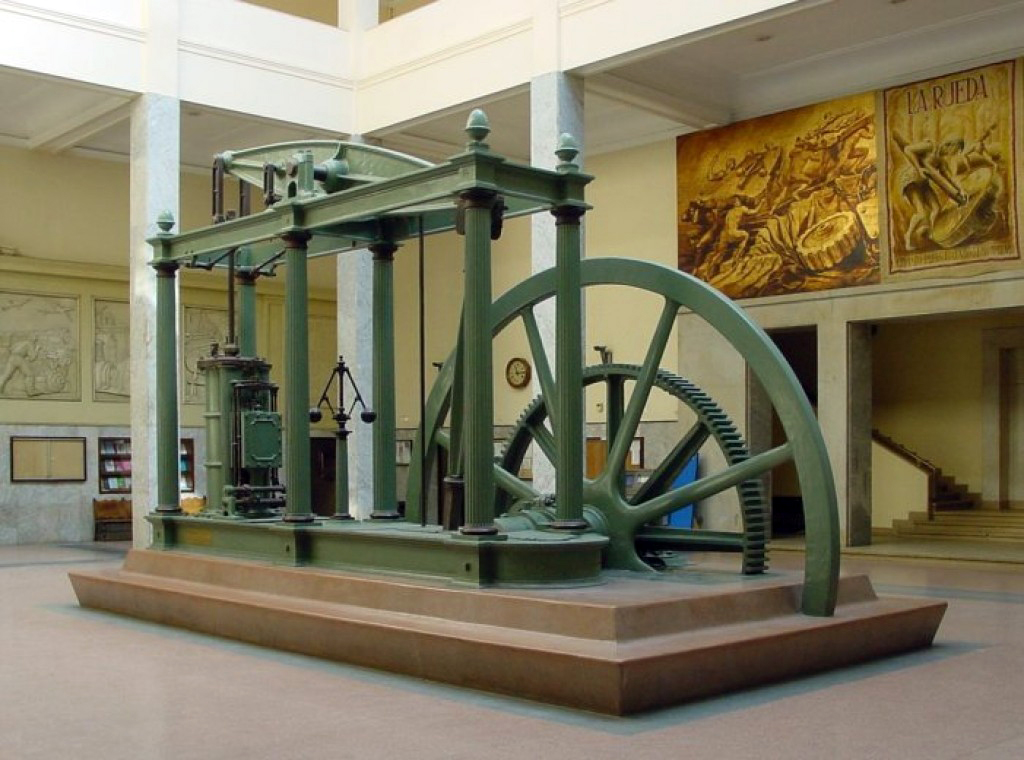
A late version of a Watt double-acting steam engine, built by D. Napier & Son (London) in 1832, now in the lobby of the Superior Technical School of Industrial Engineers of the UPM (Madrid). Steam engines of this kind propelled the Industrial Revolution in Great Britain and the world.

The Watt steam engine was an invention of James Watt that was the driving force of the Industrial Revolution.[1] According to the Encyclopædia Britannica, it was "the first truly efficient steam engine", with the history of hydraulic engineering extending through ancient water mills, to modern nuclear reactors.[2]

Conception

[edit]

The Watt steam engine was inspired by the Newcomen atmospheric engine, which was introduced by Thomas Newcomen in 1712. At the end of the power stroke, the weight of the object being moved by the engine pulled the piston to the top of the cylinder as steam was introduced. Then the cylinder was cooled by a spray of water, which caused the steam to condense, forming a partial vacuum in the cylinder. Atmospheric pressure on the top of the piston pushed it down, lifting the work object. James Watt noticed that it required significant amounts of heat to warm the cylinder back up to the point where steam could enter the cylinder without immediately condensing. When the cylinder was warm enough that it became filled with steam the next power stroke could commence.

Watt realised that the heat needed to warm the cylinder could be saved by adding a separate condensing cylinder. After the power cylinder was filled with steam, a valve was opened to the secondary cylinder, allowing the steam to flow into it and be condensed, which drew the steam from the main cylinder causing the power stroke. The condensing cylinder was water cooled to keep the steam condensing. At the end of the power stroke, the valve was closed so the power cylinder could be filled with steam as the piston moved to the top. The result was the same cycle as Newcomen's design, but without any cooling of the power cylinder which was immediately ready for another stroke.

Watt worked on the design over a period of several years, introducing the condenser, and introducing improvements to practically every part of the design. Notably, Watt performed a lengthy series of trials on ways to seal the piston in the cylinder, which considerably reduced leakage during the power stroke, preventing power loss. All of these changes produced a more reliable design which used half as much coal to produce the same amount of power.[3]

The new design was introduced commercially in 1776, with the first example sold to the Carron Company ironworks. About the same time, Watt encountered a business problem that led him to introduce a new unit of measurement of power, or the rate at which work is done: the horsepower. His earlier business agreements framed his earnings in how much coal the customer of the steam engine saved, but when discussing installing a steam engine for a London brewer, that business did not use coal - it used horses to drive the mills.[4]

Watt continued working to improve the engine, and in 1781 introduced a system using a sun and planet gear to turn the linear motion of the engines into rotary motion. This made it useful not only in the original pumping role, but also as a direct replacement in roles where a water wheel would have been used previously. This was a key moment in the industrial revolution, since power sources could now be located anywhere instead of, as previously, needing a suitable water source and topography. Watt's partner Matthew Boulton began developing a multitude of machines that made use of this rotary power, developing the first modern industrialized factory, the Soho Foundry, which in turn produced new steam engine designs.

Watt's early engines were like the original Newcomen designs in that they used low-pressure steam, and all of the power was produced by atmospheric pressure. When other companies introduced high-pressure steam engines in the early 1800s, Watt was reluctant to follow suit due to safety concerns.[5] Wanting to improve on the performance of his engines, Watt began considering the use of higher-pressure steam, as well as designs using multiple cylinders in both the double-acting concept and the multiple-expansion concept. These double-acting engines required the invention of the parallel motion, which allowed the piston rods of the individual cylinders to move in straight lines, keeping the piston true in the cylinder, while the walking beam end moved through an arc, somewhat analogous to a crosshead in later steam engines.

Introduction

[edit]

In 1698, the English mechanical designer Thomas Savery invented a pumping appliance that used steam to draw water directly from a well by means of a vacuum created by condensing steam. The appliance was also proposed for draining mines, but it could only draw fluid up approximately 25 feet (7.5 m), meaning it had to be located within this distance of the mine floor being drained. As mines became deeper, this was often impractical. It also consumed a large amount of fuel compared with later engines.[6]

The model Newcomen engine upon which Watt experimented

The solution to draining deep mines was found by Thomas Newcomen who developed an "atmospheric" engine that also worked on the vacuum principle. It employed a cylinder containing a movable piston connected by a chain to one end of a rocking beam that worked a mechanical lift pump from its opposite end. At the bottom of each stroke, steam was allowed to enter the cylinder below the piston. As the piston rose within the cylinder, drawn upward by a counterbalance, it drew in steam at atmospheric pressure. At the top of the stroke the steam valve was closed, and cold water was briefly injected into the cylinder as a means of cooling the steam. This water condensed the steam and created a partial vacuum below the piston. The atmospheric pressure outside the engine was then greater than the pressure within the cylinder, thereby pushing the piston into the cylinder. The piston, attached to a chain and in turn attached to one end of the "rocking beam", pulled down the end of the beam, lifting the opposite end of the beam. Hence, the pump deep in the mine attached to opposite end of the beam via ropes and chains was driven. The pump pushed, rather than pulled the column of water upward, hence it could lift water any distance. Once the piston was at the bottom, the cycle repeated.[6]

The Newcomen engine was more powerful than the Savery engine. For the first time water could be raised from a depth of over 300 feet (90 m).[7] The first example from 1712 was able to replace a team of 500 horses that had been used to pump out the mine. Seventy-five Newcomen pumping engines were installed at mines in Britain, France, Holland, Sweden and Russia. In the next fifty years only a few small changes were made to the engine design.

While Newcomen engines brought practical benefits, they were inefficient in terms of the use of energy to power them. The system of alternately sending jets of steam, then cold water into the cylinder meant that the walls of the cylinder were alternately heated, then cooled with each stroke. Each charge of steam introduced would continue condensing until the cylinder approached working temperature once again. So at each stroke part of the potential of the steam was lost.

Separate condenser

[edit]
The major components of a Watt pumping engine

In 1763, James Watt was working as instrument maker at the University of Glasgow when he was assigned the job of repairing a model Newcomen engine and noted how inefficient it was.[8]

In 1765, Watt conceived the idea of equipping the engine with a separate condensation chamber, which he called a "condenser". Because the condenser and the working cylinder were separate, condensation occurred without significant loss of heat from the cylinder. The condenser remained cold and below atmospheric pressure at all times, while the cylinder remained hot at all times.

Steam was drawn from the boiler to the cylinder under the piston. When the piston reached the top of the cylinder, the steam inlet valve closed and the valve controlling the passage to the condenser opened. The condenser being at a lower pressure, drew the steam from the cylinder into the condenser where it cooled and condensed from water vapour to liquid water, maintaining a partial vacuum in the condenser that was communicated to the space of the cylinder by the connecting passage. External atmospheric pressure then pushed the piston down the cylinder.

The separation of the cylinder and condenser eliminated the loss of heat that occurred when steam was condensed in the working cylinder of a Newcomen engine. This gave the Watt engine greater efficiency than the Newcomen engine, reducing the amount of coal consumed while doing the same amount of work as a Newcomen engine.

In Watt's design, the cold water was injected only into the condensation chamber. This type of condenser is known as a jet condenser. The condenser is located in a cold water bath below the cylinder. The volume of water entering the condenser as spray absorbed the latent heat of the steam, and was determined as seven times the volume of the condensed steam. The condensate and the injected water was then removed by the air pump, and the surrounding cold water served to absorb the remaining thermal energy to retain a condenser temperature of 30 to 45 °C (85 to 115 °F) and the equivalent pressure of 0.04 to 0.1 bars (4.0 to 10.0 kPa; 0.6 to 1.5 psi).[9]

At each stroke the warm condensate was drawn off from the condenser and sent to a hot well by a vacuum pump, which also helped to evacuate the steam from under the power cylinder. The still-warm condensate was recycled as feedwater for the boiler.

Watt's next improvement to the Newcomen design was to seal the top of the cylinder and surround the cylinder with a jacket. Steam was passed through the jacket before being admitted below the piston, keeping the piston and cylinder warm to prevent condensation within it. The second improvement was the utilisation of steam expansion against the vacuum on the other side of the piston. The steam supply was cut during the stroke, and the steam expanded against the vacuum on the other side. This increased the efficiency of the engine, but also created a variable torque on the shaft which was undesirable for many applications, in particular pumping. Watt therefore limited the expansion to a ratio of 1:2 (i.e. the steam supply was cut at half stroke). This increased the theoretical efficiency from 6.4% to 10.6%, with only a small variation in piston pressure.[9] Watt did not use high pressure steam because of safety concerns.[5]: 85 

These improvements led to the fully developed version of 1776 that actually went into production.[10]

The partnership of Matthew Boulton and James Watt

[edit]

James Watt formed a partnership with Dr. Roebuck of the Carron Ironworks near Falkirk in exchange for two thirds of the profits from the Watt engine. He cleared Watt's debts and funded the building of a protoype engine at Kinneil House, and helped him get his 1769 patent. The separate condenser showed dramatic potential for improvements on the Newcomen engine but Watt was still discouraged by seemingly insurmountable problems before a marketable engine could be perfected. The piston of the Newcomen engine didn't require a precision seal to the cylinder as it was the practice to pool some water above the piston to assist the seal, but for the Watt engine to be efficient the cylinder had to stay at steam temperature, so the piston had to seal without the water above. Watt tried unsuccessfully for 5 years to obtain an accurately bored cylinder for his steam engine. Joseph Wickham Roe stated in 1916: "When [John] Smeaton saw the first engine he reported to the Society of Engineers that 'Neither the tools nor the workmen existed who could manufacture such a complex machine with sufficient precision'".[11]

In 1773 Dr Roebuck's suffered severe financial problems, in part due to flooding in his coal mine, and facing insolvency he agreed with Matthew Boulton that he would give Boulton his 2/3rds share in the Watt patent in return for cancellation of a debt of £1200.

Then in 1774, John Wilkinson invented a way to cast and precision bore large diameter cylinders using a boring machine in which the shaft that held the cutting tool was supported on both ends and extended through the cylinder. Matthew Boulton arranged for the protoype Kinneil engine to be moved to his Soho works, and using a cylinder bored by Wilkinson, and with the facilities and the practical experience of craftsmen they were soon able to get the protoype engine working properly. As fully developed, it used about 75% less fuel than a similar Newcomen one. In 1775 Boulton & Watt formed a business partnership and the production of Boulton and Watt engines began. However it had taken 6 years of the 14 years patent period to get the engine to production, so in 1775 Boulton & Watt made the case that the remaining 8 years were insufficient to recoup the huge costs invested in getting to production and were able to get an Act of Parliament to extend the patent until 1800.

In 1775, Watt designed two large engines: one for the Bloomfield Colliery at Tipton, completed in March 1776, and one for John Wilkinson's ironworks at Broseley in Shropshire, which was at work the following month. A third engine, at Stratford-le-Bow in east London, was also working that summer.[12]

Boulton wrote in 1776 that "Mr. Wilkinson has bored us several cylinders almost without error; that of 50 inches diameter, which we have put up at Tipton, does not err on the thickness of an old shilling in any part".[11]

Boulton and Watt's business was to help mine-owners and other customers to build engines, supplying men to erect them and some specialised parts. The main hardware came from other suppliers, especially John Wilkinson who had an almost exclusive contract to provide the cylinders for the next 20 years. However, their main profit from their patent was derived from charging a licence fee to the engine owners, based on the cost of the fuel they saved (in most cases they were replacing Newcomen engines). The greater fuel efficiency of their engines meant that they were most attractive in areas where fuel was expensive, particularly Cornwall, for which three engines were ordered in 1777, for the Wheal Busy, Ting Tang, and Chacewater mines.[13] Where there was a new installation they negotiated charges based on the engine size and use, and around 1784 Watt introduced the concept of the horse-power (HP) of an engine and charged £5 per HP per year for the duration of the patent.

Later improvements

[edit]
Watt's parallel motion on a pumping engine

The first Watt engines were atmospheric pressure engines, like the Newcomen engine but with the condensation taking place separate from the cylinder. Watt opposed the use of high pressure steam (e.g 2 atmospheres), and it was others such as Richard Trevithick in the late 1790s that developed it partly because using steam expansively without a condenser circumvented Watt's patent. Driving the engines using both low pressure steam and a partial vacuum raised the possibility of reciprocating engine development.[14] An arrangement of valves could alternately admit low pressure steam to the cylinder and then connect with the condenser. Consequently, the direction of the power stroke might be reversed, making it easier to obtain rotary motion. Additional benefits of the double acting engine were increased efficiency, higher speed (greater power) and more regular motion.

Before the development of the double acting piston, the linkage to the beam and the piston rod had been by means of a chain, which meant that power could only be applied in one direction, by pulling. This was effective in engines that were used for pumping water, but the double action of the piston meant that it could push as well as pull. This was not possible as long as the beam and the rod were connected by a chain. Furthermore, it was not possible to connect the piston rod of the sealed cylinder directly to the beam, because while the rod moved vertically in a straight line, the beam was pivoted at its centre, with each side inscribing an arc. To bridge the conflicting actions of the beam and the piston, Watt developed his parallel motion. This device used a four bar linkage coupled with a pantograph to produce the required straight line motion much more cheaply than if he had used a slider type of linkage. He was very proud of his solution.

Watt steam engine[15]

Having the beam connected to the piston shaft by a means that applied force alternately in both directions also meant that it was possible to use the motion of the beam to turn a wheel. The simplest solution to transforming the action of the beam into a rotating motion was to connect the beam to a wheel by a crank, but because another party had patent rights on the use of the crank, Watt was obliged to come up with another solution.[16] He adopted the epicyclic sun and planet gear system suggested by an employee William Murdoch, only later reverting, once the patent rights had expired, to the more familiar crank seen on most engines today.[17] The main wheel attached to the crank was large and heavy, serving as a flywheel which, once set in motion, by its momentum maintained a constant power and smoothed the action of the alternating strokes. To its rotating central shaft, belts and gears could be attached to drive a great variety of machinery.

Because factory machinery needed to operate at a constant speed, Watt linked a steam regulator valve to a centrifugal governor which he adapted from those used to automatically control the speed of windmills.[18] The centrifugal was not a true speed controller because it could not hold a set speed in response to a change in load.[19]

These improvements allowed the steam engine to replace the water wheel and horses as the main sources of power for British industry, thereby freeing it from geographical constraints and becoming one of the main drivers in the Industrial Revolution.

Watt was also concerned with fundamental research on the functioning of the steam engine. His most notable measuring device, still in use today, is the Watt indicator incorporating a manometer to measure steam pressure within the cylinder according to the position of the piston, enabling a diagram to be produced representing the pressure of the steam as a function of its volume throughout the cycle.

Preserved Watt engines

[edit]

The oldest surviving Watt engine is Old Bess of 1777, now in the Science Museum, London. The oldest working engine in the world is the Smethwick Engine, brought into service in May 1779 and now at Thinktank in Birmingham (formerly at the now defunct Museum of Science and Industry, Birmingham). The oldest still in its original engine house and still capable of doing the job for which it was installed is the 1812 Boulton and Watt engine at the Crofton Pumping Station in Wiltshire. This was used to pump water for the Kennet and Avon Canal; on certain weekends throughout the year the modern pumps are switched off and the two steam engines at Crofton still perform this function. The oldest extant rotative steam engine, the Whitbread Engine (from 1785, the third rotative engine ever built), is located in the Powerhouse Museum in Sydney, Australia. A Boulton-Watt engine of 1788 may be found in the Science Museum, London,[20] while an 1817 blowing engine, formerly used at the Netherton ironworks of M W Grazebrook now decorates Dartmouth Circus, a traffic island at the start of the A38(M) motorway in Birmingham.

The Henry Ford Museum in Dearborn, Michigan houses a replica of a 1788 Watt rotative engine. It is a full-scale working model of a Boulton-Watt engine. The American industrialist Henry Ford commissioned the replica engine from the English manufacturer Charles Summerfield in 1932.[21] The museum also holds an original Boulton and Watt atmospheric pump engine, originally used for canal pumping in Birmingham,[22] illustrated below, and in use in situ at the Bowyer Street pumping station,[23][24] from 1796 until 1854, and afterwards removed to Dearborn in 1929.

Another one is preserved at Fumel factory, France.

Watt engine produced by Hathorn, Davey and Co

[edit]

In the 1880s, Hathorn Davey and Co / Leeds produced a 1 hp / 125 rpm atmospheric engine with external condenser but without steam expansion. It has been argued that this was probably the last commercial atmospheric engine to be manufactured. As an atmospheric engine, it did not have a pressurised boiler. It was intended for small businesses.[25]

Daveys Engine 1885

Recent developments

[edit]

Watt's Expansion Engine is generally considered as of historic interest only. There are however some recent developments which may lead to a renaissance of the technology. Today, there is an enormous amount of waste steam and waste heat with temperatures between 100 and 150 °C (210 and 300 °F) generated by industry. In addition, solarthermal collectors, geothermal energy sources and biomass reactors produce heat in this temperature range. There are technologies to utilise this energy, in particular the Organic Rankine Cycle (ORC). In principle, these are steam turbines which do not use water but a fluid (a refrigerant) which evaporates at temperatures below 100 °C (212 °F). Such systems are however fairly complex. They work with pressures of 6 to 20 bars (600 to 2,000 kPa; 87 to 290 psi), so that the whole system has to be completely sealed.

The Expansion Engine can offer significant advantages here, in particular for lower power ratings of 2 to 100 kW: with expansion ratios of 1:5, the theoretical efficiency reaches 15%, which is in the range of ORC systems. The Expansion Engine uses water as working fluid which is simple, cheap, non-toxic, non-flammable and non-corrosive. It works at pressure near and below atmospheric, so that sealing is not a problem. And it is a simple machine, implying cost effectiveness. Researchers from the University of Southampton / UK are currently developing a modern version of Watt's engine in order to generate energy from waste steam and waste heat. They improved the theory, demonstrating that theoretical efficiencies of up to 17.4% (and actual efficiencies of 11%) are possible.[26]

The 25 Watt Experimental Condensing Engine built and tested at Southampton University

In order to demonstrate the principle, a 25 watt experimental model engine was built and tested. The engine incorporates steam expansion as well as new features such as electronic control. The picture shows the model built and tested in 2016.[27] Currently, a project to build and test a scaled-up 2 kW engine is under preparation.[28]

See also

[edit]

References

[edit]
[edit]
Revisions and contributorsEdit on WikipediaRead on Wikipedia
from Grokipedia
The Watt steam engine was a pivotal improvement on the earlier , invented by Scottish engineer in the 1760s and patented in 1769, which introduced a separate condenser to dramatically enhance by preventing the cooling and reheating of the main during operation. This innovation addressed the key inefficiency of Thomas Newcomen's 1712 design, where was condensed inside the cylinder itself, resulting in only about 1% ; Watt's version roughly doubled this by maintaining the cylinder at a consistent while using a dedicated external chamber for condensation. Watt's development began in 1763–1765 while he repaired a Newcomen model at the , leading to his realization of losses—though he later connected with chemist for deeper insights into the concept—and culminated in a functional by 1774 through a partnership with industrialist . The engine's core mechanism involved a single-acting driven by on the downward stroke, with an air to restore , and it was initially used for pumping water from mines; later enhancements included a double-acting around 1782 for bidirectional power, rotary motion in 1781 for driving machinery, and the parallel motion linkage in 1784 to convert linear movement into stable beam oscillation. Boulton & Watt's firm produced the first commercial engines in 1776, scaling to dozens by the 1780s and establishing a monopoly via patent extensions until 1800, which funded further refinements like the for speed control. The Watt engine's significance lies in its role as the driving force of the , transforming steam from a niche tool into a versatile power source for textile mills, , and eventually locomotives and steamships, thereby enabling unprecedented factory production, , and across Britain and beyond. By the early , as patents expired, high-pressure variants built on Watt's foundation further accelerated industrialization, though his original low-pressure design prioritized safety and reliability over raw power.

Historical Context

Pre-Watt Atmospheric Engines

The atmospheric steam engine, pioneered by in 1712, represented the first practical steam-powered device for industrial use, primarily designed to pump water from deep mines. design featured a vertical connected to a rocking beam, with a that moved within the to drive pumps below. In operation, low-pressure from a separate was admitted into the through a valve, allowing the to rise as the steam equalized with the atmosphere above it. A cold spray was then injected to condense the steam rapidly, creating a partial beneath the ; atmospheric on the exposed upper side pushed the downward, performing the power stroke that lifted water via the beam-connected pumps. The engine's single metal served dual roles, alternately receiving hot and undergoing cooling for , which caused significant and energy inefficiency. Despite its innovations, the Newcomen engine suffered from key limitations, including extremely low of approximately 0.5% to 1%, as most input energy was wasted in reheating the cold with each cycle of admission. This resulted in high fuel consumption—often exceeding 20 pounds of per horsepower-hour—making operation costly outside coal-rich areas, though its reliability confined it mainly to mines where flooding posed a constant threat. Later refinements, such as those by in the 1770s, marginally improved efficiency to around 1.5% through better boiler designs and insulation, but the core issues persisted. By the mid-18th century, Newcomen engines had achieved widespread adoption in Britain, particularly in collieries, with over 100 installed by 1760 and estimates reaching several hundred operational units across mining regions like and the . Their success stemmed from the urgent need to access deeper seams, enabling expanded production that fueled Britain's growing . In 1763, , then an instrument maker at the , repaired a small-scale model of a Newcomen engine for the university, gaining firsthand insight into its operational flaws.

Watt's Early Experiments

James Watt was born on January 19, 1736, in , , into a family where his father worked as a shipbuilder and merchant. Despite a frail childhood marked by migraines and other ailments, Watt developed an early interest in and , learning carpentry from his father and receiving homeschooling from his mother. In 1755, at age 19, he apprenticed as an instrument maker in before returning to in 1756, where he established a workshop on the grounds and was appointed as the university's Mathematical Instrument Maker. This role exposed him to scientific apparatus and academic circles, laying the foundation for his later investigations into mechanical power. In the winter of 1763–1764, Watt's engagement with steam technology began when Professor John Anderson tasked him with repairing a small-scale model of Thomas Newcomen's atmospheric , used for pumping water in the university laboratory. Although he successfully restored the model to operation, Watt quickly observed its inherent inefficiencies, particularly the excessive fuel consumption stemming from the engine's design. The Newcomen engine's core flaw involved injecting cold water into the to condense after each power stroke, causing the walls to cool dramatically and leading to significant loss as re-expanded and condensed repeatedly. Watt's experiments confirmed the power losses due to this repeated and reheating. He also experimented with insulating the to minimize escape, while conducting measurements of water vapor pressure and exploring the concept of in expansion and , which highlighted the thermodynamic inefficiencies unique to the process. These preliminary investigations culminated in a pivotal on a walk in May 1765 across , a public park near the university. At age 29, Watt realized that the condensation of steam could be separated from the main power , allowing the cylinder to remain hot throughout the cycle and thereby reducing the wasted on repeated heating and cooling. This conceptual breakthrough, often described as his "eureka" moment, stemmed directly from his hands-on observations and measurements, shifting his focus toward practical solutions for steam power's thermodynamic limitations.

Invention and Key Innovation

Conception of the Engine

In 1765, while repairing a model of Thomas Newcomen's atmospheric engine at the University of Glasgow, James Watt conceived the fundamental idea for an improved steam engine. The core innovation was an engine in which steam would expand within the cylinder to drive the piston, while condensation occurred in a separate chamber to prevent the cooling of the working cylinder and thereby minimize heat loss. This separate condenser allowed the cylinder to remain hot, dramatically improving thermal efficiency by reducing fuel consumption. Between 1765 and 1767, Watt constructed early prototypes, including wooden models and a jet condenser using a vessel connected to a water , along with a small tin model tested in the presence of witness John Robison. These trials demonstrated the concept's potential, with Watt noting that the engine would "not waste a particle of ." Prototyping faced significant challenges, particularly the accumulation of non-condensable air in the condenser, which impaired maintenance and . To address this, Watt experimented with air pumps for removal. By , Watt prepared a for his invention, which was ultimately granted on January 5, 1769, under the title "A New Invented Method of Lessening the Consumption of and Fuel in Fire Engines."

Development of the Separate Condenser

James Watt conceived the separate condenser in 1765 while repairing a model of Thomas Newcomen's atmospheric engine at the , realizing that the engine's inefficiency stemmed from the repeatedly heating and cooling during each cycle. To test his idea, Watt conducted experiments using a as a makeshift and , connected to a small tin-pipe condenser; by injecting and then cooling the condenser to create a , he lifted an 18-pound weight, confirming the potential for separate without cooling the main . The design positioned a separate condensation vessel below the cylinder, where exhaust steam flowed into the chamber and was rapidly condensed by jets of cold water—a jet condenser configuration that maintained the cylinder at a consistent hot temperature, enabling continuous operation without thermal losses from reheating. This innovation maximized the change in volume (ΔV) during the power stroke for the work done, as described by the equation W=PΔVW = P \Delta V, where P is pressure, avoiding the reheating inefficiencies of integrated designs like Newcomen's. The separate condenser theoretically improved fuel economy by 2 to 3 times over the Newcomen engine, reducing coal consumption by about two-thirds through minimized heat waste. Watt built initial prototypes in 1765, including a tin-plate model preserved at the , which demonstrated the condenser's viability but required further refinement. In 1768-1769, in partnership with John Roebuck, Watt oversaw the construction of a full-scale experimental at Kinneil Colliery near , ; however, it suffered from incomplete vacuum due to air leaks and poor sealing around the . Watt addressed these issues through iterative improvements, such as enhanced seals and better valve designs, leading to a successful on January 5, 1769, for "a new method of lessening the consumption of steam and fuel in fire-engines." The separate condenser's role proved pivotal in enabling the expansive use of steam, where partially expanded steam performed work before full condensation, further cutting coal use by up to 75% in optimized setups and transforming the engine from a mining novelty into a versatile industrial power source.

Partnership and Commercialization

Collaboration with Matthew Boulton

James Watt first met in August 1768 at Boulton's Soho Manufactory near Birmingham, where Watt demonstrated his early model of the improved , which formed the basis of his 1769 . This encounter laid the groundwork for their collaboration, as Boulton recognized the potential of Watt's invention to address power needs in . In 1774, Watt relocated from to Birmingham to deepen their working relationship, settling near to facilitate joint development efforts. Boulton provided essential financial backing, covering Watt's debts from prior partnerships and funding further experimentation and prototyping. His manufacturing expertise, honed through operating the advanced Soho Manufactory, proved crucial in refining production processes for engine components. The partnership was formalized in 1775 through a legal agreement that assigned Boulton a two-thirds share of profits from Watt's patents, reflecting Boulton's greater financial investment and risk. That same year, Boulton lobbied successfully for a parliamentary act extending Watt's 1769 patent by 25 years until 1800, securing exclusive rights for their venture. A key technical challenge they addressed jointly was achieving precise cylinder boring for efficient engine operation; in 1774, Boulton directed Watt to ironmaster John Wilkinson, whose newly invented boring machine enabled the accurate machining required, resolving persistent fitting issues in prototypes. This collaboration transformed Watt's concepts from experimental models into scalable production, with Boulton overseeing manufacturing and customer negotiations to drive commercialization.

Market Introduction and Patenting

James Watt secured his foundational patent for the separate condenser on January 5, 1769 (Patent No. 913), with the detailed specification submitted on April 25 and officially enrolled on April 29 of that year, marking a significant advancement over the by allowing steam to condense in a separate chamber without cooling the main . This patent encompassed additional features such as air pumps to remove non-condensable gases. In 1782, Watt obtained another key (No. 1321, dated March 12) covering improvements including the double-acting principle, where steam pressure drove the in both directions, broadening the engine's utility beyond mere pumping. The partnership between Watt and facilitated the engine's commercial rollout, with the first full-scale installation occurring in 1776 at Bloomfield Colliery near , where it successfully pumped water from the mine, demonstrating practical viability after years of prototyping delays. To monetize the invention without bearing full manufacturing costs, Boulton and Watt employed a licensing system: users constructed engines to their specifications but paid royalties equivalent to one-third of the fuel cost savings compared to equivalent Newcomen engines, a model that incentivized adoption while ensuring steady income. Initial focused on water-pumping duties in coal mines and municipal waterworks, where offered clear economic advantages; by the end of 1800, approximately 450 Boulton and Watt engines, totaling over 11,000 horsepower, had been erected across Britain, underscoring the technology's growing acceptance. These installations generated substantial royalties for the partners, with Watt alone receiving more than £76,000 between 1779 and 1790 from dues. However, commercialization encountered legal hurdles, notably the prolonged dispute with Jonathan Hornblower, whose 1781 compound engine was challenged for infringing the 1769 separate condenser; after extended litigation, the courts ruled in favor of Boulton and Watt in 1799, compelling Hornblower to pay back royalties and reinforcing their monopoly until the patents expired that year.

Design and Operation

Core Working Principle

The Watt steam engine operates on a that leverages the expansion of to generate mechanical work, distinct from earlier designs by maintaining a hot throughout most of the cycle. from the is admitted into the , where it expands and pushes the outward in a single-acting motion, with the connected to a beam that drives a or other load. As the reaches the end of its stroke, the inlet closes, and the exhaust is directed to a separate condenser, where it is rapidly cooled and condensed into water, creating a partial . then forces the back to its starting position, completing the cycle without the need for reheating the each time. Key components include the for generating , the housing the steam-tight , the separate condenser (often a vessel with cold water circulation), an air pump to remove condensed water and non-condensable gases from the condenser to maintain , and pumps for water circulation. The single-acting design initially applies pressure only on one side of the , with the return stroke powered by against the . This setup allows continuous operation with used efficiently across multiple cycles. A primary advantage over the is the avoidance of cooling and reheating in each cycle, which in the Newcomen design wasted much of the heat energy. By isolating condensation in the separate condenser, the Watt engine reduces fuel consumption by approximately two-thirds, enabling more economical operation and broader industrial applications beyond mine pumping. The of the Watt engine was around 2-3%. This improvement stems from minimizing loss to the cold reservoir, allowing more of the input QBQ_B to convert to work WW via the relation QB=W+QCQ_B = W + Q_C, where QCQ_C is the reduced rejected . Power output can be calculated as P=pALNtP = \frac{p \cdot A \cdot L \cdot N}{t}, where pp is the mean effective pressure, AA is the area, LL is the length, NN is the number of cycles, and tt is time, representing the work done per stroke multiplied by cycle frequency. This formula quantifies the engine's capacity, with typical early models delivering 5-10 horsepower for mine drainage.

Rotative Engine Adaptations

To adapt the Watt steam engine from its initial pumping applications to rotary power output, James Watt introduced the sun-and-planet gear mechanism in 1781. This epicyclic gear system, patented on October 25, 1781 (British Patent No. 1306), converted the linear of the into continuous circular rotation, enabling the engine to drive machinery without infringing on James Pickard's existing crank from 1780. The design featured a central "sun" gear on the output shaft and a "" gear connected to the end of the engine's beam, which orbited the sun gear to produce smooth rotary motion when paired with a for momentum. This innovation marked a pivotal shift, allowing the engine to power beyond mine drainage. Building on this, Watt patented the double-acting configuration in 1782 (British Patent No. 1321, March 12, 1782), which admitted alternately to both sides of the for power strokes in both directions, effectively doubling the engine's output compared to single-acting pumps. To accommodate the bidirectional motion and maintain alignment, the design incorporated a tail rod extending from the piston's underside through the bottom, connected to the beam or . Sealing was achieved via stuffing boxes—packed glands—at both the top and bottom of the to minimize leakage while permitting rod movement. These rotative adaptations found immediate application in mills and factories, replacing unreliable , , or animal power with steady mechanical drive. mills and factories were early adopters, as the rotary output directly turned grinding stones or spinning machinery. A prominent example was the 1788 installation at Albion Mills in , where two (later three) 50-horsepower double-acting rotative engines, equipped with sun-and-planet gears, powered 20 pairs of millstones via a central shaft for large-scale production. Incorporating expansive working—achieved by partially closing the steam inlet valve to allow expansion within the —rotative engines realized efficiencies of 5-7%, a significant improvement over earlier designs and enabling broader industrial viability. This efficiency stemmed from reduced fuel consumption, with Boulton and Watt engines using about one-third the of contemporary rivals for equivalent work.

Improvements and Variants

Sun-and-Planet Gear and Other Enhancements

Following the initial adaptations for rotative motion, the Boulton and Watt introduced several mechanical refinements in the 1780s to enhance the steam engine's performance, reliability, and control. The sun-and-planet gear, patented by in October 1781 (British Patent No. 1306), was a key innovation to convert the of the into continuous rotary motion without infringing on James Pickard's 1780 patent for the . Developed by their employee but attributed to the , the mechanism featured a fixed central sun gear attached to the output shaft and a planet gear connected to the end of the rocking beam via an arm. As the beam oscillated, the planet gear orbited the sun gear in planetary motion, meshing teeth to drive the shaft. With equal tooth counts on both gears (typically a 1:1 ratio), the output shaft rotated twice per complete stroke—one per half-stroke—effectively doubling the rotational speed relative to the beam's motion. This arrangement transmitted efficiently through multiple gear contacts, enabling the engine to power mills and factories while distributing load to reduce wear on components. The design was used until Pickard's patent expired in 1794, after which simpler cranks were adopted. In 1784, Watt patented the parallel motion mechanism (British Patent No. 1432) to address inefficiencies in connecting the to the beam, particularly in double-acting engines where acted on both sides of the . This system used articulated rods and pivots to guide the rod along a nearly straight vertical path, approximating perfect rectilinear motion over the stroke length. By constraining lateral deviation, it eliminated significant side on the and walls, which previously caused uneven wear and leakage. The mechanism consisted of two curved links (or "arches") connected to the beam and rod via a central head, with rods forming a parallelogram-like configuration that maintained alignment. This improvement extended the longevity of seals and packing materials by minimizing friction and imbalances, reducing maintenance needs and enhancing overall reliability. Also in the 1784 patent, Watt introduced a throttle valve to provide manual control over engine speed and power output. Positioned in the steam supply pipe, this butterfly or sliding valve regulated the volume of steam admitted to the cylinder, allowing operators to adjust load response without altering boiler pressure. It enabled finer tuning for varying workloads, improving fuel economy and preventing overload. In 1788, Matthew Boulton oversaw the addition of the centrifugal governor to the rotative engine design, marking the first automatic speed regulation in steam engines. Mounted on the output shaft, the device featured two flyballs attached to arms that rotated with the engine; as speed increased, centrifugal force caused the balls to rise outward against gravity and spring tension, lifting a sleeve connected to the throttle valve via linkage. This partially closed the valve to reduce steam flow and slow the engine, maintaining constant speed under fluctuating loads. The governing principle relied on balancing the centrifugal force F=mω2rF = m \omega^2 r (where mm is the ball mass, ω\omega is angular velocity, and rr is the radius of rotation) against the counterforce from steam pressure and mechanics, ensuring stable operation. These post-1780 enhancements—integrating precise motion conversion, straight-line guidance, and automatic regulation—collectively contributed to thermal efficiencies of up to about 5% by the , a substantial gain over earlier designs.

Hathorn, Davey and Co Production

Hathorn, Davey and Co., based in , , emerged as a prominent manufacturer of engines during the late 19th and early 20th centuries. Originally established as the Sun Foundry in 1846, the firm transitioned to producing advanced pumping and stationary engines after William Hathorn and Henry Davey became partners in 1878, formalizing the name Hathorn, Davey and Co. in 1880. Operating from their Dewsbury Road works until the and beyond, the company specialized in reliable machinery for industrial applications, building on foundational principles like James Watt's separate condenser to meet evolving demands in , , and systems. The firm's engines featured designs that integrated high-pressure and low-pressure cylinders, enabling more effective steam expansion and improving overall performance. This configuration achieved approximately 25% greater compared to traditional single-cylinder Cornish engines, with later triple-expansion variants reaching practical efficiencies suitable for demanding operations. These engines were widely deployed in pumping stations for waterworks and collieries, as well as marine applications aboard ships, where their compact vertical or inverted layouts proved advantageous for space-constrained environments. A distinctive innovation from Hathorn, Davey was the Davey safety valve incorporated into their "Safety Motor," a low-pressure designed for secure, efficient operation in domestic and small-scale industrial settings. This variant emphasized safety through automatic regulation, complemented by the use of indicator diagrams—graphical records of versus —to monitor and optimize performance in real time. Such features allowed operators to diagnose issues and maintain high reliability, particularly in continuous pumping duties. By the early 1900s, Hathorn, Davey's production declined amid competition from more efficient steam turbines and emerging electric motors, prompting the firm to diversify into hydraulic and belt-driven systems. Despite this shift, many of their engines continued operating in waterworks and similar facilities, with some remaining in service until the , exemplifying the durability of their designs.

Legacy and Preservation

Industrial Impact

The Watt steam engine fundamentally transformed the economic landscape of Britain by enabling the factory system, which concentrated production in large-scale facilities powered by machinery rather than human or animal labor or unreliable water wheels. This shift allowed for increased efficiency and output in , particularly in textiles and , fostering the growth of centralized factories that became the backbone of industrial capitalism. The engine's ability to generate consistent power independent of geographic constraints contributed to broader GDP expansion during the , with steam technology accounting for approximately two-fifths of the growth in British labor between 1850 and 1870. Overall steam power output rose dramatically from around 10,000 horsepower in 1800 to over 2 million horsepower by 1870, reflecting the engine's role in scaling industrial capacity. Technologically, the Watt engine laid the groundwork for subsequent innovations, including high-pressure steam engines developed by in the early 1800s, which built upon Watt's low-pressure design to achieve greater efficiency and . It proved essential in key sectors such as textiles, where it drove spinning and machines; , where it facilitated deeper extraction through improved pumping; and , powering early locomotives and steamships that revolutionized . By , engines based on Watt's patented improvements dominated British industry in manufacturing and extraction activities. The partnership's innovative royalty model, charging users one-third of the fuel savings achieved, generated substantial returns through premiums, royalties, and legal settlements. Socially, the widespread adoption of the Watt engine accelerated as factories could be built near supplies or urban markets, reducing dependence on riverside locations and drawing rural workers into cities for employment in mechanized production. This migration led to significant labor shifts, from agrarian and artisanal work to factory-based roles, altering class structures and daily life while contributing to in industrial centers like and Birmingham. However, it also introduced challenges such as overcrowded living conditions and the of certain crafts, marking a profound reconfiguration of society during the .

Preserved Examples and Modern Developments

Several notable examples of Watt steam engines have been preserved, allowing for study and demonstration of their historical significance. The Boulton & Watt rotative steam engine of 1785, originally installed at Samuel Whitbread's Brewery in , is housed at the in , , and remains one of the oldest operational examples worldwide, regularly run under steam for public demonstrations. This engine, designated an International Historic Engineering Landmark by the , features the original sun-and-planet gear mechanism and exemplifies early rotative adaptations for industrial power transmission. In 2023, restoration and relocation efforts at the sparked controversy over potential risks to its integrity; the engine was subsequently disassembled and relocated to the new Powerhouse Castle Hill site in 2025, where it continues to operate as a centerpiece of the collection (as of November 2025). At the in , "Old Bess," a 1777 single-acting atmospheric built by Boulton & Watt, stands as the oldest surviving complete Watt engine, though it is preserved for static display rather than operation. This prototype from the 1770s era highlights Watt's initial improvements, including the separate condenser, and has been part of the museum's collection since 1861, contributing to exhibits on energy history. Other preserved Watt engines, such as the 1779 double-acting Smethwick Engine at Thinktank in Birmingham, , and the 1796 atmospheric pump at Museum in , further illustrate the design's evolution, with a handful maintained in operational condition at sites like Crofton in the UK. In modern developments, scaled-down replicas of Watt engines serve educational purposes, particularly in STEM programs, where they demonstrate thermodynamic principles without the hazards of full-scale operation. For instance, metal model kits replicating the Watt design, complete with pistons, condensers, and flywheels, are available for assembly and are used in classrooms to teach concepts like conversion and . These micro-scale versions, often powered by small alcohol burners or electric heaters, provide hands-on learning about the engine's core working principle of separate . Contemporary research draws on Watt's innovations for sustainable applications, including renewable steam technologies integrated with . Small-scale steam engines inspired by Watt's efficient condenser design are being adapted for solar systems, where concentrated sunlight generates steam to drive pistons or turbines, offering a low-emission alternative for off-grid electricity in remote areas. In the , studies have explored these systems' environmental advantages, such as reduced reliance on fossil fuels compared to traditional internal combustion engines, with prototypes achieving up to 500 watts of output using solar-heated boilers. Such developments underscore Watt's enduring influence on eco-friendly energy conversion, prioritizing efficiency in modern contexts like decentralized power generation.

References

Add your contribution
Related Hubs
User Avatar
No comments yet.