Recent from talks
Nothing was collected or created yet.
Joseph Fesch
View on Wikipedia
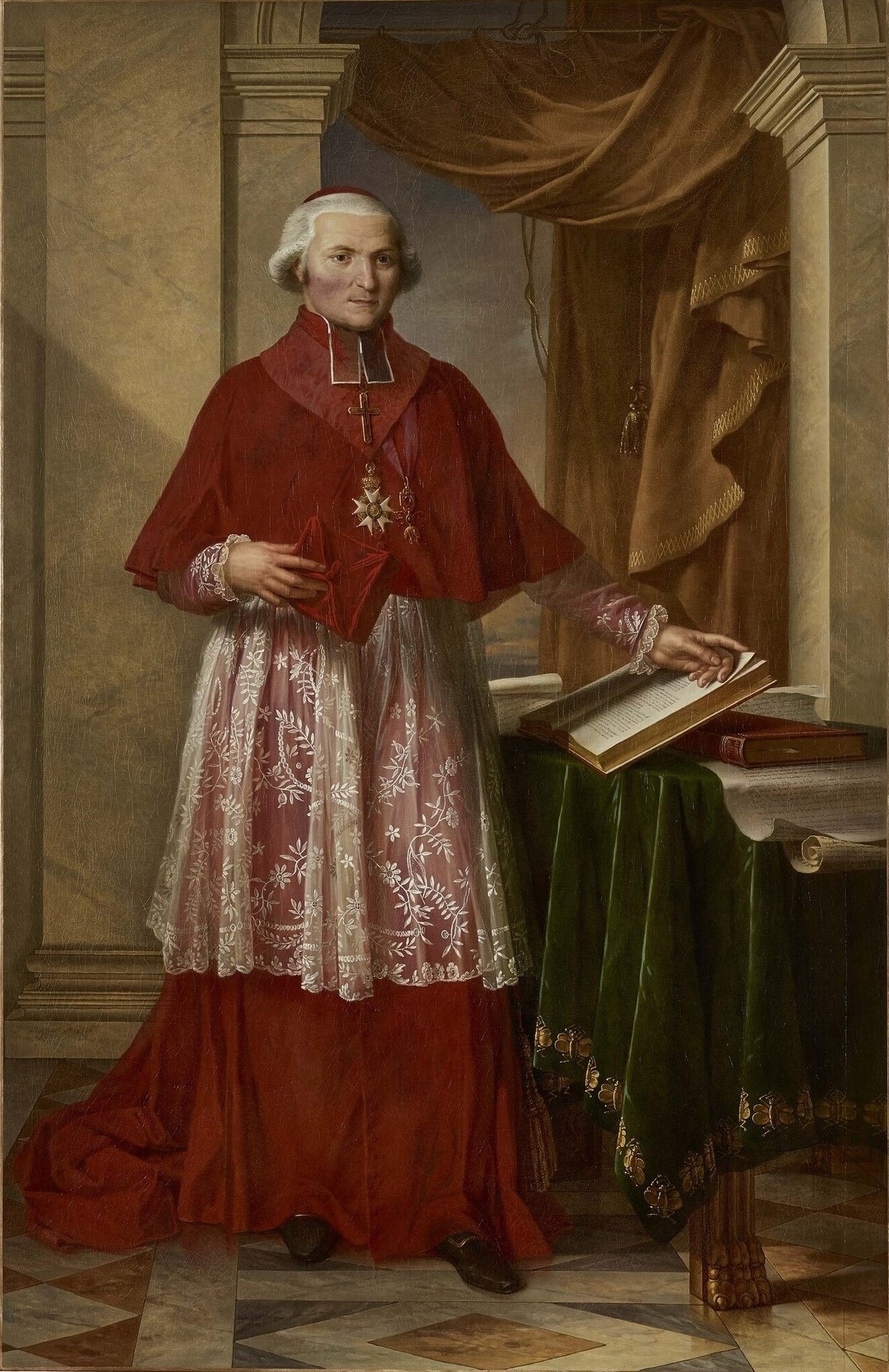
Joseph Cardinal Fesch, Prince of the Empire (3 January 1763 – 13 May 1839) was a French priest and diplomat, who was the maternal half-uncle of Napoleon Bonaparte (half-brother of Napoleon's mother Laetitia). In the wake of his nephew, he became Archbishop of Lyon and cardinal. He was also one of the most famous art collectors of his period, remembered for having established the Musée Fesch in Ajaccio, which remains one of the most important Napoleonic collections of art.
Key Information
Born in Corsica, he was the son of Swiss-born Franz Faesch and Angela Maria Pietrasanta, and belonged on his father's side to the Faesch family, one of the most prominent patrician families of Basel. He rose to great prominence in France following Napoleon's coup d'état of 1799. Fesch became Archbishop of Lyon in 1802, a Cardinal in 1803, Ambassador to the Holy See in 1804, a French senator and count in 1805, Grand Almoner of France in 1805, a sovereign prince in 1806, Prince of the Empire ("French Prince") in 1807 (a dignity he shared only with Napoleon's siblings, brother-in-law Joachim Murat, and adopted son Eugène de Beauharnais), and Peer of France in 1815, and was named a Prince of the Papal States by the Pope. He was a member of the Imperial House, and was included in the order of succession to the French imperial throne[citation needed] in accordance with the French constitution of 1804 (Title III, Article 9, "The Imperial Family").
He was Napoleon's most important diplomat in regard to Pope Pius VII, but Napoleon's relationship with his uncle deteriorated as his relationship with the Pope soured. Nevertheless, Napoleon remained loyal to his uncle. Fesch wed his nephew to Joséphine de Beauharnais in Paris in 1804, the day before Bonaparte was crowned as Emperor of the French,[1] in 1810 he wed Napoleon to Marie Louise of Austria, and in 1811 baptized the Emperor's son Napoleon II.
After the end of the French Empire in 1815, he was banished from France in 1815, like the rest of the Imperial House. He relocated to Rome with his half-sister Laetitia, and took up residence at the Palazzo Falconieri, dedicating himself to art and to beneficence.
Biography
[edit]
Fesch was born at Ajaccio in Corsica. His father was Franz Faesch, a Swiss officer in the service of the Republic of Genoa, whose family belonged to the Basel patriciate and had been ennobled in the Holy Roman Empire in 1562. His mother was Nobile Angela Maria Pietrasanta. His mother had previously been married to Captain Giovanni Geronimo Ramolino, and he had an elder half-sister, Letizia Ramolino, later the mother of Napoleon. With support of Luciano Buonaparte (1718–1791), archdeacon of Ajaccio, he entered the seminary at Aix-en-Provence in 1781.[citation needed] He was ordained as a priest in 1785, and 24 years old, he became himself the archdeacon of Ajaccio.[citation needed] After the 1791 death of Luciano Buonaparte, he became for a time the protector and patron of his sister's family. In 1789, when the French Revolution broke out, he felt, like the majority of the Corsicans, repugnance for many of the acts of the French government during that period; in particular he protested against the application to Corsica of the act known as the Civil Constitution of the Clergy (July 1790). As provost of the "chapter" in that city he directly felt the pressure of events; for on the suppression of religious orders and corporations, he was constrained to retire into private life.[2]

Thereafter he shared the fortunes of the Bonaparte family in the intrigues and strifes which ensued. Drawn gradually into espousing the French cause against Pasquale Paoli and the Anglophiles, he was forced to leave Corsica and to proceed with Laetitia and her son to Toulon, in early autumn, 1793. Failing to find clerical duties at that time (the Reign of Terror), he took several posts in civil life, until on the appointment of Napoleon Bonaparte to the command of the French "Army of Italy" he became a commissary attached to that army. This part of his career is obscure, but his fortunes rose rapidly when Napoleon became First Consul, after the coup d'état of 18 Brumaire (November 1799). When the restoration of the Roman Catholic religion was in the mind of the First Consul, Fesch resumed his clerical vocation and took an active part in the complex negotiations which led to the signing of the Concordat with the Holy See on 15 July 1801. His reward came in being made Archbishop of Lyon in August 1802. Six months later he received a further reward for his past services, being raised to the dignity of cardinal.[2]
Appointed by Napoleon on 4 April 1803 to succeed François Cacault on the latter's retirement from the position of French ambassador at Rome,[3] Fesch was assisted by Chateaubriand, but soon sharply differed with him on many questions. Towards the close of 1804, Napoleon entrusted to Fesch the difficult task of securing the presence of Pope Pius VII at the forthcoming coronation of the emperor at Notre Dame, Paris (2 December 1804). His tact in overcoming the reluctance of the pope (it was only eight months after the execution of the duc d'Enghien) received further recognition. He received the grand cordon of the Legion d'Honneur, became grand-almoner of the empire and had a seat in the French senate. He was to receive further honours. In 1806 one of the most influential of the German clerics, Karl von Dalberg, then prince-bishop of Regensburg, chose him to be his coadjutor and designated him as his successor.[2]
Subsequent events damaged his prospects. In the course of the years 1806-1807 Napoleon came into sharp collision with the pope on various matters both political and religious. Fesch sought in vain to reconcile them. Napoleon was inexorable in his demands, and Pius VII refused to give way where the discipline and vital interests of the church seemed to be threatened. The emperor several times rebuked Fesch for what he thought to be weakness and ingratitude. It is clear, however, that the cardinal went as far as possible in counselling the submission of the spiritual to the civil power. For a time he was not on speaking terms with the pope; and Napoleon recalled him from Rome.[4]
Affairs came to a crisis in the year 1809, when Napoleon issued at Vienna the decree of 17 May, ordering the annexation of the Papal States to the French empire. In that year Napoleon conferred on Fesch the archbishopric of Paris, but he refused the honour. Fesch did however consent to take part in an ecclesiastical commission formed by the emperor from among the dignitaries of the Gallican Church, but in 1810 the commission was dissolved. The hopes of Fesch with respect to Regensburg were also damped by an arrangement of the year 1810 whereby Regensburg was absorbed in Bavaria.

In the year 1811 the emperor convoked a national council of Gallican clerics for the discussion of church affairs, and Fesch was appointed to preside over their deliberations. Here again, however, he failed to satisfy the inflexible emperor and was dismissed to his diocese. The friction between uncle and nephew became more acute in the following year. In June 1812 Pius VII was brought from his first place of detention, Savona, to Fontainebleau, where he was kept under surveillance in the hope that he would give way in certain matters relating to the Concordat and in other clerical affairs. Fesch ventured to write to the aged pontiff a letter which came into the hands of the emperor. His anger against Fesch was such that he stopped the sum of 150,000 florins which had been accorded to him.[5]
The disasters of the years 1812-1813 brought Napoleon to treat Pius VII more leniently and the position of Fesch thus became for a time less difficult. However, on the first abdication of Napoleon (11 April 1814) and the restoration of the Bourbons, he retired to Rome where he received a welcome. The events of the Hundred Days (March–June 1815) brought him back to France; he resumed his archiepiscopal duties at Lyon and was further named a member of the senate and a peer of France. On the second abdication of the emperor (22 June 1815), Fesch retired to Rome along with his older sister Letizia. There he spent the rest of his days in dignified ease, surrounded by numerous masterpieces of art, many of which he bequeathed to the cities of Lyon and Ajaccio. He died in Rome in 1839.[5]
Coat of arms
[edit]
As a member of the imperial family of France, he was given a new coat of arms based on the imperial coat of arms of France (cf. House of Bonaparte). The Faesch family traditionally used a different coat of arms.
Paintings owned by Fesch
[edit]The Fesch collection included almost 16,000 paintings (not all at the same time). The core was Italian works of the Renaissance to the 18th century, but Fesch also had a number of Dutch Golden Age paintings and contemporary French works,[6] as well as a number of classical sculptures. Fesch was a fairly early collector of Quattrocento paintings, or "Italian Primitives". The Musée Fesch, Ajaccio contains much of Fesch's collection, including works by Botticelli, Giovanni Bellini, Titian and others. Some of his collection is contained in the Hôtel de Ville in Ajaccio.[7] Another part, including the works considered most important, was sold by auction in 1845. Paintings not in Lyons or Ajaccio include:[8]
- The Entombment, Michelangelo, National Gallery, London
- Saint Jerome in the Wilderness, Leonardo da Vinci, Vatican Museums
- Adoration of the Shepherds, Giorgione, NGA, Washington, who also have a Nativity by Perino del Vaga, Saint Martin Dividing His Cloak by Jan Boeckhorst and The Larder by Antonio Maria Vassallo.[9]
- Mond Crucifixion, Raphael, National Gallery, London
- Portrait of a Seated Woman with a Handkerchief, now attributed to Carel Fabritius rather than Rembrandt, Art Gallery of Ontario, Toronto.
- Adoration of the Magi, Bramantino, National Gallery, London, who have other works including a Philippe de Champaigne Vision of St Joseph, a Vincenzo Foppa & a Botticelli.
- Last Judgement Fra Angelico, in the Gemäldegalerie, Berlin.
- The Broken Mirror, Greuze, Wallace Collection, London, who have another Greuze, an Anthony van Dyck Virgin and Child, a Philippe de Champaigne Annunciation, and a Hobbema.
- Hunting in the Lagoon, Vittore Carpaccio, Getty Museum, originally part of the same composition as his Two Venetian Ladies
- Saints George and Dominic, side panels from an altarpiece, Carlo Crivelli, Metropolitan Museum of Art.[10]
- Lamentation of Christ, Scipione Pulzone, MMA.
- The Visitation, Sebastiano del Piombo, Duke of Northumberland's collection at Alnwick Castle.
Honours
[edit]- Great Eagle (Grand Cross) of the Legion of Honour.[11]
- Knight of the Order of the Golden Spur (1802)
- Knight of the Order of the Golden Fleece (1805)
See also
[edit]Notes
[edit]- ^
Compare: Bingham, Denis Arthur, ed. (1884). A Selection from the Letters and Despatches of the First Napoleon: With Explanatory Notes. Cambridge Library Collection - European History. Vol. 3. Cambridge University Press (published 2010). p. 5. ISBN 9781108023429. Retrieved 29 November 2014.
[I]t is still a matter of doubt whether Napoleon and Josephine were ever married at the altar. There is not a scrap of evidence to prove it. The official account relates that on the eve of the coronation the Pope refused to officiate unless the Emperor made Josephine his wife, the Church not recognising the[ir] civil marriage. To avoid a scandal Napoleon consented, and the religious ceremony was secretly performed at the Tuileries by Cardinal Fesch, with the consent of the Pope, and in the presence of Duroc, Berthier, and Talleyrand, on the night of the 1st December, 1804.
{{cite book}}: ISBN / Date incompatibility (help) - ^ a b c Chisholm 1911, p. 292.
- ^ Goyau, Catholic Encyclopedia.
- ^ Chisholm 1911, pp. 292–293.
- ^ a b Chisholm 1911, p. 293.
- ^ Cardinal Fesch and the art of his time, exhibition Archived 2011-09-28 at the Wayback Machine
- ^ Peraldi, François (1 July 1900). "Catalogue des tableaux, statues, bustes, médailles, meubles". Musée de l'Hôtel de ville d'Ajaccio. p. 3.
- ^ "Standard STAR Web Error Page".
- ^ NGA Fesch Archived 2009-05-09 at the Wayback Machine
- ^ "Carlo Crivelli - Saint George - The Met". The Metropolitan Museum of Art, i.e. The Met Museum.
- ^ Almanach Du Département de L'Escaut Pour L'an 1809-1815, Volume 1;Volume 1809. lA.B. Stéven. p. 6.
References
[edit]- This article incorporates text from a publication now in the public domain: Chisholm, Hugh, ed. (1911). "Fesch, Joseph". Encyclopædia Britannica. Vol. 10 (11th ed.). Cambridge University Press. pp. 292–293.The following references are given for the 1911 Encyclopædia Britannica article on Joseph Fesch:
- Jean Baptiste Lyonnet, Le Cardinal Fesch (2 vols., Lyon, 1841)
- Louis Gustave Ricard, Le Cardinal Fesch (Paris, 1893)
- Henri Welschinger, Le Pape et l'empereur, 1804–1815 (Paris, 1905)
- Frédéric Masson, Napoleon et sa famille (4 vols., Paris, 1897–1900)
- Pierre-Louis-Théophile-Georges Goyau (1913). . In Herbermann, Charles (ed.). Catholic Encyclopedia. New York: Robert Appleton Company.
External links
[edit]
Media related to Joseph Fesch at Wikimedia Commons
- The Age of Napoleon, which includes an entire chapter on Fesch
- . Encyclopedia Americana. 1920.
- Spencer Napoleonica Collection Archived 5 December 2012 at archive.today at Newberry Library
Joseph Fesch
View on GrokipediaEarly Life
Birth and Family Background
Joseph Fesch was born on 3 January 1763 in Ajaccio, Corsica, which at the time formed part of the Republic of Genoa.[1][4] His father, François Fesch (also known as Franz or Octave), originated from Basel, Switzerland, and served as a captain in a Swiss regiment employed by Genoa.[1][4] His mother, Angela Maria Pietrasanta, was a Corsican of Italian ancestry whose family had local prominence; she had previously married Giovanni Gerolamo Ramolino, with whom she had several children, including Letizia Ramolino in 1750.[5][4] Through his shared mother, Fesch was the maternal half-brother of Letizia Ramolino, who in 1764 married Carlo Maria Buonaparte and bore Napoleon Bonaparte along with seven other surviving children, establishing Fesch's direct kinship tie to the Bonaparte family as Napoleon's uncle.[6][5] François Fesch died approximately six months after Joseph's birth, in mid-1763, leaving Angela a widow for the second time and the young Joseph dependent on his mother's relatives for support, including the Ramolino and emerging Buonaparte connections in Ajaccio's interconnected Corsican nobility.[5] Fesch's early years unfolded amid Corsica's volatile transition from Genoese overlordship to French control. The island had been under nominal Genoese rule since the 15th century, but effective governance eroded due to internal revolts and the rise of Pasquale Paoli's independence council in 1755, which established de facto self-rule.[7] In May 1768, facing Paoli's resistance, Genoa ceded Corsica to France under the Treaty of Versailles for 40 million lire, prompting a French expeditionary force of over 20,000 troops under Comte de Vaux to invade and suppress the insurgents, culminating in Paoli's defeat at the Battle of Ponte Nuovo on 15 May 1769 and his exile.[7][8] This annexation integrated Corsica into France just months before Napoleon's own birth in August 1769, reshaping local elites like the Buonapartes—who had initially backed Paoli but pragmatically aligned with French authorities through Carlo Buonaparte's legal roles—amid broader economic strains from feudal remnants and banditry.[7][8]Education and Initial Career
Fesch commenced his ecclesiastical education in 1781 at the seminary of Aix-en-Provence, facilitated by the patronage of Luciano Bonaparte, archdeacon of Ajaccio.[5] He completed his studies there and was ordained a priest on 5 June 1785.[5] Upon returning to Corsica, Fesch assumed administrative roles within the church, becoming archdeacon of Ajaccio Cathedral in 1787 at age 24 and subsequently vicar-general under the local bishop.[9] These positions involved oversight of cathedral affairs and diocesan administration amid growing political tensions. With the onset of the French Revolution in 1789, Fesch displayed initial sympathy for its constitutional changes, swearing the oath of fidelity to the Civil Constitution of the Clergy in 1790, which subordinated church authority to the state.[5] He endorsed the reform while preserving personal religious devotion, avoiding outright rejection of revolutionary principles that might have endangered his position or family ties to the Bonapartes. In June 1793, escalating conflicts with Paolist nationalists in Corsica prompted Fesch to flee with his half-sister Letizia Bonaparte and her children to Toulon, marking the family's break from the island.[5][7] As anti-clerical measures intensified under the Reign of Terror, he temporarily set aside clerical garb and served as paymaster and commissary of war for Republican forces, including units linked to his nephew Napoleon, handling financial and supply logistics without deeper immersion in combat or ideology.[5][10] This pragmatic shift, enabled by Bonaparte familial influence, allowed survival amid upheavals while deferring full clerical recommitment until post-Terror stabilization.Ecclesiastical Rise
Ordination and Early Church Roles
Fesch entered the seminary at Aix-en-Provence in 1781 and was ordained a priest in 1785, subsequently becoming archdeacon and vicar-general of Ajaccio cathedral by age 24.[5][4] During the French Revolution, he initially took the oath to the Civil Constitution of the Clergy in 1790 but soon emigrated from France, suspending active clerical duties amid widespread de-Christianization and persecution of the Church.[4][11] Following Napoleon's coup of 18 Brumaire on November 9, 1799, which ended the Directory and initiated the Consulate, Fesch resumed his ecclesiastical career, reconciling with the restored Church hierarchy under the influence of superiors like Jacques-André Emery of Saint-Sulpice.[12][11] In this period, he served as canon of Bastia in Corsica and contributed to negotiations for the Concordat of 1801, which reestablished Catholicism as the religion of the majority in France while subordinating the Church to state oversight, reflecting a pragmatic accommodation to post-revolutionary realities.[1][12] On July 29, 1802, Fesch was nominated Archbishop of Lyon, a key see and primatial seat of the Gauls, with papal confirmation on August 4; he received episcopal consecration on August 15 from Cardinal Giovanni Battista Caprara, the papal legate in France.[1][13] Assuming possession of the archdiocese, where revolutionary iconoclasm had denuded churches of ornaments and disrupted seminaries, Fesch focused on administrative restoration, including clergy reorganization and efforts to revive catechesis and liturgical practice without aligning to prior constitutional schisms or endorsing secular ideologies.[14][6] This approach prioritized empirical recovery of ecclesiastical infrastructure over doctrinal confrontation, leveraging familial ties to Bonaparte for institutional leverage amid ongoing state supervision of Church affairs.[15]Elevation under Napoleonic Influence
Joseph Fesch's ecclesiastical elevation accelerated markedly following the Concordat of 1801, which reconciled the French state with the Catholic Church under Napoleon's direction. As Napoleon's maternal half-uncle, Fesch benefited from familial ties that positioned him as a key intermediary in the regime's efforts to consolidate control over the French episcopate while maintaining nominal papal deference. On 17 January 1803, Pope Pius VII created Fesch Cardinal-Priest of Santa Maria Nuova, a promotion widely attributed to Napoleon's insistent pressure on the pontiff to reward loyal collaborators in the post-revolutionary church reorganization.[2][1] This appointment underscored a pragmatic strategy wherein Napoleon leveraged nepotism to embed family members in high ecclesiastical offices, ensuring alignment with state interests over independent meritocratic selection.[2] Concurrently with his cardinalate, Fesch assumed secular roles that intertwined church and imperial authority, including membership in the Senate and service as an imperial councilor, appointments reflecting Napoleon's broader aim to integrate clerical leaders into the administrative framework of the Consulate transitioning toward empire. These positions, formalized in the early 1800s amid the stabilization of Napoleonic governance, allowed Fesch to advocate for ecclesiastical policies favoring Gallican autonomy—state oversight of church affairs—though his personal stance leaned against extreme Gallicanism, as evidenced by later refusals to endorse measures undermining papal primacy.[1] Critics, including papal courtiers, viewed such alignments as opportunistic accommodations to regime demands, yet Fesch's actions facilitated a causal bridge between revolutionary secularization and restored religious order, prioritizing institutional survival over ideological purity.[1] Further honors cemented Fesch's status in 1806, when Napoleon decreed him Prince of the Empire, granting noble precedence and estates as part of a system rewarding ecclesiastical vassals who supported imperial consolidation. This elevation, devoid of prior princely lineage, exemplified first-principles nepotism: direct familial causation overriding traditional ecclesiastical merit, enabling Napoleon to co-opt the church hierarchy for political leverage without ceding substantive authority to Rome. Despite these ties, Fesch's tenure revealed tensions, as his oath of loyalty to Pius VII during the 1811 National Council demonstrated persistent deference to papal supremacy amid regime pressures.[2][1]Diplomatic and Political Involvement
Ambassadorship to the Holy See
Joseph Fesch was appointed French ambassador to the Holy See on 4 April 1803, succeeding François Cacault upon the latter's retirement.[16] Assisted by secretary François-René de Chateaubriand, he arrived in Rome on 2 July 1803 and established residence there to oversee diplomatic protocol and correspondence with papal authorities.[17] His primary logistical duties involved facilitating communications between the French government and the Vatican, including the management of official dispatches related to the ongoing implementation of the 1801 Concordat, which had restored Catholic Church operations in France under state oversight.[18] A pivotal aspect of Fesch's ambassadorship was his negotiation of arrangements for Pope Pius VII's journey to Paris, culminating in the papal attendance at Napoleon Bonaparte's coronation on 2 December 1804 at Notre-Dame Cathedral.[19] These discussions required extensive coordination on travel logistics, security protocols, and ceremonial details, overcoming initial papal hesitations through persistent diplomatic exchanges.[18] Fesch's efforts ensured the visit proceeded, symbolizing a temporary alignment in Franco-Papal relations despite underlying frictions over ecclesiastical appointments and finances. Fesch's tenure, spanning 1803 to 1806 with interruptions for related travels, emphasized representational functions such as hosting delegations and relaying French policy positions on Church matters to Vatican officials.[20] His correspondence from Rome documented attempts to mediate routine disputes arising from Concordat enforcement, including queries on papal revenue allocations under French influence.[18] By early 1806, escalating political pressures prompted his recall to Paris, concluding his formal posting.[20]Efforts at Mediation between Church and State
In late 1804, Napoleon entrusted Cardinal Joseph Fesch, his uncle and ambassador to the Holy See since April 1803, with persuading Pope Pius VII to attend the imperial coronation in Paris on December 2, 1804, amid rising tensions over French encroachments on papal temporal authority.[1] Fesch successfully induced the pope to make the journey, accompanying him to France and performing the nuptial blessing for Napoleon and Josephine on November 29, 1804, just prior to the ceremony, thereby temporarily stabilizing relations and affirming the Church's role in legitimizing the empire.[1] During these negotiations, Fesch advocated for respect toward the pope's territorial sovereignty in the Papal States, countering French demands for annexation that threatened to undermine Pius VII's independence, though Napoleon's ambitions limited concessions to assurances rather than binding guarantees.[1] As ambassador, Fesch continued mediation efforts into 1806, conveying Napoleon's demands in an official note to Cardinal Secretary of State Ercole Consalvi on March 2, 1806, while privately urging restraint against further seizures, particularly following the French occupation of Ancona and other papal territories.[21] He opposed the progressive annexation of Papal States provinces, striving to mitigate what he viewed as irreparable errors in Napoleon's religious policy, including pressures for Gallican reforms that subordinated the Church to state control.[1] These interventions yielded short-term successes, such as deterring immediate decrees on ecclesiastical reorganization and maintaining diplomatic channels that briefly preserved the 1801 Concordat's framework, but failed against the regime's intransigence, culminating in Fesch's recall from Rome in May 1806.[5] Historians credit Fesch with demonstrating loyalty to papal interests despite intense familial pressures from Napoleon, positioning him as a bridge between imperial ambitions and ecclesiastical autonomy during this period.[5] Catholic chroniclers praise his diplomatic persistence in advocating for temporal rights as a bulwark against secular overreach, yet critics argue his efforts lacked sufficient firmness, potentially enabling perceptions of complicity in Gallican encroachments by not rupturing ties earlier.[1] Ultimately, the mediation's efficacy was constrained by causal factors including Napoleon's prioritization of military expansion and the inherent asymmetry between state power and papal diplomacy, leading to only transient stabilizations before escalating conflicts.[1]Controversies and Conflicts
Tensions with Napoleon over Papal Authority
The French occupation of Rome on 2 February 1808, ordered by Napoleon in retaliation for Pius VII's refusal to adhere to the Continental Blockade against Britain, precipitated direct challenges to papal temporal sovereignty and strained Fesch's dual role as imperial relative and church prelate. Pius VII responded with formal protests against the military presence and demands for French troops to withdraw, viewing the incursion as an assault on the Holy See's independence. Fesch, adhering to ultramontane doctrine emphasizing papal supremacy over secular interference, conveyed private remonstrances to Napoleon via letters, advocating restraint to preserve ecclesiastical autonomy amid familial pressures. These interventions underscored a core tension: Fesch's loyalty to his nephew conflicted with his obligation to defend the Church's causal primacy in spiritual matters, as evidenced by his reluctance to endorse state encroachments that subordinated religious authority to imperial control. Escalation peaked with Napoleon's decree annexing the Papal States to France on 17 May 1809, followed by Pius VII's bull of excommunication against Napoleon and accomplices on 10 June 1809, and the Pope's arrest and removal to Savona on 6 July 1809. In the ensuing vacuum, Fesch proposed interim measures to administer vacant church functions in France, aiming to stabilize affairs without fully capitulating to regime dictates, while tendering his resignation from key positions—including his archiepiscopal see—as a symbolic protest against the captivity and annexation; Napoleon rejected the offer, prioritizing Fesch's potential as a familial intermediary to coerce papal concessions. Empirical records of Fesch's correspondence reveal attempts to mitigate the regime's aggressions, yet his measured approach delayed overt confrontation, permitting policies like the suppression of papal legates and enforcement of Gallican reforms that prioritized national church obedience over Roman oversight. Fesch's stance merits assessment on both merits and limitations: it upheld ultramontane realism by resisting causal erosion of papal authority through state fiat, preserving doctrinal independence against Napoleon's ambitions for a subservient clergy, as seen in Fesch's deterrence of decrees asserting Gallican autonomy. Conversely, the postponement of public defiance—rooted in kin ties and hopes for reconciliation—functioned to legitimize interim imperial oversight, enabling enforcement of oaths to the regime among French bishops and prolonging Pius VII's isolation until 1814. This duality illustrates how personal allegiances could temper principled opposition, though Fesch's ultimate fidelity to Rome precluded full complicity in the subjugation.Refusal of the Archbishopric of Paris and National Council
In 1809, following Napoleon's annexation of the Papal States and the subsequent imprisonment of Pope Pius VII at Savona, Cardinal Fesch refused appointment to the Archbishopric of Paris, viewing acceptance as incompatible with canonical loyalty to the Holy See amid the emperor's aggressive interference in papal affairs.[5] This rejection stemmed from Fesch's correspondence and private expressions of concern over the pope's treatment, prioritizing ecclesiastical independence over imperial favor despite his familial ties to Napoleon.[10] On 17 June 1811, Napoleon convoked a national council of Gallican clergy in Paris to deliberate church governance, episcopal nominations, and measures to avert schism from ongoing state encroachments, appointing Fesch as president by virtue of his primacy as Archbishop of Lyon.[22] Fesch opened proceedings at Notre-Dame with a roll call during which attending bishops—approximately 80 prelates—swore an oath of allegiance to Pius VII, adhering to Tridentine norms and implicitly affirming papal authority over imperial dictates.[22] This public fidelity declaration, intended to safeguard doctrinal unity, directly contravened Napoleon's expectations for Gallican subordination and risked endorsing resistance to state controls on investitures and jurisdiction. The council's early defiance prompted swift retaliation; on 5 July, Fesch reported internal divisions to Napoleon at Saint-Cloud, revealing opposition among bishops to proposed imperial articles on church-state relations, which elicited threats of arrest against non-compliant prelates including those of Ghent, Tournai, and Troyes.[22] Napoleon suspended the assembly on 12 July, arresting several dissenters and pressuring Fesch to identify resisters, though the cardinal avoided full complicity.[22] While Fesch escaped personal imprisonment, the episode led to his temporary deprivation of court functions, including grand almoner duties, as punishment for perceived weakness in enforcing Napoleonic policy over papal primacy.[5] These actions marked Fesch's peak resistance to secular overreach, temporarily bolstering clerical autonomy by spotlighting schism perils and invalidating unilateral episcopal appointments without papal consent, though critics noted the council's rapid dissolution underscored limited efficacy against imperial power, especially given Fesch's earlier accommodations like facilitating Pius VII's 1804 coronation.[22] The events highlighted causal tensions between absolutist state control and ultramontane fidelity, with Fesch's stance averting immediate fracture but yielding no structural concessions from Napoleon.Art Patronage and Collection
Development of the Collection
Fesch commenced assembling his art collection upon his appointment as ambassador to the Holy See in Rome on April 4, 1803, leveraging his diplomatic residence to engage directly with the city's vibrant art trade.[1] His acquisitions primarily occurred through purchases at auctions, where he often bought entire lots, and via intermediaries such as art dealers, capitalizing on the proximity to major Italian collections and the era's market dynamics.[5] This expansion was facilitated by opportunities arising from Napoleonic military campaigns, including access to artworks confiscated from religious institutions in the Papal States following the 1809 annexation decree, though such provenance raised ethical concerns as the Holy See later deemed portions of these holdings as improperly plundered and demanded returns.[23][24] Fesch's position not only provided financial resources from imperial stipends but also insider knowledge of dispersed ecclesiastical treasures, enabling systematic buildup over the subsequent decades. By the 1830s, the collection had swelled to roughly 16,000 paintings, dominated by Italian Renaissance and Baroque pieces—such as works by Titian and Raphael—reflecting a deliberate focus on religious subjects aligned with Counter-Reformation emphases on visual piety and doctrinal reinforcement.[5] This prioritization stemmed from Fesch's clerical vocation, viewing art as a tool for spiritual edification rather than mere aesthetic indulgence, with nearly three-quarters of holdings comprising devotional Italian works.[25] In parallel, Fesch extended patronage by allocating select pieces to churches and seminaries for instructional purposes, as documented in contemporary gifts like those to foreign archdioceses, underscoring his intent to deploy art in catechetical settings to cultivate faith among clergy and laity.[24] Inventories from his Roman and Lyonnais residences confirm this dual role of accumulation and ecclesiastical distribution, tying acquisitions to broader aims of religious renewal amid post-Revolutionary secular pressures.[5]Scope, Acquisitions, and Cultural Significance
Fesch's art collection encompassed approximately 16,000 paintings, with a predominant emphasis on Italian works spanning the 14th to 18th centuries, including primitives, Renaissance masters, and later schools.[26] [5] [27] Roughly three-quarters of the holdings consisted of Italian religious art, evenly distributed across historical periods, reflecting a comprehensive survey rather than selective curation by era.[25] Notable examples included altarpieces and panels attributable to early Italian artists, such as those evoking Filippino Lippi's style in biblical scenes like the Crossing of the Red Sea.[28] Acquisitions derived primarily from purchases during Fesch's residences in Rome and Lyon, supplemented by opportunities arising from Napoleonic campaigns, with some pieces traced to spoils of the wars.[29] This inclusion of wartime-origin items has fueled retrospective debates on ethical acquisition and potential restitution, weighing the preservation of dispersed artifacts against claims of original ownership; however, contemporaneous records indicate Fesch's intent focused on canonical Catholic subjects over opportunistic gain.[29] Upon his death on May 13, 1839, inventories cataloged the estate in 1839 and 1841, leading to auctions from 1839 to 1845 that dispersed the bulk, while approximately 1,000 paintings were bequeathed to Ajaccio for ecclesiastical study.[30] [26] The collection's cultural significance resided in its role as a theological resource, bequeathed explicitly for seminary training in Catholic doctrine via visual exegesis, prioritizing orthodox iconography—such as Christological and hagiographic themes—over secular aesthetic or enrichment motives.[25] This doctrinal orientation contrasted with broader Napoleonic-era appropriations, underscoring Fesch's alignment with ecclesiastical tradition amid state-church tensions.[5] Its scale and Italian depth influenced 19th-century French scholarship on primitive masters, providing empirical access to underrepresented periods despite dispersal.[28]Later Life and Exile
Post-Napoleonic Exile
Following Napoleon's defeat at Waterloo on 18 June 1815 and his subsequent abdication on 22 June, Cardinal Joseph Fesch accompanied his half-sister Letizia Ramolino to Rome, where they sought refuge under the protection of Pope Pius VII.[2] The Bourbon Restoration regime, upon Louis XVIII's return, banished Fesch from French territory due to his unwavering loyalty to Napoleon during the Hundred Days, effectively stripping him of his ability to exercise civil and ecclesiastical roles within France, though he retained nominal status as Archbishop of Lyon.[31] In Rome, Fesch benefited from Pius VII's hospitality, rooted in their prior diplomatic rapport, which facilitated sanctuary for Bonaparte family members amid the Congress of Vienna's reconfiguration of Europe and Bourbon retribution against imperial adherents.[32] Financially constrained without French revenues, he subsisted through modest papal support and selective disposals from his art holdings, navigating survival via personal networks rather than state pensions.[5] This period of 1815–1817 marked Fesch's transitional hardships, characterized by political isolation from French ecclesiastical circles owing to perceptions of his Napoleonic entanglements, yet demonstrating resilience through devotion to pious exercises and scholarly reflection, undeterred by the punitive climate of Restoration purges.[2] Empirical accounts highlight his avoidance of overt Bonapartist agitation, prioritizing quiet endurance over confrontation, though such restraint drew critique from ultra-royalist factions viewing any papal refuge as insufficient disavowal of imperial ties.[31]Return to France and Final Years
Following the Bourbon Restoration and his banishment from France alongside the Bonaparte family in 1815, Fesch relocated to Rome, where he spent the remainder of his life in a pious and secluded manner.[5][11] Despite the exile, he retained his archiepiscopal see in Lyon without exercising active duties, as the diocese was administered by a vicar due to his refusal to resign amid political pressures.[33] He maintained cordial relations with the Holy See, having been favorably received by Pope Pius VII upon his arrival, which facilitated his retirement without further ecclesiastical penalties.[11] In Rome, Fesch continued limited pastoral engagements consistent with his cardinalate status, focusing on personal devotion rather than public ministry, though unresolved tensions with French authorities persisted through surveillance of Bonaparte exiles.[5] His later activities included overseeing the cataloging and disposition of his vast art holdings, culminating in a will dated prior to his death that directed significant portions of the collection—approximately 1,500 paintings and artifacts—to establish public museums: one in his native Ajaccio for an art academy and another benefiting Lyon.[34][20] This bequest aimed to promote artistic study, but post-mortem auctions of select items, documented in contemporary sale catalogues, resulted in partial dispersal before institutional transfers were fully realized.[35] Fesch's health deteriorated in his final decade, marked by age-related infirmities at 76 years old.[36] He died on May 13, 1839, in Rome, and was interred in the Chapelle Impériale there.[36] His estate faced administrative challenges, including negotiations over the art allocations amid claims from heirs and institutions, though the core bequests endured to form foundational collections in Corsica and France.[34]Legacy
Ecclesiastical and Political Assessment
Joseph Fesch's ecclesiastical career exemplifies the tensions between familial loyalty and institutional independence in the Napoleonic era. Appointed Archbishop of Lyon in 1802 and elevated to cardinal the following year, Fesch played a pivotal role in negotiating and implementing the Concordat of 1801, which facilitated the restoration of Catholic worship in France after revolutionary upheavals.[37] His tenure in Lyon coincided with papal visits by Pius VII in 1804 and 1805, underscoring efforts to rebuild diocesan structures amid ongoing state oversight. However, his swift promotions, directly tied to his status as Napoleon's maternal half-uncle, have drawn criticism for exemplifying nepotism, prioritizing blood relations over merit in ecclesiastical appointments.[5] Politically, Fesch served as Napoleon's ambassador to the Holy See from 1803, mediating disputes that escalated into direct confrontations over papal authority. He opposed the 1809 arrest of Pius VII, refusing the Archbishopric of Paris as a protest against imperial encroachments on church autonomy.[5] During the 1811 National Council, which Fesch presided over, participants conducted a canonical roll call affirming allegiance to the Pope, an act that undermined Napoleon's push for Gallican reforms emphasizing national church independence.[37] This stance highlighted his inconsistent navigation of Gallican tendencies within the regime while ultimately prioritizing ultramontane principles, though some analyses attribute his effectiveness to family leverage rather than doctrinal rigor. Scholarly evaluations diverge on Fesch's legacy, with conservative perspectives lauding his resistance to secular overreach as a defense of traditional ecclesiastical prerogatives against state absolutism.[37] Critics, often aligned with narratives emphasizing clerical alignment with authoritarian power, highlight how kinship enabled initial influence but eroded perceived impartiality, rendering his defenses reactive rather than principled. Empirical indicators of his diocesan impact remain sparse, but the council's failure to endorse neo-Gallicanism—despite Napoleonic pressure—demonstrates a tangible check on imperial church policy, albeit short-lived amid broader regime dominance. Family connections thus acted as both catalyst for restoration efforts and constraint on uncompromised advocacy for papal rights.Enduring Cultural Impact
The Musée Fesch in Ajaccio, established through Cardinal Joseph Fesch's 1839 bequest of approximately 1,500 paintings primarily from Italian schools, opened to the public in 1852 and continues to serve as a major repository for Italian art in France.[26][38] This institution preserves works spanning from Italian primitives to Roman Baroque and Neapolitan paintings, offering one of the country's largest collections of Italian masterpieces outside major metropolitan museums.[26][39] By bequeathing selected pieces from his vast holdings of over 16,000 canvases, Fesch ensured the long-term public access to Renaissance and later Italian art, fostering cultural education in his native Corsica and contributing to the broader appreciation of religious and historical themes in European painting.[5] Fesch's legacy as a cleric-patron exemplifies Catholic engagement with the arts, countering narratives of ecclesiastical detachment from cultural production by demonstrating how church figures could amass and dedicate resources to preserving devotional and aesthetic heritage.[20] The museum's emphasis on Italian religious art has supported scholarly study and public edification, aligning with Fesch's vision for an Institute of Arts and Sciences that integrated artistic patronage with ecclesiastical mission.[26] However, portions of his collection not designated for Ajaccio were dispersed through auctions between 1843 and 1845, resulting in the loss of collection unity and raising questions about the ethical handling of his estate amid post-Napoleonic financial pressures.[5] Debates persist regarding the provenance of some acquisitions, acquired during the Napoleonic era when wartime confiscations and monastery suppressions flooded markets with artworks, though Fesch primarily purchased through legitimate dealers rather than direct looting.[5] These origins have prompted modern provenance reviews, yet the Musée Fesch's enduring role in safeguarding Italian art underscores the positive cultural transmission despite such historical contingencies, positioning Fesch as a pivotal figure in bridging clerical authority with artistic legacy.[26]Heraldry and Honours
Coat of Arms
Joseph Fesch's coat of arms features an azure field charged with a golden eagle preying upon a golden thunderbolt, the latter surcharged with an oval silver medallion bearing a sable letter "F".[40] This design was adopted during the early years of the Napoleonic Empire, approximately 1803, coinciding with his elevation to the cardinalate on June 17, 1803.[41] The eagle and thunderbolt evoke imperial symbolism associated with Napoleon Bonaparte's regime, while the personalized monogram distinguishes Fesch's ecclesiastical and princely status within the French hierarchy.[40] Depictions of these arms appear in historical documents and seals from Fesch's era, including those related to his roles as Archbishop of Lyon and Grand Almoner of the Empire. As a cardinal, the shield was frequently surmounted by the ecclesiastical hat with tassels, integrating Catholic insignia with the imperial elements to symbolize his dual loyalties to church and state.[42] This heraldry underscores Fesch's position as a bridge between Corsican origins, Swiss paternal heritage, and French imperial identity, though the arms prioritize Napoleonic motifs over traditional family blazons of the Faesch lineage.Titles, Orders, and Recognitions
![Cardinal_Joseph_Fesch.jpg][float-right]Joseph Fesch received key ecclesiastical titles early in the Napoleonic period, reflecting both papal approval and imperial influence. On 31 July 1802, he was selected as Archbishop of Lyon, with confirmation following on 4 August and consecration as bishop on 15 August.[13] This position carried the ancient primacy as Primate of the Gauls, which he held from 1802 until his death in 1839, despite administrative interruptions.[2] On 17 January 1803, Pope Pius VII elevated Fesch to the College of Cardinals as Cardinal-Priest of Santa Maria della Vittoria, later transferring him to San Lorenzo in Lucina on 2 December 1822.[13] These appointments, while papal in origin, were facilitated by Napoleon's advocacy amid tensions between church and state. In 1806, Fesch accepted the role of coadjutor to Karl Theodor von Dalberg, Prince-Primate of the Confederation of the Rhine and Bishop of Regensburg, positioning him within the restructured German ecclesiastical hierarchy under French influence.[1] Civil honors included his appointment as French Ambassador to the Holy See on 4 April 1803, a role leveraging family ties to Napoleon.[1] He also served as a member of the French Senate from approximately 1804 and as Grand Almoner of France from 1805 to 1814, roles tied directly to imperial patronage rather than independent merit.[3] Following Napoleon's defeat at Waterloo in 1815, Fesch faced revocation of his French civil titles and honors, including his senate membership and grand almonership, as the Bourbon Restoration dismantled Napoleonic institutions.[1] His ecclesiastical positions, however, remained intact under papal authority; the Archdiocese of Lyon was administered by surrogates during his exile in Rome, but he retained formal jurisdiction until death. These honors, largely products of political alignment with Napoleon, underscore the era's fusion of religious and imperial authority, with post-restoration losses highlighting their contingent nature.[1]
References
- https://commons.wikimedia.org/wiki/File:Blason_Joseph_Fesch.svg
- https://commons.wikimedia.org/wiki/File:Blason_Joseph_Fesch2.svg
