


Community hub
Recent from talks
Contribute something
Nothing was collected or created yet.
Alexander Suvorov
View on Wikipedia | This article may be too long to read and navigate comfortably. (December 2024) |


Key Information


| Coat of arms of Count Suvorov-Rymniksky, Prince of Italy | |
|---|---|
 |
Count Alexander Vasilyevich Suvorov-Rymniksky, Prince of Italy[2][a][b] (24 November [O.S. 13 November] 1729 or 1730 – 18 May [O.S. 6 May] 1800) was a Russian general and military theorist in the service of the Russian Empire.
Born in Moscow, he studied military history as a young boy and joined the Imperial Russian Army at the age of 17. Promoted to colonel in 1762 for his successes during the Seven Years' War, his victories during the War of the Bar Confederation included the capture of Kraków and victories at Orzechowo, Lanckorona, and Stołowicze. His reputation rose further when, in the Russo-Turkish War of 1768–1774, he captured Turtukaya twice and won a decisive victory at Kozludzha. After a period of little progress, he was promoted to general and led Russian forces in the Russo-Turkish War of 1787–1792, participating in the siege of Ochakov, as well as victories at Kinburn and Focșani.
Suvorov won a decisive victory at the Battle of Rymnik, and afterwards decisively defeated the Ottomans in the storming of Izmail. His victories at Focșani and Rymnik established him as the most brilliant general in Russia, if not in all of Europe.[3] In 1794, he put down the Polish uprising, defeating them at the battle of Praga and elsewhere. After Catherine the Great died in 1796, her successor Paul I often quarrelled with Suvorov. After a period of ill-favour, Suvorov was recalled to a field marshal position at the outbreak of the French Revolutionary Wars. He was given command of the Austro-Russian army, and after a series of victories, such as the battle of the Trebbia, he captured Milan and Turin, and nearly erased all of Napoleon's Italian conquests of 1796–97.[4][5] After an Austro-Russian army was defeated in Switzerland, Suvorov, ordered to reinforce them, was cut off by André Masséna and later surrounded in the Swiss Alps. Suvorov's successful extraction of the exhausted, ill-supplied, and heavily-outnumbered Russian army was rewarded by a promotion to generalissimo (Russian: генералиссимус, romanized: generalissimus). The most prominent battle was in the Muottental. According to one statement, Masséna himself would later confess that he would exchange all of his victories for Suvorov's passage of the Alps;[6] as per another, Masséna said that he would never forgive him for crossing won by him in Switzerland.[7] Suvorov died in 1800 of illness in Saint Petersburg. He was instrumental in expanding the Russian Empire, as his success ensured Russia's conquering of Kuban, Crimea, and New Russia.[8]
One of the foremost generals in all of military history, and considered the greatest military commander in Russian history. Undefeated in major engagements, he has been described as the best general Republican France ever fought against,[9] and noted as "one of those rare generals who were consistently successful despite suffering from considerable disadvantages and lack of support and resources."[10] Suvorov was also admired by his soldiers throughout his whole military life, and was respected for his honest service and truthfulness.[11]
Early life
[edit]Origins
[edit]Alexander Suvorov was born into a noble family originating from Novgorod at the Moscow mansion in Arbat, given as dowry from his maternal grandfather, Fedosey Manukov [ru]. His father, Vasily Ivanovich Suvorov [ru], was a general-in-chief and a senator in the Governing Senate, and was credited with translating Vauban's works into Russian.[12]
His mother, Avdotya Fedoseyevna (née Manukova), was the daughter of judge Fedosey Manukov, and was an ethnic Russian.[13][14] According to a family legend his paternal ancestor named Suvor[15] had emigrated from Karelia, at the time ruled by the Swedish Empire, with his family in 1622 and enlisted at the Russian service to serve Tsar Michael Feodorovich (his descendants became Suvorovs).[16][12] Suvorov himself narrated for the record the historical account of his family to his aide, colonel Anthing, telling particularly that his Swedish-born ancestor was of noble descent, having engaged under the Russian banner in the wars against the Tatars and Poles. These exploits were rewarded by Tsars with lands and peasants.[17] This version, however, was questioned recently by prominent Russian linguists, professors Nikolay Baskakov and Alexandra Superanskaya [ru], who pointed out that the word Suvorov more likely comes from the ancient Russian male name Suvor based on the adjective suvory, an equivalent of surovy, which means "severe" in Russian. Baskakov also pointed to the fact that the Suvorovs' family coat of arms lacks any Swedish symbols, implying its Russian origins.[18]
Among the first of those who pointed to the Russian origin of the name were Empress Catherine II, who noted in a letter to Johann von Zimmerman in 1790: "It is beyond doubt that the name of the Suvorovs has long been noble, is Russian from time immemorial and resides in Russia", and Count Semyon Vorontsov in 1811, a person familiar with the Suvorovs.[19] Their views were supported by later historians: it was estimated that by 1699 there were at least 19 Russian landlord families of the same name in Russia, not counting their namesakes of lower status, and they all could not descend from a single foreigner who arrived only in 1622.[19]
Moreover, genealogy studies indicated a Russian landowner named Suvor mentioned under the year 1498, whereas documents of the 16th century mention Vasily and Savely Suvorovs, with the last of them being a proven ancestor of General Alexander Suvorov.[19] The Swedish version of Suvorov's genealogy had been debunked in the Genealogical collection of Russian noble families by V. Rummel and V. Golubtsov (1887) tracing Suvorov's ancestors from the 17th-century Tver gentry.[20] In 1756 Alexander Suvorov's first cousin, Sergey Ivanovich Suvorov, in his statement of background (skazka) for his son said that he did not have any proof of nobility; he started his genealogy from his great-grandfather, Grigory Ivanovich Suvorov, who served as a dvorovy boyar scion at Kashin.[20]

Spalding
Childhood
[edit]As a boy, Suvorov was a sickly child and his father assumed he would work in civil service as an adult. However, he proved to be an excellent learner, avidly studying mathematics, literature, philosophy, and geography, learning to read French, German, Polish, and Italian, and with his father's vast library devoted himself to intense study of military history, strategy, tactics, and several military authors including Plutarch, Quintus Curtius, Cornelius Nepos, Julius Caesar, and Charles XII. This also helped him develop a good understanding of engineering, siege warfare, artillery, and fortification.[21] His father, however, insisted that he was unfit for military affairs. However, when Alexander was young, General Gannibal asked to speak to the child, and was so impressed with the boy that he persuaded the father to allow him to pursue the career of his choice.[12]
Early career
[edit]First military experience
[edit]Suvorov entered the military in 1745 and served in the Semyonovsky Lifeguard Regiment for nine years.[22] During this period he continued his studies attending classes at Cadet Corps of Land Forces.[23] He spent most of his time in the barracks: the troops loved him, though everyone considered him eccentric.[24] Besides, he was sent with diplomatic dispatches to Dresden and Vienna; to carry out these assignments on 16 March 1752, he received a diplomatic courier passport, signed by the Chancellor Count Alexey Bestuzhev-Ryumin.[25] From 1756 to 1758 Alexander next worked on the College of War; from 1758 he was engaged in forming reserve units, and was commandant of Memel.[26] Suvorov gained his first battle experience fighting against the Prussians during the Seven Years' and the Third Silesian wars (1756–1763).[c] His first skirmish occurred on 25 July 1759 under Crossen, when Suvorov with a cavalry squadron attacked and routed Prussian dragoons;—he was serving in General-Major Mikhail Volkonsky's brigade.[27][28] The following month Suvorov participated in the complete victory over Frederick the Great at the battle of Kunersdorf,[29] after which the so-called Miracle of the House of Brandenburg happened.
At the time when Pyotr Semyonovich Saltykov, upon his Kunersdorf victory, remained unmoved and did not even send Cossacks to pursue the fleeing enemy, Suvorov said to William Fermor: "if I were commander-in-chief, I would go to Berlin right now". Fortunately for Frederick, he did not face Suvorov.[30]
1761
[edit]
1. General of the Infantry (Vasily Ivanovich Suvorov);
2. Musketeer of an infantry regiment;
3. Staff officer of a dragoon regiment (Alexander Vasilyevich Suvorov).
Kirill S. Vasilyev
Then, Alexander served under the command of General-Major Maxim Berg [ru]. Suvorov successfully defended his positions at Reichenbach, but contrary to his future rules did not pursue the retreating enemy, if the only surviving account of this action is accurate. At the skirmish of Schweidnitz, in a third assault, Suvorov managed to take the hill occupied by the hussar picket; in this clash 60 Cossacks opposed 100 hussars.[31] For another example, in the combat of Landsberg on 15 September 1761, his Cossack-hussar cavalry unit defeated 3 squadrons of the Prussian hussars.[32] On leaving the Friedberg Forest, he hit General Platen's side units and took many prisoners.[31] He also fought minor battles at Bunzelwitz, Birstein, Weisentine,[d] Költsch, and seized the small fortified town of Golnau.[33] After repeatedly distinguishing himself in battle Suvorov will become a colonel in 1762, aged around 33.[34] Soon afterwards, following the capture of Golnau, he was given temporary command of the Tver Dragoon Regiment [ru] until the regimental commander recovered. Prussian observation detachments had spread far from Kolberg; Berg moved there in two columns, the left he led himself, and the right, which consisted of three Hussar, two Cossack, and Tver Dragoon regiments, he entrusted to Suvorov. In the village of Naugard[e] the Prussians positioned themselves with 2 battalions of infantry and a weak dragoon regiment. Forming his unit in two lines, Suvorov began the attack. He felled the dragoons, struck one of the battalions, killed many on the spot and took at least a hundred prisoners. At Stargard, Suvorov attacked the rearguard of Platen, during which Suvorov cut into the enemy cavalry and infantry, and it was reported that "many were taken and beaten from the enemy".[35] Suvorov managed to avoid heavy losses.[33] All the battles described took place at the same time as the siege of Kolberg (1761) in Pomerania.
Freemasonry, Berlin
[edit]It is stated that Suvorov visited Prussian Masonic lodge. But it is doubtful that he himself was ever a Freemason.[36][37] Just before his career in 1761, he took part in the raid on Berlin by Zakhar Chernyshev's forces (one year after the Kunersdorf). Suvorov took in a young boy, took care of him during the whole campaign, and on arrival at the quarters sent to the widow, the boy's mother, a letter reading:[38]
"Dear mother, your little son is safe with me. If you want to leave him with me, he will not lack anything and I will take care of him as if he were my own son. If you wish to keep him with you, you can take him from here or write me where to send him."
Wars against Poland–Lithuania
[edit]Dissolution of the Bar Confederation (1768–1772)
[edit]Outbreak of war and setbacks
[edit]Suvorov next served in Poland during the Confederation of Bar. Leading a unit of the army of Ivan Ivanovich Weymarn [ru], he dispersed the Polish forces under Pułaski at Orzechowo, captured Kraków (1768), overthrew the Poles of Moszyński near Nawodzice in the spring of 1770, before defeating Moszyński's Polish troops at Opatów in July.[39] The following year Alexander Suvorov won a small combat with Charles Dumouriez's army at Lanckorona, but he failed in the storming of the Lanckorona Castle, being injured here; and then on 20 May 1771, he unsuccessfully stormed the mountain near Tyniec Abbey, which included a strong redoubt enclosed by a palisade, trous de loup,[40] and strengthened with two guns.[41] The Russians under Suvorov and Lieutenant Colonel Shepelev captured the fortification twice, but were beaten back. Fearing to lose a lot of troops and time, Suvorov retreated.[40] It were among the few tactical setbacks in his career, however, these were not field engagements.
Slightly earlier than at Tyniec, however, Suvorov had won small victories over the Confederates at Rachów and Kraśnik (27 & 28 February 1771), capturing an entire wagon train in the first of these clashes. By a "happy coincidence", Suvorov survived in it. After their failure at the Lanckorona Castle, Suzdalian infantrymen [ru], the victors at Orzechowo, restored their reputation in Suvorov's eyes, not only at Kraśnik but also in Rachów. He wrote to Weymarn:[42]
The infantry acted with great subordination, and I made my peace with them.

Retaliatory strike
[edit]Follow-up clashes rectify Suvorov's situation: the battle of Lanckorona one day after an incident at Tyniec, where Dumouriez, the future hero of the French Republic, was severely defeated; the combat of Zamość on 22 May 1771;[43] the battle of Stołowicze; and the siege of the Wawel Castle (Kraków Castle), where the French and the szlachta, under the leadership of Brigadier Marquess Gabriel de Claude, made a sortie from the fortifications, and a force of Tyniec moved towards them – the Poles and their French allies were "defeated by brutal shooting and put to flight",[44] paving the way for the first partition of Poland between Austria, Prussia and Russia.[45] Suvorov meanwhile reached the rank of major-general.[34]


Battles against Polish uprising (1794)
[edit]Turning victories
[edit]More than two years after the signing of the treaty of Iași (Jassy) with the Ottoman Empire, Suvorov was yet again transferred to Poland where he assumed the command of one of the corps and led the victorious battles of Dywin, Kobryń, Krupczyce, and the battle of Brest where he vanquished the forces of the Polish commander Karol Sierakowski [pl]; afterwards, Suvorov won the battle at Kobyłka. The cavalry attacks at Brest and Kobyłka resemble of Suvorov's offence at Lanckorona 22 years earlier, which ended in the defeat of Dumouriez. The battle showed that there was stability in his tactical rules, and he did not act on momentary impulse.[46]
Suvorov was praised and exalted, anecdotes were told about him, his letters were quoted. It became known that he wrote a letter to Platon Zubov, in which, congratulating Zubov "with local victories," he proceeded: "I recommend to your favour my brothers and children, squires of the Great Catherine, who is so illustrious thanks to them". Suvorov sent to his daughter poems, where he described his working life:[47]
The heavens have given us
Twenty-four hours.
I do not indulge my fate,
But sacrifice it to my Monarch,
And to end [die] suddenly,
I sleep and eat when at leisure.
Hello, Natasha [ru] and her household.
Triumph and tragedy in Praga
[edit]On 4 November 1794, Suvorov's forces stormed Warsaw, held by Józef Zajączek's troops, and captured Praga, one of its boroughs (a suburb or the so-called faubourg). The massacre of 12,000[48][f] civilians in Praga broke the spirits of the defenders and soon put an end to the Kościuszko Uprising. During the event, Russian forces looted and burned the entire borough. This carnage was committed by the troops in revenge for the slaughter of the Russian garrison in Warsaw during the Warsaw Uprising in April 1794, when up to 4,000 Russian soldiers died.[50] According to some sources[51] the massacre was the deed of Cossacks who were semi-independent and were not directly subordinate to Suvorov. Suvorov supposedly tried to stop the massacre and even went to the extent of ordering the destruction of the bridge to Warsaw over the Vistula River[52] with the purpose of preventing the spread of violence to Warsaw from its suburb. Other historians dispute this,[53] but most sources make no reference to Suvorov either deliberately encouraging or attempting to prevent the massacre.[54][55][56] "I have shed rivers of blood," the troubled Suvorov confessed, "and this horrifies me".[21] A total of 11,000 to 13,000 Poles were taken prisoner (approximately 450 officers), including captured with weapons, unarmed and wounded. Of the men taken alive and wounded, more than 6,000 were sent home; up to 4,000 were sent to Kiev, – from the regular army, without the scythemen, who were set at liberty with other non-military men.[48]

Aleksander Orłowski
Many writers call the storming of Praga a simple slaughterhouse. As historian Alexander Petrushevsky notes, Suvorov's dispositions of the troops were characterised by remarkable thoroughness; such was that of Praga according to Petrushevsky. "It is homogeneous with the Izmailian at its core and identical to it in many basic details. Both show a remarkable military calculation, which includes not only figures, but knowledge of the enemy's character, properties and general strength, a correct estimation of their own resources, moral and material, and a choice of means based on these data. But even more than the plan (the storming programme), what is striking is its execution, in which some features of the plan turned out to be additional steps to the Russian victory. Only troops who are perfectly trained and between whom and their leader there is complete harmony can act in this way".[48]
Culmination, impact of campaign
[edit]Despite early successes on a battlefield, the organizer of the uprising, Tadeusz Kościuszko, was captured by the Don Cossack general Fyodor P. Denisov [ru] at the battle of Maciejowice, where Kościuszko was defeated at the hand of Baron Fersen's larger forces. Suvorov's and other Russians' victories led to the third partition of Poland. He sent a report to his sovereign consisting of only three words:[57]
"Hurrah, Warsaw's ours!" (Russian: Ура, Варшава наша!)
Catherine replied in two words:[57]
"Hurrah, Field-Marshal!" (Russian: Ура, фельдмаршал! – that is, awarding him this rank)
The newly appointed field marshal remained in Poland until 1795, when he returned to Saint Petersburg. But his sovereign and friend Catherine died in 1796, and her son and successor Paul I dismissed the veteran in disgrace.[34]
Wars with the Ottoman Empire
[edit]1st war against the Ottomans
[edit]Developments
[edit]
Johann Friedrich Anthing
By this time period, the Ottoman Turkish empire had become significantly weakened militarily and politically.[58]
The Russo-Turkish War of 1768–1774 saw his first successful campaigns against the Turks between 1773 and 1774, and particularly in the battle of Kozludža (1774); Suvorov laid the foundations of his reputation there.[34] During the same conflict, the Imperial Russian Navy triumphed over the Ottoman Navy at the battle of Cheshme, and Peter (Pyotr) Rumyantsev, likewise one of the most capable Russian commanders of the era as per statistician Gaston Bodart and historian K. Osipov [ru], routed the Ottomans at the battle of Kagul. Petrushevsky states the following: "The battles of Larga, Chesma, and Kagul were balm for the Russian heart of Suvorov, but at the same time a vexation stirred up in him from the fact that he had not participated there. While in Poland, Suvorov's displeasure, inflated by his self-love and unsatisfied thirst for activity, was fed by news from the Turkish theatre of war. There was (or he thought there was) what he wanted, that "comfort" about which he wrote to Yakov Bulgakov in January 1771. Especially strong was to ignite in Suvorov is the desire to go to the main army after its glorious deeds of 1770". It was then that he had already started pushing for a transfer from Poland to Turkey.[59]
His later earned victories against the Ottomans bolstered the morale of his soldiers who were usually outnumbered, such as the stormings of Turtukaya from 21 May to 28 June 1773, and the repelling of the assault on Hirsovo fortress with a subsequent counterattack on 14 September that year.[60] In Suvorov's first reconnaissance to Turtukaya the troops pulled up to the tract of Oltenița, not far from the Danube, waiting for dawn. Suvorov stayed at the outposts, wrapped himself in a cloak and went to bed not far from the Danube shore. It was not yet daybreak when he heard loud shouts: "alla, alla"; jumping to his feet, he saw several Turkish horsemen, who with raised sabres were rushing towards him. He had barely time to jump on his horse and gallop away. Carabiniers were immediately sent to assist the attacked Cossacks, and those first-mentioned attacked the Turks in the flank, while they, having struck down the Cossacks, carried on to the heights. The Turks were repulsed, throwing themselves to the ships and hurriedly departed from the shore; there were only 900 of them, of whom 85 were killed, more were sunk; several men were taken prisoners, including the chief of the detachment. According to the testimony of the prisoners Suvorov managed to find out how many men were in the Turtukaya stronghold,[61] and following its capture, even before sunrise, Suvorov wrote in pencil on a small piece of paper and sent to Lieutenant-General Count Ivan Saltykov, in whose division he served, the following short report: "Your Excellency, we have won; thank God, thank you". Suvorov also sent another report to the Commander-in-Chief Rumyantsev, consisting of couplets:[62][63]
Glory to God, glory to you,
Turtukaya is taken and I am there too.
The war ended with the treaty of Küçük Kaynarca.
Suvorov's astuteness in war was uncanny and he also proved a self-willed subordinate who acted upon his own initiative. Rumyantsev's putting Suvorov on trial for his arbitrary reconnaissance of Turtukaya belongs to the realm of pure fiction. Rumyantsev was not dissatisfied with Suvorov, but with Ivan Saltykov.[64] There was inactivity in Wallachia after Suvorov's initial capture of Turtukaya; Saltykov did not take advantage of the successful Turtukaya engagement despite the insistence of Rumyantsev; and Ottoman communications on the Danube became unimpeded. Lieutenant-General Mikhail Kamensky, with whose help Suvorov defeated the Turks at Kozludzha, not liking Suvorov, at the same time teased Ivan Saltykov with the mention of Alexander Vasilyevich. In one "decent, but rather unpleasant" letter to Saltykov, he amuses himself about the second Turtukaya victory of Suvorov and the inaction of Saltykov himself.[65] Plus, a little earlier several reconnaissances had been made from Saltykov's division and one of them very unsuccessful. Colonel Prince Repnin was taken prisoner with 3 staff officers, more than 200 Russians were killed and missing, 2 ships, and 2 cannons were recaptured.[64]
2nd war against the Ottomans
[edit]Beginning
[edit]
From Generalissimo Prince Suvorov, composed by Alexander F. Petrushevsky
M. M. Stasyulevich Press

Christian von Mechel
From 1787 to 1791, under the overall command of Grigory Alexandrovich Potemkin, he again fought the Turks during the Russo-Turkish War of 1787–1792 and won many victories; he was wounded twice at the hard-won Kinburn engagement (1787) and saved only thanks to the intervention of the grenadier Stepan Novikov. Novikov heard the call of his chief, threw himself at the Turks; he stabbed one, shot another and turned to the third, but that one fled, and with him the rest. The retreating Russian grenadiers noticed Suvorov, shouted: "Brothers, the general stayed in front!" and rushed again upon the Ottomans. The fight resumed, and the bewildered Turkish soldiers began again to rapidly lose one trench after another.[66] Suvorov suffered greatly from grievous wounds and huge loss of blood; although he kept on his feet, he often fainted, and this went on for a month.[67]
Suvorov was also soon involved in the costly siege of Ochakov (Özi). Energetic and courageous as usual, Alexander Suvorov proposed to take the fortress by storm, but Potemkin was cautious. "That's not how we beat the Poles and the Turks," Suvorov said in a close group of people; "one look will not take the fortress. If you had listened to me, Ochakov would have been in our hands long ago".[68] The siege that took place was supported by a blockade of the Black Sea flotilla of Charles Henri de Nassau-Siegen under John Paul Jones, a renowned fighter for American independence. After a fierce naval combat, the Russian rowing vessels surrounded the flagship and took it; only Kapudan-ı Derya Hasan Pasha managed to escape.[69] However, when great damage was done to the Ottoman fortress plus fleet, "as if inviting" the besiegers to storm, Potemkin still continued the siege, which Rumyantsev wryly called the siege of Troy, and Suvorov described in couplet that he was:
Sitting on a stone so cold,
Watching Ochakov as of old.[g]
The mortality rate was extreme, from one cold 30–40 people a day: the soldiers were stiff in their dugouts, suffering terrible want of essentials, and so were the horses. During Potemkin's visit to the camp, the soldiers took the courage to personally ask him to storm, but this did not work. At last there was a deafening murmur among the whole army. Only having reached such a hopeless situation Potemkin decided to storm, setting it for 17 December,[71][72] in which Suvorov did not participate due to a bullet wound that penetrated his neck and stopped at the back of his head. This happened during a successful Ottoman sortie from the fortress.[h][73]

The apex of military deeds
[edit]In 1789, after the joint Russian and Habsburg victorious battle of Focșani, he and the talented Austro-Bavarian general Josias of Coburg fought most decisive victories in their career. First at the battle of Rymnik, where, despite the vast inferiority in numbers (a Russian–Austrian force of 25,000 against 100,000 Turks), Suvorov persuaded the Austrian commander to attack;[74] with the bold flanking maneuver of Suvorov and the resilience of the Austrians, together they routed the Ottoman army within a few hours, losing only 500 men in the process. Suvorov earned the nickname "General Forward" in the ranks of the Austrian corps for the latter victory; the word combination came to his attention and gave him sincere pleasure, as he later recalled this martial assessment of his person, smugly grinning.[75] Suvorov's 11th Fanagoriysky Grenadier Regiment was formed from soldiers who took part at Rymnik. Catherine the Great, in turn, made Suvorov a count with the name Rymniksky (or Rimniksky[76]) as a victory title in addition to his own name, and the Emperor Joseph II made him a count of the Holy Roman Empire.[34]
The second one came at the storming of Izmail in Bessarabia on 22 December 1790. On 20 December Suvorov convened a military council. Petrushevsky writes as follows: "Suvorov had nothing to consult about, but by doing so, he acted on the basis of the law and used this means to communicate his decision to others, to make his view their view, his conviction – their conviction." Petrushevsky further observes: "This is very difficult for ordinary commanders who do not tower over their subordinates in anything other than their position; but easy for such as Suvorov. There is no need for ranting, or intricately woven evidence; it is the winning authority that persuades, the unbending will that fascinates". Suvorov spoke a little in council and nevertheless brought everyone into raptures, he enthralled the very people who a few days ago considered the same assault unrealisable. The youngest of those present, Brigadier Platov, said the word assault, and the decision to assault was taken by all 13 persons without exception. The council determined:[77]
"approaching Izmail, according to the disposition to storm it without delay, in order to give the enemy no time for further strengthening, and therefore there is no need for reference to his lordship the commander-in-chief [Grigory Potemkin]. Serasker's request is to be refused. The siege must not be turned into a blockade. Retreat is reprehensible to Her Imperial Majesty's victorious troops. By virtue of chapter fourteen of the military regulations [ru]."
Turkish forces inside the fortress had the orders to stand their ground to the end and haughtily declined the Russian ultimatum. Despite the fact that Mehmed Pasha was a resolute and firm commander, and inflicted serious losses on the Russians, his army was destroyed. Their defeat was seen as a major catastrophe in the Ottoman Empire, and in Russian military history there has never been a similar instantaneous storming of a fortress in terms of numbers and casualties as that of Izmail, much less without a proper siege. An unofficial Russian national anthem in the late 18th and early 19th centuries "Grom pobedy, razdavaysya!" ("Let the Thunder of Victory Rumble!"; by Gavrila Derzhavin and Józef Kozłowski) immortalized Suvorov's victory and 24 December is today commemorated as a Day of Military Honour in Russia. In this war Fyodor Ushakov also won many famous naval victories, as in the battle of Tendra, which deprived the Ottomans of Izmail's support from the Danube. Suvorov announced the capture of Ismail in 1791 to the Empress Catherine in a doggerel couplet.[78]
The war ended with the treaty of Jassy.

Cossack Rebellion (1774)
[edit]From 1774 to 1797, Suvorov stayed and served in Russia itself, that is, in Transvolga or "Zavolzhye", in Astrakhan, Kremenchug, the Russian capital Saint Petersburg; in Crimea, or, more accurately, Little Tartary (Kuban which is in the North Caucasus, and Kherson); in the recently former Poland (Tulchin, Kobrin); and in the Vyborg Governorate, on the border with Swedish Finland.
In the footsteps of Pugachev
[edit]In 1774, Suvorov was dispatched to suppress Pugachev's Rebellion, whose leader Yemelyan Pugachev claimed to be the assassinated Tsar Peter III. Count Pyotr Panin, appointed for operations against Pugachev, asked to appoint a general to assist him, who could replace him in case of illness or death. On the very day of the news' arrival of Pugachev's passage to the right bank of the Volga, Rumyantsev sent orders – to send Suvorov to Moscow as soon as possible. Suvorov, who was in Moldavia, immediately rushed out at full speed, met in Moscow with his wife and father. On the order left by Panin, in one caftan and without luggage, raced to the village of Ukholovo, between Shatsk and Pereyaslavl Ryazansky. He arrived in Ukholovo on September 3 (NS), just at the time when Panin received notice of Alexander Vasilyevich's appointment. Panin gave him broad powers and ordered the military and civil authorities – to execute all Suvorov's orders.[79]

After receiving instructions, Suvorov the same day set out on the road, in the direction of Arzamas and Penza to Saratov, with a small escort of 50 men. Panin reported to the Empress on the rapid performance of his new subordinate, which "promised in the circumstances of the time a lot of good ahead and therefore worthy of attention". Thanking him for such zeal and speed, the Empress granted him 2,000 chervonets to equip the crew. Reaching Saratov, Suvorov learned that tireless Ivan Mikhelson, who "like a shadow" followed everywhere after Pugachev and repeatedly defeated him, again defeated him badly. Strengthening his detachment here, Suvorov hurried to Tsaritsyn, but a lot of horses went to Pugachev, there was a lack of them, and Suvorov was forced to continue the journey by water. Defeated by Mikhelson, Pugachev slipped away; having somehow crossed the Volga with a small number of his loyalists, he disappeared into the vast steppe. Hasty arrival of Suvorov in Tsaritsyn drew the attention of the Empress, who announced her pleasure to Count Panin. But Suvorov was still essentially late. However, Suvorov did not stop it, he assigned to his detachment 2 squadrons, 2 Cossack sotnias, using horses captured by Mikhelson put on horseback 300 infantrymen, seized 2 light guns, and after spending less than a day on it all, crossed the Volga. Apparently, for reconnaissance on the rebels, he first moved upriver, came to a large village, which kept the Pugachev side, took 50 oxen, and then seeing that around the quiet, turned to the steppe. This vast steppe, which stretched for several hundred km., desolate, woodless, homeless, was a "dead desert, where even without the enemy's weapons was threatened with death". Suvorov had very little bread; he ordered to kill, salt and bake on fire some of the taken cattle and use the slices of meat for people instead of bread, as he did in the last campaign of the Seven Years' War. Thus secured for some time, Suvorov's detachment went deeper into the steppe. "They followed the sun by day and the stars by night; there were no roads, they followed the traces and moved as fast as they could, not paying attention to any atmospheric changes, because there was no place to hide from them". In different places Suvorov was overtaken and joined by several detachments, who went before him from Tsaritsyn; on 23 September, he came to the Maly Uzen River, divided his squad into four parts and went to the Bolshoy Uzen in different directions. Soon they stumbled on Pugachev's trail; they found out that Pugachev was here in the morning, that his men, seeing an unstoppable pursuit, lost faith in the success of their cause, revolted, tied Pugachev and took him to Yaitsk, to extradite the leader to save themselves. And indeed Pugachev was arrested, as it turned out later, at this time, some 53 km (33 mi) from Suvorov.[80] Suvorov arrived at the scene only in time to conduct the first interrogation of the rebel leader, but Suvorov missed the chance to defeat him in battle, who had been betrayed by his fellow Cossacks and was eventually beheaded in Moscow.[34]
Kuban and Crimea
[edit]Kuban
[edit]
Johann F. Anthing
As a result of the Russo-Turkish War of 1768–1774, the Crimean Khanate became independent of the Ottomans, but in fact became a Russian protectorate (1774 to 1783). The Russian-imposed Şahin Giray proved unpopular. The Kuban Nogais remained hostile to the Russian government.[81] From the end of January 1777, Suvorov set about building new fortifications at Kuban, despite the severe cold and predator raids, suggesting that the entire cordon should be shortened, and that it should be connected to the Azov-Mozdok fortified line [ru]. There were only about 12,000 men under Suvorov's command. He explored the region, more than 30 fortifications were built, and the order of service at the cordon was changed. Attacks from across the Kuban ceased; Tatars, guarded against the unrest of Turkish Zakuban [ru] emissaries and from the raids of predators, were pacified, and began to make sure that the Russians really had good intentions towards them. But the peace was short-lived, however. "Intelligent Rumyantsev could not fail to appreciate the fruitful activities of Suvorov in Kuban" and spoke of him with pleasure and praise.[82]
By 1781, the situation in the Crimean Khanate, especially in the North-West Caucasus, had "heated up to the limit". Dissatisfaction with the Khan and the withdrawal of Russian troops led to an uprising of the Kuban Nogais at the beginning of the year. By July 1782, the uprising had spread to Crimea. In September to October 1782, Suvorov was engaged in "restoring order" on the territory of north-west Caucasus. The first insurrection was suppressed by the force of returning Russian troops directly by Alexander Suvorov and Anton de Balmen at the end of 1782 (Balmen put down a rebellion on the Crimean Peninsula territory). In 1783, Suvorov with complete surprise for the rebels crossed the Kuban River and in the battle of the Laba on 1 October (near Kermenchik tract) decisively quelled the second Nogai uprising, which, in turn, was triggered by Catherine's manifesto, declaring Crimea, Taman, and Kuban as Russian possessions.[81] At the Laba, Nogai losses amounted to 4,000.[83]

Crimea (Little Tartary)
[edit]Christian resettlement
[edit]On behalf of Empress Catherine II, Suvorov participated in an incident – the forced resettlement of Christians from Crimea.[21] The possession of Crimea did not seem secure for Russia at that time. Russia had to extract all it could from Crimea, and this was achieved by resettling Christians, mainly of Greek and Armenian nationalities, from Crimea: they had industry, horticulture and agriculture, which constituted a significant part of the Crimean Khan's income. The fact that the Crimean Christians were burdened "to the last degree" by the Khan's extortions and, therefore, the tax exemption granted to them in the new place should have inclined them in favor of the measure conceived by the Russian government, was in favor of the feasibility of resettlement. Thus the matter was resolved and Suvorov was entrusted with its execution.[84] In the second half of September 1778 the resettlement ended. More than 31,000 souls were evicted; the Greeks were mostly settled between the rivers Berda [uk] and Kalmius, along the river Solyonaya [uk] and all the way to Azov; the Armenians near Rostov and generally on the Don. Rumyantsev reported to the Empress that "the withdrawal of the Christians can be regarded as a conquest of a noble province". 130,000 rubles were spent for transportation and food. Petrushevsky suggests that food itself cost very cheap, because Suvorov bought from the same Christians 50,000 quarters of bread, which, coming locally to the shops, cost half as much as delivered from Russia, what resulted in savings of 100,000 rubles. "Suvorov's orders were distinguished by remarkable and calculated prudence, he had put his heart into this business". More than half a year later, when the case was almost submitted to the archives, Suvorov still felt as if he had a moral obligation towards the settlers and wrote to Potemkin:[85]
"The Crimean settlers suffer many shortcomings in their present state; look upon them with a merciful eye, who have sacrificed so much to the throne; relish their bitter remembrance."
After Suvorov organized the resettlement of Armenian migrants displaced from Crimea, Catherine gave them permission to establish a new city, named Nor Nakhichevan by the Armenians. In addition, Alexander Suvorov would later found the city of Tiraspol (1792), now the capital of Transnistria.
In 1778 Alexander as well prevented a Turkish landing on the Crimean Peninsula, thwarting another Russo-Turkish war.[21] In 1780 he became a lieutenant-general and in 1783 – General of the Infantry, upon completion of his tour of duty in the Caucasus and Crimea.[34]
Kherson
[edit]Going to Kherson (1792), Suvorov received quite a detailed instruction. He was entrusted with command over the troops in the Yekaterinoslav Governorate, Taurida Oblast and the territory newly annexed from Ottoman Turkey, with the responsibility to manage the fortification works there. Black Sea Fleet was under the command of Vice-Admiral Nikolay Mordvinov, and a rowing fleet under the command of General-Major Osip Deribas, who was dependent on Suvorov only for troops in the fleet. Suvorov was ordered to inspect the troops to ascertain their condition and replenish what was missing, to survey the coast and borders, and submit his opinion on bringing them to safety from accidental attack; he was also allowed to change the disposition of the troops without giving any reason for neighbors to think that the Russians were anxious; – finally, he was ordered to collect and submit notifications from abroad.[86]

Engineering occupied the most prominent place in Suvorov's activities in the south, as well as in Finland. The plans signed by him were preserved: the project of the Phanagoria fortress, three projects of fortifications of the Kinburn Spit and the Dnieper–Bug estuary, the plan of the Kinburn Fortress [ru], the main logistics center of Tiraspol, the fort of Hacıdere (Ovidiopol) on the Dnieper–Bug estuary, Khadjibey (Odessa) and Sevastopol (Akhtiar) fortifications. Some of these were built during his time there and have progressed considerably, others had only just begun; there were also fortifications remained in the project due to short time and lack of money. At Sevastopol four forts were started, including 2 casemated; in Khadjibey was placed a military harbor with a merchant pier, according to François Sainte de Wollant's plans, under the direct supervision of Deribas and supreme surveillance of Suvorov.[87]
Tulchin
[edit]In Tulchin he contributed to the training of troops (1796). On arriving in Tulchin, Suvorov first of all paid attention to the welfare of the soldiers. There were "huge numbers" dying, as in epidemic times, especially at work in the port of Odessa, where the annual percentage of deaths reached up to 1/4 of the entire staff of the troops, and one separate team died out almost entirely. The reason: "many generals were suppliers to the troops"; the builder of Odessa Deribas capitalised "terribly" on this. Against all the "evils" detected, Suvorov took immediate measures, akin to those of the previous ones, and watched their execution vigilantly. Barely two months have passed before the death rate in Odessa fell fourfold, and in some other places the percentage of deaths was closer to normal, and in August it was below normal.[88]
Finland (1791–1792)
[edit]A feast was held in Russia to commemorate glorious military exploits, especially the storming of Izmail. A few days before the feast, 6 May 1791, Suvorov received from Potemkin command of the Empress – to go around Finland to the Swedish border, to design a border fortifications. Suvorov went willingly, "just to get rid of his inactivity"; the region was familiar to him, as 17 years ago he had already traveled around the Swedish border, and although the present task seemed more difficult, but with his usual energy and diligence, Suvorov completed it in less than 4 weeks.[89] The Empress treated with full approval of Suvorov's construction works.[90]

During the harsh Finnish spring, he traveled in sledges in the wild backwoods of the Russian–Swedish border, enduring hardships that "a military man of high position does not know even in wartime". Repeated the same old thing: Suvorov had already traveled in winter inclement weather, riding on a Cossack horse, without luggage, to Izmail.[89]
Suvorov, besides building and repairing fortresses, had troops and a flotilla on his hands. The greater part of the rowing flotilla was in the skerries, the smaller on Lake Saimaa. At first the flotilla was commanded by Prince Nassau-Siegen, but in the summer of 1791, he absented himself from Catherine on the Rhine to offer his services to the French princes for the war against the Republicans. The flotilla was numbering upwards of 125 vessels of various names and sizes, with 850 guns; it was under the command of Counter-Admiral Marquess de Traversay and General-Major Hermann, subordinates to Suvorov. He was responsible for manning ships, for training people, for conducting naval exercises and maneuvers. Suvorov was never a nominal chief; he endeavoured to familiarise himself, as much as possible, with marine speciality. Some practical information he had acquired earlier, in the Dnieper–Bug estuary, where a flotilla was also under his command, and continued in Finland to look into naval affairs. On his first trip here he took private lessons, about which he wrote to Military Secretary Turchaninov [ru]; later, according to some reports, he jokingly asked to test himself in naval knowledge and passed the exam "quite satisfactorily".[91]
Suvorov lived in different places in Finland, depending on the need: in Vyborg, Kymmenegård [fi], Ruotsinsalmi. In Kymmenegård he left a memory of his concern for the Orthodox Church: he sent a church choir director from St. Petersburg to train local choristers, bought different church things for several hundred rubles. Here he formed a circle of acquaintances, free from service time spent fun; Suvorov often danced, and in a letter to Dmitry Khvostov bragged that once he "contradanced for three hours straight".[92]
Relations with Paul
[edit]
Suvorov remained a close confidant of Catherine, but he had a negative relationship with her son and heir apparent Paul. "Paranoid" Paul even had his own regiment of Russian soldiers whom he dressed up in Prussian-style uniforms and paraded around. Suvorov was strongly opposed to these uniforms and had fought hard for Catherine to get rid of similar uniforms that were used by Russians up until 1784.[21][93][34]

When Catherine died of a stroke in 1796, Paul I was crowned Emperor and brought back these outdated uniforms instead of the comfortable clothing introduced by Potemkin.[93] It is considered that in the same year the Golden Age [ru] of Russian nobility and of the Russian Empire came to an end, along with Catherine the Great.[94] Suvorov was not happy with Paul's reforms and disregarded his orders to train new soldiers in the Prussian military manner (it also included severe punishments), which he considered cruel and useless.[21][34][i] Paul was infuriated and dismissed Suvorov, exiling him to his estate Konchanskoye [ru] near Borovichi and kept under surveillance. His correspondence with his wife, who had remained at Moscow because their marriage was unhappy, was also tampered with. It is recorded that on Sundays he tolled the bell for church and sang among the rustics in the village choir. On weekdays he worked among them in a smock-frock.[34]

Suvorov Memorial Museum
Italian and Swiss expedition of 1799
[edit]Italian campaign
[edit]General coverage of events
[edit]
In February 1799, Paul I, worried about the victories of France in Europe during the French Revolutionary Wars and at the insistence of the coalition leaders, was forced to reinstate Suvorov as field marshal.[34] Alexander Suvorov was given command of the Austro-Russian army and sent to drive France's forces out of Italy. For subordination of the Austrian soldiers to a general of foreign service, it was deemed necessary to place him a step above the most senior Austrian generals of the army of Italy, also granting the field-marshal of the HRE.[95]
Suvorov and Napoleon never met in battle because Napoleon was campaigning in Egypt and Syria at the time. However, in 1799, Suvorov erased practically all of the gains Napoleon had made for France in northern Italy during 1796 and 1797, defeating some of the republic's top generals: Moreau and Schérer at the Adda River (Lecco, Vaprio d'Adda, Cassano d'Adda, Verderio Superiore), again Moreau at San Giuliano (Spinetta Marengo[j]), MacDonald near the rivers of Tidone, Trebbia, Nure at the Trebbia battle, and Joubert along with Moreau at Novi;[21] but the Russians lost the battle of Bassignana. All the major battles (Adda, Trebbia, Novi) are of the most decisive nature.[96] Besides, the following Italian fortresses fell before Suvorov: Brescia (21 April); Peschiera del Garda, Tortona, Pizzighettone (April); Alessandria, Mantua (July). Suvorov captured Milan and Turin, as well as citadels of these cities, and became a hero to those who opposed the French Revolution. Allied forces also took the towns of Parma and Modena, the capitals of the Duchies of Parma–Piacenza and Modena–Reggio respectively. The British drawn many caricatures dedicated to Suvorov's expedition.[k]
The French client states Cisalpine Republic and Piedmontese Republic collapsed in the face of Suvorov's onset. Admiral Ushakov, sent to the Mediterranean for support to Suvorov, in 1799 completed the five-month siege of Corfu (1798–1799) and put an end to the French occupation of the Ionian Islands in Greece. On receiving news of the capture of Corfu, Suvorov exclaimed:[97]
Our Great Peter is alive! What he, after defeating the Swedish fleet near Åland in 1714, said, namely that nature has produced only one Russia: she has no rival, — we see it now. Hooray! To the Russian fleet!.. I now say to myself: why wasn't I at least a midshipman at Corfu?
Two resounding victories: Trebbia and Novi
[edit]
Hermitage Museum

Hermitage Museum
The sister republic in the south, the Parthenopean, also fell before the British Royal Navy, Ushakov's naval squadron, and the local rebels, since Jacques MacDonald at the head of the Army of Naples was forced to abandon southern Italy to meet Suvorov at the Trebbia, leaving only weak garrisons in the Neapolitan lands. MacDonald attacked Ott's small force, whereupon Suvorov quickly concentrated most of his army against MacDonald and threw his men into the fray immediately after a hard march. This confrontation near the Trebbia proved to be the toughest French defeat of Suvorov's Italian campaign: by the end of the retreat, MacDonald had barely 10,000 to 12,000[l] men left out of an army of 35,000.[99] The battle of Novi, on the other hand, is the most difficult victory in Suvorov's career, largely because the French had strong defensive positions and the Allies could not fully deploy their superior cavalry as a consequence;[100] however, the Russo-Austrian victory turned into a complete rout for the French army. Its troops lost 16,000 of their comrades-in-arms (in total) and were driven from Italy, save for a handful in the Maritime Alps and around Genoa.[101] But the Hofkriegsrat did not choose to take advantage, and sent Suvorov with his Austrian and Russian forces to Switzerland. Suvorov himself gained the title of "Prince of the House of Savoy" and the rank of grand marshal of the Piedmont troops from the King of Sardinia,[102] and after the Trebbian battle – the title of "Prince of Italy" (or Knyaz Italiysky).[103]
Detailed assessment of all battles
[edit]Like Gustavus Adolphus, Turenne, Frederick II the Great, Alexander the Great, Hannibal, and Caesar, in military affairs Alexander Vasilyevich was not vulnerable at any point, rushing with speed to the most important places, and carefully observed the principle of force concentration all his life:[104] at San Giuliano Vecchio (1st Marengo), for example, his troops gathered more than double superiority,[105] and at Novi not so considerable, but at least reaching about 38 per cent, which was still offset by the French army's favourable position.[106] The combat of Lecco, fought as a diversionary maneuver, brought virtually no advantage to either side, but at the beginning, before the reinforcements, the Russian troops were far inferior in numbers. At the combat of Vaprio (part of Cassano), passing through a river obstacle, the Coalition eventually managed to concentrate four thousand more troops in practice than the French did, largely also at the expense of the Cossacks; although in the middle of the battle the French had a twofold preponderance in numbers. In the end there were about 11,000 Austrians and Cossacks versus 7,000 French; but French troops began to give up their footholds before the remaining Austrian battalions arrived. Notwithstanding all, the outcome of the combat at Vaprio d'Adda could have been the only outcome: the timely arrival of 3,000 from Sérurier's division, 6,000 from Victor's division (2,000 he could have left at Cassano d'Adda on the way), would be 16,000 French, led by Moreau, against 11,000 of the enemy.[107] At Cassano d'Adda, Suvorov allocated about 13,000 Austrians against approximately 3,000 French from the divisions of Paul Grenier and Claude-Victor (along with reinforcements), who had taken up strong defences behind the stream; but it was the combat of Vaprio that was decisive and pivotal. At Verderio the Sérurier detachment, cut off during the combat at Vaprio d'Adda, was surrounded and pinned down by the river. Thus, with roughly equal strength overall, having a minimum of 65,000 men at his disposal against the 58,000 available for active operations in the field[108] as part of the French Army of Italy, Suvorov was able to use every advantage he had in the theater to win a complete victory at the battle of Cassano.[109] The blame lies with Barthélemy Schérer: he scattered an even cordon along the whole river; on the more important stretch from Lecco to Cassano d'Adda, 42 km (26 mi), there were no more than 12,000; meanwhile Suvorov had 42,000 on the same stretch.[110]

Near the Trebbia, in contrast to the above, MacDonald had one and a half superiority; this circumstance is explained by the fact that Kray, despite the order of Suvorov, did not send him reinforcements, based on the direct command of Holy Roman Emperor Francis II not to separate any forces before the surrender of Mantua. It was too late for the commander-in-chief to find out.[111] At the battle of the Trebbia on the first day at the Tidone River, the French had 19,000 men against his 14–15,000,[112] and were thrown back. By the Trebbia River itself on the second day the forces were equal, and on the third day Suvorov, with some 22,000 men, beat MacDonald's force of 33,000–35,000. Suvorov then rushed into a fighting pursuit, and at the Nure River, similar to Verderio, an entire Auvergne Regiment was captured after a short battle.[113]
Despite the restraining influence of the Hofkriegsrat, Suvorov always held the initiative in his hands when dealing with the enemy. If the French sometimes tried to catch him (e.g., the movements of Moreau and MacDonald to join at Tortona), the Allies concentrated and dealt brutal blows like at the Trebbia. As for Novi, Joubert, advancing from Genoa to Tortona and expecting to catch the Allied Field Army scattered, unexpectedly met Suvorov and his "strike fist" behind Novi Ligure.[114] But perseverance in the battle of Novi came to the point that when the Russian attacks were unsuccessful, Suvorov got off his horse and, rolling on the ground, shouted: "dig a grave for me, I will not survive this day", and then resumed his attacks. Moreau spoke of Suvorov in this way:[115]
"What can you say of a general so resolute to a superhuman degree, and who would perish himself and let his army perish to the last man rather than retreat a single pace."
Campaign environment
[edit]As a disadvantage to his decisiveness, Field Marshal Suvorov, famous for the storming of Izmail, did not want to storm the citadels of Italian cities, and preferred to resort, in accordance with the situation, to blockade and siege.[116] Nevertheless, during the Italian campaign of 1799 Suvorov's talent expressed itself fully and comprehensively. Nikolay Orlov describes: "When assessing Suvorov's actions, one must always keep in mind the unfavourable situation for the commander, the environment in which he was:—meaning mainly the inconvenience of commanding the Allied troops, originating from the difference in political aspirations of the Allied governments, and the binding influence of the Hofkriegsrat".[117]
The Polish forces had a no small quantity of militias, and the Turks and Tartars were largely "unstable hordes". True, "all these opponents were characterised by fanatical bravery, it was not easy for Suvorov to overcome them; the wars brought Suvorov practice, from which he took out extensive experience, his talent gradually developed and strengthened in this fight, the commander learned the essence, the spirit of war".[118] In 1799, Suvorov's enemies were troops purely regular, crowned with the glory of victories over the German armies (considered themselves the best in Europe), and were led by some of the best generals of the time,[117] including Jean Victor Moreau, "a man in the prime of life" (35), who was generally respected in the army, distinguished by his theoretical knowledge of the art of war and combat experience, affability and high intelligence. "He was not a high-minded genius, but the presence of mind and unwavering equanimity gave him the ability to come out with honour from the most critical circumstances. At any rate, after Bonaparte, he was the best French general of the time" (the talented Lazare Hoche was no longer alive),[119] winning the famous victory at Hohenlinden a year later. The theater of war was not like those steppes, swamps and forests, among which the commander had hitherto fought.[117] In the war with the French Suvorov was not only commander-in-chief, independently acting in the theater of operations, but in addition he was in charge of the allied army – a matter even more difficult for a commander,[117] and in the battles of Cassano and Novi the Austrians formed the bulk of the army, while at Cassano only irregular Cossack troops participated from the Russian side, including the encirclement of the French detachment at Verderio. It should also be noted that Suvorov, being fiery and irritable, was able to restrain himself in many cases.[115]
Swiss campaign
[edit]
Defeat of the allied armies
[edit]After the victorious Italian theater, Suvorov planned to march on Paris, but instead was ordered to Switzerland to join up with the Russian forces already there and drive the French out. The Russian army under General Korsakov was defeated by André Masséna at Zürich, and Friedrich von Hotze's Austrian army was defeated by Jean-de-Dieu Soult at the Linth River before Suvorov could reach and unite with them all. "…I have defeated myself Jelačić and Lincken who are now pinned down in Glarus. Marshal Suvorov is surrounded on all sides. He will be the one forced to surrender!"—said Gabriel Jean Joseph Molitor to Franz von Auffenberg and Pyotr Ivanovich Bagration.[120]
Surrounded by Masséna's 77,000 French troops,[121] Suvorov with a force of 18,000 Russian regulars and 5,000 Cossacks, exhausted and short of provisions, led a strategic withdrawal from the Alps while fighting off the French.[21]

Early achievements
[edit]Early on in the path, going to join with the not yet defeated Korsakov, he struggled against general Claude Lecourbe and overcame the St. Gotthard and Oberalp (that goes round Oberalpsee) mountain passes. Suvorov's troops beat the French out of Hospental (situated in the Urseren valley), followed by the so-called Teufelsbrücke, or "Devil's Bridge", located in the Schoellenen Gorge, and the Urnerloch rock tunnel. All these interventions were not without great losses for Suvorov; but in his main attack, where he concentrated some 6,700 against 6,000 Frenchmen, he suffered relatively the same casualties as his opponent.[122] However, Suvorov's troops were at their wits' end.

Russian troops of Andrey Grigoryevich Rosenberg crossed the Lukmanier Pass, Austrian troops of Franz Auffenberg overcame the Chrüzli Pass, while Suvorov himself also later traversed more remote passes such as Chinzig and Pragel (Bragell), before climbing the 8,000-foot mountain Rossstock.[123] Marching over rocks had worn out the soldiers' inadequate footwear, of which many were now even deprived, uniforms were often in tatters, rifles and bayonets were rusting from the constant dampness, and the men were starving for lack of adequate supplies,—they were exhausted, surrounded by impassable mountains in freezing cold, and, one way or another, faced a French army far superior in numbers and equipment. Cossack reconnaissance units instead of the Austrians of Lincken found the French there. France's forces, meanwhile, blocked off many important places for troop movements;[124] and on September 29 (18 OS), still uncertain but informed about the fate of Korsakov and Hotze (from the testimony of French prisoners), Suvorov assembled a council of war in the refectory of the Franciscan monastery of Saint Joseph, which decided to pave the way for the army toward Glarus. During the council the Russian commander showed himself extremely resolute not to surrender, blamed the Austrian allies for all the hardships they were forced to suffer, and proposed what appeared to him to be the only possible solution. Suvorov dictated the disposition: in the vanguard appointed to go Auffenberg, who came out on the 29th, and the next day the rest of the troops, except for Rosenberg's corps and Foerster's [ru] division, which remained in the rearguard and must hold the enemy coming out of Schwyz until all the packs had passed over the mountain Bragell. Rosenberg was ordered to hold firm,—to repel the French with all his strength, but not to pursue him beyond Schwyz.[125] Alexander Suvorov's speech was written down from the words of Pyotr Ivanovich Bagration, made a huge impression on everyone who attended[126] (especially angry and menacing looked Derfelden and Bagration[125]):
We are surrounded by mountains… surrounded by a strong enemy, proud of victory… Since the Pruth expedition, under the Sovereign Emperor Peter the Great, Russian troops have never been in such a perilous position…[126] To go back is dishonorable. I have never retreated. Advancing to Schwyz[m] is impossible: Masséna commands more than 60,000 men and our troops do not reach 20,000. We are short of supplies, ammunition and artillery… We cannot expect help from anyone. We are on the edge of the precipice! All we have left is to rely on Almighty God and the courage and spirit of sacrifice of my troops! We are Russians! God is with us![124]
Salvation and breakthrough
[edit]
Andermatt, Altkirch Barracks, UR

Zurich Central Library, Prints and Drawings Department and Photo Archive


Between 30 September and 1 October 1799, Suvorov's vanguard of 2,100 men, led by Bagration, was able to break through the Klöntal valley,—with Klöntalersee inside,—and reached the goal. It inflicted 1,000 killed or wounded, and another 1,000 captured to a French force of 6,500 men.[9] However, Bagration tried to push further than Glarus, failing to do so: he was finally stopped by Molitor's troops.
When Molitor took up a position at Netstal, he held for a long time, in spite of Bagration's persistent attacks. Finally driven out of Netstal with the loss of a cannon, a banner and 300 prisoners, Molitor retreated to Näfels, on both banks of the river Linth. Here the French took a strong position, where they again repulsed Bagration long and hard. No matter how weakened Bagration's troops were by the previous battles and heavy march through the mountains, they had so far gained superior numbers over Molitor's detachment. Molitor had gone into full retreat, but the long-expected advance troops of Gazan soon came to his aid. The French now received an overwhelming strength and knocked them out of Näfels. Bagration in turn attacked Näfels and drove off the French, who then went on the attack again. Five or six times the village passed from hand to hand, and when last time it was occupied by the Russians, Bagration received orders from Suvorov to withdraw to Netstal, where at that time the rest of Derfelden's troops were already concentrated. It was evening when Bagration came out of Näfels; noticing this, Gazan moved all his forces to the attack and himself led the grenadiers to the bayonets; but this time the French were also repulsed, and Bagration's troops retreated quite calmly to Netstal.[127]
Meanwhile, on the same days, the rearguard of 7,000 men[9][128] out of a total of 14,000, commanded by Andrey Rosenberg, who, according to plan, was assigned the task of deterrence, met with Masséna's forces, which numbered up to 15,000 men[9] out of 24,000 in the Muotatal (Muota valley), formerly Muttental. Suvorov ordered to hold on there at all costs, and the rearguard, suffering 500[128] to 700[129] casualties, routed the French by inflicting them between 2,700[9] and 4,000[130] losses in two days. More than 1,000 prisoners alone were taken, including a general and 15 officers. Suvorov reported to Paul 6,500 French dead, wounded and prisoners of war in two days of fighting: 1,600 – September 30 and 4,500 – October 1.[131] While Suvorov was fighting the French, the short-lived Roman sister republic had also fallen before the troops of the restored Kingdom of Naples.
Despite all the Russian successes on the battlefield, they were not going to win the campaign. Suvorov hoped to make the way for his exhausted, ill-supplied troops over the Swiss passes to the Upper (Alpine) Rhine and arrive at Vorarlberg, where the army, much shattered after a lot of crossing and fighting, almost destitute of horses and artillery, went into winter quarters.[34] When Suvorov battled his way through the snow-capped Alps his army was checked but never defeated. Suvorov refused to call it a retreat and commenced a trek through the deep snows of the Panixer (Ringenkopf) Pass and into the 9,000-foot mountains of the Bündner Oberland, by then deep in snow. Thousands of Russians slipped from the cliffs or succumbed to cold and hunger, eventually escaping encirclement and reached Chur on the Rhine, with the bulk of his army intact at 16,000 men.[132] After the troops reached Chur, they crossed another pass in the form of the St. Luzisteig, and hence left the territory of present-day Switzerland.[123]
For this marvel of strategic retreat, earning him the nickname of the Russian Hannibal, Suvorov became the fourth Generalissimo of Russia on 8 November 1799 (28 OS).[133] Historian Christopher Duffy, on the back cover of his book Eagles Over the Alps: Suvorov in Italy and Switzerland, 1799, called Suvorov's whole Italian and Swiss adventure a kind of Russian "crusade" against the forces of revolution.[134]
Consequences
[edit]Recently, beginning with his involuntary stay in the village of Konchanskoye, Suvorov often felt unwell; when he returned to duty, he seemed to have recovered, but by the end of the Italian campaign again began to grow weak. Before the Swiss campaign, his weakness was so great that he could hardly walk, his eyes began to hurt more often than before; old wounds started making themselves felt, especially on his leg, so that he could not always put on a boot. The Swiss campaign made him sicker; he began to complain of cold, which had never happened before; the cough, which had become attached to him some months before, did not leave him either, and the wind became particularly sensitive.[135] He was officially promised a military triumph in Russia, but Emperor Paul cancelled the ceremony and recalled the Russian armies from Europe, including the Batavian Republic after the unsuccessful Anglo-Russian invasion of Holland; and ultimately the French would regain all of their captured possessions on the Italian Peninsula, though with heavy casualties.
On the road from Switzerland to Russia
[edit]The return journey of Suvorov to Russia lasted more than three months.[136]
Suvorov's name, which had grown during the Italian campaign, took on a double luster after the Swiss campaign, and when he retired from the theatre of war and entered Holy Roman Empire (Germany), he became the centre of attention. Travellers, diplomats and soldiers flocked to his destinations, especially on his longer stops in Lindau, Augsburg and Prague. "A general reverence bordering on awe", ladies sought out the honour of kissing his hand, and he did not particularly resist this. Everywhere he was welcomed and seen off, though he avoided it; every social gathering was eager to have him as its guest.[137]
Russian society was proud of its hero and worshipped him enthusiastically. The Emperor Paul was a "true" representative of the national mood; he accompanied all his rescripts with expressions of the most gracious disposition to the Generalissimo, spoke of his unanimity with him, asked advice, and apologised for giving instructions himself. "Forgive me, Prince Alexander Vasilievich," wrote the tsar, "may the Lord God preserve you, and you preserve the Russian soldiers, of whom some were everywhere victorious because they were with you, and others were not victorious because they were not with you". In other rescript it has told:
"…excuse me, that I have taken it upon myself to give you advice; but as I only give it for preservation of my subjects, which have rendered me so much merit under your leadership, I am sure, that you with pleasure will accept it, knowing your affection to me."
In the third:
"I shall be pleased if you will come to me to advice and to love, after you have bring the Russian troops into our borders."
The fourth reads:
"It is not for me, my hero, to reward you, you are above my measures, but for me to feel it and appreciate it in my heart, giving you your due."
The Tsar had extended his courtesy to the point that, in reply to Suvorov's New Year greetings, he asked him to share them with his troops if he, the Tsar, was "worthy of it" and expressed his desire "to be worthy of such an army".[138]
Suvorov, Nelson, Coburg, and Charles
[edit]The famous Admiral Lord Nelson, who, according to the Russian ambassador in London, was at that time together with Suvorov the "idol" of the English nation, also sent the Generalissimo an enthusiastic letter. "There is no man in Europe," he wrote, "who loves you as I do; all marvel, like Nelson, at your great exploits, but he loves you for your contempt of wealth". Someone called Suvorov "the land Nelson"; Nelson was very flattered by this. Someone else said that there is a very great similarity in appearance between the Russian Generalissimo and the British Admiral. Rejoicing at this, Nelson added in a letter to Suvorov that although his, Nelson's, deeds can not equal with those of Suvorov, but he asked Suvorov not to deprive him of the dear name of a loving brother and sincere friend. Suvorov answered Nelson in the same way, and expressed his pleasure that their portraits certify the similarity existing between the originals, but in particular was proud of the fact that the two were alike in their way of thinking.[139]

He also received a warm welcome from his old associate, the Prince of Coburg. The Grand Duke Constantine went to Coburg, through whom Suvorov conveyed a letter or bow to the Prince and via the same Grand Duke received a reply. The Prince called him the greatest hero of his time, thanked him for his memory, lamented the Russian army's removal to the fatherland and lamented the bitter fate of Germany. Suvorov replied to the Prince and said among other things that the entire reason for the failure lies in the differences of systems, and if the systems do not come together, there is no point in starting a new campaign.[139]
Furthermore, a little earlier he had correspondence with Archduke Charles, which, however, was of a sharp nature.[140] Suvorov received greetings and congratulations even from strangers.[139]
St. Petersburg
[edit]Early in 1800, Suvorov returned to Saint Petersburg. Paul, for some reason, refused to give him an audience, and, worn out and ill, the old veteran died a few days afterwards on 18 May 1800, at Saint Petersburg.[34] The main reason for the newly emerged disfavor of Emperor Paul to Suvorov remains uncertain.[141] Suvorov was meant to receive the funeral honors of a Generalissimo, but was buried as an ordinary field marshal due to Paul's direct interference. Lord Whitworth, the British ambassador, and the poet Gavrila Derzhavin were the only persons of distinction present at the funeral. Suvorov lies buried in the Church of the Annunciation in the Alexander Nevsky Monastery, the simple inscription on his grave stating, according to his own direction, "Here lies Suvorov".[34]
Military record
[edit]- Key to opponent flags
 Kingdom of Prussia (1701–1918) Kingdom of Prussia (1701–1918)
|
 Polish–Lithuanian Commonwealth (1569–1795) Polish–Lithuanian Commonwealth (1569–1795)
|
 Kingdom of France (987–1792) Kingdom of France (987–1792)
|
 Holy Roman Empire (800/962–1806) Holy Roman Empire (800/962–1806)
|
 Ottoman Empire (c. 1299–1922) Ottoman Empire (c. 1299–1922)
|
 Crimean Khanate (1441–1783) Crimean Khanate (1441–1783)
|
 Regency of Algiers (1516–1830) Regency of Algiers (1516–1830)
|
 Crimean Tatars Crimean Tatars
|
 French Republic (1792–1804) French Republic (1792–1804)
|
 Polish Legions (1797–1815) Polish Legions (1797–1815)
|
 Helvetic Republic (1798–1803) Helvetic Republic (1798–1803)
|
 Piedmontese Republic (1798–1799) Piedmontese Republic (1798–1799)
|
 Cisalpine Republic (1797–1802) Cisalpine Republic (1797–1802)
|
- Key to outcome
Indicates a favorable outcome Indicates an unfavorable outcome Indicates an uncertain or mixed outcome
| № | Date(s) | Clash(es) | Type(s) | Conflict(s) | Opponent(s) | Location(s) | Outcome(s) |
|---|---|---|---|---|---|---|---|
| 1. | 25 July 1759 | Combat of Crossen | Open Battle | Seven Years' War | |
Margraviate of Brandenburg | Victory |
| 2. | 12 August 1759 | Battle of Kunersdorf | Open Battle | Seven Years' War | |
Margraviate of Brandenburg | Decisive victory |
| 3. | October 1760 | Raid on Berlin | Raid; Occupation |
Seven Years' War | |
Margraviate of Brandenburg | Berlin occupied for three days |
| 4. | 1761 | Combat of Reichenbach | Open Battle | Seven Years' War | |
Austrian Silesia | Victory |
| 5. | 1761 | Skirmish of Schweidnitz | Open Battle | Seven Years' War | |
Austrian Silesia | Victory |
| 6. | 15 September 1761 | Combat of Landsberg | Open Battle | Seven Years' War | |
Margraviate of Brandenburg | Victory |
| 7. | 1761 | Combat of the Friedberg Forest | Open Battle | Seven Years' War | |
Prussia | Victory |
| 8. | 11 October 1761 | Storming of Golnau[142] | Storming Fortifications | Seven Years' War | |
Prussia | Victory |
| 9. | 20–21 November 1761 | Assault on Neugarten | FIBUA | Seven Years' War | |
Margraviate of Brandenburg | Victory[143] |
| 10. | 1761 | Combat of Stargard | Open Battle | Seven Years' War | |
Province of Pomerania | Victory |
| 11. | 24 August – 16 December 1761 | Third Siege of Kolberg | Siege | Seven Years' War | |
Province of Pomerania | Victory |
| 12. | 13 September 1769 | Battle of Orzechowo | Open Battle | War of the Bar Confederation | |
Brest Litovsk Voivodeship | Decisive victory |
| 13. | 1770 | Combat of Nawodzice | Open Battle | War of the Bar Confederation | |
Sandomierz Voivodeship | Victory |
| 14. | July 1770 | Combat of Opatów | Open Battle | War of the Bar Confederation | |
Sandomierz Voivodeship | Victory |
| 15. | 20 February 1771 | Open Battle | War of the Bar Confederation | |
Kraków Voivodeship | Victory | |
| 16. | 20 February 1771 |
|
Storming Fortifications | War of the Bar Confederation | |
Kraków Voivodeship | Defeat[144] |
| 17. | 27 February 1771 | Assault on Rachów | FIBUA | War of the Bar Confederation | |
Lublin Voivodeship | Victory |
| 18. | 27–28 February 1771 | Combat of Kraśnik | Open Battle | War of the Bar Confederation | |
Lublin Voivodeship | Victory |
| 19. | 20 May 1771 | Action of the Tyniec Abbey | Storming Fortifications | War of the Bar Confederation | [145] |
Kraków Voivodeship | Defeat[146] |
| 20. | 21 May 1771 |
|
Open Battle | War of the Bar Confederation | |
Kraków Voivodeship | Decisive victory |
| 21. | 22 May 1771 | Combat of Zamość | Open Battle | War of the Bar Confederation | |
Ruthenian Voivodeship | Victory |
| 22. | 24 September 1771 | Battle of Stołowicze | Open Battle | War of the Bar Confederation | |
Nowogródek Voivodeship | Decisive victory |
| 23. | 24 January – 26 April 1772 |
|
Siege | War of the Bar Confederation | |
Kraków Voivodeship |
|
| 24. | 8 May 1773 | Combat of Oltenița | Open Battle | Sixth Russo-Turkish War | |
Wallachia | Victory |
| 25. | 21 May 1773 |
|
Open Battle; Storming Fortifications |
Sixth Russo-Turkish War | |
Ottoman Bulgaria | Decisive victory |
| 26. | 28 June 1773 |
|
Storming Fortifications; Open Battle |
Sixth Russo-Turkish War | |
Ottoman Bulgaria | Decisive victory |
| 27. | 14 September 1773 | Defence of Hirsovo[147] | Storming Fortifications; Open Battle |
Sixth Russo-Turkish War | |
Dobruja | Victory |
| 28. | 20 June 1774 | Battle of Kozludzha | Open Battle | Sixth Russo-Turkish War | |
Ottoman Bulgaria | Decisive victory |
| 29. | 1 October 1783 | Battle of the Laba | Open Battle | Kuban Nogai uprising | |
Kuban | Decisive victory |
| 30. | 11–12 October 1787 | Battle of Kinburn | Storming Fortifications;[148] Open Battle |
Seventh Russo-Turkish War | |
Silistra Eyalet | Decisive victory |
| 31. | May – 17 December 1788 |
|
Siege | Seventh Russo-Turkish War | |
Silistra Eyalet | |
| 32. | 18 November 1788 | Assault on Berezan Island | Storming Fortifications | Seventh Russo-Turkish War | |
Black Sea | Victory |
| 33. | 1 August 1789 | Battle of Focșani | Open Battle | Seventh Russo-Turkish War | |
Moldavia | Decisive victory |
| 34. | 22 September 1789 | Battle of Rymnik | Open Battle | Seventh Russo-Turkish War | |
Wallachia | Decisive victory |
| 35. | 21–22 December 1790 | Storming of Izmail | Storming Fortifications | Seventh Russo-Turkish War | |
Silistra Eyalet | Decisive victory |
| 36. | 15 September 1794 | Combat of Kobryń | Open Battle | Polish Revolution of 1794 | |
Brest Litovsk Voivodeship | Victory |
| 37. | 17 September 1794 | Battle of Krupczyce | Open Battle | Polish Revolution of 1794 | |
Brest Litovsk Voivodeship | Decisive victory |
| 38. | 19 September 1794 | Combat of Dywin | Open Battle | Polish Revolution of 1794 | |
Brest Litovsk Voivodeship | Victory |
| 39. | 19 September 1794 | Battle of Terespol (Battle of Brest) |
Open Battle | Polish Revolution of 1794 | |
Brest Litovsk Voivodeship | Decisive victory |
| 40. | 26 October 1794 | Battle of Kobyłka | Open Battle | Polish Revolution of 1794 | |
Masovian Voivodeship | Victory |
| 41. | 2–4 November 1794 | Storming of Praga | Open Battle; Storming Fortifications |
Polish Revolution of 1794 | |
Warsaw | Decisive victory |
| 42. | 21 April 1799 | Capture of Brescia | Surrender | Italian campaign |
|
Cisalpine Republic | Victory |
| 43. |
|
|
Open Battle; Storming Fortifications |
Italian campaign | |
Cisalpine Republic | Decisive victory |
| 44. | 16 May 1799 | Battle of San Giuliano (First Battle of Marengo) |
Open Battle | Italian campaign | [150] |
Piedmontese Republic | Victory |
| 45. | till 20 June 1799 | Siege of Turin Citadel[151] | Siege | Italian campaign | |
Turin | Victory |
| 46. | 17–20 June 1799 |
|
Open Battle | Italian campaign | |
Duchy of Parma | Decisive victory |
| 47. | 15 August 1799 | Battle of Novi | Open Battle; Storming Fortifications[152] |
Italian campaign | |
Piedmont | Decisive victory |
| 48. | 24 September 1799 | Battle of the Gotthard Pass | Open Battle | Swiss campaign | |
Saint-Gotthard Massif | Victory |
| 49. | 24 September 1799 | Combat of Hospital[153] / Hospental[154] | Open Battle | Swiss campaign | |
Canton of Waldstätten | Victory |
| 50. | 24 September 1799 | Battle of Oberalpsee[153] / the Oberalp Pass[155] | Open Battle | Swiss campaign | |
Canton of Waldstätten; Canton of Raetia |
Victory |
| 51. | 25 September 1799 | Combat of the Urnerloch[156] | Open Battle | Swiss campaign | |
Canton of Waldstätten | Victory |
| 52. | 25 September 1799 | Battle of the Devil's Bridge | Open Battle | Swiss campaign | |
Canton of Waldstätten | Victory |
| 53. | 30 September – 1 October 1799 | Battle of the Klöntal | Open Battle | Swiss campaign | |
Canton of Linth | Victory |
| 54. | 30 September – 1 October 1799 | Battle of the Muttental | Open Battle | Swiss campaign | |
Canton of Waldstätten | Decisive victory |
| 55. | 1 October 1799 | Battle of Glarus[157] | Open Battle; Storming Fortifications[n] |
Swiss campaign | |
Canton of Linth | Disputed |
Progeny and titles
[edit]Honours
[edit]
By N. E. Maslennikov

._%D0%9D%D0%B0%D1%83%D0%BA%D0%B0_%D0%BF%D0%BE%D0%B1%D0%B5%D0%B6%D0%B4%D0%B0%D1%82%D1%8C._%D0%A2%D0%B8%D1%82%D1%83%D0%BB._2%D0%B5_%D0%B8%D0%B7%D0%B4,1809%D0%B3_%D0%93%D0%98%D0%9C.jpg)
Suvorov's full name, titles (according to Russian pronunciation) and ranks are the following: "Aleksandr Vasilyevich Suvorov, Prince of Italy, Count of the Rymnik, Count of the Holy Roman Empire, Prince of Sardinia, Generalissimus of Russia's Ground and Naval Forces, Marshal of the Austrian and Sardinian Armies, Grandee of the Spanish Crown";[158] seriously wounded six times, he was the recipient of various honors, many of which are listed below.[159]
Medals
- Order of Saint Andrew, the Apostle First-Called (09.11.1787, for the victory at Kinburn) + the diamond insignia of this order (03.11.1789, for the victory at Focsani);
- Order of Saint George, the Victory-bearer
- First Class (18.10.1789, for the victory at Rymnik),
- Second Class (30.07.1773, for the victories at Turtukaya),
- Third Class (19.08.1771, for the victories during the war of the Bar Confederation in 1770 & 1771);
- Order of Saint Vladimir First Class (28.07.1783, "for the accession of various Zakuban [ru] peoples to the All-Russian Empire");
- Order of Saint Alexander Nevsky (20.12.1771, for the victory at Stołowicze) + the star of this order with diamonds "from Her Imperial Majesty's own clothes" (24.12.1780);
- Order of Saint Anna First Class (30.09.1770, for the victory at Orzechowo);
- Order of Saint John of Jerusalem and Grand Commander's Cross (13.02.1799);
- Order of the Black Eagle (07.12.1794) & Order of the Red Eagle (07.12.1794) – Prussia;
- Supreme Order of the Most Holy Annunciation with Grand Cross (23.06.1799) & Order of Saints Maurice and Lazarus with Grand Cross (23.06.1799) – Sardinia;
- Military Order of Maria Theresa First Class and Grand Cross (12.10.1799) – Austria;
- Order of Saint Hubert (21.01.1800) – Bavaria;
- Royal Military and Hospitaller Order of Our Lady of Mount Carmel and Saint Lazarus of Jerusalem united (13.02.1800, from the exiled titular King Louis XVIII) – France.
Weapons
- Golden Weapon for Bravery with diamonds (29.07.1775, while celebrating peace with the Ottoman Empire in 1775);
- Golden Weapon for Bravery with diamonds and the inscription "To the victor of the Vizier" (26.09.1789, for the victory at Rymnik).
Other honours
- Gold snuff box with the portrait of Empress Catherine II (1778, for forcing the Ottoman squadron out of the Akhtiar harbour);
- Gold coin (05.11.1784, for the joining Crimea and Taman to Russia in 1783);
- Gold snuff box with the monogram of Empress Catherine II, decorated with diamonds (06.1787);
- Diamond feather to the tricorne with the letter "K", meaning Kinburn (26 [15] April 1789);
- Gold snuff box with the monogram of the Austrian Emperor Joseph II, decorated with diamonds (13.08.1789, for the victory at Rymnik);
- Decision on the establishment of a medal in honour of A. V. Suvorov (25.03.1791, for the capture of Izmail; analogous medal was established on 02.03.1994);
- The Senate was ordered to compile a letter of commendation with a list of Suvorov's exploits (25.03.1791);
- Diamond epaulettes and ring (02.09.1793, for strengthening the southern borders of Russia);
- Certificate of Appreciation (02.09.1793);
- As a demonstration of the Emperor's confidence, the Order of St. George of the 3rd degree is entrusted to be conferred on the worthiest of Suvorov's choice (02.09.1793);
- Diamond bow to the hat (26.10.1794, for victories at Krupczyce and Brest);
- Three guns from among those captured from Polish insurgents (26.10.1794, for victories at Krupczyce and Brest);
- Gold snuff box from the Warsaw magistrate with the inscription "Warsaw to its deliverer, day 4 November 1794" (15.11.1794, a gift, as only monarchs had the right to award);
- Portrait of the Austrian Emperor Francis II, decorated with diamonds (25.12.1794);
- The Senate was ordered to compose a letter of commendation outlining the merits of A. V. Suvorov in the Polish Campaign (01.01.1795);
- Ring with the portrait of Emperor Paul I (14.05.1799);
- Portrait of Emperor Paul I to wear on the chest (13.07.1799).
Often found in the literature references to the awarding of Suvorov with the Polish Orders of the White Eagle and Saint Stanislaus, the Prussian Pour le Mérite, the Neapolitan Order of Saint Januarius and the Bavarian "Order of the Golden Lion" (perhaps referring to the Order of the Palatine Lion) do not correspond to reality.[159]
Progeny
[edit]27 (16 OS[160]) January 1774, Suvorov was married to Varvara Ivanovna Prozorovskaya [ru] of the Prozorovsky and Golitsyn noble families, and had a son Arkadi Suvorov and daughter Natalya Suvorova [ru] (in marriage Zubova), but his family life was not happy and he had an unpleasant relationship with his wife due to her infidelity. Suvorov's son, Arkadi Suvorov (1783–1811) served as a general officer in the Russian army during the Napoleonic and Ottoman wars of the early 19th century, and drowned in the same river Rymnik in 1811 that had brought his father so much fame. The drowning of his son in the river is supported by Aleksey Yermolov's memoirs,[161][self-published source?] as well as by the military historian Christopher Duffy.[162] His grandson Alexander Arkadievich (1804–1882) served as Governor General of Riga in 1848–61 and Saint Petersburg in 1861–66. Suvorov's daughter Natalya Alexandrovna (1775–1844) known under her name Suvorochka married Count Nikolay Zubov.
-
 Varvara Ivanovna, wife
 -
 Natalya, daughter
 -
 Arkady, son
 -
 Alexander, grandson

1.jpg)


Character
[edit]Suvorov was one of the best-educated Russians of his time. He was well versed in mathematics, history and geography; spoke German, French, Italian, Polish, Turkish, Arabic and Finnish; he also had a thorough knowledge of philosophy, ancient and modern literature. His military erudition was impressive. He had studied all the important military works from Plutarch down to his own contemporaries, mastered the science of fortification and had also passed a naval qualifying examination.[163]
Contrary to the belief that Suvorov was short, academic Vladimir Medinsky stated that Suvorov measured at 177 cm, taller than the average soldier.[164]
Political views
[edit]His political views were centered around enlightened monarchy. However, Suvorov had no interest in pursuing politics and made his disdain for the court lifestyle and tendencies of aristocrats well known: he lacked diplomacy in his dispatches, and his sarcasm triggered enmity among some courtiers.[21] He joked with the men, calling common soldiers "brother" and shrewdly presented the results of detailed planning and careful strategy as the work of inspiration.[78]
-
 Graf Aleksandr Vasil'evich Suvorov-Rymnikskiy by Joseph Kreutzinger
 -
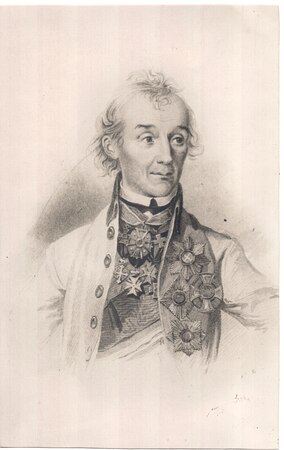 Suvorov by John Charles Robinson from a drawing by Taras Shevchenko

Assessment
[edit]Suvorov's art of war
[edit]
end of XIX century.
Suvorov is widely considered to be the single greatest and most talented military commander in all of Russian history,[165][166][167][168][169] the most gifted commander of the eighteenth century,[170] and one of the greatest generals in world history.[171][165][172][173] Suvorov has also been described as the best general Republican France ever fought,[9] and the best Coalition general when he was active.[174] Undefeated in battle,[10] he led and won 63 battles without suffering a major defeat or setback.[21][175][176]
Suvorov won despite being outnumbered in almost all of his battles,[175] defeating many of the best commanders of the time period, those being André Masséna, Étienne Macdonald, and Jean Victor Marie Moreau of France, and Koca Yusuf Pasha, Cenaze Hasan Pasha, and Aydoslu Mehmed Pasha of the Ottoman Empire. Notably, Suvorov defeated the French Revolutionary Army multiple times, which was regarded as the best in the world, and Masséna, arguably the best French Revolutionary general, who had superior forces in terms of experience, morale, and numbers.[177]
Moreau ultimately ranked Suvorov alongside Napoleon, while also describing Suvorov's victory at Trebbia as "the height of the art of war", while writer Eugen Binder von Krieglstein ranked Suvorov as one of the greatest commanders of all time, alongside Napoleon and Frederick the Great.[178] Renowned military officer and theorist Antoine-Henri Jomini called Suvorov "the true genius of war".[179] Naval officer John Paul Jones, referred to as the "Father of the American Navy", labeled Suvorov the "greatest warrior" and ranked him alongside Alexander the Great, Hannibal, Caesar, Gustavus Adolphus and Frederick the Great.[180] The British historian Simon Sebag Montefiore called Suvorov Russia's most brilliant general and ranked him as one of the modern military geniuses, along with Napoleon and Frederick the Great.[181]
In 1799, Napoleon himself warned the Directory that they would not be able to stop Suvorov unless they found generals with "special skill in fighting him".[182] In 1807, Macdonald declared to the Russian ambassador at a reception with Napoleon and a crowd around that "This crew would never have seen the Tuileries if you had had a second Suvorov".[183]
While on a campaign, he reportedly lived as a private soldier, sleeping on straw and contenting himself with the humblest fare.[184] Suvorov saw victory as dependent on the morale, training, and initiative of the front-line soldier. In battle he emphasized speed and mobility, accuracy of gunfire and the use of the bayonet, as well as detailed planning and careful strategy.[34] His motto: coup d'oeil (glazomer), speed (bystrota), impetus (natisk).[185] He abandoned traditional drills, and communicated with his troops in clear and understandable ways. Suvorov also took great care of his army's supplies – what could not be done in Switzerland due to the Habsburg indifference to his army (see § The march to Switzerland) – and living conditions, reducing cases of illness among his soldiers dramatically, and earning their loyalty and affection.[34] A master of logistics, Suvorov ordered his officers, quartermasters and doctors to keep the welfare and fitness of the troops in the forefront of their attentions. He severely punished, often with courts-martial, any officers who senselessly or cruelly drilled their troops or who failed to maintain his high sanitary and health standards. Although a strict disciplinarian, he took extenuating circumstances into account. Once a soldier or officer had been punished or reprimanded, Suvorov would do his utmost to rehabilitate him.[21]
Suvorov "did not know retreat", he constantly acted offensively and in accordance with the situation was looking for a fight, not evaded it, but he did not overuse the battles, the fight always turned out to be appropriate, necessary in the operation, and moreover decisive; if he got the chance to confront his enemy, he used it with all the energy.[114] Suvorov's guiding principle was to detect the weakest point of an enemy and focus an attack upon that area. He would send forth his units in small groups as they arrived on the battlefield to sustain momentum. Suvorov used aimed fire instead of repeated barrages from line infantry and applied light infantrymen as skirmishers and sharpshooters. He used a variety of army sizes and types of formations against different foes: squares against the Turks, lines against Poles, and columns against the French.[21]
Suvorov believed that "a military man must know the languages of the nations with whom he is fighting," so he developed a fluent command of French, German, Greek, Ottoman Turkish, Italian, Polish and Latin, as well as some knowledge of Arabic, Finnish and Persian. He also rejected a suggestion that the Russian army rid itself of its musicians, saying,
"music doubles, trebles the force of an army."[21]

According to D. S. Mirsky, Suvorov "gave much attention to the form of his correspondence, and especially of his orders of the day. These latter are highly original, deliberately aiming at unexpected and striking effects. Their style is a succession of nervous staccato sentences, which produce the effect of blow and flashes. Suvorov's official reports often assume a memorable and striking form. His writings are as different from the common run of classical prose as his tactics were from those of Frederick or Marlborough".[186]
Mikhail Ivanovich Dragomirov declared that he based his teaching on Suvorov's practice, which he held as representative of the fundamental truths of war and of the military qualities of the Russian nation.[187]
Suvorov's maneuvering of the Alps led him to be called the "Russian Hannibal",[188] and was also referred to as the "Russian Mars" and "God of War".[189] The French king, Louis XVIII, compared Suvorov to Attila.[190]
Suvorov and Napoleon
[edit]Suvorov considered Hannibal, Alexander the Great, Julius Caesar, and Napoleon Bonaparte to be the greatest military commanders of all time. Suvorov is seen as having anticipated Napoleon's tactics, and is regarded as being on par with him in terms of military genius.[8][191][192][193] Like Napoleon, Suvorov believed that opportunities in battle are created by fortune but exploited by intelligence, experience and an intuitive vision. To Suvorov, mastery of the art and science of war was not, therefore, purely instinctive. Suvorov kept up with events in Europe by subscribing to foreign newspapers and journals.[21] He had written to one of his nephews in 1796:[194]
"That young Bonaparte, how he moves! He is a hero, a giant, a magician. He overcomes nature and he overcomes men. He turned the Alps[o] as if they did not exist; he has hidden their frightful rocks in his pocket, and tucked up his army up the right sleeve of his uniform. The enemy scarcely catches sight his soldiers before he throws his troops at them like a thunderbolt from Jupiter, spreading terror in all directions, and crushing the scattered bands of Austrians and Piedmontese. My God, how he moves! The first time he assumed command he cut to the heart of tactics like a sword slashing through the Gordian Knot. He disregards the odds against him, he attacks the enemy wherever they are to be found, and he defeats them in detail. He knows that shock is irresistibe—and that says it all. His enemies will continue in their old routine, subject to the scribblers in the Cabinet, but as for him, he carries his council of war in his head. His operations are as free as the air he breathes… My conclusion is this. That as long as General Bonaparte keeps his wits about him he will be victorious; he possesses the higher elements of the military art in a happy balance. But if, unfortunately for him, he throws himself into the whirlpool of politics, he will lose the coference of his thoughts and he will be lost."


Suvorov held Napoleon in high regard, despite not living to see the Napoleonic Wars. However, Napoleon did not reciprocate Suvorov's esteem, assessing Suvorov as having "the soul of a great commander, but not the brains. He was extremely strong willed, he was amazingly active and utterly fearless—but he was as devoid of genius as he was ignorant of the art of war".[194] Despite the two never facing each other, military historians often debate between Suvorov and Napoleon as to who was the superior commander.[21]
Legacy
[edit]
Suvorov was buried in Saint Petersburg in the Alexander Nevsky Lavra. His gravestone states simply: "Here lies Suvorov".
Within a year after his death, Paul I was murdered in his bedroom for his disastrous leadership by a band of dismissed officers and his son and successor Alexander I erected a statue to Suvorov's memory in the Field of Mars.

Suvorov's revolutionary methods of waging war endure in his prodigious literary, documentary and epistolary output. He was famed for his military writings, the most well-known being The Science of Victory (The Science of Winning)[ru] and Suzdal Regulations,[ru] and lesser-known works such as Rules for the Kuban and Crimean Corps, Rules for the Conduct of Military Actions in the Mountains (written during his Swiss campaign), and Rules for the Medical Officers.[21] Suvorov was also noted for several of his sayings:[195]
"What is difficult in training will become easy in a battle."
"Perish yourself but rescue your comrade!"
"Fight the enemy with the weapons he lacks."
"One minute can decide the outcome of the battle, one hour — the outcome of the campaign, and one day — the fate of the country."
"He who is afraid is half beaten."
"To me death is better than the defensive."
"A strong pursuit, give no time for the enemy to think, take advantage of victory, uproot him, cut off his escape route."
"When the enemy is driven back, we have failed, and when he is cut off, encircled and dispersed, we have succeeded."
He taught his soldiers to attack instantly and decisively:[21]
"Attack with the cold steel! Push hard with the bayonet!"


A "Suvorov school" of generals who had apprenticed under him played a prominent role in the Russian military. Among them was future Field Marshal Mikhail Kutuzov who led the Russian imperial army against Napoleon during the Napoleonic Wars, including the French invasion of Russia.[21] Suvorov, a follower of Peter I the Great and a pupil of Field Marshal Pyotr Alexandrovich Rumyantsev-Zadunaisky, brought up a pleiad of remarkable commanders and military leaders, among whom the most outstanding were, except for Kutuzov, Generals of the Infantry P. I. Bagration, M. A. Miloradovich. On his ideas were brought up Field Marshal D. A. Milyutin, Generals of the Infantry M. I. Dragomirov, M. D. Skobelev, General of the Cavalry A. A. Brusilov, and other famous military figures.[26]
The Suvorov Museum opened in Saint Petersburg in 1900 to commemorate the centenary of the general's death.[196] Apart from in St. Petersburg, other Suvorov museums and monuments have feature in Focșani, Ochakiv(-ov) [1907[p]], Sevastopol [1983], Tulchyn(-in) [1954], Kobryn(-in) [1949; 1950; 1964], Novaya Ladoga [1947], Kherson [1904], Tymanivka or Timanovka [1947; 1950], Simferopol [1984], Kaliningrad [1956], Konchanskoye-Suvorovskoye [1942], Râmnicu Sărat or Rymnik,[q] Elm and Andermatt which are in the Swiss Alps, etc.
During World War II, the Soviet Union revived the memory of many pre-1917 Russian heroes to raise patriotism. Suvorov was the Tsarist military figure most often referred to by Joseph Stalin, who also received (but did not personally use) the rank of Generalissimo that Suvorov had previously held. The Order of Suvorov was established by the Presidium of the Supreme Soviet on 29 July 1942, and it is still awarded to senior army personnel for exceptional leadership in combat operations against superior enemy forces.[197]
The town of Suvorovo in Varna Province, Bulgaria, was named after Suvorov during the communist period, as was the Russian ship which discovered Suwarrow Island in the Pacific in 1814.
Various currency notes of the Transnistrian ruble depict Suvorov.[198][199]
There is a Suvorov Square in Tiraspol, Transnistria, named after Alexander Vasilyevich, and another in Saint Petersburg.
His prowess, military wisdom, and daring remain in high regard. Another of his many utterances are well known in the Russian military:
"Achieve victory not by numbers, but by knowing how."
"The bullet is a mad thing; only the bayonet knows what it is about."
"Train hard, fight easy. Train easy and you will have hard fighting."
"Train hard, fight easy" became a Russian proverb.[21]
Alexander Petrushevsky in third volume of his work Generalissimo Prince Suvorov quoted a small song of Russian soldiers about Alexander Suvorov, Pyotr Rumyantsev, and Grigory Potemkin:[200]
Count Rumyantsev-general
Lost a lot of strength.
Thief Potemkin-general
Was never in his own regiment,
He neglected all his strength:
Some of it he drank, some of it he squandered,
Some of it he lost at cards.
And Suvorov-general
Proved his strength,
He loaded a small cannon,
He took the king prisoner.
In Russia, there are 12 secondary-level military schools called Suvorov Military School that were established during the USSR. There is also a military school in Minsk named after Suvorov.[201]
In Soviet times, the 1941 film Suvorov was made (released in the US as General Suvorov).
Russia's former defence minister Sergei Shoigu has proposed that Suvorov be made a saint in the Russian Orthodox Church.[202]
Miscellaneous art
[edit]Coins
[edit]-
 Bank of Russia coin – Series: "Outstanding Russian Military Commanders"; A. V. Suvorov, 3 rubles reverse.
 -
 Bank of Russia coin – Series: "Outstanding Russian Military Commanders"; A. V. Suvorov, 25 rubles reverse.
 -
 Bank of Russia coin – Series: "Outstanding Russian Military Commanders"; Generalissimo A. V. Suvorov, 50 rubles reverse.


Banknotes
[edit]-
-
 Transnistria
1,000 Transnistrian rubles
Transnistrian Republican Bank. 1993 series. -
 Transnistria
100,000 Transnistrian rubles
Transnistrian Republican Bank. 1994 series. -
 Transnistria
500,000 Transnistrian rubles
Transnistrian Republican Bank. 1997 series.


Stamps
[edit]-
![USSR stamp, 2 rubles; 150th anniversary of Suvorov's death; Suvorov in the Alps (artist Nikolay Mikhailovich Avvakumov [ru], 1941, Moscow, Pushkin Museum).](//upload.wikimedia.org/wikipedia/commons/thumb/e/e2/The_Soviet_Union_1950_CPA_1519_stamp_%28150th_death_Anniversary_of_Alexander_Suvorov_%281730-1800%29._%27Suvorov_in_the_Alps%27_based_on_drawing_by_Nikolai_Avvakumov%2C_1941%29_2.jpg/120px-thumbnail.jpg) USSR stamp, 2 rubles; 150th anniversary of Suvorov's death; Suvorov in the Alps (artist Nikolay Mikhailovich Avvakumov [ru], 1941, Moscow, Pushkin Museum).
USSR stamp, 2 rubles; 150th anniversary of Suvorov's death; Suvorov in the Alps (artist Nikolay Mikhailovich Avvakumov [ru], 1941, Moscow, Pushkin Museum). -
 Capture of Izmail. USSR. 10 kopecks. "Death flees the saber and bayonet of the brave." (Alexander Suvorov).
 -
 Russian Postage stamp. 200th anniversary of Suvorov's crossing of the Alps. Suvorov with a group of officers and soldiers of the Russian army.
 -
 Russian postage stamp, 2005.
 -
![The Monument to Alexander Suvorov and his Swiss assistant Antonio Gamma by Dmitry Nikitovich Tugarinov [ru]. Bronze. The Gotthard Pass, Switzerland. 31 rubles.](//upload.wikimedia.org/wikipedia/commons/thumb/5/5f/Stamp_of_Russia_2016_No_2171_Monument_to_Alexander_Suvorov_by_Dmitry_Tugarinov.jpg/120px-Stamp_of_Russia_2016_No_2171_Monument_to_Alexander_Suvorov_by_Dmitry_Tugarinov.jpg) The Monument to Alexander Suvorov and his Swiss assistant Antonio Gamma by Dmitry Nikitovich Tugarinov [ru]. Bronze. The Gotthard Pass, Switzerland. 31 rubles.
The Monument to Alexander Suvorov and his Swiss assistant Antonio Gamma by Dmitry Nikitovich Tugarinov [ru]. Bronze. The Gotthard Pass, Switzerland. 31 rubles. -
 USSR stamp, 1980. 250th anniversary of Suvorov's birth. 4 kopecks.
![USSR stamp, 2 rubles; 150th anniversary of Suvorov's death; Suvorov in the Alps (artist Nikolay Mikhailovich Avvakumov [ru], 1941, Moscow, Pushkin Museum).](https://en.wikipedia.org/wiki/File:The_Soviet_Union_1950_CPA_1519_stamp_(150th_death_Anniversary_of_Alexander_Suvorov_(1730-1800)._%27Suvorov_in_the_Alps%27_based_on_drawing_by_Nikolai_Avvakumov,_1941)_2.jpg)


![The Monument to Alexander Suvorov and his Swiss assistant Antonio Gamma by Dmitry Nikitovich Tugarinov [ru]. Bronze. The Gotthard Pass, Switzerland. 31 rubles.](https://en.wikipedia.org/wiki/File:Stamp_of_Russia_2016_No_2171_Monument_to_Alexander_Suvorov_by_Dmitry_Tugarinov.jpg)

- Additional Swiss memorials
-
 On the Panixer Pass way near Elm GL: a memorial was inaugurated on 6 October 2012 at the Wichlen Shooting Range in Glarus Süd to commemorate the Russian soldiers who marched through here with General Alexander Suvorov during the Second Coalition War. The sculpture of a grenadier was placed on a rock, and a memorial plaque with an inscription is attached to the rock.
 -
 Memorial stone, erected 1957, dedicated to the Russian soldiers of Suvorov's Italian campaign, who died in the hospital of the Weingarten Abbey 1799, and are buried here. Weingarten, Baden-Württemberg, Germany.
Russian: Здесь покоятся суворовские чудо-богатыри, lit. 'This is the resting place of Suvorov's wonder-bogatyrs'
German: Hier Ruhen Suworow-Helden, lit. 'Suvorov's heroes rest here'


Ukraine
[edit]Due to "decommunization policies" the street named after Suvorov in (Ukraine's capital) Kyiv was renamed after Mykhailo Omelianovych-Pavlenko in 2016. Suvorov is not related to communism, but his name was used by the Soviet Union for propaganda purposes.[203]
In September 2022, a street that was named after Suvorov in Dnipro (Ukraine) was renamed to honor Alan Shepard.[204]
In October 2022, during the Russian invasion of Ukraine, Russian troops captured a monument to Suvorov in Kherson and took it with them as they fled the city.[205]
In December 2022, another street in Kyiv that was still named after Suvorov was renamed to Serhiy Kotenko Street.[206]
In January 2023, an image of Suvorov on a monument was removed in Odesa.[207]
In Kherson the Suvorivskyi Raion (urban district), named after General Suvorov, was renamed to Tsentralnyi (Central) Raion in October 2023.[208]
Literary references
[edit]Poet Alexander Shishkov devoted an epitaph to Suvorov, while Gavrila Derzhavin mentioned him in Snigir (Bullfinch) and other poems, calling Suvorov "an Alexander by military prowess, a stoic by valor". Suvorov was mentioned by Alexander Pushkin and Mikhail Lermontov and in the numerous works of other Russian poets of the 18th and 19th centuries, such as Ivan Dmitriev, Apollon Maykov, Dmitry Khvostov, Yermil Kostrov, Kondraty Ryleyev, Vasili Popugaev. Kostrov, the first translator of Homer into Russian, wrote an ode in honor of Suvorov and an epistolary on the capture of Izmail.[209] In 1795 poet and soldier Irinarkh Zavalishin [ru], who had fought under the command of Alexander Suvorov, wrote a heroic poem titled "Suvoriada", celebrating Suvorov's victories. Suvorov is one of the characters in the drama "Antonio Gamba, Companion of Suvorov in the Alpine Mountains" by Sergey Glinka which commemorates the Swiss expedition of 1799.[210][211] In British literature, Byron caricatured Suvorov in the seventh canto of Don Juan. In Leo Tolstoy's War and Peace, old Prince Nicholas Bolkonski says: "Suvorov couldn't manage them so what chance has Michael Kutuzov?". Tolstoy also refers to Suvorov later on in the book. Suvorov is also mentioned by Capt. Ryków in Adam Mickiewicz's poem Pan Tadeusz.
See also
[edit]- Suvorov Military School
- Suvorov military canals
- Suwarrow
- Suvorov Museum, Saint Petersburg
- Suvorov Museum, Timanivka
- Order of Suvorov
- Medal of Suvorov
- Suvorov (film)
- Russian battleship Knyaz Suvorov
- Soviet cruiser Aleksandr Suvorov
- River cruise ship Aleksandr Suvorov
- Russian submarine Generalissimus Suvorov
- Suvorov's Swiss campaign
Notes and refs
[edit]Notes
[edit]- ^ Russian: Князь Итали́йский граф Алекса́ндр Васи́льевич Суво́ров-Ры́мникский, romanized: Knjazj Italijskij graf Aleksandr Vasiljevič Suvorov-Rymnikskij, IPA: [knʲæsʲ ɪtɐˈlʲijsʲkʲɪj graf ɐlʲɪkˈsandr vɐˈsʲilʲjɪvʲɪtɕ sʊˈvorəf ˈrɨmnʲɪksʲkʲɪj]
- ^ The Prince of Italy is the anglicised victory title of "Knyaz Italiysky". In Russian language, Italiysky comes from the Latin and Italian word Italia and is equivalent to the English word Italic.
- ^ The term Third Silesian War is a narrow concept of the Seven Years' War: the place of action is limited to Europe. Swedish historiography also uses the term Pomeranian War, which is confined only in Pomerania.
- ^ Weisentin?
- ^ Neugarten? / Neigarten?
- ^ Petrushevsky: "According to a Polish source, 8,000 Poles in arms and 12,000 Praga residents killed."
Or up to 20,000.[49] Only the killing of 20,000 Poles is indicated, without specifying civilians or Poles in arms. - ^ In Edith Bone's translation of Osipov's book, the meaning is slightly changed for rhyme in English. In the original (Petrushevsky and Longworth include this as well) it reads:
"I am sitting on a rock
And at Ochakov I look."[70] - ^ The Russians lost 365 men in it, although Ottoman losses were greater.
- ^ See Prussian Army
- ^ The place where, a year later, Bonaparte would score his famous victory.
- ^ Examples of Suvorov caricatures
- "General Swallow-all-o Feasting on a French Fricassee!!"
Library of Congress description: "Print shows a gigantic Russian soldier, possibly a gross caricature of Field Marshal Aleksandr Vasil'evich Suvorov, eating the severed head of a French soldier, another oversized man, a chef, holds a platter containing several more heads; refers to the defeat of the French in Italy by Russian forces under the command of Suvorov". - "General Swarrow, towing the French Directory into Russia!!"
Suvorov took the French Directory captive. On Suvorov's uniform, on the right sleeve, a round red-yellow patch with the inscription "WARSAW" (reference to the Praga massacre). - "Gen'l Swallow Destroying the French Army."
Giant Suvorov in a pirate hat catches the fleeing French troops with a forks, devours them and tramples others. Just below Suvorov, a French soldier hides under a cannon.
- "General Swallow-all-o Feasting on a French Fricassee!!"
- ^ or up to 13,000[98]
- ^ When Suvorov was unaware of Korsakov's defeat, in the absence of news he preferred not to stop to let his exhausted army rest, which he directed instead, as early as the early hours of September 27, toward the Chinzig Chulm, counting on bypassing the French by reaching Schwyz from the village of Muotathal (Mutten).
- ^ Battle of Glarus (1799)#According to Milyutin
- ^ Tyrolean Alps, during his 1796–1797 campaign.
- ^ Year when the monument was built.
- ^ Battle of Rymnik § Gallery
References
[edit]- ^ Duffy 1999, p. 14.
- ^ Polevoy 1897, p. 13.
- ^ Longworth 1966, p. 164.
- ^ Fremont-Barnes, Gregory, ed. (2006). The Encyclopedia of the French Revolutionary and Napoleonic Wars: A Political, Social, and Military History (PDF). ABC-CLIO. p. 11. ISBN 1-85109-651-5.[permanent dead link]
- ^ Clodfelter 2017, p. 107.
- ^ Longworth 1966, p. 288.
- ^ Suvorov's Swiss campaign § Legacy of the campaign
- ^ a b Uzefovich, Alexis M. (1931). "Alexander V. Suvorov, Generalissimo". The Military Engineer. 23 (127): 62–66. ISSN 0026-3982. JSTOR 44575916.
- ^ a b c d e f Clodfelter 2017, p. 108.
- ^ a b Longworth 1966, p. 11, 305.
- ^ Petrushevsky, Alexander (1884). Generalissimo Prince Suvorov (in Russian). Vol. 3 (1st ed.). Saint Petersburg: Типография М. М. Стасюлевича. p. 376.
- ^ a b c Spalding (1888). "Suvóroff". Illustrated Naval and Military Magazine. VII: 328–340. Retrieved June 29, 2009.
- ^ Мелик-Шахназаров, Арсен Ашотович (2007-11-04). ""Варанда – сердце Арцаха"". Анив (6).
- ^ Цветков, Сергей (2019-03-22). "Армянские корни Суворова — правда или миф?". sergeytsvetkov.livejournal.com. Retrieved 2024-09-27.
- ^ Chamber's repository, 1857, v. 6, p. 3.
- ^ Mandich, Donald R. Russian Heraldry and Nobility, 1992, p. 271
- ^ Anthing 1813, p. 6.
- ^ "Наука и жизнь. №8, 2005". Nauka i Zhizn magazine. 2005. Retrieved May 28, 2018.
- ^ a b c Осипов К. (И. М. Куперман). Александр Васильевич Суворов. Изд. 3-е, испр. М.: 1955. С. 3–5
- ^ a b В. Могильников. Новая версия происхождения полководца А. В. Суворова // Генеалогический вестник. №13, 2003.
- ^ a b c d e f g h i j k l m n o p q r s Isinger 1996.
- ^ Petrushevsky 1900, pp. 4, 7.
- ^ Petrushevsky, Alexander (1884). Generalissimo Prince Suvorov (in Russian). Vol. 1 (1st ed.). Saint Petersburg: Типография М. М. Стасюлевича. p. 8.
- ^ Petrushevsky, Alexander (1884). Generalissimo Prince Suvorov (in Russian). Vol. 1 (1st ed.). Saint Petersburg: Типография М. М. Стасюлевича. p. 17.
- ^ Kipnis 2021, pp. 38–40.
- ^ a b Zolotaryov 2023.
- ^ Alexeyev 2010.
- ^ Mikhaylov 1973, pp. 53–54.
- ^ Petrushevsky 1900, p. 11.
- ^ Petrushevsky 1900, pp. 11–12.
- ^ a b Petrushevsky, Alexander (1884). Generalissimo Prince Suvorov (in Russian). Vol. 1 (1st ed.). Saint Petersburg: Типография М. М. Стасюлевича. pp. 29–30.
- ^ "Бой при Ландсберге" [Combat of Landsberg]. Runivers. Военные конфликты, кампании и боевые действия русских войск 860–1914 гг. (in Russian). Retrieved 9 June 2023.
- ^ a b Petrushevsky, Alexander (1884). Generalissimo Prince Suvorov (in Russian). Vol. 1 (1st ed.). Saint Petersburg: Типография М. М. Стасюлевича. pp. 31–32.
- ^ a b c d e f g h i j k l m n o p Chisholm 1911.
- ^ Н., РОГУЛИН (2010). ""...ПРОТИВУ НЕПРИЯТЕЛЯ ПОСТУПАЛ ВЕСЬМА С ОТЛИЧНОЙ ХРАБРОСТИЮ". СУВОРОВ В СЕМИЛЕТНЕЙ ВОЙНЕ". исторических наук (in Russian). ISSN 0235-7089.
- ^ Petrushevsky, Alexander (1884). Generalissimo Prince Suvorov (in Russian). Vol. 1 (1st ed.). Saint Petersburg: Типография М. М. Стасюлевича. p. 27.
- ^ Орехов, Дмитрий. "Суворов и масоны". www.hrono.ru. Retrieved 2024-04-24.
- ^ Petrushevsky 1900, p. 12.
- ^ Petrushevsky, Alexander (1884). Generalissimo Prince Suvorov (in Russian). Vol. 1 (1st ed.). Saint Petersburg: Типография М. М. Стасюлевича. p. 87.
- ^ a b Petrov 1874, p. 222.
- ^ Petrushevsky 1900, pp. 48–49.
- ^ Petrushevsky, Alexander (1884). Generalissimo Prince Suvorov (in Russian). Vol. 1 (1st ed.). Saint Petersburg: Типография М. М. Стасюлевича. pp. 98–99.
- ^ Petrushevsky, Alexander (1884). Generalissimo Prince Suvorov (in Russian). Vol. 1 (1st ed.). Saint Petersburg: Типография М. М. Стасюлевича. pp. 104–105.
- ^ "24.01.1772 г. – Начало осады Краковского замка" [The Beginning of the Siege of the Kraków Castle]. Runivers. Календарь побед Русской армии (in Russian). Retrieved 8 June 2023.
- ^ Cowley, Robert; Parker, Geoffrey, eds. (2001). The Reader's Companion to Military History. Houghton Mifflin Books. p. 457. ISBN 978-0-618-12742-9. Retrieved 2006-09-10.
- ^ Petrushevsky, Alexander (1884). Generalissimo Prince Suvorov (in Russian). Vol. 2 (1st ed.). Saint Petersburg: Типография М. М. Стасюлевича. p. 96.
- ^ Petrushevsky, Alexander (1884). Generalissimo Prince Suvorov (in Russian). Vol. 2 (1st ed.). Saint Petersburg: Типография М. М. Стасюлевича. pp. 71–72.
- ^ a b c Petrushevsky, Alexander (1884). Generalissimo Prince Suvorov (in Russian). Vol. 2 (1st ed.). Saint Petersburg: Типография М. М. Стасюлевича. pp. 122–123.
- ^ Ledonne, 2003, p. 144 Google Print and Alexander, 1989, p. 317 Google Print (broken link)[permanent dead link]
- ^ See Battle of Praga#Massacre
- ^ (in Russian) Alexander Bushkov Russia that never existed, cites Adam Jerzy Czartoryski's memoirs that Suvorov was trying to prevent the massacre Archived September 27, 2007, at archive.today
- ^ Petrushevsky, Alexandr Fomich (2005) [1884]. "17. Польская война: Прага; 1794." [Polish war: Prague; 1794.]. Генералиссимус князь Суворов [Generalissimo Prince Suvorov] (in Russian). Русская Симфония. ISBN 978-5-98447-010-0. Retrieved 9 October 2016.
- ^ (in Polish) Janusz Tazbir, Polacy na Kremlu i inne historyje (Poles on Kreml and other stories), Iskry, 2005, ISBN 978-83-207-1795-2, fragment online Archived March 25, 2012, at the Wayback Machine
- ^ Davies, Norman (1996). Europe: A History. Oxford University Press. p. 722. ISBN 0060974680.[permanent dead link]
- ^ Dixon, Simon (1999). The Modernisation of Russia, 1676–1825. Cambridge University Press. p. 41. ISBN 052137961X.[permanent dead link]
- ^ John Leslie Howard, Soldiers of the Tsar: Army and Society in Russia, 1462–1874, Keep, Oxford University Press, 1995, ISBN 978-0-19-822575-1, Google Print, p. 216
- ^ a b Bantysh-Kamensky 1840, p. 136.
- ^ Petrushevsky, Alexander (1884). Generalissimo Prince Suvorov (in Russian). Vol. 1 (1st ed.). Saint Petersburg: Типография М. М. Стасюлевича. pp. 144–145.
- ^ Petrushevsky, Alexander (1884). Generalissimo Prince Suvorov (in Russian). Vol. 1 (1st ed.). Saint Petersburg: Типография М. М. Стасюлевича. pp. 90–91.
- ^ Velichko et al. 1912, pp. 323–325.
- ^ Petrushevsky, Alexander (1884). Generalissimo Prince Suvorov (in Russian). Vol. 1 (1st ed.). Saint Petersburg: Типография М. М. Стасюлевича. p. 149.
- ^ Petrushevsky, Alexander (1884). Generalissimo Prince Suvorov (in Russian). Vol. 1 (1st ed.). Saint Petersburg: Типография М. М. Стасюлевича. p. 153.
- ^ Osipov 1939, p. 47.
- ^ a b Petrushevsky, Alexander (1884). Generalissimo Prince Suvorov (in Russian). Vol. 1 (1st ed.). Saint Petersburg: Типография М. М. Стасюлевича. pp. 154–155.
- ^ Petrushevsky, Alexander (1884). Generalissimo Prince Suvorov (in Russian). Vol. 1 (1st ed.). Saint Petersburg: Типография М. М. Стасюлевича. p. 166.
- ^ Petrushevsky, Alexander (1884). Generalissimo Prince Suvorov (in Russian). Vol. 1 (1st ed.). Saint Petersburg: Типография М. М. Стасюлевича. p. 309.
- ^ Petrushevsky, Alexander (1884). Generalissimo Prince Suvorov (in Russian). Vol. 1 (1st ed.). Saint Petersburg: Типография М. М. Стасюлевича. p. 311.
- ^ Petrushevsky, Alexander (1884). Generalissimo Prince Suvorov (in Russian). Vol. 1 (1st ed.). Saint Petersburg: Типография М. М. Стасюлевича. p. 325.
- ^ Petrushevsky, Alexander (1884). Generalissimo Prince Suvorov (in Russian). Vol. 1 (1st ed.). Saint Petersburg: Типография М. М. Стасюлевича. p. 321.
- ^ Longworth 1966, p. 148.
- ^ Petrushevsky, Alexander (1884). Generalissimo Prince Suvorov (in Russian). Vol. 1 (1st ed.). Saint Petersburg: Типография М. М. Стасюлевича. p. 332.
- ^ Osipov 1939, p. 76.
- ^ Petrushevsky, Alexander (1884). Generalissimo Prince Suvorov (in Russian). Vol. 1 (1st ed.). Saint Petersburg: Типография М. М. Стасюлевича. pp. 326–327.
- ^ Petrushevsky, Alexander (1884). Generalissimo Prince Suvorov (in Russian). Vol. 1 (1st ed.). Saint Petersburg: Типография М. М. Стасюлевича. pp. 351–352.
- ^ Petrushevsky, Alexander (1884). Generalissimo Prince Suvorov (in Russian). Vol. 1 (1st ed.). Saint Petersburg: Типография М. М. Стасюлевича. p. 360.
- ^ Longworth, Philip. "Aleksandr Vasilyevich Suvorov, Count Rimniksky". Encyclopedia Britannica, 14 May. 2023. Accessed 26 June 2023.
- ^ Petrushevsky, Alexander (1884). Generalissimo Prince Suvorov (in Russian). Vol. 1 (1st ed.). Saint Petersburg: Типография М. М. Стасюлевича. p. 386.
- ^ a b Goodwin 1998.
- ^ Petrushevsky, Alexander (1884). Generalissimo Prince Suvorov (in Russian). Vol. 1 (1st ed.). Saint Petersburg: Типография М. М. Стасюлевича. p. 188.
- ^ Petrushevsky, Alexander (1884). Generalissimo Prince Suvorov (in Russian). Vol. 1 (1st ed.). Saint Petersburg: Типография М. М. Стасюлевича. pp. 188–191.
- ^ a b Gutakov 2007.
- ^ Petrushevsky, Alexander (1884). Generalissimo Prince Suvorov (in Russian). Vol. 1 (1st ed.). Saint Petersburg: Типография М. М. Стасюлевича. p. 201.
- ^ Velichko et al. 1915, p. 447.
- ^ Petrushevsky 1900, pp. 116–117.
- ^ Petrushevsky 1900, p. 119.
- ^ Petrushevsky 1900, p. 280.
- ^ Petrushevsky, Alexander (1884). Generalissimo Prince Suvorov (in Russian). Vol. 2 (1st ed.). Saint Petersburg: Типография М. М. Стасюлевича. p. 6.
- ^ Petrushevsky 1900, p. 418.
- ^ a b Petrushevsky, Alexander (1884). Generalissimo Prince Suvorov (in Russian). Vol. 1 (1st ed.). Saint Petersburg: Типография М. М. Стасюлевича. pp. 406–407.
- ^ Petrushevsky, Alexander (1884). Generalissimo Prince Suvorov (in Russian). Vol. 1 (1st ed.). Saint Petersburg: Типография М. М. Стасюлевича. p. 410.
- ^ Petrushevsky, Alexander (1884). Generalissimo Prince Suvorov (in Russian). Vol. 1 (1st ed.). Saint Petersburg: Типография М. М. Стасюлевича. p. 412.
- ^ Petrushevsky, Alexander (1884). Generalissimo Prince Suvorov (in Russian). Vol. 1 (1st ed.). Saint Petersburg: Типография М. М. Стасюлевича. p. 443.
- ^ a b Osipov 1939, p. 66.
- ^ Onion, Amanda; Sullivan, Missy; Mullen, Matt; Zapata, Christian (September 21, 2017). "Romanov Family". HISTORY. A&E Television Networks. Retrieved June 22, 2023.
- ^ Petrushevsky 1900, p. 519.
- ^ Orlov 1892, p. 322.
- ^ Novikov 1948, p. 153.
- ^ Duffy 1999, p. 114.
- ^ Elchaninov, A. (2003). История русской армии (in Russian). St. Petersburg: Полигон. p. 412. ISBN 5-89173-205-X.
- ^ Semyonov, Boris (15 August 2019). "Битва при Нови. Самая трудная победа Суворова" [Battle of Novi. Suvorov's most difficult victory]. История.РФ (in Russian). Russian Military Historical Society. Retrieved 9 June 2023.
- ^ Bogolyubov 1939, p. 118.
- ^ Petrushevsky 1900, p. 627.
- ^ See Battle of the Trebbia (1799)#Result
- ^ Orlov 1892, pp. 315, 331.
- ^ See First Battle of Marengo (1799)
- ^ See Battle of Novi (1799)
- ^ Orlov 1892, pp. 92–93.
- ^ Duffy 1999, p. 40.
- ^ See Battle of Cassano (1799)
- ^ Orlov 1892, p. 73.
- ^ Orlov 1892, p. 332.
- ^ Milyutin 1852, p. 254.
- ^ See Battle of the Trebbia (1799)
- ^ a b Orlov 1892, p. 337.
- ^ a b Orlov 1892, pp. 322–323.
- ^ Orlov 1892, p. 323.
- ^ a b c d Orlov 1892, p. 316.
- ^ Orlov 1892, p. 315.
- ^ Orlov 1892, p. 83.
- ^ See Suvorov's Swiss campaign#The march to Glarus
- ^ See Suvorov's Swiss campaign (infobox)
- ^ See Battle of Gotthard Pass
- ^ a b See Suvorov's Swiss campaign route (map)
- ^ a b See Suvorov's Swiss campaign#The crossing of Chinzig
- ^ a b Petrushevsky, Alexander (1884). Generalissimo Prince Suvorov (in Russian). Vol. 3 (1st ed.). Saint Petersburg: Типография М. М. Стасюлевича. p. 262.
- ^ a b See ru:Швейцарский поход Суворова
- ^ Petrushevsky, Alexander (1884). Generalissimo Prince Suvorov (in Russian). Vol. 3 (1st ed.). Saint Petersburg: Типография М. М. Стасюлевича. pp. 265–266.
- ^ a b Bodart 1908, p. 344.
- ^ Rostunov 1989, p. 496.
- ^ Petrushevsky, Alexander (1884). Generalissimo Prince Suvorov (in Russian). Vol. 3 (1st ed.). Saint Petersburg: Типография М. М. Стасюлевича. pp. 269–270.
- ^ See ru:Сражение в Мутенской долине
- ^ Latimer, Jon (December 1999). "War of the Second Coalition". Military History: 62–69.
- ^ Petrushevsky 1900, p. 697.
- ^ Duffy 1999.
- ^ Petrushevsky, Alexander (1884). Generalissimo Prince Suvorov (in Russian). Vol. 3 (1st ed.). Saint Petersburg: Типография М. М. Стасюлевича. p. 343.
- ^ Petrushevsky, Alexander (1884). Generalissimo Prince Suvorov (in Russian). Vol. 3 (1st ed.). Saint Petersburg: Типография М. М. Стасюлевича. pp. 317–318.
- ^ Petrushevsky, Alexander (1884). Generalissimo Prince Suvorov (in Russian). Vol. 3 (1st ed.). Saint Petersburg: Типография М. М. Стасюлевича. p. 318.
- ^ Petrushevsky, Alexander (1884). Generalissimo Prince Suvorov (in Russian). Vol. 3 (1st ed.). Saint Petersburg: Типография М. М. Стасюлевича. p. 319.
- ^ a b c Petrushevsky, Alexander (1884). Generalissimo Prince Suvorov (in Russian). Vol. 3 (1st ed.). Saint Petersburg: Типография М. М. Стасюлевича. pp. 320–321.
- ^ Petrushevsky, Alexander (1884). Generalissimo Prince Suvorov (in Russian). Vol. 3 (1st ed.). Saint Petersburg: Типография М. М. Стасюлевича. p. 286.
- ^ Petrushevsky, Alexander (1884). Generalissimo Prince Suvorov (in Russian). Vol. 3 (1st ed.). Saint Petersburg: Типография М. М. Стасюлевича. p. 363.
- ^ Anthing 1813, p. 16.
- ^ "А. В. СУВОРОВ". az.lib.ru (in Russian). Retrieved 2024-04-17.
- ^ Longworth 1966, p. 56.
- ^ Petrushevsky 1900, p. 48.
- ^ "Generalissimo Prince Suvorov". az.lib.ru (in Russian). Retrieved 2024-04-17.
- ^ Pares 1926, p. 309.
- ^ Bodart 1908, p. 263.
- ^ Petrushevsky, Alexander (1884). Generalissimo Prince Suvorov (in Russian). Vol. 3 (1st ed.). Saint Petersburg: Типография М. М. Стасюлевича. pp. 326–327.
- ^ See First Battle of Marengo (1799)#Forces
- ^ Petrushevsky, Alexander (1884). Generalissimo Prince Suvorov (in Russian). Vol. 3 (1st ed.). Saint Petersburg: Типография М. М. Стасюлевича. pp. 103–134.
- ^ Velichko et al. 1914, pp. 21–24.
- ^ a b Bodart 1908, p. 343.
- ^ Duffy 1999, p. 177.
- ^ Duffy 1999, p. 181.
- ^ Duffy 1999, p. 188.
- ^ Mikaberidze, Alexander (2003). Lion of the Russian Army: Life and Military Career of Prince General Peter Bagration. Florida State University. pp. 162–165.
- ^ Osipov 1939, p. 7.
- ^ a b See ru:Суворов, Александр Васильевич#Награды
- ^ Polovtsov 1912, p. 1.
- ^ Mikaberidze, Alexander (2011). Alexey Yermolov's Memoirs. Lulu.com. p. 211. ISBN 978-1105258183.[self-published source]
- ^ Duffy 1999, p. 86.
- ^ Osipov 1939, p. 190.
- ^ "Мединский назвал настоящий рост генералиссимуса Суворова – РИА Новости, 04.02.2021". ria.ru (in Russian). 4 February 2021. Retrieved 2024-04-22.
- ^ a b Bodart 1908, p. 789.
- ^ Paret, Peter; Craig, Gordan A.; Gilbert, Felix, eds. (1986). Makers of Modern Strategy from Machiavelli to the Nuclear Age. Princeton University Press. pp. 356–357. ISBN 0-691-09235-4.
- ^ Millar, James R., ed. (2004). Encyclopedia of Russian History. New York: Macmillan Reference. pp. 928, 1503–1504. ISBN 0-02-865693-8.
- ^ "Александр Суворов признан лучшим полководцем в истории России". tass.ru (in Russian). 2014-05-09. Retrieved 2024-04-20.
- ^ Шахмагонов, Николай Фёдорович (2020). Генералиссимус Суворов (in Russian). Вече. pp. 3, 52. ISBN 978-5-4484-8601-2.
- ^ Grant, R.G. (2011). Commanders: History's Greatest Military Leaders. DK Publishing. p. 174. ISBN 978-1-4053-3696-3.
- ^ Osipov 1939, p. 198.
- ^ Шишов, Алексей (2008). 100 великих военачальников [100 Great Military Leaders] (in Russian). Вече. pp. 188–193. ISBN 978-5-9533-2594-3.
- ^ Рустамович, Моллаев Алимсолтан (2017-04-06). Салимовна, Джелилова Саадат (ed.). "Три самых ярких полководца в мировой истории". Юный учёный (in Russian). 2 (11).
- ^ Зотов, Алексей (2012). Главный соперник Наполеона. Великий генерал Моро [Napoleon's Main Rival: The Great General Moreau] (in Russian). Вече. p. 45. ISBN 978-5-9533-5877-4.
- ^ a b Волковский, Н. Л., ed. (2003). "Суворов — полководец и воспитатель". История русской армии: В 7 т. [History of the Russian Army: In 7 volumes. Volume 1: From the birth of Rus' to the War of 1812.] (in Russian). Vol. 1: От зарождения Руси до войны 1812 г. ООО «Издательство Полигон». p. 441. ISBN 5-89173-205-X.
- ^ Шахмагонов, Николай Фёдорович (2020). Генералиссимус Суворов (in Russian). Вече. pp. 3, 6. ISBN 978-5-4484-8601-2.
- ^ Богданов, Андрей Петрович (2013). Суворов. Победитель Европы [Suvorov: European Winner] (PDF) (in Russian). Вече. pp. 2–5. ISBN 978-5-4444-2234-2.
- ^ Волковский, Н. Л., ed. (2003). "Суворов — полководец и воспитатель". История русской армии: В 7 т. [History of the Russian Army: In 7 volumes. Volume 1: From the birth of Rus' to the War of 1812.] (in Russian). Vol. 1: От зарождения Руси до войны 1812 г. ООО «Издательство Полигон». pp. 468–469. ISBN 5-89173-205-X.
- ^ Савинкин, А.Е. (1999). Домнин, И.В. (ed.). Военная мысль в изгнании: Творчество русской военной эмиграции [Military thought in exile: Creativity of the Russian military emigration] (PDF) (in Russian). Военный университет. p. 325. ISBN 5-85887-056-2.
- ^ Богданов, Андрей Петрович (2013). Суворов. Победитель Европы [Suvorov: European Winner] (PDF) (in Russian). Вече. p. 5. ISBN 978-5-4444-2234-2.
- ^ Montefiore, Simon Sebag (2000). The Life of Potemkin: The Prince of Princes. Phoenix Press. pp. 382–383, 491–492. ISBN 1-84212-438-2.
- ^ Longworth 1966, p. 311.
- ^ Osipov 1939, p. 152.
- ^ Ross, Steven T.; Ross, P. Stewart Michael (2010). The A to Z of the Wars of the French Revolution (Volume 203 of The A to Z Guide Series). Rowman & Littlefield. p. 159. ISBN 978-0810876323.
- ^ Duffy 1999, p. 17.
- ^ Mirsky, D.S. (1999). A History of Russian Literature. Northwestern University Press. pp. 60–61. ISBN 978-0-8101-1679-5.
- ^ Keegan, John; Wheatcroft, Andrew (2014). Who's Who in Military History: From 1453 to the Present Day. Routledge. p. 79. ISBN 978-0415260398.
- ^ Grant, R.G. (2011). Commanders: History's Greatest Military Leaders. DK Publishing. p. 175. ISBN 978-1-4053-3696-3.
- ^ "Генералиссимус Суворов: от Державина до поэмы Симонова / / Независимая газета". www.ng.ru. 2023-05-17. Retrieved 2024-04-24.
- ^ Skripnik, Oleg (2017-01-06). "Russia's military victories aren't just thanks to 'General Frost'". Russia Beyond. Retrieved 2024-04-18.
- ^ Osipov 1939, p. 129, 153, 197.
- ^ Longworth 1966, p. 12, 311.
- ^ А.а, Гришин (2016). "Моральное наследие генералиссимуса". Вестник Московского университета МВД России (6): 211–214. ISSN 2073-0454.
- ^ a b Duffy 1999, p. 269.
- ^ "Alexander Suvorov Quotes". A-Z Quotes. Retrieved 2024-04-26.
- ^ Giangrande & Norwich 2003.
- ^ "Decree of the Presidium of the Supreme Soviet of the USSR of July 7, 1942" (in Russian). Legal Library of the USSR. 1942-07-29. Retrieved 2012-03-26.
- ^ Brezianu, Andrei; Spânu, Vlad (2010). The A to Z of Moldova. Scarecrow Press. p. 109. ISBN 978-1461672036.
- ^ King, Charles (2009). Extreme Politics: Nationalism, Violence, and the End of Eastern Europe. Oxford University Press. p. 120. ISBN 978-0199708246.
- ^ Petrushevsky, Alexander (1884). Generalissimo Prince Suvorov (in Russian). Vol. 3 (1st ed.). Saint Petersburg: Типография М. М. Стасюлевича. p. 377.
- ^ "Minsk Suvorov Military School". Archived from the original on 5 August 2014. Retrieved 18 Dec 2014.
- ^ "Russian defender of 18th-century Crimea proposed for sainthood". Reuters. 24 May 2022.
- ^ (in Ukrainian) Bandera Avenue in Kyiv to be – the decision of the Court of Appeal, Ukrainska Pravda (22 April 2021)
- ^ "In the center of Dnipro, the street of Stepan Bandera appeared – the mayor". Ukrainska Pravda (in Ukrainian). 21 September 2022. Retrieved 18 October 2022.
- ^ "Occupiers steal monuments to Suvorov and Ushakov when fleeing Kherson". Ukrainska Pravda. 24 October 2022. Retrieved 3 December 2022.
- ^ Oleksandr Shumilin (8 December 2022). "n Kyiv, 32 more streets were de-Russified, including Druzhby Narodiv Boulevard". Ukrainska Pravda (in Ukrainian). Retrieved 8 December 2022.
- ^ Oleksandr Shumilin (3 January 2023). "In Odesa, the images of the Russian tsar and admiral were dismantled". Istorychna Pravda ("Historical Truth") (in Ukrainian). Retrieved 3 January 2023.
- ^ "In Kherson, the city's Suvorovsky district was renamed Central". Ukrinform (in Ukrainian). 18 October 2023. Retrieved 16 November 2023.
- ^ Petrushevsky, Alexander (1884). Generalissimo Prince Suvorov (in Russian). Vol. 1 (1st ed.). Saint Petersburg: Типография М. М. Стасюлевича. p. 444.
- ^ Замостьянов А. А. Гений войны Суворов. «Наука побеждать». М. Эксмо, 2013, ISBN 978-5-699-62465-2
- ^ Суворовский сборник. Статьи и исследования. ред. А. В. Сухомлин, генерал-лейтенант. М. АН СССР. 1951
Attribution
[edit]In English:
- This article incorporates text from a publication now in the public domain: Chisholm, Hugh, ed. (1911). "Suvárov, Alexander Vasilievich". Encyclopædia Britannica. Vol. 26 (11th ed.). Cambridge University Press. pp. 172–173.
- Goodwin, J. (1998). Lords of the Horizons. New York: Henry Holt and Company. p. 244. ISBN 978-0-8050-6342-4.
- Longworth, Philip (1966). The Art of Victory: The Life and Achievements of Field-Marshal Suvorov, 1729-1800. Holt, Rinehart and Winston.
- Ledonne, John P. (2003). The Grand Strategy of the Russian Empire, 1650–1831 (Uitgawe and Revised ed.). New York: Oxford University Press US. ISBN 978-0-19-516100-7.
- Alexander, John T. (1989). Catherine the Great: Life and Legend. New York: Oxford University Press US. ISBN 978-0-19-506162-8.
- Duffy, Christopher (1999). Eagles Over the Alps: Suvorov in Italy and Switzerland, 1799. Chicago, Illinois: The Emperor's Press. ISBN 978-1883476182.
- Pares, Bernard (1926). A History Of Russia. London: Jonathan Cape. Retrieved 23 June 2023.
- Anthing, Johann Friedrich (1813). History of the Campaigns of Count Alexander Suworow-Rymnikski. London: W. Green and T. Chaplin. Retrieved 23 June 2023.
- Osipov, K. (1939). Alexander Suvorov. Translated by Bone, Edith. London, New York, and Melbourne: Hutchinson & Co. (Publishers) Ltd. Retrieved 26 September 2023.
- Peter Paret, Gordon A. Craig, Felix Gilbert. "Russian Military Thought: The Western Model and the Shadow of Suvorov" in the Makers of Modern Strategy from Machiavelli to the Nuclear Age. Princeton University Press, 1986, p. 354.
- Fuller, William C. Jr. "Suvorov, Alexander" in The Reader's Companion to Military History. Ed. by Robert Cowley & Geoffrey Parker. Houghton Mifflin Harcourt. 1996. p. 457.
- Clodfelter, M. (2017). Warfare and Armed Conflicts: A Statistical Encyclopedia of Casualty and Other Figures, 1492–2015 (4th ed.). Jefferson, North Carolina: McFarland. ISBN 978-0-7864-7470-7.
- Giangrande, Cathy; Norwich, John Julius (2003). Saint Petersburg: Museums, Palaces, and Historic Collections. Bunker Hill Publishing, Inc. p. 71. ISBN 1593730004.
- Lieut.-Colonel Spalding, Suvorof (London, 1890).
- "Alexander Vasilyevitch Suvorov, a great Russian commander, was born". Presidential Library. Retrieved 2023-11-06.
- Isinger, Russell (October 1996). "Aleksandr Suvorov: Count of Rymniksky and Prince of Italy". Military History.

In Russian:
- Polevoy, Nikolai (1897). История князя Италийского, графа Суворова-Рымникского, генералиссимуса российских войск [History of the Prince Italiysky, Count Suvorov-Rymniksky, Generalissimo of the Russian Forces]. Moscow: Типография Вильде. Retrieved 26 June 2023.
- Petrov, Andrey (1874). Война России с Турцией и Польскими конфедератами. С 1769—1774 год [Russia's war with Turkey and the Polish confederates]. Vol. III. St. Petersburg: Типография К. В. Трубникова. Литейная, дом №42. Retrieved 23 June 2023.
- Novikov, Nikolay Vasilyevich (1948). Боевая летопись русского флота [Battle chronicle of the Russian navy]. Moscow: Военное издательство министерства вооруженных сил союза ССР. Retrieved 29 June 2023.
- Petrushevsky, Alexander F. (1900). Генералиссимус князь Суворов [Generalissimo Prince Suvorov]. Saint Petersburg: Типография М. М. Стасюлевича. Retrieved 14 June 2023.
- Bogolyubov, Aleksandr Nikolayevich (1939). Полководческое искусство А.В. Суворова [A.V. Suvorov's art of leadership]. Moscow: Voenizdat. ISBN 978-5-4484-0277-7.
{{cite book}}: ISBN / Date incompatibility (help) - Rostunov, Ivan I. (1989). Генералиссимус Александр Васильевич Суворов: Жизнь и полководческая деятельность [Generalissimo Alexander Suvorov: Life and military activity]. Moscow: Voenizdat. ISBN 5-203-00046-8.
- Velichko, Konstantin; Novitsky, Vasily; Schwartz, Alexey von; Apushkin, Vladimir; Schoultz, Gustav von (1912). Военная энциклопедия Сытина [Sytin Military Encyclopedia]. Vol. VIII: Гимры – Двигатели судовые. Moscow: Типография Т-ва И. Д. Сытина. Retrieved 23 June 2023.
- Velichko, Konstantin; Novitsky, Vasily; Schwartz, Alexey von; Apushkin, Vladimir; Schoultz, Gustav von (1915). Sytin Military Encyclopedia. Vol. XIV: Круковский – Линта. Moscow: Тип. Т-ва И. Д. Сытина. Retrieved 17 July 2023.
- Velichko, Konstantin; Novitsky, Vasily; Schwartz, Alexey von; Apushkin, Vladimir; Schoultz, Gustav von (1914). Sytin Military Encyclopedia. Vol. XVII: Нитроглицерин – Патруль. Moscow: Тип. Т-ва И. Д. Сытина. Retrieved 3 July 2023.
- Velichko, Konstantin; Novitsky, Vasily; Schwartz, Alexey von; Apushkin, Vladimir; Schoultz, Gustav von (1915). Sytin Military Encyclopedia. Vol. XIV: Круковский – Линта. Moscow: Тип. Т-ва И. Д. Сытина. Retrieved 17 July 2023.
- Orlov, Nikolay Aleksandrovich (1892). Разбор военных действий Суворова в Италии в 1799 году [Analysis of Suvorov's military actions in Italy in 1799]. St. Petersburg: Тип. Тренке и Фюсно. ISBN 9785998994289.
{{cite book}}: ISBN / Date incompatibility (help) - Milyutin, Dmitry (1852). История войны России с Францией в царствование Императора Павла I в 1799 году [The history of Russia's war with France during the reign of Emperor Paul I in 1799]. Vol. II. St. Petersburg: Типография штаба военно-учебных заведений. Retrieved 12 August 2023.
- Polovtsov, Alexander (1912). Russian Biographical Dictionary. Vol. 20: Суворова—Ткачев. St. Petersburg: Типография Товарищества "Общественная Польза". Retrieved 1 July 2023.
- Mikhaylov, Oleg Nikolaevich (1973). Суворов [Suvorov]. Moscow: Young Guard.
- Kipnis, Boris Grigoryevich (2021). Непобедимый. Жизнь и сражения Александра Суворова [Invincible. Life and battles of Aleksandr Suvorov]. St. Petersburg: Издательский дом "Питер". ISBN 9785446112845.
- Bantysh-Kamensky, Dmitri (1840). Биографии российских генералиссимусов и генерал-фельдмаршалов. с 48 портретами. – Часть вторая [Biographies of Russian generalissimos and general-fieldmarshals. With 48 portraits – Part two]. St. Petersburg: Тип. Третьего Департамента Министерства Государственных Имуществ. Retrieved 21 August 2023.
- Zolotaryov, V. A. (2023). "СУВОРОВ АЛЕКСАНДР ВАСИЛЬЕВИЧ". Great Russian Encyclopedia. Electronic version. Retrieved 14 August 2023.
- Gutakov, Vladimir (2007). "Русский путь к югу. Часть вторая" [Russian way to the south. Part 2]. Вестник Европы. No. 21. Retrieved 11 July 2023.
- Alexeyev, Alexander (2010). "Непобедимый полководец" [Invincible military commander]. Science and Life. No. 3. Moscow. Retrieved 21 August 2023.
In German:
- Bodart, Gaston (1908). Militär-historisches Kriegs-Lexikon (1618–1905). Vienna and Leipzig: C. W. Stern. Retrieved 7 July 2022.
Further reading
[edit]- Acerbi, Enrico (2019). The 1799 campaign in Italy. Vol. 1, 2, 3, 4. Bergamo: Luca Cristini Editore. ISBN 978-8893274517.
- Blease, Lyon (1920). Suvorof. London: Constable & Co Ltd. Retrieved November 6, 2023.
- Clausewitz, Carl von (2020). Napoleon Absent, Coalition Ascendant: The 1799 Campaign in Italy and Switzerland, Volume 1. Trans and ed. Nicholas Murray and Christopher Pringle. Lawrence, Kansas: University Press of Kansas. ISBN 978-0-7006-3025-7.
- Clausewitz, Carl von (2021). The Coalition Crumbles, Napoleon Returns: The 1799 Campaign in Italy and Switzerland, Volume 2. Trans and ed. Nicholas Murray and Christopher Pringle. Lawrence, Kansas: University Press of Kansas. ISBN 978-0-7006-3034-9.
- Macready, Edward Nevil (1851). A sketch of Suwarow and his last campaign : with observations on Mr. Alison's opinion of the Archduke Charles as a military critic, and a few objections to certain military statements in Mr. Alison's History of Europe. London: Smith, Elder.
- DTIC ADA 216366: Train Hard, Fight Easy: The Legacy of A. V. Suvorov and His "Art of Victory" by Dr. Bruce W. Menning
- Léger Marie Philippe comte de Laverne, The life of Field Marshal Souvarof; with reflections upon the principal events, political and military, connected with the history of Russia, during part of the eighteenth century (trans. from the French, Baltimore, 1814)
- Duffy C. Russia's Military Way to the West: Origins and Nature of Russian Military Power 1700–1800. Routledge & Kegan Paul Books Ltd. 1985.
- J.F. Anthing, Versuch einer Kriegsgeschichte des Grafen Suworow (Gotha, 1796–1799).
- G. von Fuchs, Suworows Korrespondenz, 1799 (Glogau, 1835).
- Reding-Biberegg, Der Zug Suworows durch die Schweiz (Zürich, 1896).
- F. von Smitt, Suworows Leben und Heerzüge (Vilna, 1833–1834) and Suworow and Polens Untergang (Leipzig, 1858).
- Souvorov en Italie by Gachot, Masséna's biographer (Paris, 1903).
- The standard Russian biographies of Polevoi (1853; Ger. trans., Mitau, 1853); Rybkin (Moscow, 1874), Vasiliev (Vilna, 1899), Meshcheryakov and Beskrovnyi (Moscow, 1946), and Osipov (Moscow, 1955).
- The Russian examinations of his martial art, by Bogolyubov (Moscow, 1939) and Nikolsky (Moscow, 1949).
- "1799 le baionette sagge" by Marco Galandra and Marco Baratto (Pavia, 1999).
- "Suvorov – La Campagna Italo-Svizzera e la liberazione di Torino nel 1799" by Maria Fedotova ed. Pintore (Torino, 2004).
External links
[edit]

- Alexander V. Suvorov: Russian Field Marshal, 1729–1800
- Speed, Assessment, and Hitting Power: Suvorov's Art of Victory
- State memorial museum of Alexander Suvorov
- Suvorov military museum in Saint Petersburg
- Suvorov's home and family
- Suvorov – the one man who could have stopped Bonaparte
- Aleksandr Suvorov: Count of Rymniksky and Prince of Italy
- Alexander Suvorov: The Science of Victory (untranslated)


Alexander Suvorov
View on GrokipediaEarly Life
Family Origins
Alexander Suvorov descended from the Suvorov family, a Russian noble house with origins traced to the Novgorod region, deriving its surname from the ancient Slavic nickname Suvor, denoting a willful or stubborn individual.[5] The lineage belonged to the lesser nobility, with records of military service dating back to at least the early 18th century, though claims of Swedish ancestry via an emigrant named Suvor in 1622 lack substantiation in primary genealogical evidence and were dismissed by Suvorov himself in favor of indigenous Russian roots.[2] His father, Vasily Ivanovich Suvorov (1705–1775), began his career as a batman to Tsar Peter the Great, advancing through prosecutorial roles in military administration before attaining the rank of general-in-chief and a seat in the Russian Senate by the 1760s. Vasily played a key role in codifying Peter the Great's military regulations and emphasized discipline in family upbringing, reflecting the era's emphasis on service to the state.[6][2] He married Eudokia (Avdotya) Fedoseyevna Manukova around 1728, whose dowry included a Moscow mansion on the Arbat where Alexander was later born.[7] Eudokia, daughter of the affluent Moscow merchant and noble Fedosey Manukov, brought connections to mercantile and administrative circles; the Manukov line, while less militaristic, traced to boyar stock with possible Armenian influences in nomenclature, though integrated into Russian nobility by the 18th century.[5] Vasily and Eudokia had three sons, with Alexander as the eldest surviving to prominence, underscoring the family's orientation toward state service amid the nobility's obligations under the Table of Ranks system.[6] The household emphasized classical education and physical rigor despite Alexander's frail health, shaping his early worldview through paternal military ethos.[2]Childhood and Early Education
Alexander Vasilyevich Suvorov was born on 24 November 1729 in Moscow to Vasily Ivanovich Suvorov, a Russian lieutenant-general who had served as aide-de-camp to Peter the Great and later rose to governorships, and Avdotya Fedoseyevna Manukova, daughter of a deacon from a minor noble family.[8] The Suvorov family traced its noble origins to the Novgorod region, with ancestors involved in military service since the 16th century.[2] From an early age, Suvorov exhibited frailty, described as scrawny and prone to illness, which contrasted with his developing intellectual vigor and determination.[2] He spent much of his childhood on his father's rural estate, where the military environment of the household fostered his interests despite his physical weaknesses.[9] His education was conducted privately at home, emphasizing classical studies alongside practical knowledge; he acquired proficiency in French, German, Italian, and Polish, while independently pursuing military topics including war history, tactics, artillery principles, and fortifications.[9][10] Though his father intended him for civil administration, Suvorov's self-directed focus on martial pursuits shaped his early development, leading to his ceremonial enrollment as a private in the elite Semenovsky Guards Regiment at age 12 in 1742—an initial step in noble military training common for the era, blending theoretical study with regimental exposure.[2][8] This early immersion, rather than formal schooling, honed his unconventional approach to command, prioritizing practical application over rote academia.[9]Early Military Career
Initial Service and Formative Experiences
Suvorov was enrolled as a private musketeer in the Life Guards Semenovsky Regiment on 22 November 1742 (Old Style), in accordance with the custom for noble sons to secure seniority toward an officer commission.[6] He remained at home pursuing education until commencing active duty on 1 January 1748 (Old Style) as a corporal in the regiment's 3rd company.[6] During these initial years, his service involved standard garrison responsibilities in Saint Petersburg, including drill and routine maintenance, providing foundational exposure to military discipline amid the regiment's elite status.[2] Advancement followed merit-based progression: Suvorov was elevated to sergeant on 8 June 1751 (Old Style).[6] Three years later, on 10 May 1754 (Old Style), he received a commission as lieutenant of infantry in the Ingermanland Regiment, marking his transition from enlisted ranks to officership and detachment from the guards for field army experience.[6][2] These formative years honed Suvorov's self-reliant approach to soldiership, as he supplemented formal duties with rigorous personal regimen—marching long distances, practicing fencing, and enduring harsh weather to build resilience despite chronic frailty from childhood ailments.[2] Intellectually, he immersed himself in military classics, including works on fortifications by Vauban and analyses of ancient campaigns, fostering an early disdain for rote Prussian-style parades in favor of practical, morale-boosting training that prioritized speed and initiative.[2] This period laid the groundwork for his lifelong advocacy of adaptive tactics over rigid formalism, evident in later regimental reforms.[2]Seven Years' War Engagements
Suvorov entered active military service during the Seven Years' War in 1758, initially serving in rear-area duties before transferring to frontline units as a captain in the Shuvalov Regiment.[2] His first combat experience occurred on July 25, 1758 (Gregorian calendar), in a skirmish near Crossen, where Russian forces under General Pyotr Saltykov engaged Prussian troops, resulting in a Russian victory that disrupted Prussian foraging operations.[11] In this action, Suvorov led a dragoon squadron that routed a detachment of Prussian dragoons, demonstrating early tactical initiative.[2] On August 12, 1759, Suvorov participated in the Battle of Kunersdorf, a major Russian victory over Frederick the Great's Prussian army near Frankfurt an der Oder, where Russian and Austrian forces inflicted approximately 20,000 casualties on the Prussians while suffering around 16,000 of their own. Serving on General Wilhelm Fermor's staff, Suvorov observed and contributed to the Russian assault on Prussian field fortifications, gaining insights into large-scale infantry and artillery coordination amid the battle's chaotic breakthroughs.[12] The engagement highlighted Russian numerical superiority but also exposed command delays, experiences that informed Suvorov's later emphasis on speed and discipline.[2] In October 1760, Suvorov took part in the Russian-Austrian raid on Berlin, a brief occupation of the Prussian capital from October 9 to 14, during which Russian forces under General Gottlob Heinrich Tottleben captured the city after minimal resistance, seizing supplies and artillery while avoiding a decisive battle with Frederick's approaching army.[2] Assigned to duty in the raid's vanguard, Suvorov helped secure key positions, contributing to the operation's success in diverting Prussian resources despite its limited strategic impact.[11] Suvorov also served during the 1761 Siege of Kolberg, a prolonged coastal operation where Russian forces under General Pyotr Rumyantsev blockaded the Prussian-held fortress from August to December, ultimately failing to capture it due to naval shortages and harsh weather, though they inflicted attrition on the defenders.[2] In logistical and reconnaissance roles, Suvorov managed supply lines and patrols, honing administrative skills amid the campaign's frustrations.[2] For his wartime performance, including consistent bravery and staff contributions, Suvorov was promoted to colonel in 1762 and given command of the Suzdal Infantry Regiment, a recognition of his emerging reputation within the Russian officer corps.[13] These engagements provided Suvorov with practical exposure to European linear tactics, Prussian resilience, and the pitfalls of coalition warfare, shaping his future doctrines of maneuver and morale over rigid formations.[2]Campaigns Against the Polish-Lithuanian Commonwealth
Suppression of the Bar Confederation (1768–1772)
In response to the Bar Confederation—an alliance of Polish nobility formed on February 29, 1768, at the fortress of Bar to oppose Russian influence over King Stanisław August Poniatowski and reforms granting rights to Orthodox dissidents—Russian authorities deployed additional forces to suppress the uprising, which had escalated into guerrilla warfare across southern Poland and Podolia. Alexander Suvorov, then a colonel, was appointed commander of an infantry brigade on May 15 (26), 1769, and dispatched to Poland to conduct operations against confederate detachments, focusing on rapid maneuvers to disrupt their mobility and seize key positions.[6][9] Suvorov's brigade, comprising regiments such as the Suzdal and Narva infantry, engaged confederate forces in skirmishes and sieges throughout 1769–1770, emphasizing surprise attacks and forced marches to compensate for the irregular terrain and numerically superior but disorganized Polish units. By early 1771, as confederate resistance concentrated in Lesser Poland and Lithuania, Suvorov shifted to decisive field engagements; on May 10, 12, and 22 (Old Style; corresponding to May 21, 23, and June 2 New Style), he defeated Polish troops at Tyniec, Lanckorona, and Zamość, where his forces, often outnumbered, exploited confederate divisions through flanking maneuvers and artillery support, inflicting heavy casualties and capturing fortifications.[6][14] A pivotal action occurred on September 23 (October 4), 1771, at Stołowicze in present-day Belarus, where Suvorov, leading a vanguard of approximately 800–1,000 Russian infantry and cavalry, ambushed a confederate column of over 4,000 under Michał Kazimierz Ogiński; using concealed positions and a sudden bayonet charge, the Russians routed the Poles, killing or capturing hundreds, including Ogiński himself, with minimal losses on their side—reportedly fewer than 20 dead. This victory fragmented remaining confederate commands in the east, as fleeing units abandoned artillery and supplies, accelerating the collapse of organized resistance.[14][15] Suvorov's operations, characterized by disciplined infantry tactics and avoidance of prolonged sieges, contributed significantly to the Confederation's dissolution by February 1772, when surviving leaders fled abroad or submitted, enabling Russian diplomats to negotiate the First Partition Treaty on August 5, 1772, which divided Polish territories among Russia, Prussia, and Austria. For his role, Suvorov received promotion to major general in 1771 and commendations from Empress Catherine II, though Russian forces under other commanders, such as Pyotr Rumyantsev, handled parallel fronts; overall casualties in the suppression exceeded 10,000 on the confederate side, reflecting the asymmetry between regular Russian troops and noble-led insurgents.[6][14]Pacification of the Kościuszko Uprising (1794)
In August 1794, following initial setbacks for Russian forces against Polish insurgents led by Tadeusz Kościuszko, Empress Catherine II appointed Alexander Suvorov to command the army suppressing the uprising.[16] Suvorov arrived in Poland on 14 (25) August and rapidly reorganized his troops, emphasizing mobility and aggressive tactics.[16] His forces, numbering around 15,000, linked up with General Fersen's column, enabling a push toward Warsaw. On 19 September 1794 (Old Style), Suvorov decisively defeated a Polish corps under Stanisław Sierakowski at Brest-Litovsk, annihilating much of the enemy force and capturing artillery. This victory disrupted Polish reinforcements and cleared the path for further advances. Suvorov then conducted a series of skirmishes, defeating retreating Polish units and maintaining momentum despite supply challenges. By early November, Suvorov's army approached Warsaw, where insurgents under Józef Zajączek held the Praga suburb across the Vistula River. On 4 November 1794, after artillery preparation and a failed Polish skirmish on 2 November, Russian troops stormed Praga in a fierce assault. Russian casualties totaled approximately 450 killed and 2,000 wounded, reflecting the intense street fighting.[17] The capture of Praga led to uncontrolled looting and violence by Russian soldiers, particularly Cossacks, resulting in significant civilian deaths amid the chaos of the sack.[18] The fall of Praga demoralized Warsaw's defenders, prompting capitulation on 5 November and effectively ending the Kościuszko Uprising. Suvorov's swift campaign restored Russian control over the region, earning him promotion to field marshal and praise from Catherine for his efficiency in quelling the revolt.[1] The operation highlighted Suvorov's adherence to rapid, decisive action, though the brutality at Praga drew international criticism.[19]Russo-Turkish Wars
First Russo-Turkish War (1768–1774)
In 1773, Alexander Suvorov, recently promoted to lieutenant general, joined Field Marshal Pyotr Rumyantsev's army on the Danube front during the ongoing conflict with the Ottoman Empire.[13] His initial independent command involved a nighttime amphibious assault on May 9, 1773, across the Danube River at Turtucaia (Turtukai), where his force of approximately 710 men destroyed a Turkish garrison estimated at 5,000, capturing the position with minimal Russian losses through rapid surprise tactics.[20] Later that year, on June 28, Suvorov recaptured Turtucaia after Ottoman reinforcements retook it, demonstrating effective use of maneuver to exploit enemy disarray and secure the Danube crossing point.[13] On September 14, 1773, Suvorov stormed and defended the Black Sea fortress of Hârșova (Hirsov), repelling subsequent Ottoman counterattacks and consolidating Russian control over key positions along the lower Danube.[21] These operations highlighted Suvorov's emphasis on offensive speed, concentrated assaults on weak points, and defensive resilience against numerically superior foes, contributing to Rumyantsev's broader strategy of crossing the Danube and threatening Ottoman Balkan holdings.[2] The culminating engagement occurred on June 20, 1774 (June 9 Old Style), at Kozludzha, where Suvorov commanded around 50,000 Russian troops against an Ottoman force of 60,000 under Abdi Pasha.[2] Maneuvering through dense, hilly terrain, Suvorov's divisions launched a coordinated assault that routed the disorganized Turkish army, inflicting heavy casualties and forcing a retreat that precipitated the war's end via the Treaty of Küçük Kaynarca.[21] [22] Russian losses were comparatively light, underscoring the effectiveness of Suvorov's tactical doctrine of aggressive pursuit and exploitation of enemy panic, which pressured the Ottomans into ceding southern Ukrainian territories and access to the Black Sea.[2] These victories elevated Suvorov's reputation as a commander adept at overcoming logistical challenges and Ottoman irregular tactics through disciplined infantry columns and rapid decision-making.[13]Second Russo-Turkish War (1787–1792)
In 1787, Alexander Suvorov was appointed general-in-chief of Russian forces in the south and tasked with defending key coastal positions against Ottoman incursions.[21] He successfully repelled two Ottoman sea-borne attacks on Kinburn in September and October, preventing a larger invasion of Crimea and stabilizing the southern frontier.[23] Suvorov's major field engagements began in 1789 amid Russian advances into Moldavia and Wallachia. On 1 August (21 July Old Style), he commanded Russian troops alongside Austrian allies under Prince Josias of Coburg at the Battle of Focșani, where they defeated an Ottoman corps led by Grand Vizier Koca Yusuf Pasha, disrupting Turkish reinforcements and securing the allied right flank.[21] This victory demonstrated Suvorov's emphasis on rapid maneuver and coordinated infantry assaults against numerically superior but disorganized Ottoman forces.[6] The Battle of Rymnik followed on 22 September (11 September Old Style), where Suvorov marched his 25,000 Russian troops approximately 100 kilometers in two and a half days to link with Austrian forces, then assumed overall command of the combined army.[24] Crossing the Rymnik River in two columns, Suvorov's forces launched a surprise uphill assault on the main Ottoman army of over 100,000 under Yusuf Pasha, encamped in fortified positions; the rapid bayonet charges routed the Turks, inflicting heavy casualties and capturing their camp.[25] For this triumph, Catherine II elevated Suvorov to the rank of count, styling him Count Rymniksky.[25] The war's decisive phase for Suvorov culminated in the storming of Izmail fortress on the Danube in late 1790. Arriving on 13 December to take command of besieging forces after prior failed assaults, he imposed a strict blockade from land and river, while drilling troops in scaling walls and overcoming obstacles to counter the fortress's formidable defenses—held by 35,000 Ottoman troops with 265 guns.[2] After a day of bombardment on 21 December, Suvorov launched a multi-column assault at dawn on 22 December, with troops breaching the walls amid fierce hand-to-hand fighting; the Russians captured Izmail after several hours, though at significant cost in lives.[26] This brutal victory shattered Ottoman morale along the Danube, compelled peace negotiations, and underscored Suvorov's doctrine of aggressive shock tactics over prolonged sieges.[2]Internal Security Operations
Pugachev's Rebellion (1773–1775)
In 1774, Alexander Suvorov was transferred from the ongoing Russo-Turkish War to the Volga region to bolster efforts against Pugachev's Rebellion, a widespread uprising that began on September 17, 1773 (Old Style), when Don Cossack Yemelyan Pugachev declared himself the surviving Emperor Peter III near the Yaik River (modern Ural River), attracting support from disaffected Cossacks, peasants, Bashkirs, and factory serfs resentful of conscription, taxation, and land policies under Catherine II.[6] By mid-1774, Pugachev's forces had besieged Orenburg for six months but suffered key setbacks, including defeat at Kazan on July 15, 1774 (O.S.), by General Ivan Mikhelson. Suvorov, arriving under the overall command of Count Peter Panin, focused on pursuing the fragmented rebel army after its rout at Tsaritsyn (modern Volgograd) on August 24–25, 1774 (O.S.), where Pugachev commanded approximately 20,000 ill-equipped fighters against government regulars.[27] Suvorov's forces engaged and dispersed remaining rebel detachments in the steppe during September 1774, contributing to the collapse of organized resistance without major pitched battles under his direct command, as Pugachev's momentum had already waned due to supply shortages, desertions, and superior imperial artillery and discipline. On September 15, 1774 (O.S.), Pugachev was betrayed and captured by his own Cossack lieutenants near the Yaik fortress of Yaitsk (modern Uralsk), ending the core threat; Suvorov then oversaw the escort of the shackled prisoner roughly 500 kilometers to Simbirsk (modern Ulyanovsk) for preliminary interrogation, during which Pugachev confessed under questioning but maintained his impostor claim.[6] [28] Through 1775, Suvorov commanded operations to pacify lingering bands in the Volga and southern Urals, employing rapid maneuvers and fortified garrisons to secure compliance from over 30,000 rebels who had submitted by year's end, amid reprisals that executed or exiled thousands; his efforts helped restore administrative control, though the rebellion's scale—claiming up to 100,000 lives in combat, famine, and atrocities—highlighted underlying social tensions rather than military innovation as the primary driver of its failure. Pugachev was transferred to Moscow, tried by the Senate, and quartered on January 10, 1775 (O.S.), after which Suvorov resumed frontier duties.[6][27]Frontier Administration and Preparations
Kuban, Crimea, and Southern Frontier Management
Following the suppression of Pugachev's Rebellion, Suvorov was appointed to command Russian forces in the Crimea from 1776 to 1779, where he focused on securing the region against Tatar unrest and Ottoman influence in the aftermath of the 1774 Treaty of Küçük Kaynarca, which had nominally recognized Crimean independence under Russian protection.[11] In 1778, he decisively quelled a revolt by Crimean Tatars, employing rapid punitive expeditions to restore order and prevent alliances with external powers.[21] His command emphasized disciplined patrols and intelligence gathering to deter raids, contributing to the eventual full annexation of Crimea in 1783 by demonstrating Russia's capacity for sustained military oversight.[9] From 1782 to 1784, Suvorov led the Kuban Corps, directing operations against nomadic incursions from Nogai tribes and Circassian highlanders along the northern Caucasus frontier.[11] He suppressed a Nogai uprising in 1783 through coordinated cavalry maneuvers and fortified outposts, which minimized Russian casualties while disrupting enemy mobility.[29] Under his supervision, construction advanced on the Kuban fortified line—a series of 12 redoubts and earthworks spanning approximately 200 kilometers from the Sea of Azov to the Black Sea—designed to channel potential invaders into kill zones and facilitate Cossack patrols.[30] Suvorov's southern frontier management integrated conventional infantry with irregular Cossack units, refining tactics for asymmetric warfare such as ambushes and scorched-earth policies against raiders, which reduced border violations by over 70% in the late 1770s compared to pre-war levels.[29] [31] These efforts prioritized causal deterrence—inflicting disproportionate losses on aggressors to undermine their will to fight—while coordinating with civil administrators to enforce tribute collection from submissive tribes, thereby funding ongoing defenses without straining central resources.[32] His approach contrasted with prior reactive strategies, establishing proactive control that fortified Russia's expansion into the Pontic steppe and prepared the theater for the Second Russo-Turkish War.[21]Establishment of Fortresses and Resettlement Policies
In 1776–1779, Suvorov commanded Russian troops in Crimea and the Kuban region, where he oversaw efforts to integrate these territories into the Russian Empire following the First Russo-Turkish War (1768–1774).[11] A key aspect of his administration involved the forced resettlement of Christian populations—primarily Greeks and Armenians—from Crimea to the Azov Governorate and other mainland areas, executed on orders from Empress Catherine II starting in 1778.[11] [33] This policy displaced approximately 27,000 individuals, justified as a security measure to eliminate potential Ottoman loyalists or spies along the volatile frontier, thereby reducing risks of subversion in the strategically vital peninsula prior to its formal annexation in 1783.[34] Suvorov directly implemented the operation after assuming command of the Crimean Corps in April 1778, coordinating logistics amid local resistance and ensuring the evacuation of communities that refused voluntary relocation.[35] Parallel to these efforts, Suvorov initiated the construction of fortifications to bolster defenses against raids by Circassian tribes and other Caucasian groups. In 1778, he established the Alexander Fortification (later Ust-Labinsk) as an initial outpost along the emerging Kuban defensive line on the right bank of the Kuban River.[36] This cordon system of forts and redoubts aimed to create a buffered frontier, facilitating control over the northern Caucasus approaches and protecting newly acquired Black Sea coastlines from incursions.[37] From 1782 to 1784, as commander of the detached Kuban Corps, Suvorov intensified these initiatives by directing the expansion of the Kuban frontier fortified line, incorporating additional strongpoints to systematize border security.[38] [30] During this period, he also suppressed a Nogai uprising, integrating punitive expeditions with resettlement incentives to stabilize the region through loyal garrisons and limited colonization by Russian settlers and Cossack units. These policies emphasized empirical frontier management, prioritizing defensible perimeters and demographic shifts to favor Russian-aligned populations over potentially hostile indigenous or Ottoman-influenced groups, thereby laying groundwork for sustained imperial expansion southward.[11]Court Relations and Pre-1799 Activities
Service Under Catherine the Great
Suvorov entered a period of accelerated advancement following Catherine II's accession to the throne on July 9, 1762, after her coup against Peter III. Recognizing his capabilities demonstrated in prior service, she promoted him to colonel of the Suzdal Infantry Regiment in 1763, entrusting him with reforming its discipline through his "Suzdal Regulations," which emphasized merit-based training and tactical efficiency over rote parade-ground drills.[13] His early assignments under her included administrative duties, such as a 1774 mission to Astrakhan to organize forces for a prospective campaign against Persia, though the expedition was ultimately aborted due to shifting priorities.[13] Promotions came gradually, reflecting Catherine's valuation of proven field competence amid a court rife with favoritism toward more pliable officers. By 1786, Suvorov attained the rank of lieutenant general (general-anshef), followed by elevation to general of infantry in 1787, positions that positioned him for independent command despite his aversion to St. Petersburg's intrigues.[16] Catherine's personal regard was demonstrated through leniency toward his unorthodox methods; in one instance during 1773 operations, she reportedly pardoned him from severe reprimand for independent actions, declaring that "winners cannot be judged."[39] This pragmatic stance contrasted with systemic court biases favoring aristocratic conformity, allowing Suvorov's merit to prevail. Suvorov's relations with Catherine remained professional rather than intimate, marked by mutual respect for his strategic acumen but strained by his blunt demeanor and reluctance to engage in flattery. He later expressed discomfort at court, noting his inability to "endear myself to superiors" due to rough habits, such as rejecting luxurious attire; in an anecdote, when presented a fur coat by the empress, he draped it over his uniform to comply formally while adhering to his ascetic preferences.[13][39] Rewards underscored her favor: following key successes, he was ennobled as Count Suvorov-Rymniksky in 1789, granted equivalent status in the Holy Roman Empire, and awarded 7,000 serfs in 1794.[13] By the late 1780s, court factions influenced assignments, leading to Suvorov's 1791 transfer to inspect and fortify Finnish border defenses—a sidelining role amid hostilities from rivals like Potemkin loyalists, though Catherine preserved his seniority.[13] Her ultimate endorsement came with his promotion to field marshal on November 7, 1794, confirmed by a terse personal missive: "Congratulations, Field Marshal. Catherine," affirming his status as her most reliable commander despite interpersonal frictions.[39] This elevation, rare under her reign, highlighted causal prioritization of empirical victories over social graces in military preferment.[13]Finnish Inspection and Tensions with Paul I
In April 1791 (May 6 by the Gregorian calendar), Suvorov was dispatched to Finland to inspect the borders along the frontier with Sweden and formulate a plan for their fortification amid ongoing regional tensions following the recent Russo-Turkish War. He completed the assessment and proposed fortifications within one month, returning to Saint Petersburg with detailed recommendations that emphasized rapid defensive enhancements to deter potential Swedish incursions.[40] These measures aligned with Russia's strategic priorities to secure its northwestern possessions, including the fortification of key sites like Olavinlinna, where Suvorov personally oversaw rearmament efforts. On August 8, 1792 (August 19 Gregorian), Suvorov received appointment as commander-in-chief of the Finnish Division, tasked with maintaining vigilance over the Swedish border and organizing local forces for potential conflict. Under his leadership, the division focused on training, logistics, and frontier patrols, contributing to a period of relative stability without major engagements, as Sweden remained deterred by Russia's post-war posture.[2] Suvorov's tenure, lasting into 1793, underscored his administrative acumen in frontier management, though he was soon reassigned to southern commands in Ekaterinoslav and Tauride provinces. Following Catherine the Great's death on November 6, 1796 (November 17 Gregorian), Tsar Paul I ascended the throne and rapidly initiated purges of her favored courtiers, including Suvorov, whom he viewed with suspicion due to the general's prominence under the previous regime. Paul dismissed Suvorov from active service and exiled him to his rural estate at Konchanskoye, south of Saint Petersburg, where the general spent nearly two years in relative isolation, studying military texts and critiquing emerging reforms.[20] Tensions escalated in 1797 when Suvorov publicly protested Paul's newly issued Infantry Code, which emphasized Prussian-style drill and rigid formations over the flexible, aggressive tactics Suvorov championed—methods proven effective in his prior campaigns but deemed incompatible with Paul's admiration for Frederick the Great's discipline. This clash highlighted fundamental disagreements on military doctrine: Suvorov advocated mobility, morale-driven initiative, and bayonet charges, while Paul's reforms prioritized uniformity and parade-ground precision, leading to Suvorov's further marginalization as Paul favored younger, more compliant officers. Despite occasional appeals, including from Paul's wife Maria Feodorovna, Suvorov remained in disfavor until geopolitical pressures in 1798 prompted his recall for command against France, marking a temporary reconciliation driven by necessity rather than resolved animosity.[41]Italian and Swiss Campaigns of 1799
Italian Campaign Victories
In April 1799, Alexander Suvorov arrived in northern Italy to command a combined Russo-Austrian army of approximately 60,000 men, tasked with expelling French forces from the region amid the War of the Second Coalition.[13] His forces rapidly advanced from the Austrian Tyrol, linking with Austrian troops under Michael von Melas, and initiated offensive operations against French armies totaling around 50,000 under generals like Jean-Mathieu-Philibert Sérurier and later Jean Victor Marie Moreau.[42] Suvorov emphasized speed and aggressive maneuvers, crossing the Mincio River on April 12 and pushing toward Milan, which compelled French commander Barthélemy Schérer to retreat.[43] The campaign's initial victories centered on the Battle of the Adda (also known as Cassano), fought from April 26 to 28. Russian detachments under Pyotr Bagration and Friedrich Joseph, Prince of Hohenzollern-Hohenlohe, forced crossings at Lecco and Cassano d'Adda against French forces of about 14,000 led by Sérurier, capturing key bridges amid fierce resistance.[44] The allies inflicted roughly 2,000 French casualties while sustaining around 1,500 of their own, securing the river line and enabling the unopposed entry into Milan on April 28, where Suvorov was hailed as liberator.[45] This success fragmented French cohesion, forcing Schérer's resignation and Moreau's assumption of command, while allowing allied forces to consolidate control over Lombardy.[44] Subsequent pursuits led to the Battle of Trebbia from June 17 to 19, where Suvorov's 34,000-man army (including 22,000 Russians) clashed with a French force of 36,000 under Étienne-Maurice Gérard Macdonald, reinforced mid-battle by Moreau's corps.[46] Despite extreme heat and torrential rains that turned the field into a quagmire, Suvorov orchestrated repeated assaults, with Russian infantry under Pyotr Deribas and Bagration breaking French lines after three days of grueling combat.[47] French losses exceeded 5,000 killed and wounded plus 5,000 captured, compelling their retreat toward Genoa; allied casualties reached about 6,000, reflecting the battle's intensity but affirming Suvorov's tactical edge in maneuver and close-quarters fighting.[43] This victory halted French counteroffensives and secured Piedmont.[46] The campaign culminated in the Battle of Novi on August 15, pitting Suvorov's reinforced army of 49,000 against 45,000 French troops under Barthélemy Catherine Joubert.[48] Suvorov launched a dawn assault coordinated with Melas's Austrians, enveloping French flanks while Russian reserves under Alexander Rimsky-Korsakov struck the center; Joubert was killed early, sowing disorder.[48] The French suffered catastrophic losses—approximately 7,000 dead or wounded, 4,000 captured, and 37 artillery pieces seized—while allies incurred around 12,000 casualties in the bloodiest single-day engagement of the campaign.[49] Novi effectively annihilated the French Army of Italy, enabling the reconquest of Genoa by late August and restoring allied dominance over northern Italy by September.[48] These victories, achieved through Suvorov's insistence on mobility and shock tactics against numerically comparable foes, expelled French forces from Lombardy and Piedmont, though at the cost of heavy attrition that strained reinforcements.[13]Swiss Campaign and Alpine Retreat
After achieving victories in northern Italy, Suvorov received orders on 5 August 1799 (Old Style) to march his Russian corps into Switzerland to link with allied Russian forces under Admiral Fyodor Ushakov and General Alexander Korsakov, as well as Austrian troops, against French armies led by André Masséna and Claude Lecourbe.[50] Commanding roughly 20,000 Russian infantry, lacking significant cavalry and artillery due to logistical constraints of the terrain, Suvorov departed from Bellinzona on 15 September, advancing northward through the Ticino valley toward the St. Gotthard Pass.[51] The expedition aimed to relieve pressure on allied positions around Zurich and expel French forces from the Helvetic Republic, but Austrian coordination proved unreliable, with their commanders failing to secure flanks or provide promised support.[52] Suvorov's vanguard clashed with French outposts en route, but the decisive engagement occurred at the St. Gotthard Pass from 24 to 26 September, where Russian assault columns, aided by two Austrian brigades, stormed fortified positions held by a French division under Élisabeth Lecourbe. Intense fighting amid narrow defiles and precipices resulted in Russian success in capturing the pass after repeated bayonet charges, though at the cost of heavy casualties from musket fire and defensive artillery.[53] Pressing onward down the Reuss valley toward Altdorf, Suvorov's forces encountered continued harassment, but news arrived of Korsakov's defeat at the Second Battle of Zurich (25–26 September) and the death of Austrian General Friedrich von Hotze, isolating the Russian corps as Austrian units withdrew eastward.[51] Faced with encirclement by superior French numbers, Suvorov pivoted southeast toward Glarus, defeating French rearguards in skirmishes at Naefels on 29 September. The rearguard under General Peter Rosenberg then held the Muottental valley against French pursuit from 30 September to 1 October, repelling attacks by larger forces under Masséna in a series of defensive stands that inflicted disproportionate losses on the attackers while covering the main body's withdrawal.[54] These actions preserved combat effectiveness despite ammunition shortages and fatigue, demonstrating Suvorov's emphasis on rapid maneuver and aggressive infantry tactics even in unfavorable terrain. The subsequent Alpine retreat, commencing early October, required crossing multiple high passes including the Klausen, Segnes, and Panix, under worsening weather conditions of snow, rain, and fog at elevations exceeding 2,000 meters. Troops, burdened by inadequate clothing and supplies after abandoning all artillery and excess baggage to traverse sheer cliffs and swollen streams—often via improvised paths like the famed Devil's Bridge—suffered severe attrition from exposure, starvation, and falls, with estimates indicating up to half the force lost through non-combat causes.[52] [55] Suvorov, aged 69, personally led the columns, enforcing discipline to prevent panic and foraging excesses, enabling roughly 16,000 survivors to reach Chur in Austrian Grisons by 8 October, averting total destruction despite allied strategic failures and the inherent challenges of mountain warfare for lowland-trained Russians.[51] The campaign's hardships underscored causal factors such as inter-allied discord and underestimation of Alpine logistics, yet highlighted Suvorov's operational resilience in extricating his command intact from a untenable position.
Final Years
Return Journey and Interactions
Following the Swiss campaign's conclusion in early October 1799, Suvorov extricated the remnants of his Russian corps—reduced to approximately 16,000 men after suffering over 4,000 casualties from combat, starvation, and alpine hardships—northward from Switzerland via the Rhine Valley and Vorarlberg region into Austrian territory. The forces reached Feldkirch around October 8, then continued to Vienna, where Suvorov was feted by Austrian commanders and officials for his tenacity in preserving the army amid encirclement by French forces. This leg of the return underscored logistical strains, with the troops relying on Austrian provisioning amid strained coalition relations, as Russia soon withdrew from the Second Coalition under Paul I's orders.[2][51] En route through Austria, Suvorov maintained correspondence with St. Petersburg, dispatching detailed reports on the campaign's reversals, which highlighted Austrian operational failures and French numerical superiority without excusing Russian setbacks. On October 28, 1799, Tsar Paul I promoted Suvorov to the rank of generalissimo—the empire's supreme military title, held by only four individuals in Russian history—in acknowledgment of his Italian victories and alpine salvage, despite Paul's growing disillusionment with the coalition's collapse and Rimsky-Korsakov's separate defeat at Zürich. This elevation, conveyed while Suvorov was still in Europe, reflected Paul's initial admiration for Suvorov's field prowess but masked underlying frictions over Suvorov's advocacy for aggressive maneuvers conflicting with Paul's Prussian-influenced caution.[50][6] Suvorov's overland journey to Russia spanned the winter, arriving in St. Petersburg in early 1800 amid deteriorating health from exhaustion and injuries sustained in the Alps. Despite the recent promotion, Paul I denied him a formal audience, citing protocol disputes and personal resentments—stemming from Suvorov's earlier criticisms of court favoritism and Paul's military reforms—which left the generalissimo isolated in his final months. This snub exemplified the tsar's erratic temperament toward subordinates, prioritizing monarchical prerogative over merit, even as Suvorov's feats had burnished Russia's continental prestige. Suvorov resided with relatives, declining further duties, until his death in May.[9][56]Death and Immediate Aftermath
Suvorov returned to Saint Petersburg in late 1799 after the grueling Swiss campaign, his health severely compromised by the Alpine hardships, including exposure to harsh weather and physical exhaustion at age 69.[2] Despite his victories, Tsar Paul I, who had initially appointed him to command the Russian-Austrian forces but grew disillusioned over strategic disagreements and the campaign's setbacks, treated him with cold indifference upon arrival, refusing an audience and confining him to his residence.[57] Suvorov's condition deteriorated rapidly amid this isolation, compounded by fever and respiratory issues, leading to his death on May 18, 1800.[21] [2] Paul I's animosity persisted in the immediate aftermath; he declined to attend Suvorov's funeral, a notable snub reflecting their mutual distrust, though the tsar had previously elevated him to the rank of generalissimo in 1799.[57] The ceremony proceeded with military honors in Saint Petersburg, where Suvorov's body was interred in the Blagoveshchenskaya Church vault at the Alexander Nevsky Lavra monastery, his final resting place amid Russia's military elite.[6] Anecdotal accounts from contemporaries describe the coffin briefly catching on the church doors during procession, prompting a soldier to declare that Suvorov had always forced his way through obstacles, underscoring his legendary tenacity even in death.[58] Suvorov's passing elicited subdued official recognition under Paul I, whose reign emphasized Prussian-style discipline over Suvorov's innovative tactics, yet it marked the end of an era for Russian military command, with his undefeated record intact and no formal disgrace imposed posthumously.[57] Within months, Paul's own assassination in March 1801 shifted court dynamics, allowing later emperors like Alexander I to rehabilitate Suvorov's reputation through monuments and doctrinal adoption.[6]Military Record
Catalog of Battles and Undefeated Status
Alexander Suvorov commanded Russian forces in numerous engagements across seven wars, accumulating a record of approximately 60 battles without a recorded defeat.[2][23] His victories spanned conflicts against Prussians, Poles, Turks, and French revolutionaries, often achieved through aggressive maneuvers, rapid assaults, and superior morale despite numerical disadvantages or logistical challenges.[2]Seven Years' War (1756–1763)
- Battle of Kunersdorf (12 August 1759): Russian forces under Suvorov contributed to initial defeat of Prussian army led by Frederick the Great.[2]
- Raid on Berlin (1760): Suvorov's unit participated in successful Russian capture and sack of the city against Prussian defenders.[2]
- Siege of Kolberg (16 December 1761): Suvorov aided in the final storming and Prussian surrender of the fortress.[2]
Russo-Polish Partitions (1768–1772)
- Battle of Orekhovo (1769): Defeated Polish confederate forces.[2]
- Battle of Landskorn (1771): Routed Polish insurgents.[2]
- Battle of Saowicz (1771): Overcame Polish resistance.[2]
- Capture of Krakow (1772): Secured the city against Polish opposition.[2]
First Russo-Turkish War (1768–1774)
- Battle of Turkutai (1773): Victorious against Turkish troops.[2]
- Battle of Hirsov (September 1773): Captured and defended Ottoman fort.[2]
- Battle of Kozludji (20 June 1774): With 50,000 Russians, decisively defeated 60,000 Turks under Abdi Pasha, inflicting heavy casualties and forcing retreat.[2][23]
Second Russo-Turkish War (1787–1792)
- Battle of Kinburn (12 October 1787): Repelled amphibious Turkish assault on the fortress, causing thousands of Ottoman casualties.[2][23]
- Siege of Ochakov (17 December 1788): Stormed the fortress after prolonged siege, defeating 20,000 defenders.[2]
- Battle of Focsani (31 July/1 August 1789): With 17,000 Russians and Austrians, defeated 30,000 Turks under Osman Pasha.[2][23]
- Battle of Rymnik (11/22 September 1789): Led 25,000 allied troops to rout 60,000–100,000 Turks under Yusuf Pasha, earning the title Count Rymniksky.[2][23]
- Storming of Izmail (22 December 1790): Directed assault on heavily fortified Ottoman stronghold with 35,000 defenders; Russian forces scaled walls in a bloody melee, capturing the city after initial repulses.[2][23]
Polish Uprising (1794)
- Battle of Krupchitse (1794): Defeated Polish forces under Aleksandr Tormasov.[2]
- Battle of Brest-Litovsk (19 September 1794): Captured the fortress from Polish defenders.[2]
- Battle of Kobrin (1794): Routed insurgents.[2]
- Storming of Praga (4 November 1794): Assaulted Warsaw suburb, breaking Polish resistance and contributing to suppression of the uprising.[2]
Italian and Swiss Campaigns (1799)
- Battles of the Adda (26–28 April 1799): Crossed river against French under Moreau (28,000), securing victory with 45,000 Austro-Russians.[2][23]
- Battles of the Trebbia (17–19 June 1799): Repelled MacDonald's 33,000–35,000 French over three days, forcing retreat.[2][23]
- Battle of Novi (15 August 1799): Annihilated 38,000 French under Joubert and Moreau with 45,000 allies, killing or capturing most opponents.[2][23]
- Battles at St. Gotthard Pass (19–24 September 1799): Broke through 8,500 French under Lecourbe.[2]
- Action at Devil's Bridge (25 September 1799): Outflanked and defeated French blocking forces during Alpine withdrawal.[2][23]