
.jpg/250px-Joseph_Reed_(NYPL_b12610206-424966).jpg)


.jpg)
Community hub
Recent from talks
Contribute something
Nothing was collected or created yet.
Joseph Reed (politician)
View on Wikipedia
Joseph Reed (August 27, 1741 – March 5, 1785) was an American lawyer, military officer, politician, and Founding Father of the United States. He served as aide-de-camp to George Washington, as adjutant general of the Continental Army and fought in several key battles during the American Revolutionary War. He is credited with designing the Pine Tree Flag used during the war.
Key Information


He served as a delegate to the Continental Congress from Pennsylvania and was a signatory to the Articles of Confederation. He served as the third President of Pennsylvania's Supreme Executive Council, a position analogous to the modern office of Governor, from 1778 to 1781. He was elected to Congress a second time in 1784, but did not take office due to poor health.
Early life and education
[edit]Reed was born in Trenton in the Province of New Jersey on August 7, 1741, to Andrew Reed and Theodosia Bowes.[1] His grandfather, Joseph Reed, was a wealthy merchant born in Carrickfergus, County Antrim in Ulster who settled in West Jersey.[2] The family moved to Philadelphia shortly after Reed's birth and, as a boy, Reed was enrolled at Philadelphia Academy. He received his bachelor's degree from the College of New Jersey (later known as Princeton University) in 1757.[3]
He studied law under Richard Stockton. In the summer of 1763, Reed sailed for England and studied law at Middle Temple in London for two years.[1] Shortly after his studies ended in 1768, Reed was elected as a member of the American Philosophical Society.[4]
Business career
[edit]Upon his return from London, he established a law practice in Trenton, New Jersey, and was appointed deputy secretary of New Jersey[1] and clerk of the council. He worked as an assistant to Dennys de Berdt, a former agent for his father and the colonial representative for New England. He was a successful land speculator.[5]
Military career
[edit]In 1775, after the Battles of Lexington and Concord, Reed was appointed lieutenant colonel in the Pennsylvania Militia. When his friend George Washington was assigned commander-in-chief, Reed became his aide-de-camp.[1]
Reed is credited with creating the Pine Tree Flag. On October 20, 1775, Reed wrote a letter to Colonel John Glover of the "Marblehead Men" Regiment of seamen in the Continental Army, setting the design of the First Navy Flag, the Evergreen Tree of Liberty flag. Reed wrote: "What do you think of a Flag with a white Ground, a tree in the middle, the motto: "Appeal to Heaven"."[6][7]

In June 1775, Reed served as Adjutant-General of the Continental Army with the rank of colonel and fought in the Battle of Long Island.[1] In this service he became one of General Washington's closest confidants; Washington wrote letters to him frequently and rarely traveled or made any substantial military decision without first consulting Reed.[8] Because of his knowledge of the terrain of New Jersey, Reed was instrumental in the planning of the Battle of Trenton. He fought in the Battle of Princeton and provided important intelligence in the Battle of Princeton back to Washington. He was involved in the second crossing of the Delaware, and fought in the Battle of Brandywine, the Battle of Germantown and the Battle of Monmouth.[1]
In December 1776, anxious to know the location of General Charles Lee's forces following the Continental Army's chaotic retreat from Manhattan, Washington opened a letter from Lee to Reed which indicated that they were both having serious doubts about Washington's decision-making and abilities. This was extremely disconcerting to Washington, as Reed was one of his most trusted officers. Washington and Reed maintained a working relationship in the army together, although Reed never had the same level of trust from Washington from that point forward.[9]
In 1782, Reed was accused of treasonous conduct during the war in an anonymous article published in a newspaper. Reed assumed the article was published by Colonel John Cadwalader, but others believe the author was Dr. Benjamin Rush. A pamphlet series was published in 1783 which defended Reed.[10]
Political career
[edit]He served on the Committee of Correspondence for Philadelphia in 1774, as president of Pennsylvania's second Provincial Congress in 1775 and as member of the Pennsylvania Assembly in 1776. He was offered the position of Chief Justice of the Supreme Court of Pennsylvania in 1777, but declined.[5] In 1778, Reed was one of the signers of the Articles of Confederation.[11]
On December 1, 1778, he was elected President of the Supreme Executive Council of Pennsylvania, a position analogous to the modern office of governor.[5] Reed oversaw the gradual abolition of slavery in Pennsylvania and the awarding of Revolutionary soldiers with lifelong "half-pay". Reed carried on a public feud with Benedict Arnold, who was the military commander of Philadelphia at the time. He accused him of eight instances of corruption. Arnold demanded a military trial and successfully cleared his name, although his reputation was damaged. Arnold resigned his post in Philadelphia, and the charges led Arnold to later commit treason against the United States.[9]
In 1778, Reed reported to Congress that Frederick Howard, 5th Earl of Carlisle, through the Carlisle Peace Commission, had attempted to bribe him to promote reconciliation of the colonies with Britain.[12]
Reed's antipathy to Pennsylvania's Loyalist residents has been well attested by historic sources. Whilst in Congress, he advocated for the seizure of Loyalist properties and treason charges for those aligned with Great Britain (Reed and his family then lived in a confiscated Loyalist home). Congress regarded the Loyalist citizens in a more tolerant manner. As the President of Pennsylvania, Reed oversaw numerous trials of suspected Loyalists.[9] He also played a key role in settling the Pennsylvania Line Mutiny in January 1781.[12]
After leaving the office of president of the Supreme Council, he served as one of the lawyers who defended Pennsylvania's claim to the Wyoming Valley in a land dispute from the state of Connecticut.[5]
He was elected to Congress a second time in 1784, but was unable to take office due to poor health.[5]
Personal life
[edit]
During his time studying in London, Reed became romantically attached to Esther de Berdt, the daughter of the agent for the Province of Massachusetts Bay, Dennis de Berdt. Though very fond of Reed, de Berdt was aware of Reed's intention to return to Philadelphia and initially refused consent for Esther to marry him. Reed returned to the Colonies with only a tenuous engagement to Esther, and with an understanding that he would return to settle permanently in Great Britain shortly after. Following the death of his father, Reed finally returned to London to find that Esther's father had died during Reed's return trip to Britain. Reed and Esther married in May 1770 at Saint Luke's, Cripplegate, near the City of London. Finding the de Berdt family in financial difficulties, Reed remained in London long enough to help settle his wife's family's affairs. Together with the widowed Mrs. de Berdt, Esther and Reed sailed for North America in October 1770.[13]
The Reeds would have five children: Joseph, who would become a prominent lawyer; Denis de Berdt; George Washington, who would become a Navy commander; Esther; and Martha.[2]
Reed owned two slaves.[5]
Death
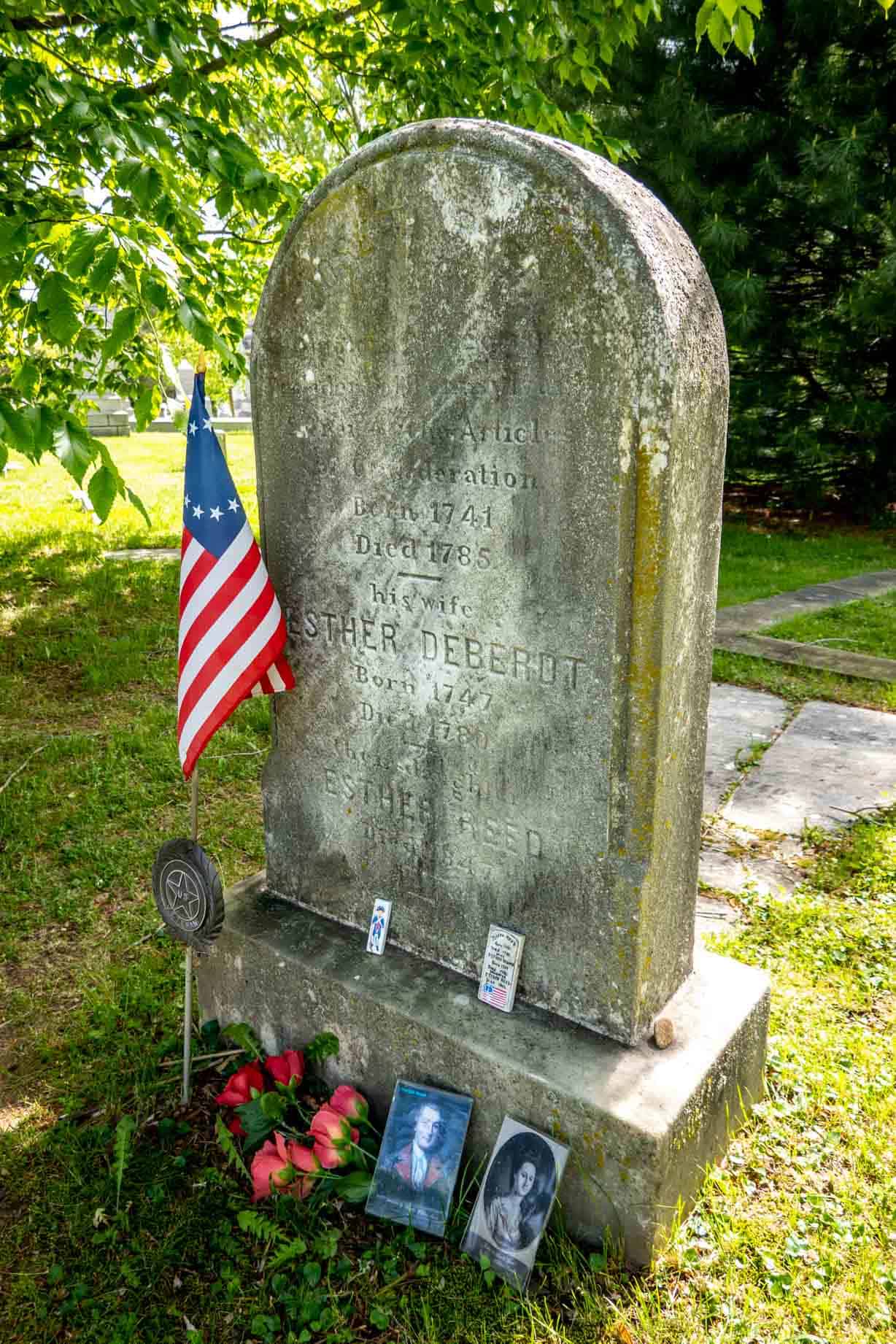
[edit]In 1784, Reed visited England with the hope of improving his health but was not successful. He returned to Pennsylvania and died in Philadelphia on March 5, 1785, at the age of 43.[3] Reed was initially interred in the Second Presbyterian Church cemetery in Philadelphia. Both he and his wife were reinterred to Laurel Hill Cemetery in 1868.[14]
References
[edit]Citations
- ^ a b c d e f Malone, Dumas (1935). Dictionary of American Biography. New York: Charles Scribner's Sons. pp. 451–453. Retrieved February 6, 2024.
- ^ a b Reed, Jacob Whittemore (1861). History of the Reed family in Europe and America. Boston: J. Wilson and Son. pp. 458–459. Retrieved February 6, 2024.
- ^ a b "Reed, Joseph 1741-1785". bioguide.congress.gov. Biographical Directory of the United States Congress. Retrieved February 6, 2024.
- ^ Bell, Whitfield J. (1997). Biographical Sketches of Members of the American Philosophical Society - Volume 3. American Philosophical Society. pp. 508–518. ISBN 9780871692269. Retrieved February 7, 2024.
- ^ a b c d e f "Joseph Reed". archives.upenn.edu. University Archives and Records Center. Retrieved February 6, 2024.
- ^ Wyatt, Rick (2002). Washington's Cruisers Flag (U.S.). Retrieved from http://www.crwflags.com/fotw/flags/us-wacr.html.
- ^ Roark, Steve (June 24, 2021). "Independence History: An Appeal to Heaven". www.newportplaintalk.com. The Newport Plain Talk. Retrieved February 9, 2024.
- ^ McCullough, David (2005). 1776. Simon & Schuster. ISBN 978-0-7432-2671-4.
- ^ a b c Easton, Keslie. "Joseph Reed". www.mountvernon.org. Mount Vernon Ladies' Association. Retrieved February 7, 2024.
- ^ "Joseph Reed". www.battlefields.org. American Battlefield Trust. Retrieved February 7, 2024.
- ^ Reed 1847, p. 2.
- ^ a b Bellesiles, Michael. "Reed, Joseph". www.encyclopedia.com. Encyclopedia.com. Retrieved February 7, 2024.
- ^ William B. Reed, (grandson) Life and Correspondence of Joseph Reed (1847; Philadelphia: Lindsay & Blakiston, pp. 26–43)
- ^ Yaster, Carol; Wolgemuth, Rachel (2017). Laurel Hill Cemetery. Charleston, South Carolina: Arcadia Publishing. p. 24. ISBN 978-1-4671-2655-7. Retrieved June 11, 2023.
Sources
- Reed, William B. (1847). Life and Correspondence of Joseph Reed. Lindsay & Blakiston.
Further reading
[edit]- George Bancroft, Joseph Reed, A Historical Essay, New York: W.J. Widdleton, Publisher, 1867
- Joseph Reed, A Reprint of the Reed and Cadwalader Pamphlets., Philadelphia: J. Munsell, 1864
- William B. Reed, Reprint of the Original Letters from Washington to Joseph Reed During The American Revolution, Philadelphia: A. Hart, 1852
External links
[edit]

| Presidents (1777–1790) |  | |
|---|---|---|
| Governors (since 1790) |
| |

Joseph Reed (politician)
View on GrokipediaJoseph Reed (August 27, 1741 – March 5, 1785) was an American lawyer, military officer, and statesman from Pennsylvania who served as aide-de-camp and adjutant general to George Washington during the Revolutionary War, delegate to the Continental Congress, and president of Pennsylvania's Supreme Executive Council from 1778 to 1781.[1][2][3] Born in Trenton, New Jersey, to merchant Andrew Reed and Theodosia Bowes, he attended the Philadelphia Academy and graduated from the College of New Jersey (now Princeton) in 1757 before studying law at the Middle Temple in London and being admitted to the bar in 1763.[1][3] He practiced law initially in Trenton, then moved to Philadelphia in 1770 after marrying Esther De Berdt, daughter of a British agent, which connected him to influential patriot circles.[3] Reed emerged as a key figure in the patriot movement, joining Philadelphia's Committee of Correspondence in 1774 and presiding over Pennsylvania's Second Provincial Congress in 1775.[1][2] In July 1775, he became Washington's military secretary, drafting orders and managing correspondence, and was appointed adjutant general with the rank of colonel in 1776, participating in battles including Long Island, Trenton, Princeton, Brandywine, Germantown, and Monmouth.[3][2] Elected to the Continental Congress in 1777, he signed the Articles of Confederation in 1778.[2][3] As Pennsylvania's chief executive, he oversaw the prosecution of Loyalists and supported a 1780 law for gradual emancipation of slaves, though his administration enforced strict Test Acts requiring loyalty oaths, leading to property confiscations from those refusing.[2] Reed's career included notable controversies, such as a 1778 public dispute with cavalry commander John Cadwalader over allegations—later largely disproved—that Reed had considered defecting to the British, stemming from intercepted correspondence and fueling a pamphlet war that highlighted tensions within patriot ranks.[3] He also faced strains from internal army criticisms, including doubts about Washington's leadership revealed in correspondence with Charles Lee.[2] Despite these challenges, Reed remained committed to the revolutionary cause until his death from illness in Philadelphia at age 43.[1][3]
Origins
Early Life and Education
Joseph Reed was born on August 27, 1741, in Trenton, Province of New Jersey, to Andrew Reed, a merchant and shopkeeper, and Theodosia Bowes Reed.[4] [5] As the eldest son in a family of Presbyterian Scots-Irish descent, he benefited from his father's modest commercial success, which afforded opportunities for formal education uncommon for the era.[6] [3] The Reed family relocated to Philadelphia shortly after his birth, integrating into the city's mercantile and intellectual circles.[2] Reed demonstrated early intellectual promise, pursuing a classical curriculum that prepared him for higher studies.[2] In 1757, at age 16, Reed graduated from the College of New Jersey (now Princeton University), where he studied liberal arts under the tutelage of figures like President Samuel Finley. [4] Following commencement, he apprenticed in the law under Philadelphia practitioners, honing skills in legal reasoning and colonial jurisprudence that would shape his later career.Pre-Revolutionary Career
Legal and Mercantile Activities
Reed commenced his legal training under Richard Stockton, a prominent New Jersey jurist, and was admitted to the bar in 1763.[3] He subsequently traveled to London, where he studied English law at the Middle Temple from 1763 to 1765.[2] Upon returning to the colonies, Reed established his practice in Trenton, New Jersey, by 1765, achieving an annual income of £1,000 by 1767.[2] In that year, he also served as deputy secretary of New Jersey and clerk of the provincial council, roles that supplemented his legal work.[3] In Trenton, Reed diversified into mercantile pursuits, engaging in the iron trade and real estate speculation alongside his law practice.[6] These ventures formed an extensive business network that connected him with colonial leaders across provinces, leveraging his father's merchant background in the same locale.[7] From 1767, he assisted Dennys De Berdt, the colonial agent for Massachusetts, in lobbying efforts that bordered on commercial advocacy between Britain and the colonies.[3] No specific partners or transaction volumes are documented, but these activities positioned Reed as a multifaceted operator in colonial commerce. By October 1770, Reed relocated to Philadelphia, where he rapidly ascended as a leading lawyer and continued land speculation.[1] His Philadelphia practice focused on general legal services, though particular cases remain unrecorded in primary accounts; the move enhanced his ties to provincial politics and trade hubs.[8] These pre-revolutionary endeavors underscored Reed's blend of jurisprudence and enterprise, yielding financial stability amid growing transatlantic tensions.[6]Military Service
Aide-de-Camp to Washington
In April 1775, following the outbreak of hostilities at Lexington and Concord, Joseph Reed accepted a commission as lieutenant colonel in the Continental Army and was appointed military secretary and aide-de-camp to General George Washington upon the latter's assumption of command.[8] He formally began these duties at the army's headquarters in Cambridge, Massachusetts, around early July 1775, during the ongoing Siege of Boston.[9][8] Reed's primary responsibilities encompassed drafting Washington's official correspondence, orders, and reports to the Continental Congress, as well as managing the general's confidential papers and administrative operations.[2][8] Operating from Washington's headquarters—initially the Vassall-Longfellow House—Reed facilitated communication on critical matters such as troop recruitment, supply shortages, and fortifications, contributing to the army's early organization amid resource constraints.[2] His legal background enabled precise documentation, with Washington relying on him for candid counsel during this formative phase of the war.[8] Despite Washington's repeated entreaties, Reed resigned his position on October 30, 1775, citing the need to resume his Philadelphia law practice and attend to personal finances strained by unpaid military service.[10][8] In subsequent months, Washington corresponded with him seeking advice on military and political affairs, underscoring the trust placed in Reed's judgment even after his departure from the staff.[11][12] This early tenure established Reed as one of Washington's most valued initial aides, though his brief service reflected the challenges of compensating civilian professionals in the nascent Continental forces.[8]Adjutant General and Field Engagements
In March 1776, George Washington offered Joseph Reed the position of Adjutant General of the Continental Army, which carried the rank of colonel and an annual salary of £700; Reed accepted reluctantly, viewing it as a temporary duty amid wartime exigencies.[6] As Adjutant General, Reed managed administrative functions, including the issuance of general orders, coordination of military correspondence, and support for Washington's command structure, building on his prior role as military secretary and aide-de-camp since 1775.[8] His tenure emphasized logistical and advisory contributions rather than frontline command, though he participated directly in key operations before resigning in early 1777, shortly after the victory at Princeton, citing personal financial strains and a desire to return to civilian life.[6] Reed's first major field engagement as Adjutant General occurred during the New York campaign, including the Battle of Long Island on August 27, 1776, where Continental forces suffered a decisive defeat against British and Hessian troops, prompting Washington's retreat across the East River.[3] In this capacity, Reed handled operational dispatches and reconnaissance amid the chaos, leveraging his familiarity with the region from prewar legal practice.[13] By late 1776, amid the army's morale crisis following defeats, Reed provided critical intelligence and local knowledge for the surprise attack on Hessian forces at Trenton on December 26, 1776; on December 22, he wrote to Washington urging an offensive against isolated garrisons, contributing to the planning that yielded a pivotal victory with minimal American casualties.[14] [8] This success enabled the subsequent Battle of Princeton on January 3, 1777, where Reed fought alongside Washington's troops, helping rout British forces and boosting Continental recruitment; his involvement in both engagements underscored his dual administrative and tactical utility before his departure from the post.[6] [3]Political Involvement
Continental Congress Delegate
Reed was elected to represent Pennsylvania in the Continental Congress in 1778, serving as a delegate during a critical phase of the American Revolution.[15] His tenure focused on supporting the war effort, including deliberations on military supplies and colonial coordination against British forces.[15] A key contribution came through his role in ratifying foundational documents; Reed was one of five Pennsylvania delegates who signed the Articles of Confederation, which Congress had approved in November 1777 but which required state-level endorsement, thereby advancing the framework for interstate cooperation and national governance.[2] This action underscored Pennsylvania's commitment to the confederation amid ongoing military campaigns. Reed's congressional service was short-lived, as he transitioned to state leadership upon his election as president of Pennsylvania's Supreme Executive Council in December 1778, a position that demanded his primary attention through 1781.[2]Presidency of Pennsylvania
Joseph Reed was elected president of Pennsylvania's Supreme Executive Council in December 1778, serving from December 6 until his resignation on October 18, 1781.[16][17] Under the 1776 state constitution, the Council operated as a collective executive body with Reed as its head, equivalent to a modern governor and commander-in-chief of state militia forces.[8] His selection as a compromise candidate bridged radical and moderate factions, enabling him to prioritize wartime governance amid economic strain, inflation, and Loyalist threats.[3] Reed's administration advanced several key reforms, including the abrogation of the Penn family's proprietary rights in 1779, which transferred estate revenues to public use. He oversaw the passage of the Gradual Abolition Act on March 1, 1780, America's first statutory emancipation measure, which mandated freedom for children born to enslaved women after that date upon reaching age 28, while requiring registration of existing slaves and providing limited owner compensation.[8][2] This policy, enacted despite ongoing war uncertainties, marked Pennsylvania's early leadership in phasing out slavery. Reed also supported financial incentives for soldiers, including post-war land bounties and pay adjustments, to bolster recruitment and retention in the Continental Army.[2] In matters of internal security, Reed assisted the General Assembly in prosecuting treason cases against Loyalists, contributing to the suppression of disaffection in Philadelphia and surrounding areas recently evacuated by British forces.[3] A critical challenge arose in January 1781 with the mutiny of approximately 1,300 Pennsylvania Line troops near Morristown, New Jersey, who marched on Princeton demanding resolution of enlistment disputes, back pay, and better conditions after years of arrears.[18] Dispatched urgently by the Council, Reed arrived on January 4, negotiated directly with a committee of sergeants, and secured a settlement by January 8 that included amnesty for most mutineers, payment commitments, and enlistment clarifications, averting escalation while Washington intervened against a splinter group.[19][20] Two ringleaders of the subsequent revolt were court-martialed and executed under Reed's oversight, restoring order but highlighting troop grievances over congressional funding shortfalls.[18]Controversies
Feud with Benedict Arnold
In June 1778, following the British evacuation of Philadelphia, George Washington appointed Benedict Arnold as military commandant of the city, a position intended to oversee security and governance amid postwar recovery. Arnold, recovering from wounds sustained at Saratoga, quickly adopted a lavish lifestyle, marrying Peggy Shippen, daughter of a prominent Loyalist sympathizer, and engaging in speculative trade that involved private use of government wagons and issuance of passes for goods potentially linked to British interests. These actions drew scrutiny from Pennsylvania officials, who viewed them as exploitative in a region scarred by occupation and economic hardship.[21][22] Joseph Reed, elected president of Pennsylvania's Supreme Executive Council on December 1, 1778, spearheaded an investigation into Arnold's conduct, compiling evidence of alleged corruption such as unauthorized profiteering and favoritism toward Loyalists. In February 1779, Reed formally presented eight specific charges against Arnold to Congress, accusing him of abuses akin to those of "oppressive Governors" under British rule, including misuse of military resources for personal gain and irregular trading practices that undermined Continental authority. Arnold, denying the allegations as politically motivated, demanded an immediate court-martial to vindicate his honor, bypassing civilian oversight in favor of military jurisdiction.[8][23][22] The feud intensified as Reed and the Pennsylvania Council resisted Arnold's push for a swift trial, requesting delays to amass further testimony and citing logistical challenges from British threats, though Arnold and supporters perceived this as deliberate obstruction to bolster a weak case. Washington, balancing military needs, approved the court-martial but accommodated postponements, including one at Reed's insistence in early 1779. Proceedings convened on December 19, 1779, at Morristown, New Jersey, under Maj. Gen. Robert Howe; after reviewing evidence, the court acquitted Arnold on six counts but convicted him on two lesser charges—issuing an improper pass for a vessel carrying goods and authorizing private use of public wagons—resulting in a mild reprimand from Washington on January 13, 1780.[24][8][25] This outcome deepened Arnold's resentment toward Reed, whom he blamed for orchestrating a partisan attack that damaged his reputation without disproving his core contributions to the Revolution, while Reed maintained the probe upheld civilian accountability over military overreach. Contemporary accounts and later analyses suggest Reed's pursuit stemmed from genuine concerns over wartime ethics, though Arnold's defenders highlighted inconsistencies in Pennsylvania's enforcement against similar civilian traders, framing the conflict as emblematic of Whig factionalism against a celebrated but abrasive commander. The episode strained relations within Washington's circle, foreshadowing Arnold's escalating disillusionment with the Patriot cause.[22][26][6]Treason Accusations and British Overtures
In June 1778, the British Carlisle Peace Commission, consisting of Lord Carlisle, William Eden, and George Johnstone, arrived in America with authorization to negotiate an end to the Revolutionary War, offering terms short of full independence while secretly empowered to offer bribes to key American figures to undermine the Patriot cause.[27] Governor George Johnstone, a member of the commission, covertly approached several Continental Congress delegates, including Joseph Reed, then a delegate from Pennsylvania, with financial inducements aimed at swaying support toward reconciliation on British terms.[28] Johnstone offered Reed £10,000 along with the promise of a high-ranking position, such as chief justice of Pennsylvania or a colonial governorship, in exchange for influencing Congress to accept the proposals or defecting to the British side.[29] Reed rejected the overture outright, reportedly replying that he was "not worth purchasing, but such as [he was], the King of Great Britain [was] not rich enough to do it," and immediately disclosed the attempt to Congress, which publicized the bribery efforts to discredit the commission.[30] In response, Reed authored and published Remarks on Governor Johnstone's Speech (1779), a pamphlet denouncing the British tactics as corrupt and insincere, arguing that such offers confirmed the ministry's contempt for American liberty and reinforced the necessity of independence.[31] The exposure of Johnstone's approaches, including to Reed, led Congress to formally denounce the commissioner on August 11, 1778, barring him from further negotiations and rejecting the commission's proposals as incompatible with American demands.[32] However, the overtures fueled British and Loyalist propaganda portraying Reed—and other Patriot leaders—as traitors to the Crown, guilty of high treason under English law for levying war against their sovereign, with Reed's English birth and prior legal studies in London cited to amplify claims of ingratitude and betrayal.[33] These accusations echoed earlier suspicions of Reed's loyalty during the 1776-1777 campaigns, when his private letters expressing pessimism after defeats like Long Island prompted whispers among some officers that he harbored Loyalist sympathies or sought a pardon from General Howe, though no evidence emerged of actual negotiations or acceptance of terms.[2] Reed's firm rejection and public stance bolstered his reputation among Patriots, but drew retaliatory claims from British sympathizers that his initial hesitations in 1776—expressed in correspondence where he wrote of fearing "half-treason" without full commitment—indicated latent disloyalty to the American cause, potentially exploitable by overtures like Johnstone's.[33] Historians have debated these charges, with some contemporaries like General John Cadwalader alleging Reed's correspondence with British contacts showed irresolution, yet primary documents confirm no pardon was sought or granted, and Reed's actions, including his role in exposing Arnold's later treason, affirmed his allegiance.[6] British overtures thus highlighted Reed's pivotal position but ultimately reinforced his opposition, as he proceeded to assist Pennsylvania's attorney general in prosecuting over 20 Loyalists for treason in 1778-1779, confiscating properties and executing sentences under state law modeled on English treason statutes.[22]Loyalty Oaths and Treatment of Loyalists
In Pennsylvania, the Test Act of June 13, 1777, mandated that all free inhabitants aged 21 and older swear or affirm allegiance to the state's revolutionary constitution and government, explicitly renouncing fidelity to King George III; refusal rendered individuals ineligible for public office, professional practice, or militia exemptions and branded them as "disaffected persons" subject to surveillance and potential further penalties.[34] This law, supplemented by a treason act in October 1777 and an attainder law in 1778 authorizing property confiscation and banishment for notorious Loyalists, formed the basis for suppressing internal opposition during the British occupation of Philadelphia.[35] Joseph Reed, serving as a Continental Congress delegate in 1778, assisted the Pennsylvania Assembly in prosecuting approximately 23 suspected Loyalists for treason, arguing that their actions—such as providing intelligence or supplies to British forces—warranted severe punishment to deter collaboration.[22] As principal prosecuting attorney in these High Court of Errors and Appeals trials, Reed helped secure convictions leading to the public hangings of Quaker tradesmen Abraham Carlisle and John Roberts on November 4, 1778, for corresponding with and aiding the enemy during the British occupation, actions deemed high treason under state law despite their religious objections to oaths and warfare.[36] These executions, among the few capital sentences carried out in Pennsylvania for such offenses, exemplified the revolutionary government's determination to eliminate perceived fifth columns, though critics later viewed them as overly punitive against pacifist Quakers whose aid was arguably minimal.[37] Upon assuming the presidency of the Supreme Executive Council on November 1, 1779, Reed intensified enforcement of test laws and anti-Loyalist statutes amid ongoing threats from disaffected elements in the countryside.[2] Under his leadership, the Council issued proclamations, such as one in early 1780, demanding attainted Loyalists return property or face permanent escheat to fund the war effort, while overseeing the sale of confiscated estates from over 100 banished individuals; this generated revenue but displaced families and fueled emigration to British-held New York.[38] Reed defended these measures as necessary for state security, citing Loyalist roles in frontier raids and supply disruptions, yet contemporaries like Benjamin Rush condemned his administration's rigor— including imprisonments without full trials—as excessive, particularly against non-combatants whose loyalty wavered due to economic hardship or religious scruple.[39] By 1781, partial amnesties allowed some pardons for oath-takers, reflecting pragmatic adjustments as British threats receded, but the policies under Reed contributed to Pennsylvania's reputation for stringent treatment compared to more lenient states like New York.[40]Personal Life
Marriage and Family
Joseph Reed married Esther de Berdt, the daughter of Dennis de Berdt, Crown agent for the Province of Massachusetts Bay, in London on May 22, 1770.[3][41] The couple departed for Philadelphia in October of that year, where they established their family residence.[3] Reed and Esther had six children: Martha, Joseph, Esther, Theodosia, Dennis de Berdt, and George Washington.[41][42] Theodosia died in infancy from smallpox.[43] Esther Reed managed the household and cared for the children during Joseph's extended absences for military service and political responsibilities, including his roles as aide-de-camp to George Washington and president of Pennsylvania.[42][44] Esther Reed died on September 18, 1780, from dysentery, leaving Reed a widower with several young children.[41][42] Their son Joseph Reed Jr. later became a prominent lawyer and diplomat.[41]Religious and Philosophical Views
Joseph Reed maintained an affiliation with Presbyterianism, the predominant Protestant denomination among many American revolutionaries of Scottish or Ulster Scots descent. Following his death on March 4, 1785, he was initially interred in the cemetery of Philadelphia's Second Presbyterian Church, reflecting this denominational connection.[15] His paternal ancestors originated from Ypres in Flanders, emigrating as Protestant refugees persecuted under the Spanish Duke of Alba's religious campaigns during the Dutch Revolt of the sixteenth century, which underscores a familial commitment to Reformed Protestantism.[45] Reed's formal education at the College of New Jersey (now Princeton University), from which he graduated in 1760, exposed him to Presbyterian theological influences, as the institution was established by Presbyterian clergy to train ministers and promote Reformed doctrine amid Anglican dominance in colonial America.[1] While Reed corresponded extensively on military, political, and personal matters, surviving letters reveal no explicit advocacy for deism, skepticism, or Enlightenment rationalism detached from Christian foundations; instead, they align with the moral and providential worldview common to Protestant patriots, invoking divine favor in revolutionary struggles without deviation into heterodoxy.[46] His membership in the American Philosophical Society from 1768 onward indicates engagement with empirical inquiry and natural philosophy, yet this coexisted with orthodox religious practice rather than supplanting it.[15]Later Years and Legacy
Post-Presidency Activities
Following the conclusion of his three-year term as President of Pennsylvania's Supreme Executive Council on November 13, 1781, Reed returned to private legal practice in Philadelphia, where he had established his career prior to the Revolutionary War.[41] His focus during this period centered on resuming professional responsibilities amid ongoing postwar recovery efforts in the state.[8] In 1784, Pennsylvania's assembly elected Reed once more as a delegate to the Continental Congress, recognizing his prior service and contributions to the Articles of Confederation. However, he declined the appointment, citing poor health that had worsened since the war's end.[8][3] This marked his final involvement in public office, as his condition prevented further active participation before his death in early 1785.[41]Death
Joseph Reed died on March 5, 1785, in Philadelphia, Pennsylvania, at the age of 43.[2][1] His health had deteriorated in the years following the Revolutionary War, culminating in his decision to decline election to the Continental Congress in 1784.[8] In a bid for recovery, Reed traveled to England that year but returned without significant improvement.[13] He was initially interred in the Arch Street Presbyterian Church cemetery.[1]Historical Assessments and Impact
Historians regard Joseph Reed as a pivotal yet polarizing figure in the American Revolution, initially favoring reconciliation with Britain before embracing full independence, with his moderation enabling him to bridge factional divides in Pennsylvania politics. Scholarly works, such as John F.. Roche's 1957 biography, portray Reed as a pragmatic administrator whose service as George Washington's aide-de-camp and adjutant general from 1775 onward facilitated critical military correspondence and logistics, enhancing Continental Army cohesion during campaigns like Trenton and Princeton. Roche emphasizes Reed's loyalty amid wartime pressures, countering earlier suspicions arising from his brief 1777 negotiations with British emissaries, which were framed as exploratory peace efforts rather than defection.[47] Reed's administrative impact extended to state governance, where as president of Pennsylvania's Supreme Executive Council from December 1778 to November 1781, he mobilized resources for the war, including authorizing financial incentives like half-pay pensions for Continental soldiers to sustain enlistments amid manpower shortages. Under his leadership, Pennsylvania enacted the Gradual Abolition Act on March 1, 1780, prohibiting slavery for children born after that date and requiring gradual manumission, representing an early institutional challenge to hereditary bondage in a major state and influencing subsequent northern emancipation efforts.[8][3] In the Continental Congress, Reed's signature on the Articles of Confederation, ratified by Pennsylvania on December 5, 1777, advanced the framework for national unity, while his post-war legal advocacy secured Pennsylvania's claims to the Wyoming Valley against Connecticut in 1782, averting interstate conflict and stabilizing western expansion. Assessments acknowledge these achievements tempered by criticisms of his rigorous enforcement against Loyalists, including property confiscations and loyalty oaths, which some contemporaries decried as excessive but which Reed defended as necessary for revolutionary security. Overall, Reed's legacy lies in bolstering institutional resilience during crisis, though his reputation suffered from personal rivalries, such as with Benedict Arnold, leading to a mixed historical appraisal that prioritizes his substantive contributions over episodic controversies.[2][33][6]References
- https://en.wikisource.org/wiki/1911_Encyclop%25C3%25A6dia_Britannica/Reed%2C_Joseph