Hubbry Logo
Kaiser rollKaiser rollMain
Open search
Kaiser roll
Community hub
Kaiser roll
logo
8 pages, 0 posts
0 subscribers
Be the first to start a discussion here.
Kaiser roll
Kaiser roll
from Wikipedia

Kaiser roll
Alternative namesVienna roll, hard roll, water roll
TypeBread roll
Place of originAustria
Region or stateVienna
Main ingredientsFlour, barm, malt, water, salt
VariationsMichetta, rosetta
Food energy
(per serving)
200 (100 g)
Other informationglycaemic load 40 (100 g)[1]
  •   Media: Kaiser roll

The Kaiser roll (German: Kaiserbrötchen [ˈkaɪzɐˌbʁøːtçn̩] ; "Emperor roll"; Slovene: kajzerica; Polish: kajzerka; Hungarian: császárzsemle), also called a Vienna roll (Wiener Kaisersemmel), a hard roll or, if made by hand, also Handsemmel, is a typically round bread roll, originally from Austria. It is made from white flour, yeast, malt, water and salt, with the top side usually divided in a symmetric pattern of five segments, separated by curved superficial cuts radiating from the centre outward or folded in a series of overlapping lobes resembling a crown.[2] The crisp Kaisersemmel is a traditional Austrian food officially approved by the Federal Ministry of Agriculture.[3]

Origin

[edit]
Kaiser rolls at a court banquet of Maria Theresa about 1760, detail from a painting by Martin van Meytens

It is sometimes claimed that kaiser rolls were named to honor Emperor (Kaiser) Franz Joseph I of Austria (born 1830, reigned 1848–1916); but the term appears as early as 1825.[4] There is also the theory that the name stems at least in part from a baker family called Kayzer in Opatów in Galicia which had been occupied by the Austrian monarchy in the First Partition of Poland.[5] In the 18th century a law fixed retail prices of Semmeln (bread rolls) in the Habsburg monarchy. Another claim is that the name Kaisersemmel came into general use after the bakers' guild sent a delegation in 1789 to Emperor Joseph II (b. 1741, r. 1765–1790) and persuaded him to deregulate the price of bread rolls.[citation needed]

With its monarchical connotation, Kaiser rolls stood out against common rolls known as Mundsemmeln ("mouth rolls") or Schustersemmeln ("cobbler's rolls"). They are traditionally found in Austria, but have also become popular in other countries of the former Austrian Habsburg Empire, such as the Galicia region in Poland and later the whole country (where it is known as kajzerka), Croatia, Slovenia, and Serbia (kajzerica), Hungary (császárzsemle), the Czech Republic (císařská žemle, císařská houska,[6] kaiserka) and Slovakia (kaiserka), as well as in Germany, the United States, and Canada. During Austrian rule in Lombardy, Italian bakers produced a hollow version known as michetta or rosetta.

Variations

[edit]

A handmade Kaiser roll is known as a Wiener Kaisersemmel (Handsemmel) according to the Codex Alimentarius Austriacus standards collection.[7]

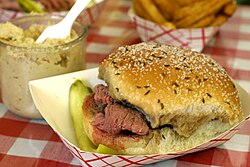
There are multiple variants of the common roll, differing in size, type of flour used, and toppings. While traditionally plain, Kaiser-style rolls are today found topped with poppy seeds, sesame seeds, pumpkin seeds, flax, or sunflower seeds. The Kaiser roll is a main part of a typical Austrian breakfast, usually served with butter and jam. It is often used as a bun for such popular sandwiches as hamburgers in America, and with a slice of Leberkäse in Germany and Austria, though sliced Extrawurst and pickled gherkins (Wurstsemmel), or a type of Wiener schnitzel (Schnitzelsemmel) are also used. A variation called a kümmelweck (alternatively spelled "kimmelweck" or "kummelweck")[8] is topped with kosher salt and caraway, and in the United States is an essential component of a Buffalo-area specialty, the beef on weck sandwich. "Weck" is short for "Weckerl", the diminutative of "Wecken", a loaf of bread, "Kümmel" is caraway.

In much of eastern New York State—New York City, Long Island, the Hudson and Mohawk Valleys, and the Adirondacks—and throughout New Jersey, Pennsylvania, Maryland, Delaware, and Connecticut, Kaiser rolls are known as "hard rolls", or "rolls", and are staples of delicatessen and convenience stores. Hard rolls are the bread traditionally used to make the Bacon, egg and cheese sandwich in New York.[citation needed][9]

The Wisconsin variety of "hard roll", which was formed over the decades by the bakeries of Sheboygan to be paired with the local specialty of bratwurst (either in a long single bun or circular "double brat" roll), features a fluffy consistency on the inside with a crust on the crown of the bun, though most of the steps and some ingredients in the creation of Sheboygan hard rolls are proprietary, and can vary by each bakery's own recipe.[10][11]

See also

[edit]

References

[edit]
[edit]
Revisions and contributorsEdit on WikipediaRead on Wikipedia
from Grokipedia
The Kaiser roll, known in German as Kaisersemmel or Vienna roll, is a classic Austrian bread roll characterized by its round shape, crisp crust, and soft, airy crumb, typically featuring a distinctive or crown-like scoring on the top surface. Made primarily from , yeast, malt, water, and salt—sometimes with added sugar or butter for tenderness—it weighs about 50–60 grams and bakes to a golden brown with a chewy texture ideal for slicing and filling. As one of Austria's most iconic and beloved baked goods, it serves as a versatile staple for , , or snacks, often topped with seeds like or and paired with cheeses, meats, or jams. The roll traces its roots to 18th-century , where the name Kaisersemmel—literally "emperor's roll"—emerged to honor Habsburg rulers. It is commonly linked via legend to Emperor Joseph II (r. 1780–1790), who in 1789 granted Viennese bakers greater autonomy over pricing after a , though some sources attribute the naming to Emperor Franz Joseph I (r. 1848–1916). Earlier forms of similar crusty white rolls existed in Austrian baking by the mid-1700s, but the signature stamped pattern, evoking a royal crown, solidified its identity as a symbol of imperial baking craftsmanship. The Kaisersemmel is officially approved as a traditional Austrian food by the Federal Ministry of Agriculture, remaining a cornerstone of Viennese bakery culture and produced daily in high volumes by major firms like Ankerbrot. Beyond , the Kaiser roll gained widespread adoption in the United States during the late 19th and early 20th centuries through , particularly among German and Eastern European communities in the Northeast, where it became a go-to for deli sandwiches, burgers, and breakfast items like egg and cheese rolls. Its durable crust and neutral flavor make it adaptable to diverse fillings, from to , cementing its status in American delis and bakeries while preserving the original Viennese technique of hand-forming or stamping the dough for even expansion.

History

Austrian Origins

The Kaiser roll, known in Austria as the Kaisersemmel, originated in during the mid-18th century, with its distinctive form already evident by the . Historical records confirm its presence at the imperial court of , as depicted in a by court artist from around 1760–1770, showing the rolls on a festive table at . This early development reflects the refined baking traditions of Habsburg , where bakers innovated to create a premium roll characterized by a crisp crust and soft interior. The name "Kaisersemmel" carries legendary associations with the Habsburg emperors, though its exact origin remains uncertain. One popular account links it to Emperor Franz Joseph I (reigned 1848–1916), suggesting the roll's five-segmented, star-like shape was designed to evoke an imperial emblem or crown in his honor; however, this cannot be accurate given the roll's earlier appearance. Alternative theories trace the name to earlier rulers, such as Emperor Friedrich III in 1487, who allegedly commissioned rolls stamped with his portrait, or to a Viennese surnamed Kayser who purportedly invented the incisions around 1730 to enhance the crust. Regardless, the term underscores the roll's status as a symbol of imperial excellence. By the late , the Kaisersemmel gained formal recognition through Vienna's bakers' guilds, which emphasized its artisanal quality using simple, high-grade ingredients: white wheat flour, , , water, and salt. In 1789, the guilds successfully petitioned Emperor Joseph II to exempt Semmeln from strict price and weight regulations, arguing that such controls hindered the craftsmanship required for these superior rolls—a decision that affirmed their cultural value. This approval solidified the Kaisersemmel as a protected traditional product in Austrian heritage. Initially crafted as a versatile or Semmel, the Kaisersemmel served both at the imperial court and commoners across by the 18th century, often enjoyed plain, with , or as a base for simple toppings like cheese or . Its accessibility grew after , when local bakers were authorized to produce fine white breads like the Semmel, making it a daily staple that bridged social classes in Viennese life.

Spread to Other Regions

The , originating in with its distinctive star-shaped scoring, spread to neighboring during the , where it became known as the Kaisersemmel or Kaiserbrötchen, integrating into the broader tradition of Brötchen varieties in German baking. It gained international fame at the 1867 World Exhibition. Austrian and German bakers immigrated to the in the late , bringing the roll with them and establishing bakeries in the Northeast, particularly in New York and . In 1876, Viennese immigrant Louis Fleischmann introduced the Kaiser roll at the in and later popularized it through his Vienna Model Bakery in , where it quickly gained traction in local delis by the early 1900s. During the early 20th century, the roll was adopted into Jewish-American cuisine, particularly in New York delis, as Eastern European Jewish immigrants arriving between 1880 and 1920 incorporated it from established German-Jewish traditions to serve sandwiches like , adapting the hard roll to fit kosher preferences. Through the 20th-century trade and continued European , the Kaiser roll spread globally, reaching —where it became a staple for everyday sandwiches—often via post-World War II migrants from and who established ethnic bakeries.

Description

Physical Characteristics

The Kaiser roll is characteristically round in shape, measuring approximately 9–13 cm (3.5–5 inches) in diameter and weighing 50–85 grams (1.8–3 ounces), varying by regional style. Its exterior displays a crusty, golden-brown crust bearing a distinct star-shaped pattern formed by stamping or folding the surface prior to . This crust achieves a shiny finish through application of an , milk glaze, or injection during the process, contributing to its crisp yet thin texture. In certain styles, the surface is adorned with or seeds for added visual and textural contrast. The interior features a chewy, open crumb with slight elasticity, resulting from steam-assisted that promotes spring and moisture retention.

Ingredients

The Kaiser roll, a traditional crusty originating from , relies on a lean dough composition to achieve its characteristic chewy interior and crisp exterior. The primary ingredients include high-protein , which provides the necessary structure for the roll's firm crumb and ability to hold shape during baking; active dry or instant for leavening and ; diastatic powder or syrup, which enhances flavor through enzymatic activity and promotes desirable browning via the ; water for hydration; and salt, which strengthens the dough by tightening networks while balancing taste. In traditional recipes, these components are proportioned using baker's percentages relative to the weight to ensure consistency and authenticity. A standard formulation approximates 100% high-protein (typically 11-13% protein content, such as European-style Type 550 or similar for optimal extensibility), 60% (including any minor addition for subtle tenderness), 2% salt, 2% , and 1-2% . Optional additions, such as small amounts of (up to 1%) or fat like or (1-3%), may be incorporated sparingly to improve handling and add slight tenderness without compromising the lean profile; eggs are typically absent from traditional lean recipes. For authenticity, bakers often source European-style flours milled without additives to replicate the original Viennese texture, and versions avoid chemical preservatives or conditioners, relying instead on natural fermentation for shelf stability and flavor development. These ingredients contribute to the roll's dense yet airy structure by supporting high hydration levels that foster production during .

Preparation

Dough Making

The preparation of Kaiser roll dough begins with combining the dry ingredients in a large mixing bowl: high-gluten bread flour, , malt powder or to aid , and salt to regulate yeast activity and strengthen the structure. Water, often at and sometimes mixed with a small amount of or , is added gradually to the dry mixture to form a stiff, low-hydration around 60%, which is essential for the roll's dense, chewy crumb. Kneading follows immediately, either by hand on a lightly floured surface or using a stand mixer's dough hook, for 10-15 minutes until the dough becomes smooth, elastic, and passes the windowpane test, indicating well-developed for the signature texture. This intensive process aligns with traditional Austrian practices, where development is prioritized for structural integrity. The then enters bulk in a lightly oiled , covered with a damp cloth or , rising at for 1-2 hours until it doubles in volume, or alternatively refrigerated overnight to slow fermentation and deepen flavor through enhanced enzymatic activity. Once fermented, the is gently punched down to expel trapped gases and redistribute , then divided into equal portions of approximately 50-60 grams each, ready for the next stages of preparation.

Shaping and Baking

The shaping of Kaiser rolls begins after the dough has undergone initial and is divided into portions weighing approximately 50-60 grams (1.8-2.1 ounces) each. To achieve the characteristic five-point star pattern on top, bakers traditionally employ a Kaiser stamp—a specialized tool that presses a into the surface of a flattened ball, nearly to the bottom without puncturing through, ensuring the roll maintains its structure during proofing and . Alternatively, the rope-twist or knot method involves rolling each portion into an 8- to 10-inch rope, forming a loose , and then wrapping the ends through the center loop to create overlapping petals that mimic the stamped effect, a technique that preserves the roll's rounded shape while embedding the signature topping. Following shaping, the rolls undergo a second proofing period to promote even expansion and prevent flattening under their own weight. The shaped pieces are placed cut-side down on a parchment-lined baking sheet, covered loosely with or a damp cloth to maintain , and allowed to rest at for 30 to 45 minutes, or until nearly doubled in volume and puffy to the touch. This step leverages the structure developed earlier in the , enabling the rolls to rise without spreading excessively. Baking transforms the proofed rolls into their final form, emphasizing a crisp, golden crust. The is preheated to 425°F to 450°F, and is introduced immediately upon loading the rolls—typically by spritzing the oven walls with water, adding ice cubes to a hot pan, or using a steam injection system—for the first 5 to 10 minutes to facilitate oven spring and enhance crust formation through gelatinization of starches on the surface. The rolls, turned cut-side up and optionally brushed with milk or before sprinkling with seeds, are then baked for 15 to 20 minutes total, rotating the sheet midway if needed, until they achieve a deep golden color and sound hollow when tapped on the bottom. Once baked, the rolls are removed from the oven and transferred promptly to wire racks to cool completely, typically for at least 30 minutes, which allows moisture to escape evenly and prevents the bottom crust from becoming soggy while promoting the signature audible crackle upon breaking. This cooling method ensures the rolls retain their chewy interior and shatteringly crisp exterior characteristic of the style.

Cultural Role

In Europe

In Austria and Germany, the Kaisersemmel, or Kaiser roll, serves as a staple breakfast item, often enjoyed fresh with , jam, or topped with cold cuts such as or cheese. In Bavaria, it is particularly iconic as the base for the Leberkässemmel, a traditional sandwich featuring a slice of baked known as , which highlights its versatility in everyday meals. This roll's crisp crust and soft interior make it a daily essential in Central European households and cafes, reflecting its enduring popularity since its origins in Viennese baking traditions during the Habsburg era. The Austrian version holds official recognition as a traditional food under the Austrian Food Codex (B18), which defines its specific characteristics, including the signature five-part star pattern, minimum weight of 46 grams, and a lengthy dough resting process of at least two hours to ensure quality. This codex, maintained by the Austrian Ministry of Agriculture, Forestry, Environment and Water Management, underscores the roll's status as a cornerstone of national cuisine, emphasizing hand-shaping techniques that preserve its historical form. While not granted (TSG) status, this national designation protects its authenticity and promotes standardized production among bakers. Baking guilds in and uphold longstanding traditions of daily fresh production, symbolizing artisanal craftsmanship central to European culture. In Viennese bakeries, the Handsemmel variant—folded by hand without stamps—represents a pinnacle of , with bakers adhering to guild-regulated methods that date back to the to maintain the roll's airy texture and golden crust. practices emphasize morning batches to ensure the rolls reach markets and homes at peak freshness, reinforcing community ties and the value of local milling. Beyond daily consumption, the Kaiser roll features in festive contexts across , such as holiday meals during or , where it accompanies roasts and salads in family gatherings. In beer gardens of and , it commonly encases sausages or for casual outdoor dining, enhancing the social atmosphere of these seasonal venues. This role underscores its integration into celebratory traditions, from Viennese coffeehouse rituals to Oktoberfest-style events.

In North America

The Kaiser roll gained prominence in through European immigration waves in the late 19th and early 20th centuries, particularly among Jewish communities in , where it became a staple in delis and sandwich shops. Its sturdy crust and chewy interior made it popular in New York's Jewish community for breakfast sandwiches, providing textural contrast. In the mid-20th century, the Kaiser roll extended its reach into casual dining across the , serving as a reliable base for sandwiches in bodegas and diners from New York to . Its crisp exterior held up well to toppings, making it a preferred choice in these settings. This adaptation aligned with the post-World War II boom in quick-service eateries, where the roll's durability supported portable meals. Commercial production scaled up the Kaiser roll's availability, with companies like mass-baking versions since 1904 to meet growing demand. Founded in , by Italian immigrant Vincenzo Amoroso, the bakery developed softer-interior variants optimized for convenience in sandwiches, diverging slightly from traditional European crustiness while retaining the signature stamped top. These hearth-baked rolls became essential for regional specialties, enhancing portability and flavor absorption. As a , the Kaiser roll embodies North American immigrant ingenuity, prominently featured in regional foods like the Philadelphia cheesesteak, where it cradles thinly sliced beef, cheese, and onions. Its presence in media depictions of delis—such as cinematic portrayals of bustling New York eateries—further cements its status as a symbol of urban traditions. Amoroso's rolls, in particular, have contributed to the cheesesteak's national fame, underscoring the roll's role in elevating local cuisines.

Variations

Regional Adaptations

In , similar crusty white rolls known as Brötchen incorporate barley malt for more flavorful results and a reddish-brown color, distinguishing them from lighter American versions. These rolls are typically hand-shaped without the traditional stamped pattern, emphasizing a crisp crust and substantial crumb suitable for everyday consumption. In the United States, particularly the Northeast, the Kaiser roll has evolved into a variant known as the hard roll, adapted for sandwich use with a crispier exterior achieved through dusting and extended baking, often topped with or seeds. This version omits from the traditional Austrian recipe, resulting in an airier interior that pairs well with deli meats and cheeses, reflecting local preferences for sturdier yet yielding bread bases. Canadian adaptations closely mirror the American Northeast style but are prominently featured in Toronto's sandwich culture, where softer Kaiser buns serve as the base for iconic dishes like sandwiches, highlighting their versatility in urban eateries. These rolls maintain a balance of crust and tenderness, making them a staple in local bakeries and delis. In , Kaiser rolls commonly feature a topping, as produced by wholesale bakers in regions like , adding a nutty crunch that complements the classic knotted shape and appeals to diverse culinary influences.

Modern Twists

In recent years, particularly since the , bakers have developed health-focused versions of the Kaiser roll by incorporating or starters, which reduce reliance on refined white flour and enhance nutritional profiles through increased fiber and natural processes. adaptations leverage wild and for longer , improving digestibility and potentially lowering glycemic impact compared to commercial breads. Examples include einkorn Kaiser rolls, which use for added protein and minerals, and variants with up to 100% hard red spring to boost nutrient density without additives. Artisanal bakeries have elevated the Kaiser roll through applications, such as infusing the with flavors like roasted onions, , or seeds to create more complex profiles for upscale sandwiches. Onion-infused Kaiser rolls, for instance, feature thinly sliced onions baked into the for a sweet-savory balance that complements fillings like smoked meats. Herb-flavored versions, including those with or a blend of , , and , appear in small-batch productions to add aromatic depth while maintaining the roll's signature crust and crumb. Filled variations, such as those stuffed with cheese or jalapeño-cheese mixtures before , offer a molten interior that transforms the roll into a standalone or enhanced base for preparations in specialty bakeries. Vegan and gluten-free adaptations of the Kaiser roll emerged prominently in the , driven by rising awareness of dietary restrictions and the demand for inclusive options using plant-based binders and alternative flours. Vegan recipes from this period often replace eggs with or while preserving the roll's structure through careful hydration and proofing techniques. Gluten-free versions utilize blends of , , and husk to mimic the elasticity of , enabling the traditional knot-shaping method and yielding rolls with a soft crumb suitable for those with celiac disease. These adaptations prioritize accessibility, with gluten-free variants further aiding gut health via . Post-2020, industrial innovations like pre-sliced or frozen dough for rolls gained traction for home use, capitalizing on the surge during the and ongoing busy lifestyles. Frozen dough products, such as proof-and-bake rounds, allow consumers to thaw, rise, and bake fresh rolls at home with minimal equipment, maintaining quality through controlled freezing that preserves activity. This format has driven market growth in ready-to-bake items, with sales increasing due to demand for easy, customizable solutions in retail and online channels.

References

Add your contribution
Related Hubs
User Avatar
No comments yet.