Hubbry Logo
Averrhoa bilimbiAverrhoa bilimbiMain
Open search
Averrhoa bilimbi
Community hub
Averrhoa bilimbi
logo
8 pages, 0 posts
0 subscribers
Be the first to start a discussion here.
Averrhoa bilimbi
Averrhoa bilimbi
from Wikipedia

Averrhoa bilimbi
Scientific classification Edit this classification
Kingdom: Plantae
Clade: Tracheophytes
Clade: Angiosperms
Clade: Eudicots
Clade: Rosids
Order: Oxalidales
Family: Oxalidaceae
Genus: Averrhoa
Species:
A. bilimbi
Binomial name
Averrhoa bilimbi
Synonyms[1]
  • Averrhoa abtusangulata Stokes
  • Averrhoa obtusangula Stokes

Averrhoa bilimbi (commonly known as bilimbi, cucumber tree, or tree sorrel[2]) is a fruit-bearing tree of the genus Averrhoa, family Oxalidaceae. It is native to the Maluku Islands and Sulawesi in Indonesia,[1] and has become naturalised and is common throughout Southeast Asia. It is cultivated in parts of tropical South Asia and the Americas. It bears edible but extremely sour fruit. It is a close relative of the carambola tree.

Description

[edit]

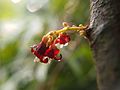
Averrhoa bilimbi is a small tropical tree reaching up to 15 m in height.[3] It is often multitrunked, quickly dividing into ramifications. Bilimbi leaves are alternate, pinnate, measuring approximately 30–60 cm in length. Each leaf contains 11-37 leaflets; ovate to oblong, 2–10 cm long, and 1–2 cm wide, and cluster at branch extremities.[4] The leaves are quite similar to those of the Otaheite gooseberry. The tree is cauliflorous with 18–68 flowers in panicles that form on the trunk and other branches. The flowers are heterostylous, borne in a pendulous panicle inflorescence. There flower is fragrant, corolla of 5 petals 10–30 mm long, yellowish green to reddish purple.[5]

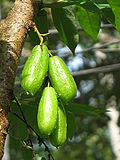
The fruit is ellipsoidal, elongated, measuring about 4 – 10 cm and sometimes faintly 5-angled.[3][4] The skin is smooth to slightly bumpy, thin, and waxy turning from light green to yellowish-green when ripe.[4] The flesh is crisp and the juice is sour and extremely acidic and therefore not typically consumed as fresh fruit by itself.[6]

The odd-pinnate leaves hang down at night, then raise in the morning in stages like "two steps forward, one step back" and descend in the same manner in the evening.[7]

Distribution and habitat

[edit]

A. bilimbi is believed to be originally native to Moluccas, Indonesia, the species is now cultivated and found throughout Indonesia, Timor-Leste, the Philippines, Sri Lanka, Bangladesh, Maldives, Myanmar (Burma), and Malaysia. It is also common in other Southeast Asian countries. In India, where it is usually found in gardens, the bilimbi has gone wild in the warmest regions of the country.[8] It is also seen in coastal regions of South India.[citation needed]

Outside of Asia, the tree is cultivated in Zanzibar. In 1793, the bilimbi was introduced to Jamaica from Timor and after several years, was cultivated throughout Central and South America where it is known as mimbro. In Suriname, this fruit is known as lange birambi. Introduced to Queensland at the end of the 19th century, it has been grown commercially in the region since that time.[8] In Guyana, it is called Sourie, One Finger, Bilimbi, and Kamranga.[citation needed]

This is a tropical tree, less resistant to cold than the carambola, growing best in rich and well-drained soil (but also stands limestone and sand). It prefers evenly distributed rainfall throughout the year, but with a 2- to 3-month dry season. Therefore, the species is not found, for example, in the wettest part of Malaysia. In Florida, where it is occasionally cultivated as a curiosity, the tree needs protection from wind and cold.[8]

Uses

[edit]

Culinary

[edit]

In Indonesia, A. bilimbi, locally known as belimbing wuluh, is often used to give a sour or acidic flavour to food, substituting tamarind or tomato. In the northwestern province of Aceh, it is preserved by salting and sun-drying to make asam sunti, a kitchen seasoning to make a variety of Acehnese dishes. It is a key ingredient in many Indonesian dishes such as sambal belimbing wuluh.[6]

In the Philippines, where it is commonly called kamias and ibâ, it is commonly found in backyards. The fruit are eaten either raw or dipped in rock salt. It can be either curried or added as a souring agent for common Filipino dishes such as sinigang, pinangat and paksiw. It can be sun-dried for preservation and used as a spice. It is also used to make a salad mixed with tomatoes, and chopped onions, with soy sauce as dressing.

The uncooked bilimbi is prepared as relish and served with rice and beans in Costa Rica.

In the Far East, where the tree originated, it is sometimes added to curry.

In Malaysia and the Philippines, bilimbi or kamias is made into a rather sweet and sour jam, with a flavour profile similar to prunes or plums.

In Kerala and Coastal Karnataka, India, it is used for making pickles and fish curry, especially with sardines, while around Karnataka, Maharashtra, and Goa the fruit is commonly eaten raw with salt and spice. In Guyana and Mauritius, it is made into achars/pickles.

In Maldives where it is known as bilimagu, it is pickled with aromatic spices and eaten with rice and local Garudhiya (fish soup). It is also used in various Maldivian local dishes such as Boakibaa and Mashuni as a souring agent.

In Seychelles, it is often used as an ingredient to give a tangy flavour to many Seychellois creole dishes, especially fish dishes. It is often used in grilled fish and also (almost always) in a shark meat dish, called satini reken. It is also cooked down with onion, tomato, and chili peppers to make a sauce. Sometimes they are cured with salt to be used when they are out of season.

Bilimbi juice (with a pH of about 4.47) is made into a cooling beverage. It can replace mango in making chutney. Additionally, the fruit can be preserved by pickling,[9] which reduces its acidity.

Potential adverse effect

[edit]

The fruit contains high levels of oxalate. Acute kidney injury due to tubular necrosis caused by oxalate has been recorded in several people who drank the concentrated juice on continuous days as treatment for high cholesterol.[10]

The fruit also contains the neurotoxin caramboxin. The combination of both substances can also cause acute kidney injury when the fruit is consumed in excess, akin to the case with carambola. Even for those with prior normal renal function, this can result in neurotoxic as well as nephrotoxic effects.[11]

Other uses

[edit]

In Malaysia, very acidic bilimbis are used to clean kris blades.[12]

In the Philippines, it is often used in rural places as an alternative stain remover.[13]

In the region of Addu in Maldives, the flowers of the bilimbi plant were commonly used in the 20th century as a cloth dye.[citation needed]

[edit]

See also

[edit]

References

[edit]
[edit]
Revisions and contributorsEdit on WikipediaRead on Wikipedia
from Grokipedia
Averrhoa bilimbi, commonly known as bilimbi, tree, or , is a species of small evergreen tree in the family , native to the and in . It typically grows to a height of 5–15 meters, featuring a short trunk, upright branches, and a sparse crown with compound leaves consisting of 11–37 ovate-oblong leaflets that are 2–10 cm long. The tree produces purplish-red flowers directly on the trunk or older branches in pendulous panicles, and its fruits are glossy, , yellowish-green berries measuring 4–10 cm in length, known for their intense acidity due to high content. These fruits resemble small and are indehiscent and fleshy, containing few flat seeds. Widely cultivated in tropical and subtropical regions, Averrhoa bilimbi thrives in humid lowland environments, including primary and secondary forests along rivers, at elevations up to 1,200 , and prefers full sun with well-drained, fertile loamy soils of 5.5–6.5. Its natural range extends across , including and , and it has been introduced to areas such as , , , the , and , where it grows spontaneously. The plant is propagated by seeds and exhibits a moderate growth rate, with trees capable of yielding 50–150 kg of per year in two harvest seasons, often fruiting year-round in suitable climates. The fruits of Averrhoa bilimbi are primarily used in culinary applications as a souring agent in curries, sauces, pickles, and relishes, often consumed with salt or to mitigate their tartness, and they serve as a good source of . Additionally, various parts of the plant have traditional medicinal uses, including leaf decoctions for treating high and itching, fruit juice for reducing fever and , and flowers for cough relief, with the fruits also exhibiting properties due to . Beyond food and , the is valued ornamentally for its attractive flowers and as a host for pollinators like birds and , while its wood provides and the petals yield a dye.

Taxonomy

Classification

Averrhoa bilimbi belongs to the kingdom Plantae, phylum Tracheophyta, class Magnoliopsida, order Oxalidales, family Oxalidaceae, and genus Averrhoa. It shares the genus Averrhoa with the closely related species Averrhoa carambola, commonly known as starfruit. The species was first described under its binomial nomenclature by Carl Linnaeus in his Species Plantarum in 1753. Phylogenetically, A. bilimbi is positioned within the monophyletic genus Averrhoa in the Oxalidaceae family, with molecular studies using plastid genomes and DNA barcoding (such as ITS and trnL-F regions) confirming its close evolutionary relationship to A. carambola. Accepted synonyms include Averrhoa abtusangulata Stokes, Averrhoa obtusangula Stokes, and Averrhoa bilimbi f. papuana R.Knuth.

Etymology

The genus name Averrhoa honors (Ibn Rushd, 1126–1198), the renowned Andalusian-Arab philosopher, physician, and astronomer whose works influenced medieval European scholarship. The specific epithet bilimbi is a Latinized form derived from the Malay vernacular "belimbing" or "bilimbi," a name rooted in Austronesian languages of . Common names for Averrhoa bilimbi vary widely across regions, reflecting its cultivation in tropical areas and linguistic influences from trade and migration. In English-speaking contexts, it is known as bilimbi, , or , with "cucumber tree" alluding to the fruit's elongated shape. In Malay and Indonesian languages, terms include belimbing asam (sour belimbing), belimbing buluh ( belimbing), and bimbing (Javanese variant), emphasizing its acidic flavor and slender form. South Asian names feature irumbai or irumban puli in Tamil (meaning "elephant's " for its sourness), kamias in Filipino (from Tagalog for its culinary use), and taling pling in Thai. Other regional variants include bilin in Sinhala () and blimblin in Creole languages of the Caribbean, illustrating adaptations during colonial-era dispersal. The scientific nomenclature was formalized by in his in 1753, drawing on earlier European botanical records of Southeast Asian flora encountered through colonial exploration and trade routes. This adoption integrated local Malay-Indonesian terms into , facilitating the plant's documentation in Western herbariums amid 18th-century expansions of European in the .

Botanical description

Growth habit and morphology

Averrhoa bilimbi is an , small to medium-sized that typically reaches a of 5–10 m, although it can attain up to 15 m under favorable conditions. It often develops a multitrunked structure with a short, slender trunk that branches from near the base into numerous upright to spreading limbs, resulting in a low, sparse crown. The branches are cylindrical, contributing to the tree's overall form. The bark is smooth, thin, and light gray in color. The leaves are alternate and pinnately compound, measuring 30–60 cm in length, and are primarily clustered at the tips of the branches. Each leaf bears 11–37 alternate or subopposite leaflets that are ovate to oblong-lanceolate, 2–10 cm long and 1.2–1.25 cm wide, with a rounded base and pointed apex; they are medium green and glossy above, pale and beneath. In cultivation, A. bilimbi is usually pruned to maintain a height of 5–10 m for easier , and it exhibits cauliflory, with reproductive structures emerging directly from the trunk and older branches. The tree is typically hermaphroditic, though some variations may show polygamous tendencies.

Flowers and fruit

The flowers of Averrhoa bilimbi are small and fragrant, measuring approximately 1–2 cm in diameter, and are borne in pendulous, cauliflorous panicles that emerge directly from the trunk and older branches. These panicles typically reach 10–20 cm in length and contain 18–64 flowers each. Each flower features a five-lobed calyx with sepals 3–5 mm long and five imbricate petals that are 9–20 mm long and 2–4 mm wide, colored reddish-purple. The flowers are hermaphroditic, with 10 fertile stamens and a five-locular topped by a 6–10 mm style ending in a capitate or obscurely five-lobed stigma. It exhibits distyly (long- and short-styled morphs) with , promoting cross-pollination. Pollination is primarily entomophilous, facilitated by insects such as bees, including (e.g., spp.). The develops as an indehiscent, fleshy that is oblong-ellipsoid to nearly cylindrical, typically 4–10 cm long and 1–2 cm in diameter, with a glossy, waxy that is when immature and turns yellowish upon . It features five faint, blunt longitudinal ridges corresponding to the five carpels. The is notably acidic, with a ranging from 0.9–2.3, primarily due to high content of 8.5–14.7 mg/g. Each contains 1–3 flattened seeds embedded in a crisp, juicy, translucent pulp, and in tropical regions, fruiting can occur year-round under favorable conditions.

Ecology and distribution

Habitat preferences

Averrhoa bilimbi thrives in tropical lowland environments, typically at elevations from to 1,200 meters, where it inhabits primary and secondary forests, often along riverbanks. It prefers a warm with optimal temperatures ranging from 23°C to 30°C, tolerating down to 10°C but suffering damage below -1°C and being killed by -3°C; frost sensitivity limits its distribution to frost-free zones. Annual rainfall of 1,200 to 2,300 mm is ideal, with even distribution preferred or a short of 2–3 months, though it can endure 700 to 4,000 mm overall; high humidity above 70% supports its growth in humid tropical conditions. The species requires well-drained, fertile soils such as or clay loam rich in , with a preferred pH of 5.5 to and tolerance up to 8.3; it performs adequately on or but is intolerant of waterlogging, heavy clay, or poor drainage, which can lead to . In its natural habitat, A. bilimbi acts as a component of disturbed secondary , contributing to forest regeneration in tropical ecosystems, and is often associated with other fruit-bearing trees in mixed lowland vegetation. It shows sensitivity to strong winds, necessitating sheltered positions, and while it prefers full sun for optimal growth, it exhibits some , particularly in younger stages, allowing establishment under partial canopy cover. Once established, A. bilimbi demonstrates moderate , surviving short dry periods better than flooding, though it favors consistent moisture for production; this aids its persistence in seasonally variable tropical habitats without irrigation. Its ecological role includes attracting pollinators like bees and birds, supporting in secondary forest edges, but it does not form dense thickets or fix .

Native and introduced ranges

Averrhoa bilimbi is native to the region of , with its core distribution centered in the (Moluccas) and in . The species is believed to have originated in the Moluccas, where it occurs in lowland tropical forests. Some sources extend the native range to include parts of and possibly , reflecting its early presence in the broader Malesian ecoregion, though others limit it strictly to Maluku and . The plant has been widely introduced and naturalized across tropical regions through human activity. In , it is common in , the , , , , , and . In , naturalized populations occur in (including ), , , and the . African introductions include the , , and in the Western . In the , it has naturalized in (e.g., ) and parts of , particularly northeastern , as well as the . Pacific distributions encompass the , Marianas, , and . It is also cultivated in subtropical areas such as in the United States and in . The spread of A. bilimbi is attributed to in early migrations across and later colonial trade routes. Historical records document its transport from to in 1793 aboard Captain William Bligh's second voyage, facilitating its establishment in the . In the Pacific, it arrived in around 1906 with Filipino immigrants. While generally not highly invasive, A. bilimbi exhibits weedy tendencies and potential invasiveness in certain islands, though populations often remain limited without significant expansion. Currently, the species faces no major conservation concerns.

Cultivation

Environmental requirements

Averrhoa bilimbi thrives in tropical climates and requires specific environmental conditions for optimal growth and fruit production in cultivation settings. It prefers full sun exposure to promote vigorous development and fruiting, though it can tolerate partial shade with slower growth rates. should include protection from strong s, as the is highly sensitive to wind damage, particularly when young. For mature trees, spacing of 4 to 6 meters between plants is recommended to allow adequate air circulation and root expansion. The tree performs best in fertile, well-drained soils with a slightly acidic to neutral range of 5.5 to 6.5, such as deep sandy loams or clay loams enriched with . It adapts to a variety of types, including sandy or substrates, but heavy mulching is advised to retain and suppress weeds. Watering requirements emphasize consistent without waterlogging; regular during dry periods supports multiple fruiting cycles annually, while a natural 2- to 3-month is tolerated if followed by adequate rainfall of 1,200 to 2,300 mm per year. Overwatering should be avoided to prevent . Climatically, A. bilimbi is suited to USDA hardiness zones 10 to 12, with optimal temperatures between 23°C and 30°C and a minimum tolerance around 10°C; exposure to temperatures below 0°C can cause severe damage or death. It flourishes in humid, lowland tropical environments up to 1,200 meters elevation and benefits from evenly distributed rainfall. Fertilization involves applying a balanced NPK formula, such as 6-6-6, quarterly, supplemented with micronutrients like , , and iron to address potential deficiencies in Hawaiian or similar soils. Common pests include fruit flies, which can infest maturing fruits, while diseases such as anthracnose (caused by gloeosporioides) and other fungal issues like inflorescence wilt (caused by Fusarium decemcellulare), rot, Phyllosticta leaf spot, and Cercospora leaf spot affect leaves, flowers, and fruits. Management typically relies on cultural practices and organic sprays, such as copper-based fungicides for anthracnose, as no major insect pests require intensive chemical control.

Propagation and maintenance

Averrhoa bilimbi is primarily propagated by seeds, which are recalcitrant and must be sown fresh immediately after extraction in a well-draining medium and kept moist at temperatures of 25–30°C, with germination typically occurring within 4–6 weeks. Asexual methods such as air-layering and grafting are preferred for maintaining desirable traits, as seed propagation results in genetic variability; air-layering is common but produces plants without taproots, while grafting onto rootstocks like carambola (Averrhoa carambola) improves vigor, stability, and adaptability to local conditions. Grafted or air-layered trees begin yielding in 2–4 years, while seedlings take 4–6 years. Stem cuttings are possible but less frequently used due to variable success rates. Pruning is essential for shaping the canopy, enhancing air circulation, and promoting fruiting; annual removal of dead wood, watersprouts, and overcrowded branches helps maintain health and facilitates access for harvesting, with trees typically kept to a height of 10–15 meters. However, heavy should be avoided, as it can suppress flowering and reduce productivity. Fruits are harvested by hand when they reach a light green to yellowish color and soften slightly, indicating maturity, typically in clusters from the trunk and branches; care must be taken to avoid bruising, as the fruits have a short of 4–5 days at . Mature specimens (around 10 years old) produce ≈45 kg (100 pounds) of fruit per year under optimal conditions. Long-term maintenance involves applying around the base to retain , particularly in areas without , and regular monitoring for nutrient deficiencies such as iron chlorosis, , or shortages, which can be addressed through targeted foliar applications or soil amendments. Fertilization with a balanced formula like 6-6-6 is recommended quarterly during the growing season to support sustained health and productivity.

Uses

Culinary applications

The fruits of Averrhoa bilimbi, known for their intensely sour flavor, serve primarily as an acidic agent in various cuisines across and beyond, often substituting for , lime, or raw to impart tanginess to dishes. This sourness, derived from high levels of organic acids including , enhances the taste of soups, curries, and relishes without overpowering other ingredients. In the Philippines, where the fruit is called kamias, it is a staple souring ingredient in sinigang, a traditional sour or stew typically made with pork, fish, or , , and greens, where the fruits are added whole or juiced during cooking to balance richness with acidity. Similarly, in , known locally as belimbing wuluh, the fruits feature in sambals—spicy condiments—and , while in , they are fermented and sun-dried to create asam sunti, a pungent used to flavor fish dishes and reduce fishy odors. Malaysian cuisine employs them in belimbing masak, a sour or meat cooked in , highlighting their role in regional acidic flavoring. In Indian cooking, particularly in coastal areas like and , the fruits appear in gojju, a tangy or served with , and rasam, a spiced . Preparation methods vary by tradition: the fruits are sometimes eaten raw in salads with salt to temper their acidity, though they are most commonly cooked into stews or curries to mellow the sourness. provides a vinegar-like substitute for dressings, soups, or beverages such as a cooling lemonade. Occasionally, young leaves and flowers are used as greens in salads or stir-fries, adding a mild tartness. For preservation, excess fruits are pickled in , made into chutneys, or processed into jams by with to achieve a spreadable consistency suitable for breads or accompaniments. Drying methods include sun-drying after salting to draw out moisture, or fermenting for extended , as in asam sunti, which retains flavor for months when stored properly. Fruits can also be frozen whole or juiced for later reconstitution in sauces and dishes.

Medicinal and therapeutic uses

In traditional Southeast Asian and Indian folk medicine, the fruits of Averrhoa bilimbi are commonly used to manage hypertension through consumption of fresh juice, while decoctions or infusions of the leaves serve as remedies for coughs and diabetes mellitus. Leaves are also applied as poultices to treat skin ailments such as itches, boils, and eruptions, and for rheumatism by rubbing the paste on affected joints. The plant contains bioactive compounds including , , and ascorbic acid, which contribute to its antidiabetic and effects as demonstrated in pharmacological studies. For instance, extracts of the leaves exhibit activity against and fungi, with minimum inhibitory concentrations ranging from 15.65 to 62.50 µg/ml. Modern research supports potential applications in , where a 10% leaf extract promotes gingival proliferation in rat models, aiding tissue repair. Additionally, fruit extracts display strong activity, with an IC50 value of 20.35 µg/ml in DPPH assays, indicating capacity to scavenge free radicals and reduce . Culturally, A. bilimbi is incorporated into Ayurvedic as "Bilimbi" for treating inflammatory conditions and via juices or powders, and in Indonesian traditions for and purposes through infusions.

Health considerations

Nutritional profile

The edible of Averrhoa bilimbi exhibits a low-calorie profile dominated by high moisture content (approximately 94 g per 100 g), making it a hydrating option with minimal . Per 100 g of fresh , it typically contains about 25 kcal, 0.6 g protein, 0.3 g fat, 6.5 g carbohydrates (primarily simple sugars), and 2.8 g , contributing to its role as a low-fat, fiber-rich suitable for weight management diets. Values may vary based on ripeness, , and growing conditions. In terms of micronutrients, the fruit is particularly rich in at around 27 mg per 100 g, providing nearly half the daily recommended intake for adults, alongside at approximately 120 mg per 100 g, which supports balance. It also harbors significant organic acids, including (contributing to its tart flavor) and (up to 1,000 mg per 100 g in unripe fruits), as well as neurotoxins analogous to . These compositional data stem from proximate analysis, for acids, and spectrophotometric assays conducted in USDA-aligned regional studies across and , revealing variations influenced by ripeness—greener specimens are more acidic due to elevated levels. The fruit's acidic composition, driven by these compounds, can promote digestive processes by enhancing gastric secretions, though its high acidity generally advises moderation in consumption to avoid gastrointestinal discomfort.

Potential adverse effects

Averrhoa bilimbi contains high levels of , which can lead to acute oxalate nephropathy upon excessive ingestion, characterized by crystal deposition in renal tubules and resulting in or renal failure, even in individuals with previously normal function. Case reports document this following consumption of concentrated , with symptoms including , elevated serum creatinine, and biopsy-confirmed tubular damage. The fruit also exhibits neurotoxic potential, particularly in patients with compromised renal function, due to a hypothesized caramboxin-like compound that disrupts and systems. Ingestion has been associated with intractable hiccups, agitation, , , , and generalized tonic-clonic seizures, as observed in a case involving six fruits in an end-stage renal disease patient on . Individuals with , especially advanced stages, should avoid consumption due to heightened risk of and renal exacerbation. There is limited scientific data on its safety during ; moderation in culinary use is recommended, and medicinal use should be avoided without medical advice. Overconsumption can provoke gastrointestinal disturbances such as , , , and stomach cramps from the fruit's acidity, alongside potential mouth irritation upon direct contact. While no precise safe daily limit is established, moderate intake as part of a varied diet is generally tolerated, but excessive amounts—such as concentrated juice—heighten risks. Due to its potential hypoglycemic effects, it may interact with antidiabetic medications, potentially leading to enhanced ; consultation with a healthcare provider is advised for those on such medications or with renal conditions. The high content may interfere with calcium absorption by forming insoluble complexes, potentially complicating management in patients on or those at risk for oxalate-related disorders.

References

Add your contribution
Related Hubs
User Avatar
No comments yet.