Hubbry Logo
logo
Kepler problem
Community hub

Kepler problem

logo
0 subscribers
Read side by side
from Wikipedia

In classical mechanics, the Kepler problem is a special case of the two-body problem, in which the two bodies interact by a central force that varies in strength as the inverse square of the distance between them. The force may be either attractive or repulsive. The problem is to find the position or speed of the two bodies over time given their masses, positions, and velocities. Using classical mechanics, the solution can be expressed as a Kepler orbit using six orbital elements.

The Kepler problem is named after Johannes Kepler, who proposed Kepler's laws of planetary motion (which are part of classical mechanics and solved the problem for the orbits of the planets) and investigated the types of forces that would result in orbits obeying those laws (called Kepler's inverse problem).[1]

For a discussion of the Kepler problem specific to radial orbits, see Radial trajectory. General relativity provides more accurate solutions to the two-body problem, especially in strong gravitational fields.

Applications

[edit]

The inverse square law behind the Kepler problem is the most important central force law.[1]: 92  The Kepler problem is important in celestial mechanics, since Newtonian gravity obeys an inverse square law. Examples include a satellite moving about a planet, a planet about its sun, or two binary stars about each other. The Kepler problem is also important in the motion of two charged particles, since Coulomb’s law of electrostatics also obeys an inverse square law.

The Kepler problem and the simple harmonic oscillator problem are the two most fundamental problems in classical mechanics. They are the only two problems that have closed orbits for every possible set of initial conditions, i.e., return to their starting point with the same velocity (Bertrand's theorem).[1]: 92 

The Kepler problem also conserves the Laplace–Runge–Lenz vector, which has since been generalized to include other interactions. The solution of the Kepler problem allowed scientists to show that planetary motion could be explained entirely by classical mechanics and Newton’s law of gravity; the scientific explanation of planetary motion played an important role in ushering in the Enlightenment.

History

[edit]

The Kepler problem begins with the empirical results of Johannes Kepler arduously derived by analysis of the astronomical observations of Tycho Brahe. After some 70 attempts to match the data to circular orbits, Kepler hit upon the idea of the elliptic orbit. He eventually summarized his results in the form of three laws of planetary motion.[2]

What is now called the Kepler problem was first discussed by Isaac Newton as a major part of his Principia. His "Theorema I" begins with the first two of his three axioms or laws of motion and results in Kepler's second law of planetary motion. Next Newton proves his "Theorema II" which shows that if Kepler's second law results, then the force involved must be along the line between the two bodies. In other words, Newton proves what today might be called the "inverse Kepler problem": the orbit characteristics require the force to depend on the inverse square of the distance.[3]: 107 

Mathematical definition

[edit]

The central force F between two objects varies in strength as the inverse square of the distance r between them:

where k is a constant and represents the unit vector along the line between them.[4] The force may be either attractive (k < 0) or repulsive (k > 0). The corresponding scalar potential is:

Solution of the Kepler problem

[edit]

The equation of motion for the radius of a particle of mass moving in a central potential is given by Lagrange's equations

and the angular momentum is conserved. For illustration, the first term on the left-hand side is zero for circular orbits, and the applied inwards force equals the centripetal force requirement , as expected.

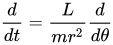
If L is not zero the definition of angular momentum allows a change of independent variable from to

giving the new equation of motion that is independent of time

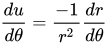
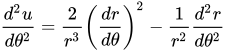
The expansion of the first term is

This equation becomes quasilinear on making the change of variables and multiplying both sides by

After substitution and rearrangement:
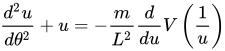
For an inverse-square force law such as the gravitational or electrostatic potential, the scalar potential can be written
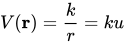
The orbit can be derived from the general equation


whose solution is the constant plus a simple sinusoid

where (the eccentricity) and (the phase offset) are constants of integration.

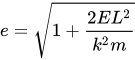
This is the general formula for a conic section that has one focus at the origin; corresponds to a circle, corresponds to an ellipse, corresponds to a parabola, and corresponds to a hyperbola. The eccentricity is related to the total energy (cf. the Laplace–Runge–Lenz vector)

Comparing these formulae shows that corresponds to an ellipse (all solutions which are closed orbits are ellipses), corresponds to a parabola, and corresponds to a hyperbola. In particular, for perfectly circular orbits (the central force exactly equals the centripetal force requirement, which determines the required angular velocity for a given circular radius).

For a repulsive force (k > 0) only e > 1 applies.

See also

[edit]

References

[edit]
Revisions and contributorsEdit on WikipediaRead on Wikipedia
from Grokipedia
The Kepler problem is a fundamental problem in classical mechanics that describes the motion of two point masses interacting through a central force proportional to the inverse square of the distance between them, such as the gravitational attraction between a planet and a star.[1][2] This two-body system reduces to an equivalent one-body problem with a reduced mass orbiting a fixed center under the same force law, governed by the differential equation r¨=μr3r\ddot{\mathbf{r}} = -\frac{\mu}{r^3} \mathbf{r}, where μ=G(m1+m2)\mu = G(m_1 + m_2) is the gravitational parameter and GG is the gravitational constant.[1][3] Historically, the problem emerged from Johannes Kepler's empirical laws of planetary motion, derived in the early 17th century from Tycho Brahe's astronomical observations, which described elliptical orbits with the Sun at one focus, equal areas swept in equal times, and periods squared proportional to semi-major axes cubed.[4] Isaac Newton provided the theoretical foundation in 1687 through his Philosophiæ Naturalis Principia Mathematica, where he demonstrated that his second law of motion combined with the universal law of gravitation—stating that the force FF between two masses m1m_1 and m2m_2 is F=Gm1m2/r2F = G m_1 m_2 / r^2—exactly reproduces Kepler's laws as mathematical consequences.[4][2] Newton's solution required the invention of calculus to integrate the equations of motion, marking a pivotal advancement in dynamical systems.[1] The solutions to the Kepler problem yield conic section trajectories: bound orbits are ellipses with eccentricity e<1e < 1, parabolic orbits occur at zero total energy (e=1e = 1), and hyperbolic orbits describe unbound scattering (e>1e > 1), all determined by the specific angular momentum and energy conservation.[2][1] The orbit equation is r=p1+ecosθr = \frac{p}{1 + e \cos \theta}, where p=h2/μp = h^2 / \mu is the semi-latus rectum and hh is the specific angular momentum.[2] Additional conserved quantities include the Laplace-Runge-Lenz vector, which points to the periapsis and enables closed-form solutions, highlighting the problem's superintegrability.[2] The Kepler problem's significance extends beyond celestial mechanics, serving as a cornerstone for understanding N-body problems in astrophysics, such as planetary systems and binary stars, and influencing quantum mechanics through analogies like the hydrogen atom, where the Coulomb potential mirrors the inverse-square law.[5] Generalizations include relativistic versions in general relativity for phenomena like Mercury's perihelion precession and extensions to spaces of constant curvature or higher dimensions.[6] Its exact solvability makes it a benchmark for numerical methods and perturbation theory in modern simulations of gravitational dynamics.[2]

Introduction and Historical Context

Overview and Significance

The Kepler problem describes the motion of two bodies interacting via mutual inverse-square gravitational attraction, which reduces to an equivalent one-body problem under a central force directed toward the more massive body.[7] This formulation captures the essential dynamics of gravitational systems where one body is significantly more massive, such as a planet orbiting a star.[8] As a foundational element of classical mechanics, the Kepler problem enables accurate predictions of orbital paths for planets, moons, and artificial satellites, underpinning much of celestial mechanics and spaceflight trajectory planning.[8] The solution specifies the orbit through six key parameters known as orbital elements: the semi-major axis, which determines the orbit's size; eccentricity, which sets its shape; inclination, defining the orbital plane's tilt relative to a reference; longitude of the ascending node, locating the orbital plane's orientation; argument of periapsis, indicating the position of closest approach; and true anomaly, measuring the body's angular position along the orbit.[7] The problem's significance extends to highlighting the unique stability of certain central forces, as per Bertrand's theorem, which proves that only the inverse-square force law and the harmonic oscillator potential produce closed, bounded orbits for all initial conditions yielding bound motion.[9] Originating from Johannes Kepler's empirical laws and Isaac Newton's theoretical framework, it remains vital for understanding gravitational interactions in astronomy.[8]

Historical Development

The Kepler problem originated from efforts to explain planetary motions observed in the late 16th and early 17th centuries. Johannes Kepler, working with the exceptionally accurate astronomical data amassed by Tycho Brahe over decades of observations at his Uraniborg observatory, undertook a meticulous analysis to model the orbit of Mars.[10][11] This collaboration was pivotal, as Brahe's measurements, precise to within 1 arcminute, provided the empirical foundation that enabled Kepler to depart from the prevailing geocentric and circular orbit paradigms.[10] In his seminal work Astronomia Nova, published in 1609, Kepler announced his first two laws: planets orbit the Sun in ellipses with the Sun at one focus, and a line joining a planet to the Sun sweeps out equal areas in equal times.[12] These laws emerged from Kepler's exhaustive computations, which rejected circular orbits after testing thousands of variations on Brahe's Mars data.[11] A decade later, in Harmonices Mundi (1619), Kepler introduced his third law, stating that the square of a planet's orbital period is proportional to the cube of the semi-major axis of its orbit, derived by comparing periods across multiple planets.[13] These empirical rules described planetary motion accurately but lacked a physical explanation, leaving open the question of the underlying force.[10] By the late 17th century, astronomers like Robert Hooke and Christopher Wren had hypothesized that planetary deviations from straight-line motion could arise from a central force varying inversely with the square of the distance, inspired by Kepler's laws and analogies to optics.[14][15] However, neither provided a rigorous proof linking this inverse-square law to elliptical orbits. Isaac Newton resolved this in the first edition of Philosophiæ Naturalis Principia Mathematica (1687), where he demonstrated using his laws of motion and universal gravitation that an inverse-square attractive force between bodies necessarily produces Kepler's three laws.[16] Subsequent editions of the Principia (1713 and 1726) included refinements, such as clarifications on the inverse-square derivation and responses to critiques, solidifying the theoretical framework.[14] In the 19th century, Pierre-Simon Laplace built upon Newton's foundations in his multi-volume Mécanique Céleste (1799–1825), expanding celestial mechanics to address perturbations in Keplerian orbits caused by interplanetary interactions.[17][18] Laplace's analytical methods provided stability proofs for the solar system and higher-order corrections to planetary motions, though the core Kepler problem remained rooted in the classical inverse-square law established by Newton.[17]

Mathematical Formulation

The Two-Body Problem

The two-body problem in classical mechanics describes the motion of two point masses interacting solely through their mutual gravitational attraction, with no external forces acting on the system. This setup assumes the bodies can be treated as point particles, neglecting their size and internal structure, and relies on Newton's law of universal gravitation, which states that the force between the masses m1m_1 and m2m_2 separated by a distance rr is F=Gm1m2/r2F = G m_1 m_2 / r^2, directed along the line joining them.[19][20] Unlike the general nn-body problem for n>2n > 2, where the equations of motion are coupled and generally non-integrable, the two-body problem is exactly solvable because the mutual interaction allows separation of the center-of-mass motion from the relative motion.[21][22] To solve this, the system is analyzed in the center-of-mass frame, where the total momentum is zero, simplifying the dynamics. The position of the center of mass R=(m1r1+m2r2)/(m1+m2)\mathbf{R} = (m_1 \mathbf{r}_1 + m_2 \mathbf{r}_2)/(m_1 + m_2) moves with constant velocity, while the relative motion is described by the vector r=r1r2\mathbf{r} = \mathbf{r}_1 - \mathbf{r}_2. This reduction transforms the two-body system into an equivalent one-body problem, where an effective particle of reduced mass μ=m1m2/(m1+m2)\mu = m_1 m_2 / (m_1 + m_2) moves under the influence of a fixed central force proportional to the total mass m1+m2m_1 + m_2.[21][22] The reduced mass μ\mu satisfies 1/μ=1/m1+1/m21/\mu = 1/m_1 + 1/m_2, ensuring the equations mimic a single body orbiting a fixed center.[20] The equation of motion for the relative vector r\mathbf{r} in this framework is derived from Newton's second law applied to both bodies:
d2rdt2=G(m1+m2)r2r^, \frac{d^2 \mathbf{r}}{dt^2} = -\frac{G(m_1 + m_2)}{r^2} \hat{\mathbf{r}},
where r=rr = |\mathbf{r}| and r^=r/r\hat{\mathbf{r}} = \mathbf{r}/r is the unit vector in the direction of r\mathbf{r}. This form highlights the central nature of the force, confined to the plane perpendicular to the angular momentum vector L=μr×r˙\mathbf{L} = \mu \mathbf{r} \times \dot{\mathbf{r}}, which is conserved due to rotational invariance, restricting the motion to a plane.[21][22][20] The Kepler problem emerges as the specific instance of this two-body dynamics under the inverse-square gravitational law, enabling closed-form solutions for the orbits.[19]

Central Force and Potential

In the context of the two-body problem, the interaction between the bodies is modeled as a central force, which acts along the line connecting their centers of mass and depends only on the separation distance $ r $. Such a force can be expressed as $ \mathbf{F} = f(r) \hat{\mathbf{r}} $, where $ \hat{\mathbf{r}} $ is the unit vector in the radial direction, and $ f(r) $ is a scalar function that determines the force's magnitude and direction. Central forces are inherently conservative, meaning they derive from a potential energy function $ V(r) $ satisfying $ \mathbf{F} = -\nabla V $, which ensures the work done is path-independent and enables the use of energy conservation in the dynamics.[23] For the Kepler problem, the central force is specifically the gravitational attraction, given by $ \mathbf{F} = -\frac{G m_1 m_2}{r^2} \hat{\mathbf{r}} $, where $ G $ is the gravitational constant and $ m_1, m_2 $ are the masses of the two bodies; this attractive inverse-square law $ f(r) = -k / r^2 $ with $ k = G m_1 m_2 > 0 $ captures the essential physics of planetary motion under Newton's law of universal gravitation. In more generalized treatments, the force is often written as $ \mathbf{F} = -\frac{k}{r^2} \hat{\mathbf{r}} $, allowing application to analogous systems like electrostatic interactions by adjusting the constant $ k $. This form distinguishes the Kepler problem from other central force scenarios, as the $ 1/r^2 $ dependence leads to closed elliptical orbits for bound systems, unlike power-law forces with different exponents.[24][25] The associated potential energy for this inverse-square force is derived by integrating the force relation $ f(r) = -\frac{dV}{dr} $, yielding $ V(r) = -\frac{k}{r} + C $, where the constant $ C $ is conventionally set to zero for convenience, as only differences in potential matter in classical mechanics. In the reduced-mass framework, where the two-body system is equivalent to a single particle of mass $ \mu = \frac{m_1 m_2}{m_1 + m_2} $ moving in this potential, the gravitational potential thus becomes $ V(r) = -\frac{G m_1 m_2}{r} $. This $ 1/r $ form is a direct consequence of the inverse-square law and provides the binding energy scale for orbital motion.[23][25] To analyze the radial motion in the reduced-mass system, an effective potential is introduced that incorporates the centrifugal barrier arising from angular momentum conservation:
Veff(r)=V(r)+L22μr2=kr+L22μr2, V_{\text{eff}}(r) = V(r) + \frac{L^2}{2 \mu r^2} = -\frac{k}{r} + \frac{L^2}{2 \mu r^2},
where $ L $ is the conserved angular momentum magnitude. This effective potential governs the one-dimensional radial dynamics, with the first term providing the attractive well and the second the repulsive centrifugal contribution, enabling qualitative analysis of bound and unbound orbits through its shape and minima.[24][23] The inverse-square nature of the Kepler force uniquely results in a $ 1/r $ potential, which, when combined with the centrifugal term, produces an effective potential supporting stable circular orbits at its minimum and closed conic-section paths—properties not shared with other central potentials, such as the harmonic oscillator's $ V(r) \propto r^2 $, which yields elliptical orbits centered at the force origin rather than focused at a point. This specificity underpins the problem's solvability and its foundational role in celestial mechanics.[25][23]

Solving the Kepler Problem

Conservation Laws

The Kepler problem, as a central force problem with an inverse-square law, exhibits several conservation laws arising from its underlying symmetries, which significantly simplify the analysis of orbital motion. These conserved quantities stem from the rotational invariance of space and the specific form of the gravitational potential, reducing the complexity of the six-dimensional phase space (three position and three momentum coordinates) to a more manageable form solvable in polar coordinates.[26][27] Angular momentum is conserved due to the rotational invariance of the system, corresponding to the SO(3) symmetry group of three-dimensional rotations. For a reduced mass μ\mu, the angular momentum vector is L=μr×v\mathbf{L} = \mu \mathbf{r} \times \mathbf{v}, which remains constant in both magnitude and direction. This conservation implies that the orbital motion is confined to a plane perpendicular to L\mathbf{L}, as the position r\mathbf{r} and velocity v\mathbf{v} are always orthogonal to L\mathbf{L}.[5][28] The total mechanical energy is also conserved, reflecting the time-translation invariance of the Lagrangian or Hamiltonian. The energy EE is given by
E=12μv2kr, E = \frac{1}{2} \mu v^2 - \frac{k}{r},
where k=Gm1m2k = G m_1 m_2 is the gravitational parameter, combining kinetic energy T=12μv2T = \frac{1}{2} \mu v^2 and potential energy V=krV = -\frac{k}{r}. The sign of EE determines the orbit type: negative for bound (elliptic) orbits and positive for unbound (hyperbolic) orbits, with zero corresponding to parabolic trajectories.[26][27] A distinctive conserved quantity unique to the 1/r1/r potential is the Laplace-Runge-Lenz vector A\mathbf{A}, which arises from an additional hidden symmetry beyond the manifest SO(3) rotational invariance. Defined as
A=p×Lμkr^, \mathbf{A} = \mathbf{p} \times \mathbf{L} - \mu k \hat{\mathbf{r}},
where p=μv\mathbf{p} = \mu \mathbf{v} is the linear momentum and r^=r/r\hat{\mathbf{r}} = \mathbf{r}/r is the unit radial vector, A\mathbf{A} is constant in magnitude and direction. This vector lies in the orbital plane, points toward the periapsis (closest approach), and has magnitude A=μkeA = \mu k e, where ee is the eccentricity of the orbit. The conservation of A\mathbf{A} is tied to the specific inverse-square form of the potential, enabling the closed-form solution for the orbit shape. For bound orbits, this hidden symmetry extends to an SO(4) group structure, explaining the periodicity and closure of elliptic paths.[26][28][27] These conservation laws—L\mathbf{L}, EE, and A\mathbf{A}—provide five independent integrals of motion (noting relations like AL=0\mathbf{A} \cdot \mathbf{L} = 0), effectively reducing the six degrees of freedom to two independent ones in the plane, such as radial distance and angle, which can be solved using polar coordinates. This reduction is crucial for integrating the equations of motion and understanding the bounded, periodic nature of Keplerian orbits.[5][28]

Derivation of the Orbit Equation

To derive the orbit equation for the Kepler problem, the motion is analyzed in polar coordinates (r,θ)(r, \theta), where rr is the radial distance from the central body and θ\theta is the polar angle. The conserved angular momentum L\mathbf{L} implies that the angular velocity satisfies θ˙=L/(μr2)\dot{\theta} = L / (\mu r^2), with μ\mu the reduced mass and L=LL = |\mathbf{L}|.[25] Substituting the change of variable u=1/ru = 1/r expresses the trajectory as u(θ)u(\theta), and the time derivative transforms via d/dt=(Lu2/μ)d/dθd/dt = (L u^2 / \mu) d/d\theta.[5] The radial equation of motion arises from the conservation of total energy E=12μr˙2+L22μr2krE = \frac{1}{2} \mu \dot{r}^2 + \frac{L^2}{2 \mu r^2} - \frac{k}{r}, where k=Gm1m2k = G m_1 m_2 is the gravitational constant for the attractive 1/r1/r potential. Expressing r˙\dot{r} in terms of du/dθdu/d\theta yields the second-order differential equation for uu:
d2udθ2+u=μkL2. \frac{d^2 u}{d\theta^2} + u = \frac{\mu k}{L^2}.
[25]
This is a linear nonhomogeneous equation resembling a harmonic oscillator with a constant forcing term. The general solution is the sum of the particular solution up=μk/L2u_p = \mu k / L^2 and the homogeneous solution uh=Acos(θθ0)u_h = A \cos(\theta - \theta_0), giving
u(θ)=μkL2[1+ecos(θθ0)], u(\theta) = \frac{\mu k}{L^2} \left[ 1 + e \cos(\theta - \theta_0) \right],
[5]
where the eccentricity e=AL2/(μk)e = A L^2 / (\mu k) determines the orbit type, and θ0\theta_0 is a phase angle. Inverting yields the polar form of the conic section orbit r=L2/(μk)1+ecos(θθ0)r = \frac{L^2 / (\mu k)}{1 + e \cos(\theta - \theta_0)}. The boundary condition for θ0\theta_0 is set by the direction of the conserved Runge-Lenz vector A=p×Lμkr^\mathbf{A} = \mathbf{p} \times \mathbf{L} - \mu k \hat{r}, which points along the major axis toward the periapsis and has magnitude A=μkeA = \mu k e, fixing θ0\theta_0 as the argument of periapsis.[25] To obtain the time dependence r(t)r(t), the angular momentum conservation integrates θ(t)\theta(t) implicitly. For the elliptical case (e<1e < 1, E<0E < 0), the mean anomaly M=ntM = n t (with mean motion n=μk/a3n = \sqrt{\mu k / a^3}, aa the semi-major axis) relates to the true anomaly θ\theta via Kepler's equation M=θesinθ+O(e2)M = \theta - e \sin \theta + O(e^2), requiring numerical solution for exact t(θ)t(\theta); the full transcendental form uses the eccentric anomaly.[25] For e<1e < 1, the orbits are closed because the solution u(θ)u(\theta) is bounded and periodic with period 2π2\pi in θ\theta, corresponding to finite energy E<0E < 0 and recurrent motion without precession, unlike general central forces.[5]

Orbital Properties and Classifications

Kepler's Laws

Kepler's three laws of planetary motion, formulated by Johannes Kepler around 1609–1619 based on meticulous observations of planetary positions by Tycho Brahe, provided the first quantitative description of heliocentric orbits. These empirical laws—elliptical orbits, equal areas swept in equal times, and the period-semi-major axis relation—captured the dynamics of solar system bodies without an underlying theory. The Kepler problem, solving the two-body equations of motion under Newton's inverse-square gravitational force $ F = G m_1 m_2 / r^2 $, reveals that these laws emerge precisely from this force law, confirming their validity for isolated central-force systems.[29][30] Kepler's first law states that each planet orbits the Sun in an ellipse, with the Sun occupying one focus. In the Kepler problem, the orbit equation, derived from conservation of energy and angular momentum, yields the polar form
r=h2μ/k1+ecosθ, r = \frac{h^2 \mu / k}{1 + e \cos \theta},
where $ r $ is the separation, $ \theta $ is the angle from periapsis, $ h $ is the specific angular momentum, $ \mu = m_1 m_2 / (m_1 + m_2) $ is the reduced mass, $ k = G m_1 m_2 $, and $ e $ is the eccentricity determined by the total energy $ E .Forboundorbits(. For bound orbits ( E < 0 $), $ e < 1 $, producing an ellipse with the force center at a focus; the semi-major axis $ a $ relates to energy via $ E = -k / (2a) $. This conic form verifies the law, as only the inverse-square force yields such focused ellipses among central forces.[29][30] Kepler's second law asserts that the line from the Sun to a planet sweeps out equal areas in equal times, implying constant areal velocity. This arises from angular momentum conservation in the central-force setup, where torque vanishes since the force is radial. The areal velocity is
dAdt=h2=L2μ, \frac{dA}{dt} = \frac{h}{2} = \frac{L}{2 \mu},
with $ L = \mu h $ the total angular momentum, remaining constant throughout the motion. Consequently, the area $ A $ accumulated over time $ t $ is $ A = (h/2) t $, directly proportional to $ t $, which speeds up the planet near periapsis and slows it at apoapsis to maintain uniformity. This law holds for any central force, but in the Kepler problem, it combines with the orbit shape to describe full elliptical sweeps.[29] Kepler's third law relates the orbital period $ T $ to the semi-major axis $ a $ via $ T^2 \propto a^3 $. From the elliptical orbit solution, the period follows by dividing the total area $ \pi a b $ (with semi-minor axis $ b = a \sqrt{1 - e^2} $) by the constant areal velocity $ h/2 $, yielding $ T = 2\pi a b / h $. Substituting $ h^2 = k (1 - e^2) a / \mu $ from the orbit parameters and energy conservation gives the precise relation
T2=4π2a3G(m1+m2), T^2 = \frac{4 \pi^2 a^3}{G (m_1 + m_2)},
where the mean motion $ n = 2\pi / T $ satisfies $ n^2 a^3 = G (m_1 + m_2) $. This proportionality, exact for inverse-square forces, scales with the total mass and confirms Kepler's empirical finding across planets.[31][29] The Kepler problem thus theoretically substantiates all three laws, showing that only an inverse-square central force produces closed elliptical orbits with these exact relations; deviations occur for other force laws. However, the laws approximate planetary motion when the central mass dominates ($ m_1 \gg m_2 $), as in the Sun-planet case, where $ G(m_1 + m_2) \approx G m_1 $ and the Sun appears nearly fixed at the focus. In the general two-body scenario, both masses orbit their center of mass, but the relative orbit remains an ellipse.[30][31]

Conic Section Orbits

In the Kepler problem, the shape of the orbit is classified by the eccentricity ee, a dimensionless parameter ranging from 0 to greater than 1, which determines whether the trajectory is a circle, ellipse, parabola, or hyperbola. The sign of the total energy EE further distinguishes bound orbits (E<0E < 0) from unbound ones (E0E \geq 0), with ee related to EE via e=1+2EL2μk2e = \sqrt{1 + \frac{2 E L^2 \mu}{k^2}}, where LL is the specific angular momentum, μ\mu the reduced mass, and kk the gravitational parameter.[32] Elliptical orbits occur for 0<e<10 < e < 1 and represent bound, closed paths around the central force, with the focus at the primary body. The semi-major axis a>0a > 0 sets the overall scale, while the semi-minor axis is b=a1e2b = a \sqrt{1 - e^2}. The closest approach, or periapsis, is at rmin=a(1e)r_{\min} = a (1 - e), and the farthest point, or apoapsis, is rmax=a(1+e)r_{\max} = a (1 + e). A special case is the circular orbit when e=0e = 0, where the radius remains constant at r=L2μkr = \frac{L^2 \mu}{k}.[33] Parabolic orbits arise when e=1e = 1, corresponding to unbound trajectories with exactly zero total energy that allow escape to infinity. The orbit equation simplifies to r=L2μ/k1+cosθr = \frac{L^2 \mu / k}{1 + \cos \theta}, where θ\theta is the true anomaly, and the semi-major axis aa is formally infinite.[33] For e>1e > 1, hyperbolic orbits describe unbound, scattering paths with positive total energy, where the particle approaches from infinity, deflects around the center, and recedes to infinity. The semi-major axis aa is negative in convention (with magnitude a|a| scaling as k/(2E)k / (2 E)), and the deflection is characterized by the asymptotic true anomaly ϕ\phi satisfying cosϕ=1/e\cos \phi = -1/e.[33] The following table summarizes the classification of conic section orbits in the Kepler problem:
Orbit TypeEccentricity eeTotal Energy EESemi-Major Axis aaPhysical Interpretation
Circular0<0< 0Positive (= radius)Bound, constant distance
Elliptical0<e<10 < e < 1<0< 0PositiveBound, closed oscillation
Parabolic1=0= 0InfiniteMarginal escape to infinity
Hyperbolic>1> 1>0> 0NegativeUnbound scattering trajectory
To fully specify the orbit in three-dimensional space, six classical orbital elements are used: semi-major axis aa, eccentricity ee, inclination ii, longitude of the ascending node Ω\Omega, argument of periapsis ω\omega, and true anomaly θ\theta (or mean anomaly MM at a reference epoch). These elements parameterize the conic section's size (aa), shape (ee), and orientation, with ii defining the angle between the orbital plane and a reference plane via the direction of the angular momentum vector L\mathbf{L}.[32]

Applications and Modern Extensions

Celestial Mechanics

In celestial mechanics, the Kepler problem serves as the foundational model for predicting planetary positions through the use of six classical orbital elements: semimajor axis, eccentricity, inclination, longitude of the ascending node, argument of pericenter, and mean anomaly at epoch. These elements define the orientation, shape, and size of an elliptical orbit around the Sun, enabling the computation of a planet's position and velocity at any time via Kepler's equation, which relates the mean anomaly to the eccentric anomaly iteratively. For instance, the Jet Propulsion Laboratory (JPL) employs these elements in its SPICE toolkit to generate high-precision ephemerides, such as the DE440 series released in 2020, which provide planetary positions accurate to within meters over centuries by integrating two-body solutions with minor adjustments for perturbations.[34][35][36] Ephemerides derived from Keplerian orbital elements are essential for mission planning and astronomical observations, allowing predictions of planetary alignments and conjunctions. The JPL Horizons system, for example, outputs positions using osculating elements fitted to numerical integrations, supporting applications from solar system calendars to spacecraft navigation. These predictions assume a dominant central gravitational force, with the Sun's mass far exceeding planetary masses, yielding near-perfect elliptical paths that align with Kepler's first law.[37][10] For satellite and space probe trajectories, the Kepler problem underpins efficient interplanetary transfers, such as the Hohmann transfer orbit, which minimizes fuel by following an elliptical path tangent to both departure and arrival orbits. In a Hohmann transfer from Earth to Mars, the spacecraft launches into an ellipse with perihelion at Earth's orbit (1 AU) and aphelion at Mars' orbit (1.52 AU), requiring two impulsive burns: one to depart Earth's sphere of influence and another for Mars arrival. Launch windows for such transfers occur approximately every 26 months due to the relative positions of Earth and Mars, optimizing the phase angle for minimal delta-v (typically 2.9 km/s for Earth-Mars).[38] The Voyager missions exemplify hyperbolic escape trajectories within the Kepler framework, where eccentricity exceeds 1, allowing spacecraft to achieve solar system escape velocity. Voyager 1, launched in 1977, followed a hyperbolic path post-Jupiter flyby with eccentricity 1.32 and negative semimajor axis, gaining speed via gravity assists to reach 17 km/s relative to the Sun. Similarly, Voyager 2's Neptune encounter resulted in a post-flyby hyperbolic orbit with eccentricity 6.28, enabling its interstellar trajectory at 15 km/s. These paths, computed using Keplerian conic sections, facilitated the grand tour of outer planets by exploiting planetary alignments.[39] In binary star systems, where masses are comparable, the Kepler problem is reformulated using the reduced mass μ = m₁m₂ / (m₁ + m₂) to treat the relative motion as an equivalent one-body orbit around the total mass M = m₁ + m₂ at the center of mass. This reduction preserves Kepler's laws, with the relative orbit being an ellipse (or conic) having the same eccentricity and period as in the unequal-mass case, scaled by the separation. For visual binaries like Alpha Centauri, observations of each star's elliptical path around the barycenter yield individual masses via Kepler's third law generalized as T² ∝ a³ / M.[40][41] For exoplanet detection, the radial velocity method relies on Keplerian orbital models to interpret stellar wobbles induced by unseen planets. As a planet orbits its star in an ellipse, the star exhibits reflex motion with the same period, causing Doppler shifts in spectral lines measurable to ~1 m/s precision. Fitting observed velocity curves to a Keplerian model provides the planet's minimum mass (m sin i), semimajor axis, and eccentricity; for example, the 1995 discovery of 51 Pegasi b used this to infer a Jupiter-mass planet in a 4.2-day orbit. NASA's Exoplanet Archive catalogs 1,157 such detections as of November 2025, with the total number of confirmed exoplanets surpassing 6,000, often combining radial velocity with transit data for full orbital characterization.[42][43][44] When perturbations from other bodies or non-spherical potentials affect the ideal Keplerian motion, numerical methods treat the unperturbed two-body solution as the zeroth-order approximation, with deviations integrated via perturbation theory. In celestial mechanics, techniques like Cowell's method directly integrate the full equations of motion, while Encke's method accelerates computations by subtracting the Keplerian reference orbit and integrating only the differential perturbations. For planetary ephemerides, the zeroth-order Keplerian elements serve as initial conditions for higher-order numerical propagators in JPL's Development Ephemeris (DE) series. The Gaussian gravitational constant k ≈ 0.01720209895 (in units where T is in mean solar days, a in AU, and M in solar masses) standardizes these computations, linking Kepler's third law to Gaussian units for consistent orbital period predictions.[45][46] Modern applications include GPS satellites, which operate on near-Keplerian elliptical orbits with semimajor axis 26,560 km, inclination 55°, and period ~11.97 hours, broadcast via orbital elements in navigation messages. Relativity corrections are essential: gravitational redshift causes satellite clocks to run 45 μs/day faster than ground clocks, offset by a factory adjustment of -4.465 × 10^{-10} in frequency, while periodic eccentricity effects add ~50 ns/day variation, modeled as Δt = - (2π GM_e / c²) √(a / (1 - e²)) e sin M, where M is mean anomaly. These ensure positioning accuracy to ~10 m globally.[47] For Mars rover missions, Keplerian trajectories guide orbital insertion phases, solving Lambert's problem to determine velocity vectors for efficient transfers from Earth. Patched conic approximations model the heliocentric cruise as a hyperbolic escape from Earth followed by hyperbolic approach to Mars, with aerobraking or propulsive maneuvers for capture. The Mars Science Laboratory (Curiosity rover) used a Type-I Hohmann-like transfer in 2011, arriving after 254 days with a hyperbolic trajectory (v_∞ ≈ 6 km/s) targeted via porkchop plots for minimal delta-v (~1.5 km/s insertion burn equivalent via atmosphere). Such planning optimizes fuel for rover delivery, as in the Perseverance mission's 2020 launch window.[48][38]

Other Physical Systems

The Kepler problem extends beyond gravitational interactions to other inverse-square force laws, most notably in electrostatics where the classical Coulomb problem describes the motion of charged particles. In this context, the potential energy is given by $ V(r) = -\frac{k}{r} $, with $ k = \frac{e^2}{4\pi\epsilon_0} $ for an electron-proton system, mirroring the gravitational case but with electrostatic constants replacing the gravitational one.[49] This analogy underpins the Bohr model's semiclassical approximation for atomic orbits, where quantized angular momentum leads to circular electron paths around the nucleus, though the full quantum treatment reveals more complex stationary states.[50] Bertrand's theorem provides a foundational justification for the prevalence of closed orbits in such systems, stating that among central force laws yielding stable, bounded, non-circular orbits, only the inverse-square law ($ F \propto 1/r^2 )andthe[radialharmonicoscillator](/page/Harmonicoscillator)() and the [radial harmonic oscillator](/page/Harmonic_oscillator) ( F \propto r $) produce exactly closed trajectories for all bound energies.[51] The theorem's proof involves analyzing the radial orbit equation and requiring the precession angle to be a rational multiple of $ 2\pi $ under small perturbations from circularity, a condition uniquely satisfied by these potentials.[9] This result underscores why Keplerian conic sections emerge specifically in inverse-square dynamics, distinguishing them from other power-law forces that yield rosette-like, non-closing paths. In quantum mechanics, the Kepler problem manifests in the hydrogen atom, where the Schrödinger equation for a Coulomb potential is separable in spherical coordinates, yielding bound-state energy levels $ E_n = -\frac{k^2 \mu}{2 \hbar^2 n^2} $, with $ n $ as the principal quantum number, $ \mu $ the reduced mass, and $ k = \frac{e^2}{4\pi\epsilon_0} $.[52] This spectrum arises from the exact solvability due to the Runge-Lenz vector, which commutes with the Hamiltonian and reveals an underlying SO(4) dynamical symmetry responsible for the degeneracy in $ l $ (orbital angular momentum) for fixed $ n $.[53] The accidental degeneracy—where states with different $ l $ share the same energy—stems directly from this hidden symmetry, analogous to the classical orbit closure. Relativistic extensions of the Kepler problem appear in the Schwarzschild metric, describing geodesics around non-rotating black holes as analogues to classical orbits but perturbed by spacetime curvature.[54] These timelike geodesics exhibit bounded motion similar to elliptical orbits for low energies, yet incur additional effects like perihelion precession beyond Newtonian predictions. For instance, general relativity resolves the anomalous precession of Mercury's perihelion—observed at 5600 arcseconds per century, with 5557 from classical perturbations—by adding 43 arcseconds per century from post-Newtonian terms.[55] This agreement, derived from the Schwarzschild geodesic equations, confirms the theory's validity in weak-field limits.[56] Modern applications address limitations of the two-body idealization through numerical N-body simulations, which integrate Keplerian elements as a baseline for multi-particle gravitational dynamics in astrophysics. Software like REBOUND employs symplectic integrators that split the Hamiltonian into Keplerian (solvable analytically) and interaction terms, enabling efficient long-term evolution of star clusters or planetary systems while conserving energy to high precision.[57] These methods, often using Kepler-based propagators for close encounters, simulate phenomena like orbital instabilities in multi-planet configurations, bridging the exact two-body solution to complex, chaotic realities.[58]

References

User Avatar
No comments yet.