Hubbry Logo
Gyeongsang ProvinceGyeongsang ProvinceMain
Open search
Gyeongsang Province
Community hub
Gyeongsang Province
logo
8 pages, 0 posts
0 subscribers
Be the first to start a discussion here.
Gyeongsang Province
Gyeongsang Province
from Wikipedia

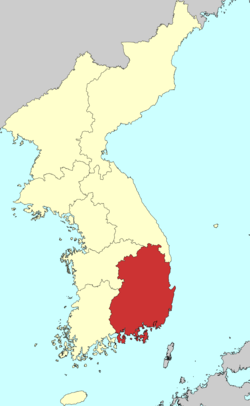
Gyeongsang Province (Korean경상도; Hanja慶尙道; Korean pronunciation: [kjʌ̹ŋ.sa̠ŋ.do̞]) was one of the Eight Provinces of Joseon Korea. Gyeongsang was located in southeastern Korea.

Key Information

The provincial capital of Gyeongsang was Daegu. The region was the birthplace of the kingdom of Silla, which unified Korea in 668 CE. The region also has a highly significant role in modern Korean history; every non-acting South Korean president from 1963 to 2022 except Choi Kyu-hah (1979-1980) had ancestry from Gyeongsang, and all except Lee Myung-bak were also born in Gyeongsang.

Today, the historical region is divided into five administrative divisions: the three independent cities of Busan, Daegu and Ulsan, and the two provinces of North Gyeongsang Province and South Gyeongsang Province. The largest city in the historical region is Busan, followed by Daegu.

History

[edit]

The predecessor to Gyeongsang Province was formed during the Goryeo (918-1392), replacing the former provinces of Yeongnam, Sannam and Yeongdong.

Gyeongsang acquired its current name in 1314. The name derives from names of the principal cities of Gyeongju and Sangju.

In 1895, Gyeongsang was replaced by the districts of Andong in the north, Daegu (대구부; 大邱) in the centre, Jinju in the southwest, and Dongnae (동래부; 東萊府; now Busan) in the southeast.

In 1896, Andong, Daegu, and northern Dongnae Districts were merged to form North Gyeongsang, and Jinju and southern Dongnae districts were merged to form South Gyeongsang. North and South Gyeongsang are part of South Korea today.

Language

[edit]

The language used in Gyeongsang province (south and north) is the Yeongnam dialect of Korean, also called the Gyeongsang dialect, and the intonation and vocabulary is different from the standard Seoul dialect (표준어, pyojuneo) in several ways.[1] Yeongnam dialect itself is further subdivided into several dialects. For example, Busan dialect is slightly different from Andong dialect and Uljin dialect.

Examples of different intonation and vocabulary
English Seoul dialect Gyeongsang dialect
key 열쇠 yeolsoe 쇳대 soetdae (in Busan)
whole, every, all 모두 modu, 언제나 eonjena, 항시 hangsi 마카 maka (in Yaecheon county)
Why do you do that? (asking reason of an action-sentence) 왜 그래요? Wae geuraeyo?, 왜 그러세요? Wae geureoseyo? 와 그랑교? Wa geuranggyo? (in Southern Gyeongsang, Busan, Ulsan)
와 그리니껴? Wa geurinikkyeo? (in Northern Gyeongsang)

Geography

[edit]

Gyeongsang Province was bounded on the west by Jeolla and Chungcheong Provinces, on the north by Gangwon Province, on the south by Korea Strait, and on the east by the Sea of Japan. The region is ringed by the Taebaek and Sobaek Mountains and is drained by the Nakdong River.

The largest cities in the region are Busan, Daegu, and Ulsan. Other cities of note are Gyeongju (the former capital of Silla), Andong, Yeongju, Sangju, Gimcheon, Miryang, Gimhae, Changwon (the capital of South Gyeongsang), Masan, and Jinju.[2]

The Gyeongsang region as a whole is often referred to by the regional and former provincial name of "Yeongnam" (The term "Yeongdong" is applied today to Gangwon Province).

References

[edit]
[edit]
Revisions and contributorsEdit on WikipediaRead on Wikipedia
from Grokipedia
Gyeongsang Province (Korean: 경상도; Gyeongsang-do) was a major administrative division in southeastern Korea during the Dynasty (1392–1897), one of the Eight Provinces established under the kingdom's central governance system. The province derived its name from the key historical centers of and , reflecting their prominence in the region since earlier dynasties. It covered an extensive area now split into modern North Gyeongsang and South Gyeongsang Provinces, serving as a vital hub for agriculture, trade, and cultural preservation. Historically, Gyeongsang-do originated in 1314 during the Dynasty as a consolidation of southeastern territories previously known as , Sannam, and Yeongdong, and retained its structure through the era until administrative reforms in 1896 divided it into northern and southern halves. The region held profound significance as the heartland of the Kingdom (57 BCE–935 CE), which originated in and achieved unification of the by 668 CE, leaving behind numerous archaeological sites, temples, and royal tombs that underscore its enduring legacy in Korean heritage. Geographically, the province was characterized by a bow-shaped of mountains, including the Sobaek and ranges, with the providing fertile plains for rice cultivation and supporting dense populations in riverine basins. Gyeongsang Province played a pivotal role in Joseon-era politics and , producing influential figures in Confucian and affairs, while its coastal access facilitated maritime and defense against invasions. The area's defining characteristics included robust agricultural output, particularly in grains and fisheries, contributing to Korea's economic stability, alongside a of folk festivals and shamanic rituals preserved in rural villages from the late Joseon period. Post-division, the legacy of unified Gyeongsang-do persists in the shared dialect, cuisine, and regional identity of its successor provinces, which together form the Yeongnam cultural and economic bloc in contemporary .

Etymology

Name Origin and Historical Designations

The name "Gyeongsang" derives from the combination of the first syllables of (慶州) and (尙州), two major historical centers in the region. This etymological structure, reflecting administrative consolidation, was formalized in 1314 during the first year of King Chungsuk's reign in the Dynasty (918–1392), when the province was designated as Gyeongsang-do. Prior to 1314, the territory had been part of broader divisions including , Sannam, and Yeongdong provinces. Under the subsequent Dynasty (1392–1910), Gyeongsang-do retained its name and status as one of Korea's eight provinces, with boundaries largely unchanged until the late . In 1895, the Gabo Reforms abolished the provincial system, subdividing Gyeongsang-do into districts such as , , , and others. The province was reestablished in 1896 amid the short-lived Thirteen Provinces system. During Japanese colonial rule (1910–1945), the area was redesignated as Keishō Hokudō (慶尚北道) for the northern portion and Keishō Nando (慶尚南道) for the southern portion, reflecting the imperial administrative framework.

History

Ancient Origins and Silla Kingdom

The southeastern Korean Peninsula, corresponding to the modern Gyeongsang Province, was home to the Jinhan tribal confederacies during the proto-Three Kingdoms period (circa 1st century BCE to CE), with the Saroguk polity in the basin emerging as a key walled around the 3rd century BCE due to migrations and cultural integrations. Saroguk, consisting of six villages and clans, formed the nucleus of and was strategically positioned south of the Sobaek Mountain Range, near the , and within the Baekdudaegan Mountains, offering fertile lands and defensive terrain. Traditional accounts in the attribute Silla's founding to 57 BCE, when local chieftains united under King Hyeokgeose (r. 57 BCE–4 CE), a figure mythically born from an egg, marking the shift from tribal alliances to monarchical rule. By the 4th century CE, under King Namul (r. 356–402 CE), Saroguk evolved from an eumnak (village confederation) into a centralized bu system, incorporating influences from through alliances, such as sending Prince Silseong as a in 391 CE, and military aid against Gaya and Wa invaders in 399 CE. Archaeological findings in , including mid-4th-century wooden chamber tombs with stone mounds and 5th-century high mound tombs like Hwangnam Daechong containing tools and , evidence a stratified society with advancing craftsmanship and royal burial customs predating full kingdom consolidation. The polity formally renamed itself in 503 CE under King Soji, signifying administrative reforms and absorption of remaining Jinhan states, with (formerly Saro or Seorabeol) established as the enduring capital. Silla's pre-unification growth centered on Gyeongsang's expansion, as seen in King Jinheung's (r. 540–576 CE) conquests of Gaya polities by 562 CE, of fortresses like Namsansinseong, and extension to the Han River basin, tripling its territory through the warrior system and bang administrative units. Reforms under King Beopheung (r. 514–540 CE) introduced legal codes and official recognition in 528 CE, while asset-based taxation (hodeungje) and land distribution (nogeup) under King Taejong Muyeol (r. 654–661 CE) supported militarization. Alliances with Tang China, forged by Queens Seondeok (r. 632–647 CE) and Jindeok (r. 647–654 CE), enabled decisive victories over Baekje in 660 CE and in 668 CE, culminating in peninsula unification by 676 CE under King Munmu, cementing Gyeongsang as Silla's political and cultural core.

Goryeo and Joseon Periods

During the dynasty (918–1392), the southeastern region corresponding to modern Gyeongsang Province was integrated into the kingdom's administrative framework, which evolved from earlier -era divisions into a system of (pastoral districts) and other local units. The designation Gyeongsang-do was formally established in 1314, during the first year of King Chungsuk's reign, as part of a reorganization into 13 provinces to streamline governance amid internal strife and Mongol influence. The provincial office, known as Gamyeong, was based in , reflecting the area's historical significance as the former capital and a center for Buddhist institutions that persisted under state patronage. Following the founding of the dynasty in 1392 by Yi Seong-gye, the Gyeongsang-do structure was retained and adapted to the new Confucian-oriented bureaucracy, emphasizing centralized control over local elites. In recognition of its expansive territory and population—larger than most other regions—the province was subdivided in 1407 during Taejong's reign into western (Seogyeongsang) and eastern (Donggyeongsang) circuits to improve tax collection, military recruitment, and agricultural oversight. By 1413, in the 13th year of Taejong's rule, formalized its eight-province system nationwide, with Gyeongsang-do as one key unit encompassing fertile plains suited for rice cultivation and coastal ports vital for maritime defense against Japanese incursions. The Gamyeong was relocated from to Sangju-mok shortly after the dynasty's inception, enhancing administrative efficiency in a region that supplied significant grain reserves and hosted influential academies promoting Neo-Confucian scholarship by the mid-Joseon era.

Late Joseon to Colonial Era

During the late period, Gyeongsang Province faced significant social unrest amid economic hardships and heavy taxation. In 1862, the Imsul Peasant Revolt erupted in Danseong County, rapidly spreading to where peasants mobilized systematically through local associations like Suchungga, protesting corrupt officials and exploitative grain transport duties. The uprising involved arson, destruction of government property, and demands for relief, reflecting broader agrarian grievances that influenced subsequent revolts nationwide. Further tensions arose with Yi Pil-je's Rebellion in 1871, which disrupted emerging religious movements like Donghak in the region, highlighting factional and ideological conflicts among the populace. Administrative reforms marked the era's end. The Gabo Reforms of 1894–1896, prompted by the Donghak Peasant Revolution and Japanese influence, initially redivided the eight provinces into 23 districts, affecting Gyeongsang's governance structure. In 1896, under King Gojong, the province was split into Gyeongsangbuk-do (northern) and Gyeongsangnam-do (southern) as part of reorganizing into 13 provinces, with capitals at and respectively, to better manage local administration and population distribution. Following Japan's annexation via the , Gyeongsang Province was subdivided into Keishōhoku-dō (North Gyeongsang Circuit) and Keishō-nan-dō (South Gyeongsang Circuit) under the Japanese . Colonial policies emphasized resource extraction and infrastructure, with in southern Gyeongsang expanded as a major international port to facilitate trade and military logistics, contributing to economic modernization but primarily benefiting Japanese interests through land reforms that transferred ownership to colonial elites. Resistance persisted, as seen in the March 1 Movement of 1919, where protests in and surrounding areas demanded independence, met with harsh suppression that underscored the regime's coercive control. Archaeological efforts during this period, such as excavations of tombs in Gyeongsang from 1918–1919, yielded artifacts like gold crowns but served Japanese narratives of . Overall, the era entrenched economic disparities, with increased rice production for export amid forced labor and cultural suppression, setting the stage for post-liberation divisions.

Post-1945 Division and Legacy

Following the on August 15, 1945, the territory encompassing the historical Gyeongsang Province fell entirely within the U.S. occupation zone south of the 38th parallel, avoiding any partition between and . The pre-existing administrative split, formalized in 1896, persisted as (Gyeongsangbuk-do) and (Gyeongsangnam-do) under the Military Government in Korea (USAMGIK) from 1945 to 1948, with boundaries largely mirroring Japanese-era designations of Keishōhoku-dō and Keishōnan-dō. This structure carried over into the of Korea upon its founding on August 15, 1948, with serving as the capital of North Gyeongsang and (later ) for South Gyeongsang, while operated as a separate metropolitan entity. During the (June 25, 1950–July 27, 1953), the provinces became critical rear areas for South Korean and UN forces. Busan, in South Gyeongsang, hosted the from December 1950 to March 1952 and anchored the Pusan Perimeter, where defensive lines held against North Korean advances, preserving a foothold for counteroffensives. Daegu, in North Gyeongsang, absorbed significant influxes alongside repatriates from 1945, spurring and positioning it as an administrative and logistical center. These events entrenched the region's role as a stable economic base amid nationwide devastation, with minimal direct combat damage compared to northern areas. Postwar reconstruction amplified the provinces' industrial prominence, particularly under President Park Chung-hee (1963–1979), born in 1917 in Gumi, North Gyeongsang Province. His administration directed state-led investments toward heavy industry in Yeongnam (the Gyeongsang dialect region), including the founding of Pohang Iron and Steel Company (POSCO) in 1968, which transformed Pohang into a steel production hub, and expansion of shipbuilding in South Gyeongsang sites like Geoje. This focus, alongside export-oriented policies, elevated the provinces' GDP contribution, with North Gyeongsang comprising about 19% of South Korea's land area by the late 20th century while fostering manufacturing clusters. Politically, the legacy manifests in Yeongnam's enduring conservative dominance, rooted in support for authoritarian modernization under —a native son—and successors like (from Hapcheon, South Gyeongsang). Regionalism intensified post-1945 factional rivalries, positioning Gyeongsang as a to (Jeolla) progressivism, with disproportionate presidential representation (e.g., , from ) shaping national policy until the . This dynamic, while fueling economic prioritization, has drawn critique for exacerbating inter-regional tensions, though empirical growth metrics underscore the provinces' causal role in South Korea's rapid industrialization from the onward.

Geography

Location and Topography

Gyeongsang Province encompassed the southeastern region of the Korean Peninsula, forming part of the area historically administered as a single from until its division in 1896. Its territory extended along the East Sea () to the east for approximately 335 kilometers of coastline and the to the south, with western boundaries adjoining Jeolla and Chungcheong regions, and northern limits reaching toward Gangwon Province. The topography of Gyeongsang Province is dominated by rugged mountain ranges, including the paralleling the eastern seaboard and the Sobaek Mountains extending westward, which together enclose a broad central basin formed by the —the longest river in Korea at 510 kilometers. This river originates in the Taebaek range and flows southward, creating fertile alluvial plains such as the Gimhae Plain in the southern delta area, which spans about 10 miles north-south and supports extensive agriculture. The eastern coastal zones feature narrower plains interspersed with headlands, while inland elevations rise sharply, contributing to diverse microclimates and limiting flat to river valleys and coastal strips.

Climate and Natural Resources

Gyeongsang Province experiences a temperate with four distinct seasons, marked by hot, humid summers influenced by the East Asian Monsoon and cold, dry winters due to continental air masses. Annual average temperatures range from approximately 12.5°C in inland areas like to 13.5°C in coastal regions such as , with summer highs reaching 29–31°C in August and winter lows dropping to -8°C or below in . is concentrated during the July–August rainy season, averaging 1,140–1,307 mm annually, though inland zones receive slightly less due to topographic rain shadows from surrounding mountains. Regional variations arise from the province's topography, with inland northern areas like those near recording some of South Korea's highest summer temperatures owing to distance from moderating sea influences, while southern coastal zones benefit from milder winters and enhanced . rains can lead to flooding in river valleys such as the Nakdong, exacerbating risks in low-lying agricultural areas, though overall sunshine hours support robust seasonal growth. Winter snowfall is more prevalent in elevated terrains, contributing to drier conditions continent-wide. Natural resources in Gyeongsang Province historically centered on , fisheries, and limited deposits, shaped by its mountainous interior, fertile valleys, and extensive coastline. , constrained by steep terrain covering much of the region, supports cultivation in basins like the Nakdong, alongside fruits, , and grains, with traditional sustainable farming practices adapting to hilly conditions. Coastal fisheries yield abundant marine resources, including shellfish and fish stocks, bolstered by proximity to the East Sea and South Sea. Forests provide timber and non-timber products, while extraction includes , , , silver, , lead, , and kaolin, with notable deposits in southern areas such as lead-zinc operations yielding 117 tons of copper-bearing ore in 2016. Overall mineral reserves remain modest compared to national totals, emphasizing secondary processing over raw extraction.

Administrative Divisions

Historical Subdivisions and Capitals

Gyeongsang-do was established as one of the eight provinces of Korea in 1413, encompassing the southeastern region derived from the historical territories of and , from which its name is abbreviated. The provincial governor's office, known as the gamyeong, was initially relocated from to Sangju-mok in 1392 during the first year of King Taejo's reign, where it was administered by four Gyeongsang governors serving as moksa until 1408. In 1407, during the seventh year of King Taejong's reign, Gyeongsang-do was temporarily divided into western and eastern sections along the Nakdong River, with administration handled by the Sangju moksa in the west and the Gyeongju buyun in the east. Following the Imjin War (1592–1598), the gamyeong was relocated several times for security, including to Chilgok and Andong, before being permanently established in Daegu by 1601, which thereafter served as the de facto provincial capital throughout the remainder of the Joseon Dynasty. Administratively, Gyeongsang-do was subdivided into northern (districts) such as Andong-mok and Seongju-mok, primarily for civil governance, and southern gam (protection commands) including Dongnae-gam and Jinju-gam, which combined civil, , and judicial functions in strategic coastal and inland areas. These subdivisions reflected the province's dual focus on inland agricultural administration and defense against maritime threats, with further local units like dohobusa ( commands) in key posts. In the mid-Joseon period, temporary divisions into Gyeongsang Left-do (southern) and Right-do (northern) were implemented post-Imjin War to enhance regional control, though the unified provincial structure persisted until the late 19th century. During the Gabo Reforms of 1894–1895, the eight-province system was abolished in favor of 23 bu (departments), reorganizing Gyeongsang-do's territories into entities like Dongnae-bu and . In 1896, under King Gojong's 33rd year, the peninsula was redivided into 13 provinces, splitting Gyeongsang-do into Gyeongsangbuk-do (north, capital initially ) and Gyeongsangnam-do (south, capital then ), marking the end of the historical unified province. continued as the capital of Gyeongsangbuk-do until 1981, when provincial functions shifted to .

Key Cities and Their Roles

Sangju served as the initial administrative capital of Gyeongsang Province during the early Joseon Dynasty, hosting the provincial governor's office (Gamyeong) and overseeing a vast area encompassing modern Busan, Daegu, Ulsan, and both North and South Gyeongsang Provinces. This role diminished after the Imjin War (1592–1598), when the Gamyeong was transferred to Daegu in 1601, marking Sangju's transition to a secondary regional center while Daegu assumed primary governance functions until the Korean Empire's establishment in 1894. Daegu emerged as the longstanding provincial capital from 1601 onward, functioning as the administrative, economic, and cultural nucleus of Gyeongsang-do for over 400 years. It coordinated taxation, military logistics, and regional policy, benefiting from its central inland location that facilitated control over surrounding counties and direct oversight of coastal trade routes. Busan, situated on the southeast coast, acted as the province's principal maritime gateway, designated as a treaty port under the Gyehae Treaty of 1443, which permitted limited trade with Japan and established it as the hub for exporting goods like silk and importing Japanese silver. Its role expanded in the late Joseon period as a defensive outpost against naval threats and a conduit for coastal commerce, underpinning the region's economic ties to East Asia. Gyeongju retained prominence as the historical cradle of the Kingdom (57 BCE–935 CE), serving as a repository of cultural and archaeological significance within Gyeongsang-do, with sites like the Wolseong-dong palace ruins preserving artifacts from Korea's era unification. Though not an active administrative seat in times, it influenced regional identity through its legacy of Buddhist temples and royal tombs, drawing scholarly and ritual attention. Ulsan complemented Busan as one of the three ports opened in 1443, focusing on shipbuilding and localized trade, while Jinju functioned as a key military stronghold, hosting fortresses that repelled invasions during the Imjin War and symbolizing the province's defensive posture.

Culture

Language and Dialect Characteristics

The Gyeongsang dialect, a southeastern variety of Korean spoken historically in Gyeongsang Province (now divided into North and South Gyeongsang Provinces), features a distinctive pitch accent system that sets it apart from standard Korean, which is non-tonal and based on the Seoul dialect. This prosodic framework employs contrastive lexical tones at the word level, with 12 tonal categories identified for nouns, often realized through a "summit approach" of continuous high-toned syllables varying in length and position (e.g., high tone on the first syllable for words like "mal" or low-high patterns for "saram"). The system influences adjacent morphemes, with some roots neutralizing tones in compounds, and includes rules like downstepping to reduce pitch in subsequent high tones within prosodic phrases. Phonologically, the dialect exhibits vowel reductions, such as eliding the initial vowel in compound forms (e.g., standard "yeppeuda" [pretty] pronounced as "ippeuda") and substituting /ʊ/ with /ʌ/ (e.g., "deul" [field] as "deol"). Consonantal shifts include initial /s͈/ realized as /s/ (e.g., "ssaum" [fight] as "saum"), contributing to a brisk, abrupt intonation often perceived as assertive or forceful compared to the flatter prosody of standard Korean. These features are most pronounced in South Gyeongsang varieties, affecting around 13 million speakers in the region, and reflect retention of Middle Korean tonal elements not preserved elsewhere in modern Korean dialects. Grammatical distinctions include unique interrogative endings and sentence structures, such as "wae an doenya?" for "Why can't I?" versus standard forms, alongside dynamic pitch variations that can alter emphasis or meaning (e.g., higher pitch on the second syllable of "eomui" [mother]). While mutually intelligible with standard Korean, the dialect's prosody and phonology can convey regional identity, sometimes stereotyped in media as "manly" or direct due to its rhythmic intensity. Urbanization and media exposure have led to some leveling, but core traits persist in rural and older speakers.

Traditions, Cuisine, and Social Norms

The traditions of Gyeongsang Province reflect its historical role as a center of Confucian scholarship during the Joseon Dynasty (1392–1910), with preserved folk villages like Hahoe in showcasing architecture, ancestral rituals, and community performances dating back over 600 years. Annual revive these customs, including the International Mask Dance held in September or October, which features (mask dances) originating from Joseon-era satire of social hierarchies, and the Jinju Namgang Yudeung in October, commemorating a 1592 victory against Japanese invaders through lantern-floating ceremonies symbolizing historical resilience. Other events, such as the National Folk Bullfight in April, draw on ancient agricultural rites tied to Gaya kingdom heritage, pitting bulls in ritual combats to invoke bountiful harvests. Gyeongsang cuisine emphasizes bold, savory profiles influenced by its coastal access to and inland production, with techniques yielding pungent varieties heavy in and red chili for preservation suited to the region's . Signature dishes include , a Joseon-era braised with potatoes, noodles, and soy-based developed for stamina among scholars, and heotjesabap, a "false ancestral offering" rice dish from featuring , vegetables, and as a post-Confucian meal. Chungmu gimbap, small rice rolls with spiced squid from , highlights minimalist preparation using and chili flakes for portable, nutrient-dense fare among fishermen. Social norms in Gyeongsang derive from entrenched Neo-Confucian hierarchies, fostering traits like direct communication and resilience, with residents stereotyped as "stubborn" and nerve-strong due to historical in a rugged terrain that bred pragmatic over relational emphasized elsewhere in Korea. Family structures prioritize elder deference and patrilineal continuity, reinforced by Joseon (scholar-official) legacies in areas like , where clan-based communities maintain genealogical records and communal labor norms. Regional pride manifests in assertive interpersonal styles, often perceived as brusque but rooted in efficiency for agricultural and maritime livelihoods, contrasting with more indirect national .

Economy and Politics

Historical Economic Foundations

The economy of Gyeongsang Province during the Joseon Dynasty (1392–1910) rested primarily on , with wet-rice cultivation as the cornerstone due to the region's extensive alluvial plains and favorable southeastern climate. Areas such as the basin supported intensive paddy farming, positioning Gyeongsang—particularly locales like —as a major granary that contributed significantly to national grain production. Advancements in techniques, including diversion weirs in hilly terrains, expanded cultivable land and boosted yields, reflecting broader Chosŏn efforts to enhance rice output amid growing population demands. Complementing agriculture, localized commerce emerged through periodic markets in Gyeongsang-do, driven by socioeconomic progress from late into early , where vendors traded agricultural produce, handicrafts, and marine goods. Infrastructure developments, such as new roads linking passes in the region, facilitated the transport of these commodities, integrating rural economies with regional networks. Maritime trade via further underpinned economic foundations, as the 1443 Gyehae Treaty with Tsushima formalized limited bilateral exchanges with , channeling exports of local specialties like and imports of and through the port. This port-centric activity not only supplemented agrarian revenues but also spurred ancillary sectors, laying groundwork for Gyeongsang's enduring role in Korea's external commerce despite the dynasty's tributary restrictions.

Political Conservatism and Regional Influence

Gyeongsang Province, comprising North and South Gyeongsang and forming the core of the region, has served as a primary base for political forces in since the mid-20th century. This regional alignment stems from the concentration of power under authoritarian leaders who originated from or favored Yeongnam, fostering economic development and institutional loyalty that solidified conservative voting patterns. The area's is characterized by emphasis on , rapid industrialization, and traditional hierarchies, contrasting with the progressive leanings of the southwestern region (Jeolla provinces). Historically, Yeongnam's influence peaked during the Third and Fourth Republics, producing a succession of conservative presidents: Park Chung-hee (from Gyeongsangbuk-do, ruling 1963–1979), (from Gyeongsangbuk-do, 1980–1988), (from , 1988–1993), and (from Gyeongsangbuk-do, 1993–1998). , daughter of Park Chung-hee, further extended this lineage as president from 2013 to 2017. These leaders channeled national resources toward Yeongnam's infrastructure and heavy industries, such as steel and shipbuilding in and , which enhanced regional prosperity but also entrenched perceptions of favoritism and exacerbated north-south divides. The Korean War's impact, with heavy fighting and evacuations in parts of Gyeongsang, reinforced anti-North Korean sentiments, aligning the region with hardline security policies. In presidential elections, Gyeongsang provinces have delivered overwhelming majorities to conservative candidates, reflecting entrenched regionalism. For instance, in the 2017 election, conservative Hong Joon-pyo secured over 70% of votes in Daegu and North Gyeongsang, while liberal Moon Jae-in garnered less than 20%. Similarly, in 2022, Yoon Suk-yeol of the conservative People Power Party won approximately 65–75% in Yeongnam areas, compared to national averages. Even amid national shifts, such as the 2025 victory of liberal Lee Jae-myung, Gyeongsang maintained strong conservative turnout, underscoring the persistence of regional voting blocs despite generational and ideological pressures. This conservatism exerts outsized national influence through control of legislative seats and party leadership. The People Power Party, successor to earlier conservative entities, draws significant cadre from Yeongnam, enabling it to dominate policy on defense, economy, and U.S. alliances. However, reliance on regional bases has drawn criticism for perpetuating factionalism, as seen in calls for conservatives to broaden appeal beyond Yeongnam to counter liberal gains elsewhere. Regionalism's durability, rooted in historical grievances and economic legacies, continues to shape coalition-building and electoral strategies, though urbanization and youth mobility show signs of gradual erosion.

Controversies in Regionalism

The phenomenon of regionalism in South Korea, particularly involving Gyeongsang Province (Yeongnam), has generated controversies over perceived favoritism in political appointments and resource allocation, exacerbating tensions with the Jeolla provinces (). During the authoritarian eras of Park Chung-hee (1963–1979), born in Gumi, Gyeongsangbuk-do, and (1980–1988), from Hapcheon, Gyeongsangnam-do, administrations directed disproportionate expenditures and positions to Yeongnam natives to consolidate power bases, leading to accusations of systemic against other regions. This clientelistic approach, rooted in securing regional loyalty amid military rule, entrenched beliefs in Yeongnam dominance, with data showing higher proportions of high-level bureaucrats from Gyeongsang compared to population shares. A flashpoint controversy was the May 18, 1980, Democratization Movement, where protests in Jeonnam Province against Chun's regime were suppressed by paratroopers from the Yeongnam-based faction, resulting in hundreds of civilian deaths and framing the event as emblematic of marginalization by a Gyeongsang-led . Critics, including residents, viewed the crackdown—coupled with delayed investigations until the 1990s—as not merely political suppression but regionally motivated retribution, deepening animosities that persist in narratives of arrogance. Economic policies amplified these disputes, as received priority for under Park's Five-Year Plans, including the 1968 establishment of in , Gyeongsangbuk-do, which propelled regional GDP growth while , reliant on , lagged with slower industrialization and . This disparity fueled claims of deliberate neglect, with per capita income trailing by up to 20–30% in the 1970s–1980s, though aggregate regional GDPs have converged since , suggesting historical biases rather than inherent inferiority. Electorally, Gyeongsang's near-monolithic support for conservative parties—such as the United Future Party securing 56 of 65 seats in the 2020 legislative election—has been criticized as perpetuating division, with opponents arguing it rewards past favoritism and hinders merit-based national governance. Social fallout includes online , with 75% of respondents in a 2021 Realmeter survey reporting exposure to regional slurs targeting Jeolla residents, often amplified during campaigns despite official efforts to transcend factionalism under presidents like (1993–1998), himself from . While academic analyses attribute persistence to mechanics amplifying regional bases, detractors from non-Yeongnam areas decry it as unmerited entitlement from decades of power concentration.

References

Add your contribution
Related Hubs
User Avatar
No comments yet.