


Community hub
Recent from talks
Contribute something
Nothing was collected or created yet.
Larry Diamond
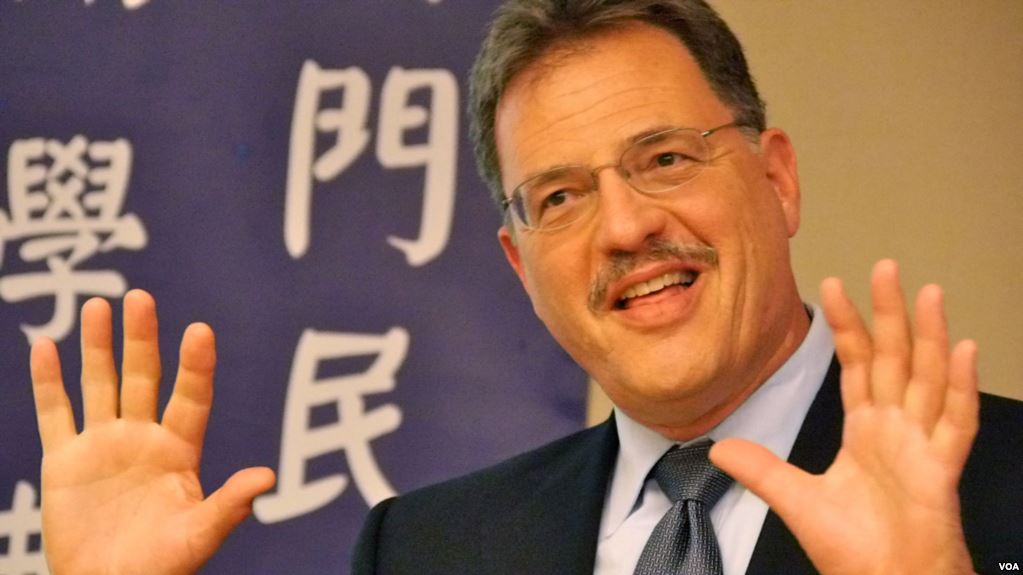
View on WikipediaLarry Jay Diamond (born October 2, 1951)[1] is an American political sociologist and scholar in the field of democracy studies. He is the William L. Clayton Senior Fellow at the Hoover Institution, a public policy think tank on the Stanford campus working to advance freedom and prosperity, and the Mosbacher Senior Fellow in Global Democracy at the Freeman Spogli Institute for International Studies (FSI), Stanford University's main center for research on international issues. At FSI Diamond served as the director of the Center on Democracy, Development, and the Rule of Law (CDDRL) from 2009 to 2015.[2] He was succeeded in that role by Francis Fukuyama[3] and then Kathryn Stoner.[4]
Key Information


Diamond served as a founding co-editor of the National Endowment for Democracy's Journal of Democracy from 1990 until fall 2022.[5] As of August 2025, he co-chairs Hoover’s Project on Taiwan in the Indo-Pacific Region Project (with James O. Ellis, Jr.). At FSI, he founded the program on Arab Reform and Development and the Israel Studies Program, and he co-founded and leads its Global Digital Policy Incubator.[6][7]
Early life and education
[edit]Diamond was born in Los Angeles. He earned a B.A. in Political Organization and Behavior from Stanford in 1974, where he was active in student politics and journalism and co-chaired committees on admissions and teaching quality.[8] From 1974 to 1975 he conducted interviews in multiple countries on democratic change and development. He received an M.A. from the Food Research Institute in 1978 and a Ph.D. in Sociology in 1980 at Stanford, working with Alex Inkeles and Seymour Martin Lipset.[9][10]
Career
[edit]Diamond taught sociology at Vanderbilt University from 1980 to 1985, researching Nigeria’s Second Republic and spending a year in Kano as a Fulbright Lecturer.[11] His work on corruption and electoral fraud in Nigeria informed later publications, including In Search of Democracy (2016) and Transition Without End (1997).[12]
He joined Stanford’s Hoover Institution in 1985. With Juan Linz and Seymour Martin Lipset he co-led a 26-country study on democratization, resulting in the Democracy in Developing Countries book series (1988–1995). This laid the groundwork for the Journal of Democracy, which Diamond co-founded with Marc F. Plattner. Together they also co-directed the International Forum for Democratic Studies at the National Endowment for Democracy (1994–2009).[13]
Diamond has collaborated with Taiwan-based scholars, beginning with a 1995 international conference on democratization. He co-developed the Asian Barometer Survey and has written on Taiwan’s political development, favoring strong U.S. support for Taiwan’s democracy and security. He has also co-led Hoover’s “China’s Sharp Power” projects, producing studies on China’s influence operations and semiconductor security.[14]
He was the dissertation adviser for Regina Ip, former Secretary for Security of Hong Kong during her years at Stanford.[15]
In 2022, Diamond joined Yermak-McFaul Expert Group on Russian Sanctions as an expert to work on elaborating and imposing international sanctions against Russia which invaded Ukraine.[16]
Post–2003 Iraq
[edit]In early 2004, Diamond was a senior adviser on governance to the Coalition Provisional Authority in Iraq.[11]
His book Squandered Victory: The American Occupation and the Bungled Effort to Bring Democracy to Iraq, published in 2005, was one of the first public critical analyses of America's post-invasion of Iraq strategy.[17]
Views on democracy
[edit]Although a strong proponent of democracy, Diamond has emphasized that its survival depends on effective and accountable governance, respect for the rule of law, and responsiveness to citizens’ needs. In his 2023 Seymour Martin Lipset Lecture, later published in the Journal of Democracy (2024),[18] he identified power, performance, and legitimacy as central to democracy’s endurance.[19] He has argued that weak economic or political performance, such as corruption, crime, or insecurity, can erode public support, while effective governance can strengthen democratic commitment.[20]
Diamond’s writings, including Developing Democracy (1999), The Spirit of Democracy (2008), and Ill Winds (2019), have highlighted both the promise of democracy and the challenges it faces.[21] He has pointed to threats from authoritarian powers such as China and Russia, as well as democratic backsliding within established democracies. His work defines democracy broadly, requiring free and fair elections, political freedom, and pluralism.[22] In a 2002 Journal of Democracy article, he warned about “hybrid regimes” or “electoral authoritarian” systems that mask autocratic practices behind democratic appearances. He has also criticized the failure to recognize such trends in countries including Russia, Venezuela, Hungary, and Turkey. His collaborative 2004 article with Leonardo Morlino, followed by a 2005 edited volume, offered a framework for assessing the “quality of democracy.”[23]
From his early studies of Nigeria’s First Republic, Diamond has underscored corruption, waste, and abuse of power as key causes of democratic breakdowns. He has argued that while economic development supports democracy, it is not an absolute requirement. Cases such as India, Costa Rica, and Botswana show that democracy can emerge in lower-income settings when supported by good governance, steady growth, limited inequality, democratic values, and a strong civil society.[24] He has warned that persistent misgovernance can push people toward authoritarian alternatives, particularly in “predatory states” where corruption is pervasive and wealth is extracted through exploitation rather than productive growth. In resource-rich countries, he has suggested distributing oil revenues directly to citizens to promote accountability.[22]
In policy discussions, including contributions to USAID reports, Diamond has called for tying foreign assistance to the quality of governance. He has supported the principle of “selectivity,” as seen in the Millennium Challenge Corporation, which conditions aid on democratic governance, investment in social development, and economic openness.[22] He has also urged the United States and other democracies to devote more resources to strengthening democratic institutions, media, and civil society abroad, along with promoting democratic values in foreign policy.[25]
Research
[edit]A central theme in Diamond's work is democratic consolidation, examined in Developing Democracy: Toward Consolidation (1999) and later essays. He has argued that stable democracy depends on accountability, the rule of law, effective governance, and public trust. He has also written on hybrid or “electoral authoritarian” regimes, where elections coexist with repression, and with Leonardo Morlino developed a framework for assessing the “quality of democracy.”[26]
His regional studies cover Africa, Asia, Latin America, and the Middle East. He has analyzed Nigeria’s democratic breakdowns, co-edited volumes on Taiwan’s democratic transition, and examined East Asian political culture through the Asian Barometer Survey, which he co-founded.[27] In 2024 he co-edited The Troubling State of India’s Democracy, addressing challenges to institutional independence in India.[28]
Diamond has also studied the international dimensions of democratization. He has argued that foreign aid and policy should encourage accountable governance and has critiqued externally driven regime change, as in his book Squandered Victory (2005). He has called for greater support of democratic institutions, civil society, and media worldwide.[29]
Since 2008, Diamond has written about the “global democratic recession,” linking democratic decline to authoritarian resurgence, polarization, and weakening institutions.[30] His book Ill Winds (2019) explored these themes, and his 2025 co-edited volume with Edward Foley and Richard Pildes addressed electoral reforms such as ranked choice voting in the United States.[31]
Teaching and public service
[edit]Diamond was named Stanford's "Teacher of the Year" in May 2007.[32] At the June 2007 commencement ceremonies he was awarded the Dinkelspiel Award for Distinctive Contributions to Undergraduate Education. Among the many reasons for Diamond to receive this award it was cited that he fostered dialogue between Jewish and Muslim students.[33]
In addition to his academic work, Diamond has served on advisory boards and task forces for the U.S. Agency for International Development, the Council on Foreign Relations, the Freedom House "Freedom in the World" survey, and the Council for a Community of Democracies.[3] He is also a member of the Pacific Council on International Policy and the American Political Science Association.[2]
Awards and fellowships
[edit]Diamond's work has been supported by fellowships and grants from the Smith Richardson Foundation, the MacArthur Foundation, the National Endowment for Democracy, and the Agency for International Development. He was a Fulbright Fellow in Nigeria in 1982–83 and a POSCO Visiting Fellow at the East-West Center in Honolulu.[1][9]
Selected affiliations
[edit]- Member, Editorial Board, Journal of Democracy
- Member, Editorial Board, Current History
- Board member, Voices of a Democratic Egypt
- Member, Conference Group on Taiwan Studies
- Faculty Advisory Board, Haas Center for Public Service
Publications
[edit]Books
[edit]As author
[edit]- Ill Winds: Saving Democracy from Russian Rage, Chinese Ambition, and American Complacency, Penguin Press, 2019 ISBN 978-0525560623
- In Search of Democracy, Routledge, 2016
- The Spirit of Democracy, Times Books, 2008
- Squandered Victory: The American Occupation and the Bungled Effort to Bring Democracy to Iraq, Owl Books, 2005, ISBN 0-8050-7868-1
- Developing Democracy: Toward Consolidation, Johns Hopkins University Press, 1999
- Promoting Democracy in the 1990s, Carnegie Commission on Preventing Deadly Conflict, 1995
- Class, Ethnicity, and Democracy in Nigeria, Syracuse University Press, 1988
- Milani, Abbas; Diamond, Larry Jay (2015). Politics and Culture in Contemporary Iran: Challenging the Status Quo. Boulder, CO: Lynne Rienner Publishers. ISBN 9781626371477.
As editor
[edit]- Political Culture and Democracy in Developing Countries
- Diamond, Larry; Plattner, Marc F.; Walker, Christopher, eds. (2016). Authoritarianism Goes Global: The Challenge to Democracy. Johns Hopkins University Press. ISBN 9781421419985.
- Democracy in Decline?, with Marc F. Plattner
- Democratization and Authoritarianism in the Arab World, with Marc F. Plattner
- Will China Democratize?, with Andrew J. Nathan and Marc F. Plattner (2013, containing articles of the Journal of Democracy, written between 1986 and 2013)
- Democracy in East Asia: A New Century, with Yun-han Chu and Marc F. Plattner
- Liberation Technology: Social Media and the Struggle for Democracy, with Marc F. Plattner
- Politics and Culture in Contemporary Iran, with Abbas Milani
- Democracy in Developing Countries, four-volume series, with Juan J. Linz and Seymour Martin Lipset
Essays and articles
[edit]- Milani, Abbas; Diamond, Larry (July 6, 2009). "Let's Hear the Democracies". The New York Times (Op-ed). ISSN 1553-8095.
References
[edit]- ^ a b "Diamond, Larry Jay". Social Networks and Archival Context (SNAC). University of Virginia Library, National Archives and Records Administration. Retrieved 29 October 2018.
- ^ a b "FSI - CDDRL - Center on Democracy, Development and the Rule of Law". Cddrl.stanford.edu. Retrieved 29 October 2018.
- ^ a b University, © Stanford; Stanford; California 94305 (2015-04-20). "Fukuyama to lead FSI's Center on Democracy, Development, and the Rule of". cddrl.fsi.stanford.edu. Retrieved 2023-08-29.
{{cite web}}: CS1 maint: numeric names: authors list (link) - ^ University, © Stanford; Stanford; California 94305 (2021-08-27). "Kathryn Stoner Named Mosbacher Director of the Center on Democracy". cddrl.fsi.stanford.edu. Retrieved 2023-08-29.
{{cite web}}: CS1 maint: numeric names: authors list (link) - ^ "Larry Diamond". Hoover.org. Retrieved 29 October 2018.
- ^ "China's Global Sharp Power Project". Hoover Institution. Retrieved 2023-05-21.
- ^ "Taiwan in the Indo-Pacific Region". Hoover Institution. Retrieved 2023-05-21.
- ^ "Larry Diamond". www.afrobarometer.org. Retrieved 2025-09-08.
- ^ a b "Larry Diamond – C.V." Stanford University. n.d. Archived from the original on 29 June 2020. Retrieved 29 June 2020.
- ^ "Diamond". Institut Montaigne. Retrieved 2025-09-08.
- ^ a b "Larry Diamond". Stanford.edu. Retrieved 29 October 2018.
- ^ "Political Corruption: Nigeria's Perennial Struggle". Journal of Democracy. Retrieved 2025-09-08.
- ^ "Larry Diamond's Profile | Stanford Profiles". profiles.stanford.edu. Retrieved 2023-08-29.
- ^ "China's Influence & American Interests: Promoting Constructive Vigilance". Hoover Institution. Retrieved 2025-09-08.
- ^ "'Iron Ladies' resurface in Hong Kong". Atimes.com. Archived from the original on 17 July 2006. Retrieved 29 October 2018.
- ^ "Sanctions endgame: what the Yermak-McFaul group is preparing – News". newsreadonline.com. Retrieved 2022-07-27.
- ^ "Larry Diamond Bio". Stanford.edu. Retrieved 29 October 2018.
- ^ "Larry Diamond Delivers NED's 20th Annual Seymour Martin Lipset Lecture on". fsi.stanford.edu. 2023-12-12. Retrieved 2025-09-08.
- ^ "Power, Performance, and Legitimacy". Journal of Democracy. Retrieved 2025-09-08.
- ^ "Opinion | 'At this point, we are a liberal democracy in decline'". The Washington Post. 2025-05-05. ISSN 0190-8286. Retrieved 2025-09-08.
- ^ "Elections Without Democracy: Thinking About Hybrid Regimes". Journal of Democracy. Retrieved 2025-09-08.
- ^ a b c Diamond, Larry (2004). Essential Readings in Comparative Politics: The Democratic Rollback: The Resurgence of the Predatory State. New York: Norton & Company.
- ^ Diamond, Larry (2008). The Spirit of Democracy: The Struggle to Build Free Societies Throughout the World. New York: Henry Holt and Company, LLC.
- ^ O'Neil, Patrick H.; Rogowski, Ronald (2010). Essential Readings in Comparative Politics. New York: W.W. Norton &, 2010. ISBN 978-0-393-93401-4.
- ^ Diamond, Larry (December 30, 2008). "Doing Democracy Promotion Right". Newsweek. Retrieved 15 June 2011.
- ^ "China Exerting 'Sharp Power' Influence On American Institutions". Hoover Institution. Retrieved 2025-09-08.
- ^ Diamond, Larry (1988). Class, Ethnicity and Democracy in Nigeria. doi:10.1007/978-1-349-08080-9. ISBN 978-1-349-08082-3.
- ^ Mistree, Dinsha; Ganguly, Šumit; Diamond, Larry (2024-08-13). "The Troubling State of India's Democracy". FSI Publications.
- ^ Muñoz, Boris (2025-03-05). "Larry Diamond, sociólogo: "Trump busca que todos se arrodillen ante su voluntad imperial"". El País US (in Spanish). Retrieved 2025-09-08.
- ^ "Trump's threat to US liberal democracy". www.ft.com. Retrieved 2025-09-08.
- ^ "Is the world still in a democratic recession?". cddrl.fsi.stanford.edu. 2023-11-02. Retrieved 2025-09-08.
- ^ "Larry Diamond, Hoover Senior Fellow, Named Teacher of the Year by Associated Students of Stanford University". Hoover Institution. Retrieved 2023-05-21.
- ^ "Hoover Institution's Larry Diamond honored with Stanford University Dinkelspiel Award for teaching". Hoover Institution. Retrieved 2023-05-21.
External links
[edit]- Larry Diamond Biography provided by Stanford University
- Larry Diamond papers, 1969-1977, at Stanford University
- "No Exit Strategy" – David Rieff reviews Diamond's book in The Nation magazine.
- Appearances on C-SPAN
- Interviews
- South China Morning Post podcast in which Larry Diamond shares his views on Hong Kong political reforms in a podcast interview with South China Morning Post reporter, James Moore, on September 19, 2006. Interview 3mins 43secs into podcast.

Larry Diamond
View on GrokipediaLarry Diamond (born October 2, 1951) is an American political sociologist renowned for his expertise in comparative democratization, democratic consolidation, and international efforts to promote liberal governance.[1] As the William L. Clayton Senior Fellow at the Hoover Institution and the Mosbacher Senior Fellow in Global Democracy at Stanford University's Freeman Spogli Institute for International Studies, he analyzes empirical patterns in regime change, authoritarian resilience, and the institutional prerequisites for stable self-rule, often emphasizing causal factors like civil society strength, electoral integrity, and rule-of-law enforcement over ideological narratives.[2][3] Diamond also serves as a professor by courtesy in political science and sociology at Stanford, where he earned his B.A. in 1974, M.A. in 1978, and Ph.D. in sociology in 1980.[2] A founding co-editor of the Journal of Democracy, Diamond has shaped scholarly discourse through decades of publications tracking the "third wave" of democratization and its subsequent reversals, including influential essays on electoral authoritarianism and the paradoxes of partial democratic reforms.[3] His major books, such as Developing Democracy: Toward Consolidation (1999), which outlines sequences of institutional sequencing for new democracies, and Ill Winds: Saving Democracy from Russian Rage, Chinese Ambition, and American Complacency (2019), which diagnoses threats from revisionist powers and domestic decay, draw on cross-national data to advocate evidence-based strategies for bolstering constitutional orders.[3][2] In 2004, he advised the Coalition Provisional Authority in Iraq on governance reconstruction, an experience that informed his critical assessment in Squandered Victory (2005) of U.S. policy failures, including inadequate security prioritization and overreliance on expatriate elites, which undermined post-invasion stabilization efforts.[3][2] Diamond's work underscores the empirical limits of externally imposed transitions absent local buy-in and robust counterinsurgency measures, while cautioning against complacency in established democracies facing populist challenges and geopolitical erosion.[3]
Biography
Early Life and Education
Larry Diamond received a B.A. in political organization and behavior from Stanford University in 1974.[4] He then earned an M.A. from Stanford's Food Research Institute in 1978, followed by a Ph.D. in sociology in 1980, completing all of his higher education at the university.[4] These degrees laid the foundation for his subsequent focus on comparative politics and democratic transitions, blending sociological analysis with political inquiry.[4]Professional Career
Academic and Research Positions
Diamond served as Assistant Professor of Sociology at Vanderbilt University from 1980 to 1985.[5] In 1982–1983, he held a Fulbright Teaching Fellowship as Visiting Lecturer in Sociology at Bayero University in Kano, Nigeria.[5] At Stanford University, Diamond is Professor by Courtesy of Political Science and Sociology, where he lectures and teaches courses on democracy, including an online course on comparative democratic development.[2][3] He is the Mosbacher Senior Fellow in Global Democracy at the Freeman Spogli Institute for International Studies (FSI), focusing research on global trends in freedom and democracy as well as policies to advance them.[2][6] As William L. Clayton Senior Fellow at the Hoover Institution, he co-chairs the Project on Taiwan in the Indo-Pacific Region and participates in the Program on the U.S., China, and the World.[3] Diamond directed the Center on Democracy, Development, and the Rule of Law (CDDRL) at Stanford's FSI from 2009 to 2015, having previously coordinated its Democracy Program from 2002 to 2009.[5] He served as Founding Co-Director of the International Forum for Democratic Studies from 1994 to 2009.[5] In research program leadership, he was Principal Investigator of the Taiwan Democracy Program at CDDRL from 2006 to 2017; currently, he leads the Arab Reform and Democracy Program (since 2010) and the Global Digital Policy Incubator (since 2017), both at CDDRL.[5] Among visiting research positions, Diamond conducted a study on democratic consolidation in Taiwan as a Visiting Scholar at Academia Sinica from 1997 to 1998, supported by Taiwan's National Science Council.[5] In 1999, he was POSCO Visiting Fellow at the East-West Center in Honolulu.[5]Editorial and Institutional Roles
Diamond served as founding co-editor of the Journal of Democracy, published by the National Endowment for Democracy, from its inception in 1990 until fall 2022, a tenure spanning 32 years during which the quarterly journal became a leading forum for scholarship on democratic theory, transitions, and challenges.[6][7] In this role, co-edited with Marc F. Plattner, Diamond shaped the publication's focus on empirical analysis of democratization processes and global democratic trends, contributing to volumes that addressed topics such as democratic recessions and institutional reforms.[7] Institutionally, Diamond holds the position of William L. Clayton Senior Fellow at the Hoover Institution at Stanford University, where he conducts research on threats to liberal democracy, U.S. foreign policy toward autocratic regimes, and strategies for promoting democratic governance.[3] He is also the Mosbacher Senior Fellow in Global Democracy at Stanford's Freeman Spogli Institute for International Studies (FSI), supporting interdisciplinary work on democracy, development, and the rule of law through programs like the Center on Democracy, Development, and the Rule of Law (CDDRL), which he co-directed from 2009 to 2017.[2][6] As senior consultant to the International Forum for Democratic Studies at the National Endowment for Democracy (NED), Diamond advises on research initiatives examining authoritarian resilience and civic resistance, drawing on NED's mission to foster democratic institutions worldwide since its founding in 1983.[8] These roles have positioned him at the intersection of academia and policy, influencing debates on democratic backsliding through affiliations with nonpartisan think tanks emphasizing evidence-based advocacy over ideological prescriptions.[3][2]Policy and Advisory Engagements
Diamond served as a consultant to the U.S. Agency for International Development (USAID) from 2001 to 2003, contributing to the agency's report Foreign Aid in the National Interest, which advocated for aligning foreign assistance with U.S. strategic priorities including democracy promotion.[2][9] He also held principal investigator roles for USAID-funded projects, including the "Project on Democracy in Developing Countries" (1987–1989) and "Economy, Society, and Democracy" (1990–1993), which supported research informing policy on democratic transitions in aid recipient nations.[5] From 2004 to 2007, Diamond was a member of USAID's Advisory Commission on Voluntary Foreign Aid, providing guidance on public-private partnerships for international development and democracy-building initiatives.[5][10] In 2004–2005, he participated in the Council on Foreign Relations' Independent Task Force on U.S. Policy Toward Reform in the Arab World, which recommended strategies for advancing political liberalization amid regional stability concerns.[5][11] Diamond has advised and lectured for international organizations such as the World Bank, the United Nations, and the U.S. State Department on democracy promotion and governance issues, often emphasizing empirical evidence from democratic transitions to shape policy recommendations.[3] He continues to consult on global democracy programs, drawing from his academic expertise to influence aid allocation and institutional reform efforts.[12]Involvement in Iraq Reconstruction
Role in Post-2003 Efforts
In the fall of 2003, Stanford University professor Larry Diamond received a direct request from National Security Advisor Condoleezza Rice to join the Coalition Provisional Authority (CPA) in Baghdad as an advisor on post-invasion reconstruction.[13] He accepted and served from January to April 2004 as Senior Advisor on Governance, a position focused on leveraging his expertise in democratic transitions to guide the CPA's political rebuilding efforts amid escalating insurgency and institutional chaos.[14][5] Diamond's responsibilities centered on advising CPA administrator Paul Bremer and his team on strategies for establishing legitimate Iraqi governance, including recommendations for rapid power transfer to elected bodies, de-Baathification reforms, and fostering civil-military relations to stabilize the transitional authority.[15][3] Operating from the heavily fortified Green Zone, he engaged in daily consultations with U.S. officials, Iraqi exiles, and emerging local leaders to address immediate challenges like sectarian tensions and the need for inclusive political processes ahead of the June 2004 sovereignty handover.[16] His work emphasized empirical lessons from prior democratizations, such as prioritizing security and elite pacts, though these were often constrained by CPA policy decisions and insufficient troop levels—approximately 130,000 U.S. forces at the time, deemed inadequate by Diamond for effective state-building.[14] During this period, Diamond contributed to internal CPA deliberations on constitutional interim frameworks and electoral timelines, advocating for mechanisms to build public trust in nascent institutions amid widespread looting and violence that had damaged over 80% of Baghdad's infrastructure by early 2004.[15] He also supported initiatives to revive civil society, drawing on his prior research to propose targeted aid for non-governmental organizations, though implementation was hampered by bureaucratic silos within the CPA and the State Department's understaffing, with only about 1,200 personnel managing a nation of 25 million. Diamond's tenure ended shortly before the CPA dissolved, having provided on-the-ground insights into the causal links between security failures and democratic setbacks, as later detailed in his firsthand accounts.[17]Analysis of Failures and Lessons
Diamond's tenure as a senior advisor to the Coalition Provisional Authority (CPA) from January to April 2004 exposed him to the operational shortcomings of the U.S.-led reconstruction, which he later detailed in Squandered Victory: The American Occupation and the Bungled Effort to Bring Democracy to Iraq (2005). A primary failure was the post-invasion security vacuum, exacerbated by the rapid dissolution of Iraqi state institutions without adequate replacement; the CPA's Order No. 1 on May 16, 2003, implemented sweeping de-Baathification, purging an estimated 50,000 to 100,000 Baath Party members from government roles, while Order No. 2 on the same day disbanded the Iraqi army, releasing 400,000 soldiers into unemployment and fueling insurgency recruitment.[15][18] These decisions, made before Diamond's arrival but persisting under CPA administrator L. Paul Bremer, alienated Sunnis and created a power void exploited by militias and al-Qaeda affiliates, leading to over 10,000 insurgent attacks by mid-2004.[19] Compounding this, the U.S. committed insufficient ground forces—peaking at around 150,000 troops for a population of 27 million—adopting a "light footprint" doctrine that prioritized quick withdrawal over stabilization, contrary to historical precedents like post-World War II occupations requiring troop ratios of 20 per 1,000 civilians.[15] Diamond critiqued the ideological overconfidence in rapid democratization, ignoring Iraq's sectarian cleavages (Shia 60%, Sunni 20%, Kurds 15-20%) and absence of civil society traditions, which Bremer's centralized governance model failed to address through delayed local elections and exclusionary national processes.[18] The CPA's insularity, with limited Arabic speakers (fewer than 20 at senior levels) and reliance on exiles like Ahmed Chalabi, undermined legitimacy, as evidenced by the failure to co-opt tribal leaders or neutralize Muqtada al-Sadr's Mahdi Army, which launched uprisings in April 2004 during Diamond's time there.[20] From these experiences, Diamond derived key lessons for post-conflict state-building, emphasizing security as a prerequisite: future interventions must deploy adequate forces with robust rules of engagement to establish order before political reforms, avoiding the Iraq error of sequencing democracy ahead of stability.[15] He advocated decentralizing authority via early municipal elections to build grassroots legitimacy, as national processes in Iraq's 2005 Transitional Administrative Law sidelined local buy-in and empowered Iran-backed Shia parties.[15] Internationalization is essential, with multilateral involvement (e.g., UN or NATO) to share burdens and enhance perceived neutrality, unlike the CPA's unilateralism that isolated the U.S. amid 85% global opposition to the invasion by 2004 polls.[18] Finally, Diamond stressed realistic assessments of societal preconditions, warning against imposing federalism or power-sharing without addressing underlying authoritarian legacies and ethnic distrust, as Iraq's 2005 constitution entrenched sectarian quotas that perpetuated violence, with civilian deaths exceeding 100,000 by 2007.[19] These insights, while drawn from Diamond's advocacy for democracy promotion, underscore causal realities: exogenous regime change without endogenous demand and security guarantees courts prolonged instability.[15]Scholarly Contributions to Democracy Studies
Theories of Democratization
Diamond contributed to the analysis of the "third wave" of democratization, a period of global democratic expansion from the mid-1970s to the early 1990s, by emphasizing not only initial transitions from authoritarianism but also the subsequent challenges of sustaining and deepening democracy. Building on Samuel Huntington's framework, he argued that this wave produced many electoral democracies but few consolidated ones, with reversals occurring through coups, erosions, or incomplete reforms.[21] [22] In his developmental theory of democracy, outlined in Developing Democracy: Toward Consolidation (1999), Diamond posited that successful democratization requires progression beyond mere electoral competition to institutional maturity and behavioral adherence to democratic norms. He defined consolidation as the point where major political actors, including elites and organizations, internalize democracy as "the only game in town," rejecting authoritarian alternatives even amid crises.[23] [24] This process demands enhanced liberalism (protection of rights and opposition), accountability (via effective legislatures and parties), responsiveness (through civil society and decentralization), and mass inclusion, often facilitated by economic growth and adaptive state institutions like impartial judiciaries.[25] Diamond highlighted hybrid regimes—systems blending democratic facades like elections with authoritarian controls—as a persistent barrier to full democratization, complicating regime classification and stalling the third wave's momentum. In "Thinking About Hybrid Regimes" (2002), he described these as "elections without democracy," where incumbents manipulate outcomes through media control, vote buying, or coercion, preventing genuine power alternation.[26] Such regimes, prevalent in post-third wave contexts like parts of Latin America and Africa, erode public trust and invite further authoritarian backsliding unless countered by strong opposition coalitions and international pressure.[27] Rejecting deterministic prerequisites like high per capita income or cultural homogeneity, Diamond maintained that democracy's emergence hinges primarily on elite pacts and contingent factors such as external shocks or leadership choices, though consolidation correlates empirically with moderate economic development (around $4,000–$6,000 GDP per capita) and rule-of-law capacities.[28] He stressed causal mechanisms like vibrant civil societies and horizontal accountability to prevent elite capture, warning that without them, transitions yield unstable pseudodemocracies prone to recession, as observed in over 20 countries by the early 2000s.[21]Empirical Research on Democratic Transitions
Diamond's empirical analysis of democratic transitions centers on the "third wave" of democratization, initiated by Portugal's Carnation Revolution on April 25, 1974, which facilitated regime changes in over 80 countries by the early 1990s through processes of negotiation, breakdown of authoritarianism, or external pressure.[21] Drawing on aggregated data from sources such as Freedom House's annual freedom ratings (scored 1-7, with 1-2.5 indicating "free") and the Polity IV dataset, he quantifies the expansion of electoral democracies from 39 in 1974 (27.5% of countries with populations over 1 million) to 117 by 1996 (57% of such countries).[21] This growth reflected regional diffusion effects, where successful transitions in Southern Europe (e.g., Greece in 1974, Spain in 1977) and Latin America (e.g., Ecuador in 1979, Peru in 1980) encouraged emulation, though empirical patterns showed clustering rather than uniform global progress.[21] However, Diamond's data reveal significant limitations in transition quality and sustainability, with 22 countries reverting from "free" status between 1974 and 1991 due to coups, erosions, or hybrid regimes.[21] By the mid-1990s, while electoral democracies proliferated—reaching 76 liberal democracies, 41 electoral nonliberal ones, 34 pseudodemocracies, and 40 authoritarian regimes among approximately 151 countries holding multiparty elections—the proportion of "free" states among self-proclaimed democracies declined from 85.5% in 1990 to 65% in 1995, per Freedom House metrics.[21] This gap between electoral form and substantive liberal democracy stemmed from persistent authoritarian enclaves, weak rule of law, and incomplete civil-military pacts, as evidenced in cases like Haiti's 1990 election followed by military ouster in 1991.[21] Quantitative correlations in Diamond's work highlight socioeconomic prerequisites for successful transitions: higher per capita income levels strongly associated with liberal outcomes, while low development, inequality, and fragile civil societies elevated breakdown risks, as seen in African transitions post-1991 (e.g., flawed elections in 10 countries including Kenya and Zimbabwe).[21] He supplements these with public opinion surveys and human rights reports to argue that transitions falter without institutional consolidation, noting stagnation in liberal democracy counts after the early 1990s amid rising pseudodemocracies.[25] Empirical trends thus underscore that while international demonstration and economic pressures catalyzed initial shifts, endogenous factors like elite pacts and state capacity determined durability, challenging overly optimistic paradigms of inevitable consolidation.[21]| Year | Number of Democracies (Total) | % Free (Freedom House) | Key Transition Trend |
|---|---|---|---|
| 1974 | 39 | ~29% (1972 baseline) | Onset of third wave; Southern Europe focus[21] |
| 1990 | 76 | 85.5% of democracies | Peak expansion in Latin America, Eastern Europe[21] |
| 1995 | 117 | 65% of democracies | Stagnation; rise in electoral but illiberal regimes[21] |
| 1996 | 117 | N/A | Global electoral democracies plateau[21] |