Hubbry Logo
Abelian varietyAbelian varietyMain
Open search
Abelian variety
Community hub
Abelian variety
logo
8 pages, 0 posts
0 subscribers
Be the first to start a discussion here.
Abelian variety
Abelian variety
from Wikipedia

In mathematics, particularly in algebraic geometry, complex analysis and algebraic number theory, an abelian variety is a smooth projective algebraic variety that is also an algebraic group, i.e., has a group law that can be defined by regular functions. Abelian varieties are at the same time among the most studied objects in algebraic geometry and indispensable tools for research on other topics in algebraic geometry and number theory.

An abelian variety can be defined by equations having coefficients in any field; the variety is then said to be defined over that field. Historically the first abelian varieties to be studied were those defined over the field of complex numbers. Such abelian varieties turn out to be exactly those complex tori that can be holomorphically embedded into a complex projective space.

Abelian varieties defined over algebraic number fields are a special case, which is important also from the viewpoint of number theory. Localization techniques lead naturally from abelian varieties defined over number fields to ones defined over finite fields and various local fields. Since a number field is the fraction field of a Dedekind domain, for any nonzero prime of your Dedekind domain, there is a map from the Dedekind domain to the quotient of the Dedekind domain by the prime, which is a finite field for all finite primes. This induces a map from the fraction field to any such finite field. Given a curve with equation defined over the number field, we can apply this map to the coefficients to get a curve defined over some finite field, where the choices of finite field correspond to the finite primes of the number field.

Abelian varieties appear naturally as Jacobian varieties (the connected components of zero in Picard varieties) and Albanese varieties of other algebraic varieties. The group law of an abelian variety is necessarily commutative and the variety is non-singular. An elliptic curve is an abelian variety of dimension 1. Abelian varieties have Kodaira dimension 0.

History and motivation

[edit]

In the early nineteenth century, the theory of elliptic functions succeeded in giving a basis for the theory of elliptic integrals, and this left open an obvious avenue of research. The standard forms for elliptic integrals involved the square roots of cubic and quartic polynomials. When those were replaced by polynomials of higher degree, say quintics, what would happen?

In the work of Niels Abel and Carl Jacobi, the answer was formulated: this would involve functions of two complex variables, having four independent periods (i.e. period vectors). This gave the first glimpse of an abelian variety of dimension 2 (an abelian surface): what would now be called the Jacobian of a hyperelliptic curve of genus 2.

After Abel and Jacobi, some of the most important contributors to the theory of abelian functions were Riemann, Weierstrass, Frobenius, Poincaré, and Picard. The subject was very popular at the time, already having a large literature.

By the end of the 19th century, mathematicians had begun to use geometric methods in the study of abelian functions. Eventually, in the 1920s, Lefschetz laid the basis for the study of abelian functions in terms of complex tori. He also appears to be the first to use the name "abelian variety". It was André Weil in the 1940s who gave the subject its modern foundations in the language of algebraic geometry.

Today, abelian varieties form an important tool in number theory, in dynamical systems (more specifically in the study of Hamiltonian systems), and in algebraic geometry (especially Picard varieties and Albanese varieties).

Analytic theory

[edit]

Definition

[edit]

A complex torus of dimension g is a torus of real dimension 2g that carries the structure of a complex manifold. It can always be obtained as the quotient of a g-dimensional complex vector space by a lattice of rank 2g. A complex abelian variety of dimension g is a complex torus of dimension g that is also a projective algebraic variety over the field of complex numbers. By invoking the Kodaira embedding theorem and Chow's theorem, one may equivalently define a complex abelian variety of dimension g to be a complex torus of dimension g that admits a positive line bundle. Since they are complex tori, abelian varieties carry the structure of a group. A morphism of abelian varieties is a morphism of the underlying algebraic varieties that preserves the identity element for the group structure. An isogeny is a finite-to-one morphism.

When a complex torus carries the structure of an algebraic variety, this structure is necessarily unique. In the case , the notion of abelian variety is the same as that of elliptic curve, and every complex torus gives rise to such a curve; for it has been known since Riemann that the algebraic variety condition imposes extra constraints on a complex torus.

Riemann conditions

[edit]

The following criterion by Riemann decides whether or not a given complex torus is an abelian variety, i.e., whether or not it can be embedded into a projective space. Let X be a g-dimensional torus given as where V is a complex vector space of dimension g and L is a lattice in V. Then X is an abelian variety if and only if there exists a positive definite hermitian form on V whose imaginary part takes integral values on . Such a form on X is usually called a (non-degenerate) Riemann form. Choosing a basis for V and L, one can make this condition more explicit. There are several equivalent formulations of this; all of them are known as the Riemann conditions.

The Jacobian of an algebraic curve

[edit]

Every algebraic curve C of genus is associated with an abelian variety J of dimension g, by means of an analytic map of C into J. As a torus, J carries a commutative group structure, and the image of C generates J as a group. More accurately, J is covered by :[1] any point in J comes from a g-tuple of points in C. The study of differential forms on C, which give rise to the abelian integrals with which the theory started, can be derived from the simpler, translation-invariant theory of differentials on J. The abelian variety J is called the Jacobian variety of C, for any non-singular curve C over the complex numbers. From the point of view of birational geometry, its function field is the fixed field of the symmetric group on g letters acting on the function field of .

Abelian functions

[edit]

An abelian function is a meromorphic function on an abelian variety, which may be regarded therefore as a periodic function of n complex variables, having 2n independent periods; equivalently, it is a function in the function field of an abelian variety. For example, in the nineteenth century there was much interest in hyperelliptic integrals that may be expressed in terms of elliptic integrals. This comes down to asking that J is a product of elliptic curves, up to an isogeny.

Important theorems

[edit]

One important structure theorem of abelian varieties is Matsusaka's theorem. It states that over an algebraically closed field every abelian variety is the quotient of the Jacobian of some curve; that is, there is some surjection of abelian varieties where is a Jacobian. This theorem remains true if the ground field is infinite.[2]

Algebraic definition

[edit]

Two equivalent definitions of abelian variety over a general field k are commonly in use:

When the base is the field of complex numbers, these notions coincide with the previous definition. Over all bases, elliptic curves are abelian varieties of dimension 1.

In the early 1940s, Weil used the first definition (over an arbitrary base field) but could not at first prove that it implied the second. Only in 1948 did he prove that complete algebraic groups can be embedded into projective space. Meanwhile, in order to make the proof of the Riemann hypothesis for curves over finite fields that he had announced in 1940 work, he had to introduce the notion of an abstract variety and to rewrite the foundations of algebraic geometry to work with varieties without projective embeddings (see also the history section in the Algebraic Geometry article).

Structure of the group of points

[edit]

By the definitions, an abelian variety is a group variety. Its group of points can be proven to be commutative.

For the field , and hence by the Lefschetz principle for every algebraically closed field of characteristic zero, the torsion group of an abelian variety of dimension g is isomorphic to . Hence, its n-torsion part is isomorphic to , i.e., the product of 2g copies of the cyclic group of order n.

When the base field is an algebraically closed field of characteristic p, the n-torsion is still isomorphic to when n and p are coprime. When n and p are not coprime, the same result can be recovered provided one interprets it as saying that the n-torsion defines a finite flat group scheme of rank 2g. If instead of looking at the full scheme structure on the n-torsion, one considers only the geometric points, one obtains a new invariant for varieties in characteristic p (the so-called p-rank when ).

The group of k-rational points for a global field k is finitely generated by the Mordell-Weil theorem. Hence, by the structure theorem for finitely generated abelian groups, it is isomorphic to a product of a free abelian group and a finite commutative group for some non-negative integer r called the rank of the abelian variety. Similar results hold for some other classes of fields k.

Products

[edit]

The product of an abelian variety A of dimension m, and an abelian variety B of dimension n, over the same field, is an abelian variety of dimension . An abelian variety is simple if it is not isogenous to a product of abelian varieties of lower dimension. Any abelian variety is isogenous to a product of simple abelian varieties.

Polarisation and dual abelian variety

[edit]

Dual abelian variety

[edit]

To an abelian variety A over a field k, one associates a dual abelian variety (over the same field), which is the solution to the following moduli problem. A family of degree 0 line bundles parametrised by a k-variety T is defined to be a line bundle L on such that

  1. for all t in T, the restriction of L to is a degree 0 line bundle,
  2. the restriction of L to is a trivial line bundle (here 0 is the identity of A).

Then there is a variety and a family of degree 0 line bundles P, the Poincaré bundle, parametrised by such that a family L on T is associated a unique morphism so that L is isomorphic to the pullback of P along the morphism . Applying this to the case when T is a point, we see that the points of correspond to line bundles of degree 0 on A, so there is a natural group operation on given by tensor product of line bundles, which makes it into an abelian variety.

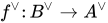
This association is a duality in the sense that it is contravariant functorial, i.e., it associates to all morphisms dual morphisms in a compatible way, and there is a natural isomorphism between the double dual and (defined via the Poincaré bundle). The n-torsion of an abelian variety and the n-torsion of its dual are dual to each other when n is coprime to the characteristic of the base. In general — for all n — the n-torsion group schemes of dual abelian varieties are Cartier duals of each other. This generalises the Weil pairing for elliptic curves.

Polarisations

[edit]

A polarisation of an abelian variety is an isogeny from an abelian variety to its dual that is symmetric with respect to double-duality for abelian varieties and for which the pullback of the Poincaré bundle along the associated graph morphism is ample (so it is analogous to a positive definite quadratic form). Polarised abelian varieties have finite automorphism groups. A principal polarisation is a polarisation that is an isomorphism. Jacobians of curves are naturally equipped with a principal polarisation as soon as one picks an arbitrary rational base point on the curve, and the curve can be reconstructed from its polarised Jacobian when the genus is . Not all principally polarised abelian varieties are Jacobians of curves; see the Schottky problem. A polarisation induces a Rosati involution on the endomorphism ring of A.

Polarisations over the complex numbers

[edit]

Over the complex numbers, a polarised abelian variety can be defined as an abelian variety A together with a choice of a Riemann form H. Two Riemann forms and are called equivalent if there are positive integers n and m such that . A choice of an equivalence class of Riemann forms on A is called a polarisation of A; over the complex number this is equivalent to the definition of polarisation given above. A morphism of polarised abelian varieties is a morphism of abelian varieties such that the pullback of the Riemann form on B to A is equivalent to the given form on A.

Abelian scheme

[edit]

One can also define abelian varieties scheme-theoretically and relative to a base. This allows for a uniform treatment of phenomena such as reduction mod p of abelian varieties (see Arithmetic of abelian varieties), and parameter-families of abelian varieties. An abelian scheme over a base scheme S of relative dimension g is a proper, smooth group scheme over S whose geometric fibers are connected and of dimension g. The fibers of an abelian scheme are abelian varieties, so one could think of an abelian scheme over S as being a family of abelian varieties parametrised by S.

For an abelian scheme , the group of n-torsion points forms a finite flat group scheme. The union of the -torsion points, for all n, forms a p-divisible group. Deformations of abelian schemes are, according to the Serre–Tate theorem, governed by the deformation properties of the associated p-divisible groups.

Example

[edit]

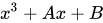
Let be such that has no repeated complex roots. Then the discriminant is nonzero. Let , so is an open subscheme of . Then is an abelian scheme over . It can be extended to a Néron model over , which is a smooth group scheme over , but the Néron model is not proper and hence is not an abelian scheme over .

Non-existence

[edit]

Viktor Abrashkin [ru][3] and Jean-Marc Fontaine[4] independently proved that there are no nonzero abelian varieties over with good reduction at all primes. Equivalently, there are no nonzero abelian schemes over . The proof involves showing that the coordinates of -torsion points generate number fields with very little ramification and hence of small discriminant, while, on the other hand, there are lower bounds on discriminants of number fields.[5]

Semiabelian variety

[edit]

A semiabelian variety is a commutative group variety which is an extension of an abelian variety by a torus.[6]

See also

[edit]

References

[edit]

Sources

[edit]
Revisions and contributorsEdit on WikipediaRead on Wikipedia
from Grokipedia
An Abelian variety is a smooth, projective over a field kk that is also a commutative algebraic group, with the group defined by regular morphisms. These varieties are connected and of finite dimension g1g \geq 1, generalizing the structure of elliptic curves, which are precisely the one-dimensional Abelian varieties. Over the complex numbers C\mathbb{C}, an Abelian variety of dimension gg is analytically equivalent to a complex torus Cg/Λ\mathbb{C}^g / \Lambda, where Λ\Lambda is a lattice in Cg\mathbb{C}^g, but projectivity requires the existence of a polarization, a positive definite Hermitian form compatible with the lattice. Abelian varieties play a central role in and , serving as moduli spaces for polarized structures and appearing as of algebraic curves. For a smooth projective curve CC of gg over a field kk, the J(C)J(C) is a gg-dimensional Abelian variety that parametrizes the degree-zero line bundles on CC, equipped with a natural principal polarization induced by the intersection pairing. More generally, over any field kk, every Abelian variety is isogenous to a of a Jacobian, linking them to the geometry of curves. Key properties include the existence of a dual Abelian variety AA^\vee, which classifies line bundles on AA, and the fact that endomorphisms form a ring that may contain complex multiplication by orders in imaginary quadratic fields for certain varieties. The theory originated with foundational work by in the 1940s, who proved the for their zeta functions and established their abstract properties before projectivity was fully resolved in the 1950s. Applications extend to arithmetic geometry, including the study of L-functions, the Mordell-Weil theorem for rational points, and Faltings's proof of the Mordell conjecture using the finiteness of classes.

Historical Background

Early Motivations from Complex Analysis

The study of elliptic integrals emerged in the late 17th and early 18th centuries as mathematicians sought to compute arc lengths of curves like and lemniscates, leading to expressions that could not be integrated in elementary terms. These integrals, first encountered by in 1655 while examining ellipse arc lengths and later by the Bernoulli brothers in problems involving spirals and elastic curves, revealed a connection to periods in the through their inversion into periodic functions. By the early , formalized the classification of elliptic integrals into three kinds, highlighting their dependence on elliptic modulus and the emergence of period lattices formed by integrating over closed paths in the , which laid the groundwork for understanding multi-periodic behaviors. Carl Gustav Jacobi advanced this framework in the 1820s and 1830s by developing the theory of elliptic functions as inverses of elliptic integrals, emphasizing their double-periodicity in the . In his 1827 correspondence with Legendre, Jacobi introduced theta functions to express these periods, and his seminal 1829 treatise, Fundamenta nova theoria functionum ellipticarum, provided the first systematic exposition using techniques, demonstrating that elliptic functions possess two independent periods whose ratio is generally non-real. By 1834, Jacobi proved that any single-valued doubly periodic function must have a non-real period ratio, a result that spurred further investigations into the lattice structures underlying these periods and their geometric interpretations on the . Bernhard Riemann extended these ideas in the 1850s by addressing multi-valued functions and abelian integrals, generalizing elliptic cases to higher genera. In his 1851 doctoral thesis, Riemann introduced Riemann surfaces to resolve branch points of multi-valued functions, treating them as single-valued over multi-sheeted coverings of the . His 1857 paper, "Theorie der Abel'schen Functionen," developed the inversion of abelian integrals—generalizations of elliptic integrals with g independent periods for g—and associated them with the topology of algebraic curves, using theta functions to parameterize solutions. This work highlighted the role of period lattices in defining the global structure of these functions. These analytic developments motivated the uniformization of Riemann surfaces through complex tori, where surfaces of genus one were recognized as quotients of the by lattice subgroups, providing a conformal model via doubly periodic functions. Riemann's topological insights into surface connectivity and periods inspired viewing higher-genus surfaces as uniformized by multi-dimensional tori, precursors to the varieties that embed the period relations geometrically.

Key Developments in the 19th and 20th Centuries

In 1857, published his seminal paper "Theorie der Abelschen Funktionen," which laid foundational analytic insights into abelian functions and their relation to multidimensional complex integrals, marking a pivotal advancement in understanding higher-genus Riemann surfaces and their associated varieties. Building on this analytic framework, introduced the concept of abelian integrals and the in the early 1880s, starting in 1881, where he demonstrated that the Jacobian of a provides a compactification for the space of divisors, enabling deeper study of integrals over algebraic curves. At the turn of the , posed his 16th problem in 1900, which sought bounds on limit cycles for polynomial vector fields; its infinitesimal version, concerning the number of zeros of abelian integrals, connected directly to the and dynamics arising from abelian varieties, inspiring ongoing research into their geometric properties. In the 1920s, advanced the topological study of abelian varieties through his 1921 paper on numerical invariants, where he applied homology theory to classify their cycles and forms, establishing key results on the and fixed-point theorems for these varieties. In the 1940s, provided the modern foundations for abelian varieties, defining them abstractly as projective algebraic varieties that are commutative groups and proving the for their zeta functions over finite fields, thereby establishing their arithmetic properties independently of analytic methods. The mid-20th century saw Alexander Grothendieck's profound reformulation of abelian varieties within modern during the and , beginning with his 1957 Tôhoku paper introducing abelian categories and extending to schemes and relative theory, which allowed a purely algebraic definition independent of . Grothendieck further developed in this period, providing a tool to compute groups of abelian varieties over arbitrary fields and facilitating the proof of the for their zeta functions as part of the broader (completed by in 1974). Parallel to these geometric developments, motivations from emerged prominently, particularly through links to , where complex multiplication on abelian varieties parametrizes abelian extensions of imaginary quadratic fields, as explored in works connecting torsion points to ray class groups. This interplay, highlighted in arithmetic studies from the onward, underscored abelian varieties' role in describing Galois representations and finiteness theorems in .

Analytic Theory

Complex Tori and Basic Definitions

In the analytic theory of abelian varieties over the complex numbers, a of gg is defined as the X=Cg/ΛX = \mathbb{C}^g / \Lambda, where Λ\Lambda is a lattice in Cg\mathbb{C}^g, meaning a discrete isomorphic to Z2g\mathbb{Z}^{2g} as a free Z\mathbb{Z}-module. Such a quotient is a compact connected of complex gg, and the integer gg corresponds to the of the torus in this context. The natural analytic group structure on XX is induced by the vector addition in Cg\mathbb{C}^g, making the projection map π:CgX\pi: \mathbb{C}^g \to X a holomorphic with kernel Λ\Lambda. This group law is commutative because every compact connected complex is abelian. For g=1g=1, a complex torus C/Λ\mathbb{C}/\Lambda with Λ=ZτZ\Lambda = \mathbb{Z} \oplus \tau \mathbb{Z} for τ\tau in the upper half-plane is precisely an over C\mathbb{C}, which admits a projective via the Weierstrass \wp-function. To realize a complex torus as an abelian variety, it must embed as a projective algebraic subvariety of some PN(C)\mathbb{P}^N(\mathbb{C}). This embedding is achieved using theta functions associated to a positive definite Hermitian form (a Riemann form) on the torus, which generate sufficiently many global sections of a to provide the embedding for sufficiently large powers of the bundle, as established by the Lefschetz theorem on sections.

Riemann's Theta Functions and Conditions

A complex torus of dimension gg can be realized as Cg/Λ\mathbb{C}^g / \Lambda, where Λ\Lambda is a lattice generated by a basis whose periods form a 2g×g2g \times g period matrix Π=(AB)\Pi = (A \mid B), with A,BGLg(R)A, B \in \mathrm{GL}_g(\mathbb{R}). For this torus to underlie an abelian variety, the period matrix must satisfy Riemann's bilinear relations, which ensure the existence of a non-degenerate alternating bilinear form on Cg\mathbb{C}^g that is Hermitian with respect to the complex structure and positive definite on the real subspace. Specifically, these relations state that AtBBtA=0A^t B - B^t A = 0 (symmetry condition) and AtCA+BtCB>0A^t C A + B^t C B > 0 for some positive definite symmetric matrix CC, where the imaginary part of the normalized period matrix Ω=(A1B)\Omega = (A^{-1} B) plays a central role. The normalized period matrix Ω\Omega lies in the Siegel upper half-space Hg\mathfrak{H}_g, consisting of g×gg \times g complex symmetric matrices with positive definite imaginary part Im(Ω)>0\operatorname{Im}(\Omega) > 0. This condition guarantees that the torus admits a Riemann form, a key step toward projectivity. The Riemann theta function associated to Ω\Omega is defined as θ(zΩ)=nZgexp(πintΩn+2πintz),\theta(z \mid \Omega) = \sum_{n \in \mathbb{Z}^g} \exp\left( \pi i n^t \Omega n + 2 \pi i n^t z \right), for zCgz \in \mathbb{C}^g, which converges absolutely due to the positive definiteness of Im(Ω)\operatorname{Im}(\Omega). This function is holomorphic in zz and quasi-periodic with respect to the lattice, satisfying transformation properties under lattice translations that reflect the abelian group structure. The zero set of θ(zΩ)\theta(z \mid \Omega), known as the theta divisor Θ={zCg/Λθ(zΩ)=0}\Theta = \{ z \in \mathbb{C}^g / \Lambda \mid \theta(z \mid \Omega) = 0 \}, is an ample divisor on the torus. By Riemann's theorem, the complete linear system Θ| \Theta | embeds the complex torus projectively into P2g1\mathbb{P}^{2^g - 1} if and only if ΩHg\Omega \in \mathfrak{H}_g, providing the necessary for the torus to be an . This embedding realizes the theta divisor as a , and the line bundle O(Θ)\mathcal{O}(\Theta) induces a principal polarization on the , characterized by the intersection form on H1(Λ,Z)H_1(\Lambda, \mathbb{Z}) being the standard symplectic form. The theta null values θ(0Ω)\theta(0 \mid \Omega) further serve as coordinates on the of principally polarized , embedding it into projective space via the Riemann theta embedding.

Jacobians of Algebraic Curves

The Jacobian variety J(C)J(C) of a smooth projective curve CC of genus gg over an kk is defined as the Picard variety Pic0(C)\operatorname{Pic}^0(C), the connected component of the identity in the Picard scheme Pic(C)\operatorname{Pic}(C) containing the structure sheaf OC\mathcal{O}_C. This construction identifies J(C)J(C) with the group of isomorphism classes of line bundles on CC of degree zero, endowed with a natural structure via the of line bundles. As an , J(C)J(C) has gg and is principally polarized, providing a canonical example of an associated to CC. The Picard variety Pic0(C)\operatorname{Pic}^0(C) admits an interpretation as the parametrizing degree-zero line bundles on CC, where points correspond to C\mathbb{C}-equivalence classes of such bundles under the action of the automorphism group. The Abel–Jacobi map μ:CJ(C)\mu: C \to J(C) embeds the into its by sending a point PCP \in C to the class [OC(PP0)][ \mathcal{O}_C(P - P_0) ], where P0P_0 is a fixed base point on CC and classes are taken modulo principal divisors. This map extends to a morphism from the rr-th symmetric power Symr(C)\operatorname{Sym}^r(C) to J(C)J(C) for r1r \geq 1, sending an effective divisor of degree rr to its class in Pic0(C)\operatorname{Pic}^0(C) after subtracting rP0r P_0, thereby realizing J(C)J(C) as the image of the fundamental map from Symg(C)\operatorname{Sym}^g(C). Over the complex numbers C\mathbb{C}, the Jacobian J(C)J(C) is isomorphic to the quotient of the gg-dimensional complex vector space V=H0(C,ΩC1)V = H^0(C, \Omega^1_C) of holomorphic differentials on CC by the period lattice ΛV\Lambda \subset V, where Λ\Lambda is the discrete subgroup generated by the integrals of a basis of holomorphic differentials over a basis of the integer homology group H1(C,Z)H_1(C, \mathbb{Z}). This analytic realization J(C)(C)V/ΛJ(C)(\mathbb{C}) \cong V / \Lambda highlights the Jacobian as a , with the Abel–Jacobi map corresponding to integration of differentials along paths on CC. A representative example occurs when g=1g = 1, in which case CC is an and its J(C)J(C) is isomorphic to CC itself as an abelian variety.

Abelian Functions and Important Theorems

Abelian functions are meromorphic functions on a Cg/Λ\mathbb{C}^g / \Lambda, where Λ\Lambda is a lattice in Cg\mathbb{C}^g, that are invariant under translations by elements of the lattice, making them multiply periodic with respect to the periods defined by Λ\Lambda. These functions generalize elliptic functions to higher dimensions and play a central role in the analytic study of abelian varieties, as the complex points of an abelian variety form such a torus. In the elliptic case (g=1g=1), the Weierstrass σ\sigma-function is an entire function on C\mathbb{C} with simple zeros precisely at the lattice points and quasi-periodic behavior, while the Weierstrass ζ\zeta-function is its logarithmic derivative, meromorphic with simple poles at the lattice points and residues equal to 1. These functions admit generalizations to higher genus through sigma-functions defined on the Jacobian varieties of Riemann surfaces, constructed via theta functions associated to spin structures; for an odd spin structure χ\chi, the odd higher-genus σχ(u)\sigma_\chi(u) is given by σχ(u)=F3/Ndet(2ω1)exp(12ut(η1ω11)u)θ[βχ]((2ω1)1uB),\sigma_\chi(u) = F^{-3/N} \det(2\omega_1) \exp\left(\frac{1}{2} u^t (\eta_1 \omega_1^{-1}) u \right) \theta_{[\beta_\chi]} \left( (2\omega_1)^{-1} u \mid B \right), where FF is the product of non-vanishing theta constants, N=22g1+2g1N = 2^{2g-1} + 2^{g-1} for generic curves, ω1\omega_1 and η1\eta_1 are period matrices, and BB encodes the Riemann surface data, ensuring modular invariance up to roots of unity. An even counterpart σμ(u)\sigma_\mu(u) exists for even spin structures μ\mu, providing a basis for understanding meromorphic functions on higher-dimensional tori. A foundational result is Riemann's , which states that any non-constant abelian function on Cg/Λ\mathbb{C}^g / \Lambda has an equal number of zeros and poles (counting multiplicities) within any fundamental of the lattice, as the contributions from the boundary cancel due to periodicity, implying the index (number of zeros minus poles) is zero by the argument principle applied to the . This equality ensures that abelian functions behave analogously to rational functions on projective spaces, facilitating the study of divisors and line bundles on abelian varieties. The Appell-Humbert theorem provides a complete of on a X=Cn/ΛX = \mathbb{C}^n / \Lambda, stating that every L\mathcal{L} on XX is uniquely determined by a Riemann form HH (a Hermitian form on Cn\mathbb{C}^n such that ImH(Λ,Λ)Z\operatorname{Im} H(\Lambda, \Lambda) \subseteq \mathbb{Z}) and a semi-character α:ΛU(1)\alpha: \Lambda \to U(1) compatible with HH, via the automorphy factor ψ(z,λ)=α(λ)exp(πH(z,λ)+π2H(λ,λ))\psi(z, \lambda) = \alpha(\lambda) \exp\left( \pi H(z, \lambda) + \frac{\pi}{2} H(\lambda, \lambda) \right). This extends to the ring of abelian functions, as global sections of such yield functions that generate the meromorphic functions on the when XX is projective (an abelian variety), with the ring structured as quotients of algebras of functions under the group law. The , when applied to ample on abelian varieties, implies that the homology groups of a section YAY \subset A (where AA is an abelian variety) are isomorphic to those of AA in degrees less than dimA1\dim A - 1, with the connecting induced by the Gysin map. In the context of group actions, this combines with the to count fixed points of endomorphisms or group actions on AA; for a group element acting via or , the number of fixed points equals the trace of the induced map on the ring, which for tori decomposes into exterior powers of the , yielding explicit formulas for fixed loci under abelian group actions. For example, on the of a , such fixed-point counts relate to symmetries in the theta .

Algebraic Framework

Formal Algebraic Definition

An abelian variety over a field kk is defined as a smooth, connected, proper kk- AA. This means AA is equipped with a multiplication m:A×kAAm: A \times_k A \to A, an identity section e:SpeckAe: \operatorname{Spec} k \to A, and an inversion i:AAi: A \to A, all of which are morphisms of kk-schemes, satisfying the usual group axioms of associativity, identity, and inverses, with the additional property that the group law is commutative. Equivalently, an can be viewed as a over kk endowed with a group structure such that the m:A×kAAm: A \times_k A \to A and inversion i:AAi: A \to A are morphisms of varieties, and the translations tx:AAt_x: A \to A given by yx+yy \mapsto x + y for each xA(k)x \in A(k) are isomorphisms of kk-varieties. The ensures that AA has g1g \geq 1 as a variety, and the properness (or projectivity) implies compactness in the . The TeAT_e A at the ee is a kk- of gg, which serves as the Lie(A)\operatorname{Lie}(A) of AA; since the group is commutative, this is abelian, meaning the Lie bracket is identically zero. A connected smooth algebraic group over kk is an abelian variety if and only if it is proper (equivalently, projective) and commutative. Over an of characteristic zero, this algebraic definition aligns with the analytic one via Serre's GAGA principles, which establish that projective algebraic varieties over C\mathbb{C} correspond bijectively to their associated analytic spaces.

Group Law and Structure of Points

The kk-rational points of an abelian variety AA over a field kk, denoted A(k)A(k), form an under the -defined group law of AA. This group operation is commutative, associative, and compatible with the variety structure, with the identity given by the distinguished point OO and inverses provided by the inversion [1]:AA[-1]: A \to A. The group law ensures that A(k)A(k) inherits the structure from the algebraic group AA. Over a finite field Fq\mathbb{F}_q, the group A(Fq)A(\mathbb{F}_q) is finite, with cardinality determined by the characteristic polynomial of the Frobenius endomorphism πq\pi_q, specifically #A(Fq)=i=12g(1αi)\#A(\mathbb{F}_q) = \prod_{i=1}^{2g} (1 - \alpha_i), where g=dimAg = \dim A and the αi\alpha_i are the roots satisfying αi=q1/2|\alpha_i| = q^{1/2} by the Riemann hypothesis for abelian varieties. As a finite abelian group, A(Fq)A(\mathbb{F}_q) decomposes into a direct sum of its Sylow pp-subgroups, each of which is a direct product of cyclic groups of pp-power order; more precisely, its structure can be described as a module over the ring of endomorphisms defined over Fq\mathbb{F}_q, often involving the action of powers of the Frobenius. In the case of dimension g=1g=1 (elliptic curves), the structure simplifies to A(Fq)Z/nZ×Z/mZA(\mathbb{F}_q) \cong \mathbb{Z}/n\mathbb{Z} \times \mathbb{Z}/m\mathbb{Z} for integers nn dividing mm. For an abelian variety AA over a number field KK, the Mordell-Weil theorem asserts that A(K)A(K) is a , isomorphic to ZrT\mathbb{Z}^r \oplus T where r0r \geq 0 is the Mordell-Weil rank and TT is the finite torsion . This finiteness of the torsion and the existence of a basis for the free part follow from the theorem's proof, which relies on the properness of the Néron model of AA over the of KK and height pairings on A(K)A(K). The rank rr measures the arithmetic complexity of AA and can be computed via descent methods or regulators. The Néron-Severi group NS(A)\mathrm{NS}(A) of an abelian variety AA (over an ) is the quotient of the group of Cartier divisors by algebraic equivalence, the group of Cartier divisor classes modulo algebraic equivalence. It is a free [Z](/page/Z)\mathbb{[Z](/page/Z)}-module of finite rank, known as the Néron-Severi rank ρ(A)\rho(A), satisfying ρ(A)4g2\rho(A) \leq 4g^2. The group NS(A)\mathrm{NS}(A) fits into an with the , Pic(A)NS(A)Pic0(A)\mathrm{Pic}(A) \cong \mathrm{NS}(A) \oplus \mathrm{Pic}^0(A), where Pic0(A)\mathrm{Pic}^0(A) is an abelian variety dual to AA, and the NS-rank captures the of the space of algebraic cycles of 1. Polarizations on AA induce positive definite forms on NS(A)R\mathrm{NS}(A) \otimes \mathbb{R}. The endomorphism ring End(A)\mathrm{End}(A) comprises the endomorphisms of AA as an algebraic group, forming an associative ring under composition that acts faithfully on A(k)A(k) for any field kk, turning A(k)A(k) into a (possibly non-free) module over End(A)\mathrm{End}(A). Over finite fields, End(A)\mathrm{End}(A) includes the Frobenius πq\pi_q, generating a whose action determines the module structure of A(Fqn)A(\mathbb{F}_{q^n}) for extensions Fqn\mathbb{F}_{q^n}. In general, End(A)\mathrm{End}(A) is a finitely generated Z\mathbb{Z}-order, and the semisimple Q\mathbb{Q}- End0(A)=End(A)Q\mathrm{End}^0(A) = \mathrm{End}(A) \otimes \mathbb{Q} decomposes as a product of matrix over division central over number fields, with the center related to the action on the module. This ring structure governs isogenies and the decomposition of AA into simple factors.

Products and Families

Direct Products of Abelian Varieties

The direct product A×BA \times B of two abelian varieties AA and BB over a field kk is itself an abelian variety, equipped with the componentwise group law inherited from AA and BB. This structure makes A×BA \times B a group variety, where the of points (p1,q1)+(p2,q2)=(p1+p2,q1+q2)(p_1, q_1) + (p_2, q_2) = (p_1 + p_2, q_1 + q_2) follows directly from the respective laws on each factor. The of the product is additive, satisfying dim(A×B)=dimA+dimB\dim(A \times B) = \dim A + \dim B. Isogenies between products of abelian varieties preserve the overall structure, as an isogeny f:XYf: X \to Y induces a dual isogeny ft:YtXtf^t: Y^t \to X^t with kernel isomorphic to the dual of kerf\ker f. Every abelian variety is isogenous to a of simple abelian varieties, reflecting a semisimple in the isogeny category. For instance, if AA and BB are simple and non-isogenous, then A×BA \times B decomposes uniquely isogeny into these factors. The Poincaré bundle extends naturally to families of products, where for abelian varieties XX and YY, it takes the form pPXqPYp^* P_X \otimes q^* P_Y on X×YtX \times Y^t, providing a universal object that parametrizes line bundles and polarizations over the product. This construction is rigidified over the base and plays a key role in the Fourier-Mukai transform for such families. A concrete example is the product of two elliptic curves E1×E2E_1 \times E_2, which forms a 2-dimensional abelian variety, often realized as a C2/Λ\mathbb{C}^2 / \Lambda where Λ\Lambda is the lattice generated by the periods of E1E_1 and E2E_2. The theta divisor in this case is reducible, consisting of components E1×{0}{0}×E2E_1 \times \{0\} \cup \{0\} \times E_2. Products exhibit rigidity: if an abelian variety decomposes as a product of non-isomorphic factors, this decomposition is unique up to , ensuring that the simple components cannot be further mixed without violating the structure. This property underpins the Krull-Schmidt theorem for the category of abelian varieties.

Abelian Schemes and Relative Settings

An abelian scheme over a base scheme SS is a ASA \to S that is proper, flat, and of finite presentation over SS, with smooth and geometrically connected fibers that are abelian varieties over the geometric points of SS. This generalizes the notion of an abelian variety to relative settings, where the fibers vary smoothly over the base, and includes direct products of abelian varieties over SS as a special case. The dimension of the fibers is constant and locally constant on SS. In the relative setting, the Picard scheme provides a key construction of abelian schemes. For a proper, smooth CSC \to S of g1g \geq 1, the relative Picard functor PicC/S0\mathrm{Pic}^0_{C/S} is representable by an abelian scheme J=PicC/S0SJ = \mathrm{Pic}^0_{C/S} \to S, known as the relative scheme, whose fiber over a point sSs \in S is the abelian variety of the fiber CsC_s. This scheme parametrizes families of degree-zero line bundles on C×STC \times_S T for test schemes TST \to S, up to , and inherits the group structure from the of line bundles. The relative Picard scheme PicC/S\mathrm{Pic}_{C/S} extends this to all degrees, with PicC/S0\mathrm{Pic}^0_{C/S} as its identity component. A prominent example is abelian scheme over Ag\mathcal{A}_g of principally polarized abelian varieties of dimension gg. The space Ag\mathcal{A}_g is a quasi-projective scheme over Z[1/N]\mathbb{Z}[1/N] for suitable level NN, and family XgAg\mathcal{X}_g \to \mathcal{A}_g is a smooth proper group scheme whose fibers are the principally polarized abelian varieties parametrized by points of Ag\mathcal{A}_g. This construction realizes the moduli problem via a fine moduli space when level structures are included, such as in Ag,n\mathcal{A}_{g,n} for level-nn structures. The deformation theory of abelian schemes captures how these objects vary infinitesimally over the base. For an abelian variety AA over a field, the space of infinitesimal deformations as a variety is controlled by the cohomology group H1(A,TA)H^1(A, T_A), where TAT_A is the tangent sheaf of AA, and this extends to relative deformations over artinian bases via the cotangent complex. Deformations preserving the group structure lie in a subspace, and for polarized abelian varieties, the deformation space is unobstructed and isomorphic to the dual of the space of invariant differentials. Abelian schemes do not exist over every base scheme; for instance, there is no abelian scheme of positive relative dimension over Spec(Z)\mathrm{Spec}(\mathbb{Z}), as the arithmetic obstructions prevent a universal model compatible with all residue characteristics. In positive characteristic p>0p > 0, additional issues arise, such as the distinction between ordinary and supersingular fibers, where the pp-divisible group of the fibers is described by Dieudonné modules rather than étale groups, complicating the existence of good models and deformations via the Serre-Tate equivalence.

Polarizations and Duality

Concept of Polarization

In , a polarization on an abelian variety AA over a field kk is defined as an LL on AA such that the associated ϕL:AA^\phi_L: A \to \hat{A}, where A^\hat{A} is the dual abelian variety, is induced by the first c1(L)c_1(L) in the Néron-Severi group. The map ϕL\phi_L sends a point xA(k)x \in A(k) to the class txLL1t_x^* L \otimes L^{-1} in Pic0(A)\operatorname{Pic}^0(A), which is isomorphic to A^\hat{A}, and ampleness ensures that ϕL\phi_L is an of positive degree. This structure encodes a positivity condition analogous to positive-definite forms, distinguishing polarizations from arbitrary homomorphisms to the dual. A polarization is principal if ϕL\phi_L is an isomorphism, meaning the degree of the isogeny is 1, which occurs precisely when LL generates the in a specific way and corresponds to the most "rigid" ample bundles on AA. The Néron-Severi group NS(A)\operatorname{NS}(A) plays a central role, defined as Pic(A)/Pic0(A)\operatorname{Pic}(A)/\operatorname{Pic}^0(A), the quotient of the by the subgroup of line bundles algebraically equivalent to zero; on abelian varieties, algebraic equivalence coincides with homological equivalence for divisors, so NS(A)\operatorname{NS}(A) classifies polarizations up to this relation. Elements of NS(A)Q\operatorname{NS}(A) \otimes \mathbb{Q} that are positive with respect to the natural pairing correspond to polarizations, providing a lattice-theoretic framework for their classification. The type of a polarization is determined by the elementary divisors of the alternating associated to c1(L)c_1(L), often represented via a form on the homology or , which decomposes into a of hyperbolic planes scaled by these divisors (d1,,dg)(d_1, \dots, d_g) with 1d1dg1 \leq d_1 \mid \cdots \mid d_g. The degree of the polarization, a perfect square di2\prod d_i^2, reflects this type and governs the of the associated moduli spaces. Finally, a polarization induces the Rosati involution on the endomorphism algebra End0(A)=End(A)Q\operatorname{End}^0(A) = \operatorname{End}(A) \otimes \mathbb{Q}, defined by α=ϕL1α^ϕL\alpha^\dagger = \phi_L^{-1} \circ \hat{\alpha} \circ \phi_L, where α^\hat{\alpha} is the dual map on A^\hat{A}; this involution is positive definite on the real span of the polarization, ensuring compatibility with the ample cone. The Rosati involution thus provides a canonical way to define positivity within the endomorphism ring, linking the group structure of AA to its ample divisors.

Dual Abelian Variety

The dual abelian variety A^\hat{A} of an abelian variety AA of dimension gg over a field kk is defined as A^=Pic0(A)\hat{A} = \operatorname{Pic}^0(A), the connected component of the identity in the Picard scheme Pic(A/k)\operatorname{Pic}(A/k), which represents the functor of isomorphism classes of degree-zero line bundles on AA that are algebraically equivalent to the trivial bundle or, equivalently, translation-invariant under the group action of A(kalg)A(k^{\mathrm{alg}}). This scheme A^\hat{A} is itself a smooth projective abelian variety of dimension gg over kk, and the natural map sending a point xA(kalg)x \in A(k^{\mathrm{alg}}) to the class of OA(x0)\mathcal{O}_A(x - 0) induces a group isomorphism A(kalg)A^(kalg)A(k^{\mathrm{alg}}) \to \hat{A}(k^{\mathrm{alg}}). The double dual A^^\hat{\hat{A}} is canonically isomorphic to AA, establishing a contravariant equivalence of categories between abelian varieties and their duals. A key object in this duality is the universal Poincaré bundle PP, an invertible sheaf on A×kA^A \times_k \hat{A} that parameterizes the translation-invariant line bundles: for each ϕA^(kalg)\phi \in \hat{A}(k^{\mathrm{alg}}), the restriction PA×{ϕ}P|_{A \times \{\phi\}} is the line bundle corresponding to ϕ\phi, while P{0}×A^P|_{\{0\} \times \hat{A}} is trivial, and PP satisfies a universal property for morphisms into A^\hat{A}. This bundle exists uniquely up to isomorphism and is rigidified along the zero section to ensure the universality. It provides a Poincaré correspondence that rigidifies the duality, allowing the construction of the dual via the relative Picard functor. The duality extends to homomorphisms: for abelian varieties AA and BB over kk, there is a natural of abelian groups Homk(A,B)Homk(B^,A^)\operatorname{Hom}_k(A, B) \cong \operatorname{Hom}_k(\hat{B}, \hat{A}), induced by pulling back line bundles via the universal Poincaré bundle. If f:ABf: A \to B is an , its dual f:B^A^f^\vee: \hat{B} \to \hat{A} is also an , with kernel the Cartier dual ker(f)D=Hom(ker(f),Gm,k)\ker(f)^\mathrm{D} = \operatorname{Hom}(\ker(f), \mathbb{G}_{m,k}). Over a finite field k=Fqk = \mathbb{F}_q, the kk-points of the dual satisfy A^(k)A(k)^\hat{A}(k) \cong \widehat{A(k)}
Add your contribution
Related Hubs
User Avatar
No comments yet.
