


Community hub
Recent from talks
Contribute something
Nothing was collected or created yet.
Cape Canaveral Space Launch Complex 37
View on WikipediaSpace Launch Complex 37[2][3] (SLC-37), previously Launch Complex 37 (LC-37), is a launch complex on Cape Canaveral Space Force Station, Florida. Originally built to support the Apollo program, the complex consists of two launch pads: LC-37A and SLC-37B. Pad 37A has never been used, while 37B hosted Saturn I and Saturn IB launches in the 1960s as well as Delta IV and Delta IV Heavy launches from 2002 to 2024.
Key Information


As of July 2025, the pad is not officially leased to anyone. However, SpaceX is expected to become the next tenant of SLC-37 for use as a launch site for Starship, so far possessing a limited right of entry, to begin demolition of existing structures, as it prepares a draft environmental impact statement.[4]
History
[edit]Saturn I and IB (1964–1968)
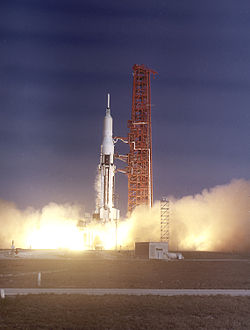
[edit]Launch Complex 37 began construction in 1959, being envisioned to be a second site to launch the experimental heavy-lift Saturn rockets, joining Launch Complex 34 (LC-34) to the south. Originally, it was planned to be the launch site for an Earth orbit rendezvous (EOR) strategy to potentially be taken by the Apollo program, where a launch vehicle such as the Saturn C-3 would launch both the trans-lunar injection stage and the Lunar Excursion Module from the two pads, while the crew would lift off from LC-34 and intercept the two payloads in low Earth orbit. Despite NASA opting for a Lunar orbit rendezvous (LOR) approach and using the Saturn V from Launch Complex 39 to the north, they nonetheless accepted LC-37 to support the Saturn I program in 1963.[5]

The original layout of the launch complex featured one Mobile Service Structure which could be used to service or mate a rocket on either LC-37A or 37B, but not on both simultaneously. The first launch from LC-37 came on January 29, 1964, launching Saturn I SA-5 as part of the rocketry development portion of the Apollo program. Over the next two years, a total of six uncrewed Saturn I flights were launched from the complex, mostly carrying boilerplate Apollo capsules alongside the three launches of the Pegasus project.
In late 1965, both LC-37 and LC-34 were modified to launch the Saturn I's successor, the Saturn IB. Similarly to its previous configuration, this was in support of Apollo development before the Saturn V's activation at Kennedy Space Center; however, the original purpose of EOR was also made ready as a backup in case complications render the Saturn V and LOR unfeasible. Only two Saturn IB launches were made from LC-37: the first one was AS-203 (or informally Apollo 3), which launched on July 5, 1966 and tested engine restart capabilities on the S-IVB upper stage. The second one was Apollo 5, lifting off on January 22, 1968 and carrying the first operational test of the Apollo Lunar Module in space.[5] The facility was deactivated in 1972, following the conclusion of the Apollo program. Proposals were drawn of resuming Saturn IB launches from LC-37 and LC-34 as part of the Apollo Applications Program, but NASA instead opted to modify Launch Complex 39B for that role. LC-37 would sit dormant for the next 30 years.
Delta IV and Delta IV Heavy (2002–2024)
[edit]In 1998, the United States Air Force and Boeing came into an agreement to use LC-37 for launching the Delta IV as part of the Evolved Expendable Launch Vehicle program, getting rechristened as SLC-37 as a result of doing so. Having acquired the Delta family following their merger with McDonnell Douglas the previous year, Boeing aimed for the Delta IV to be a complement and not a replacement to the other active members of the time, the Delta II and Delta III. As such (and taking the difference in lift capabilities into account), a new launch site similar in size to SLC-37 was needed rather than continuing to use Space Launch Complex 17 (SLC-17). Facility modifications were made to SLC-37B in 2001, constructing a 330 ft (100 m) tall Mobile Service Tower fitted to service all planned Delta IV configurations.[6] The complex was officially put into active service with the first launch of the Delta IV on November 20, 2002, carrying Eutelsat 70A to geostationary transfer orbit.
On December 21, 2004, SLC-37 supported the maiden flight of the Delta IV Heavy, which aimed at carrying a boilerplate and an assortment of small satellites into orbit. The next year, citing issues that sprang up with competition, Boeing announced that Delta operations at the pad and at SLC-17 would be combined with those of Atlas V at Space Launch Complex 41 (SLC-41) as part of a joint venture with Lockheed Martin. This handover would be made official with the establishment of United Launch Alliance (ULA) in December 2006, and SLC-37 supported its first launch under ULA with a Delta IV Heavy flight on November 11, 2007.
During the Delta IV era, SLC-37 underwent 35 launches of the family, consisting of 29 Medium launches and 16 Heavy launches.[7] Almost all payloads launched were governmental in nature, with a majority of that subsection being military customers such as the Air Force, the United States Navy, and the National Reconnaissance Office. Some notable missions launched from the facility include GOES-N, GOES-O, and GOES-P for NOAA throughout the late 2000s, Exploration Flight Test-1 for NASA's Orion spacecraft in 2014, and the Parker Solar Probe in 2018.
Throughout the late 2010s and early 2020s, ULA began to wind down operations at the complex in preparation for the Delta IV's retirement. Their new launch vehicle to replace the Delta and Atlas families, Vulcan Centaur, was planning on having its launch site be at SLC-41 and as such ULA opted to let the SLC-37 lease expire. The final Delta IV Medium launch came on August 22, 2019 carrying a GPS satellite for the Air Force, while the last overall launch of the Delta family came with a Delta IV Heavy launch for the NRO on April 9, 2024.[8]
Proposals for Starship (from 2025)
[edit]During the lead up to the Delta IV's retirement, the United States Space Force (having taken over the Air Force's jurisdiction at Cape Canaveral) and SpaceX began evaluating SLC-37 as a potential launch site for Starship. This would complement SpaceX's existing operations at Starbase and its plans for Launch Complex 39A at Kennedy Space Center. As part of the process, the Federal Aviation Administration was tasked with preparing an environmental impact statement (EIS).[9] The draft EIS, initially expected in December 2024, was released in June 2025.[10][11] An official lease announcement is expected to occur following the final study's release in September 2025.[4]
SpaceX plans to construct two launch pads with integration towers on the eastern portion of SLC-37, designed to support a potential flight cadence of up to 76 launches per year.[1] In March 2025, SpaceX announced it had received a limited right of entry for SLC-37, which it has used to begin demolition and site clearing.[12][13] On June 12, the mobile service structure and lightning towers for the Delta IV pad were imploded in a controlled demolition.[14]
Launch statistics
[edit]


Rocket configuration
[edit]List of launches
[edit]Saturn I and IB
[edit]All flights operated by NASA.
| No. | Date | Time (UTC) | Vehicle | Serial Number | Mission | Result | Remarks |
|---|---|---|---|---|---|---|---|
| 1 | 29 January 1964 | 16:25 | Saturn I | SA-5 | SA-5 | Success | First launch from LC-37 and first Block II Saturn I flight. First orbital Saturn launch and first with a live S-IV. Flight notable for being referred to by John F. Kennedy as the one that would place American lift capability ahead of the Soviets. |
| 2 | 28 May 1964 | 17:07 | Saturn I | SA-6 | AS-101 | Success | First Saturn I flight with a boilerplate version of the Apollo CSM. One H-1 engine failed during ascent, but mission performed nominally otherwise. |
| 3 | 18 September 1964 | 16:22 | Saturn I | SA-7 | AS-102 | Success | Boilerplate CSM flight. |
| 4 | 16 February 1965 | 14:37 | Saturn I | SA-8 | AS-103 | Success | Boilerplate CSM flight. Carried Pegasus 1 as a secondary payload attached to the S-IV, designed to study micrometeoroid impacts. |
| 5 | 25 May 1965 | 07:35 | Saturn I | SA-9 | AS-104 | Success | Boilerplate CSM flight. Carried Pegasus 2 as a secondary payload attached to the S-IV, designed to study micrometeoroid impacts. |
| 6 | 30 July 1965 | 13:00 | Saturn I | SA-10 | AS-105 | Success | Boilerplate CSM flight. Carried Pegasus 3 as a secondary payload attached to the S-IV, designed to study micrometeoroid impacts. Last flight of the Saturn I. |
| 7 | 5 July 1966 | 14:53 | Saturn IB | SA-203 | AS-203 | Success | Mission to test restart capabilities of the S-IVB to simulate trans-lunar injection. First Saturn IB launch from LC-37, and only Saturn IB launch without a payload. Also occasionally known as Apollo 3. |
| 8 | 22 January 1968 | 22:48 | Saturn IB | SA-204 | Apollo 5 | Success | Mission to test the lunar module in low Earth orbit. First Saturn IB flight following the Apollo 1 fire, and used Apollo 1's intended rocket for flight. Last unmanned Saturn IB launch, and last Saturn launch from LC-37. |
Delta IV
[edit]All launches before 2006 operated by Boeing. All launches since 2007 operated by United Launch Alliance.
| No. | Date | Time (UTC) | Vehicle | Configuration | Payload[15] | Result[15] | Remarks |
|---|---|---|---|---|---|---|---|
| 9 | 20 November 2002 | 22:39 | Delta IV | Medium+ (4,2) | Eutelsat W5 | Success[16] | Maiden flight of the Delta IV, and first commercial launch from SLC-37. First Delta flight not using Thor-based architecture. |
| 10 | 11 March 2003 | 00:59 | Delta IV | Medium | DSCS-3 A3 | Success[17] | First military launch from SLC-37. |
| 11 | 29 August 2003 | 23:13 | Delta IV | Medium | DSCS-3 B6 | Success[18] | |
| 12 | 21 December 2004 | 21:50 | Delta IV Heavy | Heavy | DemoSat | Partial failure | Contained two 3 Corner Satellites, nicknamed Sparkie and Ralphie, as secondary payloads. Maiden flight of the Delta IV Heavy. Common Booster Cores underperformed, placing primary satellite in incorrect orbit and failing to put secondary satellites into orbit. |
| 13 | 24 May 2006 | 22:11 | Delta IV | Medium+ (4,2) | GOES-13 | Success[19] | Launched as GOES-N. Part of the Geostationary Operational Environmental Satellites system of satellites. First GOES launch on a Delta rocket since GOES-7. |
| 14 | 11 November 2007 | 01:50 | Delta IV Heavy | Heavy | DSP-23 | Success | First Delta IV launch following the creation of United Launch Alliance. |
| 15 | 18 January 2009 | 02:47 | Delta IV Heavy | Heavy | NROL-26 | Success | NRO launch. Orion satellite, also known as USA-202. First National Reconnaissance Office launch from SLC-37, and first on a Delta IV Heavy. |
| 16 | 27 June 2009 | 22:51 | Delta IV | Medium+ (4,2) | GOES-14 | Success[20] | Launched as GOES-O. Part of the Geostationary Operational Environmental Satellites system of satellites. |
| 17 | 6 December 2009 | 01:47 | Delta IV | Medium+ (5,4) | WGS-3 | Success[21] | |
| 18 | 4 March 2010 | 23:57 | Delta IV | Medium+ (4,2) | GOES-15 | Success[22] | Launched as GOES-P. Part of the Geostationary Operational Environmental Satellites system of satellites. |
| 19 | 28 May 2010 | 3:00 | Delta IV | Medium+ (4,2) | GPS IIF SV-1 | Success[23] | Part of the Global Positioning System. First GPS launch on a Delta IV. |
| 20 | 21 November 2010 | 22:58 | Delta IV Heavy | Heavy | NROL-32 | Success | NRO launch. Orion satellite, also known as USA-223. |
| 21 | 11 March 2011 | 23:38 | Delta IV | Medium+ (4,2) | NROL-27 | Success | NRO launch. SDS satellite, also known as USA-227. |
| 22 | 16 July 2011 | 06:41 | Delta IV | Medium+ (4,2) | GPS IIF-2 | Success[24] | Part of the Global Positioning System. |
| 23 | 20 January 2012 | 00:38 | Delta IV | Medium+ (5,4) | WGS-4 | Success[25] | |
| 24 | 29 June 2012 | 13:15 | Delta IV Heavy | Heavy | NROL-15 | Success | NRO launch. Orion satellite, also known as USA-237. |
| 25 | 4 October 2012 | 12:10 | Delta IV | Medium+ (4,2) | GPS IIF-3 | Success[26] | Part of the Global Positioning System. |
| 26 | 25 May 2013 | 00:27 | Delta IV | Medium+ (5,4) | WGS-5 | Success[27] | |
| 27 | 8 August 2013 | 00:29 | Delta IV | Medium+ (5,4) | WGS-6 | Success[28] | |
| 28 | 21 February 2014 | 01:59 | Delta IV | Medium+ (4,2) | GPS IIF-5 | Success[29] | Part of the Global Positioning System. |
| 29 | 17 May 2014 | 00:03 | Delta IV | Medium+ (4,2) | GPS IIF-6 | Success[30] | Part of the Global Positioning System. |
| 30 | 28 July 2014 | 23:28 | Delta IV | Medium+ (4,2) | USA 253 to USA-255 (AFSPC-4 (GSSAP #1/#2/ANGELS)) | Success[31] | |
| 31 | 5 December 2014 | 12:05 | Delta IV Heavy | Heavy | Exploration Flight Test-1 | Success | Test flight of an Orion capsule, demonstrating flight operations in space and beyond low Earth orbit in anticipation for future operations with the Space Launch System. Maiden flight of an Orion capsule and what would eventually become the Artemis Program. Payload fairings replaced with capsule, launch escape system, and boilerplate European Service Module. |
| 32 | 25 March 2015 | 18:36 | Delta IV | Medium+ (4,2) | GPS IIF-9 | Success[32] | Part of the Global Positioning System. |
| 33 | 24 July 2015 | 00:07 | Delta IV | Medium+ (5,4) | WGS-7 | Success[33] | |
| 34 | 11 June 2016 | 17:51 | Delta IV Heavy | Heavy | NROL-37 | Success | NRO launch. Orion satellite, also known as USA-268. |
| 35 | 19 August 2016 | 04:52 | Delta IV | Medium+ (4,2) | USA-270 and USA-271 (AFSPC-6 (GSSAP #3/#4)) | Success[34] | |
| 36 | 7 December 2016 | 23:53 | Delta IV | Medium+ (5,4) | WGS-8 | Success[35] | |
| 37 | 19 March 2017 | 00:18 | Delta IV | Medium+ (5,4) | WGS-9 | Success[36] | |
| 38 | 12 August 2018 | 07:31 | Delta IV Heavy | Heavy | Parker Solar Probe | Success | Part of the Large Strategic Science Missions and the Living With a Star program, aimed at studying the corona of the Sun. Only heliocentric launch of the Delta IV, last heliocentric launch of the Delta family, and first from SLC-37. Holds the current proximity record to the Sun at 9.8 solar radii (6.9 million km), and fastest traveling artificial object at 191 km/s (0.064c). |
| 39 | 16 March 2019 | 00:26 | Delta IV | Medium+ (5,4) | WGS-10 | Success[37] | |
| 40 | 22 August 2019 | 13:06 | Delta IV | Medium+ (4,2) | GPS III-2 | Success[38] | Part of the Global Positioning System. Last GPS launch on a Delta rocket, and last Delta IV Medium launch. |
| 41 | 11 December 2020 | 01:09 | Delta IV Heavy | Heavy | NROL-44 | Success | NRO launch. Orion satellite, also known as USA-311.[39][40] |
| 42 | 22 June 2023 | 09:18 | Delta IV Heavy | Heavy | NROL-68 | Success | NRO launch. Orion satellite, also known as USA-345. |
| 43 | 9 April 2024 | 16:53 | Delta IV Heavy | Heavy | NROL-70 | Success | NRO launch. Orion satellite, also known as USA-353. Last flight of the Delta IV, and last flight of the Delta family. |
Photos
[edit]-
 Map of Launch Complex 37 of the 1960s, with original Mobile Service Structure
 -
-

-
 SLC-37B in 2010, with the Mobile Service Tower


_after_its_launch_tower.jpg)

See also
[edit]
References
[edit]- ^ a b c "Space Force Starship EIS – Environmental Impact Statement for SpaceX Starship-Super Heavy Operations at Cape Canaveral Space Force Station". Retrieved 2025-06-10.
- ^ McDowell, Jonathan (1998-02-22). "Issue 350". Jonathan's Space Report. Jonathan's Space Page. Archived from the original on 2010-05-03. Retrieved 2009-07-09.
- ^ "Delta-IV Heavy to launch last DSP satellite". www.afspc.af.mil. Archived from the original on September 30, 2011.
- ^ a b Clark, Stephen (June 9, 2025). "Prepping for Starship, SpaceX is about to demolish one of ULA's launch pads". Ars Technica. New York: Condé Nast. Archived from the original on June 11, 2025. Retrieved June 13, 2025.
- ^ a b "Complex 37 -- Cape Canaveral Air Station". Federation of American Scientists (www.fas.org). 2000-06-16. Archived from the original on 2008-04-20. Retrieved 2008-05-28.
- ^ "Boeing, Raytheon Top Off Nation's Newest Launch Tower". Boeing. March 2, 2000. Archived from the original on 2008-12-02.
- ^ "Launch Complex 37". Cape Canaveral Space Force Museum. Retrieved September 30, 2023.
- ^ "Delta IV Medium's well-earned retirement with GPS finale". NASASpaceflight. 22 August 2019. Retrieved September 30, 2023.
- ^ Foust, Jeff (2024-02-17). "Space Force to study Cape Canaveral launch sites for Starship". SpaceNews. Retrieved 2025-06-12.
- ^ SpaceX (3 March 2025). "Future of Building Starship". spacex.com.
- ^ Stone, Mark (2024-03-17). "Starship Coming to Florida". Hernando Sun. Retrieved 2024-04-14.
- ^ SpaceflightNow [@SpaceflightNow] (6 June 2025). "The @usairforce published its Draft Environmental Impact Statement on SpaceX's proposal to use pad 37 at Cape Canaveral Space Force Station to launch Starship-Super Heavy up to 76 times annually. Public review runs now through July 28. Documents: https://spaceforcestarshipeis.com" (Tweet). Retrieved 12 June 2025 – via Twitter.
- ^ Romera, Alejandro Alcantarilla (2025-06-11). "From Delta to Starship, SpaceX's ambitious plan for SLC-37's future". NASASpaceFlight.com. Retrieved 2025-06-12.
- ^ Evans, Max [@_mgde_] (12 June 2025). "END OF AN ERA: former ULA infrastructure at SLC-37, used to launch the Delta IV family of launch vehicles, was demolished this morning at the Cape Canaveral Space Force Station. It has been given new life with SpaceX and the Starship program. Lots to look forward to! 📸- @NASASpaceflight 📺 - http://nsf.live/spacecoast" (Tweet). Retrieved 12 June 2025 – via Twitter.
- ^ a b Krebs, Gunter. "Delta-4". Gunter's Space Page. Retrieved 15 March 2018.
- ^ "Boeing's Delta 4 rocket debuts successfully". Spaceflight Now. November 20, 2002.
- ^ "Delta 4 rocket successfully begins military service". Spaceflight Now. March 10, 2003.
- ^ "Delta 4 rocket delivers last Air Force DSCS satellite". Spaceflight Now. August 29, 2003.
- ^ "Weather observatory for Americas ascends to space". Spaceflight Now. May 24, 2006.
- ^ "NASA and NOAA's GOES-O Satellite Successfully Launched". NASA KSC. 2009-06-27. Archived from the original on 2009-06-29. Retrieved 2024-07-14.
- ^ Ray, Justin (2009-12-05). "New communications craft launched for U.S. military". Spaceflight Now. Retrieved 2009-12-06.
- ^ "United Launch Alliance Successfully Launches NASA/NOAA Weather Satellite Mission". United Launch Alliance. 4 March 2010. Archived from the original on 7 December 2013. Retrieved 3 February 2013.
- ^ "ULA Marks Delta 50th Anniversary with Successful Delta IV GPS IIF SV-1 Launch". United Launch Alliance. 27 May 2010. Archived from the original on 7 December 2013. Retrieved 3 February 2013.
- ^ "United Launch Alliance Marks the 50th Successful GPS Launch for the Air Force with the Delivery of the GPS IIF-2 Mission to orbit". United Launch Alliance. 16 July 2011. Archived from the original on 7 December 2013. Retrieved 16 July 2011.
- ^ "United Launch Alliance Delta IV Rocket Successfully Launches US Air Force's Wideband Global SATCOM-4 (WGS-4) Satellite". United Launch Alliance. 19 January 2012. Archived from the original on 7 December 2013. Retrieved 2 February 2013.
- ^ "United Launch Alliance Delta IV Rocket Successfully Launches Global Positioning System Satellite for the U.S. Air Force". United Launch Alliance. 4 October 2012. Archived from the original on 7 December 2013. Retrieved 4 October 2012.
- ^ "United Launch Alliance Launches Second Successful Mission for U.S. Air Force in Just Nine Days". United Launch Alliance. 24 May 2013. Archived from the original on 7 December 2013. Retrieved 25 May 2013.
- ^ "United Launch Alliance Successfully Launches Second Wideband Global SATCOM Mission for U.S. Air Force in Less Than Three Months". United Launch Alliance. 8 August 2013. Archived from the original on 7 December 2013. Retrieved 8 August 2013.
- ^ "United Launch Alliance Successfully Launches 25th Delta IV Mission Carrying Global Positioning System Satellite for the U.S. Air Force". United Launch Alliance. 21 February 2014. Archived from the original on 7 December 2013. Retrieved 21 February 2014.
- ^ "United Launch Alliance Successfully Launches Second Global Positioning System Satellite for the U.S. Air Force in Less Than Three Months". United Launch Alliance. 16 May 2014. Archived from the original on 17 May 2014. Retrieved 18 May 2014.
- ^ "United Launch Alliance Marks 85th Successful Launch by Delivering Three Satellites into Orbit for the U.S. Air Force". United Launch Alliance. 29 July 2014. Archived from the original on 5 August 2014. Retrieved 29 July 2014.
- ^ "United Launch Alliance Successfully Launches Second Mission in Less than Two Weeks". United Launch Alliance. 26 March 2015. Archived from the original on 12 January 2018. Retrieved 26 March 2015.
- ^ "United Launch Alliance Successfully Launches WGS-7". United Launch Alliance. 23 July 2015. Archived from the original on 12 January 2018. Retrieved 25 July 2015.
- ^ "United Launch Alliance Successfully Launches AFSPC6 Mission for the U.S. Air Force". United Launch Alliance. 19 August 2016. Retrieved 19 August 2016.
- ^ "United Launch Alliance Successfully Launches WGS8 Mission for the U.S. Air Force". United Launch Alliance. 7 December 2016. Retrieved 7 December 2016.
- ^ "Delta IV to Launch WGS-9 for the U.S. Air Force". United Launch Alliance. 18 March 2017. Retrieved 18 November 2017.
- ^ "United Launch Alliance Successfully Launches WGS-10 Mission". United Launch Alliance. 16 March 2019. Retrieved 16 March 2019.
- ^ "United Launch Alliance Successfully Launches GPS III Satellite for U.S. Air Force Space and Missile Systems Center". United Launch Alliance. 22 August 2019. Retrieved 22 August 2019.
- ^ "Launch Schedule". Spaceflight Now. 27 October 2020. Retrieved 31 October 2020.
- ^ "Launch Mission Execution Forecast". 45th Weather Squadron – Patrick Air Force Base. 30 October 2020. Retrieved 31 October 2020.
 This article incorporates text from this source, which is in the public domain.

External links
[edit]| Launch complexes |  | ||||||||||
|---|---|---|---|---|---|---|---|---|---|---|---|
| Ground facilities | |||||||||||
| Launch vehicles | |||||||||||
| Spacecraft and rover | |||||||||||
| Flights |
| ||||||||||
| Apollo 8 specific | |||||||||||
| Apollo 11 specific | |||||||||||
| Apollo 12 specific | |||||||||||
| Apollo 13 specific | |||||||||||
| Apollo 14 specific | |||||||||||
| Apollo 15 specific | |||||||||||
| Apollo 16 specific | |||||||||||
| Apollo 17 specific | |||||||||||
| Post-Apollo capsule use | |||||||||||
| Related | |||||||||||
| |||||||||||
Cape Canaveral Space Launch Complex 37
View on GrokipediaOverview
Site Description
Cape Canaveral Space Launch Complex 37 (SLC-37) is located on Cape Canaveral Space Force Station in Brevard County, Florida, United States, at geographic coordinates 28°31′55″N 80°34′01″W.[4] The site occupies a position in the northern section of the station, on Merritt Island along the Atlantic coast, providing access to easterly launch trajectories over the ocean. This placement minimizes risks to populated areas and supports a range of mission profiles from the facility.[5] The overall layout of SLC-37 includes two launch pads, designated 37A and 37B, which historically shared a single mobile service tower for vehicle mating and access. Pad 37A remained largely undeveloped from its original configuration, while Pad 37B served as the primary active launch position until 2024, equipped with a launch pedestal and flame trench. Horizontal integration facilities, including payload fairing and core assembly buildings, allowed for rocket stacking in a protected environment before transport to the pad via a wheeled transporter system on rails for final vertical erection. The complex also featured support infrastructure such as a blockhouse for monitoring, umbilical towers, and propellant storage areas, all connected by roads and rail lines. Its proximity to adjacent sites like Space Launch Complex 41 enhances shared resource utilization across the station.[6][5] As of November 2025, SLC-37 is managed by the United States Space Force's Space Launch Delta 45 under a lease to SpaceX for redevelopment to support the Starship launch vehicle. This includes demolition of legacy Delta IV structures, such as the mobile service tower (completed in summer 2025), and construction of two new Starship launch pads with 600-foot (183 m) integration towers on a ~230-acre footprint. The site was previously leased to NASA during the Saturn program and to United Launch Alliance for Delta IV operations from 2002 to 2024, reflecting its adaptable role in government and commercial space activities.[7][5][1][3] SLC-37 is designed for the vertical integration of medium- to heavy-lift rockets. Historically, it accommodated vehicles up to approximately 72 meters (236 ft) in height, such as the Delta IV Heavy. The site's azimuth capabilities support orbital inclinations from 28° to 57°, enabling missions to low Earth orbit, geosynchronous transfer orbits, and other trajectories suitable for national security and scientific payloads. Planned Starship operations will utilize similar trajectories while supporting super-heavy lift capabilities.[5]Operational Capabilities
As of November 2025, Space Launch Complex 37 (SLC-37) is transitioning from supporting legacy heavy-lift vehicles like the Delta IV (retired in 2024) to SpaceX's Starship-Super Heavy system, designed for super-heavy lift operations. Historically, it accommodated rockets up to approximately 71.6 meters in height, such as the Delta IV Heavy configuration with a 5-meter fairing, enabling handling of large-scale payloads with a maximum capacity to low Earth orbit (LEO) of 28,790 kilograms for the Delta IV Heavy. This allowed for missions involving substantial satellites or multi-payload stacks. The infrastructure, including the former mobile service tower, facilitated secure vertical integration of these vehicles directly on the pad, ensuring stability for tall structures during processing and countdown operations.[8][1] Under the Starship redevelopment, approved in 2025, the site will support vehicles up to approximately 120 meters in height, with planned annual operations including up to 76 launches, 152 landings, and 152 static-fire tests starting in 2026. This will enable missions for national security, NASA, and commercial customers with significantly higher payload capacities to LEO (over 100 metric tons reusable). Launch trajectories from SLC-37 primarily support eastward azimuths over the Atlantic Ocean, optimizing for equatorial and low-inclination orbits to leverage Earth's rotational velocity for efficiency. The complex allows flexibility in azimuth ranging from 35° to 110°, with a common setting of 95° for standard missions, while inclination limits are constrained to a maximum of 57° to maintain safety over unpopulated downrange areas. This setup supports a variety of orbital insertions, including geosynchronous transfer orbits, but excludes higher inclinations typically requiring sites like Vandenberg for polar trajectories.[8][9][1] Safety features at SLC-37 incorporate extensive downrange hazard zones extending over the Atlantic, including ship surveillance and regulated navigation areas to mitigate risks from debris or malfunctions during ascent. Environmental considerations include the site's inherent design for noise abatement, positioned to direct acoustic energy away from nearby populated regions like Cape Canaveral and Cocoa Beach, with temporary security perimeters activated per mission. These measures ensure compliance with range safety protocols, including fault-tolerant systems and remote blockhouse operations to protect personnel and assets. Future Starship operations will incorporate additional environmental mitigations as outlined in the 2025 Environmental Impact Statement.[10][8][1] The integration flow at SLC-37 historically emphasized efficiency through a combination of horizontal and vertical processing for Delta IV. Payloads were typically encapsulated off-pad in facilities like the Astrotech Payload Processing Facility, then transported to the site for mating with the second stage inside the mobile service tower. Vertical stacking of the full vehicle occurred on the pad, followed by prelaunch checkouts under controlled environments, streamlining the timeline from integration milestones to launch readiness. For Starship, processing will involve suborbital transport of components from other sites, with on-site vertical integration using the new towers, adapting the flow for rapid reuse.[8][3]Historical Development
Construction and Early Planning (1959–1963)
The development of Space Launch Complex 37 (SLC-37) emerged in the late 1950s as part of NASA's rapid expansion to support the Apollo program's Saturn launch vehicles, addressing the limitations of existing facilities at Cape Canaveral amid projections for numerous heavy-lift missions.[11] Initial planning positioned SLC-37 as a backup and secondary site to Launch Complex 34 (LC-34), enabling up to eight Saturn I launches per year to meet the program's demanding schedule.[12] In late 1959, evaluations of potential explosions at LC-34 prompted NASA to initiate construction of SLC-37 through contracts let by the U.S. Army Corps of Engineers, reflecting inter-agency coordination with the U.S. Air Force for site approvals and modifications.[13] Construction milestones advanced steadily following site selection northwest of LC-34. Bid invitations for the site were issued in March 1961, with preparations beginning in April 1961 and a contract awarded specifically for Pad 37B.[2] Groundbreaking and major construction started in March 1962, involving civil engineering firms such as Reynolds, Smith and Hills for foundational and support infrastructure.[14] By August 7, 1963, Pad 37B was completed, followed by Pad 37A on August 17, 1963, with NASA formally accepting the complex that month after integration of the umbilical towers and service structures.[15] The project, which spanned approximately 0.5 square kilometers, was managed under NASA's oversight to ensure compatibility with the Saturn I's requirements.[12] Design elements of SLC-37 were heavily influenced by the Saturn program's needs at NASA's Marshall Space Flight Center under Wernher von Braun, building on the layout of LC-34 while optimizing for the Saturn I's clustered engine configuration.[12] The complex featured two launch pads (37A and 37B) sharing a single 92-meter movable service tower—the largest wheeled structure of its time at 4,260 metric tons—mounted on rails for efficient vehicle processing.[2] Acoustic suppression was addressed through advanced water deluge systems to mitigate noise from the clustered engines, a refinement over earlier complexes to protect surrounding infrastructure.[16] The total cost reached approximately $44 million, supporting a peak workforce that contributed to the broader Cape Canaveral build-out during the early 1960s space race surge.[2]Saturn I and IB Era (1964–1968)
Space Launch Complex 37 (SLC-37) entered operational service during the early phases of NASA's Apollo program, hosting a series of unmanned Saturn I and Saturn IB launches from Pad 37B between 1964 and 1968. The complex supported eight successful missions in total, beginning with the SA-5 flight on January 29, 1964, which marked the debut of the Saturn I Block II configuration with a live upper stage, and concluding with the Apollo 5 mission on January 22, 1968. These launches were integral to validating the Saturn family's performance for crewed Apollo operations, with all vehicles achieving successful orbital insertion and no failures occurring at the site.[17][15] The six Saturn I Block II missions from SLC-37 primarily tested boilerplate Apollo command and service modules (CSM), designated AS-101 through AS-105, to assess structural integrity, separation systems, and orbital behavior under flight conditions. These flights also deployed Pegasus micrometeoroid detection satellites to gather data on space debris impacts, contributing essential environmental knowledge for Apollo hardware design. Transitioning to the more capable Saturn IB, the two launches at the site advanced lunar mission readiness: the AS-203 mission on July 5, 1966, evaluated the Apollo CSM's thermal protection and propulsion in vacuum, while Apollo 5 on January 22, 1968, conducted the first unmanned test of the Lunar Module (LM) ascent and descent engines, confirming their functionality for future crewed landings.[18] To accommodate the Saturn vehicles' eight H-1 engines on the S-I first stage, SLC-37 underwent targeted adaptations, including the installation of robust hold-down arms capable of securing the rocket until full thrust verification and a high-capacity water deluge system for acoustic suppression and flame trench cooling. The hold-down mechanism, integrated into the launch pedestal, withstood loads exceeding 6,000 metric tons during engine ignition tests, ensuring stable pre-liftoff positioning. The deluge system, fed by a 36-inch high-pressure main, delivered 30,000 gallons of water per minute to mitigate launch-induced vibrations and heat, tailored specifically to the Saturn I's clustered engine configuration and later verified for the Saturn IB's similar setup. These enhancements, completed as part of the site's activation, enabled reliable operations without the need for major reconfigurations between vehicle variants.[19][20]Period of Inactivity (1969–2001)
Following the successful launch of Apollo 5 on January 22, 1968—the final Saturn IB mission from the complex—Launch Complex 37 became obsolete as subsequent Saturn vehicle operations shifted to the larger facilities at Kennedy Space Center's Launch Complex 39, which had supported the Saturn V debut with Apollo 4 in November 1967.[12] NASA formally deactivated Pad 37B on January 1, 1969, marking the end of active operations at the site.[2] The complex entered a period of reduced activity, with Pad 37B placed in mothball status by November 1971 to preserve its infrastructure amid uncertain future needs. In April 1972, the aging mobile service tower from the Saturn era was dismantled and scrapped, reflecting the site's transition to minimal upkeep. NASA transferred control of the entire complex back to the U.S. Air Force in November 1973, after which it was maintained in caretaker mode involving routine security patrols and structural inspections to prevent deterioration, though no significant upgrades or modifications occurred during the 1970s and 1980s.[12][2] Throughout the 1990s, the dormant infrastructure at SLC-37 prompted initial discussions within the Air Force and commercial space sectors about potential reactivation for smaller launch vehicles, but these early proposals faltered due to insufficient funding and competing priorities at other sites. The blockhouse, originally used for launch control during the Saturn program, was repurposed for basic office and storage functions, underscoring the site's limited utility during this era.[15] Over the three decades of inactivity, the exposed launch platforms and support areas experienced gradual environmental effects, including vegetation overgrowth in surrounding undeveloped zones and minor corrosion from Florida's humid coastal climate, though the reinforced concrete structures largely withstood weathering without major interventions. By the late 1990s, the Air Force designated portions of the complex as excess property, opening the possibility for transfer to new operators while preserving its historical elements.[12]Delta IV Era (2002–2024)
Following a period of dormancy since the late 1960s, Space Launch Complex 37 (SLC-37) was reactivated for the Delta IV program through a right-of-entry agreement awarded to Boeing on January 8, 1998, for the Evolved Expendable Launch Vehicle (EELV) initiative on Pad 37B.[2] Construction and modifications began in August 1999, with Boeing investing approximately $250 million to refurbish the site, including updates to the mobile service tower, launch platform, and support infrastructure to accommodate the Delta IV Medium and Heavy variants.[21] These upgrades were completed by late 2002, enabling the complex to handle the rocket's cryogenic propellants, liquid hydrogen and liquid oxygen, through enhanced filtration systems on the swing arms and new storage and transfer capabilities for the fuels.[22] Upon the formation of United Launch Alliance (ULA) in December 2006 as a joint venture between Boeing and Lockheed Martin, operations at SLC-37 transitioned to ULA, which managed the site thereafter.[8] The Delta IV era at SLC-37 spanned from the program's inaugural launch on November 20, 2002—a Delta IV Medium carrying the EUTELSAT W5 communications satellite—to its conclusion with the final Delta IV Heavy mission on April 9, 2024, delivering the classified NROL-70 payload for the National Reconnaissance Office (NRO).[2][23] Over this period, the complex supported 35 Delta IV launches, comprising 19 Medium variants and 16 Heavy configurations, all from Pad 37B.[24] SLC-37 served primarily as a platform for national security missions, with a significant portion of flights—such as NROL-44, NROL-68, and NROL-70—orbiting classified NRO satellites essential to U.S. intelligence and reconnaissance capabilities.[25][26] The site's adaptations for cryogenic operations were critical, featuring specialized ground support equipment to safely manage the volatile liquid hydrogen and oxygen used in the RS-68A engines, ensuring reliable integration and fueling for these high-stakes payloads.[27] The Delta IV program's retirement from SLC-37 was driven by its elevated operational costs, with each Delta IV Heavy launch exceeding $350 million, prompting ULA to phase it out in favor of the more economical Vulcan Centaur rocket.[28] Vulcan Centaur, capable of matching the Heavy's lift capacity at a lower price point through advanced engines and simplified architecture, began operational flights from nearby SLC-41 in 2024, marking the end of Delta IV activities at SLC-37 and allowing the lease to expire.[29]Infrastructure
Launch Pads and Positions
Space Launch Complex 37 (SLC-37) originally comprised two launch positions, 37A and 37B, engineered for vertical vehicle integration and launch support. Pad 37A was constructed but never used for assembly, integration, or launches. Pad 37B served as the sole operational position, optimized for heavy-lift configurations throughout the site's history. It incorporated a dedicated launch stand equipped with hold-down clamps to secure the launch vehicle during pre-launch processing and ignition sequences, along with a flame trench that channeled engine exhaust away from the pad structure to protect surrounding infrastructure.[2][30][3] The core pad structures at 37B consisted of reinforced concrete platforms supported by steel frameworks, providing durability against the extreme forces of liftoff. Integrated blast deflectors, formed from steel and positioned within the flame trench, were designed to handle thrusts exceeding 1.5 million pounds, as originally specified for the Saturn program's requirements. These elements ensured the pad could accommodate the thermal and mechanical stresses of high-thrust engines without compromise.[30][31] In the original design, shared infrastructure was intended to enhance operational flexibility across the pads, including a single mobile service tower that could travel between 37A and 37B via an extensive rail system for vehicle access and maintenance. However, in practice, all operations occurred at 37B, which maintained its own fixed umbilical tower supplying critical connections for power, communications, and propellants through service arms and tunnels.[2][30] Safety was prioritized through blast-resistant construction throughout the pad assembly, complemented by water-cooled surfaces in the flame trench and deflectors to dissipate heat from exhaust plumes. A deluge system, drawing from large ground-level water tanks, activated during launches to further cool the infrastructure and attenuate acoustic energy, safeguarding the pad and adjacent site elements. The pad integrated seamlessly with the broader SLC-37 layout, including nearby support buildings for streamlined processing flows.[30] As of November 2025, the legacy launch pads and associated structures at SLC-37 have been demolished as part of the site's redevelopment for SpaceX's Starship program, with construction of new pads underway.[3]Service and Support Structures
The Mobile Service Tower (MST) at Space Launch Complex 37 (SLC-37), used during the Delta IV era, was a 100-meter-tall (330-foot) steel structure mounted on rails, designed to provide access, environmental protection, and umbilical connections for launch vehicle assembly and payload integration at Pad 37B.[2][21] It featured 11 levels, including climate-controlled platforms on levels 8 through 12 for payload checkout, a 45,360-kg (50-ton) overhead crane with a 91.5-meter hook height for hoisting encapsulated payloads, and a Portable Clean Environmental Shelter (PCES) enabling Class 5000 cleanroom access via the payload fairing door.[32] The tower included multiple elevators and catwalks for personnel movement, supporting conditioned air delivery through fairing ports and customizable access doors (0.46-meter or 0.61-meter diameter) available until approximately 24 hours before launch.[32] The MST was demolished in June 2025 to clear the site for Starship development.[3] The Horizontal Integration Facility (HIF), also referred to as the Hazardous Processing Facility (HPF) for certain operations, served as the primary building for horizontal assembly, testing, and storage of Delta IV core stages and components.[2] This 7-story structure spanned 100,000 square feet, with two processing bays each measuring 76.2 meters by 30.5 meters, equipped with 22,675-kg (25-ton) overhead cranes for handling boosters and equipment.[2][32] It incorporated Class 100,000 cleanrooms for avionics integration and hazardous processing, such as fuel loading and attitude control module mating, with environmental controls maintaining temperatures between 18.3°C and 29.4°C and relative humidity below 50%, backed by redundant air-conditioning systems.[32] As of November 2025, the HIF remains on site and is available for potential lease.[3] Cryogenic fueling infrastructure at SLC-37, used during the Delta IV era, consisted of dedicated spherical storage tanks and associated piping systems to supply liquid hydrogen (LH2) and liquid oxygen (LO2) to the launch pad.[21] The facility included an 850,000-gallon (3.2 million-liter) LH2 tank and a 250,000-gallon (946,000-liter) LO2 tank, connected via cross-country lines and pumps integrated into the Fixed Umbilical Tower (FUT), a 73.15-meter steel structure with swing arms for propellant delivery.[2][32] These systems supported hydrogen bleed and helium repressurization to manage cryogenic conditions during fueling.[32] The FUT and associated cryogenic infrastructure were demolished in 2025.[3] Access systems throughout SLC-37's support structures emphasized safe personnel mobility and operational efficiency, with elevators in the MST and FUT providing vertical transport to work platforms and umbilical connection points.[32] Catwalks and personnel access stands facilitated horizontal movement for tasks like fairing installation and inspections, while umbilicals from the towers delivered electrical power, purge gases, and propellants directly to the vehicle until disconnection at liftoff.[32] These elements connected to the launch pad via tower-to-pad umbilicals, ensuring seamless integration during pre-launch preparations.[32]Ground Support Systems
The ground support systems at Space Launch Complex 37 (SLC-37) provided essential utilities, monitoring, and logistics infrastructure to facilitate rocket assembly, fueling, and launch operations. These systems, originally developed during the Saturn era and modernized for Delta IV launches, included power distribution, telemetry networks, water suppression capabilities, and transportation networks that ensured safe and efficient mission execution. Many legacy elements have been removed or are being upgraded as of November 2025 in preparation for Starship operations.[1][3] Power and utilities at SLC-37 were supplied through Cape Canaveral Space Force Station's high-voltage grid, which received 115 kV from Florida Power & Light, with step-down transformers providing distribution at lower voltages for pad lighting, fueling pumps, and support equipment. Backup diesel generators ensured redundancy during outages, maintaining critical operations such as cryogenic propellant handling. These systems integrated with the service tower for umbilical connections, delivering electrical power and purge gases like gaseous nitrogen at rates up to 136 kg/min for payload fairing protection.[33][8] Telemetry and control operations were managed from the historic blockhouse, constructed in 1962 and listed as eligible for the National Register of Historic Places, which housed consoles for radar tracking and real-time data acquisition. The system supported multiple telemetry frequencies, including S-band at 2241.5 MHz and C-band at 5765 MHz, enabling monitoring of vehicle performance through pulse-code modulation links to ground stations or the Tracking and Data Relay Satellite System. During launches, it processed data from vehicle avionics and payload interfaces, facilitating command sequencing and anomaly detection via the Delta Launch Processing System at the nearby Delta Operations Center.[1][8][34] The deluge and suppression system employed a high-volume water deluge to mitigate acoustic energy, heat, and potential fires during engine ignition and liftoff. Supplied from municipal sources via the station's infrastructure, it delivered up to 24,000 gallons per minute at 180 psi across SLC-37 and adjacent complexes, converting exhaust plume energy into steam for sound suppression. Water was stored in onsite tanks and retention ponds, with pumps ensuring rapid deployment to protect the launch platform and surrounding structures. Legacy deluge systems are being replaced with new facilities for Starship.[35][3] Transportation infrastructure included rail spurs and paved roads integrated with Cape Canaveral's broader logistics network, allowing delivery of rocket components from processing facilities. Delta IV boosters and payloads were transported via road using elevating platform transporters at speeds up to 8 km/h, with dynamic load monitoring to prevent structural stress, while the mobile service tower historically traversed a dedicated rail system between positions on Pad 37B. These pathways, including Phillips Parkway, support heavy-haul vehicles and connect to Port Canaveral for incoming shipments.[1][8][2]Launch Record
Saturn I and IB Launches
Space Launch Complex 37 (SLC-37) served as the primary site for six Saturn I Block II launches and two Saturn IB launches between 1964 and 1968, all of which were successful with no aborts or failures recorded at the pad.[36] The Saturn I vehicles featured a first stage (S-I) powered by eight H-1 engines producing approximately 1.5 million pounds of thrust using RP-1 and liquid oxygen, paired with a second stage (S-IV) employing six RL10 engines for cryogenic liquid hydrogen and oxygen propulsion.[36] The Saturn IB represented an upgrade with an enhanced first stage (S-IB) using eight uprated H-1 engines delivering about 1.6 million pounds of thrust, and a restartable S-IVB second stage powered by a single J-2 engine generating 200,000 pounds of thrust, also using liquid hydrogen and oxygen, to support more demanding Apollo payloads.[36] The following table summarizes the eight launches from SLC-37B, including dates, vehicle designations, primary payloads, and outcomes:| Date | Vehicle Designation | Primary Payload(s) | Outcome |
|---|---|---|---|
| January 29, 1964 | SA-5 | Instrument unit, dummy upper stage | Successful |
| May 28, 1964 | SA-6 | Boilerplate Apollo (BP-13) | Successful |
| September 18, 1964 | SA-7 | Boilerplate Apollo (BP-15) | Successful |
| February 16, 1965 | SA-9 | Pegasus A micrometeoroid satellite, boilerplate Apollo (BP-16) | Successful |
| May 25, 1965 | SA-8 | Pegasus B micrometeoroid satellite, boilerplate Apollo (BP-23) | Successful |
| July 30, 1965 | SA-10 | Pegasus C micrometeoroid satellite, boilerplate Apollo (BP-9) | Successful |
| July 5, 1966 | AS-203 | Service propulsion system module with liquid hydrogen tank (no spacecraft) | Successful |
| January 22, 1968 | AS-204 (Apollo 5) | Lunar Module Test Article-1 (LM-1) | Successful |
Delta IV Launches
Space Launch Complex 37B served as the primary site for Delta IV launches, hosting 35 missions between November 20, 2002, and April 9, 2024, all operated by United Launch Alliance. These launches utilized both Medium variants (24 flights, including Medium and Medium+ configurations with single core and optional solid rocket boosters) and Heavy variants (11 flights, featuring three common booster cores for enhanced payload capacity). The majority of payloads were classified reconnaissance satellites for the National Reconnaissance Office (NRO), such as those under NROL designations, alongside notable civil missions including weather satellites for NOAA and NASA's Orion Exploration Flight Test-1. Outcomes included 34 successes and one partial failure, attributed to a second-stage engine shutdown during the inaugural Heavy launch. Launch cadence averaged two to three per year, with a peak of five in 2014 driven by GPS and GSSAP constellation deployments.[24] The following table summarizes all Delta IV launches from SLC-37B, highlighting configurations, payloads, and outcomes. Designations follow the Delta numbering system (e.g., Delta 284 for the first flight). Most NRO payloads remain classified in detail, with USA catalog numbers provided where known.| Date | Designation | Payload | Configuration | Outcome |
|---|---|---|---|---|
| 2002-11-20 | Delta 284 | Eutelsat W5 | Medium (4,2) | Success[6] |
| 2003-03-11 | Delta 285 | DSCS III-A3 (USA-167) | Medium | Success |
| 2003-08-29 | Delta 286 | DSCS III-B6 (USA-170) | Medium | Success[37] |
| 2004-12-21 | Delta 289 | DemoSat / 3CS (USA-181) | Heavy | Partial failure (lower orbit due to second-stage issue)[38] |
| 2006-05-24 | Delta 294 | GOES-N (GOES-13) | Medium+ (4,2) | Success |
| 2007-11-11 | Delta 301 | DSP-23 (USA-197) | Heavy | Success |
| 2009-01-18 | Delta 304 | Orion 6 / Mentor 4 (USA-202) | Heavy | Success |
| 2009-06-27 | Delta 306 | GOES-O (GOES-14) | Medium+ (4,2) | Success |
| 2009-12-06 | Delta 308 | WGS-3 (USA-211) | Medium+ (5,4) | Success |
| 2010-03-04 | Delta 309 | GOES-P (GOES-15) | Medium+ (4,2) | Success |
| 2010-05-28 | Delta 310 | GPS IIR-5M (Navstar 65, USA-213) | Medium+ (4,2) | Success |
| 2010-11-21 | Delta 313 | Orion 7 (USA-223) | Heavy | Success |
| 2011-03-11 | Delta 314 | NROL-27 (USA-227) | Medium+ (4,2) | Success |
| 2011-07-16 | Delta 316 | GPS IIR-6M (Navstar 66, USA-232) | Medium+ (4,2) | Success |
| 2012-01-20 | Delta 317 | WGS-4 (USA-233) | Medium+ (5,4) | Success[39] |
| 2012-06-29 | Delta 319 | Orion 8 / Mentor 6 (USA-237, NROL-15) | Heavy | Success |
| 2012-10-04 | Delta 320 | GPS IIR-7M (Navstar 67, USA-239) | Medium+ (4,2) | Success |
| 2013-05-25 | Delta 322 | WGS-5 (USA-243) | Medium+ (5,4) | Success[40] |
| 2013-08-08 | Delta 323 | WGS-6 (USA-244) | Medium+ (5,4) | Success |
| 2014-02-21 | Delta 325 | GPS IIR-8M (Navstar 69, USA-248) | Medium+ (4,2) | Success |
| 2014-05-17 | Delta 326 | GPS IIR-9M (Navstar 70, USA-251) | Medium+ (4,2) | Success |
| 2014-07-28 | Delta 327 | GSSAP-1/2 & ANGELS (USA-253/254/255) | Medium+ (4,2) | Success |
| 2014-12-05 | Delta 330 | Orion EFT-1 | Heavy | Success |
| 2015-03-25 | Delta 331 | GPS IIR-10M (Navstar 73, USA-260) | Medium+ (4,2) | Success |
| 2015-07-24 | Delta 333 | WGS-7 (USA-263) | Medium+ (5,4) | Success |
| 2016-06-11 | Delta 338 | Orion 9 / Mentor 7 (USA-268, NROL-37) | Heavy | Success |
| 2016-08-19 | Delta 340 | GSSAP-3/4 (USA-270/271) | Medium+ (4,2) | Success |
| 2016-12-07 | Delta 342 | WGS-8 (USA-272) | Medium+ (5,4) | Success |
| 2017-03-19 | Delta 343 | WGS-9 (USA-275) | Medium+ (5,4) | Success |
| 2018-08-12 | Delta 380 | Parker Solar Probe | Heavy | Success[41] |
| 2019-03-17 | Delta 383 | WGS-10 (USA-291) | Medium+ (5,4) | Success[42] |
| 2019-08-22 | Delta 384 | GPS III SV02 (Magellan, USA-293) | Medium+ (4,2) | Success |
| 2020-12-11 | Delta 385 | NROL-44 (USA-311) | Heavy | Success |
| 2023-06-22 | Delta 396 | NROL-68 (USA-345) | Heavy | Success[43] |
| 2024-04-09 | Delta 398 | NROL-70 | Heavy | Success[23] |
Performance and Incidents
Over its operational history, Space Launch Complex 37 (SLC-37) has demonstrated high reliability, hosting a total of 43 launches with 41 successes, yielding an overall success rate of 95.3%. This encompasses 8 Saturn I and IB missions from 1964 to 1968, all of which were fully successful, and 35 Delta IV missions from 2002 to 2024, of which 33 achieved nominal performance for a 94.3% success rate.[24][15][44] The site's incident record is limited to two Delta IV anomalies, both occurring during early Medium variant flights and contained without compromising pad infrastructure. On March 11, 2003, during the inaugural Defense Satellite Communications System (DSCS) III-A3 mission, a spin motor malfunction in the upper stage prevented proper payload spin-up and stabilization, resulting in deployment to a suboptimal low Earth orbit; the vehicle otherwise reached space intact. Similarly, on June 27, 2006, the GOES-N weather satellite launch experienced an RL10 engine restart failure on the Delta Cryogenic Second Stage after payload separation, placing the spacecraft into an unintended elliptical orbit, though ground systems and the pad sustained no damage. SLC-37's safety profile remains unblemished by personnel casualties or significant environmental incidents across its tenure, with all operations adhering to stringent range safety protocols that minimized risks to nearby ecosystems and communities. Turnaround times averaged 4-6 months between launches, enabling sustained operational tempo while accommodating thorough vehicle integration and testing. This performance exceeds that of earlier Cape Canaveral complexes, such as LC-34, where structural and procedural limitations contributed to lower reliability in the 1960s, underscoring SLC-37's advantages from purpose-built infrastructure and iterative safety enhancements.[24][45]Future Developments
Starship Conversion Project
In March 2025, SpaceX received a limited right of entry to Space Launch Complex 37 (SLC-37) from the U.S. Space Force, enabling initial site assessments and preparations for conversion to support Starship operations.[46] This access facilitated the subsequent controlled demolition of legacy Delta IV infrastructure, including the mobile service tower and lightning protection masts, which commenced on June 12, 2025, to clear space for new construction.[47] As of September 2025, site clearing continues, with construction slated to begin after finalization of the EIS.[48] Site clearing and redevelopment efforts are projected to continue through 2026, with full operational capability for Starship launches targeted for 2027, allowing initial test flights potentially as early as late 2026 pending construction progress.[49] The conversion envisions transforming SLC-37 into a dual-pad complex dedicated to Starship and Super Heavy vehicles, featuring two orbital launch mounts and associated integration towers to accommodate the full 120-meter stacked vehicle.[3] This setup is designed to support up to 76 launches and landings per year, enabling high-cadence operations that align with Starship's role in missions requiring in-orbit propellant transfer for extended-range flights.[50] The pads will incorporate advanced ground support equipment, including propellant loading systems for rapid turnaround, drawing on designs proven at SpaceX's Starbase facility in Texas.[1] Key engineering modifications include the installation of water-cooled flame diverters and trenches to manage the extreme thermal and acoustic loads from Super Heavy's 33 Raptor engines, as well as expanded pad surfaces and reinforced foundations to handle the vehicle's mass and dimensions.[51] Additional upgrades encompass on-site propellant production facilities, such as liquid oxygen and methane generation plants, and integration pathways for vehicle transport from Starbase via marine vessels until local manufacturing scales up.[52] These enhancements prioritize reusability and efficiency, with the complex linking to nearby production sites like the planned Gigabay facility for final assembly. SpaceX is negotiating a long-term lease with the U.S. Space Force for exclusive use of SLC-37, building on the initial right of entry to secure operational control post-demolition.[49] The company has committed approximately $1.8 billion in investments across Florida's Space Coast for Starship infrastructure, including SLC-37's redevelopment, to establish a robust East Coast launch cadence complementary to Texas operations.[53]Regulatory and Environmental Processes
The regulatory oversight for the redevelopment of Space Launch Complex 37 (SLC-37) for SpaceX's Starship-Super Heavy operations involves coordination between the Federal Aviation Administration (FAA) and the United States Space Force (USSF). The FAA is responsible for issuing launch licenses under the Commercial Space Launch Act and ensuring public safety through airspace management and vehicle operator approvals, while the USSF, through Space Launch Delta 45, manages the Cape Canaveral Space Force Station (CCSFS) infrastructure, real property agreements, and range safety protocols.[1][54] In fulfillment of the National Environmental Policy Act (NEPA), the Department of the Air Force (DAF), on behalf of the USSF, released a Draft Environmental Impact Statement (EIS) on June 28, 2025, evaluating the potential environmental consequences of redeveloping SLC-37 to support up to 76 Starship launches and landings annually. The Draft EIS addresses key impacts including noise from launches, which could cause temporary community annoyance without structural damage; wildlife disturbances, such as short-term displacement of protected species like the piping plover and wood stork; and increased traffic from up to 450 additional personnel, adding approximately 600 daily vehicle trips within regional capacity limits. The final EIS remains pending as of November 2025, with a Record of Decision anticipated in the fall, incorporating public feedback and ongoing consultations under the Endangered Species Act and Clean Water Act.[1][54] Environmental concerns highlighted in the Draft EIS include potential effects on the Indian River Lagoon ecosystems from stormwater runoff and maritime traffic restrictions, though no significant direct impacts were identified due to compliance with Clean Water Act permits and retention systems handling 104.8 million gallons annually. Sonic booms, with overpressures of 2-6 pounds per square foot over nearby areas like Cocoa Beach, pose low risks of structural damage but could temporarily startle wildlife, mitigated by oceanic propagation and species habituation. Stormwater management challenges are addressed through treated retention ponds and erosion controls to prevent pollutant discharge into adjacent waters. Mitigation strategies encompass buffer zones via launch safety exclusion areas, sound suppression systems like water deluges, and light management plans to minimize broader ecological disruptions.[1][55] Public and stakeholder engagement occurred through a comment period from June 13 to July 28, 2025, accompanied by in-person hearings in Titusville, Cape Canaveral, and Cocoa, plus a virtual session on July 15, 2025, resulting in over 1,000 submissions focused on environmental and community effects. No major opposition emerged, with feedback primarily emphasizing mitigation for local ecosystems and traffic, which the DAF is incorporating into the final EIS. Coordination with entities like the Merritt Island National Wildlife Refuge ensured alignment on wildlife protections.[56][57][3] As of November 2025, SLC-37 remains unleased following the expiration of United Launch Alliance's prior agreement, though SpaceX holds a limited right of entry for site surveys and due diligence to support the ongoing lease negotiations and EIS process.[46]References
- https://www.wikidata.org/wiki/Q2175575