


Community hub
Recent from talks
Contribute something
Nothing was collected or created yet.
Lazard
View on WikipediaLazard Inc. (formerly known as Lazard Ltd and Lazard Frères & Co.) is a financial advisory and asset management firm that engages in investment banking, asset management and other financial services, primarily with institutional clients. It is the world's largest independent investment bank, with principal executive offices in New York City, Paris and London.[2]
Key Information


Lazard was founded in 1848 and operates from 41 cities across 26 countries in North America, Europe, Asia, Australia, and Central and South America.[3] The firm provides advice on mergers and acquisitions, strategic matters, restructuring and capital structure, capital raising and corporate finance, as well as asset management services to corporations, partnerships, institutions, governments and individuals.[3]
History
[edit]Early years
[edit]On July 12, 1848, three French brothers, Alexandre Lazard, Lazare Lazard, and Simon Lazard, founded Lazard Frères & Co. as a dry goods merchant store in New Orleans, Louisiana. By 1851, Simon and two more brothers, Maurice and Elie, had all moved to San Francisco, California, while Alexandre moved to New York. With the Gold Rush in full swing, the brothers traded in gold between San Francisco and Western Europe.[4]
In 1854, Alexandre Lazard moved to Paris, France, where he opened an office to complement the U.S. business. The firm began advising the French government on gold buying. In 1870, the firm continued to expand its international operations, opening an office in London as well.[5]
The name "Lazard Frères" means "Lazard Brothers" or "the Brothers Lazard" in French. It refers to associations of the Lazard brothers to form various financial services institutions with world-wide offices and investments.
The Three Houses of Lazard
[edit]In the late 1800s and early 1900s, the firm evolved into three "Houses of Lazard" in the United States, France, and the United Kingdom, separately managed but allied. The Lazard partners advised clients on financial matters and built a cross-border network of high-level relationships in business and government. Noted financial advisor George Blumenthal rose to prominence as the head of the U.S. branch of Lazard Frères and was a partner of Lazard Frères in France.[5]
In the economic boom following World War II, the American operations of Lazard expanded significantly under the leadership of the French financier André Meyer. Meyer and Lazard partner Felix Rohatyn have been credited with virtually inventing the modern mergers and acquisitions (M&A) market.[6]
In 1953, Lazard Investors Ltd began an asset management business in London, which is the origin of today's Lazard Asset Management.[7]
A unified firm
[edit]In 1977, as the health of Meyer began to deteriorate, the firm came to be controlled by Michel David-Weill. Under his leadership, the three houses of Lazard were formally united in 2000 as Lazard LLC.[8]
In 2002, David-Weill hired Bruce Wasserstein to be CEO. Lazard became a public company in 2005, with nearly two-thirds of its shares owned by current and former employees. Wasserstein became its first chairman and CEO. In connection with the initial public offering (IPO), Lazard spun off its broker-dealer business, Lazard Capital Markets.[6]
Following Wasserstein's death in 2009, Lazard's board of directors elected Kenneth M. Jacobs as chairman and CEO.[9]
During the Greek sovereign debt crisis, Lazard served as advisor to the Greek government, securing "the biggest restructuring deal in history" in 2012. They were hired again by the incoming Syriza party in 2015.[10] The crisis was finally resolved in 2018.[11]
Lazard invested in a startup investment bank, Independence Point Advisors, in late 2021.[12][13]
On May 26, 2023, the firm announced that Peter R. Orszag, CEO of Financial Advisory, had been unanimously elected by its Board to serve as CEO of Lazard and as a Board Director, effective October 1, 2023.[14] Orszag became chief executive officer of Lazard on October 1, 2023.[15] On January 1, 2025, Orszag's role expanded to serve as CEO and Chairman of Lazard's Board of Directors.[16]
The publicly traded partnership Lazard Ltd was reincorporated under the Delaware General Corporation Law effective January 1, 2024 and changed its name from Lazard Ltd to Lazard, Inc.[17]
In 2025, Lazard and alternative credit firm Arini Capital Management have formed a strategic alliance to collaborate on sourcing and direct lending opportunities across Europe, the Middle East, and Africa.[18]
Business overview
[edit]Financial advisory
[edit]Lazard advises clients on a wide range of strategic and financial issues. These may include advising on the potential acquisition of another company, business or certain assets, or on the sale of certain businesses, assets or an entire company. The firm also advises on alternatives to a sale such as recapitalizations, spin-offs, carve-outs and split-offs. For companies in financial distress or their creditors, Lazard advises on all aspects of restructuring. The firm has advised on many of the largest restructuring assignments during and after the 2008 financial crisis.[19] Lazard also advises on capital structure and capital raising. Capital structure advice includes reviewing and analyzing structural alternatives and assisting in long-term planning. Capital raising advice includes private and public market financing. Lazard's Sovereign Advisory group advises governments and sovereign entities on policy and financial issues.[20]
Asset management
[edit]Lazard's asset management business provides investment management and financial advisory services to institutional clients, financial intermediaries, private clients, and investment vehicles around the world. The firm manages assets on behalf of institutional clients (corporations, labor unions, public pension funds, endowments, foundations, insurance companies, and banks; and through sub-advisory relationships, mutual fund sponsors, broker-dealers and registered advisors) and individual clients (principally family offices and high-net-worth individuals).[3]
Office locations
[edit]The bank operates[3] from 39 cities across 22 countries.[21]
 Amsterdam
 Austin
 Beijing
 Brussels
 Bordeaux
- Boston
- Charlotte
- Chicago
 Dubai
Dubai Dublin
 Frankfurt
 Geneva
- Hamburg
 Hong Kong
- Houston
 London
- Los Angeles
 Luxembourg
- Lyon
 Madrid
 Melbourne
 Milan
Milan- Minneapolis
 Montreal
- Munich
- Nantes
- New York City
- Paris
 Riyadh
- San Francisco
 São Paulo
 Seoul
Seoul Singapore
 Stockholm
- Sydney
 Tokyo
Tokyo- Toronto
 Vienna
- Zürich


In Paris, the Lazard offices were located successively at 17, boulevard Poissonnière (1885–1907);[5] 5–7, rue Pillet-Will (1907–1979);[5] 141, boulevard Haussmann (1979–2020);[22] and 175, boulevard Haussmann (since September 2020).[23]
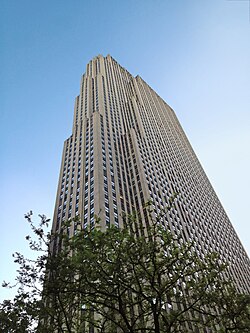
Lazard's New York City headquarters spans the top floors of 30 Rockefeller Plaza,[24] including what used to be Room 5600, the former offices of the Rockefeller family dynasty.[25]
-
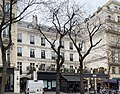 17, boulevard Poissonnière, Paris
 -
 5-7, rue Pillet-Will, Paris
 -
 121, boulevard Haussmann, Paris
 -
 175, boulevard Haussmann, Paris


Management
[edit]Past chairmen
[edit]- Alexandre Lazard, Lazare Lazard and Simon Lazard (founders)
- Alexandre Weill
- David David-Weill
- Pierre David-Weill
- André Meyer
- Michel David-Weill
- Ken Costa
- Bruce Wasserstein
- Kenneth M. Jacobs
Board of directors
[edit]Lazard's board of directors as of October 2025:[26]
- Peter R. Orszag
- Dan Schulman
- Andrew Alper
- Ann-Kristin Achleitner
- Stephen R. Howe, Jr.
- Michelle Jarrard
- Iris Knobloch
- Peter Harrison
- Dmitry Shevelenko
Notable current and former employees
[edit]Business
[edit]- Frank Altschul – Chairman, General American Investors Company
- Marcus Agius – Chairman of Barclays
- Robert Agostinelli – Founder and Chairman of Rhône Group
- Tim Collins – Founder and CEO of Ripplewood Holdings
- Disque Deane – Chairman of Starrett City Associates
- Mina Gerowin – Managing Director Paulson Europe, LLC
- Sir Philip Hampton – Chairman of Royal Bank of Scotland, Former Chairman of Sainsbury's and UK Financial Investments Limited
- Hugh Kindersley, 2nd Baron Kindersley – Chairman of Lazard Brothers (London), 1953–1964
- Sebastian Kulczyk – son of Jan Kulczyk, Board member of Kulczyk Investments
- Steven Langman – Founder & Chairman of Rhône Group
- Bryan Lawrence - Founder of Oakcliff Capital
- Jean-Marie Messier – Chairman & CEO of Vivendi (1996–2002)
- Andre Meyer – Famed American investment banker, advisor to Kennedy family, President Lyndon Johnson
- Archie Norman – Chairman ITV, Former Chairman & CEO of Asda
- Nelson Obus – Co-founder of Wynnefield Capital
- Gary Parr – American investment banker, Former Head of M&A at Morgan Stanley
- Mark Pincus – Internet entrepreneur, Co-founder of Zynga
- Steven Rattner – Venture capitalist, Co-Founder of Quadrangle Group
- Gerald Rosenfeld – Former CEO Rothschild North America, Adjunct Professor at NYU Stern
- Nathaniel Rothschild, 5th Baron Rothschild – Co-Chairman of Atticus Capital LLC
- Bernard Selz – American fund manager and philanthropist
- William von Mueffling – former head of Lazard's hedge fund unit, President of Cantillon Capital Management
- Bruce Wasserstein – American investment banker, Co-Founder of Wasserstein Perella
- Johann Rupert – South African businessman, CEO of Compagnie Financiere Richemont
- Lars Kroijer – M & A Analyst.
Politics and public service
[edit]- Jaime Bermúdez Merizalde – Former Colombian Minister of Foreign Affairs
- Ron Bloom – Senior official in the Obama administration
- Robert Henry Brand, 1st Baron Brand – a member of "Milner's Kindergarten"
- Robert Fred Ellsworth – Former U.S. Congressman, U.S. Ambassador to NATO, Deputy Secretary of Defense, and Nixon adviser
- Vernon E. Jordan Jr. – Clinton adviser, Life member of the Council of Foreign Relations
- Paul Keating – Former Prime Minister of Australia
- Robert Kindersley, 1st Baron Kindersley – British public servant
- Anne Lauvergeon – Former diplomatic council to French President François Mitterrand, CEO Areva
- Peter Mandelson – British politician, held Cabinet positions under both Tony Blair and Gordon Brown
- Henrique de Campos Meirelles – Former president Banco Central do Brasil
- Andrew Mitchell – British Member of Parliament, former Secretary of State for International Development
- Peter R. Orszag – Former OMB Director, former CBO Director
- Vincent S. Pérez – Philippine Secretary of Energy
- Rodrigo de Rato – Former Spanish Economy Minister, Head of International Monetary Fund
- Felix Rohatyn – U.S. Ambassador to France (1997–2000); board member, New York Stock Exchange (1968–1972)
- Jenny Sanford – Former First Lady of South Carolina
- Simon Sebag Montefiore – British historian and writer
- Lindsay Tanner – Former Australian Minister for Finance and Deregulation
- Andrés Velasco – Former Finance Minister of Chile
- Antonio Weiss – Counselor to the Secretary of the US Treasury
- Bill White – Former mayor of Houston (3 terms) and U.S. Deputy Secretary of Energy under President Bill Clinton
- Frank G. Zarb – FEA energy czar under President Gerald Ford, former chairman and CEO, NASDAQ, then Smith Barney
- Božidar Đelić – Former Minister of Finance of Serbia
- Ngozi Okonjo-Iweala – Director-General of the World Trade Organization, former Finance Minister of Nigeria, former Vice-President, Corporate Secretary of the World Bank Group.
- Gilles Mentré – Former advisor to President Nicolas Sarkozy.
Other
[edit]- George J. Ames – philanthropist, former general partner of Lazard
- Paul Baerwald – banker and philanthropist, Chairman of the American Jewish Joint Distribution Committee
- William D. Cohan – Contributing editor at Fortune, Award-winning author
Books
[edit]- de Rougemont, Guy D. (2010). Lazard Frères: Banquiers des Deux Mondes (1840–1939). Paris: Fayard. ISBN 978-2-213-66125-4.
- Cohan, William D. (2007). The Last Tycoons: The Secret History of Lazard Frères & Co. New York: Doubleday. ISBN 978-0-385-51451-4.
- Geisst, Charles R (2001). The Last Partnerships: Inside the Great Wall Street Money Dynasties. New York: McGraw-Hill. ISBN 0-07-136999-6.
- Reich, Cary (1983). Financier: The Biography of André Meyer: A Story of Money, Power, and the Reshaping of American Business. New York: William Morrow & Co. ISBN 0-688-01551-4.
See also
[edit]- List of investment banks
- Boutique investment bank
- Lazard Station in Montreal was built in 1918 and believed to be named in their honor as the firm was responsible for financing the Mont Royal Tunnel.[27] Renamed in 1926 as Val-Royal and demolished in 1995.
References
[edit]- ^ "Lazard Inc. Annual Report (Form 10-K)". U.S. Securities and Exchange Commission. 24 February 2025.
- ^ Indap, Sujeet; Massoudi, Arash; Fontanella-Khan, James (September 8, 2015). "Investment banking: Walking away from Wall Street". Financial Times.
- ^ a b c d "Lazard Ltd Annual Report (Form 10-K)". U.S. Securities and Exchange Commission. 28 February 2022. Retrieved 12 April 2022.
- ^ "Lazard". Jewish Virtual Library.
- ^ a b c d Guy de Rougemont, Lazard Frères, Banquiers des Deux Mondes (1840–1939), Librairie Arthème Fayard, 2010
- ^ a b "Institutional Investor International Edition, November 2011 "The New House of Lazard"" (PDF). Archived from the original (PDF) on May 9, 2013. Retrieved July 29, 2013.
- ^ "Lazard website – About Lazard". Retrieved July 26, 2013.
- ^ William Cohan, Last Tycoons: The Secret History of Lazard Frères & Co, Doubleday, 2007
- ^ "Lazard Names Kenneth Jacobs as Its New Chief". The New York Times. November 17, 2009.
- ^ "Greek radicals play it safe with debt advisers Lazard". Reuters. 5 Feb 2015.
- ^ "Greece's Debt Crisis". Council on Foreign Relations.
- ^ Schatzker, Erik (22 November 2021). "Lazard Backs Wall Street Diversity With 'Salomon Sisters' Stake". www.bloomberg.com. Retrieved 22 November 2021.
- ^ Schatzker, Erik; Natarajan, Sridhar; Baker, Liana (24 September 2021). "'Salomon Sisters' Is Coming to Wall Street, Backed by Lazard". Retrieved 22 November 2021.
- ^ "Lazard Appoints Peter R. Orszag as CEO and Kenneth M. Jacobs as Executive Chairman". Lazard.com. May 26, 2023.
- ^ Hirsch, Lauren (May 26, 2023). "Lazard Names Peter Orszag to Succeed Ken Jacobs as C.E.O." The New York Times. Retrieved 1 October 2023.
- ^ Gillespie, Todd (2024-11-25). "Lazard Appoints Orszag to Chair Board as Ken Jacobs Steps Back". Bloomberg Law. Archived from the original on 2025-01-20. Retrieved 2025-06-05.
- ^ "Lazard Ltd Completes Conversion to a U.S. C-Corporation and is Renamed Lazard, Inc". Lazard.com. Retrieved 2024-01-27.
- ^ "Lazard and alt credit firm Arini team up for EMEA direct lending deals". Pensions & Investments. 2025-03-25. Retrieved 2025-03-26.
- ^ McCracken, Jeffrey (January 14, 2012). "Lazard Appoints Kurtz Restructuring Chief After Ridings, Savage". Bloomberg.
- ^ "Lazard Reports 2013 fourth quarter earnings". Archived from the original on April 29, 2014. Retrieved March 17, 2014.
- ^ "Locations | Lazard". www.lazard.com. Retrieved 2024-12-08.
- ^ Alessandro Giacone (2015), Jean Guyot : Un financier humaniste, CNRS Editions
- ^ "Lazard Inaugurates its New Investment Banking Office in Paris" (PDF). Lazard. 10 September 2010. Archived from the original (PDF) on 2022-07-11. Retrieved 2022-07-11.
- ^ "Lazard Takes More of 30 Rock". observer.com. 15 March 2011.
- ^ Makarechi, Kia (24 November 2014). "Rockefeller Family Leaving 30 Rockefeller Center for the First Time". The Hive.
- ^ "Leadership and Board Lazard". 31 December 2024.
- ^ Walton, Mark (June 6, 2000). "The Mount Royal Tunnel Electrification". Colin Churcher's Railway Pages. Archived from the original on January 18, 2012.
External links
[edit]- Official website
- Lazard Asset Management
- Business data for Lazard Inc.:


Lazard
View on GrokipediaThe firm operates across North and South America, Europe, the Middle East, Asia, and Australia, delivering independent advice on mergers and acquisitions, capital markets advisory, restructuring and liability management, geopolitics, and customized investment solutions to corporations, governments, institutions, and individuals.[2]
With over 175 years of history, Lazard pioneered the independent investment banking model, avoiding lending or proprietary trading conflicts, and has advised on landmark transactions including the 1975 restructuring that averted New York City's bankruptcy under Felix Rohatyn.[1][3]
Its unification of U.S., French, and U.K. operations into Lazard LLC in 2000 and public listing in 2005 marked key modern milestones, alongside recent achievements like record financial advisory revenues in 2025 amid recovering dealmaking activity.[1][4]
History
Founding and Early Expansion (1848–1900)
Lazard Frères & Co. was established in 1848 in New Orleans, Louisiana, by three brothers—Alexandre, Lazare, and Simon Lazard—who had immigrated from the Alsace region of France.[1] Initially operating as a dry goods merchant selling fabrics and accessories from a store on Frenchmen Street, the partnership formalized its structure through a legal contract among the brothers, marking the firm's inception amid the economic opportunities of the antebellum American South.[1] The brothers contributed modest capital—approximately $3,000 each—to launch the venture, leveraging their trading experience gained after Alexandre and Lazare's arrival in New Orleans in 1841.[5] The firm's early expansion was driven by the 1849 California Gold Rush, prompting a relocation of operations to San Francisco, where it opened a branch to supply miners and facilitate gold-related transactions.[1] By the 1850s, Lazard diversified into financial services, including currency exchange, lending, and gold shipments, while establishing a Paris office in 1852 (as Lazard Frères & Cie) to advise on European gold purchases and bridge transatlantic trade.[6] This period saw the addition of family members, such as cousin Alexandre Weill in 1856, strengthening the firm's network as it transitioned from merchandise to banking amid the U.S. Civil War and postwar reconstruction.[6] International growth accelerated in the 1870s with a temporary London presence in 1870, formalized as Lazard Brothers & Co. in 1877 at 60 Old Broad Street, enabling access to British capital markets during the Franco-Prussian War.[1] By 1880, a New York branch on Wall Street integrated Lazard deeper into American finance, coinciding with a full pivot to investment banking, foreign exchange, and gold exporting—activities that positioned the firm as a major U.S. gold shipper.[1] In 1884, Lazard co-founded the London, Paris, and American Bank Ltd. to finance global expansion, solidifying its role as a multinational entity by century's end while abandoning dry goods entirely by 1876.[1][6]The Three Houses and Global Growth (1900–1970s)
During the early 20th century, Lazard operated through three semi-independent partnerships known as the "three houses": Lazard Frères & Cie in Paris, Lazard Brothers & Co. in London, and Lazard Frères & Co. in New York, each managed by family descendants or partners with shared ownership interests but distinct local operations and client bases.[1][6] The London house received a capital infusion in 1901, enabling expansion, followed by the recruitment of key figures Robert Kindersley in 1905—a Bank of England director—and Robert Brand, an economist, who drove international financing deals such as a £1 million bond issuance for the Canadian Northern Railway in 1908 and investments in growth-stage Canadian firms, Mexico, Eastern Europe, and Russia.[7] In 1919, a minority stake in the London house was sold to Weetman Pearson, reflecting efforts to stabilize and fund overseas ambitions amid post-World War I recovery.[1] World War I marked a pivotal expansion, with the Paris house advising the French government on financing and gold purchases, while the London house supported British war efforts, and New York operations grew amid neutral U.S. economic activity.[1] Post-war, the London house led geographical diversification, opening offices in Belgium, Germany, and Spain, and underwriting foreign government bonds for entities like the Dutch Indies and Argentina.[7] The 1924 "battle of the franc" saw coordinated efforts across houses, with New York's Frank Altschul devising a currency stabilization strategy for France.[1] Challenges arose in 1931 when fraud at a Brussels affiliate prompted a bailout by the Bank of England and Pearson, granting Pearson an 80% stake in the London house.[1][6] The interwar and post-World War II periods solidified Lazard's global footprint through investment banking shifts. In the U.S., the 1933 Glass-Steagall Act prompted New York to pivot from commercial banking to advisory services, a transition accelerated post-1944 under André Meyer, who eliminated retail brokerage and positioned the house as a mergers and acquisitions leader.[1][6] Paris operations halted during Nazi occupation but resumed under Pierre David-Weill in 1944 and Michel David-Weill post-war.[6] By the mid-20th century, asset management emerged as a new pillar, starting in London in 1953, Paris in 1969, and New York in 1970 with SEC registration.[1] Felix Rohatyn's role in averting New York City's 1975 bankruptcy via the Municipal Assistance Corporation exemplified the houses' advisory influence, though internal frictions persisted due to their autonomous structures until formal unification efforts in the late 1970s.[1][6]Unification, IPO, and Post-2000 Developments
In the late 1990s, Michel David-Weill, the senior partner overseeing Lazard's Paris operations, pursued the unification of the firm's three historically independent houses in New York, London, and Paris to centralize control and streamline global operations. This effort involved acquiring minority stakes from partners across the entities, costing approximately $650 million, amid tensions over profit-sharing and succession planning.[8] Plans for operational integration and executive reshuffles were announced in June 1999, culminating in the formal merger completion on March 7, 2000, which aligned the houses under a unified structure while preserving their local expertise.[9] Following the sale of Pearson plc's minority holdings in Lazard's U.S. and U.K. operations later that year, the three houses were reorganized as Lazard LLC, marking the end of over 150 years of semi-autonomous management.[1] In January 2002, Lazard LLC appointed Bruce Wasserstein, a prominent investment banker who had previously led his own firm acquired by Allianz AG, as CEO to drive expansion and modernization. Wasserstein focused on aggressive talent acquisition, including high-profile hires from competitors, and positioned the firm for public markets to enhance liquidity for partners and fund growth in mergers-and-acquisitions advisory and asset management.[10] Assets under management expanded to $77 billion by mid-decade, reflecting strengthened capabilities in global equity and fixed-income strategies.[11] Lazard executed its initial public offering on May 10, 2005, selling 34.2 million shares of Class A common stock at $25 per share through Lazard Ltd as the holding company, raising approximately $855 million in gross proceeds and ending 157 years as a private partnership.[12] The IPO, priced at the low end of the expected range amid market volatility, provided capital for debt reduction and employee incentives via equity grants, while retaining a partner-centric model with managing directors holding majority voting control post-offering.[13] Under Wasserstein's leadership, post-IPO revenues benefited from a rebound in global M&A activity, with advisory fees rising 15% to $482 million in 2004 alone, underscoring the firm's entrenched role in high-profile restructurings and cross-border deals.[14]Recent History and Strategic Shifts (2010s–2025)
In the early 2010s, Lazard navigated post-financial crisis recovery by emphasizing restructuring advisory, topping rankings for such deals in the first half of 2010 with involvement in eight of the ten largest global restructurings, including the $24 billion Dutch chemicals firm case.[15] By 2015, the firm achieved record operating revenue and earnings amid capital markets volatility, driven by mergers and acquisitions advisory.[16] Asset management assets under management (AUM) grew steadily, though subject to market flows, with the division focusing on diversified strategies like global equity and fixed income. The 2020 COVID-19 downturn prompted a pivot to complex M&A and advisory amid global uncertainty, with Lazard engaging in significant transactions despite economic contraction.[17] In 2022, asset management underwent leadership transition as Evan L. Russo succeeded Ashish Bhutani as CEO after Bhutani's nearly two-decade tenure, aiming to streamline operations and enhance performance.[18] Peter Orszag assumed the role of CEO and Chairman in 2023, steering a renewed focus on core financial advisory strengths while selectively expanding asset management.[19] That year, Lazard launched its "Lazard 2030" long-term growth strategy, targeting doubled revenue by 2030 through enhanced client relationships, geopolitical advisory integration, and regional expansion, including renewed Middle East emphasis.[20] The firm marked its 175th anniversary in 2023, highlighting historical resilience.[21] Execution of Lazard 2030 began strongly in 2024, with revenue rising 21% to $3.052 billion from $2.515 billion in 2023, reflecting M&A rebound and cost discipline.[22] In 2025, the strategy progressed amid resilient markets, with Q1 net revenue at $648 million, Q2 average AUM at $239 billion (down 3% year-over-year but up quarterly), and Q3 updates reaffirming 10-15% annual shareholder returns via advisory dominance and targeted asset management inflows.[23][24][25] Strategic shifts included reinvestment in high-conviction areas like capital solutions and liability management, while managing cyclical headwinds through operational efficiency.[26] In September 2025, Lazard provided a two-year progress update on 2030 goals, underscoring adaptation to policy uncertainties and trade shifts.[20]Business Operations
Financial Advisory Services
Lazard's Financial Advisory division provides independent advice to corporations, governments, and institutions on mergers and acquisitions (M&A), capital structure optimization, restructurings, and other strategic financial matters.[3] The division emphasizes unbiased, conflict-free counsel, leveraging a network of over 300 managing directors across global offices to handle complex, cross-border transactions.[2] In 2024, this segment generated approximately $1.76 billion in revenue, contributing significantly to the firm's overall operations amid a resurgence in deal activity.[27] Core services include M&A and strategic advisory, where Lazard advises on mergers, acquisitions, divestitures, takeover defenses, and joint ventures, often in high-stakes industries such as aerospace, energy, and consumer goods.[28] Recent transactions include advising Airbus, Leonardo, and Thales on strategic partnerships, as well as Vistra's acquisition of a natural gas asset portfolio.[29] Capital Markets Advisory focuses on evaluating financing alternatives, debt issuances, and equity offerings, utilizing proprietary databases for tailored capital structure assessments.[30] Specialized Advisory extends to non-M&A areas, including sovereign advisory for governments on debt restructurings and liability management, as well as geopolitical and regulatory strategy.[31] The division has demonstrated resilience in volatile markets; for instance, in the third quarter of 2025, Financial Advisory net revenue reached $427 million, a 15% increase year-over-year, driven by robust European M&A activity and diversified deal flow.[32] Through the first nine months of 2025, the segment reported $1,292 million in net revenue, reflecting sustained demand for expert guidance amid economic uncertainties.[4]Asset Management Division
Lazard Asset Management (LAM) is the investment management division of Lazard Inc., delivering active investment strategies to institutional, sovereign, and private clients globally. The division specializes in equities, fixed income, multi-asset solutions, and alternatives, with products structured as mutual funds, segregated mandates, and bespoke portfolios tailored to client needs.[33][34] LAM's approach prioritizes fundamental analysis, dynamic asset allocation, and high-conviction security selection to generate returns independent of broad market beta.[35] The division traces its origins to Lazard's early banking activities in the 19th century, which included managing client portfolios alongside advisory services, though modern institutional asset management expanded significantly during the firm's global growth in the 20th century. Following Lazard Inc.'s initial public offering in 2005, which separated its financial advisory and asset management operations into distinct segments, LAM was formalized as a standalone unit focused on scaling third-party assets. By the 2010s, it had built capabilities in emerging markets and quantitative strategies, contributing to Lazard's overall revenue diversification amid volatile advisory fees. As of September 30, 2025, LAM reported preliminary assets under management (AUM) of $264.5 billion, reflecting net inflows and market appreciation from $258.4 billion in August 2025.[1][36] LAM's equity strategies emphasize value-oriented, bottom-up stock picking, particularly in mid-cap and global franchises, where the firm has historically sought undervalued opportunities overlooked by consensus benchmarks. Fixed income offerings include credit and rates management, while multi-asset portfolios integrate tactical allocation with security-level insights to mitigate volatility. Alternatives encompass private markets and real assets, targeting uncorrelated returns for diversified client mandates. The division maintains over 1,200 employees, including more than 400 investment professionals across 20+ countries, enabling localized execution with centralized research.[34] Performance data as of September 2025 indicates that well over half of benchmarked strategies outperformed their indices over 3- and 5-year periods, driven by selective positioning in underappreciated sectors rather than passive indexing.[20] In recent years, LAM has emphasized emerging markets exposure, leveraging Lazard's advisory network for proprietary insights into geopolitical and economic shifts. Third-quarter 2025 results showed asset management net inflows supporting revenue growth of 15.8% year-over-year to $748.1 million firm-wide, with the division benefiting from higher average AUM of $239 billion in the prior quarter amid favorable market conditions. Compensation and operational expenses rose, reflecting investments in talent and technology to enhance alpha generation, though fee compression in passive alternatives remains a structural challenge per industry norms. Client retention stems from the firm's independence, avoiding conflicts with Lazard's advisory business through ring-fenced operations.[37][38][24]Restructuring and Other Advisory Practices
Lazard's Restructuring and Liability Management practice advises both debtor companies and creditors on complex financial restructurings, including out-of-court recapitalizations, liability management transactions, and in-court proceedings. The firm has participated in over 500 such engagements in the past decade, involving more than $2 trillion in restructured liabilities, positioning it as a leading advisor in high-profile cases.[39][40] In 2024, the practice handled transactions exceeding $70 billion in value, reflecting sustained demand amid economic pressures such as tariff uncertainties.[41] Recent mandates have included advising on liability adjustments driven by potential U.S. policy shifts under President Donald Trump, with firms seeking proactive debt management.[42] Beyond core restructuring, Lazard offers specialized advisory services addressing strategic challenges outside mergers, capital solutions, and liability management. These encompass geopolitical risk assessments for corporate boards, providing tailored analyses of international tensions and their business implications.[43] Sovereign advisory focuses on debt restructuring for governments and state entities, supporting liability management in emerging markets and developed economies alike.[31] The firm's Capital Markets Advisory group complements restructuring efforts with expertise in equity and debt advisory, private capital raising, and growth capital strategies. This includes guidance on corporate separations like spin-offs and carve-out IPOs, as well as broader capital structure optimization.[30] In 2023, Lazard formalized its Capital Solutions platform to integrate these elements, enhancing advice on hybrid financing amid volatile markets.[44] These practices emphasize independent, conflict-free counsel, drawing on Lazard's global network to navigate multifaceted advisory needs.[3]Global Presence
Office Locations and Regional Operations
Lazard operates from approximately 41 offices across 26 countries, with a presence in North America, Europe, Asia-Pacific, the Middle East, Australia, and Central and South America, supporting its financial advisory and asset management activities through localized expertise and global coordination.[45] The firm's global headquarters is situated at 30 Rockefeller Plaza in New York City, serving as the central hub for strategic decision-making and operations.[46] In North America, Lazard maintains a robust network, including its U.S. headquarters and additional offices in Austin, Boston, Charlotte, Chicago, Houston, Los Angeles, Minneapolis, and New York, enabling tailored advisory services across diverse regional markets such as technology, energy, and healthcare.[47] Operations extend to Canada, contributing to cross-border transactions in the Americas.[48] Europe represents a core region for Lazard, with principal offices in Paris, France, and London, United Kingdom—the latter relocated to 20 Manchester Square in June 2025 as one of three major global hubs alongside New York and Paris.[49] Additional European locations include Bordeaux, Lyon, and Nantes in France; Brussels, Belgium; Luxembourg; Amsterdam, Netherlands; and multiple sites in Germany, facilitating mergers, restructurings, and capital markets advice amid the region's regulatory and economic complexities.[50][48] In Asia-Pacific, Lazard has been active for over 40 years, with offices in Beijing and Hong Kong, China; Singapore; and Sydney, Australia, focusing on high-growth sectors like infrastructure and cross-border deals in emerging markets.[51][52][53] Central and South America operations, though scaled back with the closure of five offices in 2023 amid a mergers and acquisitions slowdown, continue from São Paulo, Brazil—established in 2004—and Mexico City, Mexico, emphasizing energy and consumer sectors.[54][55][56] The firm's regional structure promotes integrated operations, with enhanced cross-geography connectivity implemented under the Lazard 2030 strategy to streamline advisory and asset management delivery.[20]Leadership and Governance
Current Executive Management
Peter R. Orszag serves as Chief Executive Officer and Chairman of Lazard, Inc., having assumed the CEO role effective October 1, 2023.[57] Prior to joining Lazard, Orszag held senior positions including Director of the U.S. Office of Management and Budget under President Obama and Vice Chairman of Corporate and Investment Banking at Citigroup.[58] Raymond J. McGuire has been President of Lazard since April 2023.[59] In this capacity, he oversees the firm's global operations and strategic initiatives. McGuire previously spent 13 years at Citigroup as Global Head of Corporate and Investment Banking for the Markets and Securities Services division.[59] Mary Ann Betsch is Chief Financial Officer, appointed effective October 3, 2022.[60] She succeeded Evan L. Russo in the role and brings over two decades of experience, including as Managing Director in finance at Citadel. Betsch holds CPA and CFA designations.[61][60] Alexandra Soto serves as Chief Operating Officer, responsible for operational efficiency across Lazard's advisory and asset management businesses.[62] Evan Russo is Chief Executive Officer of Lazard Asset Management, overseeing the firm's asset management division as of October 2025.[62] Russo previously served as Lazard's CFO from 2017 to 2022 before transitioning to lead the asset management unit.[60] Chris Weideman acts as General Counsel, managing legal affairs for the firm.[62]Board of Directors
The Board of Directors of Lazard, Inc. provides oversight on strategic matters, risk management, and corporate governance, with a composition emphasizing expertise in finance, technology, asset management, and public policy. As of October 2025, the board includes nine members: the Chairman and CEO, a lead independent director, and seven other independent directors.[62] Peter R. Orszag has served as Chairman of the Board and Chief Executive Officer since January 2025, when he assumed the dual role following prior executive positions at Lazard. Orszag previously directed the U.S. Office of Management and Budget from 2009 to 2010, advised on economic policy, and held senior roles at Citigroup; he earned a Ph.D. in economics from the London School of Economics.[58][63] Dan Schulman acts as Lead Independent Director, having joined the board on January 30, 2024, and been appointed to the lead role on November 25, 2024. Schulman, who led PayPal as CEO from 2014 to 2023—overseeing its growth to over 400 million active accounts—became CEO of Verizon on October 6, 2025, while retaining his Lazard position.[64][65][66] Ann-Kristin Achleitner joined as an independent director in April 2021 and serves on the Audit Committee and Nominating and Governance Committee. A professor of entrepreneurial finance at Technical University of Munich, Achleitner has held supervisory roles at DHL Group (since 2024), Linde plc, and previously Munich Re and Deutsche Börse, bringing expertise in corporate finance and impact investing.[67][68] Andrew M. Alper has been a director since 2012. Alper spent 21 years at Goldman Sachs, including as co-head of investment banking, and later served as president of New York City's Economic Development Corporation; he now chairs Alper Investments LLC, focusing on real estate and private equity.[69] Peter Harrison was appointed an independent director on March 3, 2025. Harrison serves as CEO of Schroders plc, a global asset manager with over $900 billion in assets under management as of 2024, and previously held investment roles at Deutsche Bank and Invesco.[70] Stephen R. Howe Jr. joined as an independent director on January 30, 2024, and serves on the Audit Committee. Howe was U.S. Chairman and Americas Managing Partner at Ernst & Young through 2023, managing over 75,000 professionals, with prior experience in consulting and private equity.[64] Michelle Jarrard has been a director since January 2017, serving on the Compensation Committee and Workplace and Culture Committee. Jarrard is CEO of BioCircuit Technologies, Inc., a medical device firm, and previously chaired Crawford & Company; she holds engineering and business degrees from Georgia Tech and has directed technology and consumer firms including Inspire Brands.[71] Iris Knobloch joined in 2018 and chairs the Nominating and Governance Committee. Knobloch is Chairwoman and CEO of Deezer and Vice Chairman of AccorHotels' board; her career includes executive roles at Yahoo and IBM, with a focus on digital media and hospitality strategy.[72] Dmitry Shevelenko was appointed an independent director effective September 2, 2025. As Chief Business Officer of Perplexity AI, Shevelenko oversees operations at the AI search startup; he previously held senior product and strategy roles at Uber, LinkedIn, and Meta, and co-founded ventures in ad tech and data analytics.[73][74]Historical Leadership Transitions
Following the post-World War II expansion under André Meyer, who headed U.S. operations from 1944 and built Lazard into a premier mergers and acquisitions advisory firm, leadership transitioned to Michel David-Weill amid Meyer's declining health.[75][76] In 1977, David-Weill, a descendant of the founding family who had joined the Paris office in 1950 and become a general partner in New York by 1961, was named senior partner of Lazard Frères & Co. in New York, effectively unifying control over the firm's global operations.[1][75] David-Weill maintained dominance through the 1980s and 1990s, overseeing restructurings such as the 1989 appointment as head of Lazard Brothers in London and the 2000 formation of Lazard LLC to consolidate the Paris, New York, and London partnerships.[75][77] By the early 2000s, succession pressures mounted, leading David-Weill to hire Bruce Wasserstein as CEO in 2002 to drive modernization and an initial public offering.[1] Wasserstein, previously CEO of Wasserstein Perella, orchestrated Lazard's IPO in May 2005, which diluted family control and raised approximately $622 million, though it sparked internal conflicts with David-Weill over governance.[1] Wasserstein's sudden death from heart complications on October 14, 2009, prompted an immediate transition; on November 17, 2009, longtime Lazard partner Kenneth M. Jacobs was appointed Chairman and CEO, stabilizing the firm amid the financial crisis.[1][78][79] Jacobs, who had joined Lazard in 1986 and risen through investment banking roles, led the firm for nearly 14 years, focusing on advisory growth and asset management expansion during recovery from the 2008 downturn.[1] In May 2023, amid a dealmaking slump, Lazard announced Jacobs would step down as CEO effective October 1, 2023, with Peter R. Orszag—then CEO of Financial Advisory and a former Citigroup executive—succeeding him, while Jacobs assumed the role of Executive Chairman to guide strategy.[57][80] This handover aimed to inject fresh expertise in economics and policy, given Orszag's prior roles as White House budget director and OMB director under President Obama.[57]Key Personnel and Alumni
Notable Figures in Finance and Business
André Meyer served as a senior partner at Lazard Frères from the 1940s until his retirement in 1977, during which he expanded the firm's influence in American investment banking through strategic advisory roles in major corporate restructurings and capital raisings, earning recognition as one of the era's preeminent dealmakers.[1] Felix Rohatyn, a partner at Lazard from 1961 to 1997, gained prominence for orchestrating the financial rescue of New York City during its 1975 fiscal crisis, chairing the Municipal Assistance Corporation and negotiating over $4 billion in federal loans and pension fund investments to avert default.[81] Michel David-Weill led Lazard as chairman from 1977 to 2005, guiding its evolution into a global mergers and acquisitions powerhouse with transactions exceeding $1 trillion in value, while maintaining the firm's partnership structure until its public listing in 2005.[1] Peter Orszag, who joined Lazard in 2020 as a managing director before becoming CEO in 2023, previously directed the U.S. Office of Management and Budget from 2009 to 2010 and Citigroup's financial strategy unit, bringing expertise in fiscal policy and institutional advisory to the firm's operations.[82] Kenneth Jacobs, Lazard's chairman and CEO from 2009 to 2023, oversaw the firm's recovery from the 2008 financial crisis, including key advisory mandates in sovereign debt restructurings and corporate sales totaling hundreds of billions in assets.[83]Contributions to Politics and Public Policy
Lazard's Sovereign Advisory practice provides financial and strategic guidance to governments and sovereign entities, influencing public policy through debt restructuring and liability management strategies. The firm has advised on restructurings for nations including Suriname, Ghana, Sri Lanka, and Zambia in recent years, facilitating negotiations with creditors to achieve sustainable debt profiles amid economic crises.[84] These engagements often incorporate policy recommendations on fiscal reforms, competitiveness enhancements, and capital market access, directly impacting national budgetary decisions and long-term economic stability.[85] As of 2025, the practice remains active across developed and emerging markets, supporting governments in navigating geopolitical and financial pressures.[86] The firm's Geopolitical Advisory group, established in 2022 under CEO Peter Orszag, integrates former high-level government officials to counsel clients on risks intersecting finance and policy, such as sanctions, trade disruptions, and security threats. Advisors include retired U.S. Admiral William McRaven, who advised Presidents George W. Bush and Barack Obama on defense and foreign policy; General John Abizaid, former U.S. Central Command commander and ambassador to Saudi Arabia; Jami Miscik, ex-CIA Deputy Director for Intelligence; and Siddharth Mohandas, former Deputy Assistant Secretary of Defense.[87][88][89][90] In 2023, the group added Sir Stephen Lovegrove, former UK National Security Adviser, and in 2025, Patrick McHenry, ex-U.S. Congressman and House Financial Services Committee Chair.[91][92] This expertise extends Lazard's influence into policy domains by bridging corporate strategy with governmental decision-making frameworks. Key personnel have directly shaped U.S. public policy. Peter Orszag, Lazard's CEO since 2023 and formerly Director of the Office of Management and Budget (2009–2010) under President Obama, oversaw federal budgeting and healthcare reform implementation, drawing on economic analysis to inform fiscal policy.[58] Ron Bloom, who began his career at Lazard in the 1980s, served as Assistant to the President for Manufacturing Policy (2009–2011), leading the auto industry bailout and restructuring of General Motors and Chrysler, which preserved over 1 million jobs through government intervention and private equity coordination.[93][94] Bloom returned to Lazard as a senior adviser in 2012, exemplifying the revolving door between the firm and policy roles.[95] These transitions underscore Lazard's role in channeling Wall Street acumen into governmental problem-solving, particularly in crisis response and industrial policy.Other Notable Individuals
George J. Ames (1917–2001) served as a limited managing director at Lazard Frères & Co. for over 60 years, beginning in 1937 after graduating from Columbia College, while also engaging extensively in philanthropy, including support for educational and cultural institutions.[96][97] Paul Baerwald (1871–1961), an early partner at Lazard Frères from 1907 until his retirement in 1930, dedicated his subsequent career to philanthropy, serving as chairman of the American Jewish Joint Distribution Committee for 45 years and funding humanitarian efforts, including refugee aid and child welfare programs.[98] Richard A. Hettinger Jr. (1892–1972), a former professor at Harvard Business School from 1920 to 1926, transitioned to Lazard Frères where he contributed as an economist and chaired the Lazard Fund, applying his academic expertise in corporate finance to investment strategies despite the fund's challenges.[99][100]Notable Transactions and Achievements
Landmark Mergers and Acquisitions
Lazard served as exclusive financial advisor to H.J. Heinz Company in its 2015 merger with Kraft Foods Group Inc., a transaction valued at $46 billion in equity that formed The Kraft Heinz Company, the third-largest food and beverage firm in North America by revenue.[101] The deal, orchestrated with backing from Berkshire Hathaway and 3G Capital, stood out for its reliance on independent boutiques—Lazard for Heinz and Centerview Partners for Kraft—eschewing broader syndicates of bulge-bracket banks typically involved in such scale.[102] This advisory role built on Lazard's prior engagement with Heinz during its 2013 leveraged buyout by the same investors for $28 billion, demonstrating continuity in high-value consumer goods transactions.[103] In the technology domain, Lazard has advised Alphabet Inc.'s Google unit on all external-advisor-assisted acquisitions totaling $22 billion as of 2019, including strategic buys to bolster capabilities in areas like hardware and cloud services.[104] This longstanding relationship underscores Lazard's expertise in navigating regulatory scrutiny and integration risks for repeated acquirers in competitive sectors. Lazard also acted as financial advisor to ImmunoGen Inc. in its 2023 sale to AbbVie Inc. for $10.1 billion, a deal that enhanced AbbVie's solid tumor oncology assets with ImmunoGen's antibody-drug conjugate technology.[105] Such pharmaceutical mandates reflect Lazard's recurring involvement in biotech consolidations amid patent cliffs and pipeline diversification pressures. Historically, Lazard ranked as Europe's leading M&A advisor in early 1999, counseling on deals aggregating €177 billion ($190 billion), often in cross-border contexts that capitalized on its multinational footprint.[106] These engagements, spanning consumer, tech, and healthcare, affirm Lazard's track record in structuring transformative combinations while prioritizing client-specific strategic imperatives over volume-driven mandates.Restructuring Deals and Crisis Advisory
Lazard's restructuring and liability management practice advises debtors, creditors, and other stakeholders on complex financial restructurings, emphasizing out-of-court solutions such as recapitalizations and liability management transactions while also handling in-court proceedings like Chapter 11 bankruptcies. The firm leverages its expertise in capital structure optimization, creditor negotiations, and valuation analyses to facilitate resolutions in distressed situations, often engineering innovative debt exchanges or amendments to avoid formal insolvency.[39] In the sovereign debt arena, Lazard has played a prominent role during the 2020-2025 global debt crisis, serving as the primary financial advisor to multiple governments facing distress. Notable engagements include advising Argentina on its 2020 debt exchange involving approximately $65 billion in bonds, Ecuador on its 2020 restructuring of over $17 billion in sovereign debt, and Lebanon amid its 2020 default on $30 billion in Eurobonds. The firm also supported Ethiopia, Ghana, and Sri Lanka in their respective restructurings, contributing to resolutions covering nearly $200 billion in claims since 2020 through creditor coordination and bondholder exchanges.[107][108][109] For corporate clients, Lazard has advised on high-profile distress scenarios, including serving as investment banker to Neiman Marcus Group in its 2020 Chapter 11 filing, where it facilitated a sale to creditors and private equity investors amid pandemic-induced revenue declines, enabling the retailer to emerge with reduced debt. In the energy sector, the firm represented Valaris PLC, the world's largest offshore drilling contractor, during its 2020 bankruptcy, negotiating with bondholders and banks to restructure $7.1 billion in liabilities and position the company for relisting. More recently, in the third quarter of 2025, Lazard's team counseled Altice France on ongoing debt reduction efforts involving asset sales and refinancing for its €24 billion debt load, and assisted First Brands Group in liability management amid automotive sector pressures.[110][111][112] These engagements underscore Lazard's approach to crisis advisory, which prioritizes preserving enterprise value through preemptive restructurings and multi-stakeholder alignments, often in jurisdictions with varying legal frameworks. The practice's success is evidenced by completed transactions that have stabilized clients' balance sheets, though outcomes depend on macroeconomic factors like interest rates and commodity prices.[39][112]Financial Performance
Revenue and Profitability Trends
Lazard's net revenue has exhibited cyclical volatility, largely driven by its Financial Advisory segment, which accounts for the majority of earnings and is sensitive to global mergers and acquisitions (M&A) activity, economic conditions, and interest rate environments.[113] In 2021, amid a post-pandemic M&A boom, total net revenue reached $3.27 billion, reflecting heightened deal volumes.[114] This declined to $2.82 billion in 2022 and further to $2.52 billion in 2023 as rising interest rates and geopolitical uncertainties dampened transaction activity.[22] Revenue rebounded sharply to $3.05 billion in 2024, fueled by a 43% surge in Financial Advisory operating revenue to $2.05 billion, attributed to improved M&A pipelines in Europe and the U.S.[113] [115] Profitability has mirrored these revenue fluctuations, with GAAP net income swinging from approximately $357 million in 2022 to a loss of $75 million in 2023, the latter impacted by elevated compensation expenses, restructuring charges, and softer advisory fees.[116] Recovery ensued in 2024, yielding net income of $280 million, supported by cost discipline and higher-margin advisory work, though adjusted net revenue of $2.89 billion excludes certain non-recurring items like carried interest.[113] The Asset Management segment provided relative stability, contributing about 30-35% of revenue with operating income bolstered by management fees, but it has faced outflows and market-driven AUM variations.[117]| Year | Net Revenue ($ billions) | GAAP Net Income ($ millions) | Key Driver |
|---|---|---|---|
| 2021 | 3.27 | Positive (est. high) | M&A surge post-COVID[114] |
| 2022 | 2.82 | 357 | Moderating deal activity[116] |
| 2023 | 2.52 | -75 | Rate hikes, low M&A[22] |
| 2024 | 3.05 | 280 | Advisory rebound[113] |