Hubbry Logo
Russian Imperial GuardRussian Imperial GuardMain
Open search
Russian Imperial Guard
Community hub
Russian Imperial Guard
logo
8 pages, 0 posts
0 subscribers
Be the first to start a discussion here.
Russian Imperial Guard
from Wikipedia
Imperial Guard
Лейб-гвардия
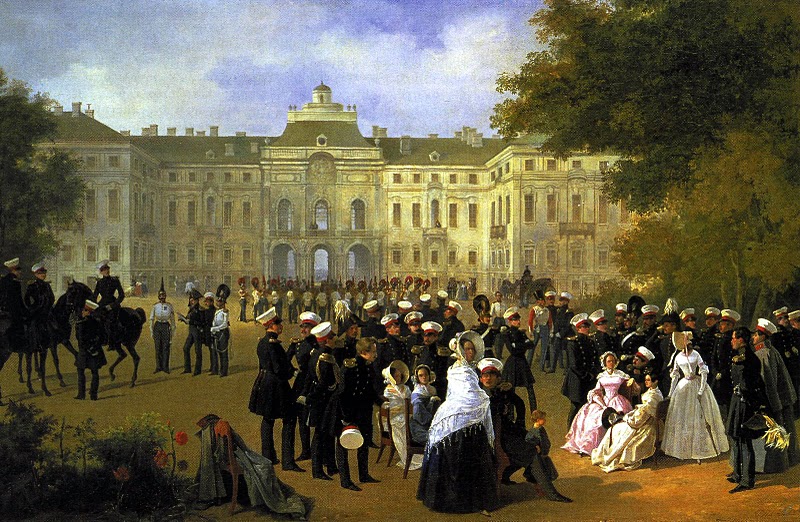
Leib Guards reception at the Constantine Palace
Active1683–1917
Country Russian Empire
Allegiance Emperor of Russia
Russian Empire
Branch Imperial Russian Army
TypeArmy aviation
Artillery
Cavalry
Horse artillery
Imperial guard
Infantry
SizeDivision

The Russian Imperial Guard, officially known as the Leib Guard (Russian: Лейб-гвардия Leyb-gvardiya, from German Leib "body"; cf. Life Guards / Bodyguard), were combined Imperial Russian Army forces units serving as counterintelligence for preventing sabotage of important imperial palaces, personal guards of the Emperor of Russia and the Russian imperial family, public security in the capital and leaders in spearheading attacks on the battlefield. Peter I founded the first such units in 1683 to replace the politically-motivated Streltsy.

The Imperial Guard subsequently increased in size and diversity to become an elite corps of all branches within the Imperial Russian Army, rather than household troops in direct attendance on the Tsar. Numerous links were however maintained with the imperial family, and the bulk of the Imperial Guard's regiments were stationed in and around the capital, Saint Petersburg, in peacetime. The Imperial Guard was disbanded in 1917 following the Russian Revolution.

History

[edit]

Tsar Peter I (later to become known as "Peter the Great") first established the two senior units of the eventual Imperial Guard, the Preobrazhensky and Semyonovsky infantry regiments,[1] as part of his so-called "toy army" in the 1680s. Peter later built on both regiments as part of his professionalization of the Russian Army after its disastrous defeat in 1700 by the Swedes at the Battle of Narva, during the early phases of Great Northern War of 1700-1721.[2] He was influenced too by his distrust of the streltsy, who had risen against him repeatedly, both during his childhood, which traumatised him, and during his reign.

In 1730, Empress Anna (r. 1730–1740) formed the Izmailovsky Regiment (recruited from her former domain, the Duchy of Courland and Semigallia) out of distrust of the other guard regiments (especially the Preobrazhensky) as a result of her paranoia of losing power. The Izmaylovsky Regiment became the official palace guards during her reign.

The term "Leib" was not used until the reign of Empress Elizabeth (1741-1762) during her formation of the Leib Company made up of the grenadiers (especially the Preobrazhensky), who had helped put her on the throne.[3]

Revolution of 1905

[edit]

The Imperial Guard played a key role in suppressing the Revolution of 1905, most particularly at Saint Petersburg on Sunday, 22 January [O.S. 9 January] 1905 (Bloody Sunday). The Semyonovsky Regiment subsequently repressed widespread disturbances in Moscow. However, a full battalion of the Preobrazhensky Regiment mutinied in June 1906.[4]

Russian Revolution of 1917

[edit]

During the February Revolution of 1917, the garrison of Saint Petersburg included 99,000 soldiers of the Imperial Guard. They were reserve battalions, made up of a mixture of new recruits and of veterans from the regiments of the Imperial Guard serving at the Eastern Front of World War I. While generally still recruited from rural districts, the Guards' rank and file were no longer the reliable instruments of Tsarist autocracy that their predecessors had been during the abortive revolution of 1905. About 90% of the officers of the reserve units had been commissioned during the war, and they were often militarily inexperienced and sometimes sympathetic towards the need for political reform.[5] The overall morale and leadership of the Saint Petersburg troops was poor although they still enjoyed the status of the historic regiments that they represented.

During the early days of rioting in Saint Petersburg, the Semyonovsky, Pavlovsky and Volinsky Regiments obeyed their officers and fired on the crowds of demonstrators. However, on 27 February, the Volinsky and then the Semyonovsky, Moskovsky, and Izmailovsky Regiments defected in large numbers to what had now become a revolution. Some officers were killed. An estimated 66,700 guardsmen in the capital had deserted or defected within about two days.[6] This mass defection from units of the Imperial Guard marked the end of the Tsarist régime.

During the October Revolution of 1917, the Pavlovsky Regiment, though it was celebrated for its actions during the Napoleonic Wars, was one of the first regiments to mutiny and to join the Bolsheviks. It then participated in the storming of the Winter Palace.[7] Much of the former Imperial Guard was still extant in October 1917. It retained its historic titles though its role was now that of politicised republican soldiers. In addition, the Semenovsky and the Ismailovsky Regiments rallied to the Bolsheviks at a crucial stage during the revolution.[8]

Organization

[edit]

The final composition of the Russian Imperial Guard at the beginning of 1914 was the following:

His Majesty's Life-Guards Hussar Regiment, 1914

Guards Corps St. Petersburg District. Headquarters, St. Petersburg, Millionaya. (Guards units not part of the Guards Corps were the Guards Replacement Cavalry Regiment and Guards Field Gendarme Squadron.)

Officers and soldiers of the Volinsky Life Guards Regiment in Warsaw, 1864
  • 1st Guards Cavalry Division. Headquarters, St. Petersburg, Fontanka
    • 1st Brigade: Her Sovereign Majesty Empress Maria Theodorovna's Chevalier Guard Regiment, Life Guard Horse Regiment
    • 2nd Brigade: His Majesty's Life-Guards Cuirassier Regiment, Her Majesty Empress Maria Theodorovna's Life-Guards Cuirassier Regiment
    • 3rd Brigade: His Majesty's Life-Guards Cossack Regiment, His Imperial Highness the Sovereign Heir and Tsesarevich's Life-Guards Ataman Regiment, Life-Guards Combined Cossack Regiment, 1st His Majesty's Ural Sotnia, 2nd Orenburg Sotnia, 3rd Combined Sotnia, 4th Amur Sotnia
    • 1st Division of Life-Guards Horse-Artillery Brigade
  • 2nd Guards Cavalry Division. Headquarters, St. Petersburg, Fontanka
    • 1st Brigade: Life-Guards Horse-Grenadier Regiment, Her Majesty Empress Alexandra Theodorovna's Life-Guards Lancer Regiment
    • 2nd Brigade: Life-Guards Dragoon Regiment, His Majesty's Life-Guards Hussar Regiment,
    • 2nd Division of Life-Guards Horse-Artillery Brigade
  • Guards Rifle Brigade. Headquarters, St. Petersburg, Fontanka
    • Life-Guards 1st His Majesty's Rifle Regiment
    • Life-Guards 2nd Tsarskoe-Selo Rifle Regiment
    • Life-Guards 3rd His Majesty's Rifle Regiment
    • Life-Guards 4th The Imperial Family's Rifle Regiment
    • Guards Rifle Artillery Battalion
  • Life-Guards Horse Artillery
  • Guards Howitzer Artillery Battalion
  • Life-Guards Sapper Battalion
  • Guards Aviation Company

Guard units of direct subordination as of 1917:

Also, the following were part of the 23rd Army Corps, Warsaw Military District. Headquarters, Warsaw, Poland.

  • 3rd Guards Infantry Division. Headquarters, Warsaw
    • Division HQ
    • 1st Brigade: Life-Guards Lithuania Regiment, Emperor of Austria's Life-Guards Kexholm Regiment
    • 2nd Brigade: King Frederick-William III's Life-Guards St.-Petersburg Regiment, Volynski Life Guards Regiment
    • 3rd Life-Guards Artillery Brigade
  • Independent Guards Cavalry Brigade
  • 3rd Battery of Life-Guards Horse Artillery

Ranks

[edit]

Every soldier and officer of the Imperial Guard had the style of the Leib Guard (Лейб-гвардии...) such as Colonel of the Leib Guard (Лейб-гвардии полковник). It is a misconception that the tsar himself functioned as the commander of the Leib Guard regiments since only he and some members of the imperial family could hold a title of colonel (polkovnik) of the Guards. In fact, there were many guards officers in the rank of colonel.[specify]

Commissioned officers enjoyed a two-grade elevation in the Table of Ranks over regular army officers, which was later changed to a one-grade elevation—first for the New Guards and later for the rest of the Leib Guard. Following the abolition of the rank of major in 1884, most grades below VII shifted one position upwards and so effectively returned to those of the Old Guards.

Grade, Old Guards Grade, New Guards Category Infantry Cavalry, Cossacks until 1891 Cossacks (since 1891)
IV V Staff Officers Colonel (Полковник)
V VI Lieutenant colonel (Подполковник) (until 1798)
VI VII Premier Major, Second Major (Премьер-майор, секунд-майор) (until 1798)
VII VIII Ober-Officers Captain (Капитан) Rittmeister (Ротмистр) Yesaul (Есаул)
VIII IX Staff Captain(Штабс-капитан) Staff-Rittmeister (Штабс-ротмистр) Junior Yesaul (Подъесаул)
IX X Poruchik/Lieutenant (Поручик) Sotnik (Сотник)
X XI Junior Poruchik/Sub-lieutenant (Подпоручик) Khorunzhiy (Хорунжий)
XI XII Praporshchik (Прапорщик) Cornet (Корнет)
XII XIII Under-Officers Feldwebel (Фельдфебель)
XIII XIV Sergeant (Сержант) (1800-1884) Wachtmeister (Вахмистр) Junior Khorunzhiy (Подхорунжий)
XIV
Junior Praporshchik (Подпрапорщик); Senior Unteroffizier (Старший унтер-офицер) since 1800 Wachtmeister (Вахмистр)
Unteroffizier (Унтер-офицер) Uryadnik (Урядник)
Gefreiter (Ефрейтор) Prikazny (Приказный)
Privates Musketeer, Fusilier, Grenadier etc. (Мушкетер, фузилер, гренадер и т.д.) Dragoon, Hussar, Cuirassier, Cossack etc. (Драгун, гусар, кирасир, казак и т.д.) Cossack (Казак)

Basis of selection

[edit]

From the 18th century onwards, the rank and file of the Imperial Guard were picked from each annual intake of conscripts. In peacetime, most regiments had a selection criteria based on features of physical appearance such as height and hair colour. The purpose of that tradition was to enhance the uniform appearance of each unit on parade.

For example, the Semyonovsky Regiment's conscripts were picked for their height (the tallest of the Guard Infantry), light brown hair and clean-shaven appearance.[9]

See also

[edit]

References

[edit]
[edit]
Revisions and contributorsEdit on WikipediaRead on Wikipedia
from Grokipedia
The Russian Imperial Guard consisted of elite military units within the , formed under in the late as the Tsar's personal and premier fighting force, encompassing prestigious , , and artillery regiments that distinguished themselves in key battles while wielding outsized political power through participation in palace intrigues and uprisings until disbandment after the 1917 . The Guard originated with the Preobrazhensky and Semenovsky regiments, initially organized as Peter's adolescent "toy" companies around 1695 but quickly professionalized into combat-tested elites during the , setting standards for discipline and loyalty amid Russia's military modernization. Recruited preferentially from noble families with stricter physical criteria—such as minimum heights exceeding those of regular troops—the Guard enjoyed superior equipment, training under rigorous Prussian-style drills, and social prestige, often supplying officers to the broader army and functioning as a training ground for future leaders. Expanded significantly during the , the Guard's infantry grew from three to eight regiments, including the Izmailovsky and Jaeger units, while cavalry formations like the Life Guard Horse and Chevaliers Garde captured enemy standards at battles such as Austerlitz and Borodino, contributing decisively to the coalition's ultimate defeat of and the occupation of in 1814. Politically, the Guard's proximity to the enabled repeated interventions, from officers' orchestration of Tsar Paul I's 1801 assassination due to his unpopular reforms to their role in Catherine the Great's 1762 coup, reflecting a pattern of elite discontent shaping monarchical successions. This influence peaked and fractured in the of 1825, when approximately 3,000 Guards troops from regiments like the Moscow Life Guards mutinied in St. Petersburg against I's accession, demanding constitutional limits on in a failed bid inspired by liberal ideals encountered during foreign campaigns—a pivotal event hardening tsarist repression. By , the Guard remained the army's vanguard, engaging in offensives like those in and at , but suffered devastating casualties that eroded morale and loyalty, culminating in refusals to suppress unrest during the 1917 revolution. Following Nicholas II's , the Guard's structure dissolved as the Imperial Army fragmented, with surviving elements absorbed into revolutionary forces or scattered amid the Bolshevik takeover later that year, marking the end of an institution that had embodied both martial excellence and dynastic volatility for over two centuries.

Origins and Early Development

Establishment under

The Russian Imperial Guard originated from the "toy" or "amusing" regiments formed by in his youth near , initially as playful military exercises with boyhood companions and local recruits at the village of Preobrazhenskoe around 1683. These early units, starting with fewer than fifty soldiers, conducted drills and mock sieges at a constructed fortress called Pressburg, reflecting Peter's early fascination with Western military tactics amid the archaic system. By drawing on European drilling techniques introduced under Alexis, Peter's father, these formations laid the groundwork for disciplined, standing forces loyal directly to the tsar rather than feudal levies. The Preobrazhensky Regiment achieved formal regimental status in 1687, evolving from the core amusing company into Russia's first regular infantry unit, followed closely by the Semenovsky Regiment formed from its surplus personnel as a counterpart unit. Both were designated Life Guards in , marking their elite role as the tsar's personal protectors and the nucleus of military reform. Initially comprising a few hundred men each, they emphasized rigorous training under foreign officers hired by Peter, prioritizing drill, firepower, and unwavering allegiance to the sovereign over the traditional streltsy's privileges and indiscipline. Their combat effectiveness was demonstrated during the of 1698, when four guard regiments, including the Preobrazhensky and Semenovsky, under commanders like Prince Fyodor Romodanovsky, quelled the mutiny of approximately 2,200 rebellious who had marched on seeking to restore the regency of Sophia Alekseyevna. Upon Peter's return from abroad, these units enforced brutal suppression, conducting investigations, tortures, and mass executions—over 1,000 killed by methods including beheading and wheeling—thereby eradicating the old guard and enabling Peter's centralization of authority. This event underscored the guards' small but professional cadre's superiority in loyalty and organization, setting a precedent for their dual military and political functions. By 1722, the guards had expanded to about 3,000 troops including , yet retained their foundational emphasis on tsarist fidelity as the bedrock of imperial power.

Expansion in the 18th Century

Following the establishment of the core Guard regiments under Peter the Great, Empress Anna Ivanovna initiated expansion in 1730 by forming the Izmailovsky Life Guards Regiment on September 22, as her personal bodyguard unit, recruited primarily from her former domain in the Duchy of Courland and Semigallia to counterbalance existing loyalist elements among the Preobrazhensky and Semenovsky regiments. Concurrently, the Horse Guards Regiment, tracing origins to Peter's era but formalized as a distinct elite cavalry unit around this period, was reinforced to enhance mobile protection for the imperial court and field operations. These additions reflected Anna's strategy to diversify Guard composition amid perceived threats from entrenched Peter-era factions, increasing the overall Guard strength through specialized infantry and cavalry elements while maintaining noble dominance in officer ranks. Under Empress Elizabeth Petrovna, who ascended via a Guard-backed coup on December 6, 1741—spearheaded by Preobrazhensky and Semenovsky soldiers against the infant Ivan VI and regent —the Guard underwent further institutional growth, incorporating additional personnel and refining training protocols aligned with Peter's system of 1722, which prioritized service merit for promotions alongside noble birth to foster competence in units. This merit-infused approach, evident in selective enlistment of capable nobles and limited commoner advancement, bolstered Guard cohesion during dynastic shifts, as empirical instances like Elizabeth's bloodless seizure demonstrated how loyalty to perceived legitimate Romanov claimants—driven by shared interests and imperial —facilitated orderly power transfers rather than widespread chaos, countering views of inherent by underscoring the Guard's in preserving monarchical continuity. By mid-century, the Guard had expanded to encompass at least four principal regiments (Preobrazhensky, Semenovsky, Izmailovsky, and emerging specialized detachments) plus , totaling several thousand effectives equipped for both ceremonial and combat duties. The Guard's tactical evolution was validated during the Seven Years' War (1756–1763), where units participated in major engagements such as Gross-Jägersdorf (1757) and Kunersdorf (1759), employing disciplined and charges to contribute to Russian victories over Prussian forces, including the occupation of on October 9, 1760, by a under General Zakhar Chernyshev that included Guard elements. These actions highlighted adaptations in drill and artillery support—though dedicated Guard artillery batteries were not yet formalized—their integration with line forces underscoring the Guard's prowess in sustaining imperial expansion against European coalitions, with casualty rates and field successes reflecting rigorous selection over mere aristocratic privilege. Such performance reinforced the Guard's dual function in external campaigns and internal stability, as loyalty incentives tied to battlefield merit enabled rulers to leverage the force for both territorial gains and regime security.

Organization and Structure

Infantry and Specialized Units

The infantry core of the Russian Imperial Guard comprised elite regiments that originated under and expanded over subsequent reigns, serving as the Tsar's personal household troops with standards of training and equipment superior to those of the . These units emphasized drill precision and combat reliability, often garrisoned in St. Petersburg to ensure rapid response to threats against the throne, though their high maintenance costs—stemming from elevated pay, specialized provisioning, and full peacetime complements—strained imperial budgets compared to line formations that operated with leaner resources. The Preobrazhensky Life-Guards , the senior infantry unit, traces its establishment to 1683, when formed it from select sons as his initial "amusing" force near Preobrazhenskoe village, evolving into a formal by the 1690s with a structure of multiple battalions focused on musketry and tactics. The Semyonovsky Life-Guards followed in 1687, similarly drawn from Peter's early military experiments along the Yauza River, achieving status by 1695 and mirroring the Preobrazhensky in organization, with both units typically fielding around 2,000-3,000 effectives in the through rigorous enlistment from noble or veteran stock. The Izmailovsky Life-Guards , third in precedence, was raised in 1730 by Empress Anna Ivanovna from foreign mercenaries and Russian recruits, incorporating companies for shock assaults and maintaining a similar multi-battalion format. By the around 1812, Guard infantry had grown to approximately eight regiments, including later additions like the Litovsky Life-Guards (formed 1732, reorganized post-1806), Pavlovsky Life-Guards Grenadier Regiment (established November 19, 1796, from Grenadier battalions under Paul I), and Volhynsky Life-Guards Regiment (created 1811 from Finnish Guard elements), each equipped with superior muskets, bayonets, and drill standards that enabled tighter formations and faster reloading rates than , as evidenced by their reserved deployment in decisive engagements to preserve manpower. Specialized subunits augmented these regiments, such as integrated battalions within formations like the Pavlovsky for assault roles, distinguished by caps and heavier armaments for close-quarters superiority over standard companies. Engineering elements included the Guard Sapper Battalion, classified under but tasked with and , outfitted from the early with specialized tools like axes, picks, and explosives kits exceeding regular pioneer allotments, reflecting the Guard's broader mandate for technical proficiency amid its combat primacy. These units' metrics—manifest in low desertion rates and consistent parade-ground performance—derived from selective recruitment and punitive oversight, yet their operational readiness came at the expense of fiscal prioritization, often diverting funds from mass-mobilized line troops during prolonged campaigns.

Cavalry, Artillery, and Support Elements

The cavalry arm of the Russian Imperial Guard encompassed and units designed for shock assaults, pursuit, and , enabling rapid exploitation of breakthroughs. The , reformed as a in 1800 from the earlier Chevalier Guard corps, comprised five squadrons initially expanding to seven by 1814, armed with sabers and adopting cuirasses in 1812 for enhanced protection in close-quarters charges. The Life Guard Horse , established in 1721, fielded five to six squadrons of similarly equipped , selected for their discipline in executing decisive maneuvers alongside foot troops. Light cavalry elements, such as the Life Guard originating in 1796 with five squadrons, provided scouting and flanking support using sabers, while specialized units like the Life Guard Cossack , active before 1801, added irregular tactics for versatility. Horses for these were chosen for strength and stamina, often drawn from hardy Russian breeds like the Don, suited to the demands of prolonged marches and combat. Guard batteries furnished mobile and positional , integrating with and for coordinated offensives. Reorganized into a in 1811 from the prior Artillery Battalion, it included foot batteries with eight to twelve 6-pounder and 12-pounder guns or unicorns for sustained barrages to disrupt enemy formations prior to assaults. Horse companies, each with eight 6-pounder pieces, accompanied units to deliver rapid, close-range fire during advances, enhancing by suppressing countercharges. This structure allowed precise, high-volume firepower—up to 64 guns in the Guard by the early —fundamental to breaking stalemates and supporting holds. Support elements, notably the Life Guard Sapper Battalion formed in December 1812 from elite engineer personnel, handled essential engineering tasks such as , bridging, and to facilitate Guard mobility and defensive preparations. These pioneers complemented pursuits by clearing obstacles and by preparing firing positions, ensuring logistical efficiency through rapid infrastructure support in operational theaters. Medical detachments from the Imperial Army's provided field care, prioritizing quick stabilization to sustain across branches. Together, these non-infantry components formed a balanced force, where shocks followed preparation, with engineers enabling sustained integration as evidenced by organizational records of the era.

Personnel and Selection

Ranks and Hierarchy

The rank structure of the Russian Imperial Guard mirrored that of the broader , encompassing positions from (sub-lieutenant) to , as codified in Peter the Great's of January 24, 1722, which organized military, civil, and court service into 14 hierarchical classes. However, Guard ranks carried elevated equivalence, typically two classes higher than corresponding ranks under Peter I, granting officers de facto seniority and accelerating their progression through the hierarchy. For instance, a Guard held the status of class 6, equivalent to an in class 7, while lower ranks like a Guard (captain) aligned with an major; this disparity persisted into later reforms, such as the 1796 retitling of Guard premier-majors and sekund-majors to with temporary equivalence for the latter. This hierarchical premium incentivized loyalty and performance among Guard officers by linking service to tangible privileges, including higher pay scales tied to superior class ratings and preferential access to circles, which facilitated retention of noble talent essential for elite . The system's causal design—elevated status rewarding proximity to the throne—countered potential egalitarian dilutions, as Guard commissions conferred not only doubled effective seniority for promotions but also exemptions from certain routine duties, fostering a merit-based escalation within an aristocratic framework. Empirically, the Guard's officer composition remained predominantly aristocratic through much of the , with the government deliberately preserving elite regiments as a noble enclave even as overall fell to 50% by 1895; this exclusivity, rooted in the ' emphasis on hereditary service, correlated with disciplined retention, as evidenced by desertion rates in the Imperial generally lower than those in contemporaneous Western European forces, undermining claims of systemic underperformance in prestige units. Such incentives ensured the Guard's role as a reliable bulwark, with rank progression serving as a mechanism for binding personal ambition to monarchical fidelity rather than diluting hierarchy through mass levies.

Criteria for Selection and Training

Selection into the Russian Imperial Guard during peacetime prioritized physical prowess and aesthetic uniformity to project imperial prestige. Minimum height requirements stood at 171 cm for guardsmen in 1806–1807, far exceeding the 155 cm threshold for regular infantry recruits, with standards raised further in 1808. Regiments imposed additional appearance criteria, such as selecting tall brunettes for the Preobrazhensky Life Guards and blonds for the Semenovsky Life Guards, to achieve a standardized, imposing presence on ceremonial duties. Social origins favored noble birth, with many enlisted men drawn from aristocratic families and officers almost exclusively from the nobility, ensuring alignment with tsarist interests through hereditary loyalty. Wartime exigencies relaxed these standards, emphasizing merit over pedigree; exemplary performers from line regiments were transferred to Guard units, as seen in expansions during the Napoleonic conflicts where veterans bolstered ranks based on battlefield provenness rather than static physical or birth qualifications. Training regimens, formalized after Peter the Great's early 18th-century reforms, spanned several years and centered on grueling exercises, precise infantry drill, and marksmanship to forge disciplined elites capable of both perfection and shock . Recruits swore a personal of to the , reinforcing ideological fidelity and distinguishing Guard service from the conscripted masses of the . This rigorous process instilled exceptional , manifest in the Guard's comparatively low incidence—stemming from superior pay, privileges, and selective vetting—enabling reliable performance amid the broader army's occasional disorders.

Military Role and Achievements

Performance in Key 18th and 19th Century Campaigns

The Russian Imperial Guard, comprising elite units such as the Preobrazhensky and Semenovsky Regiments established by , formed the nucleus of the reformed Russian forces during the (1700–1721). Initially tested at the disastrous Battle of Narva on 20 November 1700, where these Guard regiments maintained cohesion amid a broader rout—suffering fewer disintegrations than regular troops despite overall Russian losses exceeding 8,000 killed or captured—the units demonstrated emerging discipline under Peter's military reforms. By the war's decisive phase, the Guard's performance improved markedly, contributing to tactical proficiency in linear formations and coordination that addressed early deficiencies in training and . The on 27 June 1709 exemplified this evolution, with Peter I personally commanding a of the Preobrazhensky in the Russian center, where Guard helped repel Swedish assaults and enable a counteroffensive that shattered Charles XII's army. Russian forces inflicted approximately 9,000 Swedish casualties against their own 1,300 killed and 3,000 wounded, securing the capture of 4,000 prisoners and 172 guns, which precipitated Sweden's territorial concessions in the 1721 , granting control over , , and . This outcome stemmed from causal factors including Peter's emphasis on , foreign officer expertise, and Guard-led battlefield resilience, rather than numerical superiority alone, as Russian troops numbered about 42,000 to Sweden's 25,000 effectives. In the Russo-Turkish War of 1768–1774, Guard elements supported Field Marshal Pyotr Rumyantsev's campaigns, participating in maneuvers that yielded advances into and , though primary documentation emphasizes regular army formations in key actions like the on 21 July 1770 (O.S.), where 38,000 Russians routed 80,000 Ottoman-led forces, capturing 150 guns and inflicting 20,000 enemy casualties at a cost of 5,000 Russian losses. Guard contributions likely bolstered command reliability and shock tactics in river crossings and assaults, aligning with broader empirical successes in artillery dominance and maneuver, which forced Ottoman retreats and the 1774 , annexing southern Ukraine and Crimean protectorate status for . By the (1853–1856), the Guard's performance reflected systemic strains of imperial overextension, including inadequate rail and supply networks across 1.5 million square miles, rather than isolated unit incompetence. Deployed in the southern theater, Guard divisions endured disproportionate exposure in static defenses, contributing to overall Russian casualties of roughly 450,000 dead—predominantly 80–90% from , , and due to contaminated water and —amid engagements like the Siege of Sevastopol (October 1854–September 1855), where they repelled Allied assaults despite ammunition shortages. Unit-level resilience persisted, with Guard infantry holding redoubts under fire, but aggregate losses underscored logistical causal failures, such as delayed reinforcements and corruption in provisioning, over tactical obsolescence.

Contributions to the Patriotic War of 1812 and Napoleonic Era

The Russian Imperial Guard units, including the Preobrazhensky, Semenovsky, and Izmailovsky Life Guards regiments, formed the elite reserve during the Patriotic War of 1812, reserved for critical interventions that underscored their training in shock infantry tactics and resilience under fire. At the Battle of Borodino on September 7, 1812, these regiments reinforced beleaguered positions such as the Semenovskoye fleches against repeated French assaults by Davout's and Ney's corps, absorbing intense artillery and infantry pressure while maintaining formation to blunt enemy advances. The Semenovsky Life Guards alone lost 17 officers and 454 enlisted men in the fighting, representing a significant portion of their deployed strength, yet their steadfast defense contributed to the overall attrition of Napoleon's forces, which exceeded 30,000 casualties in a single day. This performance affirmed the Guard's role in denying Napoleon a decisive breakthrough, aligning with Kutuzov's strategy of trading space for time through attrition. During the French retreat from Moscow commencing October 19, 1812, the Guard's superior endurance in sub-zero temperatures and supply-scarce conditions enabled sustained pursuit operations, causally intensifying the impact of Russian scorched-earth policies by interdicting French foraging parties and supply lines. In engagements like the from November 15-18, 1812, Guard cavalry and infantry under Miloradovich's advance guard harassed Napoleon's rearguard, including elements of the , forcing repeated combats that exacerbated French cohesion loss amid and , with temperatures dropping to -30°C. This relentless pressure, leveraging the Guard's discipline to operate where regular units faltered, accelerated the disintegration of the , reducing it from over 100,000 effectives post-Borodino to fewer than 40,000 survivors crossing the Berezina River by late November. In the Allied counteroffensives of 1813-1814, Guard regiments exemplified in foreign theaters, executing charges that shattered French formations at key battles such as on October 16-19, 1813, where they advanced alongside Prussian and Austrian allies to exploit breakthroughs, and during the 1814 invasion of leading to Paris's fall on March 31. These actions, involving coordinated assaults supported by Guard , directly contributed to Napoleon's by overwhelming depleted French reserves. The Guard's feats earned them enduring recognition for operational effectiveness, with any noted shortcomings in coordination at Borodino attributable to army-wide command frictions under Kutuzov rather than inherent unit deficiencies.

Involvement in World War I

By 1914, the Russian Imperial Guard had expanded to its largest size, encompassing around 120,000 men across infantry, cavalry, artillery, and support units, reflecting the Empire's pre-war military buildup and the elite corps' role as a strategic reserve. Mobilized rapidly after Austria-Hungary's on , , Guard formations were deployed to key sectors of the Eastern Front, initially bolstering defenses against German incursions in and . Their tactical doctrine emphasized shock assaults and rapid maneuvers, leveraging superior training to achieve breakthroughs where regular line units faltered, as evidenced by their contributions to counteroffensives in late that stabilized the front after initial setbacks like the on August 26–30, . In the , launched on June 4, 1916, against Austro-Hungarian positions in Galicia, Guard units under the Southwestern Front demonstrated high effectiveness in spearheading infantry penetrations and exploiting gaps, capturing significant territory and prisoners despite intense artillery duels. Elite regiments, including Preobrazhensky and Semenovsky, maintained cohesion during the multi-phase assault, advancing up to 80 kilometers in some sectors by mid-July 1916 and inflicting disproportionate casualties on numerically superior foes through disciplined fire and bayonet charges. This performance underscored the Guard's tactical value in modern positional warfare, where their rigorous selection and drill enabled sustained momentum amid the offensive's overall success in shattering Austro-Hungarian lines. Guard morale remained relatively robust in early defensive actions against German advances, such as the 1915 Gorlice-Tarnów Offensive, where units held key positions longer than average line formations, sustaining operations through personal loyalty to the and unit esprit de corps rather than ideological fervor. Empirical accounts from front-line dispatches note minimal desertions among Guard ranks during these retreats, countering narratives of widespread early by highlighting steadfastness rooted in professional discipline and aristocratic officer . However, heavy attrition—exacerbated by Russia's industrial deficiencies, including chronic shortages of shells (averaging 1–2 rounds per gun daily versus German abundances)—eroded even elite effectiveness over time, with Guard mirroring the army's overall rate of about one-third wounded or killed from a mobilized force exceeding 15 million. These losses stemmed primarily from systemic mismatches in firepower and , not inherent incompetence, as Guard units continued to outperform regulars in localized engagements until material exhaustion predominated.

Political Influence and Loyalty

Role in Palace Coups and Dynastic Stability

The Russian Imperial Guard regiments, elite units stationed in St. Petersburg and drawn largely from the , functioned as kingmakers during 18th-century dynastic crises due to their physical proximity to the and rapid mobilization capability. This positioning enabled them to intervene decisively in succession disputes, often tipping the balance toward claimants who promised effective autocratic over regencies or rulers deemed incompetent. Their involvement reflected a pragmatic calculus: noble officers prioritized centralized imperial authority to avert the feudal disunity plaguing contemporaries like the Polish-Lithuanian Commonwealth, where fostered paralysis and foreign meddling. In the coup of November 25, 1741 (Old Style), Elizabeth Petrovna, leveraging personal ties forged through visits and sponsorships, secured the allegiance of the —numbering around 300 grenadiers initially—to arrest Regent and the infant Emperor Ivan VI, restoring direct Romanov rule without major bloodshed. Likewise, on June 28, 1762 (O.S.), Catherine II, amid Peter III's unpopular Prussian alignments and military demotions, rallied the Izmailovsky (over 1,000 soldiers) followed by the Horse Guards and Semenovsky units, proclaiming her sovereignty and isolating Peter, whose six-month reign had alienated the elite. These episodes, totaling at least six major palace shifts from 1725 to 1762, demonstrated the Guard's utility in enforcing order by swiftly excising threats to autocratic efficacy, though it also entrenched a culture of elite brokerage over hereditary absolutism. Such dynamics carried risks, including the empowerment of mediocre rulers who purchased Guard loyalty through privileges, yet empirically sustained dynastic cohesion by forestalling prolonged regencies or civil wars that could invite external partition. The Guard's suppression of peripheral unrest, as during the Pugachev Rebellion (1773–1775) where capital-based units upheld order amid Cossack and peasant revolts totaling over 100,000 participants, further exemplified their stabilizing function against anarchic fragmentation. Emperor Paul I, upon his 1796 accession, sought to mitigate the Guard's coup-prone tendencies through reforms emphasizing unswerving personal , including Prussian-inspired drill regulations imposed on , 1796, which standardized training across 10,000–15,000 Guardsmen to instill discipline over intrigue, and the 1797 Act of Succession mandating male-preference to eliminate elective ambiguities. These initiatives reframed the Guard as bulwarks of throne legitimacy rather than instruments of noble ambition, fostering a causal shift toward institutional loyalty that underpinned Romanov endurance despite Paul's 1801 overthrow by disaffected officers. Overall, the Guard's early interventions, while enabling short-term volatility, preserved autocracy's core against dissolution into competing principalities or revolutionary upheaval.

Defense of the Monarchy Against Revolutionary Threats

The Russian Imperial Guard demonstrated its allegiance to the monarchy during the of December 14, 1825 (O.S.), when mutineers from regiments such as the Moscow Life Guards and assembled approximately 3,000 troops on Senate Square in St. Petersburg to protest Nicholas I's accession and demand constitutional changes. Nicholas I countered by mobilizing over 9,000 loyal troops, including elements from non-mutinous Guard units, to encircle the rebels; after hours of standoff, cannon fire from loyal artillery—supported by Guard infantry—dispersed the uprising, killing around 80 mutineers and wounding over 300, thereby empirically affirming the Guard's ideological commitment to suppressing radical threats despite shared regimental ties. This action refuted narratives of inherent disloyalty within elite units, as the majority of Guard personnel either remained neutral or actively sided with the , prioritizing dynastic continuity over liberal agitation influenced by Western ideas. Throughout the , Guard members reinforced their loyalty through personal oaths sworn directly to the , as formalized in the military regulations, which bound soldiers to "fight bravely... for the , for , and the Orthodox faith," invoking divine retribution for betrayal and emphasizing defense of the against internal subversion. This oath-bound fidelity manifested in the Guard's role as a bulwark against revolutionary unrest, such as during the 1905 Revolution, where units including the Semenovsky and Preobrazhensky Guards participated in quelling disorders in St. Petersburg, including the Bloody Sunday shootings on January 9, 1905 (O.S.), where troops fired on unarmed petitioners, resulting in over 1,000 casualties and restoring order amid widespread strikes and mutinies. Such interventions underscored the Guard's prioritization of empirical stability—maintaining the Tsarist order against socialist and anarchist radicals—over concessions that might erode monarchical authority. In the prelude to the upheavals, the Guard upheld anti-radical postures amid growing Bolshevik agitation, with many units resisting early revolutionary propaganda in Petrograd garrisons through 1916, adhering to oaths despite frontline attrition and domestic unrest; internal debates among officers often favored measured reforms like expanded powers but rejected populist radicalism, as evidenced by their suppression of sporadic socialist plots and maintenance of palace security until mass defections eroded cohesion. This countered portrayals of the Guard as mere outdated enforcers, revealing instead a causal commitment to preserving the autocracy's structural against ideologically driven threats, grounded in and personal rather than transient political expediency.

Decline and End

Events of the 1905 Revolution

The Imperial Guard's primary response to the 1905 Revolution involved deploying elite regiments to suppress urban disorders and strikes, reflecting their entrenched loyalty to Tsar Nicholas II amid empire-wide unrest fueled by defeats in the (1904–1905), which had eroded public confidence through heavy casualties—over 70,000 Russian deaths by mid-1905—and logistical failures. On January 9, 1905 (Old Style), Guard units in St. Petersburg, including elements of the Preobrazhensky and Semenovsky regiments, opened fire on unarmed workers led by Father marching to the with petitions for economic reforms, resulting in at least 200 fatalities and up to 800 wounded, an incident that catalyzed nationwide strikes affecting over 400,000 workers by . This suppression, ordered by local commanders without direct Tsarist instruction, underscored the Guard's operational discipline but also drew later critiques for exacerbating radicalization, though contemporary analyses attribute the Guard's restraint from mutiny to their privileged status, rigorous training, and ideological indoctrination emphasizing personal oath to the sovereign over broader grievances. Guard involvement remained focused and tactical, with minimal mutinies recorded among core regiments—contrasting sharply with disorders in regular line units and naval forces, such as the Potemkin mutiny in June—allowing selective deployments to key flashpoints rather than widespread rebellion. The Semenovsky Life Guards Regiment exemplified this loyalty; dispatched from St. Petersburg in mid-December 1905, it arrived in to confront and armed socialists during the uprising that had paralyzed the city since November 20, employing and assaults to dismantle rebel strongholds in the Presnya over ten days, resulting in approximately 1,000 insurgent deaths and the restoration of government control by December 18. Such actions, prioritizing containment over negotiation, reflected causal priorities of preserving dynastic order amid war-induced economic strain, including exceeding 20% annually and food shortages in urban centers. The Guard's effectiveness in quelling these events facilitated the issuance of the on October 17, 1905 (Old Style), drafted by in response to a paralyzing railroads and factories, which promised fundamental civil freedoms, an end to censorship, and an elected —concessions that halved strike participation within weeks and averted immediate regime collapse. While some post-revolutionary accounts, often from socialist perspectives, decry the Guard's "rigidity" for enabling autocratic survival through force rather than reform, verifiable outcomes indicate their targeted interventions contained revolutionary momentum without fracturing the military hierarchy, as evidenced by the absence of Guard defections until 1917 and the manifesto's role in stabilizing St. Petersburg by November. This loyalty, grounded in elite selection and separation from proletarian influences, thus served as a bulwark against total breakdown, though it perpetuated underlying tensions unresolved by concessions.

Dissolution During the 1917 Revolutions

During the of 1917, several Imperial Guard regiments, including the Preobrazhensky and Semenovsky, mutinied alongside regular garrison units on March 12 (New Style), contributing to the collapse of order in Petrograd and pressuring Tsar Nicholas II's four days later. This shift stemmed primarily from the cumulative exhaustion of prolonged service—Russian forces had suffered approximately 1.8 million deaths and over 5 million wounded or captured by early 1917—and intensified agitation by socialist agitators and emerging soviets, which eroded discipline through promises of peace and rather than any fundamental erosion of the Guard's traditional ethos. While enlisted ranks largely followed the broader garrison's example, officer defections remained comparatively limited, with many retaining allegiance to monarchical principles amid the Provisional Government's weak authority. In the ensuing months, elements of the Guard demonstrated residual loyalty through support for General Lavr Kornilov's efforts to impose martial law and restore military discipline. Appointed Supreme Commander in July 1917, Kornilov advanced on Petrograd in late August to suppress Bolshevik-influenced soviets and radicalized workers, drawing backing from conservative officers, including those from depleted Guard units, as an attempt to halt revolutionary disintegration and indirectly safeguard remnants of imperial order. The affair collapsed due to miscommunications with Provisional Government head Alexander Kerensky and rapid Bolshevik-orchestrated worker militias, which outnumbered and outmaneuvered Kornilov's forces, highlighting the Guard's numerical disadvantages—elite regiments totaled under 20,000 effectives in the capital against hundreds of thousands of mutinous troops and civilians—rather than ideological capitulation. Following the Bolshevik seizure of power in the on November 7 (New Style), the new Soviet regime systematically disbanded Imperial Army formations, including Guard units, as part of demobilizing the old order to eliminate potential threats. On December 2, 1917, Colonel , the Preobrazhensky Regiment's final commander, issued orders to dissolve the unit, preserving its standards and allowing officers to disperse rather than submit to Bolshevik control; Kutepov himself subsequently joined anti-Bolshevik forces on the Don. Numerous Guard officers enlisted in the White Volunteer Army during the ensuing Civil War, commanding units against the Reds and refuting narratives of wholesale betrayal by underscoring that enlisted defections arose from external pressures like wartime privations and , not inherent disloyalty to the throne.

Legacy and Assessments

Symbolic and Cultural Impact

The Russian Imperial Guard's uniforms, characterized by ornate designs such as caps for and elaborate embroidery on dolmans for , served as potent symbols of elite status and imperial authority, evoking the empire's martial traditions from the era of onward. These distinctive attires were prominently displayed during ceremonial parades, such as those held annually in St. Petersburg under Nicholas I, which reinforced the Guard's role in embodying Russian military discipline and national cohesion. Artistic depictions further amplified this symbolism, with battle paintings and engravings portraying Guard regiments in heroic poses during key conflicts, grounding their image in verifiable feats like holding positions against superior forces. Monuments commemorating the Guard's actions, particularly in the 1812 campaign, underscore their emblematic status as defenders of the fatherland. At the Borodino battlefield, dedicated obelisks honor the Izmailovsky, Finlyandsky, and Semenovsky Guard regiments for their defense of the Russian left flank on September 7, 1812, where they inflicted heavy casualties on French assaults despite numerical disadvantages. These structures, erected in the 19th and early 20th centuries, perpetuate a of resilience drawn from empirical outcomes, such as the Guard's contribution to blunting Napoleon's advance and contributing to the eventual French retreat from . In literature, the Guard features as archetypes of valor and duty, most notably in Leo Tolstoy's War and Peace (1869), which draws on historical records to depict regiments like the Preobrazhensky and Semenovsky in engagements such as Austerlitz and Borodino, emphasizing their tactical cohesion amid chaos. This portrayal, informed by Tolstoy's own military observations, cemented the Guard's as exemplars of Russian fortitude, influencing collective identity through narratives validated by primary accounts of their battlefield performance.

Historiographical Debates on Effectiveness and Loyalty

Soviet-era frequently portrayed the Russian Imperial Guard as an aristocratic enclave emblematic of tsarist autocracy's detachment from , arguing that its privileges fostered inefficiency and alienated it from broader societal needs, thereby hastening revolutionary collapse. This perspective, shaped by Marxist-Leninist frameworks prioritizing class struggle, downplayed the Guard's operational merits in favor of ideological critiques of imperial repression. However, empirical assessments of unit performance reveal the Guard's superior discipline and tactical execution, with its regiments often sustaining proportionally fewer casualties than in high-intensity clashes due to selection criteria and enhanced equipping. Post-1991 , benefiting from archival access and reduced ideological constraints, has reevaluated the Guard's as a cornerstone of imperial resilience, crediting its personal oaths to the and corporate privileges with deterring intrigues and bolstering regime stability against internal threats. Analyses emphasize that this cohesion causally extended the dynasty's endurance, outweighing criticisms of resource misallocation toward an unrepresentative elite; the Guard's fidelity forestalled the factionalism that fragmented peer empires like earlier. Such views counter earlier deterministic accounts of inexorable decline, highlighting instead the Guard's adaptive professionalism in sustaining Russia's great-power status amid geopolitical strains.

References

Add your contribution
Related Hubs
User Avatar
No comments yet.