Hubbry Logo
Lowry Air Force BaseLowry Air Force BaseMain
Open search
Lowry Air Force Base
Community hub
Lowry Air Force Base
logo
8 pages, 0 posts
0 subscribers
Be the first to start a discussion here.
Lowry Air Force Base
from Wikipedia

Lowry Air Force Base (Lowry Field from 1938–1948) is a former United States Army Air Forces (USAAF) training base during World War II and a United States Air Force (USAF) training base during the Cold War. From 1955-1958, it served as the initial site of the U.S. Air Force Academy. It is a U.S. Formerly Used Defense Site (B08CO0505).[4]

Key Information

Lowry Air Force Base is located in Colorado
Lowry
Lowry
725-B
725-B
PJKS
PJKS
725-C
725-C
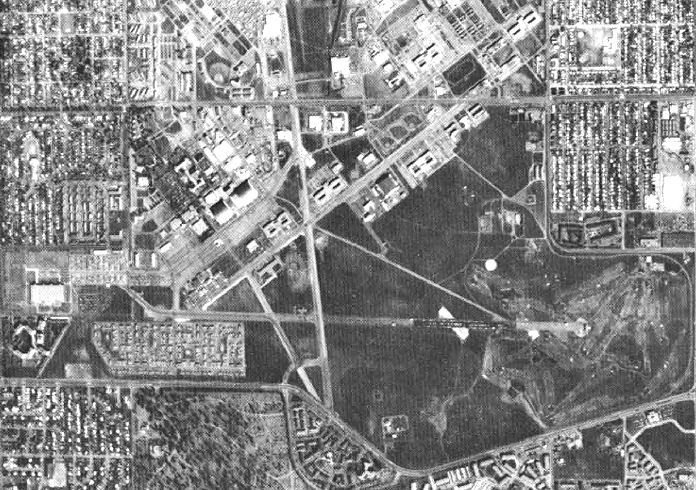
Lowry AFB shown with 2 Titan I launch complexes and missile plant PJKS

Background

[edit]

The City of Denver, Auraria, and Highland was chartered as the 1859 territorial capital after the start of the 1858 Pike's Peak gold rush. In 1887, Fort Logan was established in the modern Denver Metropolitan Area. East of the state capital, military training at Montclair, Colorado, began at the future airfield when the 1887 Jarvis Hall Military School opened. Montclair was incorporated into Denver in 1903 and Jarvis Hall burned down in 1904. At the military school site the Agnes Phipps Memorial Sanatorium[5] was established as a tuberculosis hospital in 1904 at 520 Rampart Way[5] (cf. "East 6th Avenue and Quebec Street") by Lawrence C. Phipps Sr., and in the 1930s the sanatorium included 17 buildings designed by the Gove and Walsh firm.[6]

"After several fires at Chanute Field and deterioration of the buildings" in Illinois,[7] a 1934 Air Corps announcement solicited a replacement training location and Denver submitted a bid.[6] The City of Denver purchased the sanatorium for an airfield after a 1935 municipal bond vote.[6] On 27 August 1937, the Denver Branch, Air Corps Technical School, was formed with Departments of Photography and Armament[citation needed] ("photography training moved from Chanute Field"),[8] and the WPA converted the sanatorium grounds into a Colorado military airfield.[6] In February 1938 the airfield being installed adjacent to Fairmont Cemetery was assigned to the Air Corps Technical School headquartered at Chanute,[citation needed] and "the Denver branch of the Army Air Corps became an Army post of 880 acres."[9]

Original Lowry Field

[edit]

The name Lowry Field was originally assigned to an airfield consisting of property taken over by the Colorado National Guard, having a southern border along East 38th Avenue between Dahlia & Holly Streets.[10] It was named for Second Lieutenant Francis Lowry, the only Colorado pilot killed in combat in World War I . The airfield was used by the 120th Observation Squadron, 45th Division Aviation. In 1924, the 120th began flying Curtiss JN-4Es (better known as Jennies) at the new airfield.

A 28 October 1926 photo shows the Fokker BA-1 trimotor Josephine Ford of the Byrd Arctic Expedition being refueled at the original Lowry Field.[11] Charles Lindbergh and his Spirit of St. Louis made a scheduled stop at Lowry on 1 September 1927[11] during his 48 state sponsored tour.[12] Jack Taylor died on the maiden voyage of the Cheyenne-Pueblo-Denver contract airmail route from Lowry to Cheyenne when his aircraft exploded on 10 December 1927.[13] He was flying a large Douglas mail plane for Western Air Express Inc. near Lowry.[14][15][16]

During the latter part of 1937 the name "Lowry Field" was transferred from the Colorado National Guard facility to the new Denver Branch, Air Corps Technical School. In early 1938, after about a year of overlapping operations, the 120th Observation Squadron moved to their new quarters at the Denver Municipal Airport;[17] remaining there until mobilization for World War II took place on 6 January 1941. The 19 officers and 116 enlisted members of the squadron then moved to Biggs Army Airfield, Texas.[18]

In 1938, the former Lowry Field was renamed Combs Field when Harry B. Combs began leasing the airfield. He and a partner opened Mountain State Aviation, a fixed-base operation and flight training facility. Mountain State would go on to train over 9,000 pilots for World War II through the Civilian Pilot Training Program at the location. In 1936, Combs had joined the 120th Observation Squadron, flying the 0-19 E variant and gaining enough flying time to earn his instructor’s rating.[19][20]

Lowry Field

[edit]
World War II Postcard of Lowry Field

Lowry Field was assigned to the new Army Air Field on 11 March 1938. Photographic courses began prior to the field's completion and runway paving.[21] The paved runway opened on 4 April[22] (first used by a B-18 Bolo). The sanatorium's main building became the Army post's headquarters, and the largest single barracks (3,200 men) was completed in mid-1940.[22] The "Northeast-Southwest runway was completed in 1941"[23] and on 1 March 1941, the Air Corps Technical School moved an "A.A.F. Clerical School"[24] for Air Corps Clerks (384 hours)[25] to Fort Logan from Lowry.[26] Beginning 16 July 1940,[27] the 1st class of the AAF bombardier schools was at Lowry and used the nearby bombing and gunnery range through 14 March 1941,[28] graduating three classes of instructors who opened the Barksdale Field bombardier school.[29]

Fourth Technical Training District

[edit]

Lowry training for Boeing B-29 Superfortress pilot qualification and for B-29 operational crew readiness began in 1943, and the base had a July 1943–Jan 1944 clerical school.[dubiousdiscuss] In 1944 expansion of Lowry's airfield was planned[30] and Lowry gained B-29 Flight Engineer training.

Lowry transferred under Technical Training Command in mid-October 1945 (Air Training Command on 1 July 1946) and by the end of 1945, Lowry's separation center was processing an average of 300 discharges a day. The nearby bombing range was transferred from Buckley Field, by authority of Technical Division, Air Training Command, to Lowry A.F.B. on 20 September 1946.[31] In July 1947, formal courses in Intelligence Training were established at Lowry for combat reporting, photographic intelligence, prisoner of war interrogation, and briefing and interrogation of combat crews.

USAF base

[edit]

Lowry Air Force Base was designated on 24 June 1948 and on 26 August 1948 established all Lowry training organizations under the 3415th Technical Training Wing (redesignated "Lowry Technical Training Center" on 1 Jan 1959). Lowry provided Operation Hayride emergency response for people and livestock threatened by eighteen December 1948 – January 1949 snowstorms from Utah to Kansas (e.g., a C-47 of the 2151st Air Rescue Unit delivered 115 blankets and 30 cases of C rations on 4 January to 482 people at Rockport, Colorado.)[32] By 25 August 1949, the 3903rd Radar Bomb Scoring Squadron had a unit based at Lowry which operated a Strategic Air Command radar station[33] (Lowry's radar annex was at Genesee Mountain Park.)

In 1951, plans called for the headquarters of Technical Training Air Force to be at Lowry[8] and after expansion at the beginning of the Korean War, Lowry courses included photography, armament, rocket propulsion, electronics, radar-operated fire-control systems, computer specialties, gun and rocket sights, and electronically operated turret systems. The 3415th Wing formed a Guided Missiles Department on 7 June 1951[citation needed] and from 1952 – 1955, Lowry functioned as President Dwight D. Eisenhower's Summer White House. Beginning in September 1954, the 3415th TTW moved intelligence, comptroller, and transportation training programs to Sheppard AFB. On 11 July 1955, the first class of 306 USAF Academy cadets was sworn in at Lowry.[34]

In 1956 Lowry's bombing range support ended when the bombing range mission was terminated[35] and Lowry's first general courses for missiles were developed.[8] Courses were for Falcon, Rascal, Snark, and Navajo missiles and in 1958, Nuclear Weapons Training. Also early in 1958, the USAF concluded that the new NORAD headquarters (different from the planned Cheyenne Mountain nuclear bunkers for NORAD and the Denver ADS) should be relocated from Ent AFB to Lowry AFB (CO Springs' Chidlaw Building became the new NORAD HQ).[36] In 1960, Lowry was the 3rd ranked technical training base of ATC.[7]

ICBM headquarters and training

[edit]

The Air Force Ballistic Committee, formed in 1955, approved the former bombing range on 13 March 1958 for the first Titan I ICBM launch complex (the Titan missile plant was built at Waterton Canyon.) The 703d Strategic Missile Wing was activated on 25 September 1958 and redesignated the 451 SMW on 1 July 1961, at the same time the 848th and the 849 SMS were redesignated the 724th and 725 SMS. Construction on all nine silos at the three launch complexes for the 724 was completed by 4 August 1961. On 18 April 1962, Headquarters SAC declared the 724th SMS operational, and 2 days later the first Titan Is went on alert status. A month later, the sister 725th SMS (initially designated the 849th SMS) declared it had placed all nine of its Titan Is on alert status, which marked a SAC first. Both the 724th and 725th Strategic Missile Squadrons formed components of the Lowry-headquartered 451st Strategic Missile Wing.[37] The "original class of instructors" for the Mace missile course at Lowry graduated from the "G.L. Martin factory training course in Baltimore MD in 1960"[38] and by early 1961, Lowry's personnel course moved to Greenville AFB.[7]

By 1962, Lowry's Department of Missile Training was graduating over 1,000 trained missile specialists per year,[citation needed] and the "Tactical Missile School at Lowry" (e.g., for Matador missile training) in January 1962 "was located in the Black Hangar."[39] On 25 June 1965, the 724th and 725th Strategic Missile Squadrons were inactivated,[40] and the last missile supported by Lowry was removed on 14 April 1965.[41]

Air Intelligence Training Center

[edit]

The Armed Forces Air Intelligence Training Center was established at Lowry effective 1 July 1963 with student training beginning on 17 July[citation needed] (by 14 March, "the Defense Department had assigned responsibility for all DOD air intelligence training and advanced training in photographic, radar, and infrared interpretation to the Air Force.")[8] In 1965, the runway was closed, and all Lowry AFB flying activities moved to nearby Buckley Air National Guard Base. Ten courses from Amarillo AFB were planned to be moved to Lowry in mid-1968,[8]: 159  and Amarillo's 3320th Retraining Group for convicted airmen moved to Lowry 1 July – 1 September 1967. In 1974, the Air Staff approved Lackland AFB's Special Treatment Center to transfer to the 3415th Special Training Group at Lowry AFB. In addition to Air Force personnel, the U.S. Navy also sent junior officers (ensigns and lieutenants) for initial intelligence training at Lowry, along with enlisted personnel newly graduated from boot camp for their "A" school instruction as intelligence specialists.

Construction began in 1970 for enlisted and officer billeting facilities to replace World War II vintage barracks, five 1,000-man dormitories and completed by 1974, a 187-space mobile home park. Other added facilities included a youth center, a child-care center, a chapel (in addition to the 1941 chapel), and a new Airmen's Open Mess. In 1976, the Defense Finance and Accounting Service (formerly Air Force Accounting & Finance Center) & the Air Reserve Personnel Center opened in the Gilchrist Building (Building 444).

The AFAITC school remained at Lowry from 1963 to 1988, before moving to Goodfellow AFB, in San Angelo, Texas. US Navy intelligence training for both junior officers and enlisted personnel was shifted to the new Navy Marine Corps Intelligence Training Center (NMITC) at Dam Neck, in Virginia Beach, Virginia.

USAF School of Applied Aerospace Sciences, Lowry

[edit]

In 1972, the 3415th Technical Wing[citation needed] became the USAF School of Applied Aerospace Sciences, Lowry. The Department of Aerospace Munitions Training continued missile training and in 1978 was redesignated the 3460th Training Group. In 1980 Lowry acquired a Davis-Monthan AFB B-52D and stabilized[specify] another B-52 for training ALCM and SRAM loading procedures. New courses in the 1970s and 1980s included flight line and in-shop avionics maintenance courses for the F-4 Phantom II, F-111 Aardvark, A-10 Warthog, F-15 Eagle and F-16 Fighting Falcon (e.g., communications, flight controls, navigation, weapons guidance, and electronic countermeasures & warfare systems). In 1982, Lowry's 1941 Eisenhower Memorial Chapel (cf. the Eisenhower Chapel at Fort Knox[42]) was listed in the National Register of Historic Places. The National Geospatial Agency's Integrated Operations Center was in Denver and by 1983, Lowry had the Air Intelligence Officer Course[43]

LGM-118 Peacekeeper ICBM training began at Lowry in 1985, and after Lowry became the primary training center for USAF space operations, Undergraduate Space Training's 1st graduation was in 1987. The 3301st Undergraduate Space Training unit moved to Vandenberg AFB, CA in 1991, prior to Lowry AFB closure.[44] Lowry also handled ground & armament training for several interceptor models, the A-10 Thunderbolt II, and the B-1 Lancer.

After being considered for closure in 1978 and since "Lowry lacked a runway"[7] (all runways closed and all USAF flight operations terminated, July 1966),[22] Lowry AFB was designated for closure by BRAC 1991. The 3400th Technical Training Wing inactivated on 27 April 1994, and the base officially closed on 30 September 1994. The National Civilian Community Corps used Lowry facilities from 1994 until 2004; and Space Systems Support Group Detachment 1 "located at the former Lowry AFB" in March 1995 moved to Peterson AFB.[45] The Bonfils Blood Center "became the first commercial tenant at Lowry" in the former commissary during September 1995, and the site development company was presented facility and real estate awards in 1997[46] (asbestos was remediated from the Formerly Used Defense Site[47] of "1,866 acres"—remediation at buildings included Building 402:PCBs, 606: groundwater, & 1432: soil[2]).

Closure

[edit]

The Buckley Annex was the remaining military installation after the "Whole Base Transfer" of Lowry AFB in 2006,[48] the year the USGS listed the closed Lowry AFB in the Geographic Names Information System.[1] In 2007, the annex of 70 acres (28 ha) with DFAS & ARPC[49] was planned for closure.[46] The last remaining Air Force facility at Lowry was the Air Reserve Personnel Center,[50] which BRAC 2005[2] moved to Buckley AFB in August 2011. The Buckley Annex' Whole Base Transfer was in 2012, and the "final stages of cleanup" of the base and annex were underway in February 2013.[48]

Most of the base is now the Lowry, Denver, neighborhood with 2 hangars used for the Wings Over the Rockies Air and Space Museum, the former Building 1499 for the Big Bear Ice Rink, a dormitory for the Logan School for Creative Learning,[51] and base officer housing and other facilities for the Stanley British Primary School.[52] A dormitory and a former medical building on the east end of the base are owned by the state as part of the Higher Education and Technology campus. The last remaining military facility at the former Lowry base was the Defense Finance and Accounting Service Finance Center (6760 E Irvington Place), which had its own USAF Base Facility identifier in 2004 (08002D).[3] The Lowry Community Master Association (LCMA) is located at 7581 E Academy Blvd,[53] the former hangar with the name "Lowry Air Force Base" and which also has suites for Martifer Solar USA, Mor Beverage Corp, Montessori Casa International, and Extra Space Storage. Bishop Machebeuf Catholic high school is located in the Lowry neighborhood.[54]

Assignments and major units

[edit]
  • Air Corps Technical School, 27 Aug 1937
  • Air Corps Technical Training Command, 26 March 1941 (AAF Technical Training Command on 15 March 1942)
  • AAF Training Command, 31 July 1943 (Air Training Command on 1 July 1946)
  • Air Educational and Training Command, 1 June 1992 – 27 April 1994
Major units

See also

[edit]

References

[edit]
Revisions and contributorsEdit on WikipediaRead on Wikipedia
from Grokipedia
Lowry Air Force Base was a installation in , , operational from 1938 until its closure on September 30, 1994, primarily dedicated to technical and specialized training for airmen. Named in honor of Lieutenant Francis B. Lowry, a Colorado native and aerial observer who perished in a 1918 plane crash, the base was established on a site selected in 1935 to meet requirements for bombing range space and favorable weather conditions supporting year-round flight operations. Over its 57 years of service, Lowry became one of the Air Force's premier training centers, graduating more than 1.1 million personnel in fields ranging from intelligence and aerospace maintenance to applied aerospace sciences, contributing significantly to the development of skilled forces during World War II, the Cold War, and beyond. In 1955, it temporarily hosted the inaugural class of the United States Air Force Academy before the Academy's permanent relocation to Colorado Springs. The base's closure stemmed from the 1991 Base Realignment and Closure Commission's recommendations amid post-Cold War force reductions, leading to its transformation into a 1,800-acre mixed-use redevelopment featuring residential, commercial, and educational facilities, though ongoing environmental remediation addresses groundwater contamination from historical fuel leaks and chemical spills.

Establishment and Early Operations

Founding as Lowry Field

Lowry Field was established in , , to support the expansion of Army Air Corps technical training amid growing pre-World War II military needs. The site, located near East 6th Avenue and Quebec Street, was selected in following President Franklin D. Roosevelt's authorization of funds to relocate and develop a permanent facility, building on an earlier auxiliary airfield named Lowry that had operated from 1926 to the early 1930s. Previously occupied by the Agnes Phipps Memorial Sanatorium for patients, the location offered existing structures adaptable for military use, including barracks and administrative buildings. The field was named in honor of Second Lieutenant Francis B. Lowry, a Denver native and the only Colorado aerial observer killed during World War I. On October 15, 1918, while serving as an aerial photographer with the U.S. Army Air Service in , Lowry's observation plane was struck by German antiaircraft fire near , causing it to crash and resulting in his immediate death alongside his pilot. The War Department announced the naming in 1937, recognizing his service and posthumous Distinguished Service Cross award for bravery in missions. Construction and conversion efforts commenced on October 4, 1937, transforming buildings into and initial training facilities for the Denver Branch of the Air Corps Technical School. Photographic mapping and aerial observation courses began on February 28, 1938, even as infrastructure development continued. The base was officially designated Lowry Field on March 11, 1938, with the paved runway opening on April 4, enabling the first landing by a . Major Junius W. Jones oversaw early establishment efforts after his transfer to in March 1938. In June 1938, the unveiled a four-year, $3.5 million program to expand facilities, with contracts awarded starting August 13, focusing on hangars, additional runways, and technical . This initiative supported the field's primary mission of instructing mechanics, photographers, and armament specialists, addressing the Air Corps' need for skilled personnel amid rapid aviation advancements. By late 1938, Lowry Field had transitioned from temporary operations to a key technical hub, laying the groundwork for its expansion during wartime demands.

World War II Bombardier and Technical Training

The United States Army Air Corps established its first bombardier school at Lowry Field in July 1940, conducting initial training classes that utilized the nearby Bombing and Gunnery Range. This program graduated three classes of instructors by March 14, 1941, who subsequently established bombardier schools at bases including Barksdale Field, Louisiana. Early graduates, primarily enlisted personnel, served as instructors to expand the Army Air Forces' bombardier training capacity amid pre-war mobilization. Following the transfer of primary bombardier instruction elsewhere, Lowry Field transitioned to comprehensive technical training under the Army Air Forces Training Command, with the Western Technical Training Command headquartered in . During , the base specialized in armament, photography, and familiarization training for B-29 Superfortress crews, operating courses continuously to meet wartime demands. Classes ran 24 hours a day, generating approximately 850 graduates per week across these technical specialties. The Armament School, initially housed in repurposed Phipps Sanatorium buildings acquired in 1937, trained personnel in weapons systems critical to heavy bomber operations. Lowry's technical programs emphasized practical skills for ground and support, contributing to the rapid expansion of skilled personnel for units in the European and Pacific theaters. By , the base had grown to support thousands of trainees annually, leveraging its location for efficient logistics and climate suitable for year-round operations. These efforts aligned with the Army Air Forces' doctrine prioritizing specialized technical proficiency to enhance bombing accuracy and effectiveness.

Cold War Era Expansion

Post-War Technical Training Mission

Following World War II, Lowry Air Force Base maintained its role as a cornerstone of U.S. Air Force technical training, transitioning from wartime surge capacity to sustained peacetime instruction under the Air Training Command, established on July 1, 1946. The base initially supported personnel separation efforts in late 1945 before refocusing on advanced courses in aircraft maintenance, electronics, radar, radio systems, and mechanics, building on prior emphases in aerial photography and armaments. These programs ensured the proficiency of airmen in operating increasingly complex aircraft and support equipment amid postwar demobilization and force restructuring. The 3415th Technical Training Wing oversaw operations, delivering specialized instruction that ramped up during the to meet demands for skilled technicians. By 1951, the wing incorporated guided missile training, aligning with emerging strategic priorities, while annual enrollment in technical fields exceeded 1,000 students by 1955. Formal intelligence training courses commenced in July 1947, enhancing the base's scope beyond mechanical skills to include analytical expertise vital for contingencies. Lowry's post-war mission emphasized hands-on, rigorous curricula to produce combat-ready support personnel, contributing significantly to readiness through the early era. Over its operational lifespan, the base trained more than 1.1 million students, with post-1945 efforts laying the foundation for subsequent expansions in and space-related programs.

ICBM Headquarters and Missile Systems Training

On June 7, 1951, the 3415th Technical Training Wing at Lowry Air Force Base established a Guided Missiles Department to provide instruction in guidance systems, control mechanisms, and technologies for early guided missiles, including and . This initiative marked the beginning of specialized missile systems training at the base, aligning with the Air Force's expanding focus on rocket and missile technologies during the early period. As (ICBM) programs matured, Lowry assumed a pivotal role in (SAC) operations. On September 5, 1958, SAC established the 703rd Strategic Missile Wing (ICBM-Titan), which was activated at Lowry on September 25, 1958, and assigned to the 1st Strategic Aerospace Division. This wing represented the inaugural Titan I ICBM unit, with Lowry selected partly due to its proximity to the , the missile's manufacturer in . The activation facilitated headquarters functions and initial operational preparations, including the development of training protocols for Titan I deployment. Subsequently, the 451st Strategic Missile Wing (Titan I) was also headquartered at Lowry, overseeing squadrons such as the 724th Strategic Missile Squadron, which operated Titan I complexes on the Lowry Bombing and Gunnery Range east of . By 1962, the first Titan I complex was transferred to control during a ceremony at the wing , enabling hands-on and alert operations with 18 operational missiles across multiple sites. The base's Department of Missile Training expanded to produce over 1,000 certified specialists annually, supporting SAC's missile crew proficiency in launch, maintenance, and fire control systems. Titan I operations at Lowry peaked from 1961 to 1965, after which SAC decommissioned the and closed the associated missile range between April 15 and June 25, 1965, amid broader shifts in ICBM technology toward more advanced systems like Minuteman. training persisted under the renamed USAF of Applied Sciences in 1972, incorporating evolving ICBM maintenance and operations curricula within the Department of Sciences. These programs emphasized empirical proficiency in systems, contributing to the Air Force's strategic deterrence posture through rigorous, data-driven instruction.

Intelligence and Aerospace Sciences Programs

Formal intelligence training courses were established at Lowry Air Force Base in July 1947 under the Technical Division of , initially focusing on air fundamentals for personnel. By the Korean and Wars, these programs had expanded to include advanced operations, training thousands of airmen in , analysis, and related skills as part of Lowry's core technical mission. The Armed Forces Air Center (AFAITC) was activated at effective July 1, 1963, with initial student training commencing on July 17, marking a joint-service effort to standardize intelligence education across the , , , and . The center delivered multi-week curricula, such as the 16-week officer air intelligence course, emphasizing photographic interpretation, target , and strategic assessment, while accommodating international students and producing graduates for operational assignments. Unit , established in 1964, augmented these efforts with specialized air intelligence and defense meteorological training until the unit's operations wound down in the early 1990s. In the late 1980s, general intelligence training at Lowry was consolidated and relocated to , , as part of broader efficiencies, ending AFAITC's tenure after nearly three decades of service. Aerospace sciences programs at Lowry evolved from early missile training initiatives, with the Guided Missiles Department formed on June 7, 1951, under the 3415th Technical Training Wing to instruct on guidance, control, propulsion, and maintenance for systems like , , Rascal, Snark, and Navaho missiles, graduating over 1,000 specialists annually by 1962. These courses supported Strategic Air Command's ICBM and expansions during the , later incorporating Peacekeeper ICBM reentry vehicle repair training starting in 1985. In 1972, the 3415th Technical Training Wing was redesignated the USAF School of Applied Sciences, consolidating , munitions, and emerging space-related instruction under a unified framework that emphasized practical applications in operations. The school integrated and advanced guidance curricula, training personnel from multiple services and nations through hands-on simulations and equipment familiarization. Air Training Command launched an undergraduate space training program at Lowry in October 1986, with the first class convening in February 1987, to prepare airmen as "space generalists" for operational roles in satellite systems, , and space surveillance, reflecting the 's growing emphasis on . This initiative, hosted within the School of Applied Aerospace Sciences, continued until base closure activities in the early , after which specialized shifted to sites like Vandenberg Base in April 1993.

Base Infrastructure and Command Structure

Major Units and Assignments

The primary host unit at Lowry Air Force Base throughout much of its operational history was the 3415th Technical Training Wing, established on 26 August 1948 under to consolidate and oversee the base's diverse technical training programs, including , munitions handling, and early guided missile instruction. This wing evolved into the Lowry Technical Training Center by the 1970s, expanding to train thousands of airmen annually in specialized skills such as weather operations, photography, and aerospace maintenance, with command responsibilities held by figures like William R. Usher in the 1980s. During the early , the base hosted the 451st Strategic Missile Wing, activated on 26 April 1961 and organized on 1 July 1961, which commanded Titan I intercontinental ballistic missile squadrons (including the 724th and 725th Strategic Missile Squadrons) dispersed in remote launch facilities near Lowry, marking the first fully operational Titan I wing under . The wing supported missile crew training and operational readiness until its inactivation in June 1965 as the Titan I system was phased out. The Armed Forces Air Intelligence Training Center, established on 1 July 1963 as a joint-service activity under , became a key tenant unit, delivering instruction in photographic interpretation, radar analysis, and electronic intelligence to , , and other personnel until the base's closure. From September 1976 until Lowry's inactivation in 1994, the Air Reserve Personnel Center served as a major non-flying tenant, administering personnel records, assignments, and support for over 400,000 Reserve and members as part of Reserve Command's total force integration efforts. Other notable assignments included student and school squadrons under the technical training structure, such as the 3451st, 3452nd, and 3453rd Student Squadrons, which handled trainee administration and course delivery in the base's later decades. These units underscored Lowry's role as a non-combat training hub rather than a flying or combat operations base.

Facilities, Logistics, and Strategic Role

Lowry Air Force Base maintained extensive infrastructure to support its primary technical training functions, comprising approximately 1,000 structures including headquarters buildings, classrooms, dormitories, a steam plant, aircraft hangars, and medical facilities such as dispensaries and dental clinics. The base featured two principal aircraft hangars and repurposed historic elements like Chapel Number 1 and the Agnes C. Phipps Memorial Sanatorium, which served as the administration building until its demolition in 1963. Community-oriented amenities formed a self-sufficient enclave, encompassing dining halls, commissaries, post exchanges (PX/BX), officer and enlisted clubs, theaters, and on-base housing quarters to house trainees and staff. Logistics operations at Lowry underpinned its training throughput, enabling 24/7 activities during peak periods like when the population reached 20,000 personnel. Supply and maintenance functions were integrated into the base's infrastructure, supporting the annual training of over 1,000 specialists in the and facilitating broader defense through skilled personnel output in fields such as armaments and . These efforts sustained operational readiness across multiple conflicts. In its strategic role, Lowry functioned as a cornerstone of U.S. nuclear deterrence during the , serving from 1958 as the for the first Titan I ICBM wing and overseeing six off-base launch complexes—each with underground facilities and three missile silos—spanning an 18-mile radius around the base. The installation's technical training mission prepared over 1.1 million airmen for , the , tensions, and , emphasizing skills vital to strategic air under the motto Sustineo Alas ("I Sustain the Wings"). This personnel pipeline, including specialized missile and intelligence training, directly bolstered the Air Force's capacity for sustained global operations and deterrence against Soviet threats.

Closure and Transition

Base Realignment and Closure Process

Lowry Air Force Base was recommended for complete closure as part of the 1991 (BRAC) round, established under the Defense Base Closure and Realignment Act of 1990 to facilitate the independent evaluation of excess military infrastructure following the drawdown. The Department of Defense initially proposed a list of bases for closure and realignment to reduce costs and consolidate functions, submitting Lowry due to its technical training mission being duplicative with capacities at other installations. On July 1, 1991, the independent BRAC Commission endorsed the full closure of Lowry, determining that its 1,786 acres and associated training programs could be efficiently relocated without compromising readiness, projecting annual savings of approximately $50 million once implemented. The Commission's recommendation was forwarded to President , who approved it on July 15, 1991, transmitting the list to , which had a 45-day period to disapprove via but did not exercise . This initiated a phased transition, with training activities, including those of the 3400th Technical Training Wing, progressively transferred to bases such as Lackland AFB in for basic military training and Goodfellow AFB for intelligence instruction. The BRAC statute mandated full implementation within six years of presidential approval, leading to the wing's inactivation on April 27, 1994, and the base's official closure on September 30, 1994. Property disposal and environmental assessments followed under BRAC oversight, with the Lowry Redevelopment assuming responsibility for community reuse planning by 1995.

Environmental Remediation Efforts

Upon the 1994 closure of Lowry Air Force Base under the (BRAC) process, environmental remediation efforts targeted from decades of aviation maintenance, fuel storage, and waste disposal activities, which released volatile organic compounds (VOCs) such as (TCE) and (PCE), petroleum hydrocarbons, and other solvents primarily into via storm sewers, septic systems, and surface spills. The U.S. Air Force's Installation Restoration Program (IRP), initiated in the , identified approximately 23 potential sites across the 1,800-acre former base, with key hotspots in Areas 1 through 10, including former fire training pits, paint shops, and fuel loading facilities. Remediation actions, overseen by the Air Force Civil Engineer Center (AFCEC) in coordination with the U.S. Environmental Protection Agency (EPA) and Colorado Department of Public Health and Environment (CDPHE), employed a combination of source removal and treatment technologies. These included excavation and off-site disposal of over 100,000 cubic yards of contaminated soil at sites like IRP Site 25 (a former ) by the early 2000s, installation of pump-and-treat systems with for VOC removal at Complexes 1B and 2C starting in the late , and soil vapor extraction to address residual subsurface plumes. Institutional controls, such as environmental covenants and deed restrictions prohibiting use without treatment, were implemented on transferred properties to manage residual risks, with five-year reviews confirming protectiveness as recently as 2022. Cumulative costs for environmental restoration at Lowry, drawn from Department of Defense BRAC accounts, exceeded $50 million by 2020 across documented sites, including $6.8 million for Complex 1B and $4 million for Complex 2C, covering investigation, remedial , and long-term monitoring. Most legacy VOC and fuel sites achieved remedial action complete status with land use controls by the mid-2010s, transitioning to operation and maintenance phases, though per- and polyfluoroalkyl substances (PFAS) investigations, mandated under the 2020 , identified plumes exceeding EPA advisory levels in off-base groundwater, prompting enhanced site characterization and pilot testing of in-situ treatments like injection as of 2023. Ongoing monitoring ensures no unacceptable exposures, supporting while addressing evolving regulatory standards for emerging contaminants.

Redevelopment and Enduring Legacy

Urban Redevelopment into Mixed-Use Community

Following the closure of Lowry Air Force Base on September 30, 1994, under the Base Realignment and Closure (BRAC) process, the 1,866-acre site—90% within Denver city limits and 10% in Aurora—underwent a comprehensive reuse plan approved by the U.S. Air Force in 1993 and formally adopted in 1995. The Lowry Redevelopment Authority (LRA), a quasi-public entity established to oversee the transition, acquired 758 acres from the Air Force in July 1995 via a $32.5 million economic development conveyance, initiating phased transformation into a master-planned, mixed-use community integrating residential, commercial, retail, and recreational elements while preserving select historic structures. The emphasized principles, including a grid of streets and blocks to reconnect the site with surrounding neighborhoods, pedestrian-friendly pathways, and an extensive open space system comprising parks, trails, and green belts to foster and community integration. By 2005, the project had delivered approximately 3,000 residential units housing 6,500 new residents, alongside commercial developments such as a town center with retail outlets, restaurants, and converted former barracks into loft apartments like the Grand Lowry Lofts. Mixed-income housing options, including single-family homes, townhomes, and condominiums, were prioritized to create socioeconomic diversity, supported by approval in 1998. Environmental remediation preceded and accompanied construction, addressing contaminants from prior military use, enabling safe reuse of the land for over 800 acres of parks and open spaces. The final transfer of the 70-acre Buckley Annex parcel occurred on June 1, 2012, completing the handover to local control and allowing full implementation of the mixed-use vision, which by then included educational facilities, community centers, and preserved aviation history exhibits. This approach contrasted with typical base closures by leveraging the site's central urban location to avoid sprawl, instead promoting dense, multifunctional development that enhanced Denver's eastern corridor connectivity.

Economic and Community Impacts

The operation of Lowry Air Force Base contributed approximately $1 billion annually to the area's economy through and payrolls, , and related activities prior to its closure. At the time of closure in September 1994, the base employed around 4,000 and personnel, representing a significant direct economic loss to and adjacent Aurora. The base's closure under the 1991 Base Realignment and Closure (BRAC) process initially disrupted local and fiscal revenues, but subsequent transformed the 1,866-acre site into a mixed-use neighborhood, generating substantial economic recovery. Between 1994 and 2003, the Lowry Redevelopment Authority's efforts produced a $4 billion gross economic impact, with $2.3 billion directed to through construction, , and commercial development. By 2008, cumulative contributions exceeded $5.7 billion, including new s from over 3,000 residential units 6,500 residents and commercial spaces supporting ongoing . An agreement further yielded nearly $3 billion in new , funding and public services. Community impacts have been predominantly positive, fostering integration of the former base into Denver's urban fabric with preserved historic elements, parks, schools, and 25,000 daily users living, working, or studying on-site. The master-planned community has absorbed former base infrastructure for —allocating nearly 400 units via public benefit conveyances to nonprofits—and spurred neighborhood revitalization, earning state and national awards for sustainable reuse. While delayed some phases and posed challenges, the overall transition enhanced residential density, reduced pressures, and supported Denver's broader economic renaissance without long-term net job displacement.

Preservation of Military History and Contributions

Following the closure of Lowry Air Force Base in 1994, preservation efforts focused on retaining key structures and artifacts to document its role in training over one million U.S. and Allied military personnel across more than five decades. The Lowry Foundation, established to safeguard the site's legacy, maintains records and promotes awareness of the base's contributions to aviation and technical training from its origins as Lowry Field in 1938. Hangar 1, a primary surviving structure from the base's active period, was repurposed to house the Wings Over the Rockies Air & Space Museum, which dedicates significant space to Lowry's operational history, including exhibits on its World War II-era pilot and bombardier training programs. The museum's Lowry Heritage Room features artifacts, documents, and displays illustrating the base's evolution, such as its temporary role as the interim site for the from 1955 to 1958, and preserves archives covering operations through 1994. Over 30 aircraft and related items in the collection underscore Lowry's advancements in aerial gunnery, , and armament instruction. Additional preserved buildings highlight specialized military functions; for instance, the Photography and Armament Building remains as a testament to early technical efforts that continued into the . Building 880, one of seven structures linked to the Academy's early years, stands as a physical link to that transitional phase in U.S. . These sites, integrated into the Lowry , ensure ongoing recognition of the base's causal impact on Allied airpower development, from through the , without reliance on narrative-driven reinterpretations. Local exhibits, such as the "A of Lowry Air Force Base" display in Aurora, further commemorate its establishment on the former Agnes C. Phipps Memorial grounds in 1938.

References

Add your contribution
Related Hubs
User Avatar
No comments yet.