Recent from talks
Contribute something
Nothing was collected or created yet.
Macarena
View on Wikipedia
| "Macarena" | ||||
|---|---|---|---|---|
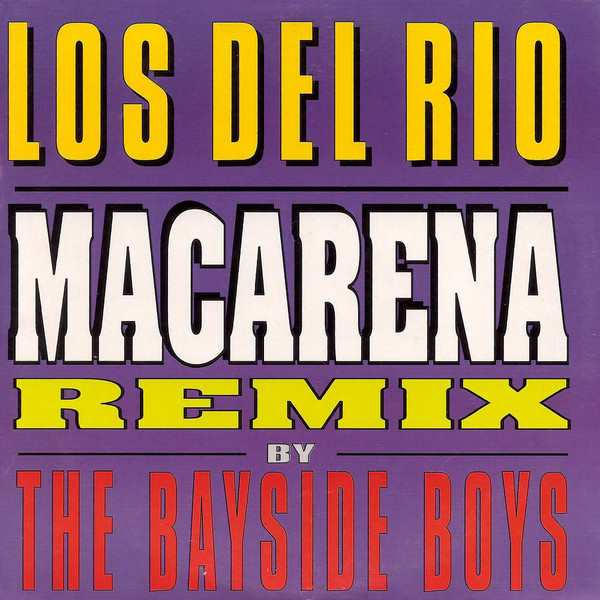
1995 European release (Bayside Boys mix) | ||||
| Single by Los del Río | ||||
| from the album A mí me gusta and Fiesta Macarena | ||||
| Released |
| |||
| Recorded | 1992 (original) | |||
| Studio | OVO | |||
| Genre | ||||
| Length |
| |||
| Label | RCA | |||
| Songwriters |
| |||
| Producer | Los del Río | |||
| Los del Río singles chronology | ||||
| ||||
| Alternative cover | ||||
Artwork for Maquina retail release | ||||
| Audio | ||||
| "Macarena" (original version) on YouTube | ||||
| Music video | ||||
| "Macarena" (Bayside Boys remix) on YouTube | ||||
"Macarena" is a song by Spanish pop duo Los del Río, originally recorded for their 1993 album A mí me gusta. A dance remix by the electropop group Fangoria was a success in Spain, and a soundalike cover version by Los del Mar became popular in Canada.[2] Another remix by Miami-based producers the Bayside Boys, who added a section with English lyrics, expanded its popularity, initially peaking at No. 45 on the US Billboard Hot 100 in late 1995.[2]
The Bayside Boys mix enjoyed a significant revival the following year when it re-entered the Billboard Hot 100 and reached No. 1 for 14 weeks between August and November 1996. Its resurgence was aided by a dance craze that became a cultural phenomenon throughout the latter half of 1996 and early 1997. The song got the group ranked the "No. 1 Greatest One-Hit Wonder of All Time" by VH1 in 2002. In 2012, it was ranked No. 7 on Billboard's All Time Top 100. It also ranked at No. 7 on Billboard's All Time Latin Songs list.[3][4] In 2023, Billboard ranked "Macarena" number 500 in their list of Best Pop Songs of All Time.[1]
Composition
[edit]The composition of "Macarena" features a variant on the clave rhythm.[5][6] The song is written in the key of A♭ major, moves at a tempo of 103 beats per minute, and follows the repeated chord progression A♭–G♭ throughout.[7]
Origin and history
[edit]As a result of their lounge act, Los del Río were invited to tour South America in 1992[8] and, while visiting Venezuela, they were invited to a private party held by the Venezuelan impresario Gustavo Cisneros.[9] During the celebration, a local flamenco teacher, Diana Patricia Cubillán Herrera, performed a dance for the guests, and Los del Río were pleasantly surprised by Cubillán's dance skills. Spontaneously, Antonio Romero Monge, one half of the Los del Río duo, recited the song's chorus-to-be on the spot, as an accolade to Cubillán: "¡Diana, dale a tu cuerpo alegría y cosas buenas!'" ("Give your body some joy, Diana").[8] When Monge wrote the song, he changed the name to Macarena, in honor of his daughter Esperanza Macarena.[9]
Spanish-language remix
[edit]In 1993, RCA Records released "Macarena" as a single in Spain along with two house remixes by Spanish group Fangoria,[10] intended to popularize the song in nightclubs and discotheques.[11] These remixes changed the flamenco rhythm of the song to an electronic beat. According to Alaska, member of Fangoria, the Bayside Boys remix that followed in 1996 took their version labelled "Macarena (River Remix)" as its base. The band denounced it as plagiarism on the Court of Justice of the European Union but the case did not go through.[11]
English-language remix
[edit]In mid-1996, the song became a worldwide hit roughly one year after the Bayside Boys (composed of Mike Triay and Carlos de Yarza) produced a remix of the song that added English lyrics.[12] Jammin Johnny Caride, a radio personality at Power 96 in Miami, first learned of the original "Macarena" when clubgoers at a club where he worked as a DJ requested the song.[12] Caride brought the "Macarena" to his supervisors at Power 96 who asked him to create an English-language version of the song.[12]
Caride recruited his two partners at Bayside Records, Mike "In the Night" Triay and Carlos de Yarza, to remix the original song.[12] The new, English-language lyrics were written by Carlos de Yarza. The Bayside Boys, Triay and de Yarza, added a new dance beat with English-language lyrics sung originally by the studio singer Patty Alfaro,[13] then later during a concert tour by Carla Vanessa.[12] Vanessa accepted a fixed-fee contract for her participation and live performances, and so does not receive any residual performer royalties.[14] The finished version was called "Macarena (Bayside Boys Remix)".[12] The Bayside Boys remix hit No. 1 on the Billboard Hot 100 in August 1996 and remained at the top of the chart for fourteen weeks.[15] It also topped the US Cash Box Top 100. Remarkably, even this version of the song was completely ignored by the US Hot Dance Club Play chart which represented DJ club playlists.
The Bayside Boys mix of "Macarena" was featured in Sonic Team's Samba de Amigo for the Sega NAOMI arcade system and the Sega Dreamcast.[16]
Critical reception
[edit]David Browne from Entertainment Weekly wrote, "It says something about our culture—something delightfully devious, probably—that a wink-wink club song has become an all-ages-approved dance step and novelty hit. Like the story it tells, 'Macarena' is a one-night stand, but you won't forget her name in the morning."[17] Dan Glaister from The Guardian said that the track was "imitating the successes of previous summer pop sensations such as 'Y Viva Espana', 'Agadoo' and 'Saturday Night'."[18] Melody Maker commented, "Admit it. You loved it. The sarky girlie lyric, the middle-aged Spanish geezers crooning away, the placidly agreeable beat. Eyyyyyy, macarena!"[19] James Hamilton from Music Week's RM Dance Update described the song as an "infectious cheerful girls giggled and guys chanted 'Me No Pop I'-ish original hit version of a jaunty hip wiggling dance craze huge for ages around Europe and now (breaking out of Florida) the US, in frisky flamenco clapped jiggling 103.2bpm Bayside Boys Mix".[20] Peter Castro from People Magazine wrote, "The 'Achy Breaky Heart' flatlined years ago and the 'Electric Slide' is short-circuiting, so what's a dance-crazed world to do? The 'Macarena', obviously."[21] Dave Fawbert from ShortList stated that "Macarena" is "a song that exists independently of cool, time, criticism – it's just there."[22] Jordan Paramor from Smash Hits gave it one out of five, saying, "'Macarena' is 1996's answer to Whigfield's 'Saturday Night', overflowing with nauseating Latino-style beats and repetitive lyrics, sung by two suited middle-aged blokes who should know better. And, quelle surprise, there's even a quirky little dance routine to go with it."[23]
Popularity
[edit]The reworked "Macarena (Bayside Boys remix)" spent 14 weeks at No. 1 on the US Billboard Hot 100 singles chart, becoming one of the longest runs atop the Hot 100 chart in history.[15] The single spent its final week at No. 1 on its 46th week on the chart, recorded as the latest No. 1 single in Hot 100 history. Billboard ranked it as the No. 1 song for 1996.[24] In the United Kingdom the song was released on 10 June 1996 and peaked at No. 2 on 17 August 1996,[25] kept off the No. 1 spot by the huge popularity of the Spice Girls song "Wannabe".[26] In Australia, it was the most successful song of 1996.
"Macarena" remained popular through 1996, but by the beginning of 1997, its popularity had begun to diminish. The song stayed in the Hot 100 chart for 60 weeks, the longest reign among No. 1 songs, only surpassed fifteen years later by Adele's "Rolling in the Deep". The Bayside Boys remix includes a sample from the Yazoo (also known in the United States as Yaz) track "Situation"—the laughter of Yazoo vocalist Alison Moyet. The chorus uses female vocal samples previously used by the Farm in their song "Higher and Higher (Remix)" from their album, Spartacus. The Bayside Boys toured the U.S. and the world and featured singer Carla Vanessa.
In the United States, the song, and its corresponding Macarena dance, became popular around the time of the 1996 Democratic National Convention in August of that year. C-SPAN filmed attendees dancing to the song in an afternoon session, a clip of which became popular on YouTube years later.[27] Vice President Al Gore, having a reputation for stiffness, made a joke about doing the Macarena dance during his speech. He said, "I would like to demonstrate for you the Al Gore version of the Macarena," then remained motionless for a few seconds, and eventually asked, "Would you like to see it again?"[28][29]
By 1997, the song had sold 11 million copies. While having only a 25% take in royalties from the song, Romero and Ruiz became immensely wealthy. According to BBC News, during the year 2003 alone—a full decade after the song's initial release—Romero and Ruiz made US$250,000 in royalties.[a] Julio Iglesias is quoted as congratulating the duo personally: "My success singing in English from Miami is nothing compared to yours; coming out of Dos Hermanas with little international exposure elsewhere and selling these many records in Spanish takes two huge sets of cojones."[30]
In VH1's 2002 documentary 100 Greatest One-hit Wonders, "Macarena" was ranked as No. 1. "Macarena" was also ranked No. 1 on a different VH1 documentary, 40 Awesomely Bad No. 1 Songs. On America's Best Dance Crew, it was danced to on the Whack Track Challenge, given to the Ringmasters. In July 2020, digital publication The Pudding carried out a study on the most iconic songs from the 1990s and songs that are most known by Millennials and the people of Generation Z. "Macarena" was the eighth song with the highest recognisability rate.[31] In a December 1, 1996, Peanuts comic strip, Snoopy is about to join Woodstock and an unnamed identical bird at a frozen-over birdbath for a hockey game, but they start off by doing the Macarena dance first before playing, much to his embarrassment.[32]
Music video
[edit]The music video for the reworked Bayside Boys-remix of "Macarena" was directed by Vincent Calvet.[33] It starred Mia Frye, who was also the choreographer, and features ten different women singing and dancing with Los del Río against a white background. In contrast to the scantily-clad women, Los del Río are dressed in suits. When the music video for the Bayside Boys Remix was filmed, Mia Frye choreographed a greatly simplified version of the Macarena dance that already existed at the time. Frye and director Calvet drew inspiration from video footage from clubs in Mexico that showed large crowds of people dancing the original, more complex, Macarena.[34]
According to Los del Rio, the dance originated from the interaction between the band and the audience at concerts. It started with some improvised arm movements from the singers during an instrumental part of the song. Some people in the audience then began to imitate similar dance moves. In the interplay between the band and the audience, an early form of Macarena dance gradually emerged over the course of several concerts because stories about the Macarena dance spread among the band's fans by word of mouth.[35]
Accolades
[edit]| Year | Publisher | Accolade | Rank |
|---|---|---|---|
| 1996 | Melody Maker | "Singles of the Year"[19] | 46 |
| 2000 | VH1 | "100 Greatest Dance Songs"[36] | 84 |
| 2005 | Blender | "The 500 Greatest Songs Since You Were Born"[37] | 198 |
| 2014 | Rolling Stone | "20 Biggest Songs of the Summer: The 1990s"[38] | 3 |
| 2017 | Billboard | "The 100 Biggest Summer Songs of All Time"[39] | 27 |
| 2017 | BuzzFeed | "The 101 Greatest Dance Songs of the '90s"[40] | 49 |
| 2017 | Paste | "The 60 Best Dancefloor Classics"[41] | 60 |
| 2018 | ThoughtCo | "The Best 100 Songs from the 1990s"[42] | 2 |
| 2019 | Billboard | "Billboard's Top Songs of the '90s"[43] | 3 |
| 2019 | Insider | "100 of the Best Songs from the '90s"[44] | * |
| 2019 | Insider | "The 57 Best One-Hit Wonders of All Time"[45] | * |
| 2019 | Stacker | "Best 90s Pop Songs"[46] | 2 |
| 2020 | Cleveland.com | "Best Billboard Hot 100 No. 1 Song of the 1990s"[47] | 134 |
| 2023 | Billboard | "Best Pop Songs of All Time"[1] | 500 |
(*) indicates the list is unordered.
Charts
[edit]"Macarena"
[edit]
Weekly charts[edit]
|
Year-end charts[edit]
|
"Macarena (Bayside Boys Mix)"
[edit]
Weekly charts[edit] |
Year-end charts[edit]
Decade-end charts[edit]
|
Certifications and sales
[edit]| Region | Certification | Certified units/sales |
|---|---|---|
| Australia (ARIA)[89] | 3× Platinum | 210,000^ |
| Austria (IFPI Austria)[110] | Platinum | 50,000* |
| Belgium (BRMA)[111] | 2× Platinum | 100,000* |
| Canada | — | 45,000[112] |
| Colombia | — | 500,000[113] |
| France (SNEP)[115] | Diamond | 1,000,000[114] |
| Germany (BVMI)[116] | 3× Gold | 750,000^ |
| Mexico Maxi single - 4 versions |
— | 130,000[117] |
| Netherlands (NVPI)[119] | Platinum | 95,000[118] |
| New Zealand (RMNZ)[120] | Platinum | 30,000‡ |
| Spain (PROMUSICAE)[121] Digital sales |
Gold | 30,000‡ |
| Sweden (GLF)[122] | Gold | 25,000^ |
| Switzerland (IFPI Switzerland)[123] | Gold | 25,000^ |
| United Kingdom (BPI)[124] Digital sales |
Platinum | 600,000‡ |
| United States (RIAA)[126] | 4× Platinum | 4,000,000[125] |
| Summaries | ||
| Worldwide | — | 11,000,000[127] |
|
* Sales figures based on certification alone. | ||
"Macarena Christmas"
[edit]Critical reception
[edit]Pan-European magazine Music & Media wrote, "Just when you thought this was just a version of their worldwide smash with a couple of jingle bells added, this seasonal single erupts into a cheerful medley of Joy to the World, Jingle Bells and Silent Night. For all those who are looking for an uncomplicated Christmas."[128]
Charts
[edit]
Weekly charts[edit]
|
Year-end charts[edit]
|
Certifications
[edit]| Region | Certification | Certified units/sales |
|---|---|---|
| Australia (ARIA)[141] | Gold | 35,000^ |
|
^ Shipments figures based on certification alone. | ||
Los del Mar cover version
[edit]| "Macarena" | |
|---|---|
Cover art of original Wil Veloz version | |
| Single by Los del Mar | |
| from the album Viva Evita/Macarena: The Hit Album | |
| Released |
|
| Recorded | 1995 |
| Genre | |
| Length | 3:49 |
| Label | Lime Inc. |
| Songwriters |
|
| Producer | Los del Mar |
| Alternative cover | |
Artwork for French and Australian releases | |
The song was covered by Canadian musical duo Los del Mar with vocals by Wil Veloz. It was first released in 1995.[142] In their native Canada, this version was popular on MuchMusic and top 40 radio in 1995. It was reissued in 1996 in a new version with vocals from Pedro Castaño, which was also featured on their album Viva Evita (retitled Macarena: The Hit Album overseas). In Australia, this new version reached No. 2 on the ARIA Singles Chart, below the Bayside Boys' reworking of the original.
Critical reception
[edit]British magazine Music Week rated the song three out of five, writing, "Hot on the heels of RCA's release of the original version by Los Del Rio comes a second, lower-key version of the Spanish dance tune. Whoever wins the battle, the song is destined to become 1996's 'Lambada', loved and loathed in equal measure."[143]
Music video
[edit]A music video was produced for the Los del Mar version. It shows Pedro Castano and his pet cat in an apartment getting ideas for the song's dance while watching people on television. By the next verse, more people dance outside to the song wherein Castano joins in and sings. Later on, a mob boss and his sidekicks pull up in a car and ask if they can join the dance. Excluding the outro segment, the video cuts around 40 seconds from the regular song.
Track listings
[edit]
Will Veloz version[edit]
|
Pedro Castaño version[edit]
|
Charts
[edit]
Weekly charts[edit]
|
Year-end charts[edit]
|
Certifications
[edit]| Region | Certification | Certified units/sales |
|---|---|---|
| Australia (ARIA)[89] | Platinum | 70,000^ |
| France (SNEP)[159] | Gold | 250,000* |
|
* Sales figures based on certification alone. | ||
Tyga cover version
[edit]This section has multiple issues. Please help improve it or discuss these issues on the talk page. (Learn how and when to remove these messages)
|
| "Ayy Macarena" | ||||
|---|---|---|---|---|
| Single by Tyga | ||||
| Released | 13 November 2019 | |||
| Recorded | 2019 | |||
| Length | 2:11 | |||
| Label | ||||
| Songwriters |
| |||
| Producer | Pliznaya | |||
| Tyga singles chronology | ||||
| ||||
| Music video | ||||
| "Ayy Macarena" on YouTube | ||||
On 13 November 2019, American rapper Tyga released a remix, rap version of the song, called "Ayy Macarena".[160] J Balvin also sings the hook of the original song at the beginning of this version. This version has a more club-oriented sound. This version's official remix features Ozuna.
In addition to this, a music video premiered on Tyga's official YouTube channel on 17 December 2019, heavily inspired by the film The Mask. Los Del Rio also make a cameo appearance, performing the original chorus at the beginning of the video and making sparse appearances throughout.[160]
Charts
[edit]Weekly charts
[edit]| Chart (2020) | Peak position |
|---|---|
| Austria (Ö3 Austria Top 40)[161] | 13 |
| Belgium (Ultratip Bubbling Under Flanders)[162] | 4 |
| Belgium (Ultratip Bubbling Under Wallonia)[163] | 16 |
| Canada (Canadian Hot 100)[164] | 48 |
| Czech Republic (Singles Digitál Top 100)[165] | 82 |
| Denmark (Tracklisten)[166] | 24 |
| France (SNEP)[167] | 97 |
| Germany (GfK)[168] | 9 |
| Hungary (Dance Top 40)[169] | 28 |
| Hungary (Stream Top 40)[170] | 32 |
| Italy (FIMI)[171] | 21 |
| Romania (Airplay 100)[172] | 6 |
| Slovakia (Singles Digitál Top 100)[173] | 56 |
| Spain (PROMUSICAE)[174] | 27 |
| Switzerland (Schweizer Hitparade)[175] | 9 |
| Turkey (Radiomonitor International List)[176] | 1 |
| Ukraine Airplay (TopHit)[177] | 33 |
| US Bubbling Under Hot 100 (Billboard)[178] | 3 |
| US Hot R&B/Hip-Hop Songs (Billboard)[179] | 42 |
| US Rhythmic (Billboard)[180] | 27 |
Year-end charts
[edit]| Chart (2020) | Position |
|---|---|
| Germany (GfK)[181] | 74 |
| Hungary (Dance Top 40)[182] | 79 |
| Romania (Airplay 100)[183] | 8 |
| Switzerland (Schweizer Hitparade)[184] | 81 |
| Turkey (Radiomonitor International List)[185] | 12 |
Certifications
[edit]| Region | Certification | Certified units/sales |
|---|---|---|
| Denmark (IFPI Danmark)[186] | Gold | 45,000‡ |
| France (SNEP)[187] | Gold | 100,000‡ |
| Germany (BVMI)[188] | Gold | 200,000‡ |
| Italy (FIMI)[189] | Platinum | 70,000‡ |
| Mexico (AMPROFON)[190] | Platinum | 60,000‡ |
| Poland (ZPAV)[191] | Platinum | 20,000‡ |
| Spain (PROMUSICAE)[192] | Gold | 30,000‡ |
| Switzerland (IFPI Switzerland)[193] | Gold | 10,000‡ |
| United States (RIAA)[194] | Gold | 500,000‡ |
|
‡ Sales+streaming figures based on certification alone. | ||
Other remixes, covers, sampling and parodies
[edit]MC Rage parody
[edit]MC Rage released the single "Fuck Macarena" in November 1996. It is a hardcore techno parody of Los del Río's "Macarena" and mocks the original version's lyrics, as do the dancers in the music video. MC Rage sings vulgar mocking lyrics as an outburst against the huge success of "Macarena". It peaked at No. 7 on the Dutch Top 40 on 27 December 1996, and at No. 8 on the Dutch Mega Top 100 on 25 January 1997.[195][196] The song has a music video featuring gabber ravers dancing hakken.
The GrooveGrass Boyz version
[edit]In 1997, the GrooveGrass Boyz recorded a country music version of the "Macarena", with rewritten lyrics.[197] This rendition peaked at No. 70 on the Hot Country Songs chart and No. 7 on the Bubbling Under Hot 100. This version was released on Imprint Records and sold over 80,000 copies.[198]
Jeffrey A. Harvey physics parody
[edit]At the Strings 1998 conference in Santa Barbara about string theory, shortly after the publication of the paper Anti De Sitter Space and Holography by Edward Witten, Jeffrey A. Harvey composed a parody song called "The Maldecena" about the holographic principle.[199][200]
Pitbull sampling
[edit]In 2012, Cuban-American rapper Pitbull and Dominican rapper Sensato recorded the song titled "Global Warming" as the intro song from his seventh studio album of the same name. The song sampled the Bayside Boys remix.
Jay-5 versions
[edit]Reggae and dancehall artist Jay-5 released the album The Dancehall Macarena on VP Records in 2015, featuring the song "Dancehall Macarena",[201] an upbeat fusion of dancehall moves, inspired by the infectious '90s classic.[202]
The single "Dancehall Macarena" is the first official Jamaican dancehall line dance[203] and gained over 1.6 million views on YouTube.[204]
The success of "Dancehall Macarena" inspired a popular reggaeton version in 2016, "Dancehall Macarena Remix", by Colombian reggaeton artist Japanese featuring Jay-5.
Gente de Zona version
[edit]In 2016, Cuban duo Gente de Zona teamed up with Los del Río and released a new joint version of the song, with new lyrics.[205]
See also
[edit]References
[edit]Notes
- ^ Antonio Burgos claims that the song generated 1.5 billion Spanish pesetas or US $8.9 million, at the exchange rate from the time the peseta was replaced by the euro (167 pesetas was equal to $1 United States dollar).
Citations
- ^ a b c Aniftos, Rania; Atkinson, Katie; Bain, Katie; Renner Brown, Eric; Chan, Anna; et al. (19 October 2023). "The 500 Best Pop Songs: Staff List". Billboard. Retrieved 20 October 2023.
- ^ a b Llewellyn, Howell (27 July 1996). "BMG's 'Macarena' Fever Spreads Around the World". Billboard. Vol. 108, no. 30. p. 102. Retrieved 9 September 2023.
- ^ "Billboard Hot 100 Chart 50th Anniversary". Billboard. Archived from the original on 13 September 2008. Retrieved 21 July 2009.
- ^ "Billboard Hot 100 Chart 50th Anniversary: Top Latin". Billboard. Archived from the original on 13 September 2008. Retrieved 21 July 2009.
- ^ "One-hit wonder 'Macarena' topped charts 20 years ago". Minnesota Public Radio. 4 October 2016. Retrieved 23 May 2017.
- ^ "Macarena Los del Río". simplypopmusic.com. 1 January 2016. Retrieved 23 May 2017.
- ^ Rafael, Ruiz (15 December 1999). "Los del Rio 'Macarena' Sheet Music in Ab Major (transposable) - Download & Print". Musicnotes.
- ^ a b del Naranco, Rafael (25 August 1996). "Ella es la famosa Macarena, ¡aaah!". El Mundo (in Spanish). Archived from the original on 15 March 2009. Retrieved 21 July 2009.
- ^ a b Martín, Laura (9 September 2015). "La verdadera historia de la canción más grande del mundo". Vanity Fair (in Spanish). Retrieved 7 December 2019.
- ^ Clark, Walter Aaron (2002). From Tejano to Tango: Latin American Popular Music. Psychology Press. ISBN 9780815336396.
- ^ a b Martín, Laura (9 September 2015). "La verdadera historia de la canción más grande del mundo". Vanity Fair (in Spanish).
- ^ a b c d e f Levin, Jordan (13 December 2012). "'Macarena' producer, lyricist Mike 'In the Night' Triay dies". Miami Herald. Retrieved 7 January 2013.
- ^ Amo, Sergio del (8 July 2021). "The making of 'Macarena,' the Spanish smash hit that got the world dancing". EL PAÍS English. Retrieved 17 April 2024.
Producers Mike Triay and Carlos de Yarza recorded the version in 1995 with the help of vocalist Patty Alfaro.
- ^ Lump Magazine Interview - http://lump.ws/post/161162516903/carla-vanessa Retrieved 28 May 2017
- ^ a b "The Hot 100 Chart". Billboard. 2 January 2013.
- ^ "Samba de Amigo 25th Anniversary | Macarena (Los Del Río) + Samba de Amigo Retrospective". YouTube. 4 May 2025.
- ^ Browne, David (19 July 1996). "'Macarena' & Cheese". Entertainment Weekly.
- ^ "Macarena fever a rhythmic rehatch of that Birdie Song." The Guardian [London, England], 19 July 1996, p. 11.
- ^ a b "Singles Of The Year". Melody Maker. 21 December 1996. p. 68. Retrieved 5 June 2024.
- ^ Hamilton, James (25 May 1996). "DJ Directory" (PDF). Music Week, in Record Mirror (Dance Update Supplemental Insert). p. 15. Retrieved 17 August 2021.
- ^ Castro, Peter (19 August 1996). "Macarena Madness". People. Retrieved 18 October 2021.
- ^ Fawbert, Dave (31 March 2017). "Who would win in a fight: 'Now That's What I Call Music! 96' vs 'Now That's What I Call Music! 34'". ShortList. Retrieved 21 April 2020.
- ^ Paramor, Jordan (4 June 1996). "Singles". Smash Hits. p. 60. Retrieved 1 December 2024.
- ^ Billboard Year-End Hot 100 singles of 1996
- ^ "Los Del Rio - Macarena". Official Charts Company. Retrieved 17 January 2010.
- ^ "Singles Chart For 17/08/1996". Official Charts Company. 17 August 1996. Retrieved 17 January 2010.
- ^ "Delegates were shown dancing the Macarena on the convention floor".
- ^ Fuller, Jaime (21 March 2014). "An uncomfortable history of politicians who dance in public". The Washington Post. Retrieved 28 January 2016.
- ^ "User Clip: The Al Gore Macarena". 3 March 2014.
- ^ "Short history of the song, featuring a photo of Los Del Río and Cubillán". Antonioburgos.com. Archived from the original on 22 May 2008. Retrieved 21 July 2009.
- ^ Daniels, Matt (July 2020). "Defining the '90s Music Canon". The Pudding. Retrieved 25 March 2003.
- ^ "December 01, 1996-Peanuts". gocomics.com.
- ^ "Los del Rio - Macarena ( VIVA TELEVISION GERMANY )". YouTube. Retrieved 21 October 2019.[dead YouTube link]
- ^ Boboltz, Sara (24 August 2016). "How The 'Macarena' Music Video Helped Shape An Iconic '90s Dance". Huffington Post. Retrieved 18 April 2024.
In the planning stages for the video, an EMI staffer showed Calvet and Frye a clip of people in a packed Mexican nightclub dancing in unison to the song. ('It was impressive!' Calvet remembered.) Their dance was complicated. With flamenco-inspired hip movement and hand-twirling, it had people moving for 16 counts. Frye took it down to eight counts.
- ^ Alice, Matthew. "Macarena — its origin, its song, its saint | San Diego Reader". San Diego Reader. Retrieved 18 April 2024.
One of the Los Del Rio guys (the composers of the original 'Macarena' in 1992) says that he invented the dance one night during a concert. He says he was just fooling around during the music bridge onstage and started doing it, and then people in the audience started doing it, and they told a friend, and they told a friend, and so on and so on and so on.
- ^ "VH1: 100 Greatest Dance Songs". Rock On The Net. Retrieved 28 December 2018.
- ^ "The 500 Greatest Songs Since You Were Born". Archived from the original on 17 December 2007. Retrieved 19 December 2019.
- ^ "20 Biggest Songs of the Summer: The 1990s". Rolling Stone. 23 July 2014. Retrieved 9 October 2018.
- ^ "The 100 Biggest Summer Songs of All Time". Billboard. 6 July 2017. Archived from the original on 20 July 2015. Retrieved 7 October 2018.
- ^ Stopera, Matt; Galindo, Brian (11 March 2017). "The 101 Greatest Dance Songs of the '90s". BuzzFeed. Retrieved 7 October 2018.
- ^ "The 60 Best Dancefloor Classics". pastemagazine.com. 27 February 2017. Archived from the original on 26 August 2017. Retrieved 7 October 2018.
- ^ "The Best 100 Songs From the 1990s". ThoughtCo. 23 September 2018. Archived from the original on 24 August 2018. Retrieved 4 November 2019.
- ^ "Greatest of All Time: Billboard's Top Songs of the '90s". Billboard. 2019. Retrieved 20 April 2022.
- ^ Vargas, Alani (25 April 2019). "100 of the best songs from the '90s". Insider. Retrieved 19 March 2020.
- ^ Shaw, Gabbi (25 September 2019). "The 57 best one-hit wonders of all time". Insider. Retrieved 16 December 2019.
- ^ Osborn, Jacob (30 April 2019). "Best 90s pop songs". Stacker. Retrieved 22 April 2020.
- ^ Smith, Tony L. (21 October 2020). "Every No. 1 song of the 1990s ranked from worst to best". Cleveland.com. Retrieved 6 March 2021.
- ^ "Nederlandse Top 40 – week 35, 1993" (in Dutch). Dutch Top 40. Retrieved 2 December 2019.
- ^ "Los del Rio – Macarena %5B1993%5D" (in Dutch). Single Top 100. Retrieved 27 March 2020.
- ^ "Palmarès de la chanson anglophone et allophone au Québec" (PDF) (in French). BAnQ. 17 June 1995. Archived from the original (PDF) on 29 November 2015. Retrieved 11 September 2019.
- ^ a b Salaverri, Fernando (September 2005). Sólo éxitos: año a año, 1959–2002 (1st ed.). Spain: Fundación Autor-SGAE. ISBN 84-8048-639-2.
- ^ a b "Los del Rio Chart History (Hot 100)". Billboard. Retrieved 22 September 2023.
- ^ a b "Los del Rio Chart History (Dance Singles Sales)". Billboard. Retrieved 22 September 2023.
- ^ "Los del Rio Chart History (Hot Latin Songs)". Billboard. Retrieved 19 November 2019.
- ^ "Jaarlijsten 1993" (in Dutch). Stichting Nederlandse Top 40. Retrieved 1 December 2019.
- ^ "Billboard Top 100 – 1996". Archived from the original on 1 March 2009. Retrieved 27 August 2010.
- ^ "Los del Rio – Macarena". ARIA Top 50 Singles.
- ^ "Los del Rio – Macarena" (in German). Ö3 Austria Top 40.
- ^ "Los del Rio – Macarena" (in Dutch). Ultratop 50.
- ^ "Los del Rio – Macarena" (in French). Ultratop 50.
- ^ "Hits of the World" (PDF). Billboard. 16 November 1996. p. 56. Retrieved 25 July 2021.
- ^ "Top RPM Dance/Urban: Issue 2724." RPM. Library and Archives Canada. Retrieved 26 September 2018.
- ^ Smith, Danyel, ed. (6 July 1996). Billboard 6 July 1996. Nielsen Business Media. Retrieved 1 December 2010.
- ^ Smith, Danyel, ed. (1996). "Billboard 29 June 1996". Billboard. Nielsen Business Media. ISSN 0006-2510. Retrieved 13 July 2013.
- ^ "Los del Rio: Macarena" (in Finnish). Musiikkituottajat.
- ^ "Los del Rio – Macarena" (in French). Le classement de singles.
- ^ "Los del Rio – Macarena" (in German). GfK Entertainment charts. Retrieved 19 November 2019.
- ^ "Top National Sellers" (PDF). Music & Media. Vol. 13, no. 33. 17 August 1996. p. 30. Retrieved 17 February 2020.
- ^ "Íslenski Listinn Topp 40 (08.06.1996 – 14.06.1996)". Dagblaðið Vísir (in Icelandic). 8 June 1996. p. 26. Retrieved 4 February 2018.
- ^ "The Irish Charts – Search Results – Macarena". Irish Singles Chart. Retrieved 19 November 2019.
- ^ Levy, Hal (22 June 1996). "International: News from The United Kingdom, Ireland & Europe" (PDF). Cash Box. p. 18. Retrieved 11 August 2024.
- ^ Llewellyn, Howell (27 July 1996). "BMG's 'Macarena' Fever Spreads Around The World". Billboard. Vol. 108. Issue 30.
- ^ "Classifiche". Musica e dischi (in Italian). Retrieved 4 June 2022. Set "Tipo" on "Singoli". Then, in the "Artista" field, search "Los Del Rio".
- ^ "Nederlandse Top 40 – Los del Rio" (in Dutch). Dutch Top 40.
- ^ "Los del Rio – Macarena" (in Dutch). Single Top 100.
- ^ "Los del Rio – Macarena". Top 40 Singles.
- ^ "Los del Rio – Macarena". VG-lista.
- ^ "Official Scottish Singles Sales Chart Top 100". Official Charts Company. Retrieved 17 February 2020.
- ^ "Los del Rio – Macarena". Singles Top 100.
- ^ a b "Årslistor > Year End Charts > Swedish Dance Chart 1996" (PDF). Music & Media. Vol. 14, no. 11. 15 March 1997. p. 30 (see appendix to the magazine). Retrieved 8 December 2020.
- ^ "Los del Rio – Macarena". Swiss Singles Chart.
- ^ "IFPI Taiwan – Single Top 10 (1996/11)". 9 November 2020. Archived from the original on 30 May 1998. Retrieved 9 November 2020.
- ^ "Los del Río: Artist Chart History". Official Charts Company. Retrieved 1 August 2017.
- ^ "Los del Rio Chart History (Adult Contemporary)". Billboard. Retrieved 19 November 2019.
- ^ "Los del Rio Chart History (Adult Pop Songs)". Billboard. Retrieved 19 November 2019.
- ^ "Los del Rio Chart History (Pop Songs)". Billboard. Retrieved 19 November 2019.
- ^ "Los del Rio Chart History (Rhythmic)". Billboard. Retrieved 19 November 2019.
- ^ "Cash Box Top 100 Pop Singles" (PDF). Cash Box. 24 August 1996. p. 6. Retrieved 20 February 2018.
- ^ a b c d "ARIA Top 50 Singles for 1996". Australian Recording Industry Association. Retrieved 26 January 2018.
- ^ "Jahreshitparade Singles 1996" (in German). Retrieved 14 June 2019.
- ^ "Jaaroverzichten 1996" (in Dutch). Ultratop. Retrieved 14 June 2019.
- ^ "Rapports annuels 1996" (in French). Ultratop. Retrieved 14 June 2019.
- ^ "1996 Year-End Sales Charts: Eurochart Hot 100 Singles" (PDF). Music & Media. Vol. 13, no. 51/52. 21 December 1996. p. 12. Retrieved 17 December 2019.
- ^ a b "Tops de L'année | Top Singles 1996" (in French). SNEP. Retrieved 18 July 2020.
- ^ "Top 100 Single–Jahrescharts 1996" (in German). GfK Entertainment. Retrieved 7 August 2015.
- ^ "Árslistinn 1996". Dagblaðið Vísir (in Icelandic). 2 January 1997. p. 25. Retrieved 30 May 2020.
- ^ "Top 100–Jaaroverzicht van 1996". Dutch Top 40. Retrieved 1 March 2020.
- ^ "Jaaroverzichten – Single 1996" (in Dutch). MegaCharts. Retrieved 14 June 2019.
- ^ "End of Year Charts 1996". Recorded Music NZ. Retrieved 29 February 2020.
- ^ "Årslista Singlar, 1996" (in Swedish). Sverigetopplistan. Retrieved 29 February 2020.
- ^ "Swiss Year-End Charts 1996" (in German). Retrieved 14 June 2019.
- ^ "Top 100 Singles 1996". Music Week. 18 January 1997. p. 25.
- ^ "Billboard Top 100 – 1996". Archived from the original on 1 March 2009. Retrieved 27 August 2010.
- ^ "Billboard Top 100 – 1997". Archived from the original on 11 June 2009. Retrieved 28 August 2010.
- ^ "Zeitraum für die Auswertung: 07.01.1990 – 26.12.1999" (in German).
- ^ "Ultratop Nineties 500" (in Dutch). Ultratop.
- ^ Lwin, Nanda. "Top 100 singles of the 1990s". Jam!. Archived from the original on 29 August 2000. Retrieved 26 March 2022.
- ^ "Top 100 – Decenniumlijst: 90's" (in Dutch). Dutch Top 40.
- ^ "Hot 100 Singles of the '90s" (PDF). Billboard. Vol. 111, no. 52. 25 December 1999. p. YE-20. Retrieved 17 August 2020.
- ^ "Austrian single certifications – Los del Río – Macarena" (in German). IFPI Austria. Retrieved 25 May 2012.
- ^ "Ultratop − Goud en Platina – singles 1996". Ultratop. Hung Medien. Retrieved 19 November 2019.
- ^ "Ventas". Correo español-El Pueblo vasco (in Spanish). 20 October 1995. p. 84. Retrieved 6 April 2025 – via Biblioteca Nacional de España.
[...] canción por excelencia, Macarena, que ya cuenta con su propia coreografía, ha entrado en el número 45 de las listas Billboard (las más imoortantes del mundo) y ha superado las 125.000 copias vendidas en Estados Unidosy México y las 45.000 en Canadá, según fuentes de su compañía
- ^ Garcia M., Victor Manuel (22 October 1996). "La millonaria danza de los ritmos". El Tiempo (in Spanish). Retrieved 12 January 2023.
- ^ "Tube de l'été 1996: La Macarena" (in French). Tendance Ouest. 8 August 2010. Retrieved 13 January 2023.
- ^ "French single certifications – Los del Río – Macarena" (in French). Syndicat National de l'Édition Phonographique.
- ^ "Gold-/Platin-Datenbank (Los del Río; 'Macarena')" (in German). Bundesverband Musikindustrie. Retrieved 25 May 2012.
- ^ Howell Llewellyn (14 October 1995). "Global Music Pulse - Spain". Billboard. Vol. 107, no. 41. p. 53. ISSN 0006-2510. Retrieved 24 October 2021 – via Google Books.
- ^ Berne, Terry (9 November 1996). "The Macarena Boys Gear Up For Christmas" (PDF). Music & Media. p. 10. Retrieved 26 February 2024.
- ^ "Dutch single certifications – Los del Rio – Macarena" (in Dutch). Nederlandse Vereniging van Producenten en Importeurs van beeld- en geluidsdragers. Enter Macarena in the "Artiest of titel" box. Select 1996 in the drop-down menu saying "Alle jaargangen".
- ^ "New Zealand single certifications – Los del Rio – Macarena". Radioscope. Retrieved 23 September 2025. Type Macarena in the "Search:" field.
- ^ "Spanish single certifications – Los del Rio – Macarena". El portal de Música. Productores de Música de España. Retrieved 30 January 2024.
- ^ "Guld- och Platinacertifikat − År 1987−1998" (PDF) (in Swedish). IFPI Sweden. Archived from the original (PDF) on 17 May 2011. Retrieved 25 May 2012.
- ^ "The Official Swiss Charts and Music Community: Awards ('Macarena')". IFPI Switzerland. Hung Medien. Retrieved 25 May 2012.
- ^ "British single certifications – Los del Rio – Macarena". British Phonographic Industry. Retrieved 18 July 2020.
- ^ Sales in the United States:
- (3.7 million until 1996) Jeffrey, Don (18 January 1997). "Best-selling Records of 1996". Billboard. Retrieved 5 January 2014.
- (4 million since 1997) Iwasaki, Scott (24 September 1997). "New 'Candle' ignites a firestorm of demand among music lovers". The Deseret News. Retrieved 6 April 2025.
- ^ "American single certifications – Los del Río – Macarena". Recording Industry Association of America. Retrieved 26 February 2015.
- ^ Hlavaty, Craig (1 August 2016). "20 years ago the world couldn't stop doing the 'Macarena'". The Houston Chronicle. Retrieved 13 January 2023.
- ^ "New Releases: Singles" (PDF). Music & Media. Vol. 13, no. 50. 14 December 1996. p. 6. Retrieved 4 December 2019.
- ^ "Los Del Rio – Macarena Christmas". ARIA Top 50 Singles. Retrieved 27 March 2020.
- ^ "Ultratop Dance 11/01/1997". ultratop.be. Retrieved 17 May 2018.
- ^ Danish Singles Chart. 20 December 1996.
- ^ "Los Del Rio: Macarena Christmas" (in Finnish). Musiikkituottajat. Retrieved 27 March 2020.
- ^ "Los Del Rio – Macarena Christmas" (in French). Le classement de singles. Retrieved 27 March 2020.
- ^ "Los Del Rio – Macarena Christmas" (in German). GfK Entertainment charts. Retrieved 28 November 2020.
- ^ "Los Del Rio – Macarena Christmas" (in Dutch). Single Top 100. Retrieved 27 March 2020.
- ^ "Los Del Rio – Macarena Christmas". VG-lista. Retrieved 27 March 2020.
- ^ "Los Del Rio – Macarena Christmas". Singles Top 100. Retrieved 27 March 2020.
- ^ "IFPI Taiwan – Single Top 10 (1996/18)". 9 November 2020. Archived from the original on 30 May 1998. Retrieved 9 November 2020.
- ^ "Los Del Rio Chart History (Hot 100)". Billboard. Retrieved 27 March 2020.
- ^ "ARIA Top 100 Singles for 1997". ARIA. Retrieved 6 June 2021.
- ^ "ARIA Charts – Accreditations – 1997 Singles" (PDF). Australian Recording Industry Association. Retrieved 27 March 2020.
- ^ "COVER.INFO – Cover-Versionen, Samples, Medleys". COVER.INFO (in German). Retrieved 10 May 2025.
- ^ "Reviews" (PDF). Music Week. 1 June 1996. p. 10. Retrieved 18 August 2021.
- ^ "Los del Mar feat. Pedro Castano – Macarena". ARIA Top 50 Singles.
- ^ "Los del Mar feat. Pedro Castano – Macarena" (in French). Ultratop 50.
- ^ "Hits of the World: Canada" (PDF). Billboard. 5 August 1995. p. 44. Retrieved 17 November 2022.
- ^ "Top RPM Singles: Issue 9220." RPM. Library and Archives Canada. Retrieved 17 July 2019.
- ^ "Top RPM Dance/Urban: Issue 9247." RPM. Library and Archives Canada. Retrieved 17 July 2019.
- ^ "Eurochart Hot 100 Singles" (PDF). Music & Media. Vol. 13, no. 30. 27 July 1996. p. 12. Retrieved 25 June 2018.
- ^ "Los del Mar feat. Pedro Castano – Macarena" (in French). Le classement de singles.
- ^ "Íslenski Listinn Topp 40 (21.10. '95 – 27.10 '95)". Dagblaðið Vísir (in Icelandic). 21 October 1995. p. 26. Retrieved 1 October 2019.
- ^ "Los del Mar feat. Pedro Castano – Macarena". Top 40 Singles.
- ^ "Palmarès de la chanson anglophone et allophone au Québec" (PDF) (in French). BAnQ. 3 June 1995. Archived from the original (PDF) on 29 November 2015. Retrieved 11 September 2019.
- ^ "Official Scottish Singles Sales Chart Top 100". Official Charts Company. Retrieved 17 July 2019.
- ^ "Official Singles Chart Top 100". Official Charts Company. Retrieved 17 July 2019.
- ^ "Los del Mar Chart History (Hot 100)". Billboard. Retrieved 17 July 2019.
- ^ "Los del Mar awards on Allmusic". AllMusic. Retrieved 13 July 2013.
- ^ "RPM Top 50 Dance Tracks of 1995". RPM. Library and Archives Canada. Retrieved 17 July 2019.
- ^ "French single certifications – Los del Mar – Macarena" (in French). Syndicat National de l'Édition Phonographique. Retrieved 17 July 2019.
- ^ a b Diep, Eric (10 November 2019). "Tyga Shares New Song "Ayy Macarena"". Complex. Retrieved 16 November 2019.
- ^ "Tyga – Ayy Macarena" (in German). Ö3 Austria Top 40.
- ^ "Tyga – Ayy Macarena" (in Dutch). Ultratip. Retrieved 25 January 2020.
- ^ "Tyga – Ayy Macarena" (in French). Ultratip. Retrieved 25 January 2020.
- ^ "Tyga Chart History (Canadian Hot 100)". Billboard. Retrieved 28 January 2020.
- ^ "ČNS IFPI" (in Czech). Hitparáda – Digital Top 100 Oficiální. IFPI Czech Republic. Note: Select 03. týden 2020 in the date selector. Retrieved 30 October 2020.
- ^ "Tyga – Ayy Macarena". Tracklisten. Retrieved 27 March 2020.
- ^ "Top Singles (Week 9, 2020)" (in French). Syndicat National de l'Édition Phonographique. Retrieved 3 March 2020.
- ^ "Tyga – Ayy Macaren" (in German). GfK Entertainment charts.
- ^ "Archívum – Slágerlisták – MAHASZ" (in Hungarian). Dance Top 40 lista. Magyar Hanglemezkiadók Szövetsége. Retrieved 17 July 2020.
- ^ "Archívum – Slágerlisták – MAHASZ" (in Hungarian). Stream Top 40 slágerlista. Magyar Hanglemezkiadók Szövetsége. Retrieved 28 February 2020.
- ^ "Tyga – Ayy Macarena". Top Digital Download. Retrieved 27 March 2020.
- ^ Arvunescu, Victor (30 March 2020). "Top Airplay 100 - Ritmo iar pe primul loc!" [Top Airplay 100 – Ritmo is number one again] (in Romanian). Un site de muzică. Retrieved 30 March 2020.
- ^ "ČNS IFPI" (in Slovak). Hitparáda – Singles Digital Top 100 Oficiálna. IFPI Czech Republic. Note: Select 06. týden 2020 in the date selector. Retrieved 11 February 2020.
- ^ "Tyga – Ayy Macarena" Canciones Top 50.
- ^ "Tyga – Ayy Macarena". Swiss Singles Chart.
- ^ "MusicTopTR Uluslararası Listesinde 8. haftada LİDER." Retrieved 22 January 2021.
- ^ Top Radio Hits Ukraine Weekly Chart. TopHit. Retrieved June 16, 2025.
- ^ "Tyga Chart History (Bubbling Under Hot 100)". Billboard. Retrieved 28 January 2020.
- ^ "Tyga Chart History (Hot R&B/Hip-Hop Songs)". Billboard. Retrieved 27 March 2020.
- ^ "Tyga Chart History (Rhythmic)". Billboard. Retrieved 28 January 2020.
- ^ "Top 100 Jahrescharts 2020". GfK Entertainment (in German). mtv.de. Archived from the original on 17 December 2020. Retrieved 13 December 2020.
- ^ "Dance Top 100 - 2020". Mahasz. Retrieved 11 February 2021.
- ^ "Airplay 100 Topul Anului 2020" (in Romanian). Kiss FM. Archived from the original on 27 December 2020. Retrieved 28 December 2020.
- ^ "Schweizer Jahreshitparade 2020". hitparade.ch. Retrieved 28 December 2020.
- ^ "RadiomonitorTR 2020 yılında en çok çalınan Uluslararası eserler Top20". Retrieved 22 January 2021.
- ^ "Danish single certifications – Tyga – Ayy Macarena". IFPI Danmark. Retrieved 2 October 2021.
- ^ "French single certifications – Tyga – Ayy Macarena" (in French). Syndicat National de l'Édition Phonographique. Retrieved 1 October 2021.
- ^ "Gold-/Platin-Datenbank (Tyga; 'Ayy Macarena')" (in German). Bundesverband Musikindustrie. Retrieved 23 December 2022.
- ^ "Italian single certifications – Tyga – Ayy Macarena" (in Italian). Federazione Industria Musicale Italiana. Retrieved 13 September 2022.
- ^ "Certificaciones" (in Spanish). Asociación Mexicana de Productores de Fonogramas y Videogramas. Retrieved 9 October 2020. Type Tyga in the box under the ARTISTA column heading and Ayy Macarena in the box under the TÍTULO column heading.
- ^ "Wyróżnienia – Platynowe płyty CD - Archiwum - Przyznane w 2021 roku" (in Polish). Polish Society of the Phonographic Industry. Archived from the original on 14 January 2025. Retrieved 28 July 2021.
- ^ "Spanish single certifications – Tyga – Ayy Macarena". El portal de Música. Productores de Música de España. Retrieved 23 May 2024.
- ^ "The Official Swiss Charts and Music Community: Awards ('Ayy Macarena')". IFPI Switzerland. Hung Medien. Retrieved 27 October 2021.
- ^ "American single certifications – Tyga – Ayy Macarena". Recording Industry Association of America. Retrieved 13 November 2019.
- ^ Smith, Danyel, ed. (8 February 1997). Billboard – 8 February 1997. Nielsen Business Media. Retrieved 1 December 2010.
- ^ Top 40, Stichting Nederlandse. "MC Rage – Fuck Macarena". Top40.nl.
{{cite web}}: CS1 maint: numeric names: authors list (link) - ^ Ankeny, Jason. "GrooveGrass biography". Allmusic. Retrieved 21 August 2008.
- ^ Keel, Beverly (10 July 1997). "Local indie seeks strength in diversity". Nashville Scene. Archived from the original on 4 March 2016. Retrieved 26 October 2012.
- ^ Susskind, Leonard (7 July 2008). The Black Hole War: My Battle with Stephen Hawking to Make the World Safe for Quantum Mechanics. Little, Brown. p. 276. ISBN 978-0-316-03269-8.
- ^ George, Johnson (22 September 1998). "New Dimension in Dance: Thinking Man's Macarena". The New York Times. Archived from the original on 31 January 2018. Retrieved 13 April 2018.
- ^ "Jamaica Observer Limited". Archived from the original on 13 July 2021. Retrieved 13 July 2021.
- ^ "Everyone is doing the'Dancehall Macarena'". I AM A JAMAICAN. 2 July 2015.
- ^ "Jay-5 - Dancehall Macarena - Music Video". 27 August 2015.
- ^ "Jay-5 Flow eyes buzz in Jamaica". 20 May 2017.
- ^ Flores, Griselda (19 July 2016). "Watch Gente De Zona's 'Mas Macarena' Music Video Feat. Los Del Rio". Billboard. Retrieved 13 January 2022.
External links
[edit]Macarena
View on GrokipediaBackground
Composition
"Macarena" is composed in the rumba flamenca style, blending traditional flamenco rhythms with Latin pop elements to create an upbeat, dance-oriented track.[3] The instrumentation features acoustic guitars, and percussion, contributing to its lively, festive sound typical of Andalusian folk influences.[5] The lyrics were written by Rafael Ruiz Perdigones and Antonio Romero Monge, the duo known as Los del Río, and center on a playful, cheeky narrative about a woman named Macarena who rejects her boyfriend Vitorino—away serving in the army—for the advances of two of his friends.[6][7] This story unfolds through lighthearted verses that highlight her flirtatious escapades and desire for excitement. Musically, the song follows a straightforward verse-chorus format, with verses narrating the story and a highly repetitive chorus hook—"Dale a tu cuerpo alegría, Macarena"—designed to be infectious and easy to sing along to during dances.[8] The hook's simplicity and repetition emphasize rhythmic clapping and movement, making it ideal for group participation. The original version was recorded in 1993 in Seville, Spain, for Los del Río's album A mí me gusta, capturing the duo's spontaneous, acoustic approach to the material.[2][3] Subsequent remixes largely preserved this verse-chorus structure while adding electronic elements to broaden its appeal.[5]Origin and Production
The song "Macarena" was created by the Spanish duo Los del Río, consisting of Antonio Romero Monge and Rafael Ruiz Perdigones, in late 1992 during a private party in Caracas, Venezuela, hosted by media mogul Gustavo Cisneros.[3] Inspired by a flamenco dancer named Diana Patricia Cubillán whom they met at the event, Romero penned the lyrics about a fictional woman named Macarena—originally titled "Magdalena" but changed to reference his daughter Esperanza Macarena—to capture a playful, flirtatious narrative in rumba flamenca style.[2] The duo, hailing from Dos Hermanas near Seville, developed the track as a lighthearted addition to their repertoire, reflecting their roots in Andalusian folk traditions.[1] Recording took place in Spain in 1993 for inclusion on Los del Río's album A mí me gusta, produced under the supervision of the duo themselves with a focus on authentic flamenco rhythms and simple instrumentation to emphasize the catchy chorus.[9] The session aimed to preserve the spontaneous energy of their live performances, blending acoustic guitars, handclaps, and vocals in a style typical of Spanish rumba.[10] "Macarena" was first released as a single in Spain on December 13, 1993, by BMG Ariola, serving as the lead track from A mí me gusta. Initially promoted through radio play and the duo's regional tours, it gained traction at local ferias and festivals in Andalusia, where Los del Río performed it live to enthusiastic crowds, establishing it as a summer anthem before expanding to Latin America via performances and airplay.[11]Main Versions
Original Spanish Version
The original Spanish-language version of "Macarena" was released as a single in 1993 by the Andalusian duo Los del Río, appearing on their album A mí me gusta. The track, a flamenco-infused rumba, runs for 4:12 and was distributed in formats including CD and 12-inch vinyl maxi-single. On the vinyl edition, the B-side included "Salsa Rumbera," while the CD single paired it with "Tocalo, Tocalo."[12][13] In 1993, Los del Río issued a Spanish-language dance remix known as the River Re-Mix 103 BPM, collaborating with producers Fangoria and Big Toxic to incorporate electronic beats and a faster tempo suitable for radio airplay and club settings. This variant retained the original lyrics while enhancing its rhythmic appeal for broader Spanish-speaking audiences.[14] The single saw significant regional success, reaching number one on the Spanish singles chart in 1993. In Latin America, it became a notable hit, particularly resonating in countries such as Mexico and Venezuela, where its festive style aligned with local pop and dance scenes.[3][15] Promotion centered on Spanish radio stations, television appearances, and live performances at regional festivals, helping solidify Los del Río's presence in the Iberian and Latin markets. This domestic traction directly influenced the development of international adaptations, such as the English-language remix.[15]Bayside Boys English Remix
The Bayside Boys remix of "Macarena" was created in 1995 in Miami by the production team known as the Bayside Boys, consisting of Carlos "Yar-Zaa" De Yarza and Mike "In The Night" Triay.[2] Building on the original Spanish version by Los del Río, the team reworked an existing European remix called the "River Mix" by incorporating a faster tempo of 103 beats per minute, prominent synthesizers for a danceable electronic backdrop, and layered female backing vocals to enhance its club appeal.[16] These production choices transformed the track into a high-energy Eurodance hit tailored for American audiences, emphasizing pulsating rhythms and catchy hooks.[1] The lyrical adaptation retained the infectious Spanish chorus while adding new English verses sung by Colombian-American vocalist Carla Vanessa, narrating the story of a flirtatious party girl named Macarena whose boyfriend is away in the army.[2][17] In the verses, Macarena dances provocatively at a club, drawing attention from men and ultimately cheating on her partner with his friends, creating a cheeky, risqué narrative that contrasted with the song's upbeat vibe.[2] The chorus features a phonetic, Americanized pronunciation of "Macarena" to make it more approachable for non-Spanish speakers, blending Spanglish elements seamlessly.[18] Released on August 13, 1995, by RCA Records, the remix initially received airplay on Miami's Power 96 FM station after DJ Jammin' Johnny Caride discovered the track at a local nightclub and enlisted the Bayside Boys to refine it for U.S. radio.[18] The immediate listener response was overwhelming, with requests flooding the station and prompting RCA to distribute the single nationwide, sparking its viral spread through dance clubs and radio playlists across the United States and eventually globally.[18] This grassroots momentum marked the remix's breakthrough, turning it from a regional curiosity into an international phenomenon by mid-1996.[18]Cultural Impact
Popularity and Dance Phenomenon
The Bayside Boys remix of "Macarena" exploded in popularity across the United States in 1996, driven by heavy rotation on radio stations and in nightclubs, particularly in South Florida where the remix originated. This surge transformed the track into an inescapable party anthem, frequently played at weddings, social gatherings, and community events, cementing its status as a staple of 1990s social occasions.[18][19][4] The song's infectious rhythm sparked a massive line dance craze, with participants following a simple sequence of movements: extending arms forward with palms down, flipping palms up, crossing arms over the chest, placing hands behind the head while shrugging shoulders, thrusting hips side to side, and concluding with a quarter-turn jump. These steps were widely taught in physical education classes and school assemblies, though some districts, like Wake County in North Carolina, banned the dance due to its hip movements being deemed inappropriate for students. On television, instructional segments proliferated, including MTV's 1996 feature where rapper Biz Markie and host Kurt Loder learned the routine in a dance studio, helping to disseminate the moves to a broad audience.[19][20][21] It notably featured at the 1996 Democratic National Convention in Chicago, where delegates, including figures like Al Gore who added a humorous stiff-legged variation, performed it en masse on the convention floor, highlighting its crossover into political and public events.[22] The phenomenon extended globally, with the dance adopted in many countries including the United Kingdom, Australia, France, and Japan, often through localized tutorials in magazines and broadcasts that adapted the steps to cultural contexts. By 2025, "Macarena" endures as a nostalgic touchstone, revived in social media memes, viral TikTok challenges, and retro-themed events that celebrate its role in pre-digital viral culture, though some retrospectives note its perceived cheesiness as part of its polarizing charm. In 2025, a new TikTok trend called the "Woke Macarena," inspired by Irish singer CMAT's song "Stay for the Leading Lady," reimagined the dance with updated moves, gaining viral popularity.[23][1][24][25]Critical Reception
Upon its release in the mid-1990s, "Macarena (Bayside Boys Mix)" by Los del Río received mixed reviews from music critics, with some praising its infectious catchiness and dance appeal while others dismissed it as a disposable novelty track. Billboard included the song in its 500 Greatest Pop Songs of All Time list at position 500, acknowledging its enduring pop impact despite its simplicity. In contrast, Rolling Stone readers voted it the second-worst song of the 1990s in a 2011 poll, criticizing its repetitive nature and overexposure as emblematic of fleeting fads.[26][27] Retrospective analyses have been more favorable, highlighting the track's role in popularizing Latin music within mainstream U.S. pop culture. VH1 ranked "Macarena" as the number-one one-hit wonder in its 2002 documentary series, emphasizing its global dance phenomenon status over artistic depth. Music publications like SPIN have noted in 2021 reflections that, while lacking profound musicianship or messaging, the song's explosive success demonstrated the viability of bilingual crossovers and democratized flamenco-pop elements for international audiences.[28][29] The song garnered several accolades focused on commercial and performance metrics rather than artistic awards. It received an ASCAP Pop Music Award in 1997 for Most Performed Song of the Year, recognizing its radio and television airplay dominance. Los del Río were honored with a Lifetime Achievement Award at the 2017 Latin Grammy Awards, celebrating the track's lasting influence on Latin pop. The duo received no Grammy nominations during the song's peak era.[30][31] Post-2020 discussions in music journalism have revisited "Macarena" through lenses of cultural fusion and digital revival, often debating its remix's toning down of the original's flirtatious Spanish lyrics for Anglo audiences. A 2023 Financial Times analysis explored its viral mechanics, citing research on how simple, teachable dance routines like the Macarena facilitate social contagion in pop music. The song experienced a TikTok resurgence in 2024, where users highlighted the explicit themes of infidelity in the untranslated lyrics, sparking conversations on its unfiltered Latin roots versus sanitized global export.[1][32]Media and Performances
Music Video
The music video for the Bayside Boys remix of "Macarena," released in 1996, was directed by French filmmaker Vincent Calvet.[33] Filmed against a minimalist bright white background to highlight the dance choreography, it runs for approximately 4 minutes and emphasizes visual simplicity to focus on movement and energy.[34] The video features the duo Los del Río—Antonio Romero Monge and Rafael Ruiz Perdigones—performing in sharp suits, intercut with a group of diverse, colorful dancers led by choreographer Mia Frye, who also appears prominently.[35] These dancers execute the simplified line dance steps in trendy, vibrant outfits, creating a sense of joyful, inclusive party energy that mirrors the song's upbeat rhythm.[35] Post-production adjustments, including two days and nights of lighting tweaks, ensured equitable visibility for dancers of various skin tones, underscoring the video's aim for broad accessibility and global appeal.[35] Released under RCA Records, the video debuted in July 1996 and received heavy rotation on MTV, where its clear demonstration of the eight-count dance routine served as an informal tutorial that accelerated the song's viral spread and encouraged widespread participation.[35] This visual format transformed the track into a communal phenomenon, prioritizing the dance's instructional clarity over narrative complexity.[35] An earlier music video for the original Spanish version of "Macarena," produced in 1993, adopted a simpler, more subdued aesthetic rooted in the song's flamenco influences, featuring Los del Río in basic performance footage without the remix's polished dance emphasis.[1] This alternate version, tied to the track's initial release on the album A mí me gusta, captured the duo's traditional pop-flamenco style in low-key settings, contrasting sharply with the remix video's dynamic, instructional vibe.[36]Live Performances and Appearances
Los del Río embarked on a U.S. tour in 1996 amid the surging popularity of the "Macarena" Bayside Boys remix, performing the track at major venues to capitalize on its chart dominance.[15] A highlight was their appearance on Dick Clark's New Year's Rockin' Eve on December 31, 1996, in New York, where they delivered a live rendition that ushered in 1997 and amplified the song's festive appeal. The tour extended into early 1997, culminating in a high-profile pregame show at Super Bowl XXXI on January 26, 1997, at the Louisiana Superdome in New Orleans, where the duo performed before a national audience of over 100 million viewers.[37] The song's infectious dance routine quickly permeated sports culture, with celebrity groups and performers incorporating it into high-energy routines. The Dallas Cowboys Cheerleaders featured the Macarena in their halftime shows during the 1996-1997 NFL season, energizing crowds at home games in Texas Stadium as part of the broader dance craze sweeping American football.[38] Similarly, the track became a staple at NBA games, often played during timeouts and halftimes to encourage fan participation, contributing to its status as one of the era's most ubiquitous arena anthems.[39] Iconic moments included the U.S. women's gymnastics team, known as the Magnificent Seven, celebrating their gold medal win at the 1996 Atlanta Olympics by dancing the Macarena on the podium, while Broadway star Chita Rivera led a record-breaking 50,000-person performance at Yankee Stadium on August 16, 1996.[19] Recent revivals have kept the Macarena alive in global events, blending nostalgia with contemporary flair. In 2024, the track appeared in live medleys at Latin music festivals, such as the Shasta District Fair's Outlaw Mariachi performance, where it was fused with traditional tunes like "La Cucaracha" to engage audiences in interactive dances.[40] In 2025, Los del Río collaborated with conductor André Rieu for live performances of "Macarena" at events including the Vrijthof concerts in Maastricht and the 3Arena in Dublin, incorporating orchestral arrangements to nostalgic crowds.[41] The duo's enduring influence is evident in its frequent use at flash mobs and corporate events, where groups spontaneously perform the routine to foster team-building and joy; notable examples include a 2022 European Caravan community flash mob promoting Roma youth arts initiatives and a 2016 hospice residents' performance in Northern Ireland that went viral for its uplifting spirit.[42][43]Commercial Success
Chart Performance
The Bayside Boys remix of "Macarena" dominated international charts following its 1996 release, becoming one of the decade's defining hits. In the United States, it ascended to number one on the Billboard Hot 100 on August 3, 1996, and maintained the position for 14 consecutive weeks, establishing it as the longest-running number-one single of the 1990s. The track spent a total of 60 weeks on the Hot 100, the longest chart run for any song up to that point. It also topped the 1996 year-end Billboard Hot 100 chart, underscoring its unparalleled dominance that year. In the 1990s decade-end rankings, it placed at number two on Billboard's Hot 100 recap, highlighting its enduring chart impact.[44] The original Spanish version, released in 1993 from the album A mí me gusta, initially found success in Los del Río's home market and select European territories. In Spain, it reached number one on the national singles chart (PROMUSICAE), marking the duo's breakthrough hit domestically. The song achieved number one on the SNEP Singles Chart in France for 7 weeks and appeared on year-end charts across several Latin American markets, including topping charts in Mexico, reflecting its early regional appeal in Hispanic-speaking regions before the remix's global explosion.[3] Internationally, the Bayside Boys remix replicated its U.S. success in multiple territories, peaking at number one in countries including Australia (for nine weeks on the ARIA Singles Chart), Germany (on the Offizielle Deutsche Charts), and Italy, while reaching number two in the United Kingdom (with eight weeks in the UK top 10 on the Official Singles Chart).| Region/Chart | Peak Position (Bayside Boys Remix) | Weeks at Peak | Total Weeks on Chart | Source |
|---|---|---|---|---|
| U.S. Billboard Hot 100 | 1 | 14 | 60 | Billboard |
| UK Official Singles Chart | 2 | 2 | 20 | Official Charts Company |
| Australia ARIA Singles Chart | 1 | 9 | 19 | Australian Charts |
| Germany Offizielle Deutsche Charts | 1 | 4 | 37 | Offizielle Charts |
| Spain Singles Chart (Original) | 1 | N/A | N/A | El País |
Certifications and Sales
The Bayside Boys Remix of "Macarena" by Los del Río became one of the best-selling singles of the 1990s, with global sales exceeding 11 million copies by 1997.[46] This figure encompassed physical shipments and downloads across various international markets, driven by the remix's widespread radio airplay and dance craze popularity. The remix accounted for the vast majority of the song's commercial performance, as the original Spanish version had limited global reach prior to the 1995 reworking. In the United States, "Macarena (Bayside Boys Remix)" was certified 4× Platinum by the Recording Industry Association of America (RIAA) for 4 million units, incorporating certified sales, downloads, and streaming equivalents as of updates through 2024. This certification underscores the track's enduring impact, with ongoing streams contributing to the total; for instance, the remix has amassed over 178 million plays on Spotify as of November 2025.[45] Internationally, the single received Gold certification from the British Phonographic Industry (BPI) for 400,000 units shipped in the UK.[47] In France, it earned Diamond status from the Syndicat National de l'Édition Phonographique (SNEP) for 500,000 sales.[48] These awards reflect the song's strong European performance during its peak, though updated streaming thresholds have not yet elevated them to higher levels in official records as of 2024. On digital platforms, "Macarena" has continued to accumulate views and streams, with the official Bayside Boys Remix music video surpassing 399 million views on YouTube as of November 2025.[49] The track's chart longevity, including a 14-week run at number one on the Billboard Hot 100, further bolstered its sales trajectory.Derivative Works
Holiday Variant
In 1996, Los del Río released "Macarena Christmas," a festive adaptation of their signature hit "Macarena," incorporating Christmas-themed lyrics and instrumental elements such as jingle bells to evoke holiday cheer.[50] The track builds on the Bayside Boys remix style from the original song, blending the upbeat dance rhythm with seasonal motifs like references to "Jingle Bells" and other carols.[51] The production of "Macarena Christmas" resulted in the primary Joy Mix version, clocking in at 4:12, with an extended Joy Mix Club Version running 5:41; it was issued as a CD single by BMG U.S. Latin in the United States.[51] The single also bundled the original "Macarena (Bayside Boys Remix)" and a Latin Piano Remix by DJ Dero, highlighting the ongoing collaboration between Los del Río and their Miami-based remix partners.[51] This holiday spin-off aimed to capitalize on the song's global dance craze by infusing it with yuletide elements for seasonal appeal. Upon release, "Macarena Christmas" achieved moderate commercial success, peaking at number 57 on the Billboard Hot 100 chart in early 1997 after debuting in December 1996.[52] It garnered inclusion in various holiday music compilations and playlists, reflecting its niche role in festive programming. As a enduring seasonal novelty, "Macarena Christmas" maintains annual radio airplay during the holiday period and appears in streaming holiday collections, sustaining its lighthearted presence in Christmas music rotations.Cover Versions
One notable cover of "Macarena" was recorded by the Canadian electropop group Los del Mar in 1995, with a follow-up version titled "Macarena '97" released the following year.[53] This adaptation featured vocals by Wil Veloz on the Bola Remix and Pedro Castaño on other mixes, transforming the original into an upbeat dance track with electronic production.[54] The single peaked at number 43 on the UK Singles Chart in 1996.[55] The CD maxi-single for Los del Mar's version, released by Bolinda Records, included the following tracks:| Track | Title | Duration | Remix/Version |
|---|---|---|---|
| 1 | Macarena (Radio Version) | 3:51 | - |
| 2 | Macarena (Mar Fe Mix) | 5:05 | Mar Fe |
| 3 | Macarena (Bola Remix) | 6:37 | - |

