Hubbry Logo
search
logo
1678705

Macropodiformes

logo
Community Hub0 Subscribers
Read side by side
from Wikipedia

Macropods
Temporal range: Late OligoceneRecent[1]
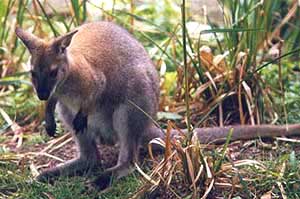
Red-necked wallaby
Scientific classification Edit this classification
Kingdom: Animalia
Phylum: Chordata
Class: Mammalia
Infraclass: Marsupialia
Order: Diprotodontia
Suborder: Macropodiformes
Ameghino, 1889
Superfamilies

Macropodoidea

The Macropodiformes (/mækrˈpɒdɪfɔːrmz/), also known as macropods, are one of the three suborders of the large marsupial order Diprotodontia. They may in fact be nested within one of the suborders, Phalangeriformes.[2] Kangaroos, wallabies and allies, bettongs, potoroos and rat kangaroos are all members of this suborder.

Classification

[edit]

[3]

References

[edit]
Revisions and contributorsEdit on WikipediaRead on Wikipedia
from Grokipedia
Macropodiformes is a suborder of marsupials belonging to the order Diprotodontia, encompassing approximately 72 extant species of herbivorous mammals including kangaroos, wallabies, tree-kangaroos, bettongs, potoroos, and rat-kangaroos.[1] These animals are characterized by their specialized hind limbs adapted for bipedal hopping, a forward-opening pouch in females for nurturing underdeveloped young, and a diprotodont dentition with two incisors on the lower jaw.[2] Native to Australia, New Guinea, and adjacent islands, Macropodiformes represent one of the most ecologically diverse radiations of marsupials, occupying habitats ranging from arid deserts to tropical rainforests.[2] The suborder is divided into three main families: Hypsiprymnodontidae, which includes the musky rat-kangaroo (Hypsiprymnodon moschatus), the sole surviving member of a primitive lineage; Potoroidae, comprising smaller rat-kangaroos and bettongs adapted for nocturnal foraging; and Macropodidae, the largest family featuring the iconic larger kangaroos and wallabies.[1] This taxonomic structure reflects evolutionary divergences dating back to the late Eocene, with the crown-group Macropodiformes emerging around 35–30 million years ago during Australia's isolation and aridification.[1] Fossil evidence indicates that early stem relatives, such as those in the Balbaridae family, exhibited versatile locomotion including quadrupedal bounding and climbing, predating the specialized hopping seen in modern species.[2] Ecologically, Macropodiformes play crucial roles as grazers and browsers, influencing vegetation dynamics and serving as prey for predators like dingoes and birds of prey. Their adaptability is evident in specialized forms, such as arboreal tree-kangaroos (Dendrolagus spp.) that climb with long tails for balance and forelimbs, contrasting with the terrestrial bounding of species like the red kangaroo (Macropus rufus).[2] However, many species face threats from habitat loss, climate change, and introduced predators, with approximately 32 listed as vulnerable, endangered, or critically endangered on the IUCN Red List as of 2025. Conservation efforts focus on protecting diverse habitats to preserve this iconic group, which has cultural significance in Indigenous Australian traditions and global symbolism.

Taxonomy

Classification

Macropodiformes is a suborder of marsupials within the order Diprotodontia, infraclass Marsupialia, class Mammalia, phylum Chordata, and kingdom Animalia, encompassing kangaroos, wallabies, and their allies. The suborder was established by paleontologist Florentino Ameghino in 1889 to group fossil and extant forms sharing specialized locomotor adaptations.[3][4] Members of Macropodiformes are characterized by several diagnostic morphological traits that distinguish them within Diprotodontia. These include syndactylous hind feet, where the second and third digits are fused by skin up to the base of the claws, facilitating grooming and support during hopping; enlarged hindlimbs with elongated femora, tibiae, and elongated metatarsals adapted for saltatorial (bipedal hopping) locomotion; diprotodont dentition featuring a pair of enlarged, forward-projecting lower incisors used for cropping vegetation; and herbivorous dental adaptations such as bilophodont molars with high crowns and complex occlusal surfaces for grinding fibrous plant material.[5][6][7] Historically, Macropodiformes was classified as the superfamily Macropodoidea, a rank that grouped kangaroo-like marsupials based on shared postcranial features, but modern taxonomy elevates it to subordinal status to reflect its monophyly and distinction from superfamilies like Phalangeroidea within Diprotodontia.[8] Recent taxonomic debates center on the position of Macropodiformes relative to other diprotodontians, with molecular evidence from nuclear and mitochondrial sequences indicating it may nest within the suborder Phalangeriformes (possums and gliders) as a derived clade allied to petauroids, though morphological and fossil data support its retention as a distinct suborder in current classifications.[9]

Families

Macropodiformes is divided into three extant families, encompassing approximately 72 species (as of 2025) of marsupials primarily distributed in Australia and New Guinea. These families exhibit varying degrees of specialization in size, locomotion, and diet, reflecting their ecological diversity within the suborder.[1][10] The family Macropodidae is the largest and most diverse, containing 63 species (as of 2025) across 12 genera. Members are characterized by their larger body sizes, ranging from about 0.5 kg to over 90 kg, powerful hindlimbs adapted for efficient hopping locomotion, and primarily herbivorous diets focused on grazing grasses or browsing vegetation. Notable genera include Macropus with seven species such as the red kangaroo (Macropus rufus), the largest extant kangaroo reaching up to 90 kg, and Wallabia and Thylogale representing wallabies known for their agile movements in varied habitats. The quokka (Setonix brachyurus), a monotypic genus, exemplifies smaller macropodids with specialized island adaptations.[11][12] The family Potoroidae includes smaller, more secretive species, totaling 8 across three genera, with a focus on nocturnal and fossorial lifestyles. These rat-kangaroos and bettongs weigh 0.8–2.7 kg and are distinguished by their digging behaviors for foraging, as well as a diet heavily reliant on mycophagy (fungi consumption) supplemented by roots, seeds, and insects. Key genera are Bettongia (bettongs, four extant species including the burrowing bettong Bettongia lesueur) and Potorous (potoroos, three species such as the long-nosed potoroo Potorous tridactylus), which construct nests and exhibit rapid declines due to habitat loss and predation. The rufous rat-kangaroo (Aepyprymnus rufescens) represents another genus with similar traits.[13][12][14] The family Hypsiprymnodontidae is monotypic, consisting solely of the musky rat-kangaroo (Hypsiprymnodon moschatus), a small species weighing 0.5–1.2 kg that retains primitive traits of early macropodiforms. Unlike its relatives, it employs quadrupedal locomotion with an opposable first toe on the hind foot, enabling climbing and running rather than hopping, and maintains an omnivorous diet including fruits, insects, fungi, and small vertebrates. As the sole surviving member of an ancient lineage, it occupies a basal phylogenetic position and is confined to rainforests in northeastern Queensland.[15][12]

Evolution

Fossil record

The fossil record of Macropodiformes begins in the late Oligocene, approximately 25–26 million years ago, with the earliest known specimens recovered from deposits in Australia, marking the initial appearance of this marsupial clade. These primitive forms, primarily from the Etadunna Formation in South Australia and Riversleigh Faunal Zone A in Queensland, represent small to medium-sized herbivores adapted to forested environments, with dental features indicating browsing diets.[16][17] The group underwent significant radiation during the Miocene epoch (23–5 million years ago), diversifying into various lineages that foreshadowed modern kangaroos, wallabies, and rat-kangaroos, driven by ecological shifts from closed rainforests to more open woodlands.[18] Key fossil sites have provided the bulk of this record, particularly the Riversleigh World Heritage Area in northwestern Queensland, which has yielded exceptionally preserved skeletons from late Oligocene to late Miocene deposits. Notable discoveries include genera such as Balbaroo and Nambaroo, representing basal macropodiforms with quadrupedal locomotion and lophodont molars suited for folivory.[16][19] Additional sites, such as Ngapakaldi Quarry in South Australia and the late Miocene Ongeva Local Fauna in central Australia, have extended the known geographic range, while fossils from New Guinea, including species of Dorcopsoides from the late Miocene, indicate early dispersals beyond the Australian mainland.[19][20] Several extinct families highlight the evolutionary experimentation within Macropodiformes. The Balbaridae, known from the late Oligocene to middle Miocene, comprised primitive, quadrupedal forms with hypertrophied canines in some species, such as Balbaroo fangaroo, and were likely omnivorous or browser-grazers in mesic habitats.[16][19] The Bulungamayinae, an extinct subfamily from the late Miocene to Pleistocene, included lophodont taxa basal to modern potoroines, with postcranial adaptations suggesting agile, terrestrial locomotion in forested settings. A major event in the fossil history was the Pleistocene megafauna extinctions around 50,000 years ago, which decimated large macropodiform species, including the giant short-faced kangaroo Procoptodon goliah, which stood up to 2 meters tall and weighed approximately 230 kg. This species, specialized in browsing chenopod shrubs in arid environments, disappeared alongside about 90% of larger kangaroos, with evidence pointing to a combination of climate-driven aridity and the arrival of humans around 50,000 years ago as contributing factors. A 2018 revision of Oligo-Miocene material from South Australian sites like the Lake Eyre Basin has refined the taxonomy of early macropodiforms from ~25 million-year-old deposits.[19] More recent discoveries include the description of three new species of extinct short-faced kangaroos (Sthenurinae) in 2024 from Pleistocene sites across Australia, providing further insights into megafaunal diversity and extinction patterns, and a 2025 osteological study of Dorcopsoides fossilis from the late Miocene Alcoota locality, confirming its status as the earliest undisputed macropodine.[21][22]

Phylogeny

Macropodiformes represents a monophyletic clade within the marsupial order Diprotodontia, characterized by a basal divergence that separates the family Hypsiprymnodontidae from the crown-group comprising Macropodidae and Potoroidae, estimated to have occurred approximately 25 million years ago (mya) during the late Oligocene to early Miocene.[1] This split is supported by molecular analyses using nuclear genes such as ApoB, BRCA1, IRBP, Rag1, and vWF, which resolve Hypsiprymnodontidae as the sister taxon to all other macropodiforms.[23] Within the crown-group, mitochondrial DNA (mtDNA) and nuclear gene sequences consistently position Potoroidae as the sister group to Macropodidae, with divergence times for this split estimated at around 20 mya in the early Miocene.[1] These relationships are reinforced by broader marsupial phylogenies that integrate multigene datasets, confirming the monophyly of Macropodiformes and its placement within Phalangerida. Morphological phylogenies further corroborate these molecular findings through shared synapomorphies, including elongated tarsal bones that facilitate specialized hopping locomotion, a trait evident across macropodiform lineages.[7] Osteological studies highlight additional cranial and postcranial features, such as the configuration of the tarsus restricting foot rotation, as diagnostic for the clade.[2] However, debates persist regarding the broader diprotodontian context, with some analyses suggesting that Phalangeriformes may be paraphyletic, as Phalangeroidea (certain possums) groups more closely with Macropodiformes than with other possum families based on nuclear sequence data.[24] This hypothesis challenges traditional classifications and implies a need for revised higher-level taxonomy, though it remains unresolved without additional fossil integration.[25] Key divergences within Macropodiformes include the radiation of Macropodidae around 15 mya, coinciding with post-Miocene climatic shifts that promoted grassland expansion and diversification among kangaroos and wallabies.[7] The Potoroidae, encompassing potoroos and bettongs, diverged earlier at approximately 20 mya, retaining more generalized traits compared to the specialized forms in Macropodidae.[1] Hypsiprymnodontidae, represented solely by the musky rat-kangaroo (Hypsiprymnodon moschatus), is regarded as a living fossil due to its retention of primitive traits, such as a five-toed hind foot and arboreal adaptations, which contrast with the bipedal specialization of derived macropodiforms.[1] Recent genomic analyses, including whole-genome sequencing of multiple kangaroo and wallaby species, have refined intrafamilial splits within Macropodidae, resolving conflicts between nuclear and mitochondrial trees through evidence of mosaic genomes from ancient hybridization events.[26] These studies, building on earlier multigene work, indicate no major taxonomic revisions to the core macropodiform structure since 2023, though they highlight ongoing refinement of divergence timings for subgroups like tree-kangaroos and rock-wallabies.

Physical characteristics

Morphology

Macropodiformes exhibit a distinctive body plan characterized by elongated hindlimbs that are significantly longer and more muscular than the forelimbs, often approximately as long as the head and body in large species such as the red kangaroo (Macropus rufus), facilitating their specialized mode of locomotion.[11] The forelimbs are reduced in size, with five clawed digits adapted primarily for grooming, foraging, and manipulation of food, while the long, muscular tail—measuring up to 90 cm in the red kangaroo—serves as a counterbalance and prop during movement.[11] This overall structure reflects adaptations to a herbivorous lifestyle across diverse habitats, with the pelvic girdle being bulkier than the pectoral girdle to support the hindlimb emphasis.[11] The skull and dentition of Macropodiformes are typical of diprotodont marsupials, featuring a lower jaw with a single pair of prominent, forward-projecting incisors and high-crowned molars suited for grinding tough vegetation.[27] The dental formula varies slightly but is generally I 3/1, C 0/0, P 2/1, M 4/4, totaling 30 teeth, with molars erupting sequentially in a process of continuous replacement that allows for ongoing wear from abrasive diets.[28] The incisors are blade-like for cropping plants, and the molars possess transverse ridges for efficient mastication, a trait shared across the order.[11] Sensory organs in Macropodiformes include large, laterally positioned eyes that provide a wide field of vision, including binocular overlap for depth perception, and are adapted for crepuscular activity with enhanced sensitivity to low-light conditions.[29] Acute hearing is facilitated by large, mobile ears set high on the head, which can swivel to detect predators, while olfactory capabilities are augmented by the vomeronasal organ (Jacobson's organ), enabling detection of pheromones and environmental cues.[11][30] Size variation within Macropodiformes is extreme, ranging from the smallest extant member, the musky rat-kangaroo (Hypsiprymnodon moschatus), at 0.4–0.7 kg and approximately 25 cm in head-body length, to the largest, the red kangaroo, which can reach 90 kg and stand 2 m tall on its hindlimbs.[11] Sexual dimorphism is pronounced in most species, with males approximately twice as heavy as females in large macropods like the red kangaroo—due to prolonged growth in males.[31] The skin of Macropodiformes is thin and vascularized to aid in thermoregulation, with fur that is coarse, 15–50 mm long, and typically in shades of gray or brown for camouflage against arid or forested backgrounds.[11] Some species possess scent glands, particularly in males, such as those on the chest or cloaca, which secrete odorous substances used in territorial marking and communication.[11]

Locomotion and adaptations

Macropodiformes exhibit specialized saltatorial locomotion, characterized by powerful hind limbs that enable efficient hopping. The enlarged Achilles tendon plays a crucial role by storing elastic energy during landing and releasing it to propel the animal forward during takeoff, substantially reducing the metabolic cost of movement.[32] This mechanism allows species like the red kangaroo to achieve horizontal hops of up to 12 meters. The pentadactyl hind feet feature syndactyly, where the second and third toes are fused, providing structural support while the larger fourth toe delivers the primary push-off force for enhanced propulsion and stability during leaps.[33] Locomotor strategies vary across the order, with primitive forms such as the musky rat-kangaroo (Hypsiprymnodon moschatus) relying on quadrupedal bounding using all four limbs for navigation in forested environments.[34] In contrast, more derived macropodids, including kangaroos and wallabies, employ bipedal hopping as their primary fast gait, attaining speeds exceeding 50 km/h over short distances.[35] The muscular tail contributes significantly to this mode of travel, serving as a counterbalance to maintain stability during high-speed jumps and sudden turns.[36] In aquatic contexts, wallabies utilize their tail for additional propulsion by lashing it rhythmically through the water. Certain potoroos, such as the long-footed potoroo, possess semi-prehensile tails that aid in climbing low vegetation.[37] Adaptations for environmental extremes further enhance survival in arid habitats. Desert-dwelling species dissipate heat through panting, which promotes evaporative cooling from the respiratory tract, and by licking their forelimbs to spread saliva over sparsely haired skin, facilitating heat loss via evaporation from underlying blood vessels.[38] Water conservation is achieved through the production of highly concentrated urine; for instance, the euro (Macropus robustus) can generate urine with a freezing point depression as low as -5.08°C, minimizing fluid loss in water-scarce conditions.[39] The biomechanics of hopping confer notable energy efficiency, with elastic recoil in tendons lowering the cost of transport by approximately 50% relative to quadrupedal running at comparable speeds, particularly beneficial for larger macropodids traversing open terrains.[40] This efficiency arises from reduced stride frequency and optimized energy storage, allowing sustained locomotion without proportional increases in metabolic demand.[41]

Distribution and habitat

Geographic range

Macropodiformes, the suborder encompassing kangaroos, wallabies, and their relatives, is endemic to the Australasian region, with the vast majority of its approximately 70 species occurring in Australia across all mainland states and Tasmania. Around 50 species inhabit Australia, while approximately 20 species, primarily from the family Macropodidae, are found in New Guinea, reflecting the suborder's concentration in these connected landmasses.[11][33][42] Historically, the range of Macropodiformes extended across the broader Sahul shelf during the Pleistocene epoch, when lower sea levels connected Australia and New Guinea into a single contiguous landmass approximately 2.6 million to 11,700 years ago. This unified paleoenvironment supported diverse macropod populations, but post-glacial sea level rises around 10,000 years ago led to contractions and isolations, fragmenting distributions and contributing to regional endemism.[43][44] Species distributions vary widely within this range; for instance, the red kangaroo (Macropus rufus) occupies vast semi-arid and arid interiors across central and northern Australia, adapting to open plains with low rainfall. In contrast, the quokka (Setonix brachyurus) is highly restricted to southwestern Western Australia, with the largest population on Rottnest Island off Perth and smaller groups on Bald Island. The musky rat-kangaroo (Hypsiprymnodon moschatus), the sole living member of Hypsiprymnodontidae, is confined to tropical rainforests along a narrow coastal strip in northeastern Queensland, from near Ingham to south of Cooktown.[45][46][47] Several macropod species have established introduced populations beyond their native range through human activities, including agile wallabies (Notamacropus agilis) introduced to various Pacific islands, as well as the brush-tailed rock-wallaby (Petrogale penicillata) in Hawaii and the red-necked wallaby (Notamacropus rufogriseus) in New Zealand.[48][49][50] These non-native groups have persisted in altered ecosystems but are not the focus of detailed ecological impacts here. Biogeographically, species diversity peaks in eastern Australia, particularly along the New South Wales-Queensland border, where environmental gradients support complex communities, whereas the arid western regions host fewer species except for highly adaptable ones like the red kangaroo.[51]

Habitat preferences

Macropodiformes exhibit diverse habitat preferences that reflect the ecological versatility of the suborder, spanning a variety of biomes across Australia and New Guinea. Large macropodids, such as kangaroos of the genus Macropus, favor open grasslands and savannas, where they utilize expansive plains for movement and foraging.[52] Wallabies, including species in genera like Macropus and Wallabia, commonly inhabit sclerophyll forests and woodlands, which provide a mix of cover and grazing opportunities.[52] In contrast, smaller potoroids such as potoroos (Potorous spp.) and the musky rat-kangaroo (Hypsiprymnodon moschatus) prefer dense rainforests, where they navigate understory vegetation for shelter and resources.[52] Microhabitat selection varies significantly among groups, enhancing their survival in specific niches. Bettongs (Bettongia spp.), for instance, construct extensive burrow systems in sandy or stony soils to escape predators and extreme temperatures, particularly in arid and semi-arid regions.[53] Tree-kangaroos of the genus Dendrolagus are arboreally adapted and occupy montane rainforests in New Guinea, residing in the canopy and understory of wet tropical forests.[54] These species tolerate an altitudinal gradient from sea level to approximately 3,000 meters, with some populations extending higher in the central cordillera.[54] Adaptations to environmental challenges, such as aridity, are evident in desert-dwelling taxa. Euros (Macropus robustus), a subspecies of the common wallaroo, thrive in spinifex-dominated grasslands of arid Australia, where they endure water scarcity by metabolizing moisture from vegetation and surviving up to two weeks without direct drinking sources.[55] Many macropodiforms display seasonal movements, with nomadic grazing patterns driven by rainfall distribution; for example, large kangaroos shift ranges to follow post-rain green-up in rangelands, prioritizing forage availability over fixed water points.[56] Species like pademelons (Thylogale spp.) maintain more sedentary habits year-round in stable understory thickets of wet forests and gullies, rarely venturing far from dense cover.[57] In human-modified landscapes, macropodiformes show varying tolerance levels. While some, such as eastern grey kangaroos (Macropus giganteus), persist along agricultural edges where habitat fragmentation allows access to modified grasslands, most avoid highly urbanized areas, with smaller species like pademelons and potoroos largely confined to remnant or protected vegetation patches.[58]

Ecology and behavior

Diet and foraging

Members of the suborder Macropodiformes are predominantly herbivorous, consuming a diet composed mainly of grasses, forbs, and browse such as leaves, shoots, and shrubs.[59] Within the Macropodidae family, larger species like kangaroos (genus Macropus) function as grazers, favoring monocotyledonous plants including grasses, which can constitute up to 74% of their intake in suitable habitats. In contrast, smaller macropodids such as pademelons (Thylogale spp.) exhibit browser tendencies, with broad-leafed forbs making up around 38% of their diet alongside grasses. Potoroid species, including potoroos and bettongs, specialize in mycophagy, relying heavily on hypogeous fungi like truffles, which they detect and excavate using keen olfaction; for instance, the long-nosed potoroo (Potorous tridactylus) successfully recovers buried truffles in 76% of digging attempts.[60] Foraging in Macropodiformes typically occurs during crepuscular or nocturnal periods to minimize heat stress and predation risk, with individuals spending 6-10 hours daily on feeding activities, often concentrated around dawn and dusk.[61] Selective feeding is facilitated by their diprotodont dentition, where specialized lower incisors crop vegetation precisely at ground level for grazers or strip leaves from shrubs for browsers.[59] The quokka (Setonix brachyurus), for example, preferentially browses on shrubs and sedges, showing a marked preference for fresh growth following fire events, which influences seasonal foraging patterns.[46] The digestive physiology of Macropodiformes is adapted for processing fibrous plant material through hindgut fermentation, primarily in an enlarged cecum and proximal colon where microbial symbionts hydrolyze cellulose via β-1,4 glycosidic bond breakdown.[62] This symbiotic microbial community enables efficient nutrient extraction from low-quality forage, allowing species like the eastern grey kangaroo (Macropus giganteus) to maintain intake on diets high in indigestible fiber.[62] Some species engage in coprophagy, reingesting soft cecotropes to recycle nutrients like B vitamins and proteins, a strategy observed in tree kangaroos to enhance hindgut fermentation efficiency.[63] Dietary variation exists across the order, with the musky rat-kangaroo (Hypsiprymnodon moschatus) displaying omnivorous tendencies by incorporating fruits from over 40 plant species, invertebrates, and fungi alongside vegetation, reflecting its ancestral, low-fiber requirements in rainforest habitats.[64] Seasonal shifts occur in arid-adapted species, such as quokkas turning to succulents like Carpobrotus spp. during dry summers when grasses are scarce, helping maintain water balance.[65] Nutritional adaptations include exceptional tolerance to high-fiber diets, supported by hindgut microbiology, and the endogenous synthesis of vitamin C in the liver, distinguishing them from certain placental herbivores that require dietary sources.[66]

Social structure and behavior

Macropodiformes exhibit a wide range of social systems, varying from solitary lifestyles in smaller species adapted to dense habitats, such as potoroos (Potorous spp.), to highly gregarious formations in larger species like kangaroos (Macropus spp.), where mobs can consist of up to 50 or more individuals in open grasslands.[11][67] Female kin groups are common in gregarious species, facilitating cooperative interactions and resource sharing, while males often become territorial during the breeding season to secure mating opportunities.[68][11] Communication among macropodiformes relies on a combination of vocalizations, olfactory cues, and visual displays. Vocal signals include grunts and clucks for mother-joey contact, as well as coughs and foot-thumping for alarm warnings that alert group members to potential threats.[11][69] Olfactory communication occurs through sternal and paracloacal glands, where individuals mark territories or conspecifics by rubbing or sniffing, particularly during social inspections.[11] Visual displays, such as boxing and wrestling with forelimbs during male agonistic encounters, serve to establish dominance without severe injury.[11] Most macropodiformes follow nocturnal or crepuscular daily rhythms, with peak activity at dawn and dusk for foraging and movement, while resting in shaded areas, burrows, or rock crevices during the day to avoid heat and predators.[11][61] Grooming behaviors, both self-directed and social, are routine during rest periods to remove parasites and maintain hygiene, often observed in groups where individuals assist kin.[70] Anti-predator strategies in macropodiformes emphasize collective defense in social species. In mobs, group vigilance increases detection probability, with individuals scanning for threats while foraging, leading to reduced per capita vigilance as group size grows.[71][72] Alarm signals like foot-thumping propagate rapidly through groups, prompting evasive hopping maneuvers at high speeds to escape predators.[69] Solitary species rely more on cryptic hiding in dense cover. Cognitive abilities in macropodiformes include strong spatial memory for remembering foraging routes and resource locations, aiding survival in variable environments, though tool use remains rare and undocumented.[73] Juveniles engage in play behaviors, such as chasing and mock fighting, which develop motor skills and social bonds within groups.[74]

Reproduction

Mating systems

Mating systems in Macropodiformes vary across species, with larger macropodids such as kangaroos exhibiting polygyny where dominant males secure mating opportunities with multiple females through intense male-male competition.[75][76] In contrast, smaller species often display promiscuous mating, characterized by extensive overlap in home ranges and multiple matings per female without exclusive pair bonds.[77][78] Many species are seasonally polyestrous, with breeding cycles influenced by photoperiod, as seen in the tammar wallaby where increasing day length triggers reactivation from diapause.[79] In the primitive family Hypsiprymnodontidae, represented by the musky rat-kangaroo (Hypsiprymnodon moschatus), breeding is seasonal from October to April, with promiscuous mating and no embryonic diapause; females often produce twins or more, unlike the monotocous litters typical of other families.[47][80] Courtship rituals typically begin with males approaching females to sniff the cloacal region, followed by displays of posturing, vocalizations such as soft clucking, and chases if the female flees.[81][82] Females exert choice based on male size and vigor, often leading to male-male fights involving kicking, boxing, and grappling with forelimbs to establish dominance.[83][82] These agonistic encounters are more pronounced in polygynous systems, enhancing sexual dimorphism in forelimb proportions for combat advantage.[78] Sperm competition is prevalent in promiscuous species, where females mate with multiple males per estrous cycle, driving adaptations like relatively large testes size in kangaroos to increase sperm production.[84][85] Levels of competition correlate with larger total sperm size, including longer flagella for enhanced motility in macropods.[86] Embryonic diapause is a common reproductive strategy in Macropodidae and Potoroidae, involving delayed implantation of the blastocyst for up to 11 months in species like the tammar wallaby, which synchronizes births with favorable resource availability.[79][87] This facultative diapause is induced by suckling and photoperiod, allowing females to maintain pregnancy while lactating.[88] It is absent in Hypsiprymnodontidae. Most species produce monotocous litters of a single joey per pregnancy, though some potoroids like bettongs exhibit superfetation through overlapping pregnancies enabled by post-partum estrus and rapid re-mating, with the new embryo entering diapause.[89][90]

Development and parental care

Macropodiformes exhibit a distinctive reproductive strategy characteristic of marsupials, featuring a brief intrauterine gestation followed by extended extrauterine development in the mother's pouch. Gestation varies from 19 to 38 days across the suborder, depending on family and species; for instance, in larger macropodids like the red kangaroo (Macropus rufus), it averages 33 days, while in the tammar wallaby (Macropus eugenii), it is about 26.5 days.[76][91] In Hypsiprymnodontidae, the musky rat-kangaroo has a gestation of about 19 days and typically produces twins.[47] In Potoroidae, gestation is shorter in bettongs (about 21 days) compared to potoroos (about 38 days).[92] The neonate, often weighing around 1 gram and comparable in size to a jellybean, emerges underdeveloped but equipped with strong forelimbs and instincts to crawl unaided through the mother's fur to the pouch, a journey that takes approximately 2-3 minutes.[75][93] Upon reaching the pouch, the tiny joey attaches firmly to one of the mother's teats, which swells to secure it in place; this attachment persists for 70-200 days depending on species size, with shorter durations in smaller forms like potoroids.[94] During pouch life, female Macropodiformes possess a permanent, forward-opening marsupium that provides a secure, warm environment for development, housing the joey continuously for 3-9 months depending on species and family. In Hypsiprymnodontidae, pouch life is about 3.5 months, similar to potoroids.[47][33] The joey suckles milk whose composition evolves to match developmental needs: early lactation milk is high in fat (up to 20-30% in some species) to support rapid initial growth, transitioning to lower-fat, higher-carbohydrate and protein content (around 10-15% fat by late lactation) to facilitate weaning and solid food intake.[95][96] Emergence from the pouch begins tentatively around 6 months in larger macropodids, with permanent exit occurring by 8-11 months; for example, western gray kangaroo (Macropus fuliginosus) joeys first peek out at about 10 months and leave fully by 11 months.[75][97] Weaning and the transition to independence occur between 12 and 18 months in macropodids, or earlier (5-6 months) in smaller potoroids, marking the end of primary milk dependency as joeys increasingly forage on vegetation; this process is gradual, with suckling tapering off amid abundant spring growth in many habitats.[76][75] Maternal investment remains high throughout, with females providing exclusive care and protection in the pouch and post-emergence, while allomothering—cooperative rearing by non-mothers—is rare in this suborder due to predominantly solitary or small-group social structures.[33] Young males typically disperse from the maternal range upon reaching independence to avoid competition, though females may remain in familial areas longer.[98] Sexual maturity is attained at 1-2 years, with smaller species reaching it faster; females often mature earlier than males, as seen in the tammar wallaby (9 months for females, 2 years for males) compared to larger kangaroos like the red kangaroo (15-20 months for females, 20-24 months for males).[99][76] In the wild, lifespans range from 6-20 years, influenced by predation, habitat quality, and disease, though individuals in protected captivity can exceed 25 years with slower growth curves due to reduced environmental stresses but consistent nutrition.[100][101] Key developmental milestones include fur growth commencing around 3 months, when the joey develops a fine coat and begins thermoregulation; eyes open shortly thereafter at 3-4 months, enabling initial exploration.[102] Hopping proficiency emerges by 8 months, coinciding with stronger hindlimb development and permanent pouch exit, allowing effective locomotion and foraging.[103] In potoroids, such as bettongs and potoroos, these cycles are accelerated: pouch life lasts 3-4.5 months (e.g., 102-112 days emergence in northern bettong Bettongia tropica), and weaning occurs by 5-6 months, reflecting their smaller size and higher metabolic demands.[89][104]

Conservation

Threats

Habitat loss due to deforestation and agricultural expansion poses a primary threat to Macropodiformes populations, fragmenting their ranges and reducing available foraging areas across Australia and New Guinea. In Papua New Guinea, tree kangaroos (Dendrolagus spp.) have experienced significant habitat degradation, with over 990,000 hectares of humid primary forest lost between 2002 and 2024, representing 51% of the total tree cover loss in the region.[105] This deforestation, driven by logging and land clearance for palm oil plantations, has particularly impacted highland species, leading to isolated populations vulnerable to local extinction.[106] In Australia, agricultural conversion has similarly cleared vast areas of native grasslands and woodlands essential for ground-dwelling macropods like wallabies and pademelons. Introduced predators such as foxes (Vulpes vulpes), feral cats (Felis catus), and dingoes (Canis dingo) exert intense pressure on smaller macropod species, contributing to widespread declines and extinctions. These non-native and invasive carnivores prey heavily on juveniles and subadults, with foxes and cats responsible for the mainland extinction of several bettong species (Bettongia spp.), which once occupied over 60% of Australia's mainland but were largely eradicated by the mid-20th century due to this predation combined with habitat changes.[107] Dingoes, while considered native in ecological contexts, amplify the threat in altered landscapes by suppressing smaller native predators but directly hunting small macropods like potoroos. Disease outbreaks and competition for resources further endanger macropod populations, often through indirect ecological disruptions. Myxomatosis, a virus introduced to control European rabbits (Oryctolagus cuniculus), has indirectly influenced macropod survival by altering predator-prey dynamics; sustained rabbit populations bolster feral cat and fox numbers through "hyper-predation," increasing attacks on native mammals when rabbit densities fluctuate.[108] Additionally, competition with livestock such as sheep (Ovis aries) and cattle (Bos taurus) for forage intensifies during droughts, reducing nutritional availability for macropods like red kangaroos (Osphranter rufus) and leading to lowered body condition and reproductive success in shared arid rangelands.[109] Goats (Capra hircus) exacerbate this by overgrazing and degrading vegetation cover. Climate change compounds these pressures by altering rainfall patterns and exacerbating extreme events, particularly affecting arid-adapted macropods. Shifts in precipitation have reduced water availability and forage quality in semi-arid regions, threatening species like the common wallaroo (Osphranter robustus) that rely on predictable wet-dry cycles for survival.[58] Increased frequency and intensity of bushfires, linked to warmer temperatures and drier conditions, have caused mass mortality; the 2019-2020 Australian "Black Summer" fires affected at least 458 macropods in New South Wales alone (with over 70% dying), with broader estimates indicating thousands killed or injured across burned landscapes totaling over 24 million hectares.[110] Hunting and roadkill represent direct anthropogenic threats, with varying sustainability depending on regulation. Traditional Indigenous harvesting practices remain sustainable for many macropod populations, but rising illegal poaching and unregulated culling for commercial meat and skin trades have escalated mortality rates, particularly for species like eastern grey kangaroos (Macropus giganteus).[111] Vehicle collisions are a major cause of death for wallabies, reducing population growth; for instance, road mortality significantly lowers survival rates in tammar wallabies (Notamacropus eugenii) on islands and coastal areas, with hotspots recording up to 0.883 road-kills per kilometer per month.[112]

Status and efforts

As of the 2024 IUCN Red List, approximately 37% (26 species) of the roughly 70 species in the order Macropodiformes are classified as threatened (critically endangered, endangered, or vulnerable), with six species assessed as critically endangered, including Gilbert's potoroo (Potorous gilbertii), one of Australia's rarest mammals with a wild population estimated at around 100 individuals as of 2025 and showing signs of recovery.[113][114] Most species within the family Macropodidae, which includes larger kangaroos and wallabies, are categorized as Least Concern due to their adaptability and wide distributions, whereas potoroid species (such as bettongs and potoroos) are disproportionately vulnerable, with over half facing extinction risks from habitat fragmentation and predation. The red kangaroo (Osphranter rufus), the largest macropod, remains secure and abundant across arid Australia, classified as Least Concern. In contrast, many tree-kangaroo species (Dendrolagus spp.) in New Guinea and far northern Australia are endangered, primarily due to ongoing logging in their rainforest habitats. Recent assessments reflect modest progress in recovery efforts for some species through successful translocations, such as the reintroduction of eastern bettongs (Bettongia gaimardi) to New South Wales mainland in 2023 after over 100 years of absence.[115] Conservation initiatives for Macropodiformes emphasize captive breeding, reintroduction, and habitat protection to bolster populations of threatened taxa. Captive breeding programs, such as those for the tammar wallaby (Notamacropus eugenii), have produced viable insurance populations and supported genetic research at facilities like Taronga Zoo, aiding reintroductions to mainland sites. Reintroduction projects have targeted predator-free islands and fenced reserves, including the relocation of burrowing bettongs (Bettongia lesueur) to areas around Shark Bay in Western Australia, where populations have established post-1990s efforts despite initial challenges from foxes and cats.[116] Protected areas play a crucial role, with sites like Kakadu National Park in the Northern Territory safeguarding diverse macropod assemblages, including agile wallabies and antilopine kangaroos, through Indigenous-managed fire regimes and anti-poaching measures. Legal frameworks provide essential safeguards, with threatened macropods listed under Australia's Environment Protection and Biodiversity Conservation Act 1999 (EPBC Act), mandating impact assessments for developments affecting their habitats. Internationally, several species, particularly New Guinean tree-kangaroos, are regulated under CITES Appendix II to control trade in skins and live specimens. Success stories include the quokka (Setonix brachyurus), classified as Vulnerable but with stable populations on Rottnest Island maintained through regulated tourism that limits human interactions and funds habitat restoration. Additionally, ongoing genomic research is mitigating hybridization threats, such as between rock-wallaby subspecies, by informing targeted breeding and translocation strategies to preserve genetic integrity.

References

User Avatar
No comments yet.