


Community hub
Recent from talks
Contribute something
Nothing was collected or created yet.

Magi (PLUR),[a] or magus (SING),[b] is the term for priests in Zoroastrianism and earlier Iranian religions. The earliest known use of the word magi is in the trilingual inscription written by Darius the Great, known as the Behistun Inscription. Old Persian texts, predating the Hellenistic period, refer to a magus as a Zurvanic, and presumably Zoroastrian, priest.
Pervasive throughout the Eastern Mediterranean and West Asia until late antiquity and beyond, mágos (μάγος) was influenced by (and eventually displaced) Greek goēs (γόης), the older word for a practitioner of magic, with a meaning expanded to include astronomy, astrology, alchemy, and other forms of esoteric knowledge. This association was in turn the product of the Hellenistic fascination for Pseudo-Zoroaster, who was perceived by the Greeks to be the Chaldean founder of the Magi and inventor of both astrology and magic, a meaning that still survives in the modern-day words "magic" and "magician".
In the Gospel of Matthew, "μάγοι" (magoi) from the east pay homage to the Christ Child,[1] and the transliterated plural "magi" entered English from Latin in this context around 1200 AD (this particular use is also commonly rendered in English as "kings" and more often in recent times as "wise men").[2] The singular "magus" appears considerably later, when it was borrowed from Old French in the late 14th century with the meaning magician.
Hereditary Zoroastrian priesthood has survived in India[3][4] and Iran. They are termed Herbad, Mobad (Magupat, i.e. chief of the Maga), and Dastur depending on the rank.
History
[edit]Iranian sources
[edit]
The term only appears twice in Iranian texts from before the 5th century BC, and only one of these can be dated with precision. This one instance occurs in the trilingual Behistun inscription of Darius the Great, and which can be dated to about 520 BC. In this trilingual text, certain rebels have magian as an attribute; in the Old Persian portion as maγu- (generally assumed to be a loan word from Median). The meaning of the term in this context is uncertain.[5]
The other instance appears in the texts of the Avesta, the sacred literature of Zoroastrianism. In this instance, which is in the Younger Avestan portion, the term appears in the hapax moghu.tbiš, meaning "hostile to the moghu", where moghu does not (as was previously thought) mean "magus", but rather "a member of the tribe"[6] or referred to a particular social class in the proto-Iranian language and then continued to do so in Avestan.[7]
An unrelated term, but previously assumed to be related, appears in the older Gathic Avestan language texts. This word, adjectival magavan meaning "possessing maga-", was once the premise that Avestan maga- and Median (i.e. Old Persian) magu- were coeval (and also that both these were cognates of Vedic Sanskrit magha-). While "in the Gathas the word seems to mean both the teaching of Zoroaster and the community that accepted that teaching", and it seems that Avestan maga- is related to Sanskrit magha-, "there is no reason to suppose that the western Iranian form magu (Magus) has exactly the same meaning"[8] as well. But it "may be, however", that Avestan moghu (which is not the same as Avestan maga-) "and Medean magu were the same word in origin, a common Iranian term for 'member of the tribe' having developed among the Medes the special sense of 'member of the (priestly) tribe', hence a priest."[6]cf[7]
Some examples of the use of magi in Persian poetry, are present in the poems of Hafez. There are two frequent terms used by him, first one is Peer-e Moghan (literally "the old man of the magi") and second one is Deyr-e Moghan (literally "the monastery of the magi").[9]
Greco-Roman sources
[edit]Hellenistic period
[edit]The oldest surviving Greek reference to the magi – from Greek μάγος (mágos, plural: magoi) – could be from 6th century BC Heraclitus (apud Clemens Protrepticus 2.22.2[10]), who cursed the magi for their "impious" rites and rituals.[11] A description of the rituals that Heraclitus refers to has not survived, and there is nothing to suggest that Heraclitus was referring to foreigners.
Better preserved are the descriptions of the mid-5th century BC Herodotus, who in his portrayal of the Iranian expatriates living in Asia Minor uses the term "magi" in two different senses. In the first sense (Histories 1.101[12]), Herodotus speaks of the magi as one of the tribes/peoples (ethnous) of the Medes. In another sense (1.132[13]), Herodotus uses the term "magi" to generically refer to a "sacerdotal caste", but "whose ethnic origin is never again so much as mentioned."[8] According to Robert Charles Zaehner, in other accounts :
"We hear of Magi not only in Persia, Parthia, Bactria, Chorasmia, Aria, Media, and among the Sakas, but also in non-Iranian lands like Arabia, Ethiopia, and Egypt. Their influence was also widespread throughout Asia Minor. It is, therefore, quite likely that the sacerdotal caste of the Magi was distinct from the Median tribe of the same name."[8]
As early as the 5th century BC, Greek magos had spawned mageia and magike to describe the activity of a magus, that is, it was his or her art and practice.[14] But almost from the outset the noun for the action and the noun for the actor parted company. Thereafter, mageia was used not for what actual magi did, but for something related to the word 'magic' in the modern sense, i.e. using supernatural means to achieve an effect in the natural world, or the appearance of achieving these effects through trickery or sleight of hand.[14] The early Greek texts typically have the pejorative meaning, which in turn influenced the meaning of magos to denote a conjurer and a charlatan.[15] Already in the mid-5th century BC, Herodotus identifies the magi as interpreters of omens and dreams (Histories 7.19, 7.37, 1.107, 1.108, 1.120, 1.128[16]).[17]
Other Greek sources from before the Hellenistic period include the gentleman-soldier Xenophon, who had first-hand experience at the Persian Achaemenid court. In his early 4th century BC Cyropaedia, Xenophon depicts the magians as authorities for all religious matters (8.3.11),[18] and imagines the magians to be responsible for the education of the emperor-to-be. Apuleius, a Numidian Platonist philosopher, describes magus to be considered as a "sage and philosopher-king" based on its Platonic notion.[19]
Roman period
[edit]
Once the magi had been associated with "magic" – Greek magikos – it was but a natural progression that the Greeks' image of Zoroaster would metamorphose into a magician too.[20] The first century Pliny the Elder names "Zoroaster" as the inventor of magic (Natural History xxx.2.3), but a "principle of the division of labor appears to have spared Zoroaster most of the responsibility for introducing the dark arts to the Greek and Roman worlds. That dubious honor went to another fabulous magus, Ostanes, to whom most of the pseudepigraphic magical literature was attributed."[20] For Pliny, this magic was a "monstrous craft" that gave the Greeks not only a "lust" (aviditatem) for magic, but a downright "madness" (rabiem) for it, and Pliny supposed that Greek philosophers – among them Pythagoras, Empedocles, Democritus, and Plato – traveled abroad to study it, and then returned to teach it (xxx.2.8–10).
"Zoroaster" – or rather what the Greeks supposed him to be – was for the Hellenists the figurehead of the 'magi', and the founder of that order (or what the Greeks considered to be an order). He was further projected as the author of a vast compendium of "Zoroastrian" pseudepigrapha, composed in the main to discredit the texts of rivals. "The Greeks considered the best wisdom to be exotic wisdom" and "what better and more convenient authority than the distant – temporally and geographically – Zoroaster?"[20] The subject of these texts, the authenticity of which was rarely challenged, ranged from treatises on nature to ones on necromancy. But the bulk of these texts dealt with astronomical speculations and magical lore.
One factor for the association with astrology was Zoroaster's name, or rather, what the Greeks made of it. His name was identified at first with star-worshiping (astrothytes "star sacrificer") and, with the Zo-, even as the living star. Later, an even more elaborate mytho-etymology evolved: Zoroaster died by the living (zo-) flux (-ro-) of fire from the star (-astr-) which he himself had invoked, and even that the stars killed him in revenge for having been restrained by him.[21] The second, and "more serious"[21] factor for the association with astrology was the notion that Zoroaster was a Chaldean. The alternate Greek name for Zoroaster was Zaratas / Zaradas / Zaratos (cf. Agathias 2.23–25, Clement Stromata I.15), which – according to Bidez and Cumont – derived from a Semitic form of his name. The Suda's chapter on astronomia notes that the Babylonians learned their astrology from Zoroaster. Lucian of Samosata (Mennipus 6) decides to journey to Babylon "to ask one of the magi, Zoroaster's disciples and successors", for their opinion.
Religious traditions
[edit]Abrahamic
[edit]Judaism
[edit]In the Talmud, instances of dialogue between the Jewish sages and various magi are recorded. The Talmud depicts the Magi as sorcerers and in several descriptions, they are negatively described as obstructing Jewish religious practices.[22][23] Several references include the sages criticizing practices performed by various magi. One instance is a description of the Zoroastrian priests exhuming corpses for their burial practices which directly interfered with the Jewish burial rites.[24] Another instance is a sage forbidding learning from the magi.[25][26][27]
Christianity
[edit].jpg)

The word mágos (Greek) and its variants appear in both the Old and New Testaments.[28] Ordinarily this word is translated "magician" or "sorcerer" in the sense of illusionist or fortune-teller, and this is how it is translated in all of its occurrences (e.g. Acts 13:6) except for the Gospel of Matthew, where, depending on translation, it is rendered "wise man" (KJV, RSV) or left untranslated as Magi, typically with an explanatory note (NIV). However, early church fathers, such as St. Justin, Origen, St. Augustine and St. Jerome, did not make an exception for the Gospel, and translated the word in its ordinary sense, i.e. as "magician".[29] The Gospel of Matthew states that magi visited the infant Jesus to do him homage shortly after his birth (2:1–2:12). The gospel describes how magi from the east were notified of the birth of a king in Judaea by the appearance of his star. Upon their arrival in Jerusalem, they visited King Herod to determine the location of the king of the Jews' birthplace. Herod, disturbed, told them that he had not heard of the child, but informed them of a prophecy that the Messiah would be born in Bethlehem. He then asked the magi to inform him when they find the child so that he himself may also pay homage to the child. Guided by the Star of Bethlehem, the magi found the infant Jesus in a house. They paid homage to him, and presented him with "gifts of gold and of frankincense and of myrrh." (2.11) In a dream they are warned not to return to Herod, and therefore return to their homes by taking another route. Since its composition in the late 1st century, numerous apocryphal stories have embellished the gospel's account.[citation needed] Matthew 2:16 implies that Herod learned from the magi that up to two years had passed since the birth, which is why all male children two years or younger were slaughtered.
In addition to the more famous story of Simon Magus found in chapter 8, the Book of Acts (13:6–11) also describes another magus who acted as an advisor of Sergius Paulus, the Roman proconsul at Paphos on the island of Cyprus, a Jew named Bar-Iesous (son of Jesus), or alternatively Elymas. (Another Cypriot magus named Atomos is referenced by Josephus, working at the court of Felix at Caesarea.)
One of the non-canonical Christian sources, the Syriac Infancy Gospel, provides, in its third chapter, a story of the wise men of the East which is very similar to much of the story in Matthew. This account cites Zoradascht (Zoroaster) as the source of the prophecy that motivated the wise men to seek the infant Jesus.[30]
Islam
[edit]In Arabic, "Magians" (majus) is the term for Zoroastrians. The term is mentioned in the Quran, in sura 22 verse 17, where the "Magians" are mentioned alongside the Jews, the Sabians and the Christians in a list of religions who will be judged on the Day of Resurrection.[31]
Eastern
[edit]Dharmic
[edit]
In India, the Sakaldwipiya Brahmins are considered to be the descendants of the ten Maga (Sanskrit मग) priests who were invited to conduct worship of Mitra (Surya) at Mitravana (Multan), as described in the Samba Purana, Bhavishya Purana and the Mahabharata. Their original home was a mythological region called Śākadvīpa. According to Varahamihira (c. 505 – c. 587), the statue of the Sun god (Mitra), is represented as wearing the "northern" (Central Asian) dress, specifically with horse riding boots. Some Brahmin communities of India trace their descent from the Magas. Some classical astronomers and mathematicians of India such are Varahamihira are considered to be the descendants of the Magas.[32][33]
Varahamihira specifies that installation and consecration of the Sun images should be done by the Magas. al-Biruni mentions that the priests of the Sun Temple at Multan were Magas. The Magas had colonies in a number of places in India, and were the priests at Konark, Martanda and other sun temples.[34]
Chinese shamanism
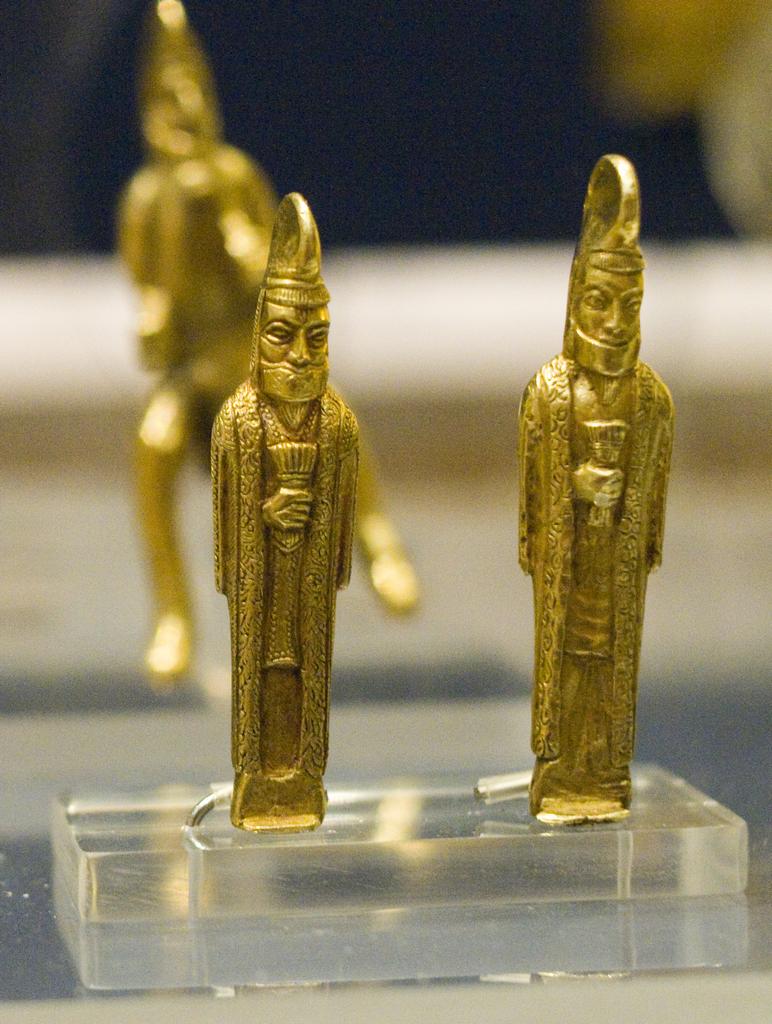
[edit]
Victor H. Mair (1990) suggested that Chinese wū (巫 "shaman; witch, wizard; magician") may originate as a loanword from Old Persian *maguš "magician; magi". Mair reconstructs an Old Chinese *myag.[35] The reconstruction of Old Chinese forms is somewhat speculative. The velar final -g in Mair's *myag (巫) is evident in several Old Chinese reconstructions (Dong Tonghe's *mywag, Zhou Fagao's *mjwaγ, and Li Fanggui's *mjag), but not all (Bernhard Karlgren's *mywo and Axel Schuessler's *ma).
Mair adduces the discovery of two figurines with unmistakably Caucasoid or Europoid features dated to the 8th century BC, found in a 1980 excavation of a Zhou dynasty palace in Fufeng County, Shaanxi Province. One of the figurines is marked on the top of its head with an incised ☩ graph.[citation needed]
Mair's suggestion is based on a proposal by Jao Tsung-I (1990), which connects the "cross potent" bronzeware script glyph for wu 巫 with the same shape found in Neolithic West Asia, specifically a cross potent carved in the shoulder of a goddess figure of the Halaf period.[36]
Usage in contemporary times
[edit]In the 1980s, Saddam Hussein's Ba'ath Party used the quranic term majus during the Iran–Iraq War as an ethnic slur against Iranians, both verbally and even in official documents. A 2000 paper elaborated the usage's propaganda significance:
"By referring to the Iranians in these documents as majus, the security apparatus [implied] that the Iranians [were] not sincere Muslims, but rather covertly practice their pre-Islamic beliefs. Thus, in their eyes, Iraq's war took on the dimensions of not only a struggle for Arab nationalism, but also a campaign in the name of Islam."[37]
See also
[edit]- Anachitis ('stone of necessity') – stone used to call up spirits from water by Magi in antiquity
- Epiphany (January 6) – a Christian holiday marking the visit of the Magi to the Christ Child
- Fire temple – Zoroastrian place of worship
Notes
[edit]- ^ /ˈmeɪdʒaɪ/
- ^ /ˈmeɪɡəs/ (Latin: magus; from Ancient Greek: μᾰ́γος and Old Persian: 𐎶𐎦𐎢𐏁 maguš)
References
[edit]- ^ About a year and half old, not a newborn (Matthew 2:11)
- ^ Matthew 2 in Greek
- ^ The Origins of Zoroastrian Priesthood in India, Parsi Khabar, April 29, 2009
- ^ Dashur FirozeDASTUR M. Kotwal (July 1990), "A Brief History of the Parsi Priesthood", Indo-Iranian Journal, Vol. 33, No. 3, pp. 165–175.
- ^ Burkert, Walter (2007). Babylon, Memphis, Persepolis: Eastern Contexts of Greek Culture. Harvard University Press. pp. 108–109. ISBN 978-0-674-02399-4.
- ^ a b Boyce, Mary (1975), A History of Zoroastrianism, vol. I, Leiden: Brill, pp. 10–11
- ^ a b Gershevitch, Ilya (1964). "Zoroaster's Own Contribution". Journal of Near Eastern Studies. 23 (1): 12–38 [36]. doi:10.1086/371754. S2CID 161954467.
- ^ a b c Zaehner, Robert Charles (1961). The Dawn and Twilight of Zoroastrianism. New York: MacMillan. p. 163. ISBN 978-0-297-76892-0.
{{cite book}}: ISBN / Date incompatibility (help) - ^ "پیر مغان حافظ كیست، دیرِ مغان حافظ كجاست؟" (in Persian). Islamic Republic News Agency. 12 October 2015. Retrieved 13 November 2022.
- ^ Butterworth, G W. (1919). Clement of Alexandria. Vol. 92 (Loeb Classical Library ed.). Cambridge, MA: Harvard University Press: Harvard University Press. p. 45. ISBN 978-0-674-99103-3.
{{cite book}}: ISBN / Date incompatibility (help) - ^ Bremmer, Jan N.; Veenstra, Jan R. (2002). The Metamorphosis of Magic from Late Antiquity to the Early Modern Period. Peeters Publishers. p. 2. ISBN 978-90-429-1227-4.
- ^ Herodotus (1904). The Histories of Herodotus. D. Appleton. p. 41.
- ^ Herodotus (1904). The Histories of Herodotus. D. Appleton. p. 54.
- ^ a b Janowitz, Naomi (2002). Magic in the Roman World: Pagans, Jews and Christians. Routledge. p. 9. ISBN 978-1-134-63368-5.
- ^ Peters, Edward (1978). The Magician, the Witch, and the Law. University of Pennsylvania Press. p. 1. ISBN 978-0-8122-1101-6.
- ^ Herodotus (1904). The Histories of Herodotus. D. Appleton.
- ^ Bremmer, Jan (2008). Greek Religion and Culture, the Bible and the Ancient Near East. Brill. p. 240. ISBN 978-90-474-3271-5.
- ^ Gera, Deborah Levine (1993). Xenophon's Cyropaedia: Style, Genre, and Literary Technique. Clarendon Press. ISBN 978-0-19-814477-9.
- ^ Too, Yun Lee (2010). The idea of the library in the ancient world. Oxford: Oxford University Press. p. 96. ISBN 9780199577804.
- ^ a b c Beck, Roger (2003). "Zoroaster, as perceived by the Greeks". Encyclopaedia Iranica. New York: iranica.com..
- ^ a b Beck, Roger (1991). "Thus Spake Not Zarathushtra: Zoroastrian Pseudepigrapha of the Graeco-Roman World". In Boyce, Mary; Grenet, Frantz (eds.). A History of Zoroastrianism. Handbuch der Orientalistik. Vol. 3. Leiden: Brill. pp. 491–565. Abteilung I, Band VIII, Abschnitt 1, p. 516
- ^ Secunda, Shai (2014). The Iranian Talmud. University of Pennsylvania Press, Incorporated. ISBN 9780812245707.
- ^ Mokhtarian, Jason (2021). Rabbis, Sorcerers, Kings, and Priests. University of California Press. ISBN 9780520385726.
- ^ Secunda, Shai (2020). The Talmud's Red Fence. OUP Oxford. ISBN 9780192598882.
- ^ Secunda, S. (2016). " This, but Also That": Historical, Methodological, and Theoretical Reflections on Irano-Talmudica. Jewish Quarterly Review, 106(2), 233–241.
- ^ Secunda, S. (2005). Studying with a Magus/Like Giving a Tongue to a Wolf. Bulletin of the Asia Institute, 19, 151–157.
- ^ Secunda, S. (2012). Parva – a Magus. In Shoshannat Yaakov (pp. 391–402). Brill.
- ^ Gospel of Matthew2:1–12:9; Acts of the Apostles 8:9; 13:6, 8; and the Septuagint of Daniel 1:20; 2:2, 2:10, 2:27; 4:4; 5:7, 5:11, 5:15).
- ^ Drum, W. (1910), "Magi", The Catholic Encyclopedia, New York: Robert Appleton Company
- ^ Hone, William (1890). "The Apocryphal Books of the New Testament". Gebbie & Co., Publishers, Philadelphia. Retrieved 20 October 2017 – via Internet Archive.
- ^ "Surah Al-Hajj – 1–78". Quran.com. Retrieved 21 June 2024.
- ^ Puttaswamy, T. K. (2012). Mathematical Achievements of Pre-modern Indian Mathematicians. Newnes. p. 141. ISBN 978-0-12-397913-1.
- ^ Biswas, Dilip Kumar (September 1949). Law, Narendra Nath (ed.). "The Maga Ancestry of Varahamihira". The Indian Historical Quarterly. 25 (3): 175.
- ^ Chattopadhyaya, Sudhakar (June 1950). Law, Narendra Nath (ed.). "The Achaemenids and India". The Indian Historical Quarterly. 26 (2): 100–117.
- ^ Mair, Victor H. (1990). "Old Sinitic *Myag, Old Persian Maguš and English Magician". Early China. 15: 27–47. doi:10.1017/S0362502800004995. ISSN 0362-5028. JSTOR 23351579. S2CID 192107986.
- ^ Ming-pao yueh-kan 25.9 (September 1990). English translation: Questions on the Origin of Writing Raised by the 'Silk Road', Sino-Platonic Papers, 26 (September 1991).
- ^ Al-Marashi, Ibrahim (2000). "The Mindset of Iraq's Security Apparatus" (PDF). Cambridge University: Centre of International Studies. p. 5. Archived from the original (PDF) on 11 April 2008.
Further reading
[edit]- Lendering, Jona (2006), Magians, Amsterdam: Livius.org, retrieved 6 January 2024.
External links
[edit]Etymology and Terminology
Linguistic Origins
The term Magi originates from Old Persian maguš (Avestan moγu-), denoting a hereditary priestly class among the ancient Iranians, particularly associated with Zoroastrian or pre-Zoroastrian ritual expertise.[3] This root appears in cuneiform as magu- or maguš, reflecting a Median or western Iranian occupational designation for religious functionaries skilled in interpretation and ceremony.[3] The earliest epigraphic evidence occurs in the Behistun Inscription of Darius I (c. 520 BCE), where a magus named Gaumata—a Median claimant to the throne—is described as impersonating Bardiya, son of Cyrus II, leading to his execution and the suppression of Magian influence.[3] This usage confirms maguš as a tribal or caste identifier with priestly connotations by the Achaemenid period, distinct from broader Iranian nobility.[4] In Greek, the term was transliterated as μάγος (magos, plural μάγοι, magoi) by the 5th century BCE, as in Herodotus' Histories (1.101, 1.132), where the Magi are portrayed as one of six Median tribes with specialized sacerdotal roles, including sacrificial and divinatory practices integral to Median-Persian kingship rituals.[5] Latin adopted it as magus, preserving the plural magi for the priestly group, pronounced approximately /ˈma.ɡiː/ ("MAH-ghee") in classical Latin.[6] Initially neutral or descriptive of Iranian wise men, magos underwent semantic broadening in Hellenistic Greek to encompass itinerant seers or esoteric practitioners, with pejorative undertones of deception or foreign superstition emerging in philosophical critiques, as in Plato's Alcibiades I (122a), which references magi as instructors in Persian royal wisdom yet implies their arts border on manipulative ritual. This evolution reflects Greek cultural distancing from Eastern priestcraft, contrasting empirical philosophy with perceived oriental mysticism.[7]Ancient Definitions and Distinctions
The magi (magus in the singular, from Old Persian maguš) formed a hereditary priestly caste originating among the Medes and Persians, functioning as the exclusive religious specialists in ancient Iranian Zoroastrianism during the Median and Achaemenid periods (ca. 7th–4th centuries BCE).[1] This caste, possibly derived from a specific Median tribe, maintained the core cultic practices centered on Ahura Mazda, including the oral preservation and recitation of Avestan liturgical texts.[1] Unlike the later Greco-Roman associations with sorcery or illusion, the magi's roles were grounded in institutionalized ritual mediation between the divine and human realms, emphasizing purity, sacrifice, and cosmic order without empirical claims of supernatural manipulation beyond religious observance.[5] Distinct from lay Iranians and other social strata—such as warriors, scribes, or farmers—the magi held a monopolistic position in sacred duties, barring non-priests from direct access to fire temples (the atarshrines housing eternal flames symbolizing divine presence) and restricting oracular interpretations to their expertise.[1] This separation reinforced their status as intermediaries, with initiation typically confined to male descendants, ensuring continuity of esoteric knowledge like the yasna ceremony's precise chants and offerings.[8] Achaemenid royal patronage, evident in inscriptions invoking Ahura Mazda (e.g., those of Darius I at Behistun, ca. 520 BCE), underscores the magi's integral advisory role in state rituals, though direct textual mentions of maguš in Persian records remain indirect, relying on Median tribal precedents.[1] Archaeological correlates from Achaemenid sites, such as the ritual platforms and fire installations at Pasargadae (founded ca. 550 BCE by Cyrus the Great), align with magi-led ceremonies inferred from structural alignments for solar observations and offerings, consistent with Zoroastrian priestly functions spanning the 6th to 4th centuries BCE.[1] These features, including possible altar remnants, demonstrate the caste's embeddedness in imperial religious architecture, predating Hellenistic distortions of their priestly identity into magical practitioners.[5]Historical Origins in Iranian Religion
Pre-Zoroastrian Roots
The Magi emerged as a distinct priestly group within the Median tribe, one of six tribes comprising the Median confederation that dominated northwestern Iran from approximately the 8th to 6th centuries BCE. Herodotus explicitly identifies the Magi as hereditary specialists in religious rites, including the interpretation of dreams and omens, roles that positioned them as intermediaries between the divine and human realms in a pre-Zoroastrian context.[1] These functions indicate an established sacerdotal class serving diverse Iranian cults, predating Zoroaster's monotheistic reforms, which primarily influenced eastern Iranian societies while western groups like the Medes retained more archaic polytheistic elements, such as the worship of daivas and natural deities.[1] Archaeological continuity from Indo-Iranian migrations supports this, as Median material culture traces to steppe pastoralists who entered the region around 1000–800 BCE, carrying ritual traditions tied to mobility and warfare.[9] Lacking direct textual evidence from pre-Zoroastrian periods—due to the oral nature of early Iranian traditions and the later composition of Avestan hymns—the origins of magi-like figures are reconstructed through linguistic and comparative analysis. The Proto-Indo-Iranian religious framework, dating to the 2nd millennium BCE and shared with Vedic India, featured ritual specialists handling fire rites, incantations, and divination, evident in elite chariot burials from Sintashta-Petrovka sites (ca. 2100–1800 BCE) that underscore the sacral role of vehicular technology in Indo-Iranian cosmology.[10] In this milieu, proto-priestly roles likely involved overseeing chariot-based rituals, paralleling the etymological roots of charioteer terms like *ráthas-tar- (chariot-driver), which imply specialized attendants in migratory warrior societies.[11] Comparative mythology further illuminates these roots through parallels with Vedic atharvan priests, who specialized in Atharva Veda incantations for healing, protection, and esoteric magic—functions cognate to Median magi soothsaying.[8] The Avestan term *āθravan- (priest), derived from Proto-Indo-Iranian *átharwan-, reflects this shared heritage, with Magi later assuming such duties in western Iran, transitioning from tribal shamans attuned to omens in nomadic contexts to formalized priests amid Median state formation.[8] This evolution underscores causal continuity: as Indo-Iranian groups settled, shamanic practices adapted to hierarchical kingdoms, preserving core divinatory expertise without Zoroastrian dualism.[1]Role in Zoroastrianism and Median-Achaemenid Periods
The Magi constituted the hereditary priestly caste responsible for maintaining Zoroastrian orthodoxy after the prophet Zoroaster's reforms, which scholarly consensus dates to circa 1000–600 BCE.[12] In this framework, they preserved and expounded the Gathas—the core hymns of the Avesta attributed to Zoroaster—focusing on doctrines of cosmic order (asha), ethical choice, and exclusive worship of Ahura Mazda as the supreme deity.[1] While the Gathas themselves employ terms like magu- in a sense denoting intellectual or spiritual mastery rather than a formal caste, the Magi as a Median-origin group adopted custodianship of these texts, ensuring their ritual recitation and doctrinal application amid the transition from pre-Zoroastrian polytheism to monotheistic dualism.[1] This role elevated their status as theological interpreters, prioritizing textual fidelity over localized shamanic practices. During the Median period (circa 678–549 BCE), the Magi functioned as ritual specialists within the Median tribal confederation, overseeing fire cults and sacrificial rites that aligned with emerging Zoroastrian norms.[1] With Cyrus the Great's conquest of Media and the establishment of the Achaemenid Empire (550–330 BCE), they were incorporated into the imperial religious apparatus, serving as state priests who legitimized royal authority through invocations of divine sanction.[1] The Behistun Inscription of Darius I (circa 520 BCE), the earliest Old Persian epigraphic reference to magush, attests to their institutional presence despite Darius's suppression of a magus-led revolt by Gaumata, after which the caste was reorganized under royal oversight to perform standardized ceremonies.[1] In Achaemenid administration, Magi advised monarchs on religious policy and divine favor, as inferred from inscriptions like those at Persepolis and Naqsh-e Rustam, where kings credit Ahura Mazda for victories while Magi mediated cultic duties.[1] Their empirical contributions to state religion included officiating haoma rituals—pressing the ephedra plant for libations symbolizing vitality and purity—alongside fire-tending and animal sacrifices to reinforce imperial cohesion across diverse satrapies.[1] These functions, documented in Avestan ritual texts and archaeological evidence of fire altars, underscored the Magi's role in embedding Zoroastrian ethics into governance without reliance on unverifiable esoteric claims.[1]Priestly Functions and Practices
Ritual and Divinatory Roles
The Magi served as hereditary priests responsible for conducting the yasna, the core Zoroastrian liturgical rite involving verbatim recitation of Avestan hymns from the Yasna collection while tending a consecrated fire on an elevated hearth.[13] This ceremony, requiring priests to memorize extensive texts from youth, incorporated the ritual preparation of haoma (a sacred plant extract symbolizing vitality) and the arrangement of barsom twigs—typically 21 bound in a bundle on crescent-shaped stands (mah-rui) alongside two loose twigs—to facilitate symbolic communion with divine forces and uphold ritual purity.[14][15] The precise mechanics of these acts, grounded in Avestan prescriptions, aimed to reinforce ethical dualism by ritually countering chaos through ordered invocation of Ahura Mazda's order (asha).[13] In divination, the Magi specialized in interpreting astronomical omens and dreams (oneiromancy), leveraging systematic observation of celestial patterns—a practice shaped by Babylonian astronomical methods integrated into Achaemenid Persia after Cyrus the Great's conquest of Babylon in 539 BCE.[16][17] Herodotus attests to their advisory role in such matters, noting their chanting of cosmogonic incantations during sacrifices to enumerate divine origins, a causal mechanism linking ritual speech to perceived efficacy in averting misfortune rather than invoking supernatural caprice.[18] This expertise extended to evaluating environmental signs for purity, as the Magi ritually dispatched vermin and serpents to mitigate polluting influences, aligning with Zoroastrian imperatives to combat druj (deceitful disorder) through empirical vigilance over natural indicators.[5] While Greek observers like Herodotus highlighted these as exotic excesses, such practices stemmed from a coherent framework prioritizing ritual causation in maintaining dualistic balance, distinct from mere superstition.[19]Social and Political Influence
The Magi formed a hereditary priestly caste originating among the Medes, which afforded them substantial privileges, including exemptions from certain taxes such as the head tax, and positioned them as key influencers in the Median and Achaemenid royal courts.[1] Their status enabled advisory roles that contributed to imperial stability by integrating religious authority with administrative oversight, particularly in upholding Zoroastrian practices amid diverse subject populations. However, this elitism drew criticism in historical accounts for fostering insularity and potential disloyalty, as the caste's entrenched power occasionally prioritized internal cohesion over broader loyalty to the throne. Political interventions by the Magi illustrated both stabilizing and disruptive potentials. In 522 BCE, the magus Gaumata orchestrated a coup by impersonating the deceased Bardiya (Smerdis), son of Cyrus the Great, securing temporary control through measures like suspending taxes and military service for three years, which garnered popular support across the empire.[20] This event, detailed in Darius I's Behistun Inscription, underscored the Magi's capacity to exploit religious prestige for political gain, ultimately prompting a counter-coup by Darius that reasserted Persian dominance and marginalized Median priestly influence. Such actions highlighted causal tensions between the caste's ritual expertise—valuable for legitimizing rule—and risks of factionalism in a multi-ethnic empire. Under Xerxes I (r. 486–465 BCE), a reported revolt involving Magi elements was suppressed, reflecting ongoing frictions over religious orthodoxy and power distribution, with Xerxes favoring Persian-centric Zoroastrianism and curbing perceived Median priestly overreach.[21] Empirical evidence from Persepolis Fortification and Treasury Tablets corroborates their administrative roles, documenting allocations of rations and resources to Magi for managing religious endowments, sacrifices, and personnel, thereby aiding the empire's logistical cohesion in ceremonial and provincial governance.[1] These records, spanning circa 509–493 BCE, reveal the caste's practical contributions to state religious infrastructure, balancing hereditary privileges with functional utility despite intermittent political upheavals.Accounts in Classical Sources
Iranian and Avestan References
In the Younger Avesta, the term maga- (plural magavan-) designates the hereditary priestly class of ancient Iranian society, often invoked in contexts of ritual worship and divine favor.[1] For instance, in the Ard Yašt (Yt. 5.86), magi are associated with offerings to the goddess of fortune, Ashi Vanguhi, highlighting their role in propitiating deities through sacrifice. Similarly, in the Mihr Yašt (Yt. 10.114), magavan participate in the veneration of Mithra, the lord of covenants, underscoring their integral function in maintaining cosmic order via priestly rites. These references portray the magi positively as custodians of religious practice, distinct yet complementary to other priestly designations like āθravan (fire priest) and zaotar (sacrificer), reflecting a specialized tribal priesthood within the broader Indo-Iranian tradition.[1][22] Later Iranian texts, composed in Middle Persian during the Sasanian era (224–651 CE), affirm the magi's continuity as Zoroaster's spiritual successors, integrating them into the orthodox priesthood despite earlier traditions of their pre-Zoroastrian daeva-worship.[1] In works like the Bundahišn, a cosmogonic compendium redacted around the 9th century CE but drawing on Sasanian sources, the priestly hierarchy—headed by figures akin to the magupat (chief of the magi)—upholds Zoroastrian doctrine, emphasizing their authority in interpreting revelation and combating impurity.[23] This self-conception contrasts with external accounts, such as Herodotus' description in Histories 1.101 of the magi as one of six Median tribes specialized in cultic interpretation, which lacks the theological depth of Iranian sources but aligns with their tribal origins prior to full Zoroastrian assimilation.[5] Sasanian inscriptions and Pahlavi literature further elevate the mobed (from magupat, meaning "lord of the magi"), positioning them as heirs to prophetic authority, with the mobedān mobed overseeing religious and sometimes secular governance.[24]Greco-Roman Descriptions
Herodotus, writing in the mid-5th century BCE, described the Magi as a hereditary priestly caste originating among the Medes, distinct from other sacerdotal groups like Egyptian priests due to their unique rituals.[5] He detailed their practices in interpreting dreams, conducting sacrifices without fire by substituting incantations and songs to appease deities, and handling ritually impure elements such as corpses, which other Persians avoided.[25] These accounts, drawn from Herodotus' inquiries during his travels, portray the Magi as integral to Median and Persian religious life, though filtered through Greek ethnographic lenses that emphasized exotic differences, potentially exaggerating peculiarities to highlight cultural contrasts with Hellenic norms.[4] By the late 5th and 4th centuries BCE, Greek perceptions shifted toward skepticism, with dramatists and philosophers associating magoi with deception and imposture. Sophocles, in works like Oedipus Rex, evoked the archetype of the seer Tiresias in ways that paralleled Magian figures as potential religious frauds, reflecting Athenian wariness of foreign diviners amid Persian conflicts.[26] Plato similarly critiqued magoi in dialogues such as the Laws, portraying their arts (magikē technē) as manipulative enchantments akin to tyranny, distrusting their incantatory methods as unreliable compared to rational inquiry.[27] This pejorative evolution influenced Latin magus, connoting trickery or sorcery by the Roman era, as Greek sources increasingly conflated Median priestly roles with charlatanism, likely amplified by post-Persian War propaganda and philosophical biases against non-Hellenic wisdom traditions.[28] Roman authors like Pliny the Elder (23–79 CE) in his Natural History critiqued Magian practices as pseudoscientific accretions of medicine, ritual (religio), and astrology, originating in Persia but disseminated globally with claims of supernatural efficacy that Pliny refuted through empirical observation.[29] He dismissed specific Magian assertions, such as the amethyst's power to prevent intoxication or stones aiding oratory, as falsehoods, yet conceded Persian advancements in astronomy, attributing them to systematic stellar observation rather than divine insight.[30] These Roman views, while acknowledging the Magi's priestly status as a Median tribe elevated under Achaemenid rule, reveal inconsistencies in foreign reporting—empirical successes in prediction undermined by ritual excesses—stemming from limited direct access and a rationalist bias against Eastern esotericism.[31]The Biblical Magi
Narrative in the Gospel of Matthew
The Gospel of Matthew, dated by scholarly consensus to approximately 80-90 CE, describes in Matthew 2:1-12 the arrival of magi from the East following the birth of Jesus in Bethlehem of Judea during the reign of King Herod.[32] These magi enter Jerusalem inquiring about the location of "the one who has been born king of the Jews," stating they have observed his star at its rising and have come to worship him.[33] Alarmed, Herod secretly summons the magi and learns from them the timing of the star's appearance; he then consults the chief priests and scribes of the Jewish people, who identify Bethlehem as the prophesied birthplace of the Messiah based on Micah 5:2.[33] Herod directs the magi to Bethlehem, urging them to report back upon finding the child so that he too may worship. The star reappears, guiding the magi precisely to the location where they find the child with Mary his mother in a house; upon seeing him, they prostrate themselves in worship and present gifts of gold, frankincense, and myrrh.[33] Warned in a dream not to return to Herod, the magi depart for their country by another route.[33] The biblical account specifies neither the number of magi nor their names, with the traditional figure of three derived from the three distinct gifts offered.[34] Early Christian exegesis interprets the gifts symbolically: gold signifying royal kingship, frankincense representing divine worship or priesthood, and myrrh foreshadowing suffering and burial.[35] As non-Jewish figures from the East, the magi illustrate early recognition of Jesus beyond Israelite boundaries.[36]Historical Context and Journey
The biblical narrative in the Gospel of Matthew situates the Magi's visit during the final years of Herod the Great's reign, circa 4–2 BCE, amid Roman client rule over Judea and ongoing rivalries with the Parthian Empire to the east.[37] The Magi, understood as a class of Zoroastrian priests from Parthian territories such as Persia or Babylon, undertook the journey motivated by astrological observations and eschatological anticipations akin to the Zoroastrian Saoshyant—a prophesied renovator who would usher in a final triumph over evil.[38] These expectations may trace causal links to 6th-century BCE interactions during the Babylonian and early Persian periods, when Jewish exiles, including the prophet Daniel, integrated into eastern courts; Daniel's elevation as chief interpreter among the kingdom's wise men—potentially overlapping with proto-Magian roles—facilitated the dissemination of messianic timelines, such as the "seventy weeks" prophecy, which could have resonated with or influenced Zoroastrian soteriological frameworks.[39][40] The overland route from Parthian heartlands westward through Mesopotamia and into Roman-controlled Syria-Palestine spanned hundreds of miles, likely following trade paths like the Royal Road remnants, and would have required weeks or months amid seasonal and political hazards.[41] Upon reaching Jerusalem, the Magi's inquiries about the newborn "king of the Jews" prompted Herod's alarm, leading them to proceed to Bethlehem while evading a return report, consistent with the era's fragile Roman-Parthian détente; Herod's throne, secured after Roman reconquest following the Parthian seizure of Judea in 40 BCE, remained vulnerable to eastern intrigue, as Parthian forces had previously backed Hasmonean rivals and continued to probe Roman frontiers.[37] Astronomical reconstructions propose the guiding "star" as a conjunction of Jupiter and Saturn, occurring three times in 7 BCE within Pisces—the zodiacal sign associated with Judea in ancient astrology—signaling royal birth omens to eastern observers versed in planetary portents.[42] Alternatively, Chinese astronomical records document a prominent comet in 5 BCE, visible for over two months and interpretable as a harbinger of dynastic change, aligning with the Magi's divinatory expertise.[43] These events, verifiable through retrocalculated ephemerides, underscore how empirical celestial mechanics could precipitate cross-cultural pilgrimages without invoking supernatural agency.[42][43]Scholarly Debates and Controversies
Origins and Identity Disputes
The magi originated as a priestly caste among the ancient western Iranians, particularly the Medes and Persians, functioning as hereditary priests responsible for cultic rituals, sacrifices, and divination from at least the 6th century BCE. The term derives from Old Persian magu-, with the earliest attested reference in Darius I's Behistun Inscription of 522 BCE, which mentions a magus named Gaumata as a usurper. Classical historian Herodotus, writing in the 5th century BCE, described the magi as one of the six Median tribes, serving as interpreters of dreams and performers of religious rites across the Achaemenid Empire. Administrative records from Persepolis, dating to 509-494 BCE, document magi receiving rations for conducting libations and sacrifices, confirming their official priestly roles in southwestern Iran.[3][3][3] Scholarly consensus identifies the magi primarily as Iranian priests who, by the late Achaemenid period, integrated Zoroastrian practices, though debates persist on whether they initially adhered to pre-Zoroastrian Median cults, potentially emphasizing deities like Mithra before reforms attributed to Zoroaster around the 6th century BCE. Alternative views propose connections to Babylonian Chaldean traditions due to overlapping divinatory expertise, as magi appear in Babylonian documents from 496 BCE performing similar functions, yet their Iranian nomenclature and ethnic ties distinguish them from Mesopotamian counterparts. Some researchers, such as Ilya Gershevitch, argue for a full Zoroastrian adoption by the 4th century BCE, while others like Jacques Duchesne-Guillemin suggest earlier syncretism with local Elamite or Mesopotamian elements without initial Zoroastrian exclusivity.[3][3][3] Regarding the biblical magi in the Gospel of Matthew, predominant scholarly interpretations locate their origins in Persian or Parthian territories under which Babylon operated by 141 BCE, positioning them as Zoroastrian-influenced priests possibly inheriting the wisdom traditions of Jewish exiles like Daniel, appointed chief of Babylonian magicians around 603-536 BCE (Daniel 2:48). This linkage reflects Zoroastrian impacts on post-exilic Judaism following the Babylonian captivity (586-539 BCE) and Cyrus the Great's conquest, introducing concepts of cosmic dualism and eschatology that paralleled magian interpretive roles. Disputes over their precise ethnicity include minority proposals of Nabataean courtiers or Babylonian astrologers trained in Daniel's prophecies, but evidence from Herodotus and Achaemenid inscriptions favors an eastern Iranian provenance. The number of magi remains unspecified in Matthew, inferred traditionally from the three gifts, while medieval assignments of names—Caspar, Melchior, Balthasar—and ethnic attributions, such as Balthasar as African, constitute later 6th- to 14th-century European inventions unsupported by ancient texts, serving symbolic rather than historical purposes.[4][4][4][44]Historicity and Astrological Interpretations
Early Christian writers, such as Justin Martyr in the mid-second century CE, affirmed the historicity of the Magi's visit as described in Matthew 2:1-12, portraying them as eastern sages who observed a star and traveled to worship the newborn king, thereby fulfilling prophecies like Isaiah 60:3.[45] This patristic acceptance treated the account as eyewitness-derived tradition rather than allegory, with Justin linking the Magi to Arabian origins to underscore gentile inclusion in messianic fulfillment.[46] Modern biblical scholarship often expresses skepticism, positing the narrative as a Matthean invention to parallel Old Testament motifs, such as Balaam's star prophecy in Numbers 24:17, or to broaden appeal to gentile audiences familiar with eastern astrology.[47] Critics argue it fabricates exotic validation for Jesus' kingship amid Herod's rule, lacking corroboration in Mark, Luke, or John, and dismiss it as pious legend without empirical traces.[48] However, such views overlook cross-cultural plausibility: Zoroastrian priests (Magi) maintained messianic expectations of a Saoshyant savior figure, potentially informed by Jewish exilic influences like Daniel's prophecies, providing a causal mechanism for eastern sages to interpret Jewish messianic signs.[49] This aligns with verifiable Parthian-Median interest in Judean affairs, countering fabrication theories by grounding the event in shared eschatological motifs rather than isolated myth-making.[4] The star's astrological interpretation divides natural and supernatural explanations, with empirical astronomy favoring observable phenomena over pure miracle. Proposed natural causes include the 7-6 BCE triple conjunction of Jupiter and Saturn in Pisces, a zodiac sign associated with Judea in ancient astrology, which would signal a royal birth to eastern observers via planetary "kingship" symbolism.[42] Persian traditions further link such omens to Tishtrya (Sirius), whose heliacal rising marked divine interventions and seasonal renewals, potentially prompting Magi to journey westward upon sighting an anomalous eastern phenomenon.[50] While these align causally with the text's description of a moving "star" guiding to Bethlehem, no single event perfectly matches all details, leaving evidential gaps; supernatural intervention remains untestable but compatible if the conjunction served as providential sign.[51] Critics highlight the unverified massacre of Bethlehem's infants (Matthew 2:16-18) as evidence of unhistorical embellishment, absent from Josephus' extensive accounts of Herod.[52] Yet Josephus documents Herod's extreme paranoia, including the execution of his Hasmonean wife Mariamne, three sons, and numerous rivals in purges from 29-4 BCE, rendering a targeted infanticide in a minor village (population ~1,000, yielding ~20 victims) consistent with his character though omitted as unremarkable amid larger atrocities.[53] The argument from silence weakens here, as Josephus prioritizes politically significant events; the Magi's tale thus withstands scrutiny not as proven fact but as plausible within Herod's documented brutality and eastern divinatory practices.[54]Perceptions in Abrahamic Traditions
Judaism
In the post-exilic era, following the Persian conquest of Babylon in 539 BCE, Jews encountered magi as Zoroastrian priests and royal advisors skilled in ritual, astrology, and divination under Achaemenid rule. Cyrus the Great's edict permitting the return to Judah in 538 BCE fostered pragmatic cooperation, as seen in Ezra 7:12, where Persian officials are described with terms akin to Jewish scribal roles, yet Torah prohibitions against gentile occult practices persisted. Deuteronomy 18:10-12 condemns soothsaying, sorcery, and necromancy—methods central to magian expertise—as abominations, reflecting a theological boundary against foreign wisdom traditions despite political reliance on Persian patronage. The Book of Daniel, set during the earlier Neo-Babylonian exile but resonant with Persian-era themes, positions Jewish exiles amid Chaldean wise men, ethnic and functional forerunners of magi. In 605 BCE, Daniel and companions undergo mandatory training in Babylonian "literature and language," encompassing astrology and omen-reading (Daniel 1:4, 1:17). When these experts fail to interpret Nebuchadnezzar's dream circa 603 BCE, unable to divine without divine aid (Daniel 2:10-11), Daniel prevails via prayer-induced revelation, declaring human wisdom futile apart from God (Daniel 2:27-28, 2:47). Jewish interpretive tradition views Daniel not as adopting magian arts but transcending them, affirming monotheistic revelation over empirical or astrological methods. Rabbinic literature, drawing from post-exilic attitudes, depicts magi (termed magushe or habarei) with suspicion, associating them with idolatry, heresy, and illicit rituals in the Sasanian context of Babylonian Talmudic redaction (c. 200–500 CE). Talmudic passages portray magi as ritual innovators or deceivers challenging Jewish purity, such as in debates over fire-kindling customs echoing Zoroastrian practices, ultimately rejected as foreign corruptions (b. Shabbat 75a; b. Avodah Zarah 4b). These references underscore a dismissal of magi as emblematic of gentile error, prioritizing halakhic fidelity over syncretism, without evidence of affirmative Jewish adoption of their priestly role.[55]Christianity
Early Christian interpreters regarded the Magi as Zoroastrian priests from Persia whose traditions anticipated a savior figure, interpreting their journey as recognition of Jesus fulfilling such prophecies, akin to the Zoroastrian Saoshyant, a future renovator of the world.[56][57] This view positioned the Magi as the inaugural Gentiles offering worship to Christ, signifying the extension of salvation beyond Israel to all nations, in line with Old Testament prophecies such as Isaiah 60:3 foretelling kings from afar bringing tribute.[58][59] In medieval Christianity, the tradition evolved with the veneration of the Magi as kings, culminating in the transfer of their purported relics from Milan to Cologne Cathedral in 1162 by Archbishop Rainald von Dassel following the sack of Milan.[60] Enshrined in a grand reliquary crafted around 1190–1220 by Nicholas of Verdun, these remains—claimed to be those of Caspar, Melchior, and Balthasar—became focal points for pilgrimage, embodying universal salvation through representations of diverse ages, races, and origins.[61] While affirming prophetic fulfillment, some Christian critiques highlight risks of syncretism, noting how later associations of "Magi" with occult practices and astrology diluted the emphasis on their priestly discernment guided by divine providence rather than forbidden arts.[62] This tension underscores cautions against blending Zoroastrian astral lore with Christian theology, prioritizing empirical adherence to scriptural portrayal over embellished esoteric interpretations.[63]Islam
In Islamic scripture, the term majus (Magians, referring to Zoroastrian priests and their followers) appears once in the Quran, in Surah al-Hajj (22:17), where they are enumerated alongside believers, Jews, Sabians, Christians, and polytheists as groups over which Allah will render judgment on the Day of Resurrection. This classification separates the majus from unambiguous idolaters (mushrikin), suggesting a qualified acknowledgment of their monotheistic-leaning practices amid fire veneration, though without affirming their doctrines as salvific.[64] Hadith literature reinforces interactions with majus communities, such as prohibitions on accepting their festival gifts to avoid endorsing non-Islamic rites, indicating regulated coexistence rather than endorsement.[65] Under sharia, majus received dhimmi protections post-conquest, permitting religious observance in exchange for jizya poll tax and submission to Islamic authority, an extension of policies applied to Jews and Christians.[66] This status traces to Caliph Umar ibn al-Khattab's era (634–644 CE), during initial Persian campaigns, where surrender terms assured Zoroastrian continuity upon tribute payment, formalized in regional pacts by 651 CE after the Sasanian collapse.[67] Unlike People of the Book, majus lacked scriptural elevation, yet empirical application tolerated their temple maintenance and clergy into the Umayyad period, reflecting pragmatic governance over doctrinal purity.[68] Theological critiques frame Zoroastrian dualism—positing Ahura Mazda against Angra Mainyu—as shirk, an impermissible bifurcation of divine unity that equates cosmic forces with independent entities.[69] Early scholars contrasted majus fire-worship and ethical binaries with Abrahamic tawhid, deeming pre-Islamic Arabs' henotheism closer to prophetic tradition than Persian cosmogony.[70] Islamic exegesis thus omits any nativity parallel to the biblical Magi, portraying majus instead as Sasanian fire-tenders whose eschatology echoes yet distorts revealed monotheism, warranting judgment rather than emulation.[71]Parallels in Eastern Traditions
Dharmic Influences
The atharvan priests of Vedic tradition, associated with the Atharvaveda, performed rituals involving the preparation and consumption of soma, a sacred plant extract believed to induce visionary states and divine insight, paralleling the Zoroastrian magi's use of haoma in the Yasna liturgy for similar ecstatic and prophetic purposes.[72] Both practices stem from a common Proto-Indo-Iranian religious framework, where priestly figures invoked the plant deity—Soma in the Rigveda (composed circa 1500–1200 BCE) and Haoma in the Avesta—for medicinal, ritual, and mantic effects, as evidenced by linguistic and ritual correspondences such as pounding the plant and pressing its juice.[73] These Indo-Iranian priestly roles, including the magi (from Avestan magu-, denoting a ritual specialist), share etymological ties to Vedic terms for seers and enchanters, reflecting a pre-Zoroastrian heritage of fire-based ceremonies and herbal inducements for wisdom.[74] Greek ethnographers, such as Strabo in his Geography (circa 7 BCE–23 CE), drew comparisons between Persian magi and Indian gymnosophists—ascetic philosophers akin to Vedic rishis or sramanas—highlighting their shared emphasis on contemplative wisdom, prophecy, and detachment from material concerns.[75] Strabo noted the gymnosophists' practices of nudity, endurance of hardships, and discourse on natural philosophy, which echoed the magi's reputed roles in divination and royal counsel, though he attributed these likenesses to independent Eastern traditions rather than diffusion.[76] Such accounts, informed by earlier Hellenistic encounters like those of Alexander's expedition (326 BCE), underscore superficial resemblances in esoteric knowledge without implying direct exchange between Iranian magi and Dharmic practitioners. While no historical records indicate direct interactions between magi and Vedic rishis post-Indo-Iranian divergence (circa 2000–1500 BCE), the parallels arise from deeper Proto-Indo-European substrata of shamanic-like rituals, including trance induction and intermediary roles between human and divine realms, preserved in divergent branches.[77] This common ancestry manifests in motifs of prophetic visionaries across Indo-Iranian and Indo-Aryan lore, but lacks evidence of sustained syncretism or borrowing specific to magi.[73]Shamanistic and Chinese Analogues
The wu, shamanic ritualists in ancient China, are attested in Shang dynasty oracle bone inscriptions from circa 1250–1046 BCE, where they performed divination by interpreting cracks formed on heated animal bones or plastrons to discern royal fortunes and supernatural will.[78] [79] These practices exhibit superficial resemblances to the magi's Zoroastrian functions in omen-reading and sacrificial interpretation, both serving as intermediaries between elites and the divine through empirical observation of ritual outcomes.[80] However, such analogies remain limited, as wu roles emphasized ecstatic spirit possession and animistic appeasement, diverging from the magi's structured priestly hierarchy.[80] Along the Silk Road from the 3rd century CE onward, syncretic faiths like Manichaeism, which drew on Zoroastrian dualism, featured an "elect" class of ascetics functioning as spiritual mediators who abstained from material defilement to facilitate divine light's transmission, echoing magi-like custodianship of sacred knowledge amid cultural exchanges between Persia and Central Asia.[81] [82] Manichaean texts portray these elect as interpreters of cosmic revelations, transmitted via trade routes that connected Iranian priestly traditions with East Asian cosmology post-Hellenistic expansion.[83] Scholars caution against overstating these parallels, noting that Zoroastrian magi embedded their divination within an ethical framework of cosmic dualism—prioritizing human agency in aligning with Ahura Mazda against chaos—while shamanistic traditions, including wu practices, centered on animistic negotiations with myriad spirits lacking such moral teleology.[84] This distinction underscores causal divergences: magi reinforced monotheistic reform against polytheistic residues, whereas shamanism perpetuated pre-axial ecstatic communing without unified ethical imperatives.[85][86]Semantic Evolution and Legacy
From Priests to 'Magicians'
Following Alexander the Great's conquest of the Achaemenid Empire in 330 BCE, Greek interactions with Persian religious practices intensified, prompting a pejorative reinterpretation of magos from denoting Zoroastrian priests to implying fraudulent sorcerers, largely attributable to entrenched cultural antagonism rather than observed deceit. Greek sources from the Hellenistic era onward, such as those distinguishing magos as experts in illicit rituals apart from approved civic cults, reflected this bias, portraying magi as charlatans exploiting superstition for gain.[87] The Greco-Persian Wars (499–449 BCE) had already framed Persians as exotic barbarians, fostering a lens of disdain that recast their structured priestly rites as manipulative illusions amid post-conquest rivalries over cultural dominance.[29] Roman adoption amplified this negativity; authors like Pliny the Elder (c. 77 CE) depicted magian arts as deceptive superstitions disseminated from Persia, reinforcing the term's association with trickery over genuine cultic expertise.[29] Yet, Achaemenid administrative records refute claims of illusionary fraud: Persepolis Fortification Tablets (c. 509–493 BCE) enumerate magush—magi—as state-sanctioned priests performing verifiable rituals, including fire-kindling (ātar-), libations, and the lan sacrifice, which involved offerings to sustain imperial religious observances.[1][88] These Elamite and Old Persian documents, numbering over 30,000 fragments, detail commodity disbursements for magi-led ceremonies, evidencing institutionalized, non-deceptive practices tied to Zoroastrian cosmology. In medieval Europe, the term evolved further in grimoires—compilations of occult instructions emerging from late antiquity onward—where "magic" and derivatives signified sorcery detached from any Persian priestly context, encompassing spells for spirit invocation, talisman creation, and divination without reference to historical magi hierarchies.[89] This semantic drift prioritized practical esotericism over origins, as texts like those in the Solomonic tradition (c. 14th–15th centuries) repurposed the label for Christianized or syncretic rituals amid ecclesiastical prohibitions on non-orthodox arts.[90] The shift thus stemmed from interpretive rivalry, not empirical invalidity of magi roles, preserving a legacy of ritual efficacy misconstrued as pretense.Modern Zoroastrian Priesthood
In contemporary Zoroastrianism, the priesthood comprises hereditary male lineages tracing descent from the ancient magi, serving as mobeds in Iran and dasturs (high priests) or ervads (assistant priests) among Indian Parsis, with roles centered on conducting esoteric inner rituals inaccessible to laypeople.[13] These priests maintain ritual purity through stringent rules derived from texts like the Videvdad, performing ceremonies such as the Yasna, which involves recitation of Avestan hymns before consecrated fires to invoke divine presence.[13] In Iran, mobeds oversee fires at historic sites including the Yazd Atash Bahram, where a flame purportedly burning since the Sassanid era (c. 224–651 CE) symbolizes eternal divine light and requires daily tending through libations and prayers.[91] Among Parsis in India, dasturs administer the highest-grade Atash Behrams, such as the Iranshah in Udvada, Gujarat, whose fire was consecrated in 1742 CE from sources tracing to ancient Iranian hearths, involving 16 purifying rituals by up to 32 priests to achieve ritual sanctity.[92] These inner rituals, conducted in the Avestan language, preserve phonetic and textual integrity of scriptures compiled during the Sassanid period, ensuring continuity of doctrines like ethical dualism despite historical disruptions.[93] As of 2023–2025 reports, priestly numbers have sharply declined in both communities—e.g., Mumbai's Parsi priesthood faces a "grave" shortage of aspirants due to the profession's demands, while Iran's mobeds dwindle amid a Zoroastrian population stabilizing at around 25,000 after earlier halving, exacerbated by emigration and secularization.[94][95][96] Priests have achieved notable success in safeguarding Avestan texts through ritual memorization and recitation, countering losses from invasions and fostering scholarly access via Sassanid-era codifications that inform modern philology.[93] However, criticisms highlight the priesthood's insularity, as rigid purity-pollution protocols from Videvdad-derived practices deter recruitment by imposing hereditary restrictions, endogamy, and aversion to secular pursuits, contributing causally to demographic contraction and limited doctrinal adaptation in a globalized context.[97][95] This persistence of ancient norms underscores both resilient continuity and vulnerability to extinction risks, with priestly families comprising under 10% of community totals in recent censuses.[94]Cultural and Symbolic Usage
In Western Christian culture, the Magi are symbolically represented as the Three Kings or Wise Men in nativity scenes and Epiphany celebrations, embodying the theme of Gentile recognition of Christ's kingship through their journey and gift-giving. Epiphany, observed on January 6, commemorates this visitation, concluding the Christmas liturgical season and featuring processions, blessings of homes, and rituals in regions like Europe and Latin America.[98] The purported relics of the Magi, transferred to Cologne Cathedral in 1164, are enshrined in a reliquary crafted between 1190 and 1220, attracting pilgrims and underscoring their enduring veneration as symbols of faith and exotic wisdom.[99] The term "Magi" influenced the etymology of "magic," evolving from denoting Zoroastrian priests skilled in astronomy and rituals to connoting sorcery in Greco-Roman usage, a semantic shift critiqued for distorting their historical priestly functions.[1] In 19th-century occult revivals, such as the Hermetic Order of the Golden Dawn established in 1888, practitioners invoked ancient "magical" traditions, romanticizing the Magi as archetypal wizards and integrating ceremonial practices that diverged markedly from the original Magi's emphasis on ethical dualism and fire rituals rather than individualistic thaumaturgy.[100] This portrayal has been deemed ahistorical, as the Magi constituted a Median tribe specializing in cultic interpretation, not entertainment or personal power manipulation.[101] Recent scholarship reaffirms the Magi's identity as hereditary Zoroastrian priests from ancient Iran, countering deconstructions that fabricate the biblical narrative as devoid of historical basis by linking them to documented Parthian and Achaemenid religious roles.[102] Studies post-2020, including genetic and textual analyses, trace their priestly lineage and practices, privileging empirical evidence over speculative myth-making while noting institutional tendencies to downplay Eastern religious influences in Abrahamic histories.[103] Such work highlights causal continuities from Median magush to Sasanian moβeds, resisting narratives that reduce the Magi to symbolic inventions.References
- https://en.wiktionary.org/wiki/magus#Latin