Hubbry Logo
KhandobaKhandobaMain
Open search
Khandoba
Community hub
Khandoba
logo
8 pages, 0 posts
0 subscribers
Be the first to start a discussion here.
Khandoba
Khandoba
from Wikipedia
Khandoba
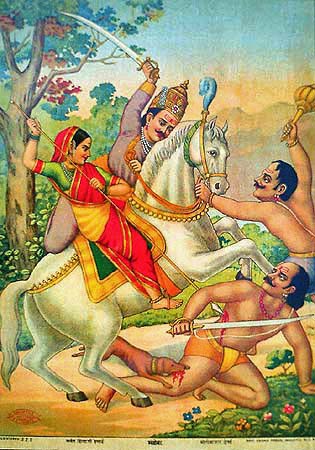
Khandoba and Mhalsa killing demons Mani-Malla — a popular oleograph, c.1880.
Sanskrit transliterationKhaṇḍobā
Devanagariखंडोबा
AffiliationAvatar of Shiva
AbodeJejuri
MantraOm Shri Martanda Bhairavaya Namah
WeaponTrishula, Sword
MountHorse
ConsortMhalsa and Banai (chief consorts)

Khandoba (IAST: Khaṇḍobā), also known as Martanda Bhairava and Malhari, is a Hindu deity worshiped generally as a manifestation of Shiva mainly in the Deccan Plateau of India, especially in the state of Maharashtra and North Karnataka. He is the most popular Kuladevata (family deity) in Maharashtra.[1] He is also the patron deity of some Kshatriya Marathas (warriors), farming castes, shepherd community and Brahmin (priestly) castes as well as several of the hunter/gatherer tribes that are native to the hills and forests of this region.

The sect of Khandoba has linkages with Hindu and Jain traditions, and also assimilates all communities irrespective of caste, including Muslims. The sect of Khandoba as a folk deity dates at least to 12th century. Khandoba emerged as a composite god possessing the attributes of Shiva, Bhairava, Surya and Kartikeya (Skanda). Khandoba is sometimes identified with Mallanna of Telangana and Andhra Pradesh and Mailara of Karnataka.

Khandoba is depicted either in the form of a linga, or as an image of a warrior riding on a horse. The foremost centre of Khandoba worship is the Khandoba temple of Jejuri in Maharashtra. The legends of Khandoba, found in the text Malhari Mahatmya and also narrated in folk songs, revolve around his victory over demons Mani-malla and his marriages.

Etymology and other names

[edit]

The name Khandoba comes from the words khadga (sword), the weapon used by Khandoba to kill the demons, and the suffix ba (father). Another name Khanderaya means "king Khandoba". Another variant is Khanderao, where the suffix rao (king) is used. In Sanskrit texts, Khandoba is known as Martanda Bhairava, a combination of Martanda (an epithet of the solar deity Surya) and Shiva's fierce form Bhairava. The name Mallari or Malhari is split as Malla and ari (enemy), thus meaning "enemy of the demon Malla". The Malhari Mahatmya records Martanda Bhairava, pleased with the bravery of Malla, takes the name "Mallari" (the enemy of Malla).[2] Other variants include Malanna (Mallanna) and Mailara (Mailar). Other names include Khandu Gavda, Mhalsa-kant ("husband of Mhalsa") and Jejurica Vani.[3]

Iconography

[edit]
The sanctum of Khandoba's older temple Kadepathar, Jejuri. Khandoba is worshipped in three forms: stone icon with the consorts (top), metal icon with Mhalsa (mid, covered with garlands) and two lingas, symbolizing him and Mhalsa.

In a popular oleograph representation of Khandoba,[4] Mhalsa is seated in front of Khandoba on his white horse. Mhalsa is piercing a demon's chest with a spear, while a dog is biting his thigh and the horse is hitting his head. The other demon is grabbing the reins of the horse and attacking Khandoba with a club as Khandoba is dismounting the horse and attacking the demon with his sword. In other representations, Khandoba is seen seated on a horse with the heads of demons trod under the horse's hooves or their heads under Khandoba's knees.[5]

In murtis (icons), Khandoba or Mailara is depicted as having four arms, carrying a damaru (drum), trishula (trident), bhandara-patra (turmeric powder-filled bowl) and khadga (sword). Khandoba's images are often dressed as a Maratha sardar,[6] or a Muslim pathan.[7] Often, Khandoba is depicted as a warrior seated on horseback with one or both of his wives and accompanied with one or more dogs.[8] He is also worshipped as the aniconic linga, the symbol of Shiva.[9] Often in Khandoba temples, both representations of Khandoba — the aniconic linga and the anthropomorphic horseback form.[8]

Legends

[edit]

Legends of Khandoba generally narrate about the battle between the deity and demons Malla and Mani. The principle written source of the legend is Malhari Mahatmya (Mallari Mahatmya), which claims to be from the chapter Kshetra-kanda of the Sanskrit text Brahmanda Purana, but is not included in standard editions of the Purana.[10] R.C. Dhere and Sontheimer suggests that the Sanskrit Mahatmya was composed around 1460–1510 AD, mostly by a Deshastha Brahmin, to whom Khandoba is the family deity.[11] A version is also available in Marathi by Siddhapal Kesasri (1585).[12] Other sources include the later texts of Jayadri Mahatmya and Martanda Vijaya by Gangadhara (1821)[13] and the oral stories of the Vaghyas, bards of the god.[14]

Mani is worshipped in the Jejuri temple of Khandoba

The legend recounts that the demon Malla and his younger brother Mani, who had gained the boon of invincibility from the god Brahma, create chaos on the earth and torment the sages. When the seven sages approach Shiva for protection, Shiva assumes the form (avatar) of Martanda Bhairava (as the Mahatmya calls Khandoba) on Chaitra Shuddha Poornima at Adimailar, Mailapura near Bidar. He rides the Nandi bull, leading an army of the gods. Martanda Bhairava is described as shining like gold and the Sun, covered in turmeric (Haridra), three-eyed and with a crescent moon on his forehead.[15] The demon army is slaughtered by the gods; finally Khandoba kills Malla and Mani. While dying, Mani offers his white horse to Khandoba as an act of repentance and asks for a boon. The boon is that he be present in every shrine of Khandoba, that human-kind is bettered and that he be given an offering of goat flesh. The boon is granted, and thus he transforms a demigod. Malla, when offered a boon, asks for the destruction of the world and human-flesh. Angered by the demon's request, Khandoba decapitates him, and his head falls at the temple stairs where it is trampled by the devotees feet. The legend further describes how two Lingas appeared at Prempuri, the place where the demons were killed.[16][17]

Oral stories continue the process of Sanskritization of Khandoba — his elevation from a folk deity to Shiva, a deity of the classical Hindu pantheon — that was initiated by the texts. Khandoba's wives Mhalsa and Banai are also identified with Shiva's classical Hindu wife, Parvati, and Ganga respectively. Hegadi Pradhan, the minister and brother-in-law of Khandoba and brother of Lingavat Vani Mhalsa,[18] the faithful dog that helps Khandoba kill the demons, the horse given by Mani and the demon brothers are considered avatars of Vishnu, Nandi and the demons Madhu-Kaitabha respectively. Other myth variants narrate that Khandoba defeats a single demon named Manimalla, who offers his white horse, sometimes called Mani, to the god.[19] Other legends depict Mhalsa (or Parvati) and Banai or Banu (or Ganga) as futilely helping Khandoba in the battle to collect the blood of Mani, every drop of which creates a new demon. Finally, the dog of Khandoba swallows all the blood. Sometimes, Mhalsa, or rarely Banai, is described as seated behind Khandoba on the horse and fighting with a sword or spear.[20]

The legends portray Khandoba as a king who rules from his fortress of Jejuri and holds court where he distributes gold. Also, king Khandoba goes on hunting expeditions, which often turn into "erotic adventures", and subsequent marriages.[21]

Wives

[edit]
Khandoba with his two chief wives: Mhalsa and Banai.

Khandoba has several wives from different communities, who serve as cultural links between the god and the communities; Mhalsa and Banai (Banu, Banubai) being the most important.[21] While Khandoba's first wife Mhalsa is from the Lingayat merchant (Vani) community, his second wife Banai is a Dhangar (shepherd caste). Mhalsa has had a regular ritualistic marriage with Khandoba. Banai, on the other hand, has a love marriage by capture with the god. Mhalsa is described as jealous and a good cook; Banai is erotic, resolute, but does not even know how to cook. Often folk songs tell of their quarrels. Mhalsa represents "culture" and Banai "nature". The god king Khandoba stands between them.[22]

Khandoba's third wife, Rambhai Shimpin, is a tailor woman who was a heavenly nymph or devangana and is sometimes identified with Banai. She is a prototype of the Muralis — the girls "married" to Khandoba. Rambhai is worshipped as a goddess whom Khandoba visits after his hunt. She is also localised, being said to come from the village from Dhalewadi, near Jejuri. The fourth wife Phulai Malin, from the gardener or Mali caste, She was a particular Murali and is thus a deified devotee of Khandoba. She is visited by him at "Davna Mal" (field of southernwood, a herb said to be dear to Khandoba). The fifth wife, Candai Bhagavin, is a Telin, a member of the oilpresser caste. She is recognized as a Muslim by the Muslims. Apart from these, Muralis — girls offered to Khandoba — are considered as wives or concubines of the god.[23][24]

Other associations and identifications

[edit]
A painting depicts Khandoba riding a white horse with Mhalsa, accompanied with a dog and attendants including a Waghya dancing before him.

Mallana (Mallikaarjuna) of Andhra Pradesh and Mailara of Karnataka are sometimes identified with Khandoba (Mallari, Malhari, Mairala). Khandoba is also associated with Bhairava, who is connected with Brāhmanahatya (murder of a Brahmin).[25] Devotees emphasize that Khandoba is a full avatar of Shiva, and not a partial avatar like Bhairava or Virabhadra. He accepts the attributes of the demon king — his horse, weapons and royal insignia.[26]

Sontheimer stresses the association of Khandoba with clay and termite mounds. Oral legends tell of Khandoba's murtis being found in termite mounds or "made of earth".[27] According to Sontheimer, Martanda Bhairava (Khandoba) is a combination of the sun god Surya and Shiva, who is associated with the moon. Martanda ("blazing orb") is a name of Surya, while Bhairava is a form of Shiva.[24][28] Sundays, gold and turmeric, which are culturally associated with the sun, form an important part of the rituals of Khandoba.[24][28] Sontheimer associates the worship of the Sun as termite mounds for fertility and his role as a healer to Khandoba's role as granter of fertility in marriages and to the healing powers of turmeric, which the latter holds.[28]

Another theory identifies Kartikeya (Skanda) with Khandoba.[29] The hypotheses of the theory rests upon the similarities between Skanda and Khandoba, namely their association with mountains and war, similarity of their names and weapons (the lance of Skanda and the sword of Khandoba) and both having two principal wives.[30] Also the festivals for both deities, Champa Sashthi and Skanda Sashthi respectively for Khandoba and Skanda fall on the same day.[31] Other symbols associated with Khandoba are the dog and horse.[32]

Worship

[edit]
Khandoba (centre icon on a horse and with Mhalsa) in a household shrine (devghar) of a Deshastha Brahmin family

Though Shiva is worshipped across Maharashtra in his original form, some Maharashtrian communities prefer to worship him in form of his avatars, Khandoba being the most popular.[33] He is the most popular Kuladevata (family deity) in Maharashtra.[1] One of the most widely worshipped gods of the Deccan plateau, Khandoba is considered as "the premier god of Sakama bhakti (wish-granting devotion) and one of the most powerful deities responsive to vows (navas)".[33] He is worshipped by the vast majority of Marathi Hindu people from all strata of that society. He is the patron deity of warrior, farming, herding as well as some Brahmin (priest) castes, the hunters and gatherers of the hills and forests, merchants and kings. The devotees of Khandoba in the Deccan principally consists of Marathas (kshatriyas) and Kunabis, shepherd Dhangars, village guards and watchmen Ramoshis — a "Denotified tribe",[34][35] the former "untouchable" Mahars and Mangs, fisher-folk Kolis, balutedar castes like gardeners (Mali) and tailors (Shimpi), though it also includes of a few Brahmins and even some Muslims.[36][37] Although Brahmin presence is nominal in his sect, Deshastha Brahmins,[38][25][39] as well as the Kokanastha Brahmins - in Nashik and Satara - do worship Khandoba, some imitating the Deshastha Brahmins.[40] The Deshastha Brahmins, Chandraseniya Kayastha Prabhus,[39] as well as the royal families like Gaikwads and Holkars worship Khandoba as their Kuladevata. He is also worshipped by Jains and Lingayats. He is viewed as a "king" of his followers.[41]

Rituals and modes of worship

[edit]

Khandoba is believed to be a kadak (fierce) deity, who causes troubles if not propitiated properly as per the family duties.[42] Khandoba is worshipped with Turmeric (Bhandār), Bel fruit-leaves, onions and other vegetables.[43] The deity is offered puran poli – a sweet or a simpler dish called bharit rodga of onion and brinjal.[44] A strict vegetarian naivedya (offering of food) is offered to Khandoba in the temples, although he is regarded by many devotees as a non-vegetarian.[4] Goat flesh is also offered to the deity, although this is done outside the temple as meat is forbidden inside the temple.[4]

An important part of the Khandoba-sect is navas, a vow to perform service to the god in return for a boon of good harvest, male child, financial success etc. On fulfilment of the navas, Khandoba was offered children or some devotees would afflict pain by hook-swinging or fire-walking.[45] This type of worship using navas is called Sakama Bhakti – worship done with an expectation of return and is considered "to be of a lower esteem".[46] But the most faithful bhaktas (devotees) are considered to be greedy only for the company of their Lord, Khandoba is also called bhukela – hungry for such true bhaktas in the Martanda Vijaya.[47]

A Vaghya, the bard of Khandoba

Boys called Vāghyā (or Waghya, literally "tigers") and girls called Muraḹi were formerly dedicated to Khandoba, but now the practice of marrying girls to Khandoba is illegal.[43] The Vaghyas act as the bards of Khandoba and identify themselves with the dogs of Khandoba, while Muralis act as his courtesans (devanganas — nymphs or devadasis). The Vaghyas and their female counterparts Muralis sing and dance in honour of Khandoba and narrate his stories on jagarans — all night song-festivals, which are sometimes held after navas fulfilment.[45] Another custom was ritual-suicide by Viras (heroes) in the cult.[48] According to legend, an "untouchable" Mang (Matanga) sacrificed himself for the foundation of the temple at Jejuri to persuade Khandoba to stay at Jejuri forever.[47] Other practices in the cult include the belief that Khandoba possesses the body of a Vaghya or devrsi (shaman).[49][50] Another ritual in the cult is an act of chain-breaking in fulfilment of a vow or an annual family rite; the chain is identified with the snake around Shiva's neck, which was cut by the demons in the fight.[32] Another rite associated with the family duties to please Khandoba is the tali bharne, which is to be performed every full moon day. A tali (dish) is filled with coconuts, fruits, betel nuts, saffron, turmeric (Bhandar) and Bel leaves. Then, a coconut is placed on a pot filled with water and the pot is worshipped as an embodiment of Khandoba. Then, five persons lift the tali, place it repeatedly on the pot thrice, saying "Elkot" or "Khande rayaca Elkot". Then the coconut in the tali is broken and mixed with sugar or jaggery and given to friends and relatives. A gondhal is performed along with the tali bharne.[51]

Khandoba is considered as the giver of fertility. Maharashtrian Hindu couples are expected to visit a Khandoba temple to obtain Khandoba's blessing on consummation of marriage. Traditional Maharashtrian families also organize a jagaran as part of the marriage ceremony, inviting the god to the marriage.[8] The Sanskrit Malhari Mahatmya suggests offerings of incense, lights, betel and animals to Khandoba. The Marathi version mentions offerings of meat and the worship by chedapatadi – "causing themselves to be cut", hook-swinging and self-mortification by viras. Marathi version calls this form of bhakti (devotion) as ugra (violent, demonic) bhakti. The Martanda vijaya narrates about Rakshashi bhakti (demonic worship) by animal sacrifice and self — torture. Possession by Khandoba, in form of a wind, is lower demonic worship (pishachi worship). Sattvic worship, the purest form of worship, is believed to be feeding Khandoba in form of a Brahmin.[13]

Muslim veneration

[edit]

Khandoba is also a figure of respect and worship to Muslims, and this affiliation is visible in the style of his temples. He is called Mallu or Ajmat Khan (Rautray) by Muslim devotees, and is many times portrayed as being a Muslim himself in this context.[52] The latter title is believed to conferred upon by the Mughal invader king Aurangzeb, who was forced to flee from Jejuri by Khandoba's power.[46] Some of these distinguishing Muslim features include his usual appearance as that of a pathan on horseback, one of his wives being a Muslim, and that his horse-keeper is a Muslim in Jejuri. The Martaṇḍa Vijaya expressly states that his devotees are mainly Muslims. The worship of Khandoba had received royal patronage by Ibrahim II, which consisted of the reinstatement of the annual jatra (fair) and the right of pilgrims to perform rituals at the Naldurg temple.[52] The Malhari Mahatmya even records Muslims (mleccha) as the god's bhaktas (devotees), who call him as Malluka Pathan or Mallu Khan.[53] In Jejuri, a Muslim family traditionally looks after the horses of the god.[46]

Temples

[edit]
Khandoba's newer Temple in Jejuri. Notice devotees showering turmeric powder (bhandara) on each other, in a temple festival.
Mylara Lingeshwara Temple at Mylara, Bellary District, Karnataka

There are over 600 temples dedicated to Khandoba in the Deccan.[33] His temples stretch from Nasik, Maharashtra in the north to Davangere, Karnataka in the south, Konkan, Maharashtra in the west to western Andhra Pradesh in the east. The eleven principal centres of worship of Khandoba or jagrut kshetras, where the deity is to be called awake or "jagrut", are recognized; six of them in Maharashtra and the rest in northern Karnataka.[33][36] Khandoba's temples resemble forts, the capital of his kingdom being Jejuri. The priests here are Guravs, not Brahmins.[6] His most important temples are:

  1. Jejuri: The foremost center of worship of Khandoba.[54] It is situated 48 km from Pune, Maharashtra. There are two temples: the first is an ancient temple known as Kadepathar. Kadepathar is difficult to climb. The second one is the newer and more famous Gad-kot temple, which is easy to climb. This temple has about 450 steps, 18 Kamani (arches) and 350 Dipmalas (lamp-pillars). Both temples are fort-like structures.[55]
  2. Pali (Rajapur) or Pali-Pember, Satara district, Maharashtra.[56]
  3. Adi-mailar or Khanapur (Pember or Mailkarpur) near Bidar, Karnataka
  4. Naldurg, Osmanabad district, Maharashtra.
  5. Mailara Linga, Dharwad district, Karnataka.
  6. Mangasuli, Belgaum district, Karnataka.
  7. Maltesh or Mailara temple at Devaragudda, Ranebennur Taluk, Haveri district, Karnataka.
  8. Mannamailar or Mailar (Mylara), Bellary, Karnataka.
  9. Nimgaon Dawadi, Pune district, Maharashtra.[57]
  10. Shegud, Ahmednagar district, Maharashtra.
  11. Komuravelli, Siddipet district, Telangana.
  12. Satare, Aurangabad district, Maharashtra.
  13. Malegaon, Nanded district, Maharashtra.
  14. Mailapur Mailarlingeshwara Temple, Mailapura, Yadgir, Yadgiri District, Karnataka

Festivals

[edit]
Khandoba with Mhalsa, a company style painting from Tiruchirappalli. Khandoba is depicted with the traditional attributes of Shiva like the Trishula, damaru and the deer.

A six-day festival, from the first to sixth lunar day of the bright fortnight of the Hindu month of Margashirsha, in honour of Khandoba is celebrated at Jejuri, to commemorate the fight with demons Mani-Malla. On the sixth day (Champa-Shashthi), Khandoba is believed to have slew the demons.[43] A jatra (temple festival and fair) is held in Pember on Champa-shasthi; the festival continues until the new moon.[58] Deshastha Brahmans and Marathas also observe the annual Champa-Shashthi festival. The images of Khandoba and Malla are cleaned and worshipped. For six days, a fast is observed. On the seventh day, the devotees break their fast by a feast known as Champasashtliiche parne. An invitation to this feast is regarded as an invitation from Khandoba himself and is harder to refuse.[59]

Another festival Somvati Amavasya, which is a new-moon day that falls on a Monday, is celebrated in Jejuri. A palakhi (palanquin) procession of the images of Khandoba and Mhalsa is carried from the Gad-kot temple to the Karha river, where the images are ritually bathed.[60][61]

In Pali-Pember, the ritual of the marriage of Khandoba with Mhalsa is annually performed. Turmeric is offered to the deities.[48] Two festivals are celebrated in honour of Mailara, as Khandoba is known in Karnataka. These are the Dasara festival at Devaragudda, and an eleven-day festival in Magha month (February–March) in Mailar, Bellary district. Both festivals have enactments of the battle between Mailar and the demons Mani-Malla.[62] Chaitra Purnima (full-moon day) is also considered auspicious.[63]

In general, Sundays, associated with the Sun, are considered auspicious for Khandoba worship.[64]

Development of the sect

[edit]
Khandoba with his wives at Mailar Mallanna temple, Khanapur near Bidar, Karnataka.

The sect of Khandoba, a folk religion, reflects the effect of Vedic Rudra, the Puranic Shiva worshipped as Linga in Brahmanical Hinduism and Nath and Lingayat sects.[42] Khandoba may be a product of the Vedic Rudra, who like Khandoba was associated with robbers, horses and dogs.[65] The 14th-century commentator Sayana traces the name Malhari to the Taittiriya Samhita, Malhari is explained as enemy (ari) of Malha (Prajapati) – an epithet of Rudra, who is considered a rival of the deity Prajapati.[66] According to Stanley, Khandoba originated as a mountain-top god, solar deity and a regional guardian and then assimilated into himself gods of various regions and communities.[33] According to Stanley, Khandoba inherits traits from both the sun-god Surya as well as Shiva, who is identified with the moon. Stanley describes Khandoba as "a moon god, who has become a sun god", emphasizing on how the moon imagery of Shiva transforms into the solar iconography of Khandoba in the Malhari Mahatmya.[24]

As per R. C. Dhere, two stone inscriptions in 1063 C.E. and 1148 C.E mentioning the folk deities Mailara and his consort Malavva which suggests that Mailara gained popularity in Karnataka in this period. Soon, royals of this region started erecting temples to this folk deity, upsetting the elite class of established religion who vilified Mailara. Initially exalted as an incarnation of Shiva, Mailara was denounced by Basava, the founder of the Shiva-worshipping Lingayat sect – who would later promote the deity. Chakradhara (c.1270, founder of Mahanubhava sect), Vidyaranya (1296–1391) and Sheikh Muhammad (1560–1650) criticized the god.[67] The Varkari poet-saint Eknath also wrote "disparagingly" about Khandoba's cult worship,[46] but after him, the "open" criticism of Khandoba stopped, but the "barbaric" practices of his cult were still targeted.[67]

Sontheimer suggests that Khandoba was primarily a god of herdsmen,[68] and that the cult of Khandoba is at least older than 12th century, which can be determined by references in Jain and Lingayat texts and inscriptions. A 12th-century Jain author Brahmashiva claims that a Jain, who died in battle after a display of his valour, was later named as Mailara. By the 13th century, wide worship of Malhari or Mailara is observed by kings, Brahmins, simple folk and warriors. With the rise of the Muslim empire, classical Hindu temples fell into ruin, giving rise to the folk religion such as of Khandoba. Chakradhara remarked in his biography Lilacharitra - "by the end of the Kali Yuga, temples of Vishnu and Shiva will be destroyed, but those of Mairala will stay". A 1369 AD inscription at Inavolu near Warangal tells an account of Mallari different from the Malhari Mahatmya — Shiva helped the epic hero Arjuna kill the demon Malla, thus acquiring the title of Mallari. Mailara was the family deity of the Kakatiya dynasty (1083–1323 AD); a text from their rule records the self-torture rituals of Mailara-devotees and describes the deity. Throughout his development, Mailara is looked upon as a lower manifestation of Ishvara (God) by Lingayat and Maharashtrian bhakti saints.[66] By the 18th century, Khandoba had become the clan deity of the Maratha Empire. In 1752, the Maratha dowager queen Tarabai chose Khandoba's Jejuri temple to seal her pact with the Peshwa ruler, Balaji Bajirao, in the deity's presence.[69]

The Malhari Mahatmya states that Khandoba first appeared on Champa-Shashthi, which was a Sunday, at Premapur, which identified as Pember (Adimailar, Mailarapur) near Bidar. Marathi traditions tell that Khandoba came originally from Premapuri, now Pember in Karnataka, then went to Naldurg, Pali and finally to Jejuri.[12] Sontheimer suggests that the cult of Mailara may have originated in Pember and then spread to Maharashtra, merging with the cult of Khandaka — the patron yaksha (demi-god) of Paithan giving it its distinct Maharashtrain characteristics. Maharashtrains call the god – Kanadya Khanderaya, the god from Karnataka. The cult possibly was spread by Lingayat, Jain and other merchants, associated with Mailara-Khandoba, to other parts of the Deccan. Besides Mailara, Khandoba is identified with other deities of Karnataka and Andhra Pradesh, and is called as Mallanna, Mairala, and Mallu Khan.[70] Other traditions like Shakta sects of folk goddesses were assimilated into the Khandoba sect, identifying the goddesses with Khandoba's wives Mhalsa or Banai.[53]

Marathi literature has a mixed reaction to the sect of Khandoba. Naranjanamadhva (1790) in stotra (hymn) dedicated to Khandoba calls him "an illustrious king with rich clothes and a horse with a saddle studded with jewels", who was once "an ascetic beggar who ride an old bull and carried an ant-bitten club (khatvanga)" – a humorous take on the Puranic Shiva. In another instance (1855), he is called a ghost by a Christian missionary and aKoknastha Brahmin in a debate against a Deshastha Brahmin.[42] Another Brahmin remarks with scorn about the impurity of the Khandoba temple, visited by Shudras and whose priests are non-Brahmin Guravs.[42] The Marathi term "khel-khandoba", which is taken to mean "devastation" in general usage, refers to the possession of devotee by the god in his sect.[42]

References

[edit]

Further reading

[edit]
[edit]
Revisions and contributorsEdit on WikipediaRead on Wikipedia
from Grokipedia
Khandoba, also known as Martanda Bhairava or Malhari Martand, is a prominent Hindu deity revered primarily in the Deccan region of , particularly in and northern , as a manifestation of in his fierce form. He is depicted as a warrior god mounted on a , armed with a sword and (drum), symbolizing his role as a protector against evil and a granter of victory and prosperity. Originating as a folk deity possibly linked to ancient warrior-heroes or storm gods during the 9th–10th centuries CE amid the , Khandoba's cult evolved through Sanskritization, incorporating attributes of , , , and while retaining local oral traditions of tales, songs, and poems that emphasize his heroic exploits. Central to his mythology is the legend of his battle against the demons Mani and Malla, where he slays them to safeguard devotees, a reflected in , rituals, and temple across the region. As a kuladevata (family deity) for communities like the Dhangars (shepherds), Kunbis, and others, Khandoba fosters social cohesion through stories of his marriages to multiple consorts—Mhalsa, Banai, and others—from diverse castes, representing collaboration and harmony among traders, pastoralists, artisans, and even interfaith elements. The epicenter of Khandoba worship is the Khandoba Temple at , near , , a hilltop site with roots possibly in the Yadava dynasty (12th century) and major expansions in the 18th century under the Holkar rulers of the . Built in the Hemadpanti architectural style using black , the temple complex features layered shrines, minimal ornamentation, and vibrant rituals involving and blood offerings (symbolic or actual), drawing millions during festivals like Somvati and Champa Shashthi. These celebrations, marked by processions, folk performances, and community feasts, underscore Khandoba's enduring significance as a symbol of regional identity, martial valor, and inclusive devotion in Maharashtra's cultural landscape.

Origins and Identity

Khandoba's cult originated as a folk deity in the Deccan region during the 9th–10th centuries CE, possibly linked to ancient warrior-heroes, storm gods, or pastoral traditions among communities like the Dhangars. Through the process of Sanskritization during the , he was incorporated into mainstream as a manifestation of , blending local oral traditions with Shaivite, solar, and martial attributes.

Etymology and Names

The name "Khandoba" derives from the Sanskrit term khadga, meaning "sword," combined with the Marathi suffix or bāb, denoting "father" or "protector," thus portraying the deity as a sword-wielding guardian. This etymology underscores Khandoba's role as a martial protector, with the sword symbol further reinforced in his iconography as a central emblem of his warrior identity. Khandoba is known by several alternative names that reflect his syncretic identity, including Martanda Bhairava, which fuses the Martanda with the fierce aspect of , a manifestation of . Other primary epithets are Mallari or Malhari, derived from "Malla" (referring to a ) and "ari" (enemy), signifying "enemy of Malla," and regional variants such as Khandu and Mahadev, the latter linking him directly to as the great god. These names highlight etymological ties to and , emphasizing Khandoba's evolution from a local folk deity to a Shaivite . The historical development of these names is evident in texts like the Malhari Mahatmya (c. 1460–1510 CE), a key Sanskritized narrative that integrates Khandoba into broader Shaivite traditions while preserving folk elements. This work reflects syncretic influences, blending local Marathi oral traditions with pan-Indian Shaivism, as Khandoba's epithets evolve to encompass both regional protector roles and cosmic Shaivite attributes.

Iconography

Khandoba is typically depicted as a warrior deity mounted on a , embodying his role as a fierce protector and of . In this standard iconographic form, he is shown with one or four arms, holding a (trident) in one hand as a symbol of Shiva's destructive power, a khadga () in another representing martial prowess, and occasionally a (drum) signifying the cosmic rhythm of creation and destruction. His consort often appears alongside him, sometimes riding a to emphasize her complementary fierce energy. Variations in Khandoba's depictions include an aniconic form as a Shiva linga, particularly in temple sanctums where the abstract symbol underscores his integration with Shaivite traditions. In anthropomorphic representations, he may appear standing or seated, adorned with jewels, a snake coiled around his neck, and draped in a skin, highlighting attributes of and dominion over wild forces. frequently accompany him as vahanas or loyal companions, symbolizing guardianship and the transcendence of fear. Symbolic elements in Khandoba's iconography often feature his body smeared with , which signifies purity, in battle, and auspicious , as the vibrant yellow paste evokes the gold devotees seek from his blessings. Friezes and reliefs in temple art illustrate his triumph over adversaries, using dynamic poses to convey themes of divine intervention without narrating specific events. Regional differences appear in southern depictions, where solar motifs, linked to names like Martanda, incorporate radiant auras or sun-like crowns to blend local solar worship with his warrior identity. Artistic styles of Khandoba's sculptures reflect medieval influences from the and Maratha eras, commonly carved in durable black basalt or stone to withstand environmental exposure in hilltop temples like . These works employ intricate low-relief carving techniques, with Maratha-era pieces often portraying him in sardar-like attire to resonate with regional warrior culture, while earlier styles emphasize geometric precision and symbolic minimalism.

Legends

The primary legend of Khandoba portrays him as an incarnation of , or sometimes , who descends to earth to vanquish the twin demons Mani and Malla, siblings who terrorized sages and disrupted the cosmic order in the Deccan region. According to this narrative, the demons had propitiated through intense , gaining boons that made them nearly invincible, but their tyranny prompted divine intervention; Khandoba, armed with a and mounted on his , engages them in a prolonged battle at the hill of . The conflict culminates in Khandoba slaying the demons; as Mani lay dying, he repented and offered his to Khandoba, attaining liberation. This core myth is elaborated in the medieval text Malhari Mahatmya (c. 1460–1510 CE), a key source for Khandoba's cult that integrates local oral traditions with Puranic elements. Variations in the legend appear in regional folk narratives, establishing familial ties through the post-battle marriage to , the daughter of a local chieftain or demon associate, and the miraculous creation of a termite hill—referred to as roopya—as a sacred emblem of his presence and power on . The legends exhibit strong syncretic features, blending Shaiva devotion to Shiva's martial aspects with Vaishnava motifs of avataric descent and folk tales of regional heroism, thereby appealing to diverse communities in . Symbolically, these narratives underscore the triumph of (cosmic order and righteousness) over (chaos and tyranny), while post-battle blessings from Khandoba invoke , , and protection for devotees, reflecting the deity's role as a guardian of agrarian and pastoral life.

Family and Associations

Wives and Consorts

Khandoba is revered with multiple divine consorts, each embodying aspects of regional and serving as bridges between the and diverse social groups in . His primary wives are and Banai, who play central roles in his mythological narratives and are integral to his and temple . , often regarded as an incarnation of , is associated with the Lingayat and merchant () communities, symbolizing cultural and urban elements in Khandoba's cult. In legends, she aids Khandoba during his battle against the demon Malla, wielding weapons alongside him to ensure victory, which underscores her role as a warrior consort. Banai, identified with Ganga and linked to the () community, represents and , often depicted with a as her companion, reflecting traditions. Folk tales describe a conflict where Mhalsa's jealousy leads Khandoba to position their shrines separately in temples—Mhalsa at higher elevations and Banai at lower—to maintain harmony. Beyond these, Khandoba's other consorts include Rambhai from the tailor () , Phulai n from the florist () community, and a Muslim consort like Candai from the oil-presser community, each marriage mythologically integrating specific s into the cult and promoting social cohesion across class lines. In , is frequently shown riding beside Khandoba on his or sharing it with him, while Banai appears on foot or with her dog; temples like feature dedicated shrines for these consorts, emphasizing their distinct yet complementary roles in devotion.

Other Associations and Identifications

Khandoba is primarily identified as a manifestation of in his fierce form, embodying the deity's destructive and protective aspects, as detailed in regional legends where assumes this guise to vanquish demons. This association underscores Khandoba's role as Martanda Bhairava, a syncretic fusion of with the Martanda, akin to , symbolizing both martial vigor and cosmic illumination in Deccan traditions. Occasionally, Khandoba merges with (Skanda), the war god, due to shared attributes of youthful warfare and spear-bearing , reflecting broader syncretic processes in folk . In some regional narratives, he aligns with Vishnu's avatars, particularly through protective motifs, though such links remain peripheral to his core Shaivite identity. Symbolically, Khandoba is tied to mounds, which represent primordial and serve as sites for his idols or rituals, linking him to agrarian and subterranean forces. Dogs function as his loyal companions, evoking Bhairava's canine associations and emphasizing vigilance, loyalty, and guardianship over flocks. These symbols reinforce Khandoba's dual roles as a for agrarian communities, ensuring bountiful harvests, and a protector for shepherds and farmers against threats, integrating him into the socio-economic fabric of rural and . Culturally, Khandoba received patronage from the Yadava dynasty (12th–14th centuries), whose rulers supported temple constructions like that at , elevating his cult from local folk worship to regional prominence. He is identified with regional guardians such as Mailar (or Mallanna) in , where shared myths of demon-slaying and shepherd patronage highlight cross-regional among Deccan pastoral groups. This identification extends to Andhra-Telangana variants, fostering a unified warrior cult across linguistic boundaries. Khandoba's aspects parallel martial saints in Indian traditions, portraying him as a deified who triumphs over asuras like Mani and Malla, embodying valor and communal defense in oral epics and ballads. Such narratives position him as a vira (hero-god), akin to historical or legendary figures who protect the marginalized, blending divine and human realms without formal .

Worship Practices

Rituals and Modes of Worship

Devotees of Khandoba engage in daily and personal rituals that emphasize devotion and seeking blessings, often centered on the application of haldi (turmeric) paste to the deity's icon or one's own body for protection and prosperity. This practice, rooted in folk traditions, symbolizes purification and is believed to invoke Khandoba's warrior-like safeguarding qualities, with turmeric also smeared on sacred objects during home worship. Navas, or conditional vows, form a core element of personal devotion, where individuals promise specific acts such as fasting on auspicious days, undertaking pilgrimages to rural shrines, or presenting offerings like betel leaves, coconuts, or votive figures of animals in exchange for boons like health, fertility, or successful harvests. These vows are fulfilled through simple household pujas, reinforcing Khandoba's role as a responsive deity accessible to common folk. Modes of devotion to Khandoba often involve intense physical and ecstatic expressions, including possession dances where devotees enter trance-like states, mimicking the god's martial vigor through rhythmic movements and calls, typically led by hereditary priests or inspired laypersons. Historically, animal sacrifices—primarily goats or sheep—were offered to appease Khandoba's fierce aspect and ensure victory over obstacles, but in contemporary practice, these have largely become symbolic, replaced by effigies or vegetarian naivedya such as poli (sweet bread) and sprinkled grains to align with broader ethical shifts. Aarti rituals, performed with lit lamps and accompanied by chants from the Malhari Mahatmya—a medieval text narrating Khandoba's exploits—serve as a communal yet adaptable mode of worship, fostering a sense of through rhythmic and symbolism. Caste-specific practices highlight Khandoba's integration into diverse social fabrics, with shepherds undertaking vows tied to their livelihood, such as offering sheep livers or dung-based rituals to Banai (Khandoba's consort) for herd protection and bountiful yields, often on full-moon days. Merchant communities, particularly Vanis and Lingayats associated with , perform prosperity-oriented rituals involving showers and wealth invocations, viewing Khandoba as a patron of success through vows for business stability. These variations underscore the deity's adaptability across occupational groups. Sacred objects play a pivotal role in worship, with the khanda (sword) carried in personal processions to embody Khandoba's demon-slaying prowess and invoke martial blessings. Circumambulation of termite hills, seen as abodes of subterranean deities linked to Khandoba's myths, constitutes a humble rite for fertility and resolution of disputes, often concluding navas fulfillment.

Muslim Veneration

Khandoba's veneration by Muslim communities in Maharashtra and Karnataka dates to the medieval period, reflecting a syncretic blend of Sufi and Hindu devotional elements in the Deccan region. This interfaith tradition emerged amid the cultural exchanges under Muslim rule, where Khandoba was integrated into local Islamic folklore as a protective warrior figure, often equated with a saintly peer (pir). Historical texts like the Martanda Vijaya (composed around 1821 by Gangadhara) describe his primary devotees as Muslims, noting royal patronage from Bahmani Sultan Ibrahim II, who supported Khandoba worship to foster communal harmony. Muslim devotees typically address Khandoba as Mallu Khan or Ajmat Khan, portraying him as a Pathan rather than a traditional Hindu , which aligns with Islamic avoidance of idol worship. They focus on abstract representations, such as linga forms or symbolic icons emphasizing his martial attributes, and participate in offerings at shared shrines without engaging in icon-centric rituals. At prominent sites like the temple, contribute through custodial roles, including a traditional Muslim policeman who guards the 's stables and accompanies the palanquin procession during the Somvati festival, symbolizing protective companionship. Legends in the Malhari Mahatmya, a key text on Khandoba's mythology, explicitly include Muslim figures as devoted bhaktas, such as guards and warriors who revere him as Malluka Pathan, highlighting narratives of loyalty across religious lines. These stories underscore interfaith devotion, with Muslims depicted as integral to the deity's protective domain, free from caste or communal barriers. This syncretic worship has played a vital socio-cultural role in promoting communal unity in the Deccan, particularly under Bahmani and later Maratha governance, where Khandoba's cult served as a bridge between Hindu and Muslim populations, encouraging shared rituals and mutual respect amid diverse agrarian and pastoral communities. Such practices continue to exemplify religious harmony in regions like Pune and northern Karnataka, where joint participation in festivals reinforces social cohesion.

Temples

The Khandoba temples are primarily located in and , serving as key centers of worship for the deity revered as a manifestation of . These sites often feature fortified hilltop structures reflecting regional architectural influences and historical patronage. Prominent examples include the temple, a major pilgrimage destination, along with those at , , and Mylara Lingeshwar. The Khandoba temple at , situated on a hilltop resembling a fort, traces its origins to the dynasty in the 12th century, with the main constructed in Hemadpanthi style using black stone. Extensions, including the ardhamandapa and with , were added in the 16th century under Maratha chieftain Ragho Mambaji, while the surrounding fort structures blend Maratha, Mughal, Deccan, and elements from the 16th to 18th centuries, supported by Holkar dynasty patronage. Inscriptions in Marathi, , Telugu, , and , dating from 1063 CE onward, document its evolution and royal endowments. The temple complex includes multiple gateways (darwazas) and stepwells essential for the arduous ascent, housing a central idol of Khandoba astride his . In , near Satara, the temple stands on the banks of the Tarli River and exemplifies Hemadpanthi with fortifications on all sides, originally constructed around the and later expanded under local Maratha commanders. It features a spacious sanctum with brass masks depicting Khandoba and his consort Mhalsabai, reflecting historical ties to regional rulers, including endowments from the Satara kingdom. The site at , particularly the temple in Bori village, represents a smaller yet significant local linked to agrarian communities, emphasizing Khandoba's role as a protective . Further south, the Mylara Lingeshwar temple in Karnataka's Bellary district honors Khandoba under the name Mailari, a form of , with parts of the sukhanasi and navaranga built in 1412 CE by Gangarasa, incorporating Vijayanagara-era sculptures of deities like Kanchaveera. This site underscores the deity's cross-regional appeal, with its architecture featuring stone carvings tied to the legend of slaying demons Mallasura and Manikasura. Across these temples, common elements include basalt idols, ornate gateways, and stepwells for , alongside motifs evoking hills from Khandoba's mythological emergence. Hundreds of smaller shrines dot , many incorporating such symbolic features to invoke the deity's warrior essence. Priestly duties at these temples are traditionally handled by communities, non-Brahmin hereditary priests specialized in Shaiva worship, who maintain rituals and manage endowments from Maratha rulers that ensured the shrines' sustenance through land grants and resources. These traditions highlight Khandoba's folk roots, distinct from Vedic Brahminical practices. The sacred geography of Khandoba temples aligns closely with legends of his battles, such as the site at near , commemorating the victory over demons Mani and Malla, where natural features like hills and rivers are interpreted as divine abodes or battlegrounds. This connection imbues the locations with spiritual potency, drawing pilgrims to sites believed to be marked by the deity's presence.

Festivals

The major festivals dedicated to Khandoba revolve around commemorating his victories over demons and fulfilling devotees' vows, drawing millions from across , , and beyond. These celebrations emphasize communal devotion, with elaborate processions and rituals that blend Hindu traditions across castes and regions. Champa Shashthi, also known as Khandoba Navratri, is a prominent six-day observed from the new moon () to the sixth day of the bright half of the Hindu month of Margashirsha, typically in November or December. It marks Khandoba's triumph over the demons Mani and Malla, symbolized through daily processions where the deity's idol is carried in a palanquin (palkhi) amid chants and music, culminating in ritual marriages of the deity with his consorts and Banai on the final day. Devotees perform special pujas, fasts, and vow fulfillments, such as offering coconuts and , believing these acts ensure protection and prosperity. The festival's scale peaks at temples like , where it integrates folk elements like horse-mounted representations of Khandoba. Somvati Amavasya, falling on new moon days that coincide with Mondays, hosts the vibrant Bhandara festival, particularly at the temple, where devotees throw bright yellow powder over the deity's idol and each other as a symbol of purification and blessing. This event, occurring two to three times annually, involves a grand palkhi procession carrying Khandoba's idol to the nearby Karha River for a ceremonial bath, followed by community gatherings where vows are fulfilled through offerings. The , known as haldi bhandara, underscores fertility and warding off evil, with participants from diverse backgrounds smearing the powder in ecstatic devotion. Dasara and Navratri fairs honor Khandoba's aspect through the Mardani Dussehra, a regional variation of the pan-Indian , celebrated over nine nights leading to the tenth day in . At sites like and , fairs feature jatra processions with folk performances reenacting Khandoba's battles, including animal blessings where horses, bulls, and other livestock are paraded and anointed for protection and prosperity. Devotees fulfill vows by presenting these animals, symbolizing gratitude for bountiful harvests or safe travels, amid displays of and decorated effigies. These festivals exhibit regional variations, with the largest gatherings at and temples, where processions span miles and attract over a million pilgrims, fostering community feasts that unite through shared meals of prasad like turmeric-laced sweets and grains. In , the events emphasize egalitarian participation, allowing Dhangars (shepherds), Kunbis (farmers), and others to lead rituals, while Pali's fairs highlight local Gondhali bards. Such integrations promote social harmony, as Khandoba's transcends caste barriers in these seasonal observances. Cultural expressions enrich these celebrations, including powadas—heroic ballads recited by bards narrating Khandoba's legends of valor—and folk theater performances that dramatize his exploits with song, dance, and satire during jatra fairs. These art forms, performed by wandering troupes, preserve oral histories and engage audiences in devotional fervor, often concluding with communal dances around the deity's palanquin.

Historical and Modern Development

Evolution of the Sect

The cult of Khandoba emerged as a local hero-god among communities in the Deccan region by the , evolving from folk worship of cattle deities and nature spirits tied to groups such as the Dhangars, Gavlis, and Kurubas. This early development was profoundly influenced by Rudra- cults, with Khandoba identified as an avatar of or Kalbhairava, incorporating attributes like the and while absorbing elements from and demon-slaying narratives. By the 13th century, the dynasty of Devagiri provided significant patronage, supporting temple foundations and integrating the deity into regional religious landscapes. Textual and sectarian growth accelerated through the incorporation of Khandoba into Mahanubhava and Lingayat traditions, which promoted Sanskritization and broader dissemination via merchant and priestly networks. The Lingayats, in particular, elevated Khandoba's consort Mhalsa as a figure from their caste, with Jangama priests officiating rituals and saints like Revana Siddhesvar aiding the sect's expansion. A pivotal milestone was the composition of the Malhari Mahatmya, a Sanskrit text embedded in the Brahmanda Purana, which formalized Khandoba's mythology around his victories over demons Mani and Malla, solidifying his identity as Martanda Bhairava and serving as a scriptural cornerstone for the sect from the medieval period onward. The sect's integration into Maratha state religion occurred in the 17th century under Chhatrapati Shivaji, who promoted Khandoba alongside deities like to foster unity among warrior and pastoral groups, with temple enhancements continuing into the Peshwa era of the . This patronage extended to regions like and Sholapur, embedding the cult in the socio-political fabric of emerging Maratha power. Socially, Khandoba's spread from its core among pastoralists—where festivals aligned with cattle markets, such as at Mhasvad—to a pan-Maharashtrian revered across s, including Ramoshis and broader Hindu communities, facilitating a degree of caste unification through shared devotional practices. Medieval milestones included the inscriptional evidence of temple activity, such as the Mhasvad record dated A.D. 1138, and ongoing constructions in the Deccan amid the sultanate period, where Hindu patrons under Muslim rule maintained sites like those at and Bid, blending local with enduring pastoral motifs. These developments trace the sect's transition from localized folk reverence to an institutionalized form of .

Contemporary Worship and Recent Developments

Since India's independence, worship of Khandoba has experienced significant growth, particularly through increased at key temples such as the one in , which now attracts thousands of devotees year-round due to improved accessibility and promotion by state initiatives. This surge reflects broader post-independence efforts to preserve and popularize regional Hindu heritage sites, with the Jejuri temple serving as a major center drawing visitors from across and beyond. Government protections have played a crucial role in sustaining these sites, with the Khandoba Temple in recognized as a state-protected under 's heritage framework, involving ongoing conservation to maintain its architectural integrity. In recent years, restoration projects have been prioritized; for instance, the government announced a comprehensive refurbishment of the temple complex in 2022, allocating funds for structural repairs and preservation amid rising visitor numbers. Further advancements occurred in 2024, when detailed restoration and conservation plans were unveiled for the temple at Kadepathar in , emphasizing historical authenticity while accommodating modern devotional practices. The prompted adaptations in worship, with major Hindu festivals, including those dedicated to Khandoba, shifting to virtual formats in to ensure devotee safety while maintaining communal rituals through live streams and digital offerings. By 2025, the Bhandara Festival at saw expansions in scale, hosting nearly six devotees who participated in traditional rituals, underscoring the festival's enduring appeal despite challenges. Restoration efforts extended to other associated sites, such as the Khandoba temple in , where state-funded repairs addressed structural wear from environmental factors. Contemporary issues include ongoing debates over , a traditional element in Khandoba rituals at temples like , where the in 2015 rejected a nationwide ban, affirming the practice's cultural significance while urging humane methods. These discussions highlight tensions between advocacy and religious customs, with local communities advocating for balanced regulations. Diaspora worship has also evolved, with Marathi communities in urban and abroad, including in , continuing Khandoba veneration through festivals and home rituals that replicate traditions like offerings to foster cultural continuity. Cultural revivals incorporate , such as digital recordings of powadas—traditional ballads narrating Khandoba's legends—made available to engage younger devotees, and mobile apps that allow tracking of personal navas (vows) for virtual fulfillment. Interfaith dialogues have gained momentum, promoting Hindu-Muslim unity by emphasizing Khandoba's historical across communities, with modern events in encouraging joint participation in to build social harmony. In March 2025, the Jejuri temple implemented a requiring traditional Indian attire for darshan to maintain sanctity. As of November 2025, preparations for the Champa Shashti included arrangements for four dedicated parking locations to manage devotee influx.

References

Add your contribution
Related Hubs
User Avatar
No comments yet.