Hubbry Logo
Gender symbolGender symbolMain
Open search
Gender symbol
Community hub
Gender symbol
logo
8 pages, 0 posts
0 subscribers
Be the first to start a discussion here.
Gender symbol
Gender symbol
from Wikipedia
Image shows male and female symbols incised deeply
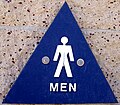
Gender symbols on a public toilet in Switzerland

A gender symbol is a pictogram or glyph used to represent sex and gender, for example in biology and medicine, in genealogy, or in the sociological fields of gender politics, LGBT subculture and identity politics.

In his books Mantissa Plantarum (1767) and Mantissa Plantarum Altera (1771), Carl Linnaeus regularly used the planetary symbols of Mars, Venus and Mercury – , ,  – for male, female and hermaphroditic (perfect) flowers, respectively.[1] Botanists now use for the last.[2]

In genealogy, including kinship in anthropology and pedigrees in animal husbandry, the geometric shapes or are used for male and for female. These are also used on public toilets in some countries.

The modern international pictograms used to indicate male and female public toilets, 🚹︎ and 🚺︎, became widely used in the 1960s and 1970s. They are sometimes abstracted to for male and for female.[3]

Biology and medicine

[edit]

Gender symbol
In Unicode
  • U+2642 MALE SIGN
  • U+2640 FEMALE SIGN
  • U+26A5 MALE AND FEMALE SIGN
  • U+25B3 WHITE UP-POINTING TRIANGLE
  • U+25A1 WHITE SQUARE
  • U+25CB WHITE CIRCLE

The three standard sex symbols in biology are male , female and hermaphroditic ; originally the symbol for Mercury, , was used for the last. These symbols were first used by Carl Linnaeus in 1751 to denote whether flowers were male (stamens only), female (pistil only) or perfect flowers with both pistils and stamens.[1] (Most flowering and conifer plant species are hermaphroditic and either bear flowers/cones that themselves are hermaphroditic, or bear both male and female flowers/cones on the same plant.) These symbols are now ubiquitous in biology and medicine to indicate the sex of an individual, for example of a patient.[4][a]

Genealogy

[edit]
Minimal kinship chart: a male and female producing male and female offspring

Kinship charts use a triangle for male and circle for female.[6] Pedigree charts published in scientific papers use an earlier anthropological convention of a square for male and a circle for female.[7]

Before a shape distinction was adopted, all individuals had been represented by a circle in Morgan's 1871 System of Consanguinity and Affinity of Human Family, where gender is encoded in the abbreviations for the kin relation (e.g. M for 'mother' and F for 'father').[8] W. H. R. Rivers distinguished gender in the words of the language being recorded by writing male kinship terms in all capitals and female kinship terms with normal capitalization. That convention was quite influential for a time, and his convention of prioritizing male kin by placing them to the left and females to the right continues to this day though there have been exceptions, such as Margaret Mead, who placed females to the left.[9]

Public toilets

[edit]

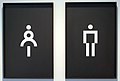
The modern gender symbols used for public toilets, 🚹︎ for male and 🚺︎ for female, are pictograms created for the British Rail system in the mid-1960s.[10] Before that, local usage had been more variable. For example, schoolhouse outhouses in the 19th-century United States had ventilation holes in their doors that were shaped like a starburst Sun or like a crescent Moon , respectively, to indicate whether the toilet was for use by boys or girls.[11] The British Rail pictograms – often color-coded blue and red[citation needed] – are now the norm for marking public toilets in much of the world, with the female symbol distinguished by a triangular skirt or dress, and in early years (and sometimes still) the male symbol stylized like a tuxedo.[3]

These symbols are abstracted to varying degrees in different countries – for example, the circle-and-triangle variants (male) and (female) commonly found on portable toilets, sometimes abstracted further to a triangle (representing a skirt or dress) for female and an inverted triangle (representing a broad-shouldered tuxedo) for male in Lithuania.[3]

In elementary schools, the pictograms may be of children rather than of adults, with the girl distinguished by her hair. In themed locations, such as bars and tourist attractions, a thematic image or figurine of a man and woman or boy and girl may be used.[citation needed]

In Poland, an inverted triangle is used for male while a circle is used for female.[3]

In mainland China, silhouettes of heads in profile may be used as gender pictograms,[citation needed] generally alongside the Chinese characters for male () and female ().[12]

Some contemporary designs for restroom signage in public spaces are shifting away from symbols that demonstrate gender as binary as a way to be more inclusive.[13][14]

Sexual orientation and gender politics

[edit]
Lesbian and gay male interlocked gender sex symbols

Since the 1970s, variations of gender symbols have been used to express sexual orientation and gender politics. Two interlocking male symbols are used to represent gay men while two interlocking female symbols are often used to represent lesbians.[15] Two female and two male symbols interlocked represent bisexuality, while an interlocked female and male symbol represents heterosexuality.[16]

The combined male-female symbol is used to represent androgyne people.[17]

The male-with-stroke symbol is also used for transgender people;[17] when additionally combined with the female and male symbols to create the symbol , it indicates transgender people or gender inclusivity[citation needed][18][19][17].

The Mercury symbol and combined female/male symbol have both been used to represent intersex people.[20][16] The alchemical symbol for sublimate of antimony 🜬 is used to represent non-binary people. The neuter symbol is also used to represent non-binary people, especially those who are neutrois or of a neutral gender.[16] A featureless circle ⚪︎ is also used to represent non-binary people, especially those who are agender or genderless, as well as asexuality.[21][16]

Since the 2000s, numerous variants of gender symbols have been introduced in the context of LGBT culture and politics.[16] Some of these symbols have been adopted into Unicode (in the Miscellaneous Symbols block) beginning with version 4.1 in 2005.

Encoding

[edit]
Unicode Standard name Symbol Associated remark in the standard[17][22]
U+2642 MALE SIGN
U+2640 FEMALE SIGN
U+26A5 MALE AND FEMALE SIGN Intersex, androgynous; hermaphrodite (in botany)
U+26A6 MALE WITH STROKE SIGN Transgender
U+26A7 MALE WITH STROKE AND MALE AND FEMALE SIGN Transgender
U+25B3 WHITE UP-POINTING TRIANGLE
U+25BD WHITE DOWN-POINTING TRIANGLE
U+25A1 WHITE SQUARE
U+25CB WHITE CIRCLE Asexuality, sexless, genderless
U+1F7D5 🟕 CIRCLED TRIANGLE 🟕
U+1F6B9 🚹 MENS SYMBOL 🚹︎ Man symbol; men's restroom
U+1F6BA 🚺 WOMENS SYMBOL 🚺︎ Woman symbol; women's restroom
U+1F6C9 🛉 BOYS SYMBOL 🛉︎
U+1F6CA 🛊 GIRLS SYMBOL 🛊︎
U+1F6BB 🚻 RESTROOM 🚻︎ Man and woman symbol with divider; unisex restroom[b]

See also

[edit]

Notes

[edit]

References

[edit]
[edit]
Revisions and contributorsEdit on WikipediaRead on Wikipedia
from Grokipedia
The male (♂) and female (♀) symbols are ideograms historically employed to denote biological males and females in scientific, medical, and classificatory contexts. Originating in Renaissance-era and astronomy as representations of the metals iron and , associated with the planets Mars and , they symbolize the spear and of the war god Mars for males and the hand mirror of the love goddess for females. Swedish botanist adapted these symbols in the 18th century for botanical , using ♂ to indicate stamens (analogous to reproductive structures) and ♀ for pistils (), a convention that extended to and . In and , the symbols remain standard for distinguishing sexes, with ♂ for XY chromosome bearers and ♀ for XX, reflecting dimorphic reproductive roles empirically observed across . They also feature in public infrastructure, such as restroom signage, to indicate facilities segregated by biological sex for privacy and safety reasons rooted in anatomical differences. While primarily denoting immutable biological sex rather than subjective —a distinction emphasized in empirical sciences—the symbols have faced reinterpretation in cultural debates, prompting proposals for additional icons representing non-binary or categories, though these lack the historical or of the originals.

Origins and Historical Development

Astronomical and Alchemical Antecedents

The symbols ♂ and ♀ trace their origins to ancient astronomical notations for Mars and Venus, with the male symbol representing Mars (the Roman god of war) and the female symbol representing Venus (). These glyphs likely evolved from contractions of the Greek names for the planets—Θουρος (Thouros, for Mars, yielding the theta-like and form) and Φωσφόρος or Ἀφροδίτη (Phosphoros or , for Venus, stylized as a hand mirror)—as documented in Greco-Roman astrological texts. By the early , these planetary symbols had achieved a standardized form in European astronomical manuscripts, predating their later biological adaptations. In alchemical traditions of medieval , the symbols acquired associations with corresponding metals, reflecting perceived affinities between celestial bodies, elements, and qualities. The Mars symbol (♂) denoted iron, prized for its hardness and use in weaponry, aligning with the planet's attributes, while the Venus symbol (♀) signified , valued for its , luster, and ornamental applications, evoking feminine and Venusian allure. These metal-planet linkages formed part of a broader septenary system in , where seven classical planets were paired with seven metals, influencing practical and philosophical speculations on transmutation from at least the 12th century onward. Alchemical texts, such as those compiling Hellenistic and Arabic influences into Latin grimoires by the 13th–15th centuries, employed these symbols in diagrams for , , and alloying processes, emphasizing empirical observations of material properties over mythological literalism. This usage underscores a causal connection between planetary influences (as understood in Ptolemaic astronomy) and terrestrial substances, where iron's resistance to mirrored Mars's perceived endurance, and copper's evoked Venus's generative fertility—interpretations rooted in observable chemical behaviors rather than unsubstantiated esotericism. Such precedents laid the groundwork for the symbols' eventual extension beyond celestial and metallurgical contexts.

Linnaean Adoption and Early Biological Use

In 1751, introduced the biological application of the symbols ♀ and ♂ in the dissertation Plantae hybridae, a work defended by J.J. Haartman under Linnaean supervision, to denote parental sexes in hybrid plants; he designated ♀ for the female (matrem) parent, ♂ for the male (patrem) parent, and ~ (later standardized as ×) for the hybrid offspring, as stated: "matrem signo ♀, patrem ♂ & plantam hybridam ~ designavero." This marked the symbols' transition from alchemical and astronomical contexts—where ♂ represented Mars (associated with iron and weaponry) and ♀ (linked to and mirrors)—to empirical , aligning with Linnaeus's emphasis on reproductive structures for . Linnaeus expanded this convention in (1753), employing the symbols to specify plant sexuality, such as ♂ for staminate (male) individuals, ♀ for pistillate (female), and ⚥ for hermaphroditic forms, exemplified in entries like Spinacia oleracea (spinach), which features separate . These notations supported his artificial , outlined earlier in Fundamenta Botanica (1735) and refined in subsequent editions of Genera Plantarum, which classified over 6,000 species into 24 classes based on (male organ) count and pistil (female organ) structure, prioritizing observable over phylogenetic relationships. By Mantissa Plantarum (1767) and its sequel (1771), Linnaeus routinely applied ♂, ♀, and ⚥ to describe flower sexes across genera, standardizing their use in taxonomic descriptions and enabling concise notation of dioecious, monoecious, or polygamous reproductive strategies. This botanical precedent extended to early zoological applications in Linnaean works like (10th edition, 1758), where the symbols denoted sexes in animal pedigrees and classifications, facilitating the documentation of binary sexual reproduction across kingdoms based on direct morphological evidence. The adoption reflected Linnaeus's mechanistic view of nature, treating sexual symbols as shorthand for causal reproductive roles verifiable through dissection and observation.

Scientific and Empirical Applications

Biology and Medicine

In biology, the symbols ♂ (male) and ♀ (female) denote organisms based on their reproductive roles, with ♂ indicating those producing small, mobile gametes (spermatozoa or equivalent) and ♀ those producing large, nutrient-rich gametes (ova or equivalent), reflecting the binary dimorphism observed across sexually reproducing species. This usage originated with Carl Linnaeus, who first applied the symbols biologically in his 1751 dissertation Plantae Hybridae to represent parental sexes in plant hybrids—♀ for the female (seed-bearing) parent and ♂ for the male (pollen-bearing) parent—and expanded their application in Species Plantarum (1753) to classify plant sexuality according to stamen (♂, analogous to male organs) and pistil (♀, analogous to female organs) morphology. Linnaeus's system emphasized empirical observation of reproductive structures, enabling concise notation in taxonomic descriptions of over 7,700 plant species, where dioecious or monoecious sex expression was indicated. The symbols were extended to shortly thereafter, appearing in studies of animal hybridization and by the late 18th century, such as Josef Kölreuter's 1761–1766 work on and plant crosses, where ♂ and ♀ distinguished es based on production and secondary sexual characteristics like genitalia or . In modern biological literature, they continue in accounts, field guides, and diagrams—e.g., denoting male (♂) and female (♀) variants in (distinguishing es by antennal morphology) or (by dimorphism)—facilitating data on sex ratios, mating behaviors, and evolutionary pressures like , as quantified in studies showing consistent 1:1 sex ratios in gonochoristic under Fisherian principles. In medicine, the symbols occasionally appear in anatomical illustrations of reproductive systems or discussions of , such as differences in gonadal development or profiles (e.g., testosterone-driven ♂ traits versus estrogen-progesterone cycles in ♀), but clinical notation predominantly employs "M"/"F" abbreviations or geometric shapes (squares for males, circles for females) in pedigrees and records to indicate biological sex, which influences —e.g., females metabolizing certain drugs 20–30% slower due to —and risks like higher ♀ in autoimmune disorders (e.g., 78% of systemic cases). This empirical distinction underscores as a binary biological trait tied to , guiding precision in diagnostics and therapies, though institutional sources sometimes conflate it with constructs despite evidence of causal primacy in outcomes like cardiovascular event timing (e.g., ♀ peaks post-menopause).

Genealogy and Pedigrees

In genetic pedigrees constructed for tracing hereditary traits through generations, the male symbol (♂) and female symbol (♀) have historically denoted biological sex to map parent-offspring relationships and inheritance patterns. These symbols, adapted from Linnaean , appeared in early human pedigrees by the late , with extensive use in British genetic and studies during the early . For example, they illustrated sex-specific transmission in conditions such as , where ♂ represented male individuals and ♀ female ones, aiding analysis of X-linked or autosomal traits. Leading figures like and endorsed the symbols for their clarity in pedigree diagrams, facilitating empirical assessment of familial resemblances and disease prevalence. This application aligned with causal mechanisms of , emphasizing biological dimorphism over social constructs, as the symbols distinguished gamete contributions from sperm- and egg-producing progenitors. By the mid-19th century, alternatives like squares (♂ equivalent) and circles (♀ equivalent) emerged, pioneered by Pliny Earle in his 1845 pedigree for red-green , which prioritized compactness for complex multi-generational charts. The geometric convention spread, appearing in prominent analyses such as the 1909 Wedgwood-Darwin-Galton pedigree, though planetary symbols lingered in some European contexts for their established astronomical and alchemical precedents. In pedigrees, such as those for horses dating to ancient records but formalized in modern registries, ♂ and ♀ occasionally supplemented textual designations of sires and dams to denote reproductive roles in lineage documentation. These notations enabled quantitative evaluation of breeding outcomes, with males (♂) often positioned leftward in patrilineal emphases of early charts, reflecting empirical on sex-biased trait expression without deference to later ideological reinterpretations of as fluid. favored biological accuracy, as deviations for self-reported identity risk obscuring sex-linked genetic realities verifiable through karyotyping or phenotypic assays.

Cultural and Practical Applications

Public Facilities and Signage

The male (♂) and female (♀) gender symbols are utilized in signage for public facilities, primarily to indicate sex-segregated restrooms and other amenities, providing a concise visual cue based on their established associations with biological sex distinctions. These symbols gained traction in signage during the mid-20th century as international standardization efforts for public spaces accelerated, particularly following the widespread adoption of pictographic systems in the 1960s and 1970s. Unlike the more common stick-figure representations standardized by organizations such as the American Institute of Graphic Arts (AIGA) in collaboration with the U.S. Department of Transportation in 1974—which depict humanoid outlines differentiated by clothing—they offer an abstract, space-efficient alternative rooted in alchemical and astronomical iconography. In the United States, federal accessibility standards under the Americans with Disabilities Act (ADA) often require specific geometric backgrounds for restroom signage: triangular for facilities and circular for , within which the ♂ or ♀ symbols may be inscribed, especially in non-pictographic designs. This configuration ensures tactile and visual compliance for identifying entrances, with the symbols reinforcing binary sex separation justified by empirical considerations of , , and behavioral differences between sexes in shared spaces. Internationally, direct use of ♂ and ♀ appears in various contexts, such as European door plaques stylized as and Mars motifs, while some regions approximate them geometrically—for instance, inverted triangles for males and circles for females in . Adaptations for non-binary or unisex facilities occasionally incorporate merged ♂♀ forms or neutral icons, such as combined circle-triangle motifs in the U.S., though these remain less standardized and are often paired with textual labels like "all-gender" to avoid ambiguity. In countries recognizing additional categories, such as India's inclusion of hijra/third-gender signage alongside ♂ and ♀, the symbols maintain their primary role in demarcating male and female spaces. Empirical critiques note that deviations from binary symbols can complicate intuitive recognition, potentially undermining the causal efficacy of signage in high-traffic environments where rapid sex-based differentiation supports safety and efficiency. Overall, the persistence of ♂ and ♀ in signage underscores their utility as empirically validated markers of sex dimorphism, despite proliferating alternatives driven by social policy shifts since the 2010s.

Extensions in Identity and Politics

In the realm of gender identity, the traditional male (♂) and female (♀) symbols have been adapted since the 1970s to represent sexual orientations and later gender identities beyond biological sex. Double interlocking male symbols (♂♂) emerged in gay male communities to signify solidarity, while double female symbols (♀♀) were adopted by lesbian groups for similar purposes. These adaptations reflect early efforts within LGBTQ activism to repurpose astronomical-derived icons for social signaling, though they originated in contexts emphasizing same-sex attraction rather than incongruence between sex and identity. By the 1990s, combined variants like the merged male-female symbol (⚦ or ⚨) gained traction for denoting androgyne or identities, symbolizing a blend of masculine and feminine elements. The symbol (⚧), a combination of the male (♂) and female (♀) symbols with an additional vertical stroke through the circle, is used in some cultural and activist contexts to represent transgender individuals; it is included in Unicode (U+26A7) but lacks widespread historical or scientific adoption compared to the original symbols. Such symbols appear in online communities and advocacy materials but lack universal standardization, often coexisting with pride flags that prioritize color over geometric forms. Politically, these symbols' interpretations underpin disputes over access to sex-segregated spaces, particularly public restrooms. In the United States, "bathroom bills" like North Carolina's House Bill 2 (enacted March 2016, repealed 2017) mandated facility use according to biological sex as indicated on birth certificates, interpreting symbols as proxies for reproductive anatomy to prioritize and concerns rooted in empirical risks of male-pattern . More recently, (signed September 22, 2025) enforces restroom access in government buildings and schools based on sex assigned at birth, rejecting self-identified gender as overriding the symbols' biological denotation. Proponents of such laws cite data showing no increase in incidents from prior policies but argue against expansions that could enable misuse, while opponents advocate gender-neutral signage—such as stick-figure hybrids or text-only labels—to accommodate identity claims. In , legal recognition of a category, affirmed by the in the NALSA v. Union of India ruling on April 15, 2014, has prompted extensions in public signage for hijras—historically a culturally distinct group often involving or traits, distinct from Western paradigms. Some facilities now feature tripartite symbols alongside icons to denote separate hijra accommodations, reflecting statutory inclusion without altering the core binary symbols' form. This adaptation aligns with hijra communities' longstanding social roles but faces implementation challenges due to societal stigma and variable state-level enforcement. These extensions illustrate a tension between the symbols' empirical origins in binary sex dimorphism—tied to gamete production and anatomy—and their politicized reinterpretation to encompass subjective identities, often amplified in advocacy amid debates over civil rights versus biological realism.

Technical Representation

Encoding Standards

The male symbol (♂) is assigned Unicode code point U+2642 in the Miscellaneous Symbols block, the female symbol (♀) at U+2641, and the male with stroke sign (⚧, U+26A7, often associated with transgender representation) also in the same block, enabling consistent representation across digital systems supporting . These assignments originated from their historical use in astronomy and , integrated into Unicode version 1.1 in 1993 to facilitate text processing in environments like databases and pedigree software. In and XML, the symbols lack predefined named entities in standards such as , requiring numeric character references for rendering: ♂ or ♂ for , and ♀ or ♁ for , ensuring compatibility in legacy and modern browsers. They are absent from ASCII and ISO-8859-1 encodings, which cover only basic Latin scripts, necessitating or UTF-16 for proper display and precluding use in pre-Unicode text files without substitution. Distinct from graphical symbols, (first published 1976, revised 2004) standardizes numeric codes for human sex in data interchange: 1 for , 2 for , 0 for not known, and 9 for not applicable, applied in databases, forms, and administrative systems to avoid ambiguity without relying on visual icons. This standard emphasizes factual sex classification over interpretive symbols, with no graphical components, and has been adopted in sectors like government records for machine-readable consistency.

Digital and Emoji Evolutions

The male sign (♂, U+2642) and female sign (♀, U+2640) were standardized in the character encoding system with the release of version 1.1 on , , as part of the block (U+2600–U+26FF). These code points enabled consistent cross-platform representation in digital text, building on earlier ad hoc inclusions in variants and symbol fonts used in scientific and alchemical software during the . Prior to Unicode unification, the symbols appeared in proprietary encodings like Apple's Mac Roman set and IBM's code pages for technical documentation, facilitating their use in early personal computing applications such as word processors and database software for biological notations. Subsequent Unicode updates expanded the repertoire of gender-related symbols in the same block. For instance, the male with stroke sign (⚧, U+26A7), often associated with representation, and the interlocked male and female sign (⚤, U+26A4) were introduced in Unicode 4.1 (March 2005), reflecting growing demands for diverse identity markers in digital communication. These additions supported applications in , medical records, and web forms, where precise symbol rendering became essential for data interoperability. By Unicode 5.2 (October 2009), further variants like the doubled female sign (⚢, U+26A2) were encoded, aiding specialized uses in demographic and sociological datasets. Emoji evolutions integrated these symbols into visual digital expression starting with Unicode 9.0 (June 2016), when U+2640 and U+2642 were designated for emoji presentation via the variation selector-16 (U+FE0F), yielding ♀️ and ♂️. This update, proposed in Unicode Technical Report #51 revision, allowed platforms to render them as colorful, stylized glyphs rather than monochrome text, aligning with planetary and gender iconography while enabling modifier sequences for professions (e.g., 👨‍⚕️ for male doctor). Earlier, the male and female sign (⚥, U+26A5) had gained emoji status in Unicode 6.0 (October 2010), but the 2016 enhancement for core symbols responded to empirical usage patterns in messaging apps, where they denote biological sex in contexts like fitness tracking or astrological apps. Rendering varies by vendor—Apple and Google stylize them with metallic or planetary hues—ensuring backward compatibility with text fallback. These developments prioritized technical universality over interpretive expansions, though platform implementations occasionally incorporate non-literal variants amid debates on symbol semantics.

Controversies and Critiques

Biological vs. Social Interpretations

The male (♂) and female (♀) symbols originated in ancient Greco-Roman astronomy and alchemy, representing the planets Mars and Venus, respectively, with ♂ derived from Mars's shield and spear and ♀ from Venus's hand mirror; these were later adapted in the 18th century by botanist Carl Linnaeus to denote biological sexes in plants and animals, reflecting observable reproductive dimorphism based on male (sperm-producing) and female (ova-producing) roles. In biological and medical contexts, the symbols continue to signify this binary sexual distinction, grounded in empirical criteria such as chromosomal patterns (XY for males, XX for females in typical cases) and gamete type, with rare intersex conditions (affecting approximately 0.018% of births for disorders altering reproductive function) not constituting a third sex but developmental anomalies within the binary framework. Social interpretations, emerging prominently in the late amid theory, repurpose the symbols to represent subjective identities rather than fixed biological sex, positing as a decoupled from ; this view, advanced in academic fields influenced by constructivist frameworks, extends the symbols to non-binary or fluid categories, sometimes via combined glyphs (e.g., ♀+♂) or new icons, emphasizing self-identification over . Critics, drawing on causal realism in , argue this expansion lacks empirical support, as human —evident in metrics like skeletal structure, profiles, and —is anisogamous and binary, with no viable third type; social constructs cannot override these realities without conflating psychological (prevalence ~0.005-0.014% for persistent cases post-puberty) with ontological categories. The tension arises from institutional biases in academia and media, where social interpretations often prevail despite counter-evidence from fields like and ; for instance, while peer-reviewed studies affirm as a bimodal distribution tied to fitness advantages in , ideology-driven policies (e.g., adaptations in for "gender-neutral" facilities) prioritize subjective claims, prompting critiques that such uses erode the symbols' scientific utility and ignore causal links between and outcomes like susceptibility (e.g., higher male mortality from X-linked conditions). Proponents of biological primacy contend that redefining symbols socially invites empirical challenges, as identity assertions do not alter measurable traits like presence in s or ovarian function in females, underscoring the symbols' original fidelity to verifiable dimorphism over ideological fluidity.

Ideological Expansions and Empirical Challenges

In contemporary gender identity movements, the classical male (♂) and female (♀) symbols, originally denoting biological sexes linked to planetary gods and reproductive roles, have been repurposed and extended to signify self-identified genders decoupled from gamete-based dimorphism. Activists have introduced hybrid symbols, such as the transgender emblem (⚧)—a male symbol with an added crossbar evoking the female—to represent individuals whose identity conflicts with their natal sex, alongside proposed non-binary variants like a neutered Mars symbol or diagonal arrow configurations for fluid or agender states. These adaptations reflect an ideological framework positing gender as an innate, mutable essence independent of anatomy, often promoted in online communities emphasizing personal declaration over physiological markers. However, such extensions originate predominantly from advocacy-driven platforms with potential selection bias toward experiential narratives rather than controlled studies, diverging from the symbols' alchemical and astronomical roots in binary sexual differentiation. Empirical counters these expansions by affirming as a stable binary, rooted in : males produce small, mobile gametes () via XY chromosomes, while females produce large, nutrient-rich gametes (ova) via XX chromosomes, a dimorphism enabling and conserved across over 99.9% of sexually reproducing . (DSDs), sometimes invoked to suggest a , affect 0.02% to 0.05% of the for cases involving unambiguous (e.g., Klinefelter or Turner syndromes), but these do not generate intermediate gametes or reproductive capacities; instead, they manifest as infertile variants within the binary, akin to somatic mutations rather than novel sexes. Longitudinal genomic and endocrinological data reinforce this, showing no viable third gamete type in mammals and evolutionary pressures favoring strict dimorphism for propagation, as intermediate forms reduce fitness in mating competitions. Critiques of symbolic expansions argue they conflate subjective identity with objective causality, risking misallocation in contexts reliant on differences, such as where testosterone-driven advantages persist post-hormone (e.g., 10-50% retained strength gains in trans women after 1-3 years). Peer-reviewed meta-analyses indicate brain dimorphisms align more closely with natal than professed identity, with rates stable at 0.005-0.014% pre-puberty but showing desistance in 60-90% of cases without intervention by adulthood, challenging notions of fixed incongruence warranting symbolic reclassification. This empirical grounding prioritizes reproductive realism over ideological multiplicity, as deviations from binary symbols in policy (e.g., ) correlate with documented safety issues in single- facilities without corresponding biological justification.

References

Add your contribution
Related Hubs
User Avatar
No comments yet.