Hubbry Logo
Bacan IslandsBacan IslandsMain
Open search
Bacan Islands
Community hub
Bacan Islands
logo
8 pages, 0 posts
0 subscribers
Be the first to start a discussion here.
Bacan Islands
Bacan Islands
from Wikipedia
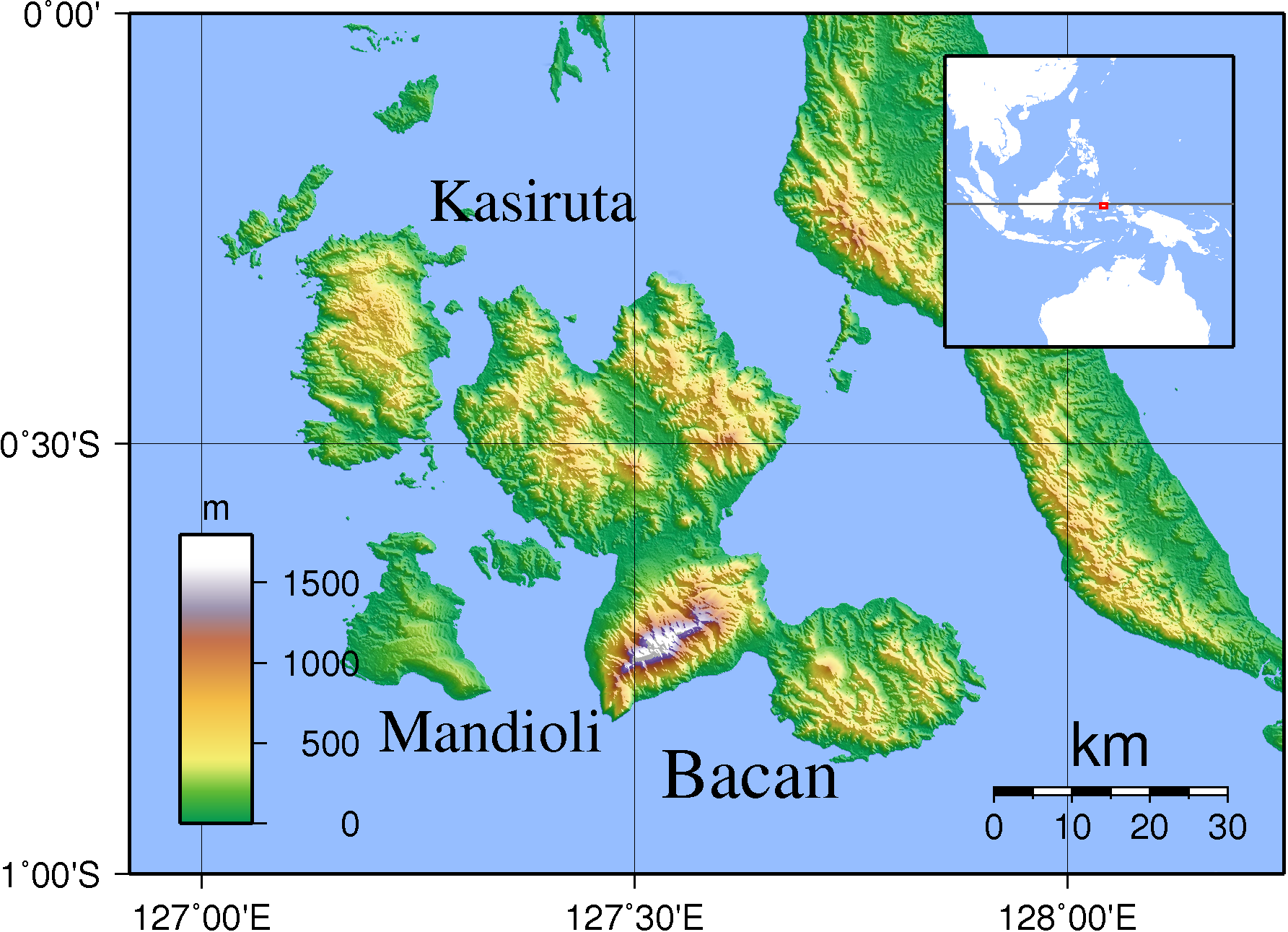
The position of the Bacans in the Moluccas

Key Information

The Bacan Islands (Indonesian: Kepulauan Bacan; Indonesian pronunciation: [kəpuˌlawan ˈbat͡ʃan]), formerly also known as the Bachans, Bachians, and Batchians,[1] are a group of islands in the Moluccas in Indonesia. They are mountainous and forested, lying south of Ternate and southwest of Halmahera. The islands are administered by the South Halmahera Regency of North Maluku Province. They formerly constituted the Sultanate of Bacan.

Bacan (Dutch: Batjan),[2] formerly also known as Bachian[3][2] or Batchian,[4] is the group's largest island. Bacan Island in 2020 included about 82,387 people, of whom 7,073 lived in the capital Labuha; it is subdivided into seven districts. The second and third-largest islands are Kasiruta and Mandioli.[3] Kasiruta and Mandioli each have over 11,000 inhabitants, and each is subdivided into two districts. A fourth island, Batang Lomang, forms a twelfth district within the group. There are dozens of smaller islands in the group, which had a total population of 84,075 at the 2010 Census,[5] but by the 2020 Census had risen to 111,517.[6] The official estimate as at mid-2023 was 117,986.[7]

Administration

[edit]

The group is divided into twelve administrative districts (kecamatan) out of the thirty districts within South Halmahera Regency. They are tabulated below with their areas and their populations at the 2010 Census[5] and 2020 Census,[6] together with the official estimate for mid 2023.[7] The table also includes the number of administrative villages (all classed as rural desa) in each district and its post code.

Kode
Wilayah
Name English name Area
in
km2
Popn
census
2010
Popn
census
2020
Popn
estimate
mid 2023
Admin.
centre
No.
of
villages
No.
of
islands
Post
code
Island
or group
82.04.21 Bacan Timur Selatan Southeast Bacan 321.13 6,460 7,493 8,352 Wayaua 7 1 97791 Bacan Island
82.04.22 Bacan Timur Tengah East Central Bacan 276.28 5,229 6,158 6,495 Bibinoi 7 2 97791 Bacan Island
82.04.07 Bacan Timur East Bacan 463.50 9,051 12,794 13,649 Babang 10 8 97791 Bacan Island
82.04.17 Bacan Selatan South Bacan 169.21 13,265 19,560 21,153 Mandaong 10 - 97791 Bacan Island
82.04.08 Bacan (Central Bacan) 304.69 19,092 27,045 28,468 Labuha 14 3 97791 Bacan Island
82.04.14 Bacan Barat Utara Northwest Bacan 264.94 4,096 5,010 5,099 Yaba 8 1 97791 Bacan Island
82.04.09 Bacan Barat West Bacan 180.78 3,549 4,327 4,665 Indari 7 49 97791 Bacan Island
82.04.18 Batang Lomang (a) Batang Lomang Islands 55.81 6,177 7,655 7,858 Bajo 8 13 97790 Batang Lomang Islands
82.04.19 Mandioli Selatan South Mandioli 138.81 5,798 6,936 7,237 Jiko 6 - 97791 Mandioli
82.04.20 Mandioli Utara North Mandioli 96.79 2,990 3,809 3,880 Indong 6 7 97791 (b) Mandioli
82.04.16 Kasiruta Timur East Kasiruta 247.93 3,847 4,865 5,062 Loleo Jaya 8 6 97790 Kasiruta
82.04.15 Kasiruta Barat (c) West Kasiruta 272.98 4,521 5,865 5,968 Palamea 10 25 97790 Kasiruta

Notes: (a) formally called Kepulauan Batanglomang; situated between Bacan and Mandioli Islands. (b) except for Bobo desa, which has a postcode of 97792.
(c) includes Lata Lata Island (27.9 km2, with 1,201 inhabitants in 2020), located to the northwest of Kasiruta Island, and comprising two desa - Lata Lata and Sidanga.

Bacan Island's seven districts comprise 63 villages (desa) as follows: Bacan Timur Selatan - Liaro, Pigaraja, Silang, Tabajaya, Tabangame, Wayakuba and Wayaua. Batan Timur Tengah - Bibinoi, Songa, Tabapoma, Tawa, Tomara, Tutupa and Wayatim. Bacan Timur - Babang, Bori, Goro-Goro, Kaireu, Nyonyifi, Sabatang, Sali Kecil, Sayoang, Timlonga and Wayamiga. Bacan Selatan - Gandasuli, Kampung Makian, Kubung, Kupal, Mandaong, Panamboang, Papaloang, Sawadai, Tembal and Tuokona. Bacan (district) - Amasing Kali, Amasing Kota, Amasing Kota Barat, Amasing Kota Utara, Awanggoa, Belang Belang, Hidayat, Indomut, Kaputusan, Labuha, Marabose, Suma Tinggi, Sumae and Tomori. Bacan Barat Utara - Geti Baru, Geti Lama, Gilalang, Jojame, Lolarogurua, Nusa Babullah, Sidopo and Yaba. Bacan Barat - Indari, Kokotu, Kusubibi, Nang, Nondang, Tawabi and Wiring.
Batang Lomang's single district comprises 8 villages as follows: Bajo, Batutaga, Kampung Baru, Paisumbaos, Prapakanda, Sawangakar, Tanjung Obit and Toin.
Mandioli's two districts comprise 12 villages as follows: Mandioli Selatan - Bahu, Galala, Jiko, Lele, Tabalema and Yoyok. Mandioli Utara - Akedabo, Bobo, Indong, Leleongusu, Pelita and Waya.
Kasiruta's two districts comprise 18 villages, listed as follows with their populations in mid 2022: Kasirutu Barat - Kakupang (493), Marikapal (255), Bisori (671), Doko (809), Palamea (763), Arumamang (742), Lata Lata (640), Sidanga (631), Sengga Baru (455) and Imbu Imbu (437). Kasirutu Timur - Tawa Bacan Barat (639), Maritosa (893), Loleo Jaya (1,439), Kou Balabala (593), Loleo Mekar (437), Kasiruta Dalam (552), Jeret (374) and Tutuhu (262).

History

[edit]

From early times, Bacan was one of the four kingdoms of Maluku together with Ternate, Tidore and Jailolo. The ruling elite converted to Islam in about the late 15th century. The sultan at first resided on Kasiruta Island and had political and commercial influence in northern Ceram and the Papuan Islands. In 1513, the first Portuguese trading fleet to reach the Moluccas set up a trading post on Bacan which at the time was tied to the Sultan of Ternate by dynastic marriages. The fleet's commander, Captain Antonio de Miranda Azevedo, left seven men on Bacan to buy cloves for the following year's expedition. Their arrogant behaviour and reported bad treatment of Bacan women led to their murder. As Ternate did not have enough stock, the ship for which the men had stayed to prepare was used by the Sultan of Ternate to fill Ferdinand Magellan's last ship, which was the first ship to circumnavigate the world. A slave and two birds of paradise were given to the ship by Bacan. Bacan became a place of refuge for rebellious Ternatans. The Portuguese sent a punitive expedition against Bacan but it failed, and instead the Portuguese Governor Galvão challenged Bacan's sultan to a duel to determine who was to be subservient to whom. The challenge was accepted but the duel never took place.[8]

In 1557, Father Antonio Vaz converted Bacan's sultan and court members to Catholicism. The king was married to a daughter of Sultan Hairun of Ternate. Fleets from Ternate invaded the islands in 1570 and later and the king apostatized in 1575, though he was nevertheless poisoned in 1578. A community of Christians remained and were later joined by coreligionists from Tobelo and Ambon. A small Roman Catholic hospital was built by an elderly Dutch nun. Today, Protestants significantly outnumber Catholics. During the mid-19th century Moluccan travels of British naturalist Alfred Russel Wallace, Christians in the Moluccas were called Orang Sirani (lit. "Nazarene People"), a term regularly applied to locals of European ancestry in the Malay Archipelago, thought to have been descended from the Portuguese. They had dressed in white and black and Wallace reports they dance "quadrilles, waltzes, polkas, and mazurkas with great vigour and much skill".[8]

Following the 1575 Ternatan invasion, Bacan become subservient to Ternate for periods, which was sealed through marriages. A sister and a daughter of Sultan Saidi Berkat of Ternate married Bacan rulers in the late 16th and early 17th centuries. A Spanish fort was built in 1606. By this time the seat of the sultan had been moved from Kasiruta to Bacan Island. Once the Dutch East India Company established hegemony in 1609, the Netherlands' power on Bacan was based in Fort Barnaveld.[8]

In 1705, the sergeant in charge of the fort and the sultan captured the English explorer William Dampier, seized his ship, looted its cargo, and threatened all aboard with execution. It is thought that this was in response to Dampier violating the trade monopoly. When the sergeant's Dutch superiors heard of the incident, Dampier was released, his ship restored and the English provided with sumptuous hospitality in Ternate.[9] The chief town at the time, also known as Bachian, was Amasing or Amasingkota on the island's isthmus.[3]

Ternate and Bacan were the only places in the northern Moluccas that had a Dutch curriculum school and a Protestant minister in the late 19th century. The majority of Bacan's Roman Catholics became Protestants during the Dutch colonial period.[citation needed] These Sirani wore semi-European dress and celebrated Sundays with dancing and music.[3] The Sultanate of Bacan was treated as a Dutch protectorate;[3] it was replaced by a council of chiefs under a Dutch contrôleur in 1889.[2] A sultan with much reduced powers was eventually appointed in 1900. What independence remained was lost with the Japanese occupation during and Indonesian independence after World War II.[10] The most significant modern town is Labuha on the west coast. Bacan has more recently been in the news due to violence between Christian and Muslim inhabitants of the island.

Geography

[edit]
German map from 1896

Bacan is of irregular form, consisting of two distinct mountainous parts, united by a low isthmus, which a slight subsidence would submerge.[3] The total land area is around 1,900 km2.[citation needed] The prevailing rocks are sandstone, coralline limestone, and pebbly conglomerate, although hot springs attest to volcanic activity as well.[3] The ancient and non-volcanic rocks are especially prevalent on the south side of the island.[2] The sulphur spring at Taubenkit has a temperature of 125 °F (52 °C) and a still more remarkable example is found at Sayowang on the east coast.[3] "Amasing Hill" on the northern half consists of three small andesitic volcanoes: Cakasuanggi, Dua Saudara, and Mount Sibela. The highest elevation on the southern half is Gunong Sabella[3] or Labua (6,950 ft or 2,120 m),[2] which the locals traditionally considered the seat of evil spirits.[3] Coal and other minerals have been discovered.[3]

During the 19th and early 20th century, large portions of the island were richly wooded, with indigenous sago, coconuts and cloves abundantly produced.[3][2] The Dutch purposefully exterminated the native nutmeg trees: a large grove still remained as late as the 1870s[3] but it had disappeared by the onset of World War I.[2] It is the easternmost point naturally inhabited by primates, in the form of a black macaque which also occurs on Sulawesi.[2] The world's largest bee, the giant mason bee, occurs here and on nearby Halmahera.

Demography

[edit]

By the mid-19th century, the interior of Bacan island was considered uninhabited and the coastal dwellers all non-indigenous.[3] They consisted of the Christian descendants of Portuguese sailors (Sirani), of Malays and Papuans, of Galelas from northern Halmahera, and of Tomore people from Sulawesi's Bay of Tolo.[3] Prior to World War I, the population of the island was around 13 000, including some Chinese and Arabs.[2] In the late 1990s, 193 of Bacan's 7,700 Christians were Protestants.[10] The whole group had a population of 84,075 at the 2010 Census, but by mid 2023 had grown to 117,986.

Several non-Austronesian (Papuan) languages are spoken on Bacan, the main one of which is Galela but also Tobelo and Ternate. Near the capital Labuha, Bacanese Malay was once spoken, but as of 2012 it had only handful of speakers remaining.[11]

Economy

[edit]

Colonial interest in Bacan was primarily driven by the spice trade, which was flourishing in Ternate, Tidore, and Halmahera. The island of Bacan was not particularly sought after for its own resources, but rather, to assist control of the more valuable islands nearby. The Dutch East India Company paid a stipend to the Bacan sultan as compensation for the destruction of Bacan's clove trees that was higher than the salary of the Dutch Governor on Ternate and about 1/9 of that paid to the Sultan of Ternate.

It is thought that gold was washed on Bacan since at least 1774; in the mid-nineteenth century, 20 skilled Chinese gold workers were brought from west Borneo but a gold rush did not eventuate.[citation needed] During the era of steam power, an attempt was made to establish coal mining on the island[3] using Japanese convicts imprisoned by the Dutch. However, following the delivery of several tons the grade of coal was deemed poor and the mining was discontinued.

From 1882, an Amsterdam merchant cleared plantations for vanilla, coffee, tobacco and potatoes, however, his land was unsuitable and the crops succumbed to floods, drought, rot, insects and rodents. Despite over ten years of large investments of capital, creditors forced him out of business in 1900 although they also did not succeed with the plantations.[9] The indigenous economy included the gathering of pearl and mother-of-pearl, and the harvesting the resin from dammar.

See also

[edit]

Notes

[edit]

References

[edit]
Revisions and contributorsEdit on WikipediaRead on Wikipedia
from Grokipedia
The Bacan Islands form an in province, , positioned south of in the , encompassing the main island of Bacan and smaller surrounding islets such as Kasiruta and Mandioli. The principal island of Bacan covers approximately 1,900 square kilometers of predominantly volcanic terrain, featuring mountainous southern regions with peaks exceeding 2,000 meters, including Mount Sibela at 2,118 meters, transitioning to lower, more level northern areas. The islands support a population of around 60,700 residents, many of whom are migrants from neighboring regions rather than indigenous groups, with settlements driven by opportunities in resource extraction and cultivation. Historically, the Bacan Islands served as the core territory of the Sultanate of Bacan, a that exerted influence primarily over its own domain and adjacent islets amid the competitive networks of the Maluku region, where cloves were a key attracting European colonial powers from the onward. The local economy today relies on agriculture, including and plantations, alongside fisheries and operations extracting , nickel, and the semiprecious bacan stone, which has spurred rapid development in certain villages like Tanjung Obit. These activities underscore the islands' transition from a peripheral role in pre-colonial trade to a site of modern resource-driven growth, though constrained by geographic isolation and infrastructural challenges.

Geography

Physical Geography

The Bacan Islands form an in the , within province, , positioned approximately at 0°35′ S latitude and 127°30′ E longitude, south of and southwest of . The group includes the principal island of Bacan, covering roughly 1,900 km², alongside Kasiruta to the northwest, Mandioli to the west, and approximately 80 smaller islets, with the total land area exceeding 2,700 km². Bacan Island exhibits rugged, predominantly volcanic , with steep mountains dominating the southern portion and rising to elevations over 2,000 meters, while the northern half features relatively lower plateaus and karstic landscapes. The highest peak, Mount Buku Sibela (also known as Gunung Sibela or Batusibela), stands at 2,111 meters above and is situated within the Gunung Sibela , marking the highest point in province. Average elevations across the island are around 127 meters, reflecting a mix of elevated plateaus and coastal lowlands. Geologically, the islands lie within the at the of the Eurasian, , and Australian plates, characterized by active and faulting. The basement consists of the Sibela Continental Suite, featuring upper amphibolite-facies schists and gneisses with minerals such as , , and , intruded by granites and overlain by sedimentary-volcanic sequences. Key formations include the Upper Eocene Bacan Formation of interbedded arc volcanics and turbidites, and the Tawali Formation of basalts and volcaniclastic turbidites metamorphosed to zeolite facies. volcanism manifests in basaltic flows associated with fault activity and andesitic centers, notably the Amasing Hill complex in northern Bacan, comprising es Cakasuanggi, Dua Saudara, and Sibela. Rapid Pleistocene exhumation, dated to about 0.7 million years ago, has shaped the prominent relief of the Sibela Mountains.

Climate and Natural Resources

The Bacan Islands exhibit a (Köppen Af), with high temperatures and abundant rainfall year-round due to their equatorial position in Province. Daily maximum temperatures typically range from 29°C to 32°C, while minima hover between 24°C and 26°C, resulting in an annual mean of approximately 28°C; frequently exceeds 80%, fostering persistently muggy conditions. Precipitation averages over 2,500 mm annually, with monthly totals around 140-200 mm and no distinct , though slight variations occur influenced by patterns—wettest months often see 24 rainy days out of 30. Forested volcanic terrain and formations underpin the islands' natural resources, including deposits such as porphyry copper-gold systems at Kaputusan and epithermal gold-base metal prospects linked to Miocene-Pleistocene . Small-scale has historically operated, with exploration confirming high-grade zones amid metamorphic basement rocks; potential exists, as Bacan is among sites targeted for development amid Indonesia's export push. Gem-quality , prized as "batu bacan" for its green hues, occurs in hydrothermal veins, supporting a niche export trade. Agriculture leverages fertile soils for plantations, the economic mainstay yielding export spices, alongside coconuts, cocoa, and ; productivity has expanded on Bacan, with yields tied to enrichment. Rainforests harbor hotspots with endemic birds, (including the giant Chalicodoma pluto), and timber , though from and has reduced forest cover. Marine resources encompass fisheries for , , and reef in surrounding waters, sustaining local communities amid the Maluku's legacy.

History

Pre-Colonial and Sultanate Foundations

The Bacan Islands, part of the Maluku archipelago, were inhabited by Austronesian-speaking populations as part of migrations across eastern dating back to approximately 2000 BCE, with evidence of human activity tied to exploitation of marine and resources, including early spice gathering. Archaeological findings in central Maluku indicate protohistoric settlements focused on sago processing and trade networks extending to and beyond, though specific pre-13th century evidence for Bacan remains sparse due to limited excavations. Local oral traditions describe the islands' societies as organized in village clusters under chieftains, engaging in inter-island exchange of cloves, birds of paradise, and resins, which laid the groundwork for later political consolidation. By the early , Bacan had coalesced into a , one of four principal polities in northern Maluku alongside , , and Jailolo, with its formation linked to intensified regional trade in spices amid contacts with Javanese and Bornean merchants. Traditions attribute the kingdom's origins to of a common ancestral figure, emphasizing Bacan's antiquity through myths like that of Bikusagara, which portray it as a foundational center in Maluku's and political order. Power was concentrated on the main island and nearby islets, with governance relying on kinship-based alliances and control over groves, though the polity's extent remained modest compared to its neighbors until the . Historical records prior to the are fragmentary, relying on later chronicles that may reflect retrospective legitimization. The transition to the Sultanate of Bacan occurred with the adoption of by the ruling elite in the late 15th century, around the 1460s–1480s, as part of broader Islamization in Maluku driven by traders from Gresik and rather than direct influence. This marked a shift from animist and ancestral practices to a ate structure, with the first reportedly styling himself as such to align with Islamic polities, enhancing trade ties and diplomatic standing. The capital was established at Kasiruta, where 15th-century ruins of fortifications, royal graves, and structures attest to early consolidation, though the site's abandonment by the underscores the sultanate's vulnerability to internal strife and external pressures. The sultanate's foundations emphasized maritime control and monopolies, setting the stage for conflicts with European arrivals.

Colonial Encounters and Spice Trade

European powers first encountered the Bacan Islands in the context of the , with the arriving in the Maluku in 1512 to secure access to , a commodity native exclusively to Bacan and nearby islands including , , Moti, and Makian. The islands' volcanic soils supported significant production, positioning Bacan as an important supplier in regional networks linking to broader Asian and emerging European markets. traders established alliances with local rulers and founded a fort on Bacan during the to protect trade routes and defend against rivals. Rivalry intensified as Spanish forces entered the competition, constructing a fort on Bacan in amid conflicts with and indigenous sultanates over monopolies. The (VOC) challenged both Iberian powers, expelling the from key Maluku positions by the early 17th century and seizing the Spanish-held fort on Bacan. To enforce exclusive control over exports, the VOC allied with select sultanates, including Bacan, signing a with its in 1653 that obligated adherence to production quotas and trade restrictions. The Dutch monopoly entailed aggressive measures, such as uprooting excess trees on Bacan and other northern Moluccan islands to prevent oversupply and maintain high prices in . These policies, extended from earlier VOC actions in and , transformed Bacan into a under Dutch oversight, subordinating the sultanate's autonomy to company interests while channeling revenues through VOC channels. Such interventions fueled intermittent resistance but solidified European dominance in the archipelago's until the .

Post-Colonial Integration and Conflicts

Following the transfer of sovereignty from the Netherlands via the Round Table Conference on December 27, 1949, the Bacan Islands were formally integrated into the unitary Republic of Indonesia as part of Maluku province, ending Dutch colonial administration that had included brief incorporation into the autonomous State of East Indonesia (1946–1949). The process encountered minimal localized resistance in Bacan, distinguishing it from the contemporaneous Republic of South Maluku (RMS) declaration on April 25, 1950, in Ambon, which sought independence for southern Moluccan islands and was suppressed by Indonesian forces by the mid-1950s; Bacan, geographically northern and lacking a comparable Christian-majority separatist base, aligned with central authority without documented RMS affiliation. The historic Sultanate of Bacan, reduced to ceremonial status under late colonial rule, persisted as a traditional institution subordinate to Indonesian governance, with no recorded challenges to national unity from royal quarters post-1950. Administrative evolution reinforced integration: Bacan remained under Maluku until the 1999 creation of province amid Suharto's fall and reforms, placing the islands in South Halmahera Regency with Labuha as the administrative center. This restructuring exacerbated pre-existing ethnic tensions from transmigration policies, as Muslim migrants from and resettled in native areas, but Bacan's relative isolation initially buffered direct impacts. Conflicts erupted in late 1999 as inter-ethnic violence in —sparked August 1999 by disputes between indigenous Kao people (mixed Muslim-Christian) and Muslim Makian transmigrants over land and resources—escalated into religious warfare, spreading southward to Bacan by December 1999 and displacing over 100,000 across , including separations of Muslim and Christian families on the islands. The clashes, fueled by rumors of broader conspiracies and arms proliferation, resulted in approximately 3,000 deaths region-wide by 2000, with Bacan experiencing outflows to camps like Sayoang and communal segregation persisting into 2001. initiatives, including the 2000 Malino Accord and local returnee ceremonies in Bacan by September 2001, facilitated partial recovery, though underlying migration grievances lingered.

Administration and Governance

Administrative Structure

The Bacan Islands are administratively part of South Halmahera Regency (Kabupaten Halmahera Selatan) in North Maluku Province (Provinsi Maluku Utara), Indonesia, with the regency's capital at Labuha on the western shore of Bacan Island. Established as a regency following the 1999 division of Maluku Province, South Halmahera encompasses the Bacan Islands group alongside the Obi Islands, Kayoa Islands, Makian Island, and portions of southern Halmahera peninsula, totaling 30 districts (kecamatan) and 249 villages (desa) as of 2023. Bacan Island itself is divided into seven districts: Bacan (headquartered in Labuha), West Bacan (Bacan Barat), North West Bacan (Bacan Barat Utara), South Bacan (Bacan Selatan), East Bacan (Bacan Timur), South East Bacan (Bacan Timur Selatan), and Central East Bacan (Bacan Timur Tengah). Smaller islands in the Bacan group, such as Kasiruta and its environs, fall under additional districts including West Kasiruta (Kasiruta Barat) and East Kasiruta (Kasiruta Timur). Each is subdivided into multiple villages; for instance, South Bacan District includes 10 villages such as Gandasuli, Kupal, Sawadai, Kubung, and Tuakona. Governance at the regency level follows Indonesia's standard hierarchical structure, with a (bupati) elected for a five-year term, supported by a regional (Dewan Perwakilan Rakyat Daerah) and administrative departments handling local services, development, and . Village-level administration occurs through elected heads (kepala desa) managing community affairs under regency oversight, with budgets allocated via central government transfers and local revenues from mining royalties and fisheries.

Traditional Institutions and Sultanate Influence

The Bacan Sultanate's traditional institutions form an centered on the as the paramount ruler, with succession preferentially passing to direct male descendants through a process overseen by the Bobato Empat, a council representing four principal clans: Tarafanur, Tungulawang, Iskandar Alam, and Kamarullah. divides into religious and secular spheres, reflecting an integration of Islamic precepts and local customs. The Bobato Akhirat manages spiritual affairs under the Ompu Qadhi, supported by figures such as the Ompu , Ompu , and Ompu Modim, while the Bobato Dunia addresses worldly administration and defense, encompassing roles like the Ompu Alolong (), Ompu Juru Tulis Raa (), and Ompu Kapita Lau (). Further subdivisions include Bobato Dalam for military functions and Bobato Luar for external administration, with specialized positions such as Jogugu and Kimalaha Sapanggala ensuring operational efficacy. Adat principles underpin these institutions, emphasizing communal acceptance of foundational laws under the dictum "Adat se Atorang" to promote and equity. Sultans are expected to embody core values including Taat De Ompu Taala (obedience to ), Palihara Piling (safeguarding trust), Kaadilang Nang Kabanaran (upholding and truth), and Bapatikamang (deliberative consensus), which blend with indigenous deliberation practices. Rituals such as the rejection of bala (calamities or malevolent forces) remain integral, symbolizing the sultanate's role in communal and , and are woven into to avert disasters through customary rites. Following 's independence in , the sultanate relinquished formal governing authority to the national administrative framework, yet its institutions endure as custodians of and enforcement. Historical sultans, such as Oesman Sadiq Syah (reigned 1900–1935), exemplified preservation efforts by establishing enduring structures like the Bacan Sultanate Mosque in 1901 and the Madrasah Diniyah Awwaliyah Misbahul Aulad in 1935, alongside defending territorial sovereignty against colonial encroachments, such as during the 1934 Oucher Incident. In contemporary contexts, the sultanate exerts informal influence over communities, particularly in land stewardship and ritual observance, with legacies sustained through entities like the Misbahul Aulad Indonesia Bacan Foundation. These elements offer latent contributions to modern governance in , including ethical public service delivery, regulatory formulation, and conflict mediation, though integration into formal state mechanisms remains limited.

Demographics and Society

Population Distribution

The Bacan Islands have a total of approximately 117,986 as of mid-2023, with the vast majority inhabiting the principal of Bacan, which alone supports 115,612 residents across an area of 2,792.85 km², yielding an overall of about 41 persons per km². Smaller s in the group, including Kasiruta and Mandioli, each sustain over 11,000 inhabitants, primarily in coastal villages, while dozens of minor islets contribute minimally to the aggregate. distribution remains uneven, favoring central and southern subdistricts on Bacan due to historical settlement patterns, access to ports, and agricultural viability, with rural dispersal dominating over urban concentration. Subdistrict-level densities highlight this disparity: Batang Lomang records the highest at 141 persons per km², followed by Bacan Selatan at 125 per km² and Bacan at 93 per km², reflecting denser clustering around fertile lowlands and the administrative hub of Labuha, where local densities exceed 3,000 persons per km² in the core village area housing roughly 7,249 people. In contrast, eastern subdistricts such as Bacan Timur Tengah (24 per km²), Bacan Timur Selatan (26 per km²), and Bacan Timur (29 per km²) exhibit sparse settlement tied to rugged and limited . Mandioli Utara and Selatan maintain moderate figures of 40 and 52 persons per km², respectively, underscoring the archipelago's reliance on maritime connectivity for demographic cohesion.

Ethnic and Cultural Composition

The ethnic composition of the Bacan Islands reflects a history of migration and settlement rather than indigenous origins, with no truly native predating regional influxes. Primary groups include Tobelo (Tobelorese), Galela (Gelarese), and Makian migrants from , supplemented by Butonese and Buginese arrivals from , who integrated through trade and sultanate affiliations. The Bacan ethnic subgroup, classified within the broader Malay peoples and numbering approximately 3,700, speaks Bacan Malay as a primary in select villages, forming a core identity linked to the island's historical elite. Culturally, Bacanese communities exhibit a blend of Austronesian , Islamic sultanate legacies from the onward, and residual elements from colonial encounters. Traditional performances feature the slow, ritualistic dendang with betel nut accoutrements, the combative cakalele representing Halmaheran warrior heritage, and the soya-soya, a children's akin to those in . Sacred rites like the kololi kie ceremony, involving communal prayers and processions to sites such as Kasiruta island, reaffirm sultanate symbolism, as observed in events following the 2011 coronation of a new ruler. persists, with Tobelo, Galela, , and Tukang Besi alongside Bacan Malay, underscoring adaptive cultural synthesis amid clove trade-era demographics.

Religion and Social Dynamics

The of South Halmahera Regency, which encompasses the Bacan Islands, is predominantly Muslim, with official provincial data for 2023 recording 107,979 adherents of out of a subtotal figure of 113,484 in the regency's core areas, equating to approximately 95% adherence. The Bacan people, the indigenous ethnic group of the islands, primarily practice , often blending orthodox Islamic tenets with pre-Islamic animistic elements such as dukun (traditional healers) who incorporate Quranic verses into rituals alongside local herbalism and spirit invocation. A small Christian minority, including Protestants and Catholics descended from colonial-era conversions, resides mainly in coastal settlements like Labuha, though their numbers have dwindled since the Dutch period; interfaith support persists, as evidenced by churches providing sacrificial animals for Muslim celebrations and reciprocal aid during Christian holidays. Social structure in the Bacan Islands revolves around patrilineal clans and networks, reinforced by the enduring influence of the Bacan Sultanate, which maintains customary authority over (traditional law) in , alliances, and despite formal integration into Indonesian governance. Ethnic composition includes indigenous Bacanese alongside immigrant groups such as , Butonese, and Makassarese traders, fostering a multicultural dynamic where Islamic hierarchies intersect with merit-based tied to and economies. Community cohesion emphasizes gotong royong (mutual cooperation), particularly in village-level decision-making, though tensions arise from influxes disrupting traditional and exacerbating disparities between coastal elites and inland halefuru (interior) communities. Religious non-radicalism is promoted through local models like the Pela Gandong covenant, which historically binds Muslim and Christian villages in mutual defense, contributing to relative stability amid broader Maluku sectarian strife in 1999–2000 that largely spared Bacan.

Economy

Historical Foundations

The economy of the Bacan Islands originated around the production and regional trade of cloves (Syzygium aromaticum), a spice native exclusively to Bacan and four other volcanic islands in the Maluku archipelago: , , Makian, and Moti. These islands' volcanic soils supported clove tree cultivation, with the spice's buds harvested for their preservative and flavoring qualities, driving inter-island exchanges for essentials like sago from and Seram. Clove trade routes connected Bacan to broader Southeast Asian networks by the 13th century, including exchanges with , , and Makian, and links to the Kingdom in . Local Islamic sultanates and indigenous polities, including that of Bacan, regulated clove production and monopolized its export to maintain economic leverage amid regional rivalries. Demand for cloves extended to ancient markets, with Chinese records from 400 B.C. describing their use as aromatic offerings to emperors, underscoring the spice's role in fostering Bacan's early prosperity through and systems. This pre-colonial foundation emphasized sustainable harvesting cycles, as clove trees fruited irregularly every 2–3 years, tying community labor to seasonal yields. European intervention from 1512 onward, beginning with Portuguese arrivals and intensifying under the after 1602, transformed Bacan's economy into a cog in global commodity chains. The VOC enforced monopolies via fleets that uprooted unlicensed trees, culminating in 1652 planting bans to stabilize prices and supply routed through to , where spices yielded profits exceeding 1,000% in some voyages. These policies decimated local groves but elevated cloves' value, compensating Bacan's rulers with stipends while subordinating autonomous trade to colonial forts and quotas.

Contemporary Sectors

The contemporary economy of the Bacan Islands, part of South Halmahera Regency, relies on , , and fisheries as primary sectors, with and related processing industries driving recent regional growth. In 2024, South Halmahera's economy expanded by 23.95%, largely propelled by and quarrying alongside industrial processing, which together form leading contributors to . Mining operations, including nickel exploration and , represent an emerging pillar, though unlicensed has led to and fatalities; for instance, eight miners perished in a September 2024 tunnel collapse on Bacan due to unstable illegal shafts. Nickel prospects on Bacan and adjacent islands like Obi have attracted investment from firms such as Harita Nickel, extending community programs to Bacan residents amid broader extraction activities in . Agriculture centers on cash crops like cloves, which serve as the principal income source for Bacan farmers, supported by suitable volcanic soils and ongoing land evaluations for expanded cultivation. Plantations in villages such as Tanjung Obit further bolster this sector alongside fisheries potential. Fisheries encompass small-scale pole-and-line operations around Bacan, affected by national moratoriums on fish aggregating devices, and such as seasonal seaweed farming in Indari waters, yielding variable production based on patterns. These activities leverage the islands' extensive marine areas, comprising about 75% of the territory, for local livelihoods.

Environmental Issues and Resource Management

Mining Impacts and Developments

Illegal small-scale has persisted in the Bacan Islands, particularly through unauthorized artisanal operations (PETI), leading to significant . In September 2024, a collapse in an illegal mine shaft trapped nine miners, resulting in eight deaths and highlighting the hazardous conditions of these unregulated activities. Such operations have caused severe land disturbance, including open pits and tunnel collapses that scar the landscape and contaminate soil and waterways with sediments and potentially toxic residues from rudimentary extraction methods. Mercury use in artisanal gold processing, common in similar Maluku Province sites, poses additional risks of water pollution and bioaccumulation in aquatic ecosystems, though specific mercury levels for Bacan remain understudied; analogous cases in nearby Buru Island show elevated contamination from gold mining since 2011. These activities disrupt local hydrology, erode topsoil, and reduce forest cover, exacerbating vulnerability to erosion on the islands' volcanic terrain. Socially, they attract migrant laborers, straining resources and fostering conflicts over land use in communities reliant on agriculture and fishing. Nickel exploration concessions have been mapped on Bacan as part of broader Province developments, with the island identified among small islands targeted for mining amid Indonesia's push for . As of 2019, Bacan featured in databases of 55 small islands nationwide hosting mining activities, primarily , though large-scale production remains limited compared to nearby or Obi islands. Potential expansion could mirror regional patterns, including and affecting coastal fisheries, but no active industrial operations were reported on Bacan by 2021. Small-scale extraction of minerals like in quartz veins within pillow lavas began in 1988, contributing modestly to local economies without documented large-scale ecological fallout. Overall, developments prioritize resource extraction over , with enforcement challenges amplifying impacts in this remote .

Conservation Challenges and Responses

The Bacan Islands, part of Indonesia's province, experience significant habitat degradation from driven by logging and conversion to agricultural lands, which has reduced and diminished tree species essential for . A 2019 study identified 42 tree species on Bacan supporting , but human activities have notably decreased their abundance and diversity, threatening local dependent on these resources. Introduced populations of the critically endangered Sulawesi crested black (Macaca nigra) persist on Bacan, but face over 80% population decline since initial surveys, primarily from ongoing habitat loss and pressure. and operations, planned or active in the broader Halmahera encompassing Bacan, exacerbate these threats through forest clearance and potential , mirroring documented environmental damage from similar activities elsewhere in . Conservation responses include surveys and rehabilitation initiatives. Recent expeditions, such as a 2025 survey recording nine new land species on Bacan, underscore efforts to catalog and monitor endemic amid habitat pressures. In South , including Bacan districts, partnerships between mining firms like Harita and universities such as UNKHAIR have rehabilitated mangroves, planting over 1,000 seedlings in Awanggo Village by 2024 to restore coastal ecosystems and mitigate erosion. Broader regional strategies propose establishing protected areas in the rainforests, such as at Wayabula and Gunung Sibela, to safeguard remaining forests, though Bacan lacks designated national parks and relies on these adjacent efforts for spillover benefits. Challenges persist due to limited enforcement and competing economic interests, with no comprehensive network yet formalized on Bacan itself; however, CITES-funded assessments of like parrots have informed regulations and monitoring to curb . Community-based forestry conservation in aims to integrate local stewardship, emphasizing sustainable resource use to preserve hotspots while addressing needs.

References

Add your contribution
Related Hubs
User Avatar
No comments yet.