


Community hub
Recent from talks
Contribute something
Nothing was collected or created yet.
Mangonel
View on Wikipedia
The mangonel, also called the traction trebuchet, was a type of trebuchet used in Ancient China starting from the Warring States period, and later across Eurasia by the 6th century AD. Unlike the later counterweight trebuchet, the mangonel was operated by people pulling ropes attached to one end of a lever, the other end of which had a sling to launch projectiles.[1]
Although the mangonel required more men to function, it was also less complex and faster to reload than the torsion-powered onager which it replaced in early Medieval Europe. It was replaced as the primary siege weapon in the 12th and 13th centuries by the counterweight trebuchet.[2][3][4] A common misconception about the mangonel is that it was a torsion siege engine.[5]
Etymology
[edit]The word mangonel was first attested in English in the 13th century, it is borrowed from Old French mangonel, mangonelle (> French mangonneau).[6] The French word is from Medieval Latin manganellus, mangonellus, diminutive form of Late Latin manganum, itself probably derived from the Greek mangana, "a generic term for construction machinery."[7] or mágganon "engine of war, axis of a pulley"[6][8][9]
Mangonel was a general term for medieval stone-throwing artillery and was used more specifically to refer to manually (traction--) powered weapons. It is sometimes wrongly used to refer to the onager.[10] Modern military historians came up with the term "traction trebuchet" to distinguish it from previous torsion machines such as the onager.[11]
The mangonel was called al-manjanīq, arrada, shaytani, or sultani in Arabic. In China, the mangonel was called the pào (砲).[12][13]
History
[edit]
China
[edit]
The mangonel originated in ancient China.[15][16][17][18] Torsion-based siege weapons such as the ballista and onager are not known to have been used in China.[19]
The first recorded use of mangonels was in ancient China. They were probably used by the Mohists as early as 4th century BC; descriptions can be found in the Mozi (compiled in the 4th century BC).[17][20] According to the Mozi, the mangonel was 17 ft (5.2 m) high with 4 ft (1.2 m) buried below ground, the fulcrum attached was constructed from the wheels of a cart, the throwing arm was 30–35 ft (9.1–10.7 m) long with three quarters above the pivot and a quarter below to which the ropes are attached, and the sling 2.8 ft (0.85 m) long. The range given for projectiles are 300 ft (91 m), 180 ft (55 m), and 120 ft (37 m). They were used as defensive weapons stationed on walls and sometimes hurled hollowed out logs filled with burning charcoal to destroy enemy siege works.[21][22] By the 1st century AD, commentators were interpreting other passages in texts such as the Zuo zhuan and Classic of Poetry as references to the mangonel: "the guai is 'a great arm of wood on which a stone is laid, and this by means of a device [ji] is shot off and so strikes down the enemy.'"[23] The Records of the Grand Historian say that "The flying stones weigh 12 catties and by devices [ji] are shot off 300 paces."[23] Mangonels went into decline during the Han dynasty due to long periods of peace but became a common siege weapon again during the Three Kingdoms period. They were commonly called stone-throwing machines, thunder carriages, and stone carriages in the following centuries. They were used as ship mounted weapons by 573 for attacking enemy fortifications.[24] It seems that during the early 7th century, improvements were made on mangonels, although it is not explicitly stated what. According to a stele in Barkul celebrating Tang Taizong's conquest of what is now Ejin Banner, the engineer Jiang Xingben made great advancements on mangonels that were unknown in ancient times. Jiang Xingben participated in the construction of siege engines for Taizong's campaigns against the Western Regions.[25]
In 617 Li Mi (Sui dynasty) constructed 300 mangonels for his assault on Luoyang, in 621 Li Shimin did the same at Luoyang, and onward into the Song dynasty when in 1161, mangonels operated by Song dynasty soldiers fired bombs of lime and sulphur against the ships of the Jin dynasty navy during the Battle of Caishi.[26][27] During the Jingde period (1004–1007), many young men rose in office due to their military accomplishments, and one such man, Zhang Cun, was said to have possessed no knowledge except how to operate a Whirlwind mangonel.[28] When the Jurchen Jin dynasty (1115–1234) laid siege to Kaifeng in 1126, they attacked with 5,000 mangonels.[21]
Chinese mangonels
[edit]The Wujing Zongyao lists various types of the mangonel:
- Whirlwind – a swivel mangonel for shooting small missiles that could be turned to face any direction[29]
- Whirlwind battery – five whirlwind mangonels combined on a single turntable[30]
- Pao che (catapult cart) – a whirlwind mangonel on wheels[30]
- Crouching tiger – medium-sized mangonel considered stronger than the whirlwind type but weaker than the four-footed[21]
- Four-footed – a trestle-frame mangonel for shooting heavier projectiles[30]
- Two-seven component – different weight classes for the four-footed type indicated by the number of poles bound together to create the swinging arm[31]
| Weapon | Crew | Projectile weight: kilograms (pounds) |
Range: meters (feet) |
|---|---|---|---|
| Whirlwind | 50 (rotating) | 1.8 (4.0) | 78 (256)[32] |
| Crouching tiger | 70 (rotating) | 7.25 (16.0) | 78 (256)[32] |
| Four footed (one arm) | 40 (rotating) | 1.1 (2.4) | 78 (256)[32] |
| Four footed (two arm) | 100 (rotating) | 11.3 (25) | 120 (390)[32] |
| Four footed (five arm) | 157 (rotating) | 44.5 (98) | 78 (256)[32] |
| Four footed (seven arm) | 250 (rotating) | 56.7 (125) | 78 (256)[32] |
Spread
[edit],_Penjikent_mural.jpg)

The mangonel was adopted by various peoples west of China such as the Byzantines, Persians, Arabs, and Avars by the sixth to seventh centuries AD. Some scholars suggest that Avars carried the mangonel westward while others claim that the Byzantines already possessed knowledge of the mangonel beforehand. Regardless of the vector of transmission, it appeared in the eastern Mediterranean by the late 6th century AD, where it replaced torsion powered siege engines such as the ballista and onager.[34][35][36] The rapid displacement of torsion siege engines was probably due to a combination of reasons. The mangonel is simpler in design, has a faster rate of fire, increased accuracy, and comparable range and power. It was probably also safer than the twisted cords of torsion weapons, "whose bundles of taut sinews stored up huge amounts of energy even in resting state and were prone to catastrophic failure when in use."[37][2][38][4] At the same time, the late Roman Empire seems to have fielded "considerably less artillery than its forebears, organised now in separate units, so the weaponry that came into the hands of successor states might have been limited in quantity."[39] Evidence from Gaul and Germania suggests there was substantial loss of skills and techniques in artillery further west.[39]
According to the Miracles of Saint Demetrius, probably written around 620 by John, Archbishop of Thessaloniki, the Avaro-Slavs attacked Thessaloniki in 586 with more than 50 mangonels. The bombardment lasted for hours, but the operators were inaccurate and most of the shots missed their target. When one stone did reach their target, it "demolished the top of the rampart down to the walkway."[40][41] The Miracles does not provide a clear date of the siege, which could have been in 586 or 597. An argument has been made that the Byzantines were already acquainted with mangonels prior to this based on the History written by Theophylact Simocatta in the late 620s. The account describes a captured Byzantine soldier named Busas who taught the Avars how to construct a "besieging machine" which led to their conquest of Appiaria in 587. The word used for the machine is helepolis, which does not indicate a specific siege engine. It has been variously interpreted as a battering ram, a stone-throwing trebuchet, and a siege tower. Theophylact's account is vague on descriptions of the device and why it allowed the Avars to take Appiaria after they had already taken many Roman cities beforehand. The Greek term manganikon, from which the Arabic word for trebuchet mandjanik is derived, was also first used to describe Avar machines used against Constantinople in 626. Peter Purton notes that the account by Theophylact is not contemporary and likely written when the mangonel was more common. David Graff and Purton argue that the account by Theophylact has chronological problems and does not explain why the machine used by the Avars in the Miracles was treated as a novelty in either 586 or 597, since the Byzantines would have known about it in both cases. Yet there are no descriptions of the mangonel in the west prior to the encounter with the Avars.[42][43][44]
Purton considers it equally likely for the Avars, Byzantines, or Persians to have learned of the mangonel first in the western world. Michael Fulton says it is at least equally likely that the Avars or some other vector transmitted the technology to the Byzantines, but expressed skepticism that the mangonel was complex enough to require explanation by a captured Byzantine soldier. He described Theophylact's account as a "racially motivated explanation of how a supposedly 'barbaric' people were able to replicate and incorporate a piece of 'civilised' technology". Others like Stephen McCotter and John Haldon consider the Avar theory to be the most likely. As McCotter puts it, "there is no good reason to doubt that the Avars may have brought it and the Byzantines copied it."[42][43][44] According to Georgios Kardaras, the idea that the Avars directly learned siegecraft from a Byzantine captive is not credible, as they had been perfectly capable of taking walled Byzantine towns beforehand and had been in contact with other tribes who engaged in siege warfare.[45]
The Byzantines may have used the mangonel in 587 against a Persian fort near Akbas, although the operators did not seem to have handled it very effectively, suggesting that it was still a new weapon. The Persians may have used mangonels against Dara in the early 7th century and against Jerusalem in 614. The Arabs had ship mounted mangonel by 653 and used them at Mecca in 683.[46][47] The Franks and Saxons adopted the weapon in the 8th century.[48] The Life of Louis the Pious contains the earliest western European reference to mangonels in its account of the siege of Tortosa (808–809).[49] In the 890s, Abbo Cernuus described mango or manganaa used at the Siege of Paris (885–886) which had high posts, presumably meaning they used trebuchet-type throwing arms.[50] In 1173, the Republic of Pisa tried to capture an island castle with mangonels on galleys.[51] Mangonels were also used in India.[2]
The catapult, the account of which has been translated from the Greek several times, was quadrangular, with a wide base but narrowing towards the top, using large iron rollers to which were fixed timber beams "similar to the beams of big houses", having at the back a sling, and at the front thick cables, enabling the arm to be raised and lowered, and which threw "enormous blocks into the air with a terrifying noise".[40]
— Peter Purton
Independent invention
[edit]According to Leife Inge Ree Peterson, a mangonel could have been used at Theodosiopolis in 421 but was "likely an onager".[52] Peterson says that mangonels may have been independently invented or at least known in the Eastern Mediterranean by 500 AD based on records of different and better artillery weapons, however there is no explicit description of a mangonel. According to Peterson's timeline and presumption that the mangonel became widespread throughout the Roman Empire by the mid-6th century, mangonels would also have been used in Spain and Italy by the mid 6th century, in Africa by the 7th century, and by the Franks in the 8th century.[53] Tracy Rihll suggests that the mangonel was independently invented through an evolution of the Byzantine staff-sling, although this has received little support.[54] There are no sources indicating whether Byzantium received the mangonel from East Asia or if it was independently invented.[55]
Thus, on the basis of fairly hard evidence of unknown machinery in Joshua the Stylite and Agathias, as well as good indications of its construction in Procopius (especially when read against Strategikon), it is likely that the traction trebuchet had become known in the eastern Mediterranean area at the latest by around 500. The philological and (admittedly circumstantial) historical evidence may even support a date around 400.[56]
— Inge Ree Peterson
Notable uses in history
[edit]The mangonel was most efficient as an anti-personnel weapon, used in a supportive position alongside archers and slingers. Most accounts of mangonels describe them as light artillery weapons while actual penetration of defenses was the result of mining or siege towers.[57] At the Siege of Kamacha in 766, Byzantine defenders used wooden cover to protect themselves from the enemy artillery while inflicting casualties with their stone throwers. Michael the Syrian noted that at the siege of Balis in 823 it was the defenders that suffered from bombardment rather than the fortifications. At the siege of Kaysum, Abdallah ibn Tahir al-Khurasani used artillery to damage houses in the town. The Sack of Amorium in 838 saw the use of mangonels to drive away defenders and destroy wooden defenses. At the siege of Marand in 848, mangonels were used, "reportedly killing 100 and wounding 400 on each side during the eight-month siege."[58] During the siege of Baghdad in 865, defensive artillery was responsible for repelling an attack on the city gate while mangonels on boats claimed a hundred of the defenders' lives.[59]
Some exceptionally large and powerful mangonels have been described during the 11th century or later. At the Siege of Manzikert (1054), the Seljuks' initial siege artillery was countered by the defenders' own, which shot stones at the besieging machine. In response, the Seljuks constructed another one requiring 400 men to pull and throw stones weighing 20 kilograms (44 lb). A breach was created on the first shot but the machine was burnt down by the defenders. According to Matthew of Edessa, this machine weighed 3,400 kilograms (7,500 lb) and caused several casualties to the city's defenders.[57] Ibn al-Adim describes a mangonel capable of throwing a man in 1089.[60] At the siege of Haizhou in 1161, a mangonel was reported to have had a range of 200 paces (over 400 m (1,300 ft)).[61]
Decline
[edit]West of China, the mangonel remained the primary siege engine until the late 12th century when it was replaced by the counterweight trebuchet.[62] In China the mangonel was the primary siege engine until the counterweight trebuchet was introduced during the Mongol conquest of the Song dynasty in the 13th century.[63] The counterweight trebuchet did not completely replace the mangonel. Despite its greater range, counterweight trebuchets had to be constructed close to the site of the siege unlike mangonels, which were smaller, lighter, cheaper, and easier to take apart and put back together again where necessary.[64] The superiority of the counterweight trebuchet was not clear cut. Of this, the Hongwu Emperor stated in 1388: "The old type of trebuchet was really more convenient. If you have a hundred of those machines, then when you are ready to march, each wooden pole can be carried by only four men. Then when you reach your destination, you encircle the city, set them up, and start shooting!"[65] The mangonel continued to serve as an anti-personnel weapon. The Norwegian text of 1240, Speculum regale, explicitly states this division of functions. Mangonels were to be used for hitting people in undefended areas.[66] As late as the Siege of Acre (1291), where the Mamluk Sultanate fielded 72 or 92 trebuchets, the majority were still mangonels while 14 or 15 were counterweight trebuchets. The counterweight trebuchets were unable to create a breach in Acre's walls and the Mamluks entered the city by sapping the northeast corner of the outer wall.[67][68] The Templar of Tyre described the faster firing mangonels as more dangerous to the defenders than the counterweight trebuchets.[69]
-
 Crouching tiger trebuchet (stationary mangonel) from the Wujing Zongyao
 -
 Five whirlwind trebuchets (swivel mangonels) from the Wujing Zongyao
 -
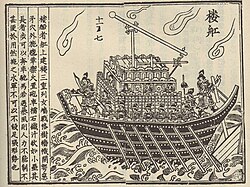 Mangonel on a Song Dynasty warship from the Wujing Zongyao
 -
 12th century depiction of a mangonel (also called a perrier) next to a staff slinger
 -
![Sicilian-Byzantine depiction of a mangonel, 12th–13th century[70]](//upload.wikimedia.org/wikipedia/commons/thumb/c/cf/Byzantine_Trebuchet_Skylintzes.jpg/250px-Byzantine_Trebuchet_Skylintzes.jpg) Sicilian-Byzantine depiction of a mangonel, 12th–13th century[70]
Sicilian-Byzantine depiction of a mangonel, 12th–13th century[70] -
 13th century depiction of a mangonel
 -
 Muslim mangonel, 1285


![Sicilian-Byzantine depiction of a mangonel, 12th–13th century[70]](https://en.wikipedia.org/wiki/File:Byzantine_Trebuchet_Skylintzes.jpg)


See also
[edit]References
[edit]- ^ Purton 2006, p. 79.
- ^ a b c Purton 2009, p. 366.
- ^ Chevedden, Paul E.; et al. (July 1995). "The Trebuchet". Scientific American: 66–71. http://static.sewanee.edu/physics/PHYSICS103/trebuchet.pdf Archived 2015-06-15 at the Wayback Machine. Original version.
- ^ a b Graff 2016, p. 141.
- ^ Purton 2006, p. 80, 89.
- ^ a b Hoad, TF (ed), The Concise Oxford Dictionary of English Etymology (1993), Oxford University Press, ISBN 0-19-283098-8, p. 280a
- ^ Purton 2018, p. 58.
- ^ Konstantin Nossov; Vladimir Golubev. Ancient and Medieval Siege Weapons: A Fully Illustrated Guide to Siege Weapons and Tactics.
- ^ Larry J. Simon; Robert Ignatius Burns; Paul E. Chevedden; Donald J. Kagay; Paul G. Padilla. Iberia and the Mediterranean World the Middle Ages: Studies in Honor of Robert I. Burns, S.J.
- ^ Purton 2009, p. 410.
- ^ Purton 2009, p. 365.
- ^ Purton 2009, p. 411.
- ^ Fulton 2018, p. 449.
- ^ Tarver 1995, p. 165.
- ^ Bradbury 1992, p. 265 "The earliest version of the trebuchet, which worked on the principle of a pivoted beam, that is, the man-powered traction trebuchet, was operated by a crew pulling on ropes, which were attached to the short end of the beam, in other words by using manpower rather than a counterweight. Such machines date back as far as ancient China."
- ^ Chevedden 1995, p. 2 "The trebuchet, invented in China between the fifth and third centuries B.C.E., reached the Mediterranean by the sixth century C.E."
- ^ a b Chevedden 2000, pp. 71, 74. "The traction trebuchet, invented by the Chinese sometime before the fourth century B.C."
- ^ Graff 2016, p. 86 "With regard to stone-throwers, however, China and the Mediterranean world had followed quite different paths of development. Hellenistic and Roman stone-throwers were torsion machines that derived their propulsive power from twisted fibers or sinews, whereas in China, as we have seen, traction-based stone-throwers (or trebuchets) had been employed since ancient times and torsion-based devices are not attested. There has been much debate about whether even the simplest of the torsion machines, the one-armed "onager," remained in use into the early Byzantine period. But the dominant trend was toward convergence, with the Byzantines adopting the traction trebuchet as their new stone-thrower (and possibly as early as 587)."
- ^ Graff 2016, p. 86.
- ^ Liang 2006 "We do however know that the forerunner of the giant catapults of the Medieval era, simple traction catapults based on the lever principle, were already in use during the Warring States period in China in the 5th – 3rd century B.C. Their description appeared in the writings of Mozi, in a Mohist text under a section on Siege Warfare."
- ^ a b c Liang 2006.
- ^ Needham 1994, p. 207–209.
- ^ a b Needham 1994, p. 206.
- ^ Needham 1994, p. 210.
- ^ Needham 1994, pp. 214–215.
- ^ Needham, Joseph (1987). Science and Civilisation in China: Military technology: The Gunpowder Epic, Volume 5, Part 7. Cambridge University Press. p. 166. ISBN 978-0-521-30358-3.
- ^ Franke, Herbert (1994). Denis C. Twitchett; Herbert Franke; John King Fairbank (eds.). The Cambridge History of China: Volume 6, Alien Regimes and Border States, 710–1368. Cambridge University Press. pp. 241–242. ISBN 978-0-521-24331-5.
- ^ Needham 1994, p. 214.
- ^ Needham 1994, p. 212.
- ^ a b c Needham 1994, p. 212-213.
- ^ Needham 1994, p. 212-214.
- ^ a b c d e f Needham 1994, p. 216-217.
- ^ "Murals of the Silk Road – Archaeology Magazine".
- ^ Chevedden 1995, p. 2 "Historians had previously assumed that the diffusion of trebuchets westward from China occurred too late to affect the initial phase of the Islamic conquests, from 624 to 656. Recent work by one of us (Chevedden), however, shows that trebuchets reached the eastern Mediterranean by the late 500s, were known in Arabia and were used with great effect by Islamic armies."
- ^ Graff 2016, p. 141 "Although neither the role of the Avars in the diffusion of the traction trebuchet and many other items of military technology westward across Eurasia nor the connection between the European Avars and the East Asian Rouran can be established with certainty, the fit is nevertheless a good one. The theory of an East Asian origin for at least a key component of the Avar elite is congruent with the evidence for the arrival of East Asian technologies in western Eurasia in the last decades of the sixth century ce."
- ^ Purton 2009, p. 33 "Neither the precise date, then, nor the route of its arrival can be determined with certainty. What is certain is that the only place known to have developed this form of artillery was China. It is equally possible that the Avars (with their origins in Central Asia), the Byzantines, or the Persians could have been the first to learn of and make use of the weapon in the western world."
- ^ Peterson 2013, p. 409.
- ^ Chevedden 1995, p. 2.
- ^ a b Purton 2009, p. 364.
- ^ a b Purton 2009, p. 30.
- ^ Kardaras 2019, p. 176.
- ^ a b Graff 2016, p. 142-144.
- ^ a b Purton 2009, p. 32.
- ^ a b Fulton 2018, p. 16-18.
- ^ Kardaras 2019, p. 178-181.
- ^ Purton 2009, p. 47.
- ^ Graff 2016, p. 86, 144.
- ^ Purton 2009, p. 367.
- ^ Noble 2009, p. 241 n.73.
- ^ Needham 1994, p. 233.
- ^ Purton 2009, p. 291.
- ^ Peterson 2013, p. 275.
- ^ Peterson 2013, p. 421-423.
- ^ Fulton 2018, p. 18.
- ^ Graff 2016, p. 144.
- ^ Peterson 2013, p. 421.
- ^ a b Fulton 2018, p. 24.
- ^ Fulton 2018, p. 22.
- ^ Fulton 2018, p. 22-23.
- ^ Fulton 2018, p. 25.
- ^ Needham 1994, p. 215.
- ^ Purton 2009, p. 29.
- ^ Jasper Becker (2008). City of heavenly tranquility: Beijing in the history of China (illustrated ed.). Oxford University Press. p. 64. ISBN 978-0195309973. Retrieved 2010-10-28.
- ^ Turnbull 2001, p. 33.
- ^ Needham 1994, p. 229.
- ^ Purton 2009, p. 386.
- ^ Fulton 2018, p. 298.
- ^ Fulton 2018, p. 299.
- ^ Fulton 2018, p. 293-295.
- ^ Fulton 2018, p. 420.
Bibliography
[edit]- Bradbury, Jim (1992), The Medieval Siege, The Boydell Press
- Chevedden, Paul E.; et al. (July 1995). "The Trebuchet" (PDF). Scientific American. 273 (1): 66–71. Bibcode:1995SciAm.273a..66C. doi:10.1038/scientificamerican0795-66. Archived from the original (PDF) on 2012-01-11.. Original version.
- Chevedden, Paul E. (2000). "The Invention of the Counterweight Trebuchet: A Study in Cultural Diffusion". Dumbarton Oaks Papers. 54: 71–116. doi:10.2307/1291833. JSTOR 1291833.
- Dennis, George (1998). "Byzantine Heavy Artillery: The Helepolis". Greek, Roman, and Byzantine Studies (39).
- Fulton, Michael S. (2016), Artillery in and around the Latin East
- Fulton, Michael S. (2018), Artillery in the Era of the Crusades
- Graff, David A. (2016), The Eurasian Way of War Military Practice in Seventh-Century China and Byzantium, Routledge
- Gravett, Christopher (1990). Medieval Siege Warfare. Osprey Publishing.
- Hansen, Peter Vemming (April 1992). "Medieval Siege Engines Reconstructed: The Witch with Ropes for Hair". Military Illustrated (47): 15–20.
- Hansen, Peter Vemming (1992). "Experimental Reconstruction of the Medieval Trebuchet". Acta Archaeologica (63): 189–208. Archived from the original on 2007-04-03.
- Huuri, Kalervo (1941). "Zur Geschicte de mitterlalterlichen Geschützwesens aus orientalischen Quellen". Societas Orientalia Fennica, Studia Orientalia. 9 (3): 50–220.
- Jahsman, William E.; MTA Associates (2000). The Counterweighted Trebuchet – an Excellent Example of Applied Retromechanics.
- Jahsman, William E.; MTA Associates (2001). FATAnalysis (PDF).
- Kardaras, Georgios (2019), Byzantium and the Avars, 6th–9th Century AD: Political, Diplomatic and Cultural Relations, Brill
- Archbishop of Thessalonike, John I (1979). Miracula S. Demetrii, ed. P. Lemerle, Les plus anciens recueils des miracles de saint Demitrius et la penetration des slaves dans les Balkans. Centre National de la Recherche Scientifique.
- Liang, Jieming (2006). Chinese Siege Warfare: Mechanical Artillery & Siege Weapons of Antiquity – An Illustrated History.
- Needham, Joseph (2004). Science and Civilization in China. Cambridge University Press. p. 218.
- Needham, Joseph (1986). Science and Civilization in China: Volume 4, Part 2. Taipei: Caves Books, Ltd.
- Needham, Joseph (1994), Science and Civilization in China 5–6
- Nicolle, David (2002), Medieval Siege Weapons 1, Osprey Publishing
- Noble, T. F. X., ed. (2009), Charlemagne and Louis the Pious: The Lives by Einhard, Notker, Ermoldus, Thegan and the Astronomer, Pennsylvania State University Press
- Payne-Gallwey, Sir Ralph (1903). "LVIII The Trebuchet". The Crossbow With a Treatise on the Balista and Catapult of the Ancients and an Appendix on the Catapult, Balista and Turkish Bow (Reprint ed.). pp. 308–315.
- Peterson, Leif Inge Ree (2013), Siege Warfare and Military Organization in the Successor States, Brill
- Purton, Peter (2006), The myth of the mangonel: torsion artillery in the Middle Ages
- Purton, Peter (2009), A History of the Early Medieval Siege c.450–1200, The Boydell Press
- Purton, Peter (2018), The Medieval Military Engineer: From the Roman Empire to the Sixteenth Century
- Saimre, Tanel (2007), Trebuchet – a gravity operated siege engine. A Study in Experimental Archaeology (PDF)
- Schneider, Rudolf (1910). Die Artillerie des Mittelalters. Berlin: Weidmannsche Buchhandlung.
- Siano, Donald B. (November 16, 2013). Trebuchet Mechanics (PDF). Archived from the original on March 3, 2014.
- Al-Tarsusi (1947). Instruction of the masters on the means of deliverance from disasters in wars. Bodleian MS Hunt. 264. ed. Cahen, Claude, "Un traite d'armurerie compose pour Saladin". Bulletin d'etudes orientales 12 [1947–1948]:103–163.
- Tarver, W.T.S. (1995), The Traction Trebuchet: A Reconstruction of an Early Medieval Siege Engine
- Turnbull, Stephen (2001), Siege Weapons of the Far East (1) AD 612–1300, Osprey Publishing
External links
[edit]
- Res Gestae, 4th century, by Ammianus Marcellinus
- Medieval Mechanical Artillery, by the Xenophon Group
- Onager Physics. An analysis of the Onager/Mangonel
Mangonel
View on GrokipediaIntroduction and Terminology
Definition and Classification
The mangonel, commonly identified as a traction trebuchet in modern scholarship, is a type of ancient and medieval siege engine powered by human traction rather than mechanical torsion or counterweights. It consists of a pivoting arm or beam with a sling at one end, where teams of operators pull on ropes attached to the short end of the arm to swing it forcefully, propelling a projectile from the sling on the long end. This design relied on coordinated human effort, typically involving 20 to 100 pullers per machine, to generate the necessary force for launching.[2][1] As a subclass of catapults, the mangonel is distinguished from torsion-based machines such as the ballista, which used twisted skein springs to hurl bolts, and the onager, a single-arm torsion catapult for stones; it also differs from later counterweight trebuchets that employed gravity for greater power and range. The term "mangonel" historically served as a catch-all for traction stone-throwers in medieval contexts, originating from Chinese designs and spreading across Eurasia, though earlier assumptions of it being torsion-powered have been debunked as a scholarly myth unsupported by primary sources.[5][2] Projectiles for the mangonel were primarily elliptical or rounded stones weighing between 1 and 50 kilograms, though incendiary devices like fire pots could also be launched to ignite structures or disrupt defenders. These machines achieved ranges of 80 to 150 meters in historical accounts and reconstructions, with skilled crews demonstrating accuracy sufficient to strike targets within 100 meters, such as wall sections or grouped personnel.[1][6] In siege warfare, the mangonel functioned as a massed artillery piece, deployed in batteries to batter fortifications, create breaches, or demoralize enemy forces through sustained bombardment, offering a reliable alternative to waning Roman torsion technology from the 6th century onward.[2]Etymology
The term "mangonel" originates from the Old French mangonel, a diminutive form of Medieval Latin mangonum or mango, denoting a military engine for hurling stones or projectiles. This Latin term derives from the Greek manganon (or mágganon), meaning "engine of war," "axis of a pulley," or "device," with possible roots in earlier concepts of mechanical contrivance or trickery.[7] The word entered English usage around the mid-13th century, reflecting its adoption in medieval military contexts across Europe.[7] In Byzantine Greek, the mangonel was often referred to as litobolos, literally "stone-thrower," a term emphasizing its function in projecting lithic ammunition and used broadly for various artillery pieces in ancient and medieval warfare.[8] Similarly, the Arabic manjanīq (or manjanik) emerged as a cognate, borrowed from Greek manganiká through Aramaic intermediaries such as Jewish Babylonian Aramaic mangānīqōn and Classical Syriac mangānīqā, and applied to traction-powered siege engines akin to the mangonel, though it later became associated with counterweight trebuchets in Islamic military texts, leading to occasional terminological confusion.[9][8] The evolution of the terminology is evident in early historical texts, where "mangana" (plural of manganon) served as a generic descriptor for siege machinery, encompassing diverse catapult types. Medieval chroniclers, including Anna Komnene in her 12th-century Alexiad, employed mangana to denote traction trebuchets and related devices during Byzantine campaigns, such as the sieges of Dyrrhachium in 1081 and Nicaea in 1097.[8] Early Roman uses of related terms referred to torsion engines, but in medieval contexts, "mangonel" specifically denoted traction-powered trebuchets, distinguishing them from earlier torsion catapults and later counterweight trebuchets that used gravity and counterpoise mechanisms. Linguistic evidence for these terms first appears clearly in Procopius' 6th-century History of the Wars, where mangana describes heavy siege engines like onagers deployed by Goths at Rome, and in Flavius Vegetius Renatus' late 4th-century De Re Militari, which references manganum in discussions of Roman artillery and optimal siege tactics.[8]Design and Operation
Key Components
The mangonel's frame formed the foundational structure, typically built as a wooden A-frame or triangular base measuring 3-4 meters in height to support the pivoting beam and withstand operational stresses, often reinforced with cross-bracing for stability.[1] This design allowed the frame to securely mount the axle and maintain balance during traction pulling.[1] Central to the mangonel was the arm, a rigid yet flexible wooden beam approximately 3-5 meters long, with the shorter end (about one-third the length) fitted for attachment of pulling ropes and the longer end equipped with a sling pouch to cradle and release projectiles.[1] The propulsive force was provided by multiple ropes (typically 3-8) tied to the short arm, pulled by the crew, along with the beam's elastic flexure to store and transfer energy. A release hook, adjustable and made of metal or wood (2.5-8 inches long), held the pulling ropes until firing, and the axle was a dense hardwood shaft with bushings for smooth pivoting.[1] Construction relied on durable materials such as oak, pine, or cedar wood for the frame and arm (laminated for flexibility), manila or hemp ropes for pulling and the sling (40-80 inches extended length with a leather or fabric pouch), and occasional iron for reinforcements or the hook.[1] Size variations distinguished lighter field mangonels, weighing 1-2 tons for portability in campaigns, from heavier siege models up to 3-5 tons, which were more stable but less mobile for prolonged assaults.[10]Firing Mechanism and Principles
The mangonel, recognized as a traction trebuchet in historical scholarship, functions through a human-powered mechanism that leverages coordinated crew effort to propel projectiles. The loading process begins with the crew, typically 12 to 20 individuals for optimal operation, positioning a stone or other missile in a leather sling attached to the end of the long arm of a pivoting wooden beam mounted on an axle.[1] The pullers then synchronize their efforts to haul on multiple ropes affixed to the short arm, drawing it downward against the tension of the ropes and the elastic flexure of the beam itself, thereby storing mechanical energy for release.[4] This process demands physical strength and timing, with roles divided among dedicated pullers, a loader to secure the projectile, and an aimer or releaser to monitor alignment and trigger the mechanism.[1] Upon achieving maximum tension, the firing sequence commences as the releaser disengages a simple hook or latch, allowing the short arm to snap upward under the accumulated force. This rapid pivot drives the long arm forward and downward, whipping the sling through an arc and releasing the projectile at an approximate 45-degree angle to achieve the optimal balance of range and height in its trajectory.[1] The core physics principles involve the conversion of human muscular energy—applied through the ropes—into the kinetic energy of the projectile via the beam's lever action, which amplifies the force multiplier. The resulting path follows a parabolic arc determined by gravitational acceleration and air drag, with the sling's extension enhancing velocity through angular momentum transfer during release.[1] Operational limitations stem primarily from reliance on crew coordination and endurance, as inconsistent pulling could reduce power and accuracy, while the machine's exposure during loading made it vulnerable to enemy archery within 100-150 meters.[1] Reload times average about 15 seconds per shot, enabling rates exceeding four rounds per minute with a well-drilled team, though sustained use fatigued operators and required rotation of personnel.[1] Unlike torsion-based engines, the mangonel exhibited lower weather sensitivity, as its rope-and-wood construction avoided the moisture-induced weakening of sinew skeins, though high humidity could affect rope grip or beam flexure.[11] Maintenance was relatively straightforward, involving rope replacements after repeated use and periodic checks for wood cracking or axle wear, without the complex re-twisting needed for torsion systems.[5] Typical ranges reached 80 to 145 meters, constrained by crew size and projectile weight uniformity for consistent performance.[1]Historical Origins and Development
Early Development in China
The mangonel, known in ancient China as a traction-powered stone-thrower or "po," originated during the Warring States period around the 4th century BCE, evolving from earlier tension-based technologies used in crossbows and siege devices described in military texts such as Sun Tzu's Art of War.[1] This invention marked a significant advancement in siege artillery, leveraging human muscle power through ropes pulled by crews to propel projectiles via a pivoting arm, distinct from the twisted skein torsion of some earlier designs. Key innovations emerged during the Han Dynasty (206 BCE–220 CE), with further refinements to traction mechanisms, as records in the Hou Hanshu (Book of the Later Han) detail "po" devices as effective stone-throwers capable of hurling projectiles up to 100 meters. Construction in China often incorporated lightweight bamboo-reinforced wooden frames, which provided flexibility and reduced weight compared to solid timber, allowing for easier transport and assembly in field conditions.[12] By the Song Dynasty (960–1279 CE), further refinements included the integration of gunpowder-infused projectiles, such as iron-shrapnel bombs launched from catapults, enhancing destructive power against fortifications as documented in the military compendium Wujing Zongyao (1044 CE).[13] Archaeological evidence supports these developments, with artifacts from Han tombs, including model siege engines, indicating widespread production and maintenance techniques for traction artillery.[1] The first recorded mass deployment occurred in 109–108 BCE during Han campaigns against Korean tribes, where "po" throwers were used to breach defenses in the conquest of Gojoseon, as chronicled in the Han Shu. However, by the 13th century, the mangonel's prominence waned in China with the rise of gunpowder-based weapons like cannons and explosive bombs, which offered greater range and lethality during the Mongol-Song conflicts.[14]Spread to the Mediterranean and Europe
The traction trebuchet, known as the mangonel in the West, originated in China during the Warring States period and spread westward across Eurasia, likely facilitated by trade along the Silk Road and interactions with nomadic groups from the 3rd century BCE onward. By the late 6th century CE, the technology reached the Byzantine Empire, probably introduced by the Avars, a steppe people with eastern connections, during their sieges of Byzantine cities. The earliest clear evidence appears in the Miracula Sancti Demetrii, which describes Avar forces employing rope-pulled trebuchets to hurl stones at the walls of Thessalonica in 586 CE, marking the weapon's debut in Mediterranean warfare.[3][15] Byzantine engineers quickly adopted and adapted the mangonel, integrating it into their siege arsenals during conflicts in the post-Justinian era, such as the wars against the Avars and Persians. These early European versions emphasized manpower efficiency, with crews of 50 to 100 pullers launching projectiles up to 50 kg at ranges of 80–120 meters, providing suppressive fire during assaults. The technology then diffused to the Islamic world by the 7th–8th centuries through conquests and cultural exchanges in the Near East, where Umayyad and Abbasid forces employed manjaniqs—Arabic for mangonels—in sieges like those during the Arab-Byzantine wars.[2][8] Islamic engineers under the Abbasid Caliphate refined the design in the 9th–10th centuries, scaling up frames to accommodate larger projectiles, including stones weighing up to 100 kg, and enhancing stability with wheeled mounts for better mobility across desert terrains. These adaptations are detailed in 12th-century Arabic military treatises, such as Mardi ibn Ali al-Tarsusi's Tabsirat arbab al-albab fi kayfiyat al-hurub, composed for Saladin around 1180 CE, which outlines hybrid variants capable of launching incendiary naphtha (a petroleum-based analogue to Greek fire) alongside stones for combined antipersonnel and anti-fortification effects. Al-Tarsusi distinguishes types like the shaytani (demonic) mangonel for heavy bombardment, reflecting innovations in beam length and counterbalance to increase range and accuracy.[8][2] The mangonel's transmission accelerated in the 11th–13th centuries through the Mongol invasions, which carried advanced siege variants—blending Chinese traction designs with Islamic counterweight improvements—into Eastern Europe during campaigns like the 1241–1242 incursions into Hungary and Poland. European adoption was evident in Norman military operations by the mid-11th century, including the conquest of Sicily (1061–1091 CE), where traction trebuchets aided sieges against Muslim fortifications. By the 12th century, mangonels were routinely integrated into European castle defenses, positioned on battlements to repel attackers, as seen in Anglo-Norman fortifications during the Anarchy (1135–1153 CE) and the construction of motte-and-bailey castles with dedicated artillery platforms. This widespread incorporation transformed static defenses into active counter-siege systems, with examples like the mangonels at Dover Castle launching counter-battery fire against besiegers.[2]Independent Inventions Elsewhere
In the Indian subcontinent, evidence suggests the possible independent development of stone-throwing siege engines during the Mauryan Empire around the 3rd century BCE. Ancient texts such as the Arthashastra, attributed to Kautilya, describe mechanical devices termed yantra employed for hurling stones to breach fortifications during sieges, indicating an early form of catapult technology adapted to local warfare needs.[16] These devices were likely used in assaults on walled cities, as noted in accounts of Mauryan military campaigns, though their precise mechanics—potentially involving traction from human pullers or simple levers rather than advanced torsion—are not detailed in surviving sources.[16] Earlier references in Buddhist Nikaya texts from the 5th to 3rd centuries BCE also allude to stone-hurling machines deployed by Magadhan kings like Ajatashatru, predating known Chinese traction designs and supporting the notion of parallel innovation driven by the subcontinent's frequent interstate conflicts and fortified urban centers.[16] Unlike the larger-scale Chinese mangonels, which benefited from abundant animal sinew and wheeled frames for mobility, Indian variants appear to have been constrained by regional material availability, such as limited access to sinew equivalents, resulting in smaller, less mobile constructions suited to infantry-heavy armies.[16] Scholarly debate persists on whether these Indian engines represent true independent invention or subtle influences via overland trade routes, with archaeological evidence from sites like Taxila providing ambiguous remnants of wooden frames but no definitive torsion skeins or counterweights.[17] Proponents of convergence argue that the universal challenges of siege warfare—overcoming walls without direct assault—naturally led to similar lever-based solutions across isolated civilizations, as seen in the evolution from basic slings to mechanical throwers.[17] In regions like Mesoamerica and Sub-Saharan Africa, however, no comparable evidence emerges for torsion or traction catapults during the specified periods. Excavations at Maya sites, such as Chichen Itza (circa 300-900 CE), reveal sophisticated engineering in architecture and tools but lack artifacts or codex depictions of stone launchers, with warfare emphasizing atlatls, slings, and obsidian weapons instead.[18] Similarly, Aksumite chronicles in Ge'ez from the 1st to 7th centuries CE describe defensive tactics involving rolled boulders but no vine-torsion mechanisms or dedicated throwers, reflecting reliance on terrain and infantry over mechanical artillery. These absences highlight how local resource limits and tactical preferences—such as fluid, open-field battles—may have precluded such innovations, underscoring scholarly consensus on Eurasian-centric diffusion rather than widespread independent parallels.[17]Military Use and Applications
Notable Historical Examples
During the Fourth Crusade, the Crusaders deployed a large number of mangonels and petraries in their siege of Constantinople in 1204, with contemporary chronicler Geoffrey de Villehardouin recording that their fleet carried more than 300 such engines for assaults on fortified cities. These traction-powered machines were positioned on land and aboard ships to bombard the city's sea walls and towers, providing critical fire support that helped demoralize defenders and facilitate breaches during the assaults of July 1203 and April 1204. Villehardouin notes that the barons readied their petraries and mangonels on the shore opposite the city, while ships equipped with these engines attacked the towers, contributing to the eventual sack on April 13, 1204.[19] The Mongols used mangonels alongside more advanced counterweight trebuchets during their 13th-century sieges in China, including at Xiangyang from 1268 to 1273, where they launched incendiary projectiles over the walls to set fire to structures and supplies within the city. As recorded in the official Yuan dynasty history, the Yuan Shi, Mongol engineers, aided by Persian and Chinese technicians, employed traction trebuchets for lighter bombardment and suppression, while massive counterweight trebuchets proved decisive in breaking the prolonged Song defense after five years of stalemate. These engines not only inflicted physical damage but also induced psychological terror among the garrison, leading to the surrender of Xiangyang and Fancheng in 1273, opening the Yangtze River region to further Mongol advances.[20][21] During the Third Crusade, at the Siege of Acre in 1191, Richard I of England deployed traction trebuchets, including large mangonels, to bombard the city's walls and towers, coordinating with Saladin's forces' counter-battery fire. These engines hurled stones and incendiaries to weaken defenses and support mining operations, contributing to the city's capture after two years of siege and demonstrating the mangonel's role in Crusader warfare.[22] This capability, combined with the psychological impact of incoming boulders and incendiaries crashing into fortifications, often led to panic and desertions among besieged troops, amplifying the engines' effectiveness beyond mere structural damage.[15]Tactical Roles in Siege Warfare
Mangonels served primarily as light artillery in siege operations, focusing on area bombardment to suppress defenders on walls and within fortifications by hurling stones, incendiary materials, or even diseased carcasses over defensive barriers. This role allowed besiegers to disrupt enemy movements, demoralize garrisons, and create chaos inside the stronghold without direct assault. In addition, mangonels were employed for wall battering through concentrated fire on gates and masonry, gradually weakening structures to facilitate breaches, though their impact was more supportive than decisive against thick stone defenses. Anti-personnel applications were also key, targeting exposed troops with rapid volleys to clear ramparts ahead of infantry advances.[23][4][24] Deployment tactics emphasized massed batteries of multiple mangonels to achieve volume of fire, often positioned 100-200 meters from the target to optimize range while minimizing exposure to short-range counterfire from archers or boiling oil. These engines required crews of typically 8-20 pullers per machine, with total support up to 50 men including loaders for larger variants, deployed in protected earthworks or behind mobile screens to sustain bombardment over hours or days. In practice, such as during Byzantine sieges in the 10th century, commanders coordinated mangonels with supporting archers to maintain pressure on defenders.[4][15][4] The mangonel's advantages included a high rate of fire—up to one shot every 20-60 seconds with a trained crew—surpassing the slower reload times of early counterweight trebuchets, enabling sustained suppression. Its design, relying on human traction rather than complex torsion or weights, allowed construction in weeks using local timber and ropes, making it cost-effective for field armies without specialized engineers. However, limitations were significant: once emplaced, mangonels were immobile and vulnerable to enemy counter-battery fire or sorties, as their wooden frames offered little protection. Crews faced high exposure during reloading and pulling phases, often under arrow fire, leading to casualties that could halt operations.[15][25][4] In medieval European doctrines, mangonels integrated seamlessly with other weapons, providing covering bombardment for sappers undermining walls or infantry scaling with ladders during assault phases. This combined approach, seen in 12th-13th century campaigns, used mangonel fire to pin defenders while engineers and storming parties exploited weakened points, turning isolated engine fire into coordinated offensives.[23][6]Decline and Legacy
Factors Leading to Decline
The introduction of the counterweight trebuchet in the late 12th century marked a pivotal technological shift that contributed to the mangonel's decline, as the new design offered superior range and projectile power without relying on human traction. Unlike the mangonel, which required a crew of typically 12 to 25 individuals to pull ropes and achieve ranges of up to 150 meters with lighter projectiles (1-8 kg), the counterweight trebuchet utilized gravity via heavy suspended weights, enabling launches of 100-300 kg stones over 300-500 meters.[26] This advancement eliminated the need for large pulling crews and provided greater destructive force against fortifications, rendering the labor-intensive mangonel less practical for breaching operations.[26] The advent of gunpowder artillery in 14th-century Europe accelerated the mangonel's obsolescence, as early cannons demonstrated superior penetration and range compared to torsion or traction-based engines. At the Battle of Crécy in 1346, English forces employed primitive gunpowder weapons, which, though limited in range and accuracy, signaled the beginning of a transition where cannons could fire explosive or solid shot to devastating effect against walls by the mid-15th century, as seen in the 1453 Siege of Constantinople. By the early 15th century, mangonels had largely been phased out in European warfare due to these advancements, though logistical challenges further hastened their replacement; the mangonel's ropes and components degraded in humid climates, requiring constant maintenance and skilled crews of 20 or more per operational battery, in contrast to the relatively simpler deployment of gunpowder pieces.[27] Regional variations in decline reflected differing paces of technological adoption, with Europe seeing faster obsolescence by around 1400, while in Asia and the Islamic world, including Ottoman forces, mangonels persisted longer into the 16th century for anti-personnel roles or as improvised weapons. In the Ottoman Empire, traction trebuchets lingered in sieges until the early 1500s, supplemented by gunpowder but valued for their reliability in certain terrains.[8]Influence on Subsequent Artillery
The mangonel's design principles, particularly its use of human traction to propel projectiles over distances for breaching fortifications, directly influenced the evolution of later siege engines, including the counterweight trebuchet that superseded it in the 12th century and early gunpowder-based bombards in the 14th century, where similar wooden frame constructions and elevation mechanisms were adapted for mounting cannons.[28] These adaptations allowed for the transition from mechanical to explosive propulsion while retaining the mangonel's emphasis on indirect fire for area suppression against defenses.[2] Conceptually, the mangonel's legacy extended to the tactical doctrine of massed artillery batteries, a practice refined in 16th-century field guns and echoed in the coordinated barrages of Napoleonic warfare, where volleys targeted enemy formations from covered positions much like medieval siege lines.[28] Parallels persist in modern rocket artillery systems, which employ similar principles of lobbing unguided projectiles for suppressive fire over obstacles, prioritizing volume over precision in contested environments.[2] The mangonel's principles were preserved in archival military treatises, such as 13th-century Arabic manuals like those of Mardi al-Tarsusi, which detailed construction and deployment, influencing later European engineering texts up to the 15th century before gunpowder dominance.[29] Scholarly analyses, including examinations of its cross-cultural adoption, highlight its role in non-Western military traditions, such as Mamluk and Ottoman adaptations that integrated traction mechanisms into hybrid engines.[2] In the 20th century, experimental archaeology revived the mangonel through full-scale reconstructions, such as Peter Vemming Hansen's 1989-1991 builds, which achieved projectile ranges of 100-145 meters with crews of 12-20, validating historical accounts and demonstrating its viability as a rapid-fire siege tool compared to slower torsion catapults.[1] These tests informed modern understandings of medieval ballistics and inspired ongoing historical reenactments by groups like the Company of the Raven, where operational replicas underscore the weapon's tactical flexibility.[30] As a symbol of medieval engineering ingenuity, the mangonel embodies the pre-gunpowder era's innovative approach to mechanical advantage in warfare, with its legacy particularly evident in underrepresented non-Western contexts like Chinese and Islamic innovations that emphasized manpower efficiency over complex counterweights.[2]References
- https://en.wiktionary.org/wiki/%D9%85%D9%86%D8%AC%D9%86%D9%8A%D9%82