


Community hub
Recent from talks
Contribute something
Nothing was collected or created yet.
Maqluba
View on Wikipedia
 | |
| Alternative names | Maaluba, maqlouba, maqlooba, maqloubeh, makluba, maklouba, makloubeh, magluba, maglouba |
|---|---|
| Course | Meal |
| Place of origin | Jordan, Lebanon, Palestine, Syria, Israel, Iraq |
| Region or state | Levant, Mesopotamia |
| Associated cuisine | Levantine (Jordanian, Lebanese, Palestinian, Syrian), Iraqi |
| Serving temperature | Hot |
| Main ingredients | Meat, rice, and vegetables (tomato, cauliflower, potato, eggplant) |
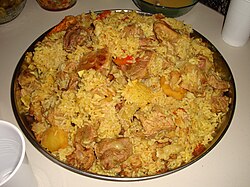
Maqluba (also attested by a variety of other spellings in English; Arabic: مَقْلُوبَة, romanized: maqlūba, lit. 'upside-down') is a traditional Levantine dish, a variety of Pilaf[1] that is popular across Palestine, Jordan, Syria, Lebanon, Israel, and Iraq.[2][3][4][5][6][7][8] It consists of meat, rice, and fried vegetables placed in a pot which is flipped upside down when served, hence the name.[9]
The earliest mention of the dish is found in a 13th-century cookbook, Kitāb al-Ṭabīkh (The Book of Dishes), written by Muhammad Baghdadi during the Abbasid Caliphate.[10]
Ingredients
[edit]
Maqluba can include various vegetables, such as fried tomatoes, potatoes, cauliflower, and eggplant, accompanied by either chicken or lamb.[11] The most common are cauliflower and eggplant. All the ingredients are carefully placed in the pot in layers, so that when the pot is inverted for serving, the dish looks like a layer cake.[9][12]
Maqluba is typically garnished with pine nuts and chopped fresh parsley.[13] It is sometimes served with salad and fresh yogurt, and is often prepared for feasts and large gatherings.
Politics
[edit]The dish has been a matter of controversy in the Israeli–Palestinian conflict, with Palestinians describing attempts to label the dish as Israeli as amounting to cultural appropriation.[14][15] The dish has been used by Palestinian activists to mobilize people to join protests at Al-Aqsa Mosque in the Israeli-occupied East Jerusalem; in 2017, Israeli police arrested a Palestinian woman who had organized a maqluba eating gathering at Al-Aqsa.[16]
Since the unsuccessful coup attempt in Turkey in 2016, which involved the Gülen movement, the dish has been seen as a "Gulenist delicacy" and eating or preparing it has been considered by some as evidence of membership of the movement.[17]
See also
[edit]


References
[edit]- ^ Carty, Elizabeth (September 24, 2012). Shrewd Food: A New Way of Shopping, Cooking and Eating. Hachette Books Ireland. p. 256. ISBN 9781444725780.
- ^ Shaheen (29 January 2020). "Maqluba--The Paella of Palestine". Arab America. Retrieved 2020-07-20.
- ^ Behnke, Alison (2005). Cooking the Middle Eastern way. Ehramjian, Vartkes. Minneapolis: Lerner Publications Co. p. 50. ISBN 0-8225-3288-3. OCLC 59008909.
- ^ Bidoun. "Cooking with Maha Alusi". Bidoun. Retrieved 2019-01-04.
- ^ Timothy L. Gall; Jeneen Hobby (2009). Worldmark Encyclopedia of Cultures and Daily Life. Gale. p. 782. ISBN 978-1-4144-4892-3.
The most traditional Palestinian meals are maqluba, musakhan, and mansaf
- ^ Ottolenghi, Yotam (2015). "Jerusalem on a Plate". Gastronomica: The Journal of Critical Food Studies. 15 (1). University of California Press: 3. doi:10.1525/gfc.2015.15.1.1. ISSN 1529-3262.
Maqluba, an upside-down rice and vegetable cake that is actually Palestinian
- ^ Elizabeth Carty (24 September 2012). Shrewd Food: A New Way of Shopping, Cooking and Eating. Hachette Books Ireland. ISBN 9781444725780.
- ^ Swift, Robert (2016-03-07). "Maqluba - Eating Upside Down". The Media Line. Retrieved 2018-12-11.
- ^ a b Lam, Francis (5 January 2017). "A Middle Eastern Layer Cake for Dinner". The New York Times. Retrieved 13 November 2018.
- ^ "Ramadan recipe: maqluba – upside-down lamb, aubergine and rice". The National. 18 April 2021. Retrieved 29 November 2023.
- ^ "Cooks.com - Recipe - Maqluba (Cauliflower with rice)".
- ^ Linda Gradstein (6 December 2015). "Eucalyptus offers food from the Bible". Jerusalem Post. Retrieved 12 November 2018.
- ^ "Maqlooba (Maqluba), Palestinian Upside Down Rice Recipe". LinsFood | by Azlin Bloor. 2013-07-21. Retrieved 2018-12-04.
- ^ "On the Settler Colonial Elimination of Palestine Get access Arrow". Cornell University Press. 1 December 2020. Retrieved 29 November 2023.
- ^ Alhelou, Yousef (4 November 2018). "Israel's appropriation of Palestinian food". The Arab Weekly.
- ^ "Palestinian national dish fuels Al-Aqsa protests". Almonitor. 11 January 2018. Archived from the original on 2021-05-15. Retrieved 29 November 2023.
- ^ Gauthier-Villars, David (2018-04-17). "U.S. Pastor Held in Turkey Denies Links to Terrorists". Wall Street Journal. ISSN 0099-9660. Retrieved 2020-12-17.
External links
[edit]

Maqluba
View on GrokipediaMaqluba (Arabic: مقلوبة, romanized: maqlūbah, lit. 'upturned') is a traditional one-pot rice dish originating from the Levant region, encompassing modern-day Palestine, Jordan, Syria, and Lebanon. It is also popular and commonly prepared in southern Turkey, especially in the Hatay province (Antakya area), where Levantine culinary influences remain strong.[1][2] It features layers of spiced meat—typically chicken or lamb—fried vegetables such as eggplant, cauliflower, or potatoes, and aromatic rice cooked in broth, which is then inverted onto a platter to reveal a molded presentation.[1][3][4] The dish's name derives from the Arabic word for "upside down," reflecting the dramatic flipping process central to its preparation, a technique that traces back to medieval Baghdad but became emblematic in Levantine culinary traditions.[1] Served on special occasions and gatherings, maqluba symbolizes hospitality and communal feasting, with variations incorporating regional spices like baharat or turmeric for flavor.[2] Its layered composition allows for efficient cooking over a single heat source, making it practical for family meals while yielding a visually striking result.[3]
History and Origins
Etymology and Linguistic Roots
The name maqluba derives from the Arabic term مَقْلُوبَة (maqlūba), the feminine passive participle of the verb قَلَبَ (qalaba), meaning "to turn over" or "to flip."[5] This root, q-l-b, fundamentally conveys inversion or reversal in Classical Arabic, reflecting the dish's preparation method where the cooked pot is inverted onto a serving platter to reveal layered rice, meat, and vegetables in an "upside-down" presentation.[6] The feminine form aligns with Arabic grammatical conventions for naming certain foods and dishes, emphasizing the act of turning as central to its identity. In Levantine dialects, including Palestinian, Jordanian, and Syrian variants, the term retains this core meaning of "upside down," though transliterations vary due to phonetic differences: common English spellings include maqluba, makloubeh, or maqlubeh, influenced by regional pronunciations of the emphatic q sound (rendered as /k/, /g/, or /ʔ/ in spoken forms).[7] The word's usage underscores a semantic link to the culinary technique rather than any pre-Islamic or ancient etymological layer, as no earlier attestations predate the dish's documented Levantine origins in medieval Arabic culinary texts.[8]Earliest Historical References
The earliest documented reference to maqluba is found in the Arabic cookbook Kitāb al-Ṭabīkh (The Book of Dishes), compiled by Muhammad ibn al-Hasan al-Baghdadi in 1226 CE amid the Abbasid Caliphate's cultural flourishing in Baghdad.[9] This text includes a recipe for a dish explicitly named "maqluba," involving sliced red meat layered and inverted for serving, marking the first known written attestation of the preparation method that defines the modern dish.[10] Al-Baghdadi's work draws from earlier culinary traditions but represents a systematic compilation reflecting Abbasid-era sophistication in layered rice and meat dishes.[11] Preceding this by nearly three centuries, Ibn Sayyar al-Warraq's 10th-century Kitāb al-Ṭabīkh—the oldest surviving Arabic cookbook—omits any reference to maqluba or analogous inverted recipes, indicating the dish's formalized emergence likely occurred between the 10th and 13th centuries in Mesopotamian or Levantine contexts.[1] While some Palestinian folklore links maqluba's name to Salah ad-Din (Saladin) after his 1187 CE recapture of Jerusalem, portraying it as a "dish of victory" prepared for troops, no primary historical texts from the Ayyubid era corroborate this, rendering it an unverified tradition rather than evidence of prior existence.[12] These later associations may reflect retrospective cultural attribution rather than chronological origins.Evolution in Levantine and Broader Middle Eastern Contexts
Maqluba traces its Levantine roots to ancient preparations like the Palestinian bathinjaniyya, a simple dish of lamb layered with eggplant sourced from Jericho or Battir villages, reflecting early agrarian practices in the region.[13] In the 12th century, during the Ayyubid dynasty under Salah al-Din, the dish gained symbolic status as a "dish of victory," with its flipping technique inspiring the name maqluba (meaning "upside down") to commemorate military triumphs, such as the liberation of Jerusalem.[13] Spanning centuries across the Levant, maqluba evolved amid trade routes and imperial exchanges, incorporating rice pilaf elements possibly originating from medieval Baghdad in the Abbasid era, where layered meat-and-vegetable casseroles were common.[1] In Palestinian and Jordanian traditions, it remained centered on lamb or chicken with fried eggplant as the historical vegetable base, but adaptations added cauliflower from Hebron, potatoes, carrots, and tomatoes to suit seasonal availability and economic constraints.[13][5] Syrian and Lebanese variants further diversified the dish through subtle spice adjustments and vegetable mixes, influenced by cross-regional migrations and Ottoman-era culinary fusions that emphasized aromatic broths and presentation.[1] Broader Middle Eastern dissemination extended to Iraq, where Persian-influenced biryani techniques blended with Levantine layering, creating denser, spice-forward iterations suited to Mesopotamian tastes.[14] These evolutions underscore maqluba's resilience, transforming from a modest one-pot meal into a versatile staple across diverse ethnic and sectarian communities.[1]Preparation and Core Recipe
Essential Ingredients
The essential ingredients of maqluba consist of layered components including rice, meat, vegetables, and spices, which are assembled in a pot and cooked together to infuse flavors before inversion.[15][16] The rice, typically basmati or short-grain varieties rinsed to remove excess starch, serves as the foundational layer, absorbing broth and spices for a fluffy texture; approximately 2 cups are standard for a serving of 6-8.[15][16] Meat provides the protein base and broth, with chicken thighs (around 3 pounds, skinless and boneless or bone-in) or lamb chops (about 10 pieces) being the most common choices in Levantine preparations, simmered with aromatics like onions and bay leaves to yield a flavorful stock.[15][16][3] Vegetables form structural and textural elements, primarily eggplant (1 medium, sliced into rounds), cauliflower (1 large head or equivalent), potatoes (2 pounds, sliced thinly), and tomatoes (2-3 large, sliced for the base layer to release juices during cooking); these are typically fried or roasted in olive oil to develop caramelization and prevent sogginess.[15][3][16] Spices are integral for the dish's signature warm, aromatic profile, including ground allspice (2 teaspoons), cinnamon (1½ teaspoons), cardamom pods (3-4, crushed), turmeric (¼ teaspoon for color), and often a seven-spice blend incorporating cumin, coriander, and black pepper, alongside salt to taste; these are distributed across the broth, rice, and meat layers.[15][3][16] Additional staples include olive oil (about 11 tablespoons total for roasting and assembly) and the meat-derived broth, which binds the ingredients without additional liquids in traditional recipes.[15][3] Garnishes like toasted almonds or pine nuts are optional and not core to the dish's structure.[16]Step-by-Step Cooking Process
The preparation of maqluba begins with cooking the meat to develop a spiced stock, typically using bone-in chicken thighs or lamb chunks simmered in water with aromatics like bay leaves, cardamom pods, cinnamon sticks, turmeric, and allspice for 30 to 60 minutes until tender.[8][2][15] The meat is then removed and reserved, while the resulting broth is strained and measured for later use, ensuring approximately 4 to 5 cups to match the rice quantity for proper absorption.[17][3] Vegetables such as eggplant, cauliflower, and potatoes are sliced and fried or roasted until lightly browned but not fully cooked, often seasoned with salt and Middle Eastern spice blends like baharat or seven-spice mix to enhance flavor without overpowering the dish.[8][2][17] Basmati rice is rinsed until the water runs clear and soaked in salted water for 30 minutes to 2 hours, then drained and mixed with spices including turmeric, black pepper, and additional seven-spice for even seasoning.[15][2] Layering occurs in a wide, non-stick pot lightly oiled to prevent sticking: start with sliced tomatoes at the bottom to form a base and release moisture during cooking, followed by arranged layers of fried vegetables, the cooked meat pieces, and finally the seasoned rice spread evenly on top without pressing down.[8][17][2] The reserved hot stock, augmented with tomato paste if desired for color and acidity, is poured over the rice until it reaches about 1 centimeter above the surface, then the pot is brought to a boil over medium-high heat for 8 to 10 minutes before reducing to low, covering tightly, and simmering for 30 to 50 minutes until the rice is fully cooked and liquid absorbed.[15][8] After cooking, the pot rests off heat for 10 to 20 minutes to allow steam to settle and layers to set.[17][15] Flipping requires placing a large serving platter over the pot lid, inverting swiftly with both hands while holding firmly, tapping the bottom to loosen, and slowly lifting the pot to reveal the intact, tiered structure with vegetables and meat on top.[8][2] This technique demands a straight-edged, heavy pot for structural integrity during inversion, and success hinges on not disturbing layers prematurely.[18][17]Key Techniques for Flipping and Presentation
The flipping process for maqluba demands precision to preserve the inverted layers of rice, meat, and vegetables without collapse. Immediately after cooking, the pot must rest off the heat for 10-15 minutes, allowing steam to escape and the rice to firm up, which minimizes breakage during inversion.[3][19] A wide, non-stick pot facilitates this by reducing adhesion to the sides.[18]- Platter selection and positioning: Employ a flat, rimless serving platter larger than the pot's mouth to fully cover it and support the weight upon flipping; position it securely atop the pot while the contents remain hot.[20][3]
- Grip and inversion motion: Using thick oven mitts or towels for protection, grasp the pot handles and platter edges firmly with both hands, then execute a swift, confident 180-degree flip in one continuous motion to transfer the maqluba onto the platter without pausing midway.[20][21]
- Post-flip settling: Leave the pot inverted over the platter for 2-5 minutes to let gravity and residual heat settle the layers, followed by gentle side-to-side shakes or pats to loosen any adhered portions before slowly lifting the pot straight upward.[20][5]
Regional Variations
Palestinian and Jordanian Styles
In Palestinian cuisine, Maqluba is characterized by its hearty layering of fried eggplant, cauliflower, potatoes, and sometimes carrots or chickpeas, atop spiced chicken or lamb, covered with aromatic rice infused with bold seasonings such as allspice, cinnamon, black pepper, cardamom, and regional blends like seven-spice or Maqluba spice.[24][25] The dish is cooked in a rich broth until the rice absorbs the flavors, then flipped to reveal a rustic, colorful mound, often garnished with toasted almonds and served alongside plain yogurt or a tomato-cucumber salad for contrast.[24][18] This preparation emphasizes deep, home-style comfort, reflecting resourcefulness in using seasonal vegetables and bold spicing to create aromatic depth, and it holds cultural prominence as a frequent first meal during Ramadan in Palestinian households.[18] Jordanian styles of Maqluba share the core inverted layering technique—typically starting with sliced tomatoes at the base, followed by fried or baked cauliflower, potatoes, and meat like chicken or lamb (with lamb more common in Bedouin-influenced areas)—but prioritize a subtler flavor profile through milder spices including cinnamon, bay leaves, cardamom, and cloves, often with reduced allspice and less oil for fluffier rice and neater presentation.[24][26] The result is an elegant, less oily dish suited to formal family gatherings, influenced by Palestinian culinary traditions yet adapted for a cleaner taste that highlights the natural flavors of ingredients like bone-in chicken thighs simmered in seasoned broth.[24][26] While both variations employ similar proportions—around 2-3 cups of basmati or jasmine rice to 2-6 pounds of meat and an equivalent volume of vegetables—and the signature flip onto a platter for serving, the Palestinian version leans toward robust, fried elements for everyday homeliness, whereas the Jordanian iteration favors refined subtlety, underscoring regional preferences in spice intensity and texture without altering the dish's fundamental one-pot structure.[25][26][18]Syrian, Lebanese, and Iraqi Adaptations
In Syrian cuisine, Maqluba features layers of meat such as lamb or ground beef, fried vegetables including eggplant and cauliflower, and spiced rice, often incorporating allspice, cloves, and coriander for flavor.[27] The dish aligns with broader Levantine traditions but reflects Syrian preferences for robust seasoning and is commonly served as a one-pot meal in family settings.[28] Lebanese adaptations typically use chicken as the protein, combined with a medley of vegetables like cauliflower, eggplant, and potatoes, layered with long-grain rice and cooked until the pot is inverted for presentation.[29] This version emphasizes lighter flavors through the inclusion of multiple vegetable types and is prepared with spices such as the Arabic seven-spice blend, including cinnamon, allspice, and cardamom.[30] In Iraq, Maqluba is traditionally assembled with beef, onions, eggplant, and rice, maintaining the signature upside-down flip after cooking to showcase the layered components.[31] The adaptation highlights beef as a staple protein, with eggplant providing a key textural contrast, and is recognized as a shared Levantine-influenced dish popular alongside Jordanian and Lebanese variants.[32]Israeli Arab and Broader Levantine Interpretations
In Israeli Arab communities, maqluba is prepared as a layered rice dish with meat or chicken, eggplant, cauliflower, and potatoes, fried and assembled in a pot before inversion, mirroring core Levantine techniques but utilizing abundant local olive oil and seasonal Galilee produce for enhanced flavor infusion.[33] This version prevails in urban centers like Nazareth, where it serves as a communal staple during family meals, often garnished with yogurt and pine nuts to complement the spiced broth absorbed by the rice.[34] Among the Druze population in northern Israel, maqluba holds traditional status, typically featuring chicken or beef alongside stuffed vegetables in multi-course home meals that underscore hospitality and shared Levantine roots.[35] Adaptations here may incorporate regional herbs like za'atar for subtle aromatic depth, reflecting the Druze emphasis on hearty, one-pot preparations suited to mountainous terrains.[36] Broader Levantine interpretations within Israel highlight maqluba's pan-regional adaptability, with Israeli Arab cooks occasionally opting for vegetarian renditions substituting meat with chickpeas or extra vegetables to align with rising health-conscious trends, while preserving the upside-down presentation central to its identity.[37] These variations maintain consistency in baharat-spiced rice and broth-soaking methods, distinguishing them minimally from Syrian or Lebanese styles but affirming the dish's enduring role in fostering cultural continuity amid diverse influences.[38]Cultural and Social Significance
Role in Family and Communal Gatherings
Maqluba serves as a centerpiece in Palestinian and Jordanian family gatherings, where its labor-intensive preparation fosters communal participation, often involving multiple household members in layering ingredients and frying vegetables before the dramatic flip. This collaborative process strengthens familial bonds and is typically reserved for special occasions rather than daily meals, emphasizing its role as a shared ritual.[39][40] In broader Levantine contexts, including Syrian and Lebanese variations, the dish features prominently at weddings, Eid al-Fitr celebrations, and reunions, symbolizing abundance and unity through its generous portions that feed large groups. For instance, at Palestinian weddings, maqluba alongside other staples like mansaf underscores cultural continuity and hospitality, even in diaspora settings such as Lebanon. Its presentation—unveiled upside-down to reveal layered rice, meat, and vegetables—creates a theatrical moment that enhances the festive atmosphere and reinforces social ties.[41][42][43] The dish's prominence in these events reflects its adaptation to communal needs in resource-constrained environments, where one-pot efficiency allows for scalable feasts without multiple dishes, promoting inclusivity across socioeconomic lines in Levantine societies.[40][39]Symbolism in Hospitality and Traditions
Maqluba holds profound symbolic value in Levantine hospitality, particularly among Palestinian and Jordanian communities, where it represents karam—the Arabic cultural imperative of generosity and honorable treatment of guests. Preparing and serving this elaborate, layered dish for visitors demonstrates abundance, effort, and communal investment, transforming a meal into an act of profound welcome and respect.[44][39] The dish's preparation, often involving multiple family members, underscores the host's commitment to sharing resources lavishly, a practice rooted in Bedouin and agrarian traditions where food scarcity historically amplified the gesture's significance.[43] In traditions, Maqluba symbolizes familial unity and continuity, frequently featured at lifecycle events such as weddings, circumcisions, and religious holidays like Eid al-Fitr on March 31, 2025 (1446 AH), or Eid al-Adha in June 2025 (1445 AH). The ritualistic flipping of the pot—revealing its intact, dome-shaped form—serves as a communal spectacle that evokes anticipation and collective pride, reinforcing intergenerational bonds as recipes are transmitted orally across households.[40][45] This act mirrors broader Levantine customs of shared labor in cooking, where the successful unveiling signifies harmony and prosperity, much like the layered structure itself represents intertwined social layers.[14] Among Arab communities, the dish's presentation as a centerpiece for gatherings embodies resilience and cultural identity, with its upside-down reveal symbolizing inversion of hardship into celebration—a motif echoed in oral histories of communal feasts during times of scarcity.[46] While not uniquely tied to one rite, its ubiquity in hospitality rituals highlights a pragmatic symbolism: the one-pot efficiency allows hosts to feed large groups without ostentation, prioritizing substance over display in line with traditional values of modesty amid generosity.[18]Economic and Everyday Usage
Maqluba functions as a practical family meal in Levantine households, particularly Palestinian and Jordanian ones, where it is prepared regularly throughout the year, with many families cooking it on Fridays for communal gatherings.[13] Its one-pot preparation allows for efficient use of kitchen resources, yielding a complete dish of rice, vegetables, and protein that serves multiple people.[47] While often associated with occasions like Ramadan iftars, it integrates into routine home cooking due to its simplicity and appeal as a shared platter.[48] Economically, maqluba relies on accessible staples such as basmati rice, seasonal vegetables like eggplant or cauliflower sourced from local areas including Jericho and Hebron, and budget-friendly meats like chicken, rendering it affordable for household budgets.[13][26] Historically in Jerusalem, vendors sold portions for five qurush, underscoring its role as an inexpensive street and home food.[13] This composition supports its viability as a cost-effective meal amid regional economic constraints, though ingredient availability can fluctuate with market conditions.[13]Controversies and Debates
Claims of National Ownership
Palestinians frequently regard maqluba as their national dish, emphasizing its prominence in communal meals and cultural identity, with recipes layered with rice, eggplant, cauliflower, and meat symbolizing layered Palestinian heritage.[17][49] This assertion is echoed in culinary sources that highlight its preparation in Palestinian households, often tied to narratives of resilience and tradition.[50] Jordanian cooks also claim strong ties to maqluba, incorporating it into family recipes with lamb or chicken and local spices, viewing it as a staple of Jordanian-Arab cuisine shared across borders but adapted in Amman and rural areas.[18] Such preparations underscore its everyday role in Jordanian hospitality, without explicit exclusion of neighboring variants.[8] Syrians and Iraqis trace maqluba to broader Levantine and Mesopotamian influences, with historical references suggesting medieval Baghdad origins, predating modern national boundaries and complicating exclusive ownership.[1] These claims invoke shared Arab culinary heritage rather than rivalry, though some Palestinian accounts link the dish's name to Saladin's 1187 conquest of Jerusalem, where it was reportedly served as a "victory dish" by local women.[12] No formal disputes over intellectual property or standardization exist, as the dish's variations reflect regional mobility and Ottoman-era dissemination across the Levant.[51]Accusations of Cultural Appropriation
Some Palestinian activists and commentators have accused Israeli chefs, restaurants, and media of culturally appropriating maqluba by presenting it as part of Israeli national cuisine, thereby erasing its Levantine Arab origins.[52] For instance, in discussions of broader food politics, maqluba is cited alongside dishes like musakhan and knafeh as examples where Israeli branding allegedly transforms Palestinian heritage into "Israeli" fare, particularly through modern adaptations in Tel Aviv eateries or culinary books.[53] These claims intensified around events like the 2023-2024 Gaza conflict, where social media posts highlighted maqluba as a symbol of Palestinian resistance, rejecting Israeli versions as theft.[54] Such accusations often frame the issue within "gastro-colonialism," arguing that Israel's promotion of maqluba—via food festivals, cookbooks, or chains like Zahav—dispossesses Palestinians of intangible cultural assets amid territorial disputes.[55] Proponents, including outlets like Al Jazeera, extend this to a pattern of appropriation affecting hummus, falafel, and za'atar, portraying it as systematic erasure of Palestinian identity. However, these narratives overlook maqluba's pre-1948 prevalence across Jordan, Syria, Lebanon, and Iraq, as well as its adoption by Mizrahi Jews from Arab countries, who comprise over half of Israel's Jewish population and integrate similar rice-based dishes from their heritage.[56] Critics of the appropriation claims, including Israeli commentators, contend that labeling shared Levantine recipes as exclusively Palestinian ignores historical migrations and culinary fusion in the region, where Ottoman-era influences blended across ethnic lines long before modern nation-states.[57] This perspective holds that mutual enjoyment of maqluba in Israeli Arab communities and beyond fosters cultural exchange rather than theft, though tensions persist in politicized contexts like university events or online debates.[58] Empirical evidence from recipe histories shows no single invention date or inventor, with textual references tracing to medieval Arabic cookbooks shared regionally.[59]Broader Implications in Regional Identity Politics
Maqluba's role in regional identity politics underscores the politicization of shared Levantine culinary traditions amid modern nation-state formations and conflicts. Originating from Ottoman-era practices common across the Levant, the dish has been selectively nationalized by Palestinians as a core element of cultural resistance, particularly in response to the Israeli-Palestinian conflict, where food symbolizes attachment to land and heritage under occupation. This framing positions Maqluba not merely as sustenance but as a tool for asserting indigeneity and mobilizing communal solidarity, evident in its deployment during protests at Al-Aqsa Mosque in East Jerusalem, where communal feasts of the dish have accompanied acts of defiance since at least 2017.[60][13] Such assertions have fueled disputes over ownership, with Palestinian narratives rejecting Israeli adaptations—often integrated into Mizrahi or Arab-Israeli cuisines—as appropriation, arguing that the dish's preparation in occupied contexts erodes Palestinian claims to authenticity. For example, instances of Israeli forces cooking Maqluba in Gaza have been highlighted by Palestinian sources as emblematic of cultural erasure, reinforcing binary framings of heritage in the conflict.[53] This dynamic mirrors broader patterns where Levantine foods become proxies for territorial and existential stakes, though empirical evidence traces Maqluba's recipes to pre-1948 shared Arab culinary repertoires across Palestine, Jordan, and Syria, predating rigid national boundaries.[61] In Jordan, home to a substantial Palestinian-descended population exceeding 2 million as of recent estimates, Maqluba delineates ethnic identities within the kingdom's Hashemite framework, contrasting with East Bank staples like mansaf and exacerbating nativist-Palestinian tensions amplified by refugee influxes since 1948 and 1967. These frictions, rooted in demographic shifts and economic disparities, illustrate how cuisine reinforces sub-national loyalties, challenging Jordan's unitary identity amid regional instability.[62][63] Palestinian diaspora communities further amplify Maqluba's symbolism globally, using it in advocacy to sustain narratives of displacement and resilience, though this overlooks the dish's diffusion in Syrian and Lebanese variants, highlighting constructed rather than inherent exclusivity in identity claims.[64]References
- https://en.wiktionary.org/wiki/maqluba